 Donate now
 Get a Call Back
 MENU
MENU 17 MIN READ
 SHARE
SHARE


If you have just received an autism diagnosis for your child—or for yourself—you are likely feeling overwhelmed. In that moment, the only question pounding in your head is how to accept an autism diagnosis.
Today, we will walk you through that very journey. We will share what we have learned, what the research says, and how thousands of families have moved from fear to acceptance.
In this guide, we will explore signs of autism in children, understand autism in kids at different ages, recognise early signs of autism, and demystify autism spectrum disorder. We will also tackle the parent reaction to autism diagnosis, overcome autism diagnosis fear, map out what to do after autism diagnosis, and finally embrace your autism acceptance journey.
First Step on Your Autism Acceptance Journey
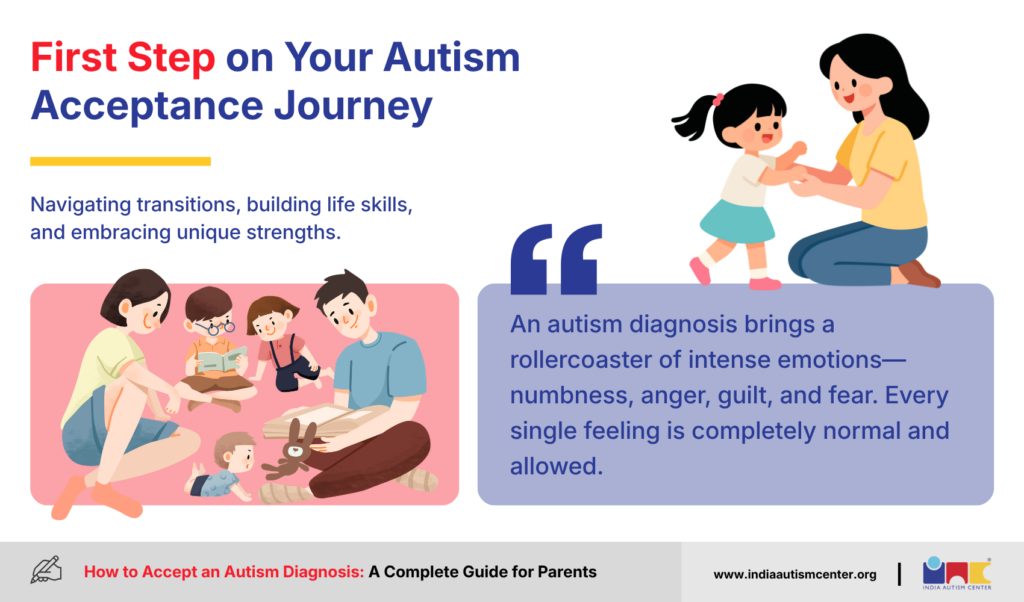
When you first learn about an autism diagnosis, your emotions may swing wildly. One minute, you feel numb. The next minute, you cry. Then you feel angry. Then guilty. Then scared again. Let me normalise all of this for you. Every single feeling is allowed.
Why Denial Is a Natural First Response
Denial is your brain’s way of buying time. You might think, “The doctor must be wrong,” or “He will grow out of it.” I felt that way too. Denial is not weakness; it is a temporary shield. However, staying in denial prevents you from getting the support your child needs. So acknowledge the denial, but then gently set it aside.
Role of Grief in Accepting an Autism Diagnosis
Grief is another common part of how to accept autism diagnosis. You grieve the child you imagined. You grieve the parenting experience you expected. You might even grieve your own future plans if you are an autistic adult receiving a late diagnosis. Let yourself grieve. Cry in the car. Write in a journal. Talk to a trusted friend. Grief has no timeline, but it does have a purpose: it clears the way for acceptance.
Letting Go of Guilt and Self-Blame
Many parents ask me, “Did I cause this?” Let me answer clearly: No. Autism spectrum disorder is not caused by what you ate during pregnancy, how you parented, or any vaccine. Science confirms that autism is largely genetic and neurological. So release that guilt immediately. Instead of blaming yourself, channel that energy into learning.
📥 Free download: Printable daily routine chart for autistic children
What Is Autism Spectrum Disorder?
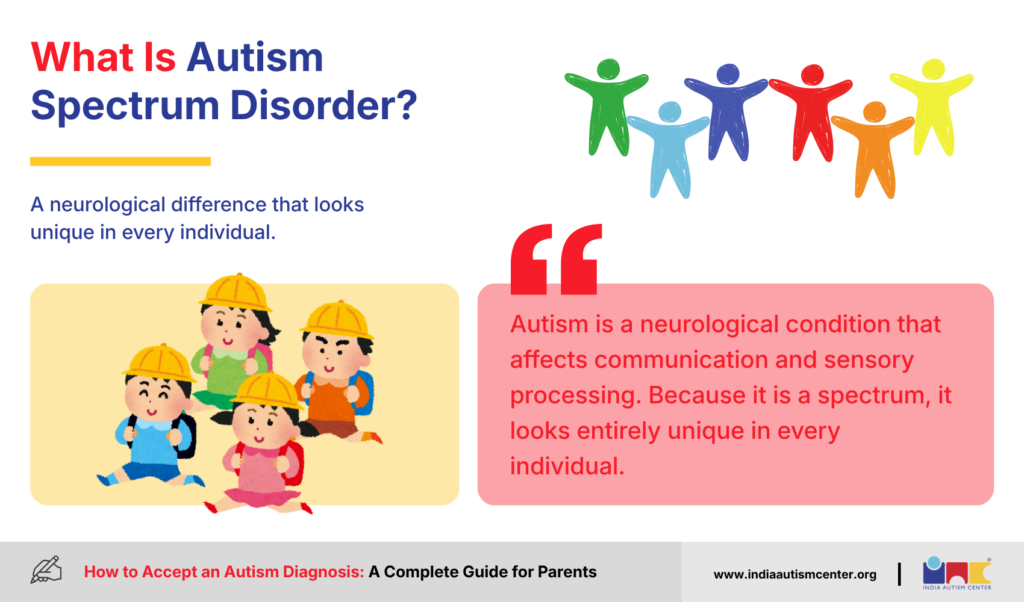
Before you can truly accept, you need accurate information. Autism spectrum disorder (ASD) is a neurodevelopmental condition. That means the brain is wired differently from birth. It affects communication, social interaction, sensory processing, and behavior patterns.
The word “spectrum” is crucial. Autism in kids and adults looks different for every person. Some autistic individuals speak fluently but struggle with social cues. Others are nonspeaking but communicate using devices. Some have intense sensory sensitivities; others seek sensory input. Some need significant daily support; others live independently.
If you want to know more about Autism in more detail, refer to Autism full guide.
Common Myths About Autism Diagnosis
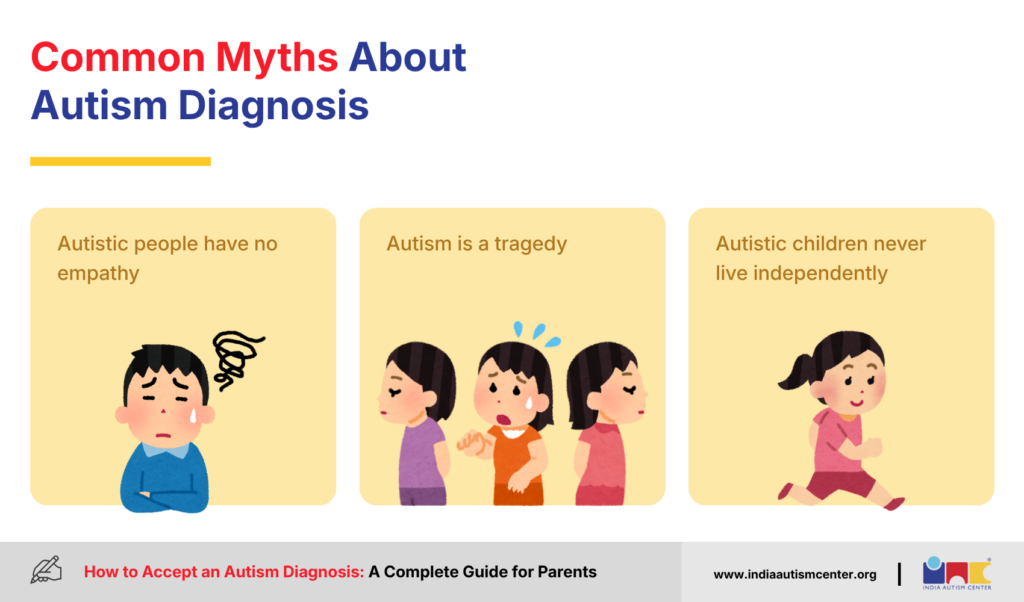
Much of your autism diagnosis fear comes from myths. Let me bust three big ones right now:
1. Myth: Autistic people have no empathy.
Fact: Many autistic people have deep empathy but express it differently. They may not show it with facial expressions, but they feel others’ pain
profoundly.
2. Myth: Autism is a tragedy.
Fact: Autism is a different way of being human. Many autistic adults report that they would not want to be “cured.”
3. Myth: Autistic children never live independently.
Fact: Many do. With the right support and skills training, autistic adults hold jobs, maintain relationships, and live on their own.
Recognising Strengths in Autism Spectrum Disorder
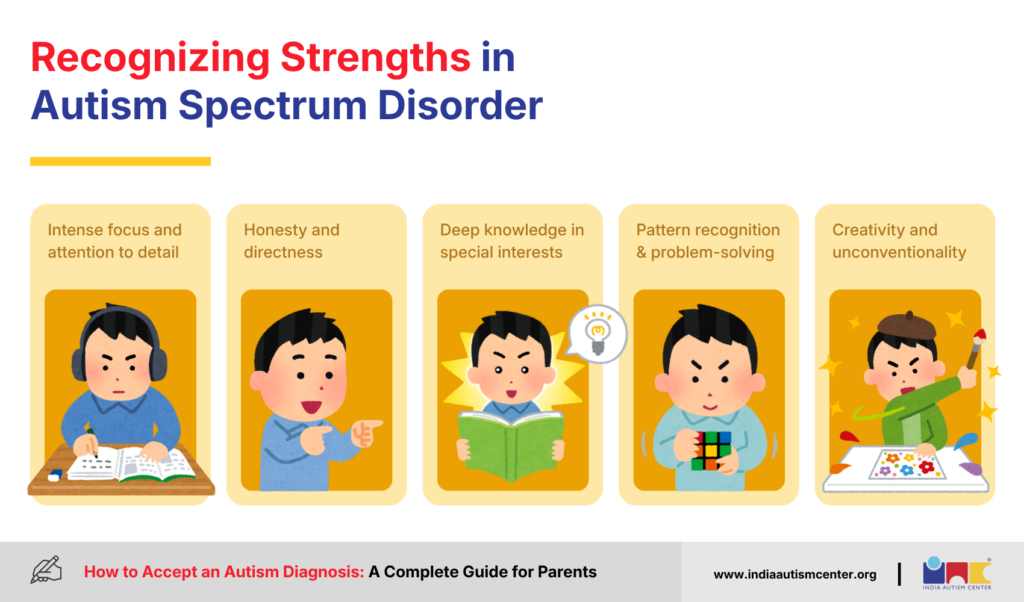
When you focus only on challenges, how to accept autism diagnosis feels impossible. But let me shift your perspective. People with autism spectrum disorder often have remarkable strengths:
- Intense focus and attention to detail
- Honesty and directness
- Deep knowledge in special interests
- Pattern recognition and logical problem-solving
- Creativity and unconventional thinking
We have worked with autistic children who could memorise entire train schedules. We know autistic adults whose coding abilities made them irreplaceable at work. These are not exceptions; they are common outcomes when autism is supported, not suppressed.
Early Signs of Autism in Children: What to Look For at Every Stage
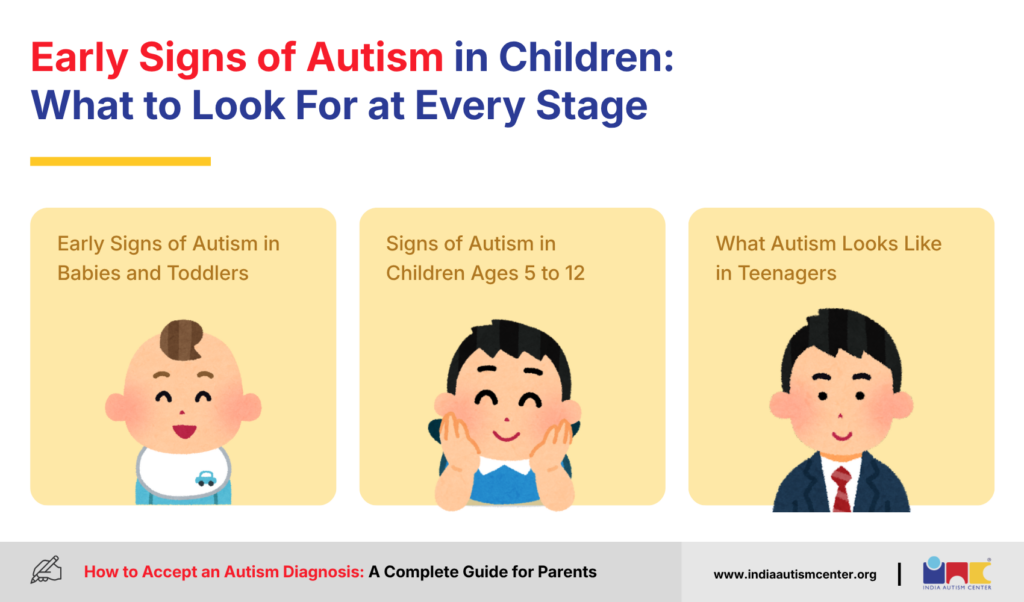
You may have noticed differences in your child long before the official autism diagnosis. Recognising early signs of autism is actually a gift because it leads to early support.
Early Signs of Autism in Babies and Toddlers
Most parents notice early signs of autism between 12 and 24 months. Typical signs of autism in children under two include:
- Not responding to their name by 12 months
- No babbling, pointing, or waving by 12 months
- No single words by 16 months
- No two-word phrases by 24 months
- Losing speech or social skills they once had
- Avoiding eye contact consistently
- Not showing interest in other children
- Unusual repetitive movements (hand-flapping, rocking, spinning)
- Extreme reactions to sounds, textures, or lights
If you saw these early signs of autism and sought an evaluation, you did exactly the right thing. Early identification leads to early intervention, which dramatically improves outcomes.
Signs of Autism in Children Ages 5 to 12
Autism in kids of elementary school age may look different. You might notice:
- Difficulty understanding sarcasm, jokes, or figurative language
- Taking everything literally (e.g., “It’s raining cats and dogs” causes confusion)
- Trouble making or keeping friends
- Intense, narrow interests (only talking about dinosaurs, space, or video games)
- Extreme distress over small changes in routine
- Difficulty with abstract concepts like time or money
- Sensory aversions to certain clothing, foods, or noises
- Meltdowns that look like tantrums but are actually sensory overload
Again, none of these traits are “bad.” They simply mean your child needs a different teaching and parenting approach.
What Autism Looks Like in Teenagers
Autism in kids who become teenagers presents unique challenges. Social expectations increase, and differences become more obvious. You may see:
- Social anxiety or avoidance of peers
- Difficulty with dating or subtle social rules
- Intense adherence to routines and rituals
- Burnout from masking (pretending to be neurotypical)
- Depression or anxiety as a result of feeling “different”
Recognising autism in kids at this stage still allows for support like social skills groups, therapy, and school accommodations.
We have a detailed blog on Signs of Autism in Newborns: Early Symptoms Explained.
Parent Reaction to Autism Diagnosis – From Shock to Strength
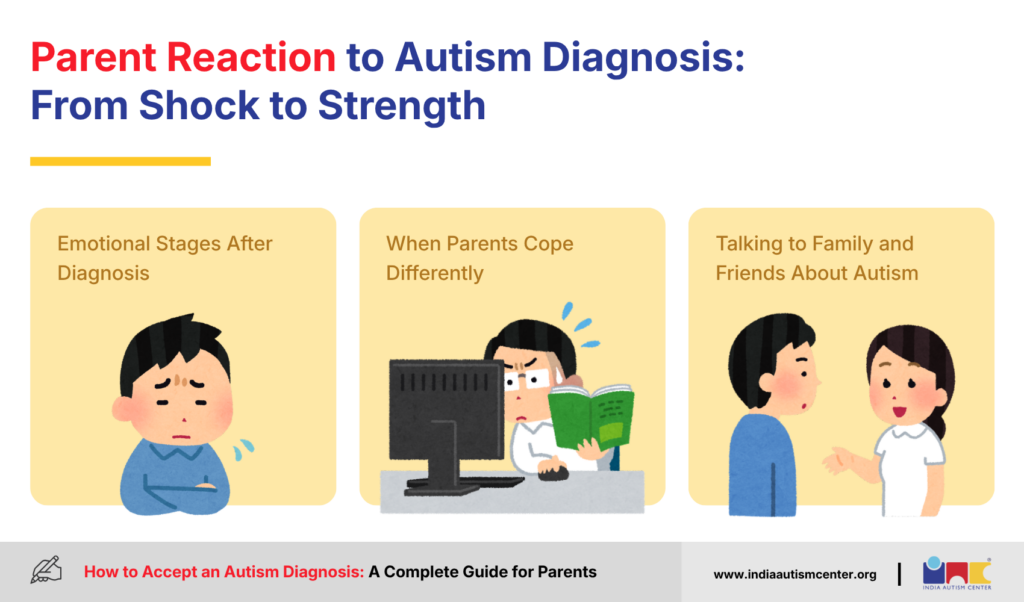
Let me speak directly to parents now. Your reaction to autism diagnosis will evolve over time.
Emotional Stages After Diagnosis
Many parents go through stages similar to grief, though not in a straight line:
- Denial – “Maybe he will outgrow it.”
- Anger – “Why us? Why not that family down the street?”
- Bargaining – “If I try this diet or that therapy, will he become normal?”
- Depression – “Our lives are ruined forever.”
- Acceptance – “He is autistic, and we can handle this.”
You will not move through these stages neatly. One day, you feel acceptance; the next day, anger returns. That is fine. Be patient with yourself. The goal is not to skip emotions but to process them.
When Parents Cope Differently
Your reaction to autism diagnosis might not match your partner’s. One of you may dive into research and action. The other may shut down emotionally. One may cry; the other may crack jokes. Neither is wrong. You are two different people coping in your own ways.
Therefore, communicate openly. Say, “I am really struggling today. Can we just sit together?” Do not judge each other’s coping mechanisms. If you disagree on treatments or therapies, seek a neutral third party like a family therapist.
Talking to Family and Friends About Autism
After the autism diagnosis, you will eventually tell siblings, and friends, etc. Prepare yourself for mixed reactions. Some will offer unconditional support. Others will say ignorant things like, “But he looks normal,” or “Have you tried punishing him more?”
Here is my advice: You do not need to educate everyone immediately. Start with the people who matter most. Send them a simple message: “We have learned that our child is autistic. That means his brain works differently. We are learning how to support him. In the meantime, we need your love and patience.
Want to know more? Get in touch with us.
Overcoming Autism Diagnosis Fear – Why You Feel This Way and How to Move Forward
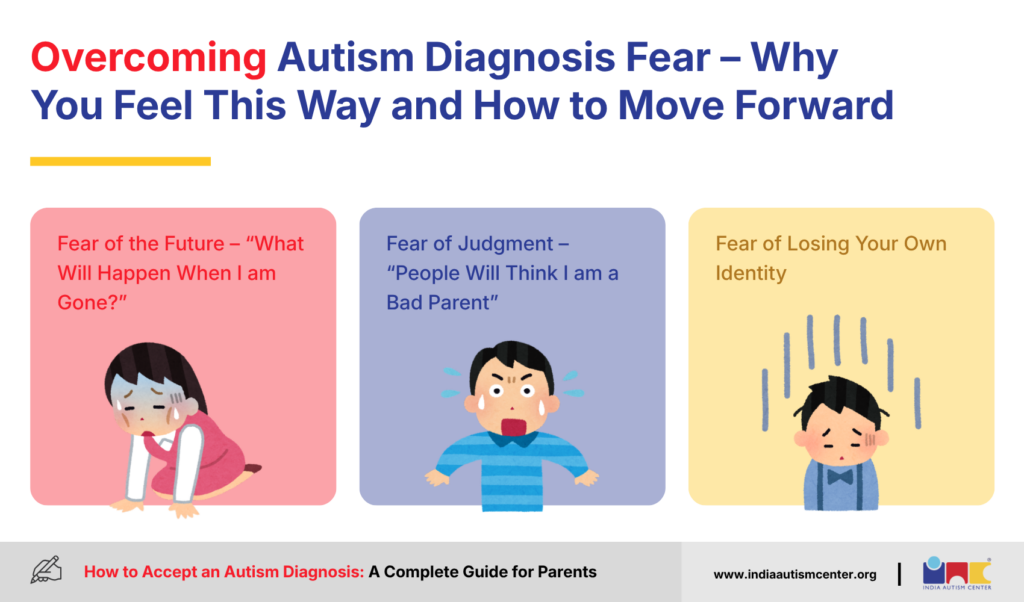
Autism diagnosis fear is real, and it does not make you a bad parent or a weak person. Fear is your brain’s way of protecting you from threats. But here is the truth: many of those threats are based on outdated information.
Fear of the Future – “What Will Happen When I Am Gone?”
This is the most common fear we hear. Parents worry, “Who will love my autistic child when I die?” That question haunts you at 3 a.m. I understand completely.
Let me offer you a different perspective. First, you have decades to build a support network. You can teach your child self-advocacy skills. You can connect with adult services, supported living programs, and vocational training. Many autistic adults live independently or semi-independently. Second, your child may surprise you. I know autistic individuals who graduated college, got married, and built meaningful careers. Do not write off a future you cannot predict.
Fear of Judgment – “People Will Think I Am a Bad Parent”
Yes, some people will stare if your autistic child has a meltdown in the grocery store. Some relatives will imply that better discipline would “fix” your child. That hurts. But let me ask you: Do those people know more than the developmental pediatrician who gave the autism diagnosis? Do they understand neurology? Of course not.
You are not a bad parent. You are a parent who shows up every day for a child with extra needs. That makes you dedicated, not defective.
Fear of Losing Your Own Identity
Parents of autistic children often feel consumed by therapies, appointments, and advocacy. You might fear losing your career, your hobbies, or your friendships. That fear is legitimate. Therefore, part of how to accept an autism diagnosis is learning to carve out time for yourself. You cannot pour from an empty cup. Schedule one hour per week for something just for you. Hire a respite caregiver if possible. Ask family to babysit. Your child needs a healthy parent, not a perfect martyr.
Practical Ways to Reduce Autism Diagnosis Fear
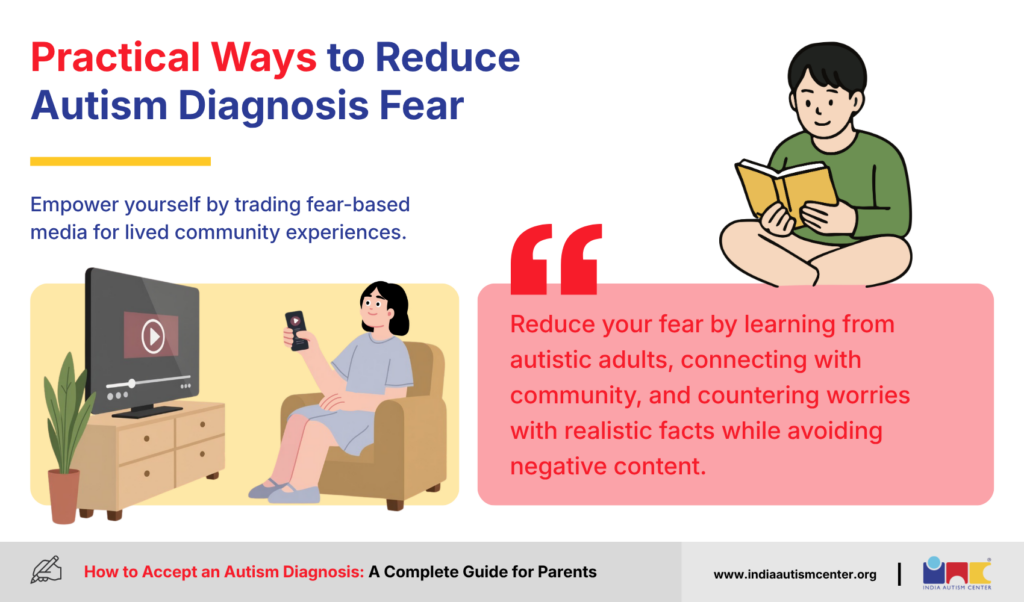
Here are actionable steps to lower your fear:
- Educate yourself from autistic adults, not just doctors. Follow @indiaautismcenter on YouTube and other platforms.
- Connect with other parents who have been through this. Their lived experience will calm your worries.
- Write down your fears and then write a realistic counterpoint. For example: “Fear – My child will never speak.” “Reality – Many nonspeaking autistic people communicate with devices or typing.”
- Limit exposure to fear-based content. Avoid websites that use words like “epidemic,” “suffering,” or “cure.”
What to Do After Autism Diagnosis – A Practical Roadmap
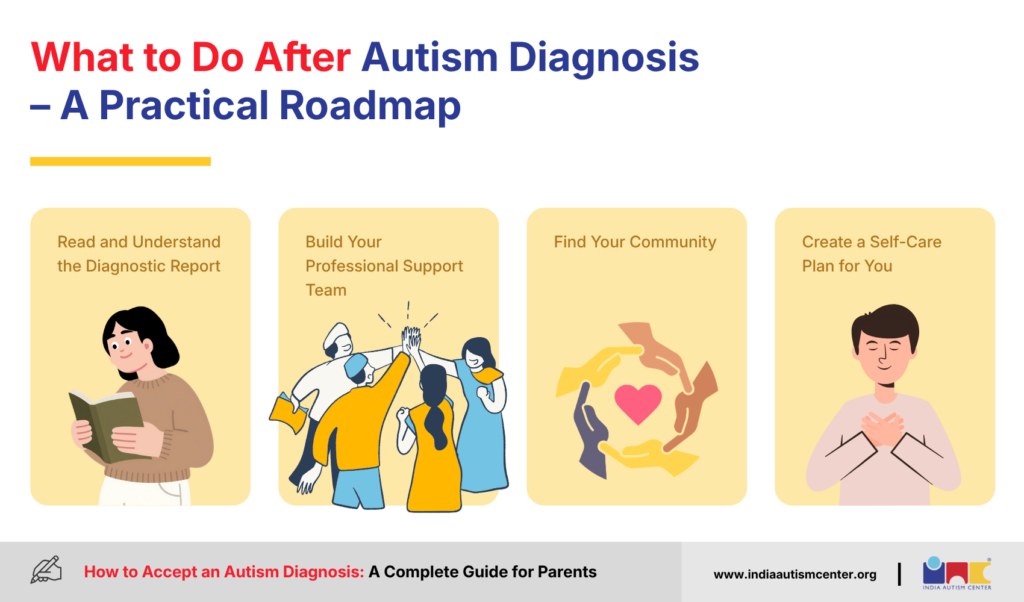
You have asked “what to do after autism diagnosis” a hundred times in your head. Now let me give you a clear, step-by-step action plan.
Step 1 – Read and Understand the Diagnostic Report
Your diagnostician gave you a written report. Read it carefully. It will describe your child’s strengths and challenges. It may mention specific levels of support (Level 1, 2, or 3). It may list recommendations for therapies. If anything confuses you, contact the clinician for clarification. You have the right to understand every word.
You can read about Levels of Autism Explained here.
Step 2 – Build Your Professional Support Team
What to do after autism diagnosis includes assembling the right professionals:
- Developmental pediatrician – coordinates overall medical care
- Speech-language pathologist – helps with communication (verbal and nonverbal)
- Occupational therapist – addresses sensory processing, fine motor skills, and daily living skills
- Behavior analyst (BCBA) – works on skill-building and reducing challenging behaviors (if needed)
- Child psychologist – supports emotional regulation and family coping
Step 3 – Find Your Community
You need people who have walked this path. Search for “autism parent support group” in your area or on Facebook. These groups are goldmines of practical advice: which therapists are great, how to navigate insurance, and which schools are inclusive. More importantly, they provide emotional validation. When you post, “My child had a meltdown because I cut his sandwich wrong,” and twenty parents reply, “Same,” you will feel less alone.
Step 4 – Create a Self-Care Plan for You
We cannot stress this enough. What to do after autism diagnosis includes taking care of yourself. Exercise, sleep, therapy, date nights, hobbies—these are not luxuries. They are necessities. You will be a better advocate when you are not exhausted and resentful.
Write down three self-care activities you can do this week. Maybe it is a 15-minute walk. Maybe it is calling a friend. Maybe it is reading a novel for 20 minutes before bed. Schedule them into your calendar like appointments.
Want to know more? Get in touch with us.
Accepting Your Autism Acceptance Journey
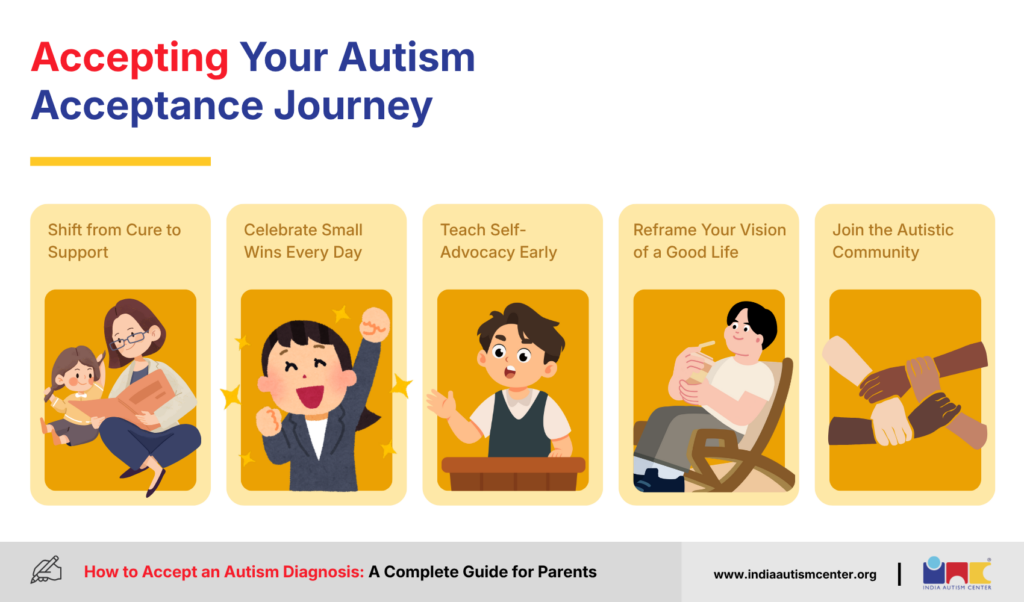
The autism acceptance journey does not end with a single decision. It is a lifelong practice of shifting your mindset. Here are strategies that will help you and your family thrive.
Shift from Cure to Support
Early in this journey, people spent thousands of dollars on therapies that promised to “recover” my child from autism. They wasted time, money, and emotional energy. Then they learned about the neurodiversity movement. Instead of trying to erase autistic traits, they started supporting them.
One parent bought noise-cancelling headphones for his son. He let him stim (hand-flap) without scolding him. He stopped forcing eye contact. Guess what? He became happier and less anxious. And so did we. That is the core of how to accept autism diagnosis – working with autism, not against it.
Celebrate Small Wins Every Day
In the world of autism in kids, progress happens in millimetres, not miles. Therefore, celebrate everything. Your child made eye contact for one second? Celebrate. They used one word instead of crying? Celebrate. They tolerated brushing their teeth for ten seconds? Big celebration. This positivity fuels motivation for both of you.
Teach Self-Advocacy Early
Even young autistic children can learn to say, “Too loud,” or “Need break.” As they grow, teach them to explain their needs to teachers, bosses, and friends. Self-advocacy is the single most important skill for a happy autistic life. Your child does not need to learn to act “normal.” They need to learn to ask for what they need.
Reframe Your Vision of a Good Life
Society tells us that success means a big house, a high salary, and dozens of friends. But for many autistic individuals, success means a quiet morning routine, a job that matches their strengths, and one or two close friends. That is not a lesser life. It is a different life. Let go of the script you were given and write a new one.
Join the Autistic Community
The best way to accept autism spectrum disorder is to listen to autistic adults. They will tell you what helped them and what harmed them. Many reject person-first language (“person with autism”) in favour of identity-first language (“autistic person”). They explain that autism is not a puzzle to be solved but an identity to be honoured. Seek out their voices on YouTube, blogs, and conferences.
A Special Note for Adults Receiving a Late Autism Diagnosis
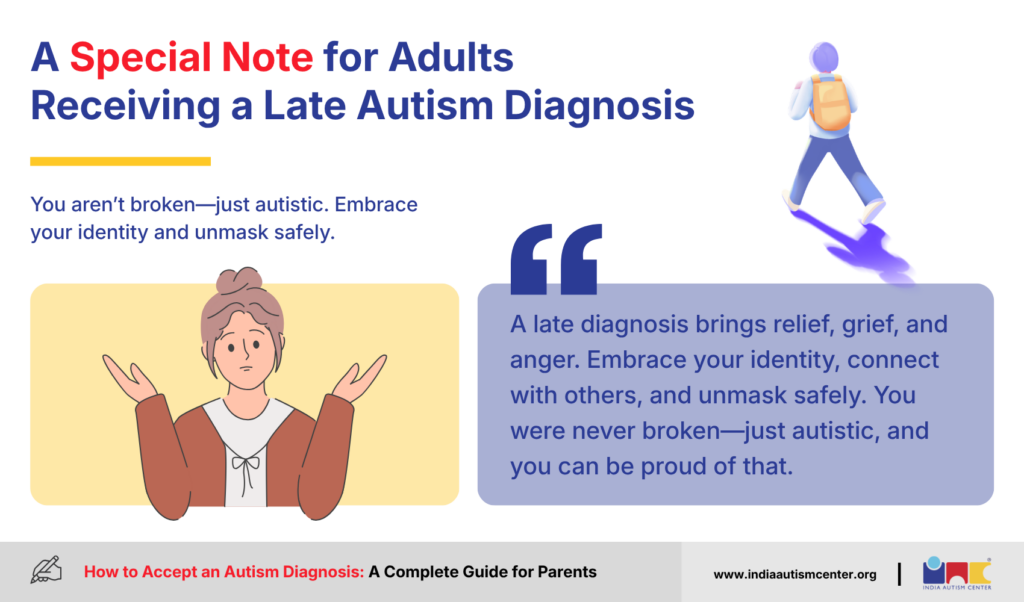
Perhaps you are not a parent. Perhaps you are an adult who just received an autism diagnosis after years of feeling “different.” You struggled socially. You burned out from masking. You always felt like an alien pretending to be human. And now, finally, you have an answer.
Your autism acceptance journey will have its own flavour. You may feel relief – finally, an explanation. You may also feel grief for the years you lost without support. You may feel anger at therapists or parents who missed the early signs of autism in you.
Let yourself feel all of it. Then, embrace your autistic identity. Connect with other late-diagnosed adults. Unmask slowly and safely. Redesign your life to accommodate your sensory and social needs. You are not broken. You were never broken. You are simply autistic, and that is more than okay – it is something to be proud of.
📥 Free download: Printable daily routine chart for autistic children
Conclusion
Learning how to accept an autism diagnosis is not a one-time event. It is a winding road with hills and valleys. Some days you will feel at peace. Other days, the old fears will resurface. That is human.
But I promise you this: the autism acceptance journey is worth every tear. On the other side of denial is understanding. On the other side of fear is advocacy. On the other side of grief is joy – real, authentic joy that comes from seeing your autistic child smile, or feeling the relief of finally understanding yourself.
You have already taken the bravest step: you sought answers. Now, use the information in this guide. Acknowledge your parent reaction to autism diagnosis without shame. Overcome autism diagnosis fear by replacing myths with facts. Follow the practical steps of what to do after autism diagnosis. Learn the signs of autism in children to help others who may be wondering. Recognize early signs of autism so no child falls through the cracks. Celebrate autism in kids as a beautiful form of human diversity. And most importantly, be gentle with yourself.
You are not alone. Millions of families and individuals have walked this path before you. They have found peace, purpose, and even celebration. So will you. One day at a time. One breath at a time.
Frequently Asked Questions (FAQs)
How long does it take to accept an autism diagnosis?
There is no set timeline. Some parents accept within weeks. Others take years. The key is not to rush yourself. Every person’s autism acceptance journey is unique.
Is it normal to still have bad days after accepting?
Absolutely. Acceptance is not a permanent state of happiness. It means you have stopped fighting reality. But you will still have hard days. That is normal. On those days, revisit the practical steps in this guide.
What if my partner never accepts the diagnosis?
Some partners stay in denial for years. You cannot force acceptance. However, you can lead by example. Continue to seek support and interventions. Eventually, when your partner sees progress and your child’s happiness, they may come around. If not, consider couples counselling with a therapist who understands autism spectrum disorder.
Can I accept the diagnosis and still wish my child were not autistic?
Yes. Many parents feel both acceptance and sadness at the same time. That is called “ambiguous loss.” You can love your autistic child fully while grieving the neurotypical child you once imagined. Both emotions are valid.
Disclaimer: This article is intended for educational and informational purposes only. It is not a substitute for professional medical advice, diagnosis, or treatment. If you are pregnant or have concerns about medication use during pregnancy, please consult a qualified healthcare provider. If your child has received an autism diagnosis and you have questions about causes or support, please reach out to a trained specialist or an autism-focused organisation for guidance.
For expert insights, support services, and inclusive learning initiatives, visit the India Autism Center.