 Donate now
 Get a Call Back
 MENU
MENU 11 MIN READ
 SHARE
SHARE


Ever felt like social situations come with a complex unwritten rulebook that everyone else seems to understand except you?
Many adults who discover they are on the spectrum later in their lives mention feeling this way for years. Such individuals tend to excel in their careers, have deep knowledge in specific areas, and also lead independent lives, yet still struggle with communication, relationships, or adapting to change. Understanding what Asperger’s syndrome is can help explain these lifelong experiences.
Reports suggest that about 1 in 200 people have Asperger’s Syndrome globally. Although Asperger’s syndrome is now included under Autism Spectrum Disorder (ASD), the term is widely used to describe people with average or above-average intelligence who often experience social as well as behavioural differences.
This article explores the ten most common signs of Asperger’s syndrome in adults, discusses its causes, explains how common it is, and provides a practical guide to dealing with it effectively.
What is Asperger Syndrome?
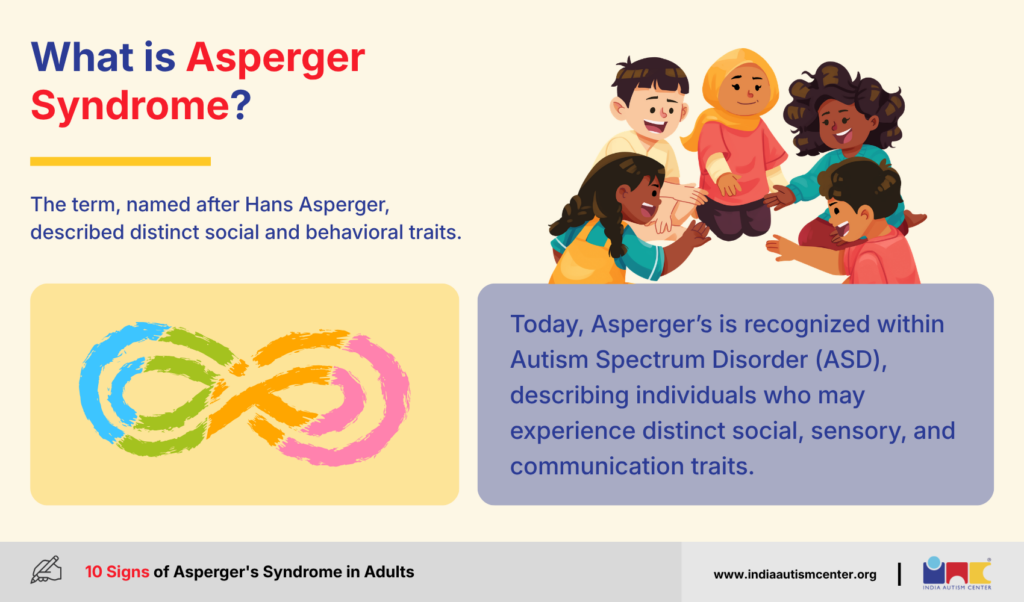
To truly grasp what Asperger’s syndrome is, it helps to look at how medical perspectives have evolved.
Named after the Austrian paediatrician Hans Asperger, the term was formally introduced to the medical world to describe individuals who displayed distinct patterns of social interaction and intense interests, but possessed average to above-average intelligence and typical language development during early childhood.
When it comes to modern clinical practice, the separate label of Asperger’s Syndrome has been integrated into Autism Spectrum Disorder. This change helps individuals to receive holistic, tiered care according to their specific support needs.
When we talk about Asperger’s in adults today, we are talking about high-functioning individuals on the autism spectrum.
These adults often graduate from universities, hold demanding professional jobs, and build families, yet they simultaneously experience persistent differences in social communication, sensory processing, and executive functioning.
📥 Free download: Printable daily routine chart for autistic children
How Common is Asperger Syndrome?
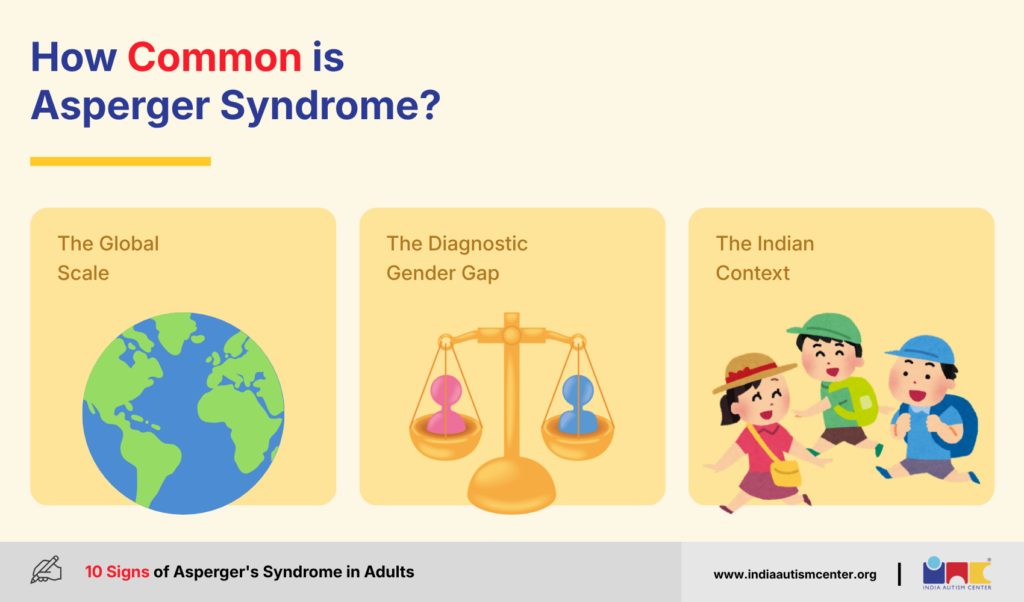
When wondering how common Asperger’s Syndrome is, it is vital to recognise that accurate adult statistics can be challenging to isolate because historical data primarily focused on children.
However, looking at the wider prevalence of autism spectrum conditions gives us a clear picture of how widespread this neurodivergent profile really is.
- The Global Scale: As per reports, the median global prevalence of autism spectrum disorder sits at approximately 1% of the population.
- The Diagnostic Gender Gap: Statistically, autism is diagnosed roughly 4 times more frequently in males than in females. Women with high-functioning autism or Asperger traits are exceptionally skilled when it comes to social masking. They consciously mimic social behaviours to fit in, so thousands of adult women remain undiagnosed.
- The Indian Context: With an estimated 1 in 65 children in India navigating life on the spectrum, adult neurodiversity impacts millions of households across urban and rural sectors alike.
Because screening tools were virtually non-existent in school systems a few decades ago, the vast majority of Indian adults with this profile are either misdiagnosed with generalised anxiety, OCD, or personality disorders, or they carry the heavy, inaccurate label of being eccentric, introverted, or socially awkward.
10 Signs of Asperger’s Syndrome in Adults
Every individual is unique, and it is important to note that no two autistic adults experience the condition in the same way. However, several signs appear consistently across many adults who identify with Asperger’s syndrome.
1. Difficulty Understanding Social Cues
One of the common signs is that adults with Asperger’s find it difficult to interpret social communication. Adults with Asperger’s syndrome may:
- Struggle to read facial expressions
- Misinterpret body language
- Have difficulty understanding sarcasm
- Miss subtle social hints
- Find group conversations exhausting or confusing
For example, they sometimes do not even realise when someone is bored, uncomfortable, or joking. Such challenges eventually lead to misunderstandings, even if they have good intentions.
2. Challenges Building and Maintaining Relationships
Relationships often require understanding unspoken social expectations. Adults with Asperger’s syndrome often:
- Have a small social circle
- Forming friendships becomes difficult
- Feel disconnected during social gatherings
- Struggle with dating and romantic relationships
- Prefer solitary activities
It does not imply that they do not value relationships. There are several people with Asperger’s who want to have deep and meaningful connections but find the social demands exhausting or confusing. Research consistently shows that social communication difficulties are among the most significant challenges reported by autistic adults.
3. Deep, Hyper-Focused Special Interests
One of the defining characteristics of high-functioning autism is the development of intense, specialised interests. While anyone can have a hobby, an individual on the spectrum will dive into a topic with deep, encyclopedic focus.
Whether it is structural engineering, railway transit maps, coding, historical periods, or specific sub-genres of art, they collect exhaustive amounts of data and find immense joy and comfort in mastering every minor detail of their chosen subject.
The obsession can be various subjects or interests like trains, technology, history, mathematics, astronomy, music, or animals.
4. Preference for Routine and Predictability
Many adults with Asperger’s syndrome thrive on structure. Common behaviours include:
- Following daily routines closely
- Feeling uncomfortable with unexpected changes
- Planning activities carefully
- Becoming stressed when schedules change suddenly
Predictability helps reduce anxiety as well as creates a sense of control. For example, a sudden change in work schedule may cause significant distress even when it appears minor to others.
5. Heightened Sensory Sensitivities
Sensory processing differences are an essential component of neurodivergence. An adult might be hypersensitive to environmental inputs that others easily tune out.
The humming of an old fluorescent light bulb, the texture of specific clothing tags, the crowded chatter of an open-plan office, or the sudden glare of bright sunlight can feel physically painful or completely draining, occasionally leading to sensory overload.
Some common experiences that people with Asperger’s face:
- Feeling overwhelmed in shopping malls
- Discomfort from clothing tags
- Difficulty concentrating in noisy workplaces
- Avoidance of crowded events
6. Difficulty Understanding Emotions
Many adults who are diagnosed with Asperger’s syndrome find emotional communication challenging. Some common challenges are:
- Difficulty identifying their feelings
- Struggling to understand others’ emotions
- Appearing unemotional despite caring deeply
- Misreading emotional situations
Considering that emotions are not always communicated directly, interpretations tend to be complicated. As a result, friends and family often mistakenly perceive the individual as either distant or even insensitive.
In reality, emotional experiences are there, but the challenge is expressing them.
7. Challenges with Flat or Literal Communication
Adults with Asperger’s Syndrome interpret language exactly as it is spoken. They may struggle to decode double meanings, sarcasm, idioms, or ironies. If someone uses a common metaphor, an adult on the spectrum might spend a moment processing the literal image before actually understanding the underlying message.
Additionally, their own speech pattern might feel unique to others. It can be overly formal, precise, or have a rhythmic, monotone pitch that does not shift with emotion.
8. Social Exhaustion and Chronic Masking
Because social interactions do not come naturally to them, adults on the spectrum must use conscious, cognitive energy to analyse social settings, suppress natural behaviours, and maintain standard eye contact.
This process is called masking. While it helps individuals get through job interviews or networking events, when they keep going on for a long period of time, it can lead to severe social exhaustion, burnout, or a sudden need to isolate in a quiet room to recover.
9. Strong Attention to Detail
Individuals who have Asperger’s syndrome tend to possess amazing skills when it comes to observation. Such individuals often:
- Notice patterns that others often miss
- Detect inconsistencies quickly
- Remember specific facts
- Excel at detailed tasks
10. Anxiety Related to Social Situations
Anxiety is a common occurrence when it comes to a condition like Asperger’s syndrome. It is even more particular when social expectations are unclear. Such individuals often:
- Fear of making mistakes
- Worry about social interactions constantly
- Stress before meetings or gatherings
- Overthink conversations afterwards and go over everything that happened
Research published in Autism and related clinical journals indicates that anxiety disorders are significantly more common among autistic adults than in the general population.
Understanding the underlying reasons behind anxiety can help individuals access appropriate support and coping strategies.
Want to know more? Get in touch with us.
What Causes Asperger’s Syndrome?
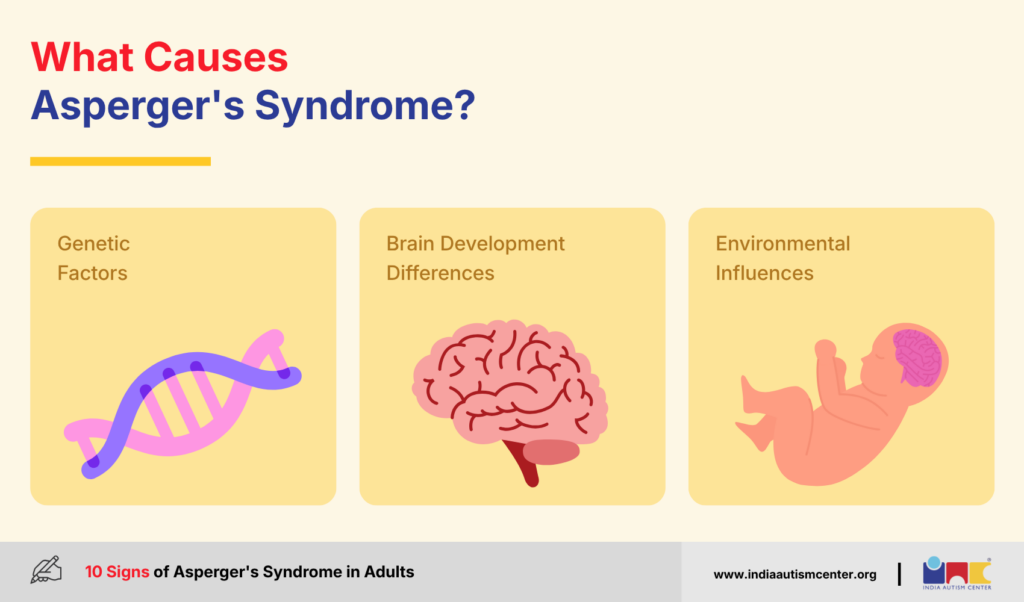
A common question is: what causes asperger’s syndrome? Current scientific evidence shows that Asperger’s syndrome and Autism Spectrum Disorder are neurodevelopmental conditions with complex origins.
Researchers believe the following are some common contributors:
- Genetic Factors
Genetics plays a major role. Studies involving twins and families consistently demonstrate a strong hereditary component. Researchers have identified hundreds of genes that are associated with autism-related traits.
- Brain Development Differences
Brain imaging studies suggest differences in neural connectivity, information processing, sensory integration, and social cognition.
- Environmental Influences
Certain prenatal and early developmental factors may contribute alongside genetics. However, it is important to understand that vaccines, parenting styles, and poor social experiences do not cause autism.
How to Deal With Asperger Syndrome in Adulthood?
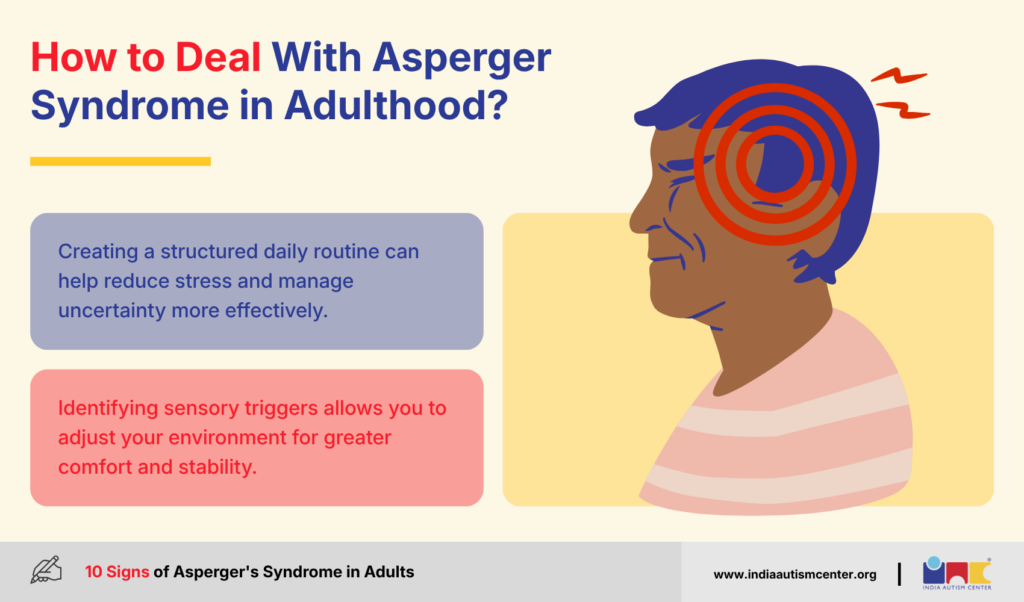
Living with Asperger syndrome as an adult can become easier with the right strategies and support. Rather than trying to change who you are, the focus should be on understanding your strengths and managing daily challenges effectively.
Some practical ways to cope include:
- Develop a structured daily routine that can help reduce stress and uncertainty.
- Learn to identify sensory triggers and create a comfortable environment.
- Practice clear communication
- Build on personal strengths and special interests to boost confidence and career growth.
- Seek support from autism specialists or support groups for individuals with Asperger’s.
- Prioritise self-care through regular exercise, adequate sleep, and stress-management techniques.
It is necessary to note that Asperger syndrome is a different way of experiencing the world, and it is certainly not a limitation. With self-awareness and appropriate support, adults can lead fulfilling and successful lives.
How Does India Autism Center Support Individuals and Families?
The India Autism Center is committed to creating a more inclusive and supportive environment for autistic individuals and their families.
With the help of awareness initiatives, educational resources, community programs, and advocacy efforts, India Autism Center helps people better understand autism and navigate challenges that come with it.
It promotes acceptance, early intervention, skill development, and lifelong support for individuals across the autism spectrum.
By fostering collaboration among families, professionals, and communities, the India Autism Center aims to assist an individual with autism to lead a meaningful, independent, and enriched life.
Want to know more? Get in touch with us.
Conclusion
Recognising the signs of Asperger’s syndrome in adulthood can be a significant step toward greater self-understanding and growth.
While challenges such as social communication difficulties, sensory sensitivities, and changes in routine may be part of the experience, many adults also possess amazing and unique strengths. Some strengths that people with Asperger’s have include attention to detail, deep focus, and strong problem-solving abilities. Seeking professional guidance can provide valuable clarity and support.
As awareness and acceptance have increased and the right resources are accessible, individuals who are diagnosed with Asperger’s can thrive in their personal and professional lives. Understanding such signs is not only about putting a label but, in fact, about embracing neurodiversity.
Frequently Asked Questions
What is Asperger syndrome?
Asperger syndrome is a term previously used to describe a form of autism characterised by difficulties in social communication, restricted interests, as well as repetitive behaviours. Today, it is included under Autism Spectrum Disorder (ASD).
How do I know if I have Asperger’s syndrome?
If you have lifelong difficulties with social interactions, communication, sensory processing, or adapting to change, it is best to seek a professional autism assessment.
Do people with Asperger syndrome struggle with relationships?
Some individuals with Asperger’s may find social interactions and emotional communication challenging, but many build strong friendships, romantic relationships, and family connections.
How is Asperger syndrome diagnosed in adults?
Diagnosis of Asperger’s syndrome includes clinical interviews, developmental history reviews, behavioural assessments, and standardised diagnostic tools, all conducted by trained professionals.
Can Asperger syndrome be treated?
Asperger syndrome is not an illness that needs to be cured. However, therapies and support services can help individuals develop skills and also improve their quality of life.
Should adults seek a diagnosis if they suspect Asperger syndrome?
A professional diagnosis can provide clarity about the situation, access to support services and workplace accommodations, and a better understanding of personal experiences.
Where can adults and families find support for Asperger syndrome?
Organisations such as the India Autism Center provide educational resources, awareness programs, and support to help individuals and families better understand autism and neurodiversity.
Disclaimer: This article is intended for educational and informational purposes only. It is not a substitute for professional medical advice, diagnosis, or treatment. If you are pregnant or have concerns about medication use during pregnancy, please consult a qualified healthcare provider. If your child has received an autism diagnosis and you have questions about causes or support, please reach out to a trained specialist or an autism-focused organisation for guidance.
For expert insights, support services, and inclusive learning initiatives, visit the India Autism Center.