 Donate now
 Get a Call Back
 MENU
MENU 11 MIN READ
 SHARE
SHARE


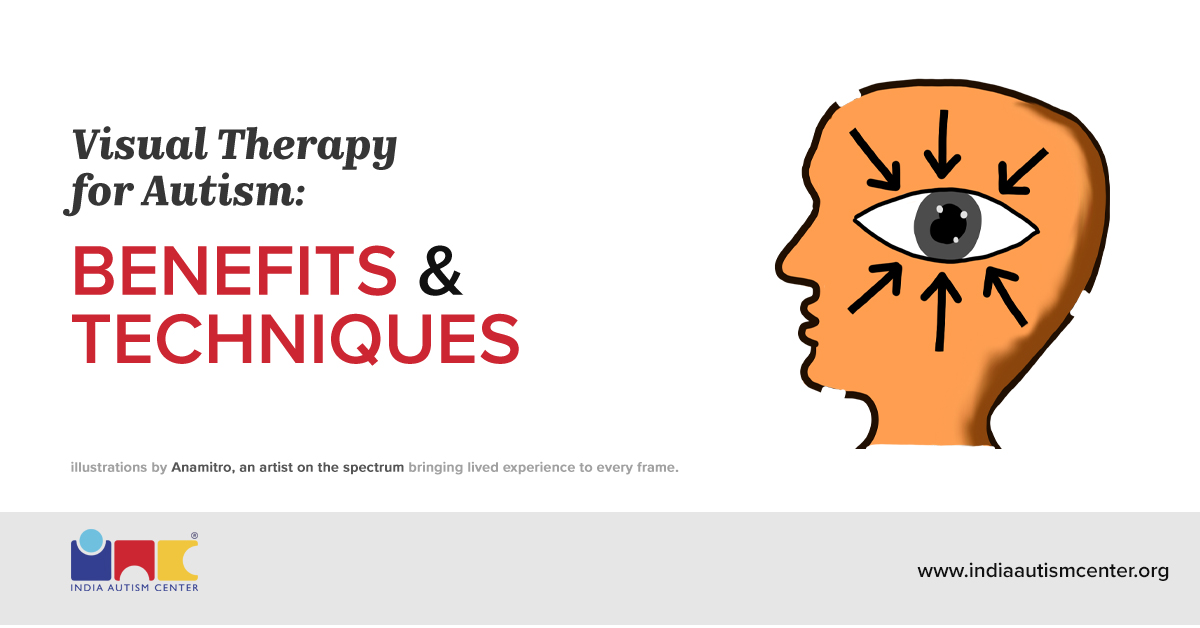
Did you know that the human brain processes about 80% of information through sight? Whether it is navigating a room or reading facial expressions. For autistic individuals, however, this process often works a little differently.
As per research, several children and adults with autism spectrum disorder tend to have atypical gaze patterns. These visual differences can affect communication, learning, behaviour, and even social connections.
That is why visual therapy for autism, also commonly called vision therapy for autism, is becoming an essential support system for children and adults on the spectrum.
Today, we will uncover what vision therapy for autism is, how it works, and how it can help. We will also discuss which techniques are most effective and how visual therapy contributes to skills, such as how to improve eye contact for autism and help address autism lazy eye (amblyopia).
What Is Visual Therapy?
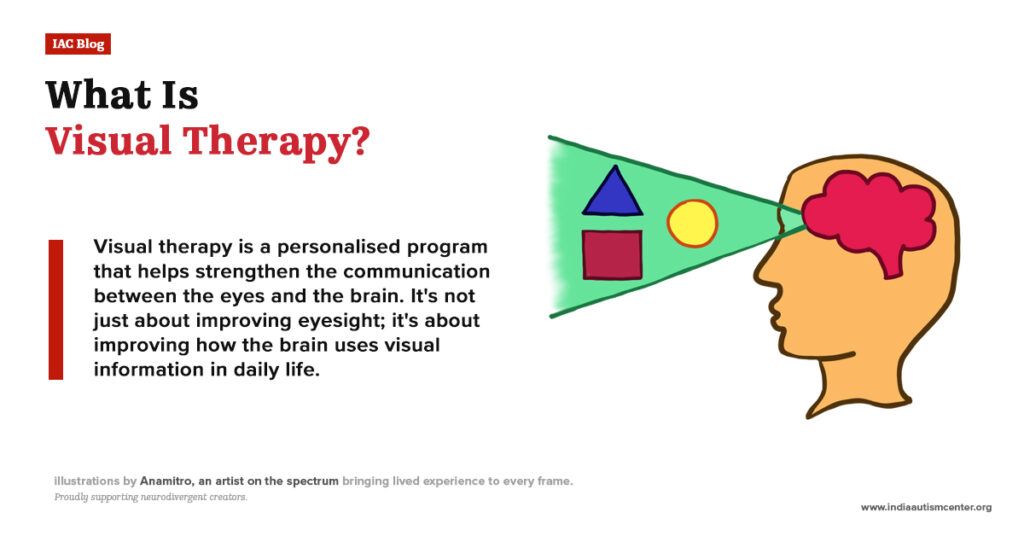
Visual therapy is a personalised program that helps strengthen the communication between the eyes and the brain. It’s not just about improving eyesight; it’s about improving how the brain uses visual information in daily life.
The eyes capture information, and then the brain interprets it. Vision therapy ensures it happens efficiently.
For autistic individuals, this can be life-changing because the visual system influences:
- Reading
- Writing
- Attention
- Social engagement
- Eye contact
- Hand-eye coordination
- Motor planning
- Spatial awareness
- Emotional regulation
Vision therapy can be helpful as the visual skills improve, making daily tasks more manageable, smoother, and less overwhelming.
Why Visual Challenges Are Common in Autism?
Many autistic individuals experience visual-processing differences for several neurological and sensory reasons:
- Neurological pathways develop differently: The brain regions responsible for visual attention, eye coordination, and face processing may grow at different paces.
- Hyperfocus or difficulty shifting attention: Some children can zoom in on details but struggle to shift their gaze between objects or people.
- Sensory processing differences: Bright lights, busy environments, or fast-moving visuals can make children with ASD feel overwhelmed.
- Co-occurring conditions: Certain types of developmental delays, ADHD, dyspraxia, and dyslexia are known to accompany ASD, affecting visual-motor skills.
- Higher rates of eye conditions: Conditions like strabismus, convergence challenges, and autism lazy eye (amblyopia in autistic individuals) are more frequent.
Everyday tasks can feel much more demanding when these factors are combined.
How Visual Therapy Supports Autistic Individuals?
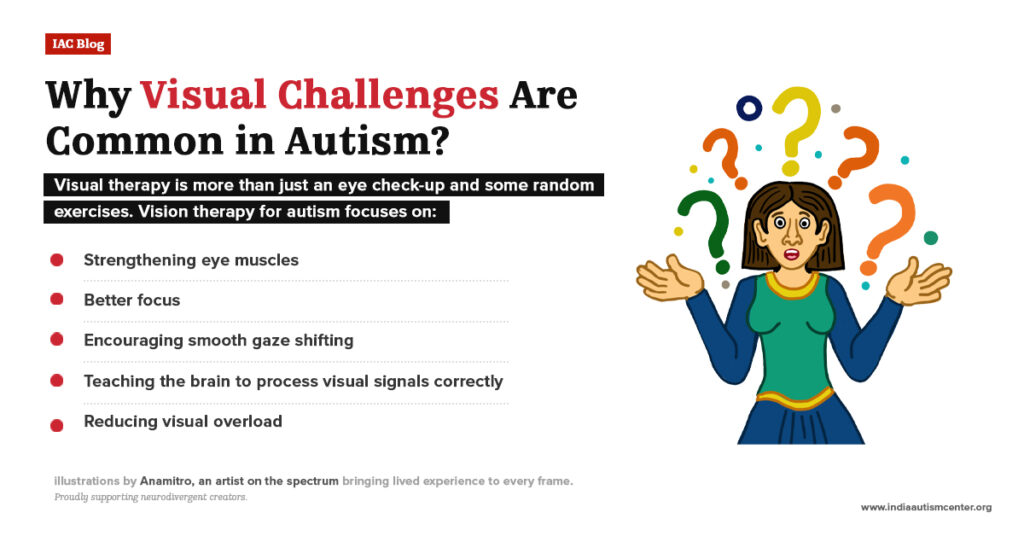
Visual therapy is more than just an eye check-up and some random exercises. Vision therapy for autism focuses on:
- Strengthening eye muscles
- Better focus
- Encouraging smooth gaze shifting
- Teaching the brain to process visual signals correctly
- Reducing visual overload
- Ensuring that coordination between body movement and vision is enhanced
- Enhancing comfort in busy visual environments
Who Can Benefit from Visual Therapy for Autism?
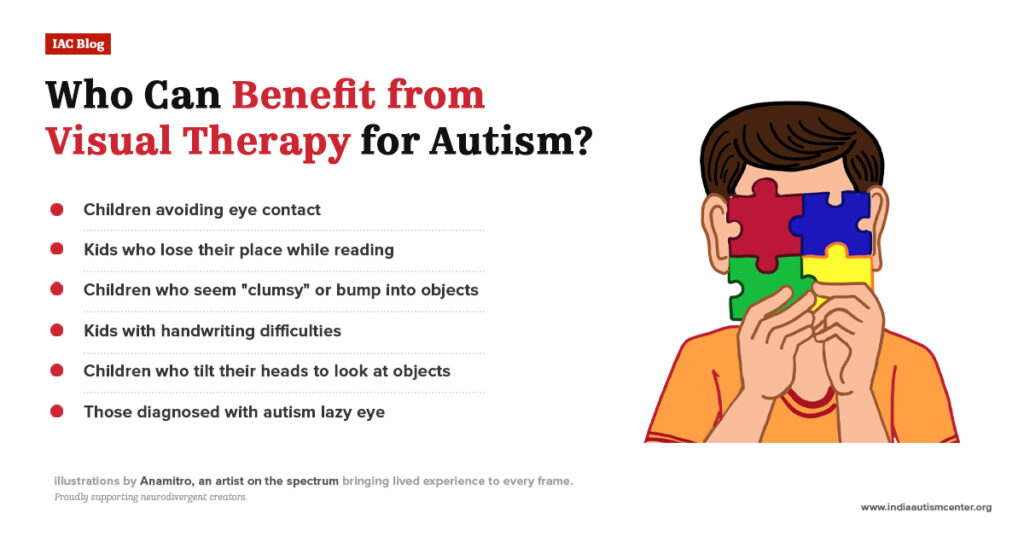
When the proper technique and visual therapy for autism are used, it can help children with autism spectrum disorder to live a better life. It is especially valuable for:
- Children avoiding eye contact
- Kids who lose their place while reading
- Children who seem “clumsy” or bump into objects
- Kids with handwriting difficulties
- Children who tilt their heads to look at objects
- Those diagnosed with autism lazy eye
- Children with sensory overload or anxiety driven by visual input
How Visual Therapy Works: Core Techniques Explained
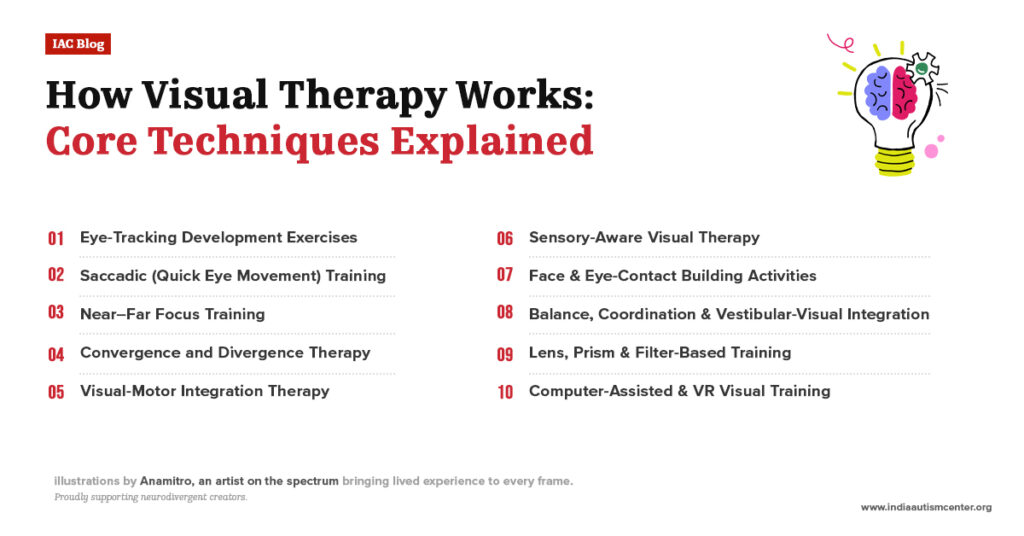
Visual or vision therapy for autism uses structured, engaging, and purposeful activities to improve the visual system. These exercises are often fun and play-based, which helps keep children motivated. If you are wondering how to improve eye contact for autism, then here are the most effective therapies that are widely used:
1. Eye-Tracking Development Exercises
These exercises teach the eyes to follow objects smoothly, as many autistic children struggle with tracking, leading their eyes to jump rather than move smoothly. It can cause problems such as difficulty copying from a board, losing place while reading, challenges with playing sports, or poor eye contact.
For this exercise, the therapists use tools like:
- Moving light pens
- Tracking balls
- Bubbles
- Flashlight following
- Computer-based eye-tracking games
These exercises teach the eyes to track objects accurately, making reading and conversation much easier.
2. Saccadic (Quick Eye Movement) Training
The term “Saccades” refers to the quick jumps your eyes make between two points. Children with saccadic difficulties may come across as inattentive, or they may be prone to losing information. Therapists use:
- Word-jump charts
- Dot-to-dot eye jumps
- Rapid pointing games
This helps improve classroom performance and conversation flow.
3. Near–Far Focus Training
Shifting the focus from near objects to far objects can often be difficult for people with ASD. Thus, training can be helpful for school tasks such as switching between a book and a board.
The tools used for this exercise include:
- Near-far charts
- Focus cards
- Digital focus training apps
This training is particularly helpful for children who experience headaches or fatigue due to frequent visual shifts.
4. Convergence and Divergence Therapy
When the eyes don’t work as a team, children may see double or feel visually confused. This vision therapy for autism helps to ensure that both eyes work in coordination. This is also the main therapy used for lazy eye in autism.
Therapists use:
- Brock String
- Barrel cards
- 3D stereoscope training
- Dot fusion cards
It helps strengthen binocular vision, improve depth perception, enhance sports performance, and reduce blurry vision.
5. Visual-Motor Integration Therapy
Visual-motor integration is important for several day-to-day activities, such as writing, eating independently, buttoning, hand-eye coordination, and participating in sports. As part of this visual therapy for autism, therapists use tools like:
- Pegboards
- Maze tracing
- Craft activities
- Ball-catching
- Pattern copying
- Tracing worksheets
This helps children coordinate what they see with what their hands do.
6. Sensory-Aware Visual Therapy
Many autistic children find bright lights, crowds, or fast visuals overwhelming. This vision therapy technique for autism aims to help children who struggle with visual overload.
As per this technique, the therapist creates a sensory safe environment using:
- Low lighting
- Contrast-based activities
- Visual-motor calming tasks
- Slow-eye movement exercises
- Visual schedules
It helps reduce stress, improve the overall attention span, and keep children regulated.
7. Face & Eye-Contact Building Activities
Several autistic children tend to avoid eye contact, not out of defiance, but because it feels uncomfortable or overwhelming. As a parent seeking to know how to improve eye contact in autism, this technique can be quite helpful.
The therapy will include the following:
- Joint Attention Games: Pointing, showing, and sharing toys.
- Mirror Play: Helps children look at faces without pressure.
- Gaze-Following Activities: Teaching children to follow someone’s eyes to understand attention.
- Naturalistic Play: Positioning toys near the therapist’s face so the child naturally glances at them.
8. Balance, Coordination & Vestibular-Visual Integration
Children with visual-processing differences may also have difficulties with balance or body awareness. The therapy aims to ensure that vision and movement work together. The treatment includes different tools, such as:
- Balance boards
- Trampolines
- Obstacle courses
- Body tracking games
When the visual and vestibular systems align, children become more confident and coordinated.
9. Lens, Prism & Filter-Based Training
This technique is also used to treat autism lazy eye, and reading difficulties. It is used only by developmental optometrists. The special lens and prism help to:
- Align the eyes
- Improve focus
- Reduce visual stress
- Enhance attention
- Support depth perception
10. Computer-Assisted & VR Visual Training
These exercises are engaging, motivating, and highly effective for older children and teens. Technology-based training is now widely used:
- Interactive VR visual tasks
- Eye tracking software
- Attention shift games
- Binocular VR games
Benefits of Visual Therapy for Autism
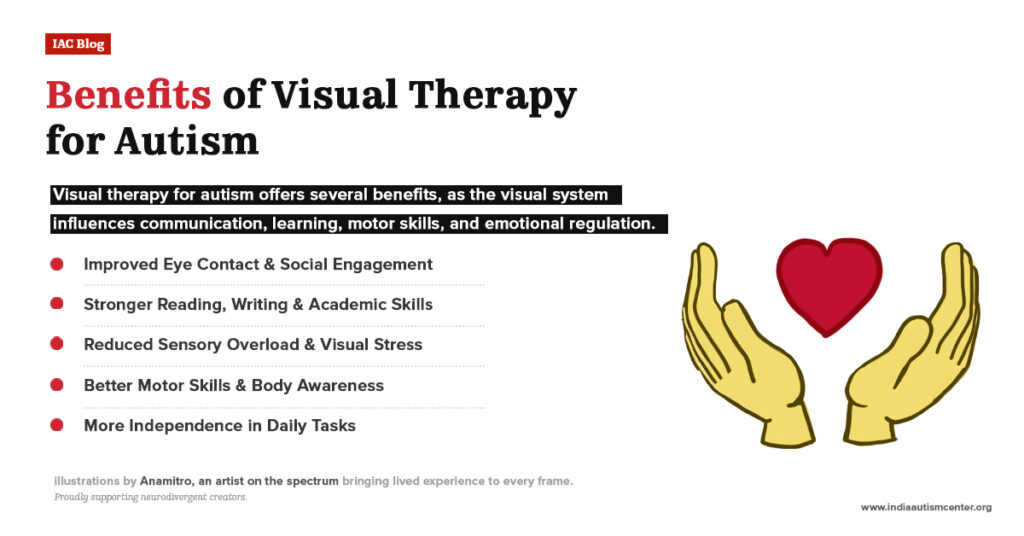
Visual therapy for autism offers several benefits, as the visual system influences communication, learning, motor skills, and emotional regulation. Here are the benefits of vision therapy for autism.
Improved Eye Contact & Social Engagement
One of the most common questions parents ask is how to improve eye contact for autism. Visual therapy supports this by strengthening eye tracking, gaze shifting, face processing, joint attention, and visual comfort during conversation.
Children gradually begin to:
- Look toward a person’s face more naturally
- Maintain brief eye contact without distress
- Understand where others are looking
- Respond better to name-calling and facial cues
Stronger Reading, Writing & Academic Skills
After visual therapy for autism, improvements often include:
- Better tracking across text
- Improved reading fluency
- Accurate copying from the board to the notebook
- Stronger letter formation
- Better spacing and writing alignment
Reduced Sensory Overload & Visual Stress
Some autistic individuals experience visual hypersensitivity to bright lights, screen glare, and crowded environments, which may feel overwhelming. Visual therapy will help to:
- Filter unnecessary visual information
- Reduce overstimulation from movement
- Improve visual attention span
- Stay calmer in busy spaces
Better Motor Skills & Body Awareness
Vision guides body movement, so when the visual system becomes stronger, physical coordination also improves. The benefits of vision therapy for autism include:
- Better balance
- Smoother walking/running
- Improved ball skills
- Stronger hand-eye coordination
- More confidence on playgrounds
More Independence in Daily Tasks
Parents often report noticeable improvements in daily functioning within months in terms of:
- Eating
- Buttoning and zipping
- Sorting objects
- Using tools correctly
- Completing homework independently
What Is Autism Lazy Eye & How Does Visual Therapy Help?
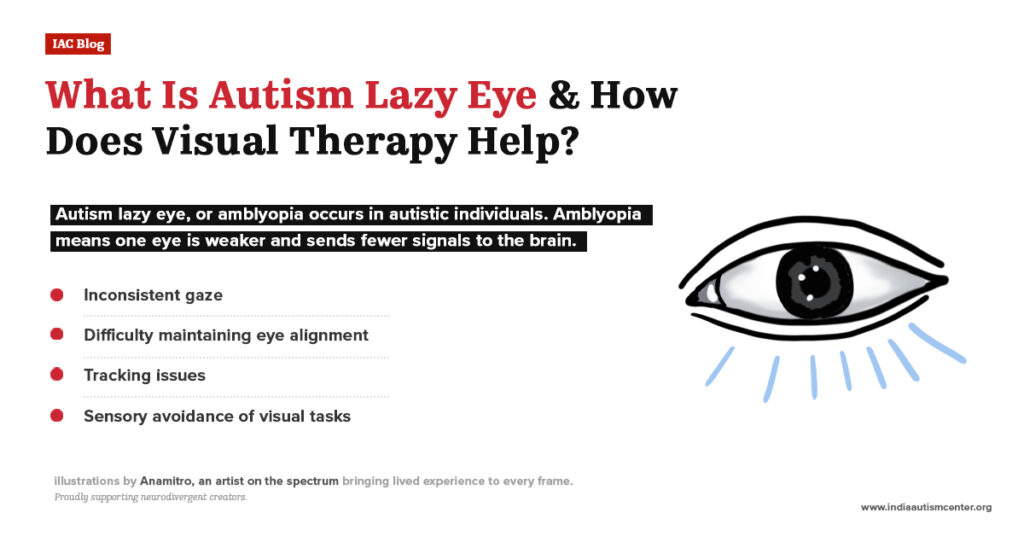
Autism lazy eye, or amblyopia occurs in autistic individuals. Amblyopia means one eye is weaker and sends fewer signals to the brain. Children with autism are more prone to have this condition due to:
- Inconsistent gaze
- Difficulty maintaining eye alignment
- Tracking issues
- Sensory avoidance of visual tasks
How does Visual Therapy treat Autism Lazy Eye?
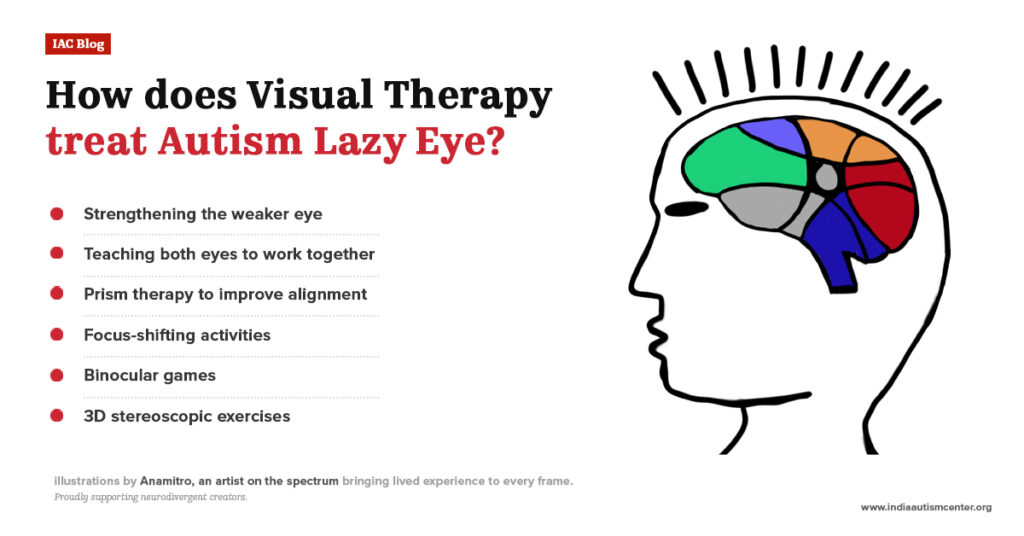
Visual therapy helps the brain reconnect with the weaker eye, restoring binocular vision and preventing long-term sight loss. Therapy techniques include:
- Strengthening the weaker eye
- Teaching both eyes to work together
- Prism therapy to improve alignment
- Focus-shifting activities
- Binocular games
- 3D stereoscopic exercises
- Patching (when prescribed)
Signs Your Child Might Need Visual Therapy
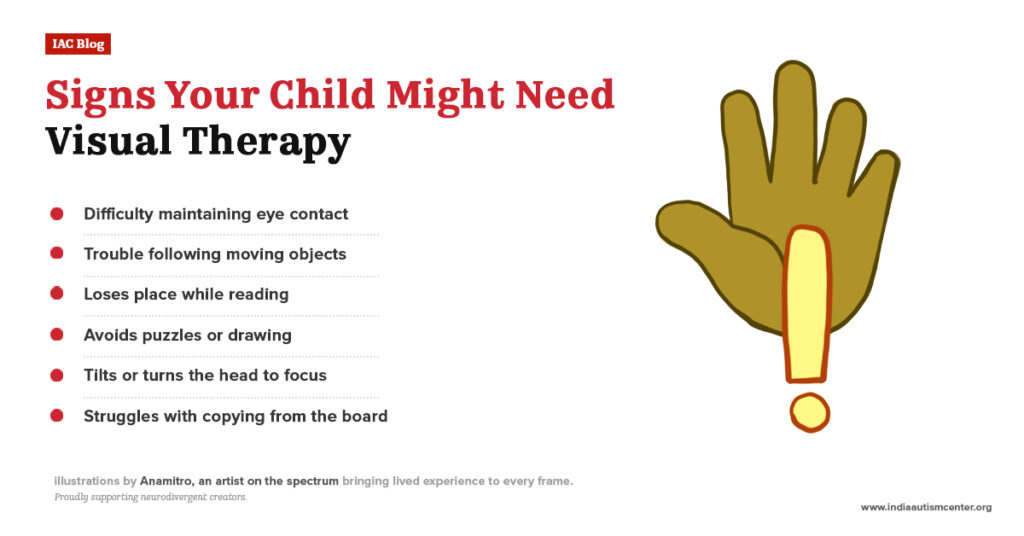
It is easy to assume that your child’s vision is perfect if they can see clearly. But visual-processing challenges are often hidden and may go undetected during a routine eye exam.
Children who have ASD often struggle with tracking, focusing, depth perception, or eye coordination without being able to explain what feels difficult. Here are some signs that you must look out for to understand if your child needs vision therapy:
- Difficulty maintaining eye contact
- Trouble following moving objects
- Loses place while reading
- Avoids puzzles or drawing
- Tilts or turns the head to focus
- Struggles with copying from the board
- Light sensitivity
- Memory difficulties
- Frequent falls or clumsiness
- Poor handwriting
- Short attention span
- Avoids face-to-face interaction
- Squints or covers one eye
Home-Based Activities to Support Visual Development
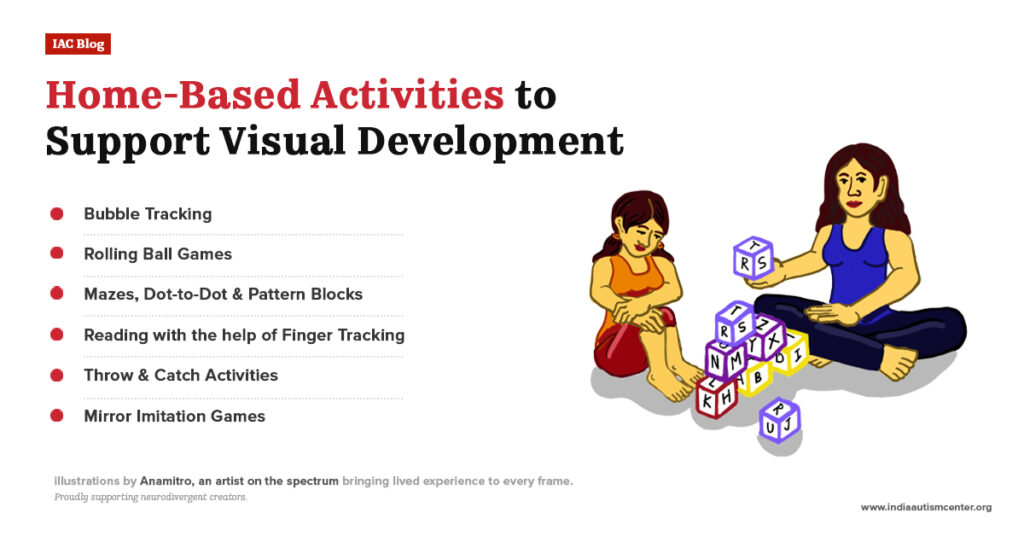
Parents play a huge role in reinforcing therapy progress at home. Here are some home-based activities that are easy to do and are also time-efficient.
- Bubble Tracking: Helps with eye pursuit and visual attention.
- Rolling Ball Games: Improves hand-eye coordination & timing.
- Mazes, Dot-to-Dot & Pattern Blocks: Strengthens visual-motor integration.
- Reading with the help of Finger Tracking: Helps children maintain place in text.
- Throw & Catch Activities: Enhance depth perception and improve ocular teaming.
- Mirror Imitation Games: Great for early social referencing and face awareness.
- Sensory-Friendly Visual Spaces: Soft lighting, clear labels, and contrast-rich visuals aim to help reduce overload.
Conclusion
Vision impacts every aspect of humans, and it is the same for children with ASD, whether it is reading and writing, eye contact, social connection, or staying regulated in sensory-rich environments. Visual therapy has been shown to deliver powerful, life-changing results.
By strengthening the communication between the eyes and the brain, vision therapy aims to help autistic individuals see, process, and respond to the world in a more comfortable way. Families who opt for structured and evidence-based visual therapies and treatment, especially through integrated centres, see remarkable progress in confidence, communication, learning, and daily independence.
Frequently Asked Questions
What is visual therapy for autism, and how does it work?
Visual therapy, also known as vision therapy for autism, is a structured program that improves coordination between the eyes and the brain. It uses exercises that strengthen tracking, focusing, eye coordination, and visual processing. Over time, children learn to interpret visual information more efficiently, which positively impacts reading, writing, social skills, and daily activities.
Can visual therapy help my child improve eye contact?
Yes. Many children avoid eye contact due to visual discomfort, not behavioural resistance. Through gentle gaze-shifting exercises, face-tracking tasks, and sensory-supported techniques, visual therapy supports the natural, pressure-free improvement of eye contact for autism.
Does vision therapy help with lazy eye in autism?
Yes. Autism lazy eye (amblyopia in autistic children) is treatable through visual therapy. Therapists strengthen the weaker eye, improve binocular vision, and retrain the brain to use both eyes together. It helps to improve depth perception and reduce long-term visual imbalance.
How long does it take to see results from visual therapy?
Most parents notice improvements within 8–12 weeks. However, children with significant visual-processing challenges or autism lazy eye may need 6–12 months of consistent therapy. Progress depends on regular sessions and home reinforcement.
Looking for expert support and inclusive learning options? Contact India Autism Center.