 Donate now
 Get a Call Back
 MENU
MENU 9 MIN READ
 SHARE
SHARE


No. Current scientific evidence does not show that Tylenol (acetaminophen) causes autism. The largest study on this topic — covering 2.5 million children — found no causal link. Some earlier studies showed a statistical association, but association is not the same as causation. This distinction matters enormously for parents.
What Is the Tylenol–Autism Controversy About?
In September 2025, President Donald Trump and HHS Secretary Robert F. Kennedy Jr. announced that the FDA would warn physicians about a “very increased risk of autism” linked to acetaminophen use during pregnancy. The statement made headlines globally and caused immediate alarm among expecting mothers.
Doctors, researchers, and autism organisations pushed back quickly. The science, they said, simply does not support that claim.
So where did this fear come from? And what does the evidence actually show? Let me walk you through it clearly.
What Is Acetaminophen (Tylenol / Paracetamol)?
Acetaminophen is the active ingredient in Tylenol. Outside the US, it is commonly known as paracetamol (Crocin, Dolo, Calpol in India). It is one of the most widely used over-the-counter pain relievers and fever reducers in the world.
Pregnant women often take it for:
- High fever during infection
- Headaches and body pain
- Post-delivery pain management
It has historically been considered the safest OTC pain option during pregnancy — which is exactly why this controversy has caused so much confusion.
Want to know more? Get in touch with us.
Why Did Some Studies Link Tylenol to Autism?
Several studies over the past decade did find an association between prenatal acetaminophen use and Autism or Attention Deficit Hyperactivity Disorder (ADHD) diagnoses in children.
Here is a summary of the key studies that raised concerns:
| Study | Finding | Limitation |
| Johns Hopkins cord blood study (2019) | Highest acetaminophen exposure linked to ~3× higher autism/ADHD risk | No control for genetics or family history |
| NCBI prenatal exposure meta-analysis | Children prenatally exposed were 19% more likely to show autism symptoms | High selection bias across included studies |
| Mount Sinai review (2025) | Available evidence supports an association with neurodevelopmental disorders | Did not use sibling-comparison design |
These studies found correlation, not causation. That difference is critical, and I will explain exactly why below.
What Is the Difference Between Association and Causation?
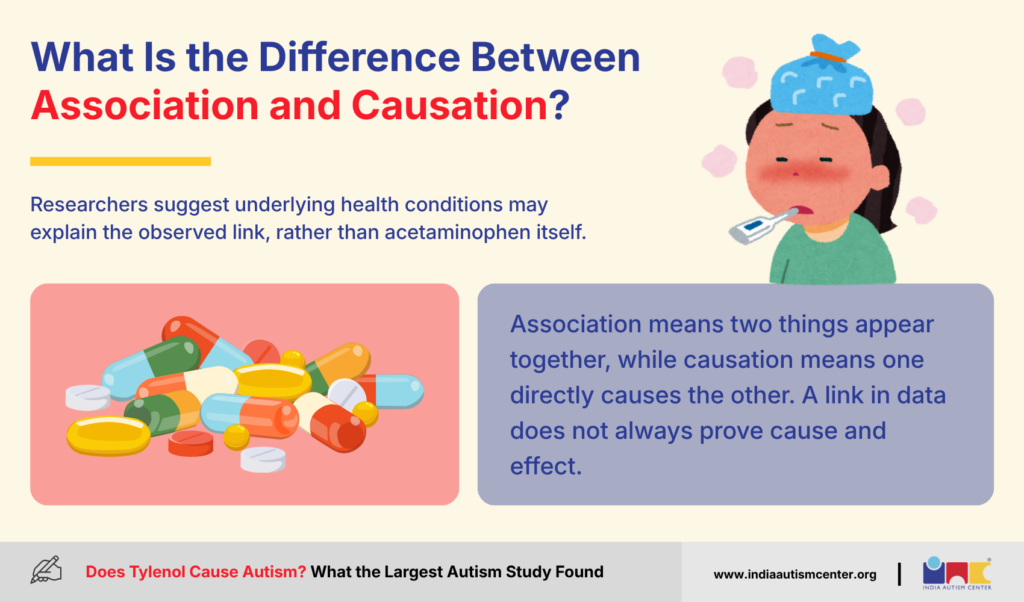
This is the most important concept in this entire debate.
Association means two things tend to appear together in the data. Causation means one thing directly causes the other. These are not the same thing.
A classic example: Ice cream sales and drowning rates both rise in summer. They are associated. Ice cream does not cause drowning — hot weather causes both.
In the acetaminophen–autism studies, the same problem existed. Mothers who took acetaminophen during pregnancy were also more likely to have:
- Fever or infection (themselves linked to autism risk in the fetus)
- Chronic pain or autoimmune conditions (genetically connected to neurodevelopmental differences)
- Migraines or inflammatory conditions (also heritable, and associated with autism)
So it is entirely possible — and scientifically likely — that the studies were measuring the underlying illness, not the medication.
What Does the Largest Study on This Topic Show?
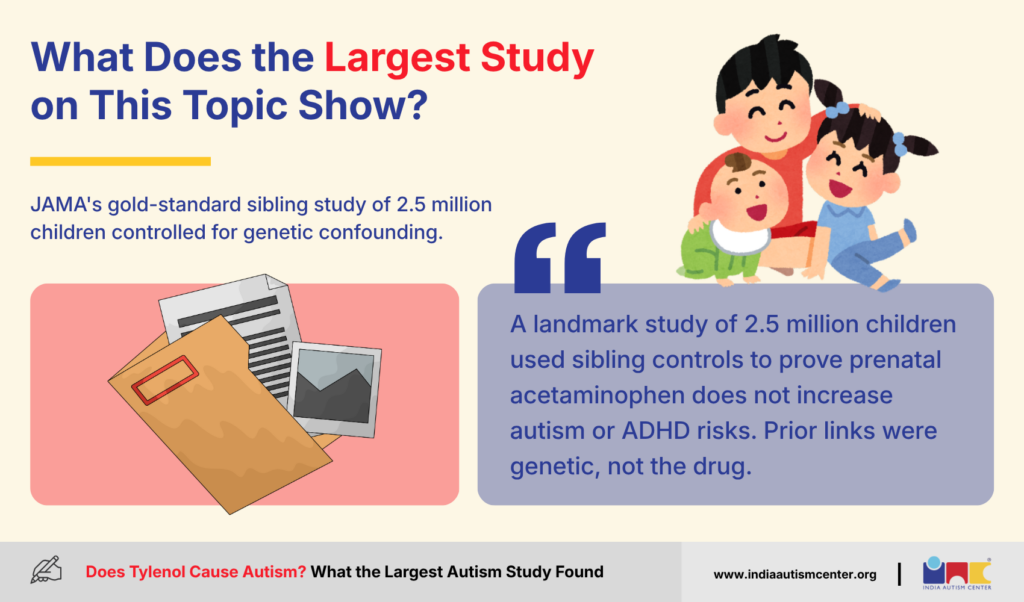
In April 2024, a landmark study was published in JAMA — one of the world’s most respected medical journals.
The study: Conducted by the Karolinska Institute (Sweden) and Drexel University, funded by the US National Institutes of Health (NIH).
The data: Nearly 2.5 million children born in Sweden between 1995 and 2019.
The method: A sibling-comparison design — comparing children in the same family, one exposed to acetaminophen in the womb and one not. This controls for shared genetics and family environment simultaneously. It is considered the gold standard for this type of research.
The finding:
When siblings were compared, there was no difference in autism, ADHD, or intellectual disability rates — regardless of acetaminophen exposure during pregnancy.
The specific numbers:
- Autism hazard ratio: 0.98 (effectively neutral — no increased risk)
- ADHD hazard ratio: 0.98 (same)
- Intellectual disability hazard ratio: 1.01 (same)
Earlier models in the same study had shown a marginal 5–7% association. That association completely disappeared once sibling controls were applied. This strongly suggests the earlier association was caused by genetic and familial confounding — not the drug.
Want to know more? Get in touch with us.
Has Any Other Country Replicated This Finding?
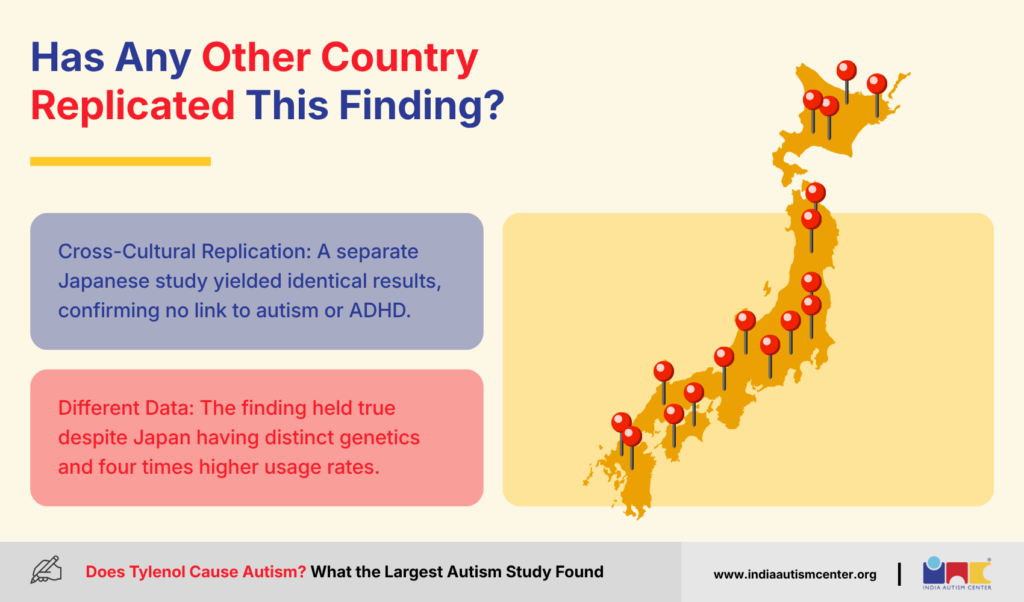
Yes. A separate Japanese study used the exact same sibling-comparison design.
Japan has a very different population, with different genetics and different acetaminophen usage patterns — nearly 40% of Japanese mothers reported using it during pregnancy, compared to under 10% in Sweden.
Despite these differences, the conclusion was identical: no link between acetaminophen use during pregnancy and autism or ADHD when siblings are compared.
This cross-cultural replication adds significant weight to the Swedish findings.
What About the February 2025 Meta-Analysis That Claimed a Link?
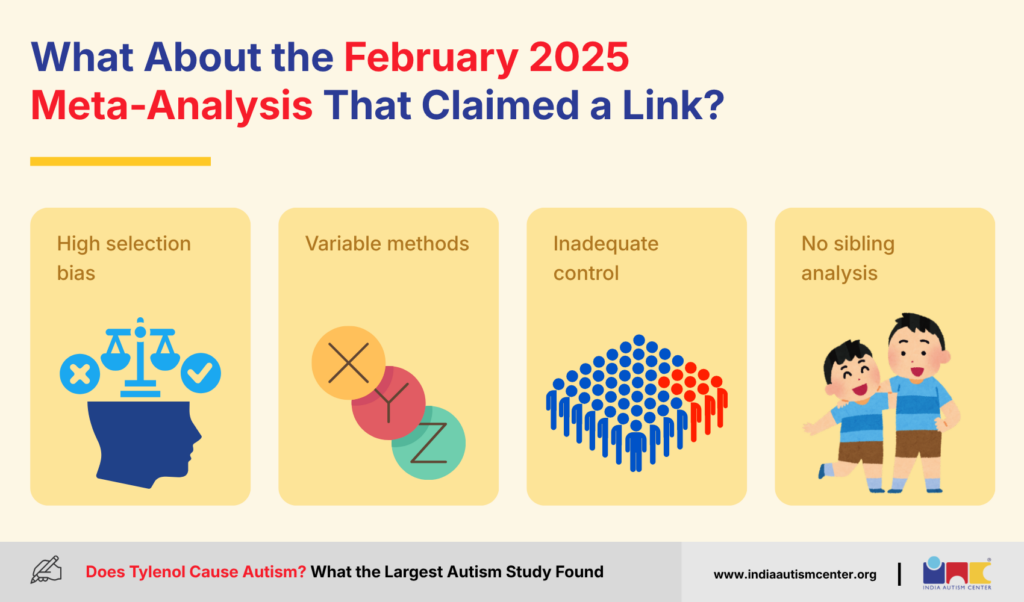
A 2025 meta-analysis (the Prada et al. review) was cited by political figures as evidence of harm. It used a methodology called the Navigation Guide.
However, independent scientists have noted that most studies included in this review had:
- High selection bias
- Variable methods for measuring exposure
- Inadequate control for familial and genetic confounding
- No sibling analysis — the most reliable design for this question
The Autism Science Foundation’s 2025 year-in-review explicitly noted that this year’s research helped exonerate acetaminophen as a cause of autism.
So What Actually Causes Autism?
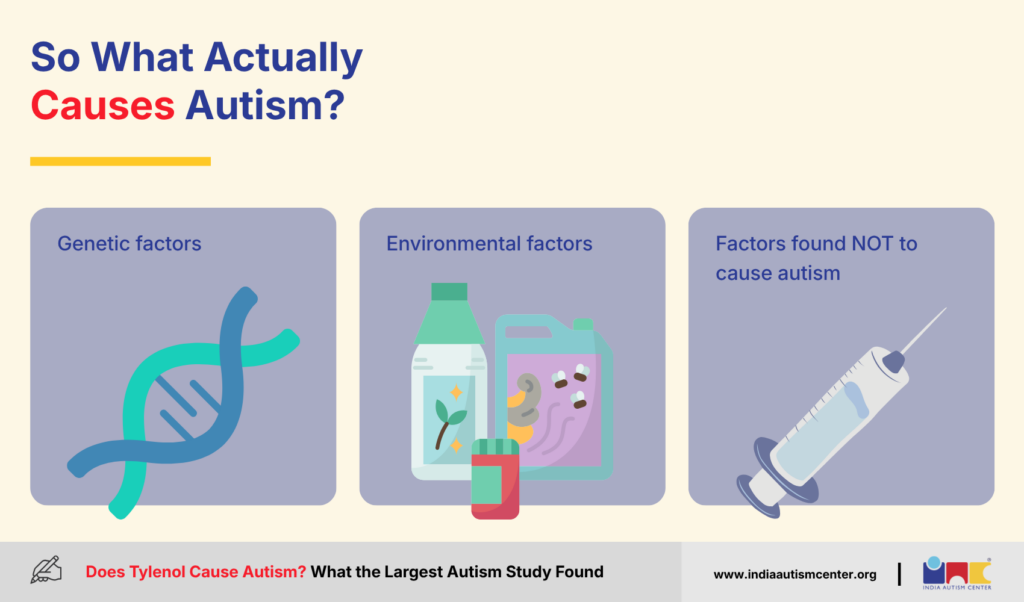
Autism does not have a single cause. It is a spectrum condition shaped by a complex interaction of genetics and environment.
Here is what the current scientific consensus does support:
Genetic factors (strongest evidence):
- Hundreds of genes have been linked to autism
- Most cases involve common inherited genes with small individual effects that work additively
- A rare genetic condition is identified in approximately 7–20% of cases
- Siblings of autistic children have roughly a 20% likelihood of also receiving a diagnosis
Environmental factors (supporting role, not standalone causes):
- Advanced parental age at conception
- Premature birth or very low birth weight
- Maternal fever or infection during pregnancy (the illness itself, not the treatment)
- Prenatal exposure to certain medications such as valproic acid (an anti-epileptic drug)
- Exposure to air pollution and certain pesticides during pregnancy
Factors that have been studied and found NOT to cause autism:
- Vaccines (the MMR-autism link was thoroughly debunked and retracted)
- Acetaminophen / Tylenol (as shown by the 2024 JAMA study)
Autism arises from differences in early brain development — and those differences begin forming in the womb, shaped by a mosaic of genetic and environmental influences over time.
Want to know more? Get in touch with us.
Is It Safe to Take Paracetamol During Pregnancy?
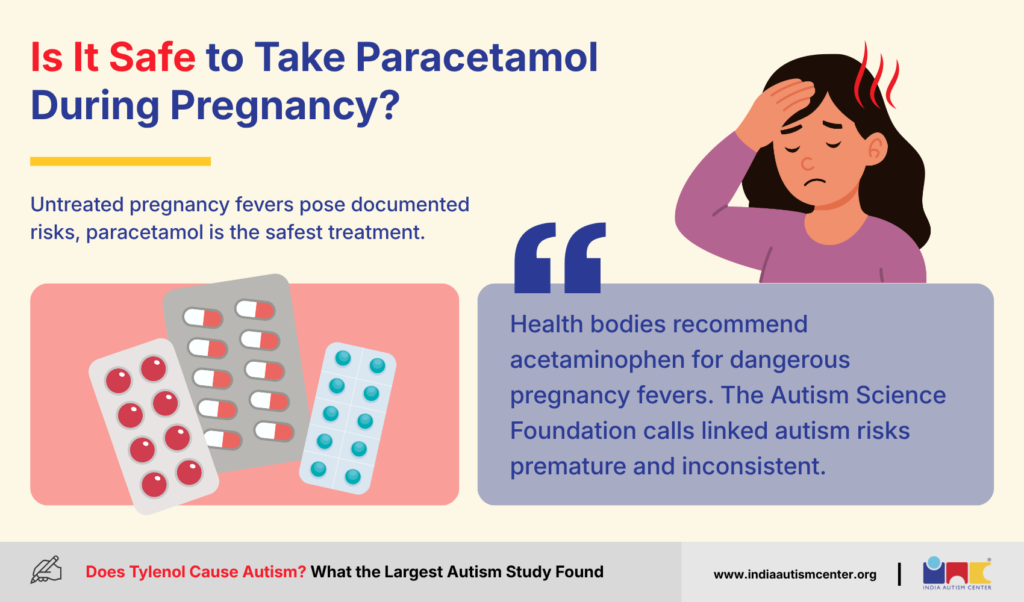
This is a question for your doctor, not for a headline. But here is the scientific context:
Untreated high fever during pregnancy carries documented risks — including complications for both mother and baby. The choice is not simply “Calpol vs. no Calpol.” It is often “treat the fever vs. leave it untreated.”
Major health bodies including the WHO and most national obstetric guidelines have not changed their position based on the Trump administration’s announcement. Acetaminophen, when used at recommended doses for specific indications, remains the most studied and generally accepted pain/fever option available to pregnant women.
That said:
- Use the lowest effective dose for the shortest necessary time
- Consult your OB/GYN before taking any medication during pregnancy
- Do not self-medicate for prolonged periods without medical supervision
The Autism Science Foundation described the link between acetaminophen and autism as “based on limited, conflicting, and inconsistent science” and called the current concern “premature.
If My Child Is Autistic, Did Something I Do During Pregnancy Cause It?
No. And I want to be clear about this, especially for parents who may be carrying that guilt.
The best available science does not support the idea that taking a common fever reducer during pregnancy caused your child’s autism. Autism develops through a combination of genetic predispositions and early brain development differences — not a single pill, a single moment, or a single decision.
Parents of autistic children already carry enough. You do not need to add unfounded guilt to that weight.
📥 Free download: Printable daily routine chart for autistic children
Frequently Asked Questions
Does Tylenol cause autism?
No. The largest study to date (2.5 million children, JAMA 2024) found no causal link.
Is there an association between acetaminophen and autism?
Some earlier studies found a weak statistical association, but it disappeared in sibling-comparison analyses — suggesting genetic confounding, not causation.
What is the gold standard study design for this question?
Sibling-comparison design, which controls for shared genetics and family environment.
What does the 2024 Swedish study show?
No increased risk of autism, ADHD, or intellectual disability from prenatal acetaminophen use, after controlling for family genetics.
What actually causes autism?
A complex interaction of hundreds of genes and environmental influences during early brain development. There is no single cause.
Should pregnant women avoid Tylenol?
Consult your doctor. Untreated fever also carries pregnancy risks. No major health body has changed guidance based on current claims.
Sources and References
Ahlqvist VH et al. Acetaminophen use during pregnancy and offspring neurodevelopment — JAMA, April 2024
Johns Hopkins Bloomberg School of Public Health — The Evidence on Tylenol and Autism, November 2025
NIH press release — Study reveals no causal link between neurodevelopmental disorders and acetaminophen exposure before birth, April 2024
Autism Speaks — Tylenol and Autism: Sibling study finds previously reported connection is likely due to other underlying factors, April 2024
Autism Science Foundation — 2025 Autism Research Year in Review, January 2026
JHU News-Letter — From Correlation to Confusion: Fact-Checking President Trump’s Tylenol–Autism Claim, October 2025
FIGO — Paracetamol use during pregnancy and autism risk: evidence does not support causal association
PBS NewsHour — Research doesn’t show using Tylenol during pregnancy causes autism, September 2025
Disclaimer: This article is intended for educational and informational purposes only. It is not a substitute for professional medical advice, diagnosis, or treatment. If you are pregnant or have concerns about medication use during pregnancy, please consult a qualified healthcare provider. If your child has received an autism diagnosis and you have questions about causes or support, please reach out to a trained specialist or an autism-focused organisation for guidance.
For expert insights, support services, and inclusive learning initiatives, visit the India Autism Center.