 Donate now
 Get a Call Back
 MENU
MENU 11 MIN READ
 SHARE
SHARE


The cup hits the wall. Your child is on the floor, and you’re standing in the doorway, not knowing whether to move toward them or back away. Autism and aggression rank among the hardest things parents navigate together, and most families spend months reacting before they find the root. For the estimated 1.8 to 2 million children with ASD in India, outbursts are often the most distressing challenges their families face, alongside the sensory challenges in autism that often precede them. This guide explains what drives the behaviour, what it is telling you, and where to start.
What Is the Connection Between Autism and Aggression?
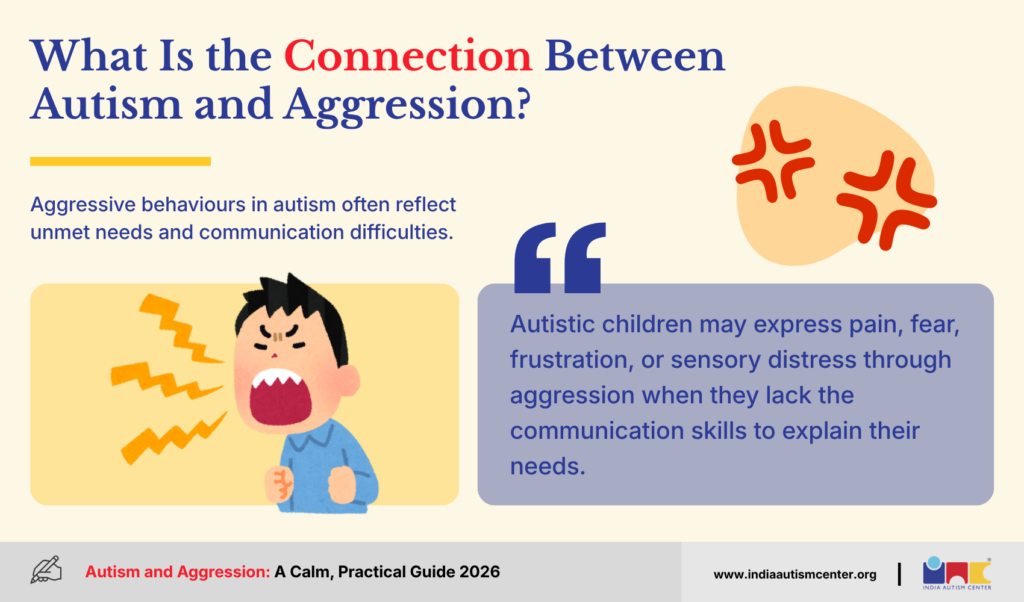
Autism and aggression often occur together because many autistic children cannot yet express pain, fear, or frustration in words. When a child hits, bites, throws, or scratches, they are not being defiant or dangerous. These are common symptoms of aggression that are serving as communication. The child is telling you something they do not yet have the words for. Finding out what that something is makes all the difference.
Why Does Aggression Happen in Children with Autism?
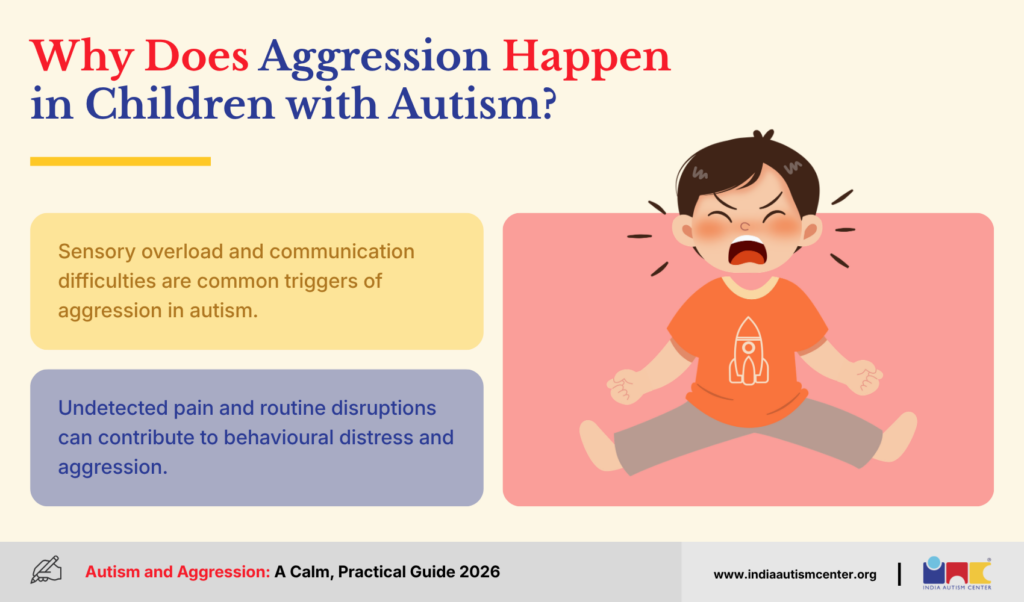
When a child becomes aggressive, the instinct is to focus on what just happened. Most of the time, the real answer is in what happened before it. Aggression in autistic children almost always traces back to one of two places: sensory overload or the absence of a reliable way to communicate. The challenges in autism linked to sensory overload push the nervous system into fight-or-flight when a transition feels unsafe, or a sound becomes unbearable.
Sensory Overload and Communication Frustration
When the nervous system hits its ceiling, physical exit or attack becomes the only available response for a child who has no faster or more reliable signal. A child who hits when a request is ignored is not being defiant. They have run out of options.
Most families focus on the outburst itself rather than the ten minutes leading up to it. That is where the real trigger almost always lies.
Medical Pain as a Hidden Trigger
Medical pain is the most overlooked trigger in autism-related aggression, and the hardest to catch precisely because nonverbal children cannot report it. Chronic gastrointestinal discomfort, untreated ear infections, and dental pain all surface as behavioural distress before they surface as anything else. A paediatric review before any behaviour plan is not optional; it is the first step most families skip.
Think about a nonverbal 7-year-old whose molar has been aching for six days. He cannot point to his jaw or say it hurts. His sleep has been broken for four nights. By Tuesday afternoon at school, the plate gets thrown, and the teacher logs it as an unprovoked outburst. The dentist appointment three weeks later tells a different story. If you have ever felt like the aggression came out of nowhere, it is worth asking whether your child has had a recent physical check-up.
| Trigger Category | What It Looks Like | Why It Drives Aggression |
| Sensory overload | Covering ears, withdrawing, becoming rigid before the outburst | The nervous system hits a ceiling; physical exit or attack becomes the only available response |
| Communication frustration | Hitting when a request is ignored or misunderstood | The child has no faster or more reliable signal available |
| Routine disruption | Outbursts at transitions, school pick-up, or unexpected schedule changes | Predictability reduces anxiety; its removal triggers acute stress |
| Undetected medical pain | Aggression spiking without an obvious behavioural trigger | Pain cannot be reported verbally and surfaces as distress behaviour |
| Demand avoidance | Outbursts in response to direct instructions or requests | The demand activates a threat response rather than deliberate defiance |
Children who are nonverbal or minimally verbal cannot distinguish between “I am in pain” and “I am overwhelmed” in their own signalling. That gap is where most families lose months. A 2024 comprehensive review published in Cureus noted that 1 in 65 Indian children aged 2 to 9 are affected by ASD, a figure that underscores how many families are navigating this without adequate guidance.
📥 Free download: Printable daily routine chart for autistic children
What Do the Symptoms of Aggression in Autism Look Like?
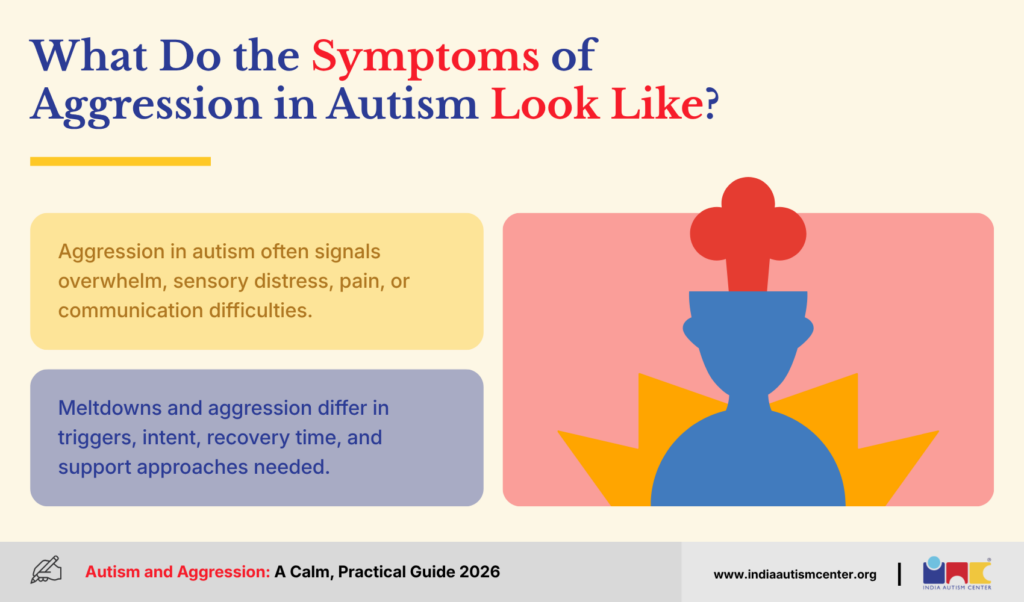
The symptoms of aggression in autism range from hitting, biting, scratching, and throwing objects to self-directed harm such as head-banging. What distinguishes these from tantrums is that they are rarely goal-directed. The child is not trying to get something or manipulate a situation. They are overwhelmed, in pain, or out of options, and the aggression is the only signal available to them.
How Aggression Differs from a Meltdown
Aggression during a meltdown is a pressure release, not a tactic. Treating it like one makes every outburst worse.
The distinction matters because the response that helps in one situation actively escalates the other. During a meltdown, staying quiet and reducing input are what help. During instrumental aggression, neutral redirection works. Confusing the two is one of the most common reasons families feel like nothing is working, no matter how hard they try.
What It Looks Like in Level 1 and Level 2 Autism
Children with level 1 autism can show aggression too. It just looks quieter and gets missed because they seem to be communicating fine. A child who storms out of a classroom or slams a door repeatedly is showing symptoms of aggression that often go unaddressed because they are not hitting anyone. Children with level 2 autism tend to show more intense and frequent outbursts, often because communication gaps are wider and sensory thresholds are lower. The intervention approach differs between levels, which is why a one-size strategy rarely holds across both.
A mother tries a firm “no” the moment her son begins hitting. The hitting escalates. She later recognised it as an autism meltdown that had been building since the car ride home, not a response to what she said.
| Feature | Aggression | Meltdown |
| Intent | May be directed at a specific person or object | No specific target; a full release of accumulated overload |
| Trigger clarity | Usually traceable to a specific denied request | May appear sudden; builds from accumulated sensory input |
| Recovery time | Shorter once the trigger is removed | Longer; the child needs quiet time and space to regulate |
| What helps | Neutral redirection; removing the reinforcing response | Reducing all sensory input; calm, wordless presence |
| What makes it worse | Shouting, restraint, or negotiating mid-episode | Eye contact, touch, or raising your voice |
A 2024 longitudinal study from the Semel Institute at UCLA, tracking 254 autistic individuals from toddlerhood to adulthood, found that 31% showed persistent aggression across their lifespan while 23% saw it decrease over time, with early intervention as the clearest differentiating factor.
Want to know more? Get in touch with us.
What Can Parents Do About Autism Behaviour Issues?
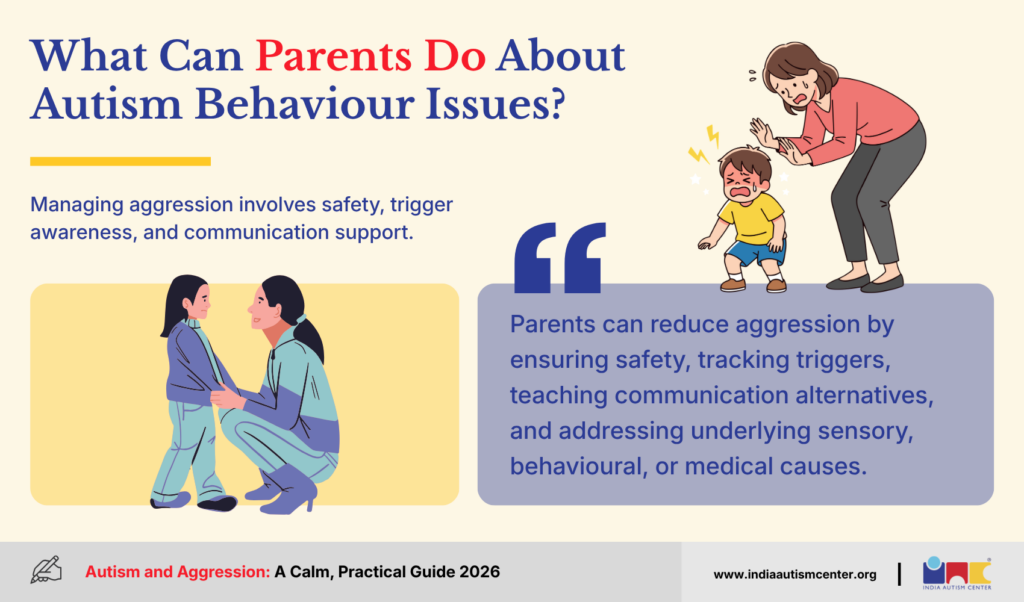
Managing autism behaviour issues related to aggression works in three phases: in-the-moment safety, post-episode investigation, and structured replacement. Most families reach the third phase first, which is why the same outburst recurs within days.
What to Do During an Outburst
What a parent does in the first thirty seconds of an outburst either shortens it or extends it. Lowering your voice, reducing visual input, and moving toward safety without restraint are the three actions that consistently work across outburst types. Eye contact, physical touch, and verbal explanation during the peak almost always make things worse, regardless of how calmly they are delivered.
One father tracked his son’s outbursts for two weeks, logging time, location, and what preceded each one. The pattern that surfaced was precise: every incident occurred within twenty minutes of a screen transition, not during the activities his teachers had flagged. Two weeks of data told him more than six months of reacting had.
Investigation and Structured Replacement
- Track triggers for 7 days: Log time, location, activity before the outburst, and who was present. Patterns surface faster than most parents expect.
- Request a Functional Behaviour Assessment (FBA): A Board Certified Behaviour Analyst identifies exactly what function the aggression is serving, which determines the appropriate replacement strategy.
- Use Functional Communication Training (FCT): Teach one alternative signal, a gesture, a card, or a sound, that gets the child the same result faster than hitting does.
- Introduce aggression replacement: Aggression replacement training pairs the safe alternative with immediate, consistent reinforcement every single time it is used. The replacement must be quicker and easier than hitting.
- Rule out physical causes first: If aggression spikes without a clear behavioural trigger, request a paediatric review for gastrointestinal discomfort, dental pain, or ear infection before advancing any behaviour plan.
The Autism Research Institute’s E-2 database of over 2,300 cases found that 59% of individuals with ASD engage in aggression, self-injury, or destructiveness at some point in their lifetime. That number is not meant to discourage you. It is meant to show that this is not rare, not your fault, and not something families have to figure out alone.
India Autism Center: Structured Support for Families Navigating Behavioural Challenges
Finding the right support when aggression is severe can feel impossible. India Autism Center (IAC) offers structured, long-term residential care for autistic individuals with complex behavioural needs.
The Samaavesh campus near Kolkata opens in November 2026. Enquire about admission or family support today.
Conclusion
Aggression in autism is a signal before it is a problem. Most of what parents experience as a behavioural crisis is a child hitting the limit of their available communication. Once you know what the outburst is doing for your child, the next step gets clearer. Pain points toward a medical review. Demand avoidance points toward communication support. Sensory overload points toward environment changes.
The question worth sitting with is this: what has your child been trying to say for weeks that no one has been able to hear yet? For a broader view of strategies, see our guide to managing autistic behaviour.
Figuring out triggers, coordinating professionals, and staying calm through repeated outbursts takes a toll that most parents carry quietly. You do not have to work this out from scratch on your own.
Frequently Asked Questions
Is aggression a symptom of autism?
Autism and aggression often co-occur, but aggression is not a core diagnostic feature of ASD, and the symptoms of aggression vary widely between children. A 2024 longitudinal study from UCLA tracking 254 individuals found aggression peaks at school age, with 69% of participants showing it between ages 6 and 12, making it the most critical window for early structured intervention.
What triggers aggression in children with autism?
Sensory overload, routine disruption, and communication frustration are the most common triggers, with the BC Medical Journal estimating aggression prevalence in ASD at 25% to 68% depending on the population studied. Anticipatory anxiety builds across hours: a schedule change announced at breakfast can surface as an outburst at lunch. Trigger logs that cover the full day, not just the thirty minutes before an incident, catch patterns most parents miss.
How do I stop my autistic child from hitting?
Identifying what the child was trying to communicate matters more than stopping the hitting in the moment. Board Certified Behaviour Analysts use Functional Communication Training (FCT) to teach a specific alternative, such as tapping an arm or handing over a PECS card, that yields the same result faster than hitting. Most families see a measurable reduction in hitting within 8 to 12 weeks of consistent FCT application.
What is aggression replacement training?
Aggression replacement training (ART) teaches autistic children a safer alternative that serves the same function as hitting, whether that is escaping a demand, signalling pain, or gaining attention. Reinforcement must happen every time the alternative is used. Without that consistency across all caregivers and settings, the safer behaviour will not hold.
Does aggression in autism get better with age?
Aggression in autism can decrease with age, but improvement is not automatic. A 2024 UCLA longitudinal study tracking 254 autistic individuals found 23% saw aggression decrease over time, with fewer repetitive behaviours and early structured intervention as the strongest predictors. For 31%, aggression remained persistent without dedicated support.
Disclaimer: This article is intended for educational and informational purposes only. It is not a substitute for professional medical advice, diagnosis, or treatment. If you are pregnant or have concerns about medication use during pregnancy, please consult a qualified healthcare provider. If your child has received an autism diagnosis and you have questions about causes or support, please reach out to a trained specialist or an autism-focused organisation for guidance.
For expert insights, support services, and inclusive learning initiatives, visit the India Autism Center.