 Donate now
 Get a Call Back
 MENU
MENU 14 MIN READ
 SHARE
SHARE


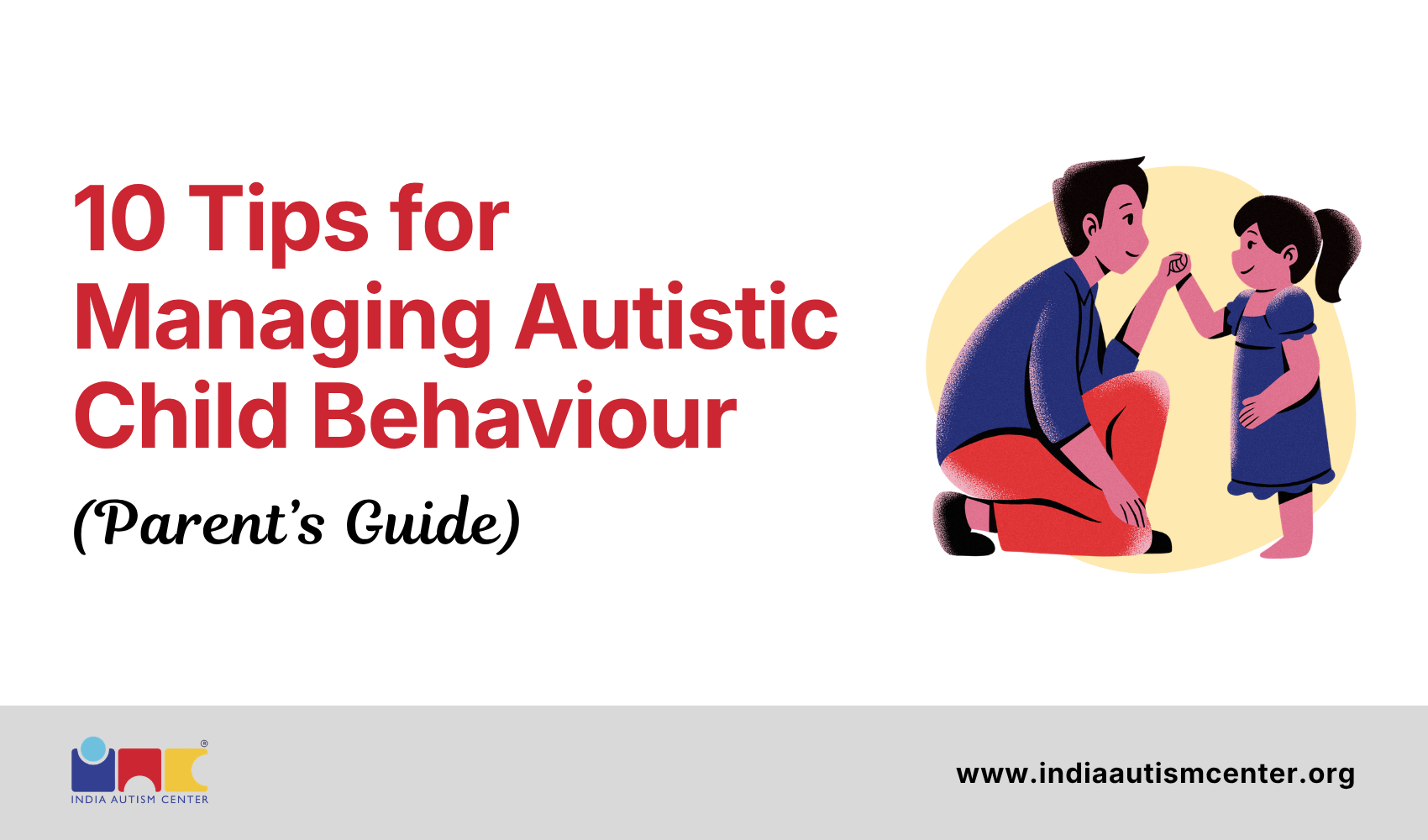
Your child is screaming. Nothing is working. You feel helpless. What do you do next? As a parent or caregiver, managing an autistic child’s behaviour can sometimes feel overwhelming. Every day brings new challenges, questions, and emotional moments.
When your child struggles with behaviour, especially if they show signs similar to high-functioning autism behavior problems, you might wonder: What works? What doesn’t? How do I respond with patience and understanding?
In this detailed guide, I’m going to walk you through strategies that helped me—and can help you too—with behaviour issues, communication barriers, sensory needs, and emotional regulation.
Understanding the Challenge: Why Behaviour Happens
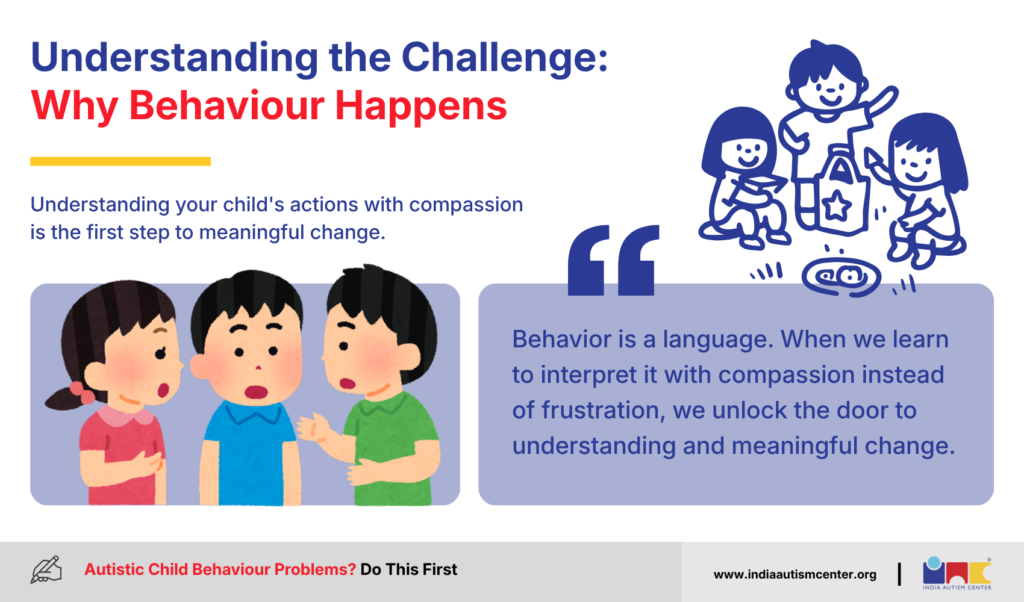
Before diving into strategies, it’s vital to understand that behaviour in autistic children isn’t about “being difficult.” Most often, behaviours are communication; it’s your child’s way of expressing discomfort, anxiety, or unmet needs.
Some behaviours may look like tantrums or meltdowns. Others might be repetitive actions, withdrawal, or avoidance. Especially with high-functioning autism, behaviour problems, the challenges may be subtler but still impactful in daily life.
When I started learning about managing an autistic child’s behaviour, I realised that behaviour is a language. If we learn to interpret it with curiosity and compassion, we can customise our responses for meaningful change.
1. Educate Yourself About Autism
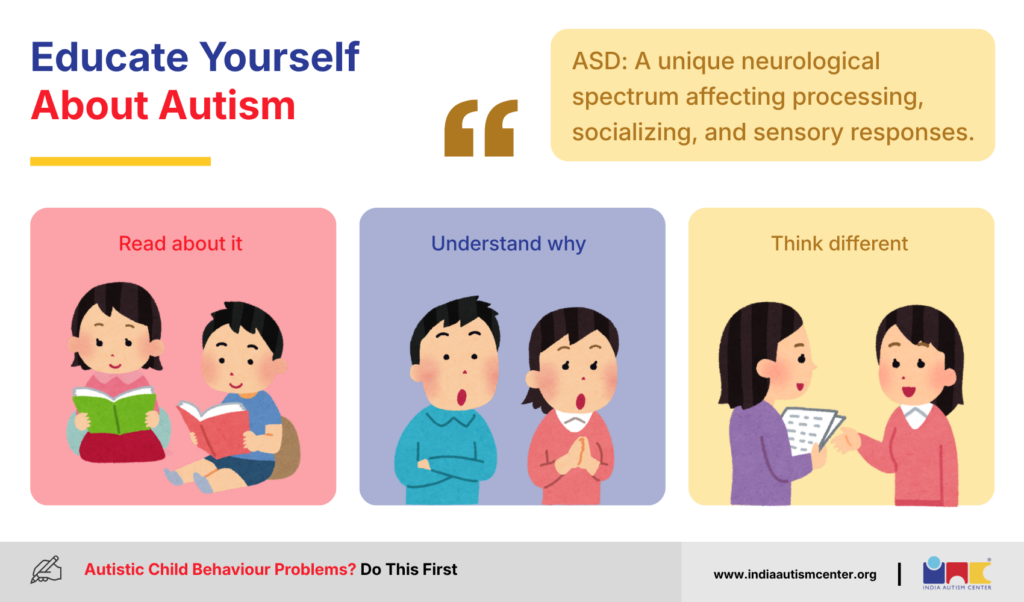
The first step in managing behaviour is simple—learn more about autism.
Autism Spectrum Disorder (ASD) is a neurological difference that affects how a child processes information, interacts with others, and responds to sensory input. There isn’t “one behaviour of autism.” Every child’s profile is unique. Learning about autism helps you respond with clarity, not frustration.
What to do:
- Read reliable resources about autism, especially guides that explain behaviour traits.
- Understand the why behind certain actions—like sensory overload or communication struggles.
- Think of behaviour as communication rather than misbehaviour.
When you know your child’s strengths and challenges, you can adapt your approach. This is the foundation of how to deal with autism behaviour problems.
Want to know more? Get in touch with us.
2. Get Professional Guidance Early
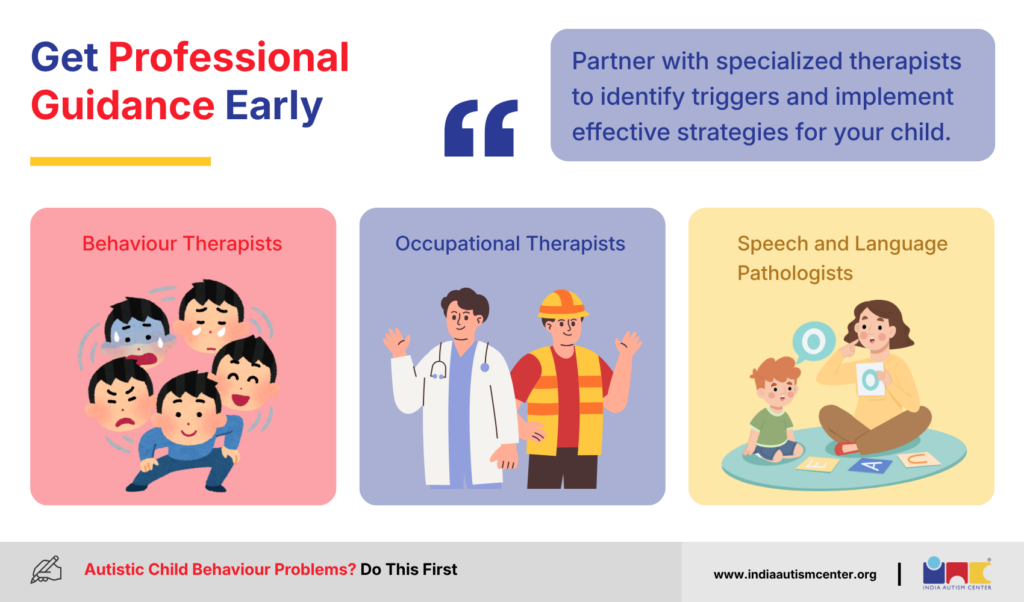
You don’t have to do this alone. Consult professionals such as:
- Behaviour Therapists (ABA, for example)
- Occupational Therapists
- Speech and Language Pathologists
Applied Behaviour Analysis (ABA) is often recommended because it breaks down behaviours into measurable steps. A trained professional can help you understand triggers and tailor strategies that actually work for your child.
What helped me:
- A therapist helped identify specific triggers for my child’s meltdowns. This insight allowed me to prepare for many outbursts rather than react to them.
- Together, we set up simple reinforcement plans that showed big results over time.
3. Create a Consistent, Structured Environment
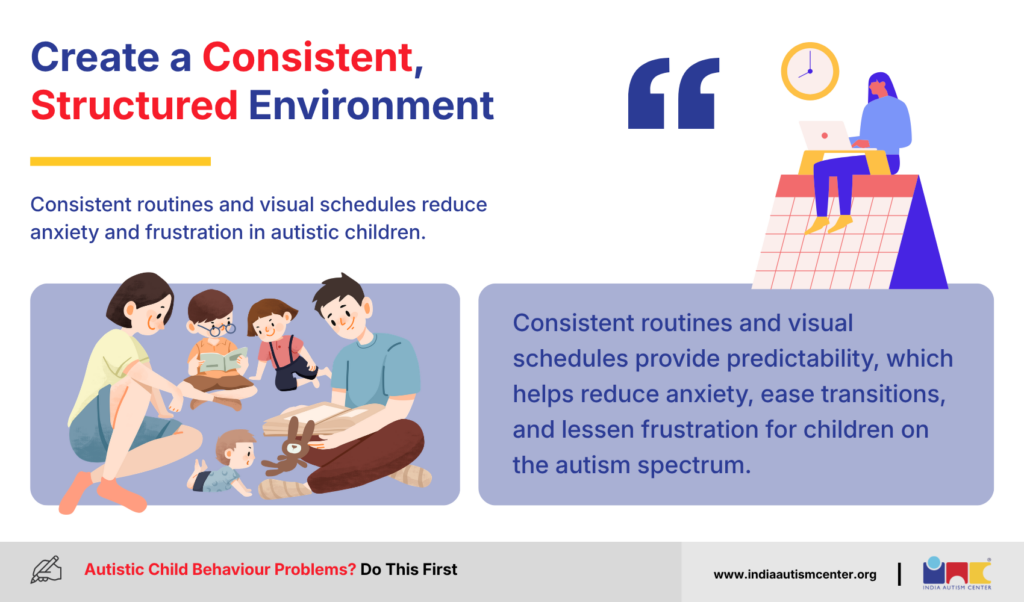
Consistency is key. Children on the autism spectrum often thrive on routine. When they know what to expect, they feel safe—and safe children behave better.
Here’s how structure helps:
- Routines decrease anxiety and unexpected reactions.
- Predictable schedules give your child a sense of control.
- Transitions (e.g., playtime to dinner) become easier with clear signals.
You can use visual schedules or simple charts to illustrate the day. These act as behaviour anchors to reduce confusion and frustration—especially helpful if your child shows signs of high-functioning autism-related behaviour problems.
This blog on Autism Therapies at Home will help you plan your routine effectively. Don’t forget to check it out.
4. Use Visual Supports to Communicate Clearly
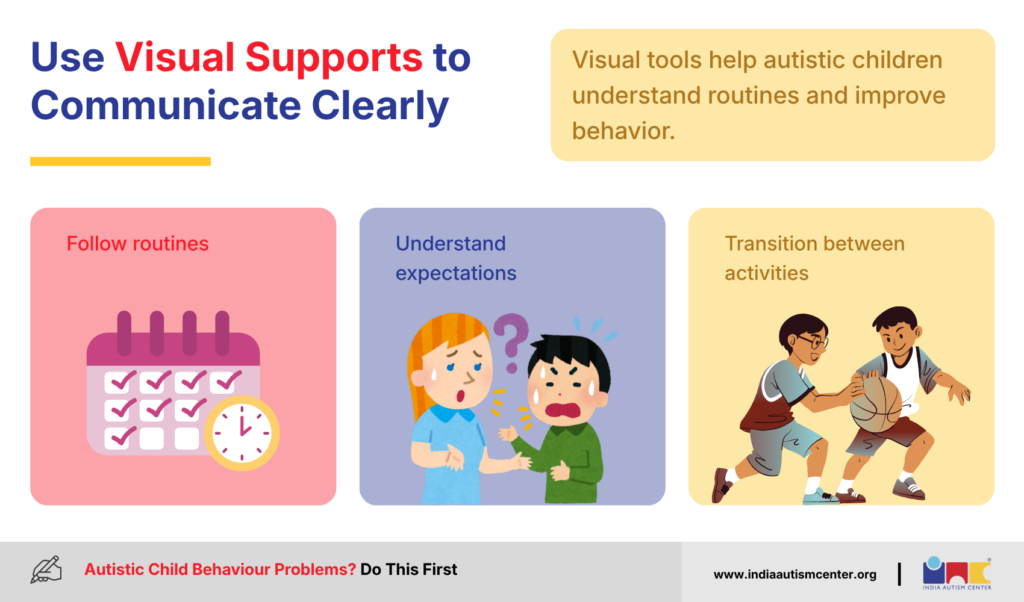
Many autistic children find visual information easier to understand than spoken words. Visual supports help your child:
- Follow routines
- Understand expectations
- Transition between activities
Examples of visual tools:
- Picture cards
- Timers or visual clocks
- Social stories that explain situations step by step
I found that when my child could see what was coming next, behaviour improved significantly. Visual reminders reduce surprises, and fewer surprises mean fewer behaviour challenges.
5. Create Sensory-Friendly Spaces
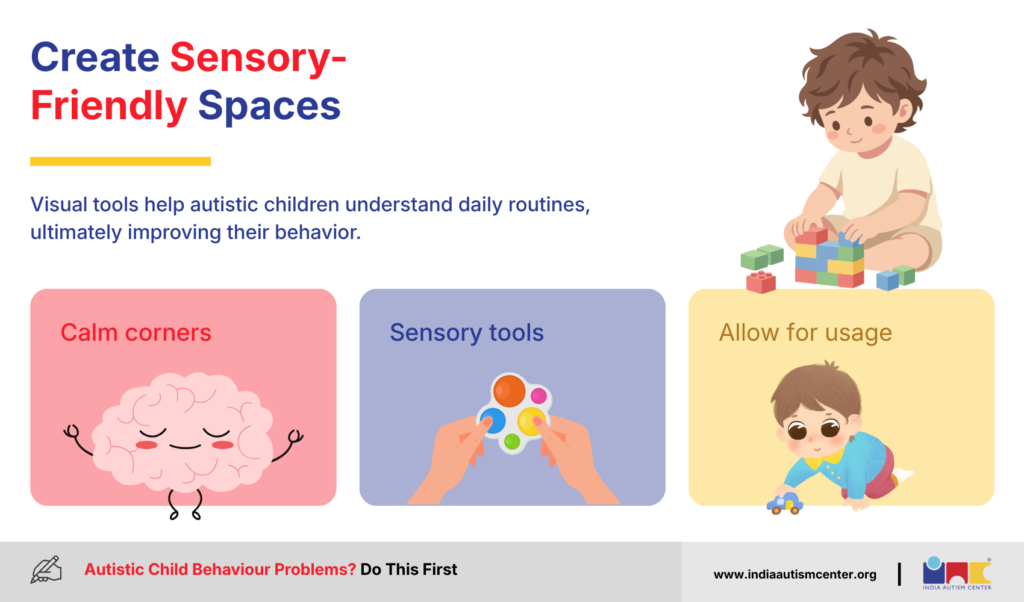
Sensory sensitivities often play a big role in behaviour. Loud sounds, bright lights, and unexpected touch can overwhelm a child’s nervous system, leading to behaviours that seem confusing or disruptive.
To support sensory needs:
- Set up calm corners with soft lighting.
- Provide sensory tools like fidget toys, weighted blankets, or noise-cancelling headphones.
- Let your child use these tools when needed.
When we identify sensory triggers and provide supportive spaces, many behaviour challenges become easier to manage.
6. Communicate in Ways Your Child Understands
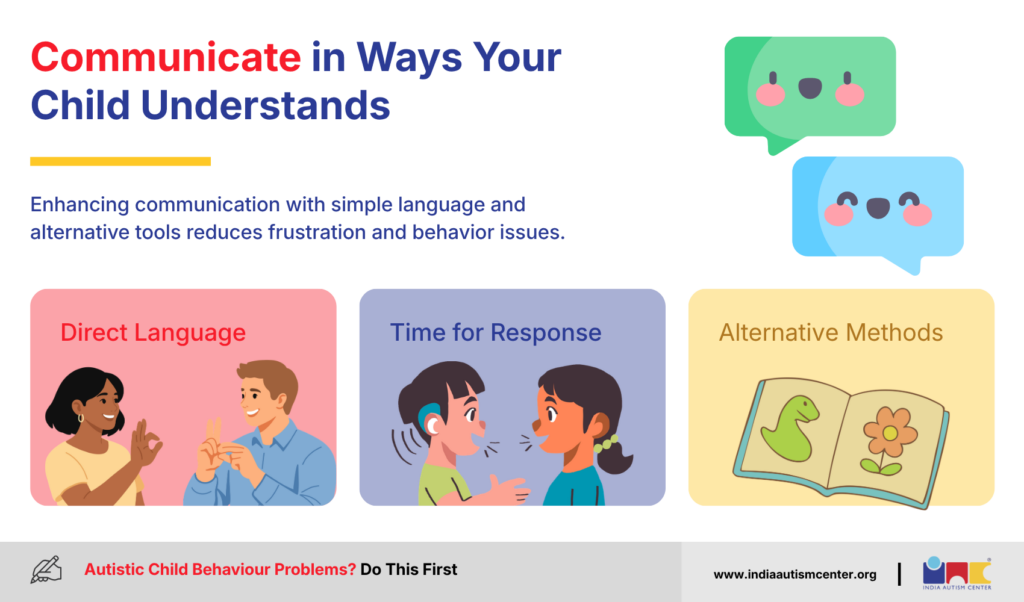
Communication difficulties are a major cause of frustration and behaviour issues. When your child can’t express themselves, their emotions often show up in behaviour.
Here’s how to help:
- Use simple, direct language.
- Allow extra time for your child to respond.
- Consider alternative communication methods like picture exchange systems or apps.
Be patient. Celebrating even small attempts at communication can build confidence and reduce challenging behaviours.
Want to know more? Get in touch with us.
7. Reinforce Positive Behaviour Every Day
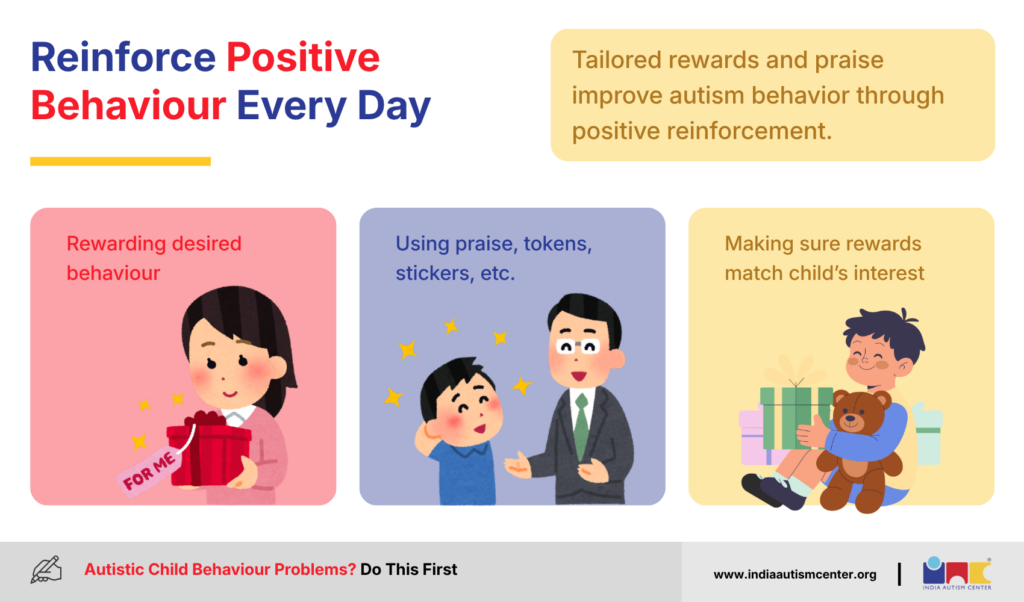
One of the most practical ways of dealing with autism behaviour problems is through positive reinforcement.
Positive reinforcement means:
- Rewarding desired behaviour
- Using praise, tokens, stickers, or preferred activities
- Making sure rewards match your child’s interests
8. Teach Self-Regulation and Coping Skills
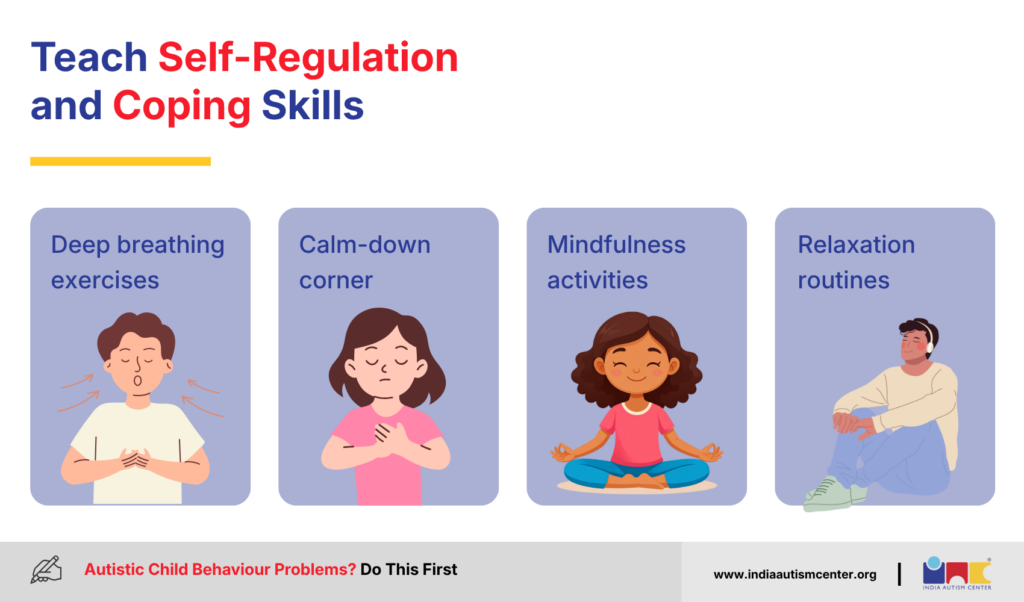
Self-regulation helps your child manage emotions like frustration, anger, or overstimulation. It’s a lifelong skill that can transform behaviour.
Some effective techniques include:
- Deep breathing exercises
- Calm-down corner with sensory tools
- Simple mindfulness activities
- Guided relaxation routines
When your child learns to regulate their feelings, you’ll see fewer intense reactions, especially during stressful times.
9. Use Social Stories to Build Understanding
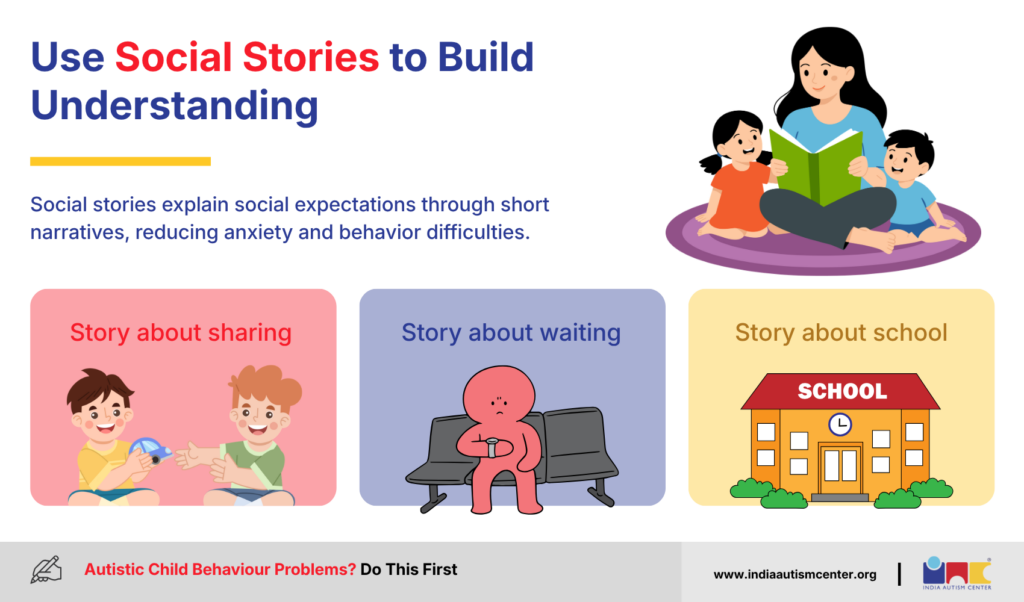
Social stories are short narratives that explain challenging social situations in simple terms. These help children understand why certain behaviours are expected and what to do in specific scenarios.
For example:
- A story about sharing toys
- A story about waiting for your turn
- A story about going to school
Social stories help children anticipate and prepare for real-life interactions, which can reduce anxiety and behaviour difficulties.
10. Collaborate with Schools and Caregivers
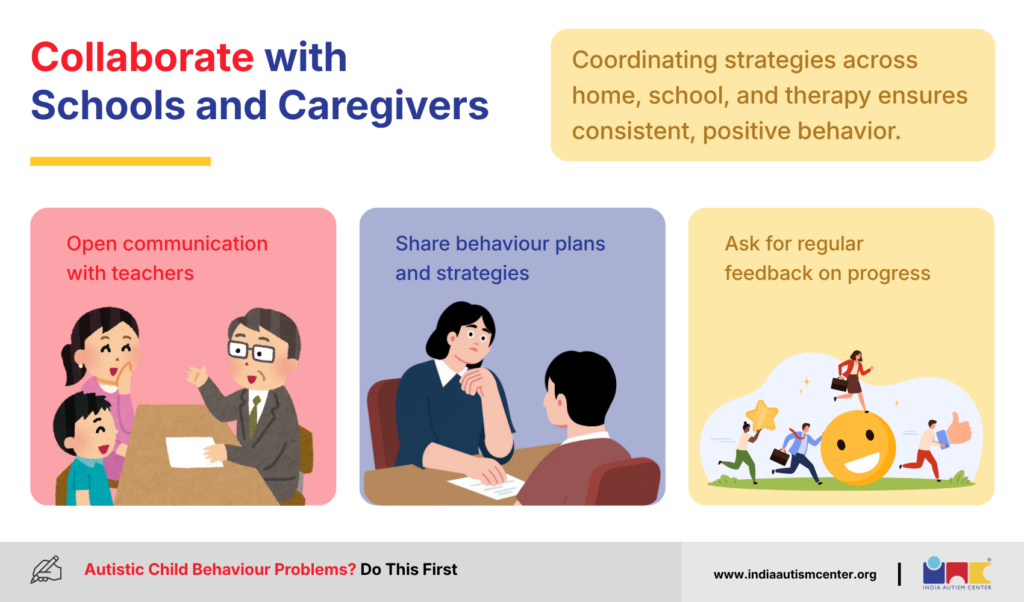
If your child attends school or therapy programs, coordination is essential. Consistent expectations across home, school, and therapy help reinforce positive behaviour everywhere your child goes.
Here’s how to collaborate effectively:
- Maintain open communication with teachers and therapists.
- Share behaviour plans and strategies that work at home.
- Ask for regular feedback on progress.
A unified support system makes managing an autistic child’s behaviour much more achievable.
Before we dive into the next section, here is an awesome article on A Guide to the Challenges in Autism [2026]
Understanding Autistic Burnout and Fatigue
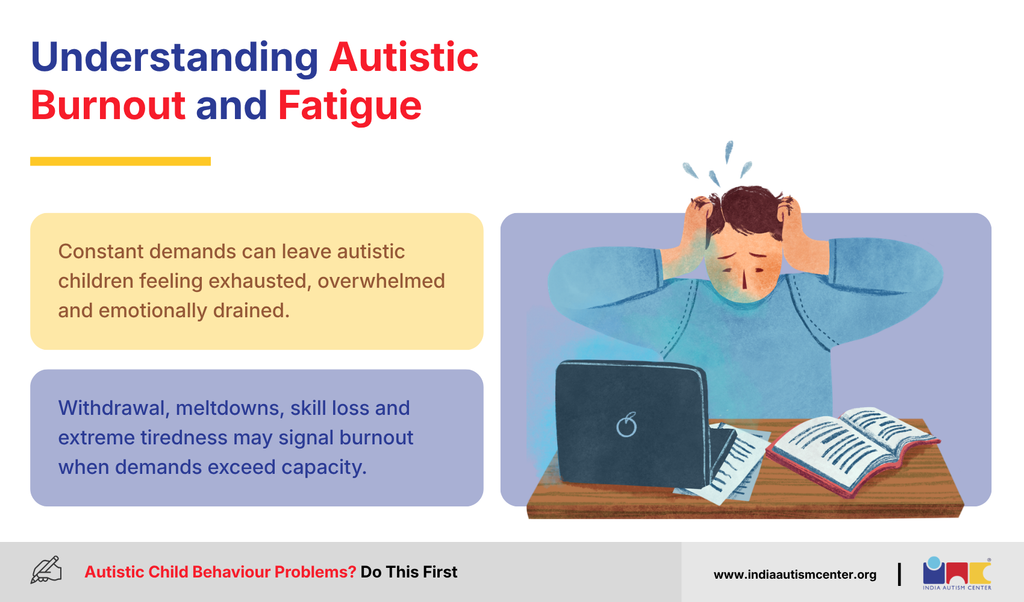
Here’s something I wish someone had told me earlier: our children are working incredibly hard every single day just to get through ordinary life.
Navigating a noisy classroom, following unspoken social rules, holding themselves together when the lights are too bright, or the schedule changes – all of this takes enormous energy. Over time, that constant effort leads to what researchers and clinicians now call autistic burnout or autistic fatigue. It’s real, it’s common, and it’s often mistaken for a behaviour problem.
What it looks like:
- Withdrawal – your child becomes quieter, more isolated, and refuses activities they usually enjoy
- Increased meltdowns or shutdowns – even small triggers cause big reactions
- Loss of skills – a child who was speaking in sentences may go back to single words; toilet training may regress
- Extreme tiredness – sleeping more than usual, or struggling to sleep at all
What you can do:
- Build in genuine rest time – not screen time, but low-demand, quiet time with no expectations
- Reduce demands temporarily – if your child is burning out, this is not the moment to push new skills
- Create a safe quiet space at home where they can decompress without being asked anything
- Watch for patterns – burnout often follows a high-demand period like exams, festivals, or a change in routine
If you notice your child losing skills they previously had, speak to their therapist or paediatrician. It’s a signal worth taking seriously.
Managing Transitions Without Meltdowns
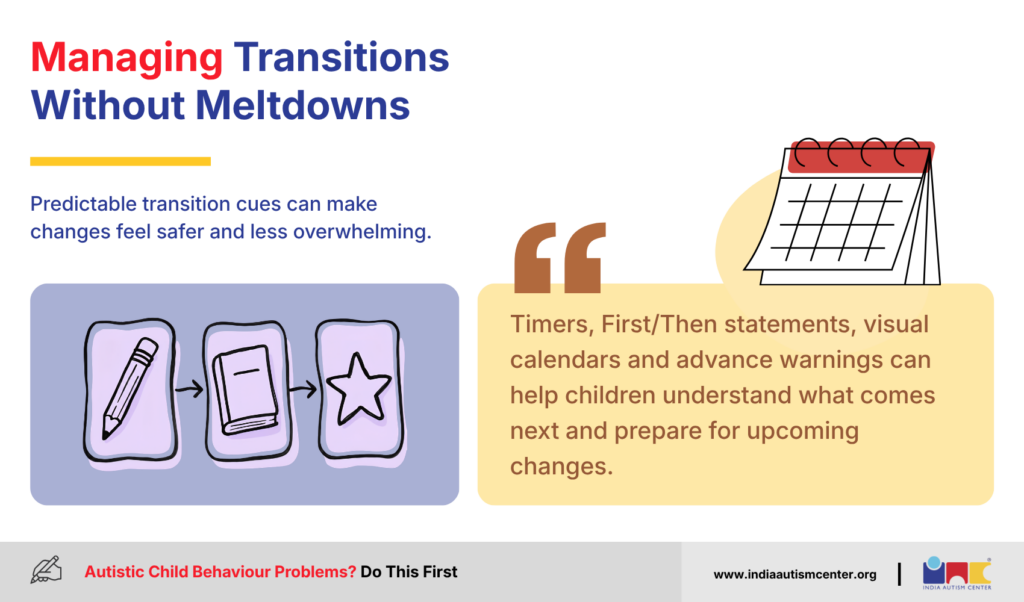
Transitions are one of the hardest parts of the day for many autistic children. Not just big changes – even small ones, like moving from playtime to dinner, or from school to home, can feel abrupt and overwhelming.
The problem isn’t stubbornness. It’s that autistic children are often deeply absorbed in what they’re doing, and an abrupt “stop now” feels like a shock to the system.
Practical tools that actually help:
- Timers as audible cues – a visual timer (like the Time Timer app or a sand timer) gives your child a concrete, visible countdown. “Five more minutes, then we eat.” They can see time running out, which is far less jarring than a sudden verbal command.
- First/Then statements – keep it simple and concrete. “First finish dinner, then iPad.” “First shoes on, then we go to the park.” This tells your child exactly what comes next, which reduces anxiety about the unknown.
- Visual calendars with images – a picture-based daily schedule on the wall or a small card in their pocket shows the sequence of the day. When your child can see that school comes before home, and home comes before dinner, transitions feel predictable rather than random.
- Transition warnings – give a 10-minute warning, then a 5-minute warning. Consistency matters here. Do it the same way every time, and your child will start to trust the signal.
The goal isn’t to eliminate transitions – it’s to make them feel safe.
Use Positive Language – Tell Them What TO Do
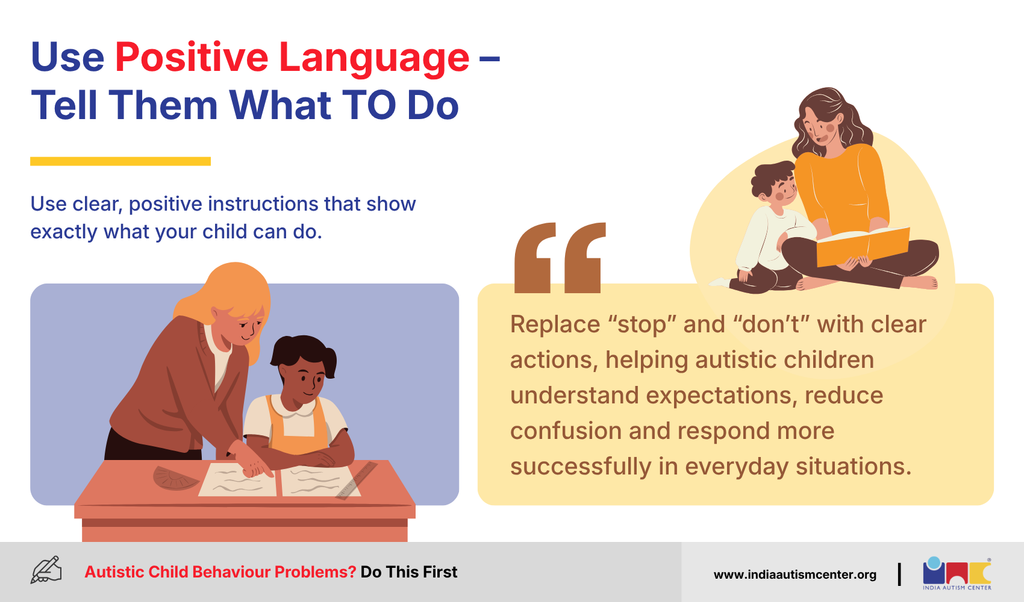
This one is a mindset shift, and it changed how I communicate with my child completely.
When we say “stop hitting” or “don’t run,” we’re telling a child what not to do – but we’re not giving them anything to replace it with. Autistic children, especially those who process language literally, need to hear the desired behaviour, not the behaviour to avoid.
The shift in practice:
| Instead of saying… | Say this instead… |
|---|---|
| “Stop hitting your sister.” | “Keep your hands in your lap.” |
| “Don’t run in the corridor.” | “Walk slowly with me.” |
| “Stop shouting.” | “Use your quiet voice, please.” |
It sounds simple. But it works because it gives your child a clear, actionable instruction – something they can do, not just something to stop.
Why it matters for autistic children:
- It reduces confusion and processing load
- It focuses attention on the correct behaviour, making it easier to reinforce
- It keeps the interaction calm and directive, rather than reactive
Next time you catch yourself saying “don’t” or “stop,” pause for a second and ask: what do I actually want them to do? Then say that.
Meltdowns Are Not Tantrums – Know the Difference
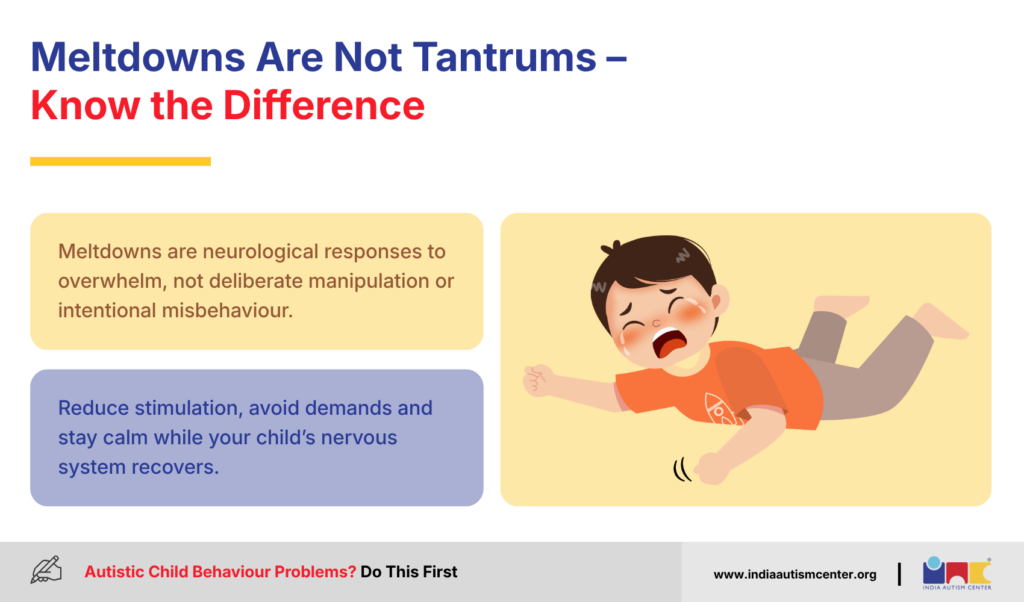
This distinction is one of the most important things I’ve learned as a parent – and getting it wrong leads to responses that make things much worse.
A tantrum is goal-directed. Your child wants something – a toy, more screen time, to avoid a task – and the behaviour is (consciously or not) aimed at getting it. Tantrums usually stop when the child gets what they want, or when the audience leaves.
A meltdown is a neurological response to overwhelm. Your child has hit a wall. Their nervous system is flooded. They are not in control, and they cannot simply stop – even if they want to. Meltdowns are not manipulation. They are not a choice.
Signs you’re looking at a meltdown, not a tantrum:
- It escalates even when you try to give them what they want
- Your child seems genuinely distressed, not strategic
- There may be stimming (rocking, hand-flapping), covering ears, or going silent
- Recovery takes time – often 20–40 minutes – and is followed by exhaustion
What to do during a meltdown:
- Reduce stimulation immediately – turn off the TV, dim the lights, move to a quieter space if possible
- Do not demand compliance – this is not the moment for “look at me” or “calm down now.” Those instructions add more input to an already overloaded system
- Wait it out calmly – your calm presence is the most powerful thing you can offer. Sit nearby, stay quiet, and let the storm pass.
Once your child is calm and regulated again – that’s when you can reconnect, comfort, and, if needed, gently problem-solve.
A more detailed blog on How to Handle Autism Meltdown: Complete Guide for Parents and Caregivers.
What Worked for Many Parents: Tips That Actually Worked
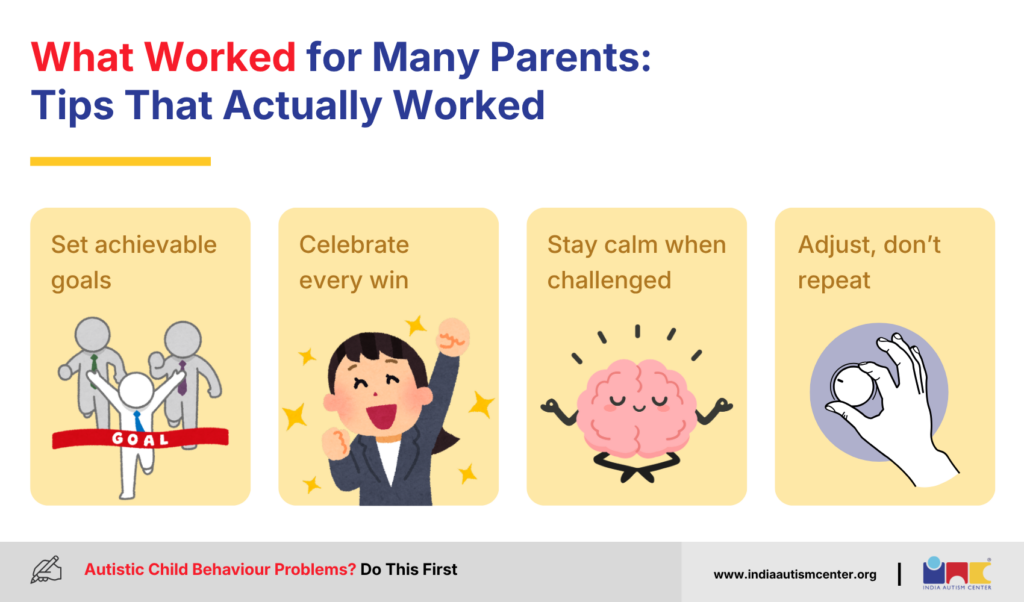
Here are some personal, practical insights that made a real difference in my journey:
Set Small, Achievable Goals
Big behaviour changes take time. I started with tiny achievable goals, like staying calm through one transition. That felt small, but it built confidence.
Celebrate Every Win
Whether it was one less meltdown or one extra word spoken, we celebrated. These celebrations helped reinforce good behaviour.
Stay Calm During Challenges
When I stayed calm, even amidst behaviour episodes, our home environment became more predictable and safe—this helped reduce triggers.
Adjust, Don’t Repeat
When something didn’t work, I didn’t repeat it the same way. I adjusted. Behaviour management is flexible—it evolves with your child.
These strategies aren’t one-size-fits-all, but with consistency, they can bring real progress and meaningfully teach your child how to cope, communicate, and thrive.
📥 Free download: Printable daily routine chart for autistic children
Conclusion
Remember:
- Behaviour is communication.
- Structure builds safety.
- Positive reinforcement encourages growth.
- Your love, patience, and consistency matter most.
You don’t have to be perfect, just keep learning, adjusting, and showing up every day.
You are not alone—and your efforts make a difference.
Frequently Asked Questions (FAQs)
What are the most effective ways for managing an autistic child’s behaviour at home?
Managing an autistic child’s behaviour at home becomes easier when you follow a consistent routine, use visual supports, and respond calmly. Focus on understanding what triggers your child’s behaviour. Positive reinforcement, sensory-friendly spaces, and clear communication help reduce behaviour challenges over time.
How do I deal with autism behaviour problems without using punishment?
If you are wondering how to deal with autism behaviour problems, avoid punishment and focus on teaching skills instead. Use positive reinforcement, redirect unwanted behaviour, and teach coping strategies like deep breathing or calm-down breaks. Behaviour improves when children feel safe, understood, and supported.
Are high-functioning autism behaviour problems different from other autism behaviour challenges?
Yes, high-functioning autism behaviour problems may look different. Children may communicate well but still struggle with emotional regulation, social understanding, or anxiety. These challenges often appear as frustration, rigidity, or emotional outbursts. Structured routines and social skills support are especially helpful in such cases.
What are some tips that improved my autistic child’s behaviour over time?
Some tips that improved my autistic child’s behaviour include setting small goals, praising positive actions immediately, staying calm during meltdowns, and adjusting strategies when something didn’t work. Consistency, patience, and understanding your child’s sensory and emotional needs make a big difference.
Disclaimer: This article is intended for educational and informational purposes only. It is not a substitute for professional medical advice, diagnosis, or treatment. If you are pregnant or have concerns about medication use during pregnancy, please consult a qualified healthcare provider. If your child has received an autism diagnosis and you have questions about causes or support, please reach out to a trained specialist or an autism-focused organisation for guidance.
For expert insights, support services, and inclusive learning initiatives, contact India Autism Center for more information.
Useful Sources
Autistic Fatigue – National Autistic Society (NAS)