 Donate now
 Get a Call Back
 MENU
MENU 20 MIN READ
 SHARE
SHARE


Picture this: you’re at a Diwali mela with your child. The firecrackers go off, the crowd surges, the lights flash – and within seconds, your child is on the ground, screaming, inconsolable. Or maybe it’s something smaller: every morning is a battle over the school uniform because the collar “feels wrong.” You’ve been told it’s stubbornness, attention-seeking, bad parenting. It isn’t any of those things.
Sensory issues in autism are neurological, not behavioural. They happen because the autistic brain processes sensory information differently – more intensely, less intensely, or in ways that simply don’t match the environment around it. Research published on PubMed Central estimates that up to 90% of autistic individuals experience atypical sensory responses. That’s not a quirk. That’s a core feature of autism, formally recognised in the DSM-5 under Criterion B4.
This article covers what sensory issues actually are, the 8 sensory systems involved, the difference between hypersensitivity and hyposensitivity, what sensory overload looks like, and – most importantly – what you can do about it as a family in India.
Understanding Sensory Issues in Autism
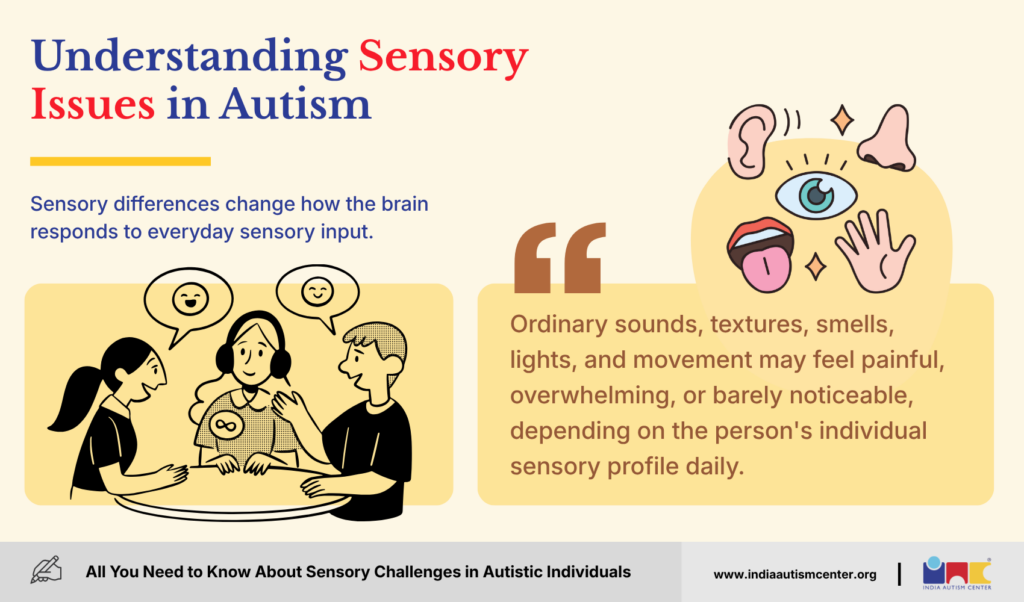
Sensory issues – also called sensory processing differences – refer to the way an autistic person’s brain receives, filters, and responds to information coming in through the senses. For most people, the brain acts like a smart filter: it turns down the background hum of a ceiling fan, ignores the feel of a shirt collar, and focuses on the conversation in front of you. For many autistic individuals, that filter doesn’t work the same way.
The result? Ordinary sensory input – a school bell, a scratchy dupatta, the smell of a neighbour’s cooking – can register as genuinely painful, terrifying, or completely invisible. According to a review in PMC (2020), approximately 90% of people with ASD experience some form of atypical sensory response. These autism sensory issues are not a phase, and they’re not something a child will “grow out of” without the right support.
Since 2013, sensory differences have been formally embedded in the autism diagnostic criteria. DSM-5 Criterion B4 specifically lists “hyper- or hypo-reactivity to sensory input or unusual interest in sensory aspects of the environment” as one of the defining features of ASD. This matters because it means sensory challenges autism families deal with every day are clinically recognised – and deserve clinical support.
The 8 Sensory Systems – Not Just the Usual Five
Most of us learned about five senses in school. But the human nervous system actually processes eight distinct streams of sensory information. All eight can be affected in autism.
- Vision – How the brain interprets light, colour, movement, and visual patterns. Autism example: A child becomes distressed by the flickering of fluorescent tube lights in a classroom.
- Hearing – How the brain processes sound, pitch, and volume. Autism example: A child covers their ears and cries when a pressure cooker whistles, even from another room.
- Touch (Tactile) – How the brain reads pressure, texture, temperature, and pain on the skin. Autism example: A child refuses to wear any clothing with an inner label or a tight elastic waistband.
- Taste (Gustatory) – How the brain interprets flavour, texture, and temperature in the mouth. Autism example: A child will only eat foods of a specific texture – plain rice, no dal, nothing mixed – and gags at anything else.
- Smell (Olfactory) – How the brain processes scent. Autism example: A child refuses to enter the kitchen when certain spices are being cooked, even if the smell is mild to everyone else.
- Proprioception – The sense of where your body is in space, including awareness of muscle tension and joint position. Autism example: A child constantly bumps into walls, misjudges distances, or seeks bear hugs and heavy blankets for deep pressure input.
- Vestibular – The sense of balance, movement, and spatial orientation, processed in the inner ear. Autism example: A child spins endlessly without getting dizzy, or conversely, panics at the top of a staircase.
- Interoception – The brain’s awareness of internal body signals: hunger, thirst, pain, heartbeat, bladder fullness, temperature. Autism example: A child doesn’t signal when they need the toilet, or doesn’t notice they’re hungry until they’re in a full meltdown from low blood sugar.
Understanding all eight systems is essential. Sensory challenges autism families notice are rarely limited to just hearing or touch – they often span multiple systems at once.
Sensory Overload and Autism
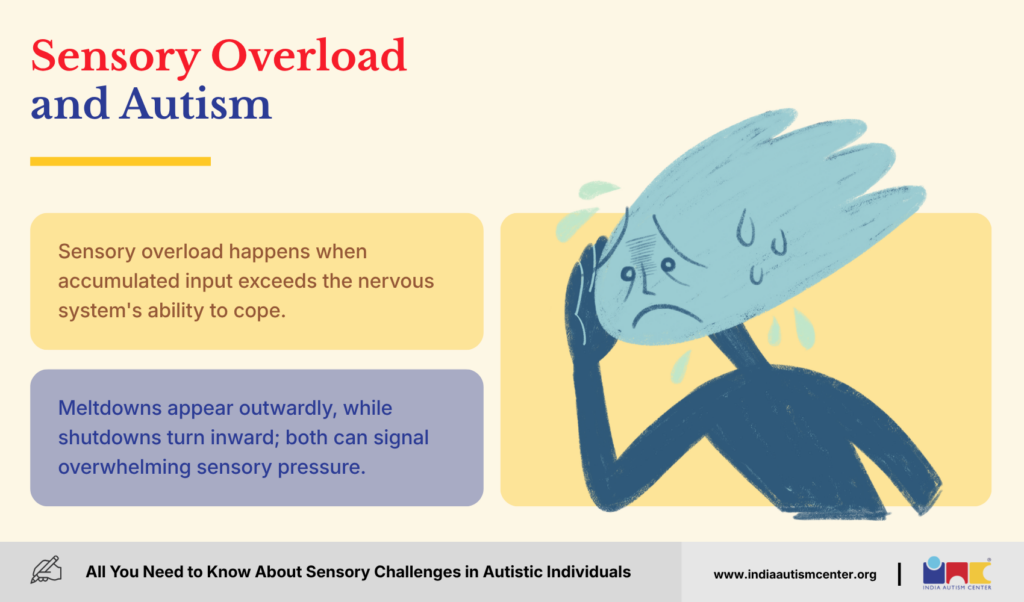
Think of the autistic nervous system as a glass that fills faster than neurotypical glasses. Every sensory input – the hum of the AC, the smell of lunch, the tag on the shirt, the noise of traffic – adds a little more to the glass. When the glass overflows, the result is sensory overload.
What happens in the brain during overload is not a choice. The amygdala – the brain’s threat-detection centre – fires as if there’s genuine danger. The stress hormones cortisol and adrenaline flood the system. The prefrontal cortex, responsible for reasoning and self-regulation, goes offline. At that point, your child is not being naughty. They are in a neurological emergency.
Overload expresses itself in two very different ways:
Meltdown – An external, outward response. Crying, screaming, hitting, throwing objects, running away. This is the nervous system releasing unbearable pressure. It is not a tantrum. Tantrums are goal-directed (a child wants something). Meltdowns are neurological – they happen because the system has exceeded its capacity, full stop.
Shutdown – An internal, inward response. The child goes quiet, withdraws, stops responding, stares blankly, or curls up. This can look like compliance or calm, but it’s actually the nervous system shutting non-essential functions down to cope. Shutdowns are often missed or misread as the child “being fine.”
Early warning signs of sensory overload – watch for these:
- Covering ears or eyes without an obvious reason
- Increased stimming (rocking, hand-flapping, humming) – the nervous system self-regulating
- Becoming clingy or unusually quiet in a busy environment
- Refusing to enter a room or a building
- Complaints of headache, stomach ache, or “feeling sick” in sensory-heavy settings
- Irritability or tearfulness that seems disproportionate to the situation
- Skin-picking, nail-biting, or other self-soothing behaviours ramping up
- Asking to go home repeatedly
Catching these signs early – before the glass overflows – is the most effective intervention available to any parent.
Want to know more? Get in touch with us.
Why Sensory Processing Matters in Autism
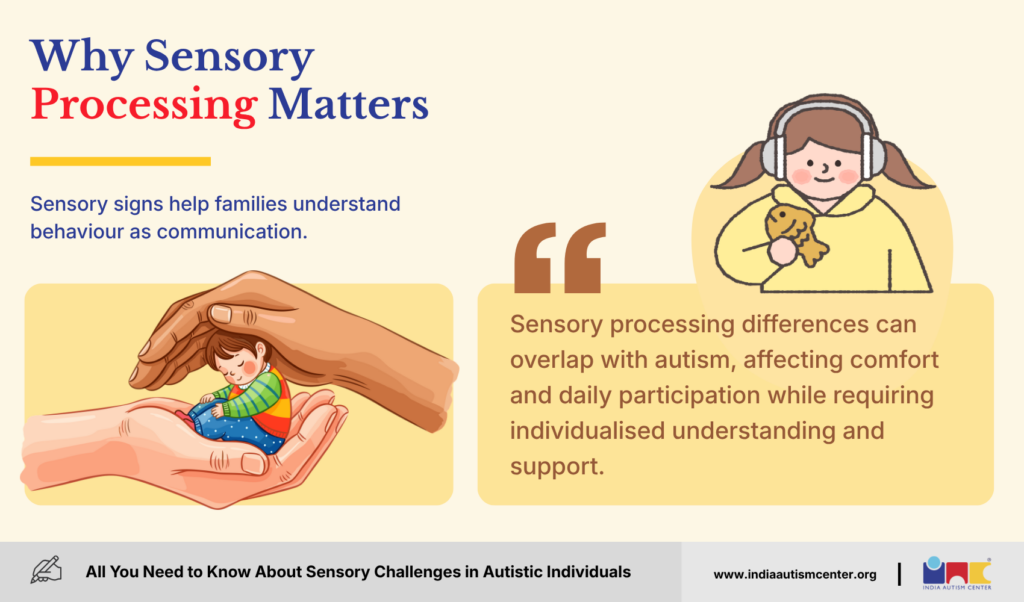
To understand these sensory challenges clearly, let’s talk about sensory processing disorder (SPD). Although SPD isn’t a formal medical diagnosis, it describes a pattern where the brain has trouble interpreting sensory signals, like sight, sound, touch, and movement.
Sensory Processing vs Autism
You might wonder — is sensory processing disorder the same as autism sensory issues? Not always. Sensory processing differences are part of autism for many people, but not everyone with autism has SPD, and some neurotypical people can also have sensory processing differences.
Still, the overlap is significant. For example, about three out of four autistic children also experience symptoms of sensory processing challenges.
Understanding this overlap helps you see sensory challenges in context — they’re part of the sensory world of many autistic individuals, and they can shape behaviour and comfort in daily life.
Read our blog on Understanding Sensory Processing Disorder.
Signs of Sensory Challenges in Autism
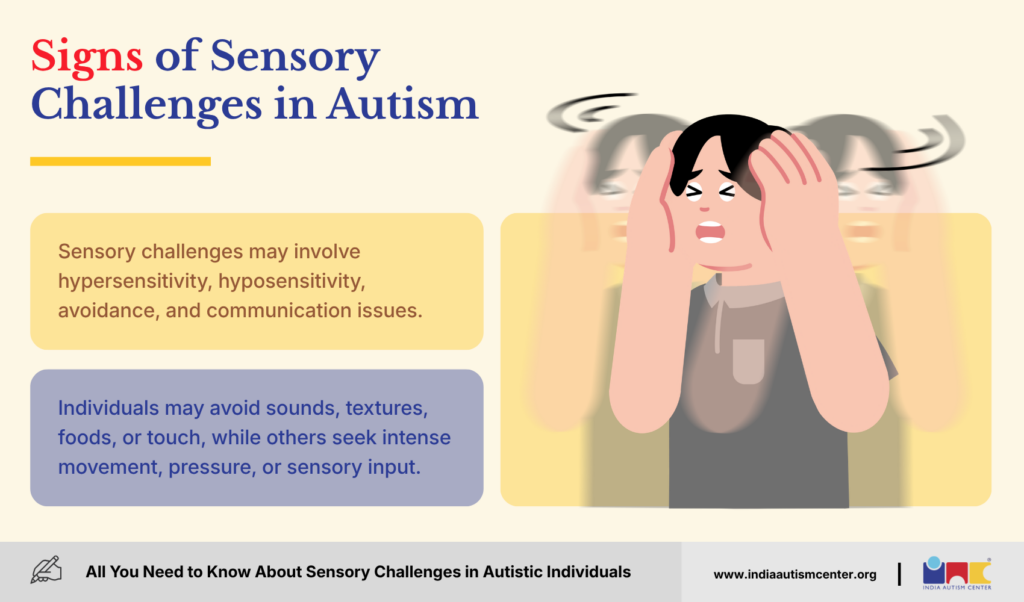
Recognising the signs of sensory problems in autistic individuals is crucial for understanding and supporting them effectively.
Some common signs include:
- Hypersensitivity: Some autistic individuals are hypersensitive to certain stimuli. They might cover their ears in response to normal sounds, avoid certain textures of clothing, or become distressed by bright lights. Example reactions include:
- Covering ears because noises feel too loud
- Avoiding tags on clothing
- Refusing certain foods due to texture
- Shying away from touch or unexpected sensations
- Hyposensitivity: On the other hand, hyposensitivity involves a decreased sensitivity to sensory input. An individual might not notice temperature extremes, engage in self-stimulatory behaviours (stimming) like repetitive movements, or seek out intense sensory experiences like jumping from heights. Examples include:
- Not noticing extreme temperatures
- Seek deep pressure or intense stimulation (like jumping or crashing)
- Have a high tolerance for pain
- Do not react to loud environments
- Avoidance Behaviours: Autistic individuals with sensory challenges often develop avoidance behaviours to cope with overwhelming stimuli. This can lead to limited social engagement, difficulty in daily activities, and challenges in academic or work settings.
- Communication Difficulties: Sensory issues can also impact communication. For instance, an individual might struggle to focus on a conversation in a noisy environment or become anxious when touched unexpectedly.
Sensory Processing Disorder in Autism
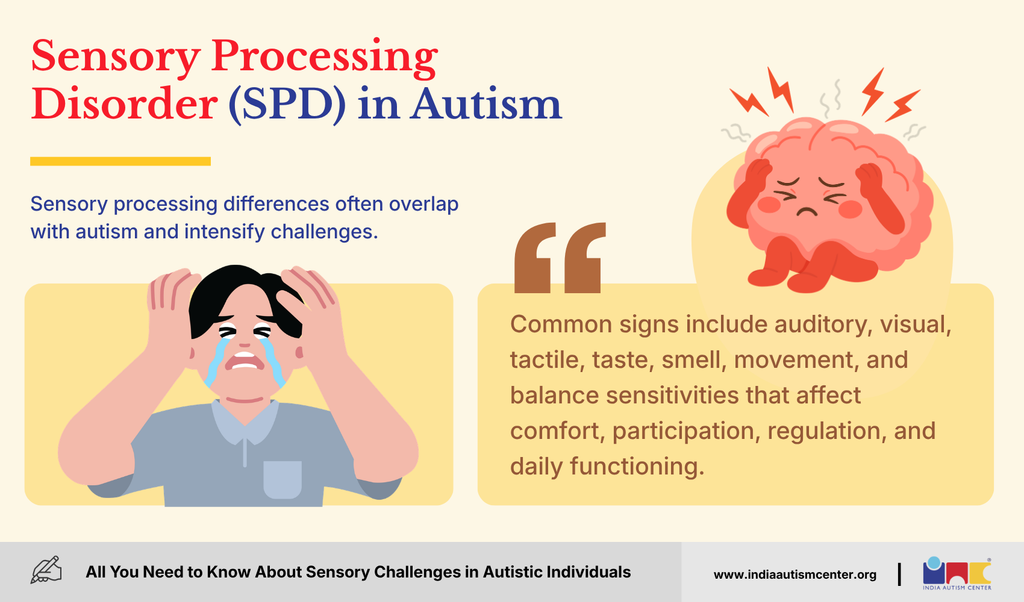
Sensory processing disorder in Autism is a condition where the brain has difficulty receiving and responding to sensory information. While not exclusive to Autism, SPD frequently co-occurs with the condition. Research suggests that around 75% of children with ASD also experience SPD (NIH). This overlapping occurrence of sensory challenges and Autism often intensifies the individual’s struggles in daily life.
Signs of Sensory Processing Disorder in Autism
Auditory Sensitivity
- Sensitive to loud or unexpected sounds
- Covers ears in busy environments
Visual Overload
- Bright lights or busy patterns feel stressful
- Prefers dim or calm lighting
Tactile Sensitivity
- Discomfort with certain textures
- Avoids touch or certain clothing fabrics
Taste and Smell Sensitivities
- Strong reactions to certain foods
- Avoids smells that others find mild
Movement and Balance Issues
- Unusual responses to movement
- May seek intense body sensations
Want to know more? Get in touch with us.
Hypersensitivity vs. Hyposensitivity: The Two Directions of Sensory Difference
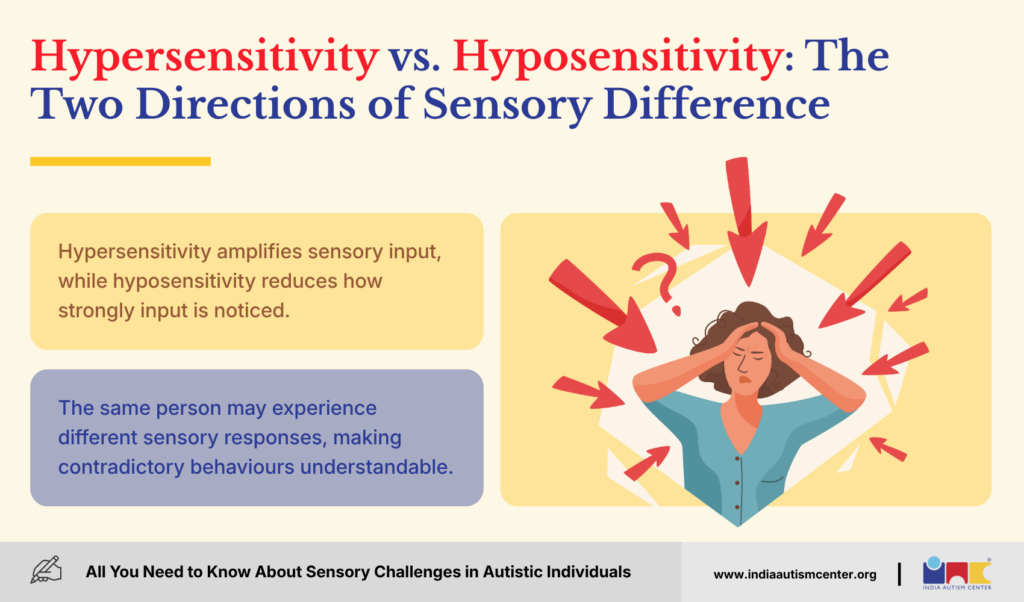
Here’s something that trips up even experienced parents: sensory differences don’t run in just one direction. Some autistic children are over-responsive (hypersensitive) – their nervous system amplifies input. Others are under-responsive (hyposensitive) – their nervous system dampens it. And the same child can be hypersensitive in one system and hyposensitive in another, sometimes simultaneously.
| Sensory System | Hypersensitivity (Over-Responsive) | Hyposensitivity (Under-Responsive) |
|---|---|---|
| Hearing | Covers ears at normal sounds; distressed by sudden noises | Doesn’t respond to their name; seeks loud music |
| Vision | Distressed by bright lights or busy patterns | Stares at lights or spinning objects for long periods |
| Touch | Avoids clothing tags, hugs, or unexpected touch | Seeks deep pressure; doesn’t feel pain normally |
| Taste | Refuses foods by texture or flavour; very restricted diet | Mouths non-food objects; seeks very strong flavours |
| Smell | Overwhelmed by mild odours; refuses certain rooms | Doesn’t notice strong smells; seeks intense scents |
| Proprioception | Avoids heavy physical activity | Crashes into furniture; seeks bear hugs, jumping |
| Vestibular | Fearful of swings, stairs, or uneven ground | Seeks spinning, rocking, swinging constantly |
| Interoception | Overwhelmed by internal signals; high anxiety | Doesn’t notice hunger, thirst, pain, or need to toilet |
This is why your child might seem contradictory – desperately seeking the deep pressure of a tight hug, but screaming when a relative touches their arm lightly. Both responses make complete neurological sense. The nervous system craves one type of input and is overwhelmed by another. Once you see it through this lens, the behaviour stops looking like contradiction and starts looking like communication.
Signs of Sensory Processing Disorder (SPD) in Autism
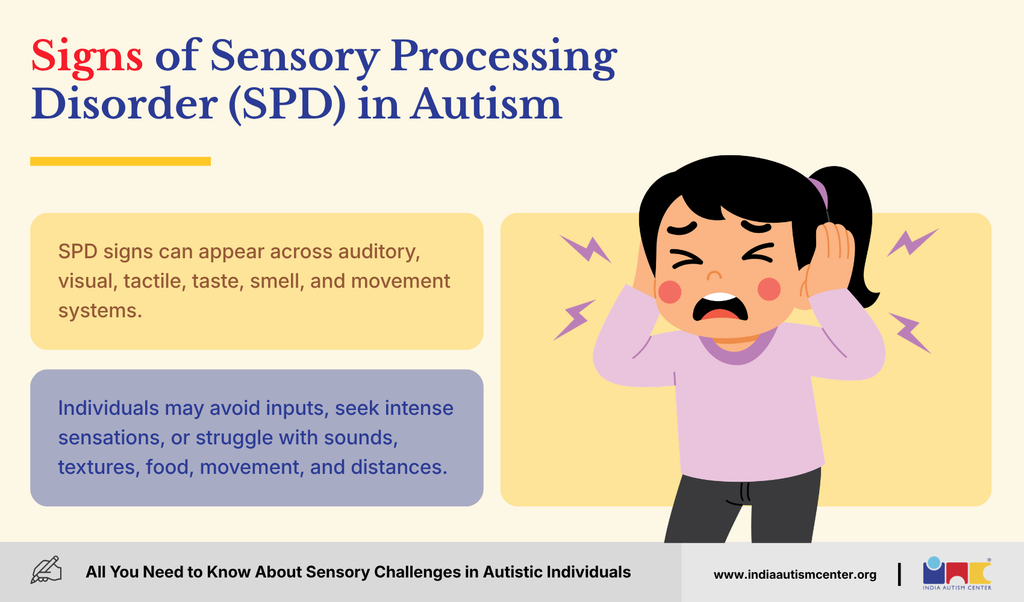
Sensory processing disorder (SPD) and autism sensory issues overlap significantly, but they’re not identical. Research suggests that around 75% of children with ASD also experience clinically significant SPD symptoms – a figure consistent with multiple NIH-indexed reviews. The overlap intensifies daily challenges, because a child managing both autism and SPD-level sensory difficulties faces a much higher baseline of sensory stress.
Signs of SPD in autism, by sensory channel:
Auditory (Hearing)
- Covers ears or becomes distressed in busy environments like markets, school assemblies, or wedding halls
- Startles excessively at sudden sounds – a door slamming, a dog barking
- Struggles to follow verbal instructions in noisy classrooms
Visual
- Distressed by bright sunlight, fluorescent lighting, or rapidly moving images
- Prefers dim rooms; may wear sunglasses indoors
- Fascinated by spinning objects, lights, or specific visual patterns for extended periods
Tactile (Touch)
- Refuses certain clothing fabrics, seams, or labels – a common trigger for school uniform battles in India
- Reacts strongly to unexpected touch, even from familiar people
- Seeks deep pressure – tight hugs, heavy objects, being wrapped tightly
Taste and Smell
- Extremely restricted diet based on texture, temperature, or flavour
- Gags or vomits at certain food smells
- Conversely, mouths non-food objects or seeks very intense tastes
Movement and Balance (Vestibular and Proprioceptive)
- Fearful of heights, escalators, or uneven ground
- Seeks constant movement – spinning, rocking, jumping on furniture
- Appears clumsy; misjudges spatial distances
Sensory Processing Disorder vs. Autism: Are They the Same?
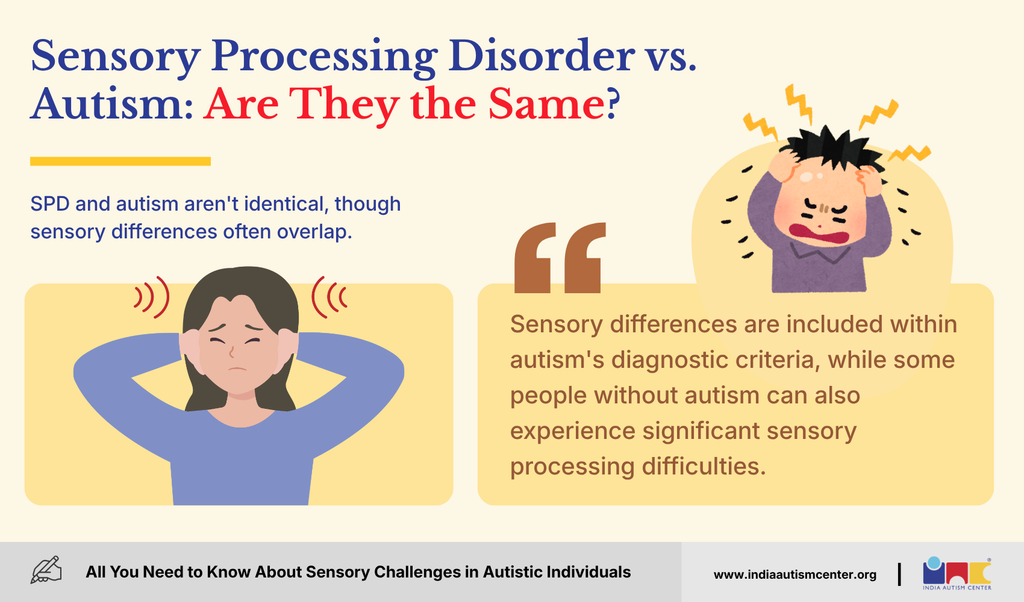
No – but the overlap is substantial, and the distinction matters for diagnosis and support.
SPD is not a standalone DSM-5 diagnosis. It is not listed as a separate condition in the current diagnostic manual. However, sensory differences are now formally embedded in autism’s diagnostic criteria under DSM-5 Criterion B4: “hyper- or hypo-reactivity to sensory input or unusual interest in sensory aspects of the environment.” This means that for autistic individuals, sensory processing differences are part of the diagnosis itself – not a separate add-on.
Some neurotypical people do experience SPD-like sensory difficulties without meeting autism criteria. And not every autistic person experiences sensory differences at the same level of intensity. The key takeaway: if your child has received an [LINK: autism diagnosis in India], sensory differences are almost certainly part of the picture and should be assessed and addressed as part of their overall support plan.
Managing Sensory Challenges: Practical Strategies for Families
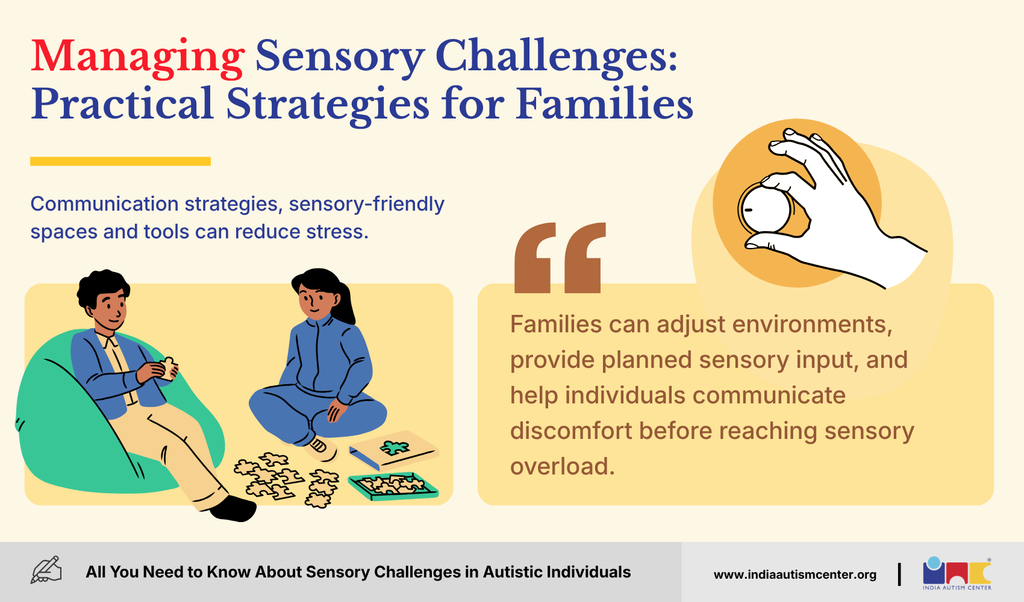
Understanding autism sensory issues is the first step. Acting on that understanding is the next. Here are four evidence-informed approaches that work in real Indian homes and schools.
1. Create a Sensory-Friendly Environment at Home
You don’t need to renovate your house. Small, targeted changes make a real difference.
Lighting:
- Replace harsh fluorescent bulbs with warm LED lights or CFL bulbs with a lower colour temperature
- Use curtains or blinds to control sunlight during peak hours
- Give your child a small lamp for their room so they can control their own light level
Sound:
- During festivals like Diwali or Holi, plan ahead: identify a quiet room in the house as a “retreat space” your child can access freely
- Use soft background music or white noise to mask unpredictable sounds
- Warn your child before loud events – a simple “the pressure cooker will whistle in 2 minutes” can prevent a meltdown
Touch and Texture:
- Source school uniforms in softer cotton fabrics; remove inner labels or replace them with iron-on name tags
- Offer seamless socks – widely available online in India
- Let your child choose their own bedding; weighted blankets (available from several Indian vendors on platforms like Amazon. in and Flipkart) can be deeply calming
Space:
- Create a designated “calm corner” – a small, low-stimulation area with a beanbag, dim light, and a few preferred sensory items
- In joint family settings, negotiate a specific room or time that is your child’s low-stimulation zone
2. Build a Sensory Diet (It’s Not About Food)
A sensory diet is a personalised plan of sensory activities scheduled throughout the day to keep the nervous system regulated. Occupational therapist Patricia Wilbarger coined the term, and it remains a cornerstone of occupational therapy at IAC and OT practice worldwide.
The idea is simple: a nervous system that gets the right kind of sensory input at regular intervals is far less likely to overflow into overload. Think of it like eating – small, regular inputs prevent the crash that comes from going too long without.
Calming activities (for an over-aroused, hypersensitive nervous system):
- Deep pressure massage or firm joint compressions
- Slow, rhythmic rocking or swinging
- Weighted blanket time (15–20 minutes)
- Slow, deep breathing exercises
- Kneading dough or clay (excellent proprioceptive input)
- Listening to preferred music through headphones
Alerting activities (for an under-aroused, hyposensitive nervous system):
- Jumping on a trampoline or jumping jacks
- Crunchy foods (popcorn, roasted chana, carrot sticks)
- Cold water play or ice cubes
- Spinning on a swivel chair
- Brisk walking or running
- Blowing bubbles or whistles (oral motor input)
Important: a sensory diet should be designed by a qualified occupational therapist who has assessed your child’s specific sensory profile. What calms one child can dysregulate another. Early intervention with OT support gives families the best foundation for building an effective sensory diet.
3. Use Sensory Tools and Supports
Several tools can make day-to-day sensory management much more manageable. Many are now accessible in India.
- Noise-cancelling headphones – Brands like Sony, JBL, and Anker all have affordable options available in India. A game-changer for crowded places, school assemblies, and festival seasons.
- Weighted blankets – Typically 10% of the child’s body weight. Available from Indian sellers on Amazon. in and Flipkart; expect to pay ₹1,500–₹4,000 depending on size and fill.
- Fidget tools – Fidget spinners, stress balls, textured rings, tangle toys. Widely available; useful for keeping hands occupied during sensory-heavy situations.
- Chewable jewellery (chewelry) – Food-grade silicone pendants or bracelets for children who seek oral sensory input. Available from specialist autism supply stores online in India.
- Sensory swings – Indoor fabric pod swings or hammock chairs provide vestibular and proprioceptive input. Can be installed in a doorframe or ceiling hook.
- Sunglasses and caps – Simple, cheap, and effective for visual hypersensitivity outdoors.
4. Communicate Sensory Needs – Even Without Words
One of the most important things we can do for a child with sensory challenges and autism families face is give them a way to communicate what they’re experiencing – before they reach overload.
Visual schedules – A picture-based or symbol-based daily schedule reduces the anxiety of unpredictability, which itself reduces sensory load. Apps like Choiceworks and First Then Visual Schedule are widely used.
Augmentative and Alternative Communication (AAC) apps – Apps like Proloquo2Go, Snap Core First, or the free LetMeTalk (Android) allow non-verbal or minimally verbal children to express sensory discomfort. A child who can tap “too loud” or “hurts” is a child who doesn’t need to melt down to be heard.
Sensory cards – Simple laminated cards with pictures of sensory states (“I need quiet,” “I need a hug,” “I need to move”) that a child can hand to an adult. Low-tech, highly effective.
Social stories – Short, personalised narratives that explain upcoming sensory situations (“At Diwali, there will be loud sounds. I can wear my headphones. I can go to my quiet room.”). These prepare the nervous system in advance.
Non-verbal children absolutely can communicate their sensory needs with the right tools. The goal is to build that communication system before the crisis, not during it.
Now, there is one more way to develop an autistic individual’s motor, adaptive, and cognitive skills and help them build social-emotional relationships. It is called Sensory Integration Therapy (SIT). SIT provides strategies to help autistic individuals better process sensory input. It is an element of occupational therapy. It can be provided only by qualified OT therapists.
Sensory Integration Therapy: A Structured Approach
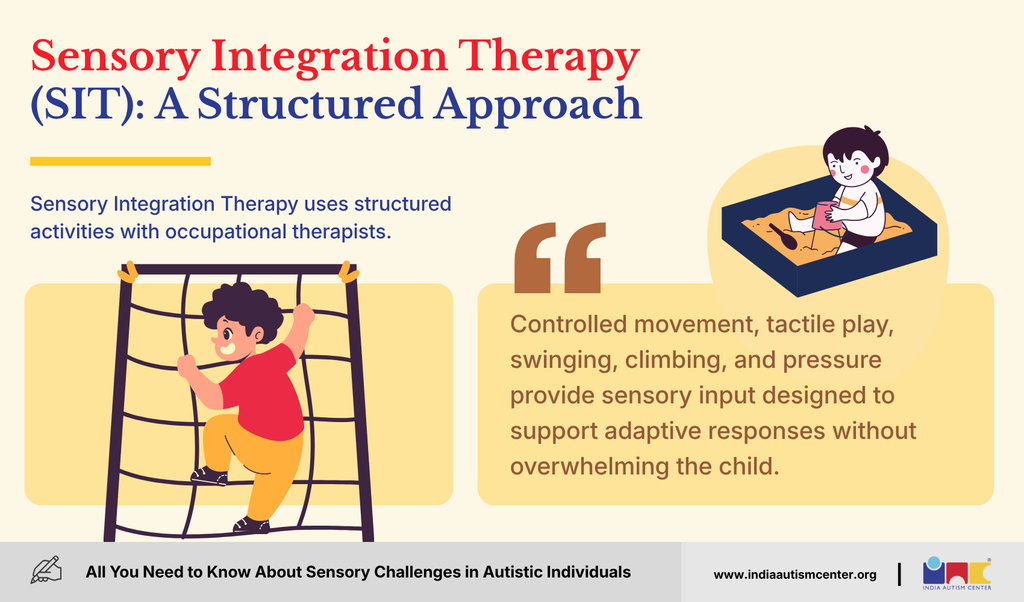
Sensory Integration Therapy (SIT) is an occupational therapy-led intervention specifically designed to help the brain learn to process sensory information more effectively. Developed by Dr A. Jean Ayres in the 1970s, it remains one of the most widely used approaches for addressing sensory problems that autism specialists work with.
What SIT involves: A trained OT guides the child through structured, play-based activities that provide controlled sensory input – swinging, climbing, deep pressure, tactile play – in a way that challenges the nervous system just enough to promote adaptive responses. The environment is carefully calibrated: the child is never overwhelmed, but always gently stretched.
Who delivers it: SIT can only be delivered by a qualified occupational therapist with specific training in sensory integration. It is not something that can be replicated at home without professional guidance, though the OT will typically send home activities to reinforce the work done in sessions.
What outcomes to expect: Research supports SIT for improving sensory regulation, motor coordination, and adaptive behaviour in autistic children. Progress is gradual – most families notice meaningful changes over 3–6 months of consistent therapy. For a detailed breakdown of what the therapy involves, read Sensory Integration Therapy for Autism: A Complete Parent’s Guide (2026).
At India Autism Center, sensory integration is embedded within our OT-led therapy programmes. Our occupational therapists conduct individualised sensory profiles for each child and design SIT programmes accordingly, as part of a holistic approach to development and daily living.
How to Support Someone with Sensory Challenges
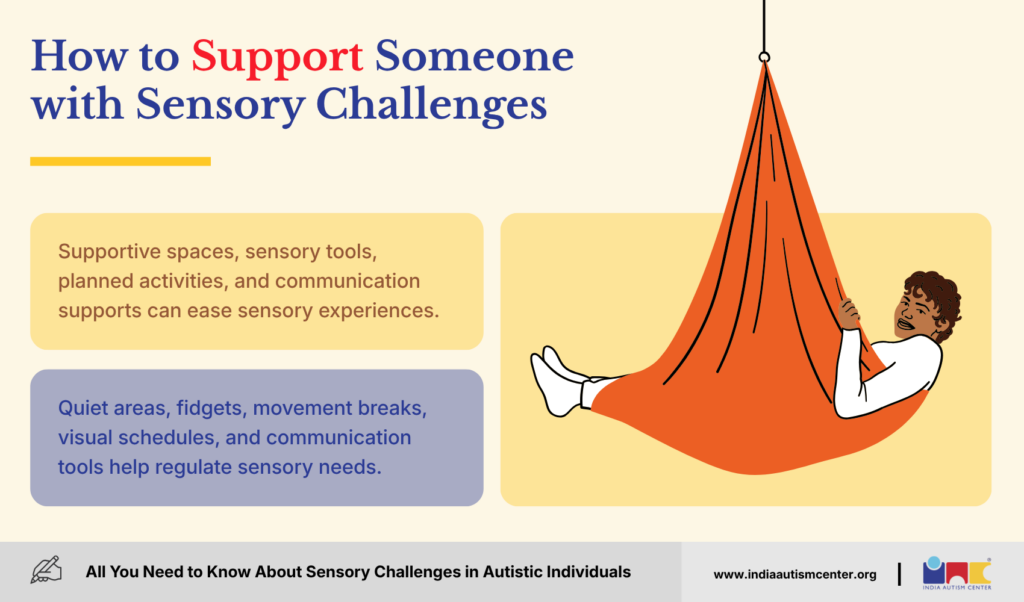
Here’s where your support really matters. Managing sensory challenges involves understanding, patience, and practical adjustments.
1. Create Sensory-Friendly Spaces
Small changes can make a big difference:
- Use soft or natural lighting
- Reduce background noise
- Provide quiet corners or calm spaces
- Allow the use of noise-cancelling headphones
These changes help people feel more comfortable and less overwhelmed.
2. Use Sensory Tools and Supports
Many autistic individuals benefit from supportive tools:
- Fidget toys
- Weighted blankets
- Sensory swings
- Quiet play items
These tools help regulate sensory input and give the nervous system predictable feedback
3. Build a Sensory Diet
A sensory diet is not food — it’s a plan of sensory activities that help the nervous system stay regulated. Occupational therapists often create these plans based on individual needs.
Activities might include:
- Deep pressure exercises
- Movement breaks
- Sensory play
- Stretching or jumping
These activities help balance sensory input and reduce stress.
4. Communicate Sensory Needs Clearly
Encourage the person to express what they feel. Tools like visual schedules, communication apps, and social stories can help those who find it hard to put sensory experiences into words.
Understanding what causes discomfort helps everyone adapt and support effectively.
Must-read blog on All You Need to Know About Sensory Challenges in Autistic Individuals
Conclusion
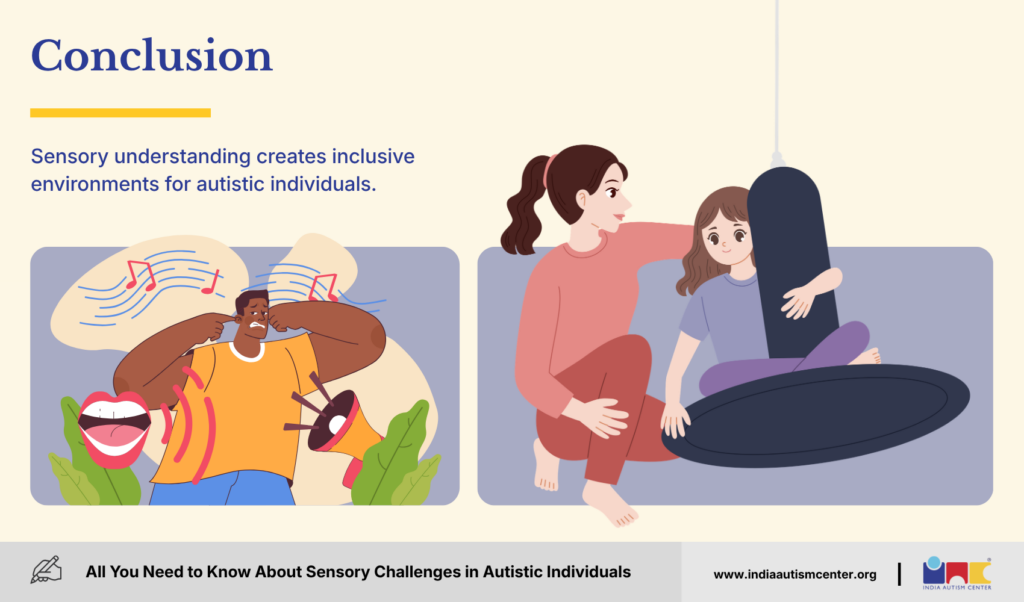
Sensory challenges are a key part of the autism experience — and they deserve greater understanding and support. When we learn about sensory processing disorder, autism sensory issues, and sensory problems in autism, we create a world that’s easier for autistic individuals to navigate.
Remember:
- Sensory experiences are real and meaningful.
- They affect comfort, behaviour, and participation.
- Supportive environments and tools can make life easier.
Whether you are a caregiver, educator, family member, or an autistic individual yourself, knowing about sensory challenges in autistic individuals helps you interact with the world in more compassionate and effective ways.
If you have questions or want practical tips tailored to your situation, feel free to ask.
Frequently Asked Questions (FAQs)
1. What are sensory challenges in autistic individuals?
Sensory challenges in autistic individuals refer to differences in how the brain processes sensory information such as sound, light, touch, taste, smell, and movement. These differences can make everyday experiences feel overwhelming, uncomfortable, or sometimes under-stimulating.
2. Are sensory challenges a part of autism?
Yes, sensory challenges are very common in autism. Many people on the autism spectrum experience autism sensory issues, which are recognised as a core feature of Autism Spectrum Disorder (ASD).
3. What is sensory processing disorder, and how is it related to autism?
Sensory processing disorder occurs when the brain has difficulty organising and responding to sensory input. While sensory processing disorder can exist on its own, it is frequently seen in autistic individuals and closely linked to sensory problems in autism.
4 . What does sensory overload mean in autism?
Sensory overload happens when too much sensory input is received at once and the brain cannot cope with it. This may result in anxiety, shutdowns, meltdowns, or withdrawal. Sensory overload is a common experience related to autism sensory challenges.
5. Can sensory issues in autism change over time?
Yes, sensory issues in autism can change with age, environment, and support. Some sensory sensitivities may reduce, while others may become more noticeable depending on life situations and stress levels.
6. How can parents support a child with sensory problems in autism?
Parents can support their child by creating sensory-friendly environments, respecting sensory preferences, using calming tools, and seeking guidance from trained professionals such as occupational therapists who specialise in autism sensory issues.
Useful Sources
- Marco, E.J., Hinkley, L.B.N., Hill, S.S., & Nagarajan, S.S. (2020). Sensory processing in autism: A review of neurophysiologic findings. PMC.
- American Psychiatric Association. (2013). Diagnostic and Statistical Manual of Mental Disorders, Fifth Edition (DSM-5). Criterion B4 for ASD.
- STAR Institute for Sensory Processing. Comorbidity of SPD and autism.