 Donate now
 Get a Call Back
 MENU
MENU 10 MIN READ
 SHARE
SHARE


Does Speech Therapy Work? The quick answer is yes, speech therapy works. Research consistently shows that structured speech and language therapy improves communication outcomes across age groups and conditions — including autism, Down syndrome, cerebral palsy, stroke, and learning disabilities. The earlier therapy begins, the stronger the results. But it also works for adults, and it’s never too late to start.
What Exactly Happens In Speech And Language Therapy?
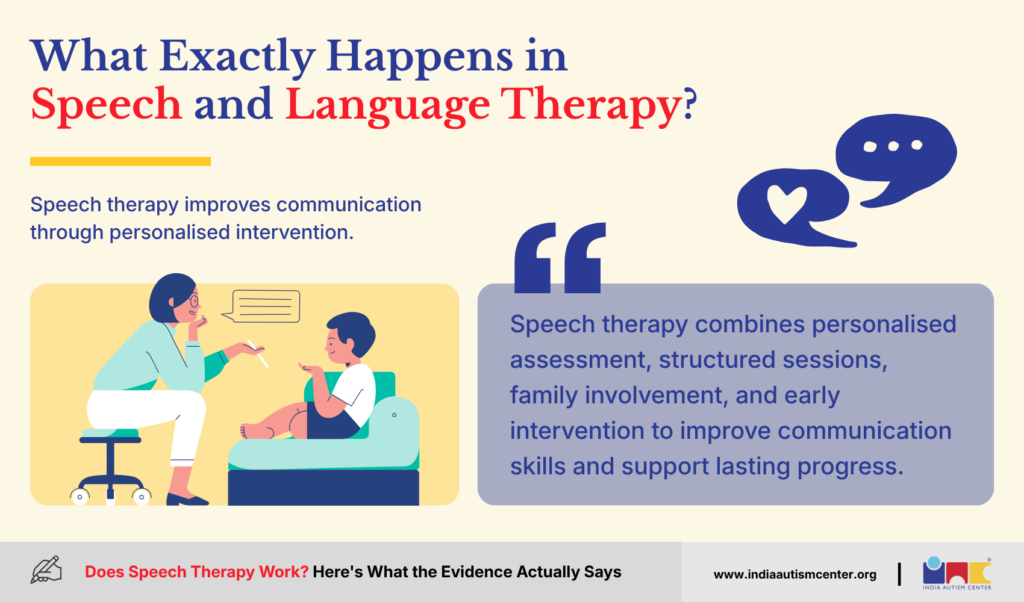
Speech and language therapy (SLT) is a clinical intervention that addresses difficulties with communication, language, voice, fluency, and swallowing. A licensed speech-language pathologist (SLP) assesses where the breakdown is — whether it’s in articulation, comprehension, social language, or something else — and builds a plan around that.
The process is structured, goal-driven, and highly individualised. No two therapy plans look the same, because no two people communicate the same way.
Sessions can be one-on-one, group-based, or a combination. They happen in clinics, schools, hospitals, or even online. What makes therapy effective isn’t just the technique — it’s consistency, family involvement, and early identification.
What Does Speech And Language Therapy Actually Treat?
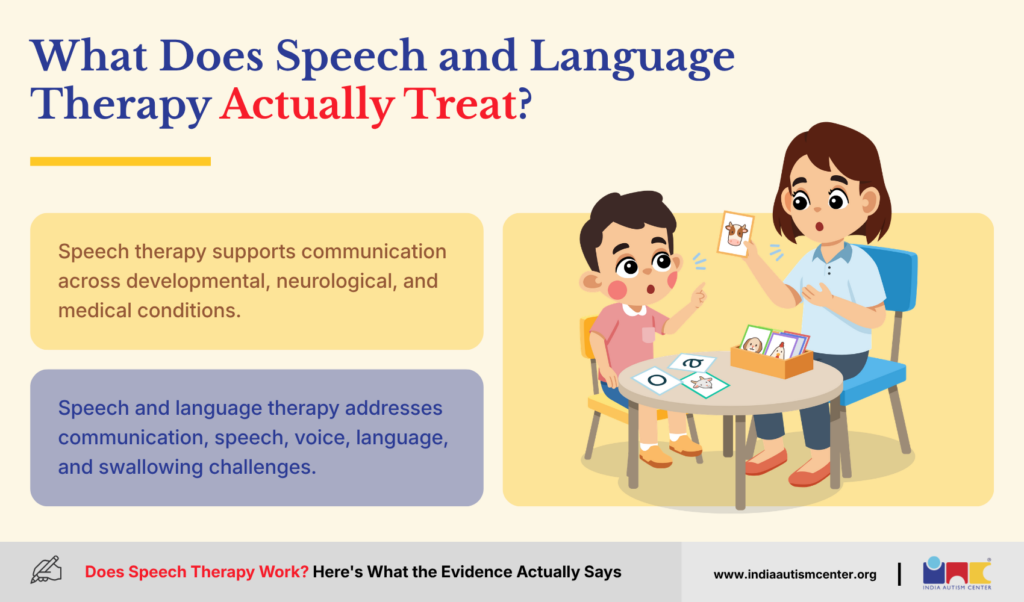
This is a question worth answering clearly, because many families think SLT is only for children who stutter or mispronounce words. It’s far broader than that.
SLT addresses:
| Condition | What SLT Targets |
| Autism Spectrum Disorder | Social communication, AAC, pragmatic language |
| Down Syndrome | Articulation, vocabulary, functional communication |
| Cerebral Palsy | Motor speech, alternative communication systems |
| Stroke / Aphasia | Language recovery, word retrieval, reading |
| Learning Disabilities | Phonological awareness, reading foundations |
| Selective Mutism | Anxiety-linked speech, graduated exposure |
| Voice Disorders | Vocal hygiene, resonance, pitch |
| Dysphagia | Safe swallowing, food textures, oral motor skills |
| Intellectual Disabilities | Expressive language, life-skills communication |
If communication is the challenge — in any form — speech and language therapy is the clinical pathway.
Does Speech Therapy Work For Children?
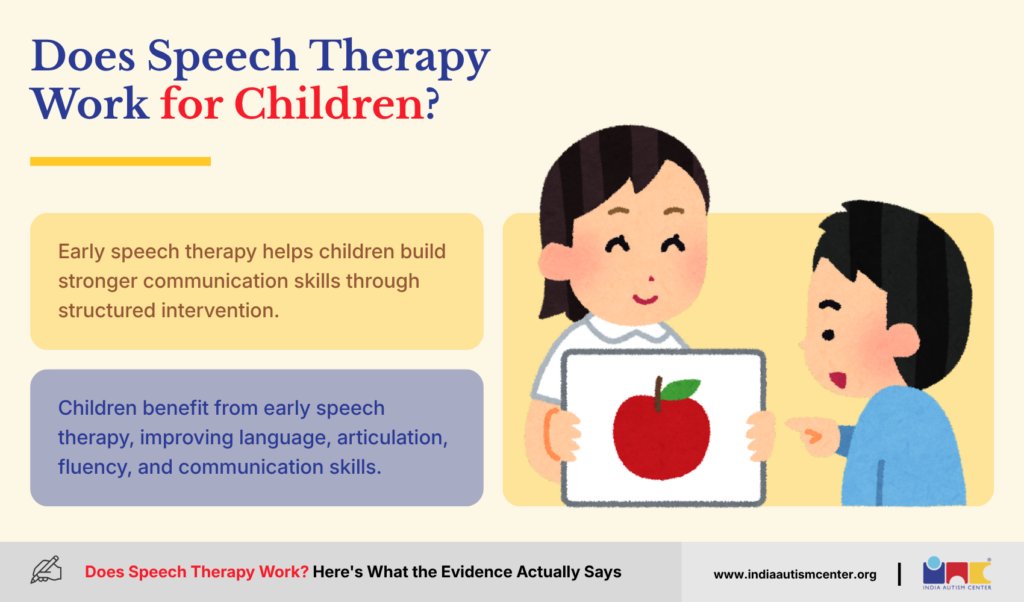
Yes, children’s speech and language therapy has one of the strongest evidence bases in all of rehabilitation medicine. The brain’s neuroplasticity — its ability to form new connections — is at its peak during the early years. This is why early intervention matters so much.
Children who receive therapy between ages 2 and 5 tend to show significantly faster progress. But even children who begin later still benefit from structured intervention.
What therapy typically works on in children:
- Phonological awareness (the foundation of reading and spelling)
- Expressive vocabulary (putting words and sentences together)
- Receptive language (understanding instructions and questions)
- Pragmatics (taking turns, reading facial expressions, staying on topic)
- Articulation (clear sound production)
- Fluency (managing stuttering)
The goal isn’t to make a child sound “normal.” The goal is to give them the tools they need to communicate effectively in the environments that matter to them — home, school, friendships.
Want to know more? Get in touch with us.
Does Speech And Language Therapy Work For Down Syndrome?
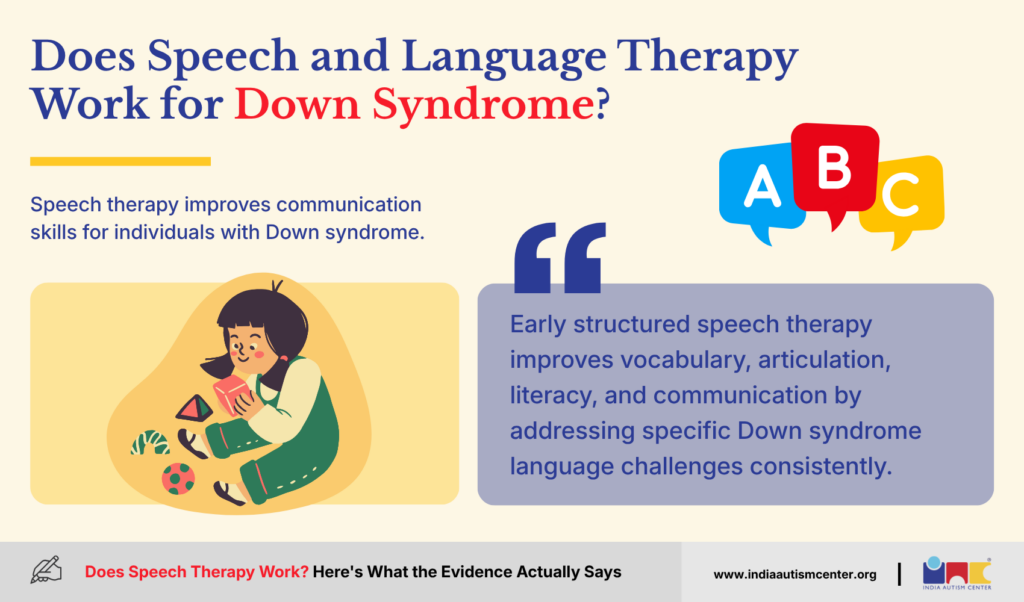
This is one of the most common questions I encounter. And the answer is: yes, meaningfully so.
Down syndrome affects speech and language in specific, well-documented ways. Low muscle tone (hypotonia) makes articulation difficult. Shorter working memory affects sentence processing. Hearing issues — very common in Down syndrome — compound the challenge.
Speech and language therapy for Down syndrome targets all of these simultaneously.
Key approaches used in Down syndrome SLT:
- Oral motor exercises — to build lip, tongue, and jaw strength
- Total Communication — combining speech with sign language and visuals
- AAC (Augmentative and Alternative Communication) — devices, boards, or apps for those who need them
- Phonological awareness training — critical for literacy
- Short, structured language input — matched to processing speed
- Reading-based language intervention — individuals with Down syndrome often learn through reading, which supports spoken language development
Research from the Down Syndrome Education International has shown that structured, consistent SLT — started early and sustained across childhood — leads to measurable gains in vocabulary, intelligibility, and literacy. The therapy doesn’t “fix” Down syndrome. It addresses the specific communication challenges that come with it, directly and practically.
Does Speech Therapy Work For Adults?
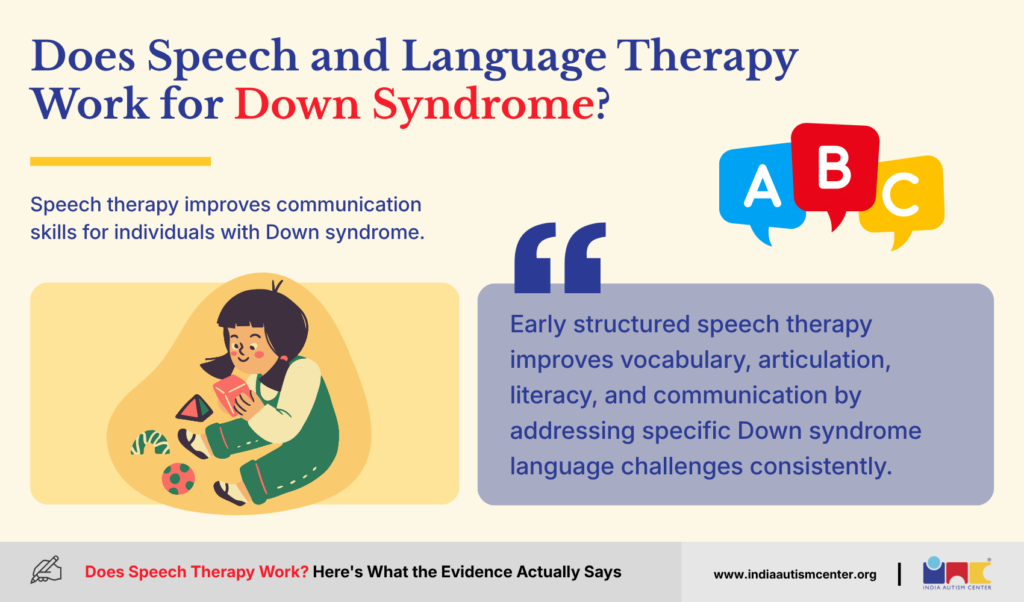
Absolutely. This is one of the most underappreciated areas of the field.
Speech and language therapy for adults covers post-stroke aphasia, acquired brain injury, Parkinson’s disease, voice disorders, and stuttering. Adults recovering from stroke, for example, can regain significant language function through intensive SLT — even months or years after the event.
The adult brain retains neuroplasticity. It adapts more slowly than a child’s brain, but it adapts. Programmes like LSVT LOUD (for Parkinson’s) and Constraint-Induced Language Therapy (for aphasia) have clinical trial data showing real, sustained improvements.
Why adults delay or avoid SLT:
- Assumption that “it’s too late”
- Limited awareness that services exist for adults
- Stigma around communication difficulties
- Access and cost barriers
None of these makes the therapy less effective. They make access harder — which is a systemic problem worth naming.
Refer to our detailed blog on Speech Therapy for Adults
What Speech And Language Therapy Techniques Are Actually Used?
This varies by condition and age, but here are the evidence-based techniques you’ll most commonly encounter:
Articulation Therapy
The SLP works on specific sounds the person struggles to produce, using repetition, auditory feedback, and visual cues. Most effective for children with phonological disorders.
Language Intervention Activities
Structured play and conversation activities that target specific language goals. The therapist models correct language and builds on what the child produces.
Augmentative and Alternative Communication (AAC)
For individuals who cannot rely on speech alone. Includes low-tech options (picture boards) and high-tech (speech-generating devices). AAC doesn’t replace speech — it supports communication and often facilitates speech development.
Social Communication Therapy
Targets pragmatic skills — understanding context, reading non-verbal cues, initiating and maintaining conversations. Frequently used in autism therapy.
Fluency Shaping
Used for stuttering. Teaches slower, relaxed speech patterns to reduce disfluency.
Voice Therapy For vocal nodules, paralysis, or misuse injuries. Includes vocal hygiene education, breath support training, and resonance work.
PROMPT Therapy
A tactile-kinaesthetic approach where the therapist physically guides jaw, lip, and tongue movements. Used for motor speech disorders like apraxia.
Narrative and Literacy-Based Therapy
Uses stories and books to build sentence structure, vocabulary, and inferential language. Particularly effective for school-age children.
This blog will help you get better insights 5 Effective Speech Therapy Techniques for Autism
What Are Speech And Language Therapy Assessments Like?
Before therapy begins, a comprehensive assessment is done. This is not a pass/fail test. It’s a diagnostic process that helps the therapist understand exactly where and how communication is breaking down.
A standard SLT assessment typically includes:
- Case history — medical background, developmental milestones, family concerns
- Standardised tests — norm-referenced tools that compare performance to age peers
- Informal observation — watching the person communicate in natural settings
- Oral motor examination — checking the structure and function of speech muscles
- Parent/caregiver interviews — understanding daily communication at home
- Hearing screening — often conducted in conjunction with SLT assessment
For adults, assessment also covers reading, writing, and cognitive-communication. For children with autism or Down syndrome, assessments are often multidisciplinary — involving OT, psychologist, and the SLT together.
The report that follows guides the entire therapy plan. It’s a clinical document, but a good SLT will walk you through it in plain language.
Want to know more? Get in touch with us.
What Is The Importance Of Speech And Language Therapy For Learning Disabilities?
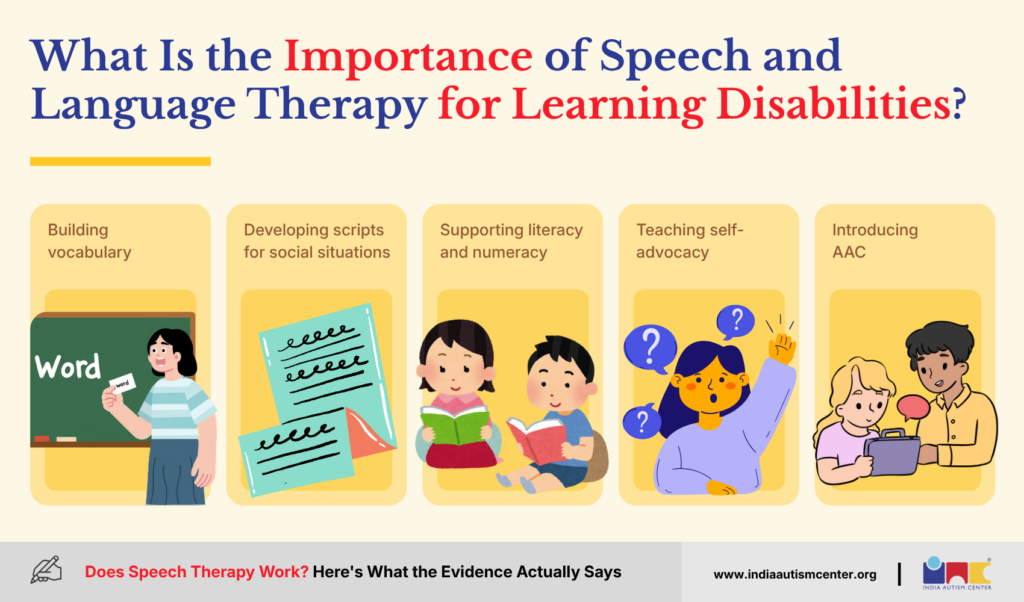
Communication is the gateway to almost every other skill. When a person with a learning disability struggles to express needs, follow instructions, or connect socially, it affects education, employment, relationships, and mental health.
Learning disability speech and language therapy takes a functional approach. The goal isn’t always “correct grammar.” It’s often about giving the person the tools to communicate what they need, when they need it, in the environments that matter most.
Specific goals in LD-focused SLT:
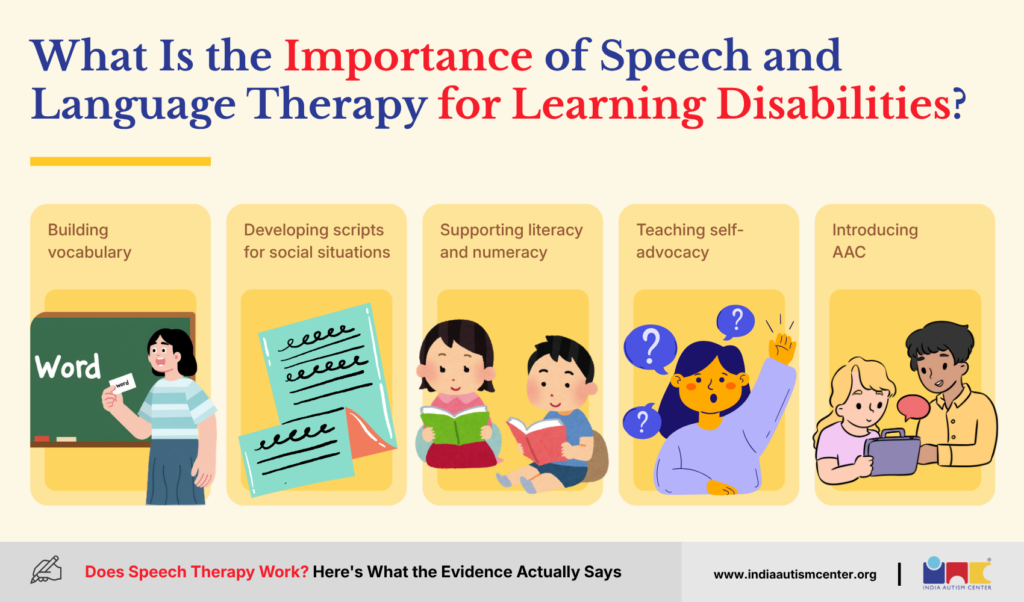
- Building vocabulary for daily life and work
- Developing scripts for common social situations
- Supporting literacy and numeracy language
- Teaching self-advocacy language (“I need help with this”)
- Introducing AAC where verbal communication is limited
This kind of therapy is also deeply tied to quality of life and independence. When someone can communicate their needs and preferences clearly, they exercise more control over their own life. That’s not a small thing.
What Makes Speech And Language Therapy Services Effective?
Not all SLT is created equal. Evidence points to several factors that consistently determine outcomes:
| Factor | Why It Matters |
| Early identification | The earlier the intervention, the higher the impact |
| Therapy intensity | More frequent sessions within a focused period outperform sporadic therapy |
| Family involvement | Carryover practice at home is critical for generalisation |
| Goal specificity | Vague goals produce vague progress — specific, measurable targets work better |
| Therapist expertise | Specialist experience with the individual’s condition matters |
| Multidisciplinary coordination | SLT working alongside OT, psychologist, and educators produces better outcomes |
| Environmental support | Teachers, employers, and family members who understand the person’s communication profile help generalise skills |
Families often ask: “How long will my child need therapy?” There’s no universal answer. But generally, the clearer the goals and the more consistent the input, the faster the progress.
Can Speech Therapy Work Without The Child’s Cooperation?
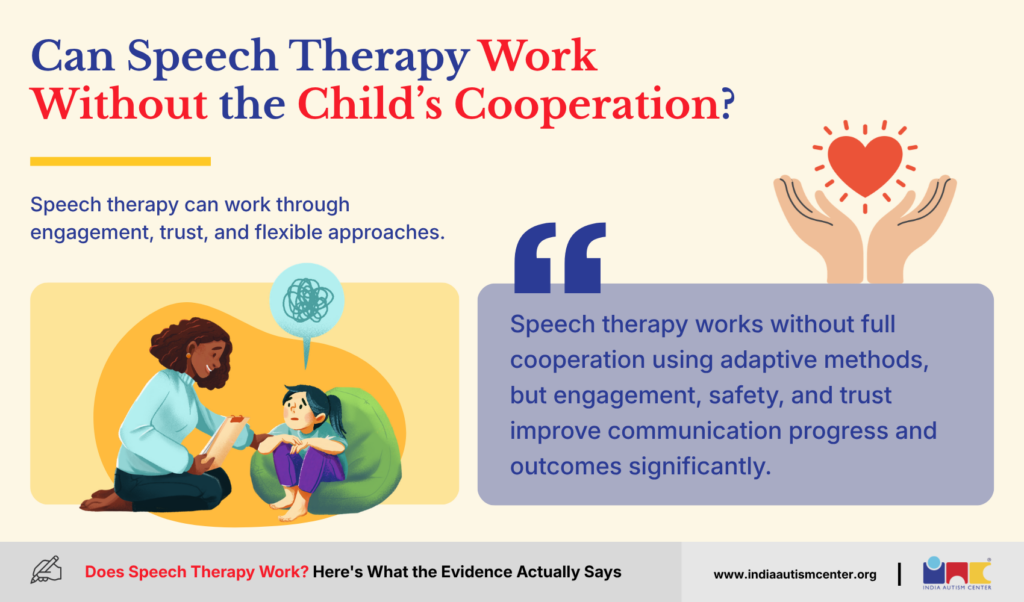
This is a real concern, especially for parents of young children or individuals with significant behavioural challenges.
Good speech and language therapists are trained to work with resistance. Play-based therapy, child-led sessions, and high-preference activities are all strategies that help. The session doesn’t need to look like a structured lesson to be therapeutic.
That said, cooperation does improve outcomes. When a child feels safe, understood, and engaged — they learn faster. This is why the relationship between the therapist and the individual matters as much as the technique.
For adults who are resistant or withdrawn — especially post-stroke — motivational approaches and meaningful, functional goals tend to unlock engagement better than abstract exercises.
Watch this video on
What Should I Look For In A Speech And Language Therapy Programme?
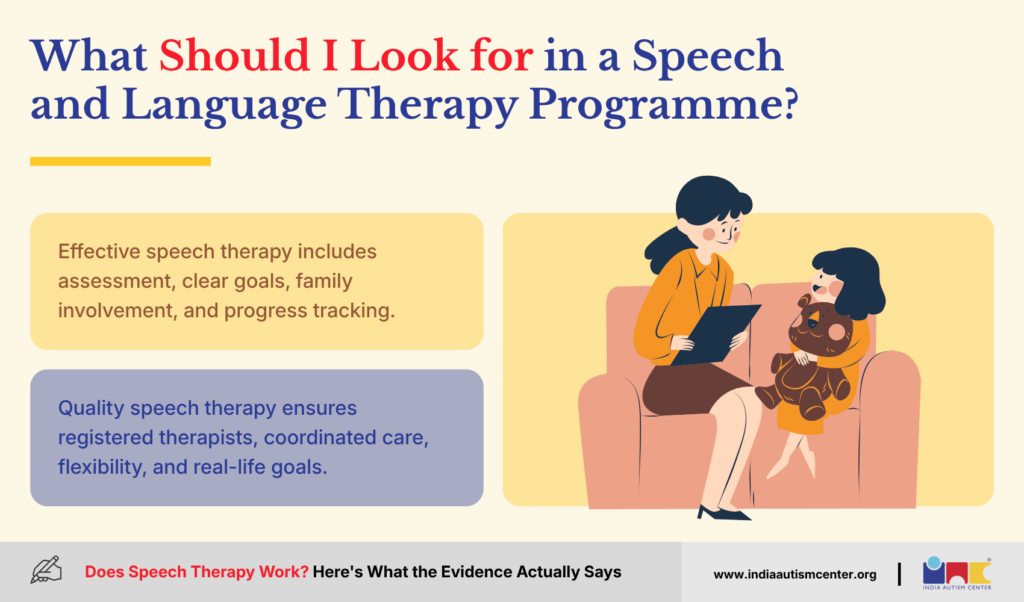
If you’re evaluating services — for a child or an adult — here’s what to look for:
- RCI-registered therapist (in India, the Rehabilitation Council of India is the governing body)
- Clear assessment before therapy begins
- Written goals that are reviewed regularly
- Active involvement of family or caregivers
- Transparency about progress — you should know if it’s working
- Coordination with the school, medical team, or other therapists
- Flexibility to adapt when something isn’t working
At India Autism Center, our speech and language therapy services are integrated within a multidisciplinary care model. Our therapists work alongside occupational therapists, behaviour analysts, and special educators to ensure every communication goal is connected to real life — not just clinic performance.
📥 Free download: Printable daily routine chart for autistic children
Conclusion
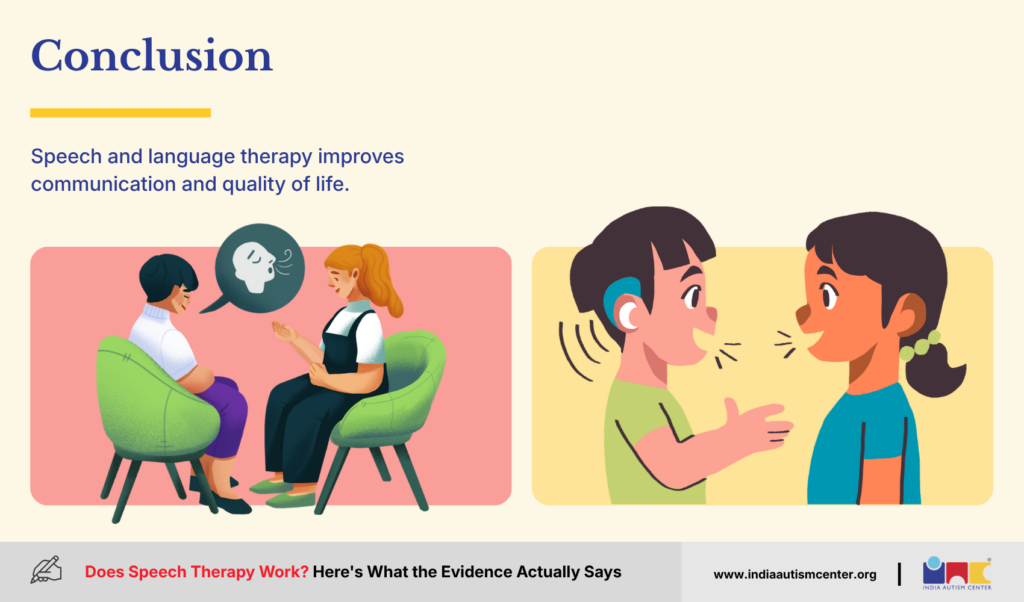
Speech and language therapy works. It works for children and adults. It works across diagnoses — autism, Down syndrome, learning disabilities, stroke, and more. The evidence is strong, and the impact on quality of life is real.
The biggest barrier isn’t the therapy itself. It’s awareness, access, and the belief that help is available. If you’re asking “does speech therapy work?” — you’re already asking the right question. The next step is finding the right team.
For expert insights, support services, and inclusive learning initiatives, visit the India Autism Center.
Disclaimer: This article is intended for educational purposes only. The information provided here does not constitute medical or clinical advice and should not be used as a substitute for professional assessment, diagnosis, or treatment. If you have concerns about your child’s or a family member’s communication development, please consult a qualified speech-language pathologist or medical professional.