 Donate now
 Get a Call Back
 MENU
MENU 11 MIN READ
 SHARE
SHARE


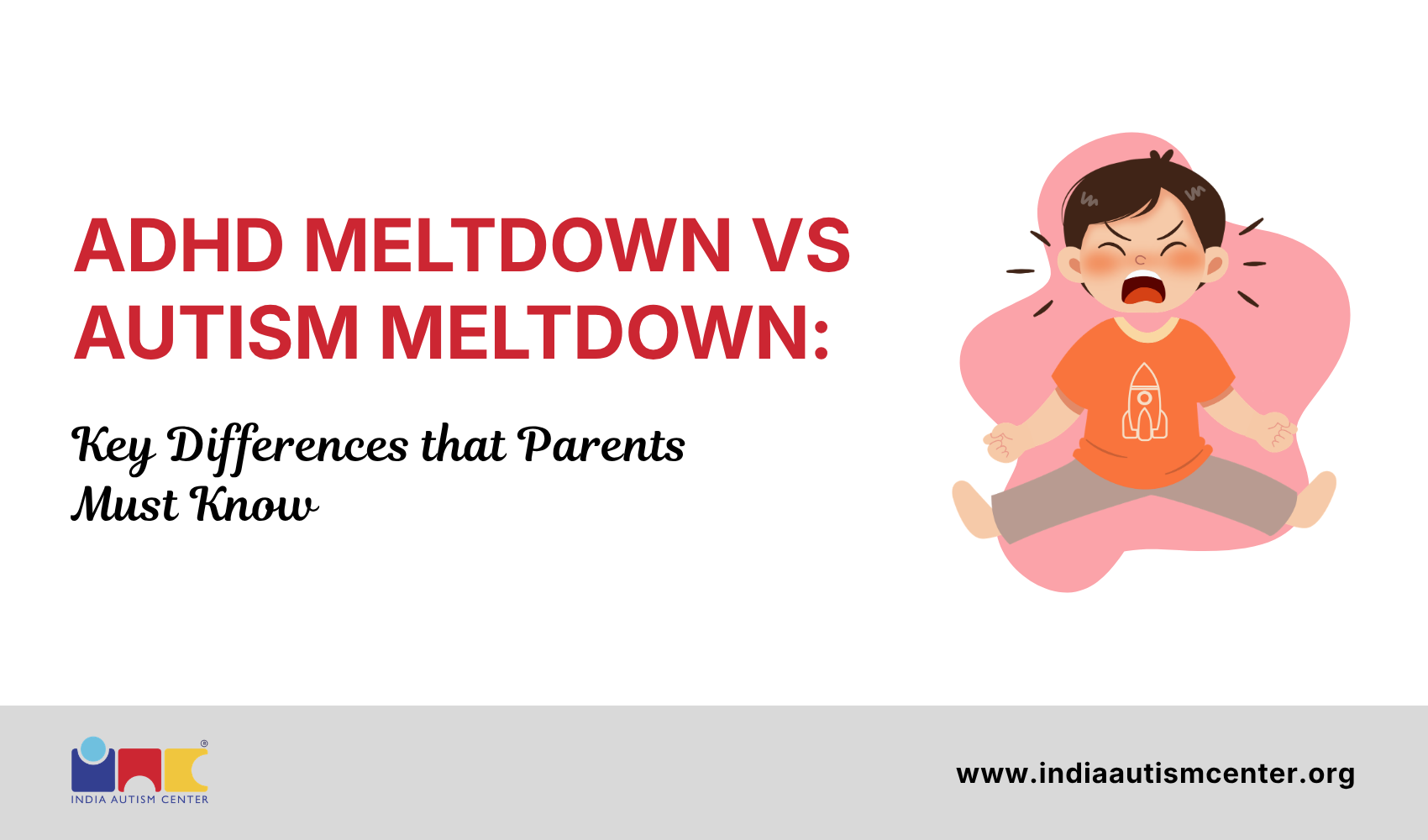
When your child experiences an intense emotional outburst, it can feel highly overwhelming. Parents do not understand what triggered the outburst or how they can handle it. Moreover, if your child is Neurodivergent, such intense episodes are not just temper tantrums. They are actually biological responses that are labelled as meltdowns.
Before you decide on the right approach to handle these meltdowns, it is important to understand the difference between an ADHD vs autism meltdown. Both look identical to someone with no idea about neurodivergence. However, the root causes, triggers, and management strategies differ significantly.
As per the World Health Organisation, 1 in 127 people worldwide is expected to be on the autism spectrum. Besides that, some studies show that 50% to 70% of individuals who have ASD also meet the diagnostic criteria for ADHD.
The co-occurrence rate can often make distinguishing between an ADHD meltdown and an autistic emotional response very complex.
Today, we are going to understand the unique mechanics of an ADHD crisis versus an autism crisis. It will help you move away from traditional disciplinary measures and towards empathetic, proactive care.
Understanding Neurodivergent Meltdown: Beyond the Surface Behaviour
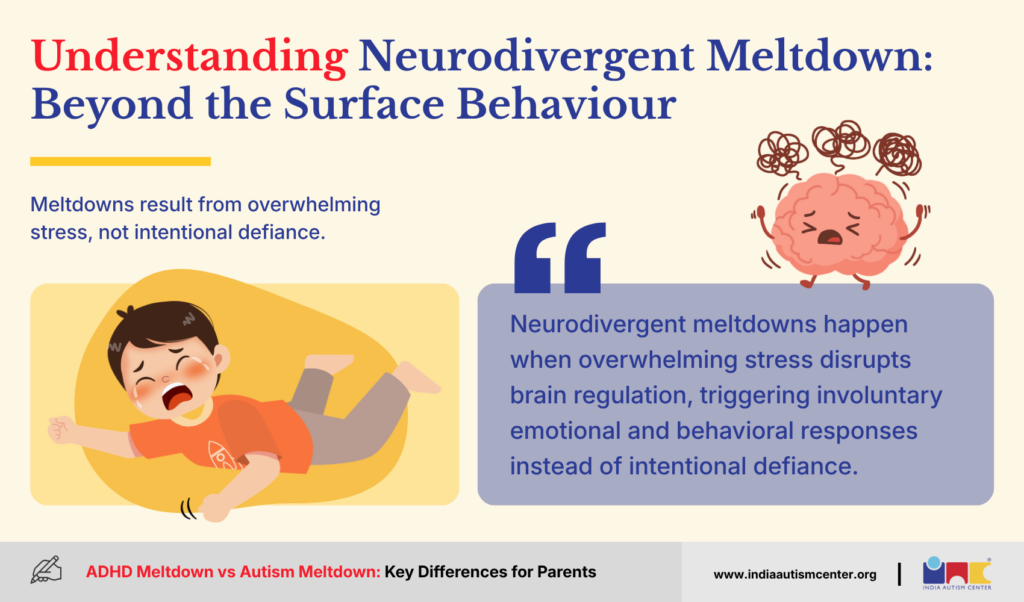
When comparing ADHD vs autism meltdown, it is important to understand what a meltdown is. Essentially, a neurodivergent meltdown is an involuntary and biological coping mechanism. It happens when the individual’s nervous system is overwhelmed, triggering a primitive fight, flight, or freeze response in the brain.
When the meltdown happens, the brain’s executive functioning temporarily shuts down. Therefore, the child attempts to lose total control over their emotional regulation, as well as their verbal and physical movements. Parents need to know that it is not an act of defiance, manipulation, or even intentional bad behaviour.
It is also important to know that these emotional episodes do not only happen to a child with ADHD or autism, but ADHD meltdowns in adults are also very common. It can happen due to workplace stress, sensory overload, or even executive dysfunction, piling up beyond the capacity of a person.
📥 Free download: Printable daily routine chart for autistic children
What Does an ADHD Meltdown Look Like?
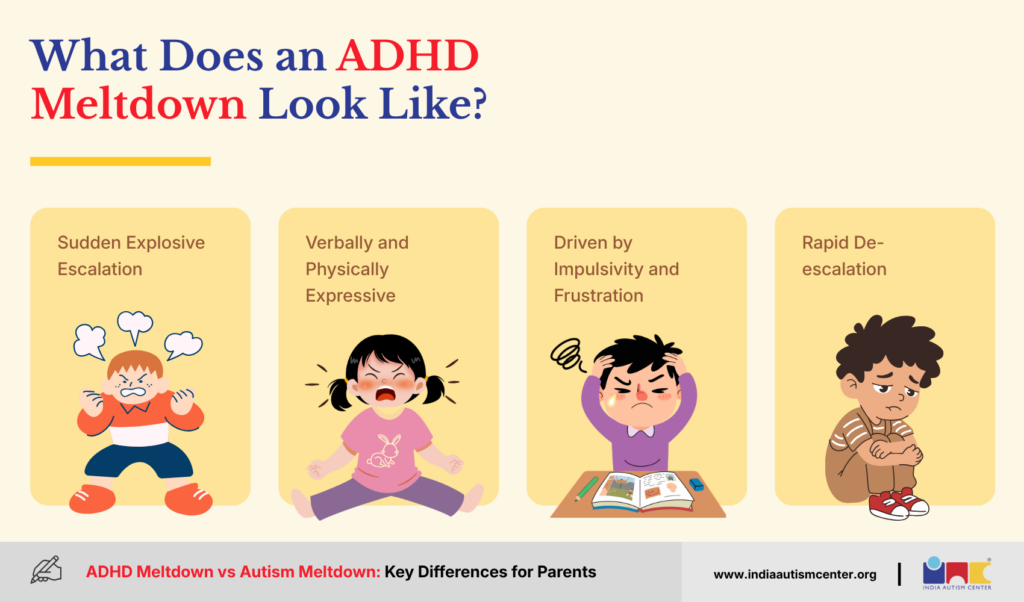
If you often wonder, what does an ADHD meltdown look like? It is necessary to know that an emotional dysregulation deficit in executive functioning drives frustration.
ADHD often affects the brain’s frontal lobe, which is responsible for impulse control, emotional processing, working memory, and, more importantly, patience. An emotional eruption occurs when these systems fail.
Signs and characteristics of ADHD meltdown
To understand the concept of autism vs ADHD meltdown, it is important to know the correct signs and characteristics of an ADHD meltdown:
- Sudden Explosive Escalation
A sudden change in a plan, a boundary being set, or a task that feels impossibly frustrating can be the trigger that sparks an ADHD episode out of nowhere.
- Verbally and Physically Expressive
Since hyperactivity and impulsivity are the core features of ADHD, the emotional energy is directed outward. So an ADHD driven episode is where children and adults might shout, slam doors, and throw objects around.
- Driven by Impulsivity and Frustration
An ADHD meltdown can happen when a person is reacting to a perceived rejection, the inability to delay gratification, or when they feel failed.
- Rapid De-escalation
It is often found that a person who has an ADHD episode comes down relatively quickly once the anger or frustration is expressed or the external trigger is removed. They also feel exhausted immediately after.
The behaviour of a child during an ADHD meltdown is often due to school or transition between activities, or feeling overwhelmed due to long instructions. However, when it comes to an ADHD meltdown in adults, it often looks like a sudden and intense verbal outburst, which can happen due to a high-stress meeting or when a person breaks down due to a simple routine not going correctly.
What Does an Autism Meltdown Look Like?
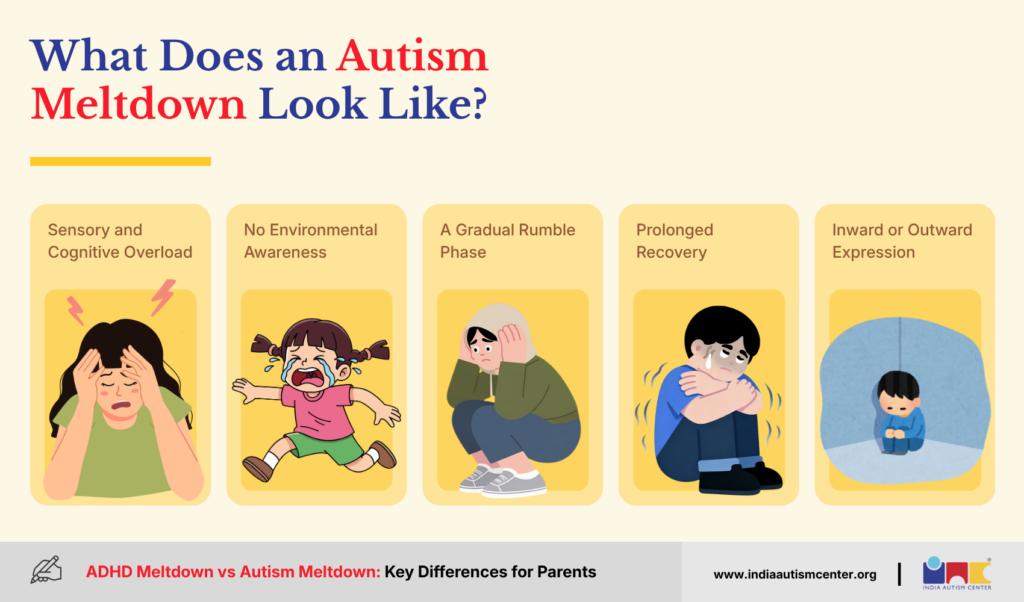
Contrary to an ADHD meltdown, an autistic meltdown is often a reaction to sensory, cognitive, and emotional overload. Autistic brains process environmental stimuli differently. It absorbs sights, sounds, smells, and textures at a very high intensity when the brain does not process the incoming data, resulting in a system crash.
Signs and characteristics of an autism meltdown:
Here are the signs and characteristics that differentiate autism meltdowns from ADHD meltdowns:
- Sensory and Cognitive Overload
Autism meltdowns, at times, happen when there is an overload of sensory inputs, like bright lights, a crowd, uncomfortable clothing, or even loud noises. A meltdown can also happen due to cognitive strain, like processing complex social cues.
- Complete Loss of Environmental Awareness
When an autism meltdown happens, the child or adult tends to disconnect from their surroundings completely. They are therefore not able to process verbal commands, nor can they negotiate or reason.
- A Gradual Rumble Phase
An autistic meltdown has a building phase. Before the individual loses control or a meltdown begins, they might show signs of distress. They may cover their ears, rock back and forth, keep humming, or pace from one place to another.
- Prolonged Recovery
It is not simple to recover from an autism meltdown. The brain of a person with ASD may take hours or even days to return to normalcy. To recover, a person often needs isolation and experiences physical fatigue.
- Inward or Outward Expression
Not every autism meltdown will have outward expression. At times, instead of an intense reaction or outburst, you may see the individual shutting down. The individual becomes completely mute, still unresponsive.
Want to know more? Get in touch with us.
Key Differences: ADHD Meltdown vs Autism Meltdown
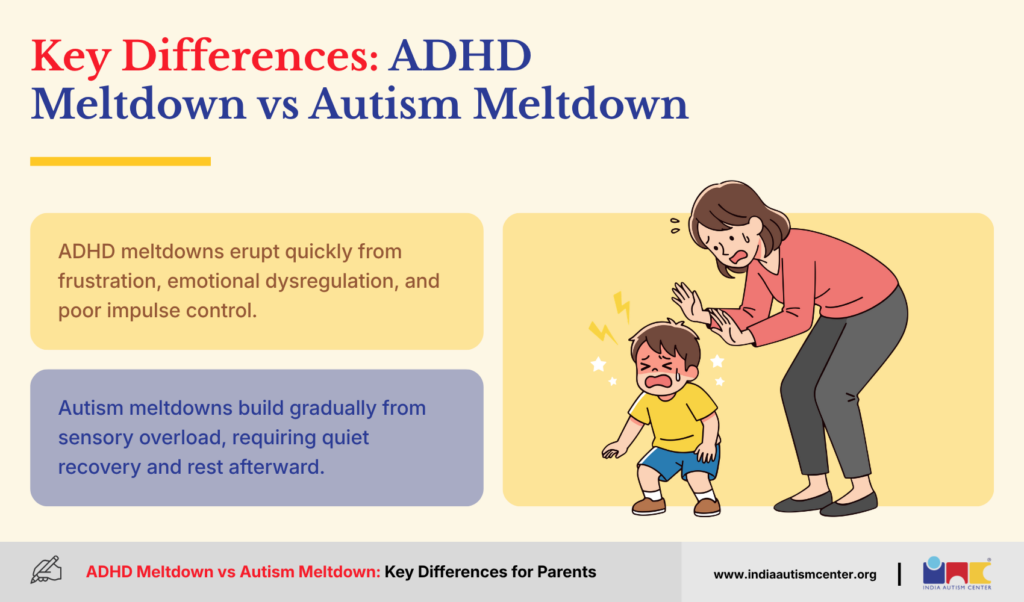
It is possible to differentiate between ADHD meltdown and autism meltdown when you know the timeline, the triggers and the recovery needs.
The table below explains how these two neurological experiences are different from one another:
| Feature | ADHD Meltdown | Autism Meltdown |
| Primary Root Cause | Executive dysfunction, poor impulse control, and intense emotional dysregulation. | Sensory overload, cognitive saturation, or an inability to process environmental changes. |
| Common Triggers | Frustration, boredom, being told “no,” sudden transitions, or tasks requiring sustained mental effort. | Loud noises, bright lights, unpredictable social situations, changes in routines, or sensory discomfort. |
| Onset Speed | Rapid, impulsive, and explosive, often occurring immediately after a specific frustrating event. | Gradual, building up over time through a noticeable “rumble phase” as sensory data accumulates. |
| Awareness During Episode | The individual generally remains aware of their environment but lacks the emotional control to stop their behaviour. | The individual experiences a temporary sensory and cognitive disconnect, becoming unaware of external reasoning. |
| Manifestation Styles | Almost always externalised, featuring verbal expressions, emotional outbursts, or physical movement. | Can be externalised (screaming, thrashing) or completely internalised as a quiet, unresponsive “shutdown.” |
| Recovery Mechanism | Calms down relatively quickly once the immediate frustration passes or the trigger is addressed. | Requires an extended recovery period involving sensory deprivation, quiet spaces, and deep rest. |
Common Triggers: ADHD Meltdown vs Autism Meltdown
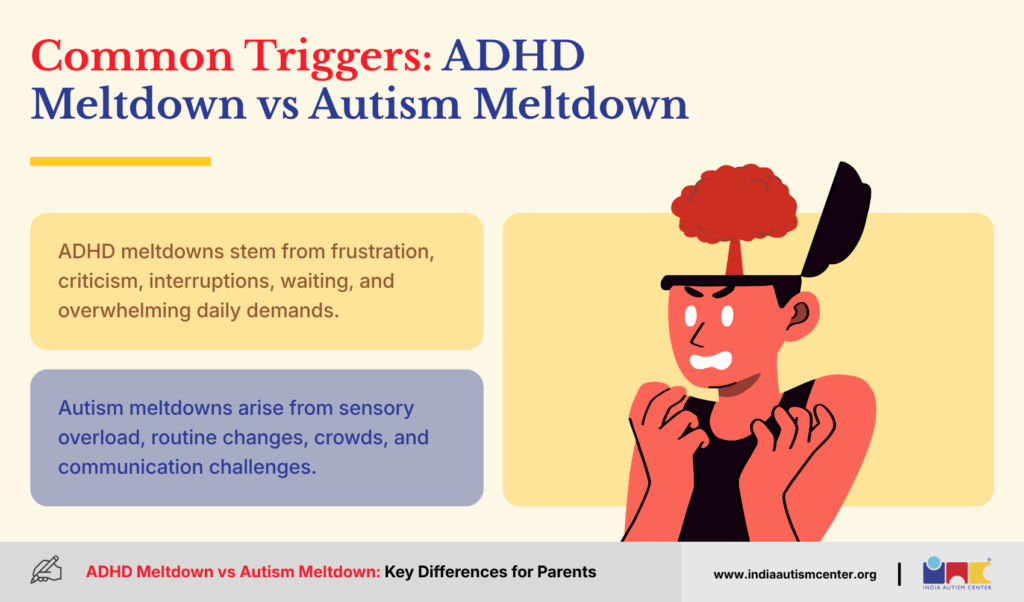
Parents and caregivers can easily prevent many meltdowns if they know how to recognise the triggers. However, every individual is different, and certain situations may be more commonly associated with one condition than another.
Common ADHD Meltdown Triggers
Individuals with ADHD tend to become overwhelmed when they are:
- Being interrupted while they’re engaged in an activity that they prefer.
- Waiting for a long period of time.
- Frustrated after repeated mistakes,
- Feeling criticised or rejected.
- Looking at sudden changes in expectations.
- Finding it difficult to complete tasks
- Bombarded with too many demands at once
At times, even simple, daily activities can become mentally exhausting and can thus trigger an ADHD meltdown.
Common Autism Meltdown Triggers
Autism meltdown triggers become very common when autistic individuals are exposed to:
- Unexpected changes in their routine,
- Bright lights, strong smells, or loud and unpredictable noises.
- Heavily crowded places.
- Social pressure from family and friends
- Difficulty in communication
- Sensory discomfort from food, texture, and clothing
Autism meltdowns are mostly caused by sensory overload.
The basic distinction between the two is that ADHD meltdowns happen due to emotional frustration, and autism meltdowns happen due to sensory and environmental factors.
How Can Parents Tell the Difference Between ADHD and Autism Meltdown?
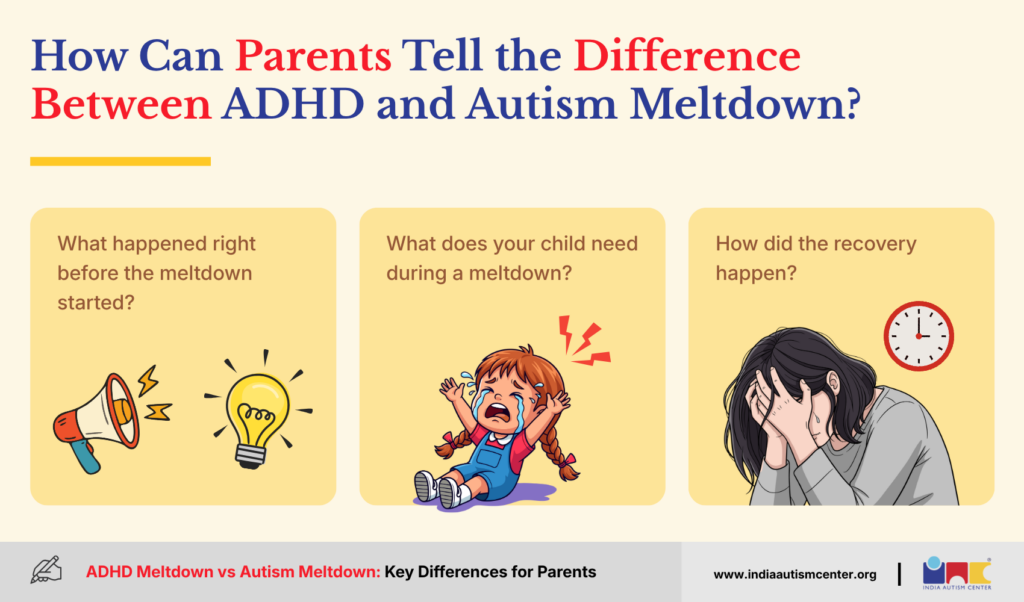
Parents and caregivers often look for a simple way to understand which type of meltdown the child is experiencing. Parents need to consider three important questions rather than just focusing on the child’s behaviour.
Below are all the questions that parents must consider:
1. What happened right before the meltdown started?
Suppose a child gets upset after losing a game, feels frustrated, or agitated when they’re corrected; it is more likely to be an ADHD meltdown.
On the other hand, if the meltdown happens after a loud noise, a change in the routine or any other overwhelming sensory experience, then autism may be the case.
2. What does your child need during a meltdown?
The child benefits from emotional reassurance. Once they begin to calm down, it is mostly ADH hd meltdown.
However, if a child seems first to need a quiet and low-stimulation environment before they can actually communicate, then it is more likely to be an autism meltdown.
3. How did the recovery happen?
If you find that your child gradually comes down as the emotion settles, it is an ADHD meltdown.
But if your child needs additional recovery time because the nervous system remains overactive, then your child might be experiencing an autism meltdown.
Want to know more? Get in touch with us.
What Should Parents Do During a Meltdown?
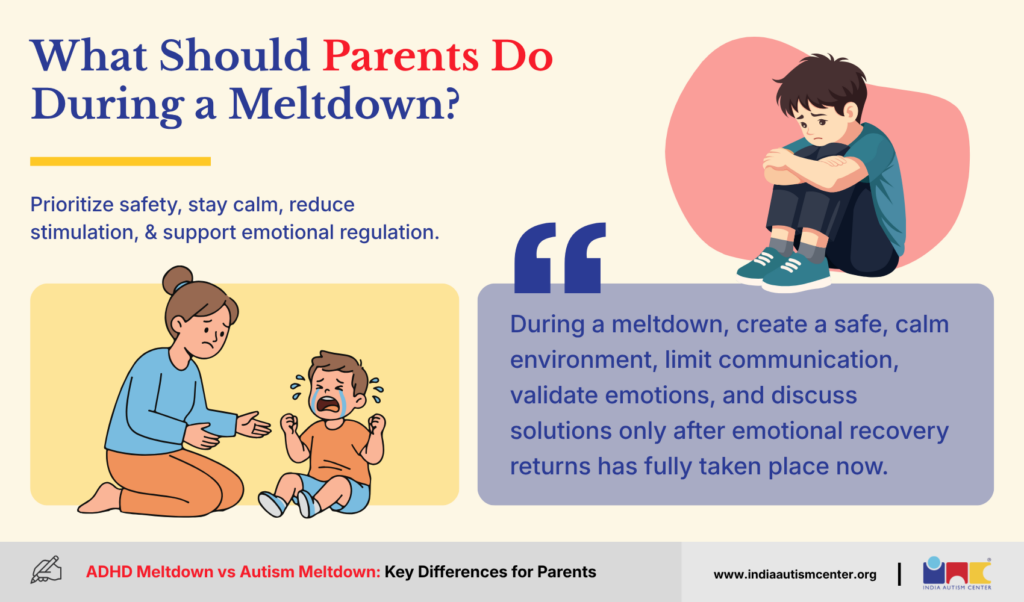
In both cases, the goal is not to stop the behaviour immediately. First, make sure your child feels safe, then regulate their nervous system.
Here are some helpful strategies that parents can try:
- Stay calm and make sure to use a gentle tone when talking to them.
- Reduce unnecessary talking and keep the instructions brief.
- Remove any possible and immediate safety risks. Aim to reduce sensory input whenever possible.
- Give the child physical space if needed.
- Make sure to validate their emotions without reinforcing unsafe behaviour.
- Before discussing what happened, make sure that your child is calm.
Parents often feel the need to teach their kids a lesson during a meltdown. However, it is important to know that the brain is not ready to learn while the meltdown is happening. Hence, problem-solving needs to occur only after emotional regulation has returned.
How Can the India Autism Center Be Helpful?
At India Autism Center, we understand that every child experiences the world differently, and hence, families receive evidence-based guidance tailored to each child’s developmental profile.
Support is provided through comprehensive assessment, early intervention programmes, various therapies, and behavioural support. The Center empowers the children to reach their potential.
With a multidisciplinary approach and a strong focus on inclusion, India Autism Center works alongside many families throughout the journey.
Conclusion
When parents can understand the key differences between an ADHD meltdown and an autism meltdown, it can be a transformative step. Both types represent a state of neurological stress. However, it is important to know whether that episode is driven by acute frustration of ADHD or the sensory saturation of autism.
This helps you to respond with the correct support that your child needs in that moment. When parents treat episodes as cries for help rather than behavioural defiance, they can create a safe and supportive environment for a neurodivergent child, who can then navigate the world with peace of mind and confidence.
Frequently Asked Questions
What is the primary difference between an ADHD meltdown and an autism meltdown?
The main differences are that ADHD is triggered by emotional frustration, difficulty regulating emotions, or even impulsivity. However, meltdowns are often caused by overload, unexpected changes, or environmental or communication challenges.
Can a child have both ADHD and autism?
Yes, ADHD and autism can co-exist. In fact, some studies suggest that about 30 to 50% of people who are autistic also have ADHD.
Do ADHD meltdowns happen in adults?
Yes, ADHD meltdowns can happen in adults as well. The most common symptoms include emotional responses such as irritability, crying, anger, or shutting down.
How long does an ADHD meltdown usually last?
The time period for which an ADHD meltdown lasts can vary from person to person. Some ADHD symptoms last only a few minutes, while others can last longer.
What should parents avoid during an ADHD meltdown?
It is best if parents avoid shouting, threatening to punish, forcing eye contact, or asking too many questions. These responses can increase the emotional distress and the meltdown.
For expert insights, support services, and inclusive learning initiatives, visit the India Autism Center.