 Donate now
 Get a Call Back
 MENU
MENU 14 MIN READ
 SHARE
SHARE


Have you ever watched a child who struggles to speak suddenly light up and say a word to a dog? We have, and it feels like magic. But it is not magic—it is Animal-Assisted Therapy.
If you are a parent, therapist, or educator working with a child on the autism spectrum, you have likely asked this question: Can animal-assisted therapy improve communication in autism?
In this article, you will learn exactly how animal therapy for autism works, what the communication benefits of animal-assisted therapy in autism really are, and why so many families are turning to autism communication therapy with animals.
What Is Animal Assisted Therapy?
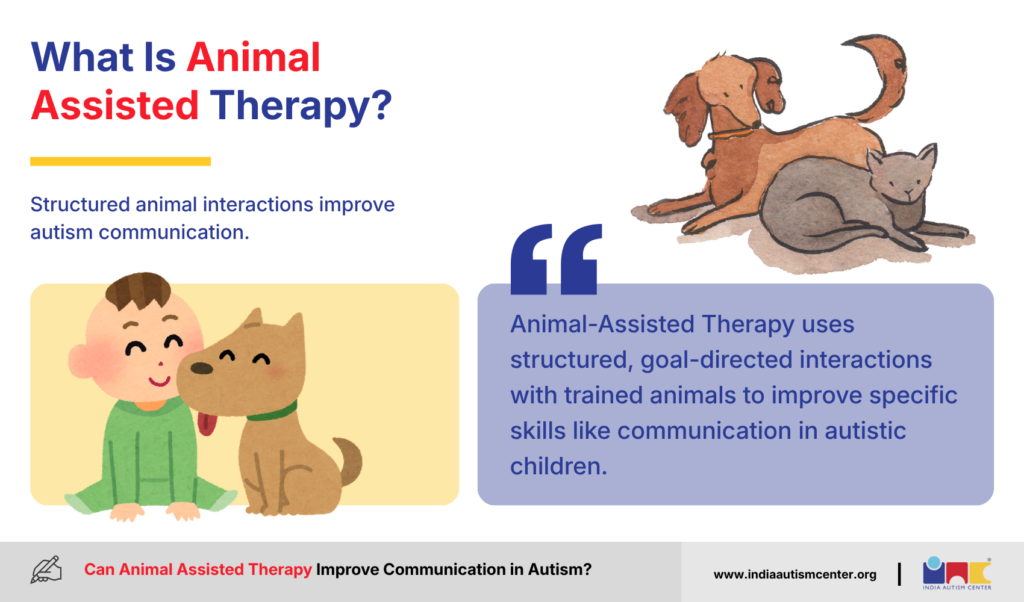
First, let me clarify what we mean by Animal-Assisted Therapy. You might confuse it with simply owning a pet. But there is a big difference. Animal-assisted therapy is a structured, goal-directed intervention.
A trained therapist works alongside a specially screened animal—often a dog, horse, or even a guinea pig. Together, they target specific skills like speech, eye contact, or social turn-taking.
I like to think of it as a partnership. The animal acts as a co-therapist. You set clear objectives. For example, you might want a non-verbal child to point at a picture of a “dog” or say “ball.” The animal provides comfort, motivation, and a non-judgmental presence. This is not just playtime. It is therapy with a tail wag.
So, can animal-assisted therapy improve communication in autism? The short answer is yes, and the long answer is even more exciting. Let me show you why.
Understanding Communication Challenges in Autism: Why We Need New Tools
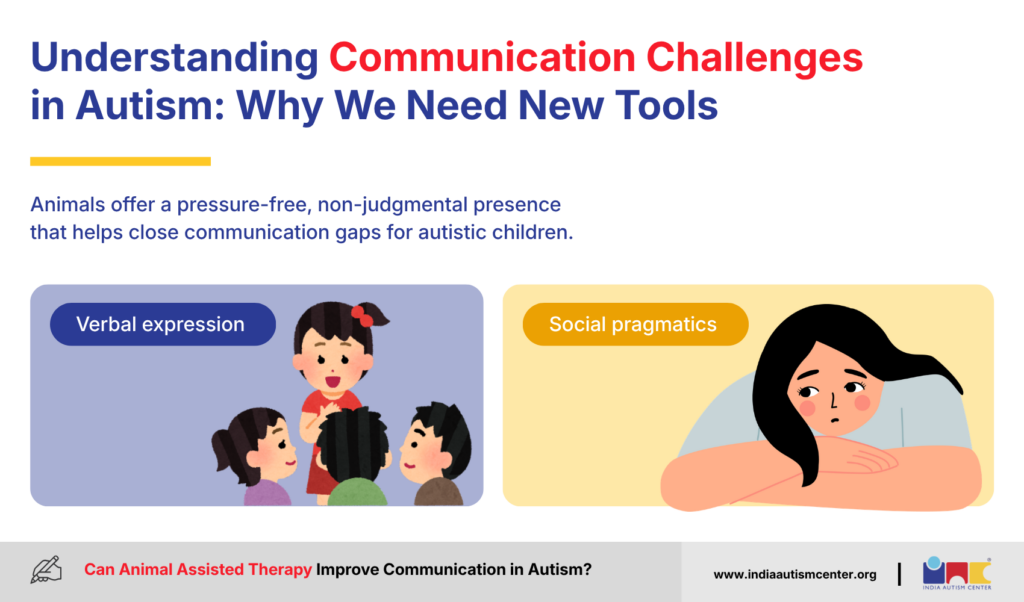
Before we explore how animals help, you need to understand the problem. Autism Spectrum Disorder (ASD) often affects two key areas of communication: verbal expression and social pragmatics.
A child might have delayed speech. They might repeat words (echolalia) without meaning. Or they might struggle with non-verbal cues—like understanding your smile or matching your tone of voice. Some individuals are non-speaking. Others speak fluently but cannot hold a back-and-forth conversation.
I have worked with children who want to connect but feel overwhelmed by human interaction. A direct question from a therapist can feel threatening. A demand to “look at me” can trigger anxiety. This is where animal therapy for autism steps in. Animals ask for nothing. They simply exist, and that existence creates a safe bridge.
You see, a dog does not judge a stutter. A horse does not care if you avoid eye contact. This lack of social pressure is exactly why autism communication therapy with animals works so well.
We also have a blog on Different Autism Therapies, which you can read later for a deeper understanding.
Want to know more? Get in touch with us.
How Animal-Assisted Therapy Works: The Science Behind the Bond
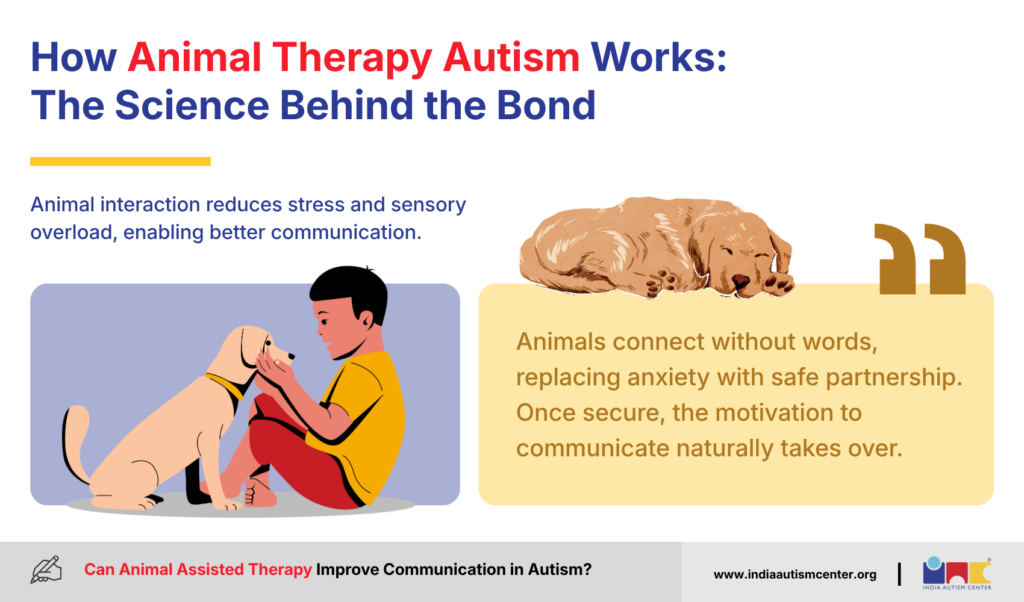
Now, let me explain the mechanism. You might wonder, “Is this just a nice story, or is there real science?” I can assure you, the research is robust.
When a person interacts with a calm, friendly animal, their body releases oxytocin. You probably know oxytocin as the “love hormone.” It lowers stress, reduces cortisol, and increases feelings of safety. For an autistic person who is often in a state of high arousal (due to sensory sensitivities or social anxiety), this biochemical shift is huge.
Lower stress means better learning. Better learning means more communication attempts.
Additionally, animals provide predictable, rhythmic input. Stroking a dog’s fur or grooming a horse creates a repetitive, calming motion. This can help an autistic person regulate their sensory system. Once regulated, they can focus on a communication task.
I have seen a non-speaking child hum along to a song about a cat. I have watched a teenager with severe social anxiety order a guinea pig’s food at a pet store — because the animal gave them a reason to speak. These are not miracles. They are the communication benefits of animal – assisted therapy in autism in action.
Key Communication Benefits of Animal-Assisted Therapy in Autism (A Detailed List)
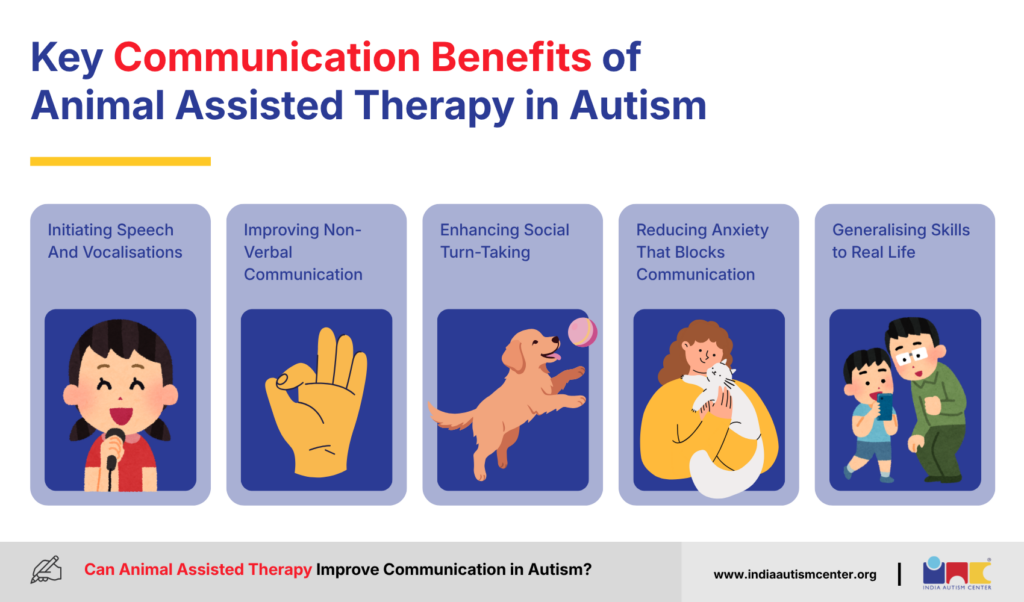
Let me break down the specific ways Animal-Assisted Therapy improves communication. You can use this list to set goals for your own child or client.
1. Initiating Speech and Vocalisations
Many autistic children rarely start a conversation. But an animal creates a natural reason to speak. For example, a child might say “more” to request another treat for the dog. I have seen children produce their first intentional word—like “woof” or “go”—during a therapy session with a trained dog. The animal never pressures them. It just waits, and that waiting invites a response.
2. Improving Non-Verbal Communication
Communication is more than words. Animal therapy for autism targets eye contact, pointing, and facial expressions. You might ask a child to point to the dog’s nose. Or you might reward a glance toward the handler. Horses, in particular, are sensitive to body language. If a child slumps, the horse stops. The child quickly learns that their posture “speaks” to the animal.
3. Enhancing Social Turn-Taking
Conversation requires back-and-forth. Animals are natural at this. You throw a ball; the dog fetches it. You say “sit”; the dog sits. This predictable exchange teaches turn-taking without complex social rules. I often use a simple game: “Your turn to brush the horse, my turn to feed the carrot.” The child internalises the rhythm of interaction.
4. Reducing Anxiety That Blocks Communication
Anxiety is the enemy of speech. When you are scared, your brain’s Broca’s area (responsible for language production) shuts down. Animal-Assisted Therapy lowers that anxiety. A child who refuses to speak in a clinical room might whisper to a rabbit in a quiet corner. The animal acts as a social lubricant. You are not talking to a therapist; you are talking about the animal.
5. Generalising Skills to Real Life
This is the ultimate goal. You do not want a child to only talk to animals. You want them to talk to people, too. The good news is that skills learned with animals often transfer. I have seen a child learn to ask “Can I pet your dog?” on a walk, and then generalise that sentence structure to ask “Can I play with your toy?” at school. How animals help with autism communication is by providing a bridge from the therapy room to the real world.
Autism Communication Therapy with Animals: Techniques and Approaches You Can Use
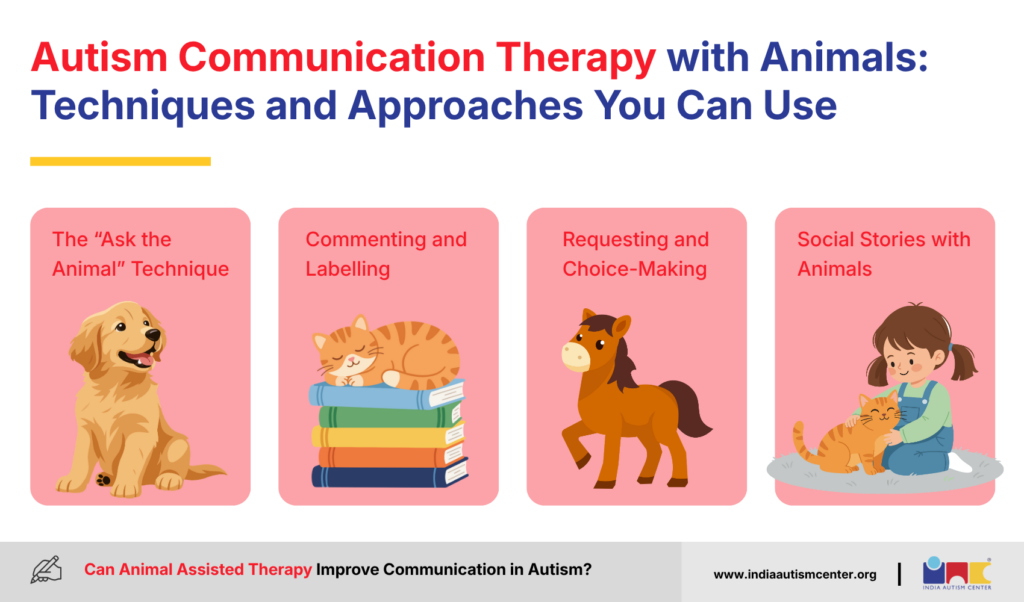
You might be thinking, “This sounds great, but how do we actually do it?” Let me give you specific techniques that therapists use in autism communication therapy with animals.
The “Ask the Animal” Technique
Instead of asking the child a direct question (which can feel threatening), you ask them to ask the animal. For example: “Can you ask the dog if he wants a walk?” The child then speaks to the dog. The pressure is off. You can fade this later by having the dog “answer” through the therapist.
Commenting and Labelling
You place the child in front of the animal and model simple comments. “Dog is brown.” “Cat is sleeping.” The child is more likely to imitate because the animal is interesting. I use this for children with echolalia—they repeat the phrase happily because they associate it with the furry friend.
Requesting and Choice-Making
Hold two items (a brush and a ball). Ask the child to tell the animal what they want. “Do you want to brush the horse or play fetch with the dog?” The child points, signs, or speaks. The animal then receives the action. This teaches purposeful communication.
Social Stories with Animals
You can write a social story about a dog who learns to say “hello.” Read it together. Then act it out with the real animal. The child sees that communication has consequences—the dog wags its tail when you speak nicely.
All of these techniques rely on one core principle: the animal is a motivator. You do not have to force communication. The child wants to interact with the animal, so they find a way.
Want to know more? Get in touch with us.
Animal-Assisted Intervention Autism: Which Animals Work Best?
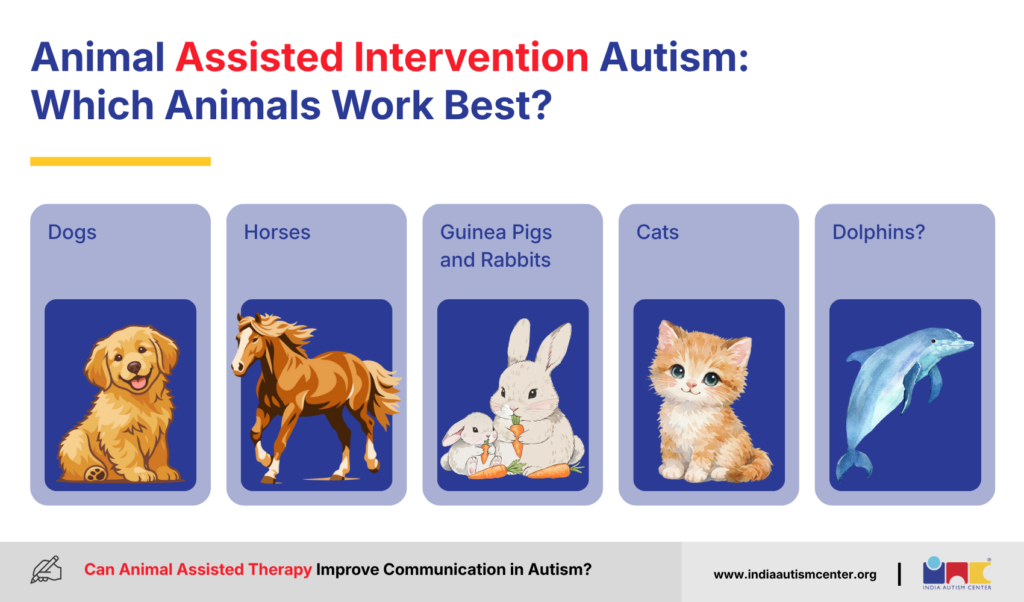
You might assume dogs are the only option. But animal-assisted intervention for autism includes many species. Each has unique advantages.
Dogs
Dogs are the most common. They are trainable, affectionate, and responsive. A therapy dog remains calm in chaotic environments. They tolerate hugs, loud noises, and sudden movements. I recommend dogs for children who need high-energy interaction—like playing fetch or practising commands.
Horses
Horses are powerful for body awareness and non-verbal communication. They mirror your emotions. If you are anxious, the horse becomes tense. This gives immediate feedback. Horses work well for older children and teens who need to regulate their own state before speaking.
Guinea Pigs and Rabbits
Small mammals are perfect for non-speaking or highly anxious children. They are quiet, soft, and non-threatening. You can hold them in your lap. I often start with guinea pigs for children who are completely non-verbal. The child just needs to sit and stroke the fur. Eventually, they whisper a sound.
Cats
Cats are more independent, but some therapy cats exist. They work for children who prefer calm, still companionship. A cat sitting on a child’s lap can encourage whispering and quiet vocalisations.
Dolphins
You may have heard of dolphin-assisted therapy. I want to be honest: the evidence is weak, and there are ethical concerns. I do not recommend it. Stick with land animals that you can interact with regularly.
Practical Considerations for Starting Animal-Assisted Therapy
You are probably excited. But let me give you a few practical tips before you start.
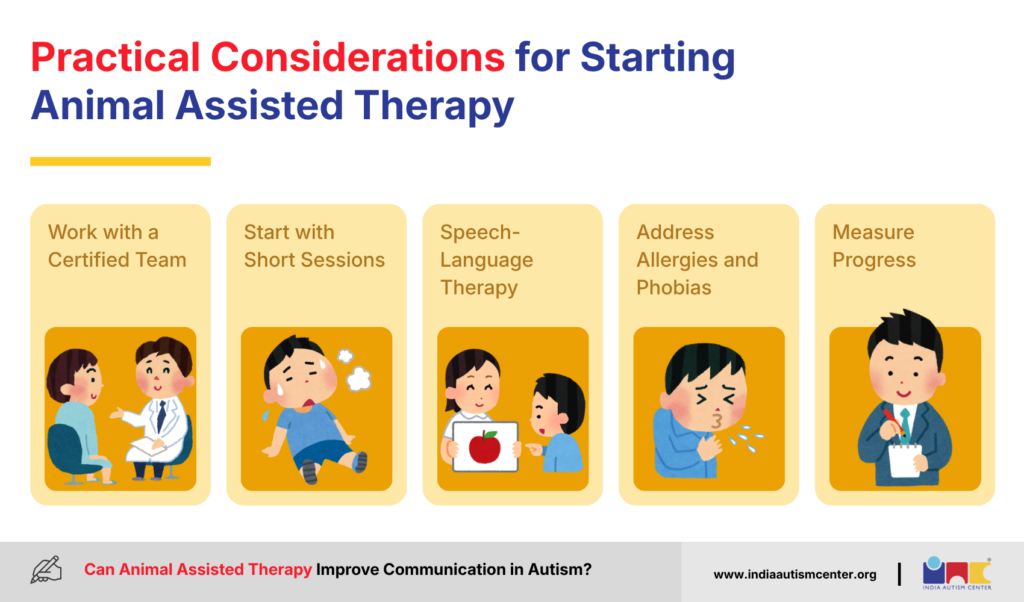
1. Work with a Certified Team
Animal Assisted Therapy requires a trained therapist and a certified therapy animal. Do not just bring your family pet into a session. Even a gentle dog can get stressed by an autistic child’s sensory behaviours. A certified team knows how to read the animal’s stress signals and keep everyone safe.
2. Start with Short Sessions
A 20-minute session is often enough. Autistic children can become overstimulated by the animal’s movements, smells, or sounds. Watch for signs of distress—covering ears, turning away, or tensing up. End on a positive note.
3. Pair with Speech-Language Therapy
Animal-assisted therapy is not a replacement for speech therapy. It is a supplement. You should continue working with a speech-language pathologist (SLP). Ideally, the SLP incorporates the animal into their existing goals. I have seen the best results when the animal is a tool in a larger communication plan.
4. Address Allergies and Phobias
Some autistic children have severe animal phobias or allergies. Do not force it. You can start with photos, videos, or robotic stuffed animals. Slowly desensitise them. For allergies, consider hypoallergenic breeds (poodles) or animals like reptiles (though they offer less social feedback).
5. Measure Progress
Keep a simple log. Note how many vocalisations, gestures, or initiations occur per session. You want to see a clear increase over the weeks. If you do not, reassess the approach.
What Does the Research Say? Evidence for Communication Benefits
I promised you science, so let me deliver. Multiple studies have examined how animals help with autism communication.
- A 2019 randomised controlled trial (O’Haire et al.) found that children with ASD who participated in animal-assisted intervention autism showed significantly more social talk and positive affect compared to a control group. They also displayed fewer instances of social withdrawal.
- A 2021 meta-analysis of 24 studies concluded that animal therapy for autism has a moderate to large effect on social communication behaviours, including joint attention, verbal initiations, and facial orienting.
- A 2022 study on equine-assisted therapy reported that 80% of autistic participants increased their use of multi-word phrases after 10 sessions.
I will be transparent: not every study shows massive gains. Some children respond better than others. But the overall direction is clear. Animal-assisted therapy is an evidence-based complementary approach.
Want to know more? Get in touch with us.
Addressing Common Concerns and Myths
Let me tackle a few doubts you might have.
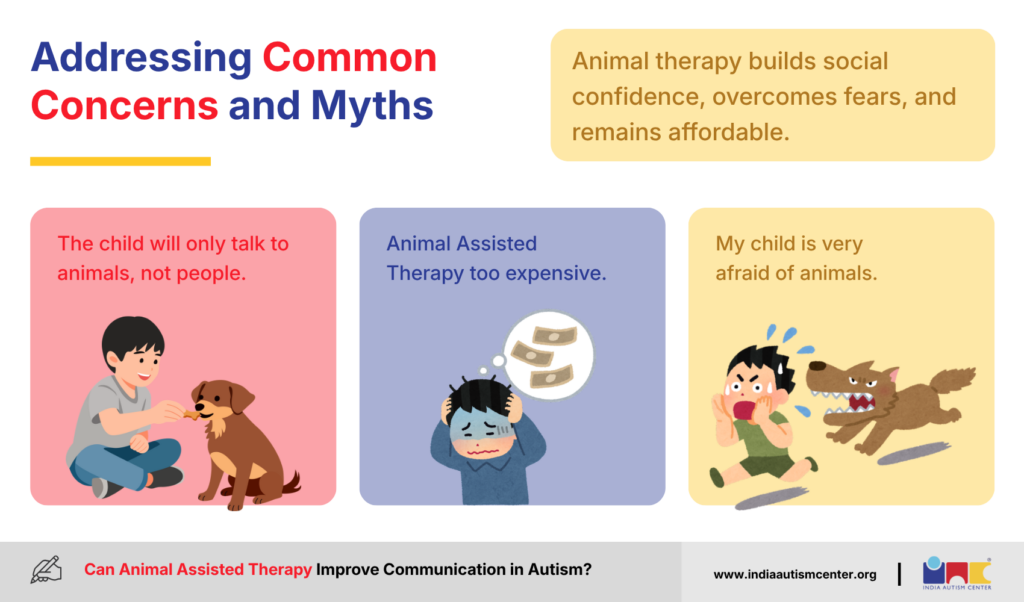
Myth 1: “The child will only talk to animals, not people.”
This is rare. In fact, the opposite happens. The animal acts as a stepping stone. Once the child experiences success (e.g., saying “sit” to a dog and seeing the dog sit), they gain confidence. That confidence spills over into human interactions.
Myth 2: “It is too expensive.”
Yes, professional Animal-Assisted Therapy can cost $75–$150 per session. But some non-profits offer scholarships. You can also look for “animal-assisted activities” at local libraries or schools—these are less formal but still beneficial. Alternatively, consider adopting a calm pet and working with a volunteer trainer.
Myth 3: “My child is afraid of animals.”
Start extremely slowly. Use stuffed animals, then videos, then a very small caged animal (like a hamster). Do not rush. For some children, fear of animals is a sensory issue (unpredictable movement). Desensitisation works, but consult an occupational therapist.
Don’t forget to read our blog on A Comprehensive Guide to Speech and Language Therapy for Autism
A Step-by-Step Plan for You to Get Started
If you are ready to try Animal Assisted Therapy, here is my recommended roadmap.
- Talk to your child’s SLP or behavioural therapist. Ask if they have experience with animals.
- Search for a certified therapy animal organisation. In the US, look for Pet Partners or Therapy Dogs International. They can connect you to a local team.
- Visit a session without your child first. Watch how the animal interacts. Ask about their safety protocols.
- Bring your child for a short meet-and-greet. No goals. Just let them see the animal.
- Set three communication goals. For example: “Point to the dog’s nose” or “Say ‘more’ twice per session.”
- Commit to 6–8 sessions. Then reassess. Have you seen improvement?
📥 Free download: Printable daily routine chart for autistic children
Conclusion: Can Animal-Assisted Therapy Improve Communication in Autism?
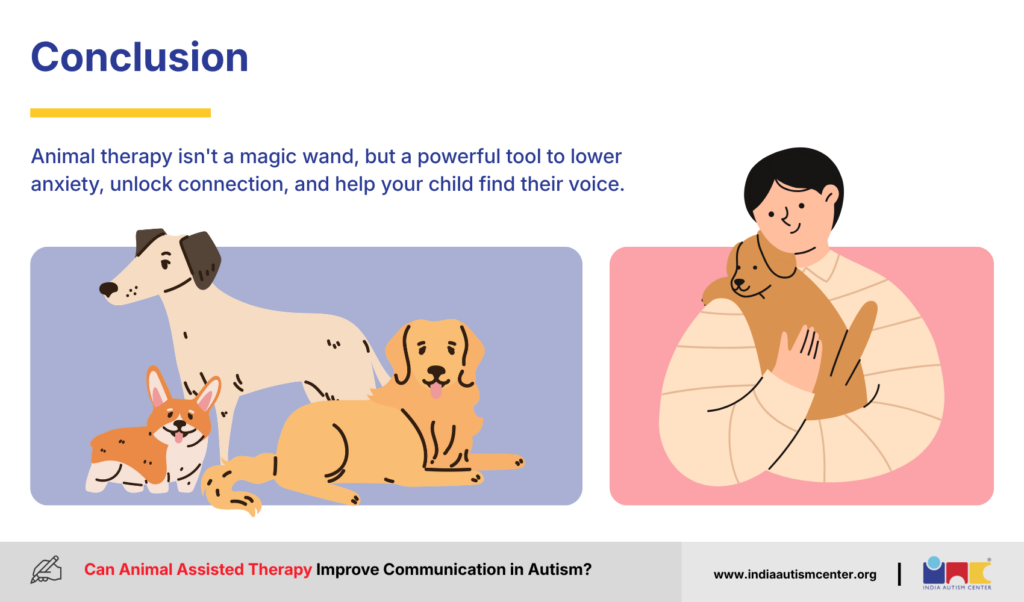
Let me give you my final answer. Yes, animal-assisted therapy can absolutely improve communication in autism. But it is not a magic wand. It is a tool—a beautiful, furry, feathery, or four-legged tool that lowers anxiety, provides motivation, and creates a safe space for practising speech and social skills.
You have learned how animal therapy for autism works at a biochemical level and the communication benefits of animal-assisted therapy in autism through real-life stories. Now you understand how animals help autism communication by acting as non-judgmental co-therapists. And you have specific techniques for autism communication therapy with animals, plus a guide to different species in animal-assisted intervention for autism.
I encourage you to take the next step. Call a local therapy animal organization. Ask questions. Observe a session. Your child or client might just find their voice—with a little help from a loyal friend.
After all, communication is connection. And animals are masters of connection. Let us use their gift to unlock ours.
Do you have experience with Animal-Assisted Therapy? I would love to hear your story in the comments below. And if you found this article helpful, please share it with another parent or therapist who needs hope.
Frequently Asked Questions (FAQs)
Can animal-assisted therapy improve communication in autism?
Yes, animal-assisted therapy can significantly improve communication in autism. It creates a low-pressure, emotionally safe environment where individuals feel more comfortable expressing themselves. Over time, this leads to better verbal attempts, improved non-verbal cues, and increased social interaction.
How does animal therapy help autism communication?
In animal therapy autism, animals act as social bridges. They motivate individuals to communicate through commands, play, and interaction. This encourages both verbal and non-verbal communication while reducing anxiety, making communication more natural and spontaneous.
Is animal-assisted therapy effective for non-verbal children with autism?
Yes, animal-assisted therapy for autism can be highly beneficial for non-verbal children. It helps develop foundational communication skills like gestures, eye contact, and sounds. In some cases, it may even support the development of verbal speech over time.
What animals are commonly used in autism communication therapy with animals?
Common animals used in autism communication therapy with animals include:
Small animals like rabbits or guinea pigs (for sensory comfort and gentle interaction)
Dogs (most widely used for emotional bonding and commands)
Horses (used in equine therapy for non-verbal communication and confidence)
What are the benefits of animal-assisted therapy in autism?
The key benefits of animal-assisted therapy in autism include:
Enhanced emotional connection and bonding
Improved communication skills (verbal and non-verbal)
Reduced anxiety and stress
Better social interaction and engagement
Increased motivation to communicate
Can animal-assisted therapy replace speech therapy for autism?
No, animal-assisted therapy should not replace speech therapy. Instead, it works best as a complementary approach. When combined with speech and occupational therapy, it enhances overall outcomes, especially in improving communication and social skills.
For expert insights, support services, and inclusive learning initiatives, visit the India Autism Center.