 Donate now
 Get a Call Back
 MENU
MENU 22 MIN READ
 SHARE
SHARE


Coping with autism can feel like a sudden shift in gravity. Relief and grief, clarity and confusion, all crowd in at once. There is the label (with that comes the stigma), the paperwork, and the inevitable questions.
And then the quiet pause of “Now what?”
Long before that moment, though, many live through a drawn-out pre-diagnosis phase. Includes studying, noting patterns, and preparing questions for the consultant. These steps, modest as they seem, help steady the ground and make the conversation ahead more coherent.
Our guide on coping with autism diagnosis is meant as a compass through both stages—the groundwork before diagnosis and the path that unfolds after. Up next, we’ll break down what the diagnosis truly means and how to cope with autism in daily life.
Read on.
Coping with Autism Diagnosis: What It Means
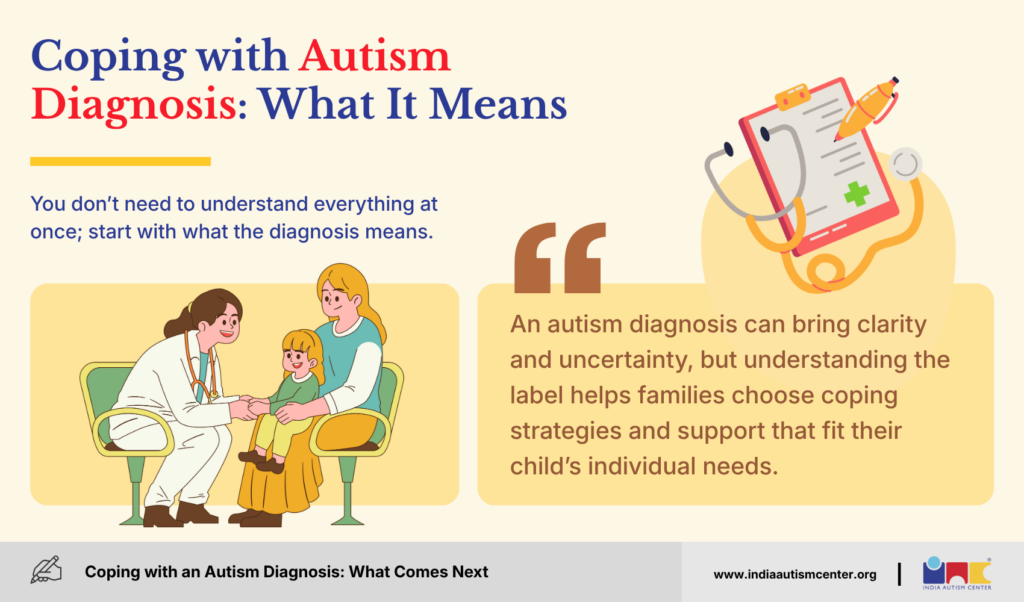
You’ve heard the word. You’ve sat through the explanation.
Now you’re holding a diagnosis that’s supposed to help, but doesn’t quite tell you how. Even with a name, coping with autism spectrum disorder is rarely straightforward – it often opens a new set of questions you didn’t know you’d be asking.
Pam Aculey, parent of a child on the spectrum, says, “Receiving our son’s autism diagnosis was a life-changing moment. Whilst it provided us with an explanation… it also instilled panic, confusion and uncertainty for the road ahead.”
That mix of clarity and overwhelm is something many families feel in the days that follow. Understanding the different diagnostic labels is the first step in finding autism coping skills that actually fit.
Your child meets the criteria for Autism Spectrum Disorder Level 2
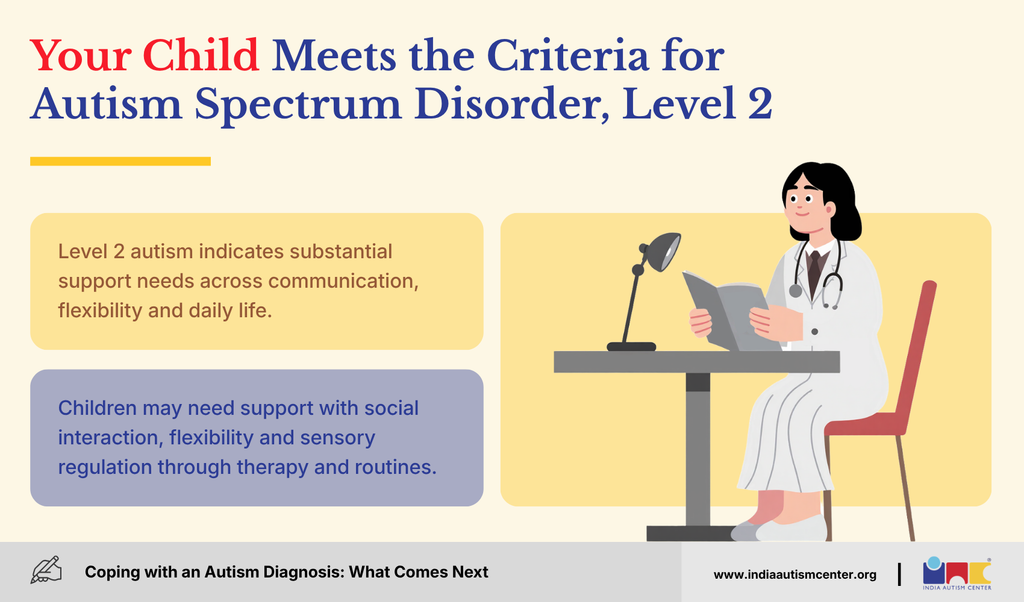
This statement reflects the current diagnostic model under the DSM-5, where autism is recognized as a spectrum rather than distinct subtypes like Asperger’s or PDD-NOS.
Level 2 suggests substantial support needs, especially in areas like social interaction, communication, behavioral flexibility, and sensory regulation.
You may notice:
- Frequent meltdowns when routines change
- Limited back-and-forth interaction
- Delayed speech or unusual language patterns
- High sensitivity to noise, touch, or crowds
What this might mean:
- Referrals for speech therapy, occupational therapy, and behaviour-based interventions
- Likely need for a special educator or shadow teacher in inclusive settings
- Monthly therapy expenses in private setups can run ₹15,000–₹30,000+
- Eligible for disability certification under the RPwD Act, which can support access to schools, concessions, and future government schemes
Often, children at this level may also be evaluated for co-occurring conditions like ADHD, sensory processing difficulties, or speech apraxia. Each of these can shape therapy goals and timelines. Families often ask how to cope with autism when support needs are substantial. At this level, coping strategies for autism usually include speech therapy, occupational therapy, structured routines, and professional guidance.
Traits consistent with autism, Level 1
Level 1 autism indicates milder but still impactful support needs. Individuals may have fluent language and average cognitive abilities, but experience difficulty with social nuance, rigidity, anxiety, or sensory overload. These are often internal struggles that others don’t easily see.
This is where high functioning autism coping strategies often come into play – building social confidence, coaching for executive skills, and offering tailored counseling.
What this might mean:
- May go unnoticed in school unless academic or emotional challenges appear
- Needs may include counseling, executive function coaching, or group therapy
- Girls and verbally articulate children may mask symptoms, leading to delayed or missed diagnosis
- Support may feel optional to others, but burnout and withdrawal are real risks
- Financially, it often means unstructured, ongoing out-of-pocket expenses for private support with little formal recognition
Diagnosis at this level may be made later in life, especially in women, nonbinary individuals, or those misdiagnosed with anxiety, OCD, or depression. For adults, it can feel like both clarity and reckoning.
📥 Free download: Printable daily routine chart for autistic children
ADHD and autistic features are both present
This is a dual diagnosis that’s becoming more widely recognized. ADHD and autism often overlap, with each condition amplifying the other’s challenges. A child might struggle to sit still and also resist transitions. An adult might be impulsive, yet hyper-focused and anxious in new social situations.
What this might mean:
- Need for a combined intervention plan: behavioral therapy, sensory tools, and classroom strategies
- In some cases, medication may be advised to manage inattention or hyperactivity
- School systems may struggle to support both diagnoses simultaneously
- Costs can quickly add up—between therapy, psychiatric consults, and parental guidance
- Most insurance plans don’t fully cover these needs in India
Clinicians often highlight this combination to explain why a child doesn’t respond to a single therapy style—or why social skills improve, but regulation doesn’t.
Parents may need to explore combined coping mechanisms for autism and ADHD, including behavioral therapy and school accommodations.
Social Pragmatic Communication Disorder fits better
This diagnosis is given when social interaction is affected—like difficulty understanding tone, taking turns in conversation, or interpreting gestures—but without the repetitive behaviors or sensory differences seen in autism.
It’s considered distinct from ASD, but support is still essential. What this might mean:
- May be referred to speech-language therapy focused on social communication
- Often excluded from autism-specific school accommodations and benefits
- Teachers may misread challenges as immaturity or rudeness
Parents sometimes ask how they’re supposed to hold it all together. The answer isn’t about perfection so much as steadiness.

Your own regulation is the anchor. If you can stay steady, you’ll catch the small signs of frustration and step in before it tips into a breakdown. Every problem cannot be immediately fixed but just staying watchful will help you detect if your child is getting pushed over the edge, and you can check that in time!
Puja Dutta, RCI-registered Clinical Psychologist at India Autism Center
Long-term support is still needed, but legal protections and public funding are limited. This diagnosis can feel ambiguous for parents, but the key is not waiting. Social communication skills can improve dramatically with early, targeted support.
Even without a full autism diagnosis, families benefit from autism coping skills for adults and children alike – skills like emotional regulation, communication strategies, and sensory support.
Developmental delay with autistic features; we’ll reassess
Used for children under 5 when delays are observed across areas—like speech, motor skills, or play—but a full autism diagnosis is not yet confirmed. It’s a watch-and-intervene approach.
This overlaps with Global Developmental Delay (GDD), a term that gives space to monitor evolving needs.
What this might mean:
- Begin early intervention immediately: speech, OT, special education
- Track milestones closely, with reassessments every 6–12 months
- May receive temporary disability certification to access early support
- Therapy costs are often high upfront, with limited public provision
- Diagnosis may later evolve into ASD, ID, or a learning disability, depending on the child’s developmental path
Early intervention here focuses less on labels and more on developing autism coping skills – speech, play-based learning, and structured support routines.
So, now that you’ve unpacked the language, let’s move toward what to actually do with it. Next up: building a plan, finding the right support, and making this diagnosis work for you.
Personalizing Support: What to Focus on, What to Let Go
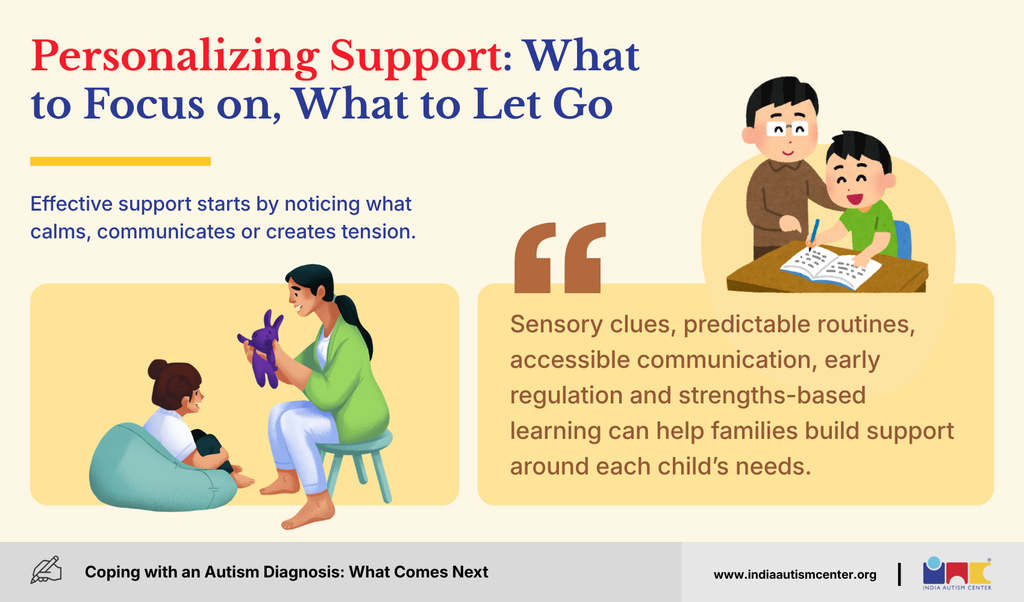
Parents of autistic children are often handed a flood of advice. New therapies, new strategies, new “essentials.” What gets lost in that rush is a quieter truth: not every approach matters equally. What matters most is finding coping strategies for autism that fit the child in front of you.
Support becomes clearer when you slow down long enough to notice. Which moments seem to calm? What sparks tension? Which gestures or sounds carry meaning? A pattern begins to reveal itself, and with it, the outline of a plan.
Seen this way, the next steps become clear.
Decode Sensory Clues Before Labeling Behavior
A child covering their ears in a crowded room is not being difficult; they are signaling distress. A refusal to wear a certain shirt may point less to stubbornness than to the irritation of a seam. Behavior, in this sense, is language—sometimes subtle, often urgent.
Check these common sensory signals found in autism and ways to respond:
| If You Notice This | It May Reflect | You Can Try |
| Hands clamped over ears | Auditory sensitivity | Noise-canceling headphones, quiet breaks |
| Refusal of clothes/shoes | Tactile discomfort | Softer fabrics, tagless clothing |
| Chewing on sleeves or pencils | Oral sensory-seeking | Chewelry, crunchy snacks |
| Pacing, spinning, or jumping | Need for movement | Swings, trampolines, and climbing breaks |
| Withdrawal in bright rooms | Visual overload | Dim lighting, sunglasses |
When interpreted this way, behavior shifts from being a problem to be managed to a clue about how the world is being experienced.
This forms part of everyday coping mechanisms for autism, helping children regulate without escalating stress.
Use Routine to Create Safety, Not Rigidity
Routines are often described as restrictive, but for many autistic children, they serve as anchors. Predictability eases anxiety, creates a sense of safety, and makes daily life less chaotic. The goal is not rigid adherence to schedules but a rhythm steady enough to provide reassurance.
Ways routines can ease daily life:
| Goal | Tool That Helps |
| Calmer mornings | Picture strip by the mirror |
| Smoother bedtimes | Dimmer switch + checklist |
| Easier transitions | Countdown timer + verbal cue |
| Less chaotic weekends | “Today’s Plan” fridge chart |
Sometimes the most effective support is not a full overhaul but a small, consistent addition that lowers stress.
For many families learning how to live with autism, routines become a key autism coping skill that provides both safety and flexibility.
Expand Communication Beyond Speech
Spoken words often arrive unevenly, or not at all. Yet communication rarely disappears. It shows up in gestures, repeated phrases, the rhythm of movement, or with the help of assistive devices. To recognize those signals is to widen the frame of what language looks like.
Ways to make communication more accessible:
- Offer clear picture choices instead of open-ended questions
- Treat repeated scripts as openings, not interruptions
- Allow extra pauses before stepping in
- Keep AAC tools close during everyday routines
By shifting attention from what is absent to what is present, communication begins to feel broader, more possible.
Communication supports are essential coping skills for autism spectrum disorder, especially when speech is delayed or absent.
Teach Regulation Before the Storm
Meltdowns rarely arrive without warning. They build gradually—restlessness, escalating scripts, withdrawal. These are not minor inconveniences but early signals that the child is nearing a breaking point. Intervening before escalation often means the difference between a spiral and a moment of calm.
Here are some early clues and supports that prove useful:
| Early Clue | Helpful Support |
| Pacing or restless hands | Fidget tools, deep pressure |
| Escalating scripts | Calm break, quiet corner |
| Covering ears or eyes | Headphones, dim lights |
| Repeated questions | Visual schedule, consistent reply |
Calm practices introduced early and often, not in the midst of a crisis, are the ones most likely to take hold. These proactive methods are some of the most reliable autism coping skills for adults and children.
Start With Strengths, Not Deficits
The impulse to focus on delays is strong, but strengths are often the more reliable path forward. A child’s fascinations, talents, or even quirks can become tools for learning and connection. What lights them up can also guide them toward growth.
Transform strengths into supports:
| Strength | How to Build On It |
| Fascination with trains | Counting, turn-taking, sequencing |
| Love of drawing | Self-made visual schedules |
| Strong memory for patterns | Anchoring routines and rules |
| Mimicry of sounds | Social scripts and play |
| Passion for animals | Responsibility and empathy-building |
When growth is anchored in strength, progress often feels less like correction and more like expansion. This strength-based model not only builds skills but also teaches coping strategies for autism by creating positive learning anchors.
Support, then, is not about adding more. It is about finding the shape that matches a child’s needs and leaning into it. Observed closely, the outline is already there.
Use Cognitive Training to Strengthen Core Skills
In India, cognitive training is slowly gaining traction as an essential part of intervention for children with developmental differences. Unlike therapies that target specific behaviors, cognitive training strengthens the “thinking skills” beneath them with flexibility, self-regulation, multitasking, working memory, and problem-solving. These are the foundations that help a child adapt in the classroom, manage frustration, and carry new learning into daily life.
Why it matters: Without these skills, even strong abilities, like language or memory, may not translate into independence. A child who can memorize facts may still struggle to shift when plans change; one who speaks fluently may still be derailed by poor regulation. Cognitive training fills these gaps by teaching children how to manage information, not just absorb it.
For many, especially when coping with ASD as an adult, cognitive training becomes a crucial tool for independence and daily functioning.
What it looks like:
- Memory and sequencing games to strengthen working memory
- Structured play that encourages flexible thinking
- Daily activities that demand planning and self-monitoring
Talking to Siblings About Autism
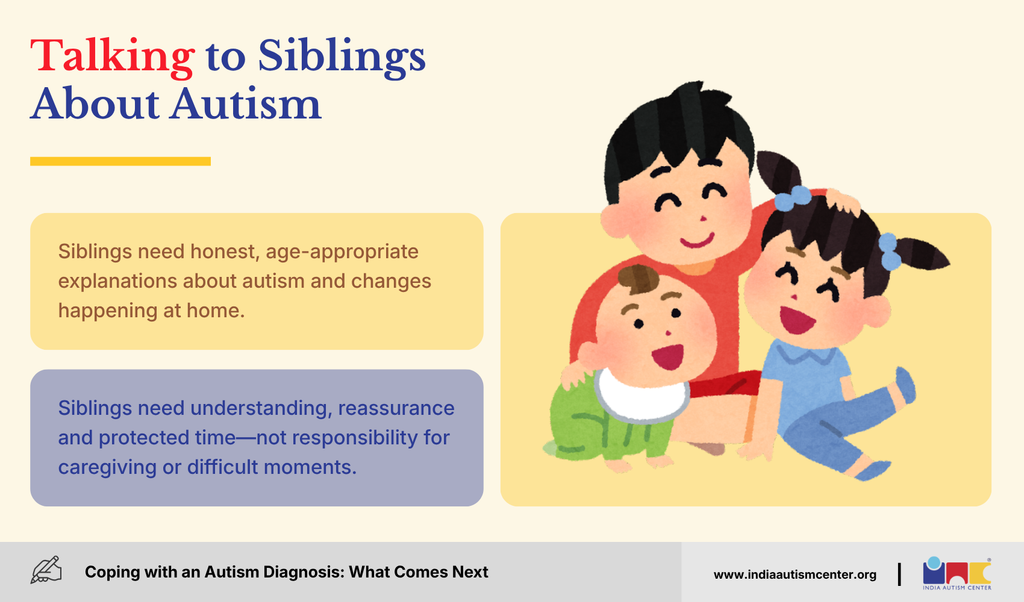
When a child receives an autism diagnosis, the conversation that often gets postponed the longest is the one with the other children in the family. It feels complicated. You’re still processing it yourself. You don’t want to say the wrong thing.
But siblings notice. They notice the extra appointments, the changed routines, the meltdowns they don’t quite understand. Silence doesn’t protect them – it just leaves them to fill the gap with their own explanations, which are rarely accurate and often unkind to themselves.
The good news: you don’t need a perfect script. You need an honest, age-appropriate conversation that you’re willing to return to.
What to Say at Each Age
Ages 3–5 (keep it concrete and brief): “Your brother’s brain works a little differently. Loud places feel very big to him, so sometimes he needs quiet. That’s not your fault, and it doesn’t mean he loves you less.”
Ages 6–10 (add a little more detail): “Autism means some parts of the brain develop differently. It can make talking, or being in noisy places, or changes in plans feel really hard. That’s why she has therapy – to help her with those things. She’s really good at other things too, like [specific strength].”
Teenagers (be direct and specific): Teens can handle the full picture. Talk about what autism means, how it affects daily life, what the therapy goals are, and – importantly – what you expect from them as a sibling. Acknowledge that it’s sometimes unfair. Don’t pretend otherwise.
Reassurance That Every Sibling Needs to Hear
- “Nothing you did caused this.”
- “Autism is not contagious.”
- “You are allowed to feel frustrated sometimes. That’s normal.”
- “You will still get your time, your attention, your space.”
Involving Siblings Without Burdening Them
There’s a meaningful difference between including a sibling and making them a caregiver. Invite them to join a therapy activity once in a while – not to help, but to understand. Let them see what their brother or sister is working on. Celebrate shared wins.
At the same time, protect their childhood. A sibling should not be managing meltdowns, explaining autism to classmates on behalf of the family, or feeling responsible for their brother’s or sister’s wellbeing. That weight belongs with the adults.
Watch for signs of resentment or withdrawal – a sibling who goes very quiet, who stops inviting friends home, or who starts acting out at school may be carrying more than they’re saying. A few sessions with a counselor, just for them, can make a real difference.
Navigating Parental Guilt After an Autism Diagnosis
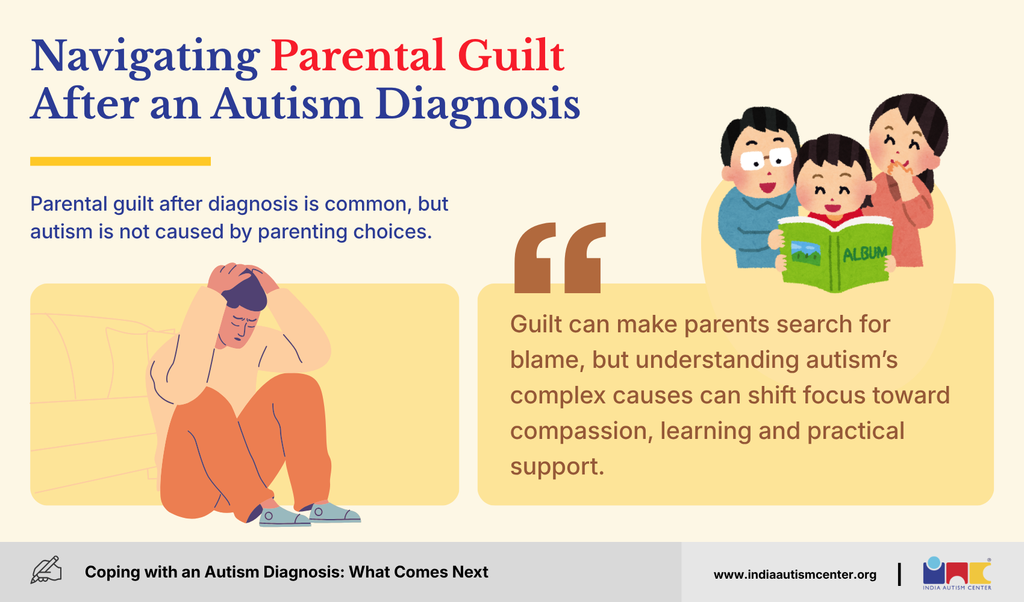
Let’s say it plainly: the guilt is real, it’s common, and it makes complete sense.
Almost every parent we work with at India Autism Center describes some version of it. Did I miss the signs too early? Was it something I did during pregnancy? Did I wait too long to get help? The mind goes back and forth, looking for a cause, looking for something to hold responsible. And it lands on you.
Research published in the Journal of Autism and Developmental Disorders confirms what clinicians see every day: parental guilt after diagnosis is one of the most consistent emotional responses, particularly in mothers, and it’s tied not to actual wrongdoing but to the shock of reinterpreting a child’s history through a new lens.
Here’s what we want you to hear clearly: you did not cause your child’s autism.
Autism has a strong genetic basis. It is not caused by parenting style, diet, screen time, vaccines, or anything you did or didn’t do. The guilt you feel is a measure of how deeply you love your child – not evidence of failure.
Reframing the Guilt: Four Mindset Shifts
1. “I missed the signs” → “I noticed something was different and I kept looking.” Most parents who reach a diagnosis did so because they kept pushing, kept asking, kept advocating. That persistence is not a failure. It’s the reason your child has a diagnosis at all.
2. “I should have acted sooner” → “I acted when I had the information I needed.” Autism diagnosis in India is still delayed for many families – the average age of diagnosis remains above 4 years in most studies. The system is not built for early detection. You were navigating that system. Give yourself credit for getting here.
3. “I’m not doing enough” → “I’m learning what ‘enough’ looks like for my child.” There is no universal checklist for autism parenting. What works for one child may not work for another. You are figuring out your child specifically. That takes time, and it’s not a deficit.
4. “I feel guilty, so something must be wrong” → “Guilt is a feeling, not a verdict.” Feelings are real. They are not always accurate. Guilt in this context is a grief response – it’s part of how parents process a major life shift. It deserves compassion, not more self-punishment.
When Guilt Becomes Something More
If the guilt is persistent, if it’s interfering with your ability to be present with your child, or if it’s tipping into depression or anxiety – please reach out to a mental health professional. Parent wellbeing is not a luxury. It is part of your child’s support system.
You cannot pour from an empty cup. And your child needs you steady, not perfect.
India-Specific Support: Government Schemes & Resources
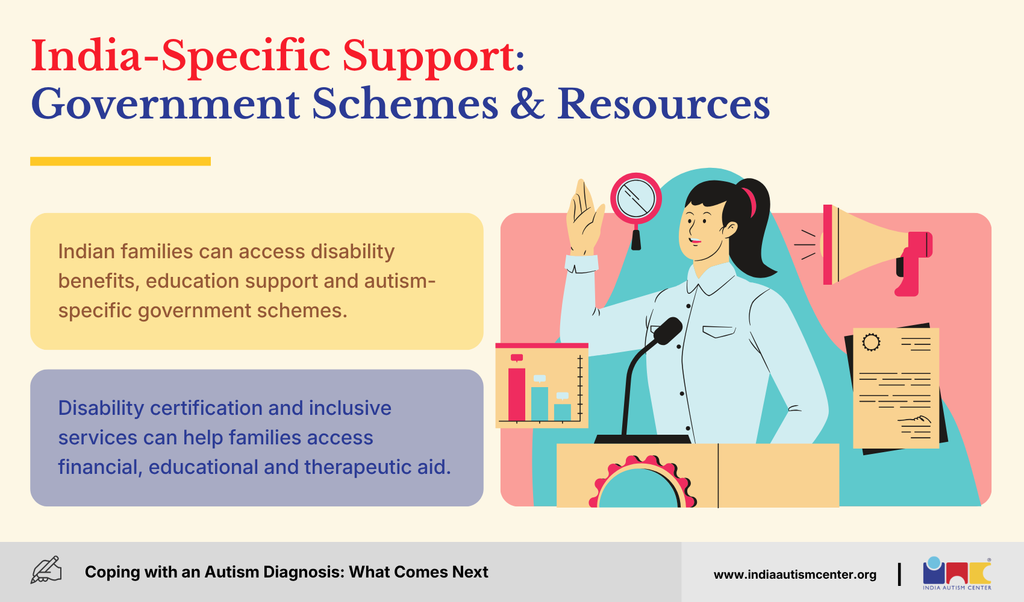
One of the most practical things you can do right after an autism diagnosis in India is to understand what the government has already put in place for your family. Most parents don’t know these schemes exist. Many who do know struggle to navigate them. Here is a clear, actionable breakdown.
Step 1: Get the Disability Certificate (UDID Card)
This is the foundation of everything else. Without a disability certificate, your child cannot access most government schemes, school accommodations, or financial benefits.
The process:
- Get a written diagnostic report from a qualified specialist (developmental paediatrician, child psychiatrist, or neurologist)
- Visit your nearest government hospital and request an assessment by the Disability Assessment Board
- The board uses the Indian Scale for Assessment of Autism (ISAA) to determine the disability percentage
- Submit your application with: diagnostic report, identity proof, address proof, birth certificate, and passport-size photographs
- The certificate should be issued within 30 days of application
The disability percentage matters: 40%+ qualifies for most benefits; 80%+ opens additional entitlements. Apply through your district DDRC (District Disability Rehabilitation Centre) or the UDID portal.
Legal basis: The Rights of Persons with Disabilities (RPwD) Act, 2016 explicitly includes autism as a specified disability. This law mandates equal opportunity, reasonable accommodation in schools and workplaces, and access to government schemes.
Step 2: Access Inclusive Education via Samagra Shiksha Abhiyan (SSA)
If your child is school-age, Samagra Shiksha Abhiyan is the central government scheme that funds inclusive education in government and government-aided schools across India.
What SSA provides for children with autism:
- Identification and assessment support
- Special educators and resource teachers in schools
- Aids and assistive devices
- Therapeutic services (speech, OT) through Block Resource Centres
- Teacher sensitization and training
- Barrier-free school infrastructure
To access SSA support, approach your child’s school principal or the Block Resource Centre in your district. The school should coordinate with the state SSA office to arrange a special educator or resource support.
Step 3: Register with the National Trust
The National Trust is a statutory body under the Ministry of Social Justice and Empowerment that runs three schemes directly relevant to autism:
| Scheme | What It Covers | Who It’s For |
|---|---|---|
| Niramaya | Health insurance up to ₹1 lakh/year – OPD, diagnostics, therapies, corrective surgeries, transport | All ages, no age bar |
| Vikaas | Day care, interpersonal skills, and vocational training | Persons with autism aged 10+ |
| Gharaunda | Lifelong residential care and shelter | Adults with autism |
How to apply: Register your child with the National Trust through a Local Level Committee (LLC) in your district. The LLC is usually hosted by a registered NGO. Find your nearest LLC on the National Trust website.
Note: Niramaya is particularly urgent to apply for early – it covers therapy costs that can otherwise run to ₹15,000–₹30,000 per month in private settings.
Step 4: Tap Into NIMHANS and NIMH Resources
- NIMHANS (National Institute of Mental Health and Neuro Sciences), Bengaluru, has a dedicated Child and Adolescent Psychiatry department that offers assessment, therapy, and parent training programs. It is a government institution, which means significantly subsidized costs.
- NIMH (National Institute for the Mentally Handicapped), now called NIEPID (National Institute for Empowerment of Persons with Intellectual Disabilities), Secunderabad, offers training, rehabilitation, and resource support for families of children with developmental disabilities including autism.
Both institutions also train professionals and publish resources that can help parents understand autism diagnosis India-specific pathways more clearly.
Step 5: Connect with State-Level Autism Societies
Every major Indian state has at least one autism society or parent network that can guide you through local resources, school options, and government scheme applications.
Key organizations:
- Action for Autism (AFA) – New Delhi; India’s oldest autism advocacy organization; runs the National Centre for Autism
- Autism Society of India (ASI) – national body with state chapters
- Ummeed Child Development Centre – Mumbai; multidisciplinary assessment and therapy
- The Banyan – Chennai; mental health and disability support
- AADI (Action for Ability Development and Inclusion) – New Delhi
These organizations often run helplines, parent support groups, and workshops – many of them free. Connecting with other parents who have navigated the same system is one of the most underrated autism diagnosis next steps you can take.
Looking Ahead: Financial Foundations for Lifelong Support
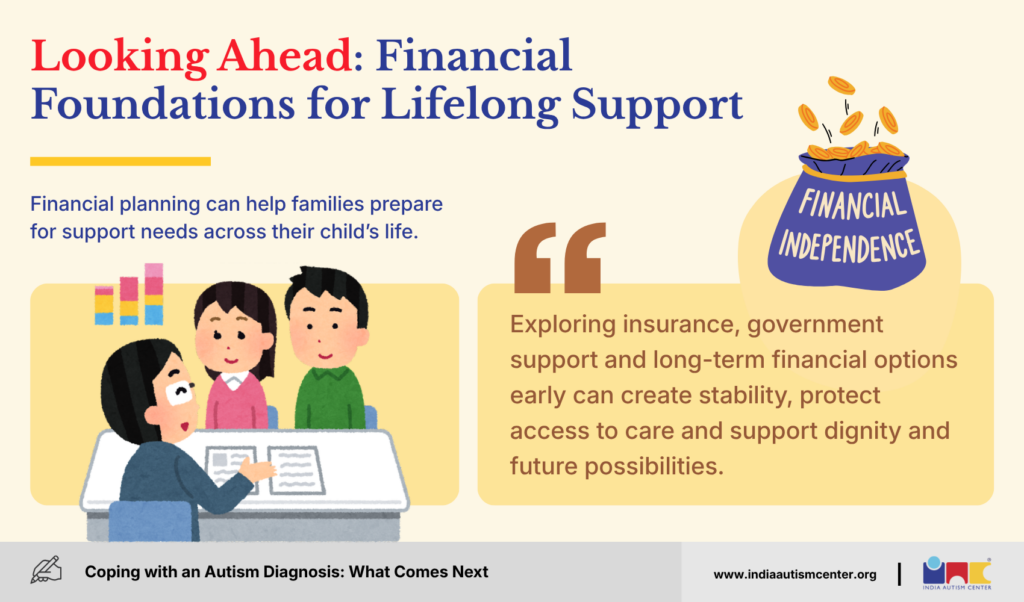
Financial planning becomes essential once an autism diagnosis enters a family’s life. It is the start of a long journey to ensure your child’s needs are met today and protected for tomorrow. A strong financial plan is just as vital as therapies and coping skills for autism. It ensures that support systems continue long-term, especially as children transition into adulthood.
In India, families can explore government-supported Niramaya Health Insurance, covering hospitalization and therapy, or private options like Star Special Care, which includes medical, therapy, and hospital expenses. Internationally, programs such as UnitedHealthcare Special Needs Plans or AXA disability coverage offer comprehensive long-term support. These plans do more than pay bills. They create a safety net that lets daily life unfold with less uncertainty.
A thoughtful financial strategy brings calm and confidence. Planning early safeguards not just care, but your child’s dignity and future possibilities. If you’re unsure which options fit best, a consultation with a specialist can help map the path forward.
Frequently Asked Questions
What are the first steps after an autism diagnosis in India?
Start with three things: understand the specific diagnosis and what level of support it implies, apply for the disability certificate (UDID card) under the RPwD Act 2016, and connect with a multidisciplinary therapy team. These autism diagnosis next steps create the foundation for everything that follows.
How do I cope with an autism diagnosis as a parent?
Give yourself permission to grieve and to feel overwhelmed – both are normal. Then focus on one step at a time. Connect with other autism parents, seek professional guidance, and remember that how to cope with an autism diagnosis is not a question you have to answer alone. Support groups, parent counseling, and organizations like Action for Autism can help.
Is autism covered under the RPwD Act 2016?
Yes. The Rights of Persons with Disabilities Act 2016 explicitly lists autism spectrum disorder as a specified disability. This entitles your child to a disability certificate, school accommodations, government scheme access, and legal protections against discrimination.
How do I explain autism to my other children?
Use simple, concrete language matched to their age. For young children: “Your brother’s brain works differently.” For older children: add detail about what autism means in daily life. Reassure them that nothing they did caused it, that autism is not contagious, and that they will still get your time and attention.
What is the Niramaya scheme and how do I apply?
Niramaya is a National Trust health insurance scheme that covers up to ₹1 lakh per year for OPD, diagnostics, therapies, and more – with no age bar. Apply through a Local Level Committee (LLC) registered with the National Trust. Find your nearest LLC at nationaltrust.nic.in.
My child was diagnosed late. Did I fail them?
No. The average age of autism diagnosis in India remains above 4 years for most children, and many are diagnosed even later. The system is not built for early detection. You got here. That matters. Focus on what you can do now – early intervention at any age produces meaningful outcomes.
What government schools support for autism is available?
Under Samagra Shiksha Abhiyan (SSA), government and government-aided schools are required to provide inclusive education support – including special educators, assistive devices, and therapeutic services – for children with autism. Contact your child’s school or the district Block Resource Centre to initiate this.
Disclaimer: This article is intended for educational and informational purposes only. It is not a substitute for professional medical advice, diagnosis, or treatment. If you are pregnant or have concerns about medication use during pregnancy, please consult a qualified healthcare provider. If your child has received an autism diagnosis and you have questions about causes or support, please reach out to a trained specialist or an autism-focused organisation for guidance.
For expert insights, support services, and inclusive learning initiatives, visit the India Autism Center.