 Donate now
 Get a Call Back
 MENU
MENU 9 MIN READ
 SHARE
SHARE


A residential autism program is worth the cost when a child’s support needs exceed what home or day programs can safely provide, and the facility delivers measurable gains in daily living skills, safety, and family stability. It is not worth it if a lower-intensity option meets the same needs at less cost and less disruption. The right answer depends on three factors: support needs, program quality, and family capacity.
I get asked this question often, and I understand why. Residential care is a major financial and emotional decision. Families want a clear, honest answer — not a sales pitch. This article breaks down the real costs, the signals that residential care might help, and the questions you should ask before you commit.
What Does a Residential Autism Program Actually Cost?
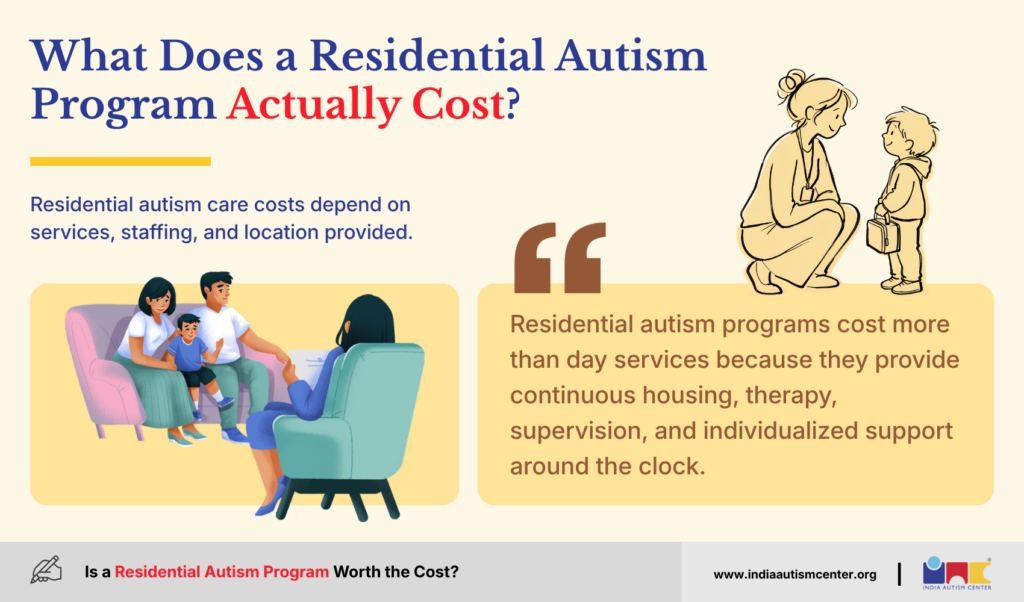
Costs vary widely based on location, staffing ratios, and included services. In India, residential autism programs typically charge more than day programs but less than equivalent facilities in the US or UK. Most quote fees as a monthly or annual package.
Here’s what typically makes up the total cost:
| Cost Component | What It Covers |
| Base tuition/residency fee | Housing, meals, supervision |
| Therapy add-ons | Speech, occupational, behavioral therapy sessions |
| Medical/nursing support | On-site health monitoring, medication management |
| Family visit travel | Transport and stay for periodic visits |
| Transition/onboarding fees | Initial assessment, individualized plan setup |
Many families underestimate hidden costs. These include lost parental income if a parent reduces work hours, sibling travel for visits, and costs during school breaks or transitions back home. Ask any facility for a full cost breakdown, not just the headline fee, before comparing options.
Residential programs generally cost more than home-based ABA therapy or day programs, because they include 24/7 staffing, housing, and meals. That higher cost buys continuous support — but continuous support isn’t always necessary. The next section helps you judge whether it is.
How Does Residential Cost Compare to Other Care Options?
Families rarely evaluate residential care in isolation. The real comparison is against day programs, home-based therapy, and hiring private in-home support. Each option carries a different cost structure and a different level of coverage.
| Care Model | Relative Cost | Coverage Level |
| Home-based therapy (weekly sessions) | Lowest | A few hours per week |
| Day care program | Moderate | Structured hours, daytime only |
| Residential program | High | 24/7, multi-staff, structured environment |
Private in-home full-time support can approach residential costs without offering the same staff diversity or peer environment. This is why cost comparisons should always be apples-to-apples: total monthly spend against total hours and quality of coverage, not just the sticker price.
Here are the Top 10 Autism Centres in India Offering Comprehensive Support and Care.
When Should You Consider Residential Care for Autism?
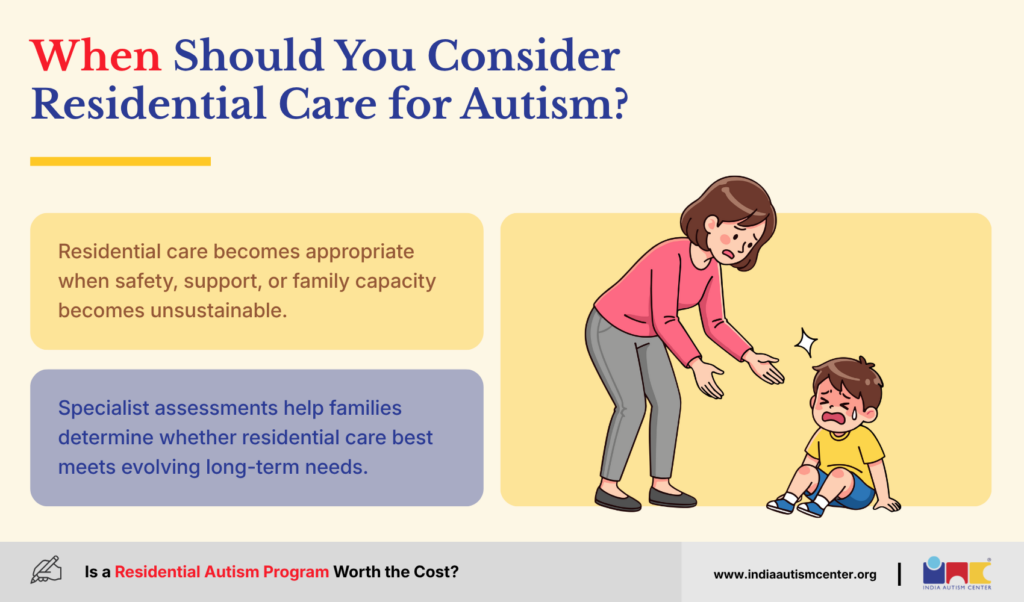
Consider residential care when safety, family capacity, or access to specialized services becomes unsustainable at home. This is not a decision based on autism severity alone. It’s based on whether the current environment can meet the child’s needs safely and consistently.
Common signals that families should evaluate residential options:
- Safety risks — self-injurious behavior or elopement that home supervision can’t reliably manage
- Caregiver burnout — sustained exhaustion that is affecting the caregiver’s health or the whole family’s functioning
- Service gaps — no qualified specialists available locally for the level of support needed
- Plateaued progress — skill development has stalled despite consistent home-based intervention
- Transition planning — an older teen or young adult needs structured, supervised independence training
None of these signals alone means residential care is required. Together, and over time, they indicate it’s worth a serious evaluation. A good starting point is a structured assessment with a developmental pediatrician or autism specialist, not a facility’s own marketing team.
📥 Free download: Printable daily routine chart for autistic children
What Are the Pros and Cons of Residential Autism Programs?
Every family weighs pros and cons differently based on their circumstances. Here’s a direct comparison to help you evaluate your own priorities.
| Pros | Cons |
| 24/7 structured support and supervision | High cost compared to home-based care |
| Access to specialized, trained staff | Physical separation from family |
| Consistent routines that support skill generalization | Reintegration can be challenging after long stays |
| Peer socialization with same-age autistic children | Quality varies significantly across facilities |
| Reduced caregiver burnout for the family | Loss of day-to-day parental involvement in routines |
The biggest variable isn’t the model itself — it’s facility quality. A well-run residential program with trained staff and individualized plans can accelerate a child’s independence. A poorly run one can set a child back. This is why vetting matters more than the general pros-and-cons list.
Does Autism Residential Care Affect Family Relationships?
Yes, and both directions matter. Separation can strain parent-child bonds if visits and communication aren’t structured well. At the same time, reduced caregiver burnout often improves the quality of time families spend together during visits and holidays.
Good facilities build family involvement into the program itself, not as an afterthought. This includes scheduled family days, progress updates, and involving parents in goal-setting for the child. When evaluating a facility, ask specifically how family relationships are supported, not just how visits are scheduled.
How Do You Measure “Worth It” Beyond Cost?
Cost alone doesn’t tell you if a program is worth it. Measure worth through outcomes, tracked consistently over time. A program is worth the investment if it produces documented progress, not just a comfortable environment.
Track these outcome areas:
1. Activities of daily living (ADL) — dressing, hygiene, meal skills
2. Communication progress — expressive and receptive language gains
3. Behavioural incidents — frequency and severity trends over time
4. Family quality of life — reduced caregiver stress, improved sibling relationships
Ask facilities how they measure and report these outcomes. A credible program shares data, not just testimonials. If a facility can’t show you how it tracks progress, that’s a warning sign regardless of its cost or reputation.
How Often Should Progress Be Reviewed?
Most credible programs review progress every 30 to 90 days, with a formal written update. Shorter review cycles suit children with rapidly changing needs; longer cycles suit stable, steady progress. Either way, reviews should be scheduled, not informal.
Ask to see a sample progress report before enrolling. It should include specific, measurable goals — not vague language like “doing well” or “improving.” Specific reporting is what lets you judge, over time, whether the cost is actually translating into outcomes.
Want to know more? Get in touch with us.
What Questions Should You Ask an Autism Residential Facility Before Enrolling?
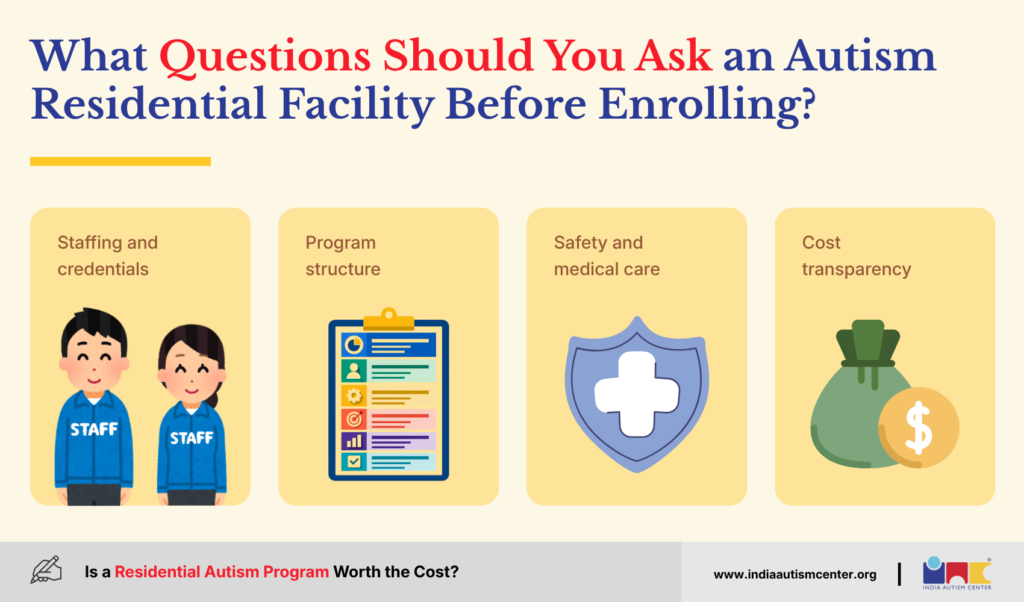
Ask specific, structured questions before enrolling — general reassurances aren’t enough. Group your questions into four categories to cover what matters most.
Staffing and credentials:
- What is the staff-to-resident ratio, day and night?
- What qualifications and training do direct care staff hold?
- Is a therapist or clinician on-site, or visiting only?
Program structure:
- Is there an individualized plan for each resident, reviewed regularly?
- How much family involvement is expected or allowed?
- What does a typical daily schedule look like?
Safety and medical care:
- What are the emergency and crisis protocols?
- Is medical staff available on-site or on-call?
- How are medications managed and documented?
Cost transparency:
- What is included in the base fee versus billed separately?
- Are there additional charges for therapy, transport, or medical care?
- What is the refund or exit policy if the program isn’t a fit?
Write down the answers and compare them across facilities side by side. A facility that answers clearly and specifically is more trustworthy than one that speaks only in general terms.
We have a cover this section in more details in our blog Choosing the Right Residential Care Facility for Autistic Adults: Questions to Ask
What Are Red Flags to Watch For During a Autism Facility Visit?
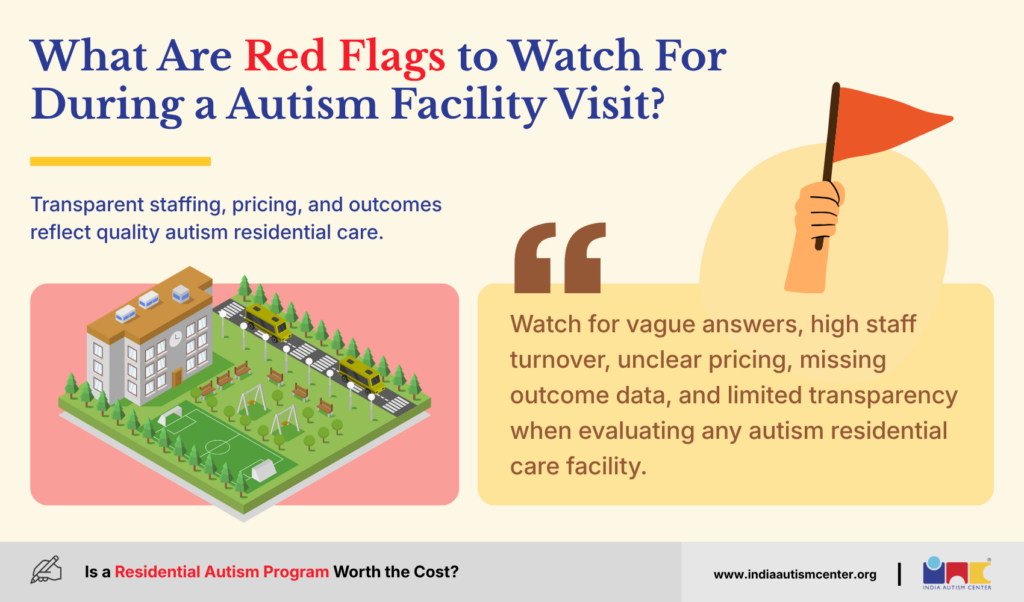
Visit before you enroll, and watch for warning signs beyond the sales pitch. Vague answers to direct questions are the clearest red flag. If staff can’t explain their ratios, training, or emergency protocols on the spot, treat that as a serious concern.
Other red flags include:
- High staff turnover mentioned casually or visible in inconsistent staffing during your visit
- No individualized plans, with residents following an identical schedule regardless of needs
- Reluctance to share outcome data or connect you with current families for reference
- Unclear pricing, with costs only revealed after you’ve expressed strong interest
A facility confident in its quality will welcome scrutiny. One that resists questions is telling you something important.
Also read, Safe and Supportive Residential for Autism: Assisted Living & Residential Environment
Is a Autism Residential Program Right for Every Family?
No single answer fits every family. Residential care is worth it for some families and unnecessary for others, depending on the child’s needs and what’s realistically achievable at home. This is a decision framework, not a recommendation.
Consider a residential program if:
- Home or day-based support has been tried and hasn’t met safety or developmental needs
- The family has assessed the cost against a realistic budget, including hidden costs
- A specific, quality-vetted facility is available within reach
Consider alternatives first if:
- Local day programs or in-home intensive therapy haven’t yet been fully tried
- The child’s needs are being met safely and progress continues at home
- Cost would create financial strain without a clear, expected benefit
If residential care fits, IAC’s residential campus, Samaavesh, opens in November 2026 and is one option worth evaluating against the framework above — including the staffing, structure, and outcome-tracking questions this article covers.
Want to know more? Get in touch with us.
Frequently Asked Questions
How much does a residential autism program cost in India?
Costs vary by facility, location, and included services, and typically run higher than day programs but lower than international equivalents. Always request a full cost breakdown covering therapy, medical support, and hidden costs before comparing.
At what age should residential autism care be considered?
There’s no fixed age. It’s considered when safety, caregiver capacity, or service access become unsustainable — this can apply to children or young adults, depending on individual needs.
Is residential care better than home-based therapy for autism?
Neither is universally better. Residential care suits situations needing 24/7 structured support; home-based therapy suits children whose needs are being met safely with periodic professional input.
What is the staff-to-resident ratio in a good residential program?
Ratios vary by facility and by day versus night shifts. Always ask directly and compare it against the specific support needs of the resident, rather than a generic industry number.
Can a child transition back home after residential care?
Yes, many children transition back home after a structured residential period, especially when the program includes reintegration planning. Ask facilities how they support this transition, including family training and gradual step-down schedules.
This article is for educational purposes only and does not constitute medical, therapeutic, or financial advice. Please consult a qualified autism specialist and evaluate facilities individually before making enrollment decisions.