 Donate now
 Get a Call Back
 MENU
MENU 11 MIN READ
 SHARE
SHARE


What if there really are subtle facial differences associated with autism? A 2019 study published in Autism Research found that autistic children showed significantly greater facial asymmetry than both typically developing children and their non-autistic siblings.
The study examined 84 autistic children, 110 typically developing children and 49 siblings of autistic children using three-dimensional facial imaging. It also found that greater lateral facial asymmetry in autistic children was associated with greater severity of repetitive and restrictive behaviours.
So, while research is beginning to uncover interesting links between facial characteristics and autism, much more remains to be understood before concluding that appearance alone is diagnostic. Let’s take a closer look at what the research says about the autism face, the facial features being studied, and what they actually mean.
What Does an Autism Face Look Like?
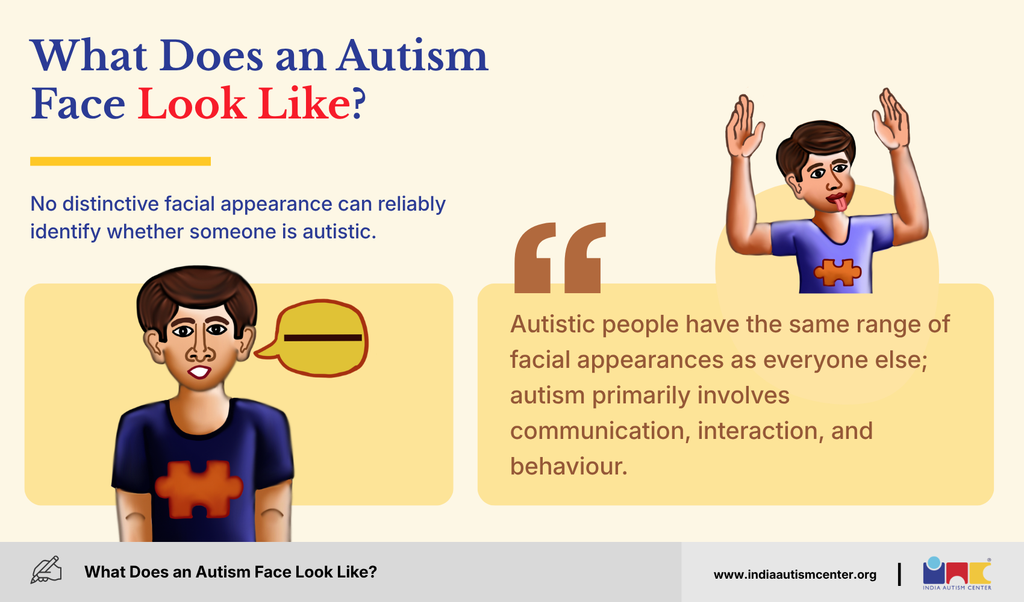
The simplest answer is that no distinctive autism face exists.
Autistic people have the same enormous range of facial appearances as everyone else. Some may have round faces; others may have long or narrow faces. Some may have closely set eyes, while others may have widely spaced eyes. Facial symmetry, nose shape, jawline, forehead, lips, skin tone, and other physical characteristics vary naturally from person to person.
So, if you are searching for an autism face because you want to know whether a child “looks autistic”, facial appearance cannot provide that answer.
The confusion often comes from grouping two different things: facial structure and facial behaviour.
Facial structure refers to physical characteristics such as the shape and proportions of the face. Facial behaviour refers to things such as eye contact, facial expressions, and how someone responds to another person’s expression.
Autism can involve differences in social communication, including how some people use eye contact, gestures, and facial expressions. These are behavioural and communication characteristics. They should not be confused with a particular physical appearance.
Is There Really an Autism Face?
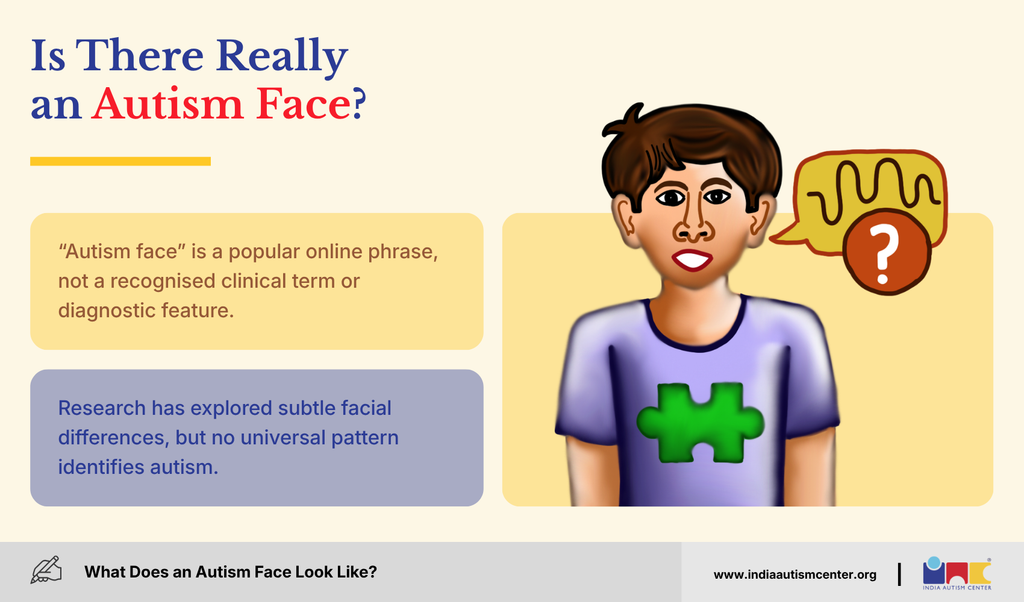
The phrase autism face is popular online, but it is not a clinical term.
Researchers have investigated whether autistic people may show subtle differences in facial morphology. Facial morphology refers to the study of facial shape, proportions, and structure. Some research has reported differences between groups of autistic and non-autistic participants.
However, it is important to distinguish between a research finding and a diagnostic feature.
If a study finds that a particular facial measurement occurs more often in one group, that does not mean everyone in that group has the feature. It also does not mean that someone with that feature belongs to that group.
More recent research continues to investigate the subject, but it has not established a universal facial pattern that can be used to identify autism.
Autism Face vs Normal Face: Is There a Difference?
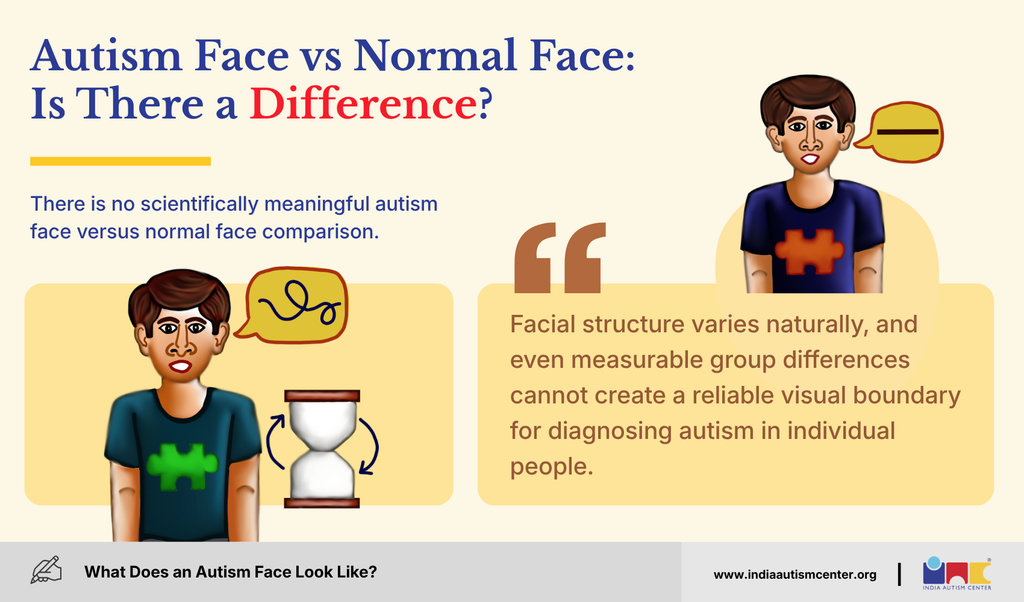
No scientifically meaningful autism face vs normal face comparison exists.
The word “normal” can make this question particularly misleading. Human faces naturally differ in thousands of ways, and no single facial template represents a normal person.
More importantly, autism is a neurodevelopmental condition. Diagnostic features relate primarily to social communication and interaction, along with associated developmental characteristics.
Facial structure is not a diagnostic criterion.
This means that putting an autistic person’s photograph next to a non-autistic person’s photograph cannot provide a reliable way of identifying autism.
Even when researchers find measurable differences between groups, substantial overlap remains. A statistical difference between two groups does not automatically create a visible boundary between them.
Think about height. If one population has a different average height from another, you could not determine a person’s population simply by looking at them. Facial measurements work similarly. Group-level patterns do not become individual diagnostic tests.
Do Autistic People Have Different Eyes?
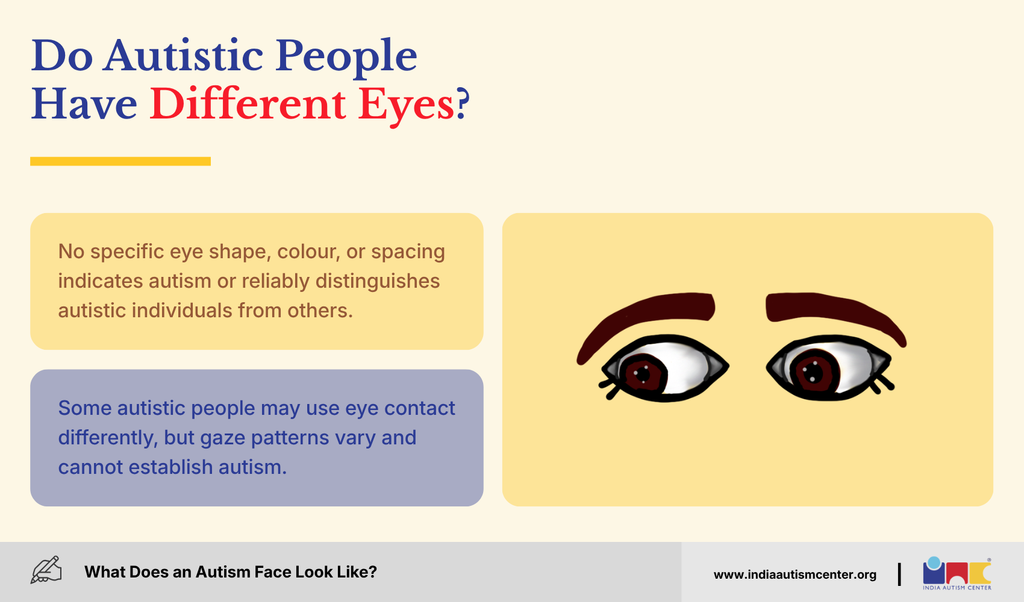
The eyes are probably the most discussed part of the autistic face. However, no specific eye shape indicates autism.
Researchers have studied gaze behaviour more extensively. Some autistic people may use eye contact differently from non-autistic people. They may look at eyes less often, find prolonged eye contact uncomfortable, or focus on other areas of a person’s face.
But these patterns vary considerably. Some autistic people make frequent eye contact. Some may make eye contact in familiar situations but not in stressful or unfamiliar ones. Others may consciously learn social expectations around eye contact.
NIMH lists inconsistent eye contact among possible social communication characteristics of autism, but also emphasises that not every autistic person displays every characteristic.
This is why “autistic eyes” should not be treated as a medical category.
Eye colour, eye shape, eyelid shape or the physical spacing of the eyes cannot establish whether someone is autistic.
Can Facial Expressions Be Different in Autism?
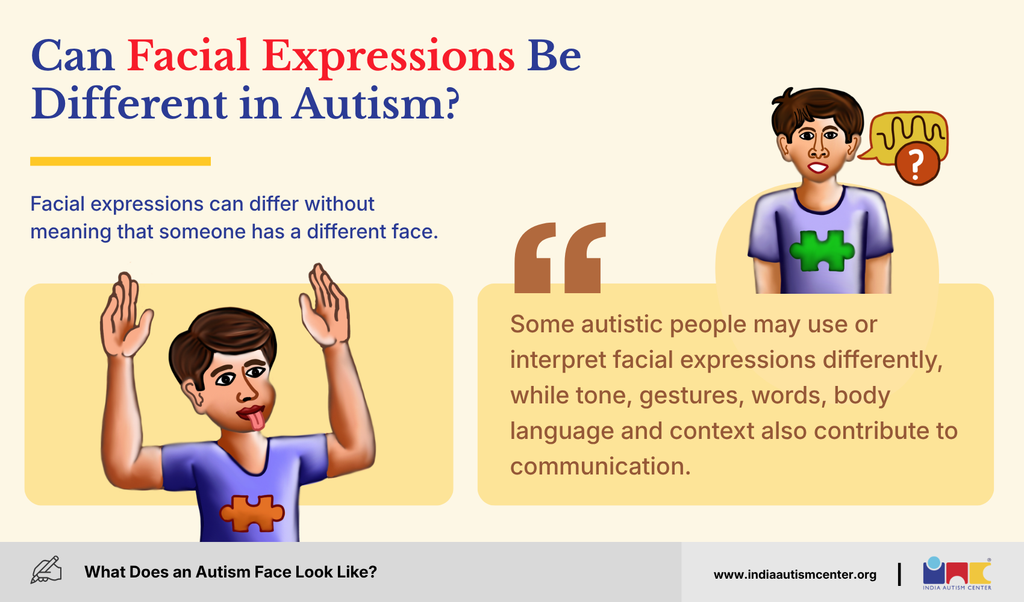
Yes, facial expressions can sometimes be different in autistic people, but this is not the same thing as having a different face. Some autistic children may use fewer facial expressions or express emotions in ways that others find less predictable. Others may have highly expressive faces.
Some people may also find it difficult to interpret subtle changes in another person’s facial expression. The NHS notes that autistic children may use fewer facial expressions and may respond differently to other people’s facial expressions or feelings.
However, this does not mean that autistic people lack emotions or cannot understand other people’s feelings. Facial expression is only one way humans communicate emotion. Tone of voice, body language, gestures, words, and context all contribute to communication.
Is There a Mild Autism Face?
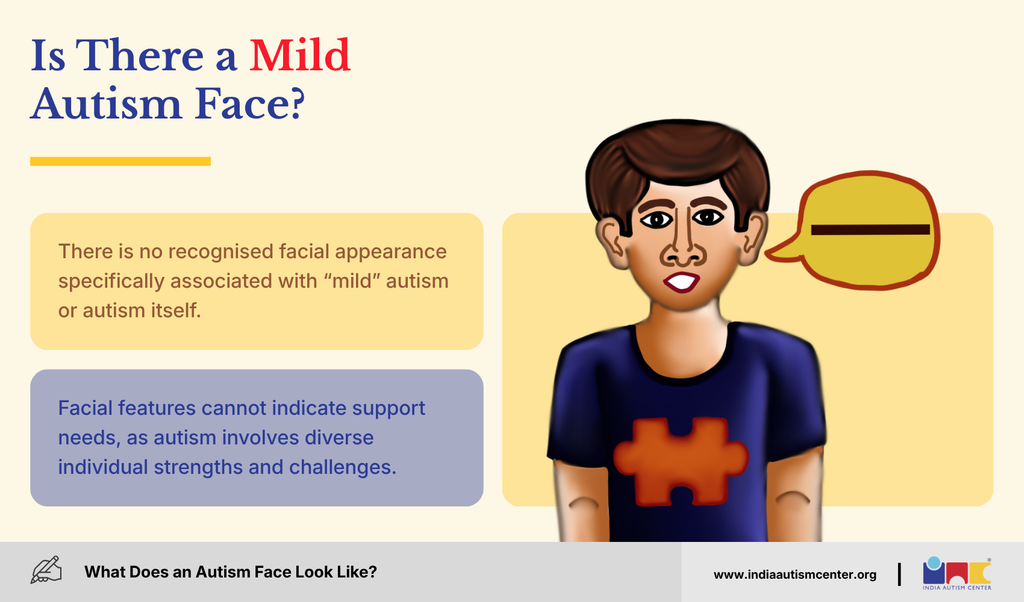
There is no recognised mild autism face.
The phrase “mild autism” is commonly used in everyday conversation, but facial appearance cannot tell you how much support an autistic person needs. Autism is a spectrum, and people can have very different profiles of strengths, difficulties and support requirements. Someone may communicate verbally but struggle considerably with sensory processing, social interaction or daily living. Another person may have significant communication difficulties but strong abilities in another area.
Therefore, there is no facial shortcut for determining whether autism is “mild”.
The term can also create an inaccurate assumption that autism is always easy to recognise when support needs are lower.
They are not.
A person may appear confident, talkative or socially capable while experiencing substantial internal difficulties. Some autistic people also consciously or unconsciously mask autistic characteristics, making them less obvious to other people. The NHS notes that masking can make autism less noticeable and can be exhausting and stressful.
Is There a Severe Autism Face?
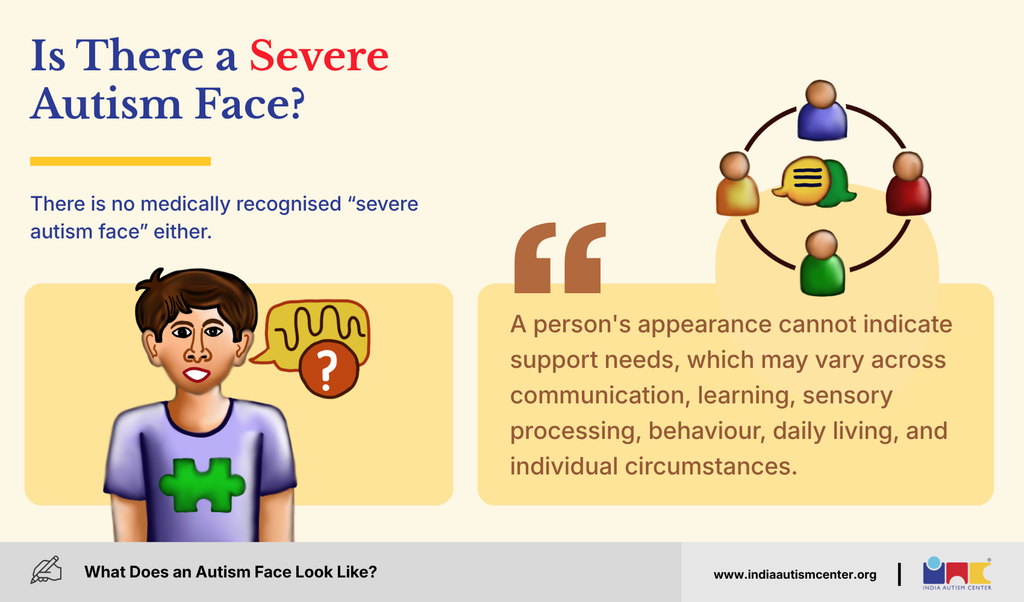
There is no medically recognised severe autism face either.
A person’s facial appearance cannot tell you whether they have high support needs.
This is particularly important because the language of “mild” and “severe” can oversimplify autism. Support needs may vary across communication, learning, sensory processing, behaviour, independence and daily living.
No facial feature can tell a parent whether a child has low or high support needs.
The right question is not “What does severe autism look like?” It is “What support does this individual need?”
What Should Parents Look For Instead of Autism Face Features?
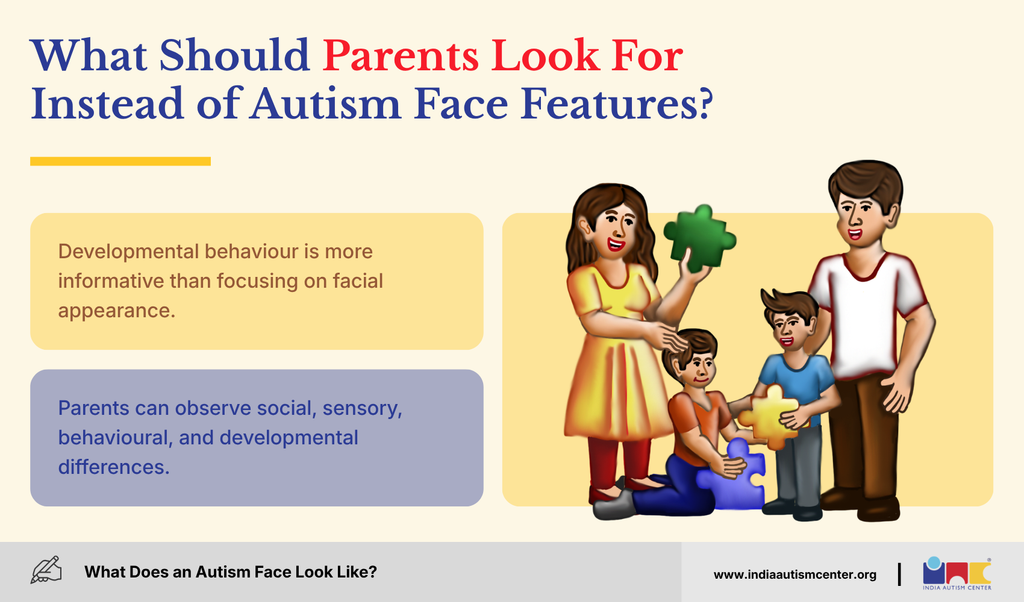
If you are concerned that your child may be autistic, developmental behaviour is much more informative than facial appearance.
Look at patterns over time rather than focusing on one characteristic.
Social communication
Possible differences can include:
- not consistently responding to their name
- limited use of gestures such as pointing or waving towards something
- difficulty sharing attention or enjoyment
- difficulty with back-and-forth interaction
- unusual or delayed development of spoken language
- difficulty understanding social cues
- differences in eye contact or facial expression
Repetitive behaviour and interests
Some children may:
- repeat words or phrases
- repeat movements such as rocking or hand-flapping
- become distressed by changes in routines
- develop unusually intense interests
- play with objects in repetitive ways
- focus strongly on particular parts of objects
Sensory differences
Autistic children may also experience sensory input differently. They may be unusually sensitive or under-responsive to sounds, lights, textures, smells, movement, temperature or other sensations.
No single characteristic proves that a child is autistic. The pattern, developmental history and effect on everyday life matter
Can a Doctor Diagnose Autism by Looking at the Face?
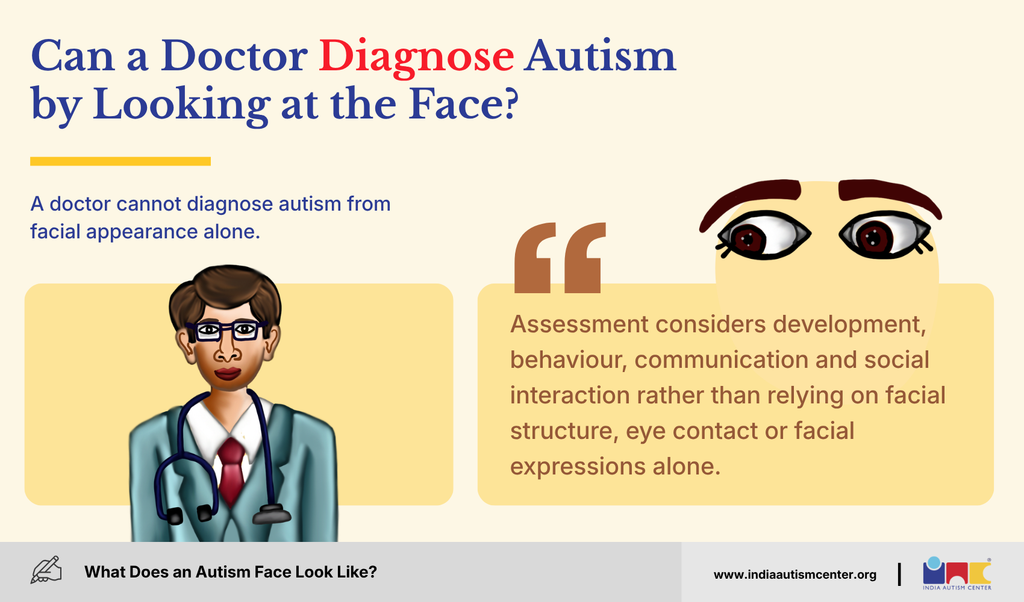
No. A clinician may observe a child’s face, eye contact, and facial expressions during an assessment, but they do not diagnose autism based on facial appearance. A proper autism assessment considers development, behaviour, communication and social interaction.
Can a Photograph Show Autism?
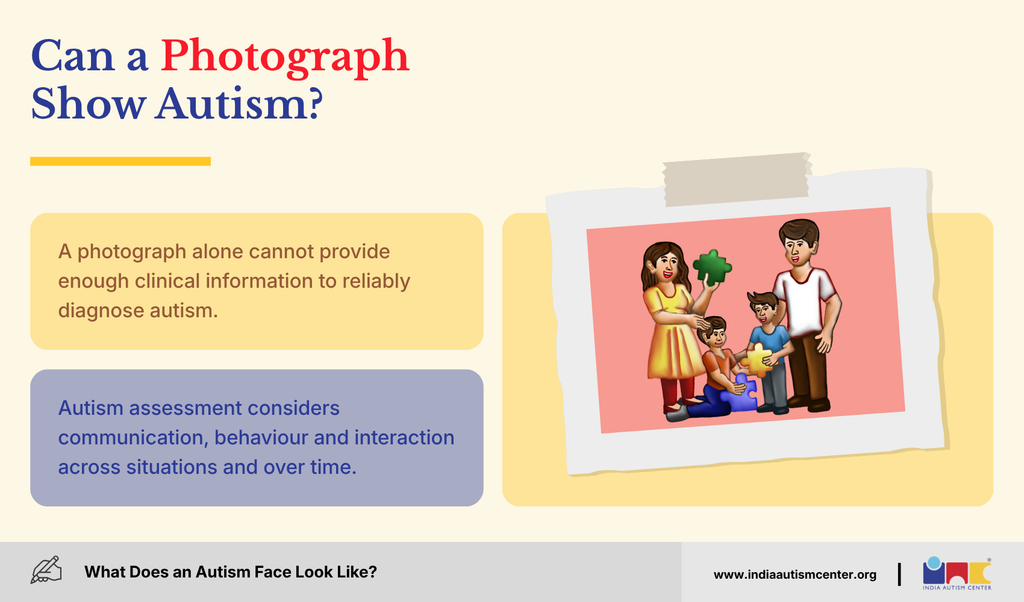
A photograph cannot provide enough information to diagnose autism. A photograph captures a single moment. Autism assessment requires information about how a person communicates, behaves and interacts across situations and over time.
Even a video provides only part of the picture.
A child might make excellent eye contact in a familiar environment but behave differently in an unfamiliar clinical setting. Another child may appear socially confident during a short interaction while experiencing significant challenges elsewhere.
Can Artificial Intelligence Recognise an Autism Face?
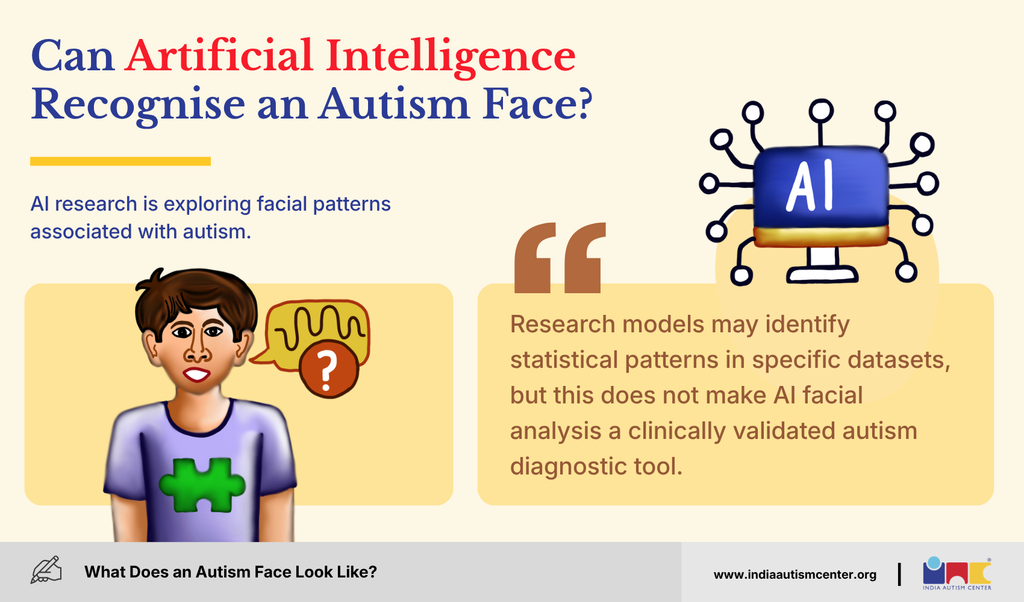
Artificial intelligence is increasingly being studied in autism research, including research involving facial images and facial measurements.
That does not mean AI can currently diagnose autism simply by analysing someone’s face.
Researchers usually train and test models using particular datasets. Sample size, demographic characteristics, image quality, age, ethnicity, camera conditions, and the characteristics of the people included in the dataset can affect their results.
A model that identifies statistical patterns in a research dataset is not automatically a clinically validated diagnostic tool.
Five Important Facts to Remember About Autism and Facial Features
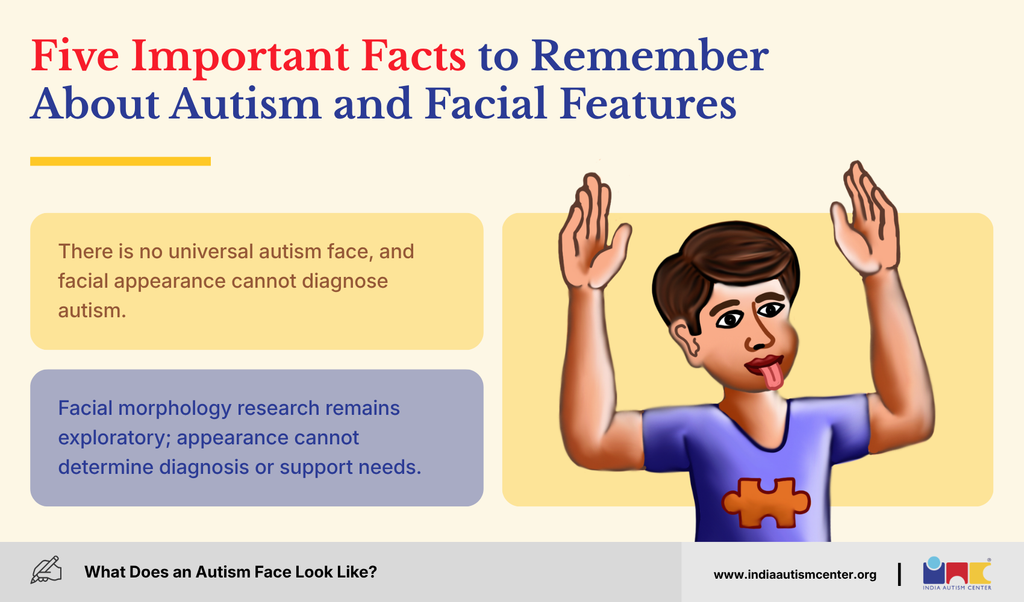
If you have come across conflicting information online, these five points can help separate evidence from misconception:
1. There is no universal autism face.
Autistic people have diverse facial appearances.
2. Facial morphology research is real, but it is still research.
Studies have identified possible group-level differences, but these are not diagnostic criteria.
3. Facial behaviour is different from facial structure.
Eye contact, facial expressions and gaze patterns may differ in some autistic people.
4. A photograph cannot diagnose autism.
A diagnosis requires developmental and behavioural information.
5. Support needs cannot be judged from appearance.
There is no mild autism face or severe autism face. The required support therefore does not depend on a person’s facial features.
What Parents Should Do If They Are Concerned?
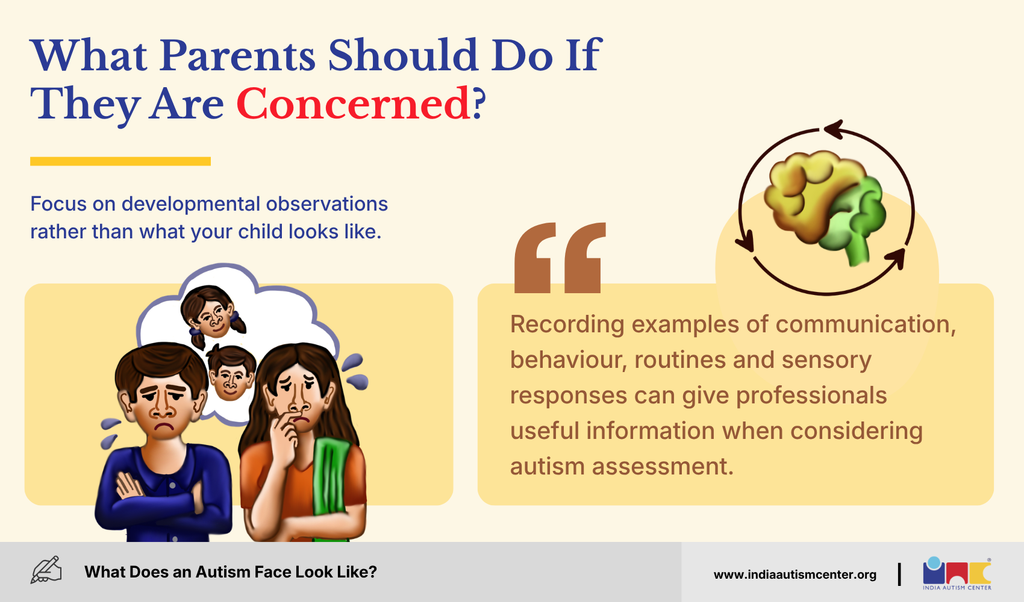
If you are wondering whether your child’s development may indicate autism, start with what you have observed rather than what your child looks like.
Write down specific examples. For instance, instead of saying “my child seems autistic”, note that your child rarely responds to their name, does not point to share interest, repeats particular phrases, becomes extremely distressed by changes to routine or has significant sensory reactions.
Specific observations give professionals much more useful information.
You can also speak with your child’s paediatrician, developmental specialist, psychologist or another appropriately qualified professional who can advise whether an autism assessment is warranted.
How India Autism Centre Helps Families Understand Autism
At India Autism Centre, understanding autism goes beyond trying to identify an autism face or a set of facial characteristics. While research continues to explore possible differences in facial appearance and expression, autism assessment focuses on a person’s communication, social interaction, behaviour, development and individual support needs.
For families, reliable information can help separate genuine research findings from misleading online claims about autism face features. India Autism Centre provides resources on autism screening, assessment, early intervention and therapies, helping families understand what to look for and when to seek professional guidance.
This informed approach keeps the focus on the individual, not appearance.
Conclusion
An autism face is not defined by one particular shape, expression or set of facial features. Although research has identified interesting associations between facial asymmetry and autism, appearance alone cannot explain an individual’s developmental profile.
What matters is understanding how a person communicates, interacts, behaves and experiences the world. If you notice developmental differences, look beyond facial features associated with autism and seek a professional assessment for meaningful clarity.
Ultimately, autism is about a person’s unique neurodevelopment, not simply what they look like.
Frequently Asked Questions
Can facial asymmetry be an autism face feature?
Research has reported greater facial asymmetry in some autistic children, but it is not a diagnostic feature. Facial asymmetry also occurs naturally in people without autism.
Is there a specific autism face shape in children?
No. No single face shape is associated with autism. Facial structure varies considerably among autistic children, just as it does among other children.
Can widely spaced eyes be an autism face feature?
No evidence shows that widely spaced eyes can identify autism. Researchers can study individual facial measurements scientifically, but they cannot use them as a diagnostic checklist.
Are autistic children’s facial features different from other children?
Some research has identified statistical differences in particular facial measurements between groups, but no universal facial appearance distinguishes autistic children from other children.
Can facial expressions be different in autistic children?
Yes, some autistic children may use or interpret facial expressions differently. However, facial expression varies considerably between individuals and should be considered alongside other characteristics rather than viewed as an autism marker.