 Donate now
 Get a Call Back
 MENU
MENU 19 MIN READ
 SHARE
SHARE


The 3 Levels of Autism: Support Needs, Characteristics & What to Expect
The levels of autism – Level 1, Level 2, and Level 3 – describe how much support a person with Autism Spectrum Disorder (ASD) needs to navigate daily life. They are not a measure of intelligence or worth. They are a clinical shorthand for support needs, and understanding them is the first step toward getting the right help.
Autism Spectrum Disorder is a neurodevelopmental condition characterised by differences in social communication, social interaction, and patterns of restricted or repetitive behaviour. The DSM-5 (Diagnostic and Statistical Manual of Mental Disorders, Fifth Edition), published in 2013, replaced older labels like Asperger’s syndrome and PDD-NOS with a single umbrella diagnosis – ASD – and introduced three levels of autism to reflect the wide variation in how the condition presents.
This guide is written for parents, caregivers, and educators in India who want a clear, honest picture: what each level actually looks like, how a formal diagnosis is reached, who does the assessment, what a support plan involves, and which therapies are most effective at each level.
The Three Levels of Autism Spectrum Disorder: An Overview
The DSM-5 assigns a severity level based on two domains:
- Social communication and interaction
- Restricted, repetitive behaviours and interests
Each domain is rated separately. A child can be Level 2 in social communication and Level 1 in restricted behaviours – the levels are not always symmetrical. What they share is this: they describe support needs, not a fixed ceiling for what a person can achieve.
| Level | Label | Social Communication | Repetitive Behaviours |
|---|---|---|---|
| Level 1 | Requiring Support | Noticeable difficulties without support | Inflexibility causes significant interference |
| Level 2 | Requiring Substantial Support | Marked deficits even with support | Frequent, obvious; distress when interrupted |
| Level 3 | Requiring Very Substantial Support | Severe deficits; minimal initiation | Extreme difficulty coping with change |
Level 1 Autism: Requiring Support
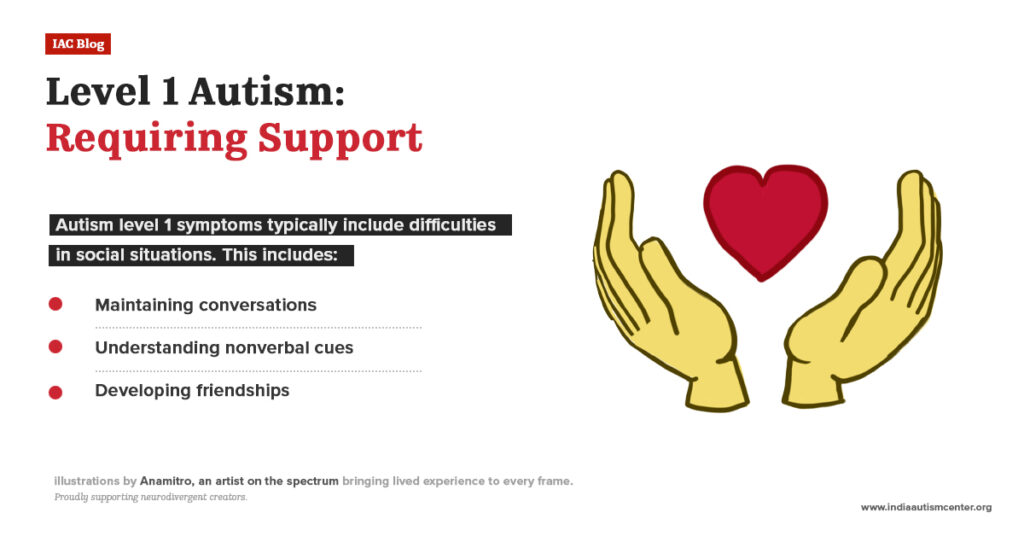
Level 1 Autism is what was previously called Asperger’s syndrome or “high-functioning autism.” Those labels are no longer used in formal diagnosis, but they still circulate widely – especially in Indian families who received older diagnoses.
Characteristics and Symptoms
A child or adult at Level 1 can usually speak in full sentences and manage most daily routines independently. The difficulties show up in the quality of social interaction, not the ability to interact at all.
Social communication challenges:
- Difficulty maintaining back-and-forth conversation
- Trouble reading nonverbal cues – facial expressions, tone of voice, body language
- Struggles to initiate friendships or sustain them beyond shared interests
- May come across as blunt or socially awkward without intending to
Restricted and repetitive behaviours:
- Deep, intense interest in one or two specific topics (trains, astronomy, a particular film franchise)
- Resistance to changes in routine – a shift in the school timetable can cause real distress
- Inflexibility in thinking; difficulty with open-ended tasks
Strengths at Level 1
This is where the deficit-only framing misses something important. Many individuals at Level 1 have:
- Exceptional attention to detail – they notice what others overlook
- Deep expertise in areas of interest that can translate into professional strengths
- Strong memory for facts, patterns, and systems
- Reliability and consistency – they follow through on commitments
With the right support, many Level 1 individuals complete mainstream schooling, pursue higher education, hold employment, and live independently.
📥 Free download: Printable daily routine chart for autistic children
Level 2 Autism: Requiring Substantial Support
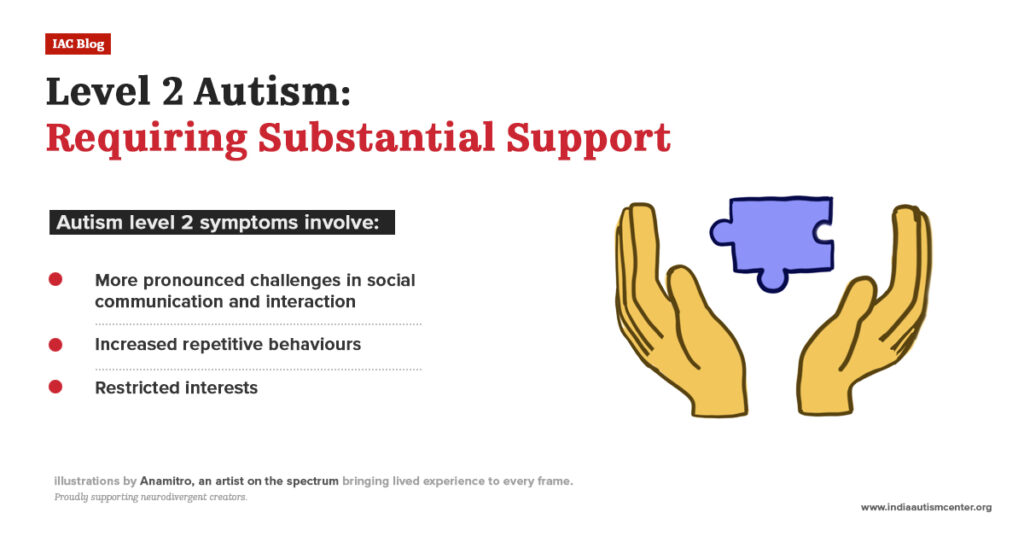
Autism Level 2 sits in the middle of the spectrum. The challenges are more visible, more consistent, and harder to compensate for without structured support. In India, many children who receive an autism diagnosis fall into this category.
Characteristics and Symptoms
Social communication challenges:
- Noticeable difficulties even when support is in place
- Limited initiation of social interaction – waits for others to approach, but responses may be reduced or atypical
- Speech may be present but used primarily for requests, not conversation
- Difficulty understanding sarcasm, humour, or implied meaning
Restricted and repetitive behaviours:
- Repetitive behaviours are frequent and obvious to observers
- Significant distress when routines are disrupted – meltdowns or shutdowns are common
- Sensory sensitivities are often more pronounced (strong reactions to noise, light, textures, crowds)
- Difficulty shifting attention between tasks
Strengths at Level 2
Level 2 individuals are often underestimated. We see this clearly in clinical work: once communication barriers are addressed, a great deal of ability becomes visible.
- Visual thinking and spatial reasoning – many Level 2 individuals excel at puzzles, patterns, and visual tasks
- Loyalty and consistency in relationships once trust is established
- Strong procedural memory – they learn routines deeply and follow them reliably
- Focused engagement – when interested, their concentration is remarkable
With consistent, structured support across home, school, and therapy, Level 2 individuals can make significant developmental progress.
Level 3 Autism: Requiring Very Substantial Support
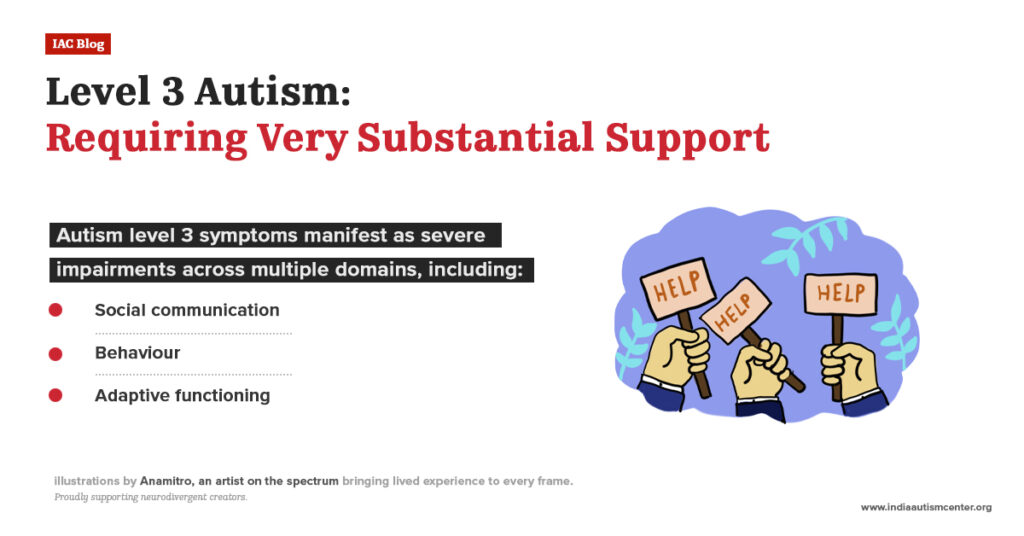
Level 3 represents the most intensive support needs on the spectrum. This is sometimes called “severe autism,” though that framing can be misleading – it describes the support required, not the person’s capacity for connection, growth, or joy.
Characteristics and Symptoms
Social communication challenges:
- Severe deficits in verbal and nonverbal communication
- Many individuals are minimally verbal or nonverbal – they may use single words, gestures, or no speech at all
- Very limited initiation of social interaction
- Responses to others are minimal or difficult to interpret
Restricted and repetitive behaviours:
- Repetitive behaviours are frequent and markedly interfere with daily functioning
- Extreme difficulty coping with any change – even small disruptions to routine can cause significant distress
- Self-injurious behaviours may be present in some individuals
- Requires extensive support for basic self-care: dressing, eating, hygiene, safety
Strengths at Level 3
Even at Level 3, strengths exist – and recognising them matters enormously for families and caregivers.
- Emotional sensitivity – many Level 3 individuals are deeply attuned to the emotional atmosphere around them, even when they cannot express it verbally
- Responsiveness to familiar caregivers – strong bonds form with consistent, trusted adults
- Visual and musical abilities – some individuals show remarkable talent in art, music, or visual memory
- Capacity for growth – with intensive, consistent intervention started early, many Level 3 individuals make meaningful gains in communication and daily living skills
Alternative and Augmentative Communication (AAC) systems – picture boards, speech-generating devices, apps like Proloquo2Go – have transformed quality of life for many nonverbal individuals at this level.
Want to know more? Get in touch with us.
Cognizance of the 3 stages of Autism
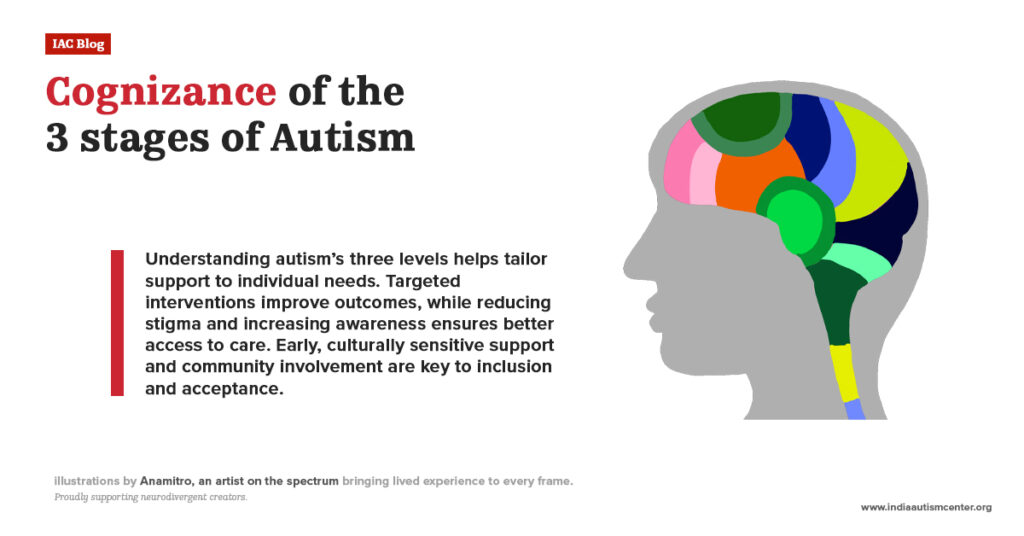
Cognisance of the 3 stages of autism – encompassing level 1, level 2, and level 3 – is important in tailoring interventions and support strategies to cater to individuals having the autism spectrum.
By discerning the specific challenges commensurate with each level, professionals and caregivers can proffer targeted support aimed at fostering the well-being and development of individuals grappling with Autism Spectrum Disorder.
The stigma surrounding neurodevelopmental disorders, coupled with prevailing misconceptions, often compounds the challenges encountered by individuals with autism in accessing appropriate support and services. Thus, initiatives aimed at fostering awareness, destigmatization, and inclusive practices are imperative in ameliorating the lived experiences of individuals with autism.
Also, tailoring early intervention for autism to encompass linguistic, religious, and regional variations ensures that support mechanisms resonate with diverse communities across the country.
Moreover, leveraging traditional knowledge systems and community networks can serve as invaluable resources in fostering acceptance and understanding of autism.
How ASD Levels Are Formally Diagnosed
A diagnosis is not something a parent can determine from a checklist, and it is not something a single professional can hand down in one appointment. It is a structured, multi-step process – and understanding it helps families navigate it with less anxiety.
The DSM-5 Criteria
For an ASD diagnosis, a clinician must document:
- Criterion A: Persistent deficits in social communication and social interaction across multiple contexts – including social-emotional reciprocity, nonverbal communication, and developing/maintaining relationships.
- Criterion B: Restricted, repetitive patterns of behaviour, interests, or activities – at least 2 of 4 features must be present (stereotyped movements or speech; insistence on sameness; highly restricted interests; hyper- or hypo-reactivity to sensory input).
- Criterion C: Symptoms present in the early developmental period (though they may not fully manifest until social demands exceed capacity).
- Criterion D: Symptoms cause clinically significant impairment in daily functioning.
- Criterion E: Not better explained by intellectual disability alone.
The severity level – 1, 2, or 3 – is then assigned separately for each domain based on the degree of support required.
Assessment Tools Used
No single test diagnoses autism. A comprehensive evaluation draws on several standardised instruments:
ADOS-2 (Autism Diagnostic Observation Schedule, Second Edition) This is the gold standard observational tool. A trained clinician directly interacts with the child across structured activities and rates social communication, play, and repetitive behaviours. It takes 40–60 minutes and is considered the most reliable single instrument for autism diagnosis.
ADI-R (Autism Diagnostic Interview – Revised) A structured interview conducted with parents or caregivers. It covers the child’s developmental history, early language milestones, social development, and current behaviour patterns. The ADI-R is particularly useful for capturing the developmental trajectory – when did certain behaviours first appear?
Vineland Adaptive Behavior Scales (Vineland-3) This measures adaptive functioning – what a person actually does in daily life, not just what they are capable of in a test setting. It covers communication, daily living skills, socialisation, and motor skills. In India, the Vineland-3 is available through Pearson Clinical India; clinicians should be aware that some items require cultural calibration, as self-care norms differ from Western standardisation samples.
ISAA (Indian Scale for Assessment of Autism) Developed specifically for the Indian context, the ISAA covers 40 items across 6 domains: social relationships, emotional responsiveness, speech and language, behaviour patterns, sensory aspects, and cognitive functioning. It is widely used in India for both clinical assessment and disability certification under the Rights of Persons with Disabilities (RPwD) Act, 2016.
Cognitive and developmental assessments Depending on age and presentation, clinicians may also use tools like the Developmental Profile-3, Griffiths Scales, or Raven’s Progressive Matrices to assess cognitive functioning alongside autism-specific measures.
Who Does the Assessment: The Multidisciplinary Team
In India, a robust autism assessment involves several professionals working together. Here is what each one contributes:
Developmental Paediatrician
Usually the first specialist a family sees. The developmental paediatrician takes a full developmental history, conducts a physical examination, rules out medical causes (hearing loss, genetic conditions, metabolic disorders), and coordinates the overall evaluation. They are often the ones who first raise the possibility of ASD and make referrals to other team members.
Child Psychiatrist
Brings the diagnostic and mental health lens. Child psychiatrists are trained to distinguish ASD from conditions that can look similar – ADHD, anxiety disorders, intellectual disability, selective mutism. They are also essential when co-occurring conditions need to be addressed, and when medication management is being considered for associated symptoms like severe anxiety, sleep disturbance, or self-injurious behaviour.
Clinical Psychologist (RCI-registered)
Administers the standardised assessment tools – ADOS-2, Vineland, cognitive batteries. Provides the psychometric backbone of the diagnosis. In India, an RCI (Rehabilitation Council of India)-registered clinical psychologist is the appropriate professional for this role. They also provide psychological support to families and contribute to the individualised support plan.
Speech-Language Pathologist
Assesses communication in detail: expressive language, receptive language, pragmatic (social) language, and – critically – the presence or absence of functional communication. Their assessment directly informs the communication goals in the support plan and determines whether AAC is needed.
Occupational Therapist
Evaluates sensory processing, fine and gross motor skills, and daily living skills. Their input is especially important for Levels 2 and 3, where sensory sensitivities and self-care challenges are significant.
A note for Indian families: In many cities, multidisciplinary autism clinics exist within government medical colleges (like NIMHANS in Bengaluru, AIIMS in Delhi, and IPGMER in Kolkata) as well as in private specialist centres. In smaller towns, families may need to see professionals separately and bring reports together. This is harder, but it is possible.
Individualized Support Plans: What They Are and How They Work
A diagnosis is not the end of the process. It is the beginning of planning. An Individualized Support Plan (ISP) – sometimes called an Individual Education Plan (IEP) in school settings or an Individual Family Service Plan (IFSP) for young children – is a written document that translates the assessment findings into concrete, measurable goals and strategies.
What a Good ISP Contains
- Child profile: current strengths, challenges, communication style, sensory profile
- Present levels of performance: what the child can do right now across language, cognition, motor, social-emotional, and self-help domains
- Short-term and long-term goals: specific, measurable, achievable targets – not vague aspirations
- Intervention strategies: the teaching methods to be used (task analysis, visual supports, prompting hierarchies, reinforcement schedules)
- Support services: which therapies, how often, in which settings
- Progress monitoring: how and when goals will be reviewed (typically every 3–6 months)
The Family’s Role
In India, parents are not passive recipients of a plan – they are the primary implementers. Research consistently shows that outcomes improve significantly when parents are coached to carry intervention strategies into daily routines: mealtimes, bath time, play, travel. A well-built ISP includes:
- Parent training sessions (not just parent information sessions)
- Home practice activities tied to therapy goals
- Clear guidance on how to respond to challenging behaviours
- Family counselling to address caregiver stress and sibling needs
The ISP should be a living document – reviewed, revised, and updated as the child grows and goals are met.
Therapeutic Interventions by Level
There is no single therapy that works for every autistic person. What works depends on the individual’s profile, age, communication level, and family context. Here is how the major evidence-based interventions map onto the three levels.
Applied Behaviour Analysis Therapy (ABA Therapy)
Applied Behaviour Analysis is one of the most extensively researched interventions for autism. It uses structured reinforcement, task analysis, and data-driven teaching to build skills and reduce behaviours that interfere with learning and safety.
- Level 1: Targeted ABA focusing on flexibility, frustration tolerance, social initiation, and independent work skills. Typically 10–15 hours per week in structured settings, supplemented by naturalistic teaching.
- Level 2: More intensive ABA addressing communication, daily living skills, and behaviour regulation. Often 20–25 hours per week, with close coordination between home and school.
- Level 3: Highly intensive ABA (25–40 hours per week in some cases) targeting functional communication, safety skills, self-care, and reduction of self-injurious behaviours. AAC integration is central.
Speech-Language Therapy
- Level 1: Focus on pragmatic language – conversational turn-taking, understanding implied meaning, perspective-taking, and narrative skills.
- Level 2: Building expressive vocabulary, sentence structure, and functional communication for requests, protests, and comments. Social scripts and peer interaction practice.
- Level 3: Establishing a reliable communication system – whether verbal, sign-based, or AAC. Even a consistent “yes/no” response is a meaningful communication goal at this level.
Occupational Therapy
- Level 1: Sensory regulation strategies, handwriting and fine motor skills, organisation and executive functioning support.
- Level 2: Sensory diet programmes, self-care skill building (dressing, feeding), classroom adaptations, and sensory integration therapy.
- Level 3: Intensive daily living skills training, positioning and feeding support, sensory environment modifications, and caregiver coaching for daily routines.
Social Skills Training
- Level 1: Structured social skills groups (e.g., PEERS – Programme for the Education and Enrichment of Relational Skills) are highly effective. Focus on reading social cues, managing conflict, making and keeping friends.
- Level 2: Smaller, more structured peer interaction groups with adult facilitation. Focus on turn-taking, shared attention, and basic conversational exchanges.
- Level 3: Social skills at this level are embedded into daily routines rather than taught in group settings. Focus on recognising familiar people, responding to greetings, and tolerating proximity to others.
Read our blog on Social Skills Development in Autism | 5 Proven Approaches (2026)
A Note on Early Intervention
Across all three levels, the evidence is unambiguous: earlier is better. The brain is most plastic in the first five years of life. A child who begins structured intervention at age 2 or 3 will, on average, make significantly more progress than one who starts at 7 or 8. If you have concerns about your child’s development, do not wait for a formal diagnosis to begin seeking support.
The Role of Early Intervention in Autism Spectrum Disorder
Stimming in Autism
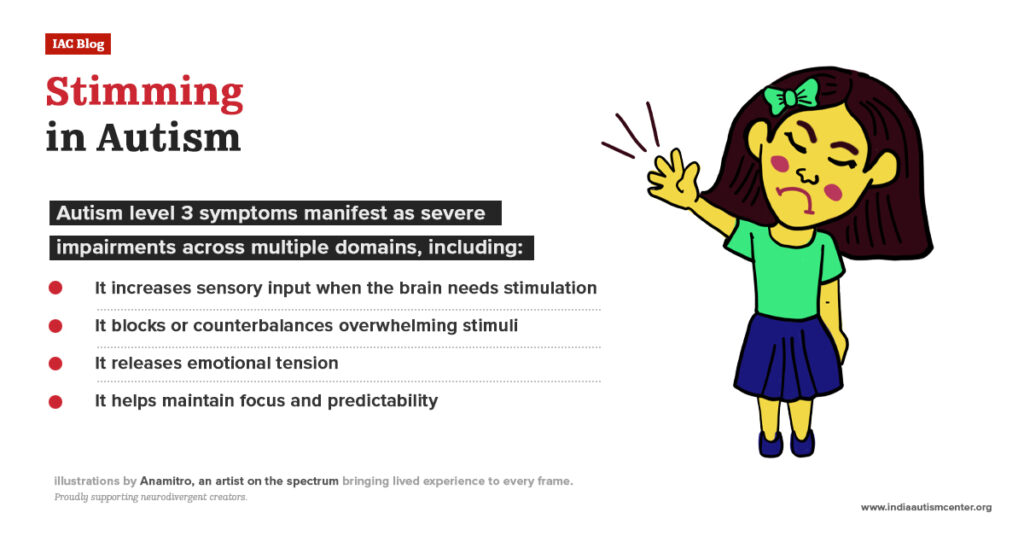
Stimming, short for self-stimulatory behavior, is a core and natural aspect of self-regulation in Autism Spectrum Disorder. It refers to repetitive movements, sounds, or sensory-seeking actions that help autistic individuals process sensory information, manage emotions, regulate stress, and maintain cognitive balance.
Rather than being “problem behaviors,” stimming behaviors are functional coping mechanisms. They allow the nervous system to regain equilibrium in environments that may feel overwhelming, unpredictable, or under-stimulating.
Understanding the science and types of stimming empowers families, educators, and communities to respond with support rather than suppression.
The Science Behind Stimming and Self-Regulation
Autistic nervous systems often process sensory input differently. This can result in:
- Sensory overload (too much noise, light, touch)
- Sensory under-stimulation (need for additional sensory input)
- Difficulty filtering or prioritising sensory information
Stimming acts as a regulatory feedback loop:
- It increases sensory input when the brain needs stimulation
- It blocks or counterbalances overwhelming stimuli
- It releases emotional tension
- It helps maintain focus and predictability
From a neurological perspective, stimming supports emotional regulation, executive functioning, and sensory integration.
Read our detailed article on Autism Stimming: Definition, Examples, Causes and Ways to Support.
Major Types of Stimming in Autism
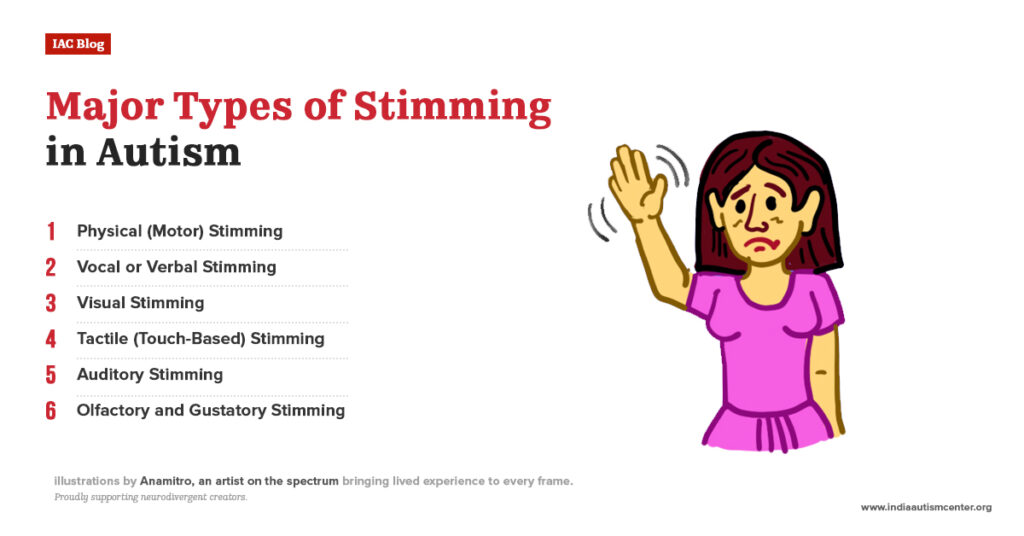
1. Physical (Motor) Stimming
Motor stimming involves repetitive body movements and is often the most noticeable type.
Common Examples:
- Hand flapping
- Rocking or swaying
- Spinning in circles
- Pacing or bouncing
- Finger tapping
Why it happens:
- Releases excess energy
- Reduces anxiety
- Creates rhythmic predictability
- Helps with body awareness (proprioception)
Motor stimming often increases during excitement, stress, or transitions. It is not always a sign of distress—sometimes it reflects joy or anticipation.
2. Vocal or Verbal Stimming
Vocal stimming includes repetitive sounds, words, or phrases.
Common Examples:
- Humming or vocal noises
- Repeating words or phrases (echolalia)
- Singing parts of songs repeatedly
- Scripted speech from movies or shows
Why it happens:
- Helps regulate emotions
- Supports language processing
- Aids memory and comprehension
- Acts as a calming auditory loop
Echolalia is often a bridge to communication, not a barrier. Many individuals use repeated phrases to express needs or emotions before developing spontaneous speech.
3. Visual Stimming
Visual stimming involves seeking visual patterns or light-based stimuli.
Common Examples:
- Watching spinning wheels or fans
- Flicking fingers in front of the eyes
- Staring at lights, reflections, or shadows
- Repeatedly lining up objects
Why it happens:
- Creates visual predictability
- Soothes visual processing overload
- Enhances focus and calm
Visual stimming may increase in visually complex environments such as malls, classrooms, or crowded spaces.
4. Tactile (Touch-Based) Stimming
This type focuses on texture and physical sensation through touch.
Common Examples:
- Rubbing fabrics or soft surfaces
- Squeezing stress balls or putty
- Touching hair, skin, or specific objects
- Picking at textures repeatedly
Why it happens:
- Grounds the nervous system
- Provides comfort and reassurance
- Supports emotional regulation
Tactile stimming is closely linked to emotional safety. Many individuals stim through touch during moments of uncertainty or change.
5. Auditory Stimming
Auditory stimming involves repetitive sound production or listening.
Common Examples:
- Tapping objects to make sound
- Repeating specific noises
- Listening to the same song or sound repeatedly
Why does it happen:
- Regulates auditory input
- Masks unpredictable background noise
- Creates a sense of control
Auditory stimming can help autistic individuals tolerate noisy environments by replacing chaotic sounds with familiar ones.
6. Olfactory and Gustatory Stimming
These involve smell and taste-based sensory input.
Common Examples:
- Smelling objects repeatedly
- Chewing on clothing, pencils, or chewable tools
- Preference for strong flavors or textures
Why does it happen:
- Provides grounding sensory feedback
- Helps regulate stress or anxiety
- Enhances sensory awareness
Chewing and smelling are powerful regulators for the nervous system and are often overlooked or misunderstood.
Here is a detailed guide on Autism Stimming: Definition, Examples, Causes and Ways to Support.
Conclusion
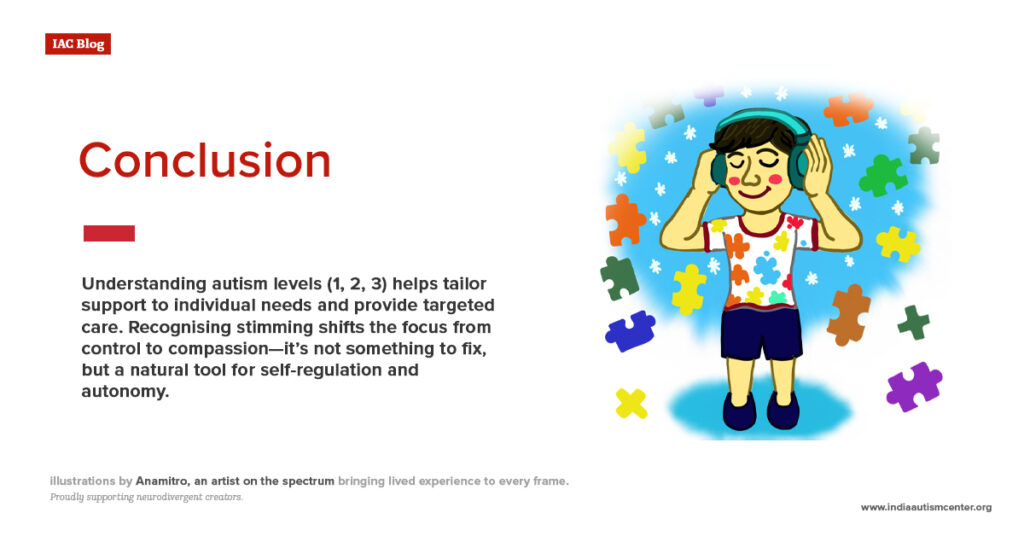
Understanding the 3 stages of autism – level 1, level 2, and level 3 – is crucial for tailoring interventions and support strategies to meet the unique needs of individuals on the autism spectrum.
By recognising the specific challenges associated with each level, professionals and caregivers can provide targeted support to promote the well-being and development of individuals with autism spectrum disorder.
Understanding the types of stimming in autism shifts the narrative from control to compassion. Stimming is not a behavior to fix—it is a language of the nervous system. When respected and supported, it becomes a powerful tool for self-regulation, resilience, and autonomy.
FAQs
What are different Levels of autism?
Levels of autism refer to the classification of autism spectrum disorder based on the amount of support a person needs in daily life, communication, and behavior. Autism levels are divided into three categories—Level 1, Level 2, and Level 3—ranging from mild to severe support needs.
What is level 1 autism?
Level 1 autism is the mildest form of autism where a person needs some support for social communication but can usually live independently.
What is Level 2 Autism?
Level 2 autism is a moderate form of autism where individuals have noticeable communication challenges and need regular support in daily life.
Is level 2 autism high-functioning?
Level 2 autism is generally not considered high-functioning, as individuals require substantial support for social interaction and daily activities.
Which is the highest level of Autism?
The highest level of autism is Level 3, which requires very substantial support for communication, behavior, and daily functioning.
Which is the highest level of Autism?
The highest level of autism is Level 3, which requires very substantial support for communication, behavior, and daily functioning.
Can level 2 autism live independently?
Some individuals with Level 2 autism can live independently with support systems in place, but most require ongoing assistance for daily living.
Disclaimer: This article is intended for educational and informational purposes only. It is not a substitute for professional medical advice, diagnosis, or treatment. If you are pregnant or have concerns about medication use during pregnancy, please consult a qualified healthcare provider. If your child has received an autism diagnosis and you have questions about causes or support, please reach out to a trained specialist or an autism-focused organisation for guidance.
For expert insights, support services, and inclusive learning initiatives, visit the India Autism Center.
Useful Sources
- American Psychiatric Association. DSM-5 Diagnostic Criteria for Autism Spectrum Disorder – autismspeaks.org/autism-diagnostic-criteria-dsm-5
- CDC. Autism Spectrum Disorder: Diagnosis – cdc.gov/autism/hcp/diagnosis/index.html
- CDC. Autism Treatment – cdc.gov/autism/treatment/index.html
- National Institute of Mental Health and Neurosciences (NIMHANS). Autism resources – nimhans.ac.in
- Indian Psychiatric Society. ASD Guidelines for Child and Adolescent Psychiatry – indianpsychiatricsociety.org
- Pearson Clinical India. Vineland-3 – pearsonclinical.in
- Autism Speaks. Applied Behaviour Analysis – autismspeaks.org/applied-behavior-analysis