Author: Supriyo Roy

  • Visual Therapy for Autism: Benefits & Techniques

    Visual Therapy for Autism: Benefits & Techniques

    Did you know that the human brain processes about 80% of information through sight? Whether it is navigating a room or reading facial expressions. For autistic individuals, however, this process often works a little differently.

    As per research, several children and adults with autism spectrum disorder tend to have atypical gaze patterns. These visual differences can affect communication, learning, behaviour, and even social connections.

    That is why visual therapy for autism, also commonly called vision therapy for autism, is becoming an essential support system for children and adults on the spectrum.

    Today, we will uncover what vision therapy for autism is, how it works, and how it can help. We will also discuss which techniques are most effective and how visual therapy contributes to skills, such as improving eye contact for autism and helping address autism-related lazy eye (amblyopia).

    What Is Visual Therapy?
    What Is Visual Therapy?

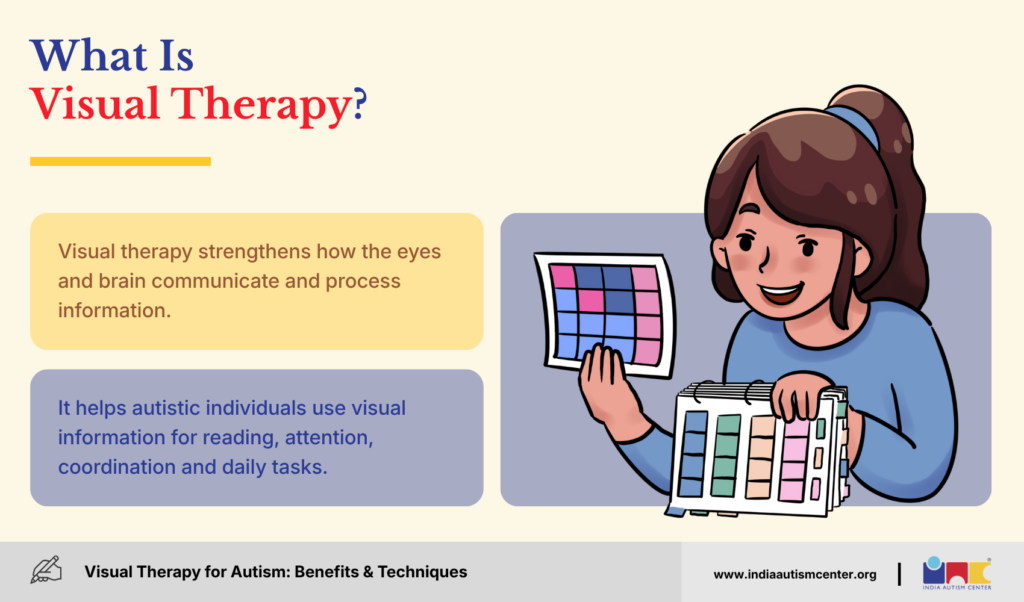
    Visual therapy is a personalised program that helps strengthen the communication between the eyes and the brain. It’s not just about improving eyesight; it’s about improving how the brain uses visual information in daily life.

    The eyes capture information, and then the brain interprets it. Vision therapy ensures it happens efficiently. 

    For autistic individuals, this can be life-changing because the vision system influences:

    • Reading
    • Writing
    • Attention
    • Social engagement
    • Eye contact
    • Hand-eye coordination
    • Motor planning
    • Spatial awareness
    • Emotional regulation

    Vision therapy can be helpful as the vision skills improve, making daily tasks more manageable, smoother, and less overwhelming. 

    📥 Free download: Printable daily routine chart for autistic children

    Why Visual Challenges Are Common in Autism?
    Why Visual Challenges Are Common in Autism?

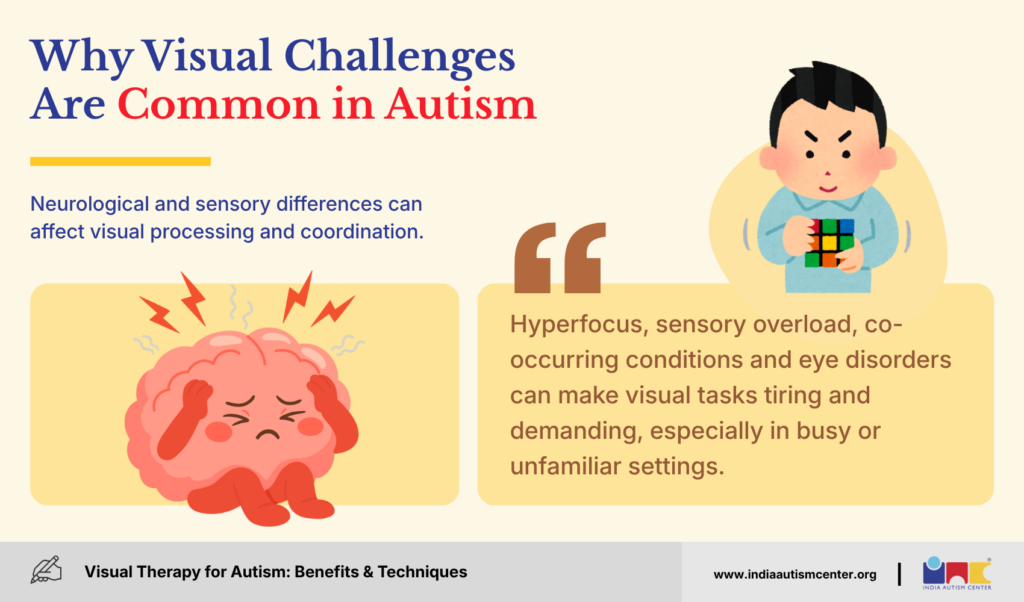
    Many autistic individuals experience visual-processing differences for several neurological and sensory reasons:

    • Neurological pathways develop differently: The brain regions responsible for visual attention, eye coordination, and face processing may grow at different paces.
    • Hyperfocus or difficulty shifting attention: Some children can zoom in on details but struggle to shift their gaze between objects or people.
    • Sensory processing differences: Bright lights, busy environments, or fast-moving visuals can make children with ASD feel overwhelmed.
    • Co-occurring conditions: Certain types of developmental delays, ADHD, dyspraxia, and dyslexia are known to accompany ASD, affecting visual-motor skills.
    • Higher rates of eye conditions: Conditions like strabismus, convergence challenges, and autism lazy eye (amblyopia in autistic individuals) are more frequent.

    Everyday tasks can feel much more demanding when these factors are combined. 

    How Does Visual Therapy Support Autistic Individuals?
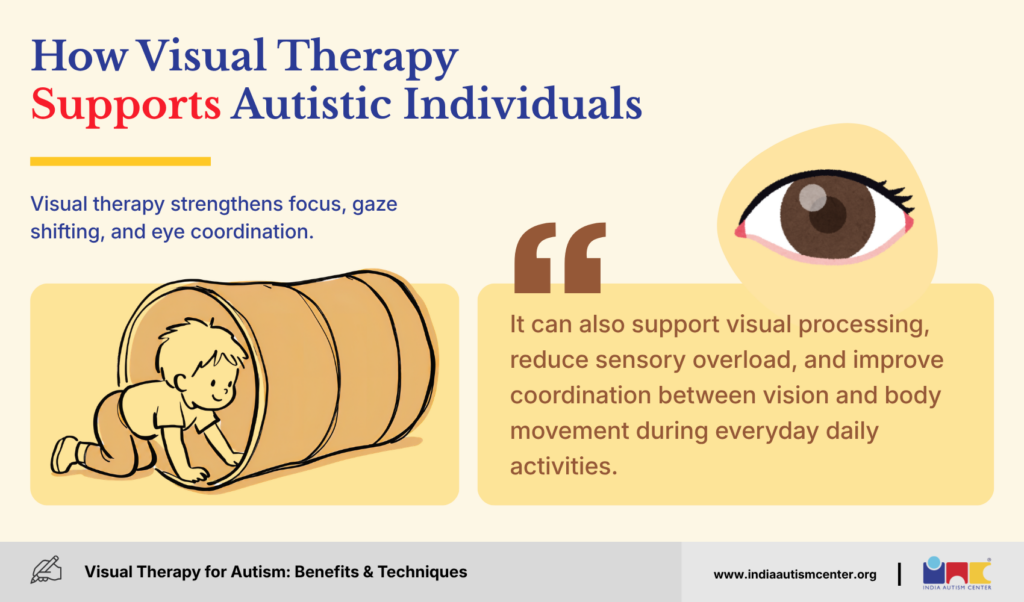
    How Visual Therapy Supports Autistic Individuals?

    Visual therapy is more than just an eye check-up and some random exercises. Vision therapy for autism focuses on:

    • Strengthening eye muscles
    • Better focus
    • Encouraging smooth gaze shifting
    • Teaching the brain to process visual signals correctly
    • Reducing visual overload
    • Ensuring that coordination between body movement and vision is enhanced
    • Enhancing comfort in busy visual environments

    Why Do Autistic Children Respond So Well to Visual Supports?
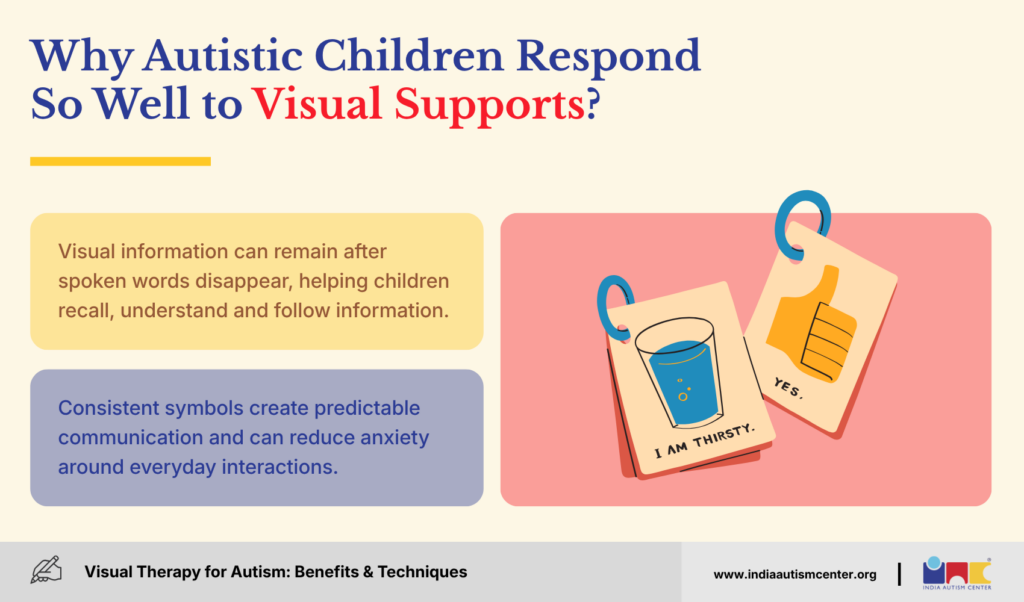
    Why Autistic Children Respond So Well to Visual Supports?

    The autistic brain often processes visual information more efficiently than auditory information. Spoken words disappear the moment they are said. A picture card stays put. A child who cannot yet form a verbal sentence can still point to a card that says “I want water” or “I feel scared” – and be understood immediately.

    Predictability is the other key factor. When a child knows exactly what a symbol means and that it will always mean the same thing, anxiety drops. In classrooms across India – from inclusive schools in Bengaluru to special education centres in Kolkata – speech-language pathologists and special educators use autism visual supports precisely because they create a consistent, reliable communication bridge.

    6 Types of Visual Supports Worth Knowing
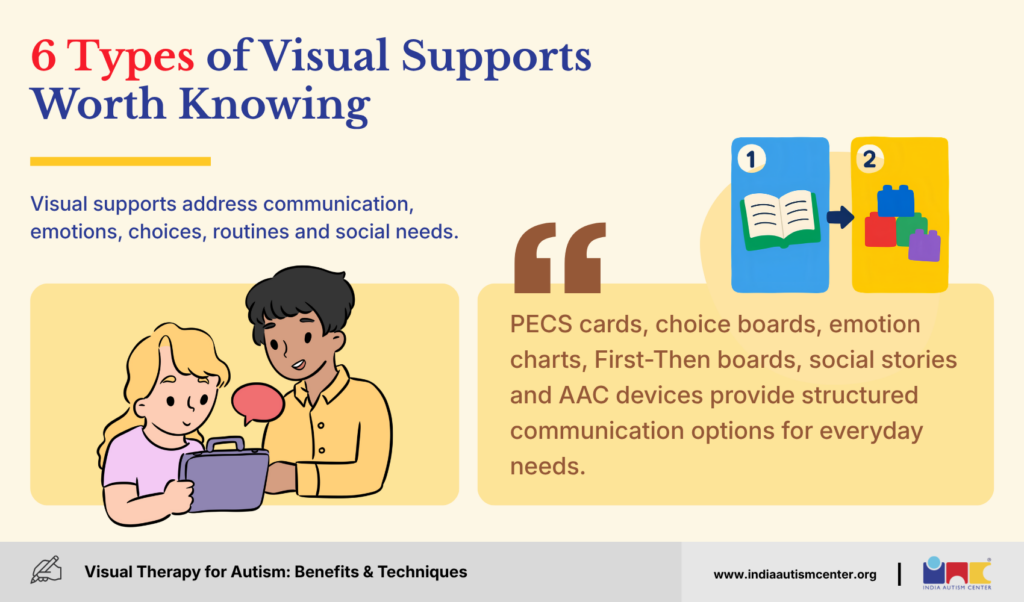
    6 Types of Visual Supports Worth Knowing
    • PECS cards (Picture Exchange Communication System): A structured, 6-phase system where children learn to hand over a picture card to request something. It is designed for nonverbal or preverbal children and does not require them to recognise pictures beforehand. A child in Phase 1 might simply exchange a card for a biscuit; by Phase 6, they are constructing simple sentences.
    • Choice boards: A board displaying 2–6 options (activities, foods, sensory tools) so a child can point to what they want rather than struggling to verbalise it. A choice board autism therapists use at home might show “swing,” “puzzle,” “drawing,” and “music” – giving the child agency without verbal demand.
    • Emotion charts: Visual grids showing facial expressions labelled with feelings – happy, sad, angry, scared, calm. More advanced charts include nuanced emotions like “frustrated” or “overwhelmed.” In therapy settings, these charts help children identify their own emotional state and communicate it to a caregiver before a meltdown escalates.
    • “First-Then” boards: The simplest visual support of all. Two images side by side: First [bath], Then [screen time]. This structure is especially effective for younger children or those who find full schedules overwhelming.
    • Social stories: Short, illustrated narratives that walk a child through a specific social situation – visiting the doctor, travelling on the metro, starting a new school. They prepare the child for what will happen and how to respond.
    • AAC devices: Augmentative and Alternative Communication devices range from low-tech communication boards to high-tech speech-generating tablets. A speech-language pathologist (SLP) can help you identify the right level for your child.

    Who Can Benefit from Vision Therapy for Autism?
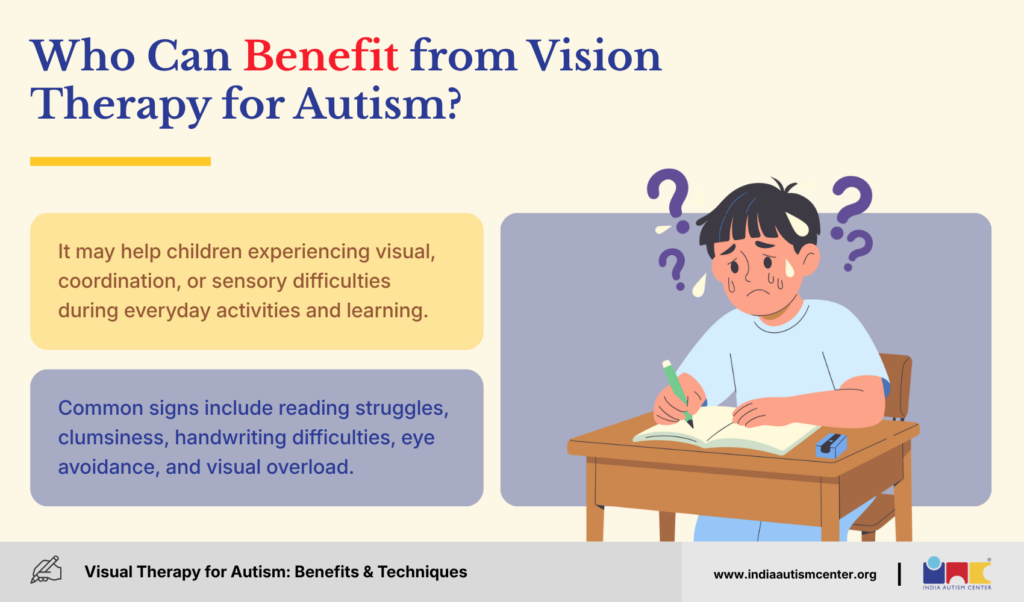
    Who Can Benefit from Vision Therapy for Autism?

    When the proper technique and visual therapy for autism are used, it can help children with autism spectrum disorder to live a better life. It is especially valuable for:

    • Children avoiding eye contact
    • Kids who lose their place while reading
    • Children who seem “clumsy” or bump into objects
    • Kids with handwriting difficulties
    • Children who tilt their heads to look at objects
    • Those diagnosed with autism or lazy eye
    • Children with sensory overload or anxiety driven by visual input

    Want to know more? Get in touch with us.

    How Vision Therapy Works: Core Techniques Explained
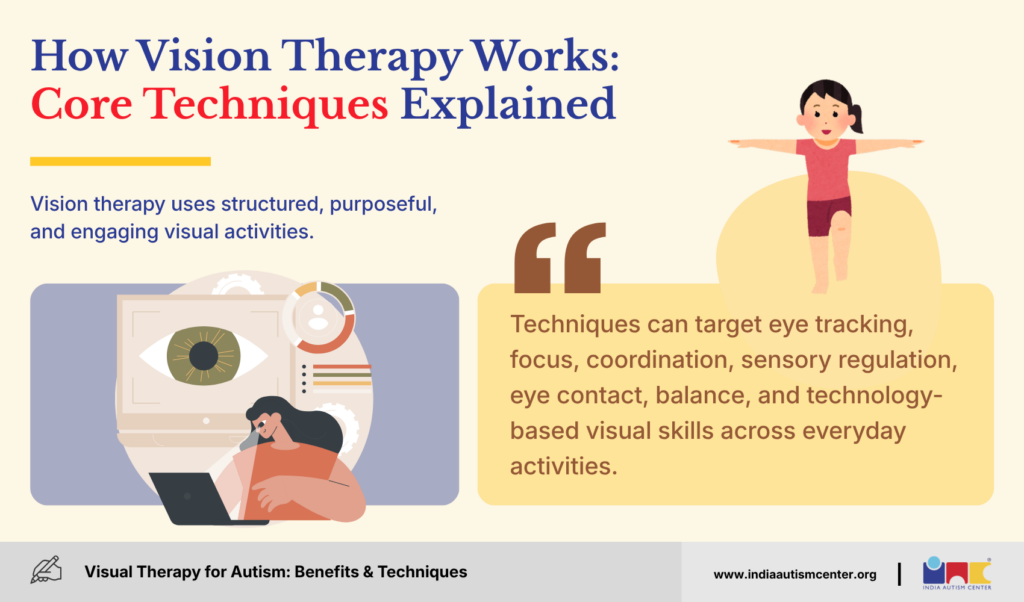
    How Vision Therapy Works: Core Techniques Explained

    Visual or vision therapy for autism uses structured, engaging, and purposeful activities to improve the visual system. These exercises are often fun and play-based, which helps keep children motivated. If you are wondering how to improve eye contact for autism, then here are the most effective therapies that are widely used:

    1. Eye-Tracking Development Exercises

    These exercises teach the eyes to follow objects smoothly, as many autistic children struggle with tracking, leading their eyes to jump rather than move smoothly. It can cause problems such as difficulty copying from a board, losing place while reading, challenges with playing sports, or poor eye contact. 

    For this exercise, the therapists use tools like: 

    • Moving light pens
    • Tracking balls
    • Bubbles
    • Flashlight following
    • Computer-based eye-tracking games

    These exercises teach the eyes to track objects accurately, making reading and conversation much easier.

    2. Saccadic (Quick Eye Movement) Training

    The term “Saccades” refers to the quick jumps your eyes make between two points. Children with saccadic difficulties may come across as inattentive, or they may be prone to losing information. Therapists use:

    • Word-jump charts
    • Dot-to-dot eye jumps
    • Rapid pointing games

    This helps improve classroom performance and conversation flow.

    3. Near–Far Focus Training

    Shifting the focus from near objects to far objects can often be difficult for people with ASD. Thus, training can be helpful for school tasks such as switching between a book and a board.

    The tools used for this exercise include:

    • Near-far charts
    • Focus cards
    • Digital focus training apps

    This training is particularly helpful for children who experience headaches or fatigue due to frequent visual shifts.

    4. Convergence and Divergence Therapy

    When the eyes don’t work as a team, children may see double or feel visually confused. This vision therapy for autism helps to ensure that both eyes work in coordination. This is also the main therapy used for lazy eye in autism.

    Therapists use:

    • Brock String
    • Barrel cards
    • 3D stereoscope training
    • Dot fusion cards

    It helps strengthen binocular vision, improve depth perception, enhance sports performance, and reduce blurry vision. 

    5. Vision-Motor Integration Therapy

    Visual-motor integration is important for several day-to-day activities, such as writing, eating independently, buttoning, hand-eye coordination, and participating in sports. As part of this vision therapy for autism, therapists use tools like:

    • Pegboards
    • Maze tracing
    • Craft activities
    • Ball-catching
    • Pattern copying
    • Tracing worksheets

    This helps children coordinate what they see with what their hands do.

    6. Sensory-Aware Visual Therapy

    Many autistic children find bright lights, crowds, or fast visuals overwhelming. This vision therapy technique for autism aims to help children who struggle with visual overload. 

    As per this technique, the therapist creates a sensory-safe environment using:

    • Low lighting
    • Contrast-based activities
    • Visual-motor calming tasks
    • Slow-eye movement exercises
    • Visual schedules

    It helps reduce stress, improve the overall attention span, and keep children regulated.

    7. Face & Eye-Contact Building Activities

    Several autistic children tend to avoid eye contact, not out of defiance, but because it feels uncomfortable or overwhelming. As a parent seeking to know how to improve eye contact in autism, this technique can be quite helpful.

    The therapy will include the following:

    • Joint Attention Games: Pointing, showing, and sharing toys.
    • Mirror Play: Helps children look at faces without pressure.
    • Gaze-Following Activities: Teaching children to follow someone’s eyes to understand attention.
    • Naturalistic Play: Positioning toys near the therapist’s face so the child naturally glances at them.

    8. Balance, Coordination & Vestibular-Visual Integration

    Children with vision-processing differences may also have difficulties with balance or body awareness. The therapy aims to ensure that vision and movement work together. The treatment includes different tools, such as:

    • Balance boards
    • Trampolines
    • Obstacle courses
    • Body tracking games

    When the visual and vestibular systems align, children become more confident and coordinated.

    9. Lens, Prism & Filter-Based Training

    This technique is also used to treat autism, lazy eye, and reading difficulties. It is used only by developmental optometrists. The special lens and prism help to:

    • Align the eyes
    • Improve focus
    • Reduce visual stress
    • Enhance attention
    • Support depth perception

    10. Computer-Assisted & VR Visual Training

    These exercises are engaging, motivating, and highly effective for older children and teens. Technology-based training is now widely used:

    • Interactive VR visual tasks
    • Eye tracking software
    • Attention shift games
    • Binocular VR games

    Visual Aids for Autism: Tools That Make Learning Easier
    Visual Aids for Autism: Tools That Make Learning Easier

    If visual supports are about communication, visual aids are about learning. They are the structured, environment-based tools that make academic tasks, daily routines, and classroom instructions accessible for autistic children – particularly those who are visual learners.

    The difference is subtle but important. A PECS card is a support your child uses actively to communicate. A colour-coded task card on the desk, a labelled shelf in the classroom, or a visual timer on the table – these are aids that structure the environment so the child can navigate it more independently.

    How visual aids reduce cognitive load and anxiety

    Autistic children often experience heightened anxiety in learning settings because the demands are unpredictable. “What comes next?” “How long will this take?” “What does the teacher want me to do?” When these questions go unanswered, the nervous system goes into alert mode – and learning stops.

    Visual aids answer those questions before the child has to ask. They externalise the structure that the child’s brain is working hard to construct internally. The result: lower anxiety, better attention, and more genuine engagement with the task at hand. This is the core of visual learning autism research – the visual channel is often the most reliable route into a child’s understanding.

    5 Visual Aids That Make a Real Difference
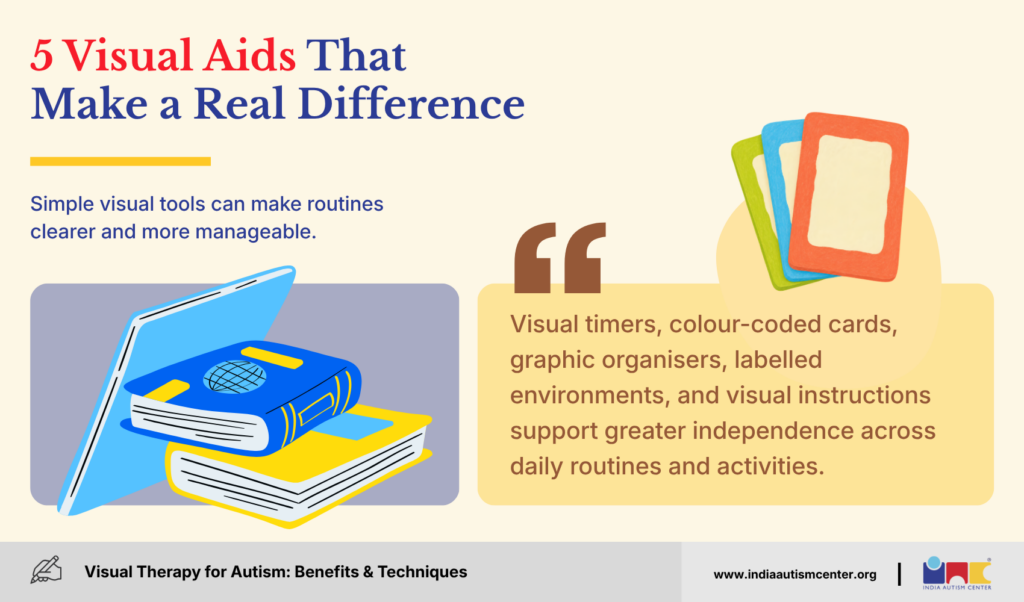
    5 Visual Aids That Make a Real Difference
    • Visual timers: A timer that shows time visually – typically as a shrinking red disc – rather than just counting down numerically. A child who cannot yet read a clock can see that “the red is almost gone, which means maths is almost over.” Time Timer is the most well-known brand internationally; in India, similar sand timers or colour-coded clock faces work just as well and cost far less. A visual timer autism specialists recommend is placed on the desk during any timed activity to reduce “how long left?” anxiety.
    • Colour-coded task cards: Each subject or activity gets its own colour. Maths is blue, Hindi is yellow, art is green. In an Indian classroom where a child moves between subjects, colour-coding the notebook covers, folders, and task cards means the child can organise independently without relying on verbal reminders.
    • Graphic organizers: Visual frameworks – mind maps, T-charts, story maps – that show how information connects. For a child who struggles to organise thoughts into a linear paragraph, a graphic organiser gives them a visual scaffold to work from.
    • Labelled environments: Sticky labels with a word and a small picture on every shelf, drawer, and bin. A child who knows exactly where the pencils live and where finished work goes does not need to ask – and does not experience the anxiety of not knowing.
    • Visual instructions: Step-by-step picture guides for tasks like handwashing, packing a school bag, or completing an art project. Placed at the point of use (a handwashing chart above the sink, a bag-packing chart near the school bag hook), these reduce the need for repeated verbal instruction.

    3 things an Indian parent or teacher can do today – at minimal cost

    1. Label the home environment. Print or hand-draw small picture-and-word labels for the kitchen, bathroom, and study area. Laminate with a ₹5 lamination pouch. Done in an afternoon, useful for years.

    2. Make a colour-coded homework folder. Assign a colour to each subject. Use coloured sticky tape on plain folders. Costs under ₹50 and immediately reduces the “which book do I need?” confusion.

    3. Use a sand timer for transitions. A 5-minute sand timer (available on Amazon India for ₹150–₹300) placed on the table before a transition – “when the sand runs out, we stop playing and get ready for dinner” – gives the child a visual, concrete warning that a change is coming.

    How vision therapy amplifies the effect of visual aids

    Here is where the two threads of this article come together. A child who has completed vision therapy – with improved eye tracking, better near-far focus, and reduced visual stress – is far better equipped to use visual aids effectively. Reading a task card requires smooth tracking. Scanning a labelled shelf requires accurate gaze shifting. Engaging with a graphic organiser requires sustained visual attention. Vision therapy builds the hardware; visual aids provide the software.

    Visual Schedules for Autism: Building Routine and Reducing Anxiety
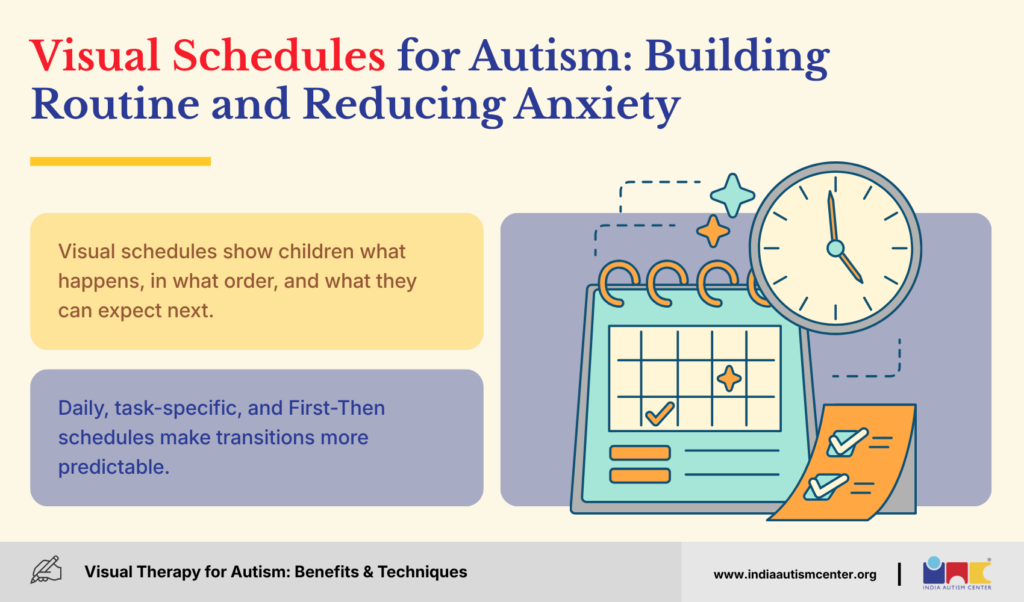
    Visual Schedules for Autism: Building Routine and Reducing Anxiety

    Of all the visual tools available to parents and teachers, the visual schedule is arguably the most powerful – and the most underused at home.

    A visual schedule is a sequence of images, symbols, or words that shows a child what will happen and in what order. It answers the single question that drives the most anxiety in autistic children: “What comes next?”

    Why predictability matters so much

    Many autistic children experience transitions – moving from one activity to another, from home to school, from playtime to bath – as genuinely distressing. The distress is not defiance. It is the neurological reality of a brain that finds uncertainty hard to tolerate. A visual schedule for autism removes the uncertainty. The day stops being a series of surprises and becomes a sequence the child can see, anticipate, and prepare for.

    Research consistently supports this. A 2017 study in Young Exceptional Children found that visual aids, including schedules, significantly supported positive behaviour and reduced anxiety in young autistic children. The University of Florida Center for Autism and Related Disabilities notes that visual schedules are particularly helpful during transitions – precisely the moments that trigger the most distress.

    Three types of visual schedules

    • Daily schedule: A full-day or half-day sequence showing every major activity from morning to bedtime (or school arrival to dismissal). Best for children who are ready to see the big picture. In an Indian home, this might run: wake up → brush teeth → breakfast → school → lunch → homework → play → dinner → bath → sleep.
    • Task-specific schedule: A mini-schedule for a single routine broken into steps. A morning routine schedule might show: alarm → toilet → brush teeth → wash face → get dressed → eat breakfast → pack bag → shoes on → leave. These are placed at the point of use – the bathroom, the bedroom, the front door.
    • “First-Then” schedule: The simplest version. Two images only: First [this], Then [that]. Ideal for younger children, children in early intervention, or any child who finds a longer schedule overwhelming. “First finish your dal-chawal, then you can watch Chhota Bheem” – shown as two pictures – is immediately comprehensible even without words.

    How to create a visual schedule at home: step by step

    Step 1 – Choose one routine to start with. Don’t try to schedule the whole day on day one. Pick the routine that causes the most friction – usually morning or bedtime – and start there.

    Step 2 – Break it into 3–6 steps. Keep each step concrete and observable. “Get ready” is too vague. “Put on shoes” is perfect.

    Step 3 – Choose your images. Use real photographs of your child doing each step (most effective), printed clipart, or hand-drawn pictures. For older or more advanced children, written words work too. The key is that your child can read the image reliably.

    Step 4 – Make it durable. Print, laminate (or use a self-laminating pouch), and add Velcro dots so cards can be moved to a “done” pocket or envelope once completed. This physical act of moving a card gives the child a satisfying, concrete marker of progress.

    Step 5 – Place it at your child’s eye level. A schedule on the fridge at adult height is not a schedule your child will use. Stick it on the bathroom wall at their eye level, or on the bedroom door at their height.

    Step 6 – Model its use every day. For the first two weeks, narrate the schedule with your child: “Look, what’s next? Brush teeth. Let’s go.” Point to each card. Let the schedule give the instruction, not you. Over time, your child will begin to check the schedule independently.

    Step 7 – Stay consistent. The schedule only works if it is used every day, for the same routine, in the same place. Consistency is what transforms a piece of laminated card into a genuine anchor for your child’s day.

    Children who have completed vision therapy engage more effectively with visual schedules.

    This is worth saying explicitly. A child whose eye tracking has been strengthened through vision therapy can scan a sequence of cards more smoothly. A child whose near-focus has improved can read the text on a task card without strain. A child whose visual attention has been trained is more likely to notice the schedule on the wall and engage with it. Vision therapy and visual schedules are not separate interventions – they reinforce each other at every step.

    As we move into the conclusion of this article, it is worth holding both threads together: the clinical work of training the eye-brain connection, and the practical work of building a visual environment that meets your child where they are. Neither is sufficient alone. Together, they give autistic children the clearest possible path to independence, communication, and confidence.

    Want to know more? Get in touch with us.

    Benefits of Vision Therapy for Autism
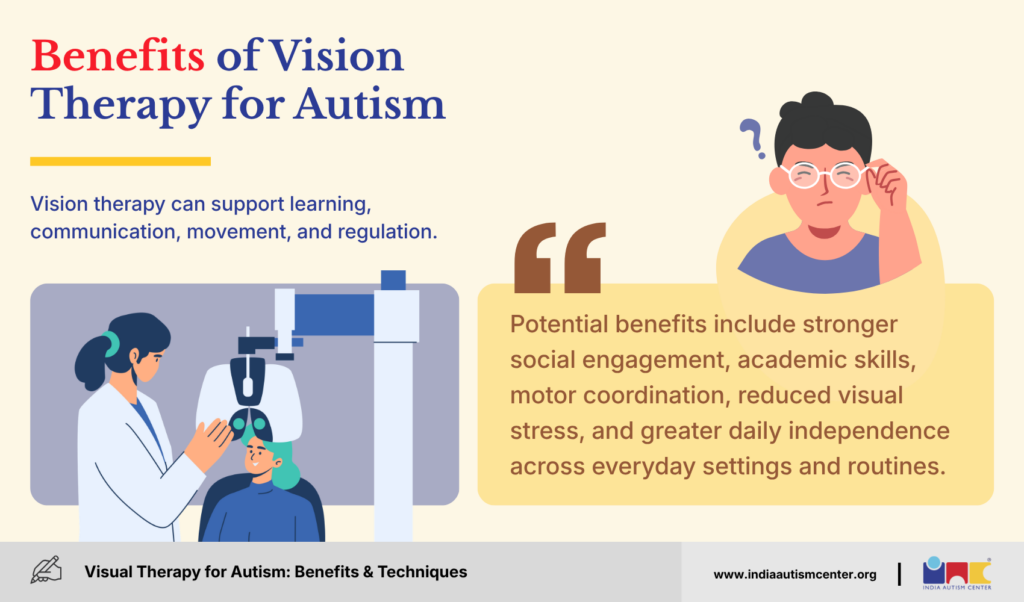
    Benefits of Vision Therapy for Autism

    Visual therapy for autism offers several benefits, as the visual system influences communication, learning, motor skills, and emotional regulation. Here are the benefits of vision therapy for autism. 

    Improved Eye Contact & Social Engagement

    One of the most common questions parents ask is how to improve eye contact for autism. Visual therapy supports this by strengthening eye tracking, gaze shifting, face processing, joint attention, and visual comfort during conversation. 

    Children gradually begin to:

    • Look toward a person’s face more naturally
    • Maintain brief eye contact without distress
    • Understand where others are looking
    • Respond better to name-calling and facial cues

    Stronger Reading, Writing & Academic Skills

    After vision therapy for autism, improvements often include:

    • Better tracking across text
    • Improved reading fluency
    • Accurate copying from the board to the notebook
    • Stronger letter formation
    • Better spacing and writing alignment

    Reduced Sensory Overload & Visual Stress

    Some autistic individuals experience visual hypersensitivity to bright lights, screen glare, and crowded environments, which may feel overwhelming. Visual therapy will help to: 

    • Filter unnecessary visual information
    • Reduce overstimulation from movement
    • Improve visual attention span
    • Stay calmer in busy spaces

    Better Motor Skills & Body Awareness

    Vision guides body movement, so when the visual system becomes stronger, physical coordination also improves. The benefits of vision therapy for autism include:

    • Better balance
    • Smoother walking/running
    • Improved ball skills
    • Stronger hand-eye coordination
    • More confidence on playgrounds

    More Independence in Daily Tasks

    Parents often report noticeable improvements in daily functioning within months in terms of:

    • Eating
    • Buttoning and zipping
    • Sorting objects
    • Using tools correctly
    • Completing homework independently

    What Is Autism Lazy Eye & How Does Vision Therapy Help?
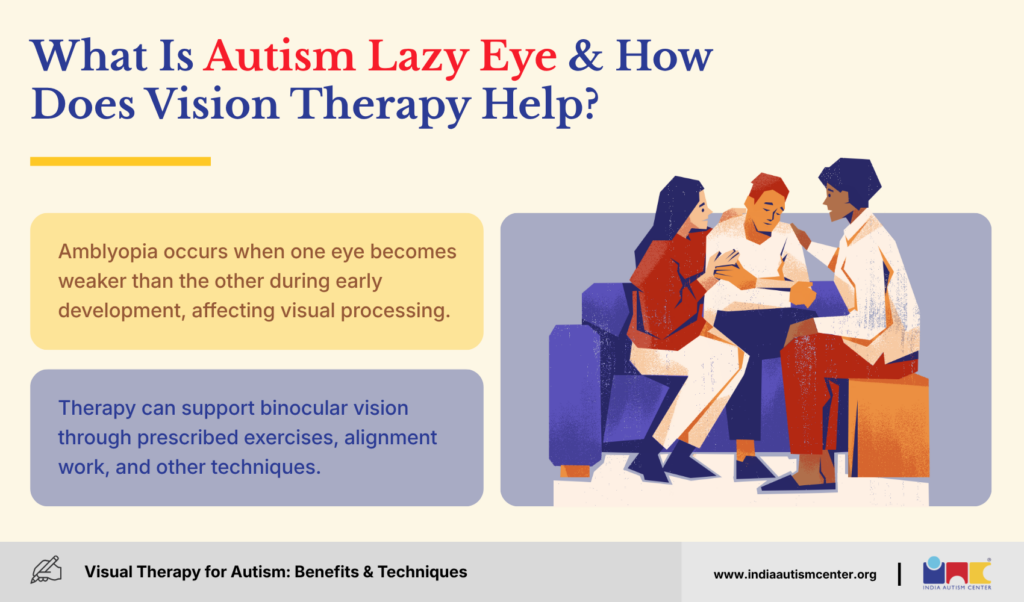
    What Is Autism Lazy Eye & How Does Vision Therapy Help?

    Autism lazy eye, or amblyopia, occurs in autistic individuals. Amblyopia means one eye is weaker and sends fewer signals to the brain. Children with autism are more prone to have this condition due to:

    • Inconsistent gaze
    • Difficulty maintaining eye alignment
    • Tracking issues
    • Sensory avoidance of visual tasks

    How does Visual Therapy treat Autism Lazy Eye?

    Visual therapy helps the brain reconnect with the weaker eye, restoring binocular vision and preventing long-term sight loss. Therapy techniques include:

    • Strengthening the weaker eye
    • Teaching both eyes to work together
    • Prism therapy to improve alignment
    • Focus-shifting activities
    • Binocular games
    • 3D stereoscopic exercises
    • Patching (when prescribed)

    Signs Your Child Might Need Vision Therapy
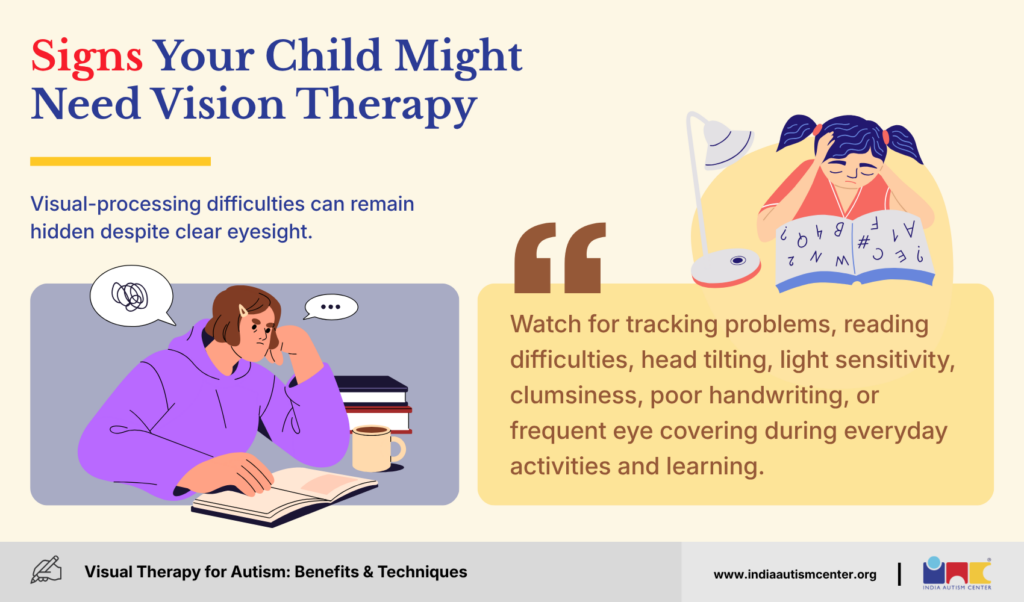
    Signs Your Child Might Need Vision Therapy

    It is easy to assume that your child’s vision is perfect if they can see clearly. But visual-processing challenges are often hidden and may go undetected during a routine eye exam. 

    Children who have ASD often struggle with tracking, focusing, depth perception, or eye coordination without being able to explain what feels difficult. Here are some signs that you must look out for to understand if your child needs vision therapy:

    • Difficulty maintaining eye contact
    • Trouble following moving objects
    • Loses place while reading
    • Avoids puzzles or drawing
    • Tilts or turns the head to focus
    • Struggles with copying from the board
    • Light sensitivity
    • Memory difficulties
    • Frequent falls or clumsiness
    • Poor handwriting
    • Short attention span
    • Avoids face-to-face interaction
    • Squints or covers one eye

    Home-Based Activities to Support Visual Development
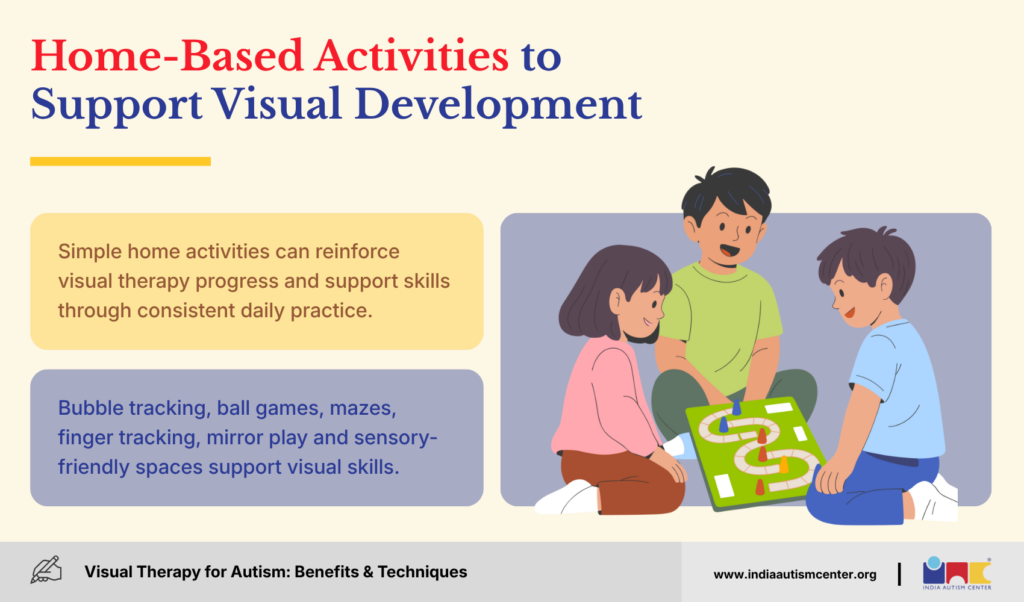
    Home-Based Activities to Support Visual Development

    Parents play a huge role in reinforcing therapy progress at home. Here are some home-based activities that are easy to do and are also time-efficient. 

    • Bubble Tracking: Helps with eye pursuit and visual attention.
    • Rolling Ball Games: Improves hand-eye coordination & timing.
    • Mazes, Dot-to-Dot & Pattern Blocks: Strengthen vision-motor integration.
    • Reading with the help of Finger Tracking: Helps children maintain place in text.
    • Throw & Catch Activities: Enhance depth perception and improve ocular teaming.
    • Mirror Imitation Games: Great for early social referencing and face awareness.
    • Sensory-Friendly Vision Spaces: Soft lighting, clear labels, and contrast-rich visuals aim to help reduce overload.

    Conclusion
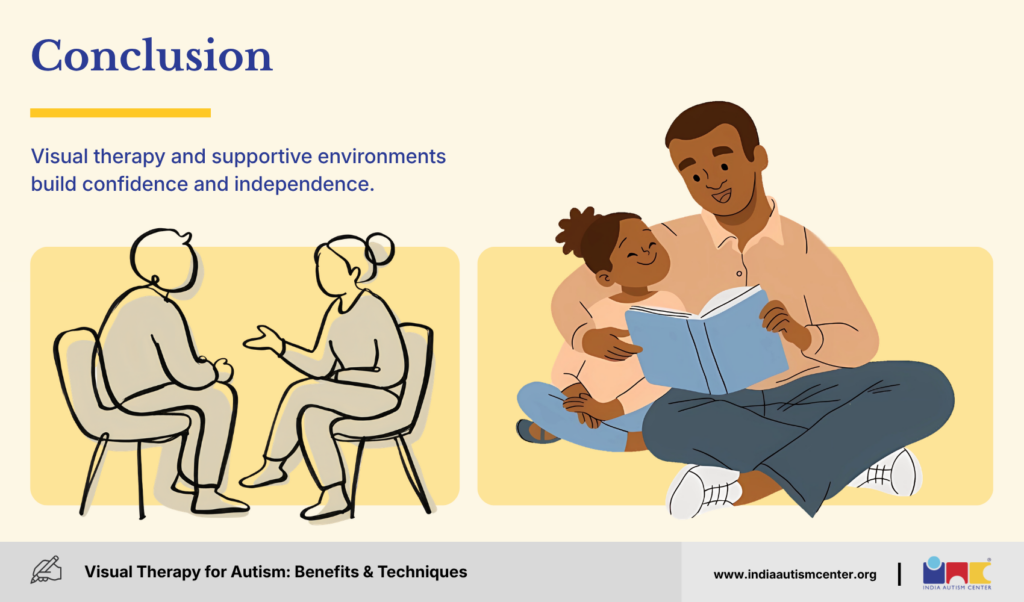
    Vision impacts every aspect of human life, and it is the same for children with ASD, whether it is reading and writing, eye contact, social connection, or staying regulated in sensory-rich environments. Visual therapy has been shown to deliver powerful, life-changing results. 

    By strengthening the communication between the eyes and the brain, vision therapy aims to help autistic individuals see, process, and respond to the world in a more comfortable way. Families who opt for structured and evidence-based visual therapies and treatment, especially through integrated centres, see remarkable progress in confidence, communication, learning, and daily independence.

    Frequently Asked Questions

    What is vision therapy for autism, and how does it work?

    Vision therapy, also known as vision therapy for autism, is a structured program that improves coordination between the eyes and the brain. It uses exercises that strengthen tracking, focusing, eye coordination, and visual processing. Over time, children learn to interpret visual information more efficiently, which positively impacts reading, writing, social skills, and daily activities.

    Can visual therapy help my child improve eye contact?

    Yes. Many children avoid eye contact due to visual discomfort, not behavioural resistance. Through gentle gaze-shifting exercises, face-tracking tasks, and sensory-supported techniques, visual therapy supports the natural, pressure-free improvement of eye contact for autism.

    Does vision therapy help with lazy eye in autism?

    Yes. Autism lazy eye (amblyopia in autistic children) is treatable through visual therapy. Therapists strengthen the weaker eye, improve binocular vision, and retrain the brain to use both eyes together. It helps to improve depth perception and reduce long-term visual imbalance.

    How long does it take to see results from vision therapy?

    Most parents notice improvements within 8–12 weeks. However, children with significant vision-processing challenges or autism-related lazy eye may need 6–12 months of consistent therapy. Progress depends on regular sessions and home reinforcement.

    Can Vision Therapy Be Used Alongside Other Autism Treatments?

    Yes, vision therapy can be considered alongside other autism treatments as part of an individualized, multidisciplinary care plan. It may be explored to address specific visual difficulties, such as eye coordination, visual tracking, or focusing problems, when identified by a qualified eye care professional. However, scientific evidence supporting the effectiveness of vision therapy in treating the core symptoms of Autism Spectrum Disorder (ASD) remains limited and mixed. Therefore, vision therapy should be considered a complementary approach rather than a replacement for established autism interventions, behavioural therapies, speech therapy, occupational therapy, or other recommended treatments. Always consult qualified healthcare professionals before incorporating vision therapy into an autism treatment plan.

    How Does Vision Therapy Differ from Other Autism Therapies?

    Vision therapy differs from other autism therapies in its primary focus and approach. It aims to address specific visual skills by improving how the eyes and brain work together to process visual information, including eye coordination, visual tracking, focusing, and visual perception. In contrast, other autism therapies, such as behavioural therapy, speech therapy, and occupational therapy, primarily focus on developing communication, social interaction, motor skills, behaviour, and everyday living abilities. While vision therapy may help address certain visual difficulties in individuals with Autism Spectrum Disorder (ASD), it does not treat the core characteristics of autism and should be considered a complementary approach when clinically appropriate.

    Is Vision Therapy the Same as Occupational Therapy for Autism?

    No, vision therapy and occupational therapy (OT) are two different approaches used to support individuals with Autism Spectrum Disorder (ASD). Vision therapy primarily focuses on improving specific visual skills, such as eye coordination, visual tracking, focusing abilities, and visual processing. In contrast, occupational therapy helps individuals develop essential everyday skills, including fine motor coordination, sensory processing, self-care, and daily living activities. Although both therapies have different objectives and require specialized professional training, they can complement each other as part of a multidisciplinary autism care plan to support an individual’s overall development and functional abilities.

    Disclaimer: This article is intended for educational and informational purposes only. It is not a substitute for professional medical advice, diagnosis, or treatment. If you are pregnant or have concerns about medication use during pregnancy, please consult a qualified healthcare provider. If your child has received an autism diagnosis and you have questions about causes or support, please reach out to a trained specialist or an autism-focused organisation for guidance.

    For expert insights, support services, and inclusive learning initiatives, visit the India Autism Center.

    Useful Sources

    Rutherford, M. et al. (2020). Visual supports at home and in the community for individuals with autism spectrum disorders: A scoping review. Autism, 24(2), 447–469.

    Kidder, J. E., & McDonnell, A. P. (2017). Visual aids for positive behavior support of young children with autism spectrum disorders. Young Exceptional Children, 20(3), 103–116

    University of Florida Center for Autism and Related Disabilities – Visual Schedules resource.
    Autism Speaks – Visual Supports Toolkit

    NAPA Center – Visual Schedules for Autism.

  • List of Several Government Schemes for Disabled Persons in India (2026)

    List of Several Government Schemes for Disabled Persons in India (2026)

    If you are looking for the latest government schemes for disabled persons in India, this guide brings together the most important disability welfare programs in one place. From health insurance and residential care to pensions, assistive devices, scholarships, and rehabilitation support, these schemes can help persons with disabilities and their families access practical support more easily.

    This updated list is designed to help caregivers, parents, and adults with disabilities quickly understand which schemes exist, who is eligible, and where to apply. We also recommend checking official government sources for the most current eligibility rules and application details, since scheme benefits and criteria may change over time.

    As per the latest records, there are more than 2.68 crore disabled persons. Even when the number is so huge, awareness of available support remains significantly low. It has also been found that over 42% of eligible persons with disabilities do not apply for government benefits simply because they are unaware of the schemes.

    The Complete List of Government Schemes for Disabled Persons in India (2026)

    Complete list of government schemes for disabled persons in India 2025 with benefits and eligibility

    Finding the right support for disability can be quite overwhelming. Several disabled persons and their families are missing out on available government support. This updated list of government schemes for persons with disabilities in India (2026) brings together all major welfare initiatives. 

    Especially when you are the parent or a primary caregiver of a kid who has autism spectrum disorder, an adult with a disability, or a caregiver who is looking for proper guidance, this guide simplifies the landscape so you can finally understand and claim the support you deserve.

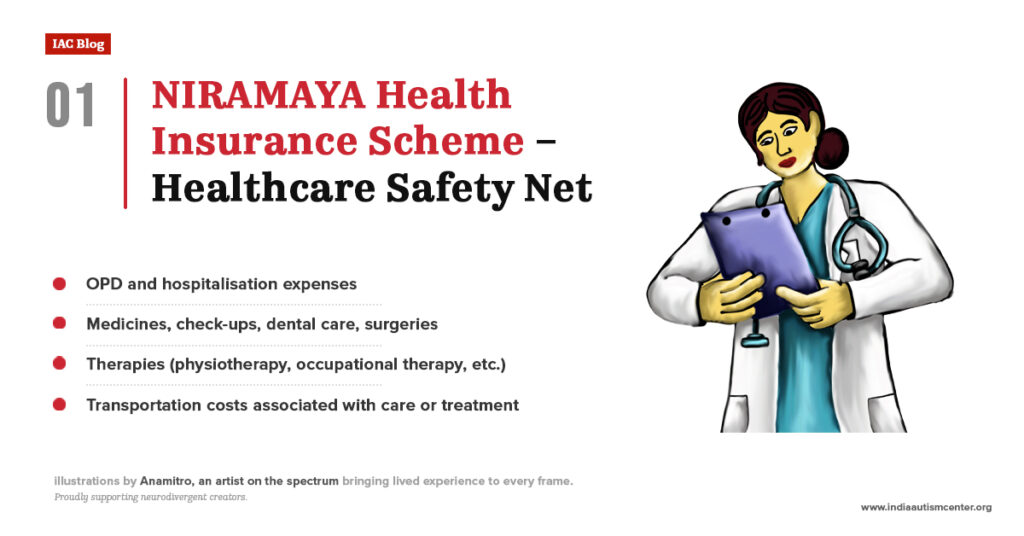
    1. NIRAMAYA Health Insurance Scheme – Healthcare Safety Net

    Niramaya health insurance scheme covering OPD, hospitalisation, medicines, and therapies for disabled persons

    When it comes to support for people with disabilities, health insurance is more than just an option; it is a necessity, a health insurance scheme exclusively for PwDs that provides coverage for a wide variety of medical needs.

    There is no need for pre-insurance medical tests. Irrespective of age or disability type, there is only a one-time premium. This ensures that medical emergencies don’t become financial disasters.

    What Niramaya Scheme Covers:

    • OPD and hospitalisation expenses
    • Medicines, check-ups, dental care, surgeries
    • Therapies (physiotherapy, occupational therapy, etc.)
    • Transportation costs associated with care or treatment

    Who Can Apply:

    Persons with disabilities (autism, cerebral palsy, intellectual disability, multiple disabilities) with a valid disability certificate and UDID/enrollment number.

    Click here to apply for Niramaya Scheme 2026

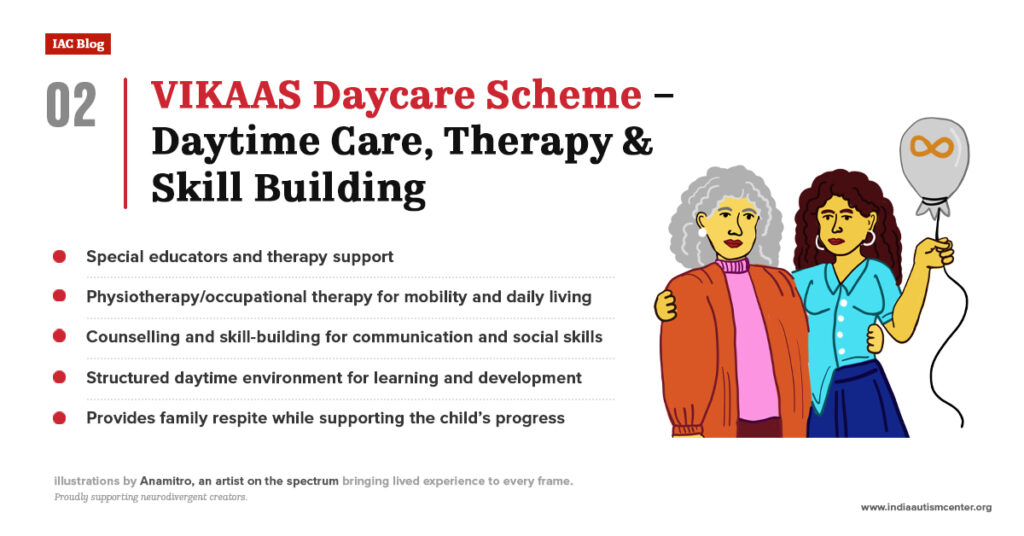
    2. VIKAAS Daycare Scheme – Daytime Care, Therapy & Skill Building

    VIKAAS daycare scheme for therapy, skill development, and structured learning for persons with disabilities

    Besides early intervention, children with disabilities can benefit from schemes like day care. There are daycare centres run by certified organisations that aim to provide therapy, education, and social & life-skills training during daytime hours.

    For families seeking assistance for disabled persons while balancing other responsibilities, VIKAAS ensures children get needed support without needing full-time institutionalisation.

    What the Scheme Covers:

    • Special educators and therapy support
    • Physiotherapy / occupational therapy for mobility or daily-living support
    • Counselling & skill-building to improve communication, daily living, and social skills
    • Structured environment for growth and learning during the day hours
    • Gives family members respite while ensuring the child’s growth and learning

    Who Can Apply:

    Children/young persons (10+ years), with autism, cerebral palsy, intellectual disability, or multiple disabilities. The applicant mustn’t already be enrolled in other residential schemes such as GHARAUNDA or SAMARTH.

    Click here to apply for Vikaas Scheme 2026

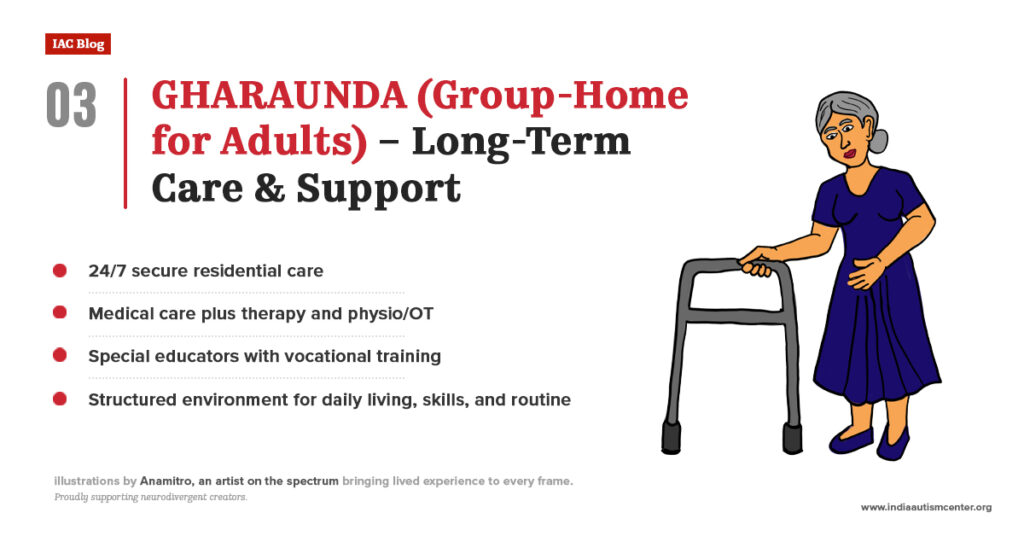
    3. GHARAUNDA (Group-Home for Adults) – Long-Term Care & Support

    Gharaunda group-home scheme for adults with disabilities providing long-term residential care and therapy

    GHARAUNDA is a scheme that provides a safe, lifelong group home for adults with disabilities under the umbrella of the relevant national disability legislation.

    It is one of the most stable government facilities for disabled persons, ensuring long-term inclusion, dignity, and independence for adults who may not be able to live independently.

    What the Scheme Covers:

    • Secure residential home providing 24/7 care. 
    • Access to medical care, therapy, physiotherapy/occupational therapy.
    • Special educators, vocational/pre-vocational training for skill development. 
    • A structured, supportive environment that helps people build daily living and vocational skills, social interaction, and meaningful routine.

    Who Can Apply:

    Adults (18+ years) with disabilities such as autism, cerebral palsy, intellectual disability, or multiple disabilities.

    Click here to apply for Gharaunda Scheme 2026

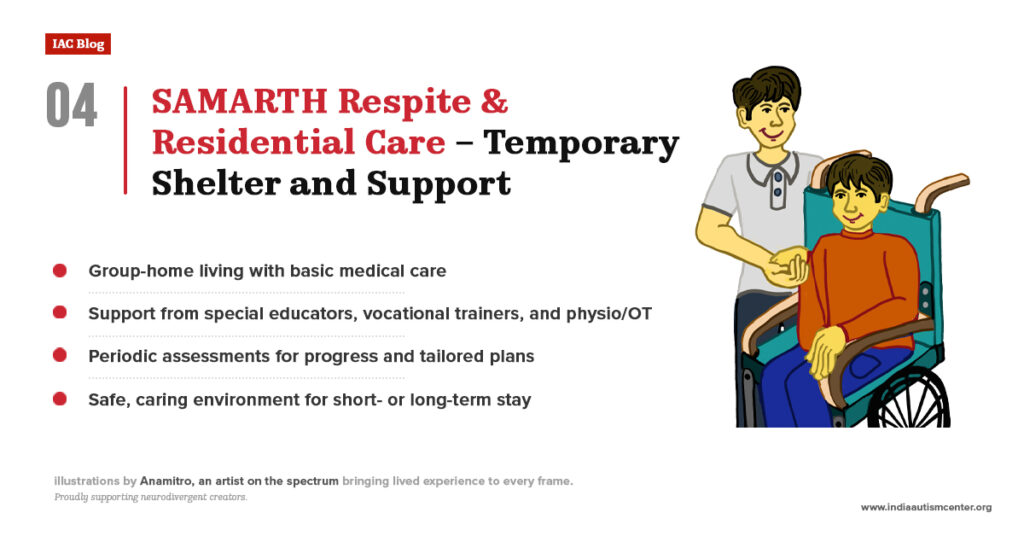
    4. SAMARTH Respite & Residential Care – Temporary Shelter and Support

    Samarth respite and residential care scheme offering temporary shelter and medical support for persons with disabilities

    SAMARTH aims to offer residential or respite care and assistance for disabled persons; it is particularly helpful for orphans, abandoned persons, PwDs from low-income backgrounds, or families in crisis. It serves as a critical government facility for people with disabilities, offering meaningful respite, especially when family support is absent or temporary relief is needed.

    What the Scheme Covers:

    • Group-home style living with basic medical care
    • Support from special educators, vocational trainers, therapists (physio / occupational) to improve physical functionality and daily-living skills 
    • Periodic assessments can help to monitor progress and offer tailored support plans.
    • Safe, caring environment for those needing temporary or long-term residential support 

    Who Can Apply:

    Persons with autism, cerebral palsy, or other disabilities, as per the relevant disability act, especially those not under other long-term or daycare schemes for disabled people in India, such as Disha, Vikaas, or Gharaunda scheme, at the same time.

    Click here to apply for Samarth Scheme 2026

    5. Deendayal Disabled Rehabilitation Scheme (DDRS) – Rehabilitation & Inclusion Funding

    Deendayal Disabled Rehabilitation Scheme DDRS for rehabilitation, therapy, and inclusion funding in India

    This is a flagship centrally sponsored program that aims to support NGOs/voluntary organisations that work for PwDs. DDRS helps build infrastructure and services for rehabilitation and inclusion through financial grants and other forms of aid.

    By funding grassroots organisations, DDRS strengthens the network of government facilities for people with disabilities across the country, thereby increasing reach, quality, and sustainability.

    What the Scheme Covers:

    • Establishment and maintenance of special schools and vocational training centres
    • Early intervention centres for children with developmental delays
    • Infrastructure improvements (ramps, toilets, and other accessible facilities) are made in disability-support institutions.
    • Rehabilitation services: therapy, counselling, skill training, inclusion programmes
    • Community-based rehabilitation and inclusive social initiatives

    Who Can Apply:

    NGOs must be registered under the PwD Act/Trusts Act/Societies Act and must have at least 2 years of experience delivering disability-related services. They must also meet the government’s infrastructure, staff, and service-quality standards to receive funding.

    Click here to apply for DDRS Scheme 2026

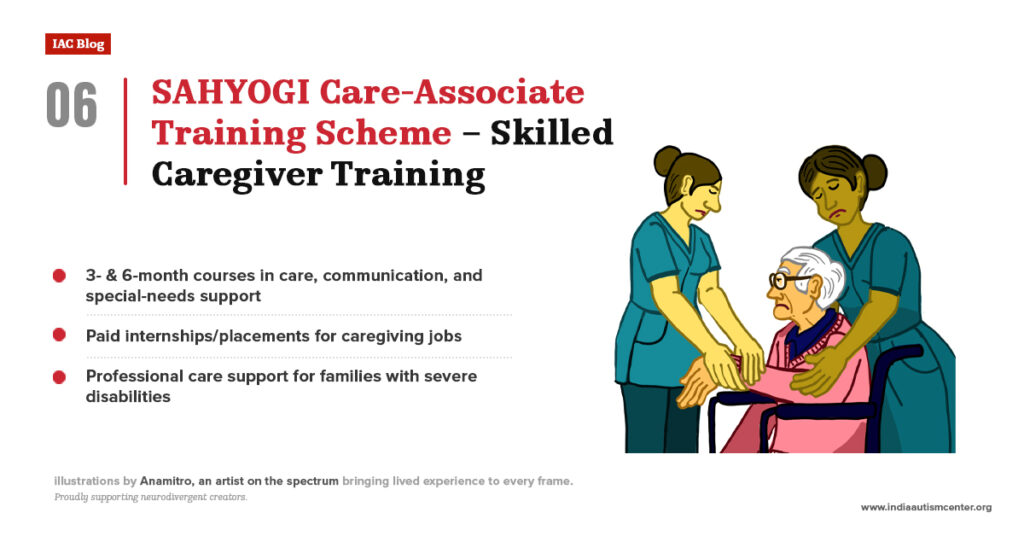
    6. SAHYOGI Care-Associate Training Scheme – Skilled Caregiver Training

    Sahyogi care-associate training scheme for skilled caregiver training and professional support services

    A training scheme that builds a network of trained caregivers (care associates) across India to support PwDs and their families. By enhancing the availability and quality of care, this scheme for disabled people in India significantly enhances day-to-day support, enabling PwDs to lead more independent, dignified lives, and reduces the burden on families.

    What the Scheme Covers:

    • Basic (3-month) and advanced (6-month) courses covering first-aid, basic care, communication skills, and special needs support (for autism, CP, etc.)
    • Paid internships/placements, enabling livelihood opportunities while meeting demand for caregiving professionals
    • Empowers families by offering professional-grade care support, especially beneficial when managing severe disabilities

    Who Can Apply:

    People aged roughly 18 to 35 years, with a minimum of 8th-grade education, who wish to become care associates. Also aimed at parents/guardians seeking training.

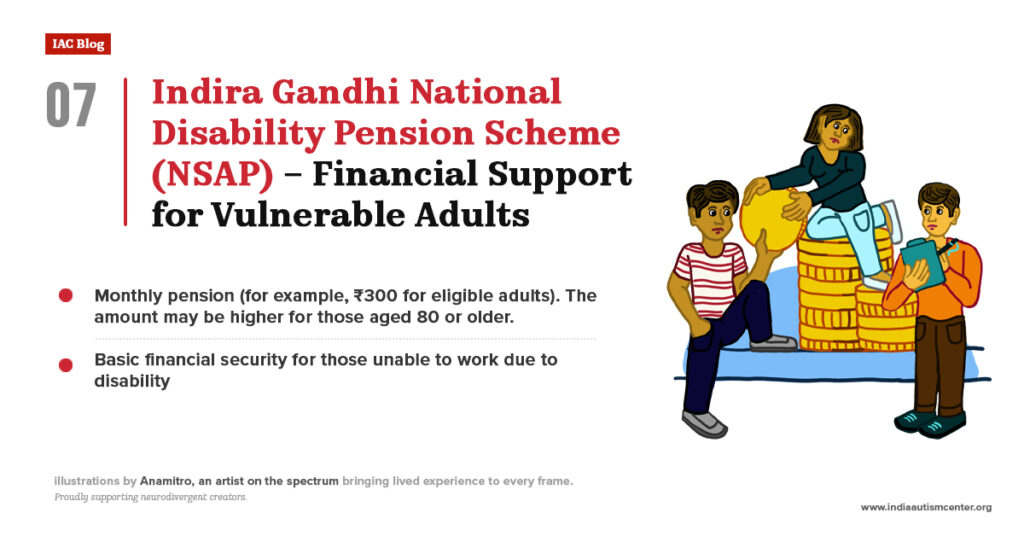
    7. Indira Gandhi National Disability Pension Scheme (NSAP) – Financial Support for Vulnerable Adults

    Indira Gandhi National Disability Pension Scheme NSAP providing monthly financial support to disabled adults

    A pension scheme offering monthly financial aid to adults (18–79 years) with severe disabilities (≥ 80%) and living below the poverty line (BPL), helping them meet basic needs. 

    This is a foundational social security net, a core example of how the Indian state assists disabled persons who are economically marginalised, allowing them dignity and basic financial support.

    What the Scheme Covers:

    • Monthly pension (for example, ₹300 for eligible adults). The amount may be higher for those aged 80 or older.
    • Basic financial security for those unable to work due to disability

    Who Can Apply: 

    • The applicant must be a person with a severe or multiple disability (typically 80% or above), and belong to a household under the Below Poverty Line (BPL) classification.
    • The eligible age group is 18 to 79 years (some state-specific norms may apply).

    Click here to apply for NSAP Scheme 2026

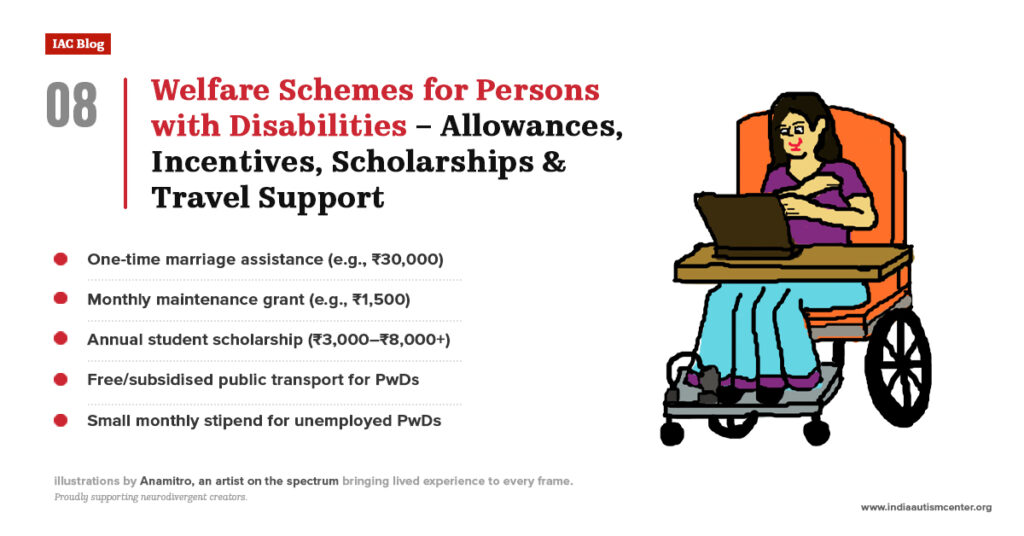
    8. Welfare Schemes for Persons with Disabilities – Allowances, Incentives, Scholarships & Travel Support

    Welfare schemes for persons with disabilities in India including allowances, scholarships, and travel support

    This is a government scheme in India for people with disabilities that offers multiple welfare benefits to improve financial security, social inclusion, and access to opportunities for PwDs.

    These schemes give real-world, everyday assistance for disabled persons, helping them lead a dignified life with social participation, mobility, education, and financial stability.

    What the Scheme Covers: 

    • A one-time amount (for example, ₹30,000) to support disabled persons upon marriage, acknowledging their right to a dignified social life.
    • A monthly maintenance grant is provided (e.g., ₹1,500) for individuals with certain disabilities that can help them with everyday needs.
    • An annual scholarship (₹3,000–₹8,000 or more) for disabled students ensures continuity in education.
    • Free or subsidised public transport for PwDs holding a valid disability certificate improves mobility and access.
    • For unemployed persons with disability (meeting certain criteria), a small stipend (e.g., ₹400–₹1,000/month) is offered to support basic needs while they seek work or training.

    Who Can Apply: 

    Applicants need to have a disability certificate. For unemployment allowance, the applicant must be aged 18 to 48, registered as unemployed, and have a 10th-grade education. 

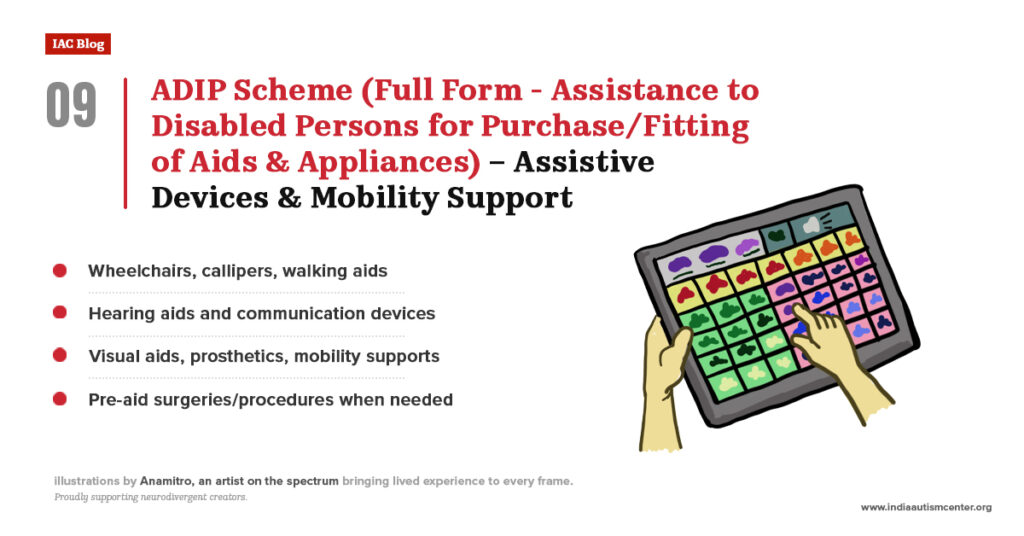
    9. ADIP Scheme (Assistance to Disabled Persons for Purchase/Fitting of Aids & Appliances) – Assistive Devices & Mobility Support

    ADIP scheme providing assistive devices, wheelchairs, hearing aids, and mobility support for disabled persons in India  If you want, I can also optimize all alt texts for PageSpeed + accessibility best practices in one clean list.  You said:
meta desc for blog of these images
ChatGPT said:  Here’s a clean SEO meta description (under 160 characters) for the blog covering these images and schemes:  Explore the complete list of government schemes for disabled persons in India 2025, including health insurance, pensions, rehabilitation, daycare, and support programmes.

    ADIP helps persons with disabilities acquire essential certified aids and appliances which can help in enhancing mobility, independence, communication, and daily living capabilities. For many PwDs, assistive devices are a gateway to independence. 

    ADIP brings those within reach, thereby reducing caregivers’ burden and increasing the person’s ability to lead a more self-reliant, active life.

    What the Scheme Covers: 

    • Wheelchairs, callipers, walking aids, orthopaedic devices
    • Hearing aids, assistive devices for speech/communication (very relevant for autism/intellectual disability)
    • Visual aids, prosthetics, mobility supports
    • Pre-aid surgeries or procedures when required for proper use of devices (e.g., orthopaedic)

    Who Can Apply:

    Indian citizens with at least 40% disability, certain income thresholds, and who have not received similar assistance in recent years. 

    Click here to apply for ADIP Scheme 2026

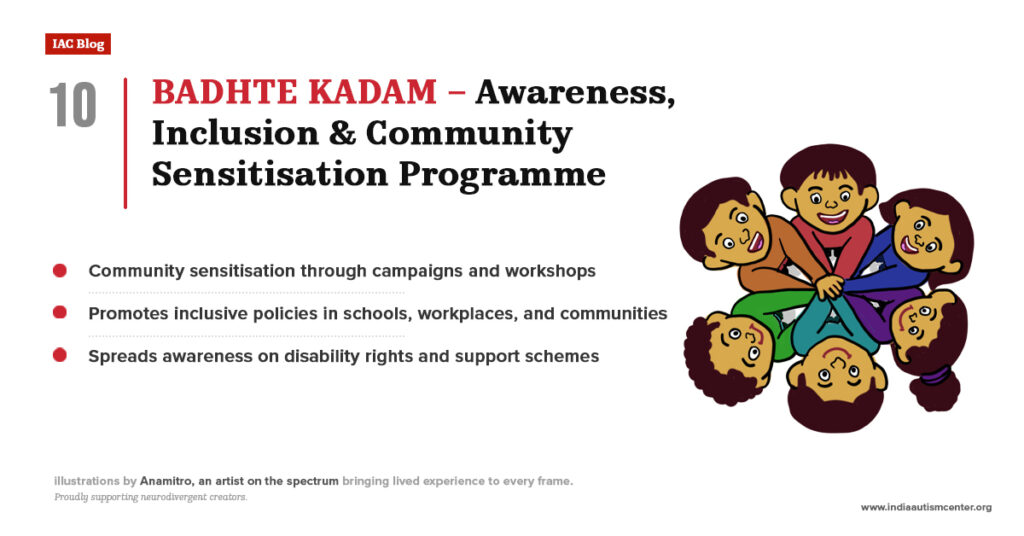
    10. BADHTE KADAM – Awareness, Inclusion & Community Sensitisation Programme

    Badhte Kadam programme for disability awareness, inclusion, and community sensitisation in India

    BADHTE KADAM is a scheme to promote social awareness, community interaction, and inclusion of PwDs. It is helping change attitudes, reduce stigma, and build inclusive societies.

    Access to government facilities for disabled persons is only part of the journey. For real social empowerment, public attitudes must shift. BADHTE KADAM works prominently for that, making inclusion part of the mainstream social fabric, and not just some policy documents.

    What the Scheme Covers:

    • Supports community sensitisation efforts through campaigns, workshops, and awareness drives
    • Encourages inclusive policies in local communities, schools, and workplaces
    • Spreads knowledge about disability rights, support schemes, and social inclusion

    Who Can Apply:

    Registered organisations (under the National Trust) working for persons with autism, cerebral palsy, intellectual disability, or multiple disabilities.

    Click here to apply for Badhte Kadam Scheme 2026

    Conclusion

    Conclusion on government schemes for persons with disabilities in India promoting inclusion and equal opportunities

    Disabled people need as much assistance as possible. Empowering persons with disabilities isn’t just a government responsibility; it’s a collective step that is taken toward a more inclusive India where everyone gets a fair opportunity. The government has a wide range of schemes in place offering financial aid, healthcare support, education benefits, and rehabilitation services. Every eligible individual can access opportunities to improve their quality of life.

    Being aware of and understanding the key details of these schemes for the disabled in India is the first step towards accessing their benefits. Encourage, apply, and help someone claim the support they deserve. India’s progress depends on inclusion, and inclusion begins with awareness.

    Frequently Asked Questions

    What are the major government schemes for disabled persons in India?

    There are several key disability welfare and government schemes that a person with disability can avail themselves of in India, including the Deendayal Disabled Rehabilitation Scheme (DDRS), the Indira Gandhi National Disability Pension Scheme (IGNDPS), the ADIP Scheme, Scholarships for Students with Disabilities, the UDID initiative, and Skill Development for PwDs. These schemes provide financial assistance, rehabilitation support, mobility aids, education grants, and livelihood opportunities.

    Who is eligible for government disability benefits in India?

    To be eligible, an individual must have a benchmark disability of 40% or more, possess a valid Disability Certificate/UDID card, and meet specific income, age, or category-based criteria depending on the scheme.

    What documents are required to apply for schemes for disabled persons in India?

    Common documents to apply for different government schemes for disabled persons include:

    • Disability Certificate or UDID
    • Aadhaar Card
    • Income Certificate
    • Age Proof
    • BPL Card (if applicable)
    • Bank account details
    • Passport-sized photographs

    What is the UDID card, and why is it mandatory?

    The UDID (Unique Disability ID) card creates a national registry of PwDs. It removes the need for multiple disability documents. It also ensures quick access to any scheme for the handicapped in India. With UDID, beneficiaries can apply for pensions, aids, transportation concessions, and education benefits seamlessly.

    What Is the Difference Between Central and State Government Schemes for Persons with Disabilities in India?

    Yes, there is a difference between Central Government and State Government schemes for persons with disabilities in India. Central Government schemes are designed to provide nationwide support, establish uniform policies, and ensure access to disability-related benefits across the country. In contrast, State Government schemes are introduced to address the specific needs of residents within individual states, offering benefits such as disability pensions, financial assistance, healthcare support, education facilities, and rehabilitation services.

    Both Central and State Government schemes work within the framework of the Rights of Persons with Disabilities (RPwD) Act, 2016, which recognizes 21 specified disabilities and safeguards the rights and entitlements of persons with disabilities in India.

    For expert insights, support services, and inclusive learning initiatives, visit the India Autism Center.

  • The Complete Autism Food List: What to Eat, What to Avoid & How to Build a Meal Plan

    The Complete Autism Food List: What to Eat, What to Avoid & How to Build a Meal Plan

    The world is always buzzing with sights, sounds, smells, and textures. Many people find it natural to process the constant stream of sensory input. However, for autistic individuals, this same sensory world can feel intense, unpredictable, or even overwhelming.

    A bright supermarket light, the scratchy texture of a shirt, or the mixed smells in a food court may be enough to trigger discomfort or anxiety. It might come as a surprise to many, but food can also become a sensory experience, sometimes soothing, sometimes stressful.

    It is therefore necessary to understand the autism food list. You can consider it a personalised, balanced, sensory-aware guide that turns mealtimes from a struggle into a predictable, comforting routine.

    So, let’s understand the whole concept step by step.

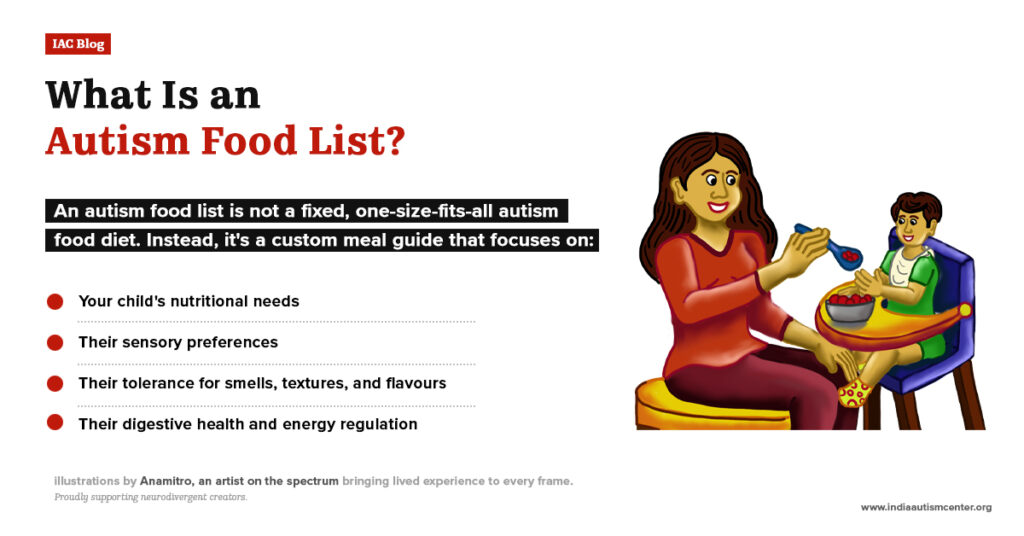
    What is an Autism Food List?

    Parent feeding a child with illustration explaining what an autism food list is and how it supports sensory and nutritional needs

    An autism food list is not a rigid prescription. It’s a personalised, living guide – built around your child’s unique sensory profile, digestive health, and nutritional gaps.

    Food is a sensory experience before it’s a nutritional one. The smell of a tadka, the slimy texture of okra, the unexpected crunch inside a soft idli – any of these can trigger distress in a child with heightened sensory sensitivity. At the same time, the gut-brain axis research published in journals like Nature Neuroscience (2023) confirms that what happens in the gut genuinely influences mood, attention, and behaviour in autistic individuals.

    So a good autism food list works on three levels simultaneously:

    • Sensory comfort – textures, temperatures, and smells that don’t overwhelm
    • Gut health – foods that support a balanced microbiome and smooth digestion
    • Nutritional completeness – ensuring the child isn’t missing key vitamins and minerals because of selective eating

    The goal isn’t perfection. It’s a calmer, more predictable relationship with food – for your child and for you.

    The goal is to ensure that autistic individuals eat foods that nourish the body, calm the senses, and avoid those that may cause discomfort or overstimulation. Hence, it is essential to select a comprehensive autism care facility that focuses on providing autism diet plans curated with care. 

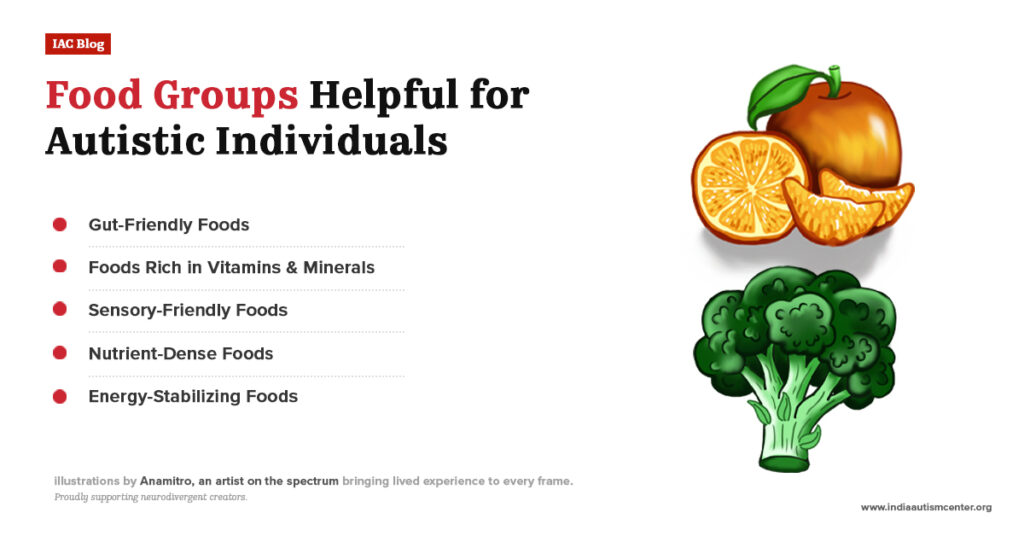
    Food Groups That Belong on Every Autism Food List

    Food groups helpful for autistic individuals including gut-friendly, vitamin-rich, sensory-safe and energy-stabilizing foods

    Gut-Friendly Foods

    The gut-brain connection is one of the most important – and most underappreciated – dimensions of autism nutrition. Studies consistently show that autistic children have higher rates of GI symptoms: constipation, bloating, irregular bowel movements, and gut dysbiosis (an imbalance in gut bacteria). These symptoms don’t just cause physical discomfort; they can directly worsen irritability, sleep, and focus.

    The good news? Indian cuisine is naturally rich in gut-friendly foods.

    Fermented foods (excellent for the microbiome):

    • Homemade curd – far more probiotic-rich than commercial yoghurt
    • Buttermilk (chaas) – light, easy to digest, soothing
    • Idli and dosa batter – naturally fermented overnight; the fermentation process increases B vitamins and digestibility
    • Naturally fermented achar (pickle) – use sparingly due to salt; avoid commercial brands with preservatives

    Fibre-rich vegetables (keeps digestion smooth):

    • Okra (bhindi) – mucilaginous fibre that soothes the gut lining
    • Bottle gourd (lauki) – very easy to digest, mild flavour
    • Pumpkin (kaddu) – soft when cooked, naturally sweet, high in fibre
    • Spinach (palak) – iron + fibre, blends well into dal and khichdi

    Prebiotic foods (feed the good bacteria):

    • Garlic and onion – powerful prebiotics; cook them into everyday sabzis
    • Banana – ripe bananas provide soluble fibre; slightly unripe bananas are even richer in resistant starch

    Foods Rich in Vitamins & Minerals

    Nutrients like Vitamin B6, Vitamin C, and Magnesium play a real role in brain function and mood regulation. Back in the 1970s, Dr Bernard Rimland – founder of the Autism Research Institute – reported that in one controlled study, 12 of 16 autistic individuals showed measurable improvement when supplemented with high-dose B6 and magnesium, and regressed when the supplements were replaced with placebos. Later systematic reviews have found the evidence base too small to make a firm recommendation, but food-first approaches to these nutrients carry no risk and plenty of benefit.

    Indian food sources by nutrient:

    NutrientIndian Food Sources
    Vitamin B6Chickpeas (chana), bananas, sunflower seeds
    Vitamin CAmla (the richest natural source – one amla = ~600 mg Vit C), guava, oranges
    MagnesiumRagi (finger millet), pumpkin seeds, spinach

    These foods integrate easily into everyday cooking. Ragi can go into rotis, porridge, or ladoos. Amla can be given as murabba, juice, or dried candy. Chickpeas work in chaat, chilla, or simply boiled with a squeeze of lemon.

    Sensory-Friendly Foods

    For many autistic children, the real barrier to eating isn’t flavour – it’s texture. Soft, predictable textures are almost universally easier to accept because they require less chewing, produce no unexpected crunch sounds, and feel consistent in the mouth.

    Soft carbs (the backbone of a sensory-friendly autism meal plan in India):

    • Mashed sweet potato – naturally sweet, smooth, and filling
    • Soft idli – the softer the better; add a little extra water to the batter
    • Dal khichdi – the ultimate comfort food; moong dal version is easiest to digest
    • Banana – portable, predictable, no preparation needed

    Mild proteins:

    • Paneer – soft, mild, takes on any flavour; paneer bhurji is a favourite
    • Boiled or scrambled egg – consistent texture, easy to season mildly
    • Moong dal – the gentlest of all lentils on the gut

    Smooth fruits:

    • Chiku (sapodilla) – naturally sweet, smooth, no seeds to navigate
    • Stewed apple – warm, soft, mildly sweet; great for children who reject cold foods

    Nutrient-Dense Foods

    Brain development doesn’t pause because eating is difficult. These foods pack the most nutritional value per bite – important when a child’s food variety is limited.

    Omega-3 fatty acids (brain and nervous system):

    • Flaxseeds (alsi) – grind them fresh and add to rotis or porridge
    • Walnuts – two to three walnuts daily; can be powdered and mixed into food
    • Fatty fish – sardines (tarli), rohu, catla are safer Indian options with lower mercury

    Iron (energy, focus, and haemoglobin):

    • Ragi – one of the best plant-based iron sources; 3.9 mg per 100g
    • Spinach – pair with Vitamin C (amla, lemon) to boost absorption
    • Jaggery (gud) – use as a sweetener instead of sugar; contains iron and minerals

    Zinc (immune function and neurological development):

    • Pumpkin seeds – a small handful daily covers a significant portion of zinc needs
    • Sesame seeds (til) – use in chutneys, laddoos, or sprinkled on rice

    Energy-Stabilizing Foods

    Blood sugar swings are a real but underappreciated trigger for behavioural shifts in autistic children. A spike from white bread or a mithai followed by a crash can look like irritability, aggression, or inability to focus – when it’s actually a physiological response to unstable glucose.

    The fix is simple: swap refined carbs for complex ones.

    Complex carbs that stabilise energy:

    • Brown rice – slower to digest than white rice; swap gradually
    • Oats (daliya) – excellent for breakfast; keeps energy steady for hours
    • Ragi roti – low glycaemic index, high in calcium and iron
    • Jowar and bajra rotis – traditional Indian millets that are naturally gluten-free and nutrient-dense

    Protein-carb combinations that work well:

    • Dal chawal – the classic; protein from dal slows glucose absorption from rice
    • Curd rice – probiotic + complex carb in one bowl
    • Besan chilla – high protein, low glycaemic, quick to make

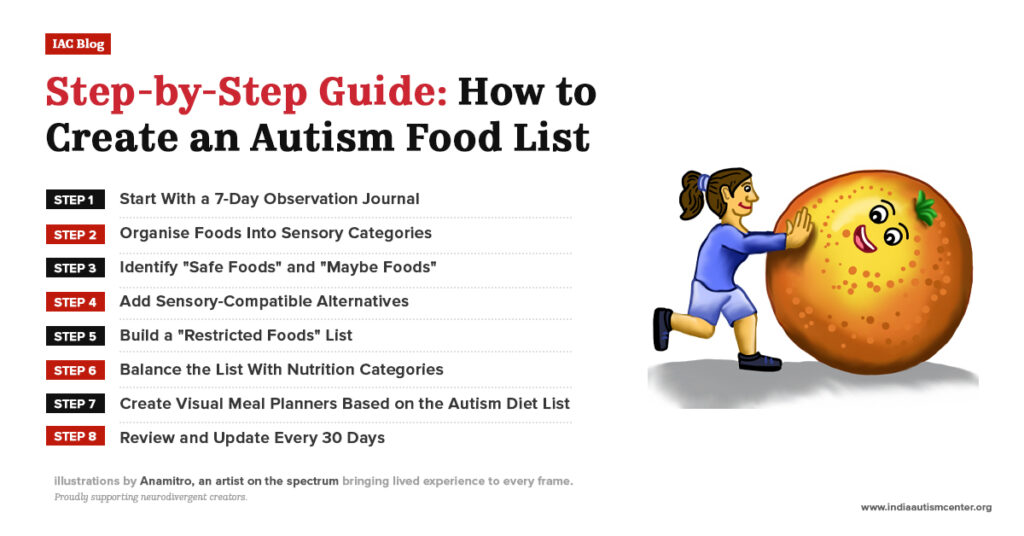
    How to Create an Autism Food List (Step-by-Step)

    Step-by-step guide illustration showing how to create an autism food list for better nutrition and digestion

    Creating the right autism diet plan is not just a routine task but a structured approach that helps manage several aspects, including nutrition, behaviour, sensory needs, and daily wellbeing.

    Many parents struggle with autism food aversion, autism food sensitivity, selective eating, restricted textures, and unpredictable preferences.

    Here is a step-by-step guide to help you create a practical, sensory-informed, and health-focused autism diet list while keeping individual comfort and nutritional balance in mind.

    Step 1: Start With a 7-Day Observation Journal

    When you start to create an autism diet list, you first have to invest some time in observing your child’s eating habits. It will help you to create a baseline for understanding diet and autism patterns.

    Here are some things that you need to track:

    • Consistently accepted foods (autism-safe foods)
    • Foods causing refusal or distress (autism food refusal, autism and food aversion)
    • Sensory responses such as gagging, rejecting textures, or preferring only white/beige foods
    • Temperature and texture preferences (autism and food textures, food textures and autism)

    Tracking these patterns will help to understand the core of autism food issues, identifying where food aversions, autism, or autism and food selectivity are strongest. This also confirms whether food aversion is a sign of autism in your child.

    Step 2: Organise Foods Into Sensory Categories

    Mealtime anxiety in autistic children can be managed with a strong sensory diet for autism or an autism sensory diet. It is necessary to classify food options by sensory features rather than standard nutritional groups.

    Sensory-based categories:

    • Crunchy foods
    • Soft/pureed foods
    • Liquids & smooth foods
    • Warm vs. cold foods
    • Low-odor foods

    Categorising by sensations helps align your sensory diet for autism with daily meals. It also helps address food aversions and autism, particularly when a child rejects foods based on smell, texture, or appearance.

    Step 3: Identify “Safe Foods” and “Maybe Foods”

    The foundation of the autism-friendly foods section in your final chart is incomplete without understanding which foods are safe. 

    Here is an example for better understanding:

    Safe Foods (Autism Safe Foods / Safe Foods Autism)

    • These are eaten without resistance and can be used to anchor meals.

    Maybe Foods

    • These are foods accepted occasionally or under specific conditions.

    It is important to understand the difference to reduce stress during meals. It will be quite helpful in creating a structure for your personalised autism food plate or autism-safe food framework.

    Step 4: Add Sensory-Compatible Alternatives

    After identifying safe foods, it is now time to introduce similar sensory alternatives. This prevents nutritional gaps while respecting autism and food sensitivities.

    Examples:

    • If crunchy foods are preferred: roasted chickpeas, veggie sticks
    • If smooth foods are preferred: pureed soups, blended porridges
    • If warm, bland foods are preferred: soft rice, khichdi

    This step supports gradual progress in tackling autism-related food aversion, food refusal, and food selectivity.

    Step 5: Build a “Restricted Foods” List

    Along with other important considerations like safe foods for autism, maybe foods, and sensory-compatible foods for autism. It is equally important to recognise the foods to avoid for people with autism.

    The food options that you must keep in the restricted autism food list include:

    • Allergic reactions (autism and food allergies)
    • Digestive discomfort
    • Sensory overload
    • Behavioural triggers

    Here are some examples for you:

    • Artificial dyes
    • Highly processed snacks
    • Foods with strong smells
    • Certain dairy or gluten items, depending on sensitivity (autism and gluten-free diet)

    Knowing which foods to avoid with autism helps ensure the autism diet plan remains supportive and consistent.

    Step 6: Balance the List With Nutrition Categories

    A proper diet for autism spectrum disorder must consider nutrition, sensory needs, and health conditions.

    Nutrients that are essential in an autism diet plan include:

    • Proteins
    • Carbohydrates
    • Fruits
    • Vegetables
    • Fats

    As a parent, you can explore diet options such as:

    • Gluten-free diet for autism
    • GAPS diet autism (Gut and Psychology Syndrome diet)
    • Keto diet and autism, or autism and ketogenic diet

    Step 7: Create Visual Meal Planners Based on the Autism Diet List

    Meal planners help to support predictability and reduce anxiety.

    Some examples of visual tools include:

    • Picture-based autism food plate
    • Weekly charts using food images
    • Step-by-step meal sequences
    • Colour-coded portion guides

    These tools reinforce structure and help the child engage better with their autism-friendly foods.

    Step 8: Review and Update Every 30 Days

    Even the best plans take time, as eating preferences often evolve. Here are the steps you can take:

    Recheck:

    • Newly accepted foods
    • New sensory challenges
    • Increasing or decreasing levels of autism food sensitivity
    • Updated notes on autism and food textures

    This ensures your autism diet list and autism nutrition diet stay relevant and supportive.

    The GFCF Diet for Autism: A Complete India Guide

    The Gluten-Free, Casein-Free (GFCF) diet is one of the most widely explored dietary approaches for autism. It removes gluten (a protein found in wheat and related grains) and casein (the primary protein in dairy) from the child’s diet entirely.

    Why do families try it?

    The theoretical basis is the opioid peptide hypothesis: when gluten and casein are incompletely digested – possibly due to increased intestinal permeability (commonly called “leaky gut”) – the resulting peptides may cross into the bloodstream and act on opioid receptors in the brain, potentially affecting behaviour and cognition. This is a hypothesis, not a proven mechanism. Research on gut permeability in autism, including a 2021 review in Frontiers in Psychiatry, does show increased intestinal permeability in a subset of autistic individuals – but causality remains unresolved.

    What we do know from clinical experience: some families report meaningful improvements in focus, GI symptoms, and behaviour after removing gluten and casein. Others see no change. Dr Susan Hyman, Professor of Paediatrics at the University of Rochester, puts it plainly: “While some parents report behavioural improvements with gluten-free, casein-free diets, controlled studies have not consistently demonstrated significant benefits. Dietary changes should be approached cautiously and under professional supervision to ensure nutritional adequacy.”

    What to Remove on a GFCF Diet

    Gluten sources to eliminate:

    • Wheat atta, maida, suji (semolina), and daliya (broken wheat)
    • All bread, biscuits, and bakery items (including Marie biscuits, Parle-G, cream crackers)
    • Pasta and noodles (Maggi, Yippee, and similar)
    • Ready-to-eat upma mixes, halwa mixes, and most namkeen (many contain besan mixed with maida)
    • Malted drinks like Horlicks and Bournvita (contain barley malt)

    Casein sources to eliminate:

    • Cow’s milk and buffalo milk
    • Paneer, cheese, butter, cream, khoa
    • Curd and buttermilk (yes, even these – casein is present)
    • Ghee – this one is debated. Ghee is clarified butter with most milk proteins removed; some families on GFCF tolerate it, others don’t. Start by removing it and reintroduce after 4–6 weeks to observe.

    Hidden gluten in Indian packaged foods – watch these:

    • Kurkure and similar puffed snacks (often contain wheat flour)
    • Most commercially available namkeen and chakli
    • Soy sauce (used in Chinese-style Indian cooking)
    • Many Indian pickles and chutneys with added thickeners
    • Instant soup mixes and masala packets

    Always read ingredient labels. Look for: wheat flour, maida, atta, semolina, barley, malt, modified starch (if source unspecified).

    Indian GFCF Substitutes

    The good news for Indian families: our traditional grain repertoire is naturally GFCF-friendly.

    Gluten-free grains and flours:

    • Rice and rice flour – the foundation; rice-based idli and dosa are naturally GFCF
    • Ragi (finger millet) flour – for rotis, porridge, and ladoos
    • Jowar (sorghum) flour – for soft rotis and bhakri
    • Bajra (pearl millet) flour – for rotis; pairs well with ghee (if tolerated)
    • Besan (chickpea flour) – for chilla, kadhi, and snacks

    Dairy substitutes:

    • Coconut milk – rich, creamy, works well in curries and porridge
    • Almond milk – mild flavour; use in smoothies and porridge
    • Oat milk – check labels carefully; some oat milks contain gluten from cross-contamination
    • Rice milk – the most hypoallergenic option

    GFCF Indian dishes that work beautifully:

    • Rice-based idli and dosa (use rice + urad dal batter, no wheat)
    • Ragi mudde or ragi porridge
    • Jowar bhakri with vegetable sabzi
    • Besan chilla with tomato and coriander
    • Rajma or chana with rice
    • Khichdi made with moong dal and rice

    How to Transition to GFCF in India: A 4-Week Plan

    Don’t remove everything at once. A sudden shift overwhelms the child and makes it impossible to identify what’s actually helping.

    Week 1: Remove casein (dairy) first. Replace cow’s milk with coconut milk or almond milk. Stop paneer, curd, and butter. Maintain all other foods.

    Week 2: Remove obvious gluten sources – wheat roti, bread, biscuits. Replace with rice, ragi roti, or jowar bhakri. Keep a daily food and behaviour diary.

    Week 3: Audit packaged foods. Check every label. Remove hidden gluten sources (Maggi, Kurkure, Horlicks, namkeen).

    Week 4: Assess. Have behaviour, GI symptoms, or sleep changed? Consult your dietitian with your diary notes before deciding to continue.

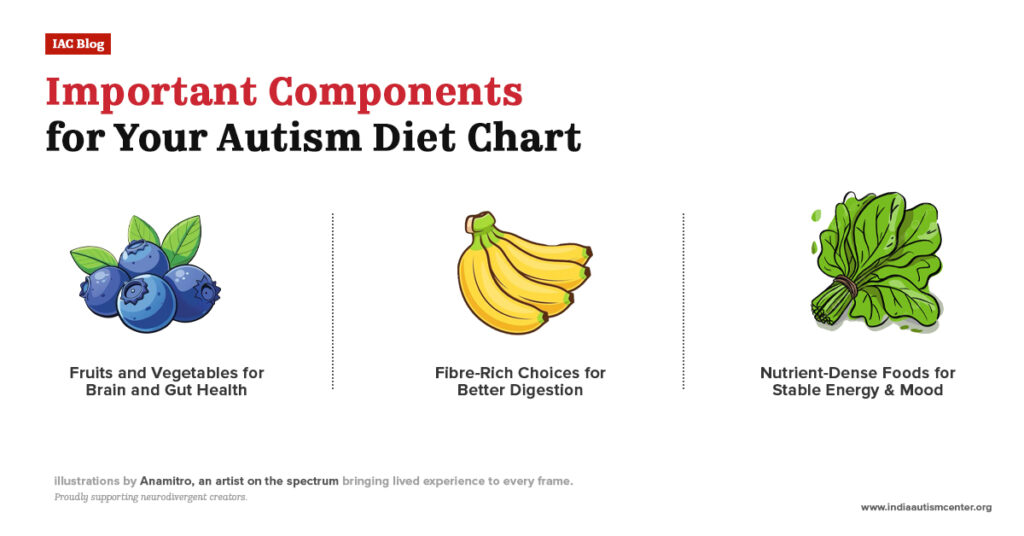
    Important Components for Your Autism Diet Chart

    Important components of an autism diet chart featuring fruits, fiber-rich foods, and nutrient-dense vegetables

    A meal that feels routine to others can become overwhelming when strong smells, unexpected textures, or loud surroundings mix with heightened sensory sensitivity. 

    Ananya, a young individual with autism, recounts her experience at a mall food court:

    “The moment I stepped in, the heavy aroma of food filled the air, overwhelming my senses. The greasy dishes on display felt like they were closing in on me, while the clatter of trays and the hum of conversations grew deafening. Panic took over; my chest tightened, my legs refused to move, and tears spilled down my face. My mother’s voice reached me, full of concern, but I couldn’t respond. She carried me home. Tomorrow was another day.”

    Stories like this are evidence of why an autism diet chart can have a considerable impact.

    The right food choices not only add nutrition but also bring comfort, predictability, and calm.

    Balanced meals can:

    • Reduce sensory discomfort
    • Support digestion and reduce anxiety
    • Improve focus and energy stability
    • Minimise meltdowns triggered by food textures or smells

    A well-designed chart also helps you identify what foods to avoid with autism, like:

    • Highly processed snacks
    • Strong-smelling or intensely flavoured foods
    • Hard-to-chew textures

    Fruits and Vegetables for Brain and Gut Health

    Food directly influences attention, mood, and digestion, three areas many autistic individuals struggle with. Adding nutrient-dense produce to the autism diet chart strengthens both brain and gut function.

    What It Essentially Helps With

    • Berries protect brain cells and improve memory.
    • Oranges boost immunity and support cognitive health.
    • Spinach and kale provide iron and folate to support better concentration.
    • Broccoli and cauliflower can aid in detoxification and support gut strength.
    • Carrots and bell peppers increase immunity with beta-carotene.

    Quick Reference Table

    FoodBenefit
    BlueberriesProtects brain cells, boosts memory
    SpinachProvides iron for energy and focus
    OrangesEnhances immune + brain function
    BroccoliSupports gut health + detoxification

    Fibre-Rich Choices for Better Digestion

    Digestive issues, including constipation, gas, or bloating, are quite common in individuals with autism. A fibre-rich section in your autism diet chart helps manage this discomfort and promote regular bowel movements.

    Why Fibre Matters

    • Supports smoother digestion
    • Feeds healthy gut bacteria
    • Reduces inflammation
    • Prevents constipation

    Top Fibre-Boosting Foods

    • Apples can help nurture good gut bacteria
    • Bananas improve digestion with soluble fibre
    • Sweet potatoes deliver prebiotic fibre
    • Brussels sprouts reduce inflammation and aid detoxification

    Quick Reference Table

    FoodProvides soluble fibre, aids digestion
    ApplesFeeds gut bacteria, prevents constipation
    BananasProvides soluble fiber, aids digestion
    Sweet PotatoesSupports gut health with prebiotics
    Brussels SproutsReduces inflammation + detoxifies

    Nutrient-Dense Foods for Stable Energy & Mood

    Energy crashes and sudden mood swings often have a nutritional root. Including slow-release, nutrient-dense foods in an autism diet chart supports stable energy levels and reduces irritability.

    How These Foods Help:

    • Apples and berries provide slow-release natural sugars
    • Bananas stabilise nerve and muscle function
    • Carrots and squash offer long-lasting carbohydrates
    • Spinach and bell peppers supply magnesium to calm the nervous system

    Quick Reference Table

    FoodHow It Helps
    ApplesProvides steady energy release
    BananasRegulates nerve + muscle function
    CarrotsSlow-digesting carbs for sustained energy
    SpinachMagnesium-rich food that reduces hyperactivity

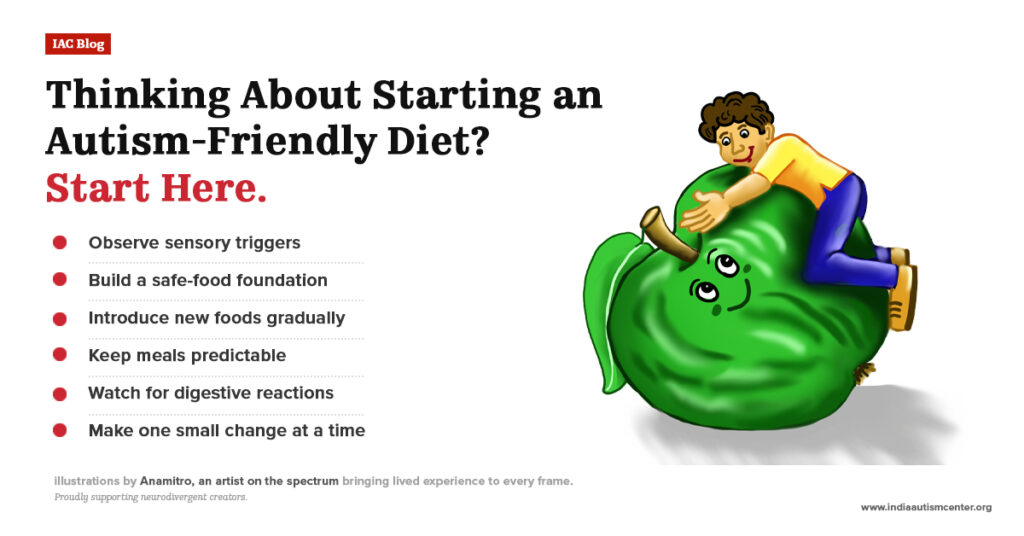
    Thinking About Starting an Autism-Friendly Diet? Start Here.

    Child interacting with vegetables showing how to start an autism-friendly diet with sensory-safe and nutritious foods

    When you are thinking of creating an autism-friendly diet. It doesn’t need to have complicated restrictions. It is more important to understand your child’s sensory world and their relationship with meals. 

    Here is how you can begin:

    • Observe sensory triggers: Which smells, textures, or temperatures cause discomfort?
    • Build a safe-food foundation: Use foods your child already accepts as a base.
    • Introduce new foods gradually: Match new foods to the texture, temperature, or colour of their preferred items.
    • Keep meals predictable: Visual meal charts reduce anxiety and increase acceptance.
    • Watch for digestive reactions: Bloating, hyperactivity, or fatigue can reveal intolerances.
    • Make one small change at a time: Progress is slow, but the payoff is big.

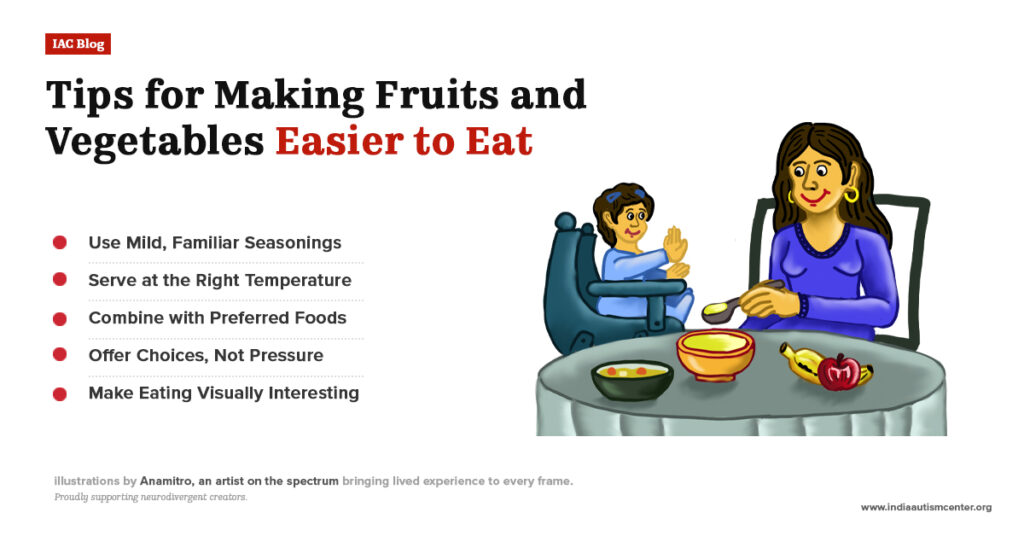
    Tips for Making Fruits and Vegetables Easier to Eat

    Tips illustration showing how to make fruits and vegetables easier to eat for children with autism through sensory-friendly methods

    New foods can feel unfamiliar or even overwhelming. The key is to introduce them in ways that feel safe and inviting. 

    Small changes in flavour, temperature, and pairing can make a big difference.

    Use Mild, Familiar Seasonings

    A sprinkle of cumin, a dash of cinnamon, or a squeeze of lemon can enhance taste without overpowering. Mild spices make vegetables more flavourful while keeping them easy to accept.

    Serve at the Right Temperature

    Cold foods may feel refreshing, while warm foods can be more soothing. Some may prefer room temperature for a neutral experience. Experiment to see what works best.

    Combine with Preferred Foods

    Pairing new fruits or vegetables with a familiar favourite can increase acceptance. Mix finely chopped spinach into dal, blend carrots into dosa batter, or serve cucumbers alongside a favourite dip.

    Offer Choices, Not Pressure

    Giving options allows more control. Instead of saying, “Eat your carrots,” try, “Would you like roasted carrots or carrot sticks?” The freedom to choose makes mealtimes more comfortable.

    Make Eating Visually Interesting

    Colours, shapes, and arrangement matter. A fruit salad with vibrant mango and pomegranate may be more appealing than plain apple slices. Fun shapes, like cucumber rounds or star-cut watermelon, can add curiosity and engagement.

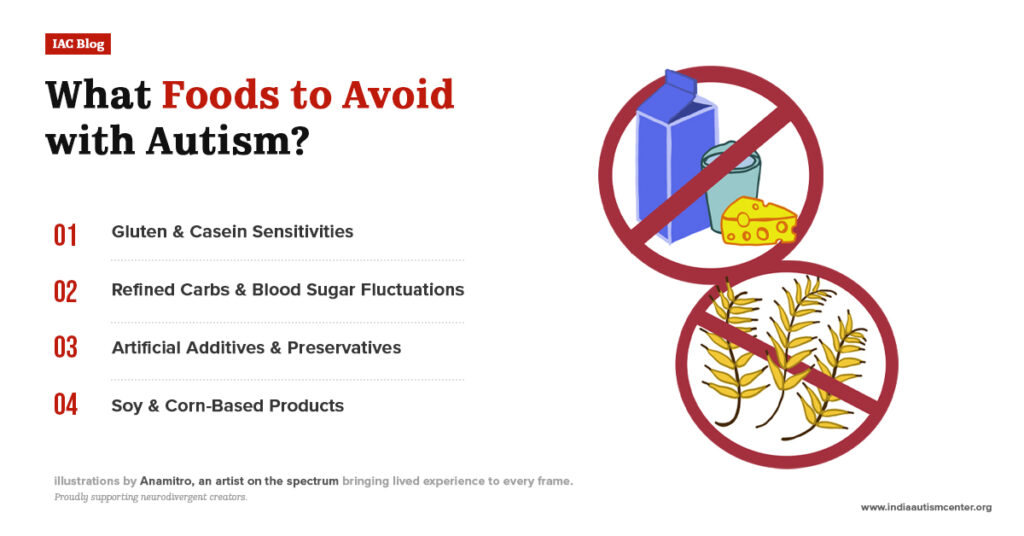
    Foods to Avoid in Autism

    Visual guide of foods to avoid with autism including gluten, casein, refined carbs, and artificial additives

    The gut–brain connection plays a major role in how autistic individuals feel, focus, and respond to sensory input. Certain foods may worsen discomfort, trigger irritability, or intensify sensory overwhelm. That’s why identifying foods to avoid with autism is the first step toward creating calmer mealtimes and better daily balance.

    One of the leading voices in this area, Dr Susan Hyman, Professor of Paediatrics at the University of Rochester, reminds us:

    “While some parents report behavioural improvements with gluten-free, casein-free diets, controlled studies have not consistently demonstrated significant benefits. Dietary changes should be approached cautiously and under professional supervision to ensure nutritional adequacy.”

    Every autistic individual is unique; what works beautifully for one may not work for another. With that balanced lens, here are the key food categories many families explore and why:

    Gluten & Casein (if on GFCF)

    Already covered above. The key point: if you’re not on a full GFCF protocol, you don’t need to eliminate these – but reducing highly processed wheat products (biscuits, white bread, maida-based snacks) and commercial dairy is sensible for any child.

    Refined Carbs & Sugar

    This is the category that affects almost every autistic child, regardless of diet protocol. Refined carbohydrates – maida, white bread, polished white rice in excess, packaged biscuits, mithai, and sugary drinks – cause rapid blood sugar spikes followed by crashes. That crash often looks like a meltdown, aggression, or sudden fatigue.

    Common Indian culprits to reduce:

    • Maida-based snacks: samosa, kachori, puri, bhatura
    • White bread sandwiches and toast
    • Packaged biscuits (Parle-G, Bourbon, Hide & Seek)
    • Mithai: barfi, gulab jamun, jalebi (very high sugar + maida)
    • Sugary drinks: packaged juices, cold drinks, flavoured milk

    Better swaps:

    • Ragi or jowar roti instead of maida-based items
    • Jaggery or dates instead of refined sugar
    • Homemade fruit chaat instead of packaged sweets
    • Coconut water instead of packaged juice

    Artificial Additives & Preservatives

    Artificial colours, MSG (monosodium glutamate), and chemical preservatives are linked to increased hyperactivity in children in general – and the concern is amplified for autistic children who may already have heightened sensory and neurological sensitivity.

    Indian products to watch:

    • Maggi noodles and similar instant noodles (MSG, refined flour, high sodium)
    • Kurkure, Lays, and similar chips (artificial flavours, MSG)
    • Packaged fruit juices with added colours (look for E102, E110, E122 on labels)
    • Ready-to-eat Chinese-style sauces (soy sauce, schezwan sauce – MSG-heavy)
    • Flavoured milk drinks with artificial colours

    Rule of thumb: If the ingredient list has more than 8–10 items and includes numbers (E-codes), it’s worth avoiding.

    Soy & Corn Products

    Soy contains phytoestrogens (plant-based oestrogen-like compounds) that some researchers flag as a concern for children with hormonal sensitivity. It is also a common allergen. Corn, particularly in its processed form (corn syrup, corn starch), is a high-glycaemic ingredient that can spike blood sugar.

    Hidden soy sources: soy sauce, tofu, soy milk, many packaged biscuits and breads (soy lecithin is a common emulsifier – check labels).

    Hidden corn sources: corn syrup in packaged sweets and drinks, corn starch in gravies and sauces, cornflour-coated fried snacks.

    High-Mercury Fish

    Fish is an excellent source of omega-3s and protein, but certain large predatory fish accumulate mercury, which is a neurotoxin. Shark (mori), swordfish, and king mackerel are the main ones to avoid.

    Safer Indian fish options with lower mercury:

    • Rohu and catla – freshwater fish, widely available, low mercury
    • Sardines (tarli) – small fish, very low mercury, high omega-3
    • Pomfret (paplet) – moderate mercury, fine in moderation (once or twice a week)
    • Hilsa (ilish) – moderate; fine in moderation

    Supplements That Support Autism – What the Research Says

    ⚠️ Important disclaimer: Supplements should only be given under medical supervision. Dosing varies significantly by age, weight, and individual nutritional status. Never self-supplement based on general guidelines alone. Always get a blood test first to confirm deficiency before supplementing.

    Omega-3 Fatty Acids (DHA/EPA)

    DHA (docosahexaenoic acid) is the primary structural fat in the brain. EPA (eicosapentaenoic acid) has anti-inflammatory properties. Both are found in fatty fish and in smaller amounts in flaxseed and walnuts.

    What the research says: An umbrella review of meta-analyses published in Nutrition Reviews (2024) found that omega-3 supplementation showed the most consistent signal for hyperactivity in children under 8 years, particularly with supplementation lasting more than 14 weeks. Effects on core autism symptoms (social communication, repetitive behaviours) were inconsistent. The honest answer: omega-3s may help some children with attention and hyperactivity, but they’re not a treatment for autism itself.

    Food sources first: Flaxseeds (grind fresh), walnuts, sardines, rohu.

    Supplement note: If supplementing, look for a combined DHA+EPA formula. A typical paediatric dose is 500–1,500 mg combined DHA+EPA daily, but confirm with your doctor. Fish oil capsules are the most bioavailable form.

    Vitamin D

    India is a sun-rich country – and yet Vitamin D deficiency is remarkably common, including in autistic children. A case-control study from Northern India found significantly lower serum Vitamin D levels in children with ASD compared to healthy controls. Multiple international reviews confirm the association: lower Vitamin D correlates with greater autism symptom severity on standardised scales like CARS and ATEC.

    What this means practically: Get your child’s Vitamin D (25-OH) levels tested. If deficient (below 20 ng/mL), supplementation is warranted. The typical supplementation range for children is 400–1,000 IU daily, but children with significant deficiency may need higher doses under medical supervision.

    Food sources: Fatty fish, egg yolk, fortified foods. Sun exposure (15–20 minutes of direct morning sun on arms and legs) also helps – though this is often insufficient alone for children with ASD who may avoid outdoor time.

    Vitamin B6 + Magnesium

    Dr Rimland’s work in the 1970s and 1980s suggested that high-dose B6 combined with magnesium improved behaviour, speech, and social interaction in a subset of autistic individuals. Later systematic reviews found the evidence base too small and methodologically limited to make a definitive recommendation – but the food-first approach to both nutrients is safe and sensible.

    B6 food sources: Chickpeas, bananas, sunflower seeds, potatoes.

    Magnesium food sources: Ragi, pumpkin seeds, spinach, almonds.

    Supplement note: If a paediatrician recommends B6 supplementation, it is typically given alongside magnesium (magnesium reduces the risk of B6-related side effects like peripheral neuropathy at high doses). Do not supplement high-dose B6 without medical guidance.

    Probiotics

    The gut-brain axis is bidirectional: the gut microbiome influences brain chemistry, and brain states influence gut function. Multiple studies have found altered microbiome composition in autistic children – lower levels of Lactobacillus and Bifidobacterium species in particular.

    What probiotics can do: Reduce GI symptoms (constipation, bloating, diarrhoea), potentially improve mood and behaviour through gut-brain signalling. The evidence for direct behavioural improvement is preliminary but promising.

    Indian food sources first (always preferable):

    • Homemade curd – the best natural source of Lactobacillus
    • Buttermilk (chaas) – lighter and often better tolerated than curd
    • Idli and dosa – fermented, though the probiotic count varies

    Supplement note: If recommending a probiotic supplement, strains most studied in autism include Lactobacillus acidophilus, Lactobacillus rhamnosus, and Bifidobacterium longum. Dosing is typically 1–10 billion CFU daily. Consult a paediatrician for the right strain and dose for your child’s age.

    Zinc

    Zinc deficiency is common in Indian children generally – and particularly so in autistic children, who often have restricted diets. It plays a role in immune function, gut integrity, and neurological development. Low zinc has been associated with increased repetitive behaviours and impaired social cognition in some studies.

    Food sources: Pumpkin seeds (the richest plant source), sesame seeds (til), rajma, chickpeas, eggs.

    Supplement note: Zinc supplementation in children is typically 5–10 mg elemental zinc daily, but excess zinc can interfere with copper absorption. Test before supplementing, and supplement only under medical supervision.

    Meal Planning Using an Autism Food List

    Meal planning using an autism food list with sensory-friendly, gut-healthy and energy-boosting food options

    Once you know what to avoid, planning meals becomes easier, calmer, and more predictable. Here are three simplified meal plans, each crafted for a specific need, sensory ease, gut support, and steady energy.

    Meal Plan 1: For Sensory Sensitivities

    Soft, neutral-flavoured foods that reduce overwhelm and feel comfortable to chew.

    • Breakfast: Soft scrambled eggs + mashed sweet potato + banana
    • Snack: Homemade yoghurt with honey
    • Lunch: Moong dal khichdi + soft carrots
    • Snack: Smooth peanut butter on rice cakes
    • Dinner: Well-cooked quinoa + mild paneer curry + steamed zucchini

    Meal Plan 2: For Gut Health & Digestion

    Fibre-rich, gut-friendly meals that reduce constipation, bloating, and discomfort.

    • Breakfast: Ragi porridge + soaked almonds
    • Snack: Papaya with coconut
    • Lunch: Brown rice + rajma + sautéed methi
    • Snack: Roasted makhana
    • Dinner: Jowar roti + bottle gourd sabzi + homemade buttermilk

    Meal Plan 3: For Steady Energy & Focus

    Slow-digesting carbs + proteins + healthy fats to prevent energy crashes and support attention.

    • Breakfast: Oats with flaxseeds, walnuts & stewed apples
    • Snack: Besan chilla + mint chutney
    • Lunch: Quinoa + grilled chicken + roasted bell peppers
    • Snack: Banana–peanut butter–almond milk smoothie
    • Dinner: Bajra roti + palak paneer + cucumber salad

    How to Create Your Child’s Autism Diet Chart (Step-by-Step)

    A good autism diet chart is a tool, not a rulebook. Here’s how to build one that actually works.

    Step 1: Keep a 7-day observation journal. Before changing anything, watch and record. Note which foods are accepted without resistance, which cause gagging or refusal, and which seem to affect behaviour or digestion. This is your baseline.

    Step 2: Sort foods by colour code. Use a simple three-colour system:

    • 🟢 Green = Safe – accepted consistently, no negative reactions
    • 🟡 Yellow = Try – sometimes accepted, or worth introducing gradually
    • 🔴 Red = Avoid – causes distress, refusal, or negative physical reactions

    Step 3: Identify safe foods and maybe foods. Safe foods anchor every meal. Maybe foods are introduced slowly, one at a time, alongside a safe food. Never introduce two new foods in the same week – you won’t know which one caused a reaction.

    Step 4: Add sensory-compatible alternatives. If your child only accepts soft foods, find soft versions of nutritious foods (mashed sweet potato instead of raw carrot; soft idli instead of bread). Match the texture, not just the nutrition.

    Step 5: Build a restricted foods list. This isn’t punishment – it’s information. Foods that consistently cause meltdowns, GI distress, or refusal go here. Review this list monthly; preferences change.

    Step 6: Create a visual meal planner. Autistic children thrive on predictability. A picture-based weekly chart – showing what’s for breakfast, lunch, and dinner each day – reduces mealtime anxiety dramatically. Use printed photos of actual dishes your child eats, not generic clip art.

    Step 7: Review every 30 days. Taste preferences evolve. A food that was red last month might be yellow this month. Update the chart regularly and celebrate every small expansion.

    Tips to Make Fruits & Vegetables Easier to Eat

    Getting an autistic child to eat vegetables is one of the most common struggles parents share with us. The key is not pressure – it’s strategy.

    Use mild, familiar seasonings. A pinch of jeera, a squeeze of lemon, or a tiny bit of jaggery can make vegetables feel familiar. Avoid strong spices, pungent smells, or anything that changes the colour of the food unexpectedly.

    Serve at the right temperature. Many autistic children have strong temperature preferences. Some want everything warm; others prefer room temperature. Find your child’s preference and stick to it – at least initially.

    Combine with preferred foods. Finely chop spinach into dal (it disappears into the texture). Blend carrots into dosa batter. Mash pumpkin into khichdi. The vegetable is present nutritionally without being a sensory challenge.

    Offer choices, not pressure. “Do you want lauki or pumpkin today?” is far more likely to succeed than “You have to eat your vegetables.” Choice creates a sense of control, which reduces anxiety.

    Try smoothie bowls. Blend banana, mango, and a handful of spinach into a thick smoothie. Pour into a bowl, top with a few familiar safe foods (like a few pieces of banana). The green colour may be a hurdle initially – introduce gradually.

    Make vegetable parathas. Grate lauki, carrot, or beetroot into ragi or jowar dough. The vegetable is hidden inside the familiar texture of a soft roti.

    Fruit chaat with chaat masala. For children who accept some flavour complexity, a mild fruit chaat with a tiny pinch of chaat masala and lemon can make fruits feel exciting rather than plain.

    Final Words

    Illustration showing a nutritionist guiding healthy food choices to build peace and flexibility around food for autistic children

    Always remember, mealtime challenges don’t have to turn into battles. Understanding this can help you stay calm and use the coping strategies we discussed earlier to defuse tension.

    To get a clearer perspective, introduce new foods alongside familiar favourites and take it slow. Just like we discussed. Involving your child in choosing alternatives and planning “Plan B” options helps build cooperation and flexibility.

    Keep trusting the process!

    Every small step you take is moving you closer to easier meals and a more peaceful, balanced mealtime for everyone.

    Frequently Asked Questions (FAQs)

    Is milk good for autism?

    This depends on the individual child. Milk is a rich source of calcium, Vitamin D, and protein – nutrients that are important for any growing child. However, some autistic children show sensitivity to casein, the primary protein in cow’s milk, which may manifest as GI symptoms (bloating, loose stools, constipation) or, in some cases, behavioural changes. If your child has no GI issues and tolerates dairy well, there’s no evidence-based reason to remove it. If you suspect a casein sensitivity, discuss a structured elimination trial with a paediatric dietitian – don’t remove dairy without a nutritional plan in place, as calcium and Vitamin D deficiency are real risks.

    Can diet really improve autism symptoms?

    Diet is not a cure for autism, and it’s important to be clear about that. But the right autism-friendly foods can meaningfully reduce some of the factors that worsen daily functioning: GI discomfort, blood sugar instability, nutritional deficiencies, and sensory overwhelm at mealtimes. Families who work with a dietitian to address gut health, reduce processed foods, and ensure nutritional completeness often report calmer behaviour, better sleep, and improved focus – not because diet changed the autism, but because it removed unnecessary physical stressors. Think of it as reducing the load, not changing the diagnosis.

    What is the best breakfast for an autistic child in India?

    There’s no single best breakfast – it depends on your child’s sensory profile and nutritional needs. That said, a few combinations work well for most children: soft idli with mild coconut chutney (sensory-friendly, fermented, easy to digest), ragi porridge with jaggery (iron-rich, low glycaemic, smooth texture), or moong dal chilla with a banana (high protein, naturally gluten-free, soft). The key principles for any autism-friendly breakfast: predictable texture, mild flavour, no sudden sensory surprises, and a protein source to stabilise energy through the morning.

    Which foods trigger autism symptoms or meltdowns?

    Food-triggered meltdowns are usually linked to one of three mechanisms: sensory overload (unexpected texture, temperature, or smell), blood sugar spikes and crashes (from refined carbs and sugar), or GI discomfort (from foods the child is sensitive to). Common Indian culprits include packaged biscuits and namkeen (refined carbs + artificial additives), sugary drinks and mithai (rapid blood sugar spikes), strong-smelling foods like certain fish preparations or heavily spiced curries (sensory overload), and dairy or gluten in children with specific sensitivities. Keep a food-behaviour diary for two weeks – patterns usually become clear.

    Is the GFCF diet safe for all autistic children?

    No – and this is important. The GFCF diet is not appropriate for every autistic child, and it carries real nutritional risks if not managed properly. Removing dairy without calcium and Vitamin D substitutes can affect bone development. Removing wheat without adequate fibre replacements can worsen constipation. The diet also adds significant complexity to family mealtimes and can increase food restriction in children who are already selective eaters. The GFCF diet should only be started after a consultation with a paediatric dietitian, with a clear plan for nutritional monitoring and a defined trial period (typically 3–6 months) to assess whether it’s actually helping.

    What vitamins are most important for autism?

    Based on current research, the vitamins and minerals most commonly deficient in autistic children – and most worth investigating – are: Vitamin D (deficiency is very common; associated with symptom severity), Vitamin B6 (involved in neurotransmitter synthesis; explored since Dr Rimland’s work in the 1970s), Magnesium (often low; supports nervous system calm), Zinc (immune and neurological function; commonly deficient in Indian children), and Omega-3 fatty acids (DHA for brain structure; EPA for inflammation). The right approach is to test first, then supplement under medical supervision. Food-first strategies – ragi, amla, pumpkin seeds, flaxseeds, homemade curd – should always be the foundation.

    Useful Sources

    Sanctuary for Kids, Food for the Brain Foundation

    NIH/NCBI – Vitamin B6 and Magnesium in Autism

    Frontiers in Psychiatry – Gut-Brain Axis and ASD (2021)

    PMC – Vitamin D and Autism Outcomes Review (2022)

    Nutrition Reviews – Omega-3 Umbrella Review (2024)

    ABC News / Dr Susan Hyman on GFCF diet

    Massachusetts General Hospital Lurie Center – Omega-3 and Autism

    For expert insights, support services, and inclusive learning initiatives, visit the India Autism Center.

  • Is It Speech Delay or Autism? Here’s How to Tell the Difference

    Is It Speech Delay or Autism? Here’s How to Tell the Difference

    Every parent is eager to hear their child’s first words, regardless of whether it is as simple as “no”. But what happens when those words take longer to come? You might start to wonder: Is my child just a late talker, or could it be something more, like autism?

    It is a natural question that comes to mind. Especially when speech delay is a common occurrence in children aged 3 to 5 years. On the other hand, globally, about 0.77% of children are diagnosed with Autism Spectrum Disorder (ASD).

    Because both conditions can present as “delayed speech”, it’s easy for parents to feel confused or even alarmed when milestones don’t align.

    The good news is that speech delay and autism are not the same. Understanding the subtle yet important differences between the two can help you take the right steps early, whether that means seeking speech therapy, undergoing developmental assessments, or simply requiring more time and support.

    Today, we will explore speech delay vs autism and discuss what parents and caregivers can do to support individuals with these conditions.

    Speech and Language Milestones: What to Expect at Each Age

    Speech and Language Milestones: What to Expect at Each Age

    Every parent counts words. It’s natural – and it’s actually useful. Speech milestones give you a concrete benchmark, not a verdict. Think of them as a road map, not a finish line. Most children reach these markers in roughly the same order, even if the timing shifts by a few weeks.

    The table below draws on guidance from the WHO’s hearing and language milestone resource, the CDC’s developmental milestones, and India’s own child-development charts published by the Ministry of Women and Child Development. We’ve added a separate red-flag column for autism because the warning signs look different – and that difference matters.

    AgeTypical Speech MilestoneRed Flag: Speech DelayRed Flag: Autism
    6 monthsBabbles; responds to sounds; smiles back when spoken toNo babbling; no response to voicesNo social smile; no eye contact during interaction
    9 monthsCopies sounds and simple gestures; understands “no”No imitation of sounds or gesturesNo back-and-forth babbling; does not look where you point
    12 monthsSays 1–2 words; waves bye-bye; responds to own nameNo words at all; no waving or pointingDoes not respond consistently to own name; no pointing to show interest
    18 monthsUses 10+ words; points to ask for things; follows simple directionsFewer than 6 words; no pointingVery few or no words; no pointing; does not bring objects to show you
    24 monthsUses 50+ words; combines 2 words (“Amma come”); names familiar objectsFewer than 25 words; no two-word phrasesNo two-word phrases; limited eye contact; echolalia (repeating TV phrases)
    36 monthsSpeaks in 3–4 word sentences; asks simple questions; strangers understand most of what they sayFewer than 100 words; difficult to understand; no simple sentencesSpeaks mainly in scripts or repeated phrases; little back-and-forth conversation
    4 yearsTells simple stories; uses longer sentences; answers “why” questionsLimited sentence structure; very hard to understandRigid speech patterns; talks at length about one topic but doesn’t respond to others
    5 yearsSpeaks in full sentences; uses most sounds correctly; can say full name and addressSignificant articulation errors; struggles to be understood by peersDifficulty with conversation turn-taking; takes language very literally

    What this table means for you

    A delay in the “Typical Milestone” column alone – your child is behind on words but still pointing, making eye contact, and reaching for you – is most likely an isolated speech delay. Around 10% of preschool-aged children experience this. It’s common. It’s treatable. And early speech therapy makes a real difference.

    A pattern of red flags in the “Red Flag: Autism” column – especially missed name response, no pointing to share interest, and limited back-and-forth play – suggests something broader may be going on. That’s not a diagnosis. But it is a clear signal to ask for a comprehensive developmental evaluation, not just a speech therapy referral.

    The most important thing to know: these two columns can overlap. Up to 30% of children with autism also have a speech delay. A child can have both. Getting clarity on which is which – or whether it’s both – is exactly what a developmental evaluation is for. You don’t need to figure this out alone.

    If your child is missing milestones in either column, trust what you’re seeing. Talk to your paediatrician at the next visit, or sooner. The earlier you ask, the earlier your child gets the right support.

    📥 Free download: Printable daily routine chart for autistic children

    Understanding Speech Delay

    Understanding Speech Delay

    In simple terms, speech delay is when a child is unable to produce words or sentences in comparison to other children their age. However, the pattern of learning typically follows a similar path.

    Children with speech delay typically understand what’s being said to them (their receptive language) but struggle to express themselves verbally (expressive language).

    For example, they may follow instructions such as “Bring your shoes,” but they may not be able to say “shoes here” or even “I want shoes.”

    Some of the most common speech delay symptoms include:

    • Limited babbling by 12 months
    • No single meaningful words by 16–18 months
    • Not combining words by age 2 (e.g., “want juice”)
    • Speech that’s difficult for even the family to understand
    • Frequent use of gestures to communicate instead of words

    There are different reasons that can lead to speech delay, such as hearing impairment, oral-motor difficulties, cognitive delay, multilingual environments, or simply a “late bloomer” tendency.

    In conclusion, speech delay does not imply autism.

    Understanding Autism Spectrum Disorder (ASD)

    4

    Autism, otherwise known as Autism Spectrum Disorder (ASD), is a neurodevelopmental condition that affects communication, social interaction, and behaviour. It is to be noted that speech delay is one of the symptoms of autism, but many more developmental differences define if a child has autism.

    Often, children who have autism develop speech delay. Sometimes, a child with autism might not even have a speech delay. However, even when words appear, they may use them in unusual ways (e.g., repeating phrases or scripting lines from TV shows).

    Some of the most common autism symptoms include:

    • Reduced eye contact or social engagement
    • Limited use of gestures such as pointing towards an object or waving
    • Lack of response to name
    • Repetitive behaviours (flapping, lining up toys, spinning objects)
    • Strong preference for routines or sameness
    • Sensitivity to sound, touch, or light
    • Speech that’s monotone, robotic, or echolalic (repetition of words or phrases)

    Contrary to popular belief, autism does not happen due to poor parenting, vaccination, or poor diet. It is essentially a neurological and developmental issue. If diagnosed early, with proper treatment, communication and social skills can improve considerably. 

    Speech Delay vs Autism: Key Differences

    Speech Delay vs Autism: Key Differences

    It is a natural phenomenon to feel confused between speech delay and autism. However, they are different from one another. When a child struggles with forming or using words, it is a speech delay, while autism involves broader challenges in communication, social interaction, and behaviour.

    It is essential to understand the distinction between speech delay and autism, allowing for timely intervention. Here is a side-by-side comparison of speech delay vs autism:

    FeatureSpeech DelayAutism
    Primary issueSlower speech development; articulation or word-use lagsCore issues in social communication & interaction + repetitive behaviours; speech may be delayed or atypical
    Social engagementThe child typically uses gestures, points, makes eye contact, and tries to communicate non-verbally despite delayed speech.The child may have reduced eye contact, limited pointing or gesturing, less joint attention and may prefer solitary play.
    Non-speech behavioursUsually no major behavioural or play issues beyond the speech domain.Presence of repetitive behaviours, restricted interests, difficulty with change of routine, etc. 
    Outcome & interventionWith speech therapy and support, many children catch up.Lifelong profile; early intervention helps significantly, but the condition tends to remain on the spectrum.
    Speech patternTypical pattern but slower; errors in production, short phrases.Speech may be absent/very delayed or present but atypical (echolalia, literal language, unusual prosody).

    For example, when a two-year-old doesn’t speak but points to objects, imitates gestures, and also plays pretend, speech delay may develop. On the other hand, a child who does not point to any object, tends to avoid eye contact, and often fixates on spinning objects has a higher chance of being diagnosed with autism.

    Is Speech Delay Autism?

    Is Speech Delay Autism?

    Since it is easy to get confused due to similar symptoms of both speech delay and autism, the reality is that speech delay itself is not autism. However, one of the many symptoms of autism is speech delay when it appears along with social as well as behavioural differences. 

    Many children with speech delays do not have autism and catch up with therapy, but if other developmental red flags appear, further assessment is needed.

    So, is speech delay autism? No, a child with speech delay is not autistic, but every child with autism tends to have speech delay. 

    Signs more likely to indicate speech delay only

    Signs more likely to indicate speech delay only

    These behaviours suggest your child’s words are behind, but their social connection and communication drive are intact:

    • Points to things they want – at the biscuit tin, at the dog outside, at you – even without words
    • Makes eye contact naturally during play, feeding, and everyday moments
    • Responds to their name consistently when called from across the room
    • Uses gestures to communicate: waves bye-bye, nods yes or no, reaches up to be held
    • Brings you things to show you – a toy, a leaf, something interesting – just to share it
    • Engages in pretend play: feeds a doll, pretends to talk on a toy phone, acts out scenes
    • Clearly wants to communicate and gets frustrated when they can’t be understood
    • Watches and imitates what other children and adults do

    Signs that may indicate autism alongside speech delay

    These behaviours, especially when several appear together, suggest the delay may be part of a broader developmental pattern:

    • Does not respond reliably to their name by 12 months, even when hearing is normal
    • Rarely or never points to share interest in something – not to request, and especially not just to show you
    • Limited eye contact during interaction, or eye contact that feels fleeting or unusual
    • Lost skills they once had – stopped babbling, stopped waving, stopped saying a word they used to say
    • Repeats phrases from TV or songs (echolalia) in place of spontaneous speech
    • Play is repetitive or rigid: lines up toys in the same order, spins wheels, insists on the same routine
    • Seems content alone for long stretches; doesn’t seek you out to share experiences
    • Unusual reactions to sensory input: covers ears at ordinary sounds, distressed by certain textures, or seems not to notice pain

    Getting an evaluation is not a verdict. It’s the first step toward the right support.

    Many parents tell us that the hardest moment was picking up the phone to make the appointment. We understand that. But here’s what we know: children who get assessed early – whether the answer is speech delay, autism, or both – have significantly better outcomes than those who wait. An evaluation gives your child’s therapists a precise map of where to start. It gives you answers instead of worry. And it gives your child the gift of support that actually fits them.

    Whatever the result, you will still be the same parent. Your child will still be the same. You’ll just have a clearer path forward.

    Signs that Hint at Autism in the Presence of Speech Delay

    Signs that Hint at Autism in the Presence of Speech Delay

    Speech delay is an early sign of autism. However, it is not necessarily always the case. Hence, it is essential to recognise the additional signs to look for. Here are some “red flag” behaviours:

    • If you find that there is limited babbling by 12 months. Or if there is a loss of babbling. 
    • No single words by 16 months, or loss of previously acquired words. 
    • Not pointing at objects, not waving or using gestures to display their interest. 
    • Doesn’t respond to their name by 9-12 months or seems indifferent. 
    • Limited eye contact or social smiling. 
    • Often displays repetitive behaviour, mainly including hand-flapping, spinning objects, or even lining up their toys. 
    • Strong preference for sameness and difficulty with change. 
    • Unusual speech: echolalia, literal language, or monotone or robotic prosody.

    If many of the listed signs begin to appear, it is time to have a complete evaluation done.

    Why Does Making the Distinction Matter?

    Understanding whether a child has a speech delay or autism is not about labelling them; it is about finding the right approach to obtain help at the right time. Early and accurate identification allows parents, therapists, and educators to tailor interventions that match the child’s specific needs.

    When parents and caregivers understand the difference between speech delay and autism, they can take action and offer support that can have a lifelong impact. 

    Here is why it is necessary to understand the speech delay vs. autism concepts:

    Intervention Timing

    Children with speech delays can receive speech-language therapy that can lead to significant catch-up. For autism, early multi-modal intervention (speech, occupational therapy, and behavioural therapy) is linked to better outcomes.

    Focused Therapy

    For speech delay, focused therapy can be provided to address articulation, sentence formulation, and vocabulary. On the other hand, for autism, more focus is on improving social skills, play skills, sensory regulation, and routine management.

    Expectations and Support Services

    Families of a child who is diagnosed with autism may have the chance to access specialised services, support networks, and long-term planning. Appropriate planning can only be done when a parent understands the distinction between speech delay and autism.

    Monitoring and Collaboration

    If you treat it as a speech delay but miss warning signs of autism, you might miss an earlier chance to intervene more comprehensively.

    What Can Parents and Caregivers Do?

    Parents and caregivers have to be aware of communication delays, as they can be both confusing and emotionally distressing. The key is not to panic but to take proactive, informed steps.

    There are different steps that parents as well as caregivers have to take, such as seeking a professional evaluation, engaging in early intervention programmes, or using supportive communication techniques at home. It can make a significant difference.

    The measures that a parent or a caregiver can take include:

    1. Tracking Development Milestones

    You can utilise speech or language milestones such as babbling by ~9–12 months, single words by ~16 months, and two-word phrases by ~24 months. If your child is not meeting expected milestones, it is essential to consult a paediatrician, a developmental paediatrician, or a speech-language pathologist.

    Reaching out to a professional can help you determine if the issue is just related to speech delay or if other broader developmental or behavioural signs imply autism.

    2. Engage in Early Intervention Services

    Once you have a diagnosis or developmental report, don’t delay intervention. In India, early intervention programs include speech therapy, occupational therapy, and behavioural therapy (like ABA).

    These therapies help to improve communication, cognitive development, and social interaction skills. The earlier the therapy begins, the more effective it tends to be.

    3. Practise Speech and Communication at Home

    Parents have to include interactive activities in their child’s speech development to enhance their child’s speech skills. Here are some actions that can help:

    • Reading storybooks aloud every single day
    • Naming different objects while playing
    • Encouraging them to repeat simple words
    • Singing rhymes or using picture cards

    It will strengthen both expressive and receptive language and also create a positive communication environment. 

    4. Observe and Encourage Social Interaction

    Social reciprocity is a common challenge that children with autism face. Some symptoms include difficulty making eye contact, difficulty sharing joy, and not responding to their name when called. 

    It is essential to foster small but meaningful interactions through play-based learning, where communication occurs naturally and organically. You can encourage children to get engaged in playing turn-based games or engage in pretend play, which helps build joint attention and empathy.

    5. Stay Patient and Consistent

    Parents/caregivers need to understand that progress will not happen overnight. Whether your child is receiving speech therapy or autism support, consistency and emotional reassurance matter most.

    It is important to celebrate even minor milestones. Moreover, a calm environment should be maintained. It also helps to keep routines predictable, as it provides a sense of safety for children with communication difficulties.

    6. Join Support Networks and Communities

    Parents who have children with such concerns can feel quite calm yet empowered when they connect to other parents with similar experiences. You’ll gain practical tips, emotional support, and access to professionals who specialise in both speech delay and autism management.

    How Does Therapy Differ for Speech Delay vs. Autism?

    How Does Therapy Differ for Speech Delay vs. Autism?

    Even though certain symptoms are similar for speech delay and autism, the treatment approaches for speech delay versus autism are quite different. Understanding these distinctions helps parents choose the right kind of intervention tailored to their child’s unique developmental needs.

    Here is a side-by-side comparison of how therapy differs for speech delay versus autism:

    Therapy FocusSpeech DelayReading aloud, naming objects, and interactive play
    Main GoalImprove articulation, vocabulary, and sentence useEnhance communication, social understanding, and behavioural regulation
    ApproachSpeech-language therapy, parent modelingMultidisciplinary: speech, occupational, behavioural (ABA)
    Home SupportVisual schedules, sensory integration, and structured social activitiesVisual schedules, sensory integration, structured social activities
    Expected OutcomeCatching up to peers within 6–12 months of therapyGradual progress; lifelong communication growth with continuous support

    When to Seek Professional Help?

    Do not wait for the condition to get worse. Once you find the signs below, it is time to seek professional help:

    • Isn’t babbling by 12 months
    • Doesn’t say single words by 16–18 months
    • Doesn’t combine words by 24 months
    • Doesn’t respond to their name or show interest in people
    • Avoids eye contact or play interaction

    You can consult a speech-language pathologist or a developmental paediatrician. If you get early screening for your child, it can help with better identification. 

    Conclusion

    Whether it is speech delay or autism, it can tend to confuse parents and make them concerned, as the symptoms overlap. A speech delay mainly has an effect on a child’s ability to use or understand language, while autism involves broader challenges in communication, behaviour, and social connection. Identifying the distinction will help the child receive the right help. 

    With actions including early detection, consistent therapy, and compassionate guidance, children with communication challenges can make remarkable progress. Ultimately, it is essential to recognise that each child is unique and develops at their own pace. 

    Frequently Asked Questions

    Is speech delay the same as autism?

    No, they are not the same. Speech delay affects a child’s ability to produce or use words, while autism (ASD) involves challenges in social communication, sensory processing, and behaviour. Some children with autism may have speech delays, but not all children with speech delays have autism.

    What are the common symptoms of speech delay?

    Typical speech delay symptoms include limited vocabulary for age, unclear speech, difficulty forming sentences, and frustration when trying to communicate. However, these children typically show an interest in interacting with and understanding others.

    What causes speech delay?

    Speech delay can result from hearing loss, oral motor issues, bilingual exposure, lack of stimulation, or neurological conditions. It doesn’t necessarily indicate autism, but it may need professional assessment to identify the cause.

    How is autism diagnosed?

    To diagnose autism, developmental assessments, observing the child’s behaviour, and standardised tools like the ADOS (Autism Diagnostic Observation Schedule) are used.

    Disclaimer: This article is intended for educational and informational purposes only. It is not a substitute for professional medical advice, diagnosis, or treatment. If you are pregnant or have concerns about medication use during pregnancy, please consult a qualified healthcare provider. If your child has received an autism diagnosis and you have questions about causes or support, please reach out to a trained specialist or an autism-focused organisation for guidance.

    For expert insights, support services, and inclusive learning initiatives, visit the India Autism Center.

    Useful sources

    WHO Hearing and Language Milestones

    CDC Developmental Milestones

    AIIMS Delhi – Autism Booklet (PDF)

    NIMHANS Child and Adolescent Psychiatry

    Autism Society of India – Resources

    ISHA – Indian Speech-Language and Hearing Association

    Connected Speech Pathology – Speech Delay vs Autism

    Capital Area Paediatrics – Autism vs Speech Delay