 Donate now
 Get a Call Back
 MENU
MENU 20 MIN READ
 SHARE
SHARE


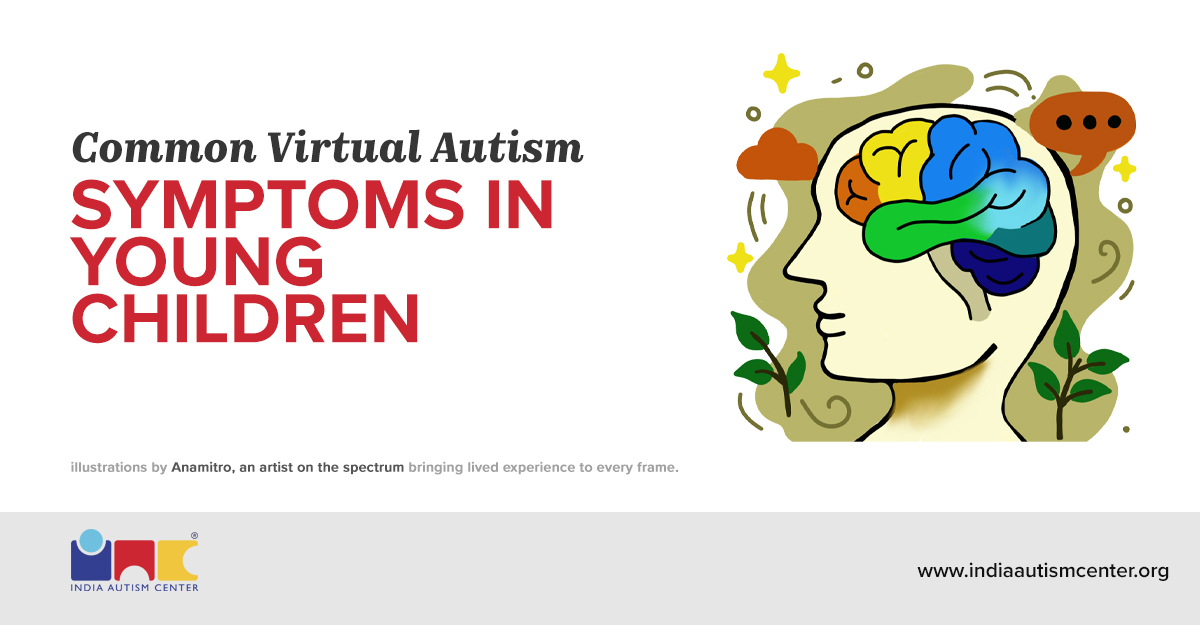
In recent years, several parents have noticed subtle changes in their kids. A few years earlier, toddlers were curious and responsive, but today many show a preference for screens, avoid eye contact, and are often found lost in their own worlds.
A new term has been coined to describe these concerns: virtual autism. However, having a term is not enough; several questions arise for a parent today. Is it the same as autism? Is it real? Can it be cured? How do I know if my child has virtual autism symptoms or classic autism?
So here we are with answers. In this article, we are going to explore what virtual autism is, the common symptoms, and the steps parents can take to help their child.
What is Virtual Autism?
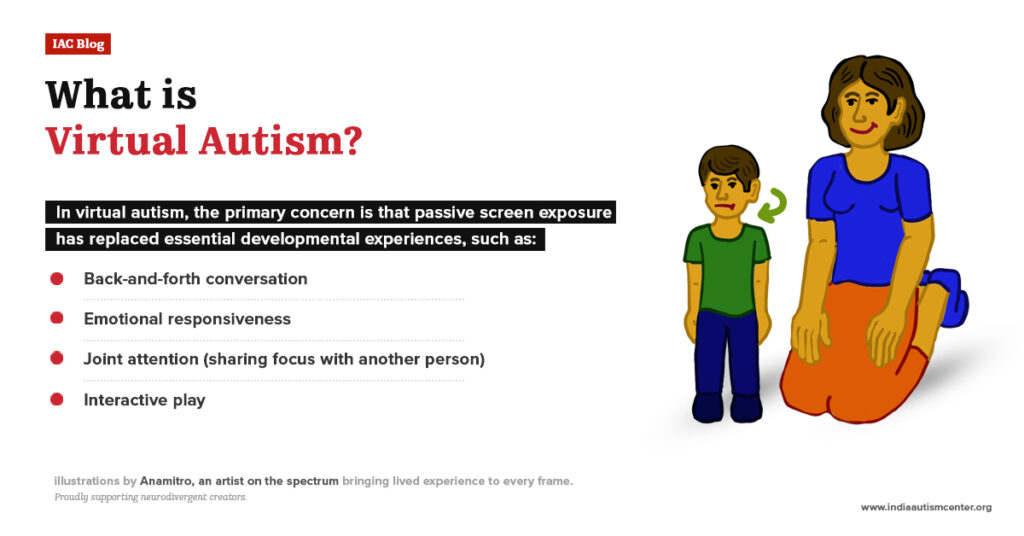
In some children, there are a few autism-like-developmental symptoms. There is a non-clinical term to describe these symptoms: Virtual Autism. It is common in young children, particularly toddlers.
These conditions are associated with excessive and early exposure to digital screens, such as smartphones, tablets, televisions, or other electronic devices. If you want to understand what virtual autism is, it is necessary to be clear that the symptoms are real, and the cause is environmental.
The virtual autism means a child’s development is influenced more by a virtual (screen-based) environment than by real-world human interaction during the critical early years of brain growth.
There are certain symptoms, such as delayed or absent speech, poor eye contact, reduced social engagement, limited attention span and repetitive behaviour, which can closely resemble the symptoms of Autism Spectrum Disorder (ASD). However, there are still distinctions between the two.
In virtual autism, the primary concern is that passive screen exposure has replaced essential developmental experiences, such as:
- Back-and-forth conversation
- Emotional responsiveness
- Joint attention (sharing focus with another person)
- Interactive play
Why the Term Virtual Autism Has Emerged Now?
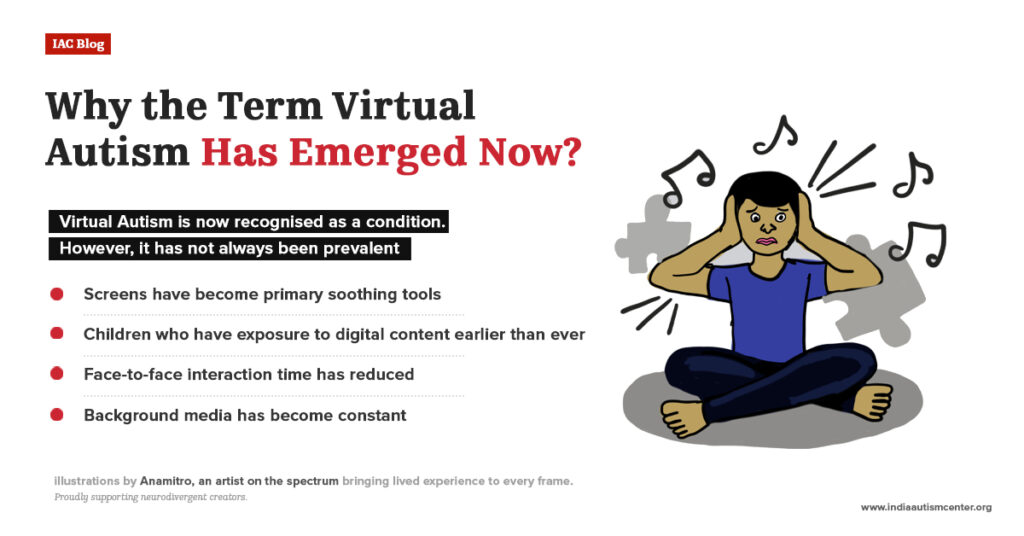
Virtual Autism is now recognised as a condition. However, it has not always been prevalent because earlier kids got little to no exposure to screens. In fact, it is only over the last decade that:
- Screens have become primary soothing tools
- Children have exposure to digital content earlier than ever
- Face-to-face interaction time has reduced
- Background media has become constant
Proper brain development in a child depends on social interactions, not on passive stimulation. Human speech, facial expressions, turn-taking, and shared attention are essential for language and emotional growth.
However, as screens are now replacing these interactions, developmental delays are bound to happen. This is also common when screen exposure is prominent during the first three years of childhood. It does not mean the screen exposure causes autism.
The effects of screen exposure can influence how the symptoms appear, worsen, or even mimic autism-like behaviour.
📥 Free download: Printable daily routine chart for autistic children
Is Virtual Autism Real?
A large population study asks: Is virtual autism real? The answer is not so simple and depends upon how you interpret the term, since the term is not an official medical virtual autism diagnosis.
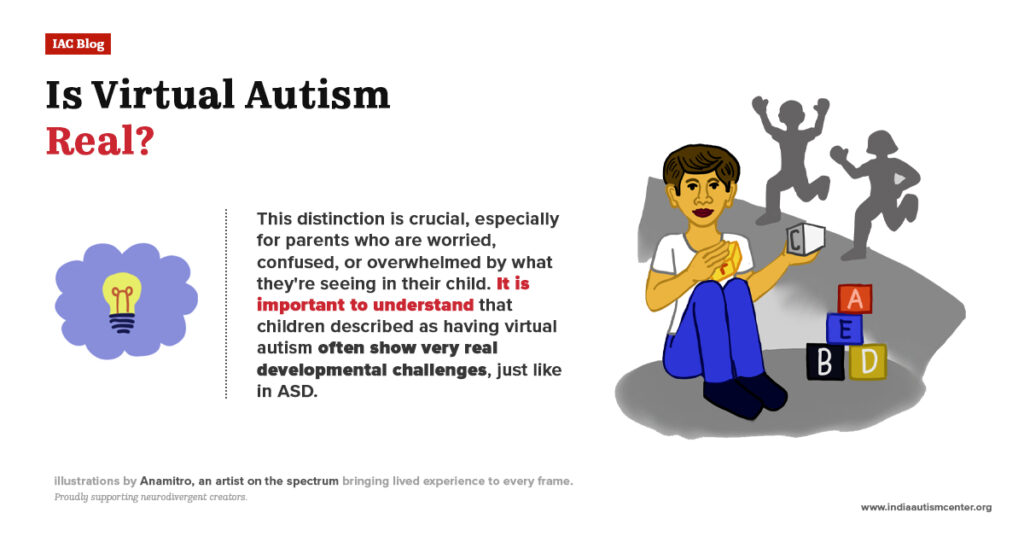
This distinction is crucial, especially for parents who are worried, confused, or overwhelmed by what they’re seeing in their child. It is important to understand that children described as having virtual autism often show very real developmental challenges, just like in ASD.
The behaviours are not imagination, exaggeration, or “just bad habits”; they are measurable, observable, and sometimes quite concerning.
What are the Most Common Virtual Autism Symptoms?
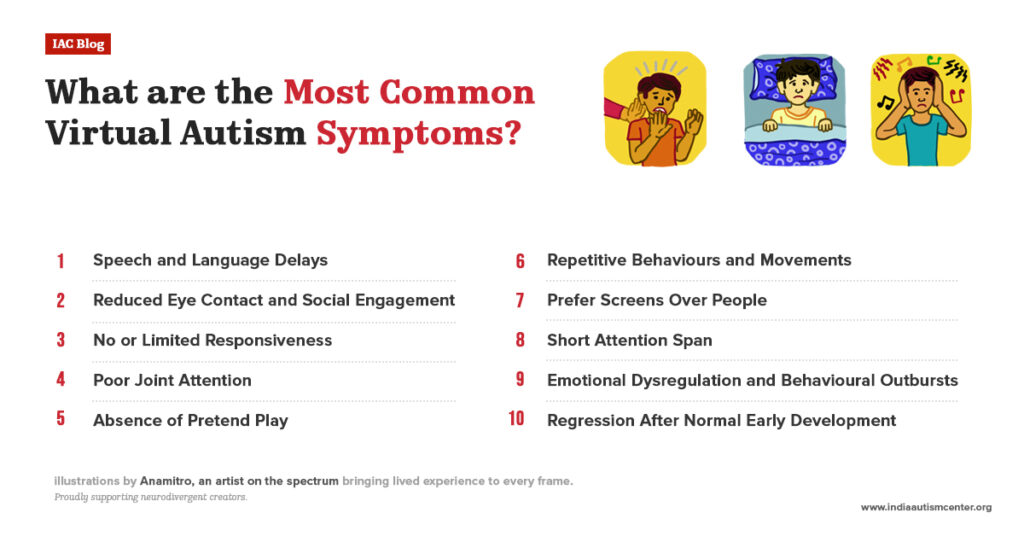
Virtual autism symptoms refer to autism-like behaviours that are frequently observed in young children who have early and excessive screen exposure. Here are some of the most common virtual autism symptoms observed:
1. Speech and Language Delays
One of the earliest and most noticeable virtual autism symptoms is a delay in speech development. Some of the prominent symptoms that parents observe include:
- No babbling or very limited babbling.
- No meaningful word, even when the child turns 18 months.
- Absence of two-word phrases even by the age of 2.
- Loss of words the child previously used
Language develops through back-and-forth human interaction. When screens replace conversation, children hear language but do not learn how to use it socially.
2. Reduced Eye Contact and Social Engagement
Another hallmark of virtual autism symptoms is poor or inconsistent eye contact. Some parents have noticed the following behaviour in their child:
- The child rarely looks at faces.
- Their child seems to avoid eye contact during play or in conversation.
- The child does not seem to follow the pointing.
- Appears more engaged with screens than people
Screens do not respond to a child’s facial expression, tone, or emotional cues, which limit their social learning. This reduces social engagement and connection.
3. No or Limited Responsiveness
Since a child with virtual autism has reduced social attention, parents may observe other behaviours in terms of responsiveness, s such as
- Not responding when called by name.
- Often, they cannot react to familiar voices.
- The child has zero to verify.
- The child shows no interest when a person enters or leaves the room.
4. Poor Joint Attention
Joint attention is the ability of a child to look at an object, then look back at the caregiver, and respond with excitement or interest. However, when a child has virtual autism symptoms, they may not point or show interest.
- Do not bring toys to show parents
- Play alone without seeking shared interaction
Poor joint attention can be a significant concern that requires timely evaluation.
5. Absence of Pretend Play
When a child is 18-24 months old, they achieve a major developmental milestone: pretend play. This milestone is often absent or limited to children with virtual autism symptoms.
Such a child may:
- Use toys repetitively rather than imaginatively
- Spin wheels, line up objects, or tap items repeatedly
- Shows little interest in pretend scenarios (feeding dolls, role-play games)
6. Repetitive Behaviours and Movements
When you observe your child displaying repetitive actions, you may feel they have autism. However, it doesn’t need to be autism. To distinguish, look for repetitive actions, such as.
- Hand flapping
- Rocking
- Spinning
- Repetitive vocal sounds
These behaviours may also increase drastically when the child is overstimulated, bored or disengaged, or when the child does not get screen time.
While repetitive behaviours can occur in autism, in virtual autism, they are often linked to sensory dysregulation and a lack of interactive stimulation.
7. Prefer Screens Over People
One of the major symptoms of virtual autism is that the child feels an intense attachment to the screens. There are certain scenarios that you may observe as a parent, such as
- When the screens are absent, there is extreme distress.
- When a distressed child gets a screen or device, they calm down.
- Children with virtual autism syndrome are not much interested in toys, books or even in interacting with people.
- Such children also find it difficult to engage in non-screen activities.
8. Short Attention Span
Since children with virtual autism prefer screens, they focus intently on them for longer periods. They also lose interest in any non-screen activities. They also seem to struggle with turn-taking or even structured play.
Screens provide rapid visual rewards, making real-world activities feel slow or less engaging by comparison.
9. Emotional Dysregulation and Behavioural Outbursts
As soon as the screen is taken away, parents report that their child throws tantrums, becomes highly irritated or frustrated, and it becomes quite difficult to calm them down. More often than not, these reactions are due to:
- Overstimulation
- Poor self-regulation skills
- Dependence on external (screen-based) soothing
10. Regression After Normal Early Development
A particularly concerning virtual autism symptom is developmental regression. It is more common than people expect. Parents report that their child was developing normally, and then things changed suddenly.
Some signs of developmental regression include:
- Loss of words
- Reduced social interaction
- Increased screen fixation
When parents report regression, it is necessary to take it seriously and to evaluate.
Autism vs Virtual Autism: Key Conceptual Differences
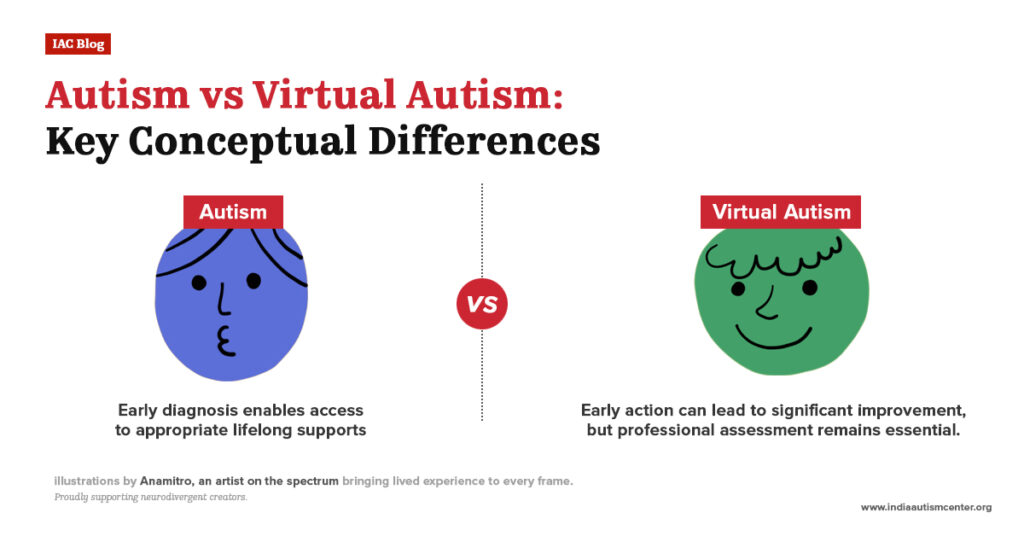
Awareness of developmental concerns in childhood is growing. However, because of similar symptoms, a parent can confuse two conditions, like ASD and virtual autism. The confusion is understandable. The behaviours can appear strikingly alike: delayed speech, reduced eye contact, limited social interaction, and repetitive actions.
However, the underlying cause for these behaviours may vary widely, which is why distinguishing between the two concepts matters. Here is a comparison table for autism vs virtual autism explaining the key conceptual difference between the two:
| Aspect | Autism Spectrum Disorder (ASD) | Virtual Autism |
| Definition | A recognised neurodevelopmental condition characterised by differences in social communication, behaviour, and sensory processing. | An informal term describing autism-like symptoms believed to arise primarily from environmental factors, especially excessive early screen exposure. |
| Medical Recognition | Officially recognised and diagnosable using standard clinical criteria (DSM-5 / ICD-11). | Not a recognised medical virtual autism diagnosis; used descriptively in clinical and therapeutic discussions. |
| Primary Cause | Largely neurobiological, with strong genetic and neurological components. | Considered mainly environmental, with screen overuse and reduced human interaction playing a significant role. |
| Age of Onset | Signs are usually present from infancy, even if they become more noticeable as the child grows. | Symptoms often emerge after a period of heavy screen exposure, sometimes following an initially typical development. |
| Role of Screen Time | Screen exposure does not cause autism, though excessive use may worsen existing symptoms. | Screen exposure is believed to be a central contributing factor to the development or amplification of symptoms. |
| Speech and Language Development | Delays or atypical language patterns are common and persist without targeted therapy. | Speech delays are common but may improve significantly once screen time is reduced and interaction increases. |
| Social Interaction | Ongoing challenges with social communication, eye contact, and social reciprocity. | Reduced social engagement is often linked to screen preference and may improve with increased real-world interaction. |
| Joint Attention | Frequently limited or absent due to underlying neurodevelopmental differences. | Often underdeveloped because of reduced interactive experiences, not necessarily a neurological impairment. |
| Pretend and Imaginative Play | May be limited, unusual, or develop differently compared to neurotypical peers. | Often delayed due to a lack of modelling and interaction, with potential to develop once exposure increases. |
| Repetitive Behaviours | Core diagnostic feature; may persist long-term. | May appear but cannot always be fixed, and can reduce as engagement and stimulation diversify. |
| Response to Environmental Changes | It can improve over time with consistent therapy and proper support, but there is a chance that the traits will remain. | Noticeable improvement is quite possible with screen reduction and improved interaction. |
| Long-Term Outlook | A lifelong condition with varying levels of independence and support needs. | Not considered lifelong; symptoms may reduce or resolve if environmental factors are addressed early. |
| Approach to Intervention | Requires structured, long-term interventions such as speech therapy, behavioural therapy, and educational support. | Focuses on reducing exposure to screens, increasing social interaction, and monitoring progress, along with consistent therapy if needed. |
| Risk of Misinterpretation | Delayed diagnosis can delay access to essential support services. | Mislabeling may lead to false reassurance or delayed autism assessment if professional evaluation is absent. |
| Key Takeaway for Parents | Early diagnosis enables access to appropriate lifelong supports. | Early action can lead to significant improvement, but professional assessment remains essential. |
Can Virtual Autism Be Reversed?
This is the question every parent asks first. And the honest answer is: for many children, yes – especially when action is taken early.
Here is why. The first five years of a child’s life are the most neurologically active period in human development. The brain is not a fixed organ at this age; it is extraordinarily malleable. This capacity for change is called neuroplasticity – the brain’s ability to reorganise itself by forming new neural connections in response to experience, learning, and environment.
Research from the Harvard Center on the Developing Child shows that the brain builds its architecture in the early years at a pace that will never be repeated – with more than 1 million new neural connections forming every second in infancy. When the right experiences are introduced, the brain responds. When harmful patterns (like passive screen dependency) are removed and replaced with rich human interaction, the developing brain can course-correct.
This is the key distinction between virtual autism and ASD. Because virtual autism symptoms arise from an environmental cause – not a neurological one – the brain has not been wired differently from birth. The developmental gaps have formed because the right inputs were missing. Restore those inputs, and the brain can begin to fill those gaps.
Clinical observations support this. Children who show virtual autism symptoms and receive early intervention – structured speech therapy, increased caregiver interaction, sensory play, and screen time reduction – frequently show significant improvement within 3 to 6 months. Some children recover fully; others show partial but meaningful gains.
That said, outcomes are not uniform. A few honest caveats:
- Age matters. The earlier the intervention, the greater the neuroplastic response. Children under 3 tend to show the fastest and most complete recovery. Between ages 3 and 5, improvement is still very achievable but may require more structured support.
- Severity of exposure matters. A child who has had 6 hours of daily unsupervised screen time from 12 months of age will likely need more intensive support than one who had moderate exposure from age 2.
- Individual variation is real. No two children respond identically. Some will bounce back quickly; others will need sustained therapy over a year or more.
- Professional evaluation is non-negotiable. If symptoms do not improve meaningfully after 3 months of consistent screen reduction and enriched interaction, a formal developmental assessment is essential – because what looks like virtual autism may, in some cases, be ASD or another developmental condition that needs its own pathway of support.
The bottom line for parents: you have not missed a window that cannot be reopened. If your child is under 5 and you are acting now, the brain is still very much on your side.
Signs of Virtual Autism Recovery – What to Look For
Recovery does not happen overnight, and it rarely announces itself dramatically. It shows up in small, quiet moments – a glance held a second longer, a new word said unprompted, a giggle during a game. These are the milestones worth celebrating.
Here are the encouraging signs that your child is moving in the right direction:
1. Increased Eye Contact
One of the earliest and most reliable signs of recovery is a child who begins to hold your gaze more naturally. You might notice it during feeding, during a song, or when you call their name. It may last only a second at first. That second matters enormously – it signals that the child’s social brain is beginning to re-engage.
2. Spontaneous Speech or New Words
When a child starts producing new words – especially without being prompted – it is a strong indicator that language pathways are activating. Watch for words that emerge in context: “ball” when they want to play, “mama” when they want comfort. Spontaneous, functional speech is a very different thing from repeating sounds heard on a screen.
3. Interest in Toys and Imaginative Play
A child who was previously fixating on a screen or lining up objects repetitively begins to pick up a toy and use it with intent – pretending a spoon is a phone, feeding a stuffed animal, building something and showing it to you. This shift from repetitive to imaginative play is a significant developmental leap and a clear sign of recovery.
4. Seeking Interaction with Parents and Siblings
Watch for the child who starts coming to you – tugging at your sleeve, bringing you a book, pulling you toward something they want to show you. This social initiation is one of the most meaningful recovery signs. It means the child is beginning to prefer human connection over passive screen stimulation.
5. Reduced Tantrums When Screens Are Removed
In the early stages of screen reduction, meltdowns are common and expected. They are a sign of withdrawal, not failure. As recovery progresses, you will notice these tantrums becoming shorter, less intense, and less frequent. A child who can be redirected to another activity within a few minutes – rather than screaming for 40 – is making real progress.
6. Improved Attention During Non-Screen Activities
Screens are engineered to hold attention through rapid cuts, bright colours, and constant novelty. The real world cannot compete – at first. But as the brain recalibrates, children begin to sustain attention during slower, richer activities: a picture book, a puzzle, a conversation. Even 5 minutes of focused engagement with a non-screen activity, where there was none before, is worth noting.
7. Emotional Responsiveness – Smiling Back, Reacting to Names
A child who begins to smile when you smile, laugh when you laugh, or look up when their name is called is demonstrating that their social-emotional circuits are coming back online. These responses – so automatic in typically developing children – are genuinely hard-won milestones for a child recovering from virtual autism, and they deserve to be recognised as such.
How to Help a Child with Virtual Autism – Treatment and Recovery Steps
There is no single prescription for virtual autism recovery. But there is a clear direction. The steps below are evidence-informed, practical, and designed to work within the reality of Indian family life.
Step 1: Reduce Screen Time – Gradually and Deliberately
Cold turkey rarely works for young children. A sudden, total removal of screens often triggers intense distress that makes everything harder. Instead, reduce screen time in stages over 2–4 weeks.
The American Academy of Pediatrics (AAP) guidelines are a useful benchmark:
- Under 18 months: no screen media at all, except video calls with family members.
- 18–24 months: if introduced, only high-quality content, always co-viewed with a parent.
- Ages 2–5: maximum 1 hour per day of age-appropriate, high-quality programming – co-viewed, not solo.
Use these as your target, not your starting point. If your child is currently watching 4 hours a day, reduce to 3, then 2, then 1 – week by week. Replace each removed hour with something from the steps below.
Step 2: Replace Screen Time with Face-to-Face Interaction Rituals
The brain learns language, emotion, and social connection through live human interaction – not through watching it on a screen. Build daily rituals that create these interactions:
- Reading aloud together – even 10 minutes a day of shared picture-book reading builds vocabulary, joint attention, and emotional bonding. Point to pictures, name things, pause and wait for the child to respond.
- Singing and nursery rhymes – songs with repetition, gesture, and eye contact (think Johny Johny, Twinkle Twinkle, Machli Jal Ki Rani) are powerful language tools.
- Turn-taking games – rolling a ball back and forth, stacking blocks and knocking them down together, simple peek-a-boo. These teach reciprocity, the foundation of all communication.
- Narrate your day – talk to your child constantly. “Now we’re washing hands. Cold water! Now we’re drying. Good job.” This running commentary builds language comprehension even before the child can respond.
Step 3: Prioritise Outdoor and Sensory Play
Many children with virtual autism symptoms show signs of sensory dysregulation – they are either over-sensitive or under-sensitive to touch, sound, and movement, partly because passive screen time does not provide the varied sensory input the developing brain needs.
Outdoor play addresses this directly:
- Sand play, water play, and mud play provide rich tactile input.
- Running, climbing, and swinging develop vestibular and proprioceptive systems.
- Interaction with other children in a park or playground builds social skills organically.
Even 30–45 minutes of outdoor play daily can make a measurable difference within weeks.
Step 4: Seek Speech Therapy If Delays Persist
If your child’s speech has not shown meaningful improvement after 3 months of consistent screen reduction and enriched interaction, do not wait further. Refer to a qualified speech-language pathologist.
Speech therapy for virtual autism typically focuses on:
- Building functional vocabulary (words the child uses to communicate needs and wants)
- Developing joint attention and turn-taking in conversation
- Encouraging spontaneous communication rather than scripted or prompted responses
The earlier speech therapy begins, the better the outcomes. A child who starts at 2 years will generally progress faster than one who starts at 4.
Step 5: Consider Occupational Therapy for Sensory and Motor Development
If your child shows significant sensory sensitivities, poor motor coordination, or difficulty with daily activities like self-feeding, dressing, or sitting still for play, occupational therapy (OT) is worth exploring.
OT for young children addresses:
- Sensory processing and regulation
- Fine and gross motor skill development
- Play skills and social participation
- Self-care routines
An occupational therapist can also guide parents on setting up a sensory-friendly home environment that supports the child’s recovery.
Step 6: Know When to Seek a Formal ASD Evaluation
This is the most important step many parents delay – and the one that matters most.
Seek a formal developmental evaluation if:
- Symptoms do not improve, or worsen, after 3 months of consistent screen reduction and intervention
- Your child shows no meaningful speech by 18 months, or no two-word phrases by 24 months
- You notice regression – loss of skills the child previously had
- Repetitive behaviours are intensifying rather than reducing
- Your gut, as a parent, tells you something more is going on
A formal evaluation by a developmental paediatrician, child psychologist, or multidisciplinary team will clarify whether your child has ASD, a speech or language disorder, a sensory processing difference, or a combination – and will open the door to the right support.
Getting a diagnosis is not a failure. It is the fastest route to the right help.
Conclusion
It is quite natural for a parent to feel confused between autism and virtual autism based on the symptoms. Several autism symptoms are similar to those that are visible in children with autism. However, there is a slight distinction between the two. Even if you notice a few of the symptoms listed above, it is best to seek professional help to manage the condition effectively.
Frequently Asked Questions
What is virtual autism in simple terms?
Virtual autism is an informal term which describes autism-like developmental symptoms in young children that are believed to be strongly influenced by excessive early screen exposure, rather than an underlying neurodevelopmental condition. It is not a medical diagnosis but a descriptive concept used in developmental discussions.
Is virtual autism real or just an internet myth?
The behaviours associated with virtual autism are real and clinically observed. However, the term itself is not an official diagnosis. It is used to explain autism-like symptoms linked to environmental factors, particularly heavy screen use.
Can screen time really cause virtual autism symptoms?
Screens do not “cause” autism. However, excessive passive screen exposure during early childhood can interfere with speech, attention, and social development, leading to virtual autism symptoms that resemble autism.
Can virtual autism be cured completely?
Parents often ask whether virtual autism can be cured. If symptoms are primarily environmental, many children show significant improvement or resolution with early intervention, reduced screen time, and increased social interaction. Outcomes vary by child.
Can a child have both autism and virtual autism traits?
Yes. A child with autism may also experience worsening symptoms because of excessive screen exposure. Reducing screen time benefits children regardless of diagnosis.
What should parents do if virtual autism symptoms worsen after screen removal?
Temporary behavioural challenges can occur during screen withdrawal. In case the symptoms persist or worsen over time, consult a healthcare professional to rule out autism or other developmental conditions.
Disclaimer: This article is intended for educational and informational purposes only. It is not a substitute for professional medical advice, diagnosis, or treatment. If you are pregnant or have concerns about medication use during pregnancy, please consult a qualified healthcare provider. If your child has received an autism diagnosis and you have questions about causes or support, please reach out to a trained specialist or an autism-focused organisation for guidance.
Useful Sources
American Academy of Pediatrics – Media and Young Minds
Harvard Center on the Developing Child – Brain Architecture
PMC – Neuroplasticity and Early Intervention in Children
DSM-5 / ICD-11 – ASD Diagnostic Criteria
PMC – Long-Term Outcomes in Autism Spectrum Disorder
For expert insights, support services, and inclusive learning initiatives, visit the India Autism Center.