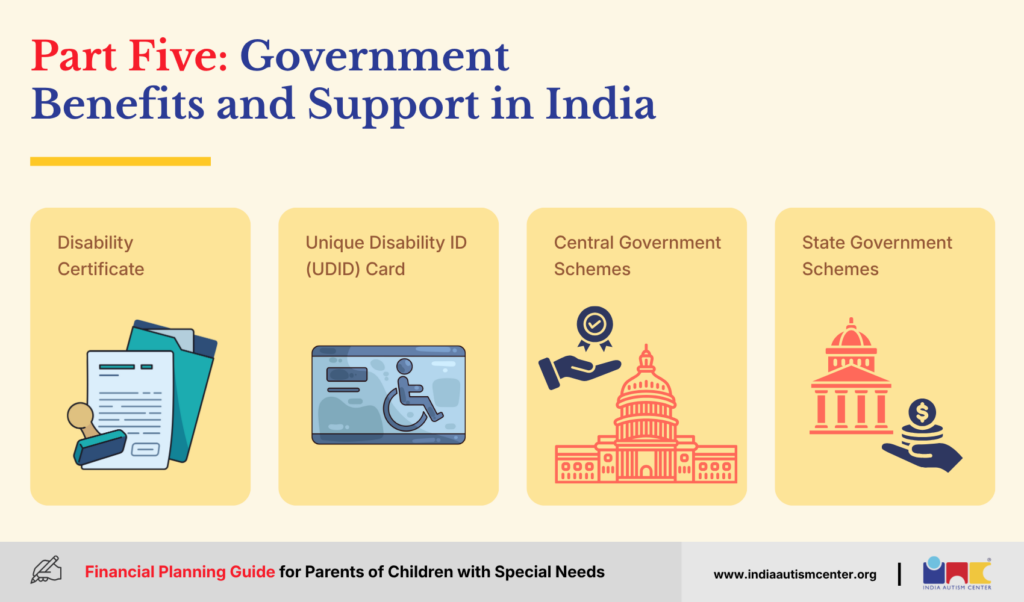
Managing the financial well-being of a loved one with a disability often feels quite overwhelming. Whether it is therapy sessions or navigating educational needs, knowing what government support is available is important.
As per the Census 2011 data, in India, there are approximately 2.68 crore persons with disabilities, representing roughly 2.21% of the total population. More recent estimates suggest these numbers have grown significantly as awareness around neurodivergence, like autism, has increased.
Financial assistance through schemes like the disability pension provides a vital safety net for these families. However, the application is only the first step. The real challenge often lies in tracking that application to ensure it does not get lost in the bureaucratic shuffle.
Fortunately, with the push toward a “Digital India,” checking your divyang pension or viklang pension status has become significantly more accessible from the comfort of your home.
This guide will explain to you the various portals and methods for verifying your disability pension status online, ensuring you have the information you need to secure your child’s financial future.
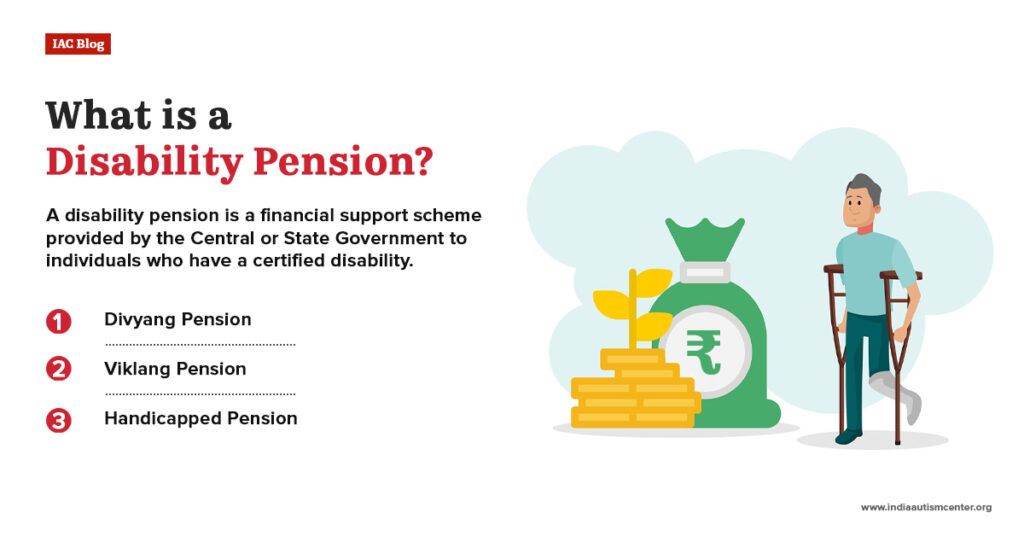
What Is Disability Pension?
A disability pension is a financial support scheme provided by the Central or State Government to individuals who have a certified disability. The goal is to help cover basic living expenses and reduce financial dependence on family members.
This pension may be known by different names across India, such as:
Divyang pension
Viklang pension
Handicapped pension
Although the names vary, the purpose remains the same: to provide monthly financial assistance to persons with disabilities.
The Indian government provides financial aid primarily through the National Social Assistance Programme (NSAP). Specifically, the Indira Gandhi National Disability Pension Scheme (IGNDPS) is the flagship central program.
Under this scheme, individuals with a disability of 80% or more and who fall below the poverty line (BPL) are eligible for monthly assistance.
Currently, over 1.5 million beneficiaries are registered under various disability pension schemes all over India. While the central government provides a base amount, many states add a supplementary amount, making the total disability pension amount vary from ₹300 to over ₹2,500, depending on your location.
Navigating government infrastructure requires a clear roadmap. To ensure your disability pension status is accurately monitored, you must familiarise yourself with the specific digital gateways provided by the Government of India.
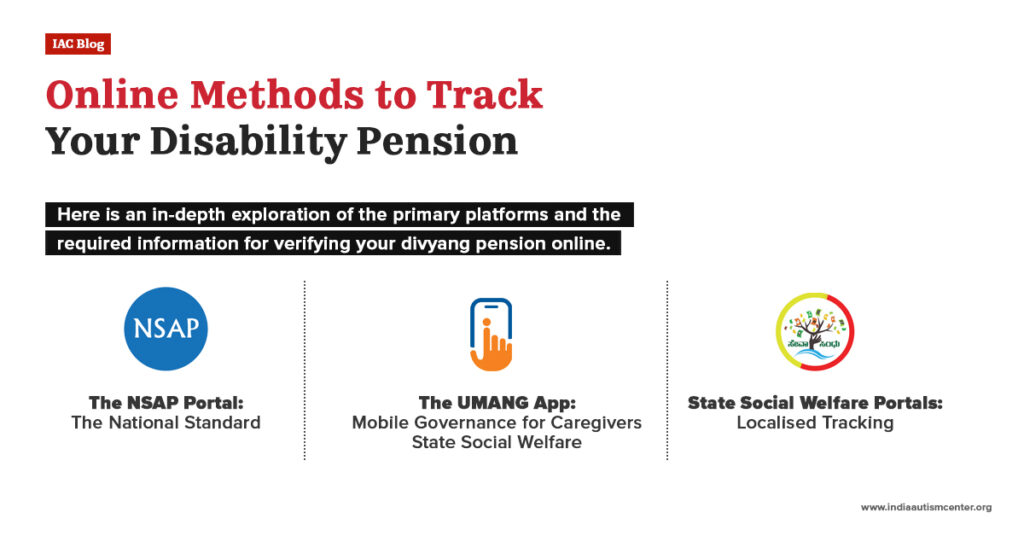
Here is an in-depth exploration of the primary platforms and the required information for verifying your divyang pension online.
1. The NSAP Portal: The National Standard
The National Social Assistance Programme (NSAP) is the central portal for knowing the details pertaining to the Indira Gandhi National Disability Pension Scheme (IGNDPS). This portal is the most reliable for those receiving central government grants.
Step 2: Click on “View Beneficiary Payment Status”.
Step 3: Log in to your Umang account for further information.
Step 4: Now you can enter your application number and click on ‘Submit’.
You can now view the correct information on the screen. The portal provides a complete view of the “Payment Processed” date versus the “Payment Disbursed” date. This will help you to identify whether the delay is at the central level or within your local bank.
2. The UMANG App: Mobile Governance for Caregivers
For parents who manage their child’s needs on the go, the UMANG (Unified Mobile Application for New-age Governance) app is an indispensable tool. It aggregates over 1,200 government services, including the viklang pension status check.
After a secure login via MPIN or OTP, search for “NSAP” in the service directory. Under this, select “Track Application.”
The app lets you save your details, so you don’t have to hunt down your PPO Number every time you want an update. It also provides push notifications for scheme updates, which is vital for staying informed about changes in disability pension amounts.
3. State Social Welfare Portals: Localised Tracking
Since the viklang pension is often a shared financial responsibility between the Centre and the State, local portals often carry the most up-to-date data on the State’s contribution to the funds.
Examples of Portals:
SSPMIS (Bihar): Allows tracking via Aadhaar Number or Bank Account details.
Pensions Portal (Uttar Pradesh): Focuses heavily on the divyang pension with a dedicated login for beneficiaries to view their complete ledger.
e-Nirman or Seva Sindhu: These portals in various states act as a single window for all social security schemes.
Most state sites will require a “Beneficiary ID.” If you do not have this, the “Search by Account Number” feature is a common and user-friendly alternative for parents.
Essential Information for a Successful Search
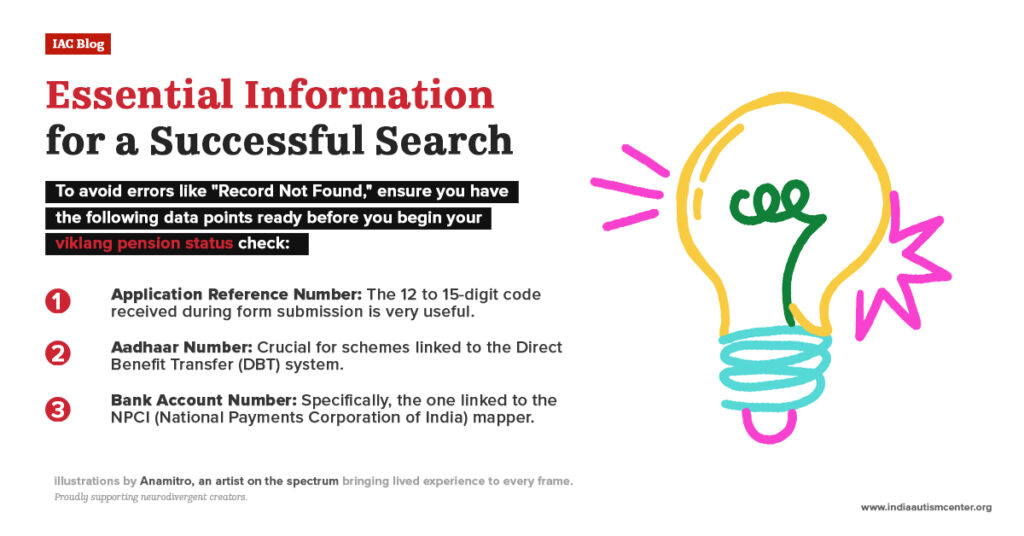
To avoid errors like “Record Not Found,” ensure you have the following data points ready before you begin your viklang pension status check:
Application Reference Number: The 12- to 15-digit code received during form submission is very useful.
Aadhaar Number: Crucial for schemes linked to the Direct Benefit Transfer (DBT) system.
Bank Account Number: Specifically, the one linked to the National Payments Corporation of India (NPCI) mapper.
Knowing about all these platforms helps you move from uncertainty to empowered monitoring, ensuring the divyang pension remains a consistent support for your family.
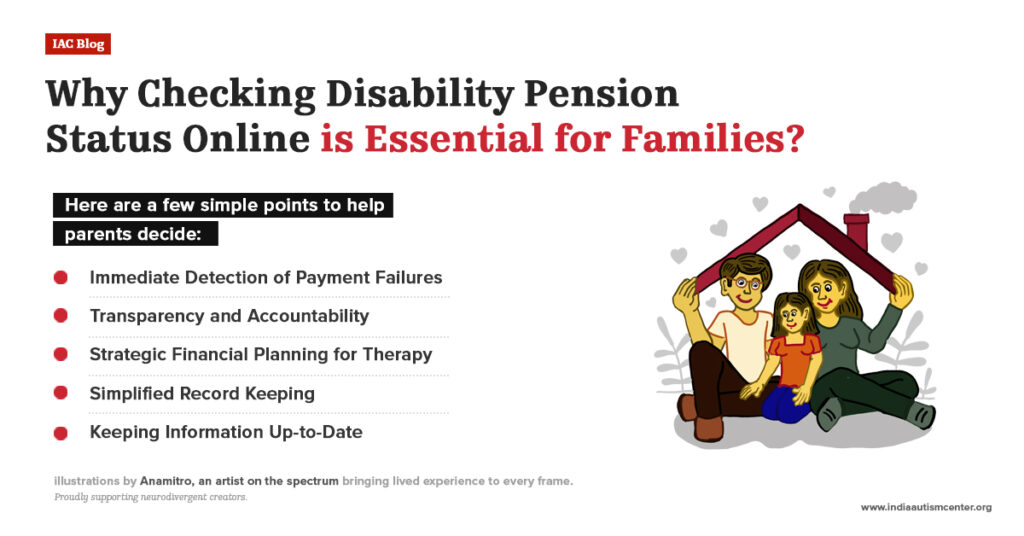
Why Checking Disability Pension Status Online Is Essential for Families
In the past, verifying the status of a government application meant several trips to government offices, standing in long queues for hours, and often returning home with vague answers. For parents of children with disabilities, these hurdles can put a significant drain on time and emotional energy that could be better spent on therapy and care. Transitioning to checking your disability pension status online is not simply a technological shift; it is a vital step toward financial autonomy and peace of mind.
Let us understand some reasons as to why monitoring the divyang pension or viklang pension status on a regular basis is important for parents as well as caregivers:
1. Immediate Detection of Payment Failures
Government payments are now largely disbursed through the Direct Benefit Transfer system. While efficient, this system can fail due to minor technicalities, such as an unlinked Aadhaar, an inactive bank account, or a misspelt name.
The Benefit: By performing a regular viklang pension status check, you can spot a “Failed” or “Returned” transaction immediately.
The Impact: Now there is no need to wait for weeks or months to realise the money hasn’t arrived; you can approach your bank or the social welfare department within just a few days to rectify the issue.
2. Transparency and Accountability
Online portals primarily offer a digital trail that physical paperwork often lacks. When you check your disability pension status online, you see exactly where your application is sitting, whether it is at the “Block Level Verification,” “District Approval,” or “Sanctioned” stage.
The Benefit: This transparency reduces the opportunity for middleman interference or administrative neglect.
The Impact: Knowing exactly which officer or department is handling your file enables more targeted, effective follow-ups if the process stalls.
3. Strategic Financial Planning for Therapy
Raising a child with autism or a related disability involves high recurring costs. From speech therapy sessions to specialised sensory equipment, every rupee of the disability pension counts.
The Benefit: Tracking the handicapped pension status will allow you to view the “Payment Triggered” date.
The Impact: This predictability will help you create a proper budget for monthly expenses, considering all the aspects. If you know the divyang pension online status, you can schedule therapy payments or medical consultations accordingly.
4. Simplified Record Keeping
Digital portals serve as virtual file cabinets. Most sites, like the NSAP portal, maintain a history of your past 12 to 24 payments.
The Benefit: You can download payment receipts and status reports as PDFs.
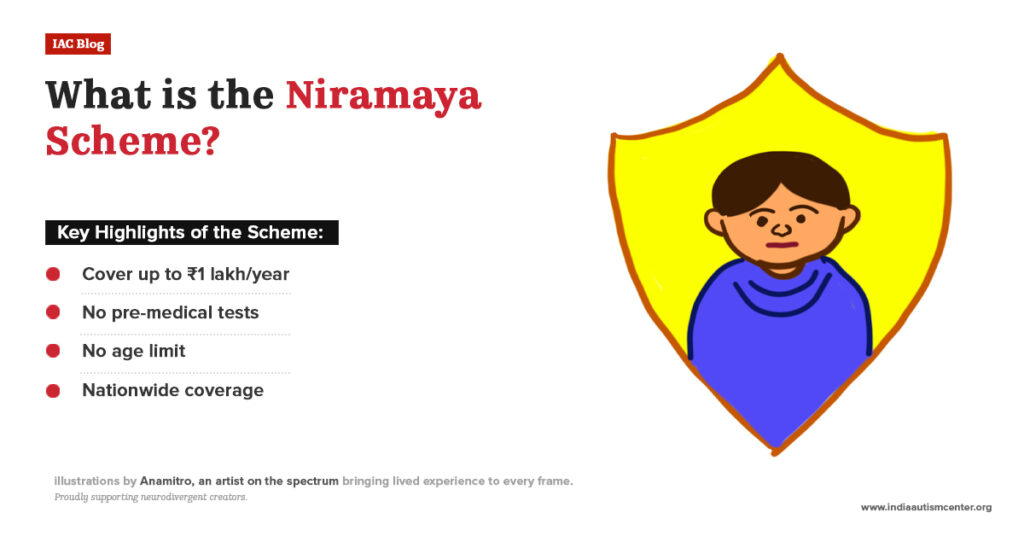
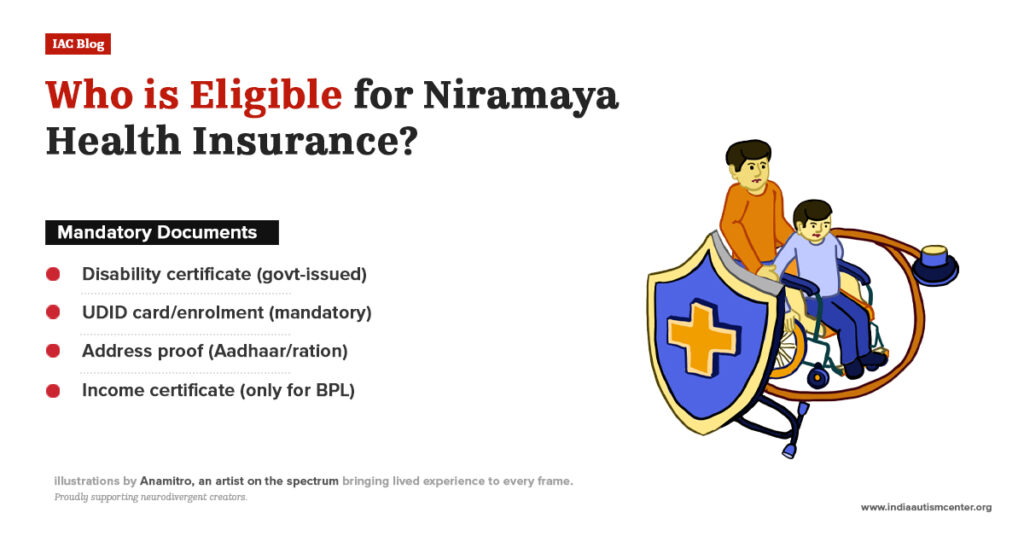
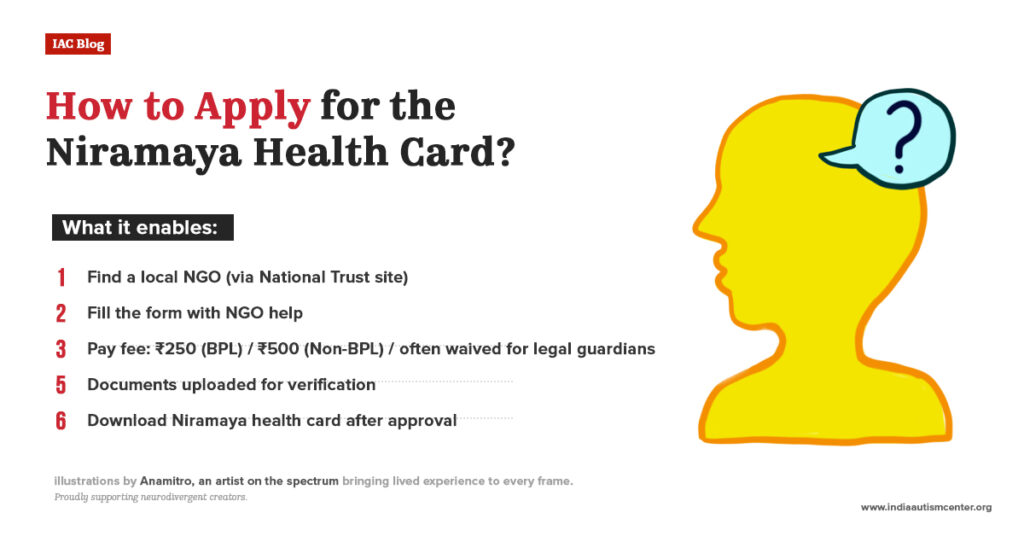
The Impact: Having these digital records is invaluable when applying for other benefits, such as the NIRAMAYA Health Insurance Scheme or state-specific educational grants, where proof of existing disability benefits is often required.
5. Keeping Information Up-to-Date
Government schemes often undergo periodic “re-verification” drives. During these times, the disability pension status might temporarily change to “Pending Verification.”
The Benefit: Regular online checks alert you if the government requires fresh documentation, such as a new income certificate or a life certificate (Jeevan Pramaan).
The Impact: Proactive monitoring ensures your viklang pension is never discontinued due to errors like missed re-verification deadlines.
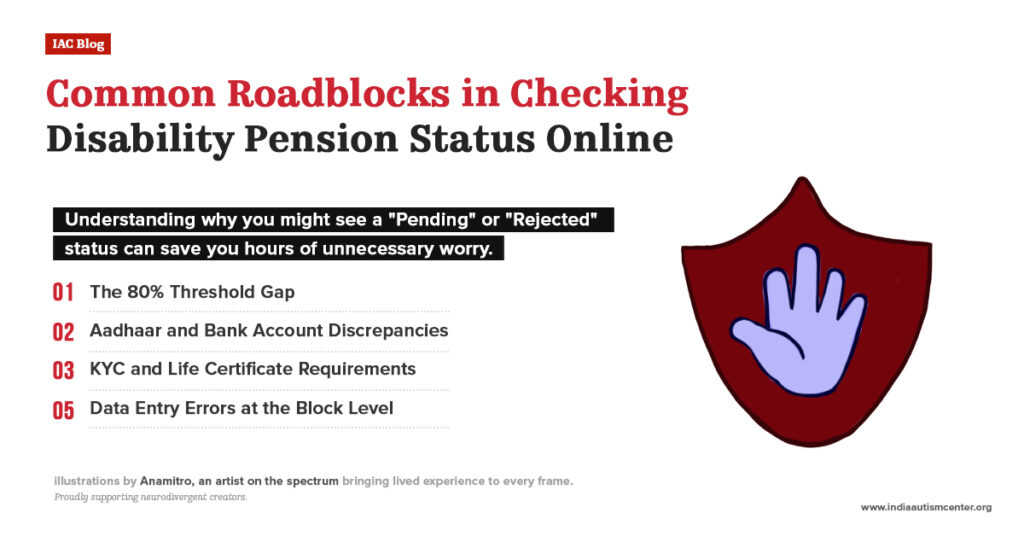
Common Roadblocks in Checking Disability Pension Status Online
While the digital system seems perfect, it is not always without flaws. Understanding why you might see a “Pending” or “Rejected” status can save you hours of unnecessary worry.
1. The 80% Threshold Gap
A common reason for confusion for parents is the disability percentage. The IGNDPS (Central Pension) has a ruling where an 80% disability is the benchmark in order to get the pension. If your child’s certificate marks them at 60%, the NSAP portal might show “Ineligible” for the central scheme, even if they are receiving a state-level viklang pension. Always verify which scheme you are tracking.
2. Aadhaar and Bank Account Discrepancies
Most disability pension payments are now sent via the Aadhaar Bridge Payment System. If the Aadhaar is not “seeded” or linked with the bank account’s NPCI mapper, there is a chance that the money will not reach the beneficiary. The online status might show “Payment Triggered,” but the funds never arrive. Visit your local bank branch to make sure that the “Aadhaar Mapping” is correct and active.
3. KYC and Life Certificate Requirements
In many states, beneficiaries must submit an annual “Life Certificate” (Jeevan Pramaan) for verification of their eligibility. Failure to do so will result in the handicapped pension status switching to “Suspended” or “Inactive.” This can often be done digitally through the Jeevan Pramaan app using biometric authentication.
4. Data Entry Errors at the Block Level
Sometimes, you cannot find your viklang pension status online simply because the physical application was never digitised. If the portal says “Record Not Found” after three months of submission, it is time to visit the Jan Seva Kendra or the District Officer.
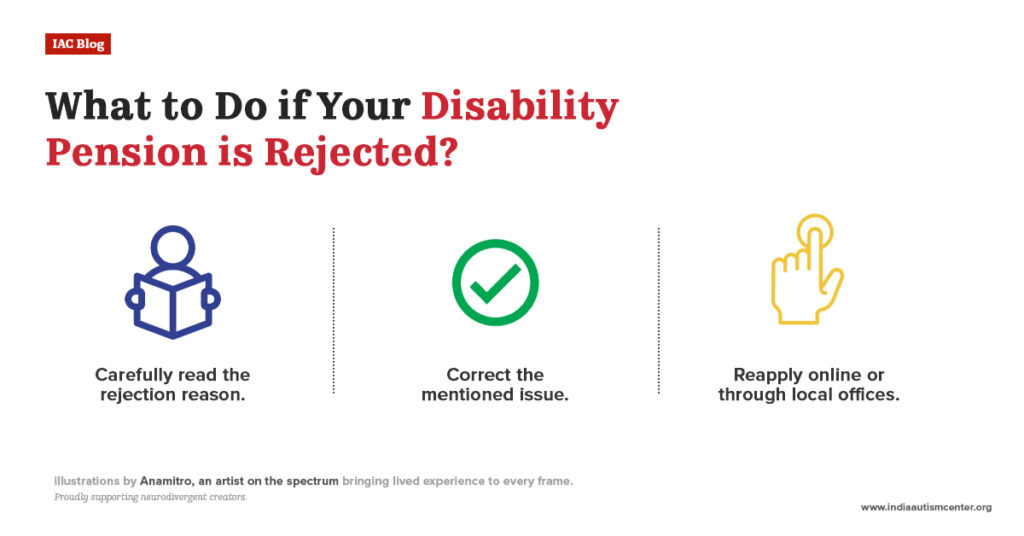
What to Do If Your Disability Pension Is Rejected?
If your viklang pension status check shows rejection:
Carefully read the rejection reason.
Correct the mentioned issue.
Reapply online or through local offices.
At times, the rejections are due to minor documentation errors and can be resolved easily.
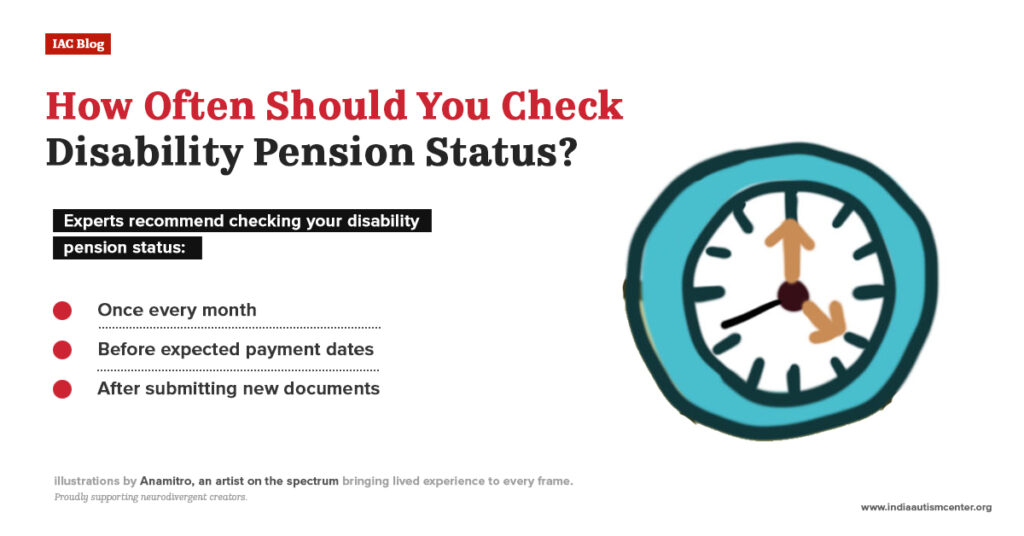
How Often Should You Check Disability Pension Status?
Experts recommend checking your disability pension status:
Once every month
Before expected payment dates
After submitting new documents
This ensures uninterrupted pension benefits.
Conclusion
When it comes to navigating government systems, it can feel overwhelming. It is more confusing when you are already managing the daily challenges of providing care for a person with a disability. Understanding how to check disability pension status online empowers parents and caregivers with clarity, confidence, and control.
Whether it is divyang pension, viklang pension status check, or handicapped pension status, staying informed ensures that financial support reaches the families who need it the most.
Frequently Asked Questions
What is a disability pension, and who is it meant for?
It is essentially a financial assistance offered to individuals with disabilities who are below the poverty line or have limited income. It helps cover expenses such as food, medical needs, transportation, and daily care. Individuals with physical, intellectual, developmental, or multiple disabilities are eligible if they meet the criteria set by their State.
Is disability pension and divyang pension the same?
Yes. Divyang pension is simply another name for disability pension used by many states in India. While the name may differ, the purpose, eligibility, and benefits are largely the same.
What does “pending” mean in disability pension status?
If your disability pension status shows “pending,” it usually means that verification is still in progress. This could be at the village, block, or district level. It does not mean rejection, but it may require patience or follow-up.
Can I check Divyang’s pension online by only using Aadhaar details?
Yes. Many states have the option to check the online status for the Divyang pension using only the Aadhaar number. An OTP is usually sent to the registered mobile number for verification.
Is autism covered under disability pension schemes?
Yes. Autism is considered a disability as per Indian law, and hence individuals with a valid disability certificate are eligible for disability pension benefits in most states.
For expert insights, support services, and inclusive learning initiatives, visit the India Autism Center.
Understanding autism stimming becomes important because when you first notice your child repeating certain movements or sounds, you may feel worried or confused.
You might ask yourself, “Why is my child doing this?” or “Is this behaviour linked to autism?”
In this guide, we explain what stimming in autism spectrum disorder (ASD) means, why it happens, common examples, and whether you should try to stop it.
What Is Stimming in Autism Spectrum Disorder?
Stimming in autism refers to self-stimulating behaviours. These are repetitive movements, sounds, or actions that help a person regulate their emotions or sensory input.
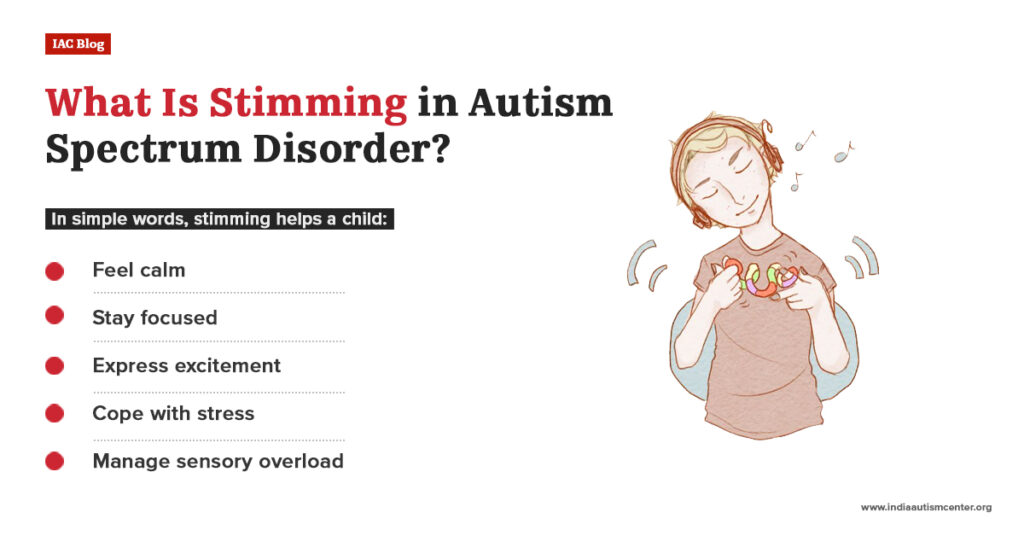
In simple words, stimming helps a child:
Feel calm
Stay focused
Express excitement
Cope with stress
Manage sensory overload
Stimming is common in autistic individuals, but it can also appear in people without autism.
So, what is stimming in autism spectrum disorder? It is a natural coping strategy that supports emotional and sensory balance.
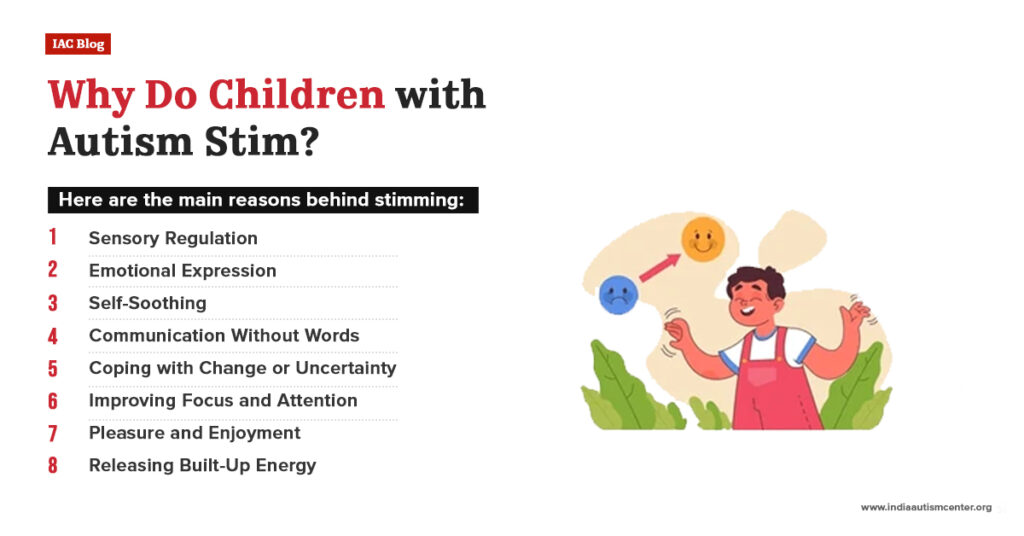
Children with autism stim because their brains process feelings and sensory information differently. Autism stimming helps them manage their body, emotions, and environment. It is not random behaviour. It has a purpose.
Here are the main reasons behind stimming:
1. Sensory Regulation
Many autistic children experience sounds, lights, smells, or touch more strongly than others. Stimming helps them control these sensations. For example, rocking or hand flapping may help block out loud noise or bright light.
2. Emotional Expression
Some children find it hard to explain how they feel using words. Stimming becomes their way to show emotions such as happiness, fear, anger, or excitement. In this way, autism stimming examples can act like emotional language.
3. Self-Soothing
Stimming often works like a calming tool. When a child feels anxious or overwhelmed, repeating a movement or sound helps their body relax and feel safe again.
4. Communication Without Words
When speech is limited, stimming can send a message. For example, increased stimming may mean the child is tired, stressed, or needs a break. So, what is stimming in autism spectrum disorder? It is also a form of non-verbal communication.
5. Coping with Change or Uncertainty
Changes in routine can feel frightening for autistic children. Stimming helps them cope when something feels unpredictable or unfamiliar.
6. Improving Focus and Attention
Some children stim to help their brain concentrate. A small movement, such as tapping or rocking, can help them stay engaged with learning or listening.
7. Pleasure and Enjoyment
Not all stimming happens because of stress. Sometimes children stim simply because it feels good or fun. For example, spinning or watching moving objects can be enjoyable.
8. Releasing Built-Up Energy
Stimming can help release physical tension or excess energy, especially when a child has been sitting still for too long.
Important Point for Parents
Stimming is not bad behaviour. It is a coping strategy. Before asking how to reduce stimming behaviors in autism, we must understand why the child is stimming.
Instead of asking: “How do I stop this?” We should ask: “What is my child feeling or experiencing right now?”
Autism Stimming Examples
Autism stimming can look different from one child to another. These behaviours involve repeated movements, sounds, or actions that help the child regulate emotions or sensory input. Understanding these autism stimming examples helps us respond with support instead of fear.
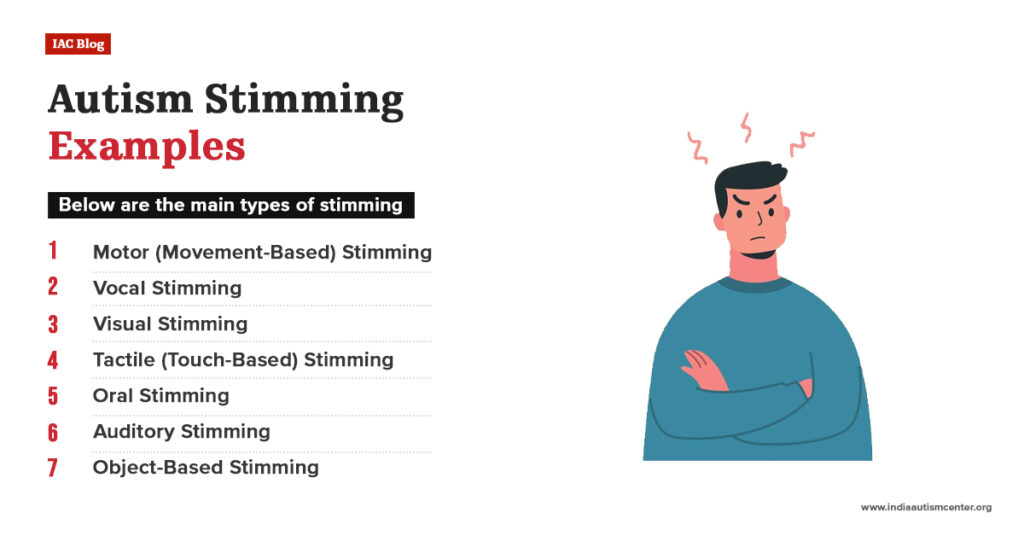
Below are the main types of stimming, with easy explanations.
1. Motor (Movement-Based) Stimming
This type involves body movements that are repeated again and again. Examples include hand flapping, rocking, spinning, jumping, or pacing. These movements help the child release energy or feel calm.
2. Vocal Stimming
This includes repeated sounds or words. Examples are humming, making clicking noises, repeating certain words, or echoing phrases. This type of autism stimming may help the child feel relaxed or focused.
3. Visual Stimming
This involves looking at objects or lights in a repetitive way. Examples include staring at ceiling fans, watching spinning toys, or moving fingers in front of the eyes. These actions help control visual input.
4. Tactile (Touch-Based) Stimming
This relates to the sense of touch. Examples include rubbing fabrics, scratching surfaces, touching textured objects, or tapping the skin. It helps the child feel grounded and secure.
5. Oral Stimming
This involves the mouth and chewing behaviours. Examples include chewing toys, biting clothes, licking objects, or sucking on fingers. This type of stimming helps with self-soothing and sensory regulation.
6. Auditory Stimming
This focuses on sound. Examples include repeating noises, tapping objects to hear the sound, or listening to the same sound again and again. It helps the child manage how they hear their environment.
7. Object-Based Stimming
This involves using objects in a repetitive way. Examples include spinning wheels, lining up toys, or flicking strings. These actions provide comfort and predictability.
These autism stimming examples are not meaningless habits. They serve important purposes such as:
calming the body
expressing emotions
coping with stress
managing sensory overload
When we ask what stimming is in autism spectrum disorder, the answer is simple: It is a natural way for the child to regulate their feelings and senses.
When Do These Behaviours Need Support?
Stimming may need guidance only when:
It causes physical harm
It stops learning or communicating
Puts the child at risk
Leads to social isolation
In such cases, the focus is not punishment but learning how to reduce stimming behaviours in autism safely by offering better coping tools.
Is Autism Stimming Harmful?
In most cases, autism stimming is not harmful. It is a natural way for autistic children to manage their feelings and sensory experiences. Stimming often helps them stay calm, feel safe, and cope with their surroundings.
So, when we ask, “Is stimming always related to autism?” or “Is stimming dangerous?”, the answer is usually no. Stimming is often helpful rather than harmful.
When Stimming Is Not Harmful
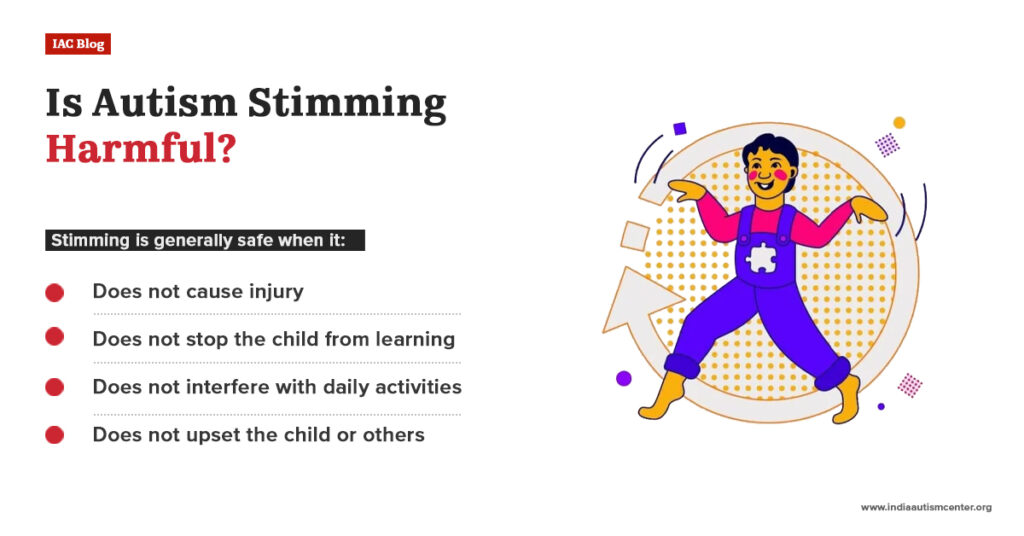
Stimming is generally safe when it:
does not cause injury
does not stop the child from learning
does not interfere with daily activities
does not upset the child or others
For example, hand flapping, rocking, or humming may simply help the child feel relaxed or focused. These types of autism stimming examples support emotional balance and self-regulation.
When Stimming Can Become a Concern
Stimming may need attention when it:
causes physical harm (such as head banging or skin picking)
affects speech or social interaction
prevents the child from taking part in school or play
becomes more intense over time
puts the child in unsafe situations
In these cases, the behaviour is not “bad”, but it shows that the child may be overwhelmed, anxious, or unable to cope with their environment.
Why We Should Not Automatically Stop Stimming
Trying to stop all stimming can:
increase anxiety
remove a coping method
lead to emotional distress
cause new problem behaviours
This is why the treatment of stimming in autism does not aim to remove stimming completely. Instead, it focuses on:
understanding the cause
reducing harmful stims
teaching safer alternatives
improving emotional regulation
Supportive Approach for Parents
Instead of asking, “How do I stop this behaviour?” We should ask, “What is my child trying to manage or communicate?”
Before thinking about how to reduce stimming behaviors in autism, we should:
Observe when it happens
Look for emotional or sensory triggers
Provide calm and safe coping tools
This helps the child feel understood rather than controlled.
How to Reduce Stimming Behaviours in Autism Safely
Before we try to reduce any behaviour, we must understand one thing: autism stimming is a coping tool, not a bad habit. Our goal is not to remove stimming completely. Instead, we help the child use safer and more appropriate ways to regulate emotions and sensory needs.
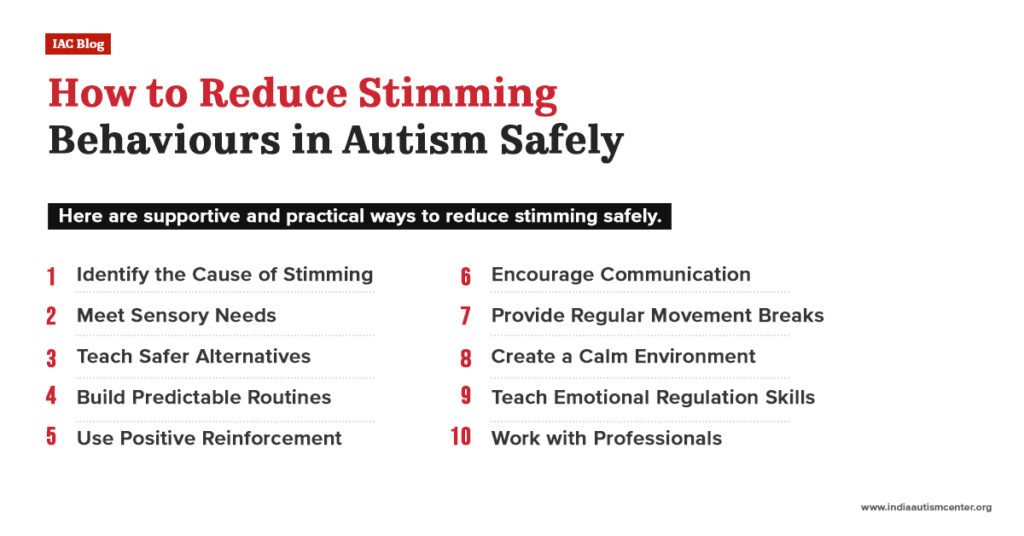
Here are supportive and practical ways to reduce stimming safely.
1. Identify the Cause of Stimming
We should observe when stimming happens and what comes before it. Your child may stim due to stress, excitement, boredom, or sensory overload. Once we know the trigger, we can respond in a better way.
2. Meet Sensory Needs
Many stimming behaviours happen because the child’s sensory system is overwhelmed or under-stimulated. We can provide sensory tools such as soft toys, textured objects, or quiet spaces to help balance their sensory input.
3. Teach Safer Alternatives
If a stim is harmful, we replace it with a safer behaviour rather than stopping it suddenly. For example, instead of head banging, we can teach squeezing a cushion or holding a stress ball.
4. Build Predictable Routines
Uncertainty increases anxiety and stimming. When we use clear routines and visual schedules, the child feels safer and needs fewer self-soothing behaviours.
5. Use Positive Reinforcement
We should praise and reward calm behaviour and safe coping skills. This helps the child learn better ways to manage emotions without feeling punished.
6. Encourage Communication
Some stimming happens because the child cannot express needs using words. We can teach simple gestures, pictures, or communication tools so they can say when they feel tired, scared, or overstimulated.
7. Provide Regular Movement Breaks
Children often stim when they have too much energy or have been sitting still for too long. Short movement breaks help release tension and reduce the need for repetitive actions.
8. Create a Calm Environment
Too much noise, light, or activity can increase autism stimming. We can reduce background noise, use soft lighting, and limit sudden changes to make the space more comfortable.
9. Teach Emotional Regulation Skills
Children need help understanding and managing their feelings. Simple breathing exercises, calm-down corners, or quiet time can reduce anxiety-based stimming.
10. Work with Professionals
Therapists can assess why stimming happens and design personalised strategies. This is an important part of the treatment of stimming in autism, especially when behaviours affect safety or learning.
Important Reminder for Parents
When we think about how to reduce stimming behaviours in autism, we must remember:
Not all stimming should be reduced
Only harmful or disruptive stims need guidance
The child still needs a way to self-regulate
When we understand autism stimming, we realise it is not bad behaviour. It is a way your child manages emotions and sensory experiences. Our role is to guide and support, not to control or shame.
Below is a clear guide on what we should and should not do.
What Parents Should Do
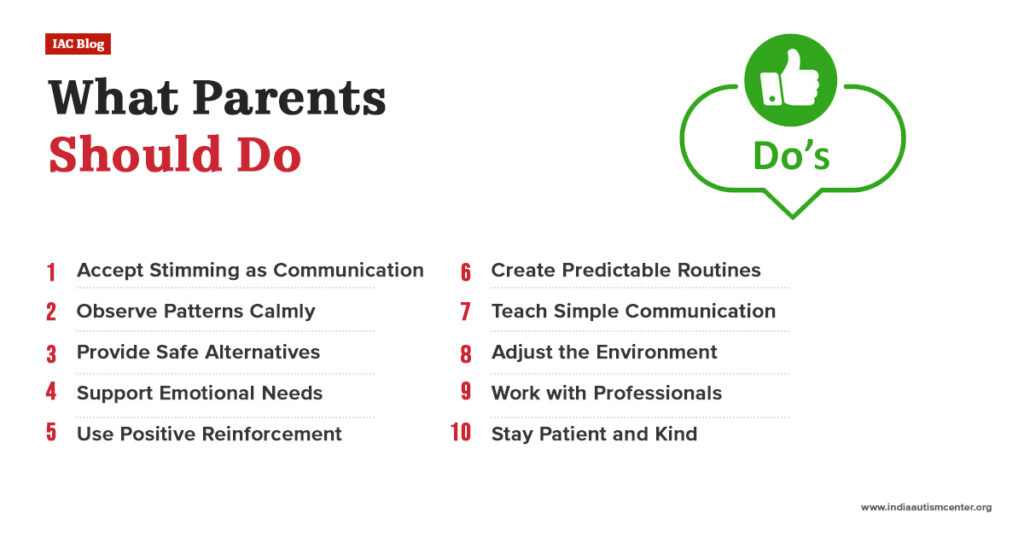
1. Accept Stimming as Communication
We should see stimming as a message, not a mistake. It tells us how the child feels inside, such as stress, excitement, or overload.
2. Observe Patterns Calmly
We need to notice when stimming happens, where it happens, and what happens before it. This helps us understand the trigger behind the behaviour.
3. Provide Safe Alternatives
If a stim is harmful, we should gently replace it with a safer option, such as squeezing a ball instead of hitting or chewing a toy instead of biting clothes.
4. Support Emotional Needs
We should help the child feel secure by offering comfort, quiet time, or reassurance when they seem overwhelmed.
5. Use Positive Reinforcement
We must praise and encourage calm behaviour and healthy coping skills. This builds confidence and reduces stress-based stimming.
6. Create Predictable Routines
Consistent routines make children feel safe. When anxiety is lower, the need for self-soothing behaviours also becomes lower.
7. Teach Simple Communication
We should help the child express needs using words, pictures, or gestures, so stimming is not their only way to communicate.
8. Adjust the Environment
We can reduce noise, strong light, or crowds when possible. A calmer environment lowers sensory overload and stimming intensity.
9. Work with Professionals
Therapists can guide us in the treatment of stimming in autism by creating personalised strategies for the child’s needs.
10. Stay Patient and Kind
Progress takes time. We must remember that the child is learning skills, not misbehaving on purpose.
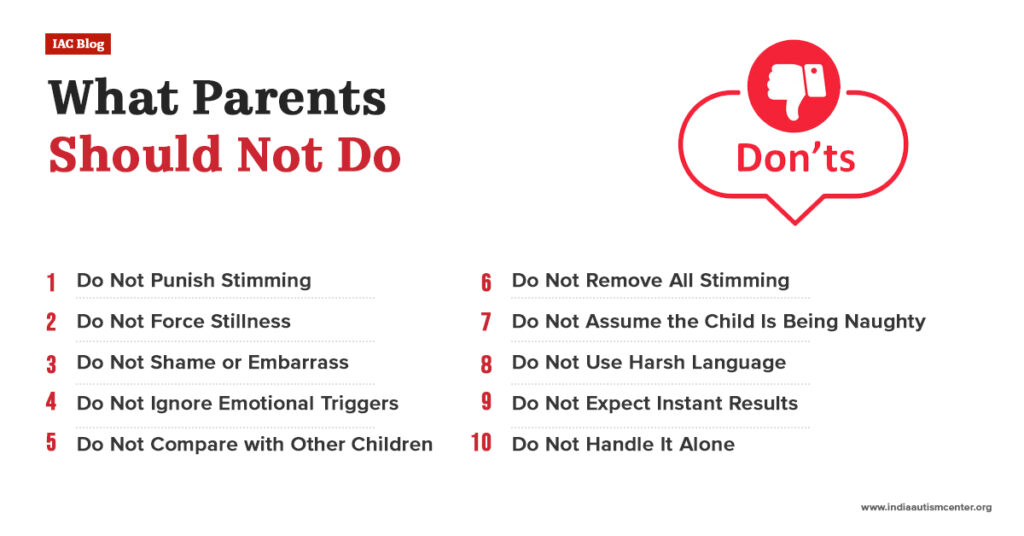
What Parents Should Not Do
If you are reading this, chances are you have watched your child rock back and forth during a crowded family gathering, or bang their head against the wall after a long school day, and felt a knot of worry in your stomach. That worry is completely valid. You are not overreacting. You are paying attention – and that is exactly what your child needs.
Here is the truth, though: autism stimming is not a flaw to be fixed. It is a coping tool. A child who flaps their hands or hums repeatedly is not misbehaving. They are managing a nervous system that experiences the world far more intensely than most of us can imagine. Our goal, then, is not to silence that coping tool. It is to make sure it stays safe, does not block learning, and – where needed – gets channelled into something that works even better.
With that framing in mind, here are ten practical, evidence-informed ways to reduce stimming behaviours in autism safely, followed by clear guidance on when to bring in professional support.
1. Identify the Cause of Stimming
Every stim has a story. Before you can change the behaviour, you need to read that story.
Observe your child closely for a week. Note when the stimming happens, where it happens, and what immediately precedes it. You may notice a clear pattern – for example, your child starts spinning in circles every afternoon when the pressure cooker goes off in the kitchen, or begins rocking intensely just before a maths test at school.
Common triggers include sensory overload, boredom, excitement, hunger, fatigue, and transitions between activities. In many Indian households, Diwali or wedding season – with their firecrackers, loud music, and unpredictable crowds – can spike stimming significantly. That is not a coincidence. That is your child’s nervous system working overtime.
Try this: Keep a simple trigger diary for seven days. Write down the time, the environment, what happened just before, and what the stim looked like. Patterns will emerge faster than you expect.
Do not do this: Do not assume the stim is random or attention-seeking before you have tracked it. Acting on assumptions leads to the wrong response.
2. Meet Sensory Needs in Autism
Many stimming behaviours exist because the child’s sensory system is either overwhelmed or starved of input. This is one of the most direct ways to address sensory needs in autism.
A child who chews their collar all day may need more oral sensory input. One who rocks constantly may need more proprioceptive (deep pressure) feedback. Meeting these needs proactively – before the child reaches overload – can reduce stimming dramatically.
Try this: Introduce a small “sensory toolkit” at home. This could include a chewable silicone pendant, a weighted lap pad, a textured stress ball, or a small trampoline for jumping. Offer these tools during known high-stress periods, such as homework time or before a family outing.
Do not do this: Do not wait for the stim to escalate before offering the tool. Proactive sensory support works far better than reactive management.
3. Teach Safer Alternatives
If a stim is physically harmful – head banging, skin picking, biting themselves – the priority is to replace it with a safer behaviour that meets the same sensory need. Stopping it cold without offering an alternative is like removing a pressure valve without releasing the pressure.
For example, a child who bangs their head against a wall may be seeking deep pressure on the skull. A safer alternative could be pressing their forehead firmly into a large cushion, or wearing a snug-fitting hat. A child who bites their hand might accept a chewy toy instead.
Many parents in India feel embarrassed when their child head-bangs in a temple or at a relative’s home. The instinct is to physically restrain the child. Instead, carry a small, firm cushion in your bag. When you sense the stim building, offer the cushion quietly. It redirects without a scene.
Try this: For each harmful stim, identify what sensory input it provides (pressure, vibration, pain relief, etc.) and find one safer object that delivers something similar. Work with a therapist to confirm the match.
Do not do this: Do not physically restrain or hold the child’s hands down. This increases panic and can make the behaviour more intense.
4. Build Predictable Routines
Uncertainty is one of the biggest drivers of anxiety-based stimming in autism. When a child does not know what comes next, their nervous system goes on high alert – and stimming is how they self-soothe through that alert state.
Predictable routines act like a map. They tell the child’s brain: you are safe, you know what is happening, you do not need to brace yourself.
School exam seasons, summer vacations that disrupt daily schedules, or sudden changes like a grandparent’s visit can all destabilise a child’s routine. During these periods, parents often report a spike in stimming. A simple visual schedule – pictures or written steps showing the day’s plan – can buffer that anxiety significantly.
Try this: Use a whiteboard or printed picture cards to display the day’s routine each morning. Even if the content changes, the ritual of reviewing the schedule together creates predictability. Apps like Choiceworks (available on iOS and Android) can help.
Do not do this: Do not spring surprises, even pleasant ones like a surprise trip to the park. Give at least 10–15 minutes of advance notice for any change.
5. Use Positive Reinforcement
When a child manages to use a safer alternative or gets through a stressful situation without escalating, that moment deserves genuine acknowledgement. Positive reinforcement is not bribery – it is the brain’s learning mechanism.
Praise needs to be specific and immediate. “Good boy” is vague. “I noticed you squeezed your stress ball instead of hitting the wall – that was brilliant” is specific and teaches the child exactly what to repeat.
Try this: Build a simple reward chart. For younger children, stickers work beautifully. For older children, a points system redeemable for screen time or a favourite activity can be highly motivating. Keep the bar achievable – reward effort, not perfection.
Do not do this: Do not withhold rewards as punishment for stimming. That conflates two separate issues and increases anxiety, which will increase stimming.
6. Encourage Communication
A significant portion of stimming happens because the child cannot find words for what they are experiencing. When a child cannot say “this room is too loud and I need to leave,” the body says it instead – through rocking, humming, or covering their ears.
Teaching even basic communication – a gesture, a picture card, a simple phrase – gives the child a more efficient tool than stimming to signal their state.
Many Indian families rely heavily on verbal communication and may not have encountered AAC (Augmentative and Alternative Communication) tools. Picture Exchange Communication System (PECS) cards, which can be printed at home, or simple apps like Proloquo2Go or LetMeTalk (free on Android) can open a communication channel that dramatically reduces distress-driven stimming.
Try this: Teach your child two or three key phrases or picture cards: “too loud,” “I need a break,” “I am scared.” Practise them during calm moments so they are available during stressful ones.
Do not do this: Do not assume that because a child is non-verbal, they cannot communicate. Every child can learn some form of expression with the right support.
7. Provide Regular Movement Breaks
Children with autism often stim more intensely when they have been sedentary for too long. The body builds up tension, and stimming is the release valve. Scheduled movement breaks prevent that build-up from reaching a tipping point.
This is especially relevant in Indian school settings, where children are often expected to sit still for 40–45 minutes at a stretch. Many mainstream schools are not yet equipped to offer structured movement breaks, which means parents need to build this into the home routine.
Try this: Every 20–30 minutes during homework or structured activity, offer a 5-minute movement break. Options include jumping on a small trampoline, doing 10 star jumps, carrying a heavy bag of books (proprioceptive input), or a short walk. These are not rewards – they are neurological necessities.
Do not do this: Do not cancel movement breaks as a consequence for bad behaviour. That removes a regulatory tool and makes the next hour harder, not easier.
8. Create a Calm Environment
Too much noise, harsh lighting, strong smells, or visual clutter can push a child’s sensory system past its threshold – and autism stimming escalates in response. Modifying the environment is one of the fastest and most underused strategies available to Indian parents.
Many Indian homes are multi-generational and genuinely noisy – TV running in the background, relatives visiting, pressure cookers, mixers, and traffic outside. None of this is anyone’s fault. But for a child with heightened sensory needs, it is a constant assault. Even small changes make a measurable difference.
Try this: Designate one corner of the house as a “calm corner” – a low-stimulation space with soft lighting (a simple lamp rather than a tube light), a bean bag or floor cushion, and a few favourite sensory objects. Let the child go there whenever they need to regulate. This is not a time-out; it is a refuelling station.
Do not do this: Do not dismiss environmental modifications as impractical. Even closing a door, switching off one TV, or drawing a curtain can lower the sensory load enough to make a difference.
9. Teach Emotional Regulation Skills
Children with autism often have difficulty recognising what they are feeling and even more difficulty knowing what to do about it. Emotional regulation skills – the ability to notice, name, and manage emotions – are learnable. They just need to be taught explicitly, step by step.
Simple techniques include belly breathing (breathe in for 4 counts, hold for 2, out for 6), the “5-4-3-2-1” grounding exercise (name 5 things you can see, 4 you can touch, etc.), and using an emotion chart to point to how they feel.
Try this: Practise one calming technique together every day during a calm moment – not during a meltdown. The brain cannot learn new skills when it is in crisis. Repetition during calm periods means the skill becomes automatic when it is needed most.
Do not do this: Do not introduce a new calming technique for the first time during a meltdown. It will not work, and both of you will feel like failures.
10. Work with Professionals
Home strategies are powerful, but they work best when they are designed alongside a qualified professional who has assessed your specific child. When stimming is frequent, intense, or causing harm, professional support is not optional – it is essential.
A good therapist will assess the function of each stim, identify the sensory and emotional triggers, and design a personalised plan. This is the backbone of any serious approach to how to control stimming in a way that is both safe and sustainable.
Try this: Ask your child’s paediatrician for a referral to an occupational therapist or developmental paediatrician as a first step. Be specific: describe the stims, their frequency, and any safety concerns.
Do not do this: Do not try to implement a full behaviour management programme from a YouTube video alone. Without professional assessment, you risk targeting the wrong behaviour or missing an underlying medical cause.
Conclusion
When we understand what stimming is in autism spectrum disorder, we stop seeing it as a problem and start seeing it as communication.
Instead of asking, “How do we stop this?”, we should ask: “What is my child trying to tell me?”
By learning the meaning behind autism stimming examples, we create safer, kinder, and more supportive environments for autistic children.
Stimming is not a flaw. It is a coping tool. And with the right guidance, it can become a strength rather than a struggle.
Important Reminder for Parents
1. When thinking about how to reduce stimming behaviors in autism, keep these three principles close:
2. Not all stimming should be reduced. Safe stims that help your child regulate are doing their job.
3. Only harmful or significantly disruptive stims need active guidance. The bar is safety and functioning, not social appearance.
4. Your child still needs a way to self-regulate. If you reduce one stim without offering an alternative, another will take its place.
Understanding autism stimming means recognising it as communication, not misbehaviour. Your role is to guide and support – not to control or shame. Every step you take to understand your child’s sensory world is a step toward a calmer, more connected life for both of you.
Frequently Asked Questions (FAQs)
What is stimming in autism spectrum disorder?
Stimming in autism refers to repetitive movements, sounds, or actions that help an autistic person regulate emotions and sensory input. In autism, stimming behaviours help reduce anxiety, express feelings, and cope with overwhelming environments. Stimming is a natural coping strategy, not bad behaviour.
Is stimming always related to autism?
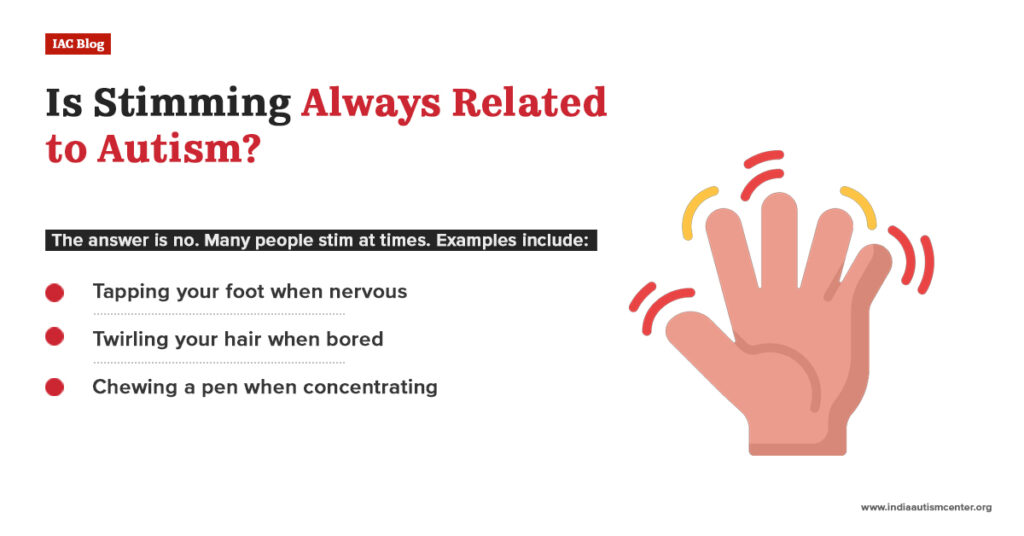
No, stimming is not always related to autism. Many people stim when they feel nervous, bored, or excited, such as tapping a foot or biting a pen. However, in autism, stimming tends to happen more often and may look more noticeable or intense.
What are some common autism stimming examples?
Common autism stimming examples include hand flapping, rocking, spinning, humming, repeating words, chewing objects, staring at lights, and rubbing textures. Each child shows stimming differently, depending on their sensory needs and emotions.
How can we reduce stimming behaviors in autism safely?
When thinking about how to reduce stimming behaviors autism, the goal is not to stop stimming completely. We should first understand the cause, then offer safer alternatives, sensory tools, and calm routines. Support from therapists is often part of the treatment of stimming in autism, especially if the behaviour causes harm or affects learning.
For expert insights, support services, and inclusive learning initiatives, visit the India Autism Center.
How to handle autism meltdowns is one of the most common and grave concerns of both parents and caregivers. Autism meltdowns can feel overwhelming for both the child and the caregiver. Many parents worry that they are doing something wrong when their child suddenly cries, screams, or loses control.
However, an autism meltdown is not a tantrum. It is usually a response to overwhelming stress, sensory overload, or emotional distress.
In this guide, we will help you understand autism meltdowns, learn how to calm an autistic meltdown, and discover practical strategies to handle autism meltdowns effectively.
What is an Autism Meltdown?
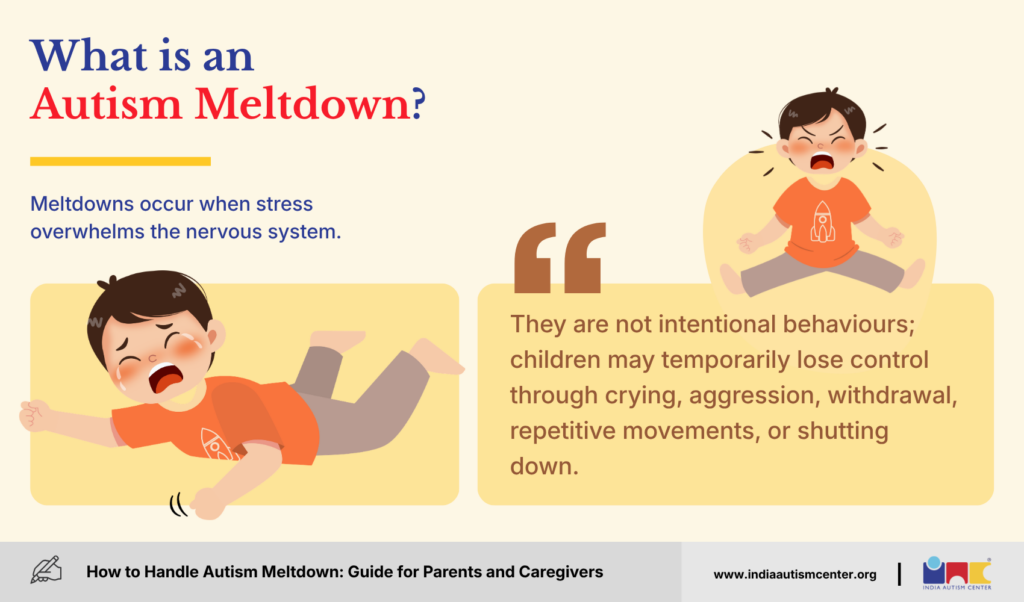
An autism meltdown is an intense emotional reaction that occurs when a person with autism becomes overwhelmed by sensory input, emotions, or environmental stress.
Unlike tantrums, meltdowns are not intentional behaviours used to get attention or achieve something. Instead, they happen when a child’s nervous system becomes overloaded, and they cannot regulate their emotions.
During an autism meltdown, a child may temporarily lose control of their behaviour.
Common behaviours during an autism meltdown include:
Crying or screaming loudly
Hitting, kicking, or throwing objects
Running away or hiding
Repetitive movements such as rocking or flapping
Covering ears or eyes
Shutting down and becoming unresponsive
Every autistic child is different. Therefore, the intensity and signs of an autism meltdown may vary.
Why Meltdowns Happen: The Neuroscience Behind Autism Meltdowns
A meltdown is not a choice. It is a neurological event – and understanding why it happens at the level of the brain changes everything about how caregivers respond.
Atypical Neural Connectivity and Sensory Processing
Research published on NCBI shows that autistic individuals possess neurons with a higher level of connectivity compared to non-autistic people. This atypical neural architecture has a direct consequence for sensory processing: the autistic nervous system receives and transmits sensory information differently, and often more intensely, than a neurotypical one.
In a neurotypical brain, a process called habituation means that repeated stimuli gradually fade into the background. Think of the ticking of a clock – within minutes, most people stop consciously registering it. The autistic brain frequently does not habituate in the same way. Research published in PubMed suggests that for many autistic individuals, the ticking clock remains as loud and intrusive on the hundredth tick as it was on the first.
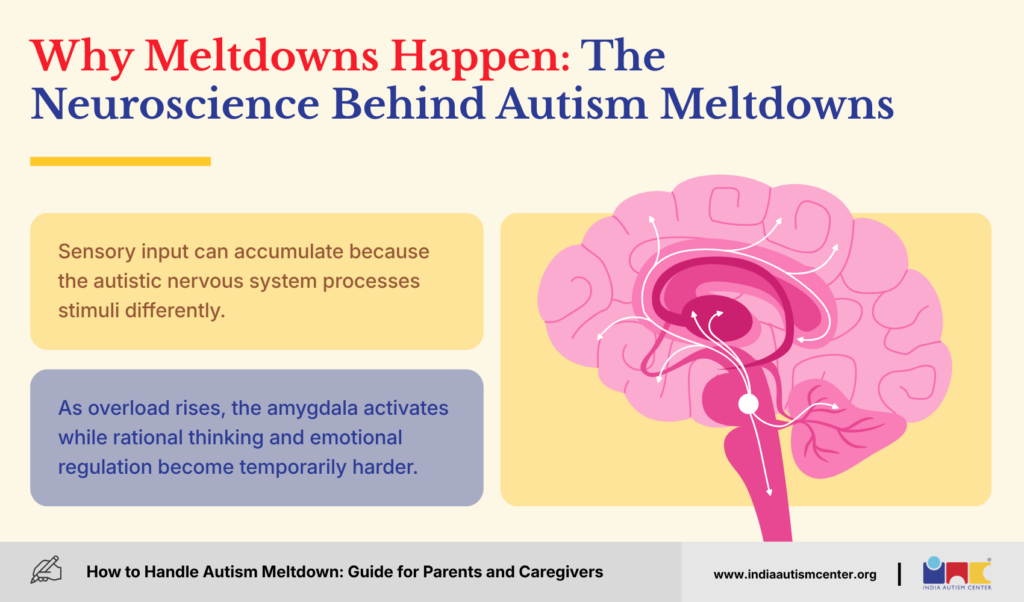
This means sensory input does not fade – it accumulates. Sound, light, texture, smell, and social demands stack on top of each other, pushing the nervous system steadily toward overload.
The Amygdala and the Prefrontal Cortex
When sensory accumulation reaches a tipping point, the amygdala – the brain’s threat-detection centre – becomes hyperactivated. It reads the overload as danger and triggers a full stress response: elevated heart rate, muscle tension, shallow breathing, and a flood of stress hormones.
At the same time, the prefrontal cortex – the part of the brain responsible for rational thinking, emotional regulation, and decision-making – is temporarily overridden. The child or adult cannot “think their way out” of the meltdown because the very brain region needed for that task has been effectively taken offline.
What This Feels Like From the Inside
A landmark study by Lewis and Stevens (2022), which interviewed 32 autistic adults about their lived experience of meltdowns, found that participants described the experience as a whole-body event. Physical precursors included blurred vision, heightened muscle temperature, flushed cheeks, and tense shoulders. Cognitively, participants reported difficulty thinking, finding words, and recalling simple information – all consistent with prefrontal suppression under acute stress.
One participant described it as being “crushed by the sensory and informational overload.” Another said, “I lose the ability to think clearly. My head feels foggy and muddled.”
Understanding this is not a behavioural choice but a neurological event fundamentally changes how caregivers respond. Punishment, reasoning, and demands for self-control are not just unhelpful during a meltdown – they are neurologically impossible to respond to.
Autism Meltdown vs Tantrum: Understanding the Difference
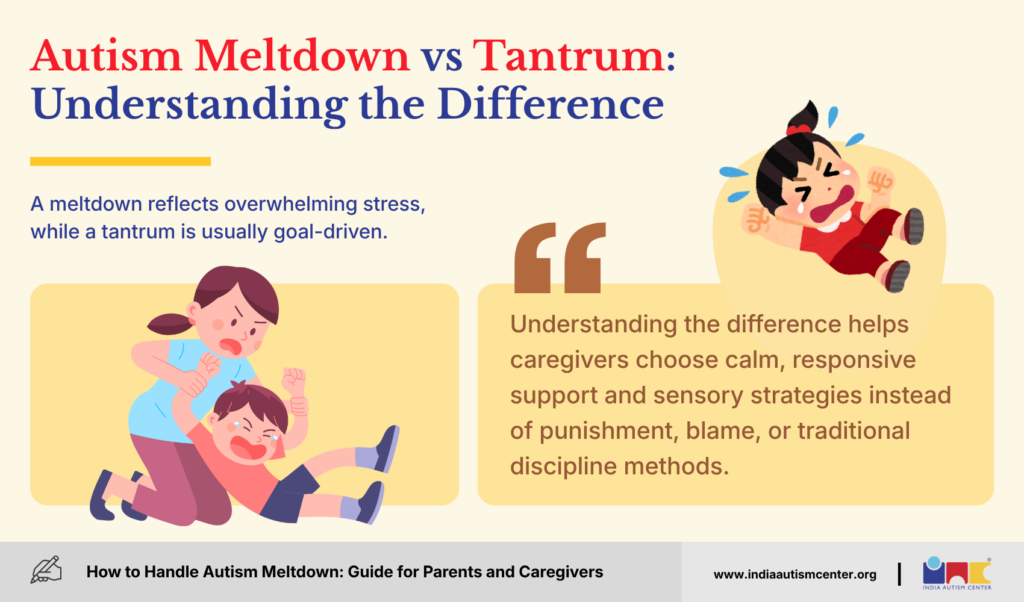
A tantrum is usually a goal-driven behaviour. Children may throw a tantrum when they want something, such as a toy, attention, or permission to do something. In most cases, the child still has some level of control over their behaviour and may stop once their demand is met or when they realise the behaviour is not working.
An autism meltdown, on the other hand, is not intentional. It happens when the child becomes overwhelmed by sensory input, emotional stress, or frustration.
During a meltdown, the child’s nervous system becomes overloaded, and they temporarily lose the ability to regulate their emotions or behaviour. This is why traditional discipline strategies that work for tantrums often do not work for autism meltdowns.
Understanding this distinction helps parents respond with support, patience, and calming strategies instead of punishment.
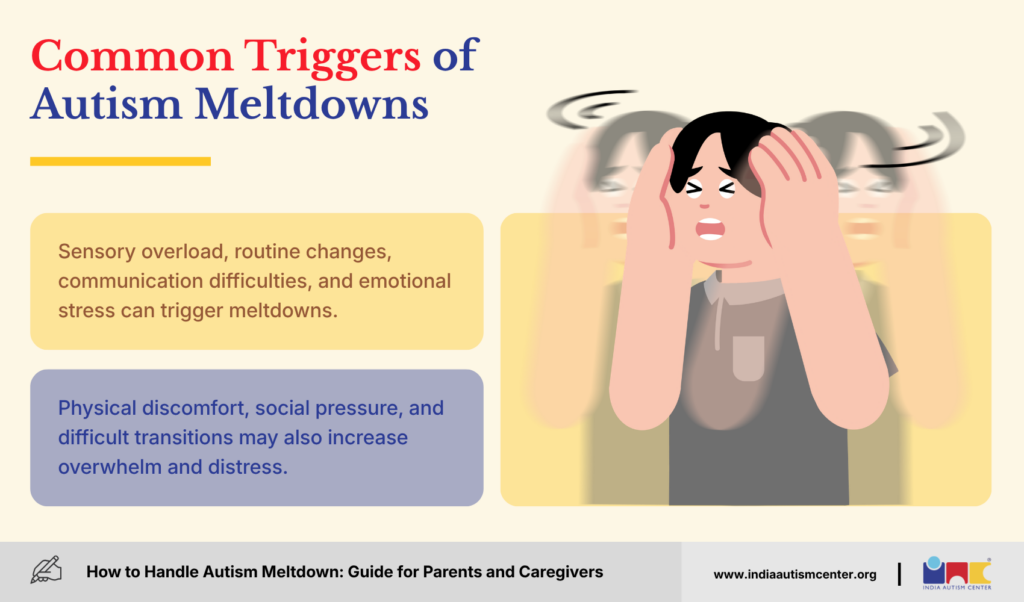
Understanding the triggers behind an autism meltdown is one of the most important steps when learning how to handle autism meltdown situations effectively. Meltdowns rarely occur without a reason. In most cases, they are the result of the child becoming overwhelmed by internal or external stressors.
Every autistic child has different sensitivities and experiences. Therefore, triggers may vary from one child to another. However, several common factors frequently contribute to meltdowns.
1. Sensory Overload
Many autistic individuals experience heightened sensitivity to sensory input. Sounds, lights, textures, smells, or crowded environments may feel much stronger and more overwhelming to them than they do to others.
For example, loud music, bright fluorescent lighting, strong food smells, or busy public places can quickly overload the sensory system. When too much sensory information enters the brain at once, the child may struggle to process it, which can lead to an autism meltdown.
Creating sensory-friendly environments and reducing unnecessary stimulation can make it easier to handle autism meltdowns and prevent them from occurring frequently.
2. Sudden Changes in Routine
Children with autism often rely on structured routines because predictability helps them feel safe and secure. When a routine changes unexpectedly, it can cause confusion, anxiety, and emotional stress.
For instance, a cancelled outing, a different classroom activity, or a sudden change in daily plans may disrupt the child’s sense of control. Without time to mentally prepare for the change, the child may feel overwhelmed and experience a meltdown.
Using visual schedules, giving advance warnings, and explaining transitions clearly can help reduce anxiety and prevent autism meltdowns caused by routine disruptions.
3. Communication Difficulties
Many autistic children face challenges when expressing their needs, feelings, or discomfort. They may know what they want but struggle to communicate it clearly using words or gestures.
When a child cannot express hunger, pain, frustration, or confusion, the internal stress may build up over time. Eventually, this frustration can lead to an autism meltdown as the child attempts to release overwhelming emotions.
Encouraging alternative communication methods, such as visual supports, communication boards, or simple gestures, can help reduce frustration and make it easier to handle autism meltdowns related to communication barriers.
4. Emotional Overload
Autistic children may find it difficult to process and regulate strong emotions such as anger, excitement, disappointment, or anxiety. When several emotions occur at the same time, the child may struggle to cope.
For example, a child might feel excited about an activity but also anxious about the unfamiliar environment. These mixed emotions can overwhelm their emotional regulation system.
When emotions build up faster than the child can manage them, the brain may respond with an autism meltdown as a way to release that pressure.
Teaching emotional awareness and simple calming strategies can help children gradually learn how to calm an autistic meltdown and regulate emotions more effectively.
5. Physical Discomfort
Physical needs often play a larger role in meltdowns than many caregivers realise. Factors such as hunger, fatigue, illness, or pain can reduce a child’s ability to cope with stress.
For instance, a child who is tired after a long school day may find it harder to manage sensory input or emotional challenges. Similarly, discomfort from tight clothing, temperature changes, or illness may contribute to frustration.
When physical discomfort combines with other triggers, the child may reach a breaking point that results in an autism meltdown.
Maintaining regular meals, ensuring adequate rest, and paying attention to signs of discomfort can help reduce these triggers and make it easier to handle autism meltdowns calmly and proactively.
6. Social and Environmental Stress
Social situations can sometimes feel confusing or overwhelming for autistic children. Busy classrooms, unfamiliar people, or situations with unclear expectations may create anxiety.
For example, a crowded birthday party or a noisy playground may involve too many interactions and sensory inputs at once. The child may struggle to process social cues while also managing environmental stress.
When these pressures build up, the child may experience an autism meltdown as their brain attempts to cope with the overload.
Preparing children for social situations and providing breaks during activities can help them manage stress and reduce the likelihood of meltdowns.
7. Transitions Between Activities
Transitions can be challenging for many autistic children because they require shifting attention from one activity to another. This shift may feel abrupt or confusing, especially if the child is deeply focused on a preferred activity.
For instance, stopping playtime to start homework or leaving the park earlier than expected may cause distress. Without preparation, these transitions may trigger resistance or emotional overwhelm.
Providing countdown warnings, visual timers, or transition cues can help children prepare mentally and make it easier to handle autism meltdowns during activity changes.
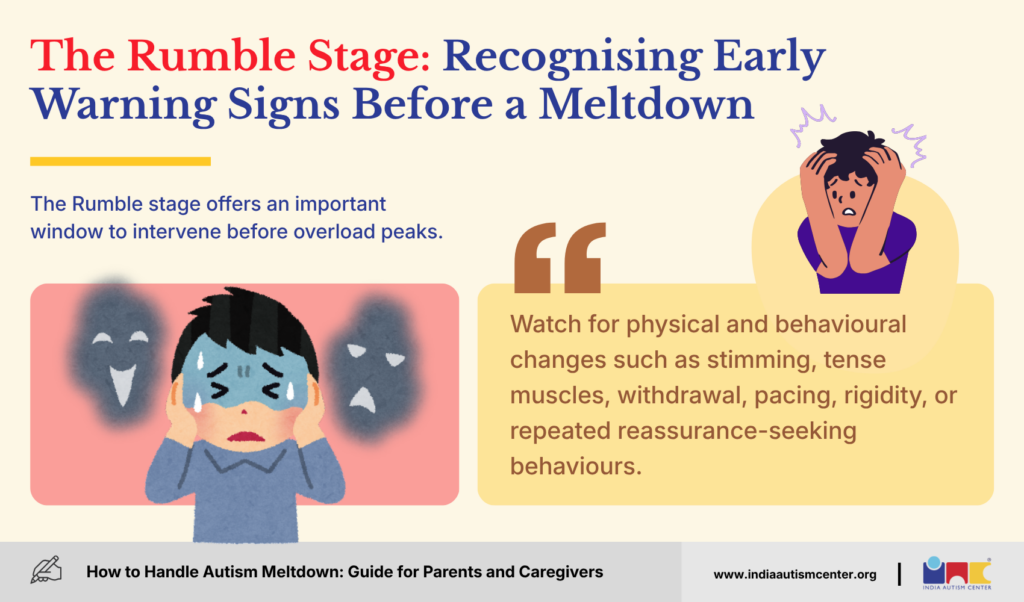
The Rumble Stage: Recognising Early Warning Signs Before a Meltdown
The single most effective thing a caregiver can do is intervene before the meltdown reaches full intensity. That window exists – but it requires knowing what to look for.
The Three-Stage Model: Rumble → Rage → Recovery
Autism meltdowns typically follow a recognisable arc:
Rumble – the build-up phase, where distress signals appear, but the nervous system has not yet reached full overload
Rage – the peak of the meltdown, where the child has lost regulatory control
Recovery – the gradual return to baseline, which can take 20 minutes to several hours
The Rumble stage is the intervention window. Once the Rage stage begins, the priority shifts to safety and containment. Intervening at the Rumble stage – by reducing demands, moving to a quieter space, or offering sensory tools – can prevent the full meltdown from occurring at all.
Physical Warning Signs to Watch For
These are the body’s distress signals, not defiance:
Flushed face or visibly warm cheeks
Tense muscles, hunched or raised shoulders
Increased or intensified stimming (rocking, hand-flapping, pacing)
Shallow, rapid breathing
Covering ears or eyes
Blurred or glazed expression (consistent with the sensory overload described in Lewis & Stevens, 2022)
Behavioural Warning Signs to Watch For
Becoming unusually quiet or withdrawn
Increased rigidity – refusing requests that are normally manageable
Repetitive questioning or seeking reassurance repeatedly
Pacing or inability to settle
Reaching for a specific comfort object
Building a Personal Warning Sign Profile
Every autistic child has a unique early-warning pattern. We recommend that parents and caregivers observe and note which signs appear first for their child – before the pattern becomes obvious. Over two to four weeks of observation, a reliable individual profile typically emerges.
Practical tip: Agree on a code word or signal with your child – something simple they can say or show you to communicate “I am overwhelmed” before it escalates. Even a hand gesture or a card with a symbol works. This gives the child agency and gives you early warning.
Intervening at the Rumble stage – moving to a quiet space, reducing demands, offering a sensory tool – is far more effective than any strategy applied during the Rage stage.
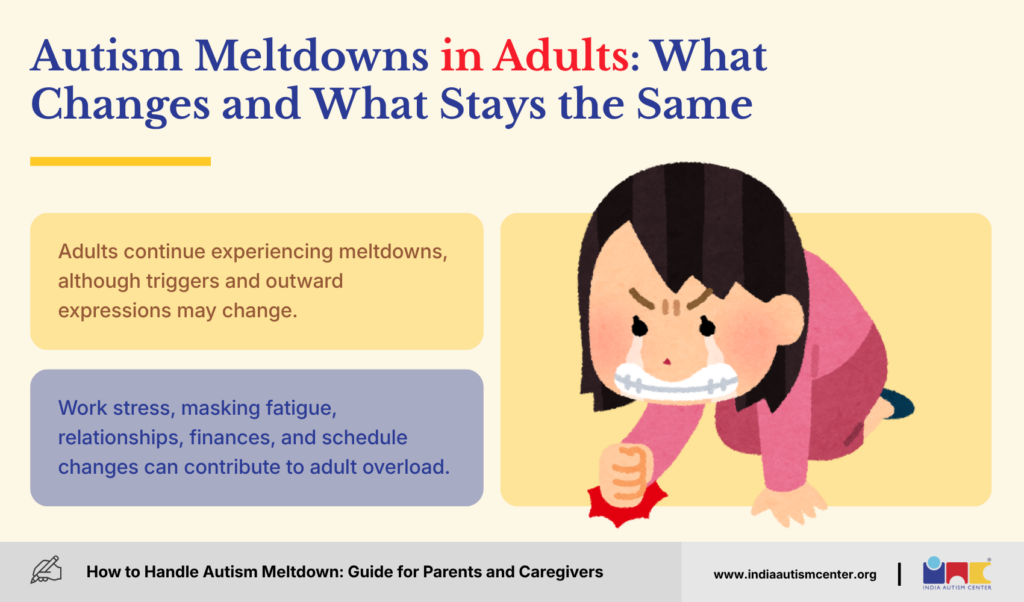
Autism Meltdowns in Adults: What Changes and What Stays the Same
There is a persistent and damaging misconception that autism meltdowns are something children grow out of. They do not. Autistic adults – across all support needs, including those who are employed, educated, and socially capable – continue to experience meltdowns throughout their lives.
What Stays the Same
The neurological mechanism is identical at every age. The amygdala becomes hyperactivated, the prefrontal cortex is overridden, and the nervous system reaches overload. The internal experience – the blurred vision, the muscle tension, the cognitive shutdown, the loss of rational control – does not diminish simply because a person has turned 18.
Lewis and Stevens (2022) found that autistic adults described meltdowns as “distressing, scary, confusing, and intensely painful events.” Many reported that the frequency varied significantly with life circumstances: some experienced meltdowns every few hours during high-stress periods; others, once or twice a year. The common thread was that the events remained neurologically involuntary.
What Changes in Adulthood
Triggers shift. School-based triggers – loud classrooms, rigid timetables, playground noise – give way to adult stressors:
Open-plan offices with unpredictable noise and interruptions
Social masking fatigue – the exhaustion of suppressing autistic traits all day to appear neurotypical
Unexpected schedule changes in professional or personal life
Financial anxiety and the pressure of independent living
Relationship demands and the complexity of adult social expectations
Masking becomes more sophisticated. Many autistic adults learn to suppress the external expression of a meltdown in public – holding it together at work, then experiencing a delayed meltdown at home when the social pressure lifts. This is not a sign that the meltdown was less severe; it is a sign that the person has learned to internalise at great personal cost.
Shame and self-blame intensify. Adults are expected to “have it together.” When a meltdown occurs, many autistic adults internalise it as personal failure – evidence that they are broken, weak, or incapable. Lewis and Stevens (2022) found that post-meltdown guilt, shame, and remorse were consistently reported, even when participants fully understood that the meltdown was not within their control.
Physical manifestations may become more internalised. Rather than the outward explosion more commonly seen in children, adult meltdowns may present as a shutdown – withdrawal, silence, inability to move or speak, dissociation. These internal meltdowns are invisible to observers but equally distressing to the person experiencing them.
Support Strategies for Autistic Adults
Self-advocacy: Learning to name and communicate personal triggers to employers, partners, and family members before overload occurs
Identifying personal triggers: Keeping a record of what precedes meltdowns (see the Meltdown Diary section below)
Scheduled decompression time: Building deliberate recovery periods into the day – particularly after high-masking situations such as meetings, social events, or commutes
Communicating needs to employers: Under the Rights of Persons with Disabilities (RPWD) Act 2016, autistic employees in India are entitled to reasonable workplace accommodations
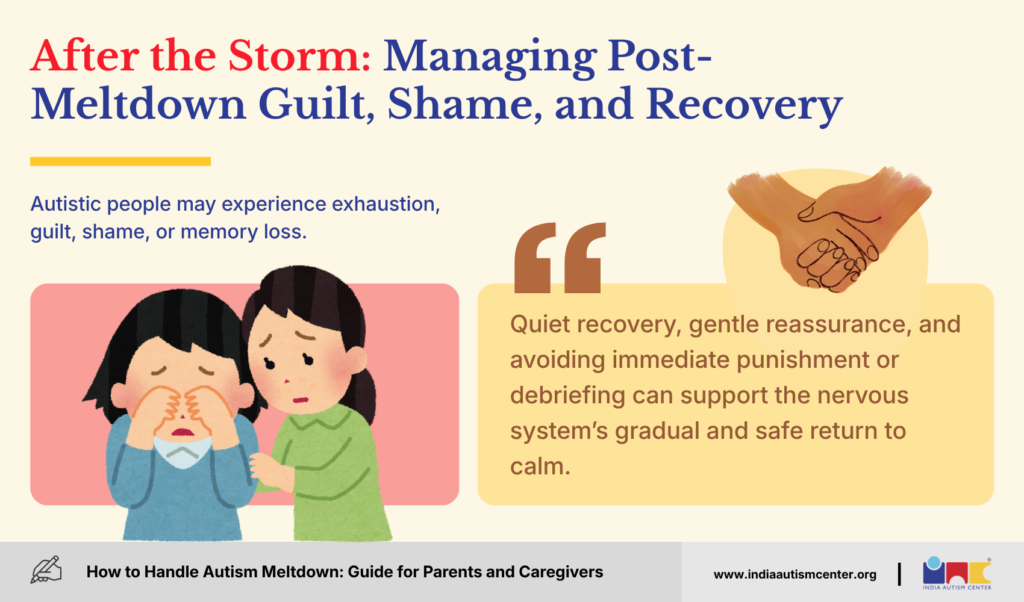
After the Storm: Managing Post-Meltdown Guilt, Shame, and Recovery
The meltdown itself is only part of the experience. What happens in the hours that follow matters just as much – for the autistic person and for the caregiver.
What the Autistic Person Experiences After a Meltdown
Lewis and Stevens (2022) found that post-meltdown experiences for autistic adults consistently included:
Profound exhaustion – physical and cognitive fatigue that can last hours or even days
Memory gaps – many participants could not recall what had happened during the meltdown; some described learning about their own behaviour second-hand from family members
Intense guilt, shame, and remorse – even when the person fully understood that the meltdown was not intentional
Negative self-worth – thoughts such as “I am worthless” or “I am broken,” which participants noted felt entirely logical during the meltdown but not outside it
For children, the post-meltdown period may look like exhaustion, tearfulness, or unusual quietness. They may not be able to articulate what happened. This is normal – the brain is still recovering.
What Caregivers Experience After a Meltdown
Caregivers are not immune to the aftermath. Emotional exhaustion, helplessness, frustration, and grief are all valid responses. Many parents describe a particular kind of loneliness – the meltdown is over, the child is resting, and the caregiver is left to process it alone.
All of these feelings are legitimate. Acknowledging them is not self-indulgent; it is necessary for sustainable caregiving.
What NOT to Do in the Immediate Aftermath
Do not debrief immediately. The nervous system needs time to reset – attempting a conversation about what happened within minutes of a meltdown adds to the overload.
Do not punish or demand apologies. The child or adult could not control what happened. Punishment does not prevent future meltdowns; it adds shame to an already painful experience.
Do not replay the incident in front of the child, or discuss it with others within earshot.
What TO Do
Allow quiet recovery time. The nervous system reset can take anywhere from 20 minutes to several hours. Offer a calm, low-stimulation environment – a favourite blanket, a quiet room, minimal talking.
Offer comfort without overwhelming. Presence without pressure. Sit nearby. Let them know you are there.
Check in gently once calm is fully restored – not surface calm, but genuine calm. A simple “Are you feeling better? Do you need anything?” is enough.
For your own recovery: Step away briefly if it is safe to do so. Debrief with a partner, a trusted friend, or a parent support group. Avoid self-blame.
Using the Calm Period Constructively
Hours or even days after the meltdown – when the child is genuinely settled – is the right time to gently explore what happened. Not as a lesson or a correction, but as a collaborative conversation: “Do you remember feeling upset yesterday? What was happening just before?” Over time, this builds the child’s self-awareness and helps them identify their own early warning signs.
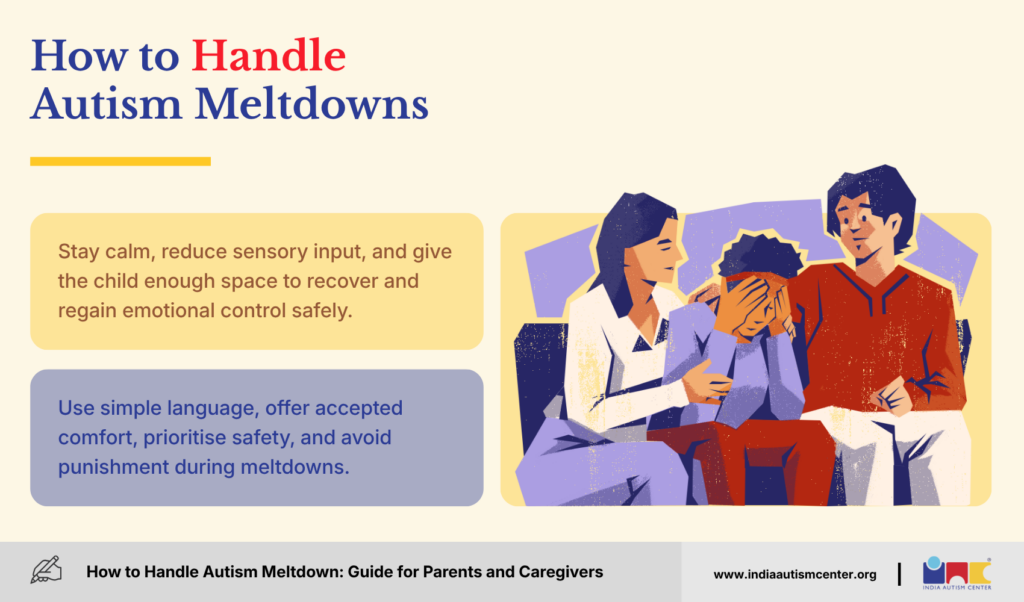
How to Handle Autism Meltdowns
When a meltdown happens, your main goal should be to help your child feel safe and regain emotional control.
Here are practical ways to handle autism meltdowns calmly and effectively.
1. Stay Calm and Patient
Children often mirror the emotions of adults around them. If we panic or raise our voice, the situation may worsen.
Instead, take a deep breath and speak in a calm tone. Your calm presence can help your child feel safe during an autism meltdown.
2. Reduce Sensory Input
Many meltdowns occur due to sensory overload. Reducing stimulation can help calm an autistic meltdown.
You can try the following:
Move the child to a quieter space
Dim bright lights
Turn off loud music or devices
Provide noise-cancelling headphones
A calmer environment can help the nervous system settle.
3. Give the Child Space
Some children need physical space during a meltdown. Too much interaction can increase distress.
Allow your child to sit, lie down, or move around safely while they calm themselves. Stay nearby so they know you are present and supportive.
4. Use Simple and Clear Language
During an autism meltdown, the brain struggles to process complex instructions.
Use short, simple sentences such as:
“You are safe.”
“Let’s take deep breaths.”
“We will sit here quietly.”
Clear communication helps reduce confusion and anxiety.
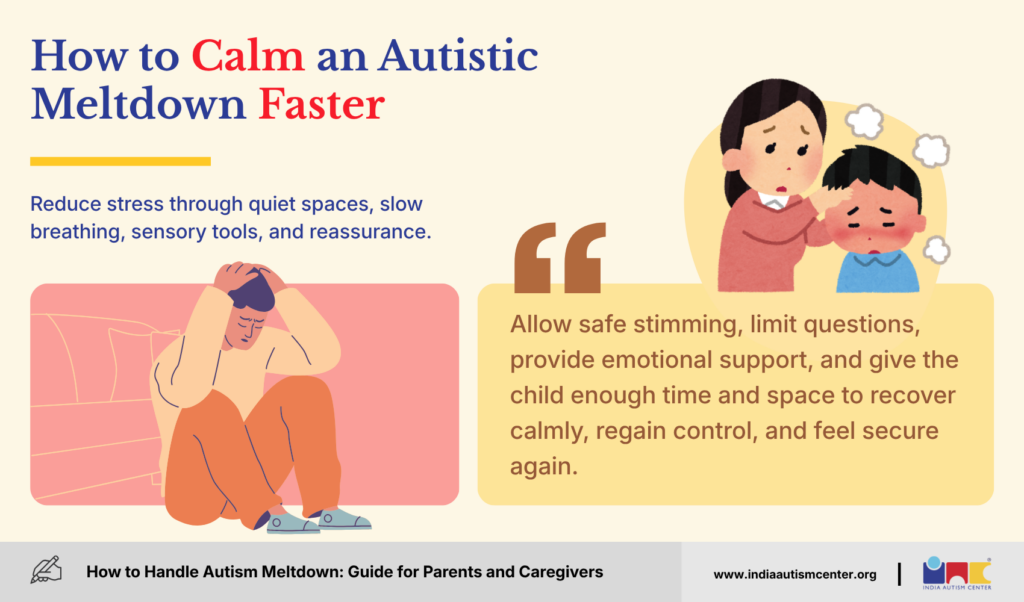
When an autism meltdown occurs, the child’s nervous system is in a state of overload. At that moment, the goal is not to reason, discipline, or correct behaviour. Instead, the focus should be on reducing stress and helping the child regain emotional control.
Although every child is different, certain strategies can help calm an autistic meltdown more quickly and safely. These techniques aim to regulate sensory input, reduce anxiety, and support the child until they feel stable again.
1. Encourage Slow and Deep Breathing
Breathing exercises can help regulate the nervous system during stressful situations. Slow breathing sends signals to the brain that the body is safe, which gradually reduces panic and emotional intensity.
You can gently guide your child by saying simple instructions such as “Breathe in slowly” and “Breathe out slowly.” Demonstrating the breathing yourself may also help the child follow your actions more easily.
Even a few deep breaths can help calm an autistic meltdown by slowing the heart rate and reducing physical tension.
2. Move to a Quiet and Safe Space
A calm environment can make a significant difference in learning to handle autism meltdowns effectively. If possible, guide the child to a quieter place where sensory stimulation is lower.
For example, you can move to a quiet room, a calm corner in the house, or a less crowded area if you are outside. Reducing loud sounds, bright lights, and visual distractions helps the brain recover from sensory overload.
This change of environment often allows the child to regain control more quickly during an autism meltdown.
3. Offer Sensory Regulation Tools
Many autistic children respond well to sensory tools that help regulate their nervous system. These tools provide controlled sensory input that can be calming and reassuring.
Examples include:
Stress balls or fidget toys
Weighted blankets or lap pads
Soft textures such as sensory cushions
Noise-cancelling headphones
These tools give the child something familiar and soothing to focus on, which may help calm an autistic meltdown faster.
4. Use Visual Supports
During an autism meltdown, verbal communication may become difficult for the child to process. Visual supports can provide clear guidance without overwhelming them with too many words.
You can use tools such as:
Emotion charts showing different feelings
Calm-down cards with simple instructions
Visual routines for breathing or relaxation
Visual cues help the child understand what they can do to regulate their emotions, making it easier to handle autism meltdowns in a structured way.
5. Speak in a Calm and Reassuring Tone
Your voice and body language play a major role in how the child responds during a meltdown. If we speak loudly, show frustration, or rush the child, their stress may increase.
Instead, speak slowly and gently. Short phrases such as “You are safe,” “I am here,” or “It will be okay” can provide reassurance without overwhelming the child with information.
A calm and supportive presence can help the child feel secure while the autism meltdown gradually passes.
6. Allow Safe Stimming Behaviour
Stimming behaviours such as rocking, hand-flapping, or pacing often help autistic individuals regulate their sensory input. During an autism meltdown, these movements may increase.
As long as the behaviour is safe, it is helpful to allow the child to stim freely. These repetitive movements can help release built-up tension and support emotional regulation.
Allowing safe stimming can therefore be an effective way to calm an autistic meltdown naturally.
7. Give the Child Time to Recover
Meltdowns do not stop instantly because the brain needs time to recover from overload. Trying to rush the process or forcing the child to calm down may increase distress.
Instead, stay nearby and allow the child to regain control at their own pace. Your calm presence reassures them that they are safe and supported.
Patience is essential when learning how to handle autism meltdowns effectively, as recovery may take several minutes or sometimes longer.
8. Avoid Asking Too Many Questions
During an autism meltdown, the brain may struggle to process language and respond to questions. Asking many questions, such as “What happened?” or “Why are you upset?” can increase frustration.
Instead, focus on simple reassurance and supportive actions. You can discuss the situation later once the child has fully calmed down.
Reducing verbal pressure helps make it easier to handle autism meltdowns without adding extra stress.
9. Stay Close and Offer Emotional Support
Even if the child prefers space, knowing that a trusted caregiver is nearby can provide emotional security. Stay close enough to monitor safety, but allow the child the distance they need.
Your presence communicates support and stability, which helps the child gradually regulate their emotions.
Over time, consistent support teaches the child that meltdowns are safe moments where caregivers will help them calm down during an autism meltdown rather than punish them.
Meltdown Diary: How to Track Triggers and Reduce Meltdown Frequency
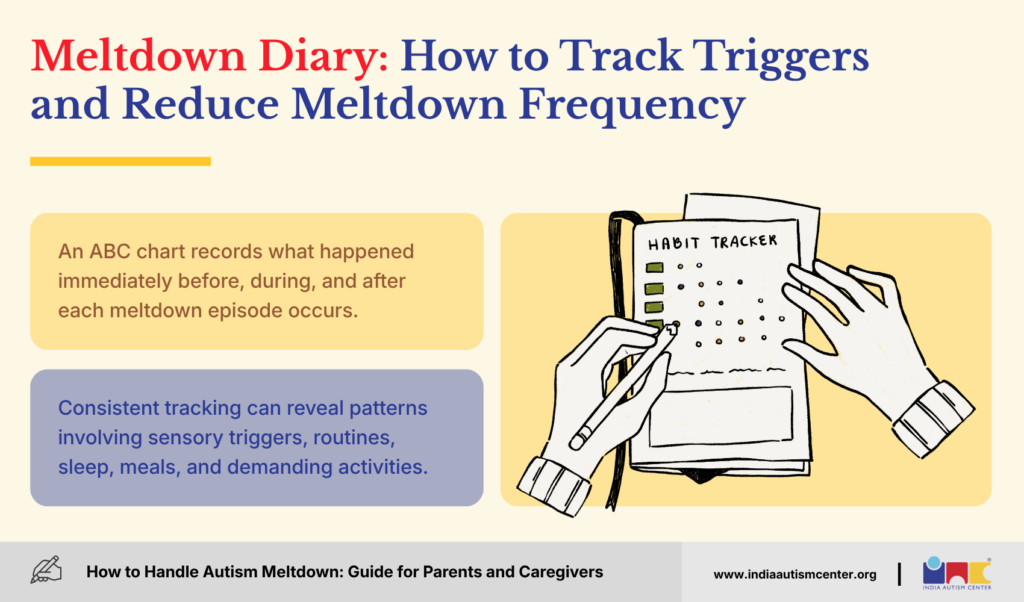
Patterns that are invisible in the moment become clear over time. A meltdown diary – sometimes called a behaviour log or ABC chart – is one of the most practical tools available to parents and caregivers.
What Is an ABC Chart?
The ABC framework stands for:
A – Antecedent: What happened immediately before the meltdown
B – Behaviour: What the meltdown looked like (intensity, duration, type of behaviour)
C – Consequence/Response: What was done in response, and whether it helped
This structure, used by behaviour therapists and special educators worldwide, turns individual meltdown incidents into usable data.
What to Record After Each Meltdown
Keep entries brief – consistency matters far more than detail. Record:
1. Date, time, and location
2. What happened immediately before (the antecedent): where were you, who was present, what was the child doing?
3. What the meltdown looked like: intensity (mild/moderate/severe), duration, specific behaviours
4. What helped or did not help in the moment
5. Physical state: Had the child eaten recently? Slept well the night before? Were they unwell?
What Patterns Typically Emerge
After two to four weeks of consistent recording, patterns usually become visible. Common findings include:
Meltdowns clustering on Monday mornings – the transition back to school after the weekend
Meltdowns following long outings or social events, even when the child appeared to cope well at the time (a sign of delayed overload)
A specific sensory trigger – a particular sound, texture, or smell – appearing in nearly every antecedent
A correlation with poor sleep or missed meals
These patterns allow for proactive adjustments: schedule changes, sensory accommodations, pre-emptive calming routines, or simply building in more recovery time after demanding activities.
How to Use the Diary Effectively
Keep it simple. A notes app on your phone works perfectly well. A dedicated notebook is fine too. The format is irrelevant; the consistency is everything.
Share it with your child’s therapist, school, or the clinical team at India Autism Center. A well-kept meltdown diary is a powerful clinical tool – it can inform therapy goals, school accommodation plans, and sensory profiles in ways that memory alone cannot.
Involve the child where appropriate. Older children and teenagers can sometimes contribute to the diary themselves, which builds self-awareness and a sense of agency.
What to do After an Autism Meltdown
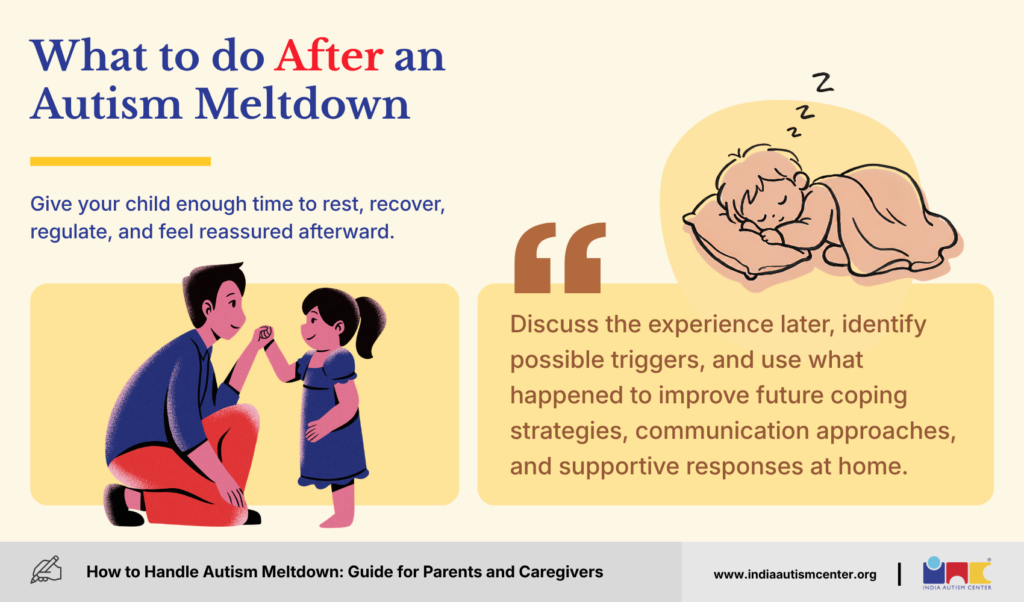
Once the meltdown ends, the child may feel exhausted, embarrassed, or confused. This is the time for gentle support.
Give Time to Recover
Allow your child to rest. Their nervous system needs time to recover after intense emotional stress.
Offer Reassurance
Let your child know they are safe and loved. Avoid criticism or blame.
Discuss the Situation Later
When your child is calm, you can talk about what happened. Try to identify triggers and discuss better coping strategies.
Adjust Future Strategies
Each meltdown teaches us something new. Use these experiences to plan better responses next time.
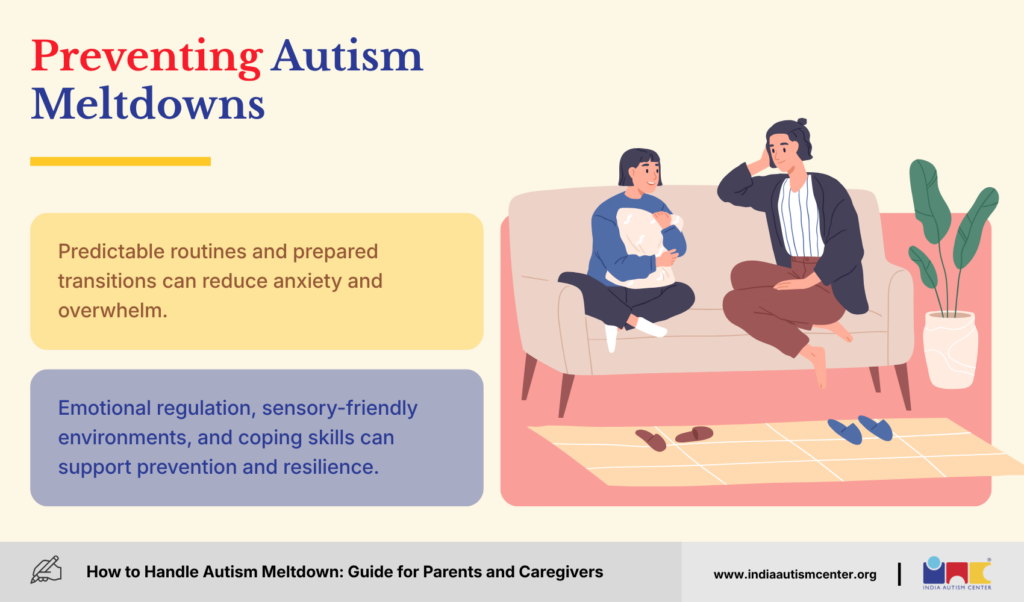
While we cannot prevent every autism meltdown, we can reduce its frequency by planning ahead. Here are some preventive strategies.
Maintain Predictable Routines
Structured routines help children feel secure and reduce anxiety.
Prepare for Transitions
Use visual schedules or reminders before changing activities.
Teach Emotional Regulation
Help your child learn words for emotions such as “frustrated”, “tired”, or “overwhelmed”.
Create a Sensory-Friendly Environment
Reduce sensory triggers at home and school whenever possible.
Build Coping Skills
Teach calming techniques such as breathing exercises, sensory breaks, or quiet time.
These strategies make it easier to handle autism meltdowns and support emotional development.
Conclusion
Learning how to handle autism meltdown situations calmly and effectively can make a significant difference for both parents and children.
Remember:
An autism meltdown is a response to overwhelming stress, not bad behaviour.
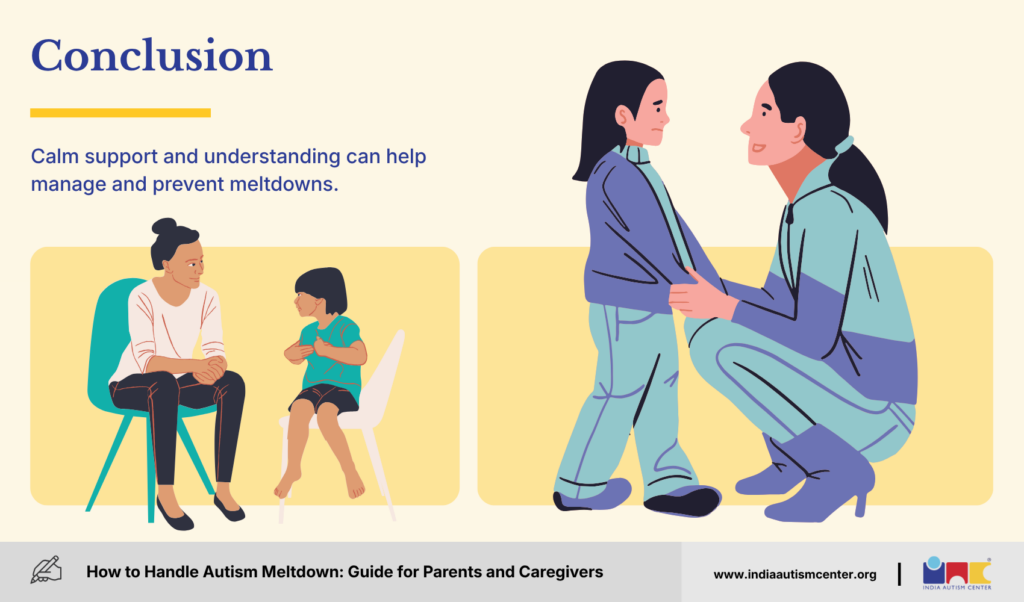
Your calm support helps your child feel safe.
Understanding triggers can help prevent future meltdowns.
With patience, awareness, and the right strategies, we can learn how to calm an autistic meltdown and support children with autism more effectively.
Frequently Asked Questions (FAQs)
What is an autism meltdown?
An autism meltdown is an intense emotional reaction that occurs when an autistic person becomes overwhelmed by sensory input, stress, or strong emotions. During a meltdown, the child may cry, scream, withdraw, or display repetitive behaviours because their nervous system is overloaded. Unlike tantrums, meltdowns are not intentional behaviours but a response to overwhelming situations.
What causes an autism meltdown?
Several factors can trigger an autism meltdown, including sensory overload, sudden changes in routine, communication difficulties, emotional stress, or physical discomfort. Loud noises, crowded environments, unfamiliar situations, or frustration from not being able to express needs can also lead to a meltdown.
How to calm an autistic meltdown quickly?
To calm an autistic meltdown, first stay calm and create a quiet, safe environment. Reduce sensory stimulation by lowering noise and lights, and speak in short, reassuring sentences. Offering sensory tools such as a stress ball or weighted blanket may also help the child regulate their emotions more quickly.
How should parents handle autism meltdowns at home?
Parents can handle autism meltdown situations by staying patient, reducing sensory triggers, and allowing the child space to calm down. Speaking calmly, ensuring the environment is safe, and offering comfort items can help the child regain emotional control. After the meltdown, parents can gently discuss the situation to identify triggers and prevent future meltdowns.
For expert insights, support services, and inclusive learning initiatives, visit the India Autism Center.
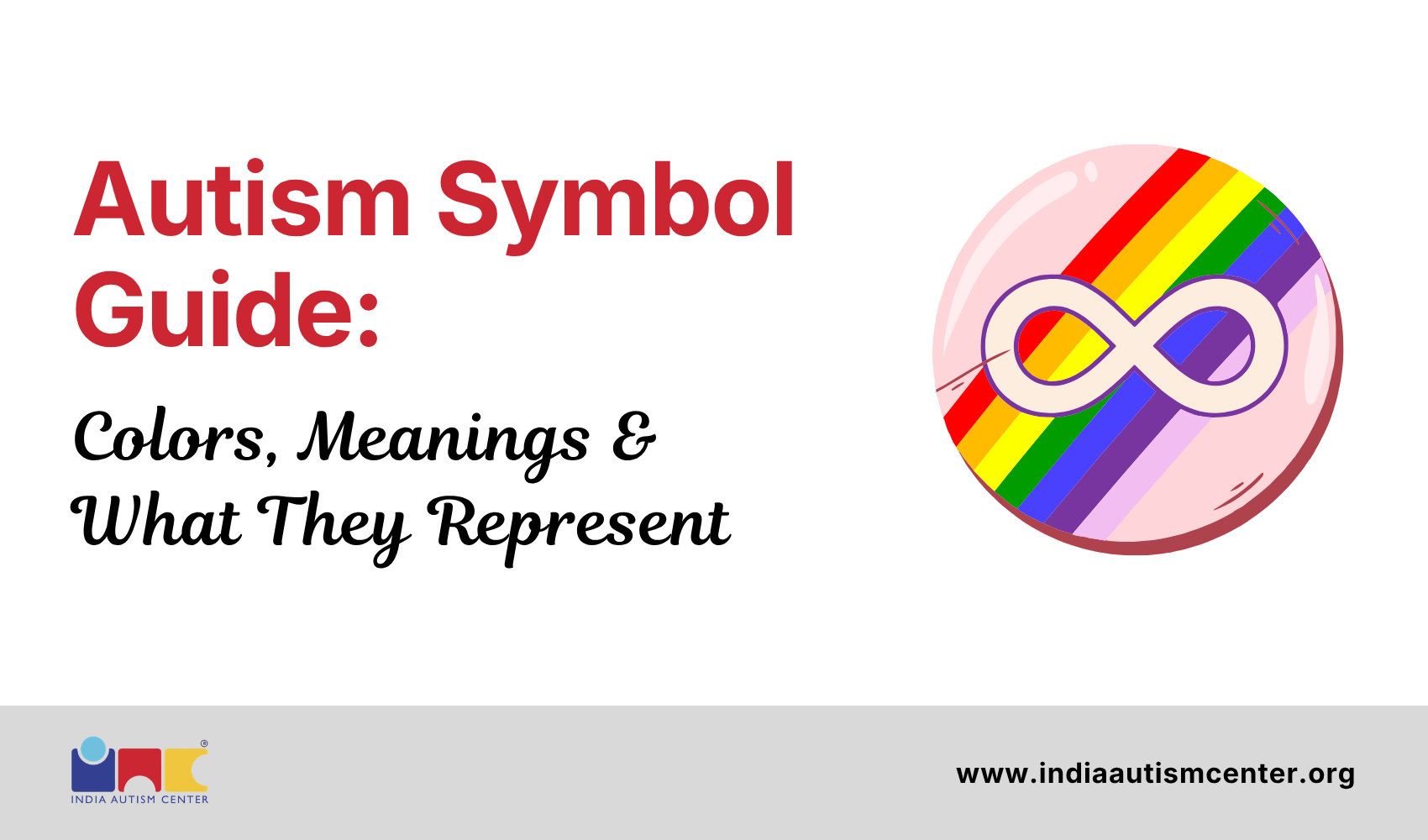
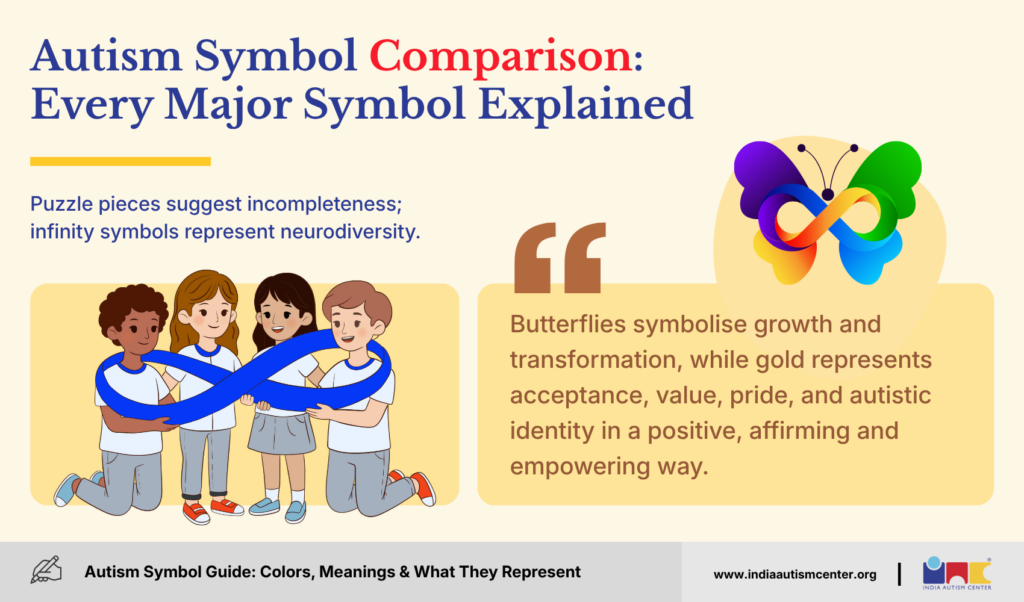
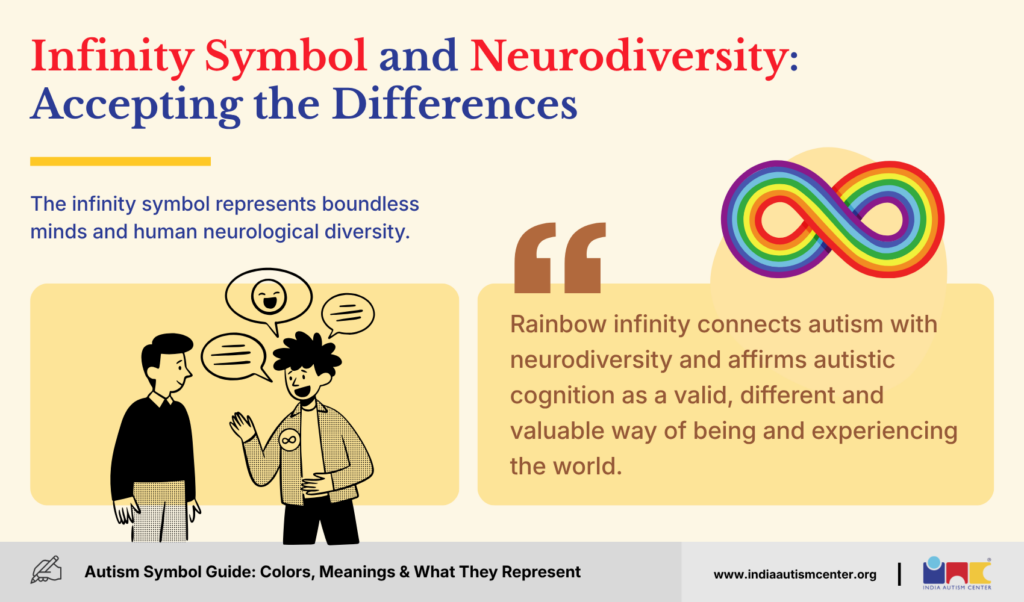
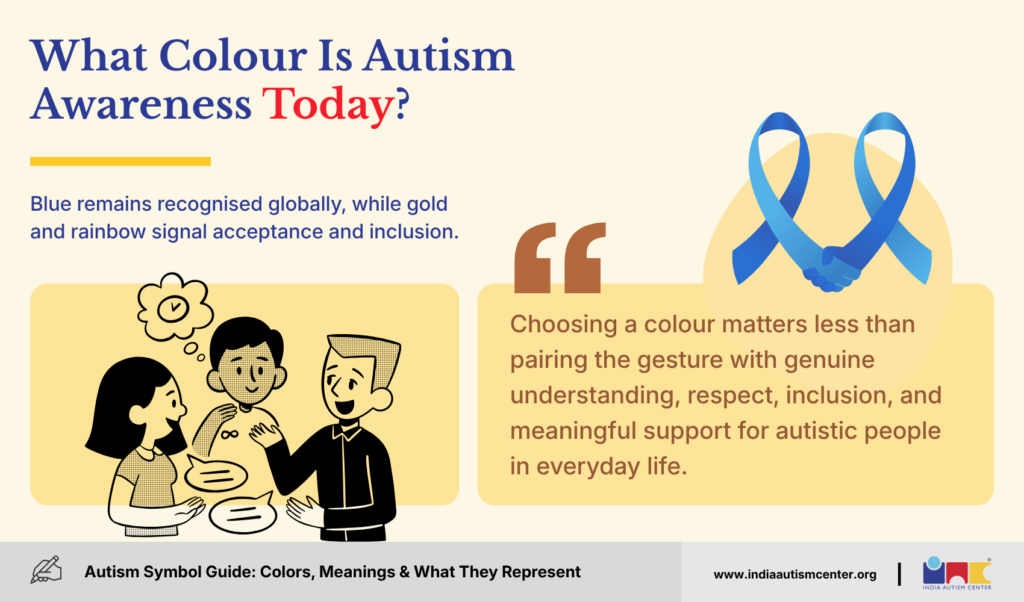
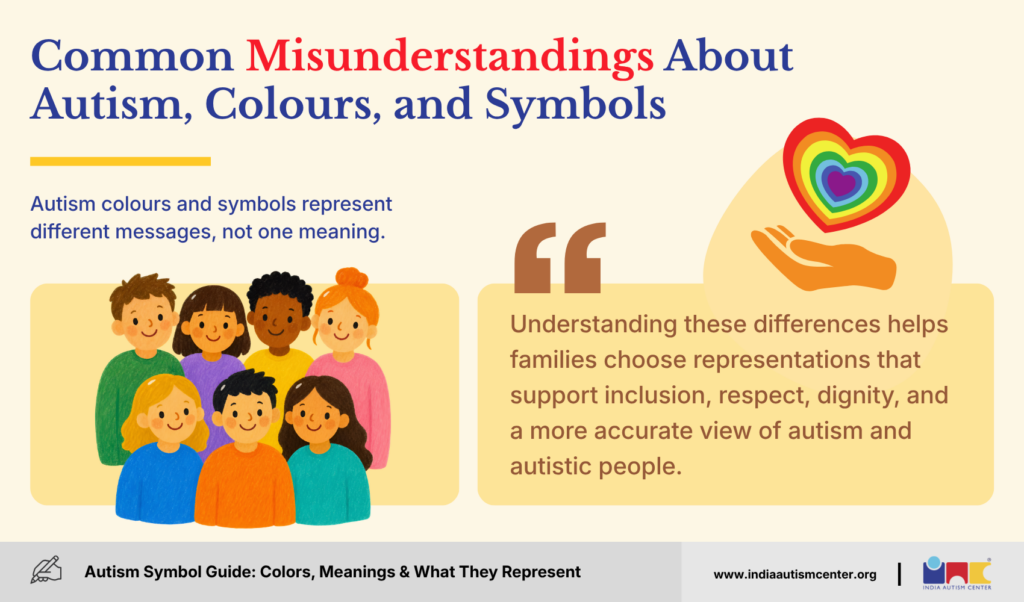
There is no single, universally agreed autism symbol. The puzzle piece (1963) was the first, but many autistic adults now prefer the infinity symbol or rainbow as more affirming alternatives. Autism colours range from blue (awareness) to gold (acceptance) to rainbow (neurodiversity). Understanding what each symbol and colour means helps parents, educators, and advocates communicate with greater respect and accuracy.
Every parent who has attended an autism awareness event has seen the imagery: puzzle pieces on banners, blue lights on buildings, rainbow ribbons on lapels. But what do these symbols actually mean? And which ones do autistic people themselves prefer?
The autism symbol landscape has shifted dramatically over the past two decades. What began as a single puzzle piece in 1963 has grown into a rich, sometimes contested vocabulary of colours and icons – each carrying a distinct message about identity, acceptance, and belonging. According to the World Health Organisation, approximately 1 in 127 people worldwide is on the autism spectrum. In India, diagnoses are rising steadily, yet misconceptions about autism persist in many communities.
The History of Autism Symbols
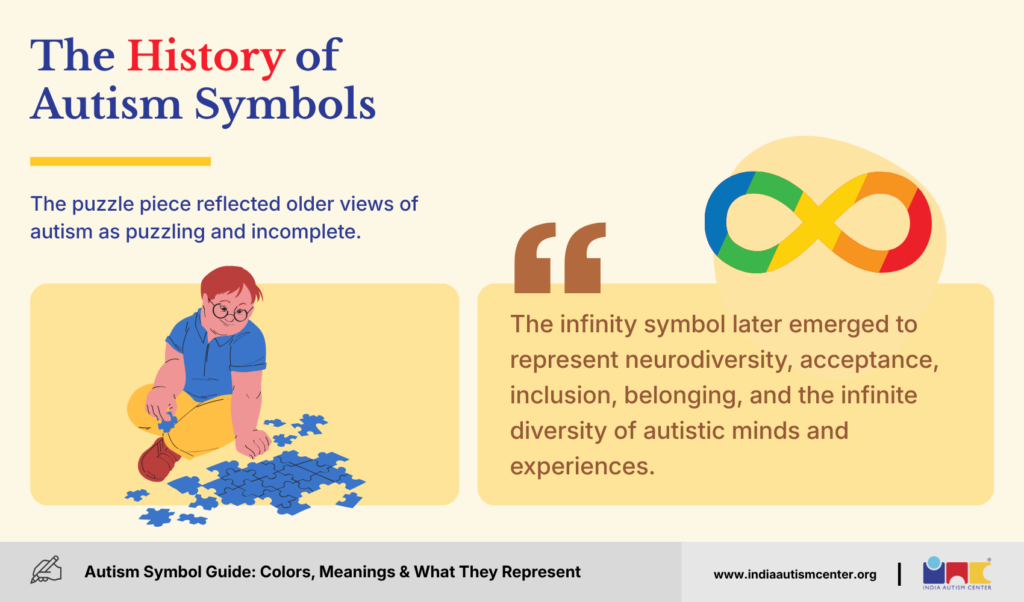
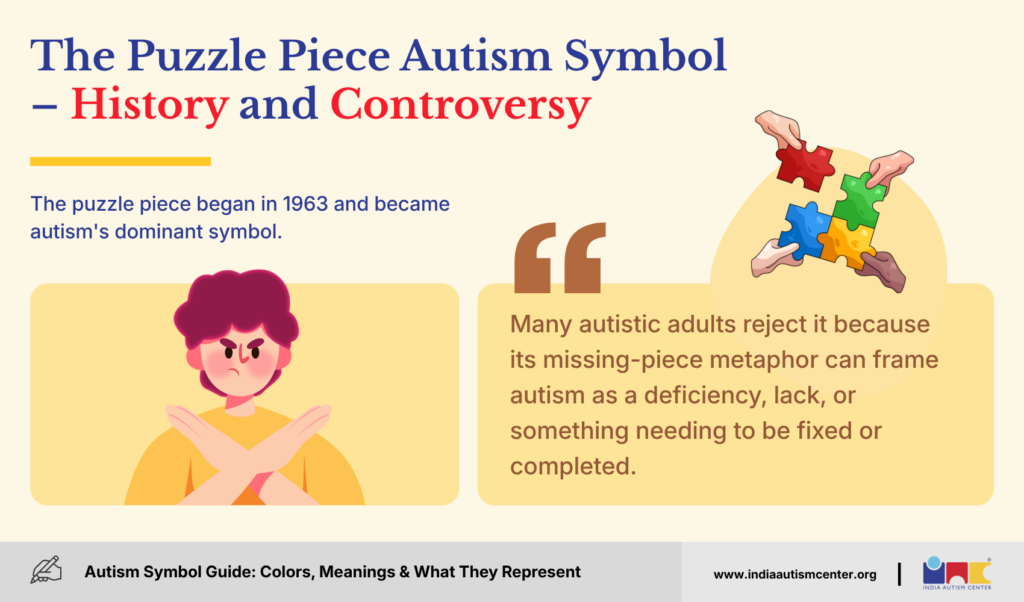
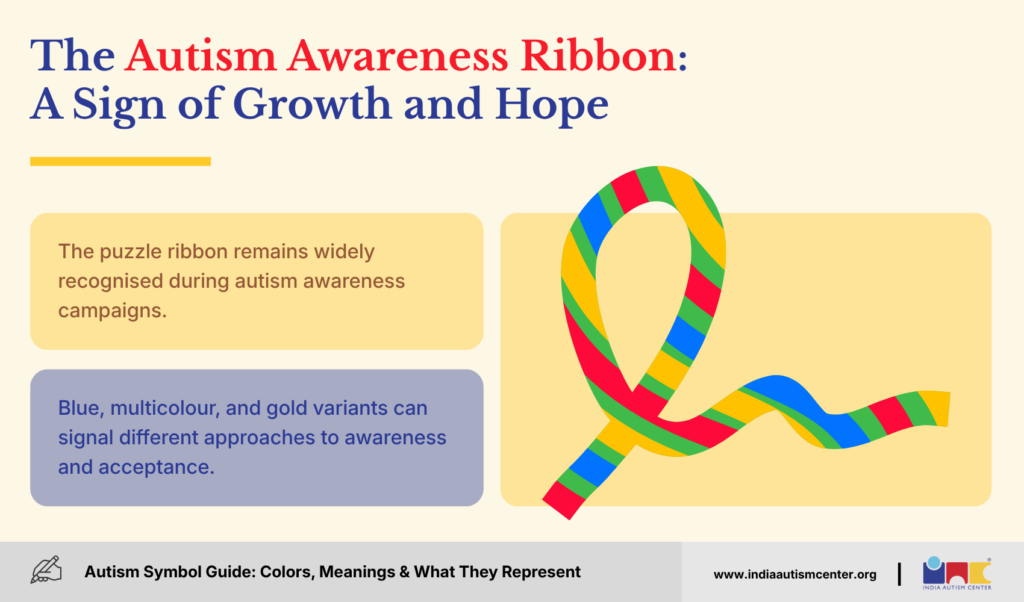
The puzzle piece was created in 1963 by the National Autistic Society (UK), then known as the National Society for Autistic Children. The designer, Gerald Gasson, chose a puzzle piece with a weeping child at its centre – a choice that reflected the era’s view of autism as a tragic, “puzzling” condition that needed to be solved.
The Autism Society of America later adopted a variation of the puzzle piece, cementing it as the dominant autism symbol for decades. For many families in the 1970s, 1980s, and 1990s, it was the first symbol that gave them access to a community, resources, and recognition.
But the framing was always problematic. A puzzle piece implies something is missing. It suggests that an autistic person is incomplete – a problem to be solved rather than a person to be understood.
Today, a significant number of autistic self-advocates reject the puzzle piece for exactly this reason. The “missing piece” metaphor feels dehumanising. It centres the discomfort of non-autistic people rather than the dignity of autistic ones.
The Shift to the Infinity Symbol
From the early 2010s onward, a new autism symbol gained ground: the infinity symbol – a figure-eight lying on its side, with no beginning and no end. Unlike the puzzle piece, it carries no suggestion of incompleteness. Instead, it represents the infinite diversity of autistic minds and the idea that autism is a natural, lifelong part of human variation.
The shift from puzzle piece to infinity symbol is not just aesthetic. It reflects a deeper philosophical move – from “awareness” (knowing autism exists) to autism acceptance (respecting autistic people as they are).
Why Autism Colours and Symbols Matter?
Autism is a neurodevelopmental condition affecting communication, behaviour, sensory processing, and social interaction. The WHO’s 2021 global estimate puts prevalence at 1 in 127 individuals – and that figure is almost certainly an undercount in countries like India, where diagnostic infrastructure is still developing and stigma delays many families from seeking assessment.
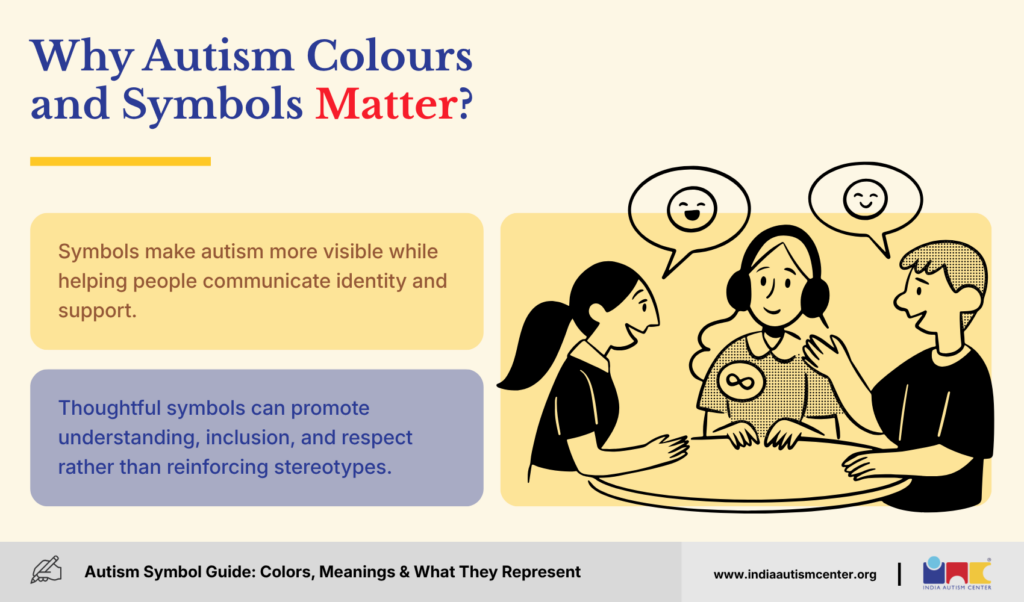
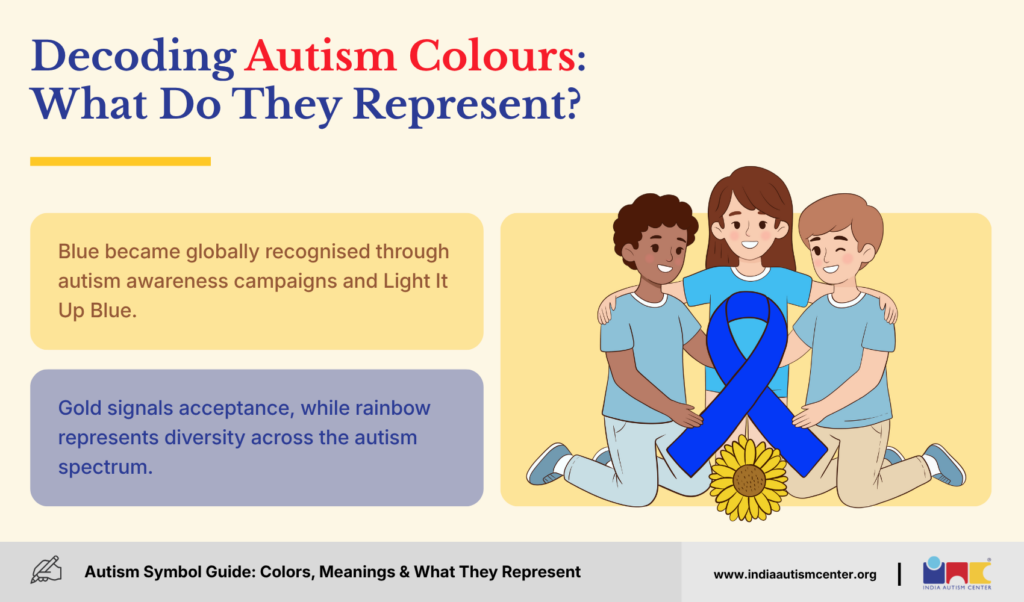
Symbols and autism colours matter because they:
Raise public awareness – a recognisable symbol can open a conversation in a classroom, a workplace, or a doctor’s waiting room
Create visibility during awareness campaigns, school events, and public advocacy
Allow autistic individuals to express identity and pride – wearing a gold infinity pin is an act of self-affirmation, not just a gesture for others
Shape how society perceives autism – positively or negatively, depending on the symbol chosen
When chosen thoughtfully, autism symbols and colours promote understanding rather than stereotypes.
Autism Symbol Comparison: Every Major Symbol Explained
Here is a side-by-side look at the major autism symbols in use today.
Symbol
Also Known As
Colours Used
What It Represents
Community Sentiment
Puzzle Piece
Jigsaw piece, puzzle ribbon
Blue, multicolour
Autism as a “puzzling” condition; used by older organisations
Mixed – many autistic adults reject it; some families still identify with it
Infinity Symbol
Rainbow infinity, gold infinity
Rainbow, gold, red
Infinite brain diversity; neurodiversity; no beginning or end
Widely preferred by autistic self-advocates and the neurodiversity movement
Butterfly
Butterfly autism symbol
Rainbow, multicolour
Transformation, growth, hope; no two butterflies identical
Popular with parents of young children and early intervention centres
Awareness Ribbon
Puzzle ribbon
Blue, multicolour
Solidarity during awareness campaigns; puzzle-piece pattern
Broadly recognised; associated with April campaigns
Rainbow Spectrum
Autism rainbow
Full spectrum
The breadth of the autism spectrum; diversity of experience
Growing adoption by schools, advocacy groups, and families
Gold / “Go Gold”
Gold infinity, Au symbol
Gold
Acceptance, value, excellence; Au = first two letters of “autism”
Strongly preferred by acceptance-focused advocates
The trend is clear. Symbols rooted in the awareness era (puzzle piece, blue ribbon) are giving way to symbols rooted in the acceptance era (gold, rainbow infinity). The language has shifted too – many advocates now prefer “Autism Acceptance Month” over “Autism Awareness Month,” and that shift is reflected in the symbols people choose to wear and display.
Decoding Autism Colours: What Do They Represent?
If you have ever searched online for “What colour is for autism?”, you might have found different answers. This is because different campaigns use different colours to send specific messages. Let’s break down the most common autism awareness colours.
The Autism Blue Colour
For most of the late 20th century, autism blue was the dominant colour. It was popularised globally by Autism Speaks’ “Light It Up Blue” campaign, launched in 2010 to coincide with World Autism Awareness Day on 2 April – a date officially designated by the United Nations General Assembly in 2007 (first observed in 2008).
Blue was chosen to convey calmness, trust, and authority. Landmarks around the world – including the Empire State Building and the Eiffel Tower – have been lit blue on 2 April.
The problem? Blue was originally chosen partly because early research focused almost exclusively on autistic boys. As awareness grew that autism affects girls, women, and non-binary individuals in equal measure, the exclusively male associations of blue began to feel exclusionary. Many autistic women and gender-diverse people have moved away from blue precisely because it does not reflect their experience.
Blue remains the most globally recognised autism awareness colour, but it is no longer the whole story.
The “Go Gold” Movement
Gold is the most compelling colour story in the autism world. In chemistry, the symbol for gold is Au – the first two letters of “autism.” That simple coincidence became the foundation of the “Go Gold” movement, which emerged from autistic-led community spaces around 2011–2012.
The autism gold colour carries a message that blue does not: acceptance over awareness. Awareness says “autism exists.” Acceptance says “autistic people are valuable exactly as they are.”
Gold also carries connotations of excellence and worth – a deliberate counter-narrative to the deficit-focused framing of older autism campaigns. When you see a gold infinity pin, it is a statement: this person is not a puzzle to be solved. They are gold.
The Vibrant Autism Rainbow
The autism rainbow is arguably the most accurate visual metaphor for autism. Because autism is a spectrum – not a single, fixed presentation – no two autistic people are alike. A rainbow, with its continuous blending of colours, captures that diversity better than any single hue.
The autism rainbow is increasingly adopted by schools, university disability services, and advocacy organisations that want to signal genuine inclusion. It aligns naturally with the neurodiversity movement, which holds that neurological differences are a normal part of human variation, not defects to be corrected.
In India, we are seeing more schools and parent groups adopt rainbow imagery as they move from a medical-model framing of autism toward a rights-based, identity-affirming one.
Red – Autism in a Different Light
Some campaigns use red for autism – particularly those focused on urgency, action, and policy change. Red is less common than blue, gold, or rainbow, but it appears in certain advocacy contexts where the goal is to signal that more needs to be done: more funding, more research, more inclusive education. It is worth knowing about, even if it is not the dominant colour in most communities.
The Puzzle Piece Autism Symbol – History and Controversy
The puzzle piece autism symbol deserves its own section, because the debate around it is ongoing and genuinely complex.
The 1963 Origin
The puzzle piece was designed in 1963 by Gerald Gasson for the UK’s National Autistic Society. The original logo showed a puzzle piece with a weeping child – a design that reflected the prevailing view of autism at the time as a mysterious, distressing condition. The Autism Society of America later adopted a colourful puzzle-piece ribbon, which became the most widely recognised autism symbol worldwide.
For decades, the puzzle piece was the symbol that opened doors. It appeared on fundraising materials, school resources, and awareness campaigns. For many families, especially those who received a diagnosis in the 1980s or 1990s, it was the first visual language they had for their child’s experience.
Why Many Autistic Adults Reject It
The criticism is not new, but it has grown louder as autistic self-advocates have gained more platforms. The core objection: a puzzle piece implies something is missing. It frames autism as a deficiency – a condition that needs to be completed, fixed, or solved. The original weeping child imagery made this framing explicit.
Many autistic adults find the puzzle piece dehumanising. It centres the perspective of non-autistic observers (“autism is puzzling to us”) rather than the experience of autistic people themselves. Organisations like the Autistic Self Advocacy Network (ASAN) have moved away from it entirely.
Why Some Families Still Use It
At the same time, many families – particularly those who have been in the autism community for a long time – still identify with the puzzle piece. For them, it represents a history of advocacy, community-building, and hard-won resources. Dismissing it entirely can feel like erasing that history.
The honest position is this: the puzzle piece is not universally accepted, and it is not universally rejected. What matters is understanding why some people find it harmful, and making an informed choice about whether to use it.
The Butterfly Autism Symbol: A Sign of Growth and Hope
The butterfly autism symbol is one of the most emotionally resonant icons in the autism community – and one of the most popular with parents of young children.
The metaphor is straightforward: a caterpillar enters a cocoon and emerges as a butterfly. The transformation is not linear, it is not predictable, and the result is something beautiful that could not have been anticipated from the beginning. This maps onto the experience of many autistic children with striking accuracy.
No two butterflies have the same wing pattern. No two autistic children have the same profile of strengths, challenges, and ways of experiencing the world. The butterfly symbol holds both of these truths at once.
Early intervention centres in particular have embraced the butterfly autism symbol because it gives families a hopeful, forward-looking frame. If a child is non-verbal at age three but begins to communicate meaningfully at age six, that is their “butterfly moment” – a transformation that happened at its own pace, in its own time, and on its own terms.
Teachers use the butterfly in classroom displays to create environments where every child’s unique development is celebrated rather than measured against a fixed norm. It is a symbol that says: your child is not behind. They are becoming.
Infinity Symbol and Neurodiversity: Accepting the Differences
The infinity symbol for autism – a figure-eight lying on its side – has become the emblem of the neurodiversity movement, and it is easy to see why.
A figure-eight has no beginning and no end. It loops continuously, suggesting that there is no fixed point at which “normal” ends and “different” begins. Applied to autism, it represents the infinite variety of ways the human brain can work – and the idea that autistic cognition is not a broken version of neurotypical cognition, but a genuinely different, valid way of being.
The rainbow infinity symbol adds another layer: it links autism to the broader neurodiversity movement, which includes ADHD, dyslexia, dyspraxia, and other neurological differences. The rainbow colours signal intersectionality – the recognition that neurodivergent identities overlap with other aspects of identity, including gender, culture, and disability.
Autistic self-advocates prefer the infinity symbol over the puzzle piece for a clear reason: it does not imply incompleteness. It does not suggest that autistic people need to be fixed. It says, simply, that their minds are boundless.
In India, the infinity symbol is gaining ground in urban autism communities and among younger parents who have engaged with international autistic-led advocacy. It is the symbol we expect to see far more of in the years ahead.
The Autism Awareness Ribbon: A Sign of Growth and Hope
The autism awareness ribbon is the puzzle-piece ribbon – a ribbon shape filled with a colourful jigsaw pattern. It is one of the most immediately recognisable autism symbols in the world, particularly during April awareness campaigns.
Colour variants and what they signal:
Blue puzzle ribbon – traditional awareness, most associated with Autism Speaks and the “Light It Up Blue” campaign
Multicolour puzzle ribbon – broader community representation, signals that autism affects people of all backgrounds and genders
Gold ribbon – acceptance-focused, used by advocates who want to signal the shift from awareness to acceptance
How to wear or use it respectfully:
Wear it as a conversation starter, not a substitute for education
If someone asks what it means, be ready to explain the difference between awareness and acceptance
Consider pairing it with a gold or rainbow element to signal that your support extends beyond April
Listen to autistic people in your community about which symbols they find affirming
The ribbon remains a widely understood shorthand for autism solidarity. Used thoughtfully, it can open important conversations.
What Colour Is Autism Awareness Today?
The honest answer to “what colour is autism awareness?” is: it depends on what you mean by awareness.
Here is how the colour landscape has evolved:
Blue (awareness era, 1990s–2010s): Blue was the dominant autism awareness colour for two decades. It raised global visibility for autism through campaigns like “Light It Up Blue.” It remains the most widely recognised colour internationally, and it is still used on World Autism Awareness Day, 2 April – the UN-designated observance that has been observed annually since 2008.
Gold (acceptance era, 2011–present): The autism gold colour emerged from autistic-led communities as a direct response to blue. Where blue signals “we know autism exists,” gold signals “we value autistic people.” The “Go Gold” movement has grown steadily, particularly among autistic self-advocates and families who prioritise acceptance over awareness.
Rainbow (neurodiversity era, 2010s–present): The autism rainbow has become the dominant symbol for organisations and individuals who want to represent the full spectrum of autistic experience. It is increasingly used in schools, universities, and workplaces as a signal of genuine inclusion.
Practical guidance for April 2: There is no wrong answer. Wearing blue signals solidarity with global awareness campaigns, gold signals acceptance and respect for autistic identity. Wearing rainbow signals neurodiversity and inclusion. Many people now combine all three. What matters most is that the symbol you choose is accompanied by genuine understanding – not just a gesture.
April is widely called “Autism Awareness Month,” but a growing number of organisations – including many autistic-led groups – now prefer “Autism Acceptance Month” as a more accurate description of what the community actually needs.
Choosing the Right Symbol: A Guide for Parents
There is no single “correct” autism symbol. That can feel frustrating when you are trying to do the right thing for your child. But the absence of a single answer is actually the point – autism is a spectrum, and the diversity of symbols reflects the diversity of the community.
Here are three questions worth asking before you choose a symbol:
1. Whose perspective does this symbol centre? Does it reflect how autistic people see themselves, or how non-autistic people see autism? Symbols that centre autistic experience – like the infinity symbol or the butterfly – tend to be more affirming.
2. What message do I want to send? Awareness (blue) says “this condition exists and deserves attention.” Acceptance (gold, rainbow) says “these people deserve respect and inclusion.” Both matter, but they are different messages.
3. Have I listened to autistic voices? The most important question. In India, a growing community of autistic self-advocates – including adults who were diagnosed as children in the 1990s and 2000s – are actively shaping local conversations about symbols, language, and representation. Their preferences deserve weight.
A note on the Indian context: autism advocacy in India has historically been led by parents and professionals rather than autistic people themselves. That is changing. Autistic-led groups are emerging in cities like Bengaluru, Mumbai, Delhi, and Kolkata, and their perspectives on symbols and language are increasingly visible online and in advocacy spaces. Engaging with these voices is not just respectful – it makes your advocacy more effective.
Common Misunderstandings About Autism, Colours, and Symbols
Autism colours and symbols are often well-intended, but they are frequently misunderstood. These misunderstandings can lead to confusion for parents and, at times, even unintentionally reinforce stereotypes. Getting clarity on these points can help families and communities use autism representation more thoughtfully.
1. There is only one colour for autism
Many people believe there is a single colour for autism, usually blue. In reality, there are multiple autism colours, each representing different ideas such as awareness, acceptance, and neurodiversity.
2. Blue represents all autistic individuals
The autism blue colour is widely used for awareness, but autism affects people of all genders and backgrounds. Blue does not reflect the full diversity of the autism spectrum.
3. All autism symbols are universally accepted
Not all autism symbols are viewed the same way. While there are parents out there who still prefer the puzzle piece, many autistic adults prefer symbols like the infinity sign or the autism rainbow that focus on acceptance rather than confusion or deficiency.
4. Using a symbol automatically shows understanding
Only wearing or sharing autism awareness colours or symbols does not always mean someone understands autism. Actual support comes essentially from respectful behaviour, inclusion, and, more importantly, listening to autistic voices.
5. Symbols are permanent and cannot change
Autism representation evolves as understanding grows. Newer symbols for autism, such as the infinity symbol or the butterfly autism symbol, reflect a shift toward dignity, growth, and acceptance.
Understanding the misconceptions above can greatly help parents and communities in choosing autism colours and symbols that genuinely support inclusion and respect.
Conclusion
While autism colours and icons are helpful tools for communication, the most important thing is the person behind the symbol. Whether you feel a connection to the butterfly autism symbol or you prefer the traditional autism blue colour, the goal is the same. We all want a world where every child is loved, supported, and given the chance to live a full life.
Organisations like the India Autism Center work hard to provide the resources and therapy needed to support this growth. Learning about the colour spectrum for autism is a great first step in your journey. When parents understand these autism symbols, they can help others better understand their children, too.
By using simple language and positive icons, we can replace fear with understanding and “awareness” with true belonging.
Frequently Asked Questions
What colour is autism awareness?
Traditionally, blue is considered the colour of autism awareness, especially during Autism Awareness Month in April. However, many people now prefer other colours that focus on acceptance rather than awareness alone.
Why do many families prefer the autism rainbow?
Many families prefer the autism rainbow because it feels more inclusive and positive. It reflects individuality and avoids focusing only on the challenges.
Why is the infinity symbol often shown in rainbow colours?
Rainbow colours highlight diversity and inclusion. Together, the infinity symbol and autism rainbow emphasise acceptance and respect for all autistic individuals.
Should parents follow trends when choosing autism symbols?
Parents do not need to follow trends. It is more important to choose symbols that feel respectful and align with their child’s needs and values.
Is using autism colours enough to support autistic people?
No. Using colours or symbols helps start conversations, but real support comes from acceptance, inclusion, education, and appropriate services.
As someone who cares deeply about the well-being of autistic individuals, you may have often wondered how to support meaningful social skills development in autism. You’re not alone — many families, educators, and caregivers struggle with understanding how to help individuals on the autism spectrum build strong social connections.
In this blog, we will explore the 5 valuable tips to facilitate the growth of social skills in autistic individuals, and the benefits of social skills programs for children with autism.
So, Why Social Skills Matter in Autism
From making friends to asking for help at school or work, good social skills shape positive experiences. For individuals with autism, however, social communication doesn’t always come naturally. Many autistic people face challenges in interpreting facial expressions, understanding tone of voice, and responding in social situations — all of which are central to successful Social Skills Development in Individuals with Autism.
Understanding Autism and Social Interaction Problems
When we talk about autism and social interaction problems, we refer to the differences in how autistic individuals communicate and engage socially. These differences might show up as:
Difficulty recognising emotions in others
Trouble with back-and-forth conversations
Challenges in understanding nonverbal cues
Struggles with initiating or maintaining friendships
Recognising these challenges is the first step toward making social skills development in autism practical and effective. Through understanding, we can remove judgment and replace it with encouragement and tools that genuinely help.
Key Social Skills to Build in Individuals with Autism
To grow meaningful connections, autistic individuals benefit from support in several key social skill areas. Below are some of the most essential skills you can focus on:
1. Emotional Recognition
Being able to identify one’s own feelings and the emotions of others is vital. When individuals can recognise emotions, they can respond more comfortably in social settings.
2. Conversational Skills
These include learning how to take turns in conversation, maintain eye contact when appropriate, and read social cues in dialogue. These are essential for forming deeper connections with family, friends, and peers.
3. Empathy and Understanding
Contrary to some misconceptions, many autistic individuals experience empathy deeply. What they may need is guidance to express that empathy in recognisable social ways.
4. Making and Keeping Friends
Initiating interactions, joining activities, and navigating social roles — such as playdates or group work — are all part of everyday life. Autistic individuals may need tailored support to feel confident in these moments
5. Advanced Social Cues for High-Functioning Autism
For individuals with stronger communication skills, learning how to interpret irony, sarcasm, humour, or subtle social cues can boost confidence and reduce frustration in complex social spaces
Effective Approaches to Social Skills Development in Autism
There is no one-size-fits-all method for Social Skills Development in Individuals with Autism. What works for one person may not work for another. The key is a balanced mix of professional support, real-life practice, and individualised adjustments. Here are approaches that have strong evidence of success:
1. Structured Learning Opportunities
Structured lessons give clear steps toward developing specific skills. Visual aids, checklists, scripts, and explicit instructions help make social expectations easier to understand. Examples of structured social learning include:
Breaking down how to start a conversation
Demonstrating turn-taking during play
Using pictures to show facial expressions and emotions
2. Identifying Key Social Skills for Autism
A comprehensive list of social skills is essential to tailor interventions required for facilitating social skills for autistic individuals effectively. The list of social skills for autistic individuals includes:
Emotional Recognition: Emotional recognition varies from person to person. While some individuals are quite adept at it, some struggle to hold social conversations efficiently. Autistic individuals struggle with this aspect more than anyone else. Helping autistic individuals identify and understand their own emotions optimally, as well as the emotions of others around them, can help them establish better social skill foundations.
Conversational Skills: Educating autistic individuals on turn-taking, maintaining appropriate eye contact, and understanding conversational cues can help them establish improved social bonds. These conversational skills are not only important for them to forge interactive relationships with their parents, spouse, siblings, and caregivers but also for communicating aptly in societal and professional ecosystems.
Empathy: Autistic individuals lack empathy – this is probably the worst kind of notion most non-autistic individuals have. On the contrary, autistic individuals are highly sensitive to emotions of their own and others and need the right decorum or social setting to display them properly. Encouraging the ability to understand and relate to the feelings of others and communicate the same optimally can help autistic individuals overcome the social interaction barrier.
Initiating and Maintaining Friendships: Forging friendships and being the first one to initiate a dialogue and carry it through can be a key challenge many autistic individuals contend with. Guiding how to make friends, engage in shared activities, and navigate social dynamics can pave the way for them to flourish in social ecosystems.
3. Social Stories and Visual Supports
Social stories and visual aids help break down social expectations into small, understandable pieces. You might create a comic-style guide about:
What happens during snack time
Steps of greeting a friend
Appropriate ways to join a group project
These visual tools make social rules predictable and less intimidating. You can read our detailed blog on Visual Therapy for a clearer understanding of how it works.
4. Tailoring Interventions to Individual Needs
Recognising that every autistic individual is unique is essential. It’s crucial to emphasise the importance of individualised interventions. What works for one autistic individual might not work for another.
So, caregivers and educators should assess the specific strengths, challenges, and interests of each autistic individual. This individualised approach ensures that interventions are personalised, relevant, and effective in promoting social skills development in autistic individuals.
5. Incorporating Social Skills into Everyday Life
Social skills training doesn’t only happen in therapy or school. Real improvement comes from blending practice into everyday routines. Encouraging participation in:
Evidence-Based Programmes for Social Skills in Autism
Choosing a programme can feel overwhelming. The four below have the strongest research backing and are widely used by qualified practitioners worldwide.
PEERS® (Programme for the Education and Enrichment of Relational Skills)
Developed at UCLA by Dr Elizabeth Laugeson, PEERS® is a structured, manualised social skills intervention delivered over 16 weekly 90-minute sessions. Teens and parents attend concurrent but separate groups – parents learn to coach their child between sessions, which is a key reason the gains last. Research consistently shows improvements in social knowledge, friendship quality, and peer interaction, with many benefits maintained at follow-up. PEERS® is appropriate for motivated adolescents and young adults who want to make and keep friends.
ABA-Based Social Skills Training
Applied Behaviour Analysis provides a systematic framework for teaching social behaviours that do not develop spontaneously. Therapists identify specific target skills – initiating greetings, joining a group activity, reading non-verbal cues – break them into small steps, and use reinforcement to build fluency. Evidence from multiple randomised controlled trials and meta-analyses supports ABA-based social skills training as an established, evidence-based practice for autistic learners across childhood and adolescence.
Social Stories™ (Carol Gray)
Developed by Carol Gray in 1991, Social Stories™ are short, individualised narratives written from the child’s perspective. Each story describes a social situation, explains the relevant cues, and suggests an appropriate response – gently and without judgement. They are particularly effective for children who struggle to predict what will happen in unfamiliar social scenarios, and they can be used at home as well as in school.
Early Start Denver Model (ESDM)
ESDM is an early intervention approach for children aged 12 to 48 months that weaves social communication and play-based learning into natural, relationship-centred interactions. Rather than drilling skills in isolation, therapists and parents embed social learning into everyday routines – mealtimes, bath time, play. Multiple peer-reviewed studies have found ESDM produces meaningful gains in social communication, language, and adaptive behaviour in young autistic children.
Benefits of Social Skills Programs for Children with Autism
When we invest in Social Skills Development in Autism — especially through structured programs — the benefits are broad and long-lasting. Social skills programs can help children:
Build Confidence and Trust: Understanding social rules reduces anxiety and increases participation.
Improve Emotional Regulation: Children learn to identify triggers and respond thoughtfully rather than reactively.
Better Academic and Social Outcomes: Children who can communicate their needs and collaborate with peers often show improved performance in school and beyond.
Foster Meaningful Friendships: Program activities and peer groups help form genuine connections based on shared interests and mutual respect.
Here are simple, concrete steps you can start implementing right now:
Start Small and Be Consistent: Begin with basic greetings before moving on to more complex interactions. Repetition creates confidence.
Use Interests to Motivate Engagement: If your child loves trains or drawing, incorporate those interests into social games or discussion topics.
Encourage Play Dates With Structure: Set clear expectations for activities, like turn-taking during board games. Structured social interaction helps ease uncertainty.
Celebrate Progress: Every step forward is progress — whether it’s making eye contact, saying “hello,” or playing cooperatively with peers.
Remember, Social Skills Development in Autism isn’t just for childhood — it’s a lifelong process. As individuals grow, they’ll face new social challenges in adolescence, adulthood, and careers. A foundation built on patience, practice, and understanding will help them navigate these milestones with strength and confidence.
With the right support, individuals with autism can build fulfilling relationships, communicate authentically, and find belonging in their communities. That’s the power of social skills — and it starts with understanding, compassion, and intentional practice.
Some of our key initiatives and relentless efforts toward equipping autistic individuals to lead a good quality of life include:
A fully-equipped and personalised residential facility for the entire neurodiverse community.
A safe and sustainable ecosystem for autistic individuals to realise their potential and further improve it.
Evidence-based and time-tested support towards enabling autistic individuals to refresh their social skills.
Leveraging digital-native initiatives and platforms for expanding reach and support for autistic individuals.
Frequently Asked Questions (FAQs)
What is social skills development in autism?
Social skills development in autism focuses on helping individuals on the autism spectrum learn how to communicate, interact, and build relationships through structured teaching, practice, and real-life experiences.
Why do autistic individuals face challenges with social interaction?
Autistic individuals may find it difficult to understand social cues, body language, emotions, and conversational rules. These challenges are linked to autism and social interaction problems, not a lack of interest in social connection.
At what age should social skills training start for autistic children
Social skills for autistic children can begin as early as preschool. Early intervention supports better communication, emotional understanding, and confidence as children grow.
What are the benefits of social skills programs for children with autism?
The benefits of social skills programs for children with autism include improved communication, reduced anxiety, better peer relationships, emotional regulation, and greater independence in social settings.
Are social skills programs helpful for individuals with high-functioning autism?
Yes. Social skills for high-functioning autism focus on advanced skills such as understanding social boundaries, managing conversations, interpreting subtle cues, and navigating social situations in school, work, and community environments.
For expert insights, support services, and inclusive learning initiatives, contact India Autism Center for more information.
If you are the parent of a child with special needs, you carry a weight that most other parents don’t. You think about tomorrow, next year, and decades from now. You worry about who will care for your child when you are no longer around. These thoughts can keep you awake at night.
This guide is here to help you turn those worries into a plan. Financial planning for a child with special needs is not just about money. It is about love, security, and peace of mind. It is about ensuring that your child’s future is safe, dignified, and happy, no matter what.
We have taken expert advice and broken it down into simple, actionable steps. Everything is written from an Indian perspective, using Indian terms, and keeping Indian families and their unique challenges in mind.
Part One: Understanding Your Responsibility
The Two-Lifetime Reality
In a typical Indian family, parents work hard, save money, and hope their children will grow up, get jobs, get married, and support them in their old age. The financial plan is simple: earn, save, spend on children’s education and marriages, and then retire.
Your situation is different. Your child with special needs may always need some level of support. They may never be able to earn a full income or manage money independently. This means your financial plan must cover not just your own lifetime, but your child’s entire lifetime after you.
This is called Two-Generation Planning:
Your lifetime: The years you are earning, saving, and directly caring for your child.
Your child’s lifetime (after you): The decades when your child will need financial support from the assets you leave behind.
This is a big responsibility, but it is not impossible. Thousands of Indian parents have done it. You can too.
Have the Difficult Conversations
Before you open any bank account or buy any insurance policy, you must sit down with your spouse and family and have an honest conversation.
Questions to Discuss:
Who will care for our child if something happens to both of us?
Are our parents, siblings, or other relatives willing and able to take on this responsibility?
How much money will our child need each month for the rest of their life?
Where will our child live as an adult? With family? In a group home? In supported living?
These conversations can be emotional. That is okay. But do not avoid them. Talking openly is the first step toward building a secure future.
Part Two: Know Your Numbers
Track Every Rupee You Spend Today
You cannot plan for the future if you do not understand your present. The first practical step is to write down exactly what you spend every month.
Get a notebook or open a simple spreadsheet. Write down:
You cannot know how much to save for the future if you don’t know how much you spend today. This exercise also helps you spot areas where you might be able to save a little.
Imagine Your Child’s Future Needs
Now, think ahead. Your child’s needs will change as they grow. Try to imagine what their life might look like at different stages.
Focus on life skills, social skills, and transition planning.
Expenses: Continued therapy, vocational training, assistive technology, and possibly a personal assistant.
Age 18-30 Years:
Focus on adulthood, day programs, supported employment, or sheltered workshops.
Expenses: Day centre fees, job coach, continued therapy, social activities.
Age 30+ Years:
Focus on long-term care, housing, and quality of life.
Expenses: Supported living or residential care, full-time carers, medical care, leisure activities.
For Each Stage, Ask Yourself:
Where will my child live?
Who will care for them?
What will they do during the day?
What medical and therapy needs will they have?
How much will all of this cost at today’s prices?
This is not about predicting the future perfectly. It is about thinking ahead so you can plan.
Part Three: Building Your Financial Foundation
Create Your Emergency Fund (Your First Priority)
Before you invest in anything, before you think about the stock market, you must build an emergency fund. This is the most important financial step you will take.
What is an Emergency Fund?
It is a pot of money set aside ONLY for unexpected emergencies. Not for a new TV. Not for a family wedding. Only for true crises.
Why Do You Need One?
Children with special needs can have unpredictable health issues. Therapies may need to be added suddenly. A caregiver may quit. You may lose your job. Your emergency fund ensures that when life throws a curveball, you do not have to sell your investments or borrow money at high interest rates.
How Much Should You Save?
Aim for 6 to 12 months of your TOTAL monthly expenses (everything you wrote down in Chapter 3). If your family spends ₹50,000 per month, your emergency fund target is ₹3,00,000 to ₹6,00,000.
Where to Keep It: This money must be SAFE and EASILY ACCESSIBLE. Do not invest it in the stock market.
Keep it in:
A savings bank account (preferably one with decent interest)
A liquid mutual fund (very safe, can be withdrawn in 1-2 days)
Fixed deposits with easy withdrawal options
How to Build It:
Set up an automatic monthly transfer from your salary account to a separate savings account.
Start small. Even ₹500 or ₹1000 a month adds up over time.
Do not touch this money for anything other than real emergencies.
Watch our video on the Ultimate Financial Guide for Autism Families
https://youtu.be/bzIC5nN5Qlk?si=NwIq4kA_SaygX9-s
Understand Your Investments
Once your emergency fund is in place, you can start thinking about long-term investments. This is the money that will grow over decades and eventually support your child.
The Problem with Keeping All Money in Fixed Deposits: Many Indian parents feel safe keeping all their money in Fixed Deposits (FDs), PPF, or savings accounts. This feels safe because the money does not lose value in rupees. But it does lose value in what it can BUY. This is called inflation.
What is Inflation?
In simple words, prices go up every year. A ₹100 therapy session today may cost ₹200 in 10 years. If your money only grows at 5% in an FD, but inflation is 6%, you are actually losing purchasing power.
To beat inflation, you need some investments that can grow faster than inflation.
Investment Options in India:
For Short-Term Needs (0-3 Years):
Savings Account
Liquid Mutual Funds
Short-Term Fixed Deposits
For Medium-Term Needs (3-10 Years):
Debt Mutual Funds
Balanced Mutual Funds (mix of debt and equity)
Fixed Maturity Plans (FMPs)
Recurring Deposits (RDs) for disciplined saving
For Long-Term Needs (10+ Years):
Equity Mutual Funds (Stocks): These are essential for long-term growth. They can go up and down in the short term, but over 10-20 years, they have historically given much higher returns than FDs.
Public Provident Fund (PPF): Very safe, tax-free, but the money is locked for 15 years. Good for very long-term, safe savings.
Sukanya Samriddhi Yojana (if you have a daughter): Excellent interest rate and tax benefits.
National Pension System (NPS): Good for retirement planning, with tax benefits.
Direct Stocks: Only if you have the knowledge and time to research.
A Simple Investment Approach:
Do not try to get rich quick. Avoid tips and shortcuts.
Invest every month through a Systematic Investment Plan (SIP) in mutual funds.
Choose 2-3 good diversified equity funds for long-term growth.
Increase your SIP amount every year as your income grows.
Be patient. Let compounding do its magic.
What is Compounding?
Think of it like a snowball rolling down a hill. It starts small, but as it rolls, it picks up more snow and grows bigger and bigger. With investing, your money earns returns. Those returns earn returns. Over time, the growth becomes exponential.
Example: If you invest ₹5,000 per month in an equity fund that gives an average 12% return per year:
In 10 years, you will have about ₹11.5 lakhs.
In 20 years, you will have about ₹50 lakhs.
In 30 years, you will have about ₹1.76 crores.
This is the power of starting early and staying consistent.
Insurance is not an investment. It is protection. It ensures that if something happens to you, your child’s future is not destroyed.
Types of Insurance You Need:
Term Life Insurance (Essential):
This pays a large lump sum to your family if you die during the policy term.
It is the cheapest and purest form of life insurance.
How much do you need? Calculate the total amount your child will need for their lifetime. This could be ₹1 crore, ₹2 crores, or more. Buy term insurance for that amount.
Important: Buy term insurance from a reputable company. Do not mix it with investment plans (like ULIPs or money-back policies) unless you have fully understood them and have a specific need.
Health Insurance (Essential):
Medical costs in India are rising fast. A single hospitalisation can wipe out years of savings.
Buy a comprehensive health insurance policy for yourself, your spouse, and your child.
For your child with special needs: Be very careful. Read the policy wording to understand what is covered and what is excluded. Some policies may exclude pre-existing conditions or certain treatments. You may need to look for specialised policies or be prepared to cover some costs out-of-pocket.
Consider a “super top-up” plan for additional coverage at a lower cost.
Critical Illness Insurance:
This pays a lump sum if you are diagnosed with a specified critical illness (like cancer, heart attack, stroke).
This money can be used for treatment, for modifying your home, or for hiring extra care for your child while you recover.
Personal Accident Insurance:
Provides coverage in case of accidental death or disability.
A Note on Insurance for Your Child:
In India, it is difficult to get comprehensive health insurance that fully covers all the needs of a child with special needs. This is a reality you must accept. Your financial plan must include a significant amount of money set aside specifically for future medical expenses. Insurance is a help, but it is not a complete solution. Routine costs like doctor consultations, tests and medicines are usually not covered either. Here’s a clear breakdown of whether health insurance covers OPD expenses.
If you die without a will (called dying “intestate”), Indian law decides who gets your property. For a child with special needs, this can be a disaster. Your assets could go to relatives who may not care for your child as you would wish. There could be disputes. Your child could be left with nothing.
What a Will Allows You to Do:
Decide exactly who gets your property and money.
Appoint a guardian for your child (if they are minors).
Appoint trustees to manage money for your child’s benefit.
Create a trust within your will to protect your child’s inheritance.
You must consult a lawyer to write a proper will. Do not use a “will kit” or try to do it yourself.
Appoint Guardians and Trustees
Guardian: A guardian is the person who will take physical care of your child if you die while your child is still a minor (under 18). Choose someone who:
Loves your child.
Is willing and able to take on this responsibility.
Is likely to be alive and healthy for many years.
Shares your values and beliefs about care.
Discuss this with the person before naming them in your will.
Trustees: A trustee is a person or an institution (like a bank or a trust company) that will manage the money you leave for your child. This is especially important if your child cannot manage money themselves. You can set up a Private Trust specifically for your child’s benefit. The trust holds your assets, and the trustees use the money to pay for your child’s care according to your instructions.
You can appoint:
Family members you trust.
Close friends.
A professional trustee (like a chartered accountant or a lawyer).
A corporate trustee (like a bank’s trust department).
Having both a loving guardian and financially responsible trustees ensures your child is cared for personally and financially.
Write a Letter of Intent
This is not a legal document, but it is priceless. It is a letter to your child’s future caregivers, explaining everything they need to know.
What to Include:
About Your Child: Their personality, likes, dislikes, routines, fears, and joys. What makes them laugh? What calms them when they are upset?
Part Five: Government Benefits and Support in India
The Indian government and various state governments have schemes to support persons with disabilities and their families. These benefits can be a crucial part of your financial plan.
1. Disability Certificate:
The first step is to obtain a disability certificate from a government hospital or a certified medical authority.
This certificate is the key to accessing most government schemes.
2. Unique Disability ID (UDID) Card:
Register for a UDID card. It is a nationwide database and card that simplifies access to benefits.
3. Central Government Schemes:
National Trust Schemes:
Niramaya Health Insurance Scheme: Provides health insurance coverage for persons with autism, cerebral palsy, mental retardation, and multiple disabilities. The premium is subsidised. This is a very important scheme to look into.
Gharaunda (Group Home Scheme): Provides funding for group homes for adults with disabilities.
Vikaas (Day Care Scheme): Provides day care and respite care for families.
Samarth (Respite Care Scheme): Provides short-term care to give families a break.
Scholarships for Persons with Disabilities:
The Department of Empowerment of Persons with Disabilities (DEPwD) offers scholarships for students with disabilities for school and higher education.
Income Tax Exemptions:
Under Section 80DD of the Income Tax Act, you can claim a deduction for expenses incurred on the medical treatment, training, and rehabilitation of a dependent with a disability. The amount depends on the severity of the disability (40% or 80%).
You can also claim a deduction for payments made to a specified scheme for the maintenance of a dependent with a disability.
Concessions in Travel:
Persons with disabilities are often eligible for concessions on Indian Railways and some state transport buses. A disability certificate is required.
4. State Government Schemes:
Each state in India has its own schemes, which may include:
Monthly pension for persons with disabilities.
Financial assistance for purchasing assistive devices (tricycles, hearing aids, etc.).
Marriage assistance schemes.
Housing schemes.
How to Find Information:
Visit the website of your State Social Welfare Department.
Visit the website of the Department of Empowerment of Persons with Disabilities (disabilityaffairs.gov.in).
Contact local NGOs working in the disability sector. They often have up-to-date information on schemes.
Approach your local District Disability Rehabilitation Centre (DDRC).
Important: Government schemes change. Benefits you are eligible for today may not exist in 20 years. Do not rely entirely on government support. Use it as a helpful addition to your own savings, not as your main plan.
Part Six: Putting It All Together – Your Action Plan
You have learned a lot. Now it is time to act. Here is a step-by-step plan you can start today.
Phase 1: Immediate Steps (This Month)
Have the family conversation: Talk to your spouse and close family about long-term plans for your child.
Track your expenses: Write down every rupee you spend for one month.
Open a separate savings account: This will be the beginning of your emergency fund.
Set up a small SIP: Even ₹500 per month in a diversified equity fund is a start.
Check your insurance: Do you have term life insurance? Health insurance? If not, start researching.
Phase 2: Next 3-6 Months
Build your emergency fund: Aim for at least 3 months’ expenses, then work toward 6-12 months.
Apply for a disability certificate and UDID card: If you haven’t already.
Research government schemes: Find out what your state and central government offer.
Meet a fee-only financial adviser: Look for one who understands special needs planning. Ask them to help you create a comprehensive plan.
Meet a lawyer: Discuss writing a will and setting up a trust.
Phase 3: Within the Year
Write your will: Get it done by a lawyer. Do not delay.
Set up a trust: If appropriate for your situation, work with your lawyer to create a trust for your child.
Write your Letter of Intent: Start with a few pages and build on it over time.
Increase your SIP: If you got a raise, increase your monthly investment amount.
Review all insurance: Make sure your coverage is adequate.
Phase 4: Ongoing (Every Year)
Review your financial plan: Set a date each year (e.g., your child’s birthday) to review everything.
Update your budget: Check if your expenses have changed.
Adjust for inflation: Increase your savings goals to account for rising costs.
Review your will and trust: Ensure they still reflect your wishes. Update your Letter of Intent.
Check your investments: Are they on track? Do you need to rebalance?
Celebrate your progress: You are doing something incredibly important. Be proud.
https://youtu.be/-_79kVXIe1c?si=1O9dezmDXtgkAZ5G
Conclusion: You Are Building a Legacy of Love
Financial planning for a child with special needs can feel overwhelming. There are numbers to calculate, forms to fill, and difficult decisions to make. But always remember what this is really about.
You are not just saving money. You are building a future where your child is safe, happy, and loved, even when you are not there. Every rupee you save, every policy you buy, every conversation you have is an act of love.
There will be good days and hard days. Some months you will save more, some months less. That is okay. The important thing is to keep going. Start where you are. Use what you have. Do what you can.
You can do this. And you do not have to do it alone. Reach out to professionals, connect with other parents, and use the resources available.
Your child’s future is bright because you are planning for it.
Please note: This guide is for educational purposes only and does not constitute financial or legal advice. Please consult qualified professionals for advice tailored to your personal situation. The projections and figures presented in this document are purely illustrative and for planning purposes only. Actual outcomes may differ materially based on market performance, economic conditions, and other prevailing market dynamics.
You can also download our free step-by-step worksheet to build your family’s Financial plan. It’s free.
When it comes to offering support to a loved one who has developmental disabilities, it is a journey that requires immense emotional strength and significant financial planning. In India, many families face the challenge of managing high costs for therapies, specialised doctor visits, and long-term medical care.
To make healthcare more affordable yet accessible, the Indian government introduced the Niramaya Health Insurance Scheme, a dedicated initiative to ensure that individuals with disabilities receive quality care without financial hardship.
This program is more than just a policy; it is a lifeline designed specifically for individuals with Autism, Intellectual Disability, Cerebral Palsy, and Multiple Disabilities. As of now, there are more than 47,000 beneficiaries who are enrolled in the Niramaya scheme, where the government has dedicated over ₹13.87 crore in the recent financial year.
Today, we will explain what the Niramaya government scheme is, how it works, who can apply, what benefits it offers, and how to use your Niramaya health card.
What is the Niramaya Scheme?
The Niramaya scheme is a unique health insurance program designed to provide affordable, accessible healthcare. Unlike most private insurance plans, which may exclude developmental conditions or charge very high premiums, Niramaya Insurance is built to be inclusive.
Key Highlights of the Scheme:
Coverage Amount: It offers a total insurance cover of up to ₹1,00,000 (1 Lakh) per year.
No Pre-Medical Tests: You do not need any medical checkups before joining.
All Ages Welcome: There is no age limit; children and adults are both covered.
Nationwide Access: The scheme is available nationwide, enabling families to seek treatment in their home cities.
The primary goal of the Niramaya health insurance scheme is to improve the quality of life for persons with disabilities (PwDs) by ensuring that there are no financial barriers that prevent them from accessing appropriate treatment at the right time.
Who is Eligible for Niramaya Health Insurance?
The scheme is specifically for individuals covered by the National Trust Act of 1999. To apply for a Niramaya health card, the person must be diagnosed with at least one of the following:
Autism Spectrum Disorder: A condition that essentially affects how a person communicates and interacts with others.
Cerebral Palsy: A group of disorders that primarily affects a person’s ability to move around as well as maintain balance.
Intellectual Disability: This involves challenges with learning, problem-solving, and daily living skills.
Multiple Disabilities: When a person has a combination of two or more of the disabilities mentioned above.
Mandatory Documents
To enrol, you must provide:
Disability Certificate: It is a certificate that is issued by a government hospital or competent authority.
UDID Card: A Unique Disability ID (UDID) or enrollment number is now mandatory for all applications.
Address Proof: such as an Aadhaar card or a ration card.
Income Certificate: Only required if you are applying under the BPL (Below Poverty Line) category.
Benefits of Niramaya Health Insurance
The Niramaya insurance scheme covers multiple aspects of medical care that are often overlooked in standard health policies. Here’s how it helps:
Comprehensive Coverage (Up to ₹1,00,000 per Year)
The table below shows how the ₹1,00,000 limit is distributed:
Coverage Type
Sub-Limit
Purpose
Hospitalization
₹55,000
Corrective surgeries for disability, non-surgical stays
Outpatient Department (OPD)
₹19,000
Medicines, diagnostics, pathology
Ongoing Therapies
₹20,000
Speech, occupational, physiotherapy
Alternative Medicine (AYUSH)
₹4,000
Ayurveda, homoeopathy, etc
Transport Costs
₹2,000+
Travel to/from medical centres
How to Apply for the Niramaya Health Card?
Applying for the Niramaya health card is usually done through a Registered Organisation (RO). These are NGOs or local centres that work with the National Trust.
Step-by-Step Enrollment Process:
Step 1: Find a Local NGO:
Visit the National Trust website to find a registered centre near you.
Step 2: Complete the Form:
The NGO will assist you in completing the application form.
Step 3: Pay the Fee: * BPL Families:
Pay a one-time fee of ₹250.
Non-BPL Families: Pay a fee of ₹500.
Legal Guardians: If the person is under a court-appointed legal guardian, the fee is often waived.
Step 4: Verification:
The NGO uploads your documents online for government approval.
Step 5: Niramaya Health Card Download:
Once approved, you can download a Niramaya Health Card from the National Trust portal. This digital card is your proof of insurance.
How to File a Niramaya Claim?
The Niramaya health insurance scheme is a “Reimbursement” plan. This means the government does not pay the hospital directly. You pay first, and the government reimburses you later.
Here is the claim process:
Step 1: Visit the Doctor:
Go to any doctor or hospital of your choice.
Step 2: Save the Bills:
Keep all original bills, prescriptions, and reports.
Step 3: Complete the Claim Form:
Download the form from the TPA (Third-Party Administrator) website, such as MediAssist or Raksha TPA.
Step 4: Submit within 30 days:
You must send your documents within 30 days of the treatment or hospital discharge.
Step 5: Track Status:
Use your ID to check the Niramaya claim status online.
If you want to have a successful claim process, follow the tips below:
Prescriptions: For therapy, you need a new prescription from your doctor every six months.
Original Documents: Always send original bills. The insurance company will not accept photocopies.
Bank Details: It is important to ensure that your bank account is properly linked to the Aadhaar details for seamless payments.
What Is a Niramaya Health Card?
A Niramaya Health Card is an official digital identity card issued to beneficiaries enrolled under the Niramaya Health Insurance Scheme. This proves that Niramaya Health Insurance covers a person with a disability and is eligible to receive medical benefits and reimbursements under the scheme.
What Does a Niramaya Health Card Do?
The Niramaya health card serves multiple important purposes:
Confirms that you are registered under the Niramaya scheme.
Shows your insurance coverage validity
Helps in filing medical reimbursement claims
Allows you to track your Niramaya claim status
Acts as proof of eligibility at hospitals and support centres
What Information Is Printed on the Card?
A typical Niramaya health card contains:
Beneficiary’s name
Unique Niramaya ID
Date of birth
Disability category
Policy validity period
Photograph
Registered Organisation (RO) details
How to Download Niramaya Health Card?
To download your Niramaya health card, follow these steps:
Visit the National Trust e-card portal
Enter your application number or registered details
Verify with OTP
Download the PDF card
Save or print it
Staying Protected: The Renewal Process
The Niramaya health insurance policy follows the financial year cycle. It simply means every policy, regardless of when you signed up, officially ends on March 31st each year. To ensure your loved one continues to get medical support, you must renew the policy annually. Think of it as a yearly health check for your insurance. Doing it on time prevents any “gap” where you might have to pay for expensive treatments entirely out of your own pocket.
Niramaya Health Card Renewal Online: Step-by-Step
The National Trust has made the renewal process simpler by allowing Niramaya health card renewals online. The renewal window typically opens on February 1st each year for the upcoming policy period (April to March).
To renew online, follow these simple steps:
Visit the Portal: Go to the official National Trust website and navigate to the ‘Niramaya’ section.
Enter Details: You will need to provide the beneficiary’s Application ID, UDID number, and Date of Birth.
Update Information: If there have been any changes, such as a new home address or updated bank details for reimbursements, you can update them here.
Fee Payment: Pay the renewal fee using a debit card, credit card, or UPI.
Renewal Fee Structure
The renewal cost is significantly lower than the initial registration fee, making it very affordable for long-term care:
BPL Families: The renewal fee is usually just ₹50.
Non-BPL (APL) Families: The renewal fee is ₹250.
Legal Guardians: If a person is under a court-appointed legal guardian (other than the natural parents), the renewal is often free.
It is very important to complete the Niramaya health card renewal online before the March 31st deadline. If you miss this date, the policy is considered “lapsed.” A lapse will result in loss of coverage, additional hassle with a new application, and the need to start the process over.
Common Reasons for Niramaya Claim Rejection (And How to Avoid Them)
Many Niramaya claims are rejected not because the treatment was wrong, but because of small mistakes in documents, timing, or forms. Understanding the common reasons that lead to rejection can help you protect your reimbursement and avoid unnecessary stress.
Here are the main reasons for claim rejection:
Incomplete Medical Documents
One of the most common reasons why the claim is rejected is missing paperwork. If hospital bills, doctor’s prescriptions, test reports, or discharge summaries are not submitted together, the claim is often not verified. Make sure all papers are ready.
Delay in Claim Submission
Niramaya claims must be submitted within the prescribed time limit, typically 30 days from the date of treatment. If documents are submitted late, the claim may be rejected automatically. Begin the claim process once the treatment is complete.
Treatment Not Covered Under the Scheme
Some medical expenses are not included under the Niramaya scheme, such as cosmetic procedures, experimental treatments, or unapproved therapies. If you claim such services, they may be rejected. Ensure that the treatment is covered in the policy.
Bills Not Issued in Beneficiary’s Name
If hospital or pharmacy bills are issued in the parent’s name or someone else’s name instead of the beneficiary, the claim may be denied. The insurance is linked to the person with disability, so all documents must match their details. Always ensure that the bills are in the beneficiary’s name.
Expired or Non-Renewed Health Card
A Niramaya Health Card must be renewed every year. If your card has expired and treatment is taken during that period, the insurance is considered inactive. In such cases, claims are not accepted. Renew the card on time.
Mismatch in Personal Details
Small differences in name spelling, date of birth, ID number, or bank details can lead to rejection. When the details on the claim form do not match those on the health card or records, verification becomes difficult. Cross-check all the information before submitting the claim.
Missing Doctor’s Signature or Hospital Stamp
Claims without proper authentication are often rejected. If documents like prescriptions, discharge summaries, or medical certificates do not have the doctor’s signature or hospital seal, they are considered unofficial documents. Ensure that all papers are signed and stamped adequately.
Submission of Photocopies Instead of Originals
In most cases, original bills and receipts are required for reimbursement. Submitting only photocopies may lead to rejection. Originals prove that the expense was actually paid. Keep photocopies as records.
Claim Amount Exceeding Sub-Limits
Niramaya insurance has separate limits for OPD, therapies, hospitalisation, and other services. If you claim more than the allowed limit in any category, the excess amount may be rejected. Always keep track of and plan expenses better.
Incorrectly Filled Claim Forms
Many claims fail because the form is filled out incorrectly. Missing signatures, blank fields, wrong dates, or incorrect claim categories can delay or cancel processing. It is best to take the time to fill out the form carefully.
Conclusion
The Niramaya health insurance scheme is an important lifeline for families supporting individuals with developmental disabilities. Providing an annual cover of ₹1,00,000 ensures that financial limits do not stand in the way of essential care. With more than 47,000 beneficiaries already benefiting, the Niramaya scheme is a proven pillar of support for the community.
For parents and caregivers, staying organised, renewing the health card on time, and understanding the claim process are just as important as seeking good medical care. When you follow the rules and prepare your documents properly, Niramaya truly becomes the strong support system it is meant to be.
A small effort in managing your Niramaya health card today provides a lasting safety net for your family’s well-being.
Frequently Asked Questions
What is the Niramaya Health Insurance Scheme?
The Niramaya Health Insurance Scheme is a government-backed policy that provides medical coverage up to ₹1 lakh per year for persons with disabilities, including autism, cerebral palsy, and intellectual disability.
How can I apply for the Niramaya scheme?
You can apply through a Registered Organisation (RO) approved by the National Trust by submitting your documents and paying the required premium.
How to download the Niramaya health card online?
You can download your Niramaya health card from the National Trust portal by entering your application number and registered mobile number for verification.
Who is eligible for Niramaya health insurance?
Any person diagnosed with autism, cerebral palsy, intellectual disability, or multiple disabilities and holding a valid disability certificate can apply. There is no age limit; children, adults, and senior citizens are all eligible.
What happens if my Niramaya card expires?
If your card expires and is not renewed, your insurance becomes inactive. Any medical expenses incurred during this period will not be reimbursed, even if you renew later.
Disclaimer: This article is intended for educational and informational purposes only. It is not a substitute for professional medical advice, diagnosis, or treatment. If you are pregnant or have concerns about medication use during pregnancy, please consult a qualified healthcare provider. If your child has received an autism diagnosis and you have questions about causes or support, please reach out to a trained specialist or an autism-focused organisation for guidance.
For expert insights, support services, and inclusive learning initiatives, visit the India Autism Center.
As educators, you help others learn, grow, and find their place in the world. But what happens when a child’s learning needs are different from those of their peers? Without the right tools and understanding, you and your school may struggle to support neurodiverse learners effectively. That’s why autism training for educators is not just beneficial — it’s essential.
In this blog, I’ll explain what autism training is, why it matters in the classroom, and how it transforms teaching and learning. I’ll also break down practical strategies you can use in your school or classroom right now.
What Is Autism Training for Educators?
Autism training for educators is structured learning designed to help teachers understand autism spectrum disorder (ASD) and adapt their teaching to meet the needs of autistic students. It provides strategies for recognising behaviours, managing sensory needs, encouraging communication, and building inclusive classrooms.
You might think this sounds like academic training, but it’s much more. It’s about seeing each child as a whole person and discovering ways to make your teaching more effective for them.
When I first encountered structured autism training, I noticed a shift in how I approached learning environments. It moved me from guessing what autistic children needed to confidently choosing strategies that work.
Why Autism Training Matters in Education
In schools today, autistic learners are becoming more common. They may be eager to participate but overwhelmed by sensory input, social challenges, or communication differences. Yet many teachers still feel uncertain about how to support them.
Research shows that without proper training, teachers can misread behaviours, miss opportunities to help, and unintentionally exclude students from full participation. Understanding autism isn’t about lowering expectations — it’s about meeting needs so students can demonstrate their true potential.
Let’s break down how autism training makes a real difference.
Key Reasons to Invest in Autism Training for Educators
1. You’ll Create Truly Inclusive Classrooms
Autism training helps teachers design learning spaces where students feel safe and comfortable. This isn’t just about physical access — it’s about emotional and cognitive support too. In an inclusive classroom, every learner feels recognised, respected, and ready to engage.
Effective autism training teaches you to recognise sensory triggers, adjust lighting or noise levels, and shape lessons in ways that reduce anxiety.
This transforms school from a place of overwhelm into a place of belonging.
2. Learning Becomes More Effective and Meaningful
When you understand how autistic learners process information, you can tailor your teaching accordingly. For example, some students may thrive with visual schedules, while others prefer quiet corners to regroup.
These strategies are rooted in autism training principles that emphasise clarity, structure, and support — not mere accommodation.
Instead of guessing what a student needs, you’ll make informed changes that improve focus, engagement, and confidence in learning.
3. Teachers and Parents Can Work Together Productively
Autism training equips you to collaborate with parents in ways that matter. You and a child’s caregivers become partners in learning, not separate voices in different worlds.
You’ll learn how to share observations clearly and build shared expectations. Together, you can create strategies that work at home and at school, reinforcing progress in a consistent way.
Partnership strengthens trust — and that’s vital for every child’s learning journey.
4. Breaks and Transitions Make Sense
Autistic learners often benefit from pauses during the school day. These don’t disrupt learning — they support it.
Autism training teaches you to recognise when a child needs a break and how to use calming sensory activities effectively. This could be anything from a quiet walk to noise-cancelling headphones for sensitive moments.
These breaks aren’t optional extras — they help reduce overwhelm and boost readiness to learn.
Autism Training Helps You Understand Diverse Behaviour
You might already see behaviours in class that don’t fit typical moulds — avoiding eye contact, repetitive movements, or frustration with changes in routine. With autism training, you begin to understand these not as “problems” but as meaningful communication.
Training helps you identify behaviour triggers and respond in ways that support learning rather than shame or correction.
When you understand the why behind behaviours, you can act with empathy and clarity.
How Autism Training Improves Communication Skills
Communication looks different for each learner. Some students speak fluently but struggle socially. Others might need assistive tools or alternative methods to express themselves.
Autism training gives you insight into:
Recognising non-verbal cues
Using visual supports to clarify instructions
Encouraging peer communication in structured ways
This enriches your teaching and gives autistic students louder voices in the classroom.
Making Lessons Sensory-Friendly
Autistic students often have unique sensory needs. Loud bells, bright lights, or crowded hallways can become obstacles to learning.
In autism training, you learn to:
Use calm colour schemes
Build predictable routines
Adjust sound levels
Offer quiet zones for focus
These adjustments boost comfort and allow students to engage more fully. Small changes can make a big difference to participation.
Practical Strategies You Can Apply Today
Here are evidence-based techniques drawn from effective autism training that you can use right now:
Use Visual Aids and Schedules
Visual cues help many autistic learners understand routines and expectations without constant verbal prompts.
Break Tasks into Manageable Parts
Avoid overload by dividing lessons into smaller, achievable steps.
Offer Alternate Response Options
Not all students communicate best by speaking — some use symbols, gestures or assistive tech.
Check-In Often
Brief, supportive check-ins help you gauge emotional readiness and avoid frustration.
These small, intentional practices can transform learning experiences.
Autism Training and Behaviour Support
Autistic learners sometimes express stress through behaviour. Autism training helps you see these behaviours as communication, not misbehaviour.
This allows you to:
Respond calmly
Identify triggers
Use proactive strategies
Reduce incidents through structure and support
It’s not behaviour control — it’s behaviour understanding.
Integrating Autism Training into School Culture
To be truly effective, autism training shouldn’t be a one-off workshop. It needs to be part of your school’s ongoing professional development plan.
You can:
Provide regular training sessions for all staff
Offer autism training to support staff, like aides and bus staff
Build learning communities where teachers share autism-related strategies
Conclusion
Autism training for educators isn’t an optional add-on — it’s a foundation for equitable education. When you understand autism, you empower learners, build confidence, and strengthen your teaching practice.
You don’t need to wait for perfection. Start by learning, then applying, reflecting, and growing. The more you engage with autism training, the more confident and effective your classroom becomes.
Empowered teachers create empowered learners. And that’s the heart of education.
The latest tech in autism is reshaping how autism is identified, treated, and supported in daily life. From artificial intelligence (AI)-based screening tools to immersive virtual reality therapies and intelligent robots, innovation is making autism care more personalized, accessible, and data-driven than ever before.
How Emerging Technologies Are Transforming Autism Support in 2026
As of early 2026, the most impactful advancements are emerging across four major domains: AI diagnostics, VR/AR therapies, wearable devices, and social robotics. Together, these tools are helping reduce diagnostic delays, improve therapy engagement, and promote independence for autistic individuals.
1. AI-Powered Screening and Early Diagnosis
Artificial intelligence is playing a crucial role in speeding up autism detection and making screening more widely available.
A notable example is the Social Interaction Recognition AI developed by ETRI. This system analyses short videos of toddlers responding to social cues and can detect early warning signs—such as limited eye contact or reduced facial engagement—in as little as six minutes.
Modern AI diagnostic tools now track:
Eye movement and gaze patterns
Speech and vocal tone
Facial expressions and emotional responses
Repetitive or atypical behaviours
These systems can be used in homes, preschools, and clinics, significantly reducing wait times for assessment and enabling earlier intervention—an essential factor in improving long-term outcomes.
2. VR and AR-Based Therapy Platforms
Virtual Reality (VR) and Augmented Reality (AR) are transforming how social and life skills are taught.
VR platforms like Floreo, which has received FDA breakthrough recognition, use immersive environments to teach:
Conversation skills
Emotional recognition
Daily living tasks (shopping, crossing roads, classroom behaviour)
These experiences are grounded in Applied Behaviour Analysis (ABA) principles but delivered in engaging, game-like formats that reduce anxiety and increase motivation.
Meanwhile, AR applications such as Magic Bubbles provide sensory-rich visual overlays that help children with severe autism practice interaction and attention skills.
More advanced systems like Auticare combine XR, AI, and brain-computer interfaces to:
Personalise therapy sessions
Track neurological and behavioural progress
Adapt exercises in real time based on user response
This marks a shift from static therapy models to responsive, data-driven rehabilitation.
3. Smart Wearable Devices for Emotional and Behavioural Support
Wearable technology is giving autistic individuals and caregivers powerful real-time insights into emotional and physiological states.
One of the most well-known devices, SuperpowerGlass (based on Google Glass), uses AI-driven facial recognition to detect emotions in others and provide:
On-screen cues for social understanding
Interactive games to practice facial expression recognition
Newer wearable systems go further by predicting emotional overload and meltdowns. By monitoring:
Heart rate
Stress indicators
Movement patterns
These devices can alert caregivers before escalation occurs, helping prevent distress and improve safety.
Beyond social skills, wearables promote:
Greater independence
Reduced anxiety in public environments
Better communication between users and caregivers through shared data
4. Social Robots in Autism Therapy
Robotic companions are emerging as effective tools for teaching communication, emotional awareness, and motor skills.
QTrobot is currently part of a major at-home study led by the University of Birmingham in 2026. The robot supports parents in teaching language and social interaction skills to young autistic children through structured play and guided tasks.
Other robots, such as NAO are being used in therapy centers to:
Improve emotional recognition
Encourage joint attention
Support motor coordination
Research from MIT has further advanced robotic adaptability, allowing robots to adjust their responses based on a child’s engagement level, learning pace, and emotional state.
These systems offer predictable, non-judgmental interaction—often making them more approachable for autistic children than human instructors during early learning phases.
5. Emerging Trends Shaping the Future of Autism Tech
Beyond hardware and therapy tools, several digital innovations are gaining traction:
AI Chatbots
Designed for emotional support and role-play, these chatbots help users:
Practice conversations
Prepare for real-world scenarios
Regulate emotions through guided interaction
Cloud-Based Therapy Analytics
Data collected from wearables, VR sessions, and assessments can now be stored and analyzed in the cloud to:
Personalise ABA therapy plans
Track progress across months or years
Support clinical decision-making
Autism Tech Accelerators
In February 2026, a dedicated Autism Tech Accelerator was launched to fund and mentor neurodiversity-focused startups. This reflects growing global investment in inclusive innovation and accessibility-driven design.
Conclusion
While technology cannot replace human therapists or caregivers, it is rapidly becoming a powerful partner in autism support. These tools:
Enable earlier diagnosis
Make therapy more engaging
Enhance independence
Provide measurable insights into progress
From AI screening tools to social robots and smart wearables, innovation is helping bridge gaps in access, personalization, and consistency of care.
As these technologies mature, the future of autism support will increasingly blend human empathy with intelligent systems, offering more inclusive, adaptive, and effective pathways for individuals on the autism spectrum.
Sound therapy helps to improve focus, sensory processing, communication, and emotional regulation using specially designed music or frequencies. But does it really work?
What is Sound Therapy?
What is sound therapy? Well, it is a therapeutic approach that uses specific sounds, music, or frequencies to influence brain activity, emotional state, and sensory processing.
The concept of sound therapy is based on the brain’s direct response to auditory input. As part of sound therapy, targeted sound exposure can help in:
Regulating sensory overload
Improving attention and focus
Enhancing emotional balance
Supporting speech and communication
Sound therapy is a non-invasive, drug-free, play-based approach in which structured auditory input may help gradually reshape how sound is perceived and responded to.
However, it is important to note that sound therapy for autism is a complementary therapy and is not a replacement for evidence-based interventions such as ABA, speech therapy, or occupational therapy.
Why Sound Plays a Powerful Role in Autism?
To completely understand the concept of sound therapy for autism, it is necessary to understand how sound affects the autistic brain. Through several studies over the years, many autistic individuals often experience:
Extreme sensitivity to noise
Difficulty filtering background sounds
Overreaction to sudden noises
Distress in crowded or echo-filled spaces
Auditory defensiveness
Although there have been cases where some autistic individuals actively seek intense sound stimulation, it involves repeating noises, tapping objects, or humming continuously.
The reason why autistic people have auditory sensitivity is that autism affects:
As a result, sound tends to feel painful, confusing, overwhelming, and excessively stimulating. This is exactly why autism sound therapy focuses on gradual, controlled, and therapeutic exposure to sound, helping the brain regulate its auditory responses over time.
How Does Sound Therapy Work on the Brain?
So, how does sound therapy for autism work? At the neurological level, it works through three core mechanisms:
Level 1: Neuroplasticity
Repeated exposure to structured sound helps the brain form new neural pathways. It thus helps improve how sound is processed in the brain.
Level 2: Sensory Integration
Sound therapy also aims to strengthen communication between the auditory system and other sensory systems (touch, vision, balance).
Level 3: Emotional Regulation
Soothing sounds can activate the parasympathetic nervous system. It helps to reduce anxiety and emotional distress.
The three mechanisms together make autism sound therapy work wonders. It supports:
Emotional calmness
Improved attention
Reduced sensory overload
Better behavioural regulation
What are the Different Types of Sound Therapy For Autism?
Autism can not be cured with a single treatment; it involves multiple therapeutic approaches that use sound, music, or controlled auditory input to support sensory regulation, emotional balance, communication, attention, and behaviour.
There are several clinically recognised types of sound therapy used for autistic individuals. Each works differently and serves different goals. Here are the top sound therapies for autism that are quite popular:
1. Music Therapy
Music therapy is the most scientifically validated form of sound therapy for autism. It is conducted by a certified music therapist using structured musical interaction, not just passive listening.
Before we move on to understand how it works, let us first understand why music is so powerful for the autistic brain:
The brain processes music in both the left and right hemispheres, activating areas responsible for speech, emotion, memory, and motor control.
Autistic individuals respond quite strongly to musical input compared to simple spoken language.
Music therapy also tends to improve social communication and emotional reciprocity in children with autism.
Here is how music therapy works for autism:
It activates multiple brain areas simultaneously.
It uses rhythm to organise the nervous system.
It supports emotional regulation without pressure.
2. Auditory Integration Training (AIT)
Auditory Integration Training is a structured type of autism sound therapy where children listen to filtered and modulated music through headphones over a number of sessions.
The aim is to improve:
Sound hypersensitivity
Noise-related anxiety
Auditory processing difficulties
Behavioural reactions to sound
AIT is one type of sound therapy, considered a complementary autism treatment rather than a primary treatment like speech or behavioural therapy. It works through three neurological principles:
Sound Filtering & Desensitisation: AIT uses modulated sound frequencies to gradually expose the auditory system to low sounds, mid-range speech sounds, and high-frequency notes.
Neuroplasticity (Brain Rewiring): Repeated exposure to filtered sound tends to activate the brain’s ability to form new neural pathways, reduce exaggerated emotional response to noise, and improve how the sound signals are processed.
Auditory System Regulation: AIT aims to stabilise communication among the auditory nerve, brainstem, and auditory cortex, as well as the brain’s emotional and behavioural centres.
3. Tomatis Method
The Tomatis Method is a form of sound therapy for autism that uses electronically filtered music and voice frequencies that improve how the brain processes sound.
Let us look at how the Tomatis method helps people with autism:
The child listens to modified classical music (like Mozart) and also filtered vocal sounds through specialised headphones.
This repeated stimulation supports neuroplasticity, helping the brain improve auditory processing and sensory integration.
The sound constantly shifts between high and low frequencies, which stimulates the auditory nerve and brain pathways.
The results are:
Improved level of listening attention and sound tolerance
Better speech clarity as well as language readiness
Regulation of emotions
Better sensory-motor coordination
4. Samonas Sound Therapy
Samonas, or Spectral Activated Music of Optimal Natural Structure therapy, is a form of autism sound therapy that uses modified classical music and natural sounds to improve how the brain processes sensory information.
So, how does this type of sound therapy work? Let us understand that:
The child listens to carefully filtered classical music and nature sounds through specialised headphones.
These sounds are adjusted to stimulate the auditory and vestibular systems (balance) and sensory integration pathways.
Sound therapy is usually delivered through structured listening programs over several weeks or months, often alongside occupational therapy.
5. White Noise & Nature Sound Therapy
White Noise & Nature Sound Therapy is a type of sound therapy for autism that uses consistent background sounds such as rainfall, forest sounds, or ocean waves. The natural sound helps calm the nervous system and aims to reduce sensory overload.
How does this sound therapy work? Here is how:
Steady background sounds create a predictable auditory environment.
The calm and steady background sounds create a predictable auditory environment.
The consistent sound activates the parasympathetic nervous system, which promotes relaxation and emotional regulation.
The results of white noise and nature sound therapy for autism show remarkable results, such as:
It improves sleep quality.
Supports attention and focus
Creates a sense of safety and calm
Reduces sensory overstimulation, anxiety levels, and emotional outbursts.
It works best when combined with speech therapy, occupational therapy, and behavioural intervention.
What are the Benefits of Sound Therapy for Autism?
Sound therapy for autism is widely used as a complementary intervention to support sensory regulation, emotional balance, attention, and overall well-being. Although it is not a cure for autism, it does help improve daily functioning and quality of life.
Let us understand the benefits of autism sound therapy:
1. Reduces Sound Sensitivity & Sensory Overload
One of the biggest benefits of sound therapy for autism is improved tolerance to everyday sounds. Many autistic individuals struggle with loud or unpredictable noise. Sound therapy helps to:
Decreases ear-covering behaviour
Reduce panic in noisy environments
Improves tolerance to classroom and public sounds
Lower sensory-triggered meltdowns
2. Improves Emotional Regulation
Different types of sound therapy help to calm the nervous system. It also supports better control over emotional reactions: It helps to:
Reduce anxiety
Decrease emotional outbursts
Improve mood stability
Self-soothe in a better way
3. Better Sleep Quality
Sleep disturbances are very common in autism. Sound therapy for autism, especially white noise and nature sounds, can greatly improve sleep quality. It helps in achieving:
Faster sleep onset
Fewer night wakings
Deeper, more restful sleep
Reduced bedtime anxiety
4. Better Attention Span, Focus, and Learning Readiness
Many forms of autism sound therapy improve the brain’s ability to filter background noise. Sound therapy leads to:
Better focus during tasks
Improved classroom participation
Increased learning engagement
Reduced distractibility
5. Improves Social Engagement & Interaction
Music-based sound therapy for autism is known to encourage shared attention, turn-taking, as well as emotional connection. It offers social benefits, including:
While it cannot entirely replace speech therapy, sound therapy for autism does support the foundations needed for communication. It helps by:
Improving speech rhythm and flow
Encouraging vocal imitation
Supporting expressive communication
Preparing the brain for speech therapy progress
7. Reduces Anxiety & Stress Levels
Many individuals suffering from autism live in a constant state of sensory stress. Autism sound therapy activates the body’s relaxation response. The results are known to include:
Lower levels of stress hormone
Reduced fear responses
Greater emotional calm
Improved adaptability to change
8. Helps with Behavioural Regulation
When sensory stress decreases, behaviour often improves naturally. Sound therapy for autism offers behavioural benefits like:
Fewer aggressive outbursts
Reduced irritability
Improved impulse control
Better frustration tolerance
9. Supports Sensory Integration & Body Awareness
Several types of sound therapy support how the body processes sensory input and improve the following:
Balance and coordination
Body awareness
Motor planning
Sensory-motor integration
10. Improves Overall Quality of Life
Considering all the benefits, it is needless to say that sound therapy for autism does lead to an improved quality of life. With sound therapy, individuals with autism can:
Feel calmer and safer.
Sleep better
Engage more socially
Learn more comfortably
Experience less emotional distress.
Does Sound Therapy Work for Autism?
There is no direct answer to the question. Yet, it is one of the most searched questions. Although sound therapy has several benefits, it still has limitations in autism treatment.
Things that sound therapy does not include:
Cure autism
Eliminate core neurological differences.
Replace behavioural or speech therapy.
Guarantee speech development
Autism sound therapy works best as a supportive, complementary intervention, but never as a standalone treatment.
When is Sound Therapy Not Suitable?
Not every autistic individual responds positively to sound therapy. Sound therapy may not seem to work if the child has:
Extreme auditory defensiveness
Sound-triggered seizures
Anxiety disorders
Trauma-related sound sensitivity
Finally, sound therapy works best when combined with other targeted therapies. Also, results may vary from individual to individual.
Conclusion
Sound therapy for autism is considered a non-invasive, gentle approach to support sensory regulation, emotional calm, and everyday functioning. While it is not a cure, it does improve the quality of life. The journey of autism care is long, and sound therapy is more than just a stimulus. Sound therapy can prove to be a powerful tool for providing comfort, connection, and steady progress for an individual with autism.
Frequently Asked Questions
What is autism sound therapy used for?
Autism sound therapy is mainly used to reduce sensory overload, improve sleep, calm anxiety, enhance attention, and support emotional regulation. It is often used alongside speech therapy, occupational therapy, and behavioural interventions.
Is music therapy the same as sound therapy for autism?
Music therapy is a clinically proven form of sound therapy for autism, but not all sound therapies are music therapy. Music therapy is therapist-led and focuses on communication and social interaction, while other sound therapies mainly target sensory regulation.
Is sound therapy for autism safe for children?
Yes, sound therapy for autism is considered to be safe, non-invasive, and drug-free when used at appropriate volumes and under professional guidance. Safety depends on the child’s sensory tolerance and proper supervision.
At what age can sound therapy for autism be started?
Sound therapy for autism can be started as early as toddlerhood, especially in early intervention programs. However, therapy choice should always be guided by a developmental specialist.
How long does sound therapy for autism take to show results?
Results from sound therapy for autism vary. Some individuals show changes in a few weeks, while others may need several months of consistent use for noticeable improvements.
For expert insights, support services, and inclusive learning initiatives, visit the India Autism Center.


 Donate now
 Get a Call Back
 MENU
MENU