Category: Understanding Autism

  • Do Vaccines Cause Autism? Here’s What Science Says

    Do Vaccines Cause Autism? Here’s What Science Says

    As parents, our top priorities are our children’s health and safety. From the moment a child is born, several decisions must be made to ensure the child is healthy. 

    One such decision is vaccination. There has been a lot of debate about whether vaccines actually work or if they are just a gimmick. Some parents even fear that the vaccine can cause diseases and even conditions like Autism. 

    In recent decades, a specific question has echoed through parenting forums, social media, and doctors’ offices: Do vaccines cause autism? This concern has led to many heated debates and, more importantly, a sense of anxiety for many families.

    What adds to the worry is that, as per a report from the CDC, about 1 in 6 children are diagnosed with a developmental disability. Also, as per a study in 1998, it was suggested by Andrew Wakefield that autism can also be caused by vaccinations for MMR (Measles, Mumps, and Rubella). 

    However, some studies explain that the MMR vaccine does not cause autism. Despite this strong evidence, confusion persists. Many parents still search for answers regarding vaccines and autism, especially after encountering conflicting information online.

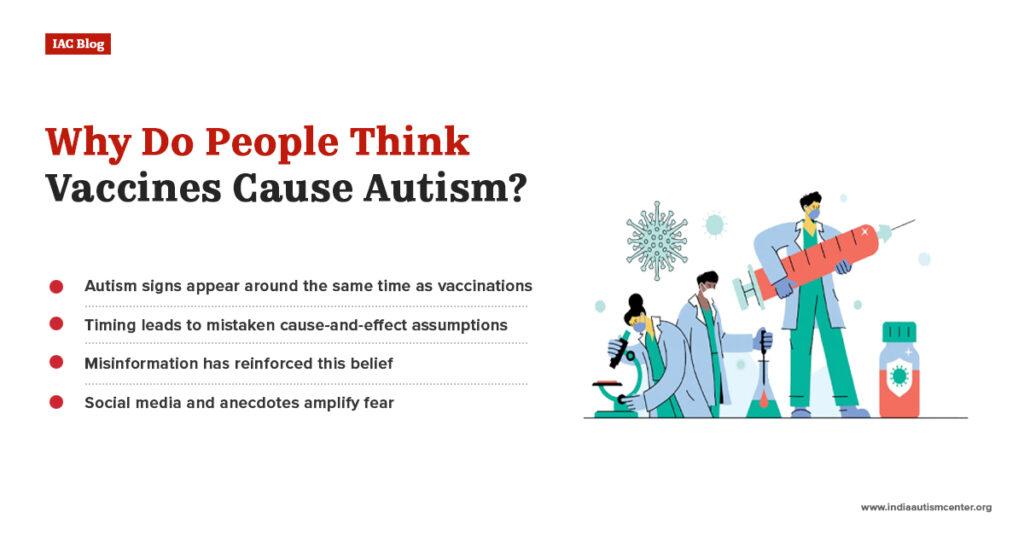
    Why Do People Think Vaccines Cause Autism?

    Why people think vaccines cause autism – misinformation, timing myths and social media influence

    It is natural to look for a specific reason when a child receives a life-changing diagnosis. If you are wondering why people think vaccines cause autism, the answer lies in a mix of historical misinformation and the timing of childhood development.

    Most children receive their primary vaccination series between birth and age 2. Coincidentally, this is the same window where the first signs of autism, like delayed speech or repetitive behaviours, become noticeable. 

    When two events happen at the same time, it is natural for the human brain to assume that one caused the other, even if they are unrelated.

    Social media and anecdotal stories often amplify fear. Parents naturally want answers, and emotional stories can feel more convincing than data, even when they are not accurate.

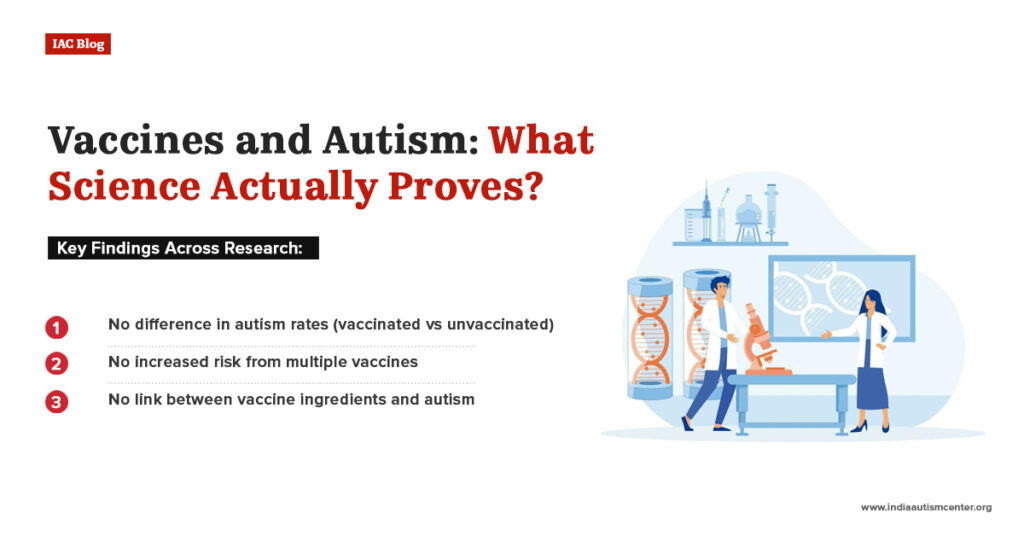
    Vaccines and Autism: What Science Actually Proves?

    Vaccines and autism research findings showing no link between vaccines and autism

    When looking at vaccines and autism, it’s important to focus on large-scale, peer-reviewed studies. 

    Key Findings Across Research

    • No difference in the number of autism cases between vaccinated and unvaccinated children
    • No increase in autism risk with multiple vaccines
    • No link between vaccine ingredients (like thimerosal) and autism

    Understanding Vaccine Ingredients and “Overload”

    Some parents worry that even if one vaccine is safe, the sheer number of vaccines given at once might “overload” a child’s immune system. Others worry about specific ingredients, such as thimerosal or aluminium.

    It is helpful to remember that a child’s immune system is incredibly resilient. From birth, babies are exposed to a plethora of bacteria and viruses in the environment, often found on their toys, in their food, and in the air they breathe.

    The total number of “antigens” (the parts of a virus that trigger an immune response) in the entire childhood vaccine schedule is just a tiny fraction of what a child encounters in a single day of normal play.

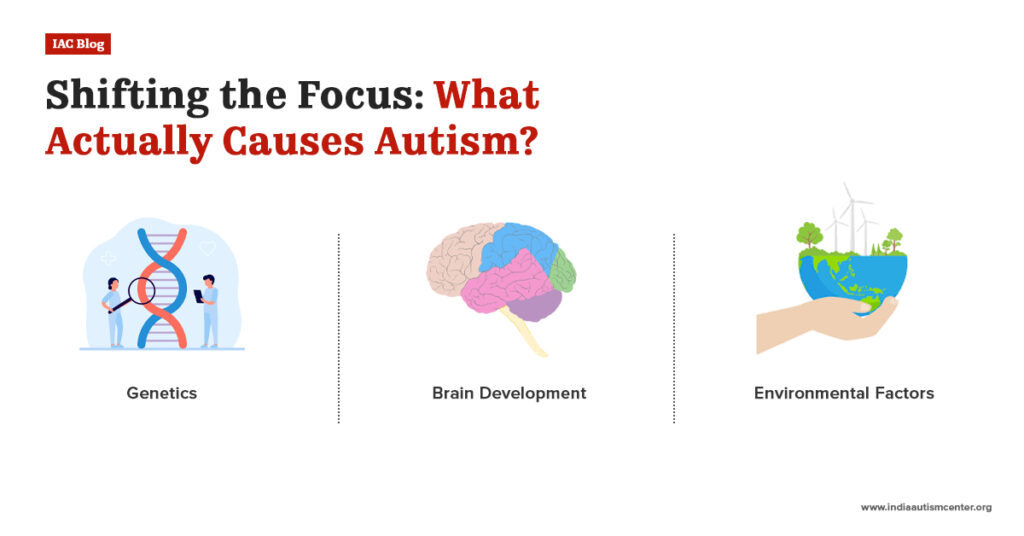
    Shifting the Focus: What Actually Causes Autism?

    What causes autism – genetics, brain development and environmental factors explained

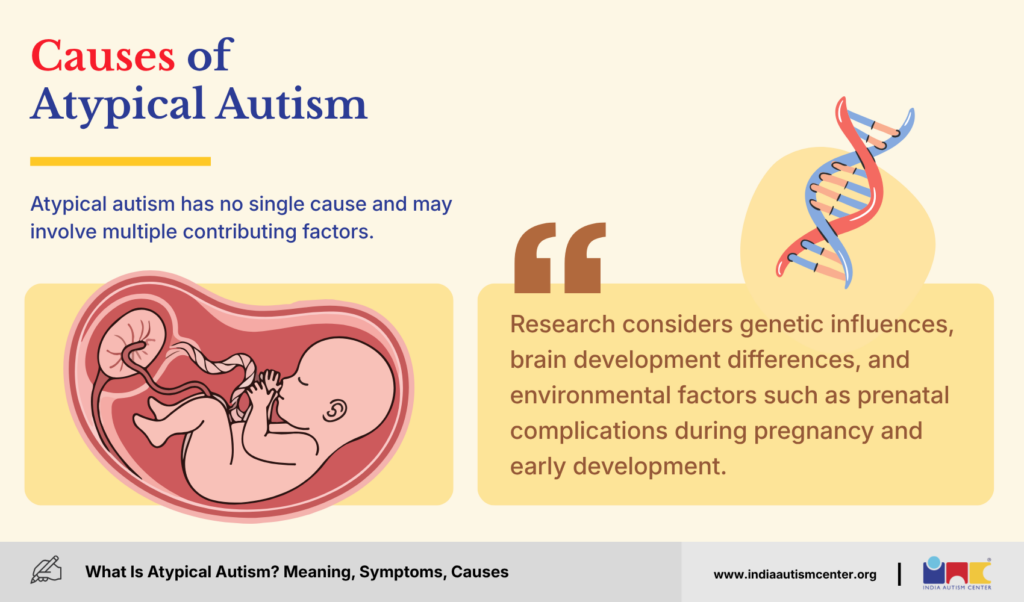
    If vaccines are not the cause, what is? There is research which suggests that autism is a complex condition which is likely caused by a combination of genetic and environmental factors.

    Genetics

    Genetics plays the largest role in autism. Scientists have identified hundreds of specific genes and genetic mutations linked to brain development. In many cases, these mutations occur spontaneously in the egg or sperm and are not even passed down from the parents.

    Brain Development

    Research using advanced imaging has shown that the differences in the brain structure of autistic children are often present long before they are born. These differences occur during the second and third trimesters of pregnancy when the brain is forming its complex “wiring.” This further confirms that events after birth, such as vaccinations, are not the cause of the condition.

    Environmental Factors

    “Environmental” does not necessarily mean pollution. In scientific terms, it refers to events that occur in the body. Some confirmed risk factors include:

    • Parental Age: Children born to older parents (both mothers and fathers) have a slightly higher risk of ASD.
    • Pregnancy Complications: Premature birth, low birth weight, or certain infections during pregnancy may increase the likelihood of a child being on the spectrum.
    • Spacing of Pregnancies: Having pregnancies less than one year apart has been linked to a higher risk.

    When parents understand the real cause of Autism, it helps in moving away from the fear. It also helps to opt for better support for their child. 

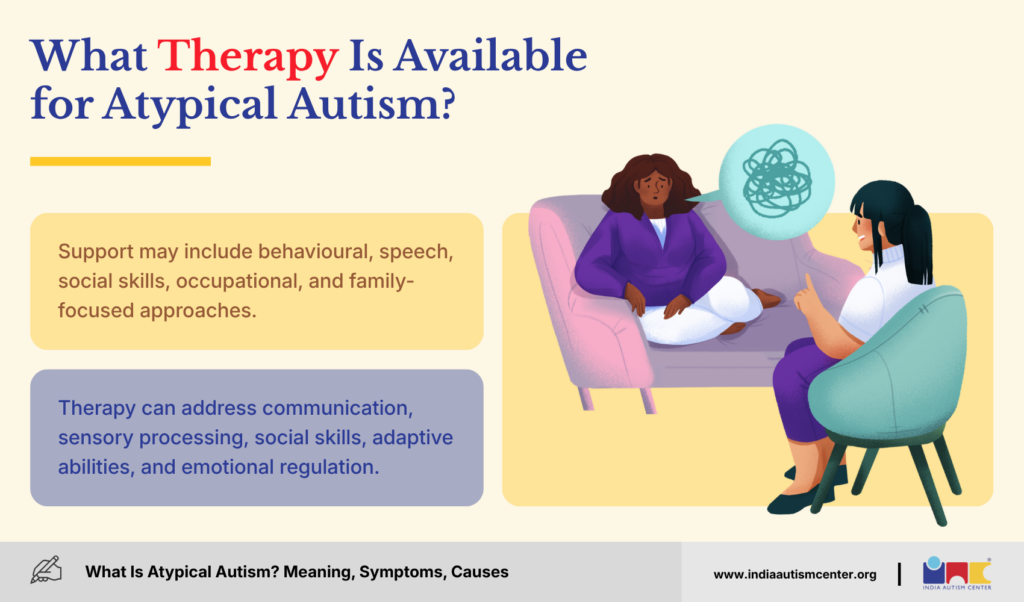
    Understanding Atypical Autism Therapy

    Atypical autism therapies including ABA, speech therapy and occupational therapy

    Atypical autism is part of the broad spectrum known as Autism Spectrum Disorder. When a child is diagnosed with Atypical autism, parents need to shift the focus to getting the right kind of support. 

    Every autistic child is unique; some may have incredible gifts in music or math, while others may struggle with basic daily tasks. The goal of any treatment is to improve the quality of life and independence.

    Choosing an atypical autism therapy plan can feel overwhelming, but the most effective approach is usually early intervention.

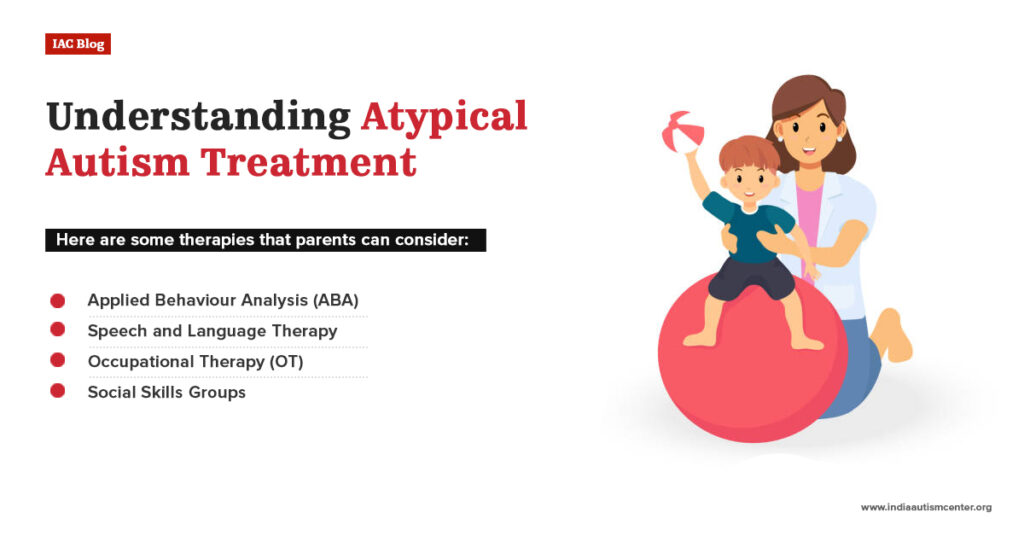
    Here are some therapies that parents can consider:

    Applied Behaviour Analysis (ABA)

    ABA is a widely used approach that focuses on teaching specific skills and reducing harmful or interfering behaviours. It uses positive reinforcement to help children learn how to communicate their needs.

    Speech and Language Therapy

    Many children on the spectrum have “social communication” challenges. A speech therapist helps them not just with the physical act of talking, but also with the nuances of conversation, such as taking turns and understanding body language.

    Occupational Therapy (OT) 

    For children who have sensory processing issues, the world can feel like a very loud, bright, and scary place. OT helps children learn how to process sensory information so they can stay calm and focused.

    Social Skills Groups 

    These are supervised settings where children can practice interacting with their friends in a safe environment.

    It is important to remember that while there is no “cure” for autism, these therapies help children build the skills they need for a fulfilling, independent life. It is best to consult with a qualified medical professional before starting a new intervention.

    Vaccination and Autism: Myths Debunked

    Vaccination and autism myths debunked with facts and scientific evidence

    For years, the debate around vaccines and autism has caused confusion and concern among parents. Even though there is overwhelming scientific evidence proving that vaccines are safe, myths continue to circulate, often fueled by misinformation and fear.

    So let us debunk the most common myths around vaccination and autism:

    MythFact
    Myth: Giving too many vaccines at once causes autism.Fact: A child’s immune system handles thousands of antigens daily. Vaccines are a tiny fraction of that and do not cause “overload.”
    Myth: The “mercury” in vaccines is dangerous for the brain.Fact: Thimerosal (ethylmercury) was removed from childhood vaccines years ago, and autism rates continued to rise regardless.
    Myth: Natural immunity is better than vaccine-acquired immunity.Fact: “Natural” immunity comes at the cost of the child getting sick with a dangerous disease. Vaccines provide protection without the risk of the illness.
    Myth: My child was “fine” until they got their shots.Fact: Autism symptoms often become visible at the same age vaccines are given, but brain differences usually begin before birth.

    Why Vaccines Still Matter?

    Why vaccines still matter for children with autism – herd immunity and disease prevention explained

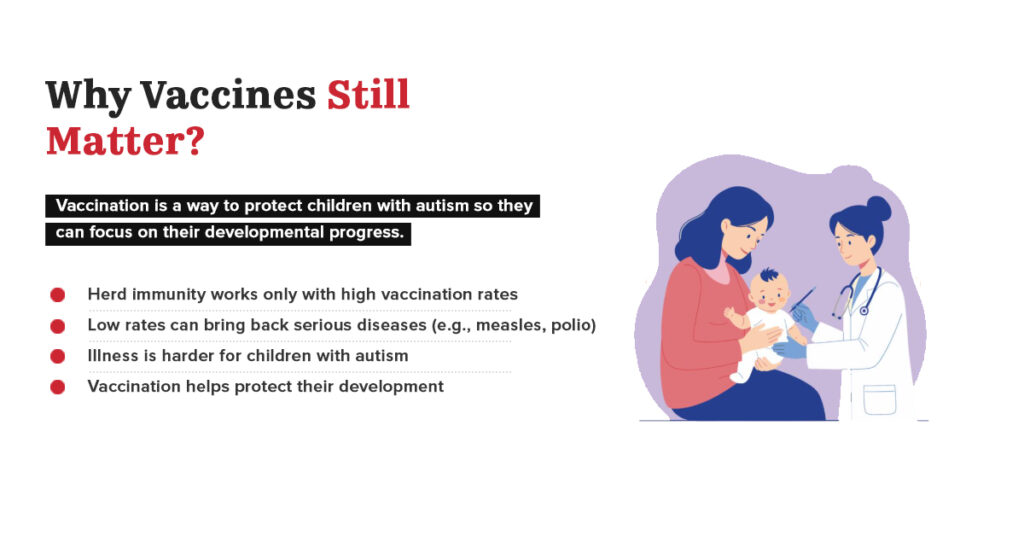
    It can be tempting to think, “If so many other people are not vaccinated, why does my child need to be?” This is known as “herd immunity.” However, herd immunity only works if the vast majority of the community is protected.

    If vaccination rates drop, diseases like measles or polio can make a sudden and deadly comeback. Measles, in particular, is quite contagious and can further lead to serious complications like pneumonia or brain swelling (encephalitis).

    It becomes even more difficult when a child with autism contracts such a disease. Dealing with a severe physical illness on top of their sensory and communication challenges can be incredibly difficult. 

    In short, vaccination is a way to protect children with autism so they can focus on their developmental progress.

    How Parents Can Make Informed Decisions?

    How parents can make informed vaccination decisions using trusted sources and avoiding misinformation

    Today, parents are bombarded with information. Hence, distinguishing between a sensationalised headline and a verified medical fact can feel like a full-time job. When parents are confused about the topic of vaccines and autism, the goal is to move from a place of fear to a place of empowered understanding.

    Parents need to trust their instincts and make informed decisions with the right information. By focusing on evidence-based resources and open communication, you can replace anxiety with a clear plan for your child’s health.

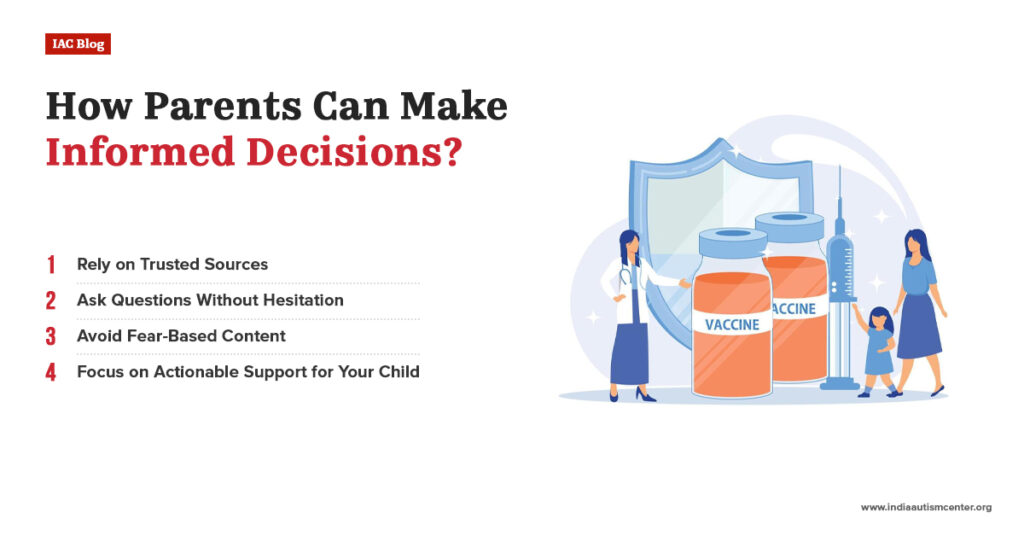
    Here are a few steps that parents can take to make sure they make the right decision:

    1. Rely on Trusted Sources

    Make sure to consult trusted sources, such as paediatricians, government health organisations, or peer-reviewed studies, for advice. 

    For example, if a source claims that vaccines cause autism and only cites personal anecdotes or the retracted 1998 study, it is not a reliable source.

    2. Ask Questions Without Hesitation

    No concern is too small when it comes to your peace of mind. A good healthcare provider will never dismiss your fears; instead, they will explain the science clearly and respectfully.

    Where there is confusion between the contents of the vaccines, ask for the data. A transparent conversation is the best way to dissolve the anxiety that often stems from the unknown.

    3. Avoid Fear-Based Content

    Misinformation often relies on emotional triggers. Anecdotes can be powerful and frightening, but they do not equal scientific evidence.

    Always look for the “big picture” data over isolated, unverified stories.

    4. Focus on Actionable Support for Your Child

    Instead of spending emotional energy on the debunked link between vaccines and autism, redirect that focus toward high-value actions that significantly improve a child’s quality of life.

    Remember:

    • Early identification is the most powerful tool a parent has. It allows you to initiate interventions during the peak developmental window.
    • Whether it is Speech Therapy, Occupational Therapy, or a specific atypical autism therapy like ABA, focus on methods that help your child gain independence and communication skills.
    • Surrounding yourself with people who understand your journey provides the emotional resilience needed to be your child’s best advocate.

    Conclusion

    Vaccines do not cause autism conclusion – science-based evidence on vaccine safety and child protection

    The question: Do vaccines cause autism? It’s more common than you think. There is scientific proof that there is no connection between vaccination and autism.  

    Vaccines do not cause autism. What they do is protect children from serious diseases that can have lifelong consequences. As we move forward into 2026 and beyond, our focus should shift away from baseless myth and toward what truly matters: supporting autistic individuals and their families.

    This means investing in better atypical autism therapy, creating inclusive schools, and building a society where everyone, irrespective of how their brain is wired, can belong.

    A diagnosis does not limit your child’s potential. With the right support, early intervention, and a healthy, vaccine-protected start in life, they can achieve amazing things.

    Frequently Asked Questions

    Do vaccines cause autism in children?

    No, vaccines do not cause autism. Multiple large-scale studies across different countries have consistently shown no link between vaccines and autism. Health organisations worldwide strongly support vaccine safety.

    Can delaying vaccines reduce autism risk?

    No, delaying vaccines does not reduce the risk of autism. Instead, it leaves children unprotected against serious diseases like measles and whooping cough during a critical period of development.

    Do vaccine ingredients cause autism?

    No, vaccine ingredients such as thimerosal have been studied extensively and shown to be safe. Even after thimerosal was removed from most vaccines, autism rates did not decrease, proving no connection.

    When do autism symptoms usually appear?

    Autism symptoms typically become noticeable between 12 and 24 months. This timing overlaps with vaccination schedules, which is why some parents mistakenly link the two.

    Is there a link between vaccines and atypical autism?

    No. There is zero scientific evidence linking vaccines to any form of autism, including atypical autism. The causes remain rooted in genetics and brain development.

    Are unvaccinated children healthier in terms of autism risk?

    No, avoiding vaccines does not reduce the risk of autism. It only increases the likelihood of contracting serious and preventable diseases, which can have long-term health consequences.

    For expert insights, support services, and inclusive learning initiatives, visit the India Autism Center.
  • Rehabilitation Psychologist in Autism: Why Emotional Support Matters as Much as Therapy

    Rehabilitation Psychologist in Autism: Why Emotional Support Matters as Much as Therapy

    Autism support often focuses on speech therapy, occupational therapy, or behavioural interventions. However, one crucial professional is sometimes overlooked — the rehabilitation psychologist in autism.

    In my experience as a rehabilitation psychologist, I often meet families who ask: “My child is receiving therapy, but why is emotional regulation still difficult?” Or “Why does behaviour suddenly change even after therapy?”

    The answer is simple. Autism is not only about behaviour or communication. It is also about emotions, coping skills, mental health, and psychological well-being.

    This is where the role of a rehabilitation psychologist becomes essential. 

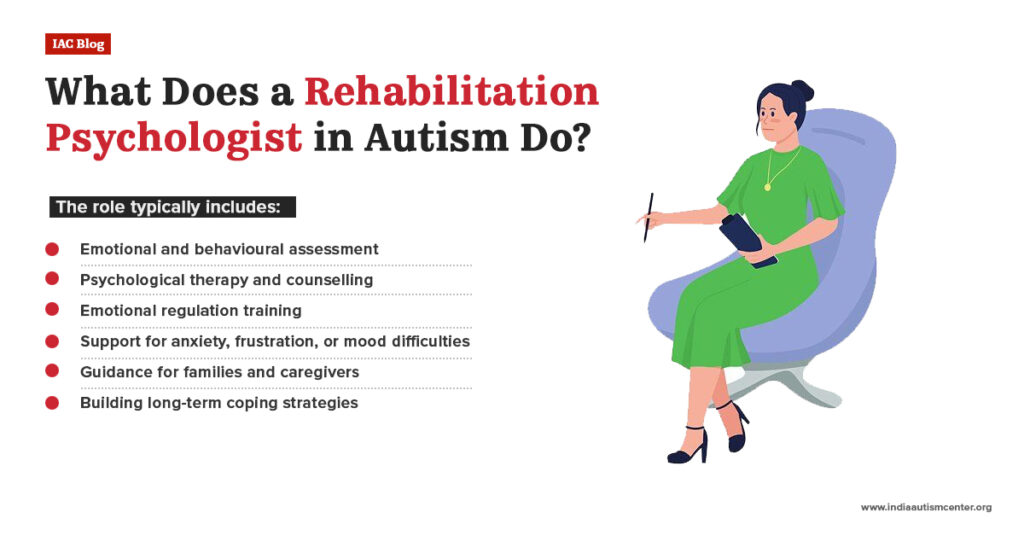
    What Does a Rehabilitation Psychologist in Autism Do?

    What Does a Rehabilitation Psychologist in Autism Do

    A rehabilitation psychologist in autism focuses on the emotional, behavioural, and psychological well-being of autistic individuals. While therapists work on skill development, the psychologist works on how the individual experiences and manages the world emotionally.

    In simple terms, I help individuals with autism understand their emotions, manage stress, and build coping strategies for everyday life.

    The role typically includes:

    • Emotional and behavioural assessment
    • Psychological therapy and counselling
    • Emotional regulation training
    • Support for anxiety, frustration, or mood difficulties
    • Guidance for families and caregivers
    • Building long-term coping strategies

    Therefore, autism rehabilitation is not only about teaching skills. It is also about supporting the mind behind those skills.

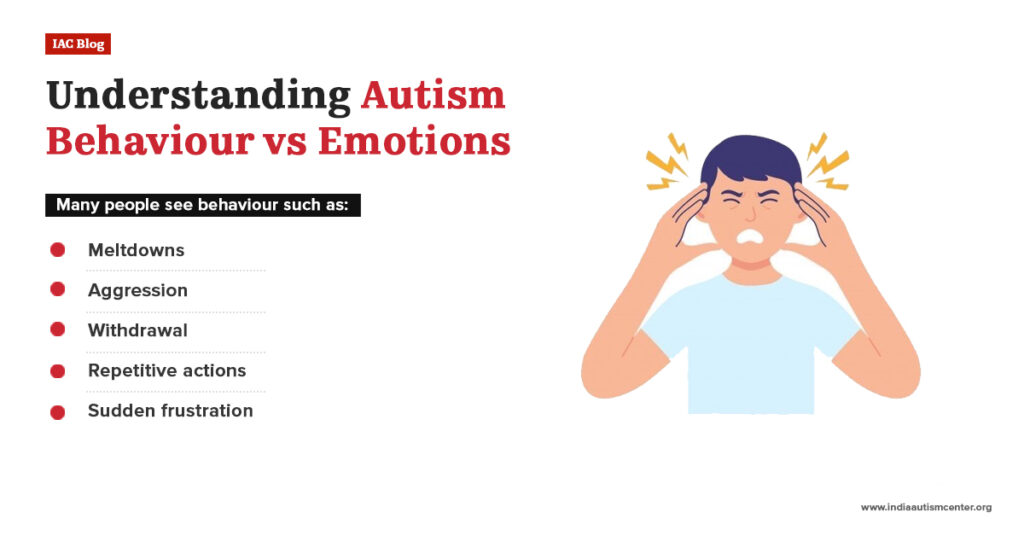
    Understanding Autism Behaviour vs Emotions

    Understanding Autism Behaviour vs Emotions

    One of the biggest misunderstandings in autism care is confusing behaviour with emotions.

    Many people see behaviour such as:

    • Meltdowns: An autism meltdown is an intense emotional reaction that happens when an autistic individual becomes completely overwhelmed. This overwhelm may be caused by sensory overload, frustration, anxiety, or sudden changes in routine. During a meltdown, the person may cry, shout, scream, or lose control of their emotions.
    • Aggression: Aggression refers to behaviours that may appear physically or verbally forceful, such as hitting, pushing, shouting, or throwing objects. In autism, aggression often occurs when the individual is experiencing strong emotions like frustration, fear, or sensory overload, but cannot communicate their needs effectively
    • Withdrawal: Withdrawal occurs when an individual pulls away from social interaction, communication, or activities. An autistic person may avoid eye contact, prefer being alone, or stop participating in conversations or tasks. This behaviour may happen when the person feels overwhelmed, anxious, tired, or socially exhausted.
    • Repetitive actions: Repetitive actions, often called repetitive behaviours or stimming, are repeated movements or activities such as hand flapping, rocking, repeating words, or arranging objects in patterns. These actions can help autistic individuals regulate emotions, manage sensory input, or reduce anxiety.
    • Sudden frustration: Sudden frustration refers to a quick emotional reaction that occurs when something becomes difficult, confusing, or overwhelming. In autism, frustration can appear suddenly because of communication challenges, sensory discomfort, unexpected changes, or difficulty completing a task.

    In many cases, autistic individuals experience:

    • Sensory Overload: A condition where the brain receives too much sensory information (such as sounds, lights, or touch), making it difficult for the person to process and respond calmly. 
    • Anxiety: A feeling of excessive worry, nervousness, or fear that can affect thoughts, emotions, and daily functioning.
    • Communication Frustration: The stress or anger that occurs when an individual struggles to express their needs, thoughts, or feelings effectively.
    • Difficulty Identifying Emotions: A challenge in recognising or understanding one’s own feelings, such as not knowing whether they are sad, angry, or anxious.
    • Difficulty Expressing Feelings: A struggle to communicate emotions to others through words, facial expressions, or behaviour.

    For example:

    BehaviourPossible Emotional Cause
    MeltdownOverwhelm or sensory overload
    AggressionFrustration or inability to communicate
    WithdrawalAnxiety or social exhaustion
    Repetitive behaviourSelf-soothing or stress regulation

    When we only try to control behaviour without understanding the emotion behind it, improvement becomes temporary. That is why a rehabilitation psychologist in autism focuses on the emotional meaning behind behaviour.

    Want to know more? Get in touch with us.

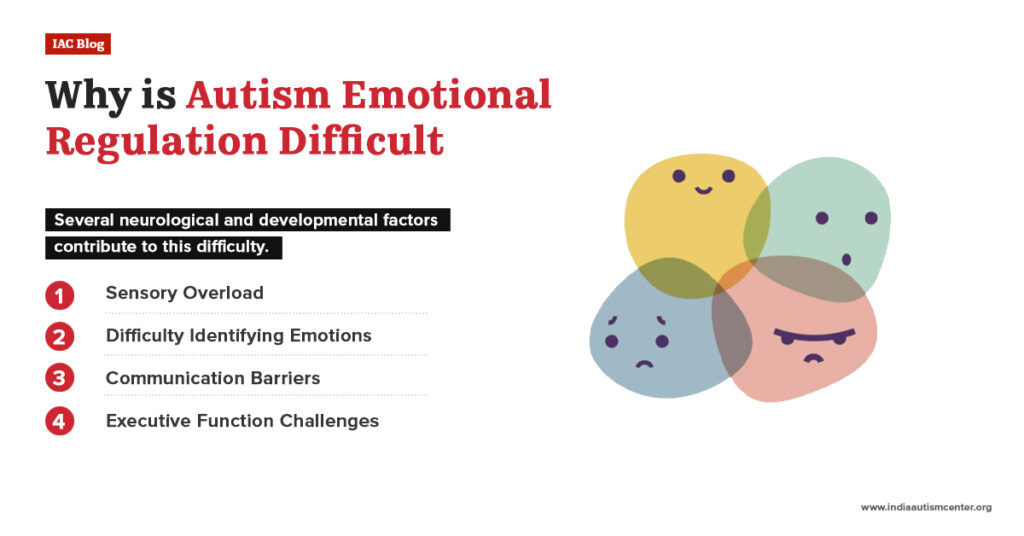
    Why is Autism Emotional Regulation Difficult

    Why is Autism Emotional Regulation Difficult

    Many autistic individuals struggle with autism emotional regulation. In simple terms, this means they may experience emotions very strongly but may find it difficult to manage or calm those emotions quickly.

    We often explain this to families in a simple way: Imagine feeling extremely upset, anxious, or frustrated but not having the tools to calm yourself down or explain what you are feeling. This can make everyday situations much more challenging.

    Several neurological and developmental factors contribute to this difficulty.

    1. Sensory Overload

    Many autistic individuals have heightened sensory sensitivity. Everyday stimuli such as loud sounds, bright lights, strong smells, or crowded environments can feel overwhelming. When the brain receives too much sensory information at once, it becomes difficult to stay calm. As a result, the person may experience stress, anxiety, or emotional outbursts.

    Here is All You Need to Know About Sensory Challenges in Autistic Individuals.

    2. Difficulty Identifying Emotions

    Some autistic individuals find it difficult to recognise or label their emotions. For example, they may feel uncomfortable or distressed but may not understand whether the feeling is anxiety, frustration, sadness, or sensory discomfort. When a person cannot clearly identify what they are feeling, it becomes harder to regulate that emotion.

    3. Communication Barriers

    Communication challenges can also make emotional regulation harder. If someone cannot easily express their thoughts, needs, or feelings, frustration may build up internally. Over time, this bottled-up emotion may appear as behaviours such as meltdowns, withdrawal, or sudden frustration.

    4. Executive Function Challenges

    Executive functions are brain processes that help us plan, control impulses, switch between tasks, and regulate our responses. Many autistic individuals experience differences in these abilities. As a result, when a stressful situation occurs, it may be harder for them to pause, think, and choose a calm response.

    Because of these factors, emotional regulation training becomes an important part of autism rehabilitation therapy. With proper guidance, individuals can gradually learn strategies to recognise emotions, cope with stress, and respond more calmly to challenging situations.

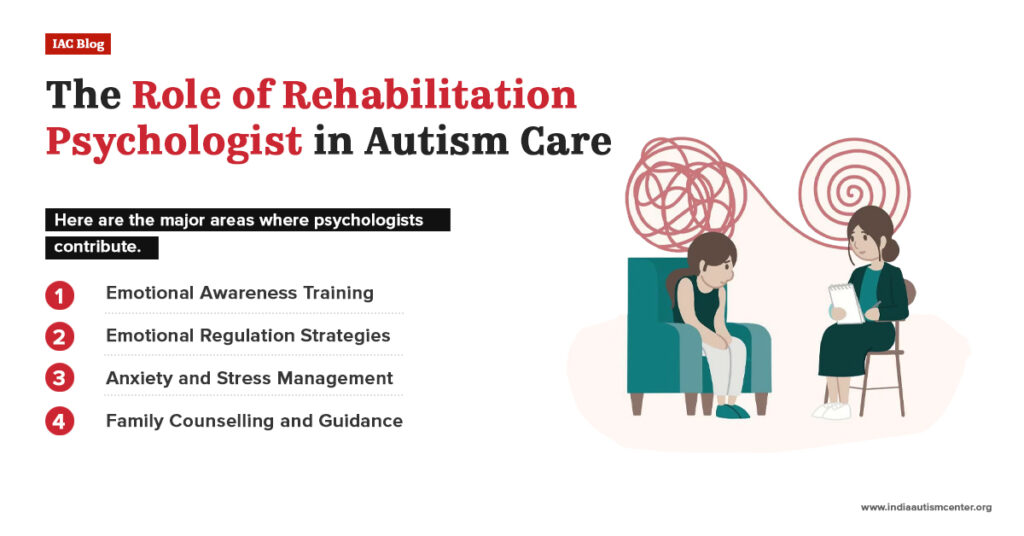
    The Role of a Rehabilitation Psychologist in Autism Care

    The Role of a Rehabilitation Psychologist in Autism Care

    The role of a rehabilitation psychologist goes beyond counselling. It involves structured psychological support that helps autistic individuals function better in daily life. Here are the major areas where psychologists contribute.

    Emotional Awareness Training

    Emotional awareness training helps autistic individuals understand and recognise their emotions more clearly. This is an important first step before learning how to manage those emotions.

    This training may include:

    • Identifying feelings: Helping individuals recognise different emotions such as happiness, anger, frustration, or sadness.
    • Recognising body signals: Teaching individuals to notice physical signs of emotions, such as a fast heartbeat, muscle tension, or feeling restless.
    • Connecting situations with emotions: Helping individuals understand how certain situations or events can trigger specific emotional responses.
    • Using visual or structured tools: Emotion charts, pictures, or simple scales can help individuals describe how they feel.

    When individuals become better at recognising their emotions, it becomes easier for them to regulate and manage those emotions effectively.

    Emotional Regulation Strategies

    Next, we teach strategies that help autistic individuals manage their emotions in a healthy and controlled way. Some common approaches include:

    • Breathing exercises: Slow and deep breathing helps calm the nervous system and reduce feelings of stress, anger, or anxiety during overwhelming situations.
    • Sensory regulation techniques: Tools such as sensory toys, weighted items, or quiet spaces help individuals cope with sensory overload and feel more comfortable.
    • Structured calming strategies: Simple routines like taking a short break, counting slowly, or moving to a calm environment help the person regain emotional control.
    • Emotional expression methods: Encouraging individuals to express feelings through words, pictures, writing, or art helps them release emotions in a safe and healthy way.

    With regular practice, these strategies help individuals pause, understand their emotions, and respond thoughtfully instead of reacting impulsively

    Anxiety and Stress Management

    Many autistic individuals experience higher levels of anxiety due to sensory sensitivities, communication challenges, or unexpected changes in routine. Psychological support helps them manage these feelings in a structured and supportive way.

    Psychological therapy helps by:

    • Identifying triggers: Understanding situations, environments, or events that cause anxiety or stress, such as loud noises, crowded spaces, or sudden changes in routine.
    • Teaching coping mechanisms: Learning practical techniques like deep breathing, relaxation exercises, or structured problem-solving to manage stress when it arises.
    • Building emotional resilience: Helping individuals gradually develop confidence and the ability to handle challenging situations without becoming overwhelmed.

    Together, these approaches form an important part of autism mental health support, helping individuals feel safer, calmer, and more in control of their emotions.

    Family Counselling and Guidance

    Parents and caregivers often feel confused or overwhelmed while supporting an autistic individual. Family counselling and guidance help families better understand autism and learn practical ways to provide emotional and behavioural support at home.

    A rehabilitation psychologist guides families by:

    • Teaching emotional support strategies: Helping parents understand the child’s emotions and respond with patience, empathy, and supportive approaches.
    • Improving communication approaches: Guiding families on using clear language, visual supports, and structured communication methods that work better for autistic individuals.
    • Managing meltdowns effectively: Helping parents recognise early signs of distress and use calming techniques to handle emotional outbursts in a supportive way.
    • Reducing stress at home: Suggesting structured routines, predictable environments, and coping strategies that create a calmer and more stable home environment.

    Want to know more? Get in touch with us.

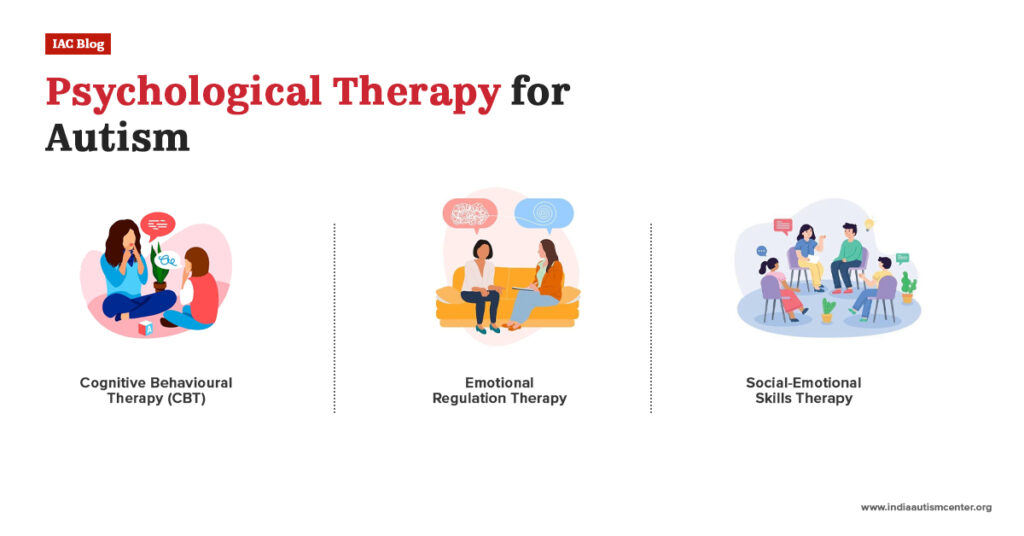
    Psychological Therapy for Autism

    Psychological Therapy for Autism

    Many people assume therapy for autism is only behavioural or speech-related. However, psychological therapy for autism plays an equally important role.

    Different therapeutic approaches may be used depending on the individual’s needs.

    Cognitive Behavioural Therapy (CBT)

    Cognitive Behavioural Therapy is a form of psychological therapy that helps autistic individuals understand how their thoughts, emotions, and behaviours are connected. It is especially useful for managing anxiety, stress, and negative thinking patterns.

    CBT helps by:

    • Understanding thought patterns: Helping individuals recognise negative or unhelpful thoughts that may increase anxiety or distress.
    • Linking thoughts, emotions, and behaviour: Teaching how thoughts influence feelings and how those feelings can affect behaviour.
    • Developing healthier thinking habits: Encouraging more balanced and realistic ways of thinking about situations.
    • Learning coping strategies: Providing practical tools such as relaxation techniques, problem-solving skills, and emotional regulation methods.
    • Managing anxiety and stress: Helping individuals identify triggers and respond to stressful situations in a calmer and more controlled way.

    Emotional Regulation Therapy

    Emotional regulation therapy focuses on helping autistic individuals recognise, understand, and manage strong emotions in a healthy way. It teaches practical skills that help individuals stay calm and respond better to stressful situations.

    This therapy may include:

    • Emotion recognition exercises: Activities that help individuals identify and label different emotions, such as happiness, anger, sadness, or anxiety.
    • Coping skill training: Teaching practical techniques like deep breathing, taking breaks, or using calming activities to handle overwhelming emotions.
    • Stress regulation strategies: Helping individuals learn ways to reduce stress, such as relaxation techniques, sensory calming methods, or structured routines.

    Social-Emotional Skills Therapy

    Social-emotional skills therapy helps autistic individuals understand social situations and interact more comfortably with others. It focuses on improving awareness of emotions and social communication.

    This therapy helps by:

    • Understanding social cues: Teaching individuals to recognise cues such as tone of voice, facial expressions, and body language during interactions. 
    • Recognising emotional expressions: Helping individuals identify emotions in themselves and others, such as happiness, anger, sadness, or confusion.
    • Improving interpersonal interactions: Practising skills like taking turns in conversations, responding appropriately, and maintaining respectful communication.
    • Building social confidence: Helping individuals feel more comfortable in social settings such as school, therapy sessions, or community environments.

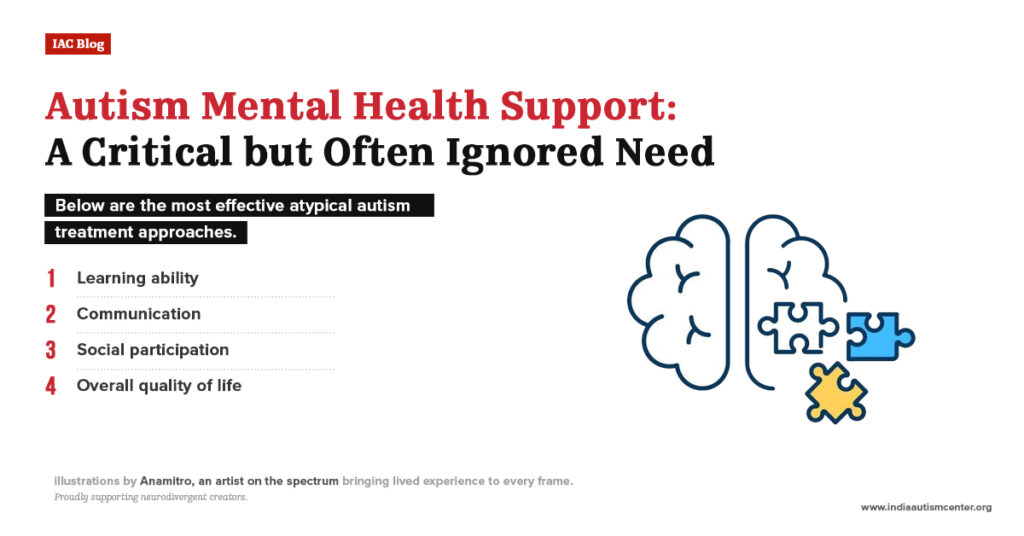
    Autism Mental Health Support: A Critical but Often Ignored Need

    Autism Mental Health Support

    Mental health is an essential part of autism care, yet it is frequently overlooked.

    Research and clinical experience show that autistic individuals are more likely to experience:

    • anxiety disorders
    • depression
    • chronic stress
    • emotional burnout
    • social isolation

    Therefore, autism mental health support must be integrated into long-term rehabilitation.

    When emotional well-being improves, individuals often show improvements in:

    • learning ability
    • communication
    • social participation
    • overall quality of life

    This is why psychological care should work alongside other therapies.

    Want to know more? Get in touch with us.

    Conclusion 

    Autism rehabilitation should never focus only on behaviour or skills. It must also address the emotional world of the individual.

    A rehabilitation psychologist in autism plays a vital role in helping autistic individuals:

    • understand their emotions
    • manage stress and anxiety
    • develop coping strategies
    • improve mental health and resilience

    When emotional regulation improves, everything else — learning, communication, relationships — becomes easier.

    Frequently Asked Questions

    What does a rehabilitation psychologist in autism do?

    A rehabilitation psychologist in autism focuses on emotional regulation, mental health support, behavioural understanding, and coping strategies to help autistic individuals function better in daily life.

    Why is emotional regulation difficult in autism?

    Autism emotional regulation can be difficult due to sensory sensitivity, communication challenges, difficulty identifying emotions, and executive functioning differences

    How does psychological therapy help autistic individuals?

    Psychological therapy for autism helps individuals understand emotions, manage anxiety, develop coping strategies, and improve emotional well-being.

    Is mental health support important for autism rehabilitation?

    Yes. Autism mental health support is essential because many autistic individuals experience anxiety, stress, or emotional challenges that affect learning and daily functioning.

    When should someone consult a rehabilitation psychologist for autism?

    Consult a psychologist if there are frequent emotional outbursts, anxiety, withdrawal, difficulty coping with change, or emotional challenges affecting therapy or daily life.

  • Is Virtual Autism Reversible? Causes, Symptoms & Treatment

    Is Virtual Autism Reversible? Causes, Symptoms & Treatment

    In recent years, many parents have started asking a new question: “Is my child developing autism because of too much screen time?” This concern has led to discussions around a term called virtual autism.

    While the concept is still debated in the medical community, experts agree that excessive exposure to digital screens during early childhood can significantly affect a child’s social, communication, and cognitive development.

    In this guide, I will walk you through everything you need to know about virtual autism—its symptoms, causes, therapy options, and whether it can be reversed.

    What Is Virtual Autism?

    What Is Virtual Autism

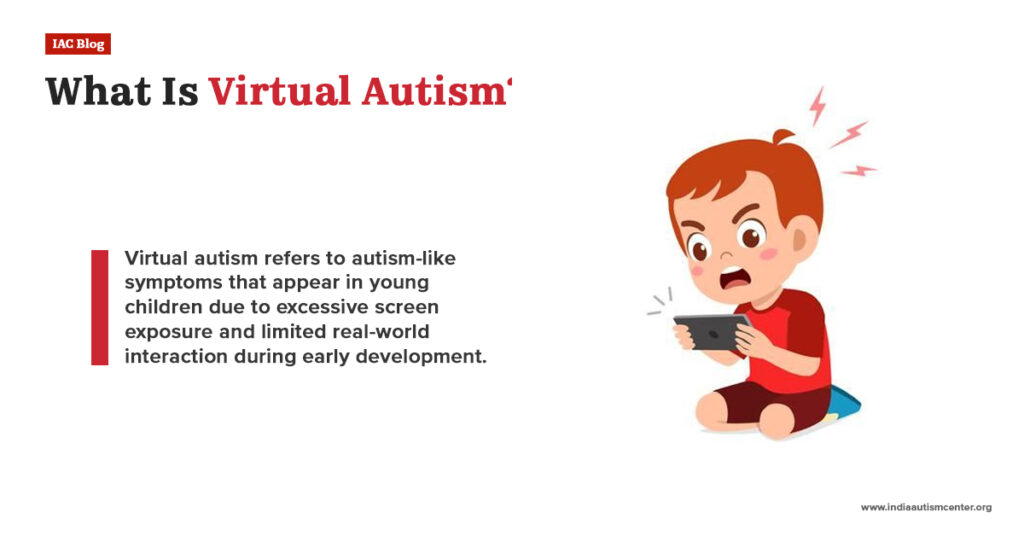
    Virtual autism refers to autism-like symptoms that appear in young children due to excessive screen exposure and limited real-world interaction during early development.

    Unlike traditional autism, this condition is believed to develop when children spend long hours interacting with screens instead of engaging with people and their environment.

    For example, many children today spend several hours daily with:

    • Smartphones
    • Tablets
    • Television
    • Digital learning apps
    • Video streaming platforms

    When this replaces face-to-face interaction, play, and exploration, a child may begin showing behaviours similar to autism.

    However, it is important to understand that virtual autism is not officially recognised as a clinical diagnosis. Instead, it describes developmental delays caused by environmental factors, especially screen overexposure.

    📥 Free download: Printable daily routine chart for autistic children

    Virtual Autism vs Autism Spectrum Disorder (ASD)

    Understanding the difference between autism spectrum disorder and virtual autism is important for parents, caregivers, and educators. Although some behaviours may appear similar, the causes, development patterns, and outcomes can be quite different.

    ASD is a neurodevelopmental condition that affects how a person communicates, interacts socially, and processes information. It is typically present from early brain development.

    On the other hand, virtual autism describes autism-like developmental delays associated with excessive screen exposure and reduced human interaction during early childhood.

    The table below explains the differences in a more detailed way.

    AspectAutism Spectrum DisorderVirtual Autism
    DefinitionA lifelong neurodevelopmental condition that affects social communication, behaviour, and sensory processing.A term used to describe autism-like symptoms that may appear due to excessive screen exposure and limited real-world interaction in early childhood.
    Primary CauseCaused by differences in brain development influenced by genetic and biological factors.Mostly linked to environmental factors such as prolonged screen time, lack of social interaction, and reduced real-world stimulation.
    Age of OnsetSigns usually appear before the age of 2–3 years as the child develops.Symptoms may appear after prolonged exposure to screens during early developmental stages.
    Communication DevelopmentChildren often show persistent challenges with speech, language understanding, and social communication.Children may experience delayed speech mainly because screens replace conversation and interaction with caregivers.
    Social InteractionChildren may have difficulty understanding social cues, emotions, and relationships.Children may show reduced social engagement because they spend more time interacting with devices instead of people.
    Eye ContactLimited or inconsistent eye contact is commonly observed as part of the condition.Poor eye contact may occur due to reduced practice in real-life social interaction.
    Behavioural PatternsRepetitive behaviours, restricted interests, and sensory sensitivities are common and often persistent.Repetitive behaviours may appear but often decrease once screen time is reduced and interactive activities increase.
    Brain DevelopmentLinked to structural and functional differences in brain development.Generally related to environmental stimulation patterns rather than underlying neurological differences.
    Response to InterventionRequires long-term therapies such as behavioural therapy, speech therapy, and occupational therapy.Many children show improvement when screen exposure is reduced and developmental stimulation increases.
    Possibility of ImprovementIndividuals can develop skills and independence with support, but autism itself is not “cured.”Symptoms may significantly improve or disappear when the child receives appropriate interaction and therapy.
    Therapy ApproachEarly intervention therapies focus on communication, behaviour, sensory regulation, and life skills.Interventions usually focus on reducing screens, increasing social interaction, and supporting language development.

    Want to know more? Get in touch with us.

    What Causes Autism Virtual Development?

    What Causes Autism Virtual Development?

    To understand autism virtual development, we first need to understand how a young child’s brain grows.

    During the first three years of life, the brain develops at an extraordinary speed. Children learn language, emotions, social behaviour, and problem-solving mainly through human interaction, play, and exploration. They watch facial expressions, respond to voices, imitate gestures, and slowly build communication skills.

    However, when screens replace these real-world experiences, the developmental process can change. Children may receive visual and auditory stimulation from devices, but they miss out on two-way communication and social learning.

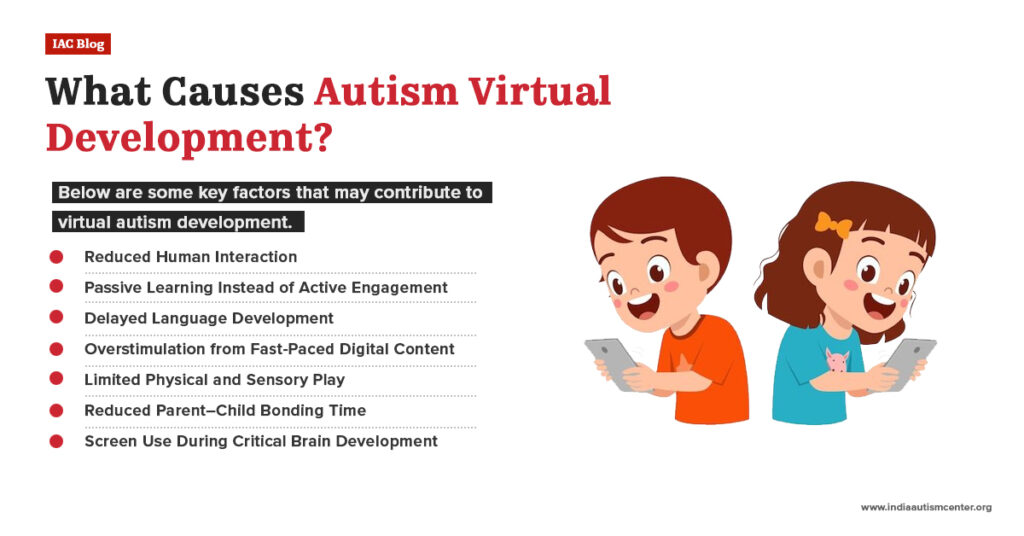
    Below are some key factors that may contribute to virtual autism development.

    1. Reduced Human Interaction

    One of the biggest causes of virtual autism development is reduced face-to-face interaction.

    Young children learn communication through constant interaction with caregivers. When you talk to a child, they observe your mouth movements, facial expressions, tone of voice, and gestures. They respond, imitate, and gradually develop language skills.

    However, screens do not provide this kind of interaction. A video may talk to the child, but it cannot respond to the child’s emotions, gestures, or attempts to communicate.

    When a child spends long hours watching screens instead of interacting with parents or peers, they may experience:

    • delayed speech development
    • reduced eye contact
    • limited social engagement

    2. Passive Learning Instead of Active Engagement

    Another important factor is passive learning.

    In healthy development, children learn by doing things actively. They touch objects, explore their surroundings, ask questions, and interact with people. These experiences strengthen brain connections related to thinking, language, and social understanding.

    In contrast, digital media often encourages passive consumption. A child may sit quietly watching videos for long periods without needing to think, respond, or interact.

    As a result, children may:

    • become less curious about real-world activities
    • struggle to initiate communication
    • show reduced attention in non-screen environments

    3. Delayed Language Development

    Language development depends heavily on real conversations.

    When adults speak to children, they pause, wait for responses, repeat words, and adjust their tone. This natural exchange helps children learn vocabulary, sentence structure, and social communication.

    However, when screens dominate a child’s routine, conversations may decrease significantly.

    For example, a child who spends several hours watching videos may hear many words but rarely practice speaking or responding. Without this practice, language skills may develop more slowly.

    This is why delayed speech is one of the most common virtual autism symptoms reported by parents.

    4. Overstimulation from Fast-Paced Digital Content

    Many digital programmes for children are designed to capture attention through:

    • bright colours
    • rapid scene changes
    • loud sounds
    • fast-paced animation

    While this may keep children engaged, it can also lead to sensory overstimulation.

    Young brains may become accustomed to this high level of stimulation. As a result, normal real-world activities such as reading, playing with toys, or listening to conversations may feel less exciting or difficult to focus on.

    This overstimulation can contribute to:

    • shorter attention spans
    • restlessness
    • difficulty focusing on slower activities

    5. Limited Physical and Sensory Play

    Children need a wide range of physical and sensory experiences to support brain development.

    Activities such as running, building blocks, drawing, climbing, and playing with other children help develop:

    • motor skills
    • problem-solving abilities
    • creativity
    • emotional regulation

    When a child spends long periods with digital devices, these activities often decrease.

    Instead of moving, exploring, and interacting with their environment, the child may remain sedentary and mentally disengaged from real-world experiences.

    This lack of sensory and physical stimulation can contribute to delays in cognitive and social development.

    6. Reduced Parent–Child Bonding Time

    Another overlooked factor is reduced bonding between parents and children.

    Healthy development depends greatly on shared experiences, such as:

    • talking during meals
    • reading stories together
    • playing interactive games
    • exploring the outdoors

    When screens are frequently used as entertainment or distraction, these bonding opportunities may decrease.

    Children may begin to prefer digital devices over human interaction, which can further affect their communication and social development.

    7. Screen Use During Critical Brain Development

    The timing of screen exposure also matters.

    The first 1,000 days of life are particularly important for brain growth. During this period, neural connections responsible for language, social skills, and emotional understanding develop rapidly.

    If children spend a significant amount of this time interacting with screens rather than people, the brain may receive less social and linguistic stimulation than it needs.

    This imbalance can increase the likelihood of autism-like developmental delays, which some researchers describe as virtual autism.

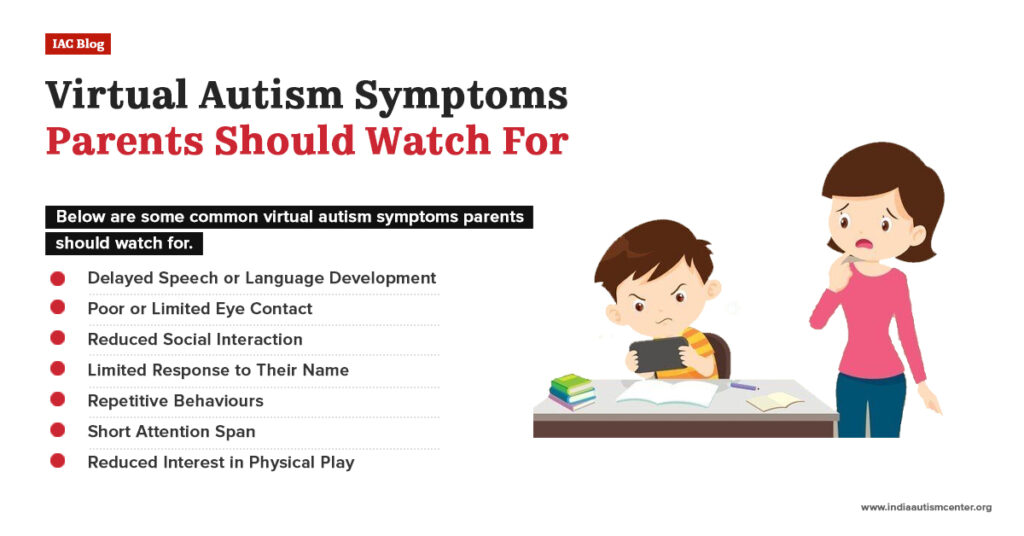
    Virtual Autism Symptoms Parents Should Watch For

    Virtual Autism Symptoms Parents Should Watch For

    Recognising virtual autism symptoms early can help you take timely action. Many of these signs appear when screen time replaces real interaction, play, and conversation during early childhood.

    At first, the changes may seem small. You might notice your child becoming more attached to screens or less interested in interacting with people. However, over time, these behaviours can affect language development, social skills, and attention.

    It is important to remember that seeing one symptom does not necessarily mean your child has virtual autism. But if several signs appear together and persist, it may be helpful to consult a developmental professional.

    Below are some common virtual autism symptoms parents should watch for.

    Delayed Speech or Language Development

    One of the most frequently reported virtual autism symptoms is delayed speech.

    Young children normally begin saying simple words between 12 and 18 months and gradually start forming short sentences by the age of two to three years. However, children who spend excessive time with screens may have fewer opportunities to practice real conversations.

    You may notice that your child:

    • speaks very few words for their age
    • struggles to combine words into short sentences
    • prefers pointing or gestures instead of speaking

    This happens because language develops through back-and-forth interaction, which screens cannot provide.

    Poor or Limited Eye Contact

    Eye contact plays a crucial role in early communication and emotional connection.

    When parents talk to their children, they naturally make eye contact. This helps children learn how to read facial expressions, understand emotions, and respond socially.

    Children showing virtual autism symptoms may:

    • avoid looking directly at people while communicating
    • focus more on screens than on faces
    • appear distracted during conversations

    Limited eye contact can happen because the child is more used to interacting with digital devices than with people.

    Want to know more? Get in touch with us.

    Reduced Social Interaction

    Children naturally enjoy interacting with caregivers, siblings, and peers. Through play and shared activities, they learn important skills such as turn-taking, cooperation, and emotional understanding.

    However, excessive screen use can reduce these opportunities.

    You may notice that your child:

    • prefers watching videos rather than playing with others
    • shows little interest in group play
    • becomes upset when screens are removed

    This reduced interest in social interaction may resemble behaviours often associated with autism virtual patterns.

    Limited Response to Their Name

    Most children begin responding to their name during the first year of life. It becomes a natural part of communication and attention.

    However, some children with heavy screen exposure may:

    • ignore their name when called
    • remain focused on the device instead of responding
    • react only when the screen is turned off

    This behaviour can occur because screens capture a child’s attention very strongly, making it harder for them to shift focus to people around them.

    Repetitive Behaviours

    Some children may display repetitive actions when they spend excessive time with digital content.

    Examples may include:

    • repeating the same sounds or phrases from videos
    • watching the same video repeatedly
    • performing repetitive body movements such as hand flapping

    These behaviours may develop because children often imitate patterns they repeatedly see on screens. In many cases, such behaviours decrease when screen exposure is reduced and the child engages in more interactive activities.

    Short Attention Span

    Another common virtual autism symptom is difficulty focusing on activities that do not involve screens.

    Fast-moving animations and colourful digital content can condition the brain to expect constant stimulation. As a result, slower activities may feel less engaging.

    You might observe that your child:

    • quickly loses interest in toys or books
    • struggles to focus during conversations
    • frequently asks for screens when bored

    Over time, this pattern can affect learning, play, and communication skills.

    Reduced Interest in Physical Play

    Healthy child development requires movement, exploration, and sensory play.

    Activities like running, building blocks, drawing, and outdoor play help children develop motor skills, creativity, and problem-solving abilities.

    However, when screen time dominates daily routines, children may show:

    • less interest in outdoor play
    • reduced curiosity about their environment
    • preference for sitting with devices for long periods

    This reduced engagement with the physical world may contribute to developmental delays linked to virtual autism.

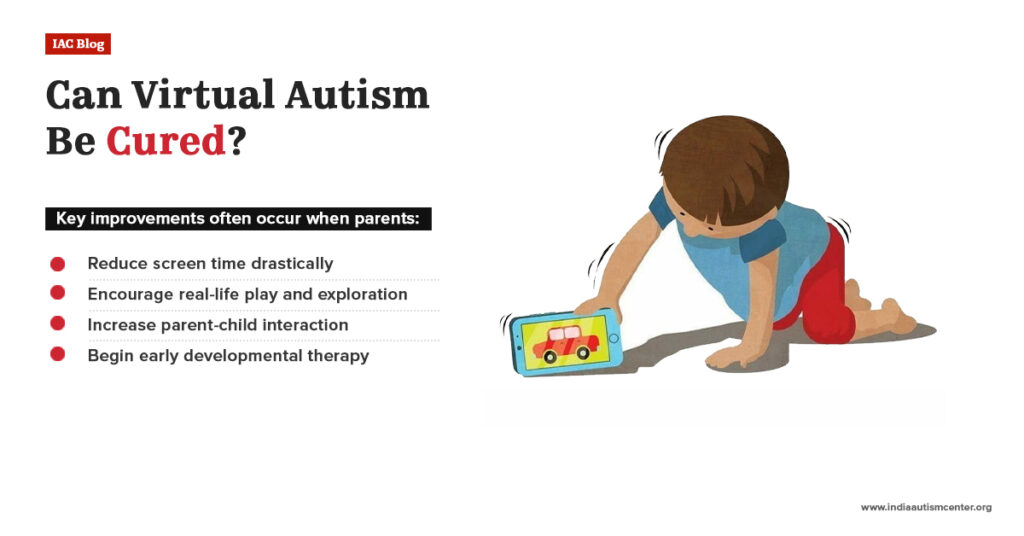
    Can Virtual Autism Be Cured?

    Can Virtual Autism Be Cured?

    Many parents ask a crucial question: Can virtual autism be cured?

    The encouraging answer is that many children improve significantly when screen exposure is reduced and developmental support is provided early.

    Unlike ASD, symptoms linked to virtual autism often decrease when the child receives proper stimulation and interaction.

    Key improvements often occur when parents:

    • Reduce screen time drastically
    • Encourage real-life play and exploration
    • Increase parent-child interaction
    • Begin early developmental therapy

    However, every child is different. So, professional assessment remains essential.

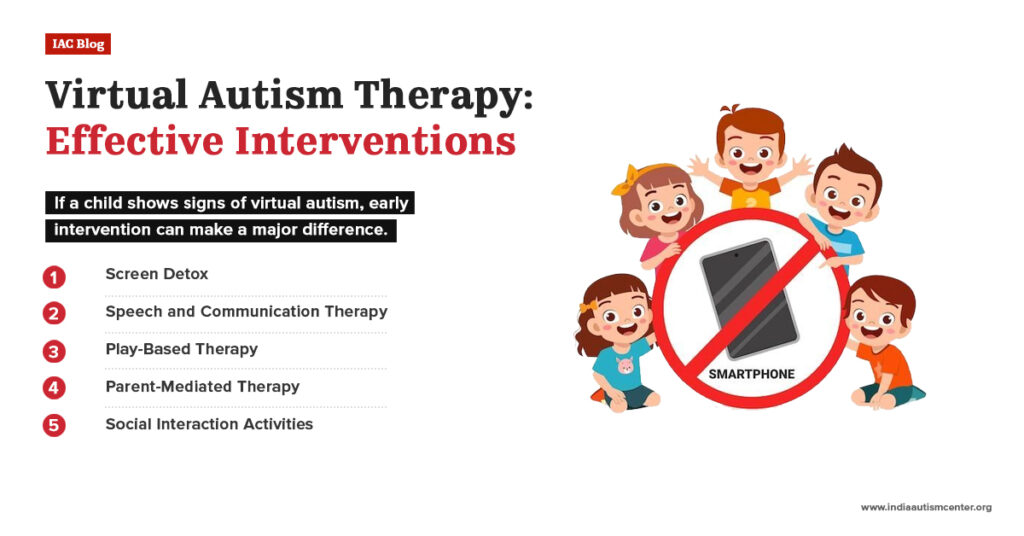
    Virtual Autism Therapy: Effective Interventions

    Virtual Autism Therapy: Effective Interventions

    If a child shows signs of virtual autism, early intervention can make a major difference.

    Let me walk you through some effective virtual autism therapy approaches.

    1. Screen Detox

    The first step usually involves reducing or eliminating screen exposure.

    Many experts recommend:

    • No screens for children under 2 years
    • Limited, supervised use for older children

    Replacing screen time with interactive activities helps stimulate development.

    2. Speech and Communication Therapy

    Speech therapy can help children:

    • Develop vocabulary
    • Improve communication skills
    • Learn conversational responses

    Therapists also guide parents on interactive communication strategies.

    3. Play-Based Therapy

    Children learn best through play.

    Therapists often use structured play sessions to improve:

    • Social engagement
    • Attention
    • Problem-solving skills

    4. Parent-Mediated Therapy

    Parents play a central role in supporting development.

    Professionals may train parents to:

    • Use interactive language
    • Encourage eye contact
    • Create communication opportunities

    5. Social Interaction Activities

    Group activities help children practice:

    • Turn-taking
    • Emotional recognition
    • Peer communication

    Want to know more? Get in touch with us.

    When Should You Seek Professional Help?

    When Should You Seek Professional Help

    You should consider consulting a specialist if your child:

    • Has no meaningful speech by 2 years
    • Shows limited eye contact
    • Does not respond to their name
    • Avoids social interaction
    • Displays repetitive behaviours

    Early evaluation helps determine whether the symptoms relate to virtual autism, developmental delay, or ASD.

    Conclusion

    The rise of digital technology has changed childhood dramatically. While screens can be useful tools, excessive exposure during early development can affect social and communication skills.

    Understanding virtual autism helps parents recognise the importance of balanced childhood experiences.

    The good news is that early intervention, reduced screen time, and supportive therapy can significantly improve outcomes for many children.

    If you suspect developmental concerns, the best step is simple: seek professional guidance and focus on meaningful interaction with your child.

    After all, no screen can replace the power of a real human connection.

    Frequently Asked Questions

    What is virtual autism?

    Virtual autism refers to autism-like symptoms in young children that may appear due to excessive screen exposure and limited real-world interaction during early development.

    What are the main virtual autism symptoms?

    Common virtual autism symptoms include delayed speech, poor eye contact, limited social interaction, reduced response to name, and repetitive behaviours.

    Can virtual autism be cured?

    In many cases, symptoms improve when screen time is reduced and early intervention therapies are introduced. However, professional assessment is important.

    What is the difference between classical and virtual autism?

    Classical autism is a neurodevelopmental condition present from early brain development, whereas virtual autism symptoms are believed to arise due to environmental factors such as excessive screen exposure.

    For expert insights, support services, and inclusive learning initiatives, visit the India Autism Center.
  • Epilepsy and Autism: Understanding the Connection, Symptoms, and Care

    Epilepsy and Autism: Understanding the Connection, Symptoms, and Care

    When I speak with parents and caregivers, one question comes up very often: “Is there a link between autism and epilepsy?”

    The short answer is yes. Research shows that epilepsy and autism frequently occur together, and understanding this relationship can help families identify symptoms earlier and seek the right care.

    In this guide, I will explain what epilepsy is, how autism and epilepsy are related, the symptoms to watch for, and how seizures are managed in autistic individuals. My goal is simple: to give you clear, reliable, and practical information that helps you support your child or loved one.

    What Is Epilepsy?

    What Is Epilepsy?

    Before we explore the connection, let us first understand what epilepsy is.

    Epilepsy is a neurological condition in which a person experiences recurrent seizures caused by abnormal electrical activity in the brain.

    Our brain communicates through electrical signals. However, in epilepsy, these signals sometimes become sudden, excessive, and uncontrolled, which leads to seizures.

    A person is usually diagnosed with epilepsy if they have two or more unprovoked seizures.

    Epilepsy can affect people of any age, including infants, children, and adults. In children with developmental conditions such as Autism Spectrum Disorder (ASD), the likelihood of developing epilepsy is higher.

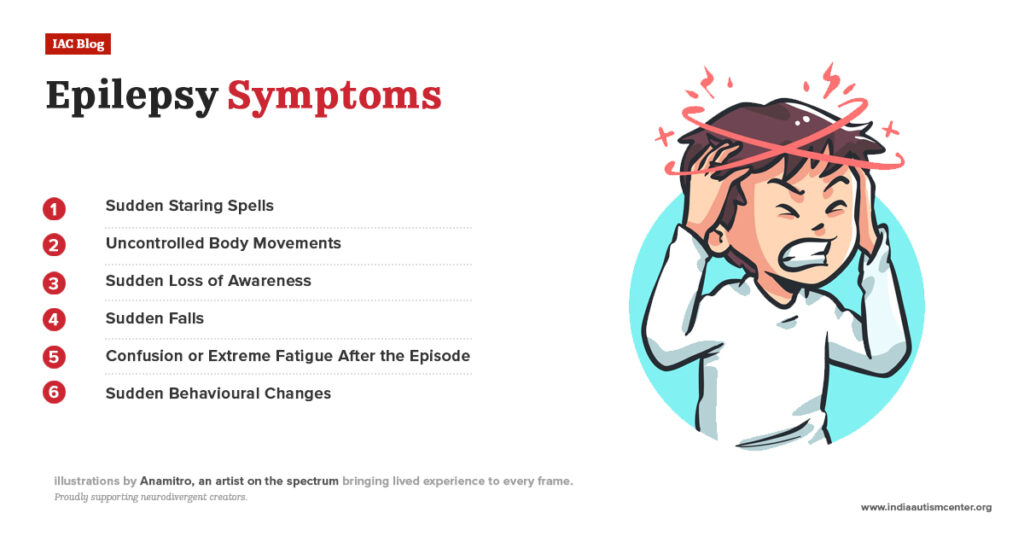
    Epilepsy Symptoms

    Epilepsy Symptoms

    The symptoms of epilepsy can vary widely. Some seizures are dramatic and easy to recognise. However, others are subtle and may look like ordinary behaviour, especially in children with ASD.

    Because of this, many parents initially miss the early warning signs. Let me explain the most common epilepsy symptoms in a bit more detail so you know exactly what to watch for.

    1. Sudden Staring Spells

    One of the most commonly overlooked symptoms is a sudden staring episode.

    Your child may suddenly stop what they are doing and stare blankly into space for several seconds. During this time:

    • They may not respond when you call their name.
    • Their eyes may appear fixed or unfocused.
    • They may pause mid-activity, such as while speaking or playing.

    These episodes often last 5–15 seconds and then the child resumes normal activity as if nothing happened.

    Parents often mistake this for daydreaming or inattention, but frequent staring spells may actually indicate absence seizures, a type of epilepsy.

    2. Uncontrolled Body Movements

    Another clear sign of epilepsy is sudden involuntary movements of the body.

    These movements happen because the brain sends abnormal electrical signals to the muscles. As a result, you may notice:

    • rhythmic jerking of the arms or legs
    • twitching of the face or eyelids
    • sudden stiffening of the body
    • repeated shaking movements

    In some seizures, the whole body may shake strongly for a short period. In others, only one part of the body moves repeatedly.

    3. Sudden Loss of Awareness

    Sometimes seizures affect consciousness rather than movement.

    During these episodes, the person may appear awake but is not aware of what is happening around them. For example:

    • They may not respond when spoken to.
    • They may continue a repetitive movement such as lip smacking or hand rubbing.
    • They may seem confused or disconnected.

    After the episode ends, the person often does not remember what happened.

    This type of seizure can easily be mistaken for behavioural changes, especially in autistic individuals.

    4. Sudden Falls

    Some seizures cause a sudden loss of muscle control. When this happens, the person may collapse or fall without warning.

    This type of seizure is sometimes called a drop attack.

    You might notice that the child:

    • suddenly drops to the ground
    • loses strength in the legs
    • briefly becomes limp

    Because these seizures occur suddenly, they can lead to frequent injuries, such as bruises or cuts. Therefore, they require careful medical evaluation.

    5. Confusion or Extreme Fatigue After the Episode

    After a seizure ends, many individuals enter what doctors call a post-seizure or recovery phase.

    During this time, the person may:

    • feel extremely tired
    • appear confused or disoriented
    • have difficulty speaking clearly
    • complain of a headache
    • want to sleep immediately

    This recovery period can last a few minutes to several hours, depending on the seizure type.

    If you repeatedly notice this pattern — an unusual episode followed by sudden exhaustion or confusion — it may indicate seizure activity.

    6. Sudden Behavioural Changes

    In some cases, seizures can appear as brief behavioural changes rather than physical symptoms.

    For example, a person may suddenly:

    • stop interacting with others
    • become unusually agitated or fearful
    • repeat the same movement over and over
    • show sudden emotional changes

    Because these symptoms can resemble behavioural patterns seen in autism, they are sometimes misinterpreted as sensory overload or emotional dysregulation.

    Want to know more? Get in touch with us.

    Autism and Epilepsy: Understanding the Link

    Autism and Epilepsy: Understanding the Link

    Now, let us talk about the important question: how are autism and epilepsy related?

    Research shows that individuals with autism have a higher risk of developing epilepsy compared to the general population.

    Studies suggest:

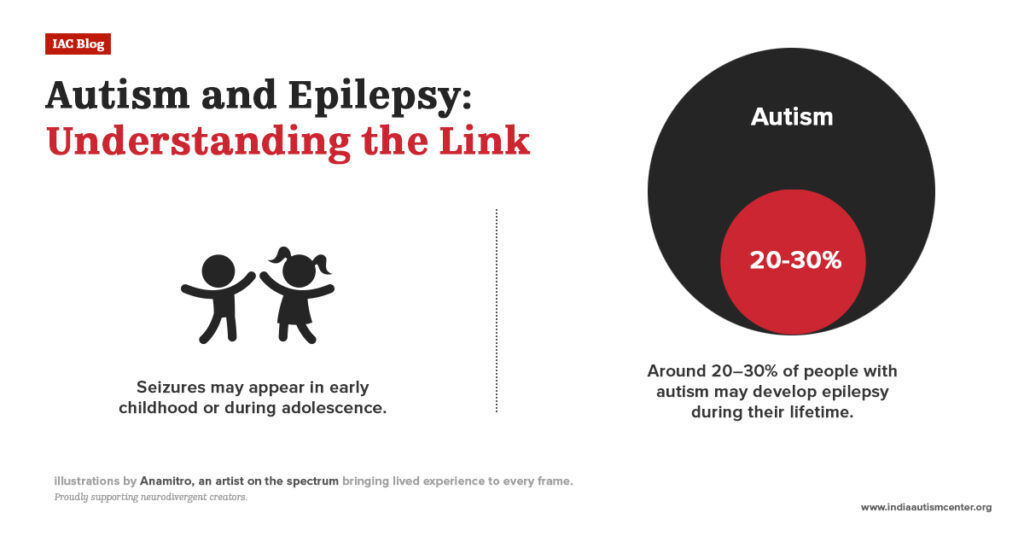
    • Around 20–30% of people with autism may develop epilepsy during their lifetime.
    • Seizures may appear in early childhood or during adolescence.

    In clinical practice, I often tell parents that both conditions affect brain development and brain signalling, which partly explains why they occur together. However, not every autistic individual will develop epilepsy.

    Read this blog to know more about What Causes Autism?A Detailed Breakdown (2026).

    Autism and Epilepsy Comorbidity: Why Do They Occur Together?

    Autism and Epilepsy Comorbidity

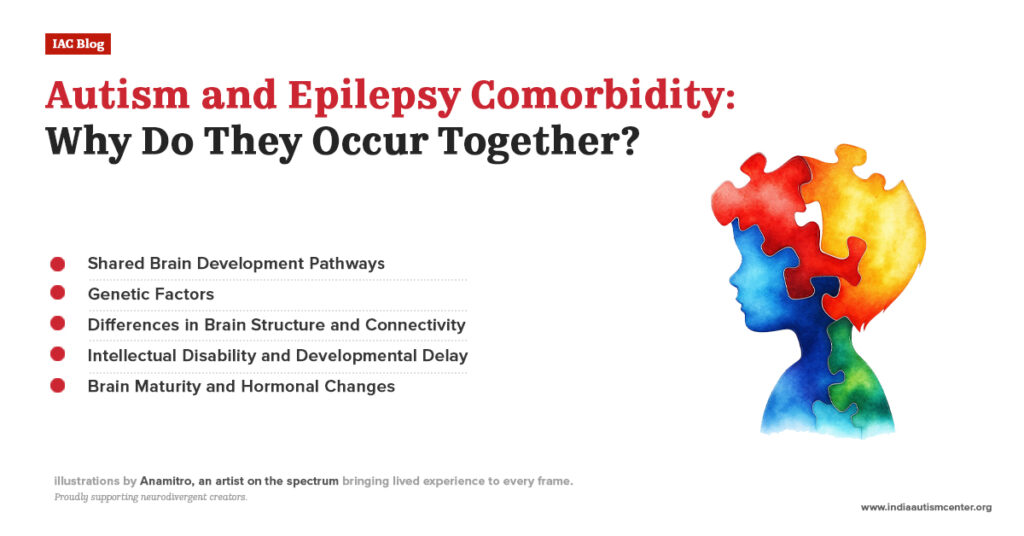
    The term autism and epilepsy comorbidity simply means that both conditions occur in the same individual. In medical practice, this overlap is not rare. In fact, studies suggest that around one in four individuals with autism may develop seizures at some point in life.

    But many parents ask me: “Why do autism and epilepsy appear together so often?”
    The answer lies in how the brain develops and functions.

    Both Autism Spectrum Disorder and Epilepsy involve differences in brain connectivity, electrical signalling, and neurological development. Because these biological pathways overlap, some individuals may develop both conditions simultaneously.

    Let us look at the main reasons in a little more detail.

    1. Shared Brain Development Pathways

    The brain develops rapidly during early childhood. During this period, billions of neurons form connections that help control:

    • communication
    • social interaction
    • learning
    • movement
    • sensory processing

    In autism, these neural connections may develop differently, affecting how the brain processes information.

    At the same time, epilepsy occurs when electrical signals in the brain become overly active or disorganised, triggering seizures.

    2. Genetic Factors

    Genetics also plays a significant role in the overlap between autism and epilepsy.

    Certain genetic conditions affect brain development and neural signalling, which can increase the risk of both disorders. For example:

    • Tuberous Sclerosis Complex
    • Fragile X Syndrome
    • Rett Syndrome

    These conditions influence how brain cells grow, communicate, and organise themselves. As a result, individuals with these genetic syndromes often show features of autism along with seizures.

    However, it is important to remember that most people with autism do not have these genetic disorders. They simply increase the likelihood of the two conditions appearing together.

    3. Differences in Brain Structure and Connectivity

    Brain imaging studies have shown that some individuals with autism may have differences in brain structure and connectivity.

    For example, certain areas of the brain may show:

    • altered neural connectivity
    • differences in cortical thickness
    • variations in how brain regions communicate with each other

    These structural differences can sometimes make the brain more sensitive to abnormal electrical activity, which may lead to seizures.

    However, this does not happen in every autistic individual. Many people with autism never develop epilepsy.

    4. Intellectual Disability and Developmental Delay

    Research shows that the risk of epilepsy is higher in individuals who have autism along with intellectual disability.

    This is because more significant developmental differences in the brain may increase the likelihood of unstable electrical signalling, which can trigger seizures.

    That said, epilepsy can also occur in autistic individuals without intellectual disability, although the probability is generally lower.

    5. Brain Maturity and Hormonal Changes

    Another interesting observation is that seizures often appear during two key developmental stages:

    • early childhood
    • adolescence

    During these periods, the brain undergoes major structural and hormonal changes. These changes can sometimes affect electrical stability in the brain, increasing the chances of seizure onset.

    This is why doctors continue to monitor autistic individuals for seizure activity even during their teenage years.

    Autism and Seizures: How Do Seizures Appear in Autistic Individuals?

    Autism and Seizures

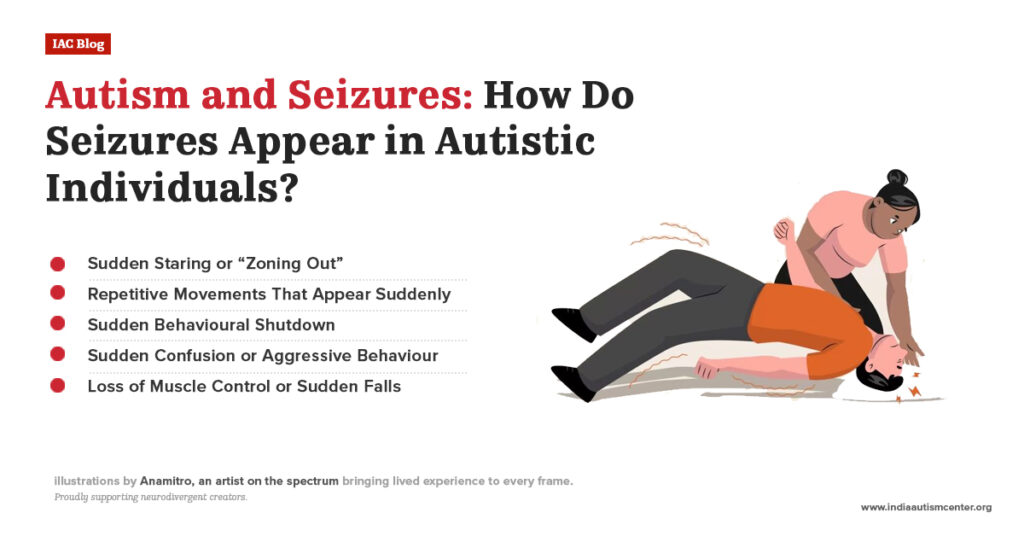
    Seizures in individuals with autism can sometimes be difficult to recognise. This is because some seizure symptoms may look similar to behaviours commonly seen in Autism Spectrum Disorder.

    1. Sudden Staring or “Zoning Out”

    One of the most common seizure signs is brief staring episodes.

    Your child may suddenly:

    • stop speaking mid-sentence
    • pause during an activity
    • stare blankly into space
    • fail to respond when you call their name

    These episodes usually last a few seconds, and then the child continues normal activity as if nothing happened.

    2. Repetitive Movements That Appear Suddenly

    Many autistic individuals show repetitive movements, also called stimming behaviours. However, seizures may also cause involuntary repetitive movements.

    For example, during a seizure, you may notice:

    • repeated lip smacking
    • chewing motions
    • blinking rapidly
    • sudden hand movements
    • rhythmic twitching of one arm or leg

    The key difference is that seizure-related movements usually begin suddenly and stop abruptly, whereas typical stimming behaviours often occur in response to emotions or sensory needs.

    3. Sudden Behavioural Shutdown

    Sometimes seizures cause a brief loss of awareness or responsiveness.

    During these episodes, the person may:

    • stop interacting with people
    • appear confused or disoriented
    • fail to respond to instructions
    • seem mentally “absent”

    These episodes may last a few seconds to a few minutes.

    Because communication challenges are common in autism, these seizures may easily be mistaken for withdrawal, sensory overload, or fatigue.

    Want to know more? Get in touch with us.

    4. Sudden Confusion or Aggressive Behaviour

    After certain seizures, individuals may experience temporary confusion, known as the post-seizure phase.

    During this period, a person may:

    • appear confused
    • become unusually irritable
    • show sudden agitation
    • struggle to communicate clearly

    In autistic individuals, this may be misinterpreted as behavioural dysregulation rather than a neurological event.

    5. Loss of Muscle Control or Sudden Falls

    Some seizures cause a sudden loss of muscle strength. As a result, the individual may:

    • suddenly drop objects
    • lose balance
    • collapse unexpectedly
    • briefly become limp

    These events can happen very quickly and without warning. Because autistic individuals may already have coordination or motor planning differences, these episodes may not immediately raise concern unless they happen repeatedly.

    Why Seizures Are Often Missed in Autism

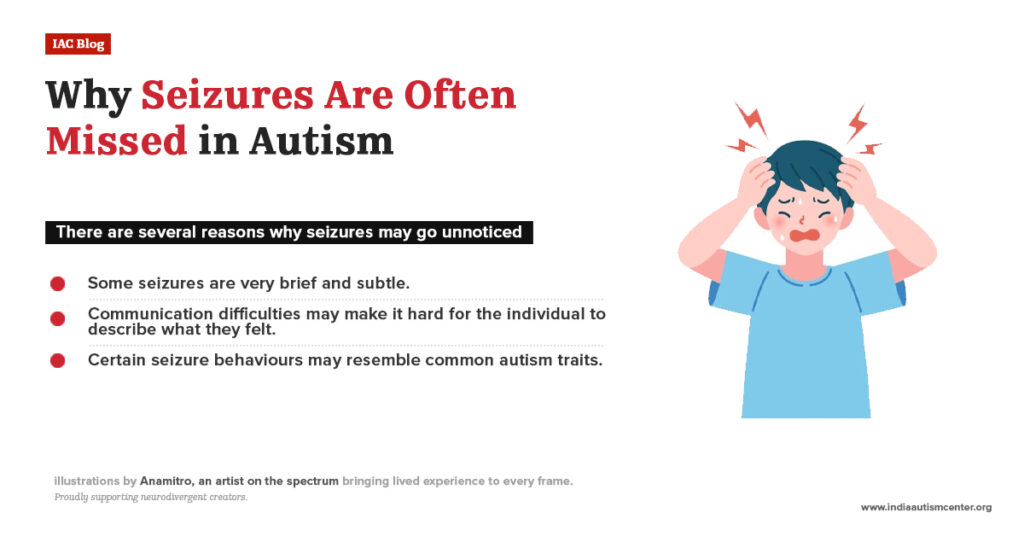
    There are several reasons why seizures may go unnoticed in autistic individuals:

    • Some seizures are very brief and subtle.
    • Communication difficulties may make it hard for the individual to describe what they feel.
    • Certain seizure behaviours may resemble common autism traits.

    Because of this overlap, doctors sometimes recommend a neurological evaluation if parents notice new, sudden, or unexplained behavioural changes.

    When Should You Suspect Seizures?

    When Should You Suspect Seizures?

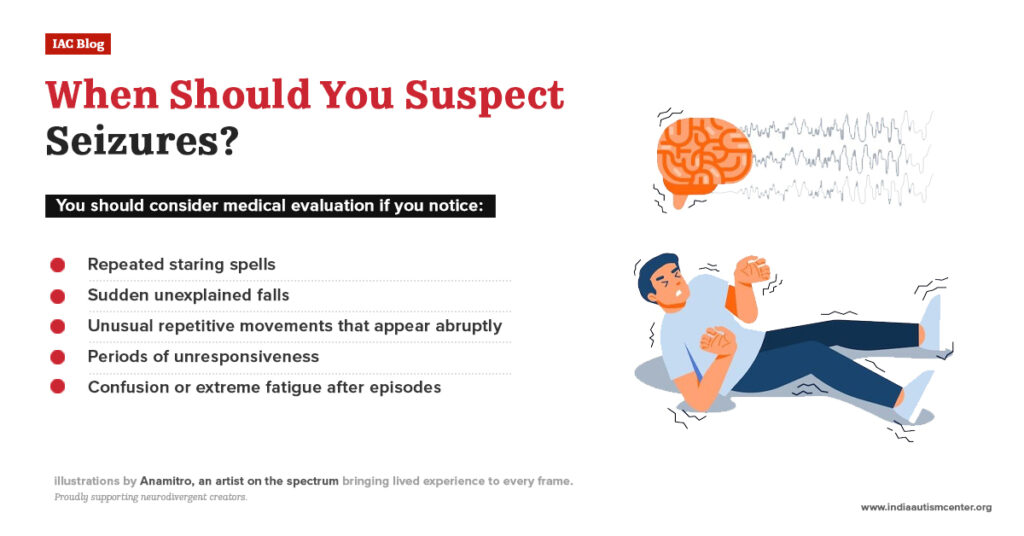
    You should consider a medical evaluation if you notice:

    • repeated staring spells
    • sudden unexplained falls
    • unusual repetitive movements that appear abruptly
    • periods of unresponsiveness
    • confusion or extreme fatigue after episodes

    Tracking these episodes in a symptom diary can be very helpful for doctors.

    When Do Seizures Usually Start in Autism?

    When Do Seizures Usually Start in Autism?

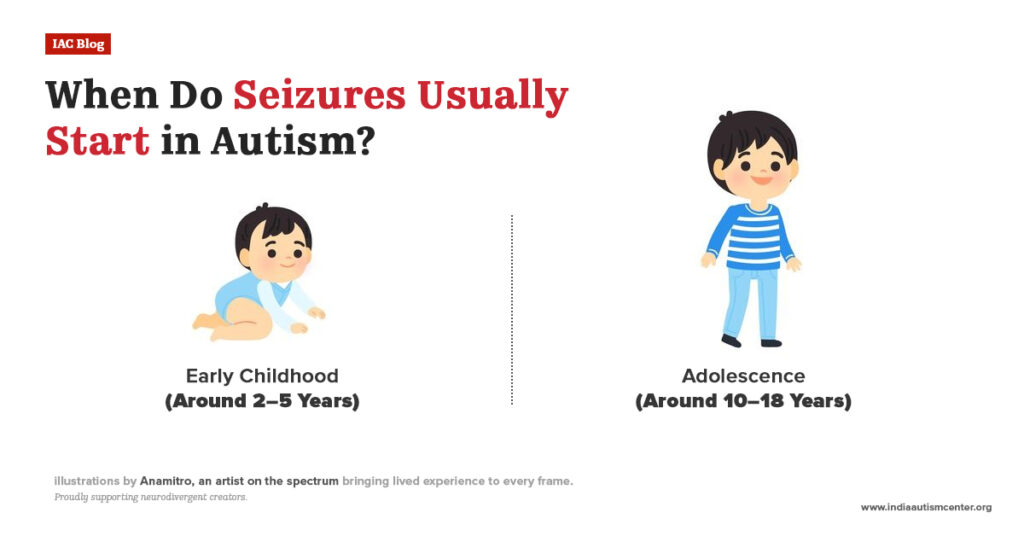
    Seizures can occur at any stage of life, but research shows that individuals with Autism Spectrum Disorder who develop Epilepsy often experience their first seizures during two key developmental periods.

    These periods are important because the brain undergoes major growth and neurological changes, which can sometimes increase vulnerability to seizure activity.

    Let me explain these stages more clearly.

    1. Early Childhood (Around 2–5 Years)

    The first common period when seizures may appear is early childhood, usually between the ages of 2 and 5 years.

    During this time, the brain is developing very rapidly. Neural connections that support:

    • language development
    • social interaction
    • motor skills
    • learning and memory

    are forming at a fast pace.

    Because the brain’s electrical systems are still maturing and organising, some children may develop abnormal electrical activity that leads to seizures.

    Parents may notice signs such as:

    • frequent staring spells
    • sudden pauses during play or speech
    • unusual repetitive movements
    • brief loss of awareness

    Sometimes these symptoms are initially mistaken for autism-related behaviours, which is why seizures during this stage may go undiagnosed for some time.

    2. Adolescence (Around 10–18 Years)

    The second peak period for seizure onset is adolescence.

    During puberty, the brain undergoes another major phase of development. Several biological changes occur, including:

    • hormonal fluctuations
    • restructuring of brain circuits
    • changes in sleep patterns
    • increased emotional and cognitive demands

    These changes can sometimes affect the brain’s electrical stability, making seizures more likely to appear during the teenage years.

    In adolescents with autism, seizures may show up as:

    • sudden confusion or disorientation
    • unexplained falls
    • jerking movements
    • brief loss of consciousness

    Because behavioural changes are also common during teenage years, seizure symptoms may sometimes be misinterpreted as mood or behavioural issues.

    How Doctors Diagnose Epilepsy in Children with Autism

    How Doctors Diagnose Epilepsy in Children with Autism

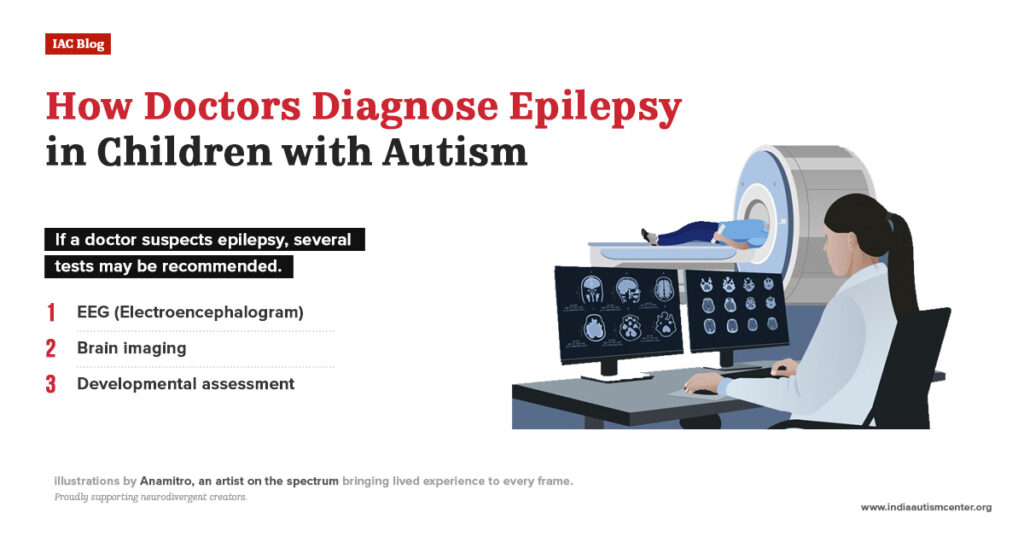
    If a doctor suspects epilepsy, several tests may be recommended.

    Electroencephalogram (EEG)

    This test records electrical activity in the brain and helps identify seizure patterns.

    Brain imaging

    Doctors may recommend scans such as:

    • MRI scan
    • CT scan

    These help detect structural differences in the brain.

    Developmental assessment

    Because autism and epilepsy can interact, doctors often assess:

    • behaviour
    • communication
    • cognitive development

    Want to know more? Get in touch with us.

    Managing Epilepsy and Autism Together

    Managing Epilepsy and Autism Together

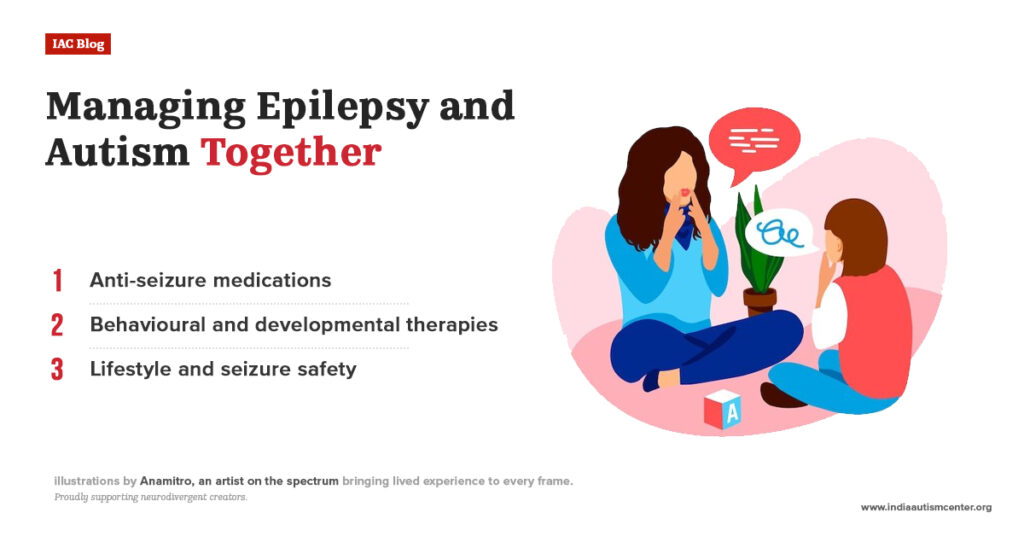
    Managing epilepsy and autism requires a multidisciplinary approach. In my clinical experience, the best outcomes happen when neurologists, therapists, and families work together.

    Here are some of the approaches you can opt for.

    1. Anti-seizure medications

    Most people with epilepsy manage seizures through medication. Your doctor will choose medication based on:

    • seizure type
    • age
    • overall health

    These medicines help stabilise electrical activity in the brain.

    2. Behavioural and developmental therapies

    While medication controls seizures, therapy supports developmental progress.

    This may include:

    • speech therapy
    • occupational therapy
    • behavioural therapy

    Together, they help improve communication, daily functioning, and independence.

    3. Lifestyle and seizure safety

    Parents should also follow some practical safety measures.

    For example:

    • Ensure adequate sleep, as sleep deprivation can trigger seizures.
    • Maintain consistent medication schedules.
    • Keep a seizure diary to track patterns.

    What Should Parents Do During a Seizure?

    What Should Parents Do During a Seizure?

    Witnessing a seizure can be frightening. However, knowing what to do can protect your child.

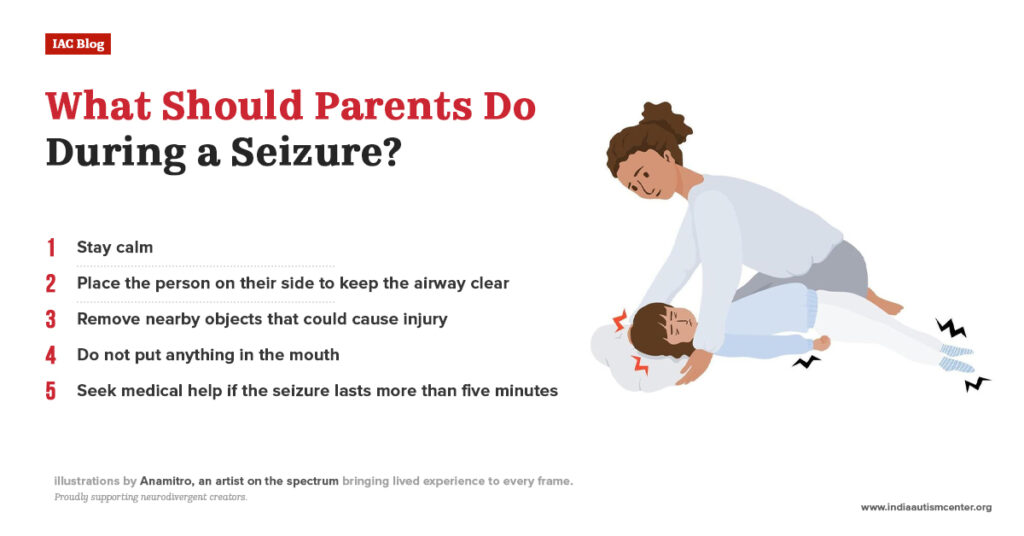
    Here are the basic steps:

    1. Stay calm.
    2. Place the person on their side to keep the airway clear.
    3. Remove nearby objects that could cause injury.
    4. Do not put anything in the mouth.
    5. Seek medical help if the seizure lasts more than five minutes.

    Most seizures stop on their own within a few minutes.

    Conclusion

    The relationship between epilepsy and autism is complex, but understanding it helps families take the right steps.

    Let me summarise the most important points:

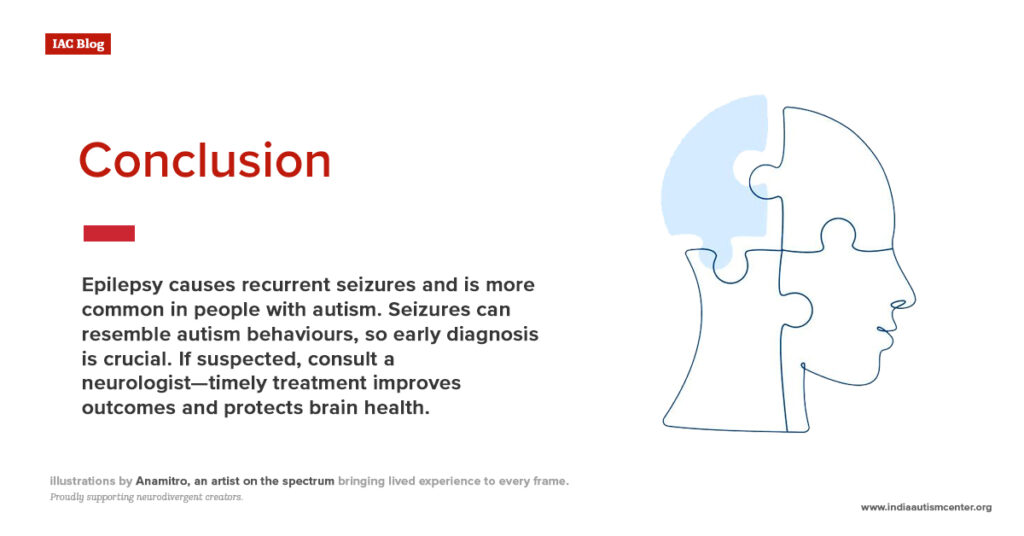
    • Epilepsy is a neurological condition that causes recurrent seizures.
    • People with autism have a higher risk of developing epilepsy
    • Seizures may sometimes look like autism behaviours.
    • Early diagnosis and treatment significantly improve outcomes.

    If you suspect seizures in a child with autism, never ignore the signs. Speak to a neurologist. Early intervention can protect brain health and improve quality of life.

    Frequently Asked Questions

    How common is epilepsy in autism?

    Around 20–30% of individuals with autism develop epilepsy at some point in life. The risk is higher in those with intellectual disability or genetic conditions

    Can autism cause epilepsy?

    Autism itself does not directly cause epilepsy. However, both conditions share brain development pathways and genetic factors, which explains why they often occur together.

    What are the early epilepsy symptoms in children?

    Common symptoms include:

    • confusion after episodes
    • staring spells
    • sudden body jerks
    • loss of awareness
    • unexplained falls

    4. Can epilepsy be cured?

    Epilepsy usually cannot be permanently cured, but it can often be well controlled with medication and medical care.

    For expert insights, support services, and inclusive learning initiatives, visit the India Autism Center.
  • What Is Atypical Autism? Meaning, Symptoms, Causes

    What Is Atypical Autism? Meaning, Symptoms, Causes

    You heard the word in a clinic. Or read it in a report. Or typed it into a search bar at midnight because something just doesn’t add up about your child – or yourself.

    Atypical autism is one of the most searched, least explained terms in the neurodevelopmental space. According to the CDC, autism spectrum disorder affects approximately 1 in 31 children globally. Within that population, a significant number present with traits that don’t fit the textbook picture – and for years, those individuals were the hardest to identify and support.

    This guide covers everything: the atypical autism meaning, how it differs from classic autism and Asperger’s, what the signs look like across the lifespan, how diagnosis works in India, what the latest research says, and what therapy actually helps.

    Understanding Atypical Autism

    Understanding Atypical Autism

    Not every autistic person looks the same. That’s the whole point of a spectrum.

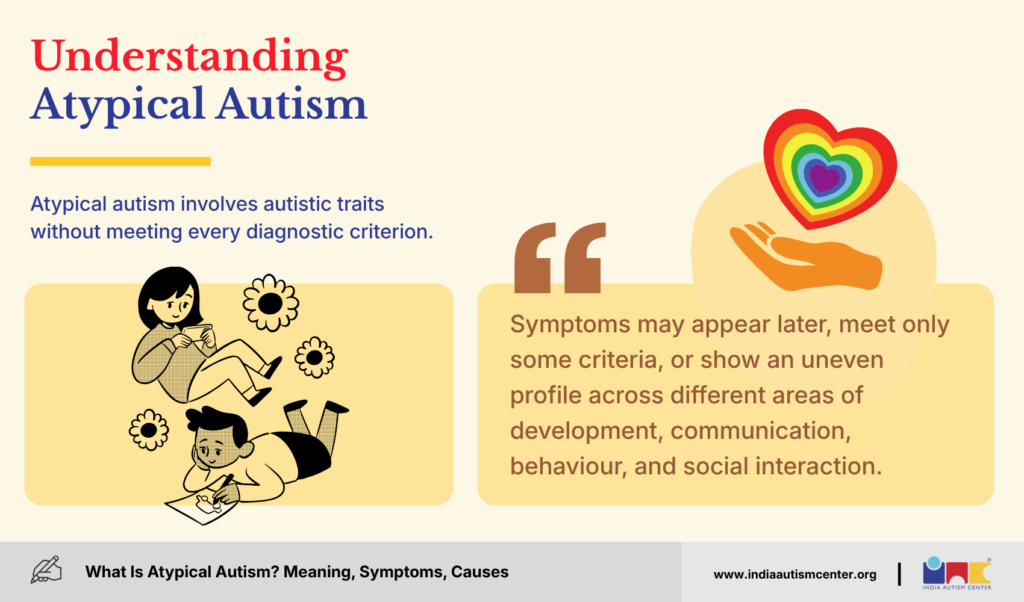
    Atypical autism is a developmental condition in which a person shows some characteristics of autism but does not fully meet the diagnostic criteria for a classic autism diagnosis. The atypical autism meaning, in plain terms, is this: the traits are real, the challenges are real – but the presentation doesn’t tick every box in the traditional checklist.

    Three things typically make a presentation “atypical”:

    • Late onset – symptoms appear after age three, rather than in early infancy
    • Partial criteria – the person meets some but not all diagnostic requirements
    • Uneven profile – strong skills in some areas coexist with significant difficulties in others

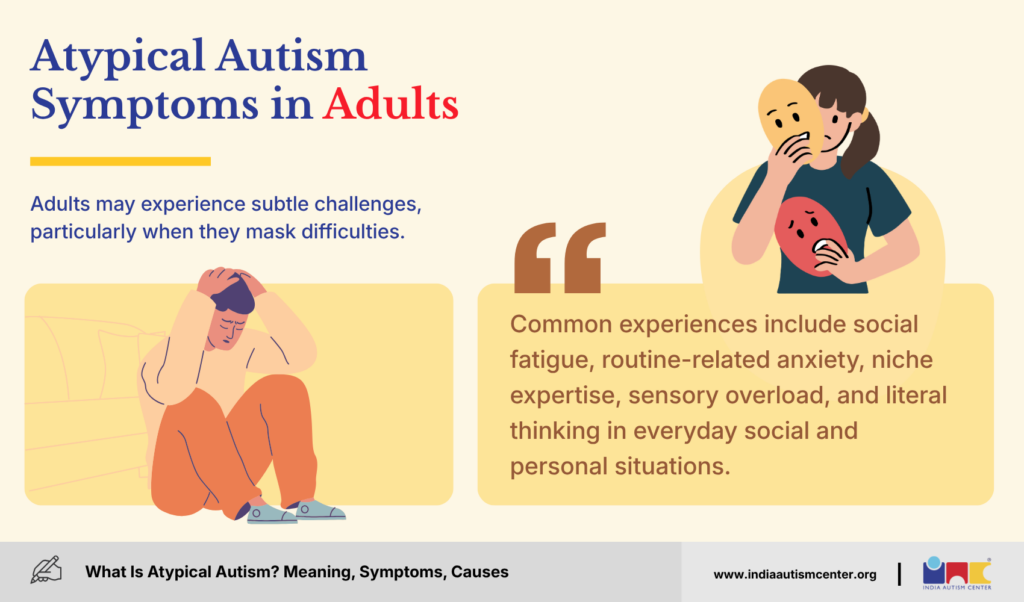
    Because of this variation, atypical autism is sometimes described as a subthreshold form of autism spectrum disorder. A child might have profound sensory sensitivities and social communication difficulties but show no repetitive behaviours whatsoever. An adult might have encyclopedic knowledge of a niche subject and struggle with every workplace relationship – yet sail through a standard autism screening.

    Today, under DSM-5 and ICD-11, the formal label “atypical autism” no longer exists as a standalone diagnosis. But the concept remains vital. It helps families, clinicians, and educators understand why some individuals clearly need support yet keep falling through the diagnostic cracks.

    📥 Free download: Printable daily routine chart for autistic children

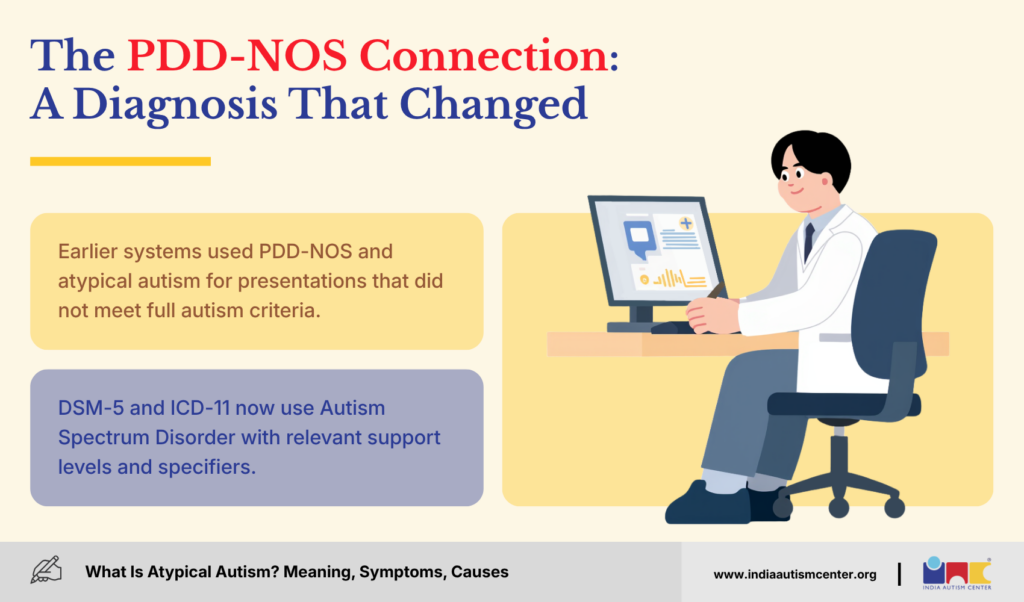
    The PDD-NOS Connection: A Diagnosis That Changed

    The PDD-NOS Connection: A Diagnosis That Changed

    This is where it gets a little complicated – and where many families feel confused.

    The diagnostic timeline matters. Here’s how the classification of atypical autism has evolved:

    DSM-IV (pre-2013): The American Psychiatric Association’s fourth edition used a three-category system under “Pervasive Developmental Disorders.” The categories were Autistic Disorder, Asperger’s Disorder, and PDD-NOS (Pervasive Developmental Disorder – Not Otherwise Specified). PDD-NOS was the catch-all label for presentations that had autistic features but didn’t meet the full criteria for either Autistic Disorder or Asperger’s. Many clinicians used it interchangeably with “atypical autism.”

    ICD-10 (still used in many Indian hospitals): The World Health Organisation’s tenth revision explicitly used the term “atypical autism” (code F84.1) for presentations with late onset, atypical symptoms, or both. This is why the term still appears in Indian diagnostic reports – many hospitals and clinics continue to use ICD-10 codes.

    DSM-5 (2013–present): The APA collapsed all subtypes – Autistic Disorder, Asperger’s, PDD-NOS, and others – into a single diagnosis: Autism Spectrum Disorder (ASD). The DSM-5 requires deficits in two core domains:

    1. Persistent deficits in social communication and social interaction across multiple contexts

    2. Restricted, repetitive patterns of behaviour, interests, or activities

    Severity is now described using three support levels (1, 2, 3) rather than separate diagnostic labels. A person who would previously have been diagnosed with PDD-NOS or atypical autism now receives an ASD diagnosis, often at Level 1, with specifiers for language and intellectual functioning.

    ICD-11 (WHO’s current standard, adopted in India from 2022): Like DSM-5, ICD-11 uses a single ASD category with dimensional specifiers. The standalone “atypical autism” code from ICD-10 no longer exists in ICD-11.

    What this means for families today: If your child received a report saying “atypical autism” or “PDD-NOS,” that diagnosis is still valid and meaningful – it describes their profile. Under current systems, a clinician would likely document it as ASD with relevant specifiers. The label changed; the person didn’t. And crucially, the need for support is just as real.

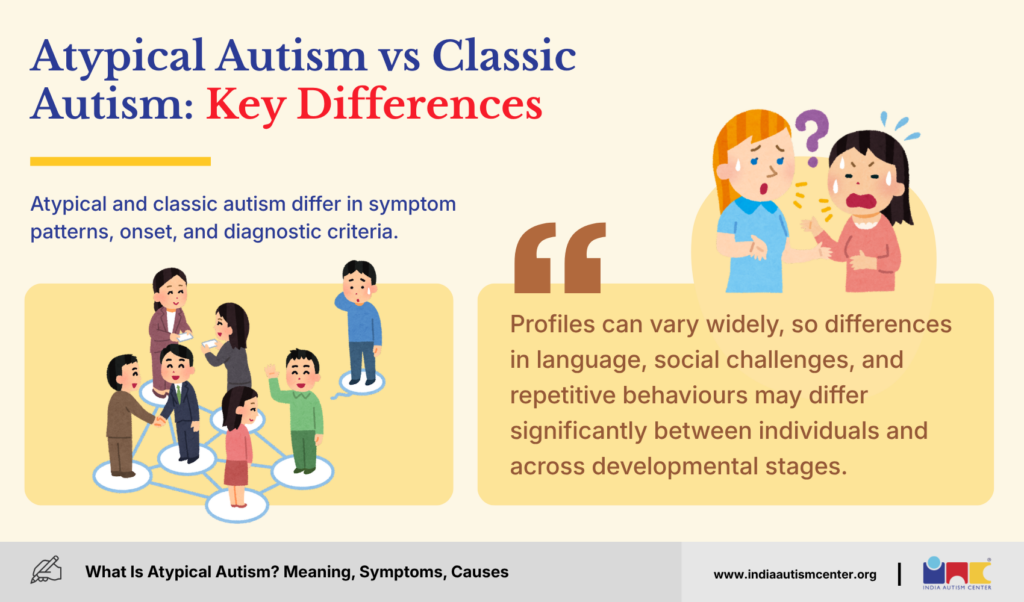
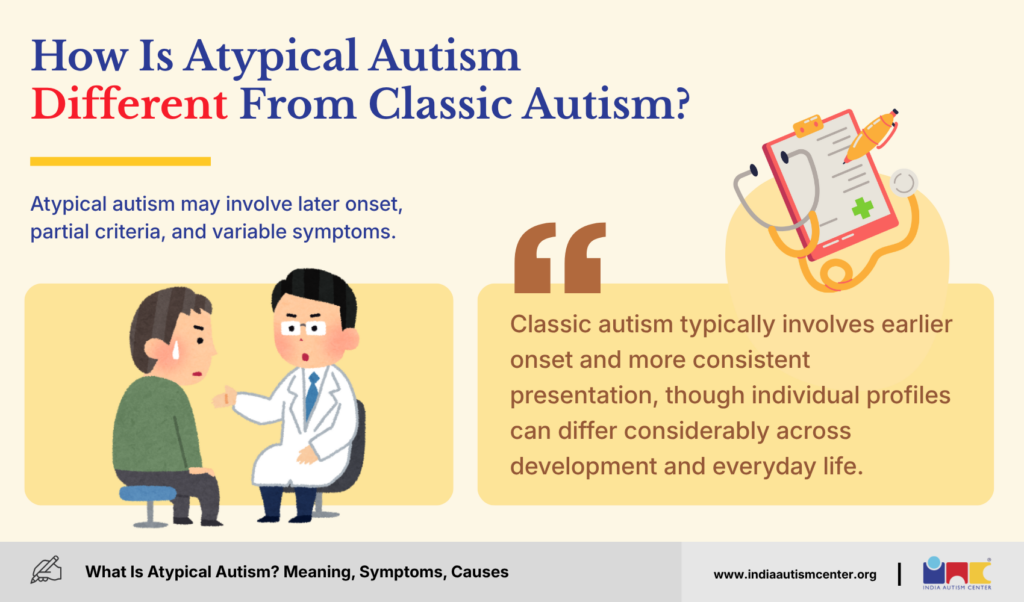
    Atypical Autism vs Classic Autism: Key Differences

    Atypical Autism vs Classic Autism: Key Differences

    The difference isn’t about severity – it’s about profile.

    FeatureAtypical AutismClassic Autism
    Age of symptom onsetOften after age 3Usually before age 3
    Diagnostic criteria metPartialFull
    Symptom severityOften milder or unevenOften more consistent and pronounced
    Social challengesPresent but variableTypically significant across contexts
    Language developmentOften typical or near-typicalFrequently delayed
    Repetitive behavioursMay be fewer or milderOften more consistent
    Intellectual abilityWide range; often average or aboveWide range

    The key phrase is “often” – neither profile is monolithic. Some individuals with classic autism have remarkable language skills; some with atypical presentations face profound daily challenges. The table is a guide, not a rule.

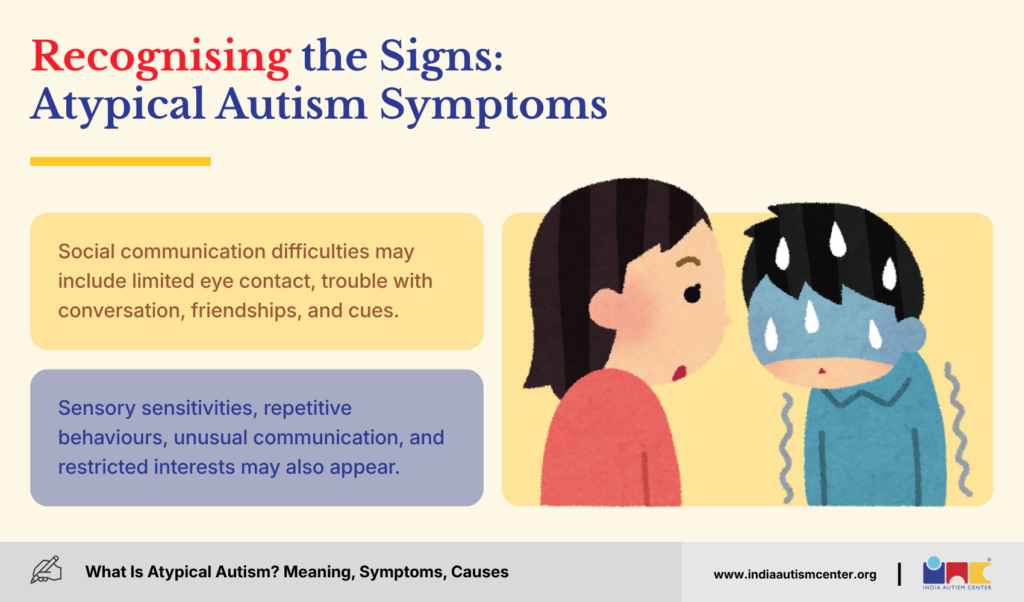
    Recognising the Signs: Atypical Autism Symptoms

    Recognising the Signs: Atypical Autism Symptoms

    Because this condition is “atypical,” the signs can be subtle or inconsistent. Some children might be very social but struggle with the “unspoken rules” of conversation. Others might have no repetitive behaviours but experience extreme sensory sensitivities.

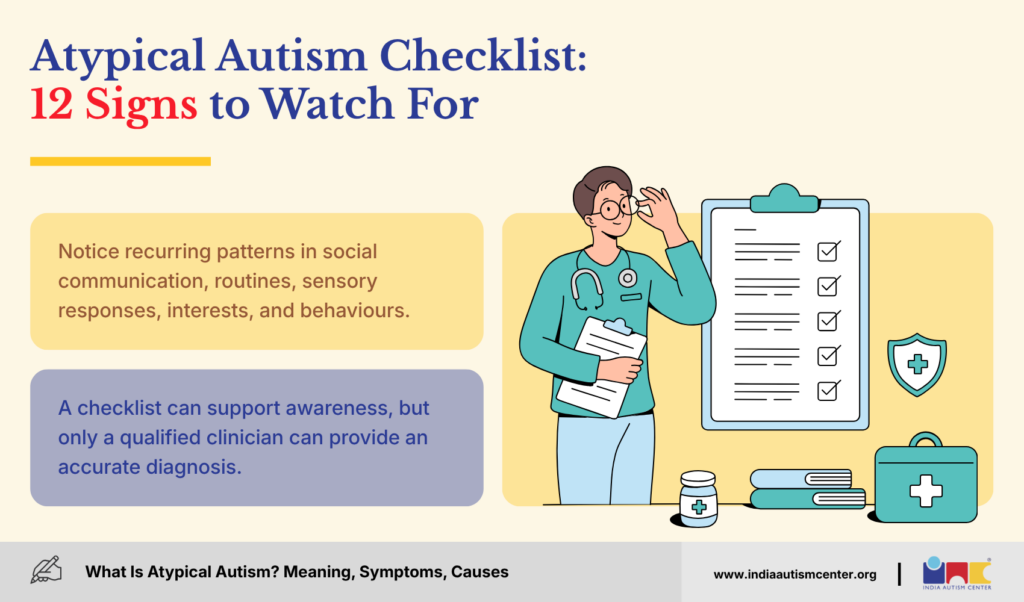
    Common atypical autism symptoms include:

    Social Communication Challenges

    Many individuals with atypical autism struggle with social interactions. However, these challenges may be less severe than in classic autism. Some of the common signs include:

    • Difficulty understanding social cues
    • Limited eye contact
    • Trouble maintaining conversations
    • Difficulty forming friendships
    • Misinterpreting facial expressions or tone

    Delayed or Unusual Communication

    Some children with atypical autism symptoms may develop speech normally but struggle with the social use of language. Here are some signs that are usually found:

    • Talking excessively about specific interests
    • Difficulty understanding jokes or sarcasm
    • Repeating phrases or scripts from TV shows
    • Trouble taking turns in conversation

    Sensory Sensitivities

    Many individuals with atypical autism symptoms experience unusual sensory responses. Children with atypical autism are found to be:

    • Sensitive to loud sounds
    • Disturbed by bright lights
    • Uncomfortable with certain textures
    • Overwhelmed in crowded environments

    Repetitive Behaviors

    Repetitive behaviours are another common feature of atypical autism. However, these behaviours may be less frequent or less intense than those seen in typical autism.

    A person with atypical autism is seen:

    • Repeating certain movements
    • Insisting on routines
    • Being strongly attached to specific objects
    • Repeating the same questions

    Restricted Interests

    People with atypical autism often develop intense interests in specific topics such as trains, maps, science, video games, or other technologies. While having strong interests is normal, individuals with atypical autism symptoms may focus on them to an unusual degree.

    It is important to remember that every individual is different. Some might show many atypical autism symptoms, while others may only show a few that appear intermittently.

    Want to know more? Get in touch with us.

    Atypical Autism Symptoms in Adults

    Atypical Autism Symptoms in Adults

    Many people reach adulthood without ever realising they are neurodivergent. Because atypical autism can be subtle, it is often missed during childhood, especially in individuals with high cognitive abilities who “mask” their struggles to fit in.

    When looking at atypical autism symptoms in adults, we often see:

    • Social Fatigue: Feeling completely exhausted after a normal workday or social gathering due to the effort required to process social cues.
    • Strict Adherence to Routines: Feeling significant anxiety if a planned route is blocked or if a meeting is rescheduled at the last minute.
    • Niche Expertise: Having an encyclopedic knowledge of a specific subject that goes far beyond a hobby.
    • Sensory Overload: Finding open-office plans or loud restaurants physically painful or impossible to concentrate in.
    • Literal Thinking: Difficulty with sarcasm, idioms, or “reading between the lines” in professional emails or romantic relationships.

    Understanding atypical autism symptoms in adults is crucial because receiving a late diagnosis can often provide a massive sense of relief and clarity for the individual.

    Atypical Autism Checklist: 12 Signs to Watch For

    Atypical Autism Checklist: 12 Signs to Watch For

    ⚠️ Important caveat: This checklist is a screening tool only – not a diagnostic instrument. A positive screen does not confirm atypical autism, and a negative screen does not rule it out. Only a qualified clinician can make a diagnosis. If several items resonate, seek a professional evaluation.

    Use this checklist to notice patterns over time, across different settings (home, school, social situations):

    ☐ Difficulty understanding unspoken social rules – often confused by what others seem to “just know”

    ☐ Inconsistent eye contact – may make eye contact sometimes but find it uncomfortable or forced

    ☐ Struggles with back-and-forth conversation – tends to monologue or misses conversational cues

    ☐ Takes language very literally – confused by idioms, sarcasm, or jokes

    ☐ Intense, narrow interests – one or two topics dominate conversation and free time

    ☐ Strong need for routine – significant distress when plans change unexpectedly

    ☐ Sensory sensitivities – over- or under-reacts to sounds, textures, lights, or smells

    ☐ Social exhaustion – feels drained after social interactions that others find energising

    ☐ Difficulty making or keeping friends – despite wanting connection, relationships don’t quite “click”

    ☐ Repetitive movements or speech patterns – rocking, tapping, scripted phrases used for comfort

    ☐ Meltdowns or shutdowns when overwhelmed – disproportionate to the apparent trigger

    ☐ Symptoms appeared after age 3, or are present in some areas but not others

    If you ticked 5 or more of these items consistently across settings, a formal atypical autism diagnosis evaluation is worth pursuing.

    How Is Atypical Autism Different From Classic Autism?

    How Is Atypical Autism Different From Classic Autism?

    Although both fall within the autism spectrum, atypical autism differs from typical autism in terms of symptom pattern, severity, and age of onset. The table below highlights the key differences:

    FeatureAtypical AutismClassic Autism
    Age of symptom onsetOften after age 3Usually, before age 3
    Symptom severityOften milderOften more pronounced
    Diagnostic criteriaPartial criteriaFull diagnostic criteria
    Social challengesPresent but variableTypically significant
    Repetitive behaviorsMaybe fewer or milderOften more consistent

    How Atypical Autism Is Diagnosed?

    How Atypical Autism Is Diagnosed?

    Diagnosing atypical autism means going through a comprehensive evaluation by specialists.

    The assessment may involve:

    • Developmental history
    • Behavioral observations
    • Psychological testing
    • Communication assessments

    Clinicians often use standardised diagnostic tools to identify atypical symptoms of autism. Early diagnosis is important because early intervention with different therapies can significantly improve long-term outcomes.

    Causes of Atypical Autism

    Causes of Atypical Autism

    There is no single cause of atypical autism. Researchers believe it develops due to a combination of genetic and environmental factors. Let us understand how these factors contribute:

    Genetic Factors

    Genetics plays a significant role in autism conditions. Studies are still being done to study the genetic patterns behind atypical autism symptoms. Here is what parents and even caregivers must know:

    • Autism is highly heritable
    • Certain gene variations affect brain development
    • Families may have multiple members with autism traits

    Brain Development Differences

    When brain imaging is done for individuals with atypical autism, it is found that there are differences in neural connectivity, the structure of the brain, and also the way information is processed. 

    These neurological differences eventually influence communication and behaviour.

    Environmental Influences

    Certain environmental factors may increase the likelihood of autism traits. Some influencing factors include:

    • Advanced parental age
    • Prenatal complications
    • Low birth weight
    • Exposure to certain prenatal risk factors

    Also, contrary to belief, vaccination in no way is responsible for causing atypical autism.

    Want to know more? Get in touch with us.

    What Therapy Is Available for Atypical Autism?

    What Therapy Is Available for Atypical Autism?

    If you or your child has received a diagnosis, the next logical question is: what now? Instead, the focus is on providing tools to navigate a world that isn’t always built for neurodivergent minds.

    Below are the most effective atypical autism therapy approaches.

    Behavioral Therapy

    Methods such as Applied Behaviour Analysis (ABA) can help build positive habits and reduce self-harm behaviours. It helps the child with atypical autism to:

    • Develop social skills
    • Improve communication
    • Reduce problematic behaviors
    • Build adaptive skills

    Speech Therapy

    Speech and language therapy helps with more than just talking. It focuses on social communication, such as taking turns during a conversation or understanding nonverbal cues used in daily life.

    Speech therapy is particularly helpful for children who struggle with expressive or pragmatic language.

    The therapy primarily focuses on:

    • Language development
    • Conversation skills
    • Social communication
    • Understanding tone and context

    Social Skills Training

    Social skills groups provide a safe environment to practice interacting with peers under a therapist’s guidance. These programs are quite beneficial for individuals with atypical autism symptoms in adults.

    Social skills programs help children and adults learn how to:

    • Interpret social cues
    • Maintain conversations
    • Understand emotions
    • Build relationships

    Occupational Therapy

    This is excellent for addressing sensory issues and supporting fine motor skills as well as daily living tasks. This therapy is frequently recommended as part of comprehensive atypical autism care.

    Occupational therapy can support:

    • Sensory processing
    • Fine motor skills
    • Self-care routines
    • Emotional regulation

    Family Support and Education

    Parents and caregivers play an important role in supporting children with atypical autism. Parent training programs aim to help families to:

    • Understand autism traits
    • Use effective communication strategies
    • Create structured environments
    • Encourage independence

    How Early Identification Helps?

    How Early Identification Helps?

    Statistics show that early intervention can drastically improve long-term outcomes for children with developmental delays. 

    When atypical autism is identified early, the brain is more “plastic,” meaning it is more adaptable to learning new coping strategies and communication methods.

    However, even if a diagnosis comes later, the value of knowing what atypical autism is cannot be overstated. It allows families to move away from frustration and toward specialised support. 

    Instead of wondering why a child is “acting out,” parents can recognise a sensory meltdown and provide the right environment to help them calm down.

    Parents should seek professional evaluation if they notice signs such as delayed social interaction, unusual communication patterns, or repetitive behaviours. It is the very first step towards long-term development progress.

    Daily Support Strategies for Atypical Autism

    Daily Support Strategies for Atypical Autism

    In addition to therapy, simple daily strategies can help individuals manage atypical autism symptoms.

    Some helpful strategies include:

    • Creating predictable routines
    • Using visual schedules
    • Encouraging structured play
    • Breaking tasks into smaller steps
    • Providing clear instructions
    • Reducing sensory overload

    Consistency and patience are essential when supporting individuals with atypical autism.

    The Female Phenotype and Camouflaging

    The Female Phenotype and Camouflaging

    Girls and women are diagnosed with autism at significantly lower rates than boys and men. The ratio in diagnosed populations has historically been around 4:1 (male to female). But research increasingly suggests this gap reflects diagnostic bias, not a genuine difference in prevalence.

    The reason? Camouflaging – also called masking.

    A 2023 systematic review published in Development and Psychopathology found that camouflaging is consistently associated with identifying as female, higher autistic traits, and negative mental health outcomes. Autistic females tend to:

    • Study and mimic social behaviour more consciously
    • Develop elaborate scripts for social situations
    • Suppress or hide repetitive behaviours in public
    • Internalise difficulties as personal failure rather than neurological difference
    • Present with anxiety, depression, or eating disorders as the primary concern – with autism missed underneath

    This is the female phenotype of atypical autism: a presentation that looks “fine” on the surface, that passes standard screening tools designed around male presentations, and that often goes unrecognised until the cost of masking becomes unsustainable.

    Gender-diverse individuals face similar diagnostic gaps. The growing recognition of these presentations is one of the most important shifts in autism research of the past decade.

    If you are a woman or gender-diverse person who has always felt “different” but never quite fit the autism picture you’ve seen described – this is worth exploring with a clinician experienced in female and gender-diverse presentations.

    How Is Living With Atypical Autism?

    How Is Living With Atypical Autism?

    People with atypical autism can lead fulfilling and successful lives when given the right support.

    Many individuals develop strengths in areas such as:

    • Analytical thinking
    • Attention to detail
    • Creativity
    • Memory
    • Specialised knowledge

    Educational accommodations, therapy, and supportive environments help individuals reach their full potential. Awareness and acceptance are also important in reducing stigma surrounding autism conditions.

    Recent Research and Advances

    Recent Research and Advances

    The field is moving fast. Here’s what’s changing.

    Late diagnosis is increasingly recognised – and addressed. A growing body of research documents the experiences of adults receiving autism diagnoses in their thirties, forties, and beyond. Studies published between 2022 and 2024 highlight that late-diagnosed adults often report years of misdiagnosis (anxiety, depression, personality disorders) before autism was identified. Recognition of this pattern is driving changes in how adult mental health services screen for neurodevelopmental conditions.

    The female phenotype is reshaping diagnostic practice. Research by Hull, Petrides, and colleagues at University College London has been particularly influential in documenting how camouflaging works, who it affects, and what it costs. A 2023 systematic review in Development and Psychopathology confirmed that camouflaging is consistently associated with female gender, higher autistic traits, and significantly worse mental health outcomes – including higher rates of anxiety, depression, and suicidality. Diagnostic tools and training are slowly catching up.

    Genetics research is accelerating. Large-scale genomic studies – including the SPARK cohort (now over 50,000 families) and the Autism Sequencing Consortium – are identifying new risk genes and clarifying how genetic variants interact. The picture emerging is one of enormous genetic heterogeneity: many different genetic pathways can lead to similar autism presentations.

    Neurodiversity-affirming approaches are gaining ground. The research community is increasingly moving away from deficit-focused models toward frameworks that recognise autistic strengths, support autonomy, and centre the perspectives of autistic people themselves. This shift is influencing therapy design, educational approaches, and how diagnostic feedback is delivered.

    India-specific research is growing. Studies from Indian institutions are documenting the prevalence, presentation, and diagnostic challenges of autism in the Indian context – including the role of cultural factors in how symptoms are perceived and reported, and the barriers to diagnosis in non-metro settings.

    Conclusion

    Whether you are just starting to ask what atypical autism is or you are looking for new atypical autism therapy options, remember that you are not alone. The spectrum is vast, and atypical autism is a significant and valid part of that diversity.

    Understanding what is atypical autism helps families, educators, and healthcare professionals recognise individuals who may fall outside traditional autism definitions but still require support.

    The atypical autism meaning highlights the diversity within the autism spectrum. Some individuals show only certain traits, while others develop symptoms later in childhood or adulthood.

    When parents can recognise atypical autism symptoms early on, they can opt for the right support at the right time. With proper atypical autism therapy and inclusive education, individuals can develop essential life skills and thrive in their communities.

    Frequently Asked Questions

    What is atypical autism?

    Atypical autism is a developmental condition in which a person shows some traits of autism but does not meet the full diagnostic criteria for autism spectrum disorder. The atypical autism meaning often refers to individuals whose symptoms appear later than age three or who display only partial autism characteristics, such as mild social or communication difficulties.

    Can atypical autism be diagnosed in adults?

    Yes, many individuals receive a diagnosis later in life. Atypical autism symptoms in adults may include difficulty understanding social cues, a preference for routines, intense interests, and challenges with workplace communication or relationships.

    Can children with atypical autism attend regular schools?

    Yes, many children with atypical autism attend mainstream schools with appropriate support. Inclusive education programs, individualised learning plans, and therapies, including speech or occupational therapy, can help them succeed academically and socially.

    Can atypical autism improve with therapy?

    Yes, early and consistent atypical autism therapy can significantly improve social skills, communication abilities, and independence. Early intervention programs are especially beneficial for young children.

    Can atypical autism go undiagnosed?

    Yes, many people live with atypical autism without receiving a formal diagnosis, especially if their symptoms are mild. Some individuals seek evaluation only during adolescence or adulthood, when social or professional challenges arise.

    How can parents identify atypical autism symptoms early?

    Parents should watch for developmental signs such as delayed social interaction, difficulty maintaining eye contact, unusual communication patterns, repetitive behaviours, or strong sensory sensitivities. Early consultation with specialists can help identify atypical autism symptoms.

    Disclaimer: This article is intended for educational and informational purposes only. It is not a substitute for professional medical advice, diagnosis, or treatment. If you are pregnant or have concerns about medication use during pregnancy, please consult a qualified healthcare provider. If your child has received an autism diagnosis and you have questions about causes or support, please reach out to a trained specialist or an autism-focused organisation for guidance.

    For expert insights, support services, and inclusive learning initiatives, visit the India Autism Center.
    Useful Sources

    CDC Autism Data and Statistics – prevalence figures and research updates

    WHO ICD-11 ASD Classification – Autism Europe summary of ICD-11 changes

    PMC: Camouflaging in Autistic Adults and Youth – Systematic Review – 2023 systematic review on social camouflaging

    SHANK3 Gene and Autism – SFARI Gene Database – genetics research reference

    Indian Academy of Pediatrics: Autism Spectrum Disorders – India-specific clinical guidance

  • Level 2 Autism: Know the Symptoms, Meaning, and Diagnosis

    Level 2 Autism: Know the Symptoms, Meaning, and Diagnosis

    Navigating the world of neurodiversity can create many doubts for parents and caregivers. When a child or an adult receives a diagnosis of level 2 autism spectrum disorder, the terminology can often seem clinical and confusing. You might find yourself asking, what is level 2 autism, and how does it differ from other forms of the condition?

    In India, estimates suggest that more than 1 in 36 children are expected to be on the autism spectrum, although large-scale national data is still evolving.

    Considering the spectrum, many parents often wonder what level 2 autism is and how it is different from other levels of autism. Understanding the meaning, symptoms, diagnosis process, and long-term outlook can help families make informed decisions early.

    Today, through this guide, we will explain the meaning of autistic level 2 in simple terms, offering a comprehensive look at symptoms, the diagnostic process, and what daily life looks like for those navigating this journey.

    Understanding Autism Spectrum Disorder (ASD)

    Autism Spectrum Disorder overview showing social communication behavior patterns sensory processing and routines

    Autism Spectrum Disorder, which is also mainly referred to as ASD, is essentially a neurodevelopmental condition that affects:

    • Social communication
    • Behavior patterns
    • Sensory processing
    • Interests and routines

    In 2013, the Diagnostic and Statistical Manual of Mental Disorders, Fifth Edition (DSM-5) introduced a severity-based classification system. Instead of older labels like Asperger’s syndrome, autism is now divided into three levels based on the amount of support required.

    This classification has led to parents frequently asking: What is ASD level 2, and how does it fit within this system?

    📥 Free download: Printable daily routine chart for autistic children

    What Does Level 2 Autism Mean?

    Explanation of what level 2 autism means in autism spectrum disorder DSM-5 classification

    To understand what level 2 autism means, we first have to look at how the DSM-5 changed the way we talk about the spectrum. Previously, conditions like Asperger’s Syndrome and Pervasive Developmental Disorder were separate. Today, they all fall under Autism Spectrum Disorder (ASD).

    The levels are not about “how autistic” someone is, but rather how much external help they need to function in a world designed for neurotypical people.

    Level 2 Autism Symptoms: What to Look For?

    Level 2 autism symptoms including social communication challenges and behavioral rigidity

    Understanding level 2 autism symptoms is crucial for parents who are trying to advocate for their child’s needs. These symptoms generally manifest in two core areas. The areas are social communication and restricted repetitive patterns of behaviour.

    Social Communication Challenges

    In Level 2 ASD, social communication gaps are quite visible. Here is what that often looks like:

    • Limited Verbal Interaction: An individual might speak only when they need something, rather than for social pleasure.
    • Atypical Nonverbal Cues: They may struggle with eye contact, or their facial expressions might not match their feelings.
    • Difficulty with Social Nuances: Understanding sarcasm, idioms, or the “unwritten rules” of a conversation is very difficult.
    • Reduced Response to Social Overtures: If someone greets them, they might not respond, or their response might be delayed or unusual.

    Behavioural Symptoms and Rigidity

    The behavioural side of autism level 2 symptoms often centres around a need for sameness.

    • Distress Over Change: Switching from one activity to another (like leaving the house for school) can trigger a meltdown or a total shutdown.
    • Repetitive Body Movements: This might include rocking back and forth, hand flapping, or spinning objects.
    • Narrow Interests: A person might be intensely focused on one specific topic, such as train schedules or a specific cartoon, to the exclusion of everything else.

    What Does Level 2 Autism Look Like at Different Ages?

    Level 2 autism characteristics in toddlers and adults comparison

    The spectrum changes as a person grows. What is visible in a toddler might look different in a working adult.

    Level 2 Autism in Toddlers

    While detecting level 2 autism in toddlers, parents might notice:

    Delayed Speech: The child may not be meeting word-count milestones or may use “echolalia,” repeating phrases they heard elsewhere without understanding their meaning.

    Lack of Functional Play: Instead of playing “house” or “cars,” a toddler might line up their toys for hours.

    Sensory Sensitivities: They might scream at loud noises like that of a vacuum cleaner or refuse to wear certain fabrics because they feel painful against the skin.

    Level 2 Autism in Adults

    For adults who are diagnosed with level 2 autism, the challenges often shift toward independent living and social integration. While many adults with Level 2 have jobs and relationships, they usually require a support system. This could include a job coach, a therapist, or a living situation that provides a predictable routine.

    Adults in this category often experience “autistic burnout” because the effort required to mask their symptoms in public is exhausting. They might still struggle with the complex social dynamics of the workplace, making traditional employment difficult without accommodations.

    The Diagnostic Process: How Level 2 is Identified?

    Diagnostic process for level 2 autism including screening observation interviews and ADOS-2 testing

    If you are wondering what ASD level 2 means in a clinical sense, the diagnosis is usually made by a team of professionals. This often includes a paediatrician, a psychologist, and a speech-language pathologist.

    The process involves:

    • Developmental Screening: Tools like the M-CHAT are used for diagnosis in younger children.
    • Observation: Clinicians watch how the individual interacts with others and toys.
    • Parental Interviews: Gathering a history of the child’s milestones and behaviours.
    • The ADOS-2 Test: the “gold standard” for diagnosis, involving structured tasks that elicit specific social behaviours.

    The goal of the diagnosis is not just to provide a label, but to open doors to services. In India, a formal diagnosis is necessary to access the NIRAMAYA Scheme or to apply for a disability pension for those who qualify. 

    Want to know more? Get in touch with us.

    Level 2 Autism Life Expectancy

    Factors influencing life expectancy in individuals with level 2 autism including epilepsy and mental health conditions

    Many parents also wonder about the life expectancy of individuals with level 2 autism.

    Autism itself does not reduce life expectancy directly. However:

    • Co-occurring medical conditions
    • Epilepsy
    • Mental health challenges

    It can affect how long the child or adult will live if untreated.

    Studies suggest individuals with autism can also have slightly reduced life expectancy due to associated health conditions, but proper medical care helps to improve the overall outcomes.

    Can Level 2 Autism Live Independently?

    Can people with level 2 autism live independently with supported living and caregiver assistance

    One of the most common questions parents ask is, ” Can a person with level 2 autism live independently? The answer depends heavily on the individual and the level of early intervention they received. Many people with level 2 ASD can live semi-independently. This might look like:

    • Living in a supported living community.
    • Living at home with a caregiver who helps with finances and scheduling.
    • Living alone but having a “check-in” person who visits daily or weekly.

    In total, unassisted independence is less common for Level 2 than for Level 1 Autism, but it is not impossible. With the right technology, visual schedules, and social skills training, many adults lead fulfilling, semi-autonomous lives.

    Supporting Someone with Type 2 Autism

    Tips for supporting someone with level 2 autism including communication strategies and sensory management

    Supporting a child or an adult with type 2 autism needs patience and, more importantly, a shift in perspective. Instead of trying to force them to “act normal,” focus on creating an environment where they can thrive.

    Communication Strategies

    Use Visuals: Since verbal processing is often on the slower side in Level 2, it is best to use picture schedules or written lists.

    Be Direct: Avoid sarcasm or “beating around the bush.” If you need them to do something, say it clearly.

    Give Time: After asking a question, wait at least 10 seconds for them to process and respond.

    Sensory Management

    Most people with Level 2 ASD have sensory processing issues.

    Create a Safe Zone: Set up a quiet corner in the house with dim lighting and sensory toys.

    Noise-Cancelling Headphones: These are a lifesaver in malls, airports, or loud classrooms.

    Dietary Awareness: Some individuals are highly sensitive to food texture, which can appear like “picky eating” but is actually a sensory response.

    Therapies for Level 2 Autism

    Therapies for level 2 autism including ABA speech therapy occupational therapy and CBT

    Understanding what level 2 autism is, it is important to know that therapy is essential, as this level is defined as “requiring substantial support.” The goal is not to change who the person is, but to build communication, independence, and coping skills.

    • Applied Behaviour Analysis (ABA)

    Applied Behaviour Analysis (ABA) is one of the most widely used approaches for level 2 autism spectrum disorder. It helps improve communication, reduce challenging behaviours, and teach daily living skills through structured, step-by-step learning.

    • Speech and Language Therapy

    Speech and Language Therapy is very important, especially when it comes to level 2 autism symptoms, which include delayed speech or difficulty maintaining conversations. Therapy tends to focus on expressive language, understanding instructions, or using alternative communication methods if needed.

    • Occupational Therapy (OT)

    Occupational Therapy (OT) supports sensory regulation and everyday skills. There are many individuals with level 2 ASD who experience sensory sensitivities or struggle with dressing, feeding, or handwriting. OT helps improve coordination, self-care, and emotional regulation.

    • Social Skills Training

    Social Skills Training teaches children and teens how to take turns, read facial expressions, and engage in conversations. This directly addresses common Level 2 autism symptoms, which are more related to social interaction.

    • Cognitive Behavioural Therapy (CBT)

    For older children and adults, Cognitive Behavioural Therapy (CBT) can help manage anxiety, rigid thinking, and emotional challenges.

    Early intervention with consistent therapies significantly improves long-term outcomes. While therapy is not meant to “cure” autism, it can considerably reduce support needs over time and improve independence. With the right structured support, individuals with level 2 autism can develop meaningful skills for daily life.

    Common Myths About Level 2 Autism

    Common myths and facts about level 2 autism explained

    When parents first learn what level 2 autism is, they are often overwhelmed not just by the diagnosis but by myths and misinformation related to autism . Let us clear up some common myths.

    Myth 1: Level 2 autism is just bad behaviour.

    Truth: Level 2 autism spectrum disorder is a neurodevelopmental condition. The behaviours associated with level 2 autism symptoms are linked to differences in brain development, not to poor parenting or discipline.

    Myth 2: Children will outgrow it.

    Truth: Autism is lifelong. While therapy aims to reduce support needs, Level 2 ASD does not simply disappear with age.

    Myth 3: Level 2 autism means low intelligence.

    Truth: The level of intelligence is not restricted due to autism. It varies widely. Some individuals may have average or even above-average abilities but still struggle socially and behaviorally.

    Myth 4: They cannot live independently.

    Truth: Many families ask, ” Can a person with level 2 autism live independently? With structured therapy, life skills training, and support, some individuals achieve partial or full independence.

    Myth 5: It is the same for everyone.

    Truth: Every person with level 2 autism is different. Symptoms, strengths, and challenges vary significantly.

    Want to know more? Get in touch with us.

    Why Early Diagnosis Matters?

    Understanding what level 2 autism is becomes far more meaningful when the diagnosis happens early. Early identification allows families to begin structured interventions during critical years of brain development.

    Research shows that therapy started before age five can significantly improve communication, social interaction, and adaptive skills in kids with level 2 autism spectrum disorder.

    When level 2 autism symptoms are recognised early, children can receive speech therapy, occupational therapy, and behavioural support before these challenges become deeply ingrained.

    Early diagnosis also helps parents understand what level 2 autism means in practical terms, reducing confusion and delay in seeking help.

    Most importantly, early support improves long-term independence, learning outcomes, and overall quality of life.

    Conclusion

    Conclusion about living a meaningful life with level 2 autism with proper support

    The first step toward accepting the answer to the question “What is level 2 autism?” is understanding the core concepts. While the “substantial support” label might sound daunting, it simply means that these individuals interact with the world differently. 

    They have a unique “autistic level 2 meaning” that involves deep passions, a different way of seeing details, and a need for a predictable, safe world.

    Whether you are a parent of a toddler or an adult seeking answers, remember that a diagnosis is a tool for understanding, not a limitation on what a person can achieve. With the right support, individuals with level 2 ASD can lead lives filled with purpose, connection, and joy.

    Frequently Asked Questions

    What is level 2 autism?

    Level 2 autism refers to a moderate form of Autism Spectrum Disorder, where an individual requires substantial support. Children and adults at this level exhibit clear social communication difficulties and repetitive behaviours that affect daily functioning.

    What are the common Level 2 autism symptoms?

    Common level 2 autism symptoms include limited eye contact, difficulty maintaining conversations, rigid routines, sensory sensitivities, and noticeable repetitive behaviours.

    How are autism level 2 symptoms different from Level 1?

    Autism level 2 symptoms are more pronounced and require structured support. Unlike Level 1, individuals at Level 2 cannot function independently without consistent assistance.

    What does level 2 autism look like in daily life?

    Parents often ask what level 2 autism looks like. It may involve a child who can speak but struggles socially, resists change, and becomes distressed when routines shift.

    Can a person with level 2 autism live independently?

    Regarding whether level 2 autism individuals live independently, some individuals achieve semi-independence with life skills training and structured support, while others may require assisted living.

    Disclaimer: This article is intended for educational and informational purposes only. It is not a substitute for professional medical advice, diagnosis, or treatment. If you are pregnant or have concerns about medication use during pregnancy, please consult a qualified healthcare provider. If your child has received an autism diagnosis and you have questions about causes or support, please reach out to a trained specialist or an autism-focused organisation for guidance.

    For expert insights, support services, and inclusive learning initiatives, visit the India Autism Center.
  • A Guide to Legal Guardianship (2026)

    A Guide to Legal Guardianship (2026)

    For many families raising children with developmental disabilities, there is a question about legal guardianship that quietly sits in the background for years:

    “What will happen to my child when I am no longer here?”

    This is where legal guardianship becomes critically important.

    Legal guardianship is a structured legal mechanism that ensures individuals who require support in decision-making continue to receive care, protection, and advocacy throughout their lives. In India, this framework is supported by the National Trust Act, 1999, which was established to protect and empower persons with Autism, Cerebral Palsy, Intellectual Disability, and Multiple Disabilities.

    India Autism Center (IAC) is redefining what long-term, inclusive support truly means for individuals with autism and their families. Instead of focusing only on short-term therapies or immediate interventions, IAC is building something far more meaningful—a comprehensive, evolving ecosystem of care that grows with the individual over time. This approach is rooted in a simple but powerful truth: autism is not a phase, but a lifelong journey that requires consistent, adaptive support at every stage of life.

    At the core of this vision lies a deep understanding of a reality many families quietly live with—the uncertainty of the future. Questions around education, employment, independent living, and social inclusion often feel overwhelming, especially in a world where structured support systems are still limited. By creating integrated environments that bring together housing, therapy, vocational training, and community engagement, IAC is working to replace that uncertainty with reassurance, continuity, and hope.

    Here, sustainability goes beyond funding or infrastructure—it is about building a life. It means creating communities where individuals with autism can lead meaningful, self-directed lives. From thoughtfully designed sensory-friendly spaces to opportunities for skill-building and employment, every element is shaped to support independence and dignity. Equally important is the network that surrounds them—caregivers, professionals, and peers who provide ongoing support and connection.

    Such initiatives signal a shift in how society approaches developmental disabilities—from a fragmented, reactive model to a more holistic and future-focused one. By addressing both present needs and long-term aspirations, organisations like IAC are not only supporting individuals with autism but also helping to build more inclusive, compassionate communities where everyone has the opportunity to thrive.

    Understanding Legal Guardianship

    Understanding Legal Guardianship

    Legal guardianship—especially in the context of autism—is often misunderstood. Many assume it takes away an individual’s independence, but in reality, it is designed to do the opposite. In India, legal guardianship is not about control; it is about creating a structured support system for individuals who may need assistance in navigating certain aspects of life. 

    For individuals with autism, these needs can vary widely—from managing finances and healthcare decisions to accessing education, employment opportunities, or independent living. Legal guardianship ensures that these responsibilities are handled with care, while protecting the individual’s rights, dignity, and overall well-being.

    India’s legal framework, guided by the National Trust Act, 1999 and the Rights of Persons with Disabilities (RPwD) Act, 2016, reflects a progressive and rights-based approach. At its core is the idea of supported decision-making—encouraging individuals with autism to actively participate in decisions about their own lives wherever possible. 

    Guardians, whether family members or appointed representatives, are there to assist—not override. Their role is clearly defined, with an emphasis on acting in the best interests of the individual while maintaining accountability and transparency. Most importantly, the law strives to preserve the individual’s voice, ensuring their agency is respected to the greatest extent possible.

    Ultimately, legal guardianship is about finding the right balance between protection and independence. It acknowledges that while some individuals may need ongoing support, they also deserve inclusion, respect, and the freedom to express themselves. In this evolving perspective, legal guardianship becomes a tool that enables individuals with autism to lead lives that are not only secure, but also meaningful and dignified.

    A legal guardian may assist in matters such as:

    • Medical and healthcare decisions
    • Educational and vocational planning
    • Financial and property management
    • Accessing government welfare schemes
    • Legal representation in official matters

    The fundamental objective of legal guardianship is to safeguard the well-being and rights of individuals who may not always be able to make fully independent decisions.

    📥 Free download: Printable daily routine chart for autistic children

    Duties of Legal Guardian

    Duties of Legal Guardian

    While many individuals with disabilities can lead independent and fulfilling lives, some may require assistance in specific areas. Legal guardianship ensures that such individuals receive the support they need while protecting them from potential risks.

    Below are some of the key reasons legal guardianship is important.

    1. Ensuring Safety and Basic Needs

    A legal guardian ensures the individual has access to essential needs such as:

    • Safe and secure housing
    • Nutritious and appropriate food
    • Healthcare services, including regular check-ups and therapies
    • Emotional support and a nurturing environment

    Guardians help create a stable environment where individuals can thrive, and together, these responsibilities ensure not only the individual’s basic well-being but also their overall development, dignity, and quality of life.

    2. Managing Legal and Financial Matters

    Many legal or financial decisions require formal representation. A legal guardian may help manage:

    • Operating and managing bank accounts
    • Overseeing property ownership, leasing, or related transactions
    • Handling and maintaining important legal documentation
    • Facilitating access to government benefits, pensions, and welfare schemes
    • Managing insurance policies and financial investments, where applicable
    • Representing the individual in legal or administrative proceedings
    • Ensuring compliance with regulatory and documentation requirements

    Through these responsibilities, the guardian helps ensure that financial and legal affairs are handled responsibly, securely, and in a manner that safeguards the individual’s rights and long-term interests.

    3. Protection Against Abuse and Exploitation

    Unfortunately, individuals with disabilities may be vulnerable to neglect or financial exploitation. Legal guardianship acts as a protective framework that safeguards them from harm.

    4. Access to Education and Services

    Guardians help individuals access critical services such as:

    • Educational programs tailored to their needs
    • Skill development and vocational training
    • Healthcare services, including routine and specialised care
    • Rehabilitation programs and therapeutic interventions

    They also play an important role in enabling broader support systems, including:

    • Enrolment in inclusive schooling or specialised learning environments
    • Access to assistive technologies and learning aids
    • Participation in social, recreational, and community-based activities
    • Coordination with multidisciplinary professionals such as educators, therapists, and counsellors
    • Access to employment support services and workplace readiness programs
    • Guidance for transitioning across life stages, such as from school to work or independent living
    • Linking individuals to government schemes, support groups, and community resources

    Institutions such as India Autism Center are designed to provide integrated support systems that help individuals develop skills and live fulfilling lives. Through these efforts, guardians ensure that individuals are not only able to access essential services but also have opportunities to grow, learn, and actively participate in society.

    Want to know more? Get in touch with us.

    Who Can Become a Legal Guardian?

    Who Can Become a Legal Guardian?

    The National Trust framework recognises that the responsibility of guardianship may fall on different individuals or organisations depending on the circumstances.

    1. Parents

    Parents are typically the natural guardians and are usually the first to take responsibility for their child’s well-being.

    Both parents can apply jointly, or one parent may apply individually if the other is unavailable due to circumstances such as death or separation.

    2. Siblings

    In cases where parents are unable to continue guardianship, brothers or sisters may apply to become legal guardians.

    Siblings often understand the personal needs of the individual and may continue the caregiving role.

    3. Extended Family Members

    If parents and siblings are not available, close relatives such as uncles, aunts, or cousins may step in to provide guardianship support.

    4. Registered Organisations

    Sometimes families do not have relatives who can take on long-term responsibility. In such cases, registered organizations recognized by the government may serve as legal guardians.

    Institutions that specialise in disability care often provide structured environments with trained professionals and supportive communities.

    5. Local Level Committee Intervention

    If no guardian is available, the Local Level Committee (LLC) established under the National Trust Act may appoint a registered organization to take responsibility for the individual.

    This ensures that no person with disability is left without support.

    Eligibility Criteria for Legal Guardianship

    Eligibility Criteria for Legal Guardianship

    Not everyone can become a legal guardian. The law outlines specific requirements to ensure the guardian is capable of responsibly managing the role.

    A guardian must generally:

    • Be a citizen of India
    • Have no criminal background or not convicted by any court of law
    • Be mentally capable of making responsible decisions
    • Be financially independent and capable of take care of such special child
    • Demonstrate a genuine commitment to the well-being of the individual

    These safeguards ensure that guardianship responsibilities are entrusted only to reliable and responsible individuals.

    • Further, anyone applying for legal guardianship should abide by the following:
    • The applicant may indicate siblings, or any member of the family or any other person or a registered institution for consideration as a guardian and in case of institutions, the conditions of eligibility of institutions. 
    • In the case of considering the institution as a guardian, the institution must be registered under a law and be capable of providing care of the person.
    • In the event of an institution ceasing to be registered under a law or stops functioning, or is found otherwise unsuitable, the Local Level Committee shall make alternative arrangements for the foster care of any such inmate or the ward, who is under the care of any such institute.
    • The alternative care shall not be permanent in nature and shall be placed by permanent guardianship within a period of one year.
    • The applicant must be living in the vicinity or close proximity to the place where the ward has been habitually living at the time of appointment of the guardian.
    • No single male shall be considered as a guardian for a female ward and in the case of female wards, the male person shall be given co-guardianship with his spouse, who shall be the master co- guardian.

    When Institutions Act as Legal Guardians

    When Institutions Act as Legal Guardians

    In certain cases, a registered institution may become the legal guardian of an individual with disability.

    For an organisation to qualify for legal guardianship:

    • It must be officially registered and legally recognised
    • It should have experience in disability care and rehabilitation
    • It must provide adequate facilities for safety, care, and support

    India Autism Center aims to create a holistic ecosystem that includes education, therapy, residential care, and community engagement.

    Such institutions can provide long-term support systems that extend beyond the lifespan of parents or immediate caregivers.

    Want to know more? Get in touch with us.

    How the Legal Guardianship Appointment Process Works

    How the Legal Guardianship Appointment Process Works

    The appointment of a legal guardian follows a structured legal process designed to ensure transparency and accountability.

    Step 1: Application Submission

    The process begins with submitting a guardianship application to the Local Level Committee (LLC) using the prescribed form.

    This application includes details about:

    • The person with disability
    • The proposed guardian
    • The nature of support required

    Step 2: Submission of Supporting Documents

    • Applicants must submit FORM A in the prescribed Format and along with such form provide documents such as:
    • Birth certificate of the person with disability (issued by Municipal Authorities, Registrar of Births, School Authorities, or Educational Board)
    • Proof of residence (such as Ration Card, Electoral ID, Passport, or certificate from the relevant authority)
    • Updated proof of address must be submitted if there has been a change in residence
    • Disability certificate issued by a competent authority (Medical Board, Government Hospital, or authorised specialist)
    • Consent of parents (required if a voluntary organisation or institution is to be appointed as guardian; to be provided on the application form)
    • Submission of self-attested photocopies is sufficient; original documents may be requested later for verification
    • If applying as a single applicant, reasons must be clearly stated in the application form or on the attached sheets
    • Details of the proposed care plan, including personal care and maintenance, must be provided
    • Information on movable and immovable property to be managed by the guardian, along with supporting proof, should be included
    • If a male applicant applies to be a guardian for a female ward, his spouse must be appointed as co-guardian. In such cases, details of the spouse must be provided. If the applicant does not have a spouse, the application will not be considered valid
    • Disability certificate issued by a recognized authority

    These documents help the committee assess the situation and determine the appropriate guardian.

    Step 3: Verification Process

      Applications for appointment of a guardian are submitted to the Local Level Committee (LLC) in Form A, as prescribed under the rules

    •  Upon receiving the application, the LLC reviews and scrutinises it and may request additional documents or information if required
    •  In cases where parents apply for appointment of a guardian other than themselves, the LLC may conduct counselling or further assessment to verify the necessity and genuineness of such a request
    • If no parents or relatives are available (for instance, in cases of abandonment, destitution, or vagrancy), the Committee may invite a registered organisation to initiate the guardianship process
    • The person with disability is assessed by the LLC to determine the genuine need for guardianship
    • The Committee may seek support from technical experts or professionals during this assessment
    • The LLC also evaluates the suitability, capability, and reliability of the proposed guardian before making a decision

      Guardianship for personal care and maintenance typically includes responsibilities related to:

    • Food, clothing, and shelter
    • Healthcare and medical/surgical needs
    • Education, training, and employment
    • Religious and cultural needs
    • Leisure, recreation, and nutrition
    • Protection from abuse, exploitation, and neglect
    • Safeguarding constitutional and human rights
    • Once approved, the appointment of the guardian is formalised in Form B, as per the rules. 

    They evaluate whether the proposed guardian meets the eligibility criteria and has the ability to fulfill their responsibilities.

    Step 4: Issuance of Guardianship Approval

    If the committee is satisfied, it issues official confirmation granting legal guardianship.

    This formal appointment legally authorizes the guardian to act on behalf of the individual in specified areas.

    Responsibilities of a Legal Guardian

    Responsibilities of a Legal Guardian

    Being appointed as a legal guardian is a serious responsibility that requires commitment, transparency, and ethical decision-making. Key responsibilities include:

    Ensuring Basic Needs

    Guardians must ensure that the individual receives:

    • Food and nutrition
    • Safe housing
    • Appropriate clothing
    • Healthcare and therapy

    Supporting Education and Skill Development

    Guardians should encourage the individual to participate in:

    • Educational programs
    • Vocational training
    • Recreational activities

    These activities help improve the quality of life and foster independence.

    Protecting Against Harm

    Guardians must protect the individual from:

    • Physical abuse
    • Emotional neglect
    • Financial exploitation

    Managing Financial and Property Matters

    If the individual owns property or financial assets, the guardian must manage them responsibly and transparently.

    https://youtu.be/jFVsHvXV0Bc?si=z-IsFiqkT5SlrE1T

    Accountability and Monitoring of Guardians

    Accountability and Monitoring of Guardians

    Legal guardianship is closely monitored to prevent misuse of authority.

    Annual Reporting

    Guardians are required to submit annual reports detailing financial transactions and property management.

    This ensures transparency and protects the interests of the individual.

    Regular Oversight

    The Local Level Committee monitors guardianship arrangements to ensure that the individual is receiving proper care and support.

    Legal Action in Case of Misconduct

    If misuse of authority or negligence is discovered, the guardian may face:

    • Removal from guardianship
    • Legal penalties
    • Appointment of a replacement guardian

    When Can a Legal Guardian Be Removed?

    A guardian may be removed if they:

    • Abuse or neglect of the individual
    • Misuse of financial assets
    • Fail to fulfil their responsibilities
    • Act against the interests of the individual

    Complaints can be filed with the Local Level Committee, which will investigate the matter and take appropriate action.

    Want to know more? Get in touch with us.

    Why IAC will have to take any Legal Guardianship

    One of the biggest fears among parents of children with autism is the uncertainty of the future.

    Who will care for their child after they are gone?

    Institutions dedicated to autism support are increasingly developing long-term solutions that address this concern.

    India Autism Center, for instance, is working toward building a sustainable community ecosystem where individuals with autism can live, learn, work, and thrive even when their parents are no longer able to support them.

    Through structured programs, residential facilities, and long-term planning, such institutions aim to create a future where individuals with autism can live with dignity and independence.

    How IAC will take the Legal Guardianship under this Act

    1. IAC will first have to get registered under this act
    2. Apply to the LLC to take the legal guardianship of the resident availing the facility of IAC
    3. IAC may appoint a designated person/position/person to act on IAC behalf as a legal guardian for all subsequent applications. Note – this is subject to LLC approval

    Responsibility of IAC as a Legal Guardian

    • Ensure the individual’s basic needs—including adequate food, clothing, safe shelter, and access to appropriate healthcare—are consistently met, in line with duties envisaged under the National Trust Act, 1999.
    • Facilitate and oversee access to education, skill development, and meaningful recreational and social activities, supporting the individual’s overall development and inclusion.
    • Safeguard the individual from abuse, neglect, exploitation, or discrimination, while upholding their dignity, autonomy, and legal rights as recognised under the Rights of Persons with Disabilities (RPwD) Act, 2016.
    • Responsibly manage financial affairs, assets, and property in the best interests of the individual, ensuring transparency, accountability, and long-term security.
    • Act in accordance with the provisions, guidelines, and safeguards prescribed under the National Trust Act, 1999, including adherence to oversight by the Local Level Committee and maintaining the individual’s best interests at all times

    Conclusion

    These guidelines/framework are designed to establish clear, transparent guidelines for the appointment and ongoing monitoring of legal guardians, ensuring that individuals with Autism, Cerebral Palsy, Intellectual Disabilities, and Multiple Disabilities are supported with dignity, respect, and fairness. Grounded in the principles of the National Trust Act, 1999 and the Rights of Persons with Disabilities (RPwD) Act, 2016, it emphasises accountability, safeguards individual rights, and promotes holistic well-being across all stages of life.

    At the India Autism Center (IAC), this framework is strengthened by a commitment to creating a secure, inclusive, and future-ready ecosystem of care. By integrating professional oversight, structured support systems, and community-based living, IAC ensures that guardianship is not merely a legal formality but a meaningful safeguard that enhances quality of life. Families can take reassurance in IAC’s person-centric approach, where the focus remains on empowering individuals, respecting their autonomy, and providing continuity of care even in the long term.

    Choosing IAC means choosing a model that goes beyond compliance—it is about trust, sustainability, and a shared commitment to enabling individuals to live with dignity, purpose, and a sense of belonging.

    Frequently Asked Questions (FAQs)

    Is it mandatory and absolutely necessary that a legal guardian be appointed for each person with disability?

    Though it is not mandatory to apply for legal guardianship of a person with disability, since the National Trust Act, 1999 has made provision for such appointment it is always advantageous to apply for legal guardianship under the provisions of the said Act. Such occasion may arise when a person with disability has to deal with issues related to himself, his interests and his properties and since he/she may not always be able to take appropriate decisions in those respects, it would be in the best interests if represented by a legal guardian in such matters. 

    Elaboration of Section 14(3) of NT Act read with Form B under National Trust Rules

    Does the Local Level Committee have any inherent powers as the Courts have?

    A friend of a person with disability cannot apply for guardianship but he can be appointed as a guardian if a parent or a sibling or a relative recommends / applies for the appointment of such a person as legal guardian.

    Can a minor act as a guardian?

    A “minor” is a person who has not completed 18 years of age. Such minor cannot act as guardian of a person with disability under the National Trust’s Regulations.

    Can an application for guardianship be made for a ward who lives abroad? 

    No. It would not be possible for a Local Level Committee to appoint a guardian who is living abroad since applicability of National Trust Act is the whole of India under Section 1(2) of the Act. As per Section 17(1)(iii)(a) of National Trust Rules the person whose name has been suggested for appointment as guardian should be a citizen of India. Further, under the Trust’s Regulation 12(6), both the guardian and the ward must be living within the jurisdiction of the Local Level Committee

    What is the position of a ‘testamentary guardian’ appointed under a ‘Will’?

    It is open to a parent to appoint a guardian for his minor child (who may also be a person with disability) under a ‘Will’ or other testamentary instrument. Where such testamentary guardian has been appointed there is intended to be the legal guardian under the National Trust Act. The LLC may take into consideration the facts and circumstances of the testamentary guardianship.

    Can separate guardians be appointed for the care of the person and for the care of the property of a person with disability? 

    Yes, it is possible that guardians are appointed separately for the care of the person and for the care of the property of the person with disability. However, the Local Level Committee will look into all the facts and circumstances of the case before taking such a decision. 

    Can a foreigner apply for guardianship? 

    No, a person who is not a citizen of India cannot apply for guardianship of a person with disability in India under the Trust’s Rules Section 17(1)(iii)(a). 

    What will happen if the guardian is convicted by a court of law and sent to prison or develops serious incapacity to discharge his duties or develops interests adverse to that of the ward or leaves the district permanently or becomes bankrupt?

    In all of these circumstances, the guardian will be liable to be removed and the Local Level Committee will have to appoint another guardian. It may also place the ward in the charge of an eligible person or institution till a guardian is appointed on regular basis.

     Can a Local Level Committee vary the powers of a guardian after appointing one? 

    The Local Level Committee can vary the powers of a guardian after having appointed him but this will depend upon the developments and the circumstances of a given case and should be properly illustrated. 

    Since Local Level Committee has no powers of Court, will it have any power over third parties? Can it summon other persons or take evidence as courts can do? 

    In order to consider applications for guardianship impartially and fairly, a Local Level Committee may call for other persons and take their evidence or hear them depending upon the facts and circumstances of the case. In the event a third person called by the Committee does not appear, it will have to do without the appearance of such person as it has no powers to enforce such presence. The Committee can also take affidavits by way of evidence from witnesses and applicants and allow cross-examination by objectors to guardianship applications. 

    For expert insights, support services, and inclusive learning initiatives, visit the India Autism Center.
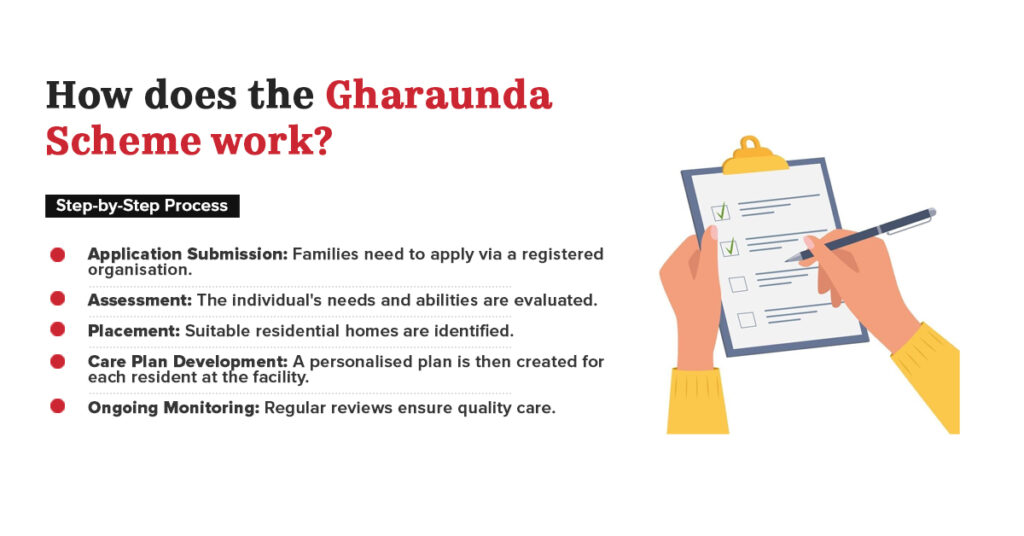
  • Dealing with an Autistic Child: Practical Strategies for Parents and Caregivers

    Dealing with an Autistic Child: Practical Strategies for Parents and Caregivers

    Parenting always comes with questions. However, dealing with an autistic child can sometimes feel overwhelming, especially if you are still learning about autism and how it affects behaviour, communication, and emotions.

    Many parents ask us the same questions: Why does my child react differently? How can I support them better? What strategies actually work?

    The good news is that with the right knowledge, patience, and structured support, you can create a nurturing environment where your child feels safe, understood, and able to grow. 

    In this guide, we will walk you through identifying and dealing with autistic child behaviours, and share practical tips to deal with an autistic child in everyday situations.

    Understanding Autism Before Dealing With an Autistic Child

    Understanding Autism Before Dealing With Autistic Child

    Autism Spectrum Disorder (ASD) is a neurodevelopmental condition that affects how a person communicates, interacts socially, and processes sensory information. Every autistic child is different. Some children may speak fluently, while others may communicate non-verbally. Some may enjoy social interaction, while others prefer solitude.

    Therefore, when dealing with an autistic individual, we must focus on understanding their individual needs rather than expecting them to behave like a neurotypical person.

    📥 Free download: Printable daily routine chart for autistic children

    Identifying Early Signs in an Autistic Child

    Identifying Early Signs in an Autistic Child

    Early awareness makes a big difference. Identifying and dealing with autistic child behaviours early allows families to seek support, therapies, and structured guidance sooner.

    Here are some common early signs to watch for:

    Limited Eye Contact

    Your child may avoid eye contact during conversations or play. This often reflects differences in social communication rather than a lack of affection.

    Delayed Speech or Communication

    Some autistic children speak later than others or rely on gestures instead of words. When dealing with an autistic child, encouraging alternative communication methods can help.

    Repetitive Behaviours

    You may notice hand flapping, rocking, or repeating words. These behaviours often help children regulate their emotions or sensory input.

    Strong Preference for Routine

    Many autistic children prefer predictable routines. Even small changes in daily activities can cause stress.

    Sensory Sensitivities

    Your child might react strongly to loud sounds, bright lights, textures, or certain foods.

    Recognising these signs is the first step in identifying and dealing with an autistic child’s needs effectively.

    Want to know more? Get in touch with us.

    Practical Tips to Deal With an Autistic Child at Home

    Practical Tips to Deal With an Autistic Child at Home

    Once you begin to understand your child’s unique needs, everyday interactions become easier. Here are some practical tips to deal with an autistic child that parents and caregivers can start using immediately.

    1. Create a Predictable Routine

    Autistic children feel more comfortable when their day follows a clear structure.

    We suggest creating a simple daily routine for meals, playtime, therapy, and sleep. This reduces anxiety and makes dealing with an autistic child’s transitions much easier.

    2. Use Clear and Simple Communication

    Keep instructions short and direct.

    Instead of saying, “Can you please go and clean up all your toys now?” say, “Put the toys in the box.” This approach helps when dealing with an autistic child’s communication challenges.

    3. Encourage Visual Supports

    Many autistic children understand visuals better than spoken instructions.

    Use picture charts, schedules, or flashcards to show daily activities. Visual cues make identifying and dealing with an autistic child’s routines easier for both parents and children.

    4. Support Their Sensory Needs

    Your child may experience sensory overload from sounds, lights, or textures.

    Provide quiet spaces, noise-cancelling headphones, or sensory toys to help them regulate. This can significantly improve your experience dealing with an autistic child’s sensory challenges.

    5. Reinforce Positive Behaviour

    Praise and rewards encourage learning.

    When your child completes a task or behaves positively, acknowledge it immediately. Positive reinforcement is one of the most effective tips to deal with an autistic person’s behaviour.

    6. Be Patient With Emotional Regulation

    Autistic children may experience meltdowns when overwhelmed.

    Stay calm and avoid raising your voice. Your calm response helps the child feel safe while dealing with emotional distress.

    7. Encourage Social Interaction Gradually

    Social skills develop at different speeds.

    Start with small interactions, such as playing with siblings or one friend. Gradual exposure helps when identifying and dealing with autistic child’s social development.

    8. Use Special Interests as Learning Tools

    Many autistic children develop strong interests in specific topics.

    Use these interests to teach new skills, improve communication, or encourage participation in activities. This strategy makes dealing with an autistic child’s learning more engaging.

    9. Work With Therapists and Professionals

    Professional support can make a major difference.

    Speech therapists, occupational therapists, and behavioural specialists can guide families in identifying and dealing with autism effectively.

    10. Take Care of Yourself as a Parent

    Supporting an autistic child requires emotional strength and patience.

    Take breaks when needed and seek support groups or professional guidance. 

    Challenges Parents May Face When Dealing With an Autistic Child

    Challenges Parents May Face When Dealing With Autistic Child

    While every child is different, some challenges are common among families.

    Communication Barriers

    Children may struggle to express their needs clearly, which can lead to frustration for both the child and parents.

    Behavioural Outbursts

    Meltdowns can occur when the child feels overwhelmed, confused, or unable to communicate.

    Social Difficulties

    Your child may find it harder to form friendships or understand social cues.

    Sensory Overload

    Busy environments, loud noises, or crowded places can trigger anxiety.

    Understanding these challenges helps parents become more prepared when dealing with an autistic child’s daily life situations.

    Here are 10 Tips on Managing an Autistic Child’s Behaviour.

    Want to know more? Get in touch with us.

    Identifying and Dealing With Autism in School 

    Identifying and Dealing With Autism in School 

    School environments can be challenging for autistic children. However, the right support can help them thrive.

    Parents and teachers should work together to create a supportive environment.

    Key strategies include:

    • Creating structured classroom routines
    • Providing visual schedules
    • Offering sensory breaks
    • Allowing quiet spaces when overwhelmed
    • Using clear and simple instructions

    Building a Supportive Environment for Your Child

    Building a Supportive Environment for Your Child

    When dealing with an autistic child, the goal is not to change who they are. Instead, we focus on helping them navigate the world comfortably and confidently.

    You can create a supportive environment by:

    • Encouraging acceptance and understanding at home
    • Celebrating your child’s unique strengths
    • Advocating for their needs in school and society
    • Seeking community support and professional guidance

    Remember, progress may be gradual. However, every small step matters.

    Learn The Crucial Role of Parents in Managing an Autistic Child.

    Conclusion

    conclusion

    Learning about dealing with autistic child behaviours can feel overwhelming at first. Yet with the right approach, patience, and support, parents can build strong and meaningful connections with their children.

    By identifying and dealing with autistic children’s needs early and applying practical tips to deal with autistic children, families can create an environment where autistic children feel safe, valued, and understood.

    Most importantly, remember this: autism is not something that needs to be “fixed.” Instead, it is a different way of experiencing the world. When we understand this, dealing with autism becomes less about managing challenges and more about supporting potential.

    Frequently Asked Questions (FAQs)

    What is the best way of dealing with an autistic child at home?

    The best approach when dealing with autistic child at home is to create a predictable routine, use simple communication, and provide a calm environment. Consistency helps children feel secure and reduces anxiety.

    What are some practical tips to deal with an autistic child’s behaviour?

    Some effective tips to deal with autistic child behaviour include using visual schedules, reinforcing positive actions, understanding sensory sensitivities, and staying patient during emotional outbursts.

    How can parents start identifying and dealing with the early signs of an autistic child?

    Parents can begin identifying and dealing with an autistic child early by observing behaviours such as limited eye contact, delayed speech, repetitive movements, or strong attachment to routines. Early consultation with professionals can help guide the next steps.

    Why is routine important when dealing with an autistic child?

    Routine helps autistic children feel safe and prepared for what comes next. When dealing with autistic child, predictable daily schedules reduce stress and improve their ability to adapt to activities and transitions.

    For expert insights, support services, and inclusive learning initiatives, visit the India Autism Center.
  • Steps to Check Disability Pension Status Online in India

    Steps to Check Disability Pension Status Online in India

    Managing the financial well-being of a loved one with a disability often feels quite overwhelming. Whether it is therapy sessions or navigating educational needs, knowing what government support is available is important. 

    As per the Census 2011 data, in India, there are approximately 2.68 crore persons with disabilities, representing roughly 2.21% of the total population. More recent estimates suggest these numbers have grown significantly as awareness around neurodivergence, like autism, has increased.

    Financial assistance through schemes like the disability pension provides a vital safety net for these families. However, the application is only the first step. The real challenge often lies in tracking that application to ensure it does not get lost in the bureaucratic shuffle. 

    Fortunately, with the push toward a “Digital India,” checking your divyang pension or viklang pension status has become significantly more accessible from the comfort of your home.

    This guide will explain to you the various portals and methods for verifying your disability pension status online, ensuring you have the information you need to secure your child’s financial future.

    What Is Disability Pension?

    Illustration explaining what a disability pension is and how divyang, viklang, or handicapped pension schemes provide financial support.

    A disability pension is a financial support scheme provided by the Central or State Government to individuals who have a certified disability. The goal is to help cover basic living expenses and reduce financial dependence on family members.

    This pension may be known by different names across India, such as:

    • Divyang pension
    • Viklang pension
    • Handicapped pension

    Although the names vary, the purpose remains the same: to provide monthly financial assistance to persons with disabilities.

    The Indian government provides financial aid primarily through the National Social Assistance Programme (NSAP). Specifically, the Indira Gandhi National Disability Pension Scheme (IGNDPS) is the flagship central program. 

    Under this scheme, individuals with a disability of 80% or more and who fall below the poverty line (BPL) are eligible for monthly assistance.

    Currently, over 1.5 million beneficiaries are registered under various disability pension schemes all over India. While the central government provides a base amount, many states add a supplementary amount, making the total disability pension amount vary from ₹300 to over ₹2,500, depending on your location. 

    For parents of autistic children, getting a disability certificate is the very first step to unlocking these benefits.

    How to Check Disability Pension Status Online

    Graphic showing online methods to track disability pension status through NSAP portal, UMANG app, and state social welfare portals.

    Navigating government infrastructure requires a clear roadmap. To ensure your disability pension status is accurately monitored, you must familiarise yourself with the specific digital gateways provided by the Government of India. 

    Here is an in-depth exploration of the primary platforms and the required information for verifying your divyang pension online.

    1. The NSAP Portal: The National Standard

    The National Social Assistance Programme (NSAP) is the central portal for knowing the details pertaining to the Indira Gandhi National Disability Pension Scheme (IGNDPS). This portal is the most reliable for those receiving central government grants.

    Step 1: Visit the National Social Assistance Programme (NSAP) portal

    Step 2: Click on “View Beneficiary Payment Status”. 

    Step 3: Log in to your Umang account for further information.

    Step 4: Now you can enter your application number and click on submit.

    You can now view the correct information on the screen. The portal provides a complete view of the “Payment Processed” date versus the “Payment Disbursed” date. This will help you to identify whether the delay is at the central level or within your local bank.

    2. The UMANG App: Mobile Governance for Caregivers

    For parents who manage their child’s needs on the go, the UMANG (Unified Mobile Application for New-age Governance) app is an indispensable tool. It aggregates over 1,200 government services, including the viklang pension status check.

    After a secure login via MPIN or OTP, search for “NSAP” in the service directory. Under this, select “Track Application.”

    The app lets you save your details, so you don’t have to hunt down your PPO Number every time you want an update. It also provides push notifications for scheme updates, which is vital for staying informed about changes in disability pension amounts.

    3. State Social Welfare Portals: Localised Tracking

    Since the viklang pension is often a shared financial responsibility between the Centre and the State, local portals often carry the most up-to-date data on the State’s contribution to the funds.

    Examples of Portals:

    • SSPMIS (Bihar): Allows tracking via Aadhaar Number or Bank Account details.
    • Pensions Portal (Uttar Pradesh): Focuses heavily on the divyang pension with a dedicated login for beneficiaries to view their complete ledger.
    • e-Nirman or Seva Sindhu: These portals in various states act as a single window for all social security schemes.

    Most state sites will require a “Beneficiary ID.” If you do not have this, the “Search by Account Number” feature is a common and user-friendly alternative for parents.

    Essential Information for a Successful Search

    Important details needed for viklang pension status check including application number, Aadhaar number, and bank account details.

    To avoid errors like “Record Not Found,” ensure you have the following data points ready before you begin your viklang pension status check:

    • Application Reference Number: The 12 to 15-digit code received during form submission is very useful.
    • Aadhaar Number: Crucial for schemes linked to the Direct Benefit Transfer (DBT) system.
    • Bank Account Number: Specifically, the one linked to the National Payments Corporation of India (NPCI) mapper.

    Knowing about all these platforms helps you move from uncertainty to empowered monitoring, ensuring the divyang pension remains a consistent support for your family.

    Why Checking Disability Pension Status Online Is Essential for Families?

    Illustration showing why checking disability pension status online helps families track payments and manage financial support.

    In the past, verifying the status of a government application meant several trips to government offices, standing in long queues for hours, and often returning home with vague answers. For parents of children with disabilities, these hurdles can put a significant drain on time and emotional energy that could be better spent on therapy and care. Transitioning to checking your disability pension status online is not simply a technological shift; it is a vital step toward financial autonomy and peace of mind.

    Let us understand some reasons as to why monitoring of the divyang pension or viklang pension status on a regular basis is important for parents as well as caregivers:

    1. Immediate Detection of Payment Failures

    Government payments are now largely disbursed through the Direct Benefit Transfer system. While efficient, this system can fail due to minor technicalities, such as an unlinked Aadhaar, an inactive bank account, or a misspelt name.

    • The Benefit: By performing a regular viklang pension status check, you can spot a “Failed” or “Returned” transaction immediately.
    • The Impact: Now there is no need to wait for weeks or months to realise the money hasn’t arrived; you can approach your bank or the social welfare department within just a few days to rectify the issue.

    2. Transparency and Accountability

    Online portals primarily offer a digital trail that physical paperwork often lacks. When you check your disability pension status online, you see exactly where your application is sitting, whether it is at the “Block Level Verification,” “District Approval,” or “Sanctioned” stage.

    • The Benefit: This transparency reduces the opportunity for middleman interference or administrative neglect.
    • The Impact: Knowing exactly which officer or department is handling your file enables more targeted, effective follow-ups if the process stalls.

    3. Strategic Financial Planning for Therapy

    Raising a child with autism or a related disability involves high recurring costs. From speech therapy sessions to specialised sensory equipment, every rupee of the disability pension counts.

    • The Benefit: Tracking the handicapped pension status will allow you to view the “Payment Triggered” date.
    • The Impact: This predictability will help you create a proper budget for monthly expenses, considering all the aspects. If you know the divyang pension online status, you can schedule therapy payments or medical consultations accordingly.

    4. Simplified Record Keeping

    Digital portals serve as virtual file cabinets. Most sites, like the NSAP portal, maintain a history of your past 12 to 24 payments.

    • The Benefit: You can download payment receipts and status reports as PDFs.
    • The Impact: Having these digital records is invaluable when applying for other benefits, such as the NIRAMAYA Health Insurance Scheme or state-specific educational grants, where proof of existing disability benefits is often required.

    5. Keeping Information Up-to-Date

    Government schemes often undergo periodic “re-verification” drives. During these times, the disability pension status might temporarily change to “Pending Verification.”

    • The Benefit: Regular online checks alert you if the government requires fresh documentation, such as a new income certificate or a life certificate (Jeevan Pramaan).
    • The Impact: Proactive monitoring ensures your viklang pension is never discontinued due to errors like missed re-verification deadlines.

    Read our detailed blog on List of Several Government Schemes for Disabled Persons in India (2026).

    Common Roadblocks in Checking Disability Pension Status Online

    Common problems faced while checking disability pension status online such as Aadhaar mismatch, KYC issues, and data entry errors.

    While the digital system seems perfect, it is not always without flaws. Understanding why you might see a “Pending” or “Rejected” status can save you hours of unnecessary worry.

    1. The 80% Threshold Gap

    A common reason for confusion for parents is the disability percentage. The IGNDPS (Central Pension) has a ruling where an 80% disability is the benchmark in order to get the pension. If your child’s certificate marks them at 60%, the NSAP portal might show “Ineligible” for the central scheme, even if they are receiving a state-level viklang pension. Always verify which scheme you are tracking.

    2. Aadhaar and Bank Account Discrepancies

    Most disability pension payments are now sent via the Aadhaar Bridge Payment System. If the Aadhaar is not “seeded” or linked with the bank account’s NPCI mapper, there is a chance that the money will not reach the beneficiary. The online status might show “Payment Triggered,” but the funds never arrive. Visit your local bank branch to make sure that the “Aadhaar Mapping” is correct and active.

    3. KYC and Life Certificate Requirements

    In many states, beneficiaries must submit an annual “Life Certificate” (Jeevan Pramaan) for verification of their eligibility. Failure to do so will result in the handicapped pension status switching to “Suspended” or “Inactive.” This can often be done digitally through the Jeevan Pramaan app using biometric authentication.

    4. Data Entry Errors at the Block Level

    Sometimes, you cannot find your viklang pension status online simply because the physical application was never digitised. If the portal says “Record Not Found” after three months of submission, it is time to visit the Jan Seva Kendra or the District Officer.

    What to Do If Your Disability Pension Is Rejected?

    Steps to take if disability pension application is rejected including reviewing rejection reasons and reapplying through official portals.

    If your viklang pension status check shows rejection:

    • Carefully read the rejection reason.
    • Correct the mentioned issue.
    • Reapply online or through local offices.

    At times, the rejections are due to minor documentation errors and can be resolved easily.

    How Often Should You Check Disability Pension Status?

    Guide on how often to check disability pension status online, including monthly checks and verification before payment dates.

    Experts recommend checking your disability pension status:

    • Once every month
    • Before expected payment dates
    • After submitting new documents

    This ensures uninterrupted pension benefits.

    Conclusion

    Conclusion highlighting the importance of regularly checking divyang or viklang pension status to ensure financial support reaches beneficiaries.

    When it comes to navigating government systems, it can feel overwhelming. It is more confusing when you are already managing the daily challenges of providing care for a person with a disability. Understanding how to check disability pension status online empowers parents and caregivers with clarity, confidence, and control.

    Whether it is divyang pension, viklang pension status check, or handicapped pension status, staying informed ensures that financial support reaches the families who need it the most.

    Frequently Asked Questions

    What is a disability pension, and who is it meant for?

    It is essentially a financial assistance offered to individuals with disabilities who are below the poverty line or have limited income. It helps cover expenses such as food, medical needs, transportation, and daily care. Individuals with physical, intellectual, developmental, or multiple disabilities are eligible if they meet the criteria set by their State.

    Is disability pension and divyang pension the same?

    Yes. Divyang pension is simply another name for disability pension used by many states in India. While the name may differ, the purpose, eligibility, and benefits are largely the same.

    What does “pending” mean in disability pension status?

    If your disability pension status shows “pending,” it usually means that verification is still in progress. This could be at the village, block, or district level. It does not mean rejection, but it may require patience or follow-up.

    Can I check Divyang’s pension online by only using Aadhaar details?

    Yes. Many states have the option to check online status for the divyang pension using only the Aadhaar number. An OTP is usually sent to the registered mobile number for verification.

    Is autism covered under disability pension schemes?

    Yes. Autism is considered a disability as per the Indian law, and hence individuals with a valid disability certificate are eligible for disability pension benefits in most states.

    For expert insights, support services, and inclusive learning initiatives, visit the India Autism Center.
  • Autism Stimming: What It Is, Why It Happens & How to Help Your Child

    Autism Stimming: What It Is, Why It Happens & How to Help Your Child

    Understanding autism stimming​ becomes important because when you first notice your child repeating certain movements or sounds, you may feel worried or confused.

    You might ask yourself, “Why is my child doing this?” or “Is this behaviour linked to autism?”

    In this guide, we explain what stimming in autism spectrum disorder (ASD) means, why it happens, common examples, and whether you should try to stop it.

    What Is Stimming in Autism Spectrum Disorder?

    What Is Stimming in Autism Spectrum Disorder

    Stimming in autism refers to self-stimulating behaviours. These are repetitive movements, sounds, or actions that help a person regulate their emotions or sensory input.

    In simple words, stimming helps a child:

    • Feel calm
    • Stay focused
    • Express excitement
    • Cope with stress
    • Manage sensory overload

    Stimming is common in autistic individuals, but it can also appear in people without autism.

    So, what is stimming in autism spectrum disorder? It is a natural coping strategy that supports emotional and sensory balance.

    📥 Free download: Printable daily routine chart for autistic children

    Is Stimming Always Related to Autism?

    Is Stimming Always Related to Autism?

    A common question parents ask is: “Is stimming always related to autism?”

    The answer is no.

    Many people stim at times. Examples include:

    • Tapping your foot when nervous
    • Twirling your hair when bored
    • Chewing a pen when concentrating

    However, in autism:

    • Stimming happens more often
    • It may look more noticeable
    • It may be more intense

    So while stimming is strongly linked with autism, not all stimming means autism, and not all autistic stimming is a problem.

    Want to know more? Get in touch with us.

    Why Do Children with Autism Stim?

    Why Do Children with Autism Stim?

    Children with autism stim because their brains process feelings and sensory information differently. Autism stimming helps them manage their body, emotions, and environment. It is not random behaviour. It has a purpose.

    Here are the main reasons behind stimming:

    1. Sensory Regulation

    Many autistic children experience sounds, lights, smells, or touch more strongly than others. Stimming helps them control these sensations. For example, rocking or hand flapping may help block out loud noise or bright light.

    2. Emotional Expression

    Some children find it hard to explain how they feel using words. Stimming becomes their way to show emotions such as happiness, fear, anger, or excitement. In this way, autism stimming examples can act like emotional language.

    3. Self-Soothing

    Stimming often works like a calming tool. When a child feels anxious or overwhelmed, repeating a movement or sound helps their body relax and feel safe again.

    4. Communication Without Words

    When speech is limited, stimming can send a message. For example, increased stimming may mean the child is tired, stressed, or needs a break. So, what is stimming in autism spectrum disorder? It is also a form of non-verbal communication.

    5. Coping with Change or Uncertainty

    Changes in routine can feel frightening for autistic children. Stimming helps them cope when something feels unpredictable or unfamiliar.

    6. Improving Focus and Attention

    Some children stim to help their brain concentrate. A small movement, such as tapping or rocking, can help them stay engaged with learning or listening.

    7. Pleasure and Enjoyment

    Not all stimming happens because of stress. Sometimes children stim simply because it feels good or fun.
    For example, spinning or watching moving objects can be enjoyable.

    8. Releasing Built-Up Energy

    Stimming can help release physical tension or excess energy, especially when a child has been sitting still for too long.

    Important Point for Parents

    Stimming is not bad behaviour. It is a coping strategy. Before asking how to reduce stimming behaviors autism, we must understand why the child is stimming.

    Instead of asking:
    “How do I stop this?”
    We should ask:
    “What is my child feeling or experiencing right now?”

    Autism Stimming Examples

    Autism Stimming Examples

    Autism stimming can look different from one child to another. These behaviours involve repeated movements, sounds, or actions that help the child regulate emotions or sensory input. Understanding these autism stimming examples helps us respond with support instead of fear.

    Below are the main types of stimming, with easy explanations.

    1. Motor (Movement-Based) Stimming

    This type involves body movements that are repeated again and again. Examples include hand flapping, rocking, spinning, jumping, or pacing. These movements help the child release energy or feel calm.

    2. Vocal Stimming

    This includes repeated sounds or words. Examples are humming, making clicking noises, repeating certain words, or echoing phrases. This type of autism stimming may help the child feel relaxed or focused.

    3. Visual Stimming

    This involves looking at objects or lights in a repetitive way.
    Examples include staring at ceiling fans, watching spinning toys, or moving fingers in front of the eyes. These actions help control visual input.

    4. Tactile (Touch-Based) Stimming

    This relates to the sense of touch. Examples include rubbing fabrics, scratching surfaces, touching textured objects, or tapping the skin. It helps the child feel grounded and secure.

    5. Oral Stimming

    This involves the mouth and chewing behaviours. Examples include chewing toys, biting clothes, licking objects, or sucking on fingers. This type of stimming helps with self-soothing and sensory regulation.

    6. Auditory Stimming

    This focuses on sound. Examples include repeating noises, tapping objects to hear the sound, or listening to the same sound again and again. It helps the child manage how they hear their environment.

    7. Object-Based Stimming

    This involves using objects in a repetitive way.
    Examples include spinning wheels, lining up toys, or flicking strings. These actions provide comfort and predictability.

    Want to know more? Get in touch with us.

    Important Understanding for Parents

    These autism stimming examples are not meaningless habits. They serve important purposes such as:

    • calming the body
    • expressing emotions
    • coping with stress
    • managing sensory overload

    When we ask what is stimming in autism spectrum disorder, the answer is simple: It is a natural way for the child to regulate their feelings and senses.

    When Do These Behaviours Need Support?

    Stimming may need guidance only when:

    • It causes physical harm
    • It stops learning or communicating
    • Puts the child at risk
    • Leads to social isolation

    In such cases, the focus is not punishment but learning how to reduce stimming behaviours in autism safely by offering better coping tools.

    Is Autism Stimming Harmful?

    Is Autism Stimming Harmful?

    In most cases, autism stimming is not harmful. It is a natural way for autistic children to manage their feelings and sensory experiences. Stimming often helps them stay calm, feel safe, and cope with their surroundings.

    So, when we ask, “Is stimming always related to autism?” or “Is stimming dangerous?”, the answer is usually no. Stimming is often helpful rather than harmful.

    When Stimming Is Not Harmful

    Stimming is generally safe when it:

    • does not cause injury
    • does not stop the child from learning
    • does not interfere with daily activities
    • does not upset the child or others

    For example, hand flapping, rocking, or humming may simply help the child feel relaxed or focused. These types of autism stimming examples support emotional balance and self-regulation.

    When Stimming Can Become a Concern

    Stimming may need attention when it:

    • causes physical harm (such as head banging or skin picking)
    • affects speech or social interaction
    • prevents the child from taking part in school or play
    • becomes more intense over time
    • puts the child in unsafe situations

    In these cases, the behaviour is not “bad”, but it shows that the child may be overwhelmed, anxious, or unable to cope with their environment.

    Why We Should Not Automatically Stop Stimming

    Trying to stop all stimming can:

    • increase anxiety
    • remove a coping method
    • lead to emotional distress
    • cause new problem behaviours

    This is why the treatment of stimming in autism does not aim to remove stimming completely. Instead, it focuses on:

    • understanding the cause
    • reducing harmful stims
    • teaching safer alternatives
    • improving emotional regulation

    Supportive Approach for Parents

    Instead of asking,
    “How do I stop this behaviour?”
    We should ask,
    “What is my child trying to manage or communicate?”

    Before thinking about how to reduce stimming behaviors autism, we should:

    • Observe when it happens
    • Look for emotional or sensory triggers
    • Provide calm and safe coping tools

    This helps the child feel understood rather than controlled.

    Want to know more? Get in touch with us.

    How to Reduce Stimming Behaviours in Autism Safely

    How to Reduce Stimming Behaviours in Autism Safely

    Before we try to reduce any behaviour, we must understand one thing – autism stimming is a coping tool, not a bad habit. Our goal is not to remove stimming completely. Instead, we help the child use safer and more appropriate ways to regulate emotions and sensory needs.

    Here are supportive and practical ways to reduce stimming safely.

    1. Identify the Cause of Stimming

    We should observe when stimming happens and what comes before it. Your child may stim due to stress, excitement, boredom, or sensory overload. Once we know the trigger, we can respond in a better way.

    2. Meet Sensory Needs

    Many stimming behaviours happen because the child’s sensory system is overwhelmed or under-stimulated. We can provide sensory tools such as soft toys, textured objects, or quiet spaces to help balance their sensory input.

    3. Teach Safer Alternatives

    If a stim is harmful, we replace it with a safer behaviour rather than stopping it suddenly. For example, instead of head banging, we can teach squeezing a cushion or holding a stress ball.

    4. Build Predictable Routines

    Uncertainty increases anxiety and stimming. When we use clear routines and visual schedules, the child feels safer and needs fewer self-soothing behaviours.

    5. Use Positive Reinforcement

    We should praise and reward calm behaviour and safe coping skills. This helps the child learn better ways to manage emotions without feeling punished.

    6. Encourage Communication

    Some stimming happens because the child cannot express needs using words. We can teach simple gestures, pictures, or communication tools so they can say when they feel tired, scared, or overstimulated.

    7. Provide Regular Movement Breaks

    Children often stim when they have too much energy or have been sitting still for too long. Short movement breaks help release tension and reduce the need for repetitive actions.

    8. Create a Calm Environment

    Too much noise, light, or activity can increase autism stimming. We can reduce background noise, use soft lighting, and limit sudden changes to make the space more comfortable.

    9. Teach Emotional Regulation Skills

    Children need help understanding and managing their feelings. Simple breathing exercises, calm-down corners, or quiet time can reduce anxiety-based stimming.

    10. Work with Professionals

    Therapists can assess why stimming happens and design personalised strategies. This is an important part of the treatment of stimming in autism, especially when behaviours affect safety or learning.

    Important Reminder for Parents

    When we think about how to reduce stimming behaviors autism, we must remember:

    • Not all stimming should be reduced
    • Only harmful or disruptive stims need guidance
    • The child still needs a way to self-regulate

    When we understand autism stimming, we realise it is not bad behaviour. It is a way your child manages emotions and sensory experiences. Our role is to guide and support, not to control or shame.

    Below is a clear guide on what we should and should not do.

    What Parents Should Do

    What Parents Should Do

    1. Accept Stimming as Communication

    We should see stimming as a message, not a mistake. It tells us how the child feels inside, such as stress, excitement, or overload.

    2. Observe Patterns Calmly

    We need to notice when stimming happens, where it happens, and what happens before it. This helps us understand the trigger behind the behaviour.

    3. Provide Safe Alternatives

    If a stim is harmful, we should gently replace it with a safer option, such as squeezing a ball instead of hitting or chewing a toy instead of biting clothes.

    4. Support Emotional Needs

    We should help the child feel secure by offering comfort, quiet time, or reassurance when they seem overwhelmed.

    5. Use Positive Reinforcement

    We must praise and encourage calm behaviour and healthy coping skills. This builds confidence and reduces stress-based stimming.

    6. Create Predictable Routines

    Consistent routines make children feel safe. When anxiety is lower, the need for self-soothing behaviours also becomes lower.

    7. Teach Simple Communication

    We should help the child express needs using words, pictures, or gestures, so stimming is not their only way to communicate.

    8. Adjust the Environment

    We can reduce noise, strong light, or crowds when possible. A calmer environment lowers sensory overload and stimming intensity.

    9. Work with Professionals

    Therapists can guide us in the treatment of stimming in autism by creating personalised strategies for the child’s needs.

    10. Stay Patient and Kind

    Progress takes time. We must remember that the child is learning skills, not misbehaving on purpose.

    What Parents Should Not Do

    What Parents Should Not Do

    If you are reading this, chances are you have watched your child rock back and forth during a crowded family gathering, or bang their head against the wall after a long school day, and felt a knot of worry in your stomach. That worry is completely valid. You are not overreacting. You are paying attention – and that is exactly what your child needs.

    Here is the truth, though: autism stimming is not a flaw to be fixed. It is a coping tool. A child who flaps their hands or hums repeatedly is not misbehaving. They are managing a nervous system that experiences the world far more intensely than most of us can imagine. Our goal, then, is not to silence that coping tool. It is to make sure it stays safe, does not block learning, and – where needed – gets channelled into something that works even better.
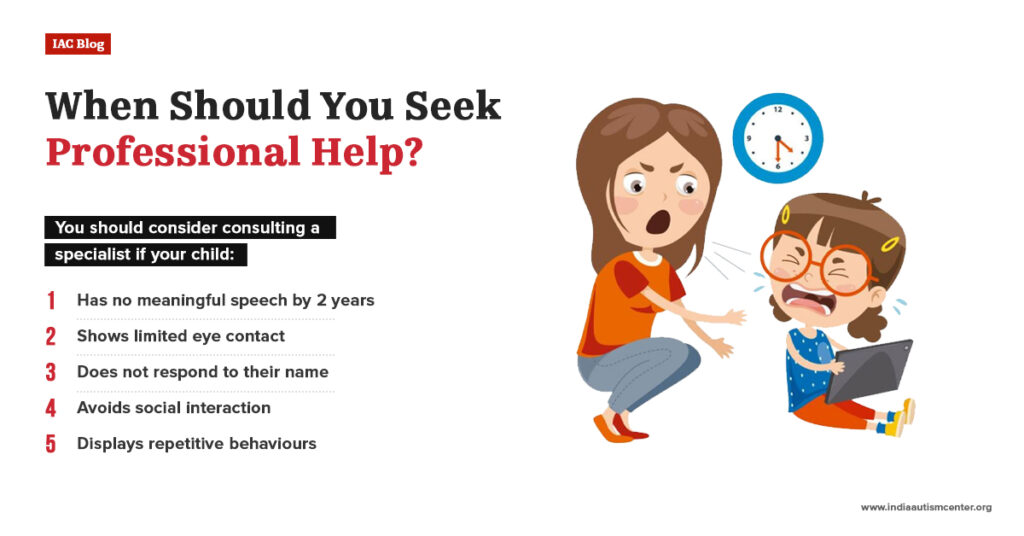
    With that framing in mind, here are ten practical, evidence-informed ways to reduce stimming behaviours in autism safely, followed by clear guidance on when to bring in professional support.

    1. Identify the Cause of Stimming

    Every stim has a story. Before you can change the behaviour, you need to read that story.

    Observe your child closely for a week. Note when the stimming happens, where it happens, and what immediately precedes it. You may notice a clear pattern – for example, your child starts spinning in circles every afternoon when the pressure cooker goes off in the kitchen, or begins rocking intensely just before a maths test at school.

    Common triggers include sensory overload, boredom, excitement, hunger, fatigue, and transitions between activities. In many Indian households, Diwali or wedding season – with their firecrackers, loud music, and unpredictable crowds – can spike stimming significantly. That is not coincidence. That is your child’s nervous system working overtime.

    Try this: Keep a simple trigger diary for seven days. Write down the time, the environment, what happened just before, and what the stim looked like. Patterns will emerge faster than you expect.

    Do not do this: Do not assume the stim is random or attention-seeking before you have tracked it. Acting on assumptions leads to the wrong response.

    2. Meet Sensory Needs in Autism

    Many stimming behaviours exist because the child’s sensory system is either overwhelmed or starved of input. This is one of the most direct ways to address sensory needs in autism.

    A child who chews their collar all day may need more oral sensory input. One who rocks constantly may need more proprioceptive (deep pressure) feedback. Meeting these needs proactively – before the child reaches overload – can reduce stimming dramatically.

    Try this: Introduce a small “sensory toolkit” at home. This could include a chewable silicone pendant , a weighted lap pad, a textured stress ball, or a small trampoline for jumping. Offer these tools during known high-stress periods, such as homework time or before a family outing.

    Do not do this: Do not wait for the stim to escalate before offering the tool. Proactive sensory support works far better than reactive management.

    3. Teach Safer Alternatives

    If a stim is physically harmful – head banging, skin picking, biting themselves – the priority is to replace it with a safer behaviour that meets the same sensory need. Stopping it cold without offering an alternative is like removing a pressure valve without releasing the pressure.

    For example, a child who bangs their head against a wall may be seeking deep pressure on the skull. A safer alternative could be pressing their forehead firmly into a large cushion, or wearing a snug-fitting hat. A child who bites their hand might accept a chewy toy instead.

    Many parents in India feel embarrassed when their child head-bangs in a temple or at a relative’s home. The instinct is to physically restrain the child. Instead, carry a small firm cushion in your bag. When you sense the stim building, offer the cushion quietly. It redirects without a scene.

    Try this: For each harmful stim, identify what sensory input it provides (pressure, vibration, pain relief, etc.) and find one safer object that delivers something similar. Work with a therapist to confirm the match.

    Do not do this: Do not physically restrain or hold the child’s hands down. This increases panic and can make the behaviour more intense.

    4. Build Predictable Routines

    Uncertainty is one of the biggest drivers of anxiety-based stimming in autism. When a child does not know what comes next, their nervous system goes on high alert – and stimming is how they self-soothe through that alert state.

    Predictable routines act like a map. They tell the child’s brain: you are safe, you know what is happening, you do not need to brace yourself.

    School exam seasons, summer vacations that disrupt daily schedules, or sudden changes like a grandparent’s visit can all destabilise a child’s routine. During these periods, parents often report a spike in stimming. A simple visual schedule – pictures or written steps showing the day’s plan – can buffer that anxiety significantly.

    Try this: Use a whiteboard or printed picture cards to display the day’s routine each morning. Even if the content changes, the ritual of reviewing the schedule together creates predictability. Apps like Choiceworks (available on iOS and Android) can help.

    Do not do this: Do not spring surprises, even pleasant ones like a surprise trip to the park. Give at least 10–15 minutes of advance notice for any change.

    5. Use Positive Reinforcement

    When a child manages to use a safer alternative or gets through a stressful situation without escalating, that moment deserves genuine acknowledgement. Positive reinforcement is not bribery – it is the brain’s learning mechanism.

    Praise needs to be specific and immediate. “Good boy” is vague. “I noticed you squeezed your stress ball instead of hitting the wall – that was brilliant” is specific and teaches the child exactly what to repeat.

    Try this: Build a simple reward chart. For younger children, stickers work beautifully. For older children, a points system redeemable for screen time or a favourite activity can be highly motivating. Keep the bar achievable – reward effort, not perfection.

    Do not do this: Do not withhold rewards as punishment for stimming. That conflates two separate issues and increases anxiety, which will increase stimming.

    6. Encourage Communication

    A significant portion of stimming happens because the child cannot find words for what they are experiencing. When a child cannot say “this room is too loud and I need to leave,” the body says it instead – through rocking, humming, or covering their ears.

    Teaching even basic communication – a gesture, a picture card, a simple phrase – gives the child a more efficient tool than stimming to signal their state.

    Many Indian families rely heavily on verbal communication and may not have encountered AAC (Augmentative and Alternative Communication) tools. Picture Exchange Communication System (PECS) cards, which can be printed at home, or simple apps like Proloquo2Go or LetMeTalk (free on Android) can open a communication channel that dramatically reduces distress-driven stimming.

    Try this: Teach your child two or three key phrases or picture cards: “too loud,” “I need a break,” “I am scared.” Practise them during calm moments so they are available during stressful ones.

    Do not do this: Do not assume that because a child is non-verbal they cannot communicate. Every child can learn some form of expression with the right support.

    7. Provide Regular Movement Breaks

    Children with autism often stim more intensely when they have been sedentary for too long. The body builds up tension, and stimming is the release valve. Scheduled movement breaks prevent that build-up from reaching a tipping point.

    This is especially relevant in Indian school settings, where children are often expected to sit still for 40–45 minutes at a stretch. Many mainstream schools are not yet equipped to offer structured movement breaks, which means parents need to build this into the home routine.

    Try this: Every 20–30 minutes during homework or structured activity, offer a 5-minute movement break. Options include jumping on a small trampoline, doing 10 star jumps, carrying a heavy bag of books (proprioceptive input), or a short walk. These are not rewards – they are neurological necessities.

    Do not do this: Do not cancel movement breaks as a consequence for bad behaviour. That removes a regulatory tool and makes the next hour harder, not easier.
    8. Create a Calm Environment

    Too much noise, harsh lighting, strong smells, or visual clutter can push a child’s sensory system past its threshold – and autism stimming escalates in response. Modifying the environment is one of the fastest and most underused strategies available to Indian parents.

    Many Indian homes are multi-generational and genuinely noisy – TV running in the background, relatives visiting, pressure cookers, mixers, and traffic outside. None of this is anyone’s fault. But for a child with heightened sensory needs, it is a constant assault. Even small changes make a measurable difference.

    Try this: Designate one corner of the house as a “calm corner” – a low-stimulation space with soft lighting (a simple lamp rather than a tube light), a bean bag or floor cushion, and a few favourite sensory objects. Let the child go there whenever they need to regulate. This is not a time-out; it is a refuelling station.

    Do not do this: Do not dismiss environmental modifications as impractical. Even closing a door, switching off one TV, or drawing a curtain can lower the sensory load enough to make a difference.

    9. Teach Emotional Regulation Skills

    Children with autism often have difficulty recognising what they are feeling and even more difficulty knowing what to do about it. Emotional regulation skills – the ability to notice, name, and manage emotions – are learnable. They just need to be taught explicitly, step by step.

    Simple techniques include belly breathing (breathe in for 4 counts, hold for 2, out for 6), the “5-4-3-2-1” grounding exercise (name 5 things you can see, 4 you can touch, etc.), and using an emotion chart to point to how they feel.

    Try this: Practise one calming technique together every day during a calm moment – not during a meltdown. The brain cannot learn new skills when it is in crisis. Repetition during calm periods means the skill becomes automatic when it is needed most.

    Do not do this: Do not introduce a new calming technique for the first time during a meltdown. It will not work, and both of you will feel like failures.

    10. Work with Professionals

    Home strategies are powerful, but they work best when they are designed alongside a qualified professional who has assessed your specific child. When stimming is frequent, intense, or causing harm, professional support is not optional – it is essential.

    A good therapist will assess the function of each stim, identify the sensory and emotional triggers, and design a personalised plan. This is the backbone of any serious approach to how to control stimming in a way that is both safe and sustainable.

    Try this: Ask your child’s paediatrician for a referral to an occupational therapist or developmental paediatrician as a first step. Be specific: describe the stims, their frequency, and any safety concerns.

    Do not do this: Do not try to implement a full behaviour management programme from a YouTube video alone. Without professional assessment, you risk targeting the wrong behaviour or missing an underlying medical cause.

    Conclusion

    When we understand what stimming is in autism spectrum disorder, we stop seeing it as a problem and start seeing it as communication.

    Instead of asking, “How do we stop this?”, we should ask: “What is my child trying to tell me?”

    By learning the meaning behind autism stimming examples, we create safer, kinder, and more supportive environments for autistic children.

    Stimming is not a flaw. It is a coping tool. And with the right guidance, it can become a strength rather than a struggle.

    Important Reminder for Parents

    1. When thinking about how to reduce stimming behaviors autism, keep these three principles close:

    2. Not all stimming should be reduced. Safe stims that help your child regulate are doing their job.

    3. Only harmful or significantly disruptive stims need active guidance. The bar is safety and functioning, not social appearance.

    4. Your child still needs a way to self-regulate. If you reduce one stim without offering an alternative, another will take its place.

    Understanding autism stimming means recognising it as communication, not misbehaviour. Your role is to guide and support – not to control or shame. Every step you take to understand your child’s sensory world is a step toward a calmer, more connected life for both of you.
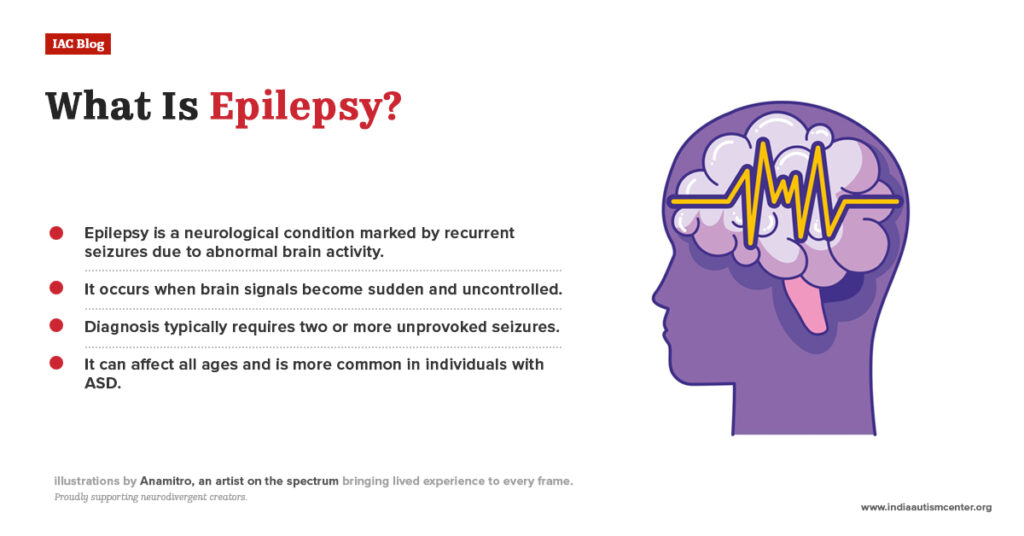
    Frequently Asked Questions (FAQs)

    What is stimming in autism spectrum disorder?

    Stimming autism definition refers to repetitive movements, sounds, or actions that help an autistic person regulate emotions and sensory input. In autism stimming, these behaviours help reduce anxiety, express feelings, and cope with overwhelming environments. Stimming is a natural coping strategy, not bad behaviour.
    Is stimming always related to autism?

    No, stimming is not always related to autism. Many people stim when they feel nervous, bored, or excited, such as tapping a foot or biting a pen. However, in autism, stimming tends to happen more often and may look more noticeable or intense.

    What are some common autism stimming examples?

    Common autism stimming examples include hand flapping, rocking, spinning, humming, repeating words, chewing objects, staring at lights, and rubbing textures. Each child shows stimming differently, depending on their sensory needs and emotions.

    How can we reduce stimming behaviors autism safely?

    When thinking about how to reduce stimming behaviors autism, the goal is not to stop stimming completely. We should first understand the cause, then offer safer alternatives, sensory tools, and calm routines. Support from therapists is often part of the treatment of stimming in autism, especially if the behaviour causes harm or affects learning.

    For expert insights, support services, and inclusive learning initiatives, visit the India Autism Center.