When people first decide to work for an NGO, they are excited, motivated, and completely clueless. They have a degree, a burning desire to “do something meaningful,” and zero experience in the development sector. Every job posting they opened asked for “2+ years of field experience” or a “background in humanitarian work.” Many don’t have either.
And if you’re reading this, I’m guessing you’re in a similar spot.
Here’s the good news: you don’t need years of experience to start your NGO journey. What you need is the right strategy, a little patience, and the willingness to show up. In this guide, I’m going to walk you through exactly how to break into the NGO sector — step by step — even if you’re starting from zero.
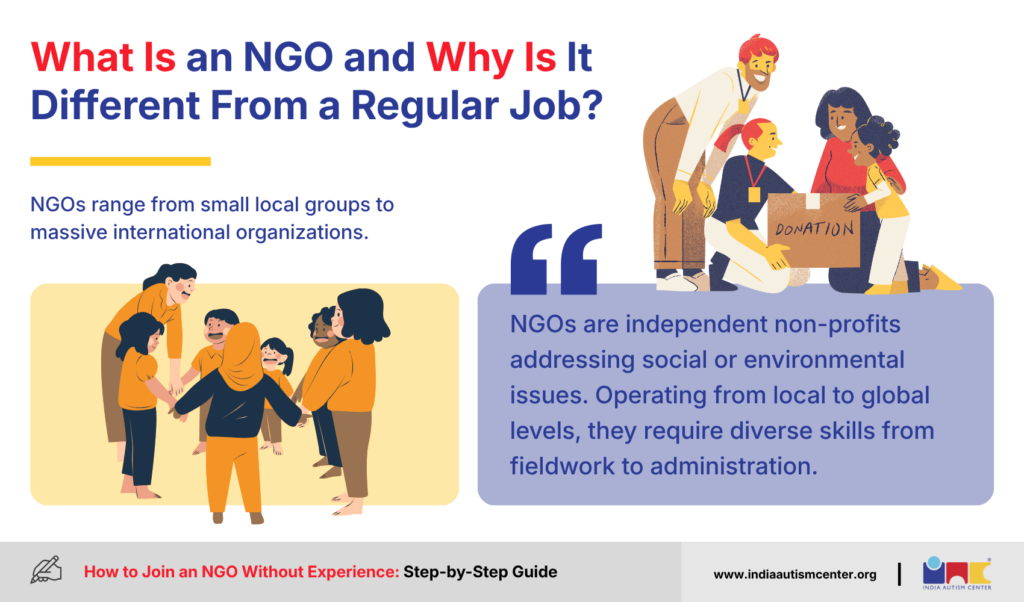
What is an NGO, and why is it Different from a Regular Job?
Before we talk about how to join one, let’s quickly understand what an NGO actually is — because “NGO” is a broad term that means different things in different contexts.
A Non-Governmental Organisation (NGO) is a non-profit organisation that operates independently of the government. Its goal is to address social, environmental, humanitarian, or developmental issues. NGOs are funded through donations, grants, and sometimes government partnerships — but they aren’t government bodies themselves.
There are different types of NGOs you might want to work with:
Local/grassroots NGOs — small organisations working within a specific community or city (like an NGO in Kolkata working on child education)
National NGOs — organisations working across a country (like Pratham or Goonj in India)
International NGOs (INGOs) — global organisations like Oxfam, Save the Children, or Médecins Sans Frontières
UN Agencies — like UNICEF, UNDP, or WHO (technically intergovernmental, but many entry-level roles exist here too)
NGO roles span a wide range: program delivery, field work, communications, fundraising, research, monitoring & evaluation (M&E), grant writing, finance, and administration. There’s genuinely a place for almost every skill set.
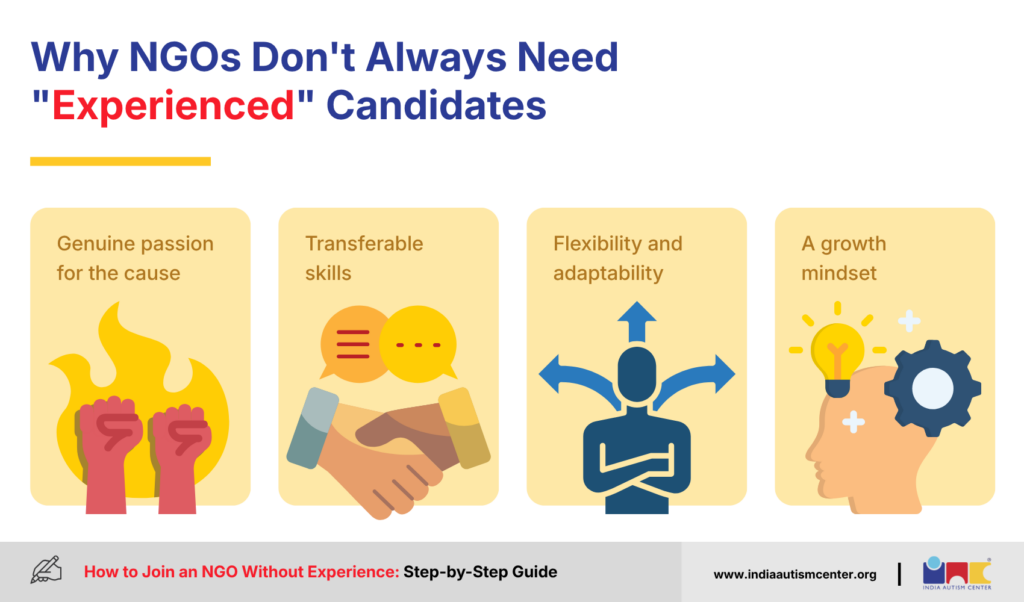
Why NGOs Don’t Always Need “Experienced” Candidates
Here’s something most job seekers get wrong: NGOs say they want experience, but what they really want is commitment.
In corporate jobs, experience signals competence. In the NGO sector, experience signals something deeper — that you understand the reality of working in challenging conditions, that you’re not going to quit after three months, and that you genuinely care about the cause.
But here’s the thing: you can demonstrate all of those things without prior NGO experience.
Many entry-level NGO roles — especially volunteering positions, internships, and fellowship programs — are specifically designed for people without formal experience. Organisations like UN Volunteers, AmeriCorps, and hundreds of local Indian NGOs actively recruit fresh graduates and career changers.
What they’re looking for isn’t a resume full of NGO stamps. They’re looking for:
So if you’re sitting there thinking “I have nothing to offer” — stop. You likely have more than you think.
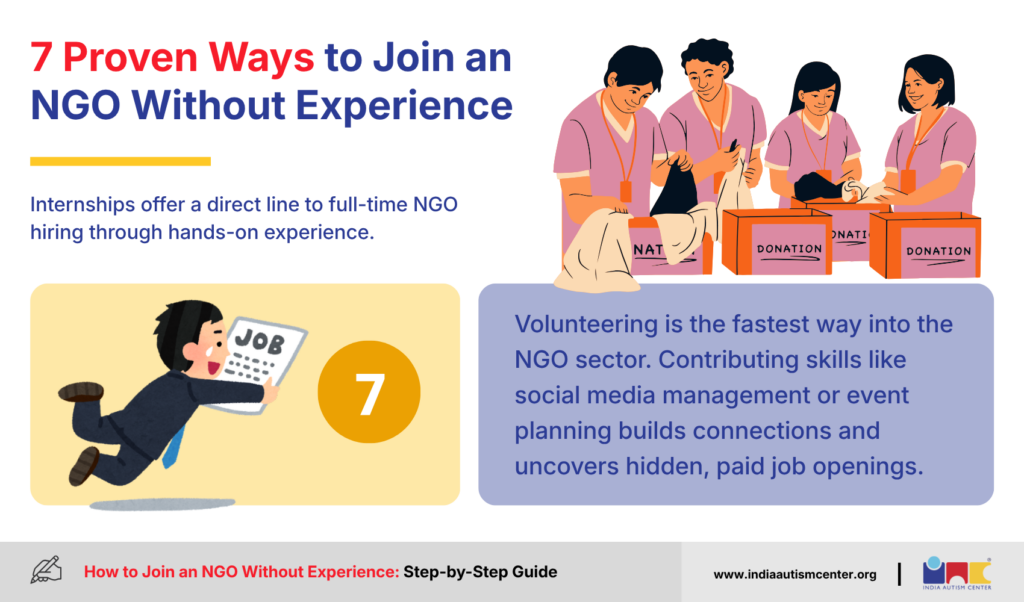
7 Proven Ways to Join an NGO Without Experience
This is the core of what I want to share with you. These are real, actionable pathways — not vague advice like “follow your passion.”
1. Start as a Volunteer
Volunteering is the single fastest way to get your foot in the door. Almost every NGO has volunteer programs, and most of them require nothing more than willingness and reliability.
When I say volunteering, I don’t mean just weekend clean-up drives. I mean structured, skill-based volunteering where you contribute meaningfully:
Help an NGO manage their social media
Assist with data collection or field surveys
Support their event planning or fundraising drives
Teach a skill (English, computers, art) in their programs
Not only does this give you experience to put on your resume, but it also gets you inside the organisation. You build relationships, understand how the sector works, and often get first notice when paid positions open up.
Where to find volunteering opportunities:
Volunteering India (volunteeringindia.com)
iVolunteer (ivolunteer.in)
United Way India
Your city’s local NGO directories
Google: “volunteer with NGO in [your city].”
2. Apply for Internships
NGO internships are one of the best-kept secrets for career switchers and fresh graduates. Many of them are paid (especially at larger national and international organisations), and they are explicitly designed for people with little to no prior experience.
Internships give you:
Real work experience with a legitimate organisation
A professional reference (huge for future applications)
Clarity on whether NGO work is actually right for you
LinkedIn: Search “NGO intern” or “non-profit intern”
Organisation websites directly (check their “Careers” or “Get Involved” pages)
Pro tip: Don’t wait for internship listings to appear. Send a direct email to organisations you admire, expressing your interest and attaching a short proposal on how you can help. NGOs often create opportunities for motivated people who reach out.
3. Leverage Your Transferable Skills
This one changed the way I looked at my own resume.
You don’t need NGO experience to be valuable to an NGO. You need skills — and skills transfer across industries. Here’s how to map what you already know:
Your Background
Transferable NGO Skill
Marketing / Social Media
Communications, digital outreach, fundraising
Teaching / Training
Capacity building, field education programs
Data Analysis / Excel
M&E (Monitoring & Evaluation), impact reporting
Finance / Accounting
Grant management, budgeting
Writing / Journalism
Grant writing, reports, donor communications
IT / Tech
Database management, digital tools for development
Healthcare
Community health programs, public health initiatives
Law
Human rights, legal aid programs
Look at your existing skills and ask: “How would an NGO use this?” Then write your resume and cover letter through that lens.
4. Build a Cause-Specific Portfolio
If you don’t have NGO experience, create it yourself. A portfolio of cause-related work is surprisingly powerful — especially for roles in communications, research, or program design.
Here are practical ways to build one:
Start a blog or newsletter about issues you care about (child rights, climate change, women’s empowerment)
Create social media content advocating for a cause and build a small, engaged following
Write research summaries or policy briefs on development issues
Organise a community initiative — even something small like a local food drive or awareness campaign
Contribute to open-source development projects that support social causes
When you apply to an NGO, you’ll be able to show — not just tell — that you care. That makes a massive difference.
5. Take Relevant Online Courses and Certifications
This one is simple, affordable, and often underused. There are excellent courses available — many of them free or low-cost — that give you foundational knowledge in the development sector.
Courses worth exploring:
Coursera / edX: Search for courses on “International Development,” “Public Health,” “Human Rights,” “Sustainable Development Goals (SDGs).”
NPTEL (for Indian learners): Development economics, social policy
UN SDG Academy: Free online learning on global development
UNHCR’s Learning Hub: Refugee and humanitarian response training
Google.org Skills: Digital skills for the social sector
Even completing one or two relevant courses shows initiative. List them on your LinkedIn and resume under “Certifications” — they signal that you’re investing in this career switch seriously.
6. Network Inside the Sector
I’ll be direct: the NGO world is relationship-driven. A lot of hiring happens through word of mouth, referrals, and internal networks. If you’re only applying cold through job portals, you’re fighting the hardest battle.
Here’s how to network effectively:
LinkedIn: Follow NGOs you admire, engage with their posts, connect with program officers and HR managers
Attend events: Webinars, panel discussions, development conferences, TEDx talks — show up and introduce yourself
Info interviews: Reach out to people working in NGOs and ask for a 20-minute call to learn about their journey. Most people are happy to help — and these conversations often lead somewhere unexpected.
Alumni networks: Your college alumni working in NGOs are your warmest possible introduction
Don’t network just to “get a job.” Network to genuinely learn, build relationships, and contribute. The opportunities follow naturally.
7. Apply for Fellowship Programs
Fellowship programs are structured, time-bound experiences designed specifically to bring talented people into the social sector — often without prior NGO experience required.
Fellowships worth researching (India & Global):
Teach For India Fellowship — education-focused, 2-year teaching fellowship
Gandhi Fellowship — rural education and community leadership
Acumen India Fellowship — social entrepreneurship and leadership
Atlas Corps — international NGO placement fellowship
Echidna Global Scholars — girls’ education focus
LAMP Fellowship (India) — legislative research and public policy
UN Young Professionals Programme (YPP) — entry into the UN system
Most fellowships come with a stipend, training, and mentorship. They’re an excellent launchpad — and they look exceptional on your resume.
How to Write an NGO Resume When You Have No Experience
Your resume is your first impression. In the NGO sector, a resume isn’t just a career document — it’s a statement of values. Here’s how to write one that works:
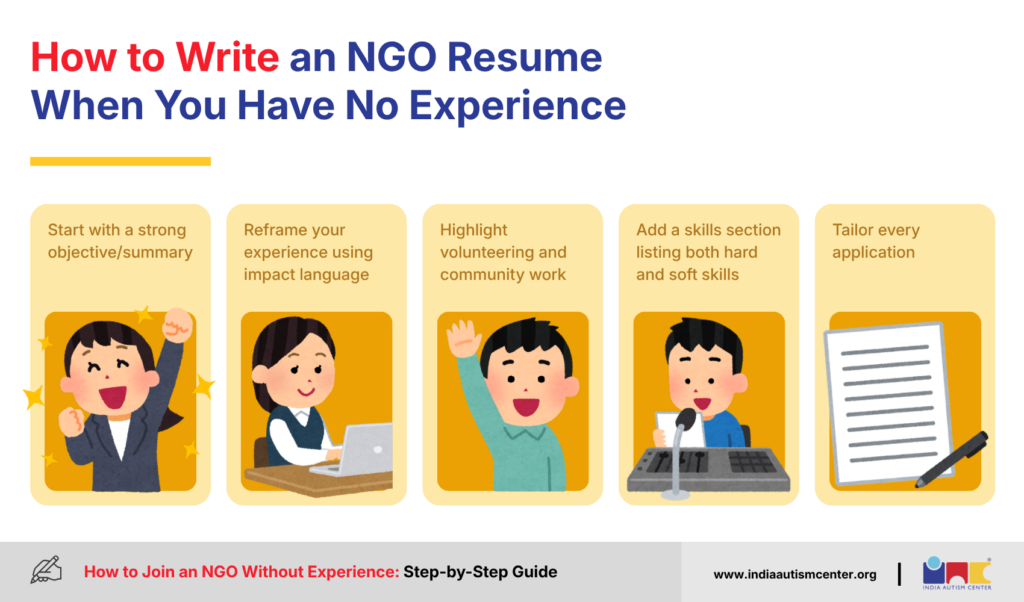
1. Start with a strong objective/summary: Lead with 2–3 lines that communicate your motivation and what you bring. Example:
“A communications professional with 3 years of digital marketing experience, transitioning into the development sector with a focus on women’s empowerment and community engagement. Passionate about using storytelling for social impact.”
2. Reframe your experience using impact language: Even if your jobs weren’t NGO-related, describe them in terms of outcomes and people impacted.
3. Highlight volunteering and community work: Don’t bury it at the bottom. If your NGO-relevant experience is volunteering, make it prominent.
4. Add a skills section: List both hard skills (Excel, research, social media, content writing) and soft skills (communication, adaptability, cross-cultural sensitivity).
5. Tailor every application: Read the organisation’s mission carefully. Mirror their language. Show that you understand their specific work — not just “NGOs in general.”
Crafting a Cover Letter That Actually Gets Read
In corporate hiring, cover letters are often skimmed or ignored. In the NGO sector, they matter a lot.
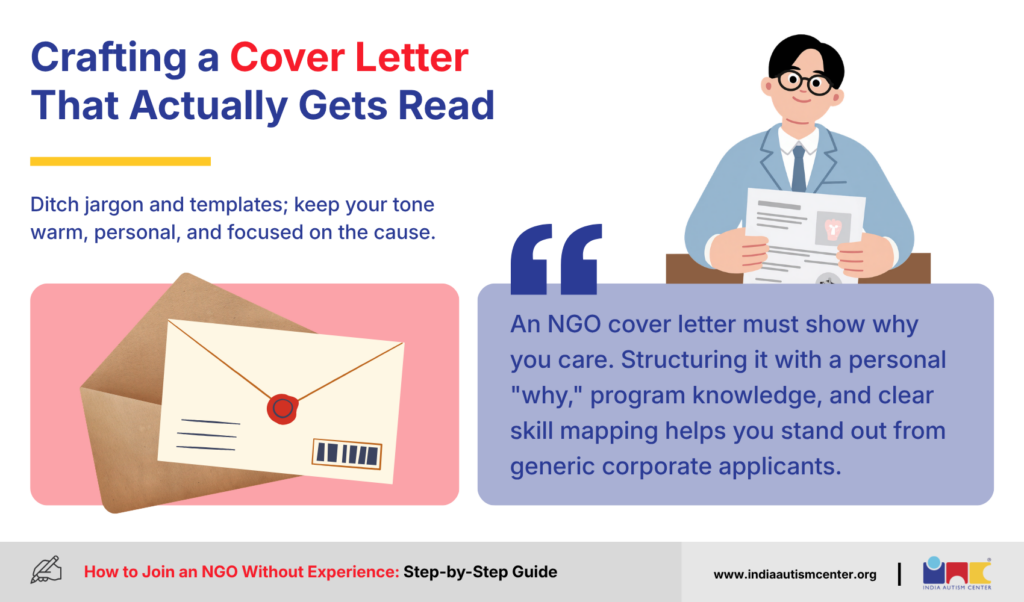
NGO hiring managers want to know why you care — and a well-written cover letter is your chance to show them.
Structure your cover letter like this:
Paragraph 1 — Hook with your ‘why ‘: Tell them why this specific organisation and cause matters to you. Make it personal. Be specific.
Paragraph 2 — Show you understand their work: Mention a specific program, initiative, or impact report you’ve read. Demonstrate that you’ve done your homework.
Paragraph 3 — Connect your skills and experience: Explain clearly what you bring to the table and how your background maps to their needs.
Paragraph 4 — Close with intent: Express your enthusiasm, mention you’d love to discuss further, and include a clear call to action.
Mistakes to avoid:
Starting with “I am writing to apply for…” (boring, skip it)
Copy-pasting the same letter to multiple organisations
Focusing only on what you want to gain, rather than what you’ll contribute
Using corporate jargon (“synergize,” “leverage bandwidth”) — keep it warm and human
Where to Find NGO Job Opportunities
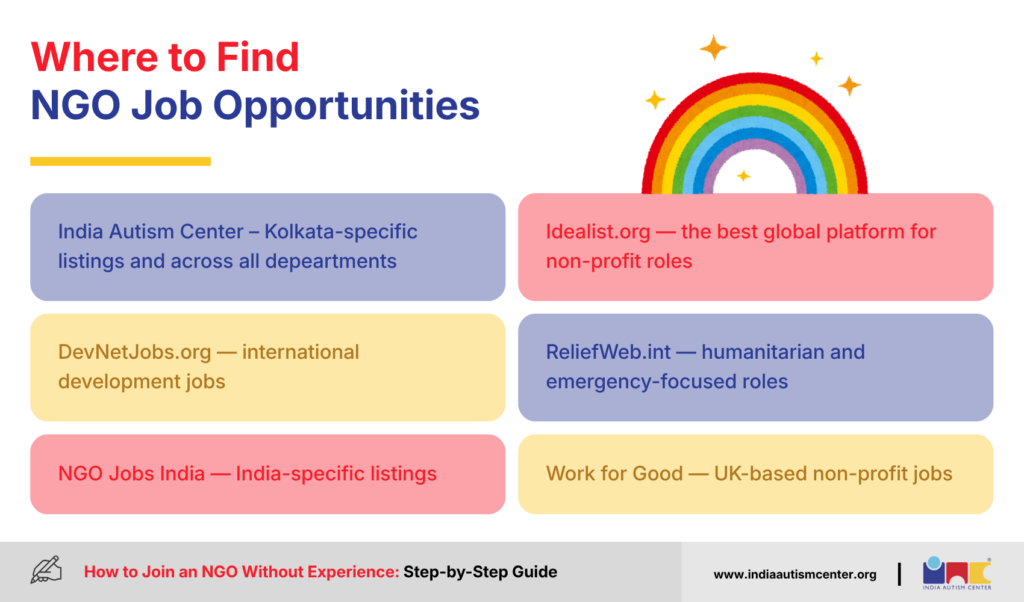
Here’s a consolidated list of the best places to look:
Opportunity Desk — fellowships, grants, and opportunities globally
Other Channels:
LinkedIn — follow NGOs, set job alerts, use keywords like “program associate,” “social sector,” “development sector fresher”
Organisation websites — bookmark and check “Careers” pages of your target organisations regularly
Facebook groups — search “NGO jobs India,” “development sector jobs,” “social sector careers”
WhatsApp groups — many sector-specific networks share openings informally
How to Ace the NGO Interview
Getting the interview is half the battle. Here’s how to make it count.
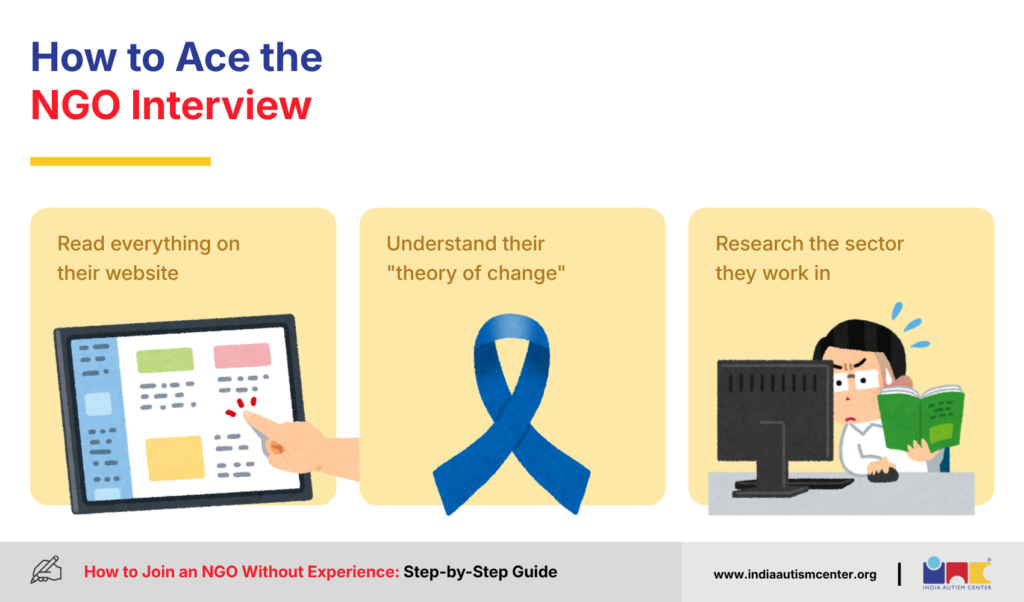
Before the interview:
Read everything on their website — mission, programs, annual reports, recent news
Understand their “theory of change” (how they believe their work creates impact)
Research the sector they work in so you can speak knowledgeably
Common NGO interview questions — and how to think about them:
“Why do you want to work in the development sector?” — Be honest and specific. Avoid generic answers like “I want to make a difference.” Talk about a real moment or experience that shaped your interest.
“What do you know about our organisation?” — This is a test of preparation. Have 2–3 specific things ready about their programs, geography, or recent impact.
“How would you handle working in a resource-constrained environment?” — They want to know you can be creative, flexible, and resilient. Give a real example if you can.
“Do you have experience with [specific skill — e.g., M&E, grant writing]?” — If not, don’t bluff. Be honest, express your eagerness to learn, and mention any adjacent experience or courses.
Questions you should ask them:
“What does success look like in this role in the first 6 months?”
“What are the biggest challenges your team is currently navigating?”
“How does the organisation support the professional development of new team members?”
Asking good questions signals genuine interest and maturity.
Frequently Asked Questions
Can I join an NGO without a degree?
Yes. Many NGOs — especially at the grassroots level — hire based on skills, experience, and commitment rather than formal qualifications. Volunteering, certifications, and demonstrated passion can outweigh a degree in many cases.
Do NGOs pay their workers?
Yes, NGOs do pay salaries — they are not entirely run by volunteers. However, compensation is generally lower than the corporate sector, especially at entry level. International NGOs and UN agencies tend to offer more competitive packages.
How do I find NGOs near me?
Search “[your city] NGO list” or check your state’s NGO directory. In India, you can also explore the NITI Aayog NGO Darpan portal (ngodarpan.gov.in), which lists thousands of registered NGOs across the country
What skills do NGOs look for?
Communication, research, project management, data analysis, community engagement, grant writing, and digital skills are highly valued. Beyond technical skills, NGOs look for empathy, cultural sensitivity, adaptability, and a genuine commitment to the cause.
Is volunteering the only way to enter an NGO?
No. Volunteering is one of the easiest entry points, but internships, fellowships, direct applications for junior roles, and networking are all valid paths. Many people enter through lateral moves from related fields like public health, education, or government.
Can I join an international NGO without experience?
It’s harder, but not impossible. UN Volunteers, the UN Young Professionals Programme, and international fellowship programs like Atlas Corps are specifically designed to bring in candidates with limited formal experience. Start with these, build your experience, and move up from there.
Conclusion
I want to leave you with this: the NGO sector needs people like you.
It needs people who bring fresh perspectives, cross-sector skills, and genuine motivation. The world’s most pressing problems — poverty, inequality, climate change, displacement — aren’t going to be solved by people who already have all the answers. They’ll be solved by people who are willing to show up, learn, and contribute.
You don’t need a perfect resume. You need a clear starting point.
So here’s your action step for this week: pick one thing from this list and do it. Apply for a volunteering role. Sign up for an online course. Send one networking message on LinkedIn. Reach out to a local NGO.
Every career in the development sector started with one small step. Yours starts now.
Found this guide helpful? Share it with someone who’s looking to make the switch into the social sector. And if you have questions, drop them in the comments — I read every one.
If you’re a parent of twins and autism has entered your world — whether through a recent diagnosis, a nagging worry, or a question your paediatrician raised — I want you to know something first: you are not alone, and you are asking exactly the right questions.
Twin studies have shaped nearly everything we know about autism. For decades, researchers have looked at twins to understand why autism happens, how much of it is genetic, and what it means when one twin is diagnosed. The answers are nuanced, sometimes surprising, and — most importantly — genuinely useful for parents like us.
In this article, we are going to walk you through what the science actually says, in plain language. No jargon, no scary statistics without context. Just the honest, evidence-based information you need to understand your children and support them well.
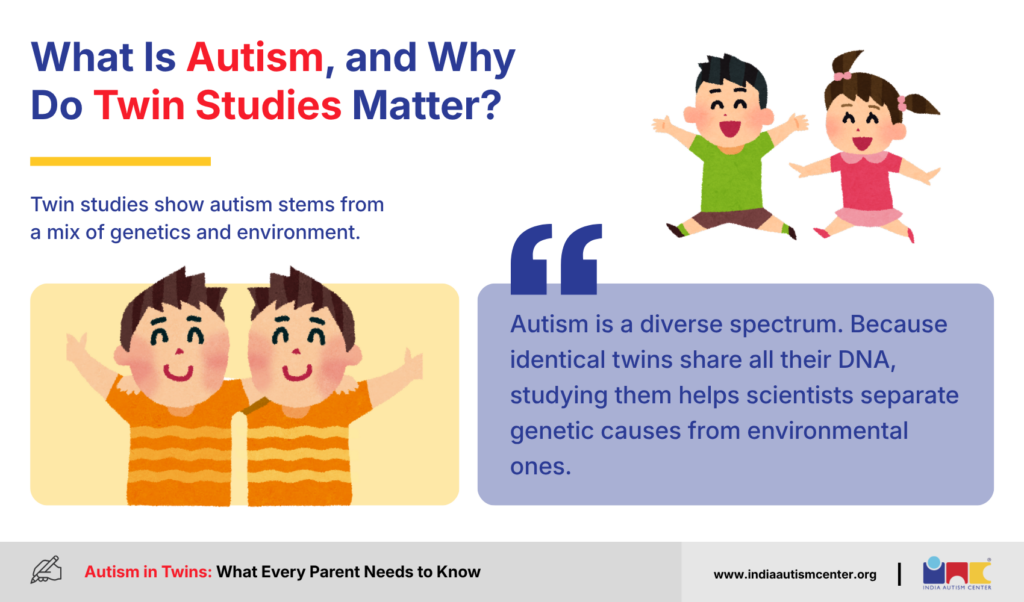
What Is Autism, and Why Do Twin Studies Matter?
Autism Spectrum Disorder (ASD) is a neurodevelopmental condition that affects how a person communicates, socialises, and experiences the world. The word “spectrum” is key — autism looks very different from one person to the next. Some autistic individuals are highly verbal and academically gifted; others may have significant support needs. Many fall somewhere in between.
According to the CDC, about 1 in 36 children in the United States is diagnosed with ASD. Globally, the World Health Organisation estimates 1 in 100 children is on the spectrum, though rates vary by country and diagnostic criteria.
So why are twins so central to autism research?
Because twins give scientists a rare natural experiment. When researchers study twins — especially identical ones who share the same DNA — they can start to separate what’s caused by genes from what’s caused by environment. If autism were purely genetic, identical twins would always both be autistic. If it were purely environmental, the rates would look similar in identical and fraternal twins. The truth, as we’ll see, is somewhere more interesting than either extreme.
Identical Twins vs. Fraternal Twins: What’s the Difference?
Before we get into the research, it helps to understand the two types of twins and why scientists treat them differently.
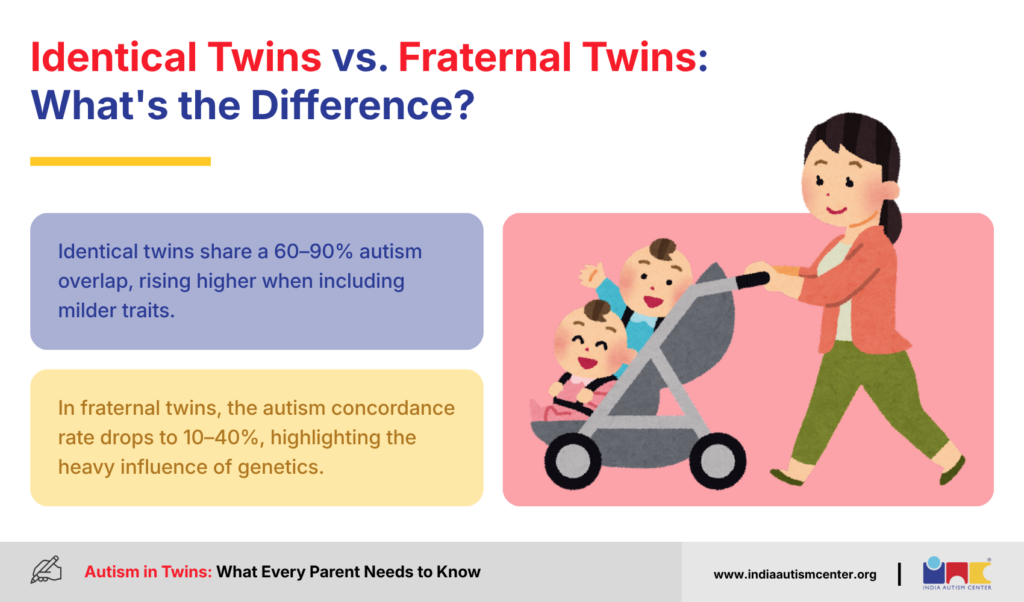
Identical twins (monozygotic, or MZ) come from a single fertilised egg that splits into two. This means they share virtually 100% of their DNA. They are always the same sex, and they often look strikingly similar.
Fraternal twins (dizygotic, or DZ) come from two separate eggs fertilised by two separate sperm. They share roughly 50% of their DNA — the same as any two siblings. They can be the same sex or different sexes, and they may or may not look alike.
This genetic difference is exactly why researchers love studying both types together. By comparing how often autism appears in identical versus fraternal twin pairs, scientists can get a clearer picture of just how much genetics is driving the condition.
Here is where things get genuinely fascinating — and reassuring in some ways, and sobering in others.
The Concordance Rate: What It Means for Your Family
In research, the word “concordance” simply means both twins sharing the same trait or diagnosis. A concordance rate of 100% would mean that if one identical twin has autism, the other always does too. A rate of 0% would mean it never happens.
The numbers from decades of twin studies are striking:
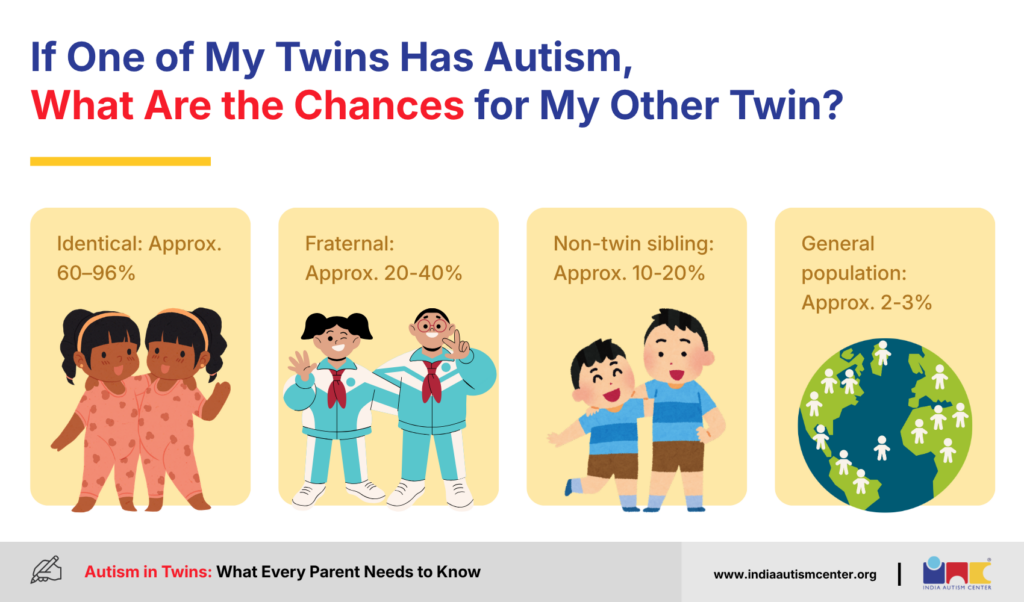
In identical (MZ) twins, the concordance rate for autism is roughly 60–90%. Some studies put it even higher when they include the broader autism phenotype — meaning milder autistic traits that don’t meet the full diagnostic threshold.
In fraternal (DZ) twins, the concordance rate is significantly lower, around 10–40%.
For comparison, the general population rate is about 2–3%. So even being a fraternal twin of an autistic child raises the chances meaningfully.
The gap between those two numbers — 60–90% versus 10–40% — is what tells us genetics is playing a major role. But notice that even in identical twins, concordance isn’t 100%. If autism were entirely down to genes, identical twins would always share the diagnosis. The fact that they don’t tells us something equally important: environment, and other biological factors, matter too.
One of the most common questions parents ask is: “Did I pass this on to my child?”
It’s an emotionally loaded question, and it deserves an honest answer.
Autism is one of the most heritable neurodevelopmental conditions we know of. Heritability estimates from twin studies typically range from 64% to 91%. That means somewhere between 64 and 91 cents of every metaphorical dollar of autism risk comes from genetic factors.
But here’s what heritability does not mean: it doesn’t mean autism is caused by a single “autism gene” that parents pass down. It doesn’t mean you did something wrong. And it doesn’t mean the outcome is fixed.
Autism is polygenic — meaning hundreds, possibly thousands, of genes are each contributing a tiny bit of risk. Some of these variants are inherited; others arise as new mutations (called de novo mutations) that weren’t present in either parent. This is why autism can appear in a family with no prior history of it, and why siblings of autistic children have elevated risk even when parents are neurotypical.
What about the environment?
Environmental factors also play a real role — and this is important for parents to understand, because it is not about anything you did or didn’t do during pregnancy.
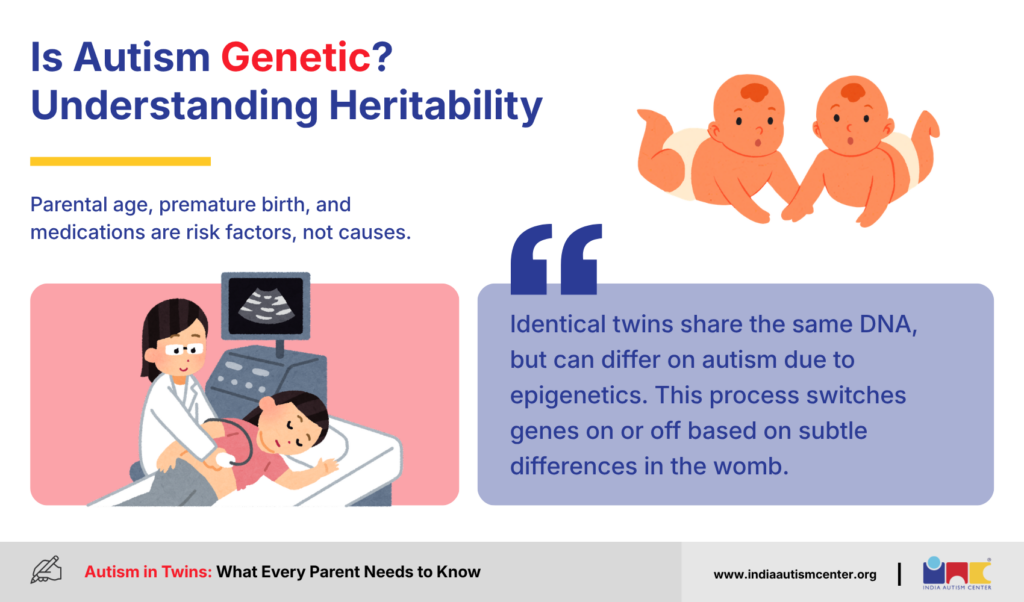
Research has linked a higher likelihood of autism to factors including:
Advanced parental age (particularly paternal age over 40)
Premature birth and low birth weight
Prenatal exposure to certain medications (notably valproate, used for epilepsy)
Complications during labour and delivery
None of these is a guarantee, and none of them is anyone’s fault. They are risk factors in a statistical sense — they shift probabilities slightly, they don’t determine outcomes. Most children exposed to these factors are not autistic, and most autistic children were not exposed to them.
The Epigenetics Piece: Why Identical Twins Can Be Different
Here’s something that surprises many parents: identical twins can have the same DNA and still have very different experiences of autism, or one can be autistic while the other is not.
How is that possible?
The answer lies in epigenetics — the study of how genes are switched on or off by biological and environmental influences. Even though identical twins start with the same genetic code, over time, their gene expression can diverge. Different experiences in the womb (one twin may receive slightly more nutrients or be in a different position), different immune responses, different early-life exposures — all of these can change how genes are expressed without changing the underlying DNA sequence.
This is actually a hopeful finding, in a way. It tells us that genes are not destiny. The environment — including early intervention, therapy, and support — can genuinely make a difference.
If One of My Twins Has Autism, What Are the Chances for My Other Twin?
This is the question most parents come here to answer, and I want to give you the clearest possible picture.
Twin Type
Risk if the Other Twin Has Autism
Identical (MZ)
Approximately 60–96%
Fraternal (DZ)
Approximately 20–40%
Non-twin sibling
Approximately 10–20%
General population
Approximately 2–3%
A few things worth noting:
Severity can differ significantly. Even when both twins in an identical pair are autistic, they may present very differently. One might be minimally verbal with high support needs; the other might be highly verbal with milder challenges. Same genes, different expression.
The broader autism phenotype matters. In many cases where one twin is autistic and the other isn’t formally diagnosed, the undiagnosed twin still shows some subclinical autistic traits — slightly different social communication patterns, particular sensory preferences, narrow interests. Researchers call this the “broader autism phenotype” (BAP). It’s not autism, but it’s a sign the genes are present even if the full condition isn’t expressed.
What should you do with this information? If one of your twins has been diagnosed, I’d strongly recommend asking your paediatrician about developmental monitoring for the other twin, even if they seem to be developing typically. The earlier a diagnosis is made, the earlier support can begin — and early intervention has consistently been shown to make a meaningful difference.
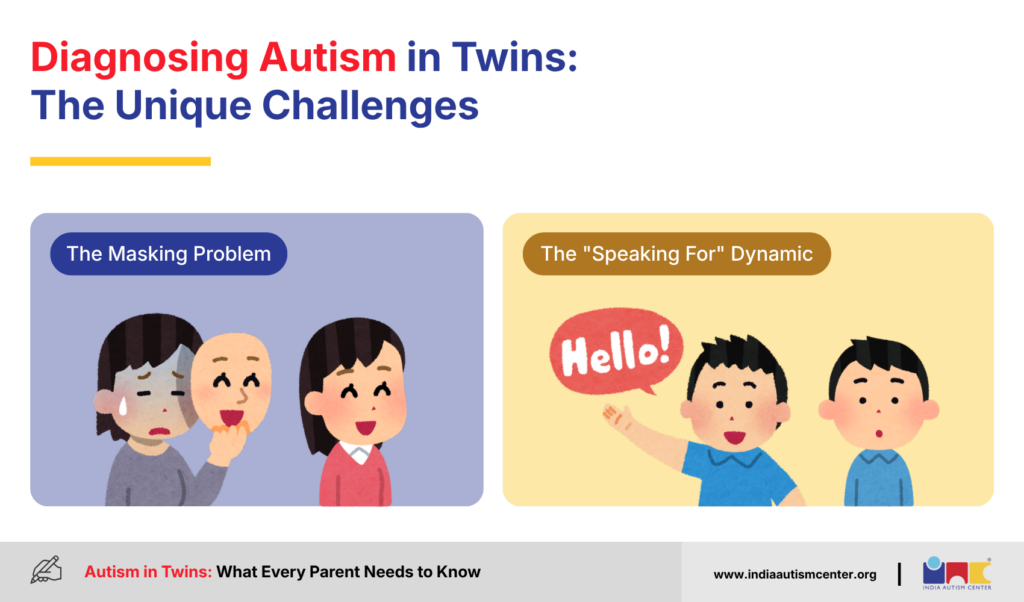
Diagnosing Autism in Twins: The Unique Challenges
Diagnosing autism in twins comes with a set of challenges that many parents and even some clinicians don’t anticipate.
The Masking Problem
When one twin is clearly autistic, attention often focuses on that child. The other twin may actually be masking autistic traits — subconsciously learning to imitate their twin’s social behaviour or compensating with their own strategies. This is especially common in girls, who tend to mask more effectively than boys regardless of whether they have a twin.
The “Speaking For” Dynamic
Twin pairs often develop tight communication shortcuts. The more verbally fluent twin may answer questions for both, fill in silences, or guide their co-twin through social situations. In a diagnostic assessment, this can make the quieter twin appear more socially capable than they actually are without their twin present.
What Good Assessment Looks Like
A thorough evaluation should assess each twin independently — in separate rooms, with separate sessions. The gold standard tools are:
ADOS-2 (Autism Diagnostic Observation Schedule) — a structured observation
M-CHAT-R/F — a screening tool used in toddlers (18–30 months)
If you feel that your concerns about the second twin aren’t being taken seriously because “we already assessed the other one and they’re fine,” advocate clearly. Each child deserves their own thorough evaluation.
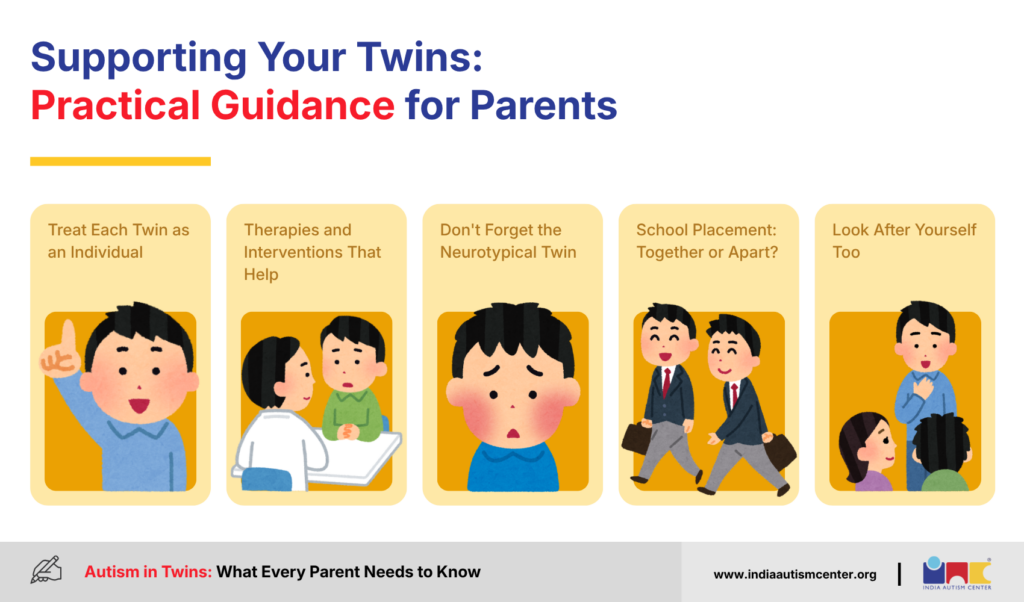
Supporting Your Twins: Practical Guidance for Parents
Learning that one or both of your twins is autistic doesn’t change who your children are. It changes what you now know about them, and it opens the door to support that is genuinely life-changing when started early and sustained consistently.
Treat Each Twin as an Individual
This might seem obvious, but it’s easy to fall into patterns where twins are treated as a unit — same school, same class, same therapy group. In families with autism in the mix, this needs careful thought. Each child’s needs are different. Each child’s pace of development is their own.
Create space for each twin to have their own relationships with you, their own achievements, and their own identity outside of being “the twins.”
Therapies and Interventions That Help
The most effective approaches are individualised — designed around each child’s specific profile of strengths and challenges. Depending on your child’s needs, these may include:
Speech and language therapy — for communication development, whether verbal or AAC (augmentative and alternative communication)
Occupational therapy (OT) — for sensory processing, fine motor skills, and daily living skills
Applied Behaviour Analysis (ABA) — structured skill-building; look for providers who take a naturalistic, child-led approach
Social skills groups — for children who want to build peer connections
Parent-mediated approaches — programmes like JASPER, ESDM, and Hanen that train you to support your child in everyday interactions
None of these are one-size-fits-all. A good therapist will regularly review progress and adjust the approach.
Don’t Forget the Neurotypical Twin
If one of your twins is autistic and the other is not, the neurotypical child has their own emotional journey to navigate. They may feel overlooked when their sibling needs more attention. They may feel confused about why their twin is different and may internalise worry or feel pressure to compensate.
Acknowledge their feelings directly. Keep some time that is just for them. Consider sibling support groups, many of which are offered by autism organisations and are specifically designed for brothers and sisters of autistic children.
School Placement: Together or Apart?
This is one of the most common questions twin parents ask, and there’s no universal right answer.
Some twins thrive in the same classroom — the familiar presence of their sibling is regulating and comforting. Others do better in separate classes, where the autistic child can receive more targeted support without being compared to their twin, and where both children have the chance to build their own friendships independently.
Talk openly with your school’s SENCO (Special Educational Needs Coordinator) or equivalent, consider your children’s individual preferences, and revisit the decision each year — what’s right at age five may not be right at age nine.
Look After Yourself Too
Parenting twins is demanding under the best of circumstances. Add an autism diagnosis — or two — and the weight can feel immense. The research is detailed that parental well-being directly affects child outcomes. This isn’t a guilt trip; it’s a reason to prioritise your own support.
Seek out parent support groups (online and in-person), be honest with your GP about how you’re coping, and remember that asking for help is one of the best things you can do for your children.
https://youtu.be/yr1zmIysrmM?si=uGMrn0WCBox9fDWy
Conclusion
If there’s one thing I hope you take from this article, it’s this: autism in twins is not a mystery beyond your understanding, and it is not outside your ability to respond to meaningfully.
The science tells us that genetics matters enormously — but it is not destiny. Epigenetics, environment, early intervention, and the quality of daily support all make a real difference to how autistic children develop and thrive.
If one of your twins has been diagnosed, get the other assessed. If both have been diagnosed, seek individualised support for each. And through all of it, take care of yourself — because your children need you at your best, not just your most exhausted.
You are already doing the most important thing: you are trying to understand.
Frequently Asked Questions
Are twins more likely to have autism than singletons?
Some research suggests a modest increase in autism rates among twins compared to singletons, though findings have been mixed. What is well-established is that twins are more likely than the general population to have a co-twin with autism if they are an identical twin of an autistic child.
Can twins have completely different levels of autism?
Yes, absolutely. Even identical twins with shared DNA can present very differently. One might need significant daily support while the other needs minimal accommodations. Autism is a spectrum, and gene expression varies even between genetically identical individuals.
Is autism caused by genetics or the environment?
Both play a role. Genetics accounts for roughly 64–91% of autism risk based on twin studies. Environmental factors — including prenatal exposures, birth complications, and parental age — contribute the remainder. Neither is “the cause” on its own; it’s an interaction.
At what age should I screen my twin for autism if the other has already been diagnosed?
As soon as possible. Screening tools like the M-CHAT-R/F are used from 18 months. If your other twin is already past that age and hasn’t been evaluated, speak to your paediatrician about a formal developmental assessment. Don’t wait for obvious signs — many children on the spectrum don’t show clear signs until 2–3 years of age, and some not until school age.
Do identical twins always share an autism diagnosis?
No. The concordance rate for identical twins is high (60–96%) but not 100%. Epigenetic differences, in-womb environmental variations, and other biological factors mean that one identical twin can be autistic while the other is not.
Disclaimer: This article is intended for educational and informational purposes only. It is not a substitute for professional medical advice, diagnosis, or treatment. If you are pregnant or have concerns about medication use during pregnancy, please consult a qualified healthcare provider. If your child has received an autism diagnosis and you have questions about causes or support, please reach out to a trained specialist or an autism-focused organisation for guidance.
This article is for informational purposes only and does not constitute medical advice. If you have concerns about your child’s development, please consult a qualified healthcare professional.
For parents with children having autism in India, getting an autism disability certificate feels like navigating a maze of forms and hospital visits. Nonetheless, it is one of the most crucial steps in securing essential support and recognition following early detection and diagnosis.
Did you know that in 2021, it was found that about 1 in 127 people have autism? And in India, millions of children are diagnosed with ASD. Many of these children are eligible for government assistance, but only a fraction have an official disability certificate.
So, wondering how to get an autism disability certificate in India? We have the answers for you.
Today, we will guide you through everything you need to know, from the process of applying for a disability certificate to obtaining the autism disability certificate in India via the UDID apply portal, including eligibility criteria and required documents, to help and empower autistic individuals.
What Is the UDID, and Why Is It Important?
First things first: what is UDID?
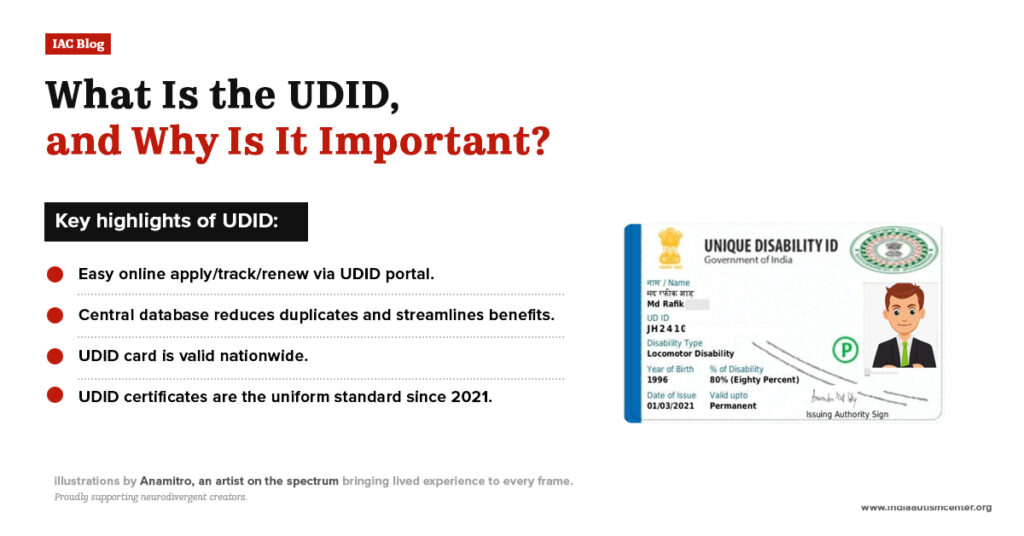
When you ask what UDID is, the answer is that it essentially stands for Unique Disability ID. It is a national digital initiative by the Department of Empowerment of Persons with Disabilities (DEPwD), under the Ministry of Social Justice & Empowerment, Government of India.
Key highlights of UDID:
A person with a disability can register and apply for a disability certificate on the UDID portal. It is quite simple to apply, track the application status, and request renewals and replacements.
It helps create a centralised national database of PwDs to avoid duplicate entries, making the process transparent and streamlining benefit delivery.
The allotted UDID card will be valid across all the states and union territories in India.
As of 1 June 2021, according to a government notification, certificates issued through the UDID portal are to be the standard across all states/UTs.
How Can UDID Benefit People With Autism?
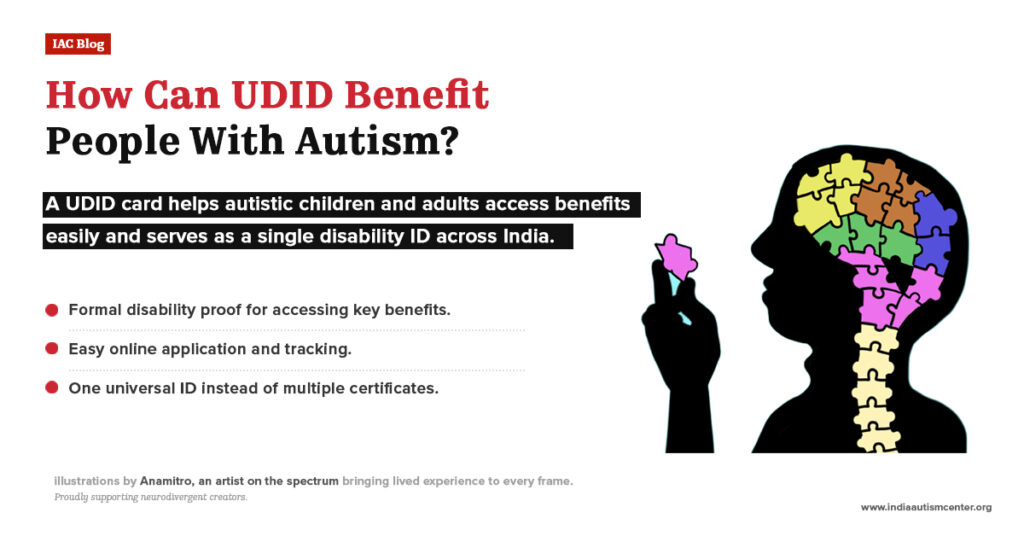
A UDID card is highly beneficial for children and adults recognised to have autism spectrum disorder (ASD) as per the RPwD Act. Here are the benefits of having a UDID card:
Formal recognition of their disability, which helps in accessing schemes and concessions in education/railways/travel.
Streamlined process (online registration, tracking) rather than wholly paper-based, manual processes.
It becomes easier to present one documented identity for disability status rather than juggling multiple certificates.
So, a UDID card can make the “how to apply for a disability certificate” journey smoother and help to manage an autistic child’s behaviour in a better and more accessible way.
What Is the Eligibility for the Autism Spectrum Disability Certificate?
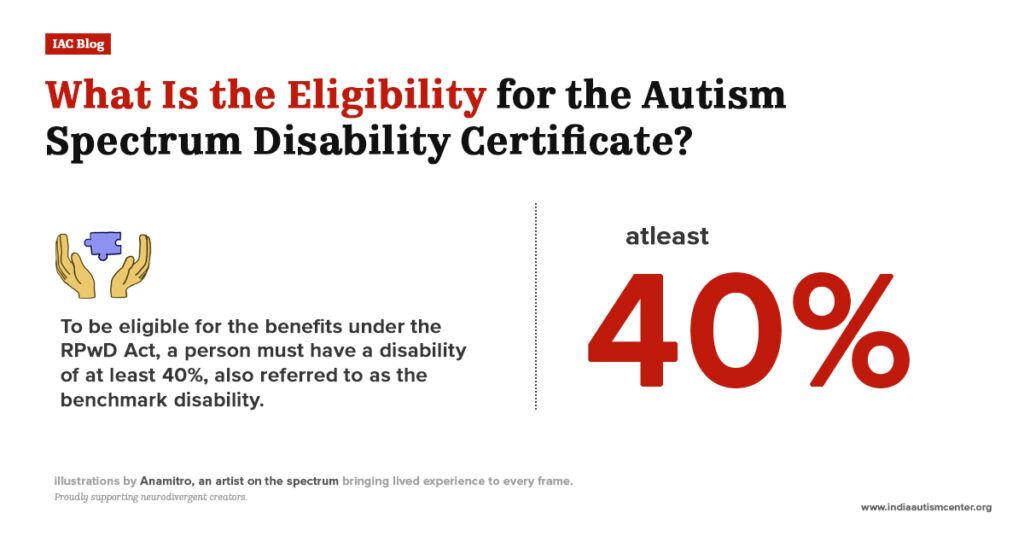
Under the RPwD Act, autism spectrum disorder (ASD) is one of the 21 specified disabilities. To be eligible for the benefits under the RPwD Act, a person must have a disability of at least 40%, also referred to as the benchmark disability.
Although autism spectrum disorder is included as per the Act, the severity and the functional impact will be assessed medically.
Who Can Apply for Autism Spectrum Disorder?
Before we get into further details, here is the information that you need to know about who can apply for an autism spectrum disability certificate:
Individuals diagnosed with ASD, or autism spectrum disorder, who are residing in India.
For minors (children), the parent/guardian can apply on behalf of the child.
For adults with ASD, they can apply themselves or via a guardian/representative (if applicable).
The applicant must undergo the prescribed medical/psychological assessment and be recognised by a competent medical board/certification authority.
Some important things to keep in mind:
Diagnosis alone is not enough; the disability certificate must be issued by the competent authority designated under the scheme.
The certificate and UDID card are different but linked; hence, you should apply for both.
The certificate may be for lifetime or temporary validity, depending on whether the disability is progressive or non-progressive.
Step-by-Step Guide: How to Apply for a Disability Certificate & UDID for Autism
The application process for how to apply for a disability certificate for autism can be overwhelming at times. Hence, here are clear steps that can help you understand the procedure, paperwork, and practical tips for smooth processing:
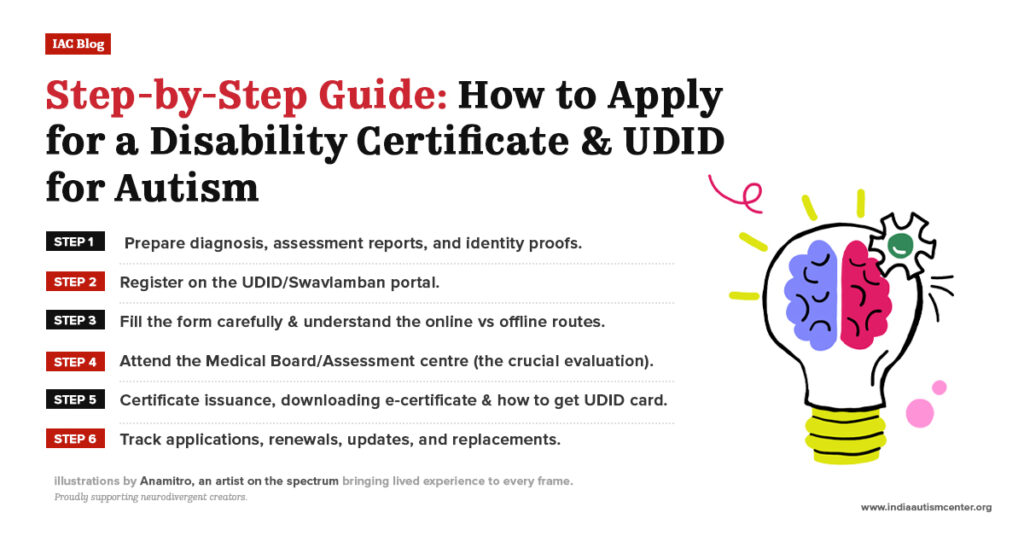
Step 1: Prepare diagnosis, assessment reports, and identity proofs
This step involves collecting all necessary reports and proofs.
Diagnostic report confirming Autism Spectrum Disorder (ASD) from a recognised specialist (paediatrician, psychiatrist, clinical psychologist, or neurologist). The report should be on hospital/clinic letterhead, with signature, registration number, and date.
Functional assessment or developmental assessment results where available (Indian Scale for Assessment of Autism (ISAA), Vineland Social Maturity Scale (VSMS), Childhood Autism Rating Scale (CARS), or equivalent).
Identity & address proof (Aadhaar, passport, voter ID, or other government ID). If Aadhaar is unavailable, another ID can be used.
For a minor, a birth certificate is necessary.
Passport-style photograph (digital upload & physical copy for the board).
Any previous disability certificate or medical records/history (if applicable).
School/therapy reports (for children: special education reports, speech therapy reports). It is a useful form of supporting documentation to demonstrate the functional impact on daily life, schooling, and communication.
Remember:
Ensure that the diagnostic reports are both recent and legible.
If assessments use paper tests, scan and save clear PDFs.
Both physical copies and scanned copies must be kept ready for use.
Step 2: Register on the UDID/Swavlamban portal
Visit the official UDID portal/Swavlamban portal. Look for the section “Apply for Disability Certificate & UDID Card” or “New Enrolment”.
You can register by creating an account (email or mobile OTP verification). Use a parent/guardian’s mobile number or email for child applications.
Fill in personal details accurately: full name, DOB, address, gender, guardian details (for minors), and Aadhaar if available (not strictly mandatory but recommended).
Select the correct disability category and choose Autism Spectrum Disorder (ASD) when prompted.
Upload scanned copies of the photo, identity proof, diagnostic report, and any assessment forms.
Remember:
Save the enrolment/application number shown after submission, as you will need it to track the status.
Some users prefer to save a screenshot of each upload step and the final confirmation page.
Step 3: Fill the form carefully & understand the online vs offline routes
Online process:
The portal typically guides you through the form fields. Common fields: demographic details, disability type, details of the diagnostic centre, uploaded reports, and declaration. Carefully type names exactly as per government ID to avoid mismatch issues at the Medical Board.
Offline process:
If you cannot apply online, many state-level social welfare offices, district disability cells, or government hospitals offer assisted/facilitated enrolment where staff fill the portal entries for you. Keep originals for verification.
Remember:
Mismatch between the name on the Aadhaar and the application, or uploading blurred/partial documents (boards may reject or request resubmission).
Using abbreviations inconsistently, spelling must match across ID/certificate; this inconsistency also needs to be avoided.
Step 4: Attend the Medical Board/Assessment centre (the crucial evaluation)
The board will verify the identity documents and original diagnostic assessments.
They will further perform a functional assessment to estimate how autism affects daily living (communication, social skills, and adaptive behaviour). The medical board for ASD typically includes paediatricians, psychiatrists, clinical psychologists, and/or neurologists, depending on the state and facility.
The board may ask questions to the parent/guardian about milestones, communication, behaviour patterns, school performance, and therapy history.
They may conduct or request additional tests (if the submitted reports are insufficient).
The board will document the percentage of disability (if applicable) and determine whether the person meets the benchmark disability threshold (commonly 40% or higher) for benefits.
Remember:
Carry all originals + 2–3 photocopies of each document (ID, diagnostic report, assessments, school reports).
Please bring any assistive devices you use (e.g., hearing aids or communication devices, if applicable).
For children, bring a familiar toy or comfort item and plan the appointment at a time when the child is calm.
Bring a parent/guardian who knows the child’s developmental history and can answer questions about daily functioning.
Step 5: Certificate issuance, downloading e-certificate & how to get UDID card
Once the board approves, the issuing authority uploads the certificate details to the UDID portal. Now, how to get the UDID card? You will receive an approval notification (via SMS/email) with a link or enrolment reference.
Log in to the portal with the help of your enrolment number and download the disability certificate (often in PDF/e-certificate format).
The portal will also generate the UDID card (unique number and e-card). Many states issue an e-UDID immediately; physical UDID cards are sent later or can be printed locally.
Remember:
Check name spelling, DOB, disability type (Autism/ASD), percentage (if stated), and validity. If anything is incorrect, please raise a correction request immediately via the portal or the relevant issuing authority.
Step 6: Track applications, renewals, updates, and replacements
Here are the steps that you can follow to track the status:
Use the enrolment/application number on the UDID portal to see the status: Submitted → Document Verification → Medical Board Pending → Approved/Rejected.
Some certificates are lifetime, while others (often for children or when a temporary assessment is done) have a validity period (e.g., 3 or 5 years). The certificate will clearly note the validity. Renew your plan at least one month before expiry, if required.
The UDID portal allows users to update their personal details and request a replacement UDID card if it is lost/damaged. Use the “Update” or “Replace UDID” options and follow the verification steps.
When you are applying for an Autism Disability Certificate or a UDID card, it can feel challenging. The good news? Most delays and rejections occur due to a few simple, avoidable mistakes. Understanding these beforehand can save you weeks of waiting and multiple hospital visits.
Below are the most common mistakes applicants make, along with detailed explanations to help you avoid them completely.
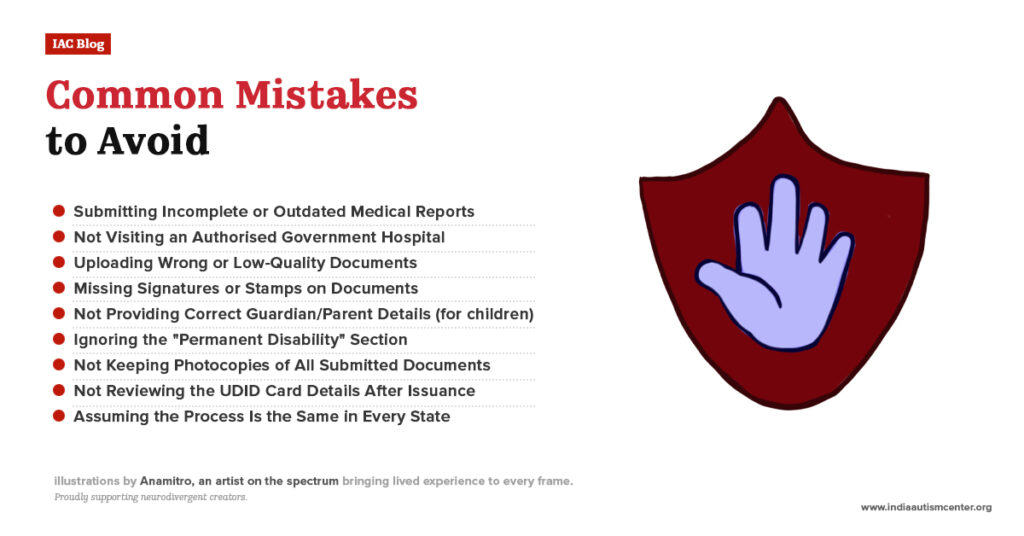
1. Submitting Incomplete or Outdated Medical Reports
Yes, one primary reason why applications get delayed is due to incomplete or outdated medical documentation.
Disability assessment teams require recent, complete, and standardised autism evaluation documents, especially tools such as ISAA (Indian Scale for Assessment of Autism).
Hence, ensure that all the reports are recent and up-to-date.
2. Not Visiting an Authorised Government Hospital
Visiting a private or a non-recognised hospital to get the reports can prove to be a mistake. Only government-certified medical boards are authorised to validate and issue a disability certificate.
Visit only district hospitals, government medical colleges, AIIMS, or state-run disability assessment centres. You can find it via the location tool on the UDID website.
3. Uploading Wrong or Low-Quality Documents
Incorrect file formats or blurry uploads can lead to rejection on the UDID portal. It is necessary to upload a clear and readable document. If it is not clear, it can get flagged by the system immediately.
Make sure that all documents are scanned clearly. Save it as a PDF, JPG, or another format that is within the supported size limit.
4. Missing Signatures or Stamps on Documents
A small detail, but one of the most common reasons for re-evaluation. Remember that unsigned reports are treated as incomplete medical evidence.
Ensure that you check every page for the doctor’s signature & hospital seal, and the assessment report has the official designation of the doctor.
5. Not Providing Correct Guardian/Parent Details (for children)
There can be verification issues if the parent details are mentioned incorrectly. The details must match the information on the Aadhaar card and birth certificate for correct authentication.
It is a best practice to double-check spellings, DOB, and ID numbers. Also, ensure that the parent applying is legally authorised as well.
6. Ignoring the “Permanent Disability” Section
Autism is classified as a lifelong neurodevelopmental condition, but many applicants mistakenly check “temporary disability”. If you select the temporary option, it can trigger yearly renewals and reassessments.
Always select ‘Permanent Disability’ when filling out UDID forms, since autism does not resolve with age.
7. Not Keeping Photocopies of All Submitted Documents
It might not seem important, but it is necessary to keep copies of all the hospital submissions. It will come in handy, especially if the hospital requests a resubmission.
Creating a folder and keeping all documents, along with UDID acknowledgement receipts, stored properly is a wise decision.
8. Delaying Follow-ups After Medical Board Assessment
Once the assessment is done, some applicants forget to track their status online. If any clarification is needed, delays can stretch for months.
Check your application status every 7–10 days on the UDID portal. Also, be sure to respond immediately if the portal indicates a document correction is required.
9. Not Reviewing the UDID Card Details After Issuance
Many people download the card without verifying details such as the disability percentage, name spelling, or date of birth. Any error requires a correction request, which takes additional weeks.
Verify each detail carefully, and if needed, apply for correction within 30 days of issuance.
10. Assuming the Process Is the Same in Every State
Each state has slight differences in hospital listings and scheduling of assessments. It is necessary to verify and follow the most recent guidelines to avoid any errors on your part.
Check your state-specific UDID instructions on the UDID portal for guidance. You should also confirm the hospital’s eligibility beforehand.
Conclusion
The process of obtaining an Autism Disability Certificate and UDID card in India can become easier if you are aware of the steps involved and the documents required, and understand the common mistakes that cause delays. With the right preparation and accurate medical assessments, families can complete the process smoothly and unlock essential benefits, support services, and government schemes that ensure better access and inclusion for individuals with autism.
Frequently Asked Questions
What is an Autism Disability Certificate?
An Autism Disability Certificate is a government-issued document that officially recognises autism as a disability under the RPwD Act, 2016. It helps individuals access support services, education accommodations, financial benefits, and various welfare schemes.
How do I apply for a disability certificate online through the UDID portal?
You can apply by visiting the UDID portal, registering with your details, uploading the required documents, and booking a medical assessment. After approval, the digital UDID card can be downloaded from the portal.
How do I get a UDID card after receiving the disability certificate?
Once the medical board approves your disability, your UDID card is generated automatically. You can log in to the UDID portal, check your status, and download the digital card.
Can private hospital reports be used as part of the application?
Private reports may support the diagnosis, but the final assessment must be done at a government medical board. Only their evaluation is accepted for issuing a certificate.
Disclaimer: This article is intended for educational and informational purposes only. It is not a substitute for professional medical advice, diagnosis, or treatment. If you are pregnant or have concerns about medication use during pregnancy, please consult a qualified healthcare provider. If your child has received an autism diagnosis and you have questions about causes or support, please reach out to a trained specialist or an autism-focused organisation for guidance.
For expert insights, support services, and inclusive learning initiatives, visit the India Autism Center.
Autism doesn’t always look the way we expect it to.
The image most people carry – a child who avoids eye contact, lines up toys, and resists all social interaction – is real, but it’s incomplete. It describes one presentation. Mostly male. Mostly visible. And it has dominated clinical thinking for decades.
For women and girls, autism tends to show up differently. More socially motivated. Better at mimicking. Quieter in its distress. A woman can be deeply autistic and still hold a conversation, maintain friendships, hold down a job – and spend every waking moment exhausted by the effort of it all.
That exhaustion has a name: masking. And it’s one of the main reasons the signs of autism in women are so consistently missed.
In India, the situation is compounded by cultural factors – the expectation that girls will be compliant, emotionally attuned, and socially adaptable. These are exactly the traits that autistic girls learn to perform. The result is that thousands of women across India are living with undiagnosed autism, cycling through misdiagnoses of anxiety, depression, or personality disorders, never quite understanding why the world feels so much harder for them than it seems to for everyone else.
This article is for them. And for the families, teachers, and clinicians who want to understand what they’re actually looking at.
Female Autism Checklist
This checklist is the most practical place to start. It’s organised across five categories that reflect how autism actually presents in women and girls – not how it presents in the male-dominated studies that shaped early diagnostic criteria.
Work through it honestly. You don’t need to tick every item. Autism is a spectrum, and presentations vary enormously.
Important: This checklist is not a diagnostic tool. It cannot tell you whether you are autistic. What it can do is help you recognise patterns worth exploring with a qualified specialist.
Category 1: Social Interaction
☐ You find social situations draining, even when you enjoy them
☐ You feel like you’re always slightly out of step with others, even in familiar groups
☐ You study other people carefully to figure out how to behave, rather than knowing intuitively
☐ You prefer one-on-one conversations to group settings
☐ You have intense, sometimes overwhelming friendships that can end abruptly
☐ You feel like an outsider even when you are technically included
☐ You find it easier to connect with people who are significantly older or younger than you
☐ You struggle to maintain friendships over time, even when you want to
☐ You often replay conversations afterward, analysing what you said or should have said
☐ You feel more comfortable with animals, children, or fictional characters than with adult peers
Category 2: Communication
☐ You take language literally and are often confused by sarcasm, idioms, or implied meanings
☐ You use formal or precise language in casual settings, sometimes described as “speaking like a book”
☐ You rehearse conversations in your head before having them
☐ You find it difficult to know when to speak in a group conversation – you either interrupt or stay silent
☐ You have a strong, distinctive speaking style that others sometimes find unusual
☐ You struggle to make small talk and find it pointless or exhausting
☐ You are very honest and direct in ways that sometimes upset people unintentionally
☐ You find phone calls significantly harder than face-to-face or written communication
Category 3: Sensory Sensitivities
☐ Certain clothing textures, seams, or labels feel genuinely painful or unbearable
☐ Loud environments – markets, weddings, classrooms – cause you real distress, not just mild discomfort
☐ You are highly sensitive to smells that others don’t seem to notice
☐ Bright or flickering lights (tube lights, screens) cause headaches or overwhelm
☐ You have strong food aversions related to texture, temperature, or smell rather than taste alone
☐ You seek out specific sensory experiences – certain fabrics, repetitive movements, particular sounds – for comfort
☐ You are very sensitive to physical pain, temperature, or touch
☐ You hold yourself together in public but “crash” at home after a sensory-heavy day
Category 4: Masking and Camouflaging
☐ You have spent years watching others and copying their behaviour, mannerisms, or speech patterns
☐ You have a different “version” of yourself for different social contexts – work, family, friends – and switching between them is exhausting
☐ You suppress the urge to move, fidget, or make sounds in public even when it helps you feel calmer
☐ You force yourself to make eye contact even though it feels uncomfortable or distracting
☐ After social events, you need significant time alone to recover
☐ You feel like you are performing rather than simply being yourself in most social situations
☐ You have a strong fear of being “found out” or exposed as somehow different or wrong
☐ You are not sure who you actually are when the performance stops
Category 5: Emotional Regulation and Executive Function
☐ You experience intense emotional reactions that feel disproportionate to the situation
☐ You often understand your feelings only hours or days after an event, not in the moment
☐ Unexpected changes to plans cause significant distress, even minor ones
☐ You have strong, all-consuming interests that you pursue with intense focus
☐ You struggle to start tasks, even ones you want to do – often described as “task paralysis”
☐ You lose track of time easily, either hyperfocusing for hours or struggling to manage basic schedules
☐ You find it hard to manage multiple responsibilities at once (work, home, relationships)
☐ You have a strong need for routine and feel destabilised when it breaks down
If you checked several items across multiple categories, consider speaking with a specialist. This checklist is not a diagnostic tool – but it is a meaningful starting point.
Identifying Signs of Autism in Women
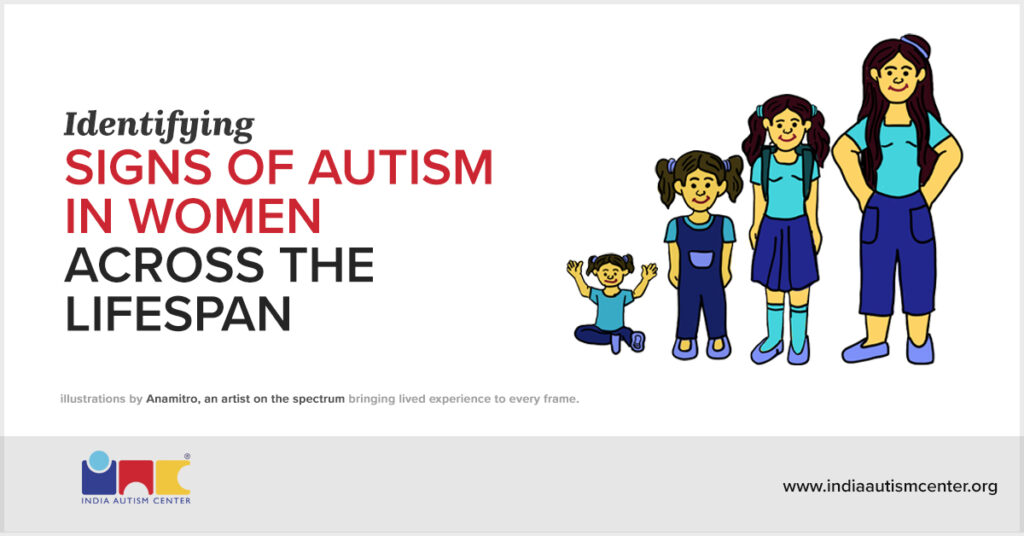
Let’s start by tracing how female autism signs show up at different life stages.
Early Signs of Autism in Girls: Infancy and Toddlerhood (0–2 years)
Autism signs in girls can be subtle early on. But beneath the surface, they start to emerge as:
Inconsistent responses to their name or social cues
Unusual reactions to sensory input
Delayed gestures or babbling despite developing spoken language on time
Fixation on specific objects or textures, such as rubbing fabrics, staring at lights
Repetitive behaviours like hand flapping, clapping, and stimming
Subtle Signs of Autism in Preschool Years (3–5 years)
Preschool years often bring new social demands, and with them, more noticeable autism signs in young girls.
But these can be misread as quirks or shyness. So, watch for:
Engaging in rich pretend play, but often alone or with rigid storylines
Echoing others’ speech or actions without initiating their own ideas
Avoiding noisy or overstimulating settings like playgrounds or parties
Early masking behaviors, such as mimicking peers to fit in
Strong attachments to routines
Eye contact discomfort (either avoiding it or holding it too long unnaturally)
Subtle Signs of Autism in Females During Childhood (6–12 years)
At school age, autism signs in girls become more nuanced.
A lot of autistic girls get ruled out because they may share a smile or may have a bit better eye contact, or they’re more socially motivated. It can be a more subtle presentation.
The most common signs include:
Social Challenges
Appears friendly but struggles with forming deeper friendships
Overthinks conversations and fears social rejection
Prefers adults or solitary play over peers
Feels like an outsider, even when included
Sensory Issues
Avoids certain clothing textures or sounds
Sensitive to smells, loud environments, or certain foods
Holds in discomfort during the day but melts down at home
Executive Dysfunction
Difficulty following multi-step instructions or organizing schoolwork
Frequently loses personal items or misses deadlines
Procrastinates not out of laziness, but due to overwhelm
Stimming and Self-Soothing Behaviors
Engages in repetitive behaviors like hair twirling, tapping, or humming
May be dismissed as nervous habits rather than recognized as self-regulation
How Signs of Autism in Girls Shift in Teenage Years (13–19 years)
Puberty and growing social pressures amplify hidden struggles. Many teenage girls with autism experience anxiety, burnout, or mental health issues.
Here are the common symptoms they develop during this period:
Autism Masking or Camouflaging
Forces eye contact despite discomfort
Rehearses social scripts and facial expressions
Bottles up emotions in public and breaks down privately
Shifts behavior dramatically between different environments
High masking autism in women often leads to chronic exhaustion and anxiety
Emotional Regulation Challenges
Emotional instability
Criticized for being ‘too sensitive’ or ‘overdramatic’
Intense emotional reactions such as shutdowns, rage, or withdrawal
Obsessive Interests and Special Focus Areas
Deep fixation on niche topics
Uses interests as coping mechanisms or emotional anchors
Intense attachments to people, such as friends, celebrities, or fictional characters
Sleep Disturbances
Light sleeper, prone to waking up easily
Relies on strict bedtime routines or sensory aids to sleep
Difficulty falling asleep due to overstimulation or racing thoughts
Recognising Autism Signs in Adult Women (20s and Beyond)
The signs of undiagnosed autism in adult women start surfacing only when lifelong coping strategies break down.
What happens then?
Executive Dysfunction Becomes More Apparent
Overwhelmed by basic life tasks, such as cooking, cleaning, and planning
Misses deadlines or hyperfocuses to the point of exhaustion
Constantly battles mental fatigue, trying to manage daily life
Sensory and Sleep Challenges Persist
Avoids crowded spaces due to sensory overload
Struggles with chronic fatigue from poor-quality sleep
Menstrual cycles, pregnancy, or menopause may intensify the symptoms
Masking, Burnout, and Identity Struggles
Feels disconnected from their authentic self
Burnout manifests as anxiety, depression, or emotional shutdown
Questions identity after years of masking: “Who am I without this act?”
Stimming and Self-Regulation Continue Quietly
Quiet stimming, like fidgeting, doodling, or skin picking, used for self-soothing
But even when these signs of autism in women appear, they often go unnoticed.
Biological Differences in How Autism Appears in Women
Autism signs in women often present differently from those in men. This difference begins with biology.
Unlike the textbook male traits of obvious social withdrawal or repetitive behaviors, autism in women shows up in:
Struggling quietly to read social cues
Masking confusion with memorized responses
Expressing emotions in ways that seem typical
These nuances don’t align with traditional diagnostic checklists. As a result, women with autism often fly under the radar.
Social Conditioning
From a young age, girls are often taught to observe, adapt, and blend in.
Over time, they:
Mimic peer behaviors without true understanding
Rehearse conversations, facial expressions, and social scripts
Hide sensory discomfort or emotional overwhelm
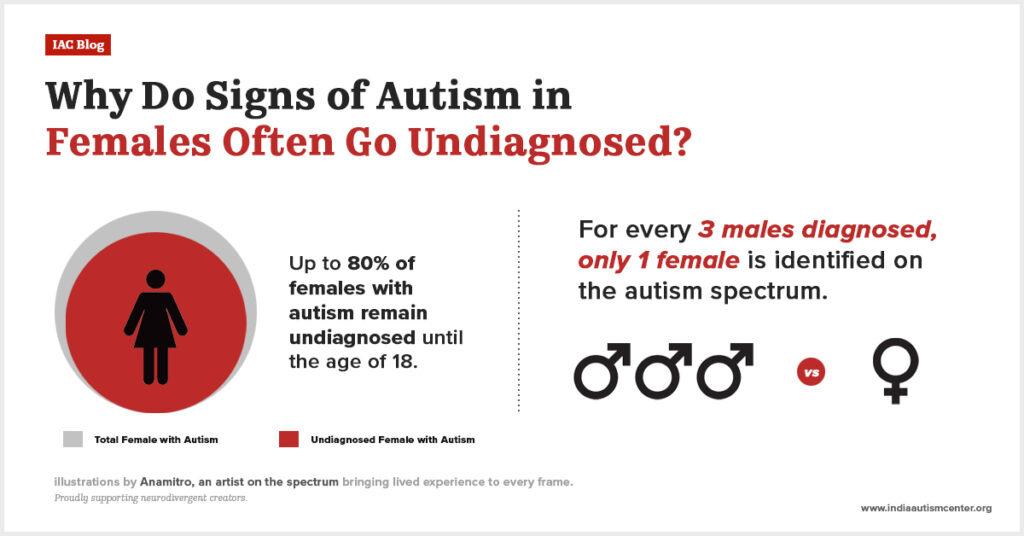
And it’s this exact social camouflaging or masking that leads even trained professionals to miss the signs of autism in women.
Male-Centric Diagnostic Tools and Research Bias
Here’s a glaring problem most people don’t realize. The most commonly used diagnostic tools, like the Autism Diagnostic Observation Schedule (ADOS), were designed and validated predominantly using male participants.
For instance, the original validation sample for ADOS consisted of 170 males and only 36 females with autism spectrum disorder (ASD).
This creates a critical blind spot. After all, what doesn’t get measured doesn’t get diagnosed.
As a result, subtle, female-specific signs of autism simply don’t register on tests designed for male-pattern presentations.
That said, the sooner these signs are recognized, the better the outcomes. And this is where early intervention for autism comes in.
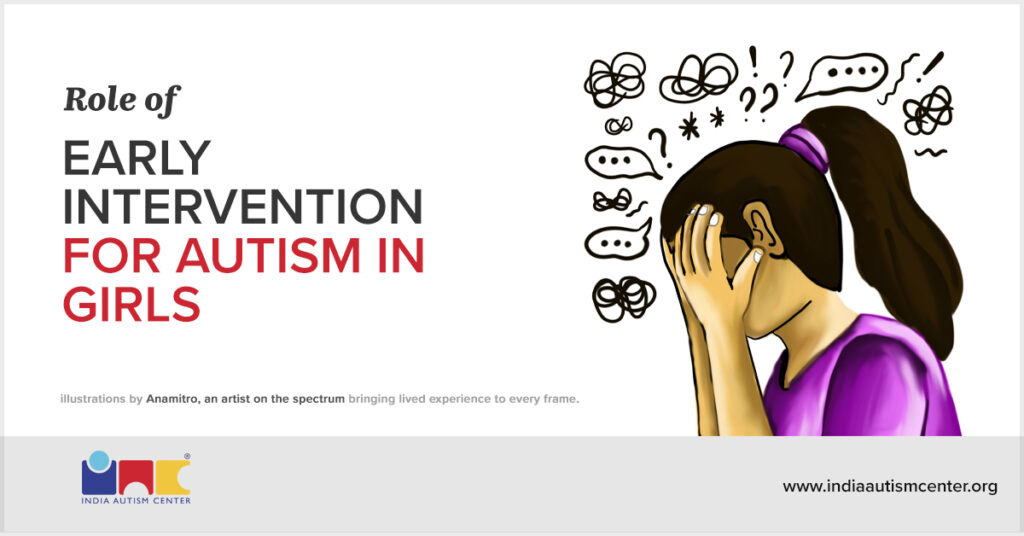
Role of Early Intervention For Autism In Girls
It means providing support and therapies to young children, ideally before the age of 3.
This critical window of neuroplasticity allows the brain to adapt, learn, and grow at an accelerated pace.
What Is Early Intervention For Autism in Girls?
For girls, whose autism signs often appear milder or get masked by social imitation, early intervention helps in:
Managing sensory sensitivities
Supporting emotional regulation
Building healthy social interaction patterns
Developing effective communication strategies
Strengthening adaptive functioning, daily living skills, and motor skills
Early Intervention Strategies for Autism in Girls
This first step is to consult a developmental pediatrician, clinical psychologist, or rehabilitation psychologist and request a developmental screening.
If screening indicates potential concerns, early autism intervention should begin immediately.
Here are the strategies that can make a difference:
Speech and language therapy to develop expressive communication
Occupational therapy (OT) for sensory regulation, motor skills, and daily tasks
Behavioral therapy to nurture emotional regulation and functional behaviors
Play-based therapy to support learning naturally
Social skills training to foster connections
Cognitive training to enhance reasoning and problem-solving skills
Parental coaching to empower families to reinforce learning at home
It is important to note that not every child or adult will need every form of therapy. The right combination depends on developmental stage, profile, and goals. A multidisciplinary team typically assesses this and creates a phased, personalized intervention plan.
Autism and Comorbidities in Women
Autism rarely travels alone. In women especially, it tends to arrive with company – and the company often gets diagnosed first.
Anxiety Disorders
Anxiety is the most common comorbidity in autistic women. It makes complete sense: living in a world that doesn’t accommodate your neurology, constantly performing a version of yourself that isn’t real, never quite knowing if you’ve said the right thing – this is an anxiety-generating existence. Generalised anxiety disorder, social anxiety, and panic disorder are all common. The critical clinical point is that standard anxiety treatments (CBT, medication) may help manage symptoms but will not address the root cause if autism is unrecognised.
ADHD
ADHD co-occurs with autism in approximately 39% of autistic individuals, and in women, both conditions are frequently missed simultaneously. Where autism drives the need for predictability and routine, ADHD introduces impulsivity and difficulty sustaining attention – creating an internal conflict that many women describe as exhausting. The masking load doubles. Women with both conditions often develop even more sophisticated camouflaging strategies, making both conditions harder to identify.
Depression
Chronic masking, social isolation, repeated misunderstanding, and the accumulated weight of years of unmet needs all contribute to depression in autistic women. Depression in this context is not simply a mood disorder – it’s often a direct consequence of living undiagnosed and unsupported. Treating it with antidepressants alone, without addressing the autism, provides limited and temporary relief.
Eating Disorders
Research consistently shows elevated rates of eating disorders – particularly anorexia nervosa and ARFID (Avoidant/Restrictive Food Intake Disorder) – in autistic women. The connections are multiple: sensory sensitivities around food texture and smell, the need for control in a world that feels unpredictable, the use of food restriction as a regulatory strategy. Studies suggest that up to 20–35% of women with anorexia may be autistic, many of them undiagnosed at the time of treatment.
PTSD and Trauma
Autistic women are at elevated risk of trauma and victimisation – partly because difficulties reading social cues make it harder to identify dangerous situations, and partly because years of being told that their perceptions are wrong can make them doubt their own experiences. PTSD in autistic women can look atypical, with sensory triggers, shutdown responses, and dissociation features that don’t fit standard PTSD presentations.
The clinical takeaway: When a woman presents with multiple, overlapping mental health diagnoses that haven’t fully responded to treatment, autism should be on the differential. Comorbidities mask autism – but they also point toward it.
Autism Diagnosis in Women: Consultation and Next Steps
A formal autism diagnosis typically happens after the age of 3. This process can bring clarity, but only when backed by the right professional guidance and a structured pathway.
Here’s a clear, actionable roadmap:
Step 1: Consult the Right Specialist
The first move should be connecting with a licensed clinical psychologist, rehabilitation psychologist, or developmental pediatrician.
Why?
Well, these professionals are trained to spot the often subtle or masked signs of autism in women. They also recommend diagnostic tools suited to an individual’s specific profile.
Step 2: Undergo a Comprehensive Autism Assessment
Autism diagnosis isn’t based on a single appointment or one-off observation. It requires a multi-dimensional evaluation that includes:
Parental Interviews and Developmental History
Early life milestones, social behaviors, and past experiences help clinicians map patterns.
Direct Behavioral Observation
How one interacts, plays, communicates, and responds across different settings gives clinicians valuable insights beyond verbal reports.
Review of Previous Records
Past therapy notes, academic reports, or psychological evaluations provide context and reveal longstanding patterns often missed earlier.
Standardized Diagnostic Tools
Depending on age and presentation, tools such as the Indian Scale for Assessment of Autism (ISAA), Childhood Autism Rating Scale–Second Edition (CARS-2), or Autism Diagnostic Observation Schedule (ADOS-2) are administered.
Final Diagnostic Report and Team Review
A multidisciplinary team reviews all findings and prepares a comprehensive report. Because female autism signs often present differently, this forms the foundation for both understanding the needs and planning the next steps.
Step 3: Building a Holistic Autism Support Team
Getting a diagnosis is just the beginning. Effective support requires a multidisciplinary approach that may include:
Speech-language therapy
Occupational therapy
Special education support
Psychological support
Play or other non-conventional therapies
Medical consultation
It’s again important to understand that not every strategy is needed at every stage. The right combination depends on developmental age, current challenges, and personal strengths.
A qualified multidisciplinary team will prioritize interventions based on ongoing assessments to ensure that support remains relevant, adaptive, and person-centered.
Step 4: Create a Personalized Autism Intervention Plan
Diagnosis without action is incomplete. What matters is crafting an individualised, strengths-based support plan that evolves with needs. This is especially crucial for women and girls who’ve often been misdiagnosed, overlooked, or misunderstood.
However, the support needs may evolve over time as the individual develops. Certain new needs may surface while the previous ones get stabilised.
Reality of Autism Diagnosis in Women
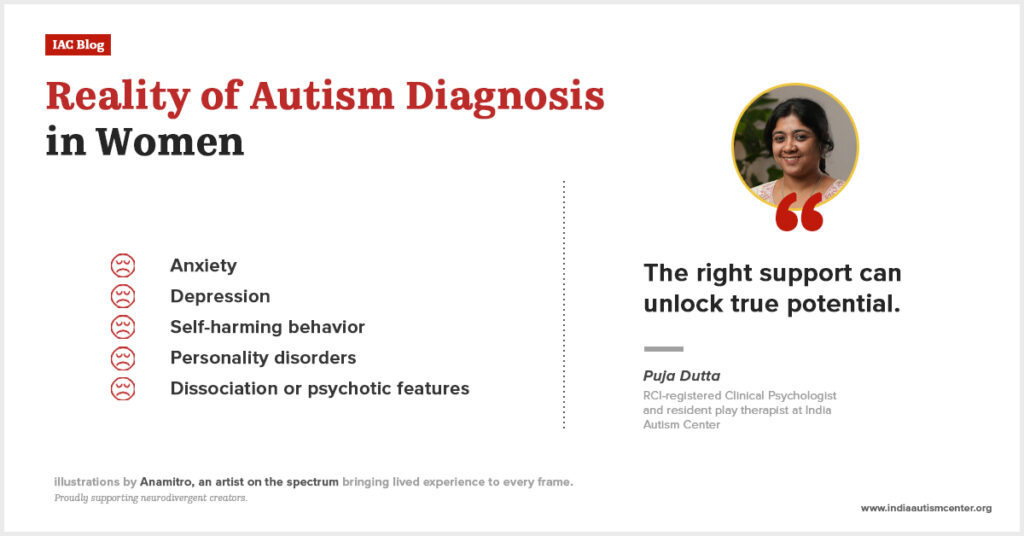
For many women, especially those with high-functioning autism, the diagnostic journey rarely follows a clear or timely path. Unlike the structured process typically seen in early childhood diagnoses, autism diagnosis in adult women often begins in reverse.
It’s not the signs of autism that prompt an evaluation. It’s the fallout from years of being misunderstood.
Many autistic women quietly struggle for decades, confused by their internal experiences. Their traits are often misread as personality quirks or signs of unrelated mental health issues.
Over time, this leads to secondary conditions, such as:
Anxiety
Depression
Self-harming behavior
Personality disorders
In some cases, dissociation or psychotic features
Often, it is these comorbid challenges that prompt women to seek professional help, rather than autism itself. Only after a thorough evaluation do clinicians identify the deeper, underlying presence of autism spectrum disorder.
Although this route is long and exhausting, it also brings clarity.
At this phase, the right support can unlock true potential.
While individual support matters, change at the policy level is equally crucial for lasting impact.
The Reality of Autism Masking in Women
Masking is not a quirk. It’s not a coping strategy in the ordinary sense of that phrase. It is a full-time neurological performance – and for many autistic women, it has been running continuously since early childhood.
What Masking Actually Is
Hull et al. (2020) defined camouflaging in autism as a set of strategies used to compensate for or hide autistic characteristics in social situations. These strategies include:
Assimilation – trying to fit in with others; copying behaviour, speech patterns, and mannerisms
Compensation – developing workarounds for social difficulties, such as scripting conversations or memorising social rules
Masking – actively hiding autistic traits, such as suppressing stimming, forcing eye contact, or performing emotions that aren’t felt
For autistic women, these strategies often begin in early childhood – sometimes as young as 3 or 4 years old. By adulthood, they are so deeply embedded that many women don’t recognise them as strategies at all. They simply feel like “who I am.”
How Masking Develops
Masking develops in response to feedback. A girl who flaps her hands and is laughed at learns to stop. A girl who talks too directly and is told she’s rude learns to soften. A girl who doesn’t understand a social situation and is excluded learns to watch more carefully and copy more precisely.
Each of these adaptations is rational. Each of them costs something. And the cumulative cost, over years and decades, is enormous.
The Cost of Chronic Masking
Research consistently links high levels of camouflaging with:
Increased anxiety and depression
Higher rates of suicidal ideation
Autistic burnout
Identity fragmentation – a profound uncertainty about who you actually are beneath the performance
The concept of autistic burnout is particularly important here. It’s distinct from ordinary burnout or depression, though it can resemble both. It typically involves a loss of previously managed skills, extreme fatigue, increased sensory sensitivity, and withdrawal from social life. It often follows a period of sustained high masking – a new job, a relationship, a move, a major life change that required the performance to intensify.
Women in autistic burnout are often at their most vulnerable. They may present to mental health services in crisis. Without a clinician who recognises what’s happening, they are likely to receive another misdiagnosis rather than the support they actually need.
Why Unmasking Matters
Unmasking – gradually allowing autistic traits to surface in safe contexts – is not about becoming “more autistic.” It’s about reducing the cognitive and emotional load of constant performance. It’s about finding out who you actually are.
This is slow, careful work. It requires a safe environment, often therapeutic support, and frequently a period of grief for the years spent performing. But women who have gone through it consistently describe it as transformative – a shift from exhausted performance to something that finally feels like living.
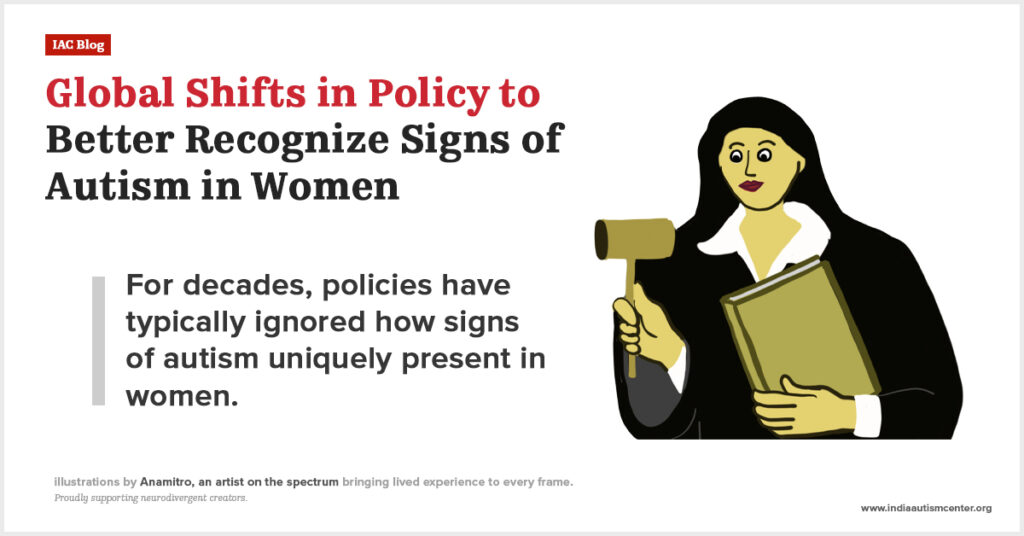
Global Shifts in Policy to Better Recognise Signs of Autism in Women
For decades, policies have typically ignored how signs of autism uniquely present in women.
But that’s starting to change.
In India: Small Steps with Big Potential
The Rights of Persons with Disabilities Act (RPwD), 2016, officially recognized autism as a disability in India. It mandates inclusion in education, employment, and healthcare.
Yet, the law remains gender-blind in practice.
It says nothing about how autism in women may appear differently. No mention of masking, camouflaging, or female-specific diagnostic needs.
That silence is finally breaking.
Karnataka and Kerala have piloted training programs for teachers and health workers to teach them to recognize the subtle autism signs in girls.
West Bengal is leading a grassroots initiative. Its Department of Women and Child Development launched a new autism screening tool, available in Bengali, Hindi, and English.
As Sarmistha Bhattacharya, a rehabilitation psychologist at the India Autism Center, explains,
The biggest strength of this tool is accessibility. It equips frontline workers to identify early signs of autism. Girls who might otherwise go unnoticed are finally getting flagged for support.
These pilot initiatives go beyond checklists. These also encourage early screenings in schools and healthcare centers.
Global Momentum: Changing the Diagnostic Lens
Internationally, the shift is sharper.
In the UK, the National Autism Strategy (2021–2026) directly calls for better identification of autism in women and girls. It pushes for tools that reflect their lived experiences.
In Australia, the National Disability Insurance Scheme (NDIS) funds diagnostic assessments designed to move beyond outdated male-centered models.
For women who spent years doubting themselves or being misdiagnosed, this shift signals a long-overdue validation.
And it’s just the start.
Getting an Autism Diagnosis in India – A Practical Guide
Getting diagnosed as an autistic woman in India is possible. It takes persistence, and the system has real limitations – but the pathway exists.
Who to Consult
The right starting point depends on age and access:
Developmental paediatrician – for girls up to approximately 18 years; the most appropriate first contact for childhood presentations
Clinical psychologist or rehabilitation psychologist – can conduct comprehensive assessments at any age; look for someone with specific experience in autism and female presentations
Psychiatrist – particularly relevant for adult women who have existing mental health diagnoses; a psychiatrist can assess for autism alongside comorbidities
Avoid the temptation to start with a general physician or GP for autism concerns. Most are not trained to recognise female autism presentations and may redirect you toward anxiety or depression treatment instead.
What the Assessment Involves
A proper autism assessment is not a single appointment. It typically includes:
Detailed developmental history – early milestones, school experiences, social development, family history; for adult women, this may involve parents or siblings providing retrospective information
Direct behavioural observation – how you communicate, interact, and respond across different contexts
Standardised diagnostic tools – in India, commonly used tools include:
ADOS-2 (Autism Diagnostic Observation Schedule, 2nd edition) – the gold standard observational assessment
ADI-R (Autism Diagnostic Interview–Revised) – a structured interview with caregivers
Vineland Adaptive Behavior Scales – assesses daily living skills and adaptive functioning
ISAA (Indian Scale for Assessment of Autism) – developed specifically for the Indian population
CARS-2 (Childhood Autism Rating Scale, 2nd edition) – used across age groups
Review of previous records – school reports, therapy notes, prior psychological assessments
Multidisciplinary team review – ideally, findings are reviewed by a team including a psychologist, psychiatrist, and other relevant specialists
Early Intervention and Support for Autistic Women in India
“Early intervention” is a phrase most people associate with young children. But for autistic women who receive a late diagnosis, early intervention means something different: getting the right support as soon as possible after recognition, regardless of age.
Why Identification Matters at Any Age
The research on early childhood intervention is clear: support provided before age 5, during the critical window of neuroplasticity, produces the best outcomes for autistic children. This is why identifying autism in girls during infancy and early childhood is so important – and why the current diagnostic gap, with 80% of autistic women undiagnosed until age 18, represents a genuine public health failure.
But identification at 25, 35, or 45 still matters. It changes how a woman understands herself. It changes what support she seeks and receives. It changes the conversations she has with her family, her employer, her doctor. A late diagnosis is not a consolation prize – it is a genuine turning point.
Types of Support
Occupational therapy (OT): Particularly valuable for sensory processing difficulties, executive function challenges, and daily living skills. A good OT will work with the individual’s specific sensory profile – not trying to eliminate sensory needs, but finding ways to accommodate and manage them.
Speech-language therapy: Relevant not just for communication difficulties but for social communication – understanding pragmatics, navigating conversation, developing strategies for workplace communication.
CBT adapted for autism: Standard CBT assumes a level of emotional awareness and social understanding that autistic women may not have in the same form. Autism-adapted CBT works more explicitly with thought patterns, uses structured frameworks, and accounts for the role of sensory and social overload in emotional dysregulation.
Peer support: Connecting with other autistic women – in person or online – is consistently described by late-diagnosed women as one of the most valuable forms of support. The experience of being understood without having to explain yourself is not something that can be replicated in a clinical setting.
Family and caregiver education: In the Indian context, where family involvement in an individual’s life is often deep and ongoing, educating family members about autism in women is not optional – it’s essential. Families who understand what autism actually looks like in women are better equipped to support rather than inadvertently undermine.
Conclusion
Recognising the signs of autism in women is just the beginning. What comes next is finding support that actually fits.
Start small. Find professionals who understand how the signs of autism in women show up. Then, join spaces where you don’t have to explain yourself.
You’re not meant to do this alone.
At school or work, ask for simple accommodations. These small shifts can change everything. And you don’t need a formal diagnosis to advocate for yourself.
If you need further assistance, feel free to contact us.
Frequently Asked Questions
How do autistic females behave?
Autistic women may appear socially competent but often struggle beneath the surface. They might have trouble reading social cues, dislike sudden changes, and feel emotionally drained from trying to fit in.
How do I tell if I’m an autistic female?
If you often feel out of sync in social settings, rely on routines, or copy others to avoid judgment, these could be signs. A formal assessment with an autism-informed specialist can offer clarity.
What does high-functioning autism look like in a woman?
It often appears as someone who performs well at work or school yet feels overwhelmed by social situations, struggles to manage emotions, and needs solitude to recover from everyday demands.
At what age does autism show in women?
Signs can start in early childhood, but they’re often subtle and misread. This leads to many girls being diagnosed much later, often in their teens or adulthood.
What can be mistaken for autism in girls?
Autism in girls is frequently misdiagnosed as anxiety, Attention-Deficit/Hyperactivity Disorder (ADHD), Obsessive Compulsive Disorder (OCD), or simply viewed as personality traits like shyness, perfectionism, or sensitivity.
What are the signs of autism in adult women?
Adult women may experience mental fatigue, social burnout, difficulties in relationships, heightened sensitivity to sound or touch, and a constant need to keep up a ‘normal’ appearance.
What are the signs of high masking autism in women?
Women who mask may script conversations, force themselves to make eye contact, suppress stimming behaviors, and constantly scan social environments to avoid making mistakes.
What are the signs of undiagnosed autism in adult women?
Undiagnosed women often feel misunderstood, anxious in social settings, and emotionally depleted. They may have a long history of misdiagnoses, like depression or general anxiety.
What are the signs of autism in females during childhood?
Look for intense routines, sensory sensitivities, solitary or scripted play, and mimicry of peers. Many girls also hold stress at school and release it at home.
What are the signs of autism in adult females?
Adult females may continue to mask their traits, face chronic sensory stress, struggle with daily life management, and question their identity due to years of adapting.
How can women get tested for autism?
Start by speaking to a developmental pediatrician or clinical psychologist experienced in diagnosing women. Assessments usually include interviews, behavior analysis, and standardized tools adapted for females.
Disclaimer: This article is intended for educational and informational purposes only. It is not a substitute for professional medical advice, diagnosis, or treatment. If you are pregnant or have concerns about medication use during pregnancy, please consult a qualified healthcare provider. If your child has received an autism diagnosis and you have questions about causes or support, please reach out to a trained specialist or an autism-focused organisation for guidance.
Disclaimer: This article is intended for educational and informational purposes only. It is not a substitute for professional medical advice, diagnosis, or treatment. If you are pregnant or have concerns about medication use during pregnancy, please consult a qualified healthcare provider. If your child has received an autism diagnosis and you have questions about causes or support, please reach out to a trained specialist or an autism-focused organisation for guidance.
For expert insights, support services, and inclusive learning initiatives, visit the India Autism Center.
If you have just received an autism diagnosis for your child—or for yourself—you are likely feeling overwhelmed. In that moment, the only question pounding in your head is how to accept an autism diagnosis.
Today, we will walk you through that very journey. We will share what we have learned, what the research says, and how thousands of families have moved from fear to acceptance.
In this guide, we will explore signs of autism in children, understand autism in kids at different ages, recognise early signs of autism, and demystify autism spectrum disorder. We will also tackle the parent reaction to autism diagnosis, overcome autism diagnosis fear, map out what to do after autism diagnosis, and finally embrace your autism acceptance journey.
First Step on Your Autism Acceptance Journey
When you first learn about an autism diagnosis, your emotions may swing wildly. One minute, you feel numb. The next minute, you cry. Then you feel angry. Then guilty. Then scared again. Let me normalise all of this for you. Every single feeling is allowed.
Why Denial Is a Natural First Response
Denial is your brain’s way of buying time. You might think, “The doctor must be wrong,” or “He will grow out of it.” I felt that way too. Denial is not weakness; it is a temporary shield. However, staying in denial prevents you from getting the support your child needs. So acknowledge the denial, but then gently set it aside.
Role of Grief in Accepting an Autism Diagnosis
Grief is another common part of how to accept autism diagnosis. You grieve the child you imagined. You grieve the parenting experience you expected. You might even grieve your own future plans if you are an autistic adult receiving a late diagnosis. Let yourself grieve. Cry in the car. Write in a journal. Talk to a trusted friend. Grief has no timeline, but it does have a purpose: it clears the way for acceptance.
Letting Go of Guilt and Self-Blame
Many parents ask me, “Did I cause this?” Let me answer clearly: No. Autism spectrum disorder is not caused by what you ate during pregnancy, how you parented, or any vaccine. Science confirms that autism is largely genetic and neurological. So release that guilt immediately. Instead of blaming yourself, channel that energy into learning.
Before you can truly accept, you need accurate information. Autism spectrum disorder (ASD) is a neurodevelopmental condition. That means the brain is wired differently from birth. It affects communication, social interaction, sensory processing, and behavior patterns.
The word “spectrum” is crucial. Autism in kids and adults looks different for every person. Some autistic individuals speak fluently but struggle with social cues. Others are nonspeaking but communicate using devices. Some have intense sensory sensitivities; others seek sensory input. Some need significant daily support; others live independently.
If you want to know more about Autism in more detail, refer to Autism full guide.
Common Myths About Autism Diagnosis
Much of your autism diagnosis fear comes from myths. Let me bust three big ones right now:
1. Myth: Autistic people have no empathy. Fact: Many autistic people have deep empathy but express it differently. They may not show it with facial expressions, but they feel others’ pain profoundly.
2. Myth: Autism is a tragedy. Fact: Autism is a different way of being human. Many autistic adults report that they would not want to be “cured.”
3. Myth: Autistic children never live independently. Fact: Many do. With the right support and skills training, autistic adults hold jobs, maintain relationships, and live on their own.
Recognising Strengths in Autism Spectrum Disorder
When you focus only on challenges, how to accept autism diagnosis feels impossible. But let me shift your perspective. People with autism spectrum disorder often have remarkable strengths:
Intense focus and attention to detail
Honesty and directness
Deep knowledge in special interests
Pattern recognition and logical problem-solving
Creativity and unconventional thinking
We have worked with autistic children who could memorise entire train schedules. We know autistic adults whose coding abilities made them irreplaceable at work. These are not exceptions; they are common outcomes when autism is supported, not suppressed.
Early Signs of Autism in Children: What to Look For at Every Stage
You may have noticed differences in your child long before the official autism diagnosis. Recognising early signs of autism is actually a gift because it leads to early support.
Early Signs of Autism in Babies and Toddlers
Most parents notice early signs of autism between 12 and 24 months. Typical signs of autism in children under two include:
If you saw these early signs of autism and sought an evaluation, you did exactly the right thing. Early identification leads to early intervention, which dramatically improves outcomes.
Signs of Autism in Children Ages 5 to 12
Autism in kids of elementary school age may look different. You might notice:
Difficulty understanding sarcasm, jokes, or figurative language
Parent Reaction to Autism Diagnosis – From Shock to Strength
Let me speak directly to parents now. Your reaction to autism diagnosis will evolve over time.
Emotional Stages After Diagnosis
Many parents go through stages similar to grief, though not in a straight line:
Denial – “Maybe he will outgrow it.”
Anger – “Why us? Why not that family down the street?”
Bargaining – “If I try this diet or that therapy, will he become normal?”
Depression – “Our lives are ruined forever.”
Acceptance – “He is autistic, and we can handle this.”
You will not move through these stages neatly. One day, you feel acceptance; the next day, anger returns. That is fine. Be patient with yourself. The goal is not to skip emotions but to process them.
When Parents Cope Differently
Your reaction to autism diagnosis might not match your partner’s. One of you may dive into research and action. The other may shut down emotionally. One may cry; the other may crack jokes. Neither is wrong. You are two different people coping in your own ways.
Therefore, communicate openly. Say, “I am really struggling today. Can we just sit together?” Do not judge each other’s coping mechanisms. If you disagree on treatments or therapies, seek a neutral third party like a family therapist.
Talking to Family and Friends About Autism
After the autism diagnosis, you will eventually tell siblings, and friends, etc. Prepare yourself for mixed reactions. Some will offer unconditional support. Others will say ignorant things like, “But he looks normal,” or “Have you tried punishing him more?”
Here is my advice: You do not need to educate everyone immediately. Start with the people who matter most. Send them a simple message: “We have learned that our child is autistic. That means his brain works differently. We are learning how to support him. In the meantime, we need your love and patience.
Overcoming Autism Diagnosis Fear – Why You Feel This Way and How to Move Forward
Autism diagnosis fear is real, and it does not make you a bad parent or a weak person. Fear is your brain’s way of protecting you from threats. But here is the truth: many of those threats are based on outdated information.
Fear of the Future – “What Will Happen When I Am Gone?”
This is the most common fear we hear. Parents worry, “Who will love my autistic child when I die?” That question haunts you at 3 a.m. I understand completely.
Let me offer you a different perspective. First, you have decades to build a support network. You can teach your child self-advocacy skills. You can connect with adult services, supported living programs, and vocational training. Many autistic adults live independently or semi-independently. Second, your child may surprise you. I know autistic individuals who graduated college, got married, and built meaningful careers. Do not write off a future you cannot predict.
Fear of Judgment – “People Will Think I Am a Bad Parent”
Yes, some people will stare if your autistic child has a meltdown in the grocery store. Some relatives will imply that better discipline would “fix” your child. That hurts. But let me ask you: Do those people know more than the developmental pediatrician who gave the autism diagnosis? Do they understand neurology? Of course not.
You are not a bad parent. You are a parent who shows up every day for a child with extra needs. That makes you dedicated, not defective.
Fear of Losing Your Own Identity
Parents of autistic children often feel consumed by therapies, appointments, and advocacy. You might fear losing your career, your hobbies, or your friendships. That fear is legitimate. Therefore, part of how to accept an autism diagnosis is learning to carve out time for yourself. You cannot pour from an empty cup. Schedule one hour per week for something just for you. Hire a respite caregiver if possible. Ask family to babysit. Your child needs a healthy parent, not a perfect martyr.
Practical Ways to Reduce Autism Diagnosis Fear
Here are actionable steps to lower your fear:
Educate yourself from autistic adults, not just doctors. Follow @indiaautismcenter on YouTube and other platforms.
Connect with other parents who have been through this. Their lived experience will calm your worries.
Write down your fears and then write a realistic counterpoint. For example: “Fear – My child will never speak.” “Reality – Many nonspeaking autistic people communicate with devices or typing.”
Limit exposure to fear-based content. Avoid websites that use words like “epidemic,” “suffering,” or “cure.”
What to Do After Autism Diagnosis – A Practical Roadmap
You have asked “what to do after autism diagnosis” a hundred times in your head. Now let me give you a clear, step-by-step action plan.
Step 1 – Read and Understand the Diagnostic Report
Your diagnostician gave you a written report. Read it carefully. It will describe your child’s strengths and challenges. It may mention specific levels of support (Level 1, 2, or 3). It may list recommendations for therapies. If anything confuses you, contact the clinician for clarification. You have the right to understand every word.
What to do after autism diagnosis includes assembling the right professionals:
Developmental pediatrician – coordinates overall medical care
Speech-language pathologist – helps with communication (verbal and nonverbal)
Occupational therapist – addresses sensory processing, fine motor skills, and daily living skills
Behavior analyst (BCBA) – works on skill-building and reducing challenging behaviors (if needed)
Child psychologist – supports emotional regulation and family coping
Step 3 – Find Your Community
You need people who have walked this path. Search for “autism parent support group” in your area or on Facebook. These groups are goldmines of practical advice: which therapists are great, how to navigate insurance, and which schools are inclusive. More importantly, they provide emotional validation. When you post, “My child had a meltdown because I cut his sandwich wrong,” and twenty parents reply, “Same,” you will feel less alone.
Step 4 – Create a Self-Care Plan for You
We cannot stress this enough. What to do after autism diagnosis includes taking care of yourself. Exercise, sleep, therapy, date nights, hobbies—these are not luxuries. They are necessities. You will be a better advocate when you are not exhausted and resentful.
Write down three self-care activities you can do this week. Maybe it is a 15-minute walk. Maybe it is calling a friend. Maybe it is reading a novel for 20 minutes before bed. Schedule them into your calendar like appointments.
The autism acceptance journey does not end with a single decision. It is a lifelong practice of shifting your mindset. Here are strategies that will help you and your family thrive.
Shift from Cure to Support
Early in this journey, people spent thousands of dollars on therapies that promised to “recover” my child from autism. They wasted time, money, and emotional energy. Then they learned about the neurodiversity movement. Instead of trying to erase autistic traits, they started supporting them.
One parent bought noise-cancelling headphones for his son. He let him stim (hand-flap) without scolding him. He stopped forcing eye contact. Guess what? He became happier and less anxious. And so did we. That is the core of how to accept autism diagnosis – working with autism, not against it.
Celebrate Small Wins Every Day
In the world of autism in kids, progress happens in millimetres, not miles. Therefore, celebrate everything. Your child made eye contact for one second? Celebrate. They used one word instead of crying? Celebrate. They tolerated brushing their teeth for ten seconds? Big celebration. This positivity fuels motivation for both of you.
Teach Self-Advocacy Early
Even young autistic children can learn to say, “Too loud,” or “Need break.” As they grow, teach them to explain their needs to teachers, bosses, and friends. Self-advocacy is the single most important skill for a happy autistic life. Your child does not need to learn to act “normal.” They need to learn to ask for what they need.
Reframe Your Vision of a Good Life
Society tells us that success means a big house, a high salary, and dozens of friends. But for many autistic individuals, success means a quiet morning routine, a job that matches their strengths, and one or two close friends. That is not a lesser life. It is a different life. Let go of the script you were given and write a new one.
Join the Autistic Community
The best way to accept autism spectrum disorder is to listen to autistic adults. They will tell you what helped them and what harmed them. Many reject person-first language (“person with autism”) in favour of identity-first language (“autistic person”). They explain that autism is not a puzzle to be solved but an identity to be honoured. Seek out their voices on YouTube, blogs, and conferences.
A Special Note for Adults Receiving a Late Autism Diagnosis
Perhaps you are not a parent. Perhaps you are an adult who just received an autism diagnosis after years of feeling “different.” You struggled socially. You burned out from masking. You always felt like an alien pretending to be human. And now, finally, you have an answer.
Your autism acceptance journey will have its own flavour. You may feel relief – finally, an explanation. You may also feel grief for the years you lost without support. You may feel anger at therapists or parents who missed the early signs of autism in you.
Let yourself feel all of it. Then, embrace your autistic identity. Connect with other late-diagnosed adults. Unmask slowly and safely. Redesign your life to accommodate your sensory and social needs. You are not broken. You were never broken. You are simply autistic, and that is more than okay – it is something to be proud of.
Learning how to accept an autism diagnosis is not a one-time event. It is a winding road with hills and valleys. Some days you will feel at peace. Other days, the old fears will resurface. That is human.
But I promise you this: the autism acceptance journey is worth every tear. On the other side of denial is understanding. On the other side of fear is advocacy. On the other side of grief is joy – real, authentic joy that comes from seeing your autistic child smile, or feeling the relief of finally understanding yourself.
You have already taken the bravest step: you sought answers. Now, use the information in this guide. Acknowledge your parent reaction to autism diagnosis without shame. Overcome autism diagnosis fear by replacing myths with facts. Follow the practical steps of what to do after autism diagnosis. Learn the signs of autism in children to help others who may be wondering. Recognize early signs of autism so no child falls through the cracks. Celebrate autism in kids as a beautiful form of human diversity. And most importantly, be gentle with yourself.
You are not alone. Millions of families and individuals have walked this path before you. They have found peace, purpose, and even celebration. So will you. One day at a time. One breath at a time.
Frequently Asked Questions(FAQs)
How long does it take to accept an autism diagnosis?
There is no set timeline. Some parents accept within weeks. Others take years. The key is not to rush yourself. Every person’s autism acceptance journey is unique.
Is it normal to still have bad days after accepting?
Absolutely. Acceptance is not a permanent state of happiness. It means you have stopped fighting reality. But you will still have hard days. That is normal. On those days, revisit the practical steps in this guide.
What if my partner never accepts the diagnosis?
Some partners stay in denial for years. You cannot force acceptance. However, you can lead by example. Continue to seek support and interventions. Eventually, when your partner sees progress and your child’s happiness, they may come around. If not, consider couples counselling with a therapist who understands autism spectrum disorder.
Can I accept the diagnosis and still wish my child were not autistic?
Yes. Many parents feel both acceptance and sadness at the same time. That is called “ambiguous loss.” You can love your autistic child fully while grieving the neurotypical child you once imagined. Both emotions are valid.
Disclaimer: This article is intended for educational and informational purposes only. It is not a substitute for professional medical advice, diagnosis, or treatment. If you are pregnant or have concerns about medication use during pregnancy, please consult a qualified healthcare provider. If your child has received an autism diagnosis and you have questions about causes or support, please reach out to a trained specialist or an autism-focused organisation for guidance.
For expert insights, support services, and inclusive learning initiatives, visit the India Autism Center.
No. Current scientific evidence does not show that Tylenol (acetaminophen) causes autism. The largest study on this topic — covering 2.5 million children — found no causal link. Some earlier studies showed a statistical association, but association is not the same as causation. This distinction matters enormously for parents.
What Is the Tylenol–Autism Controversy About?
In September 2025, President Donald Trump and HHS Secretary Robert F. Kennedy Jr. announced that the FDA would warn physicians about a “very increased risk of autism” linked to acetaminophen use during pregnancy. The statement made headlines globally and caused immediate alarm among expecting mothers.
Doctors, researchers, and autism organisations pushed back quickly. The science, they said, simply does not support that claim.
So where did this fear come from? And what does the evidence actually show? Let me walk you through it clearly.
What Is Acetaminophen (Tylenol / Paracetamol)?
Acetaminophen is the active ingredient in Tylenol. Outside the US, it is commonly known as paracetamol (Crocin, Dolo, Calpol in India). It is one of the most widely used over-the-counter pain relievers and fever reducers in the world.
Pregnant women often take it for:
High fever during infection
Headaches and body pain
Post-delivery pain management
It has historically been considered the safest OTC pain option during pregnancy — which is exactly why this controversy has caused so much confusion.
Here is a summary of the key studies that raised concerns:
Study
Finding
Limitation
Johns Hopkins cord blood study (2019)
Highest acetaminophen exposure linked to ~3× higher autism/ADHD risk
No control for genetics or family history
NCBI prenatal exposure meta-analysis
Children prenatally exposed were 19% more likely to show autism symptoms
High selection bias across included studies
Mount Sinai review (2025)
Available evidence supports an association with neurodevelopmental disorders
Did not use sibling-comparison design
These studies found correlation, not causation. That difference is critical, and I will explain exactly why below.
What Is the Difference Between Association and Causation?
This is the most important concept in this entire debate.
Association means two things tend to appear together in the data. Causation means one thing directly causes the other. These are not the same thing.
A classic example: Ice cream sales and drowning rates both rise in summer. They are associated. Ice cream does not cause drowning — hot weather causes both.
In the acetaminophen–autism studies, the same problem existed. Mothers who took acetaminophen during pregnancy were also more likely to have:
Fever or infection (themselves linked to autism risk in the fetus)
Chronic pain or autoimmune conditions (genetically connected to neurodevelopmental differences)
Migraines or inflammatory conditions (also heritable, and associated with autism)
So it is entirely possible — and scientifically likely — that the studies were measuring the underlying illness, not the medication.
What Does the Largest Study on This Topic Show?
In April 2024, a landmark study was published in JAMA — one of the world’s most respected medical journals.
The study: Conducted by the Karolinska Institute (Sweden) and Drexel University, funded by the US National Institutes of Health (NIH).
The data: Nearly 2.5 million children born in Sweden between 1995 and 2019.
The method: A sibling-comparison design — comparing children in the same family, one exposed to acetaminophen in the womb and one not. This controls for shared genetics and family environment simultaneously. It is considered the gold standard for this type of research.
The finding:
When siblings were compared, there was no difference in autism, ADHD, or intellectual disability rates — regardless of acetaminophen exposure during pregnancy.
The specific numbers:
Autism hazard ratio: 0.98 (effectively neutral — no increased risk)
ADHD hazard ratio: 0.98 (same)
Intellectual disability hazard ratio: 1.01 (same)
Earlier models in the same study had shown a marginal 5–7% association. That association completely disappeared once sibling controls were applied. This strongly suggests the earlier association was caused by genetic and familial confounding — not the drug.
Yes. A separate Japanese study used the exact same sibling-comparison design.
Japan has a very different population, with different genetics and different acetaminophen usage patterns — nearly 40% of Japanese mothers reported using it during pregnancy, compared to under 10% in Sweden.
Despite these differences, the conclusion was identical: no link between acetaminophen use during pregnancy and autism or ADHD when siblings are compared.
This cross-cultural replication adds significant weight to the Swedish findings.
What About the February 2025 Meta-Analysis That Claimed a Link?
A 2025 meta-analysis (the Prada et al. review) was cited by political figures as evidence of harm. It used a methodology called the Navigation Guide.
However, independent scientists have noted that most studies included in this review had:
High selection bias
Variable methods for measuring exposure
Inadequate control for familial and genetic confounding
No sibling analysis — the most reliable design for this question
The Autism Science Foundation’s 2025 year-in-review explicitly noted that this year’s research helped exonerate acetaminophen as a cause of autism.
So What Actually Causes Autism?
Autism does not have a single cause. It is a spectrum condition shaped by a complex interaction of genetics and environment.
Here is what the current scientific consensus does support:
Genetic factors (strongest evidence):
Hundreds of genes have been linked to autism
Most cases involve common inherited genes with small individual effects that work additively
A rare genetic condition is identified in approximately 7–20% of cases
Siblings of autistic children have roughly a 20% likelihood of also receiving a diagnosis
Environmental factors (supporting role, not standalone causes):
Advanced parental age at conception
Premature birth or very low birth weight
Maternal fever or infection during pregnancy (the illness itself, not the treatment)
Prenatal exposure to certain medications such as valproic acid (an anti-epileptic drug)
Exposure to air pollution and certain pesticides during pregnancy
Factors that have been studied and found NOT to cause autism:
Vaccines (the MMR-autism link was thoroughly debunked and retracted)
Acetaminophen / Tylenol (as shown by the 2024 JAMA study)
Autism arises from differences in early brain development — and those differences begin forming in the womb, shaped by a mosaic of genetic and environmental influences over time.
This is a question for your doctor, not for a headline. But here is the scientific context:
Untreated high fever during pregnancy carries documented risks — including complications for both mother and baby. The choice is not simply “Calpol vs. no Calpol.” It is often “treat the fever vs. leave it untreated.”
Major health bodies, including the WHO and most national obstetric guidelines, have not changed their position based on the Trump administration’s announcement. Acetaminophen, when used at recommended doses for specific indications, remains the most studied and generally accepted pain/fever option available to pregnant women.
That said:
Use the lowest effective dose for the shortest necessary time
Consult your OB/GYN before taking any medication during pregnancy
Do not self-medicate for prolonged periods without medical supervision
The Autism Science Foundation described the link between acetaminophen and autism as “based on limited, conflicting, and inconsistent science” and called the current concern “premature.
If My Child Is Autistic, Did Something I Do During Pregnancy Cause It?
No. And I want to be clear about this, especially for parents who may be carrying that guilt.
The best available science does not support the idea that taking a common fever reducer during pregnancy caused your child’s autism. Autism develops through a combination of genetic predispositions and early brain development differences — not a single pill, a single moment, or a single decision.
Parents of autistic children already carry enough. You do not need to add unfounded guilt to that weight.
No. The largest study to date (2.5 million children, JAMA 2024) found no causal link.
Is there an association between acetaminophen and autism?
Some earlier studies found a weak statistical association, but it disappeared in sibling-comparison analyses — suggesting genetic confounding, not causation.
What is the gold standard study design for this question?
Sibling-comparison design, which controls for shared genetics and family environment.
What does the 2024 Swedish study show?
No increased risk of autism, ADHD, or intellectual disability from prenatal acetaminophen use, after controlling for family genetics.
What actually causes autism?
A complex interaction of hundreds of genes and environmental influences during early brain development. There is no single cause.
Should pregnant women avoid Tylenol?
Consult your doctor. Untreated fever also carries pregnancy risks. No major health body has changed guidance based on current claims.
Sources and References
Ahlqvist VH et al. Acetaminophen use during pregnancy and offspring neurodevelopment — JAMA, April 2024
NIH press release — Study reveals no causal link between neurodevelopmental disorders and acetaminophen exposure before birth, April 2024
Autism Speaks — Tylenol and Autism: Sibling study finds previously reported connection is likely due to other underlying factors, April 2024
Autism Science Foundation — 2025 Autism Research Year in Review, January 2026
JHU News-Letter — From Correlation to Confusion: Fact-Checking President Trump’s Tylenol–Autism Claim, October 2025
FIGO — Paracetamol use during pregnancy and autism risk: evidence does not support causal association
PBS NewsHour — Research doesn’t show using Tylenol during pregnancy causes autism, September 2025
Disclaimer: This article is intended for educational and informational purposes only. It is not a substitute for professional medical advice, diagnosis, or treatment. If you are pregnant or have concerns about medication use during pregnancy, please consult a qualified healthcare provider. If your child has received an autism diagnosis and you have questions about causes or support, please reach out to a trained specialist or an autism-focused organisation for guidance.
For expert insights, support services, and inclusive learning initiatives, visit the India Autism Center.
Ever felt like social situations come with a complex unwritten rulebook that everyone else seems to understand except you?
Many adults who discover they are on the spectrum later in their lives mention feeling this way for years. Such individuals tend to excel in their careers, have deep knowledge in specific areas, and also lead independent lives, yet still struggle with communication, relationships, or adapting to change. Understanding what Asperger’s syndrome is can help explain these lifelong experiences.
Reports suggest that about 1 in 200 people have Asperger’s Syndrome globally. Although Asperger’s syndrome is now included under Autism Spectrum Disorder (ASD), the term is widely used to describe people with average or above-average intelligence who often experience social as well as behavioural differences.
This article explores the ten most common signs of Asperger’s syndrome in adults, discusses its causes, explains how common it is, and provides a practical guide to dealing with it effectively.
What is Asperger Syndrome?
To truly grasp what Asperger’s syndrome is, it helps to look at how medical perspectives have evolved.
Named after the Austrian paediatrician Hans Asperger, the term was formally introduced to the medical world to describe individuals who displayed distinct patterns of social interaction and intense interests, but possessed average to above-average intelligence and typical language development during early childhood.
When it comes to modern clinical practice, the separate label of Asperger’s Syndrome has been integrated into Autism Spectrum Disorder. This change helps individuals receive holistic, tiered care according to their specific support needs.
When we talk about Asperger’s in adults today, we are talking about high-functioning individuals on the autism spectrum.
These adults often graduate from universities, hold demanding professional jobs, and build families, yet they simultaneously experience persistent differences in social communication, sensory processing, and executive functioning.
When wondering how common Asperger’s Syndrome is, it is vital to recognise that accurate adult statistics can be challenging to isolate because historical data primarily focused on children.
However, looking at the wider prevalence of autism spectrum conditions gives us a clear picture of how widespread this neurodivergent profile really is.
The Global Scale: As per reports, the median global prevalence of autism spectrum disorder sits at approximately 1% of the population.
The Diagnostic Gender Gap: Statistically, autism is diagnosed roughly 4 times more frequently in males than in females. Women with high-functioning autism or Asperger traits are exceptionally skilled when it comes to social masking. They consciously mimic social behaviours to fit in, so thousands of adult women remain undiagnosed.
Because screening tools were virtually non-existent in school systems a few decades ago, the vast majority of Indian adults with this profile are either misdiagnosed with generalised anxiety, OCD, or personality disorders, or they carry the heavy, inaccurate label of being eccentric, introverted, or socially awkward.
10 Signs of Asperger’s Syndrome in Adults
Every individual is unique, and it is important to note that no two autistic adults experience the condition in the same way. However, several signs appear consistently across many adults who identify with Asperger’s syndrome.
1. Difficulty Understanding Social Cues
One of the common signs is that adults with Asperger’s find it difficult to interpret social communication. Adults with Asperger’s syndrome may:
Struggle to read facial expressions
Misinterpret body language
Have difficulty understanding sarcasm
Miss subtle social hints
Find group conversations exhausting or confusing
For example, they sometimes do not even realise when someone is bored, uncomfortable, or joking. Such challenges eventually lead to misunderstandings, even if they have good intentions.
2. Challenges Building and Maintaining Relationships
Relationships often require understanding unspoken social expectations. Adults with Asperger’s syndrome often:
Have a small social circle
Forming friendships becomes difficult
Feel disconnected during social gatherings
Struggle with dating and romantic relationships
Prefer solitary activities
It does not imply that they do not value relationships. There are several people with Asperger’s who want to have deep and meaningful connections but find the social demands exhausting or confusing. Research consistently shows that social communication difficulties are among the most significant challenges reported by autistic adults.
3. Deep, Hyper-Focused Special Interests
One of the defining characteristics of high-functioning autism is the development of intense, specialised interests. While anyone can have a hobby, an individual on the spectrum will dive into a topic with deep, encyclopedic focus.
Whether it is structural engineering, railway transit maps, coding, historical periods, or specific sub-genres of art, they collect exhaustive amounts of data and find immense joy and comfort in mastering every minor detail of their chosen subject.
The obsession can be with various subjects or interests like trains, technology, history, mathematics, astronomy, music, or animals.
4. Preference for Routine and Predictability
Many adults with Asperger’s syndrome thrive on structure. Common behaviours include:
Following daily routines closely
Feeling uncomfortable with unexpected changes
Planning activities carefully
Becoming stressed when schedules change suddenly
Predictability helps reduce anxiety as well as create a sense of control. For example, a sudden change in work schedule may cause significant distress even when it appears minor to others.
5. Heightened Sensory Sensitivities
Sensory processing differences are an essential component of neurodivergence. An adult might be hypersensitive to environmental inputs that others easily tune out.
The humming of an old fluorescent light bulb, the texture of specific clothing tags, the crowded chatter of an open-plan office, or the sudden glare of bright sunlight can feel physically painful or completely draining, occasionally leading to sensory overload.
Some common experiences that people with Asperger’s face:
Feeling overwhelmed in shopping malls
Discomfort from clothing tags
Difficulty concentrating in noisy workplaces
Avoidance of crowded events
6. Difficulty Understanding Emotions
Many adults who are diagnosed with Asperger’s syndrome find emotional communication challenging. Some common challenges are:
Difficulty identifying their feelings
Struggling to understand others’ emotions
Appearing unemotional despite caring deeply
Misreading emotional situations
Considering that emotions are not always communicated directly, interpretations tend to be complicated. As a result, friends and family often mistakenly perceive the individual as either distant or even insensitive.
In reality, emotional experiences are there, but the challenge is expressing them.
7. Challenges with Flat or Literal Communication
Adults with Asperger’s Syndrome interpret language exactly as it is spoken. They may struggle to decode double meanings, sarcasm, idioms, or ironies. If someone uses a common metaphor, an adult on the spectrum might spend a moment processing the literal image before actually understanding the underlying message.
Additionally, their own speech pattern might feel unique to others. It can be overly formal, precise, or have a rhythmic, monotone pitch that does not shift with emotion.
8. Social Exhaustion and Chronic Masking
Because social interactions do not come naturally to them, adults on the spectrum must use conscious, cognitive energy to analyse social settings, suppress natural behaviours, and maintain standard eye contact.
This process is called masking. While it helps individuals get through job interviews or networking events, when they keep going on for a long period of time, it can lead to severe social exhaustion, burnout, or a sudden need to isolate in a quiet room to recover.
9. Strong Attention to Detail
Individuals who have Asperger’s syndrome tend to possess amazing skills when it comes to observation. Such individuals often:
Notice patterns that others often miss
Detect inconsistencies quickly
Remember specific facts
Excel at detailed tasks
10. Anxiety Related to Social Situations
Anxiety is a common occurrence when it comes to a condition like Asperger’s syndrome. It is even more pronounced when social expectations are unclear. Such individuals often:
Fear of making mistakes
Worry about social interactions constantly
Stress before meetings or gatherings
Overthink conversations afterwards and go over everything that happened
Research published in Autism and related clinical journals indicates that anxiety disorders are significantly more common among autistic adults than in the general population.
Understanding the underlying reasons behind anxiety can help individuals access appropriate support and coping strategies.
A common question is: What causes asperger’s syndrome? Current scientific evidence shows that Asperger’s syndrome and Autism Spectrum Disorder are neurodevelopmental conditions with complex origins.
Researchers believe the following are some common contributors:
Genetic Factors
Genetics plays a major role. Studies involving twins and families consistently demonstrate a strong hereditary component. Researchers have identified hundreds of genes that are associated with autism-related traits.
Brain Development Differences
Brain imaging studies suggest differences in neural connectivity, information processing, sensory integration, and social cognition.
Environmental Influences
Certain prenatal and early developmental factors may contribute alongside genetics. However, it is important to understand that vaccines, parenting styles, and poor social experiences do not cause autism.
How to Deal With Asperger Syndrome in Adulthood?
Living with Asperger syndrome as an adult can become easier with the right strategies and support. Rather than trying to change who you are, the focus should be on understanding your strengths and managing daily challenges effectively.
Some practical ways to cope include:
Develop a structured daily routine that can help reduce stress and uncertainty.
Learn to identify sensory triggers and create a comfortable environment.
Practice clear communication
Build on personal strengths and special interests to boost confidence and career growth.
Seek support from autism specialists or support groups for individuals with Asperger’s.
Prioritise self-care through regular exercise, adequate sleep, and stress-management techniques.
It is necessary to note that Asperger syndrome is a different way of experiencing the world, and it is certainly not a limitation. With self-awareness and appropriate support, adults can lead fulfilling and successful lives.
How Does India Autism Center Support Individuals and Families?
The India Autism Center is committed to creating a more inclusive and supportive environment for autistic individuals and their families.
With the help of awareness initiatives, educational resources, community programs, and advocacy efforts, India Autism Center helps people better understand autism and navigate challenges that come with it.
It promotes acceptance, early intervention, skill development, and lifelong support for individuals across the autism spectrum.
By fostering collaboration among families, professionals, and communities, the India Autism Center aims to assist an individual with autism to lead a meaningful, independent, and enriched life.
Recognising the signs of Asperger’s syndrome in adulthood can be a significant step toward greater self-understanding and growth.
While challenges such as social communication difficulties, sensory sensitivities, and changes in routine may be part of the experience, many adults also possess amazing and unique strengths. Some strengths that people with Asperger’s have include attention to detail, deep focus, and strong problem-solving abilities. Seeking professional guidance can provide valuable clarity and support.
As awareness and acceptance have increased and the right resources are accessible, individuals who are diagnosed with Asperger’s can thrive in their personal and professional lives. Understanding such signs is not only about putting a label but, in fact, about embracing neurodiversity.
Frequently Asked Questions
What is Asperger syndrome?
Asperger syndrome is a term previously used to describe a form of autism characterised by difficulties in social communication, restricted interests, as well as repetitive behaviours. Today, it is included under Autism Spectrum Disorder (ASD).
How do I know if I have Asperger’s syndrome?
If you have lifelong difficulties with social interactions, communication, sensory processing, or adapting to change, it is best to seek a professional autism assessment.
Do people with Asperger syndrome struggle with relationships?
Some individuals with Asperger’s may find social interactions and emotional communication challenging, but many build strong friendships, romantic relationships, and family connections.
How is Asperger syndrome diagnosed in adults?
Diagnosis of Asperger’s syndrome includes clinical interviews, developmental history reviews, behavioural assessments, and standardised diagnostic tools, all conducted by trained professionals.
Can Asperger syndrome be treated?
Asperger syndrome is not an illness that needs to be cured. However, therapies and support services can help individuals develop skills and also improve their quality of life.
Should adults seek a diagnosis if they suspect Asperger syndrome?
A professional diagnosis can provide clarity about the situation, access to support services and workplace accommodations, and a better understanding of personal experiences.
Where can adults and families find support for Asperger syndrome?
Organisations such as the India Autism Center provide educational resources, awareness programs, and support to help individuals and families better understand autism and neurodiversity.
Disclaimer: This article is intended for educational and informational purposes only. It is not a substitute for professional medical advice, diagnosis, or treatment. If you are pregnant or have concerns about medication use during pregnancy, please consult a qualified healthcare provider. If your child has received an autism diagnosis and you have questions about causes or support, please reach out to a trained specialist or an autism-focused organisation for guidance.
For expert insights, support services, and inclusive learning initiatives, visit the India Autism Center.
Let me guess. Your daughter just turned 16, or maybe your son is 18 and about to exit the school system. For years, you had IEP meetings, therapists, school buses, and a structured schedule. Now you look ahead, and all you worry about is autism adulthood transition.
We have been there. You are not alone.
The autism adulthood transition is one of the most overwhelming phases you will ever navigate. Why? Because the services that felt like a safety net in school simply vanish when that diploma arrives. One day, your child has a case manager. The next day, you are staring at waitlists for adult disability services.
But here is the good news. With the right transition planning, you can build a bridge. A strong, steady bridge. In this guide, I will walk you through every step. We will talk about work, college, living arrangements, doctor visits, and even how to handle meltdowns in a new environment.
Why the Autism Adulthood Transition Feels So Different from Childhood
When your child was small, you focused on speech therapy, social skills groups, and surviving public meltdowns. You celebrated eye contact and a first word. That was phase one.
Now the game has changed. Suddenly, the questions are bigger.
Will he ever hold a job?
Can she live on her own?
What happens when I am gone?
Who will understand her sensory processing in adults needs in a loud workplace?
You see, the autism adulthood transition is not one event. It is a series of tectonic shifts. Health insurance, legal status, housing options, daily routines — all of these shift at once.
I want you to remember something. Your young adult is still the same wonderful person. They just need new tools. And you can help them build those tools.
Start Early: The Golden Rule of Autism Adulthood Transition Planning
Social communication skills do not develop overnight. Neither do independent living skills. By starting early, you have years to practice small steps like ordering food, taking the bus, or filling out a job application.
What to Include in Your First Transition Meeting
When you sit down with the school team, demand a plan that covers four pillars:
1. Post-secondary education (college or trade school)
2. Autism and employment (jobs, internships, or sheltered work)
3. Independent living (apartment, group home, or supported living)
4. Community participation (friends, hobbies, transportation)
Do not let the school focus only on academics. Academics mean nothing if your child cannot navigate a grocery store or ask for help.
Independent Living Skills: Start Teaching at Home Today
Let me be real with you. Your child might know how to solve a quadratic equation but have no idea how to do laundry. I see this all the time.
Independent living skills are the quiet heroes of successful adulthood. You do not need a classroom to teach them. You need your kitchen, your bathroom, and your backyard.
The Top 10 Skills to Master Before Age 18
Laundry – sorting, washing, drying, folding.
Meal preparation – from microwaving a burrito to boiling pasta.
Money management – using a debit card, making change, budgeting.
Personal hygiene – showering, shaving, menstrual care, deodorant.
Cleaning – wiping counters, vacuuming, taking out trash.
Safety awareness – what to do in a fire, how to call 911.
Using public transportation – reading a bus schedule, handling delays.
Making appointments – phone calls or online forms.
Medication management – filling a pillbox, refilling prescriptions.
Emergency planning – who to call when you feel overwhelmed.
I know it feels slow. I know you have to prompt a hundred times. But every small win builds momentum. Use visual schedules, checklists, and reward systems. Be patient. Do not do it for them.
Here is something most professionals forget. Sensory processing in adults does not magically improve at age 21. In fact, new environments can make it worse.
A dormitory with flickering lights. An office with constant chatter. An apartment with thin walls and noisy neighbors.
When you teach independent living skills, always include sensory solutions. Noise-canceling headphones. Weighted blankets. A “sensory corner” in their future bedroom. Teach them to recognize early warning signs of overload before a meltdown starts.
Autism and Employment: Finding the Right Fit
Let me guess. You have heard the statistics. Over 80% of autistic adults are underemployed or unemployed. Those numbers are terrifying.
But here is what they do not tell you. Many of those adults never received proper vocational training for autism. They were thrown into standard job interviews with no accommodations. They were fired for being “too blunt” or “too slow.”
You can change that narrative for your child.
Vocational Training for Autism
Not all job training is the same. Your young adult needs:
Structured internships in high school (paid if possible)
Job coaching from someone who understands autism
Social scripts for common work situations (asking for help, declining extra shifts, requesting a break)
Sensory audits of the workplace before starting
Trial shifts where they can leave early without penalty
Look into local vocational rehabilitation agencies. They are funded by the government and often provide free job training. Also explore companies that specifically hire neurodivergent talent, such as Microsoft’s Autism Hiring Program, SAP’s Autism at Work, or Walgreens distribution centers.
Healthcare Transition: Moving from Pediatric to Adult Medicine
One of the scariest parts of the autism adulthood transition is healthcare. Suddenly, your child’s beloved developmental pediatrician says, “We only see patients up to age 21.”
Now you need to find an adult primary care doctor. And you need to teach your young adult to speak for themselves.
The Self-Advocacy Script You Need to Practice
Write down a simple script. Practice it until it feels natural.
“My name is XYZ. I have autism. Sometimes I have trouble explaining my pain. Please ask me yes or no questions. Please write down your instructions. I may need extra time to answer.”
Teach them to bring a healthcare summary card in their wallet. That card should list:
Here is a big legal decision. Many parents automatically assume they need full guardianship. But guardianship takes away your child’s right to make any decision about their body, money, or life.
Consider guardianship alternatives first. Supported decision-making is a legal agreement where your adult child keeps their rights but names you (and others) as helpers. They sign a document allowing you to access medical records or talk to bankers, but they still give final consent.
Only pursue full guardianship if your child truly cannot understand basic choices. And even then, make it as limited as possible. We want dignity. We want autonomy.
Post-Secondary Education: College, Trade School, or Neither?
Your cousin keeps asking, “Is he going to college?” And you want to scream.
Let’s set the record straight. Post-secondary education is not a moral requirement. It is a tool. Does your child need that tool?
Signs a Traditional Four-Year College Might Work
Reading comprehension at or near grade level
Ability to follow a loose schedule (not minute-by-minute)
Can handle some independent studying
Wants to be there (not just pleasing you)
Better Options for Many Autistic Young Adults
Community college – smaller classes, less expensive, easy to drop in and out
Trade or vocational school – HVAC, culinary arts, medical coding (hands-on, clear rules)
Certificate programs – digital marketing, computer repair, pharmacy technician
If your child struggles with social communication, dorm life can be a nightmare. Roommates who party until 2 AM. Cafeterias with 500 people. Large lecture halls with no structure.
Instead, start with one class. One. Then add more slowly. And register with the disability services office on day one. Ask for note-takers, extended time on tests, and permission to record lectures.
Housing: Where Will They Live?
This is the question that keeps you up at night. I know.
The old model was simple: group home. But now you have many more options. Let us walk through the spectrum of independent living.
Level 1: Living with You (with adult rules)
Many autistic adults live with parents well into their 30s. That is fine. But make a formal agreement. Charge a small rent ($200/month). Assign chores. Expect them to cook one night a week. Treat them like a roommate, not a child.
Level 2: Supported Living
They have their own apartment (or a room in a shared house). A support worker visits 5–15 hours per week to help with budgeting, medical appointments, and social outings. This is often funded through Medicaid waivers.
Level 3: Group Home (now called Community Living Arrangement)
For those who need 24/7 supervision. Many group homes are terrible. Some are wonderful. You must visit often, check staffing ratios, and stay involved.
Level 4: Living with a Mentor or Peer
Some families buy a duplex. Their adult child lives in one unit; a responsible graduate student or older adult lives in the other rent-free in exchange for 10 hours of check-ins per week.
Start touring options when your child turns 16. Waitlists for adult disability housing are often 5–10 years long. Yes, years. Do not wait.
Your child may not need a huge friend group. But loneliness is real. And social communication in adulthood is trickier than in high school.
At school, peers are forced together. After graduation, no one forces anything.
How to Help Your Adult Child Build Social Connections
Special-interest groups – Dungeons & Dragons at the local game store, train clubs, anime conventions, coding meetups. Shared interests lower the social pressure.
Peer mentor programs – Some adult disability agencies match your young adult with a neurotypical peer for weekly coffee or walks.
Online communities – Discord servers, Reddit forums, or video game guilds. If real-world interaction is too hard, online friendship is still real friendship.
Volunteering – Animal shelters, food banks, or libraries. Lower stakes than a paid job.
Teach them the two-question rule for conversations: Ask someone a question. Listen to the answer. Then ask one follow-up question. Then you can talk about your special interest. That small framework prevents monologuing.
Your Emotional Health as a Parent
I see you. You have spent 20 years advocating, crying, celebrating, and exhausting yourself. And now the autism adulthood transition asks you to do even more.
But here is the secret. Your best role now is not “fixer.” It is “consultant.”
Step back. Let them fail in small ways. Let them forget to do laundry and wear a dirty shirt to work. Let them call you from the bus stop because they missed the bus. Do not rescue immediately.
Why? Because you will not be here forever. They need practice fixing their own small problems while you are still around to help them debrief.
Find your own support. A therapist. A parents’ group for adult autistic children. A weekly coffee with a friend who gets it. You cannot pour from an empty cup.
The First Year After High School: A Survival Guide
That first year of the autism adulthood transition will feel like chaos. Prepare for it.
The 3-Month Slump
Months 1-3: They sleep late, eat junk food, and seem lost. This is normal. The structure of school is gone. Give them a few weeks of decompression, then start slowly introducing new routines.
The One-Year Mark
After 12 months, most families have found a new rhythm. Maybe they work 15 hours a week at a pet store. Maybe they take two community college classes. Maybe they volunteer at a library. Progress is progress.
Celebrate small wins. A successful bus ride. A polite email to a professor. A meal they cooked without your help. Write these down. On hard days, read the list.
Close your eyes for a moment. Picture your child at 30. Not at 18. At 30.
What do you see? Maybe they live in a small apartment with a cat. Maybe they work at a grocery store and come home tired but satisfied. Maybe they text you a funny meme every morning.
That is success. That is not a tragedy. That is a real, meaningful adult life.
The autism adulthood transition is not about turning your child into a neurotypical corporate executive. It is about giving them the tools to build a life that feels good to them.
You have done amazing work to get them this far. Now take a breath. Make a plan. Start today with one small step.
Key Takeaways (for that parent notebook you keep)
Start transition planning by age 14 – demand it in the IEP.
Teach independent living skills at home – laundry, cooking, money.
Vocational training for autism works – seek internships and job coaching.
Healthcare transition needs a script – practice self-advocacy phrases.
Post-secondary education is optional – trade school is just as valid.
Housing waitlists are long – start touring group homes and supported living at 16.
Functional needs trust and ABLE account – protect benefits and savings.
Write a letter of intent – your future self will thank you.
Take care of yourself – you are the long-term support system.
Disclaimer: This article is for educational purposes. Laws, benefits, and programs change. Always consult an attorney, benefits counsellor, or medical professional for your specific situation.
Frequently Asked Questions
What if my adult child refuses to leave the house at all?
Start tiny. A walk to the mailbox. A drive-through coffee run. 5 minutes in the backyard. Then build. If refusal persists more than 2 weeks, consider depression screening.
Can my child still get SSI if they work?
Yes. SSI has work incentives. In 2025, they can earn about $2,000 per month and keep partial benefits. Talk to a benefits counsellor.
How do I handle meltdowns in public now that they are an adult?
Police may not understand autism. Create a safety card that explains “This is a meltdown, not aggression. Please give us 10 minutes alone.” Keep it in their wallet.
What if nothing I try works and they just play video games all day?
First, stop all unlimited screen time. Use video games as a reward for completing one small task (taking a shower, sending one job application). Then slowly increase expectations. Therapy may be needed for pathological demand avoidance.
Disclaimer: This article is intended for educational and informational purposes only. It is not a substitute for professional medical advice, diagnosis, or treatment. If you are pregnant or have concerns about medication use during pregnancy, please consult a qualified healthcare provider. If your child has received an autism diagnosis and you have questions about causes or support, please reach out to a trained specialist or an autism-focused organisation for guidance.
For expert insights, support services, and inclusive learning initiatives, visit the India Autism Center.
Autism looks different at every age. Routines that worked in childhood may no longer hold up against the demands of school, work, or relationships. Suddenly, what once felt manageable can feel overwhelming.
This leaves many wondering: ‘Is autism getting worse with age?’
Here’s the truth. Research shows autism itself doesn’t worsen over time. However, new environments and increasing pressures can make the challenges associated with autism appear more intense.
In this article, you’ll learn what actually happens as autistic individuals grow older, what makes autism seem worse, and what you can do to adapt.
So, let’s get right into it.
Is Your Autism Getting Worse with Age?
The short answer is no. Current scientific evidence suggests that the symptoms of autism spectrum disorder (ASD) typically do not worsen with age.
A large-scale systematic review published in PMC found that the core symptoms of ASD either remain stable or improve as individuals grow older. The neurodevelopmental profile – the way an autistic brain is wired – does not deteriorate over time the way a progressive condition like Parkinson’s does.
But here’s what that review can’t fully capture: the felt experience of being autistic often gets harder as life gets more complex.
Childhood has built-in scaffolding. There are routines, structured classrooms, patient adults, and a social world where parallel play is perfectly acceptable. Then adolescence arrives. Then employment, followed up by relationships, finances, ageing parents, and a healthcare system that barely recognises adult autism at all.
The autism didn’t change. The world did.
A landmark 2023 longitudinal study – Hong et al. (PMC10623813), tracking 406 autistic individuals across nine waves from adolescence through midlife – found exactly this pattern. Most autism-related behavioural symptoms followed an inverted U-shape: they improved from adolescence into midlife, then levelled off or worsened slightly in later midlife. But physical health measures – number of medications, health ratings, chronic conditions – worsened steadily with age, independent of autism severity.
That’s the real story. The autism doesn’t get worse. But the body accumulates stress, the supports disappear, and the world keeps raising the bar.
Let’s break it down.
Early Childhood (Ages 0–5): When Differences First Appear
This is typically when autism is first noticed – and, ideally, first diagnosed.
In the early years, the environment is still relatively forgiving. Toddlers aren’t expected to navigate complex social hierarchies or manage their own schedules. A child who lines up toys, avoids eye contact, or has a very narrow range of foods is often described as “particular” or “shy” rather than flagged for assessment.
What parents often notice first:
Delayed or absent speech, or speech that develops and then regresses
Intense focus on specific objects or topics
Sensitivity to sounds, textures, lights, or crowds
Difficulty with transitions or changes in routine
Limited eye contact or response to their name
This is also the window where early intervention has the greatest impact. The brain is at its most plastic between ages 0 and 5. Applied Behaviour Analysis (ABA), speech therapy, occupational therapy, and play-based interventions started in this window consistently show the strongest long-term outcomes.
The gap between noticing and diagnosing is a critical problem in India. Many families notice something is different by age 2 or 3 but don’t receive a formal diagnosis until age 5 or later – sometimes much later. Every month of delay in this window is a missed opportunity.
School Age (Ages 6–12): When the Gap Starts to Widen
Primary school is where the social and academic demands of neurotypical life begin to pull ahead of what many autistic children can manage without support.
The classroom environment – fluorescent lights, unpredictable noise, group work, unspoken social rules – is often a sensory and social minefield. A child who seemed to be “keeping up” in kindergarten may begin to visibly struggle by Class 3 or 4.
What typically emerges in this stage:
Difficulty making and keeping friends as peer social dynamics grow more complex
Meltdowns or shutdowns that teachers misread as behavioural problems
Academic struggles in subjects requiring working memory or executive function
Anxiety around school attendance, particularly after breaks or disruptions
Bullying – autistic children are disproportionately targeted
This is also when co-occurring conditions like ADHD, dyslexia, and anxiety are often identified – or missed. In India, many children in this age group are still waiting for a first diagnosis, let alone a second one.
Structured support at this stage – an Individualised Education Plan (IEP), classroom accommodations, social skills groups, and continued therapy – makes a measurable difference in long-term outcomes.
Adolescence (Ages 13–19): The Hardest Transition
Ask most autistic adults when things got hardest, and they’ll say: secondary school.
The social world of adolescence is built on unspoken codes, shifting alliances, sarcasm, and emotional reciprocity – exactly the domains where autism creates the most friction. Peers are no longer content with parallel play. They want connection, banter, and social fluency that many autistic teenagers simply haven’t developed.
At the same time, puberty brings hormonal changes that can genuinely amplify sensory sensitivities, emotional dysregulation, and anxiety. This is not autism “getting worse” – it’s biology interacting with an already-demanding social environment.
Using slang without understanding context, leading to social exclusion
Copying risky peer behaviour to gain acceptance
Crossing social or physical boundaries without realising it
Increasing school refusal or dropout
First episodes of autistic burnout
In India, this is also the age when family pressure around board exams, career choices, and marriage expectations begins to mount – adding layers of stress that have nothing to do with autism but everything to do with the autistic person’s wellbeing.
Additionally, several issues tend to surface more prominently during these years:
Anxiety ramps up: Meta-analyses estimate that about 40% of autistic youth meet the criteria for at least one anxiety disorder.
Masking takes its toll: Research shows that masking autistic traits, especially during teenage years, can lead to elevated stress, exhaustion, loss of identity, and depression.
Adulthood (Ages 20–40): Invisible Struggles, Real Pressures
For many autistic adults, the twenties and thirties are the most isolating period of their lives.
The formal support structures of childhood and adolescence – school-based therapy, structured routines, IEP accommodations – vanish almost overnight. What replaces them? An open-plan office. A job interview. A romantic relationship. A landlord. A tax return.
The world expects full neurotypical competence. And it offers almost no scaffolding.
What this looks like in practice:
Workplaces with fluorescent lighting, constant noise, vague instructions, and unwritten social rules
Relationships that depend on emotional reciprocity, reading between the lines, and managing conflict
The end of formal therapy hours and built-in accommodations
Years of masking leading to deep exhaustion, reduced functioning, and sometimes regression in coping strategies
Social isolation that compounds over time
The Hong et al. (2023) study found that autistic adults without intellectual disability showed some signs of accelerating aging-related challenges in later midlife – including worsening repetitive behaviours and more medications for physical health problems. This isn’t the autism itself worsening. It’s the cumulative cost of decades of unmet need.
Clinicians at India Autism Center consistently observe that autistic adults who reach their late twenties without a clear support structure – employment support, mental health care, community connection – are at significantly elevated risk of burnout, depression, and social withdrawal.
Midlife and Beyond (Ages 40+): What Research Says About Older Autistic Adults
This is the least-studied and least-supported phase of the autistic lifespan. Most autism research focuses on children. Most autism services are designed for children. Autistic adults over 40 are largely invisible to the system.
What we do know, from the Hong et al. (2023) study and other emerging research:
Physical health declines more steeply in autistic adults than in the general population
Rates of chronic conditions, medication use, and healthcare complexity are higher
Social isolation tends to deepen as peer networks shrink
Cognitive flexibility – already a challenge for many autistic people – may decline further with age
Grief and loss (of parents, of caregivers, of routines) can trigger significant regression
A 2024 study published in The Gerontologist found that autistic adults over 50 reported significantly lower quality of life and higher rates of depression than both neurotypical peers and younger autistic adults.
The message is clear: autism care cannot stop at 18, or 25, or even 40. It needs to be a lifespan commitment.
Why Autism Can Feel Worse With Age – 5 Real Reasons
The neurology is stable. But the experience can genuinely deteriorate. Here’s why.
1. Supports Fade as Expectations Rise
In childhood, the system provides scaffolding: structured classrooms, therapy hours, understanding teachers, parental advocacy. In adulthood, all of that disappears – but the expectations multiply.
An autistic adult is expected to manage their own schedule, finances, social life, career, and health – often without any of the accommodations that made childhood manageable. The gap between what’s expected and what’s supported is where the crisis lives.
2. Autistic Burnout Accumulates Over Time
Autistic burnout is not a metaphor. It’s a clinically recognised state of chronic exhaustion resulting from sustained masking, sensory overload, and the effort of navigating a neurotypical world.
Research on autistic burnout describes it as a loss of skills and functioning that can last months or years. Skills that seemed solid – communication, self-care, emotional regulation – can regress significantly during burnout.
Burnout accumulates. Each episode leaves a residue. By midlife, many autistic adults are managing the effects of two or three major burnout episodes, often without ever having had them named or treated.
3. Struggles Become Invisible in Adulthood
When an autistic child struggles, the system notices. When an autistic adult struggles, they’re often told to try harder.
Adults who are articulate, employed, or in relationships are frequently told they “don’t seem autistic.” Their internal experience – the constant sensory management, the social scripting, the executive function workarounds – is invisible to everyone around them. This invisibility means they don’t get support. And without support, the struggles compound.
4. Uneven Skill Profiles Become More Obvious
Autism creates uneven development. Someone might be a brilliant engineer but unable to manage a grocery run. They might give polished presentations at work but fall apart when their routine changes by 20 minutes.
In childhood, these inconsistencies are easier to accommodate. In adulthood, they create real-world consequences: job loss, relationship breakdown, financial crisis. Autism hasn’t changed – but the stakes have.
5. Late or Missed Diagnosis Delays the Right Support
A significant proportion of autistic people – particularly women, girls, and those without intellectual disability – are not diagnosed until adulthood. Some receive their first diagnosis at 40, 50, or later.
Decades without a framework for understanding your own neurology is genuinely damaging. It leads to misdiagnosis (depression, personality disorders, anxiety), inappropriate treatment, and a profound sense of being fundamentally broken.
Late diagnosis is not a minor inconvenience. It’s a decades-long deprivation of the right support.
Comorbidities That Worsen With Age in Autistic Individuals
Autism itself is stable. But the conditions that frequently co-occur with autism are not. These comorbidities can and do worsen over time – and they’re a major driver of the sense that autism is “getting worse.”
The mechanisms are clear: years of social rejection, masking, sensory overload, and unmet needs create the conditions for chronic anxiety and depression. These aren’t inevitable – but they are predictable without adequate support.
ADHD and Executive Function Decline
ADHD co-occurs in an estimated 30–50% of autistic individuals. Executive function – planning, initiating tasks, managing time, switching attention – is already a challenge for many autistic people. As life demands increase and the scaffolding of structured environments disappears, executive function difficulties become more consequential.
In midlife, some autistic adults also experience what researchers describe as accelerated cognitive aging – not dementia, but a steeper-than-average decline in processing speed and cognitive flexibility.
Sleep Disorders
Sleep problems affect an estimated 50–80% of autistic individuals across the lifespan. Difficulty falling asleep, staying asleep, and achieving restorative sleep are common – and they’re bidirectionally linked with anxiety, depression, and sensory sensitivities.
Poor sleep makes everything harder: emotional regulation, sensory tolerance, executive function, and social capacity all deteriorate with insufficient sleep. In adulthood, when there’s no caregiver managing bedtime routines, sleep disorders often go unaddressed and worsen.
These aren’t just physical discomforts. GI distress directly affects behaviour, mood, and sensory tolerance. An autistic person in chronic GI pain is an autistic person in a constant state of sensory overload – which looks, from the outside, like autism “getting worse.”
Epilepsy and Seizure Risk
Epilepsy is more common in autism than in the general population. Estimates suggest that 20–30% of autistic individuals develop epilepsy by adulthood – with risk increasing significantly during puberty and again in midlife.
This is one of the clearest examples of a comorbidity that genuinely worsens with age. New-onset seizures in an autistic adult who had no history of epilepsy in childhood are not uncommon. Regular neurological monitoring is essential.
Does High Functioning Autism Get Worse with Age
The answer to this question is not straightforward.
Primarily, because the term ‘high-functioning’ can be misleading. It implies that an individual with autism is coping well simply because they can speak fluently or maintain a job.
In reality, many of these individuals are working twice as hard behind the scenes to manage challenges such as sensory overload, social exhaustion, and difficulties with executive functioning, which do not diminish over time.
Here’s what typically happens as these high-functioning autistic individuals grow older:
Supports Fade Away
In childhood, structured routines, visual schedules, therapy, and understanding teachers often provide support.
However, as adults, these resources quietly disappear.
Suddenly, there is an expectation to manage workplaces, relationships, and emotional regulation without accommodations, simply because they appear capable.
Burnout Becomes More Common
Masking strategies, such as rehearsing social scripts and hiding natural responses, can be useful in the short term, but they come at a high cost.
Over time, these strategies can lead to burnout. It manifests as chronic fatigue, increased anxiety, low mood, skill loss, and even physical health issues.
Struggles Remain Invisible
When an autistic individual is articulate or academically successful, their challenges often go unnoticed.
Employers, family, and peers may assume they are thriving when in reality, they are drained from continuously having to self-regulate.
Uneven Skill Profiles Become More Obvious
Strengths and challenges do not always occur together.
For instance, someone may excel in professional presentations but neglect basic self-care, such as eating. They might manage small talk at a party, yet struggle to cope with sudden changes in their routine.
This inconsistency is common among individuals with autism spectrum disorder. However, the label ‘high-functioning’ oversimplifies their experiences, ultimately leaving them without the support they need.
Interventions That Help at Every Life Stage
The most important thing we know about autism across the lifespan is this: the right support at the right time changes outcomes. It doesn’t cure autism – it doesn’t need to. It reduces the cumulative burden of unmet need.
Early Intervention (Ages 0–6): The Most Critical Window
The brain is at its most plastic in the first six years of life. Early intervention in this window consistently produces the strongest long-term outcomes across communication, daily living skills, and adaptive behaviour.
Evidence-based approaches include:
ABA therapy (Applied Behaviour Analysis) – focused on building functional skills
Speech and language therapy – for communication, both verbal and non-verbal
Occupational therapy – for sensory processing and fine motor skills
Parent-mediated interventions – training parents to embed therapeutic strategies into daily routines
In India, access to these services is heavily concentrated in urban centres. Families in smaller cities and rural areas often face waits of 6–18 months for a first assessment, let alone ongoing therapy.
School-Age Support (Ages 6–12): Structure, Therapy, and IEP
At school age, the focus shifts to academic inclusion and social participation. Key interventions include:
Individualised Education Plans (IEPs) – legally mandated accommodations under the RPwD Act 2016 in India
Social skills groups – structured peer interaction with therapeutic support
Sensory accommodations – quiet spaces, reduced fluorescent lighting, movement breaks
Continued speech and OT – to maintain and build on early gains
Anxiety management – CBT adapted for autism, delivered by trained therapists
Adolescent Support (Ages 13–19): Transition Planning and Social Skills
Adolescence requires a specific focus on transition – from school to further education or work, and from childhood to adult identity.
Key interventions:
Transition planning – starting at age 14, not 17
Vocational assessment and skills training
Social skills and relationship education – including puberty, consent, and online safety
Mental health support – specifically targeting anxiety, depression, and burnout
Identity-affirming support – helping autistic teens understand and accept their neurology
Adult Support (Ages 20+): Independence, Employment, and Mental Health
Adult autism support in India is almost non-existent in the public system. Most autistic adults are left to navigate employment, relationships, and mental health without any specialist support.
Mental health care from autism-informed therapists – not generic CBT, but approaches adapted for autistic cognition
Community and peer support – reducing the isolation that drives depression
Residential care options – for those who need structured support to live safely and well
Support for Older Adults (Ages 40+): Preventing Regression
Older autistic adults are the most underserved group in the system. Key priorities:
Continuity of care – not having to re-explain your needs to every new provider
Physical health monitoring – proactive management of epilepsy, GI issues, cardiovascular risk
Grief and loss support – particularly around the loss of parents and primary caregivers
Housing security – planned, sensory-appropriate living arrangements before a crisis forces the issue
Interventions by Life Stage: Summary Table
Life Stage
Key Interventions
Primary Goal
Early Childhood (0–6)
ABA, speech therapy, OT, Floortime, parent training
Build foundational communication and daily living skills
School Age (6–12)
IEP, social skills groups, sensory accommodations, CBT
Academic inclusion and social participation
Adolescence (13–19)
Transition planning, vocational skills, mental health support
Prepare for adult life; protect mental health
Adulthood (20–40)
Supported employment, autism-informed therapy, peer support, residential care
Independence, employment, wellbeing
Midlife and Beyond (40+)
Continuity of care, physical health monitoring, housing planning
Prevent regression; maintain quality of life
Challenges Unique to India: Late Diagnosis, Stigma, and Rural Access
India’s autism landscape has three structural problems that compound each other.
Late diagnosis. Many Indian children are not diagnosed until after age 5 – and many autistic adults have never received a formal diagnosis at all. The reasons are multiple: shortage of trained developmental paediatricians and psychologists, concentration of specialist services in metros, lack of awareness among general practitioners, and culturally specific presentations that don’t match Western diagnostic criteria.
Stigma. In many Indian families – particularly in smaller cities, towns, and rural areas – an autism diagnosis carries significant social stigma. Families may delay seeking diagnosis to avoid the label. Parents, particularly mothers, are often blamed. Marriage prospects for siblings are considered. These pressures are real, and they delay access to support by years.
Rural access. The gap between urban and rural autism services in India is vast. A family in Mumbai or Bengaluru can access multiple specialist centres, therapy providers, and support groups. A family in rural Bihar or Odisha may have no access to a trained autism specialist within 200 kilometres. Telehealth is beginning to bridge this gap, but the infrastructure is still inadequate.
Clinicians at India Autism Center see this pattern repeatedly: families who travelled from smaller towns and rural districts, having spent years navigating misdiagnosis, traditional remedies, and well-meaning but uninformed advice from local doctors. The delay is not the family’s failure. It’s a system failure.
Ageing Well on the Autism Spectrum: Redefining What It Means
The conventional definition of “aging well” – staying physically active, cognitively sharp, and socially productive – was built for neurotypical people. For autistic individuals, it’s not just inadequate. It’s actively harmful.
Being accepted as they are, without pressure to mask
Having responsive, consistent support that doesn’t require constant re-explanation
Living in sensory-considerate environments
Staying socially connected – but on their own terms
Retaining control over routines, space, and daily choices
The problem with the “successful aging” playbook is that it treats difference as deficit. Autistic routines, communication styles, and sensory needs are not failures to be corrected. They’re realities to be accommodated.
From independence to interdependence. For autistic adults, aging well doesn’t mean doing everything alone. It means having the right kind of support – without having to justify why it’s necessary. Continuity of care is not a luxury. It’s a clinical necessity. Caregivers and autistic adults alike describe the exhaustion of navigating fragmented systems, of re-explaining needs to every new provider, of starting from scratch every time a service ends.
What sustains wellbeing isn’t just access to services. It’s consistency, trust, and the absence of the need to perform neurotypicality just to be taken seriously.
Redefining aging well on the spectrum means:
Listening to autistic voices about what wellbeing actually means to them
Building long-term supports that grow and adapt with the individual
Training healthcare professionals to recognise and respond to autism across the lifespan
Designing housing, healthcare settings, and communities with sensory needs in mind
Valuing emotional safety, identity, and quality of life alongside productivity
Aging well should not be a privilege reserved for those who conform to a narrow neurotypical standard. Every autistic person deserves a life that fits them – not one they’ve been forced to fit into.
Parting Words: Support and Care for Autistic Individuals
So, no, autism spectrum disorder itself doesn’t worsen with age.
But unmet needs do. And the cost of managing alone can quietly build until it surfaces as burnout, isolation, or health decline.
That’s why the real question isn’t “Does autism get worse with age?” but rather: “Are we providing the right kind of support as life changes?”
The goal isn’t crisis response. It’s steady, evolving care. That might mean a therapist who understands masking and burnout, or daily routines that support executive function.
Planning is key. Most importantly, support must be consistent. It must also be anchored in continuity and trust, not repeated cycles of re-explaining. Autistic adults don’t outgrow their needs. Their care simply needs to grow with them.
And if you’re exploring long-term care, feel free to contact us.
Frequently Asked Questions
Can autism worsen with age if untreated?
Autism does not progress or deteriorate, even if untreated. Without support, though, individuals may face burnout, isolation, or declining mental health, which can make daily challenges more intense and harder to manage.
Do autism symptoms get worse with age?
Autism symptoms remain stable, but life stages such as adolescence, employment, or aging can intensify how those symptoms appear. Support systems, social expectations, and co-occurring conditions play a large role in how symptoms are experienced.
Does autism get better with age?
While autism is lifelong, communication, self-regulation, and social skills often improve as autistic individuals learn strategies and gain lived experience, particularly when consistent support is available.
At what age is autism the hardest?
Many find the teenage years most challenging due to heightened academic and social pressures. Puberty, identity formation, and shifting expectations can all intensify autistic traits and make this stage feel overwhelming.
At what age does autism peak?
Autism does not peak because it is lifelong. However, certain phases, like adolescence or midlife, may feel more difficult when transitions and responsibilities outpace the support systems in place.
Disclaimer: This article is intended for educational and informational purposes only. It is not a substitute for professional medical advice, diagnosis, or treatment. If you are pregnant or have concerns about medication use during pregnancy, please consult a qualified healthcare provider. If your child has received an autism diagnosis and you have questions about causes or support, please reach out to a trained specialist or an autism-focused organisation for guidance.
For expert insights, support services, and inclusive learning initiatives, visit the India Autism Center.
Have you ever spent an entire day smiling, nodding, and saying exactly the right things — only to get home and feel completely hollowed out? For many autistic people, this isn’t an occasional bad day. It’s a way of life. It has a name: autism masking.
Autism masking — also called camouflaging — is the conscious or unconscious process of suppressing autistic traits to appear neurotypical. It is exhausting, it is invisible, and for far too long, we mistake it for “doing well.”
This blog explores what autism masking truly is, why autistic people do it, and its impact on mental health. And — crucially — how psychotherapy offers a compassionate, evidence-backed path toward unmasking and living more authentically.
What is Autism Masking?
Autism masking refers to a set of strategies autistic individuals use to hide or suppress their natural neurological traits in social situations. These can include making deliberate eye contact even when it feels uncomfortable, scripting conversations in advance, mimicking other people’s gestures and expressions, forcing themselves to sit still instead of stimming, and performing emotions they do not actually feel.
We sometimes use the term “camouflaging” interchangeably, and research published in Autism (Lai et al., 2017) was among the first to formally study it in adults. What the research found was striking: masking was widespread, particularly among autistic women, and it was strongly associated with poor mental health outcomes.
Masking is not a deliberate act of deception. It is a survival mechanism — one that develops early in life, often before a person even has the vocabulary to describe what they are doing.
Why Do Autistic People Mask? The Psychology Behind It
Understanding autism masking means understanding the social environment in which autistic people grow up. From a young age, many autistic children receive implicit and explicit messages that their natural way of being is wrong. We tell them to “look at me when I’m talking to you,” encourage to stop flapping their hands, praised when they manage to blend in, and excluded or bullied when they do not.
Over time, masking becomes automatic. It is an adaptive response to an environment that was not designed with neurodivergent people in mind.
Several psychological forces drive masking:
The fear of rejection and social exclusion. Humans are fundamentally social animals, and autistic people are no different. When the price of being visibly autistic has historically been mockery, isolation, or hostility, hiding those traits feels necessary — even lifesaving.
Internalised ableism. Many autistic people absorb the message that autism itself is something shameful, something to be hidden or overcome. This internalised ableism can make masking feel not just practical but morally necessary.
Early conditioning and reward systems. Children who mask are frequently rewarded for it — with praise, inclusion, and adult approval. This creates a powerful feedback loop that embeds masking deep into a person’s behavioural repertoire long before they can reflect on whether it is serving them.
Anxiety. The relationship between masking and anxiety is bidirectional. Masking is often driven by anxiety about social judgment, and in turn, it perpetuates anxiety by preventing genuine connection and authentic self-expression. This is one reason why psychotherapy for anxiety is such a central component of support for masking autistic adults. The two issues are rarely separable.
Psychotherapy is a structured, therapeutic process in which a trained professional helps an individual explore thoughts, emotions, and behavioural patterns in order to support psychological well-being.
Masking is not always obvious — even to the person doing it. Here are some of the most common signs:
Scripting conversations — rehearsing what you will say before social situations, sometimes running through multiple possible responses in your head
Mirroring — unconsciously copying the speech patterns, gestures, body language, and facial expressions of the people around you
Suppressing stimming in public — holding back rocking, tapping, fidgeting, or other self-regulatory behaviours while in social settings, then stimming intensely once alone
Performing emotions — smiling when you do not feel happy, feigning enthusiasm, or modulating your emotional expression to match what seems expected
Chronic social exhaustion — feeling deeply depleted after interactions that others seem to find effortless
Losing track of your own preferences — finding it difficult to answer questions like “what do you enjoy?” because so much energy has gone into tracking others’ preferences instead
Being described as “surprisingly normal” — receiving comments like “you don’t seem autistic” that, however well-intentioned, signal how thoroughly the mask has done its job
It is also worth noting that masking is not exclusive to autism. Many people with ADHD engage in similar camouflaging behaviour, suppressing symptoms of inattention, impulsivity, or hyperactivity to fit workplace or social norms. Psychotherapy for ADHD often addresses this parallel experience, and for the significant proportion of people who are both autistic and have ADHD, therapeutic support that holds both identities at once is essential.
The Hidden Cost: The Mental Health Impact of Long-Term Masking
Masking comes at a profound cost.
Autistic burnout
Unlike ordinary fatigue, autistic burnout is a state of chronic exhaustion that results from the sustained effort of masking over time. It involves significant declines in cognitive function, a reduced ability to perform daily tasks, a loss of previously held skills, and an overwhelming need for withdrawal and rest. Autistic burnout can last for months or years, and it is frequently misdiagnosed as depression or chronic fatigue syndrome.
Depression and anxiety
Multiple studies have found significantly elevated rates of depression and anxiety among autistic adults, particularly those who mask heavily. The effort of constant performance, combined with the disconnection from one’s authentic self, creates fertile ground for both conditions.
Suicidality
Masking seldom associates with elevated suicidal ideation in autistic people. A 2018 study in The Lancet Psychiatry found that autistic adults are at significantly higher risk of suicidal behaviour than the general population, and masking is considered a contributing factor — both because of the psychological burden it places on individuals and because it can delay the recognition of distress by others, including clinicians.
Delayed and missed diagnosis
Perhaps one of the most insidious consequences of masking is that it fools diagnosticians. Autistic people — particularly women, non-binary individuals, and people of colour — who have spent years perfecting their mask often receive no diagnosis at all, or are misdiagnosed with borderline personality disorder, anxiety disorders, or depression, while the underlying autism remains invisible.
Identity erosion
When a person has been masking since childhood, they can lose touch entirely with who they actually are. The authentic self — genuine preferences, natural ways of moving and speaking, real emotional responses — becomes buried under layers of performance. Many late-diagnosed autistic adults describe a profound grief when they first receive their diagnosis: not just relief, but sorrow for the years lived as someone else.
This is precisely why psychotherapy for anxiety, depression, and identity-related distress is so critical for this population. The symptoms are real, they are serious, and they deserve serious, neurodivergence-affirming support.
What Is Psychotherapy — And How Is It Different from Counselling?
Before exploring how psychotherapy helps with masking, it is worth clarifying what psychotherapy means and addressing a common source of confusion: the difference between counselling and psychotherapy.
Psychotherapy meaning: Psychotherapy is a broad term for therapeutic interventions delivered by a trained mental health professional to help people understand and change thinking patterns, emotional responses, and behaviours that are causing distress or preventing them from living well. Psychotherapy involves a specific theoretical model and a more in-depth, longer-term therapeutic relationship than counselling.
We often misunderstand the difference between counselling and psychotherapy. Both involve talking with a trained professional in a confidential space, and there is genuine overlap between them. However, there are meaningful distinctions:
Counselling
Psychotherapy
Focus
Present-life difficulties, specific concerns
Deeper exploration of patterns, identity, past experiences
Duration
Often shorter-term (6–12 sessions)
Often longer-term (months to years)
Depth
Supportive and solution-focused
Explorative and insight-oriented
Training
Varies by country and setting
Typically requires extensive clinical training and supervision
Best for
Situational distress, life transitions
Complex or long-standing difficulties
For autistic adults navigating the aftermath of years of masking — including identity confusion, trauma, burnout, and anxiety — psychotherapy’s greater depth and longer timeframe is often what is needed. Counselling can absolutely be helpful, but the roots of masking tend to go deep, and meaningful unmasking work often requires the kind of sustained, exploratory relationship that psychotherapy provides.
Types of Psychotherapy That Help with Autism Masking
Here are the most well-evidenced and clinically relevant approaches.
Cognitive Behavioural Therapy (CBT)
CBT is one of the most widely researched types of psychotherapy, and with autism-specific adaptations, it can be highly effective. Standard CBT focuses on identifying and challenging unhelpful thought patterns — but for autistic people, it needs to be adapted. Autism-affirming
CBT does not treat autism as the problem to be fixed; instead, it targets the anxiety, self-critical beliefs, and social fears that drive masking. Psychotherapy techniques within CBT — such as cognitive restructuring, behavioural experiments, and graduated exposure — can help clients test the belief that being themselves will lead to catastrophic social rejection.
Acceptance and Commitment Therapy (ACT)
ACT is particularly well-suited to unmasking work. Rather than challenging beliefs directly, ACT focuses on psychological flexibility — the ability to hold difficult thoughts and feelings without being controlled by them, while committing to actions aligned with personal values. For autistic people who have spent years suppressing who they are, values clarification work is transformative. ACT helps clients ask: What actually matters to me? What kind of life do I want to live? — questions that masking can make almost impossible to answer.
Schema Therapy
Schema therapy addresses deeply rooted emotional patterns — called “schemas” — that typically develop in childhood. For autistic people who masked from an early age, schemas around defectiveness, shame, and social isolation are common. Schema therapy’s combination of cognitive, behavioural, and experiential psychotherapy techniques makes it particularly suited to the kind of deep, identity-level work that unmasking often requires.
Person-Centred Therapy
Developed by Carl Rogers, person-centred therapy is built on unconditional positive regard — the therapist’s genuine, non-judgmental acceptance of the client as they are. For someone who has spent their life performing an acceptable version of themselves, this kind of radical acceptance can be profoundly healing. Person-centred work creates the safety needed to begin lowering the mask.
Dialectical Behaviour Therapy (DBT)
DBT was originally developed for borderline personality disorder but has since been adapted for a wide range of presentations. Its focus on emotional regulation, distress tolerance, and interpersonal effectiveness makes it particularly relevant for autistic people experiencing intense emotions and burnout. It is also one of the most commonly used types of psychotherapy for ADHD, making it useful for the many people navigating both diagnoses simultaneously.
How Psychotherapy Helps Autistic People Unmask Safely
So, how does psychotherapy help with autism masking, practically speaking? The process is rarely linear, but there are several core elements that effective, autism-affirming therapeutic work tends to involve.
Creating genuine psychological safety
Unmasking cannot happen under threat. The first and most essential thing psychotherapy offers is a relationship in which the autistic client genuinely feels safe to be themselves — where stimming is welcome, where silence is not awkward, where directness is appreciated rather than pathologised, and where the therapist’s understanding of autism is affirmative rather than deficit-based.
Building self-awareness
Many autistic adults who have masked for years have little conscious awareness of when they are doing it. A significant part of psychotherapy involves developing the capacity to notice — to identify masking triggers, to recognise the internal signals of inauthenticity, to begin distinguishing between “who I am” and “who I have learned to perform.” Psychotherapy techniques such as mindfulness practices, body-based awareness work, and structured reflection exercises support this developing self-knowledge.
Grief work
Unmasking is not simply a process of becoming freer. It is also a process of loss. Grieving missed years, grieving the relationships built on a performance rather than on genuine self, grieving the diagnoses that came late or not at all — this grief is real, and good psychotherapy holds space for it without rushing toward resolution.
Identity reconstruction
Once the mask begins to loosen, the question becomes: who am I without it? This is both an exciting and a disorienting question. Psychotherapy supports clients in building what might be called a “chosen identity” — one that is genuinely their own, that incorporates their neurodivergence not as a deficit but as a dimension of self, and that draws on their actual values, interests, and ways of engaging with the world.
Practical skills for sustainable living
Part of how psychotherapy helps is also very practical. Clients learn to set boundaries around energy-draining social situations, to communicate their needs more clearly, to build environments that support rather than require constant masking, and to develop strategies for navigating a neurotypical world without abandoning themselves in the process.
Common Myths About Psychotherapy for Autistic People
Despite growing awareness, a number of persistent psychotherapy myths prevent autistic people from accessing the support they need. It is worth addressing the most common ones directly.
Myth: Psychotherapy tries to fix or cure autism.
Fact: This is perhaps the most damaging myth, and it reflects a real and legitimate fear rooted in the history of autism “interventions” — particularly Applied Behaviour Analysis (ABA) — that have caused genuine harm. Autism-affirming psychotherapy does not attempt to make someone less autistic. It works with the person’s neurology, not against it. The goal is wellbeing, not normalisation.
Myth: Only people in crisis need psychotherapy.
Fact: In reality, psychotherapy is just as valuable as a preventive and developmental resource. An autistic adult who is managing day-to-day but quietly exhausted by masking can benefit enormously from therapeutic support before reaching burnout — not only after. Understanding psychotherapy as a space for growth, not just crisis management, opens up far wider access to its benefits.
Myth: Autistic people cannot benefit from talk therapy.
Fact: This myth likely stems from the misapplication of therapies designed for neurotypical people to autistic individuals without adaptation. Autistic-affirming therapy — delivered by a clinician who understands and respects neurodivergence — can be deeply effective. Research supports this, and the clinical evidence base for adapted CBT, ACT, and other approaches in autistic populations is growing steadily.
Myth: Psychotherapy and counselling are the same thing.
Fact: As discussed above, there are meaningful differences between counselling and psychotherapy in terms of depth, duration, and clinical focus. Neither is inherently superior — but knowing the difference allows people to seek the right kind of support for their specific needs.
Myth: Unmasking means total social rejection.
Fact: Many autistic people fear that if they stop masking, they will lose all their relationships, their jobs, and their place in the world. This fear is understandable — and not entirely unfounded, given how much neurotypical social norms dominate most workplaces and communities. But unmasking is not an all-or-nothing event. Good psychotherapy supports clients in making nuanced, context-sensitive choices about when and where to lower the mask, rather than demanding wholesale transformation overnight.
When to Seek Help: A Practical Guide
If any of the following resonate, it may be time to explore psychotherapy with an autism-affirming therapist:
You are frequently exhausted after social situations in ways that others do not seem to be
You struggle to identify your own preferences, feelings, or opinions independently of what others seem to want
You have recently received an autism (or ADHD) diagnosis and are trying to make sense of your history
You are experiencing anxiety, depression, or burnout that has not responded to other forms of support
You feel like there is a “real you” somewhere underneath the version of yourself you show the world — and you want to find them.
When looking for a therapist, seek out someone who explicitly describes their practice as neurodivergence-affirming or autism-friendly. Ask whether they have experience working with autistic adults. Ask how they approach diagnosis — a good therapist will see your autism as a dimension of identity to be understood and respected, not a collection of symptoms to be eliminated.
If you also have ADHD, or suspect you might, look for a therapist with experience in psychotherapy for ADHD alongside autism. The overlap between the two conditions is significant, and therapeutic support that understands both is more effective than support designed for only one.
In a first session, expect to do a lot of talking about your history. A good therapist will take time to understand your experience before moving into any particular therapeutic framework.
Conclusion
Autism masking is not a personal failing, a deliberate deception, or a sign that someone is “doing well.” It is an exhausting, often invisible survival strategy that has allowed countless autistic people to navigate a world not designed for them — at high cost to their mental health, identity, and sense of self.
The path toward unmasking is not a quick or simple one. But it is possible, and it is worth it. Psychotherapy — the right kind, delivered by clinicians who understand and affirm neurodivergence — offers autistic people a genuine chance to explore who they are beneath the mask, to grieve what masking has cost them, and to build lives that feel genuinely their own.
If you recognise yourself in these pages, you deserve support. You deserve a space where you do not have to perform. And you deserve to find out who you actually are.
Autism masking is the process by which autistic people suppress or hide their natural neurological traits — such as stimming, direct communication, or sensory reactions — in order to appear more neurotypical in social situations. It is a survival strategy that develops in response to social pressure and is associated with significant mental health costs when sustained over time.
What does psychotherapy mean?
Psychotherapy refers to a structured, evidence-based form of therapeutic support delivered by a trained mental health professional, aimed at helping individuals understand and change thought patterns, emotions, and behaviours that are causing distress. Unlike counselling, which tends to be shorter-term and more solution-focused, psychotherapy often involves deeper exploration of underlying patterns and a longer therapeutic relationship.
What does psychotherapy mean?
Psychotherapy refers to a structured, evidence-based form of therapeutic support delivered by a trained mental health professional, aimed at helping individuals understand and change thought patterns, emotions, and behaviours that are causing distress. Unlike counselling, which tends to be shorter-term and more solution-focused, psychotherapy often involves deeper exploration of underlying patterns and a longer therapeutic relationship.
What is the difference between counselling and psychotherapy?
Counselling typically focuses on present-life difficulties and offers shorter-term, supportive conversation. Psychotherapy goes deeper — exploring the roots of long-standing patterns, working with identity and past experiences, and requiring more extensive clinical training on the part of the practitioner. For autistic adults dealing with the aftermath of years of masking, psychotherapy’s greater depth is often more appropriate.
Can psychotherapy help with autism masking?
Yes. Autism-affirming psychotherapy — particularly approaches like ACT, adapted CBT, and schema therapy — can be profoundly helpful for autistic adults working through the effects of masking. It provides a safe space to develop self-awareness, process grief, rebuild identity, and develop practical strategies for more authentic living.
What types of psychotherapy are best for autistic adults?
The most commonly recommended types of psychotherapy for autistic adults include adapted CBT (for anxiety and self-critical thinking), ACT (for values-based living and psychological flexibility), schema therapy (for deep-rooted patterns from childhood), person-centred therapy (for identity work and unconditional acceptance), and DBT (for emotional regulation and distress tolerance, particularly relevant where ADHD co-occurs).
Is psychotherapy for anxiety relevant if I mask?
Absolutely. Anxiety and masking are closely linked — masking often develops as a response to social anxiety, and in turn generates further anxiety through the effort it requires and the inauthenticity it perpetuates. Psychotherapy for anxiety that is autism-aware will address both the anxiety symptoms and the masking behaviours that feed them.
Are there psychotherapy myths that stop autistic people from seeking help?
Yes — some of the most common psychotherapy myths affecting autistic people include the belief that therapy tries to “fix” autism, that autistic people cannot benefit from talk therapy, or that psychotherapy and counselling are the same thing. These myths can be barriers to accessing genuinely helpful support.
For expert insights, support services, and inclusive learning initiatives, contact India Autism Center for more information.


 Donate now
 Get a Call Back
 MENU
MENU