Author: Anubhav

  • AI for Neurodivergent Workers: 5 Ways Physical AI Helps

    AI for Neurodivergent Workers: 5 Ways Physical AI Helps

    AI for neurodivergent workers is moving from software into physical spaces. Cobots, vision-guided robots, and sensor-driven systems are starting to redesign jobs around how autistic adults actually work best. This shift isn’t about replacing workers. It’s about removing the ambiguity, sensory overload, and unpredictable pacing that keep skilled autistic adults out of jobs they’re fully capable of doing.

    Most of that work focuses on schools, therapy, and early intervention. But employment is where the conversation often goes quiet. So let’s talk about what physical AI in the workplace actually looks like, and why it matters right now.

    What Is Physical AI, and Why Does It Matter for Autism Employment?
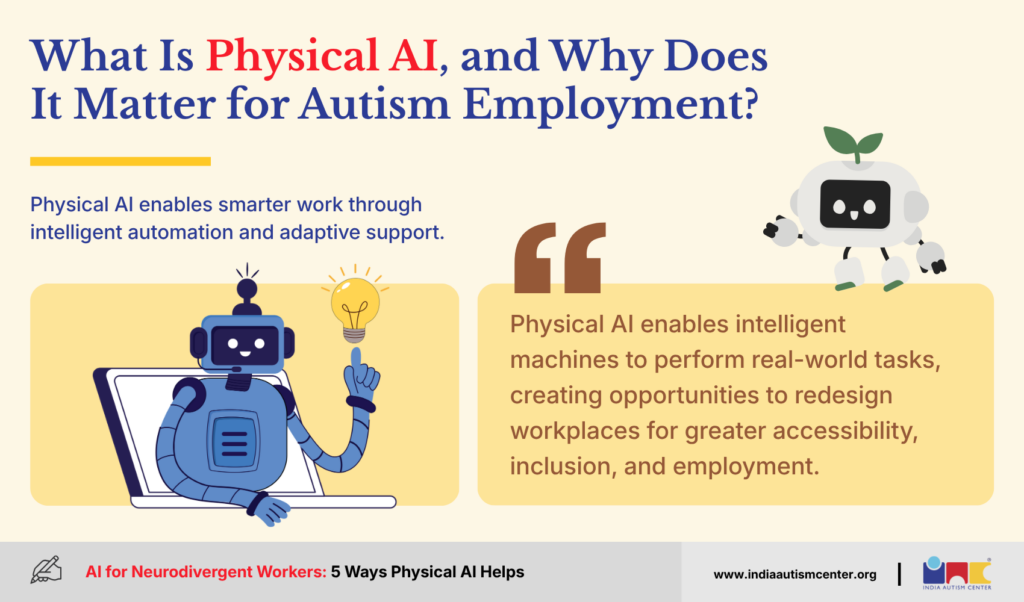
    What Is Physical AI

    Physical AI refers to AI systems that act in the real world, not just on a screen. Think collaborative robots (cobots), mobile robots, and vision-guided inspection systems. Unlike software-only AI, physical AI touches parts, adjusts pacing, and responds to physical errors in real time.

    This distinction matters for autism employment specifically. Many workplace barriers autistic adults face aren’t about screens or paperwork. They’re physical: cluttered workstations, unpredictable noise, sudden pace changes, and feedback that arrives too late to be useful.

    Adoption of this technology is already underway. Deloitte’s 2026 State of AI in the Enterprise report found that most companies already report at least some use of physical AI, with that number expected to grow sharply over the next two years. The same report found that a large majority of companies haven’t redesigned jobs around what this technology can now do.

    That gap is the whole story. Employers are installing new machines into old job designs. The robot changes. The job stays the same. This is exactly where the opportunity for accessible work sits — in the redesign, not just the installation.

    What Employment Barriers Do Autistic Adults Actually Face at Work?
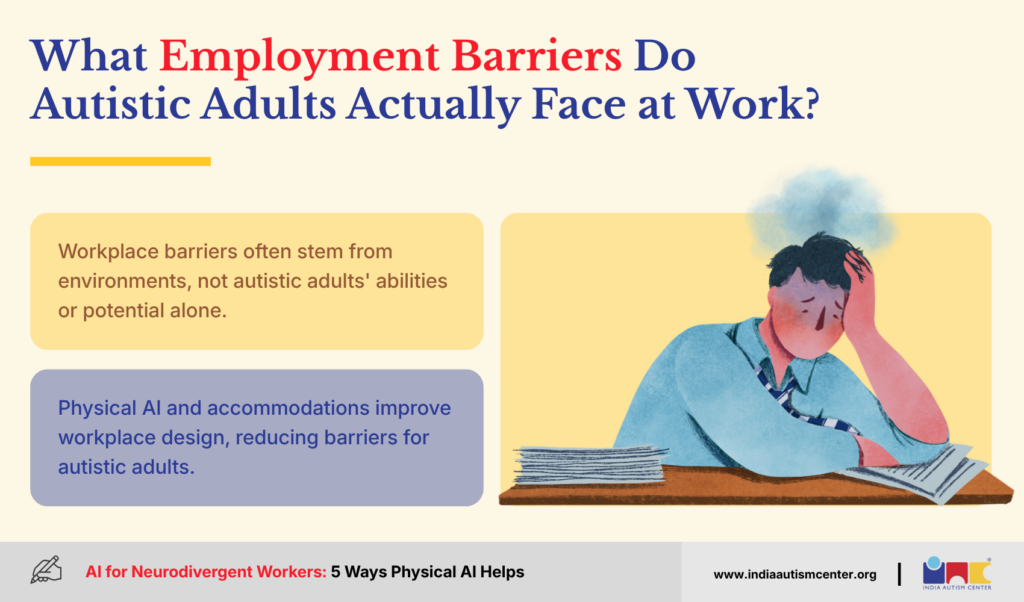
    What Employment Barriers Do Autistic Adults Actually Face at Work

    Autistic adults are not a single group with identical needs. But research and lived experience point to a recurring set of environmental barriers. These aren’t about ability. They’re about workplace design.

    BarrierWhat It Looks LikeWhy It Matters
    AmbiguityUnclear instructions, shifting prioritiesIncreases cognitive load, slows task completion
    Sensory overloadNoise, bright lights, crowded floorsBuilds fatigue across a shift, can trigger shutdown
    Unpredictable pacingSudden speed-ups on a production lineDisrupts focus, increases error risk
    Delayed or vague feedback“That didn’t look right,” said hours laterHard to decode, hard to act on

    None of these barriers are about skill. They’re about how the job is structured around the person doing it. This is the core argument physical AI advocates are making: fix the environment, and the skills gap often turns out to be smaller than assumed.

    How Does India’s Legal Framework Address This?

    India already has a legal foundation for workplace accommodation. The Rights of Persons with Disabilities (RPWD) Act, 2016 requires reasonable accommodation for employees with disabilities, including autism. A valid UDID (Unique Disability ID) certificate is often the documentation employers request to formalise this support.

    The gap isn’t the law. It’s implementation. Most Indian employers don’t yet know what “reasonable accommodation” looks like in a factory or assembly line setting. Physical AI gives that abstract legal requirement a concrete, physical form.

    Watch our video on

    https://youtu.be/1463KaLNNqA?si=1wRtVxw-Lhl-NKw3

    How Will Physical AI Make Work More Accessible for Autistic Adults?
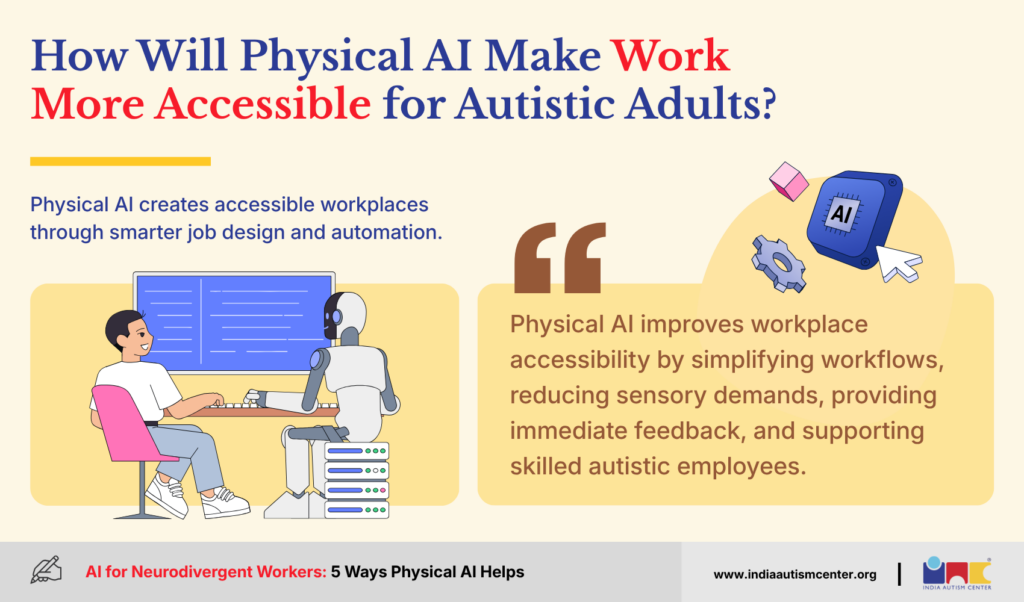
    How Will Physical AI Make Work More Accessible for Autistic Adults?

    Here are five specific, physical ways this technology can reshape jobs. Each one addresses a real barrier, not a hypothetical one.

    1. Can Cobots Bring the Right Part to the Worker?

    A large share of a job’s difficulty isn’t the skilled task itself. It’s the logistics around it: searching bins, remembering part numbers, tracking a layout that changed last week. For many autistic workers, this load on working memory is the real barrier.

    A cobot can stage and hand over the correct part at the correct moment. The job isn’t just explained better. It’s physically arranged better. This removes an entire category of friction before the skilled work even begins.

    For an Indian assembly line or electronics manufacturing unit, this could mean a worker with strong precision skills spends their energy on the task, not on hunting for components. That’s a direct productivity gain, not just an accessibility one.

    2. Can Robots Set a Steadier, Self-Paced Work Rhythm?

    Sudden, unsignaled changes in pace can be disorienting for many autistic workers. Predictability is often what makes a job workable at all. A cobot can meter the flow of parts to match the worker’s rhythm.

    When the worker is ready, the system advances. When the worker needs a short pause, it holds. This adjustment happens silently. Nobody has to disclose a need or ask for slower handling in front of colleagues.

    This matters more in workplace cultures where disclosure carries stigma. In many Indian workplaces, asking for accommodation openly can still feel risky. A system that adjusts automatically removes that social cost entirely.

    3. Can AI Catch Errors in the Work, Not After the Shift?

    Workplace feedback is often indirect, delayed, and wrapped in tone. That combination is genuinely hard for many autistic workers to decode. A vision-guided system changes this by inspecting the actual part.

    If a component is missing or misaligned, the system flags it immediately. It can hold the fixture or route the piece for rework the instant the error happens. There’s no tone to interpret and no reprimand with an audience.

    This is a fundamentally different kind of feedback loop. It responds to the physical part, not to a supervisor’s mood or phrasing. That distinction is what separates useful correction from stressful, ambiguous criticism.

    📥 Free download: Printable daily routine chart for autistic children

    4. Can Mobile Robots Remove Chaotic Peripheral Work?

    A job is rarely hard because of its core task. The real difficulty is everything happening around it: noise, foot traffic, interruptions, and constant switching between unrelated demands. For workers with heightened sensory sensitivity, this churn builds up across a shift.

    Mobile robots can absorb this layer. They move materials and restock supplies, so the work comes to the worker instead of the other way around. The space gets quieter. The person stays focused on the task worth hiring them for.

    This shift also benefits neurotypical workers, though the effect is often strongest for autistic employees managing sensory load. Reducing environmental noise tends to improve accuracy and reduce fatigue across an entire floor.

    5. Can This Make Skilled Roles Reachable, Not Just Entry-Level Ones?

    This is the outcome that matters most, and it’s also the one most likely to be done wrong. A lazy version of inclusion takes one narrow stereotype about autism and turns it into a single job assignment. That isn’t opportunity. It’s a stereotype with a job code.

    Done correctly, this approach opens up precision assembly, machine-vision quality review, robotics maintenance, and equipment monitoring. These roles use focus, consistency, pattern recognition, and an eye for anomalies — strengths many autistic adults bring to technical work.

    These jobs stayed closed for a reason that had nothing to do with capability. People weren’t excluded because they couldn’t do the skilled part. They were excluded because they couldn’t survive the chaos around it. Physical AI removes that chaos, not the skill requirement.

    Read the Latest Tech in Autism You Should Know in 2026.

    What Does This Mean for Autism Employment in India?
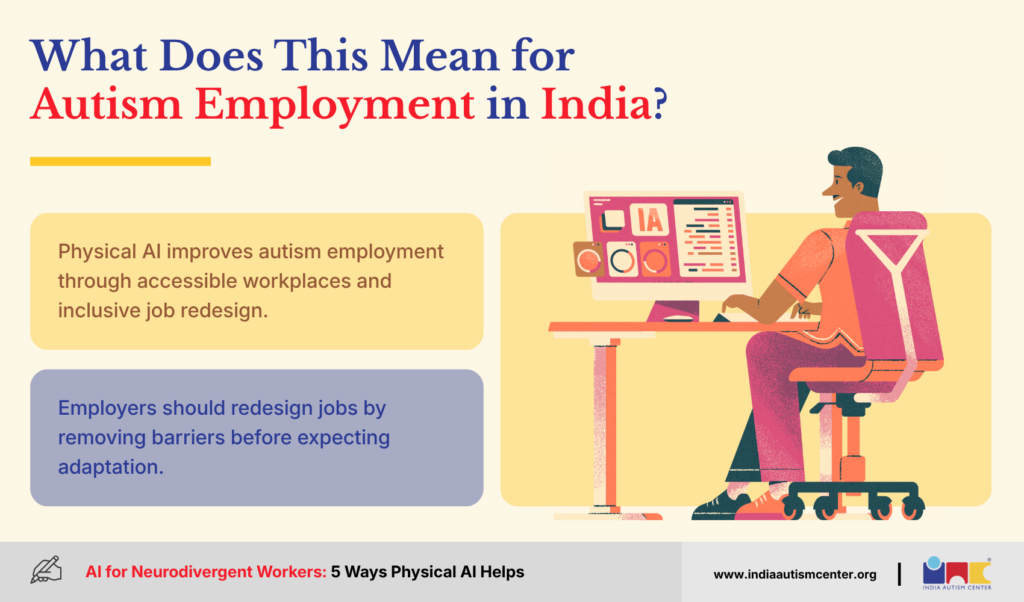
    What Does This Mean for Autism Employment in India?

    India’s autism employment landscape looks different from the US manufacturing context this conversation often starts in. Labour force participation among autistic and disabled adults remains significantly lower than the general population here. That gap has multiple causes, but workplace design is a major one.

    The RPWD Act’s quota provisions already require certain employers to reserve positions for people with disabilities. What’s missing is the physical infrastructure to make those roles genuinely workable, not just technically compliant. Physical AI could be that infrastructure.

    Government schemes like ADIP (Assistance to Disabled Persons for Purchase and Fitting of Aids and Appliances) already fund assistive devices. Extending that logic toward workplace robotics and adaptive systems is a natural next step, though not yet a widely discussed one.

    Is This Already Happening Anywhere?

    Yes, though still at an early stage. A Virginia Tech-led team, backed by the National Science Foundation, is building AI-guided cobots specifically designed to give neurodivergent workers responsive feedback and help manage pacing. This research is happening in the US, but the underlying design principles translate globally.

    India’s manufacturing and electronics sectors are strong candidates for early adoption. Auto ancillary units, electronics assembly, and quality control functions all involve the kind of structured, repeatable physical work where cobots already perform well.

    What Should Employers and Families Do Now?

    For employers, the starting point isn’t buying robots. It’s auditing existing roles for redesign potential. Look at where ambiguity, pacing, and feedback delays create friction, not just where automation could cut headcount.

    A few practical starting points:

    • Separate the skill from the chaos. Identify which parts of a role are genuinely difficult versus which parts are just disorganized.
    • Reference the RPWD Act directly when proposing pilot programs. Reasonable accommodation language already supports this kind of redesign.
    • Start small. A single workstation redesign is easier to evaluate than a full-floor rollout.
    • Involve autistic employees or candidates in the design process. Environmental barriers are best identified by the people who experience them.

    For families, this is a useful framework when evaluating job opportunities or advocating for workplace accommodations. Ask not just “can they do the task,” but “what’s making the task harder than it needs to be.”

    Want to know more? Get in touch with us.

    Conlcusion
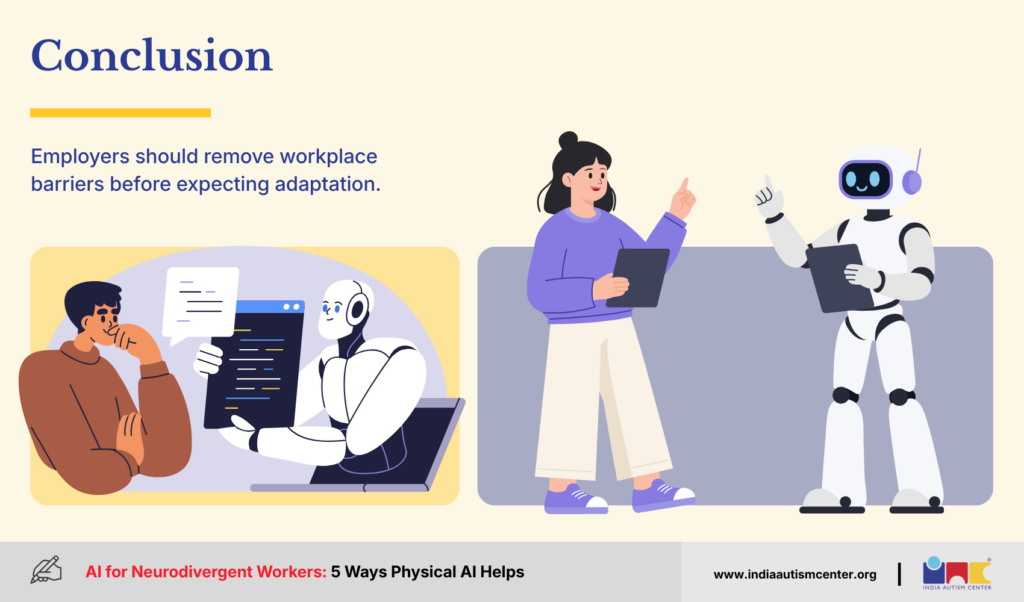
    Physical AI shouldn’t be measured only by how many workers it replaces. It should be measured by how many capable people it finally makes room for. For autistic adults, that means jobs redesigned around real strengths, not around an imaginary average worker.

    The technology exists. The legal framework in India already supports accommodation. What’s missing is the deliberate work of connecting the two. That’s the conversation worth having next.

    Frequently Asked Questions

    What is physical AI in the context of autism employment?

    Physical AI refers to robots and sensor-driven systems that act in the physical world, such as cobots and vision-guided inspection tools. In autism employment, these systems reduce ambiguity, manage pacing, and absorb sensory-heavy peripheral tasks.

    How is physical AI different from other workplace AI tools?

    Most workplace AI operates through software: scheduling tools, chatbots, or analytics dashboards. Physical AI acts directly on physical objects and environments, which is what allows it to change pacing, staging, and error detection in real time.

    Can physical AI help with sensory sensitivity at work?

    Yes. Mobile robots can absorb noisy, high-traffic peripheral tasks like restocking and material movement. This reduces the overall sensory load on the factory or workshop floor.

    What Indian laws support workplace accommodation for autistic adults?

    The RPWD Act, 2016 mandates reasonable accommodation for employees with disabilities. A UDID certificate is typically used to formalize eligibility for these accommodations with employers.

    Is physical AI being used in Indian workplaces yet?

    Adoption is still early. Global manufacturing sectors are leading, and Indian manufacturing and electronics units are strong candidates for future adoption given their reliance on structured, repeatable physical tasks.


    Disclaimer: This article is intended for educational and informational purposes only. It does not constitute legal, employment, medical, or clinical advice. For guidance specific to workplace accommodations, disability certification, or individual employment situations, please consult a qualified professional or relevant government authority.

    For expert insights, support services, and inclusive learning initiatives, visit the India Autism Center.
  • How Autistic Brains Process Faces Differently

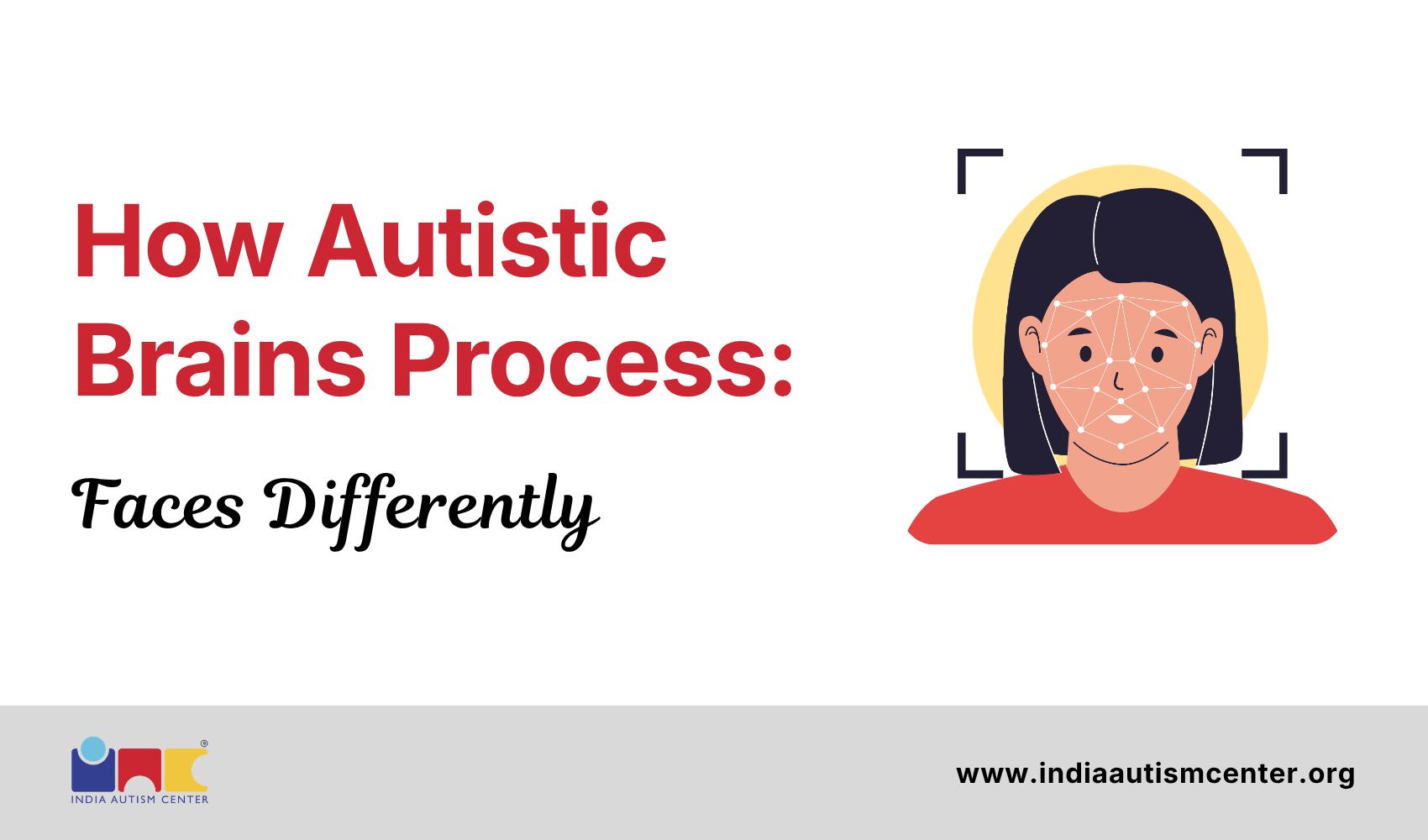
    How Autistic Brains Process Faces Differently

    Autistic brains process faces differently because the neural signals linked to face recognition are less distinct, and unlike neurotypical brains, these signals don’t sharpen with age. A 2026 Yale study of nearly 400 children, published in Nature Mental Health, confirms this using full-scalp EEG data. I’ll walk you through what the research found and what it means for autistic children and adults.

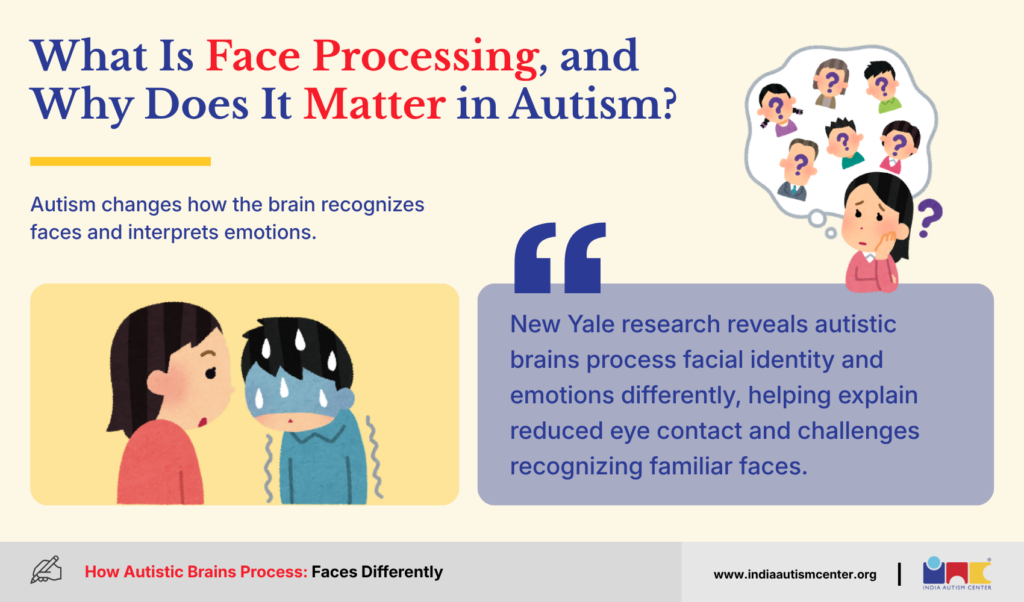
    What Is Face Processing, and Why Does It Matter in Autism?

    What Is Face Processing, and Why Does It Matter in Autism?

    Face processing is how our brains turn visual information into recognition of identity and emotion. It starts the moment light hits the retina. It ends when we know whose face we’re looking at, and what they’re feeling.

    This isn’t one single step. It’s a chain of rapid neural events. Researchers have studied this chain in autism for over two decades.

    Two hallmark traits of autism relate directly to this chain:

    • Reduced eye contact
    • Difficulty recognising faces and facial emotions

    Scientists have long suspected these traits connect to how the autistic brain handles facial information at a neural level. The new Yale research gives us the clearest picture yet.

    How Do Autistic Brains Process Faces Differently?

    How Do Autistic Brains Process Faces Differently?

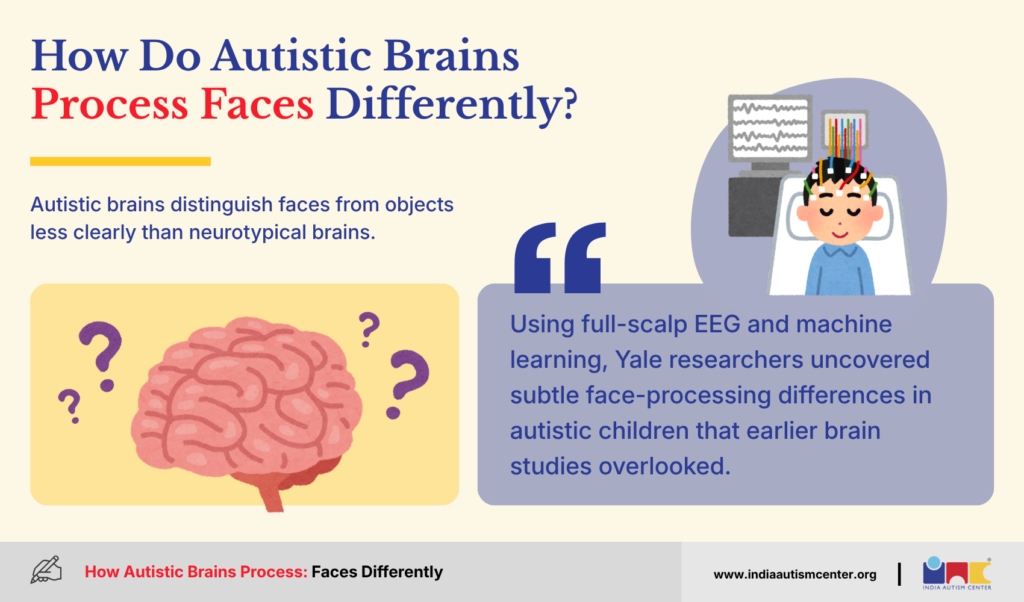
    Autistic brains show less distinct neural activity when processing faces compared to neurotypical brains. This makes it harder for researchers, and possibly for the brain itself, to clearly separate “looking at a face” from “looking at an object.”

    Led by James McPartland, PhD, at Yale’s Center for Brain and Mind Health, researchers used EEG to measure electrical activity across all 128 electrodes on the scalp. Most earlier studies looked at only one or two brain regions. This study captured the full picture.

    The team then used machine learning to predict what each child was looking at, based purely on brain activity. Here’s what they found:

    • In neurotypical children, the algorithm could reliably tell when a child was looking at a face versus an object.
    • In autistic children, this prediction was significantly harder to make.
    • The neural signature of “face” versus “non-face” was blurrier in autistic brains.

    McPartland described this using a traffic analogy. Measuring one brain region is like watching one downtown camera to judge city traffic. Measuring all 128 electrodes is like using satellite imaging to track every car in the city at once. This full-scalp approach is why the study could detect differences that earlier research missed.

    📥 Free download: Printable daily routine chart for autistic children

    Why Doesn’t Face Processing Refine With Age in Autistic Children?

    Why Doesn't Face Processing Refine With Age in Autistic Children?

    In neurotypical children, face processing becomes more specialized as they get older. Their brains get progressively better at distinguishing faces from other visual information. This is a normal, expected part of development.

    Autistic children don’t show this same trend. The study found no significant change in face-processing accuracy across different ages in autistic participants. Their neural response to faces stays roughly the same from early childhood onward, according to first author Jason Griffin, PhD, now at the University of Houston.

    This table summarizes the core contrast:

    FeatureNeurotypical BrainAutistic Brain
    Face vs. object signal distinctionClear and consistentLess distinct
    Change in accuracy with ageImproves over timeStays flat
    Face-processing specializationIncreases with developmentReduced developmental change
    N170 brain response timingOn typical scheduleDelayed
    Onset of measurable differencesEarlier than previously known

    This lack of age-related refinement suggests something important. The difference isn’t just a delay that autistic children will “catch up” on later. It appears to be a distinct developmental trajectory.

    What Is the N170, and Why Does This Study Go Beyond It?

    What Is the N170, and Why Does This Study Go Beyond It?

    The N170 is a well-known biomarker in face-processing research. It refers to a shift in brain activity that happens about 170 milliseconds after someone sees a face. In autistic individuals, this response is typically delayed.

    Most previous studies focused narrowly on the N170 signal. This new research looked at the full temporal range of brain activity, not just one snapshot at 170 milliseconds. That broader window revealed something new.

    Differences between autistic and neurotypical face processing appear to begin even earlier than the N170 response. This pushes back scientists’ understanding of when, in the visual-processing chain, autism-related differences first emerge.

    Is Difficulty Recognizing Faces a Core Feature of Autism, or a Result of Avoiding Eye Contact?

    Is Difficulty Recognizing Faces a Core Feature of Autism, or a Result of Avoiding Eye Contact?

    This is one of the most important questions the study addresses. For years, clinicians debated whether face-processing struggles were caused by autism itself, or simply by autistic people avoiding eye contact and getting less “practice” reading faces.

    The Yale findings point toward autism itself as the driver. Researchers found that the reduced developmental refinement seen in autistic children reflects an underlying neurological difference. It is not simply a byproduct of looking at faces less often.

    This distinction matters for how we support autistic individuals. If the root cause is neurological, then interventions need to target the underlying processing difference. Simply instructing someone to “make more eye contact” doesn’t address that.

    Why Doesn’t Forcing Eye Contact Help?

    For decades, some clinical approaches pushed autistic children to make eye contact as a way to improve social engagement. Researchers now understand this approach doesn’t fix the underlying processing difference.

    Forcing eye contact addresses a behavior, not the neural mechanism behind it. It can also cause real discomfort for autistic individuals, since eye contact itself can be overwhelming for many.

    A more effective approach focuses on:

    • Building alternative strategies for reading social and emotional cues
    • Supporting communication in ways that don’t rely solely on facial interpretation
    • Structured, individualized social-skills therapy rather than one-size-fits-all eye-contact drills

    This is where structured therapy programs, especially those designed specifically around autism, make a meaningful difference. Therapies that build on a child’s actual strengths tend to work better than approaches that push against core neurological traits.

    For more deeper insights on this topic, read Autism and Eye Contact: Everything You Should Know [Updated] 

    What Does This Mean for Autism Diagnosis?

    Right now, autism is diagnosed based entirely on behavioral observation. There is no blood test, brain scan, or single biological marker that confirms an autism diagnosis today.

    This study is an early step toward changing that. McPartland describes it as introducing a new potential biomarker for future diagnostic tools. The goal isn’t to replace behavioral assessment immediately, but to eventually support and refine it.

    Biological markers, like distinct EEG signatures, could eventually help with:

    1. Identifying autism earlier in development
    2. Distinguishing between different autism subgroups
    3. Predicting which children may respond best to specific interventions
    4. Reducing reliance on subjective behavioral checklists alone

    For now, though, standard behavioral screening tools remain the primary diagnostic pathway. Tools like the M-CHAT-R/F are still the accessible, validated first step for identifying early signs of autism, including differences in social engagement and face-related behaviors, in young children.

    What Does This Mean for Early Intervention?

    Since face-processing differences appear to emerge early and don’t self-correct with age, the researchers suggest interventions may be most effective in early childhood. This is when these developmental patterns are just beginning to diverge.

    Early intervention isn’t about “correcting” autism. It’s about giving children tools to navigate a world that relies heavily on facial communication, from classrooms to playgrounds. Many autistic individuals are not distressed by their traits and don’t want or need intervention.

    But for those who do experience real difficulty, understanding facial expressions can affect daily life in concrete ways. Reading a teacher’s frustration, a peer’s friendliness, or an interviewer’s reaction all depend on this kind of processing. Supporting these skills early can meaningfully improve quality of life later.

    Want to know more? Get in touch with us.

    How Common Are Face-Processing Differences in Autism?

    How Common Are Face-Processing Differences in Autism?

    Face-processing differences are considered one of the most consistently observed traits across autism research, though they vary in intensity from person to person. Some autistic individuals report significant difficulty recognising familiar faces. Others notice only mild challenges with reading subtle emotional expressions.

    This variability is important to keep in mind. Autism is a spectrum, and face processing differences reflect that same range. No single symptom checklist applies to every autistic person the same way.

    What Should Parents and Caregivers Take Away From This Research?

    If your child struggles with recognizing faces or reading emotions, this research offers a reassuring reframe. These difficulties are not a matter of effort or attention. They reflect real, measurable differences in brain activity.

    Here’s what this means practically:

    • Pushing a child to “just look people in the eye” is unlikely to help, and may cause distress.
    • Early, structured support around emotional and social understanding can be valuable.
    • Every autistic child’s experience with face processing is different, so individualized assessment matters more than generic advice.
    • Standardized screening tools remain the best current starting point if you have concerns about your child’s development.

    How Was This Study Different From Earlier Autism Face-Processing Research?

    How Was This Study Different From Earlier Autism Face-Processing Research?

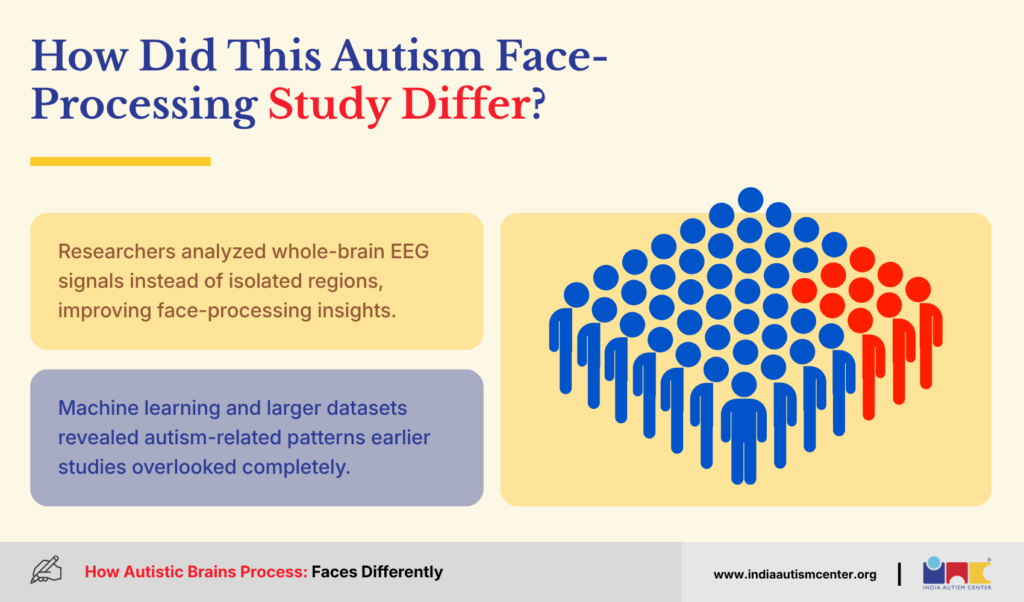
    Most earlier EEG studies on autism and face processing relied on a handful of electrodes placed over specific brain regions. This narrow approach could only capture activity in one or two areas at a time.

    The Yale team used data from the Autism Biomarkers Consortium for Clinical Trials (ABC-CT), a large research initiative tracking autistic and neurotypical children over time. Researchers recorded activity across all 128 scalp electrodes as children viewed images of faces and objects.

    This full-scalp method offered three key advantages:

    1. Wider coverage — capturing brain-wide activity instead of one isolated region
    2. Machine learning analysis — using algorithms to detect subtle patterns humans might miss
    3. Larger sample size — nearly 400 children, spanning a range of ages, strengthening the reliability of results

    This combination is why the researchers could confidently identify a difference that smaller, narrower studies had not fully captured before. It also explains why McPartland calls this a genuinely new way of measuring face perception in autism.

    Conclusion

    This research builds on findings dating back to the early 2000s, when Yale-led studies first showed reduced activity in face-processing brain regions among autistic individuals. Two decades later, this new full-scalp EEG approach confirms and deepens that understanding.

    The takeaway is straightforward: autistic brains process faces differently at a fundamental, measurable level. This isn’t a deficit to be “fixed” through forced eye contact. It’s a neurological difference that deserves informed, individualized support, starting as early as possible when a child or family wants it.

    Frequently Asked Questions

    What is face processing in autism?

    Face processing in autism refers to how the autistic brain interprets facial identity and emotion. Research shows this process involves less distinct neural signals compared to neurotypical brains.

    Why do autistic children have trouble recognizing facial emotions?

    Studies suggest the brain regions and neural signals involved in face processing are less specialized in autistic children, and this specialization doesn’t increase with age the way it typically does.

    Is difficulty with faces present in all autistic people?

    No. Face-processing differences are common in autism but vary widely between individuals. Some experience significant difficulty, while others notice only subtle differences.

    Can EEG diagnose autism?

    Not yet. Current research, including this Yale study, is exploring EEG-based biomarkers, but autism diagnosis today still relies on behavioral assessment.

    Does face-processing ability improve with therapy?

    Structured, individualised social-skills interventions, especially when introduced early, can help autistic individuals build strategies for social and emotional understanding, even if the underlying neural pattern remains different.


    Disclaimer: This article is intended for educational purposes only and does not constitute medical or diagnostic advice. If you have concerns about your child’s development or suspect signs of autism, please consult a qualified pediatrician, developmental specialist, or licensed healthcare provider for proper evaluation.

    For expert insights, support services, and inclusive learning initiatives, visit the India Autism Center.
  • Why Autism in Girls Is Missed: The Hidden Diagnostic Gap 

    Why Autism in Girls Is Missed: The Hidden Diagnostic Gap 

    Autism in girls is missed because diagnostic tools were built around how boys present, and because girls camouflage their traits more effectively. I want to walk you through exactly why this happens, what it looks like in real life, and what parents and clinicians can do about it — especially here in India.

    Why Is Autism in Girls Missed So Often?

    Why Is Autism in Girls Missed So Often?

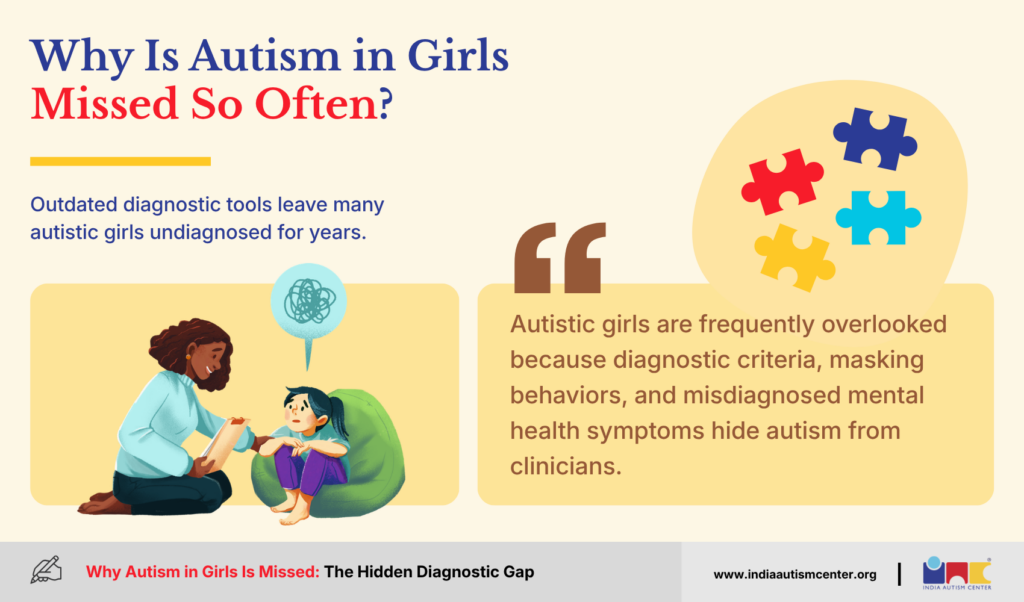
    Autism in girls is missed mainly for three reasons. The tools we use were tested on boys. Girls mask their traits better. And girls’ symptoms often get labeled as anxiety or depression instead.

    I’ve spent years writing about autism diagnosis, and this pattern comes up again and again. It isn’t that autism is rare in girls. It’s that our systems weren’t designed to catch it.

    For decades, clinicians believed autism affected boys four times more often than girls. That 4:1 ratio shaped everything — the diagnostic criteria, the screening tools, even public perception of what autism “looks like.” Newer research puts the real ratio closer to 2:1 or 3:1 (Cook et al., 2024). That gap between old assumptions and new evidence is where thousands of girls fall through.

    Is Autism Really Less Common in Girls, or Just Less Recognized?

    Is Autism Really Less Common in Girls, or Just Less Recognized?

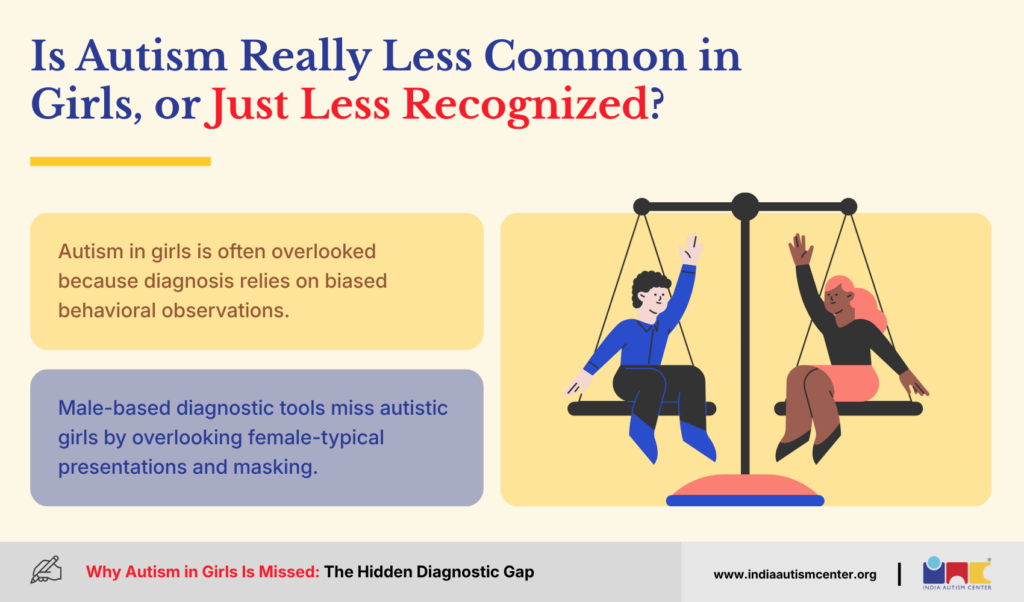
    Autism is not necessarily less common in girls. It is less recognized in girls. This is a critical distinction.

    Autism is highly genetic. Researchers estimate genetic factors account for 64 to 91 per cent of autism cases (Cook et al., 2024). There’s no single “autism gene,” and no blood test confirms it. Diagnosis depends entirely on observed behavior — and that’s where bias creeps in.

    Here’s the comparison that matters:

    Ratio EstimateBasis
    4:1 (male:female)Older data, based on tools normed almost entirely on boys
    2:1 to 3:1 (male:female)Revised estimate accounting for camouflaging and diagnostic bias (Cook et al., 2024)

    The narrowing gap tells us something important: a large share of “missing” autistic girls were never rare cases. They were missed cases.

    Why Were Diagnostic Tools Built Around Boys in the First Place?

    Diagnostic tools like the ADOS (Autism Diagnostic Observation Schedule) were developed and validated using largely male samples. This happened because autism was long considered a male-dominant condition, so researchers studied the population they had — boys.

    As a result, these tools measure the behaviors boys commonly show. They don’t account for behaviors more typical of girls, such as camouflaging. If a symptom isn’t on the checklist, a clinician isn’t trained to look for it. That’s not a small oversight. It’s a structural gap in how autism gets diagnosed.

    This is also why the discredited “extreme male brain” theory gained traction for so long.

    We have an article on Why Are Fewer Girls Diagnosed with Autism? The X Chromosome May Hold the Answer 

    What Was the “Extreme Male Brain” Theory, and Why Was It Wrong?

    What Was the "Extreme Male Brain" Theory, and Why Was It Wrong?

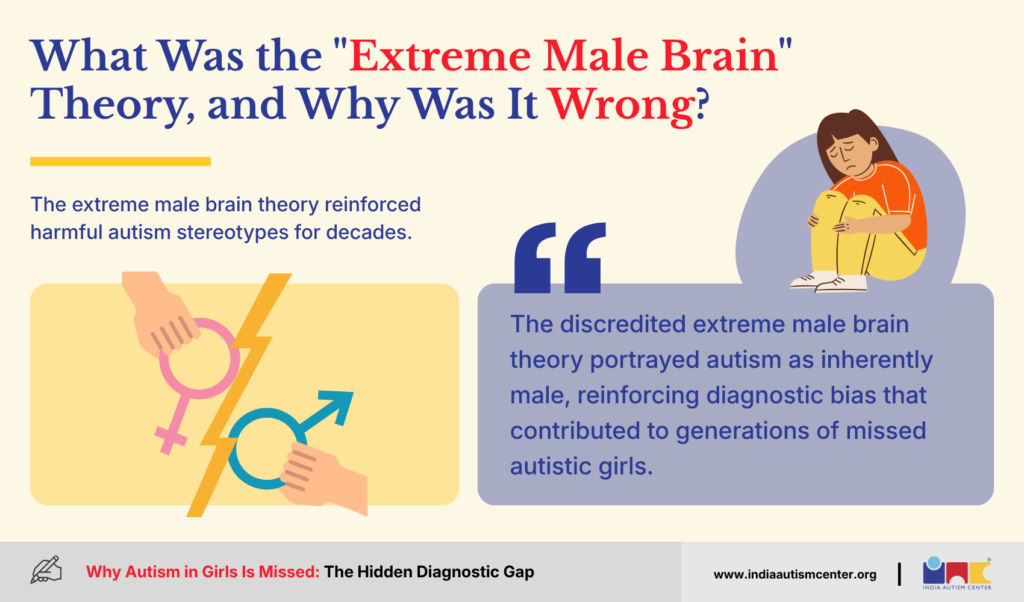
    The extreme male brain theory, proposed by researcher Simon Baron-Cohen in 2002, suggested autism was an exaggerated version of typical “male” thinking — strong on systemizing, weak on empathy. It framed autism as inherently more male.

    This theory has been heavily criticized for relying on gender stereotypes rather than solid evidence. Baron-Cohen himself has since acknowledged the terminology was problematic. It likely reflected socialised behaviour differences, not real biological sex differences in the brain.

    The damage, though, was already done. A generation of clinicians trained under this framework learned to expect autism in boys — not girls. That expectation still shapes diagnosis today.

    📥 Free download: Printable daily routine chart for autistic children

    How Do Autistic Girls Camouflage Their Symptoms?

    How Do Autistic Girls Camouflage Their Symptoms?

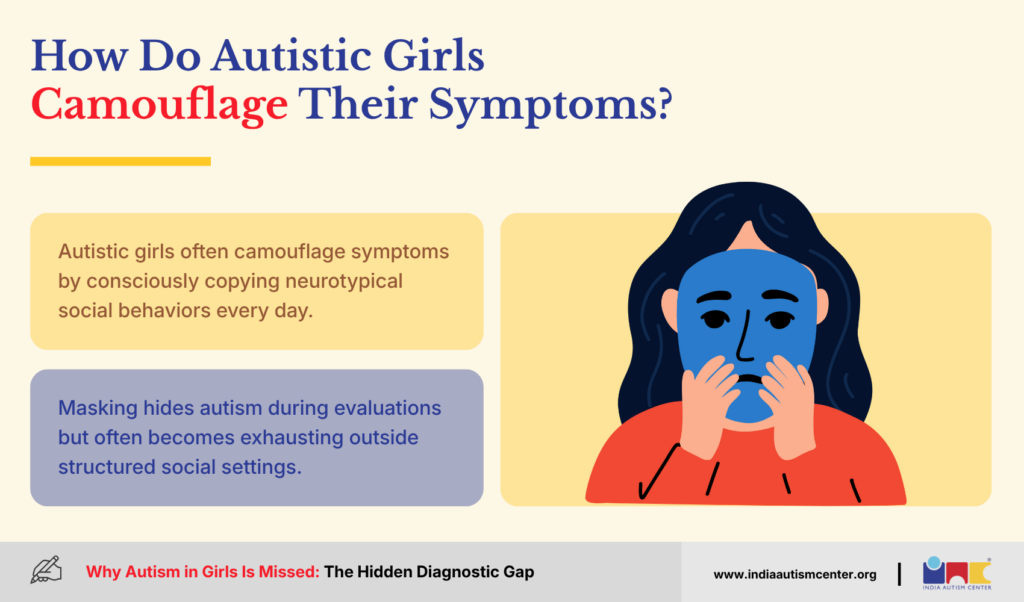
    Autistic girls often camouflage, or “mask,” by copying the social behavior of their neurotypical peers. They study how other girls talk, move, and react, then consciously imitate it.

    This happens because girls tend to be more socially motivated than boys, even when autistic (Young et al., 2018). That motivation drives them to blend in rather than stand out. Common camouflaging behaviors include:

    • Scripting conversations in advance, rather than responding spontaneously
    • Mimicking friends’ interests even without genuine engagement
    • Suppressing stimming (repetitive movements) in public, then releasing it at home
    • Forcing eye contact despite discomfort
    • Rehearsing facial expressions to match social expectations

    A clinician who observes a child for 30 to 45 minutes will likely miss all of this. Masking is designed to hold up under short-term scrutiny. It usually collapses only at home, after school, when the effort becomes too exhausting to sustain.

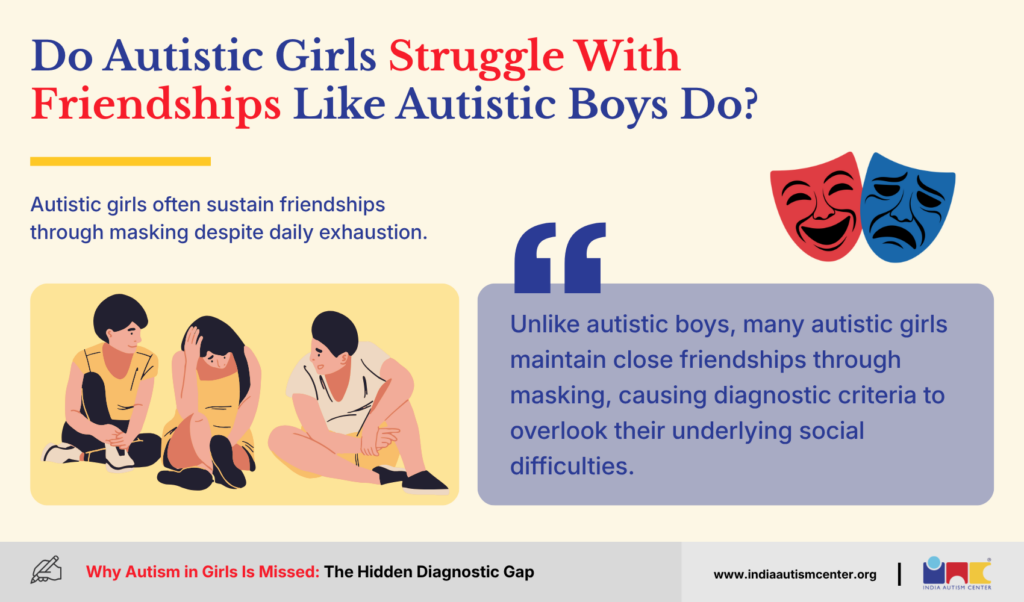
    Do Autistic Girls Struggle With Friendships Like Autistic Boys Do?

    Do Autistic Girls Struggle With Friendships Like Autistic Boys Do?

    No, not in the same way. This is one of the clearest examples of diagnostic bias in autism girls face.

    Difficulty forming friendships is a core diagnostic criterion for autism. But research shows this mainly holds true for autistic boys, who report fewer close friendships than neurotypical boys (Young et al., 2018). Autistic girls, by contrast, often report friendship closeness similar to their neurotypical peers.

    That doesn’t mean the friendships come easily. It means girls work harder — through camouflaging — to sustain them. A clinician using friendship difficulty as a checklist item will often clear an autistic girl who is, in fact, exhausting herself daily to maintain normal-looking relationships.

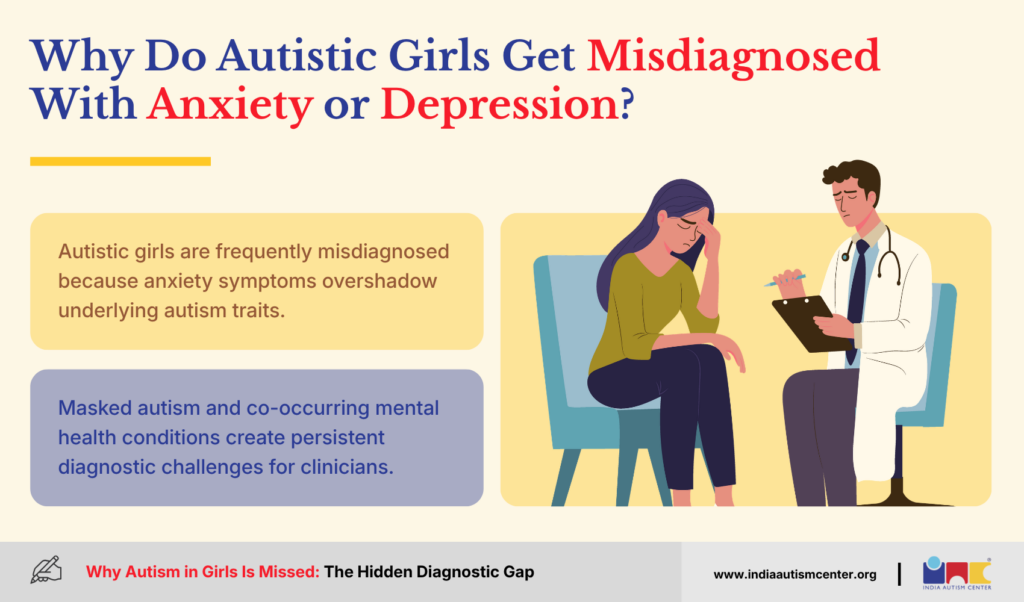
    Why Do Autistic Girls Get Misdiagnosed With Anxiety or Depression?

    Why Do Autistic Girls Get Misdiagnosed With Anxiety or Depression?

    Autistic girls are frequently diagnosed with anxiety or depression instead of autism because these conditions are more familiar to clinicians and easier to spot in short appointments.

    Up to 70 percent of autistic individuals have at least one co-occurring mental health condition, and this is especially true for girls (Cook et al., 2024). Anxiety and depression symptoms are visible and well-documented. Autism symptoms, especially masked ones, are not.

    This creates a diagnostic trap. A girl comes in with anxiety. She gets treated for anxiety. The underlying autism goes unaddressed — sometimes for years, sometimes for a lifetime. Misdiagnosis in autism girls isn’t rare. It’s close to routine.

    I’d also point out: autism itself is not a mental health disorder. It’s a form of neurodiversity — a different way of processing information, not a disordered one. But because it so often travels alongside anxiety and depression, it gets overshadowed by conditions clinicians are quicker to name.

    Want to know more? Get in touch with us.

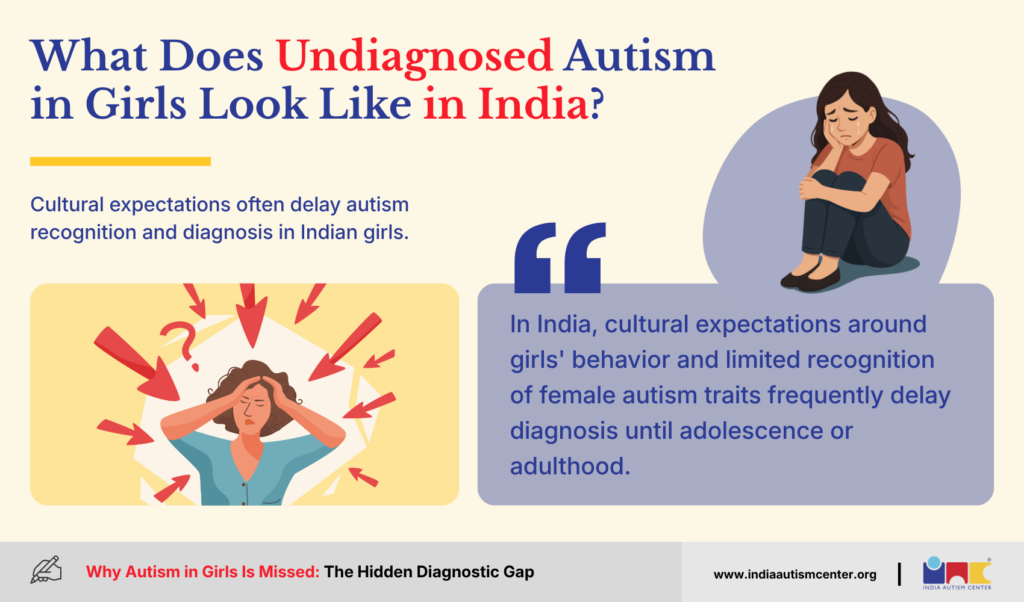
    What Does Undiagnosed Autism in Girls Look Like in India?

    What Does Undiagnosed Autism in Girls Look Like in India?

    In India, autism diagnosis in girls faces an added layer of difficulty: cultural expectations around compliance and social “adjustment.”

    Girls are often raised to accommodate, to avoid conflict, and to fit in socially — traits that overlap heavily with camouflaging behavior. A girl who masks her discomfort to please her family or teachers may be praised for being “well-behaved,” not flagged for evaluation.

    Add to this a broader awareness gap. Many Indian pediatricians and school counsellors are trained primarily on male-presenting autism traits. Referral rates for autism screening remain lower for girls than boys across Indian clinical settings. The result: Indian girls are frequently referred for anxiety, shyness, or academic pressure — not autism — well into adolescence or adulthood.

    At India Autism Center, we see this pattern often: families who come in seeking help for a “quiet, anxious” daughter, only to discover, after a full evaluation, that autism was the root cause all along.

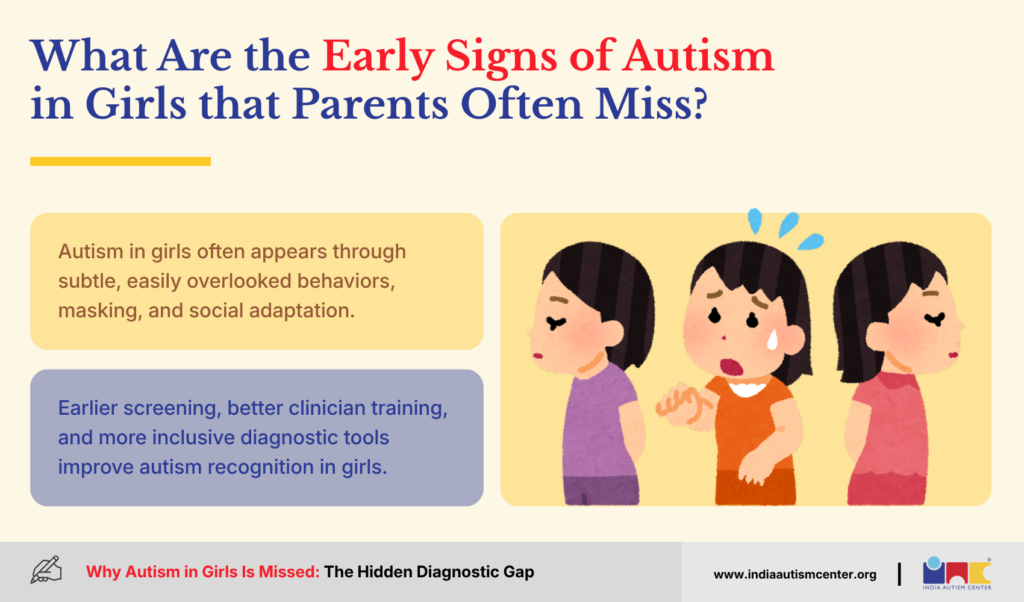
    What Are the Early Signs of Autism in Girls Parents Often Miss?

    What Are the Early Signs of Autism in Girls Parents Often Miss?

    Autism in girls doesn’t always look like the “textbook” signs most parents have heard about. Here’s how the presentation often differs:

    Commonly Known Sign (Male-Normed)Often Seen in Girls Instead
    Avoids eye contactForces eye contact, appears exhausted after
    Few or no friendshipsHas friends, but relationships feel scripted or effortful
    Obvious repetitive movementsStims privately, suppresses it in public
    Narrow, unusual interests (trains, numbers)Intense interest in socially typical topics (animals, celebrities, books) taken to an extreme depth
    Meltdowns in publicHolds it together outside, meltdowns only at home
    Delayed or unusual speechVerbally fluent, but conversation feels one-directional or rehearsed

    If several of these sound familiar, it’s worth pursuing a formal screening, not dismissing them as personality traits.

    How Can Autism Diagnosis in Girls Actually Improve?

    Improving autism diagnosis in girls requires changes at three levels: clinical training, diagnostic tools, and observation practices.

    1. Clinician training needs to explicitly cover camouflaging and female-typical presentations, not just male-normed checklists.
    2. Diagnostic tools need updated validation studies that include girls in equal numbers, so tools like the ADOS reflect a fuller range of presentations.
    3. Multi-setting observation matters more than single clinic visits. Parents and teachers should be asked directly about behavior differences between home and school.
    4. Screening should start earlier, especially when a girl shows anxiety, perfectionism, or social exhaustion alongside strong academic performance — a combination that often hides autism in plain sight.

    Progress is happening. Clinicians are increasingly aware of these gaps, and newer research is actively working to close them. But we still have a long way to go before diagnostic tools are truly inclusive.

    When Should You Seek an Autism Evaluation for Your Daughter?

    You should consider an autism evaluation if your daughter shows a consistent gap between how she behaves at home versus outside, alongside social exhaustion, intense but narrow interests, or sensory sensitivities.

    Some practical red flags by age:

    • Early childhood (2–5 years): Delayed pretend play, intense reactions to sensory input (tags, sounds, textures), difficulty with transitions
    • School age (6–12 years): Academic success paired with social exhaustion, very few but intensely close friendships, meltdowns confined to home
    • Adolescence (13+ years): Chronic anxiety, perfectionism, identity confusion, burnout from years of masking, difficulty explaining “why socializing feels so hard”

    If this sounds like your daughter, a structured screening is the right next step. Tools like the M-CHAT-R/F for younger children offer an accessible starting point before a full clinical evaluation.

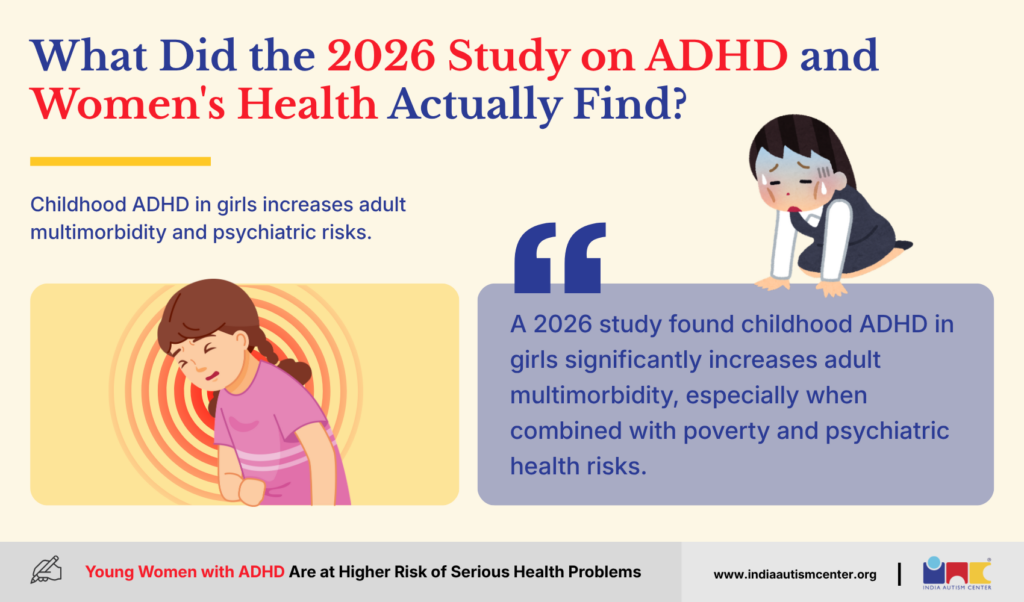
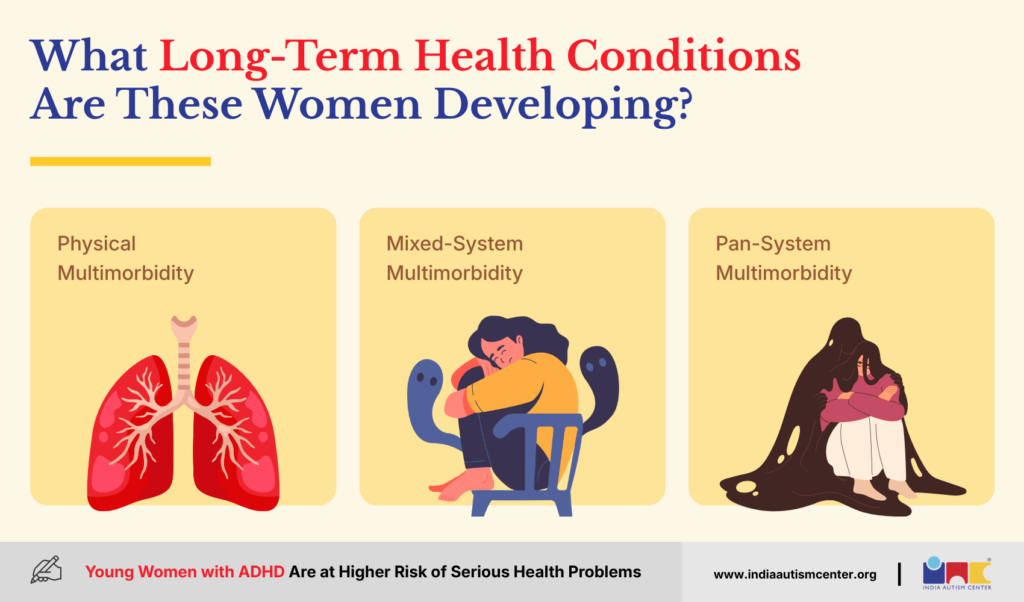
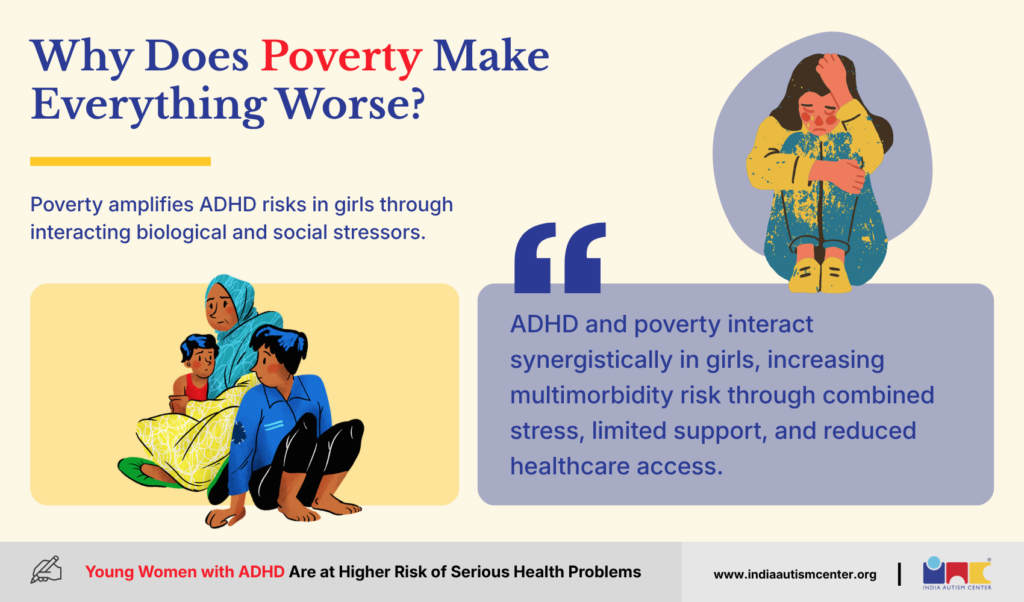
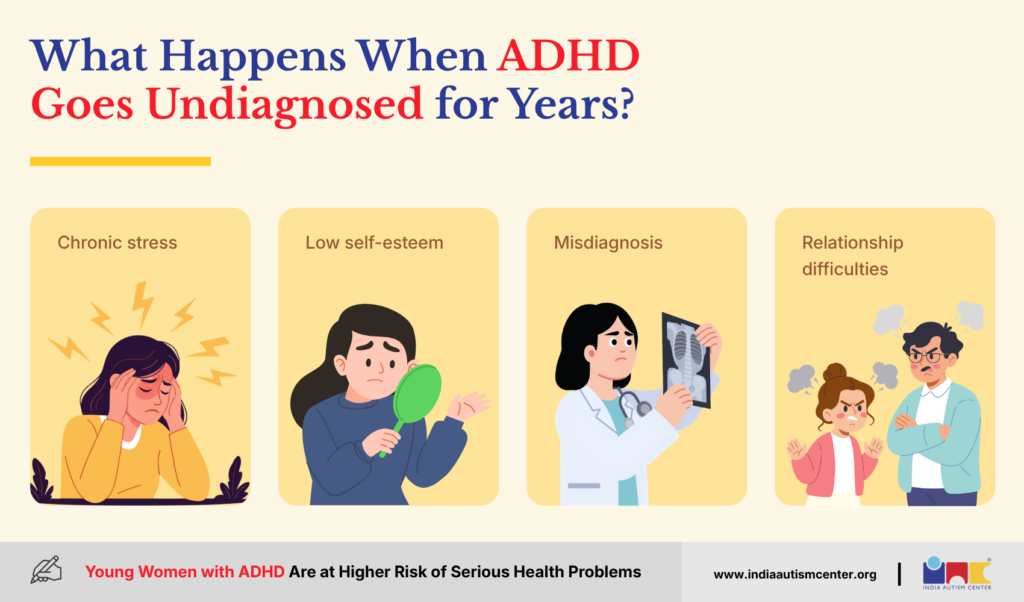
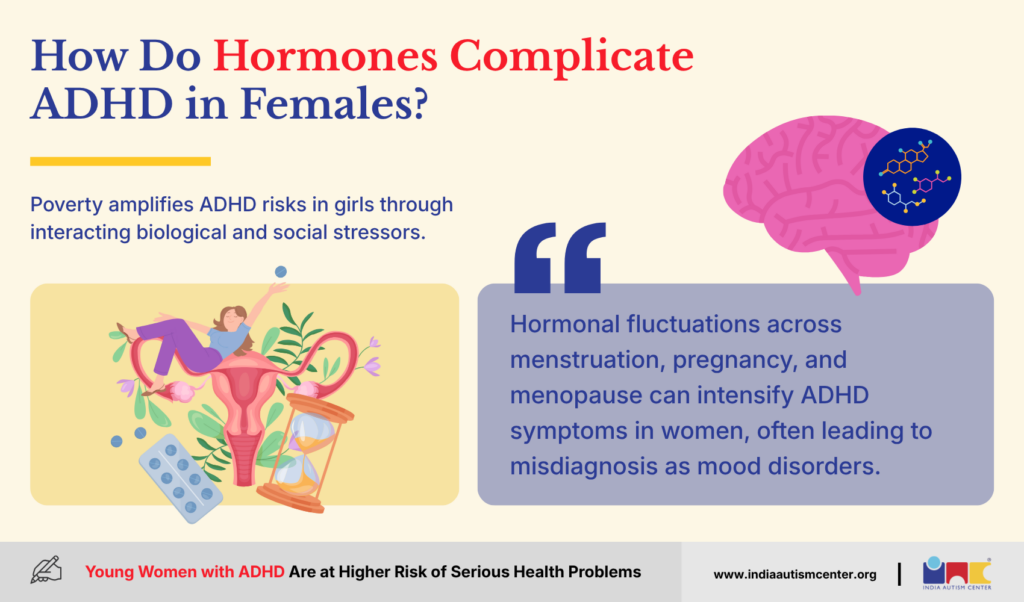
    Read ourblog on 2026 Study | Young Women with ADHD Are at Higher Risk of Serious Health Problems

    Conclusion

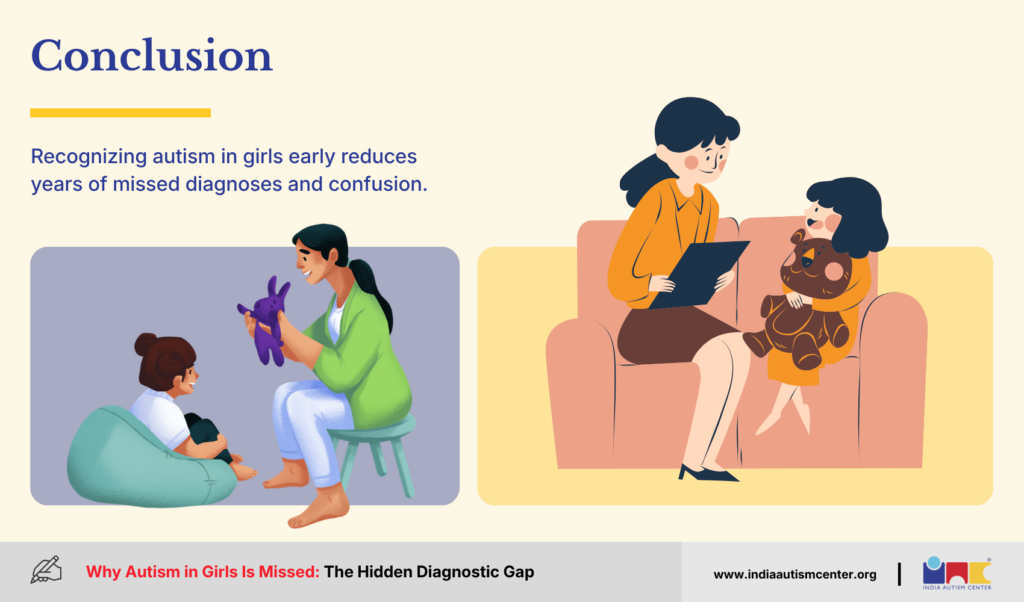
    Autism in girls is missed not because it’s rare, but because our diagnostic systems weren’t built to see it. Masking, male-normed tools, and overlapping anxiety or depression diagnoses all play a part. Recognizing these patterns early — as a parent, teacher, or clinician — can make the difference between years of confusion and a diagnosis that finally makes sense of a girl’s lived experience.

    Frequently Asked Questions

    Why is autism underdiagnosed in girls? 

    Because diagnostic tools were validated mainly on boys, and girls camouflage their traits more effectively, making autism harder to detect in short clinical observations.

    What is autism masking or camouflaging?

    It’s the conscious or unconscious effort to hide autistic traits by mimicking neurotypical social behavior, often at high emotional cost.

    Can autistic girls have close friendships?

    Yes. Autistic girls often report friendship closeness similar to neurotypical peers, even though maintaining those friendships can be far more effortful than it appears.

    Is the 4:1 male-to-female autism ratio still accurate?

    No. Once camouflaging and diagnostic bias are accounted for, researchers estimate the real ratio is closer to 2:1 or 3:1 (Cook et al., 2024).

    What should I do if I suspect my daughter is autistic?

    Start with a structured screening tool, then seek a full evaluation from a qualified clinician experienced in recognizing female-presenting autism traits.


    Disclaimer: This article is for educational purposes only and does not constitute medical or clinical advice. If you suspect your child may be autistic, please consult a qualified healthcare professional or developmental specialist for proper screening and diagnosis.


    References

    Baron-Cohen, S. (2002). The extreme male brain theory of autism. Trends in Cognitive Sciences, 6(6), 248-254.

    Cook, J., Hull, L., & Mandy, W. (2024). Improving diagnostic procedures in autism for girls and women: A narrative review. Neuropsychiatric Disease and Treatment, 505-514.

    Young, H., Oreve, M. J., & Speranza, M. (2018). Clinical characteristics and problems diagnosing autism spectrum disorder in girls. Archives de Pédiatrie, 25(6), 399-403.

  • Autism Safety Strategies: The Complete Guide for Parents (2026)

    Autism Safety Strategies: The Complete Guide for Parents (2026)

    Autism safety strategies are practical steps that reduce physical, emotional, and social risks for autistic children and adults. They cover home safety, sensory regulation, wandering prevention, bullying prevention, and safety in public spaces. The right strategy depends on the person’s age, sensory profile, and environment, but every plan starts with understanding individual triggers.

    In this guide, I’m sharing what actually works — not generic advice, but strategies grounded in research and real-world use, including what safety looks like in an Indian context.

    What Are Autism Safety Strategies and Why Do They Matter?

    What Are Autism Safety Strategies and Why Do They Matter?

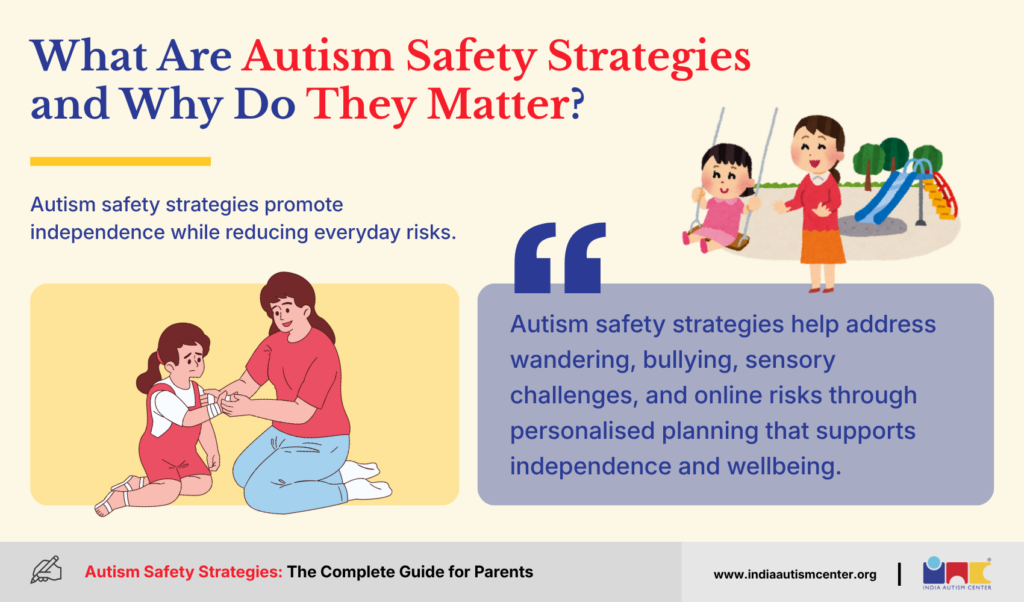
    Autism safety strategies are structured approaches that help autistic individuals navigate daily life without unnecessary harm. They matter because autistic people face higher rates of wandering, bullying, and accidental injury than neurotypical peers. Safety planning isn’t about restriction. It’s about building independence with the right supports in place.

    Research backs this up. A widely cited study published in Pediatrics found that nearly half of autistic children attempt to elope from a safe environment at some point. Autistic children are also significantly more likely to experience bullying than their peers, according to multiple special education surveys.

    Here’s a quick snapshot of why this matters:

    Risk AreaWhy It’s Elevated
    Wandering/elopementAttraction to water, difficulty with danger perception
    DrowningLeading cause of death among autistic children who wander
    BullyingSocial communication differences make some children easier targets
    Sensory injuryOverload can lead to disorientation in unsafe settings
    Online safetyDifficulty reading social cues can increase scam vulnerability

    Safety isn’t one-size-fits-all. A strategy that works for a nonverbal seven-year-old won’t work for a verbal, independent adult. That’s why I’ve broken this guide down by environment, age, and specific challenge.

    How Do Autism Sensory Issues Affect Safety?

    How Do Autism Sensory Issues Affect Safety?

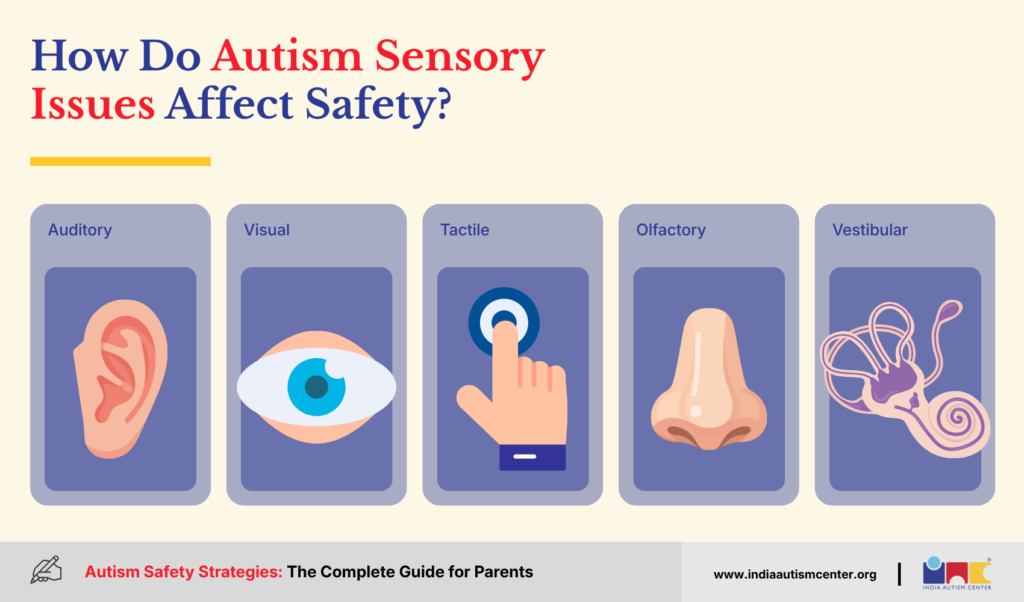
    Sensory issues affect safety because sensory overload can cause disorientation, panic, or shutdown in situations that require quick, clear thinking. A person overwhelmed by noise, light, or crowds may not notice traffic, strangers, or exits. Managing sensory input is often the first layer of any safety plan.

    Sensory triggers generally fall into five categories:

    • Auditory — sirens, crowded restaurants, sudden loud noises
    • Visual — flickering lights, crowded visual fields, bright sunlight
    • Tactile — clothing textures, unexpected touch, certain food textures
    • Olfactory — strong perfumes, cleaning products, food smells
    • Vestibular — escalators, elevators, uneven surfaces

    Identifying which triggers apply to a specific person is the real work. I recommend keeping a simple sensory log for two weeks — note the setting, the trigger, and the reaction. Patterns usually emerge quickly.

    All You Need to Know About Sensory Challenges in Autistic Individuals 

    What Tools Help Manage Sensory Overload Safely?

    Several tools can reduce sensory risk in real time. Each has a different use case:

    ToolBest ForNotes
    Noise-cancelling headphonesCrowded, loud spacesMore effective than earplugs for total noise blocking
    EarplugsDiscreet, quick useGood for unexpected noise triggers
    Weighted lap padsCalming during transitUseful in cars, waiting rooms
    Sunglasses/tinted lensesBright or flickering lightHelps in malls, hospitals
    Fidget toolsRedirecting sensory needReduces risk of self-injury during overload

    A hug or hand-hold can help too, but only if the individual welcomes physical touch. Never assume — always ask or observe first.

    What Are Effective Strategies for Preventing Wandering and Elopement?

    What Are Effective Strategies for Preventing Wandering and Elopement?

    Wandering prevention starts with securing the home, using tracking tools, and teaching water safety early. Elopement is one of the most serious autism safety risks, and drowning is the leading cause of death among children who wander. A layered approach works best — no single tool is enough on its own.

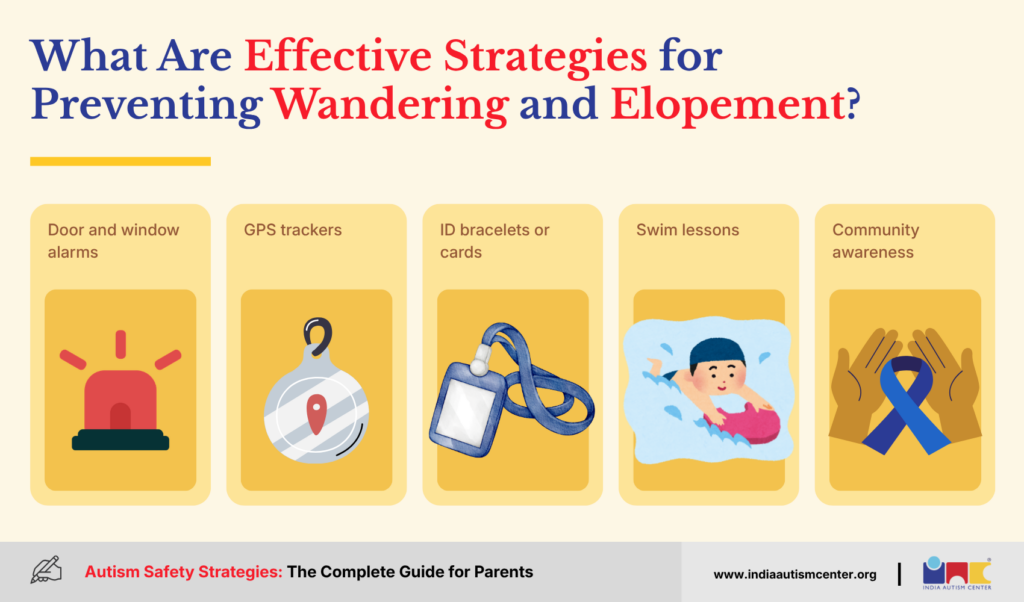
    Here’s what an effective wandering-prevention plan includes:

    1. Door and window alarms — alert caregivers the moment an exit is used
    2. GPS trackers — wearable devices or smartwatch apps that show real-time location
    3. ID bracelets or cards — include name, diagnosis, and emergency contact
    4. Swim lessons — adapted for sensory needs, started as early as possible
    5. Neighbor and community awareness — informing nearby households reduces response time

    What Should You Do If an Autistic Person Goes Missing?

    Act immediately. Don’t wait to see if they return on their own. Check water sources first — pools, ponds, or nearby rivers — since drowning risk is highest in the first hour.

    In India, contact your local police station and Childline at 1098 for missing children. Keep a recent photo and a written description, including any communication differences, ready in advance. Many families store this on their phone for instant access.

    Want to know more? Get in touch with us.

    How Can You Create Autism Safety at Home?

    How Can You Create Autism Safety at Home?

    Home safety for autism means securing hazards while also creating a sensory-safe environment. This includes childproofing dangerous areas, installing alarms, and designing at least one calm space for regulation. Indian homes often have specific risks — open balconies, exposed wiring, and non-childproofed sockets — that need particular attention.

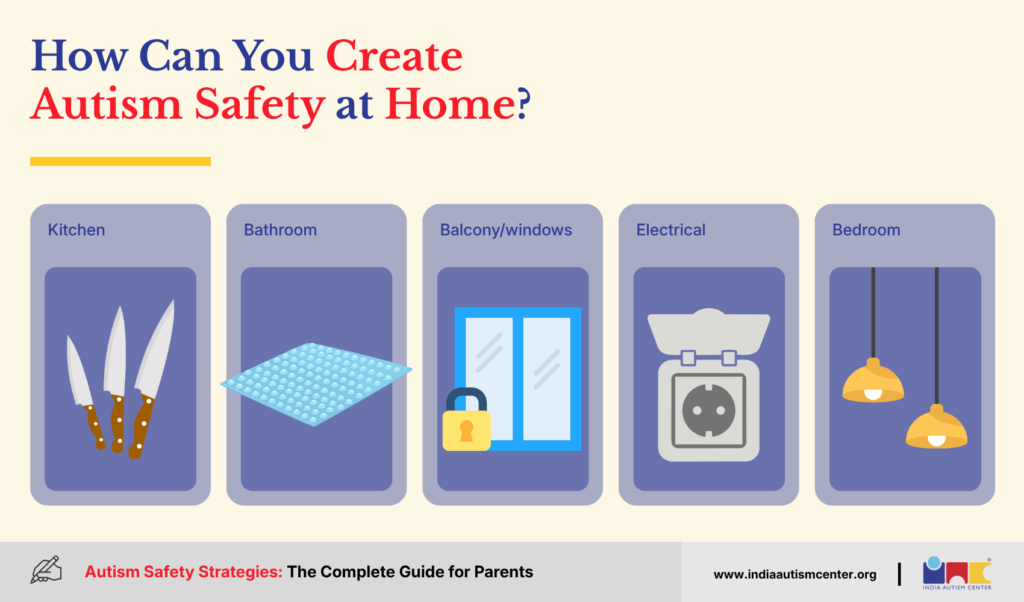
    Go room by room:

    AreaKey Safety Steps
    KitchenLock away sharp objects, secure stove knobs, store cleaning chemicals high up
    BathroomNon-slip mats, water temperature controls, lock medicine cabinets
    Balcony/windowsInstall grilles or safety locks, especially in multi-story homes
    ElectricalCover outlets, secure loose wiring, use surge protectors
    BedroomCreate a designated calm-down corner with soft lighting

    Fire safety deserves its own plan. Practice an escape route regularly, using visual cues or social stories if needed. Make sure smoke alarms use a sound the individual can tolerate, or pair audio alerts with visual strobe alarms.

    What Does Autism Safety Look Like in Daily Life?

    What Does Autism Safety Look Like in Daily Life?

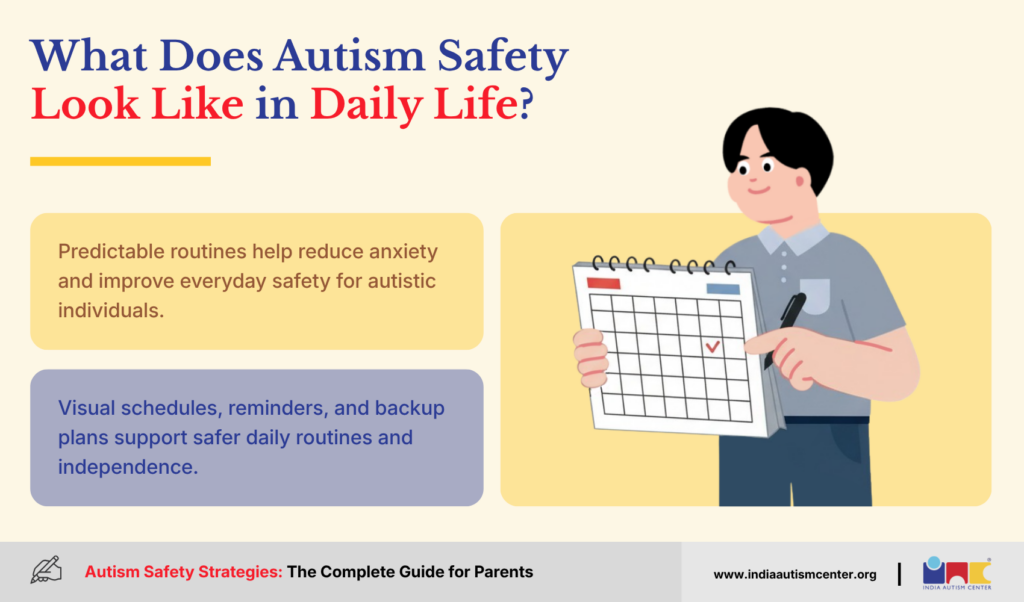
    Daily safety for autism relies on predictable routines, which reduce anxiety and lower the chance of unsafe impulsive behavior. Consistent schedules for waking, eating, hygiene, and medication build a safety net around everyday tasks. When routines break down, risk tends to go up.

    A strong daily safety routine typically includes:

    • Fixed wake and sleep times, supported by alarms
    • Visual schedules for hygiene tasks (brushing teeth, showering)
    • Medication reminders, especially for adults managing their own care
    • Backup plans for routine disruptions (what to do if the usual bus is late, or a store is closed)

    Visual schedules and social stories aren’t just teaching tools. They’re safety tools. They reduce the uncertainty that often triggers distress in unfamiliar or changing situations.

    📥 Free download: Printable daily routine chart for autistic children

    How Do Autism Safety Strategies Differ Across Environments?

    How Do Autism Safety Strategies Differ Across Environments?

    Safety strategies change depending on the environment, because each setting has different sensory demands and different risks. A school hallway poses different challenges than a crowded train platform. Matching the strategy to the setting is more effective than applying one generic rule everywhere.

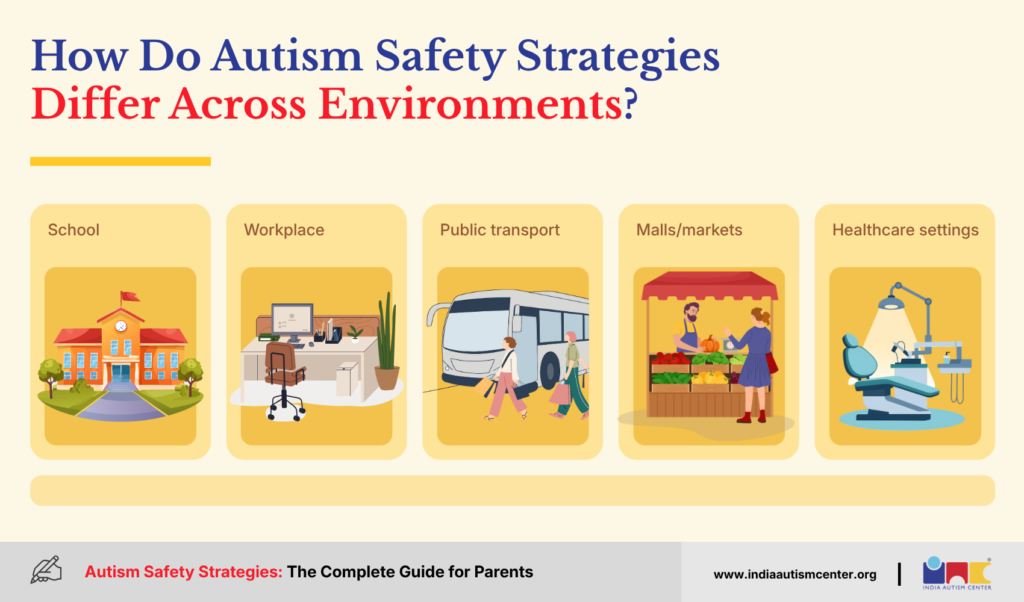
    EnvironmentMain RisksKey Strategies
    SchoolBullying, sensory overload, unclear rulesIEP-based accommodations, designated safe zones, peer buddy systems
    WorkplaceMiscommunication, sensory fatigueWritten instructions, noise-reducing accommodations, clear escalation paths
    Public transportCrowds, noise, getting lostID cards, offline maps, noise-cancelling headphones
    Malls/marketsOverstimulation, separation riskMeeting points, buddy system, visiting during off-peak hours
    Healthcare settingsUnfamiliar procedures, sensory triggersPre-visit social stories, requesting quiet rooms, bringing comfort items

    In India, festivals, crowded markets, and unpredictable power cuts add extra layers of sensory risk. Planning outings around quieter hours, and carrying backup sensory tools in case of power outages, makes a real difference.

    What Are Safety Tips for People on the Autism Spectrum in Public?

    What Are Safety Tips for People on the Autism Spectrum in Public?

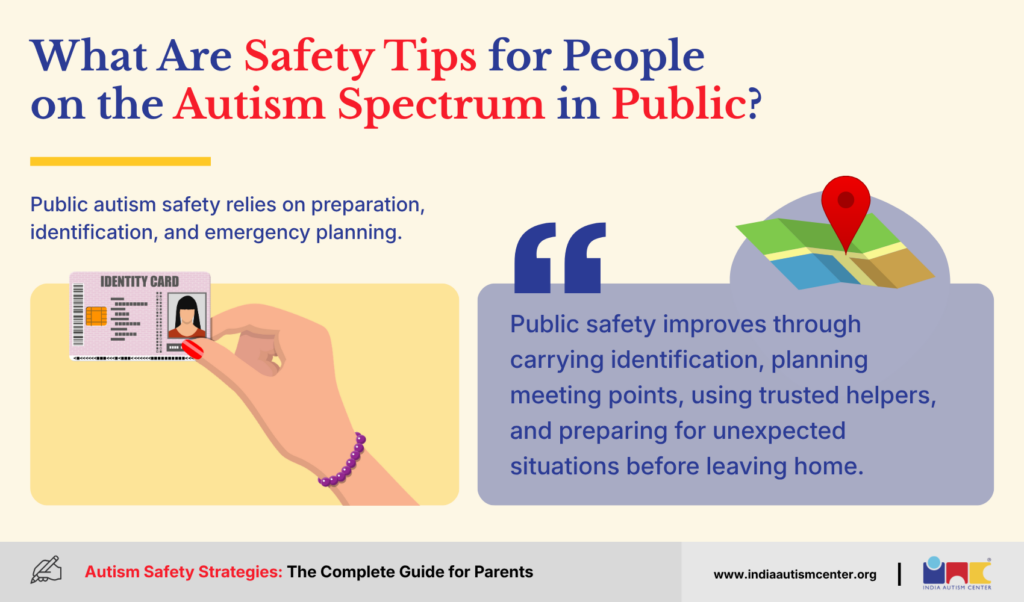
    Public safety tips for autism focus on preparation: carrying identification, knowing meeting points, and understanding how to ask for help. These strategies apply to both children with a caregiver nearby and independent adults navigating public spaces alone.

    Practical tips that work well:

    • Carry an ID card with name, diagnosis (if disclosed), and emergency contact
    • Set a meeting point before entering any crowded space
    • Use offline maps in areas with poor signal
    • Practice asking for help from identifiable staff — security guards, shopkeepers, or station staff
    • Avoid unfamiliar shortcuts like alleys, even if they seem faster

    If someone gets lost, the safest move is to stay in one place rather than searching randomly. Most safety experts recommend approaching a uniformed staff member or someone with a store badge over a random stranger.

    What Safety Strategies Do Autistic Adults Need That Differ From Children’s?

    What Safety Strategies Do Autistic Adults Need That Differ From Children's?

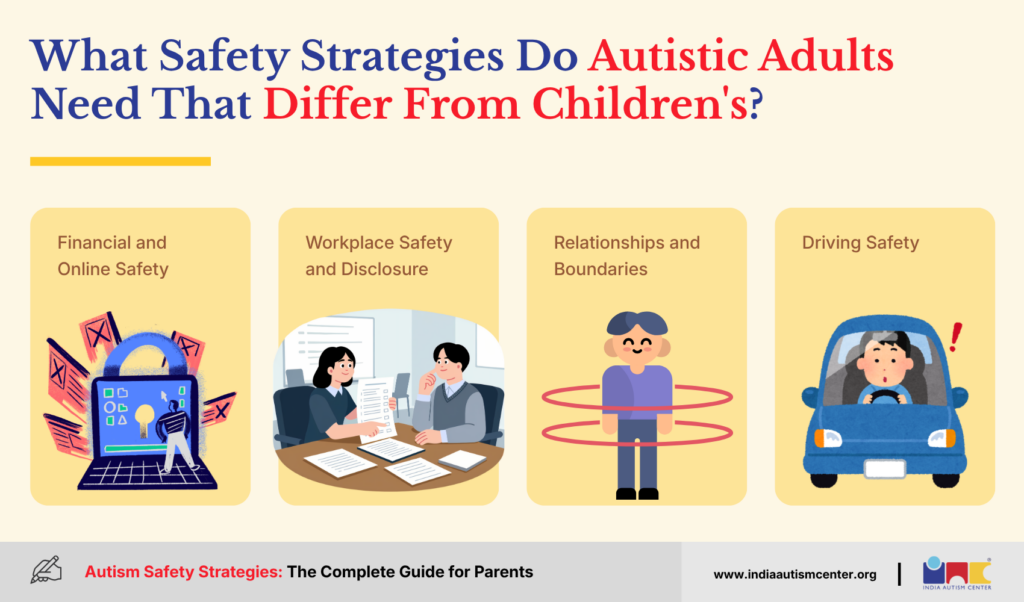
    Autistic adults need safety strategies focused on independence — financial safety, workplace accommodations, and relationship boundaries — rather than constant supervision. As autonomy grows, the safety conversation shifts from prevention by caregivers to self-advocacy skills.

    Financial and Online Safety

    Scams and phishing attempts specifically target difficulty reading social cues. Autistic adults should:

    • Never share OTPs, passwords, or bank details over calls or messages
    • Treat “too good to be true” offers as red flags, always
    • Use two-factor authentication on all financial apps
    • Set a personal rule: wait 24 hours before responding to unexpected money requests

    Workplace Safety and Disclosure

    Deciding whether to disclose autism at work is personal. If accommodations are needed — noise-cancelling headphones, written instructions, or flexible seating — a formal conversation with HR, backed by medical documentation, usually works best.

    Relationships and Boundaries

    Healthy relationships develop slowly, with clear boundaries. It’s okay to say no to physical touch, social plans, or contact you’re not ready for. If a relationship ends, physical and mental self-care come first, and talking to a trusted person helps process the change.

    Driving Safety

    Some autistic adults drive confidently; others don’t drive at all. If driving, start with short, familiar routes, take regular breaks, and minimize in-car distractions like phone notifications.

    Want to know more? Get in touch with us.

    How Does Bullying Affect Autism and Safety, and How Can It Be Prevented?

    How Does Bullying Affect Autism and Safety, and How Can It Be Prevented?

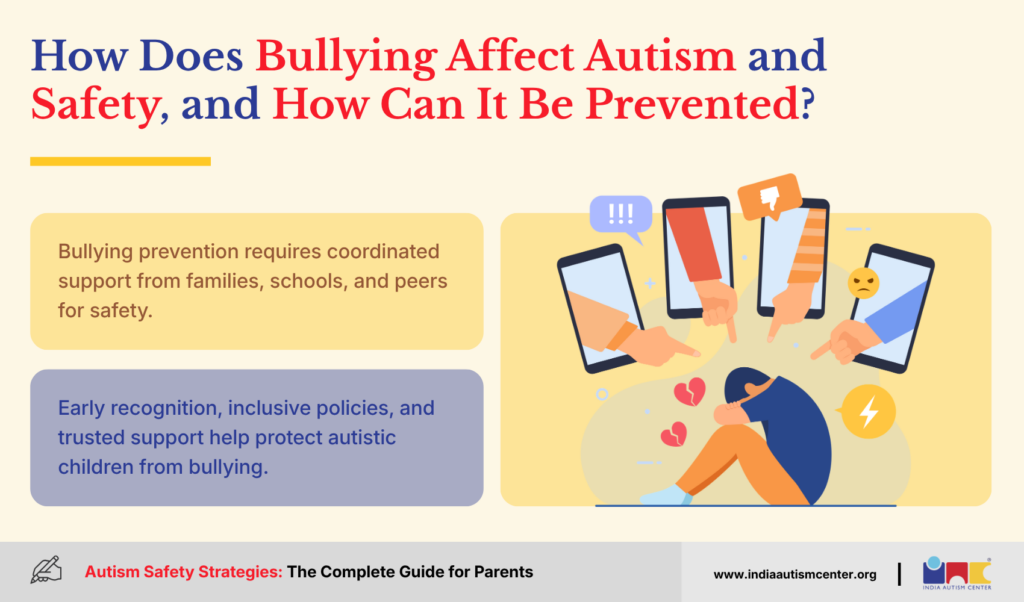
    Bullying significantly affects autism safety, since autistic children are bullied at notably higher rates than their neurotypical peers, according to special education research. Left unaddressed, bullying contributes to long-term anxiety, depression, and low self-worth. Prevention requires action from schools, families, and peers together.

    Warning signs parents should watch for:

    • Sudden reluctance to attend school
    • Unexplained injuries or missing belongings
    • Withdrawal from previously enjoyed activities
    • Increased meltdowns after school

    What Can Schools and Families Do to Prevent Bullying?

    Schools play a central role. Under India’s RPWD Act 2016, schools are required to provide an inclusive, safe environment for children with disabilities, which includes anti-bullying measures. Families can request specific accommodations through the school’s inclusion coordinator.

    Effective prevention steps include:

    1. Training peers on neurodiversity through classroom sessions
    2. Assigning a trusted staff member as a point of contact
    3. Setting up a clear, confidential reporting system
    4. Connecting the child with mentors or peer support groups

    If bullying has caused ongoing distress, a mental health professional can help address the emotional impact — this isn’t something to manage alone.

    How Do You Manage Meltdowns and Sensory Overload Safely?

    How Do You Manage Meltdowns and Sensory Overload Safely?

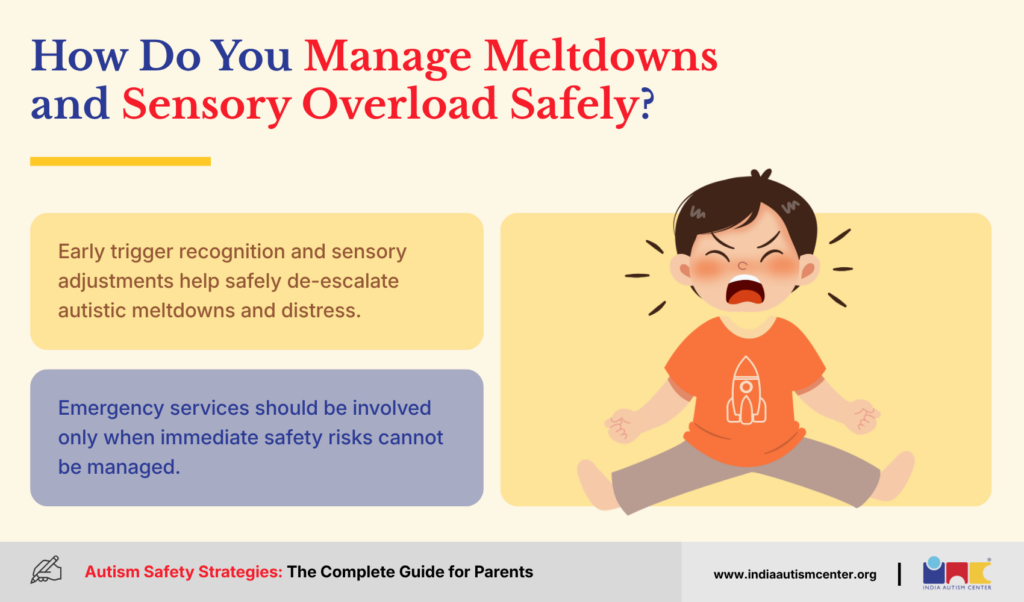
    Managing a meltdown safely means recognizing early triggers, moving to a calm space, and avoiding punishment-based responses. A meltdown is a neurological response to overload, not defiance — this distinction shapes the entire safety approach.

    Steps for safe de-escalation:

    1. Identify the trigger early — sound, light, transition, or unexpected change
    2. Move to a quieter space, if possible, before intensity peaks
    3. Reduce sensory input — dim lights, lower noise, give space
    4. Avoid physical restraint unless there’s immediate danger
    5. Wait it out calmly — don’t demand explanations mid-meltdown

    Calming tools that consistently help include weighted blankets, dim lighting, and familiar objects. Some individuals respond well to hand-holding; others need space entirely. Know the person’s preference in advance.

    When Should You Involve Emergency Services?

    Only when there’s a genuine risk of injury to the person or others. If police are called, tell them clearly that the person is autistic and may not respond to verbal commands the way they expect. Carrying an ID card that states this can prevent dangerous misunderstandings.

    What Legal Protections and Government Resources Support Autism Safety in India?

    What Legal Protections and Government Resources Support Autism Safety in India?

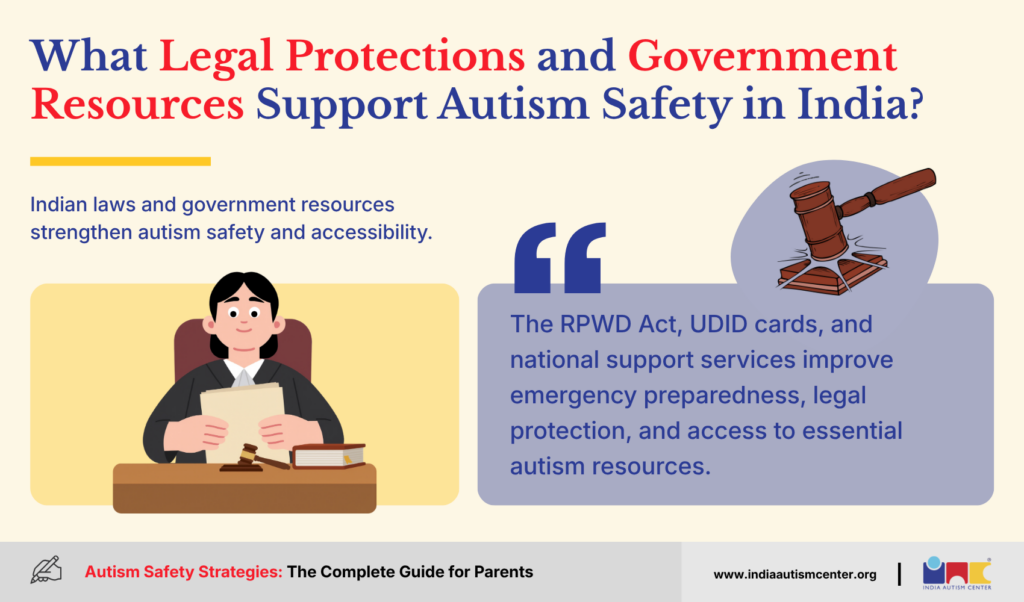
    India’s RPWD Act 2016 and the UDID card system provide legal and practical safety protections for autistic individuals. These tools aren’t just administrative — they directly support safety in emergencies, schools, and public services.

    Key resources to know:

    ResourceWhat It Does
    RPWD Act 2016Mandates reasonable accommodation and protection from discrimination
    UDID CardServes as official ID, useful during emergencies and for accessing services
    Childline 1098National helpline for missing or at-risk children
    National Trust Act 1999Supports guardianship and welfare planning for autism

    Keeping a UDID card accessible — physically and as a phone photo — is one of the simplest, most effective safety steps a family can take.

    What Should Go in an Autism Safety Plan?

    What Should Go in an Autism Safety Plan?

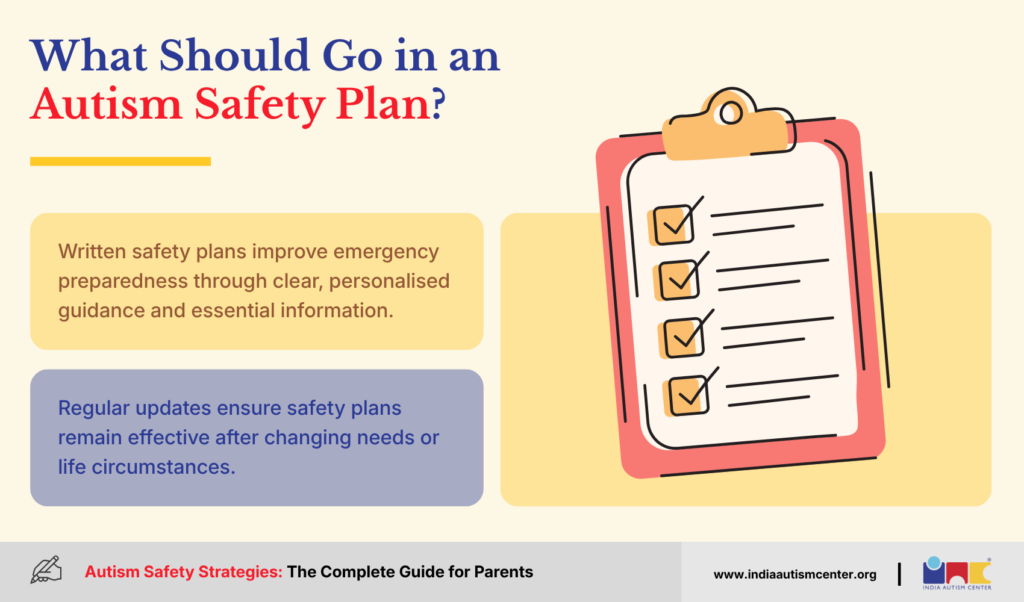
    A complete autism safety plan includes an emergency contact card, a medical and sensory information sheet, a home safety checklist, and a school or workplace accommodation plan. Having this written down, not just remembered, matters during high-stress moments.

    At minimum, include:

    • Full name, diagnosis, and emergency contacts
    • Communication notes (verbal, nonverbal, uses AAC device, etc.)
    • Known sensory triggers and calming strategies
    • Medication list and dosages
    • Preferred de-escalation approach

    Review and update this plan every six months, or after any major life change.

    Frequently Asked Questions

    What are the most important autism safety strategies to start with? 

    Start with wandering prevention and a written emergency plan. These address the highest-risk areas first, before moving to daily routine and sensory strategies.

    How can I keep an autistic child safe from wandering? 

    Use door alarms, GPS trackers, and enroll the child in adapted swim lessons early. Inform neighbors so response time stays short if wandering happens.

    What should be included in an autism ID card? 

    Include the person’s name, diagnosis, communication style, emergency contact, and any relevant medical information. A UDID card works well for this in India.

    How do I childproof a home for both safety and sensory needs?

    Secure physical hazards like sharp objects and outlets, and separately create a low-sensory calm space. Both layers work together, not as replacements for each other.

    Are there government safety resources for autistic individuals in India? 

    Yes. The RPWD Act 2016, UDID card system, and Childline 1098 all offer direct, practical support for autism safety.

    How is safety different for autistic adults compared to children? 

    Adult safety focuses on independence — financial literacy, workplace accommodations, and relationship boundaries — rather than constant supervision.


    This article is for educational purposes only and does not replace individualized guidance from a qualified medical, psychological, or legal professional. Every autistic person’s safety needs are different — please consult a specialist for advice tailored to your situation.

    For expert insights, support services, and inclusive learning initiatives, visit the India Autism Center.
  • Prenatal Paracetamol Neurodevelopmental Risk: What Science Says

    Prenatal Paracetamol Neurodevelopmental Risk: What Science Says

    Prenatal paracetamol use does not increase a child’s risk of autism, Attention Deficit Hyperactivity Disorder (ADHD), or intellectual disability. This is the conclusion of a large sibling-matched study of over 700,000 mother-child pairs, published in JAMA Internal Medicine in 2026. The finding holds regardless of dosage, trimester, or how often paracetamol was used during pregnancy.

    If you are pregnant and worried about a headache tablet you took last week, I want to put your mind at ease. Let me walk you through exactly what the science says, why the panic started, and what it means for you. 

    What Sparked the Paracetamol-Autism Debate?

    What Sparked the Paracetamol-Autism Debate

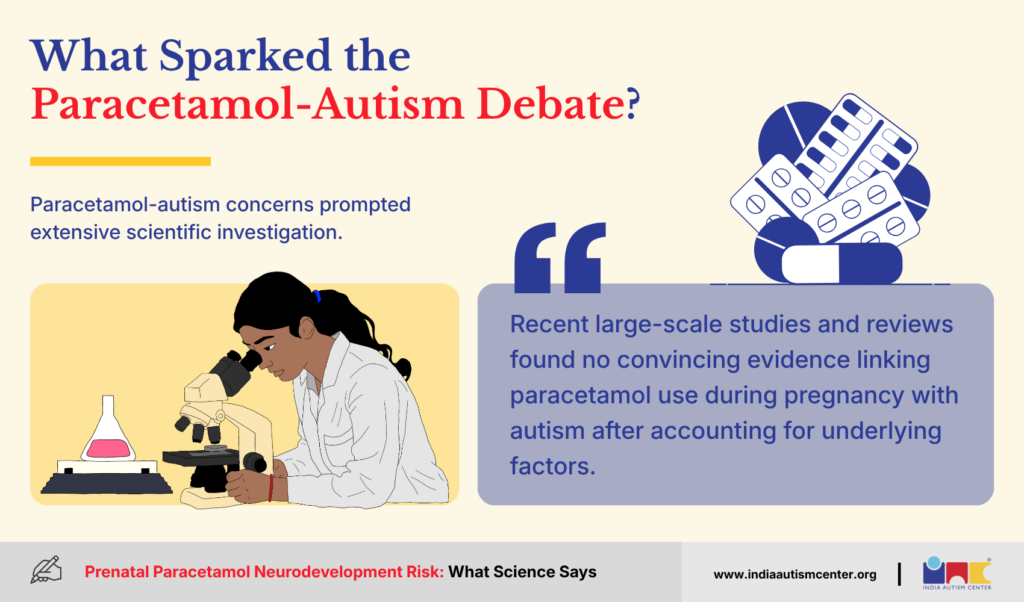
    In September 2025, statements from the US administration suggested a possible link between paracetamol use in pregnancy and autism spectrum disorder (ASD). This claim spread quickly across news outlets and social media. Expecting mothers around the world, including here in India, grew anxious almost overnight.

    Health bodies responded fast. The World Health Organization and other major medical authorities reaffirmed paracetamol’s safety profile. But public concern doesn’t disappear with a single statement. It needed strong, direct evidence. That evidence has now arrived.

    Three separate lines of research converged in early-to-mid 2026: a massive sibling-matched cohort study from Hong Kong, a 43-study systematic review from The Lancet, and a dedicated meta-analysis in the Journal of the American Academy of Child & Adolescent Psychiatry. All three point in the same direction.

    What Did the New HKUMed Study Actually Find?

    What Did the New HKUMed Study Actually Find?

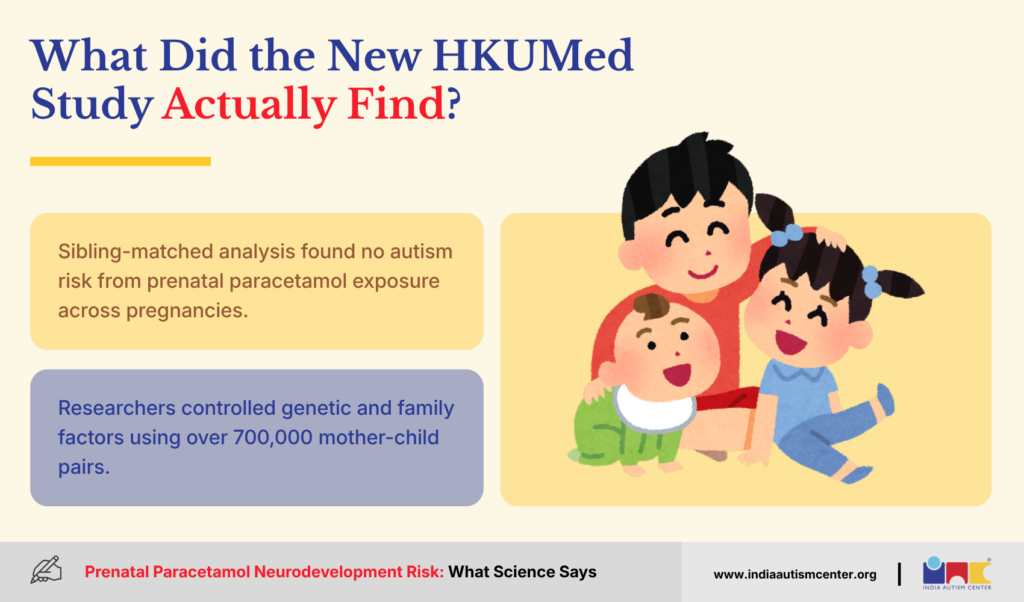
    Researchers from the University of Hong Kong (HKUMed), working with Aston Pharmacy School’s Professor Ian Chi-Kei Wong, ran the most rigorous test possible on this question. They used electronic medical records for 708,020 mother-child pairs collected in Hong Kong between 2000 and 2023.

    Here’s what made this study different. Instead of just comparing children of mothers who took paracetamol to children of mothers who didn’t, they compared siblings from the same mother. One sibling was exposed to paracetamol in the womb. The other wasn’t. This design cancels out genetic and family-environment differences that usually muddy this kind of research.

    The result: no association between prenatal paracetamol exposure and the risk of ASD or ADHD. This held true across every variable the team tested.

    What the Sibling-Matched Study Controlled For

    Variable TestedResult
    Dosage (low vs. high)No increased risk
    Trimester of exposureNo increased risk in 1st, 2nd, or 3rd trimester
    Usage patternNo increased risk with sporadic, intermittent, or persistent use
    Outcome measuredNo link to ASD or ADHD

    Why does sibling-matching matter so much? Because autism and ADHD are strongly influenced by genetics. If you compare unrelated children, you can’t easily separate genetic risk from medication exposure. Comparing siblings removes that noise. This is considered the gold standard design for this type of question.

    Does Acetaminophen Cause ADHD?

    Does Acetaminophen Cause ADHD?

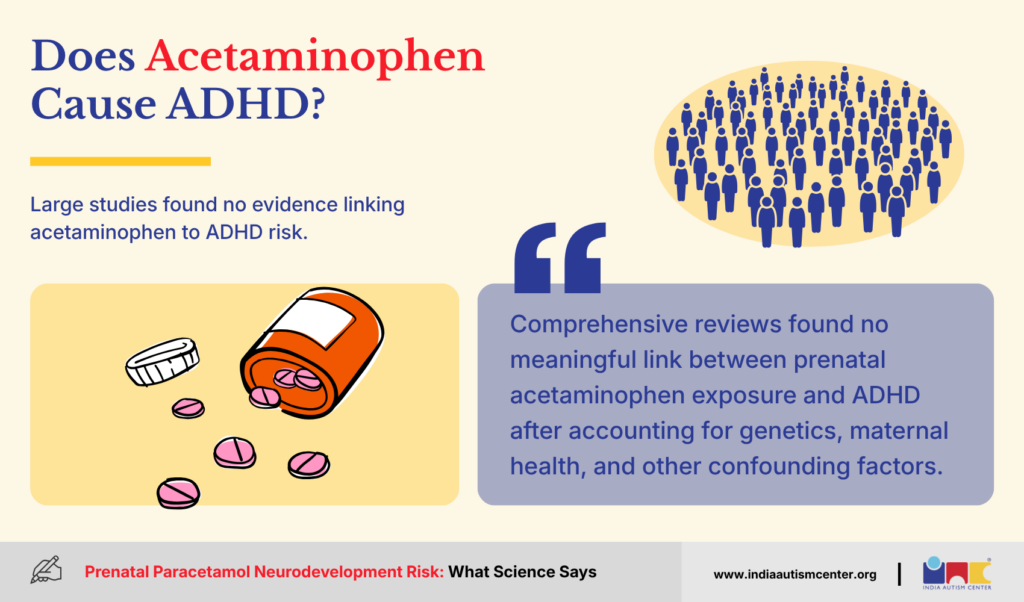
    The HKUMed study isn’t standing alone. A systematic review published in The Lancet Obstetrics, Gynaecology, & Women’s Health in January 2026 looked at 43 studies from around the world. Data came from Europe, the United States, Japan, Brazil, and New Zealand.

    The review was led by Professor Asma Khalil of City St George’s, University of London. Her team found no evidence that prenatal paracetamol exposure raises the risk of autism, ADHD, or intellectual disability. Some earlier individual studies had suggested small associations. Once researchers applied proper adjustment for confounding factors, those associations disappeared.

    A separate meta-analysis published in the Journal of the American Academy of Child & Adolescent Psychiatry in October 2025 reached a similar conclusion. That analysis reported an odds ratio of 0.97 for ADHD following in-utero acetaminophen exposure. An odds ratio close to 1.0 means essentially no effect.

    One detail from that review is worth knowing. Statistical significance only showed up when researchers used patient-chart data, not maternal recall. Maternal recall has actually been shown to be more accurate than chart data for over-the-counter medicines. This tells us that some earlier “risk signals” were likely a data quality problem, not a real biological effect.

    Why Did Earlier Studies Suggest a Link?

    You may have read older articles claiming a connection between paracetamol and neurodevelopmental problems. Here’s why those studies painted a different picture.

    • Confounding factors — genetics, maternal illness, fever, and chronic pain all independently affect child development.
    • Recall bias — some older studies relied on parents remembering medication use months or years later.
    • Short follow-up periods — a few studies didn’t track children long enough to draw firm conclusions.
    • Lack of sibling controls — most early research compared unrelated children, which cannot separate genetic risk from drug exposure.

    A large Swedish cohort of 2.48 million births found no association once familial confounding was accounted for. A Japanese cohort had initially suggested a minor risk increase for ADHD and ASD, but further analysis traced this back to confounding and misclassification, not a real drug effect.

    This is a good example of why one study should never be taken as final proof. Science builds confidence through repetition and stronger methodology, not through a single headline.

    Is Paracetamol Safe During Pregnancy?

    Is Paracetamol Safe During Pregnancy?

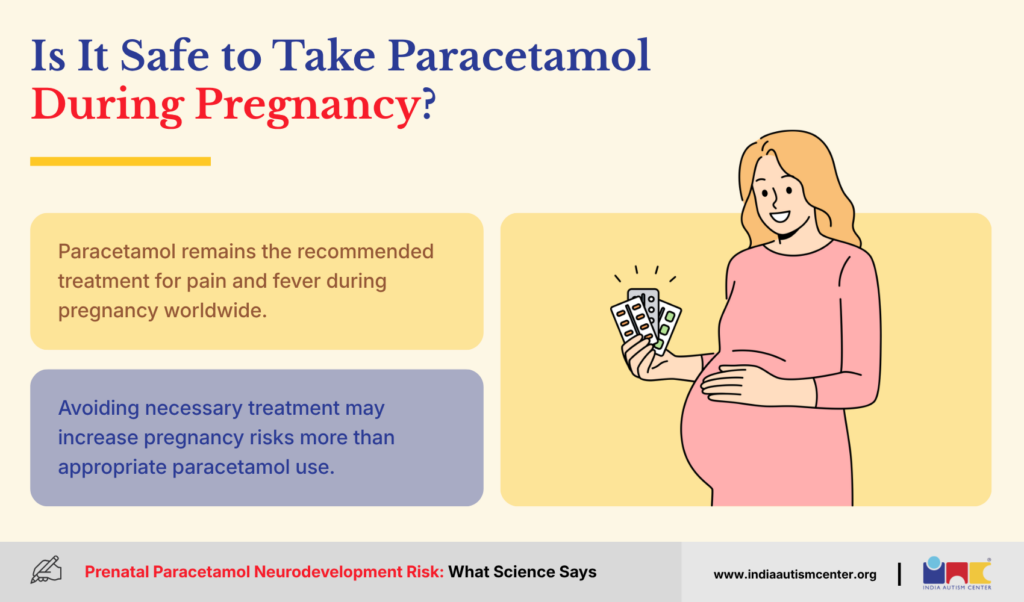
    Yes. Paracetamol remains the first-line recommended treatment for pain and fever during pregnancy. This guidance comes from major medical bodies including the CDC, ACOG (American College of Obstetricians and Gynecologists), and the Society of Obstetricians and Gynaecologists of Canada.

    More than two-thirds of pregnant women take paracetamol at some point during pregnancy. It’s used to manage:

    • Headaches and migraines
    • Fever from infections
    • Body aches and joint pain
    • Post-procedure pain relief

    Avoiding paracetamol isn’t automatically the “safer” choice. Untreated fever and pain in pregnancy carry their own documented risks, including miscarriage, preterm birth, and other adverse outcomes. Choosing to avoid treatment out of fear can sometimes create more risk, not less.

    What Should Expectant Mothers in India Know?

    What Should Expectant Mothers in India Know?

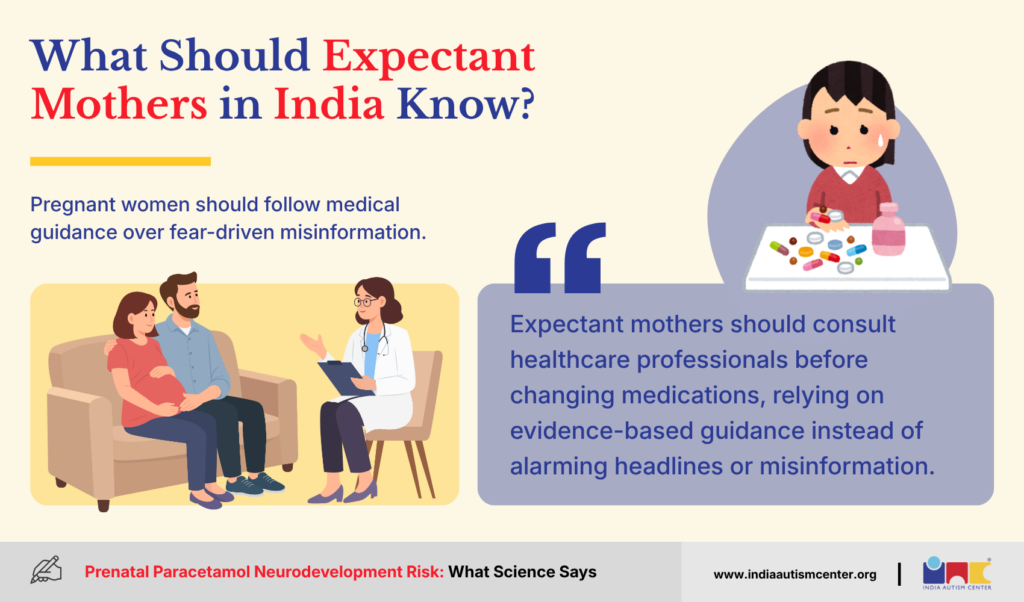
    Indian obstetric guidance, broadly aligned with FOGSI (Federation of Obstetric and Gynaecological Societies of India) recommendations, supports paracetamol as a safe option when used as directed during pregnancy. It remains widely available and commonly prescribed across Indian hospitals and clinics.

    I’ve noticed a pattern in India worth flagging directly: fear-driven avoidance of basic medication. When international headlines create panic, some expectant mothers stop taking necessary treatment altogether, sometimes without consulting a doctor first. This isn’t a safer path. It’s an uninformed one.

    If you’re pregnant and dealing with fever or pain, the right move is simple:

    1. Don’t self-diagnose based on news headlines.
    2. Talk to your obstetrician about appropriate dosage and duration.
    3. Don’t avoid necessary treatment out of unverified fear.

    At India Autism Center, our focus stays on what actually helps families: early identification and support, not retroactive guilt over a paracetamol tablet taken for a fever. If you have concerns about your child’s development, early screening tools matter far more than worrying about past medication use.

    How Should Pregnant Women Use Paracetamol Responsibly?

    How Should Pregnant Women Use Paracetamol Responsibly?

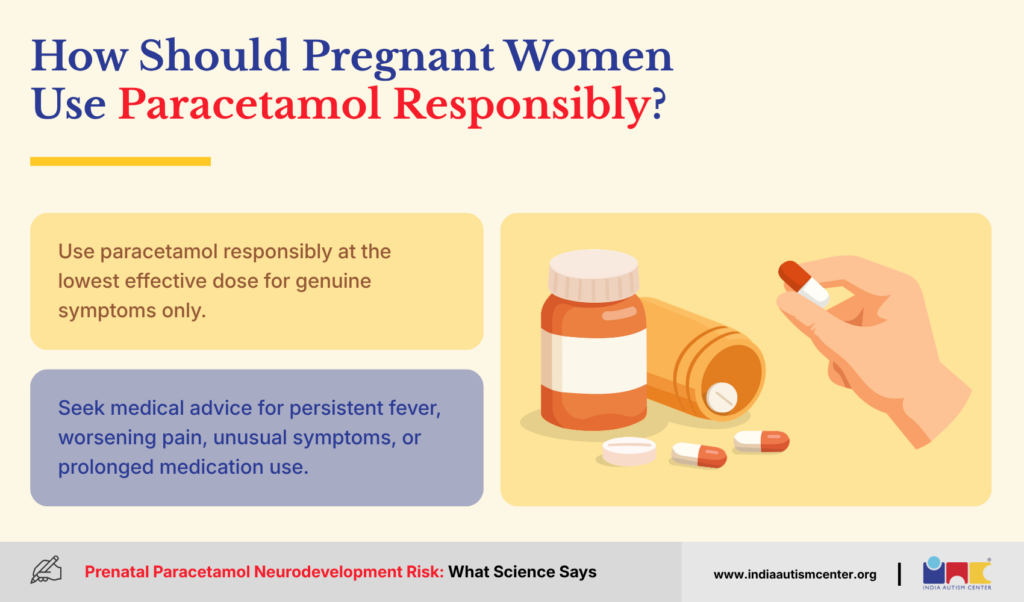
    Responsible use matters more than avoidance. Here’s a general guide, though your doctor’s advice always takes precedence over anything you read online.

    General Paracetamol Guidance in Pregnancy

    FactorGeneral Guidance
    When to useFor genuine pain or fever, not as a precaution
    DurationShortest effective duration
    DosageLowest effective dose, as advised by your doctor
    FrequencyFollow product label or physician instructions
    When to consult a doctorFever lasting more than a day, recurring pain, or before regular/prolonged use

    Red flags that need medical attention rather than self-medication include:

    • Fever above 100.4°F (38°C) that persists
    • Pain that worsens despite medication
    • Any unusual symptoms alongside fever or pain

    You might also want to read about Does Tylenol Cause Autism? What the Largest Autism Study Found  

    Key Takeaways

    Let me summarise where the evidence actually stands right now:

    • A 708,020-pair sibling-matched study found no link between prenatal paracetamol use and autism or ADHD.
    • A 43-study systematic review in The Lancet reached the same conclusion.
    • A separate meta-analysis reported an ADHD odds ratio of 0.97, essentially no effect.
    • Earlier studies suggesting risk were affected by confounding, recall bias, and weaker study design.
    • Untreated pain and fever during pregnancy carry their own real risks.
    • Paracetamol remains the first-line recommended option per WHO, CDC, ACOG, and Indian obstetric guidance.

    Frequently Asked Questions

    Does paracetamol during pregnancy cause autism?

    No. The largest and most rigorous studies, including a sibling-matched cohort of over 700,000 pairs, found no increased autism risk linked to prenatal paracetamol use.

    Does acetaminophen cause ADHD in children?

    No. A 2025 meta-analysis reported an odds ratio of 0.97 for ADHD following prenatal acetaminophen exposure, indicating no meaningful increase in risk.

    Is paracetamol safe to take in all trimesters of pregnancy?

    Yes. The HKUMed study found no increased risk regardless of whether exposure occurred in the first, second, or third trimester.

    What if I already took paracetamol during my pregnancy?

    Current evidence gives strong reassurance. There is no need for guilt or concern based on past use, especially when taken as directed for genuine pain or fever.

    What are safer alternatives for pain or fever in pregnancy?

    Paracetamol remains the recommended first-line option. Always consult your obstetrician before trying alternatives, since some other pain relievers carry higher documented risks in pregnancy.

    Why did earlier studies suggest a link if it’s not real?

    Older studies often lacked sibling controls, relied on inconsistent data sources, and didn’t fully account for genetic and family confounding factors, which distorted the findings.


    Disclaimer: This article is for educational and informational purposes only. It is not a substitute for professional medical advice, diagnosis, or treatment. Always consult a qualified obstetrician or healthcare provider regarding medication use during pregnancy or any concerns about your child’s development.

  • Can Mother’s Oxytocin Levels Protect Her Child From Autism?

    Can Mother’s Oxytocin Levels Protect Her Child From Autism?

    Maternal oxytocin and autism have a crucial connection, which can change a lot of things. A 2026 study in Scientific Reports found that poor early maternal care can trigger autism-like traits in offspring. Giving oxytocin to mothers with a history of early-life stress improved their caregiving. This, in turn, prevented the same traits from appearing in their pups. The maternal environment itself may be a modifiable factor in neurodevelopmental risk.

    I want to walk you through this study in plain language. I’ll explain what the researchers did, what they found, and what it actually means — and doesn’t mean — for parents and clinicians. This is animal research, not a human treatment protocol. But it’s a meaningful piece of the autism puzzle, and it deserves a clear explanation.

    What Did This New Study Actually Investigate?

    What Did This New Study Actually Investigate

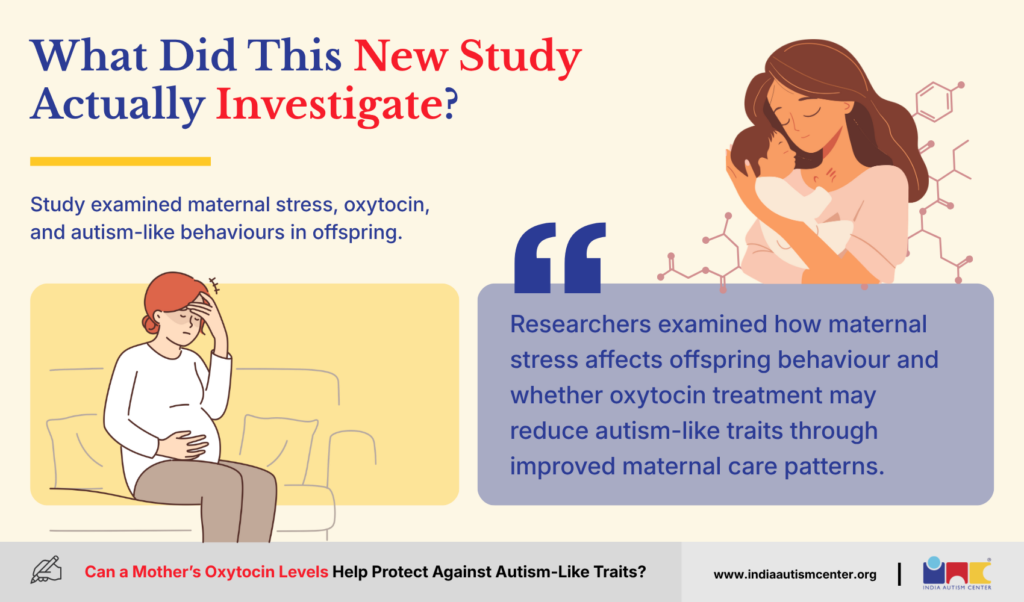
    Researchers at Shahid Beheshti University in Tehran asked two connected questions. First, does poor maternal care caused by early-life stress lead to autism-like behaviour in offspring? Second, can giving oxytocin to stressed mothers reverse that effect?

    The study was published in Scientific Reports on 8 July 2026. It’s authored by Fatemeh Barzi, Monireh Mansouri, Mohammadreza Bigdeli, and Hamid Reza Pouretemad. It was funded by Iran’s Cognitive Sciences & Technologies Council.

    The paper is currently an early-access, unedited manuscript. That means the findings are real and peer-reviewed enough to publish, but formatting and minor edits are still pending. I’ll flag this again in the limitations section.

    Why Study Rats to Understand Human Autism?

    Why Study Rats to Understand Human Autism?

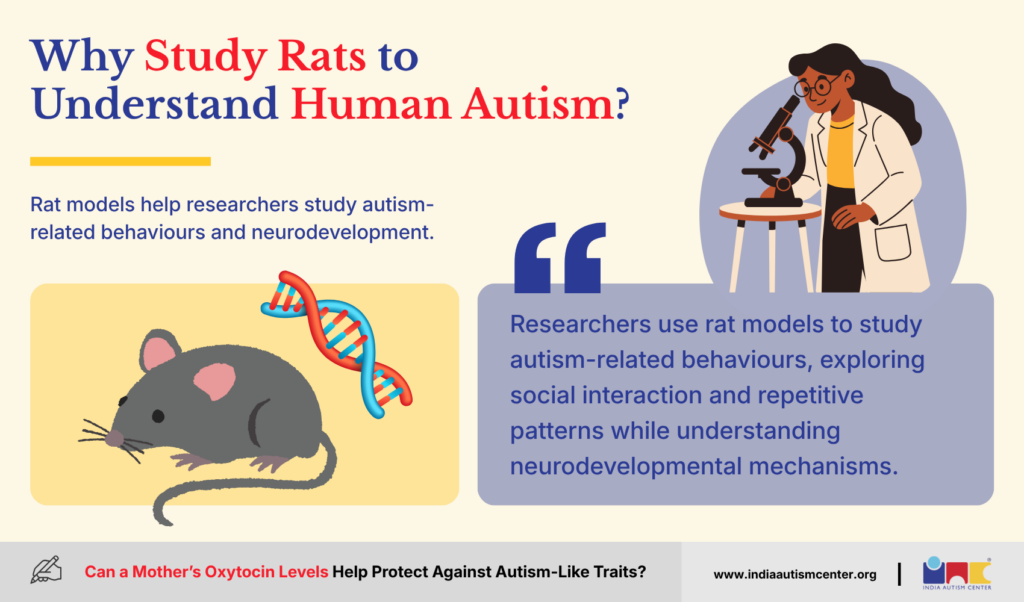
    Rat models are a standard tool in neurodevelopmental research. Rats share key brain structures and hormone systems with humans, including the oxytocin system. Researchers can control variables in rats — like exact caregiving conditions — that would be impossible to control in human families.

    This doesn’t mean rat behavior equals human autism. It means specific rat behaviors are used as proxies for core autism traits. Reduced social interaction and repetitive movements in rats mirror the two core domains used to diagnose autism spectrum disorder (ASD) in humans.

    Want to know more? Get in touch with us.

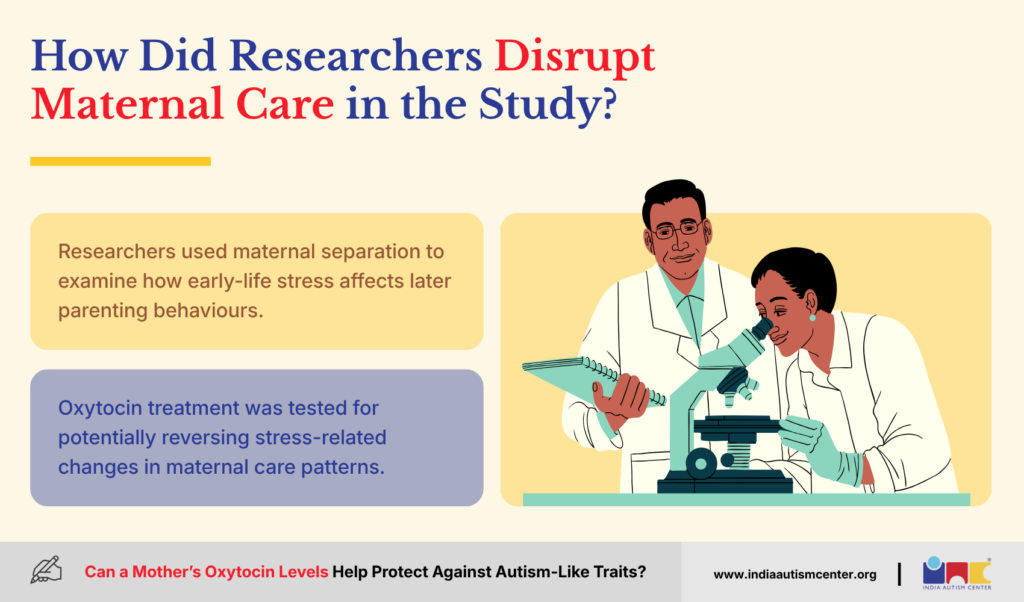
    How Did Researchers Disrupt Maternal Care in the Study?

    How Did Researchers Disrupt Maternal Care in the Study?

    The researchers used a well-established method called maternal separation (MS). Female rat pups were separated from their mothers for three hours a day, every day, from postnatal day 1 to day 14. This is their first two weeks of life.

    These separated pups grew up and eventually became mothers themselves. As adults, they were split into three groups:

    • Control group: Normal rearing, no separation history, no treatment
    • MS + Saline group: Separation history, given a placebo (saline) as adults
    • MS + OXT group: Separation history, given intranasal oxytocin as adults

    This design let researchers isolate one specific question. Does early-life stress in a mother change how she parents her own offspring later — and can oxytocin interrupt that chain?

    What Happened to Mothers With a History of Early Separation?

    What Happened to Mothers With a History of Early Separation?

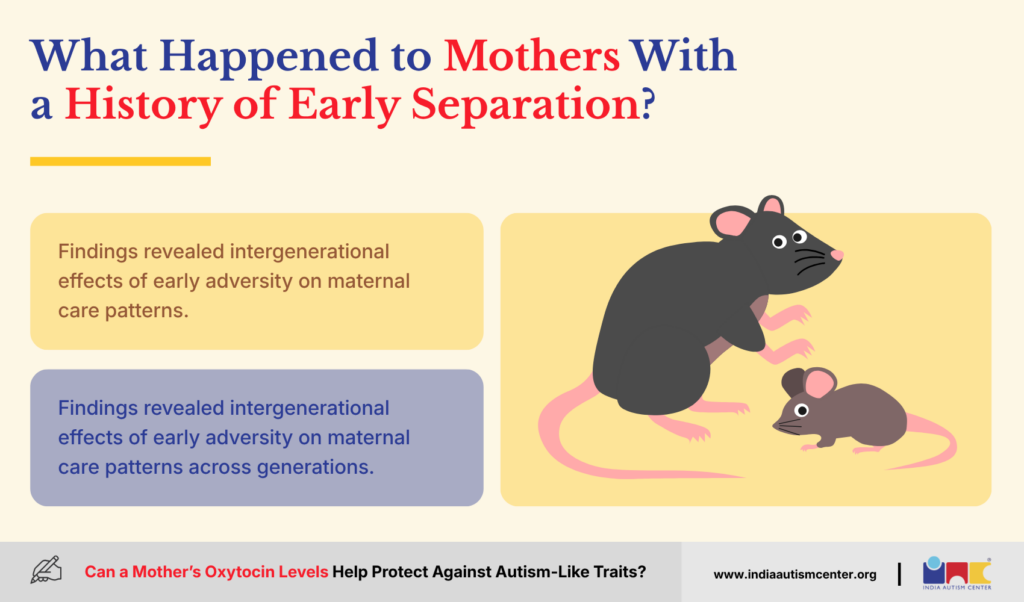
    Dams (mother rats) with an MS history showed impaired maternal care toward their own pups. This showed up in two measurable ways.

    • Reduced nursing behavior. MS-history mothers nursed their pups less frequently than control mothers.
    • Increased harmful behaviors. These mothers displayed more rough or neglectful behaviors toward their pups compared to controls.

    This finding fits a known pattern in developmental biology. Mothers who experienced poor early care themselves are more likely to show disrupted caregiving as adults. Researchers sometimes call this an intergenerational cycle of early adversity.

    Did Oxytocin Actually Change Maternal Behavior?

    Did Oxytocin Actually Change Maternal Behavior?

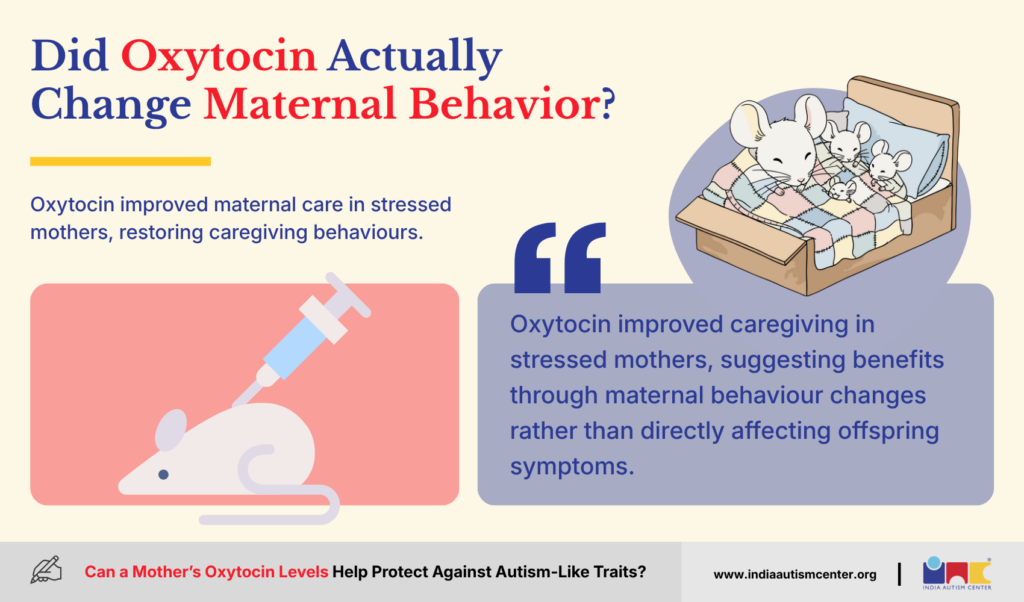
    Yes. Mothers with an MS history who received intranasal oxytocin (0.8 IU/kg, given daily from postnatal day 1 to day 14 of their own pups’ lives) showed significantly improved maternal care. Their nursing and caregiving behaviours moved closer to control-group levels.

    This is the study’s central mechanism. Oxytocin wasn’t given to the pups showing symptoms. It was given upstream, to the mothers, before problems could develop in the next generation. That distinction matters, and I’ll come back to it.

    What Autism-Like Traits Appeared in the Offspring?

    What Autism-Like Traits Appeared in the Offspring?

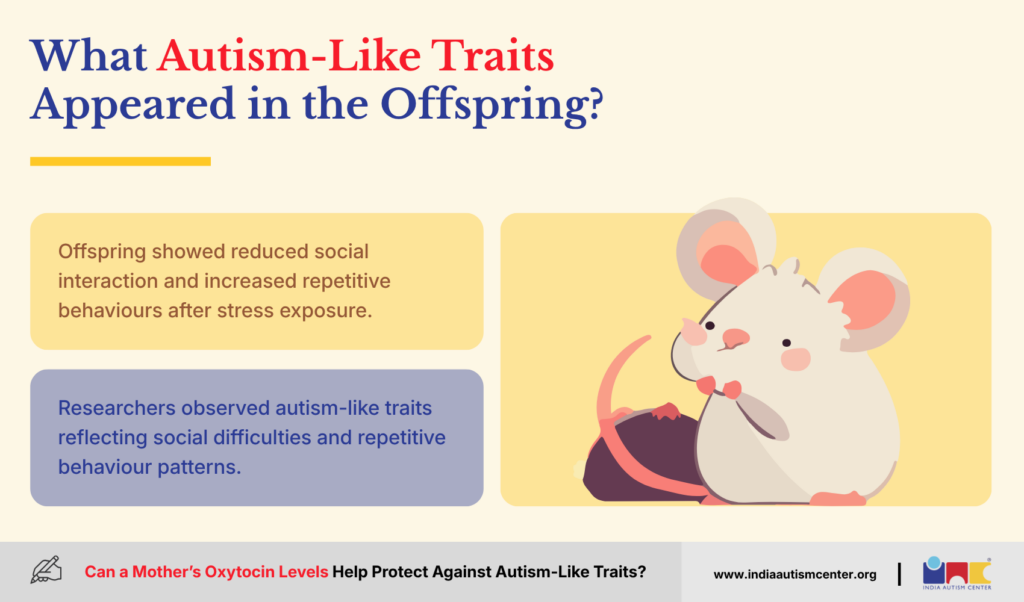
    The male offspring of MS+Saline mothers were evaluated during adolescence. Researchers tested two behavior domains that map onto core ASD diagnostic criteria in humans.

    Behavior domainWhat was measuredResult in MS+Saline offspring
    Social behaviorInteraction and engagement with other ratsSignificant deficits
    Repetitive behaviorStereotyped, repeated movement patternsSignificant increase

    These are the same two domains — social communication difficulties and restricted/repetitive behaviours — that clinicians look for when diagnosing autism in children. That parallel is why researchers describe these traits as “autism-like.”

    Want to know more? Get in touch with us.

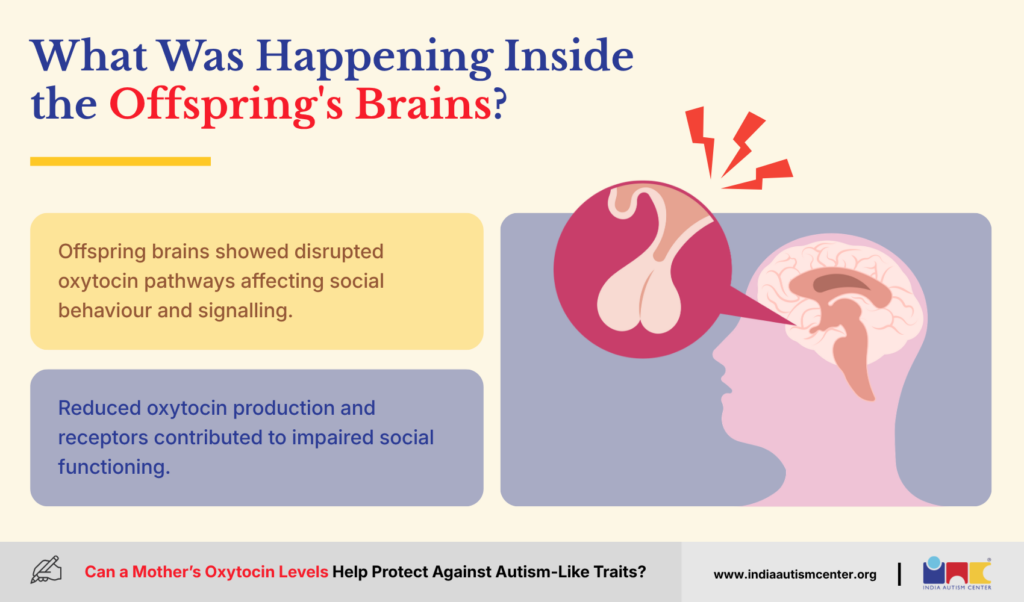
    What Was Happening Inside the Offspring’s Brains?

    What Was Happening Inside the Offspring's Brains?

    Behaviour alone doesn’t explain the mechanism. The researchers also examined two specific biomarkers in the offspring’s brains.

    • Hypothalamic oxytocin (OXT) expression. The hypothalamus produces oxytocin, a hormone central to bonding and social behavior.
    • Hippocampal oxytocin receptor (OXTR) expression. The hippocampus needs oxytocin receptors to actually respond to circulating oxytocin.

    In MS+Saline offspring, both were reduced. Lower OXT production paired with fewer receptors to detect it. This combination likely explains why social behavior was impaired — the brain’s oxytocin signaling pathway was disrupted at two points at once.

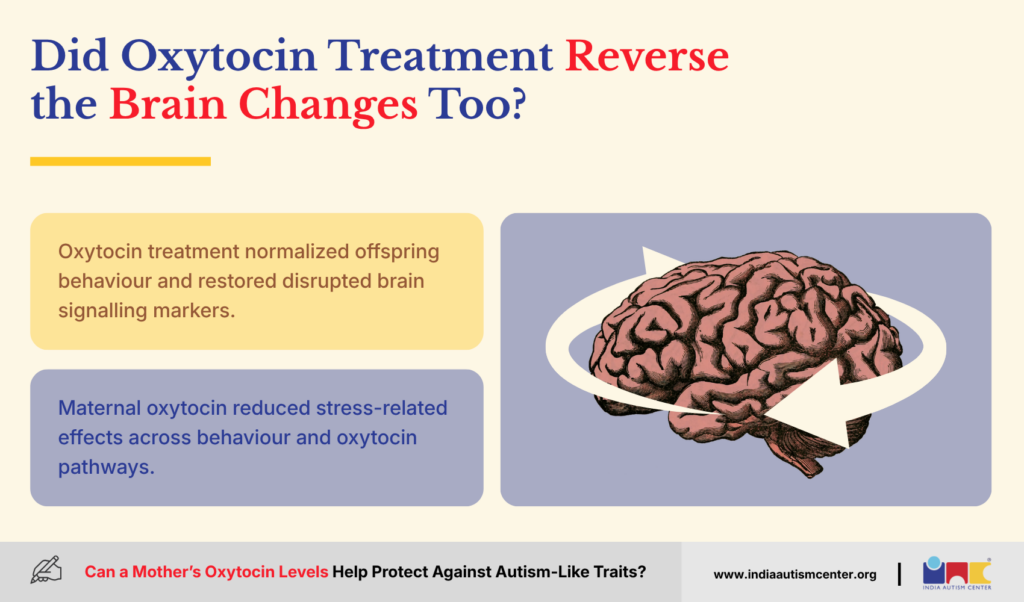
    Did Oxytocin Treatment Reverse the Brain Changes Too?

    Did Oxytocin Treatment Reverse the Brain Changes Too?

    Yes. In offspring of MS+OXT mothers, both the behavioral deficits and the brain-level abnormalities were largely normalized. Their hypothalamic OXT and hippocampal OXTR expression looked closer to control-group levels than to MS+Saline levels.

    Here’s the full picture in one table.

    GroupMother’s early historyMother’s treatmentOffspring behaviorOffspring OXT/OXTR
    ControlNormal rearingNoneTypical social behaviorNormal levels
    MS + SalineEarly separationPlaceboSocial deficits, repetitive behaviorReduced OXT and OXTR
    MS + OXTEarly separationIntranasal oxytocinNear-normal behaviorNear-normal OXT and OXTR

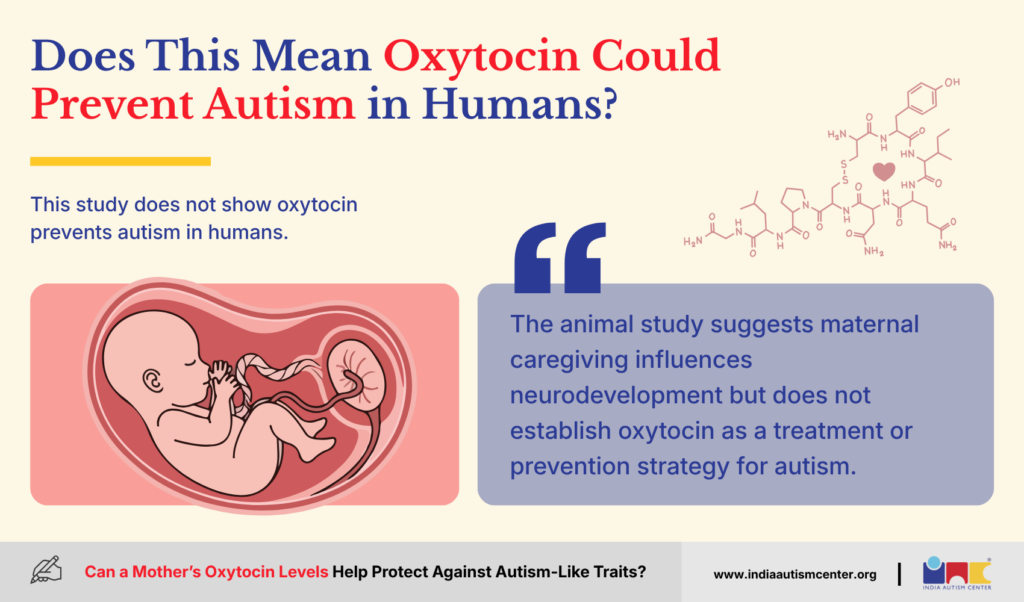
    Does This Mean Oxytocin Could Prevent Autism in Humans?

    Does This Mean Oxytocin Could Prevent Autism in Humans?

    No, not directly. This is a preclinical, animal study. It doesn’t establish a human treatment protocol, and it shouldn’t be read as one.

    There’s an important distinction to hold onto here. Some human oxytocin research has tested giving oxytocin directly to children with autism, with mixed results. This study did something different. It gave oxytocin to mothers, before problems developed, to improve their caregiving capacity. The mechanism is upstream and environmental, not a direct pharmacological fix for a child’s symptoms.

    What this study does support is a broader idea: early caregiving quality is biologically consequential, not just a “soft” or secondary factor in neurodevelopment. That’s a testable, useful hypothesis — not a clinical recommendation.

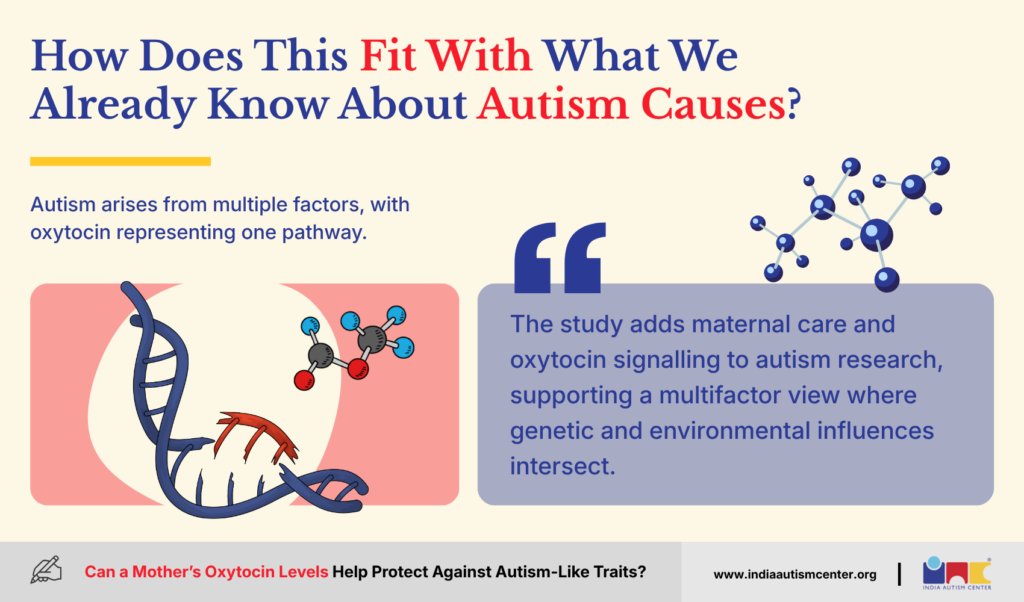
    How Does This Fit With What We Already Know About Autism Causes?

    How Does This Fit With What We Already Know About Autism Causes?

    Autism has no single cause. Genetics play a substantial role, and no maternal-care study changes that. What this research adds is one more environmental variable to a complex, multi-factor picture.

    Other research groups have reported related findings using different models. Studies on maternal diabetes, prenatal hormone exposure, and adverse childhood experiences have all pointed to the oxytocin system as a common downstream pathway. This Tehran-based study adds early maternal separation and maternal-directed oxytocin treatment to that growing list.

    The consistent theme across this research is that the oxytocin system sits at a biological crossroads. Multiple types of early adversity — genetic, hormonal, or environmental — seem to converge on it. That makes it a promising area for further study, not a settled explanation.

    What Does This Mean for Early Intervention Programs?

    What Does This Mean for Early Intervention Programs?

    This study reinforces something many early-intervention practitioners already emphasize. Supporting parents — especially parents under stress — may have downstream benefits for child development that go beyond convenience or wellbeing.

    Programs that support parental mental health, reduce caregiver stress, and strengthen early bonding aren’t just “nice to have.” This research suggests they may interact with the same biological systems implicated in neurodevelopmental risk. That’s a reason to take parent-support programs seriously as part of a broader early-intervention strategy, alongside — never instead of — direct therapeutic work with children.

    What Are the Limitations of This Study?

    What Are the Limitations of This Study?

    I want to be direct about what this study doesn’t tell us.

    • Only male offspring were studied. Female offspring outcomes remain unknown.
    • It’s a rat model. Human translation is not established or guaranteed.
    • It’s an early-access, unedited manuscript. Minor details may still change before final publication.
    • The oxytocin dose and timing used here don’t map onto any approved human protocol. This is a research tool, not a treatment guide.
    • Correlation between brain markers and behaviour doesn’t prove a single causal pathway. Other mechanisms may contribute alongside oxytocin signalling.

    📥 Free download: Printable daily routine chart for autistic children

    Frequently Asked Questions

    Does oxytocin cure autism? No. This study didn’t test a cure. It tested whether treating stressed mothers with oxytocin could prevent autism-like traits from developing in their offspring, in a rat model.

    What is “maternal separation” in this study? It’s a standard research method where rat pups are separated from their mothers for a set period each day during early life, used to model early-life stress.

    Was this study done on humans or animals? Animals. Specifically, laboratory rats. No human subjects were involved.

    What’s the difference between oxytocin and oxytocin receptors? Oxytocin is the hormone itself. Oxytocin receptors (OXTR) are the proteins that let brain cells detect and respond to that hormone. Both need to be functioning for oxytocin signalling to work properly.

    Can a stressed mother “cause” autism in her child? This study doesn’t support that conclusion for humans. It identifies one modifiable environmental factor in a rat model. Autism has strong genetic underpinnings, and no single study establishes maternal stress as a human cause.

    Where can I read the original study? The full paper, “Maternal oxytocin mitigates offspring autism-like phenotypes and oxytocin system alterations through improved maternal care,” is available open-access in Scientific Reports (2026).


    Disclaimer: This article is intended for educational purposes only. It summarises findings from a preclinical animal study and should not be interpreted as medical advice, a treatment recommendation, or a statement about the causes of autism in humans. If you have questions about autism diagnosis, intervention, or family support, please consult a qualified healthcare professional or developmental specialist.

    For expert insights, support services, and inclusive learning initiatives, visit the India Autism Center.
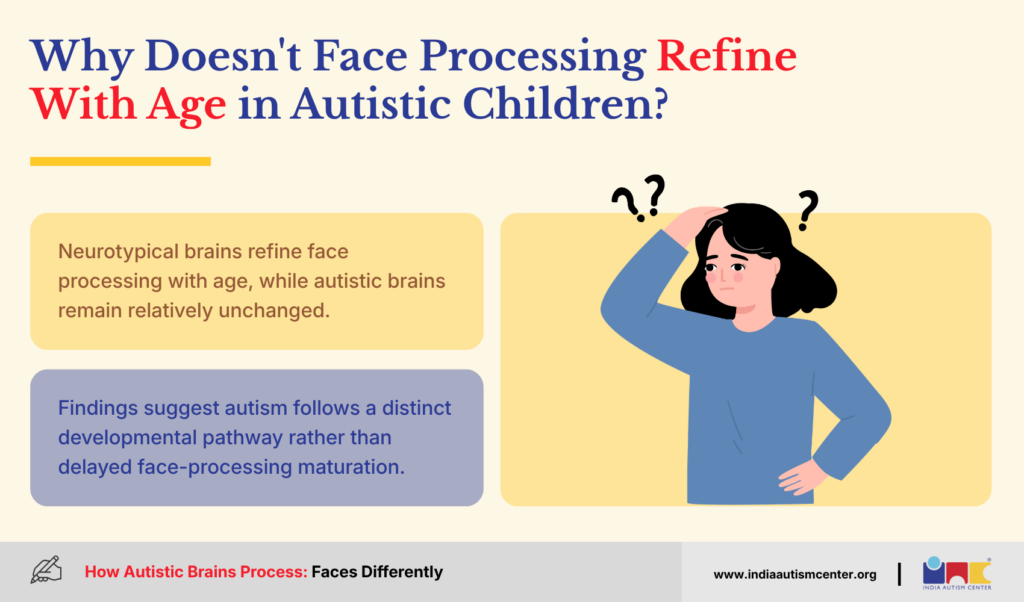
  • Autistic Burnout Recovery: A Complete, Research-Backed Guide

    Autistic Burnout Recovery: A Complete, Research-Backed Guide

    Autistic burnout recovery means reducing demands, restoring sensory safety, and rebuilding capacity gradually — not just resting more. Recovery is non-linear and often takes months, sometimes years. It requires structural changes to environment, workload, and masking, not willpower or a weekend off. This guide covers the full recovery process, realistic timelines, and practical tools you can use today.

    What Is Autistic Burnout, Exactly?

    What Is Autistic Burnout, Exactly

    Autistic burnout is a state of deep physical, mental, and emotional exhaustion. It develops after prolonged periods of stress, masking, and sensory overload. Unlike everyday tiredness, it does not resolve with a good night’s sleep.

    Three features define it consistently across research:

    • Chronic exhaustion that ordinary rest doesn’t fix
    • Loss of skills across communication, self-care, or work
    • Reduced tolerance to stimulation, including sound, light, and social contact

    I’ve seen this pattern repeatedly in the autism community I work with. People describe it as “running on empty with no refill in sight.”

    How Is Autistic Burnout Different From Regular Burnout?

    How Is Autistic Burnout Different From Regular Burnout

    Occupational burnout usually stays contained to work. Autistic burnout spreads across every part of life. It affects communication, sensory processing, executive function, and relationships simultaneously.

    Regular burnout responds well to vacations and workload changes. Autistic burnout often persists even after time off. The underlying cause — chronic mismatch between autistic needs and environmental demands — has to change first.

    FactorOccupational BurnoutAutistic Burnout
    Primary triggerWorkplace stressMasking, sensory overload, unmet needs
    Scope of impactMostly workWork, home, relationships, self-care
    Responds to rest aloneOften yesRarely
    Typical durationWeeksMonths to years
    Recovery approachReduce workloadReduce demands + redesign environment

    Is Autistic Burnout the Same as Depression?

    Is Autistic Burnout the Same as Depression?

    No. Autistic burnout and depression can look similar but have different roots. Depression involves persistent low mood and loss of interest, even in low-demand situations. Autistic burnout improves when demands and sensory load decrease, even if only partially.

    Many autistic adults experience both together. If you’re unsure which you’re facing, a mental health professional familiar with autism can help you tell them apart. This distinction matters because the recovery strategies differ.

    Want to know more? Get in touch with us.

    Why Doesn’t Rest Alone Fix Autistic Burnout?

    Why Doesn't Rest Alone Fix Autistic Burnout

    Rest alone doesn’t fix autistic burnout because the causes are structural, not just physical fatigue. Masking, sensory overload, and unsustainable demands drain capacity continuously. Sleep restores energy temporarily, but the underlying mismatch keeps draining it back out.

    Think of it like a bucket with a hole. You can keep pouring water in — sleep, weekends, holidays — but if the hole isn’t patched, the bucket never fills. Patching the hole means changing your environment and expectations, not just adding more rest.

    Recovery typically requires:

    • Reducing demands at the source
    • Increasing accommodations at work and at home
    • Improving self-understanding of your own limits
    • Redesigning environments to be more sustainable

    This entire section has been covered in great detail in Autistic Burnout Recovery: A Complete, Research-Backed Guide

    What Are the Early Signs You’re Heading Into Burnout?

    What Are the Early Signs You're Heading Into Burnout

    Recognising early signs can prevent burnout from deepening. Watch for these changes against your own baseline, not someone else’s:

    • Masking becomes exhausting rather than automatic
    • Everyday sounds or lights feel unbearable, not just annoying
    • Simple tasks like cooking or replying to messages feel overwhelming
    • You start avoiding places you used to manage fine, like the grocery store
    • Your energy for special interests drops, which is often a red flag

    If several of these apply and they’re getting worse, it’s worth slowing down before you hit full burnout.

    How Long Does Autistic Burnout Recovery Take?

    Autistic burnout recovery timelines vary widely, from a few months to several years. Mild burnout may ease within weeks once demands drop. Severe or repeated burnout, especially when the causes stay unaddressed, can last years.

    Here’s a general framework, though your experience may not match it exactly:

    StageTypical DurationWhat It Looks Like
    Acute burnout2–8 weeksSharp drop in functioning, high sensory sensitivity
    Stabilization1–3 monthsDemands reduced, symptoms plateau
    Early rebuilding3–6 monthsSmall tasks return, energy fluctuates
    Sustainable rebuilding6 months–2 yearsGradual capacity gains, setbacks still occur
    Ongoing managementLong-termOngoing prevention, occasional flare-ups

    Recovery is rarely a straight line. Most people describe a pattern of improvement, setback, then improvement again. A setback doesn’t mean you’re back to square one — it usually means a demand briefly exceeded your current capacity.

    Want to know more? Get in touch with us.

    What Does the Recovery Process Actually Involve?

    What Does the Recovery Process Actually Involve

    Recovery isn’t one action — it’s a set of coordinated changes. Based on current research and lived experience, here’s the framework I recommend.

    Step 1: Stop Further Depletion First

    Before you can rebuild, you have to stop losing ground. This means identifying and pausing whatever is draining you fastest, even temporarily. Push-through approaches usually make burnout worse, not better.

    Ask yourself: what’s the single biggest drain right now? Can it be reduced, postponed, or removed for the next few weeks? Start there.

    Step 2: Build an Energy Inventory

    An energy inventory lists which activities drain you and which restore you. Rate each activity on a simple scale, such as 1 (very draining) to 4 (restorative). This turns a vague feeling of “I’m exhausted” into something you can actually act on.

    Common draining activities:

    • Masking in social or professional settings
    • Unpredictable schedule changes
    • Multitasking under time pressure
    • Sensory-heavy environments like open offices

    Common restorative activities:

    • Time with special interests
    • Solitude without social demands
    • Predictable, low-stimulation routines
    • Stimming without needing to suppress it

    Step 3: Redesign Your Sensory Environment

    Sensory recovery means reducing sensory load while your capacity returns. Small changes often make a measurable difference:

    • Reduce lighting intensity or switch to warmer tones
    • Use noise-cancelling headphones during high-stimulation hours
    • Build in device-free, low-input windows daily
    • Limit multitasking to one demand at a time

    Step 4: Reduce Masking Where It’s Safe To Do So

    Masking is one of the biggest hidden costs in autistic burnout. Unmasking gradually, in spaces where it’s safe, can meaningfully lower your daily energy spend.

    This doesn’t mean disclosing your autism everywhere at once. It means finding pockets — home, trusted friends, specific communities — where you don’t have to perform neurotypical behavior.

    Step 5: Rebuild Gradually, Not All at Once

    Rebuilding capacity works best in small, sustainable increments. Trying to return to full functioning too quickly usually triggers a setback. A useful rule: add back one demand at a time, and wait before adding the next.

    Step 6: Address the Root Causes to Prevent Relapse

    Recovery without addressing the original causes often leads to repeated burnout cycles. Many autistic adults describe this pattern: push, compensate, crash, recover, then crash again. Preventing recurrence means changing the conditions that caused burnout in the first place, not just recovering from this one.

    What Causes Autistic Burnout in the First Place?

    What Causes Autistic Burnout in the First Place?

    Autistic burnout rarely comes from one single stressor. It builds up from a combination of demands that exceed your available capacity over time. Understanding your specific causes matters more than following a generic recovery checklist.

    Common contributing factors include:

    • Chronic masking at work, school, or in family settings
    • Sensory overload from noise, lighting, crowds, or unpredictable environments
    • Executive function strain from juggling deadlines, admin, and daily tasks
    • Social exhaustion from sustained interaction without recovery time
    • Life transitions, such as a new job, move, or relationship change
    • Lack of accommodations, which forces constant over-adaptation

    In India specifically, cultural pressure to mask autistic traits can be intense. Joint family expectations, limited workplace disclosure protections, and low awareness of adult autism often mean autistic adults push through far longer before recognizing burnout. This delay tends to make the eventual burnout deeper and the recovery longer.

    How Do You Know You’re Actually Recovering?

    How Do You Know You're Actually Recovering

    Recovery signs are often subtle at first, so it helps to know what to look for. Compare against your burnout baseline, not your pre-burnout self — early wins are usually small.

    Signs recovery is progressing:

    • Sensory tolerance is slowly increasing, even slightly
    • You can complete a task without days of recovery afterward
    • Special interests start feeling enjoyable again, not draining
    • Setbacks are shorter and less severe than before
    • You’re identifying your limits before hitting a wall, not after

    Signs you may be pushing too fast:

    • A single demanding day leads to several days of shutdown
    • Sensory sensitivity spikes again after a period of improvement
    • You’re masking more just to “prove” you’re better
    • Sleep and appetite changes return after stabilizing

    If you notice the second list more than the first, it’s worth pulling back demands again rather than pushing through.

    How Does Masking Fuel the Burnout Cycle?

    Masking means suppressing autistic traits to appear neurotypical. It’s one of the most consistently cited causes of autistic burnout in research. Sustained masking requires constant self-monitoring, which is mentally exhausting even when it looks effortless from the outside.

    The cycle often looks like this: mask to meet expectations, deplete energy reserves, crash into burnout, recover just enough to function, then resume masking again. Without breaking this cycle, burnout tends to repeat.

    Reducing masking doesn’t mean abandoning it everywhere at once. Start by identifying one low-risk setting — a close friend, a support group, or time alone — where you can drop the performance completely. Expand from there as it feels safe.

    You may like to read more on Autism Masking: Reason, Signs, Effects, Types & Solutions 

    What Role Do Relationships Play in Autistic Burnout Recovery?

    What Role Do Relationships Play in Autistic Burnout Recovery

    Relationships can either support or drain recovery, depending on how much social effort they require. Sustained social contact, even with people you love, uses the same limited capacity that burnout has already depleted.

    This doesn’t mean isolating completely. It means being selective about which relationships get your limited energy during recovery. Relationships that require constant masking or emotional labor may need to be paused, while low-demand, accepting relationships can be genuinely restorative.

    Being upfront with close people about reduced capacity — even briefly — tends to prevent misunderstandings. Most people would rather know you need space than assume you’re withdrawing from them personally.

    What Are the Biggest Mistakes People Make During Autistic Burnout Recovery?

    What Are the Biggest Mistakes People Make During Autistic Burnout Recovery

    Certain patterns consistently slow down recovery, even with good intentions. Recognizing them early can save months of unnecessary setbacks.

    • Treating recovery like a deadline. Setting a fixed date to “be back to normal” often triggers premature pushing and relapse.
    • Comparing your recovery to someone else’s. Burnout severity and recovery speed vary widely between individuals.
    • Returning to the exact same demands. Recovering fully, then walking back into the same unaddressed triggers, usually restarts the cycle.
    • Ignoring small wins. Dismissing gradual progress as “not enough” removes motivation to keep going.
    • Waiting for permission to rest. Many autistic adults delay reducing demands until they’re in crisis, rather than acting on early warning signs.
    https://youtu.be/QmsQPoFkav4?si=UuOxEShnk9dfpdcc

    What Can Families and Employers Do to Support Recovery?

    What Can Families and Employers Do to Support Recovery

    Recovery isn’t only an individual effort — the people and systems around an autistic person matter too. This is a gap most recovery guides skip entirely.

    For families and caregivers:

    • Reduce social and scheduling demands without requiring explanation
    • Avoid pushing “just push through it” advice
    • Allow withdrawal and solitude without treating it as a problem
    • Learn the difference between burnout and defiance or laziness

    For employers and workplaces:

    • Allow flexible or reduced hours during acute burnout
    • Offer sensory accommodations: lighting, noise control, quiet spaces
    • Reduce unnecessary meetings and last-minute schedule changes
    • Normalize written communication over spontaneous verbal demands

    A workplace that treats these as reasonable accommodations, not special favors, significantly shortens recovery time.

    Does Autistic Burnout Happen in Children and Teens?

    Does Autistic Burnout Happen in Children and Teens?

    Yes, autistic burnout can affect children and teens, though it’s under-researched in this age group. In children, it often looks like increased meltdowns, school refusal, regression in skills, or sudden loss of speech in situations where they previously spoke.

    Parents and educators should watch for sudden changes against the child’s usual baseline. Reducing academic and social demands early often prevents burnout from deepening in younger autistic people.

    Frequently Asked Questions

    Can you fully recover from autistic burnout?

    Many autistic adults report substantial recovery, though full baseline function isn’t guaranteed for everyone. Recovery is more reliable when the root causes are addressed, not just the symptoms.

    What’s the fastest way to recover from autistic burnout?

    There’s no fast fix. The most effective approach is reducing demands immediately, then rebuilding gradually over months. Trying to speed up recovery through pushing usually backfires.

    Can autistic burnout come back after recovery?

    Yes, especially if the original causes — excessive masking, unsustainable workload, sensory overload — remain unaddressed. Ongoing prevention is part of long-term management, not a one-time fix.

    Is autistic burnout recognised as a medical diagnosis?

    Not currently. It’s a well-documented lived experience and an active area of research, but it isn’t yet a formal clinical diagnosis in the DSM-5 or ICD-11.

    How is autistic burnout different from a meltdown or shutdown?

    A meltdown or shutdown is usually a short, acute response to overwhelming input. Autistic burnout is a prolonged state that can last weeks or years and affects overall functioning, not just a single moment.


    This article is for educational purposes only and does not constitute medical or psychological advice. Autistic burnout can overlap with other health conditions, including depression and anxiety. If you’re struggling with your mental health, please consult a qualified healthcare professional or therapist familiar with autism.

    For expert insights, support services, and inclusive learning initiatives, visit the India Autism Center.
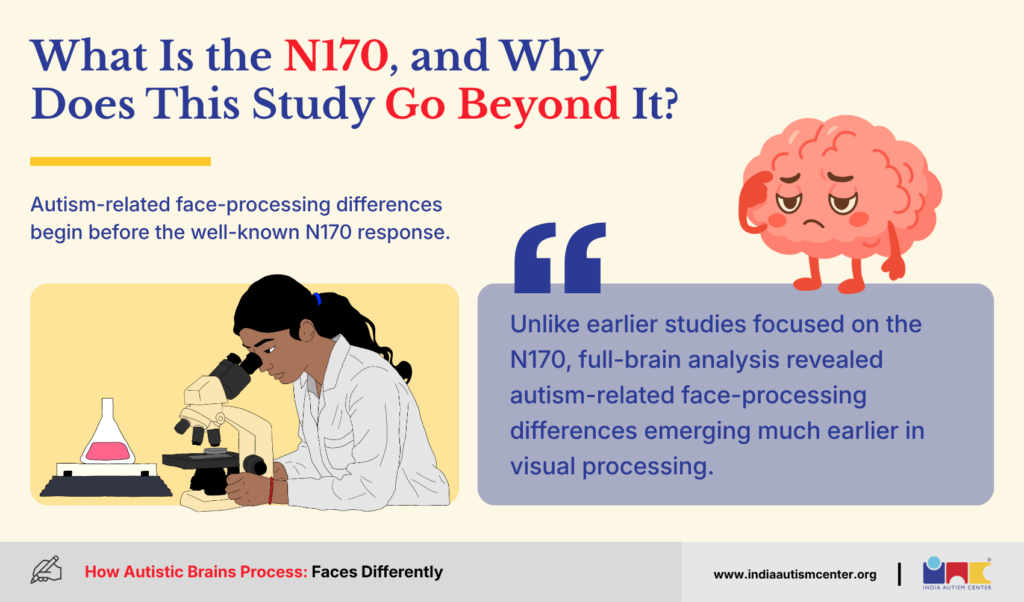
  • Why Rest Doesn’t Help Autistic Burnout & What Actually Works

    Why Rest Doesn’t Help Autistic Burnout & What Actually Works

    Rest restores energy, but it doesn’t rebuild capacity. Autistic burnout happens when demands exceed resources for too long. Sleeping more or taking a vacation won’t fix that mismatch. Real recovery means reducing sensory and social demands, redesigning your environment, and rebuilding capacity gradually. Rest is one part of a larger process, not the whole solution. And in this blog we are going to answer why rest doesn’t help autistic burnout in great details, and what needs to be done.

    What Is Autistic Burnout?

    What Is Autistic Burnout

    Autistic burnout is a state of chronic exhaustion caused by prolonged overextension of coping resources. It’s not the same as feeling tired after a busy week. It builds over months or years of masking, sensory overload, and unsupported effort.

    Researchers describe three core features of autistic burnout:

    • Chronic exhaustion that doesn’t improve with sleep
    • Skill regression, where abilities you normally have become harder to access
    • Reduced tolerance to stimuli, meaning sensory and social input feels more overwhelming than before

    Autistic burnout can last weeks, months, or years. It often gets misread as laziness, depression, or a personality change. It’s none of those things. It’s a physiological response to sustained overload.

    How Is Autistic Burnout Different From Depression or Chronic Fatigue?

    How Is Autistic Burnout Different From Depression or Chronic Fatigue

    Autistic burnout overlaps with depression and chronic fatigue syndrome, but the causes and recovery paths differ. Depression often responds to therapy and medication targeting mood regulation. Autistic burnout responds to demand reduction and environmental change. Here’s how they compare:

    FeatureAutistic BurnoutClinical DepressionChronic Fatigue Syndrome
    Primary causeProlonged demand-resource mismatchNeurochemical/psychosocial factorsUnclear; often post-viral or immune-related
    Core symptomSkill regression + sensory sensitivityPersistent low mood, anhedoniaPost-exertional malaise
    Trigger patternWorsens with masking, sensory loadCan occur without external triggerWorsens with physical/cognitive exertion
    Response to restPartial relief onlyVariablePartial relief only
    Primary recovery leverReducing environmental demandsTherapy, medicationPacing, medical management
    MoodFlat or irritable, situationalPersistently low, pervasiveCan accompany fatigue

    These conditions can co-occur. A person can experience autistic burnout and depression at the same time. If symptoms persist beyond a few months, a clinical evaluation can rule out overlapping conditions and guide the right treatment combination.

    📥 Free download: Printable daily routine chart for autistic children

    Why Rest Alone Doesn’t Help Autistic Burnout

    Why Rest Alone Doesn't Help Autistic Burnout

    Rest doesn’t fix autistic burnout because burnout isn’t caused by a lack of sleep. It’s caused by a mismatch between environmental demands and available coping resources. Sleeping more won’t change the environment that caused the overload in the first place.

    What Happens to the Body During Chronic Overload?

    Sustained stress activates the hypothalamic-pituitary-adrenal (HPA) axis repeatedly. Over time, this system stops resetting properly between stressors. Researchers call this cumulative strain allostatic load.

    High allostatic load means the body’s stress-response system stays partially activated even during rest. This explains why a person can sleep eight hours and still wake up exhausted. The nervous system hasn’t actually powered down.

    What Is the Cognitive Resource Model?

    Executive function operates like a limited daily resource. Every act of masking, sensory filtering, or social decoding draws from that resource pool. For autistic people, daily environments often demand far more of this resource than they provide back.

    Rest can partially refill this pool. But if the same high-demand environment returns the next day, the pool drains again just as fast. This is the core reason vacations feel good but burnout returns.

    Why Does Burnout Come Back After a Vacation?

    Burnout comes back after a vacation because the underlying environment hasn’t changed. A vacation removes demands temporarily. Once you return to the same job, sensory environment, or social obligations, the same mismatch resumes. Recovery requires changing the environment, not just pausing it.

    This is called person-environment mismatch. It means burnout isn’t a personal flaw. It’s a signal that your environment is asking for more than it’s built to support.

    What Actually Causes Autistic Burnout?

    What Actually Causes Autistic Burnout?

    Autistic burnout is caused by cumulative, unsupported demand across several domains. The most common contributors include:

    • Sensory overload — fluorescent lighting, open-plan offices, crowded transport, constant noise
    • Masking and camouflaging — suppressing stims, forcing eye contact, scripting conversations
    • Social-communication effort — the extra work of decoding neurotypical communication norms, sometimes called the double empathy problem
    • Executive function load — planning, switching tasks, and managing unpredictability
    • Unpredictability and uncertainty — last-minute changes, unclear expectations, unstructured time

    Each of these draws down the same limited resource pool. Most autistic people face several of them simultaneously, every day, without accommodation.

    Read our blog on Autism Masking: Reason, Signs, Effects, Types & Solutions 

    How Long Does Autistic Burnout Recovery Take?

    How Long Does Autistic Burnout Recovery Take?

    Autistic burnout recovery timelines vary widely, from a few weeks to several years. Recovery speed depends on burnout severity, how much the environment changes, and how much support is available. Mild burnout caught early can resolve in weeks with demand reduction. Severe, prolonged burnout can take years of sustained environmental change.

    There’s no fixed recovery calendar. Expecting a fast timeline often causes people to push themselves back into the same overload cycle. Gradual, non-linear recovery is normal and expected.

    Want to know more? Get in touch with us.

    What Is the Actual Recovery Framework for Autistic Burnout?

    What Is the Actual Recovery Framework for Autistic Burnout?

    Recovering from autistic burnout requires five steps: mapping your demands, reducing them, redesigning your environment, setting boundaries around masking, and rebuilding capacity slowly. Rest supports this process but doesn’t replace it.

    Step 1: Map Your Demands

    List every recurring demand in your week. Rate each one by intensity, from mildly draining to severely draining. Include sensory, social, cognitive, and emotional demands separately. This map shows exactly where your resources are going.

    Step 2: Reduce and Redistribute Demands

    Once mapped, identify which demands can be reduced, delegated, or removed. Some examples:

    • Swap open-plan seating for a quieter workspace, if possible
    • Replace verbal check-ins with written updates
    • Batch social obligations instead of spreading them daily
    • Delegate high-effort tasks that don’t require your specific skills

    Small reductions compound. You don’t need to remove every demand — just enough to stop the daily deficit.

    Step 3: Redesign the Environment, Not Just Yourself

    Environmental change works better than willpower. Noise-cancelling headphones, flexible hours, and written communication options reduce demand at the source. This is more sustainable than trying to build tolerance to an overwhelming environment.

    Step 4: Set Boundaries Around Masking

    Masking is one of the biggest hidden drains in autistic burnout. Identify low-risk spaces where you can unmask selectively, such as with trusted friends or at home. Reducing masking even part-time lowers cumulative load significantly.

    Step 5: Rebuild Capacity Gradually

    Add activities back slowly, one at a time. Watch for early warning signs of overload before adding more. Rebuilding too fast is the most common cause of relapse.

    What Does Support Look Like for Employers and Families?

    What Does Support Look Like for Employers and Families

    Employers and families can support autistic burnout recovery by reducing demands, not by encouraging more rest alone. Practical support includes flexible schedules, sensory-friendly spaces, written instructions, and predictable routines. Understanding replaces pressure to “push through.”

    What Should Employers Do?

    • Offer flexible or remote work options where feasible
    • Reduce unnecessary meetings and last-minute changes
    • Allow written communication as an alternative to verbal check-ins
    • Provide a quiet space or allow noise-cancelling headphones

    What Should Families Do?

    • Avoid framing burnout as laziness or a phase
    • Reduce social obligation pressure during recovery periods
    • Allow stimming and unmasking at home without comment
    • Ask what kind of support is helpful, rather than assuming

    Avoid saying: “You just need to relax more” or “Everyone gets tired.” These responses minimize a physiological state and can delay recovery.

    📥 Free download: Printable daily routine chart for autistic children

    How Does Autistic Burnout Show Up Differently in Indian Workplaces and Families?

    How Does Autistic Burnout Show Up Differently in Indian Workplaces and Families

    Autistic burnout in India often intersects with cultural expectations around family duty, workplace hierarchy, and limited flexibility. Joint-family living can increase social demand rather than reduce it. Open-plan offices and rigid attendance norms are common, and disclosure of autism still carries significant stigma in many workplaces.

    Access to autism-informed therapists and occupational therapists remains limited outside major cities. This makes environmental self-management, rather than clinical intervention alone, a practical necessity for many autistic adults in India. Community-based and family-inclusive strategies often work better than approaches designed around Western workplace norms, such as fully remote work or living independently.

    https://youtu.be/sQpo2tzc5h8?si=-C88mv3qgmVRf0Gw

    What Are the Signs You Need Professional Support?

    Professional support becomes necessary when burnout symptoms persist beyond a few months, when skill regression is severe, or when self-harm thoughts appear. A psychiatrist or occupational therapist experienced with autism can assess co-occurring conditions and guide a structured recovery plan.

    Warning signs that need clinical attention include:

    • Burnout lasting more than three to six months without improvement
    • Significant loss of previously stable daily living skills
    • Withdrawal from all social contact, not just high-demand situations
    • Thoughts of self-harm or hopelessness

    If any of these apply, reach out to a qualified mental health professional promptly.

    Frequently Asked Questions

    Can autistic burnout be misdiagnosed as depression?

    Yes. Autistic burnout shares symptoms with depression, including low energy and reduced motivation. Misdiagnosis is common when clinicians aren’t familiar with autism presentation in adults. An accurate diagnosis considers both possibilities together.

    How is autistic burnout different from regular burnout?

    Regular workplace burnout responds to reduced workload and rest. Autistic burnout requires reducing sensory and social demands specifically, alongside workload. It also includes skill regression, which isn’t typically part of standard burnout definitions.

    Can you fully recover from autistic burnout?

    Many autistic people recover significantly with sustained environmental change and demand reduction. Full recovery timelines vary, and some residual sensitivity may remain. Recovery is possible, but it’s rarely instant.

    Does masking cause autistic burnout?

    Masking is one of the largest contributors to autistic burnout. Suppressing natural behaviors and mimicking neurotypical norms requires continuous cognitive effort. Reducing masking, especially in safe environments, lowers overall burnout risk.

    How do I explain autistic burnout to my employer or family?

    Describe it as a physiological state caused by prolonged overload, not a mood or motivation issue. Share specific, practical accommodations that would help, rather than only naming the diagnosis. Concrete requests are usually easier for others to act on.


    This article is for educational purposes only and isn’t a substitute for professional medical or psychological advice. If you’re experiencing prolonged burnout, skill regression, or thoughts of self-harm, please consult a qualified healthcare professional.

    For expert insights, support services, and inclusive learning initiatives, visit the India Autism Center.
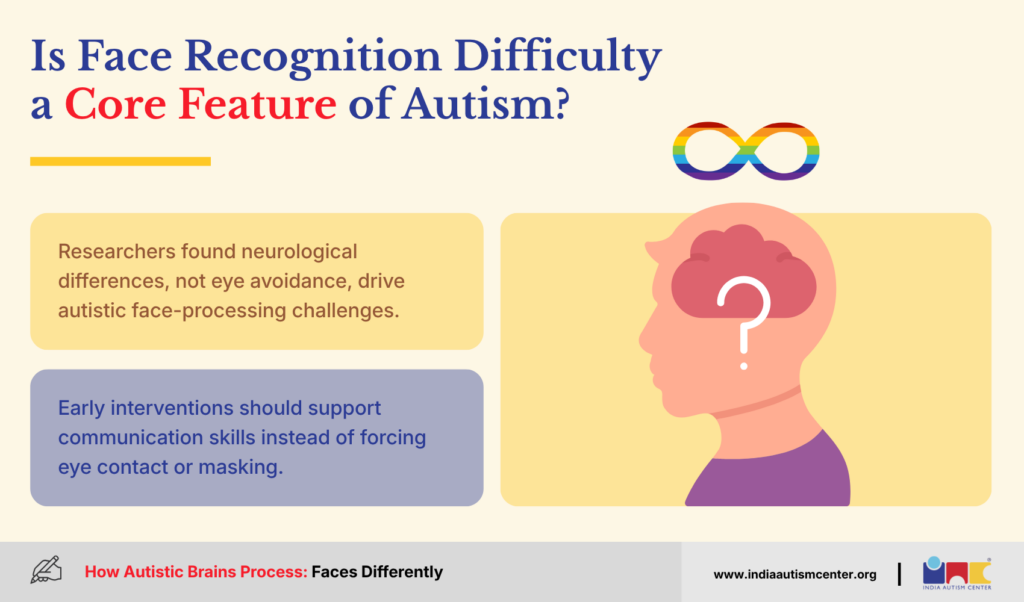
  • Is My Autistic Child Ready For School?

    Is My Autistic Child Ready For School?

    Your autistic child may be ready for school if they can follow simple two-step instructions, tolerate a structured routine for at least 30–45 minutes, manage basic personal needs like toileting with minimal help, and communicate wants and needs — even non-verbally. But readiness isn’t a single milestone. It’s a profile.

    That’s the honest answer. And I know it’s not the clean yes or no most parents come here hoping for.

    We hear from families who are terrified of getting this decision wrong. Should I send my child this year? Will the classroom overwhelm them? What if they can’t sit still, or they have a meltdown in front of everyone? These aren’t small fears. They’re legitimate questions that deserve serious, practical answers.

    So let me walk you through this properly.

    What Does “School Ready” Actually Mean For An Autistic Child?

    What Does "School Ready" Actually Mean for an Autistic Child?

    School readiness for an autistic child looks different from the standard checklist.

    For neurotypical children, readiness typically means knowing colours, counting to ten, and being able to sit quietly. For autistic children, the more important markers are around self-regulation, communication, and sensory tolerance — not academic knowledge.

    Here’s what matters most:

    Readiness DomainWhat to Look For
    CommunicationCan express basic needs (verbally or via AAC/gestures)
    Self-regulationCan tolerate transitions without prolonged distress
    Self-careManages toileting, eating, and dressing with some independence
    AttentionCan engage with an activity for 10–15 minutes
    Social toleranceCan be in a shared space with other children without significant dysregulation

    Notice I said “with some independence” and “without significant dysregulation.” I’m not asking for perfection. I’m asking for a functional baseline that a school can build on.

    Want to know more? Get in touch with us.

    What Are the Signs My Autistic Child Is Ready for School?

    What Are the Signs My Autistic Child Is Ready for School?

    Look for functional communication, basic self-care, and the ability to tolerate — not necessarily enjoy — structured group settings.

    These are the most reliable green-light indicators:

    • Follows two-step verbal or visual instructions (e.g., “pick up your bag and sit down”)
    • Can wait briefly — even 2–3 minutes — without full meltdown
    • Uses consistent communication to express “yes,” “no,” “want,” or “help”
    • Is toilet-trained or actively progressing toward it
    • Shows some curiosity or interest in other children, even from a distance
    • Can tolerate wearing school uniform or sensory-similar clothing for extended periods

    If your child checks most of these, school is likely a viable option — with the right support in place. If they check only a few, that doesn’t mean “not ready forever.” It means you need a more structured autism early intervention plan before or alongside enrolment.

    What If My Autistic Child Cannot Sit In Class?

    What If My Autistic Child Cannot Sit in Class?

    An autistic child who cannot sit in class is not failing — the classroom environment may simply be unaccommodating of their neurological needs.

    This is one of the most common concerns I encounter. And it’s also one of the most misunderstood.

    Sitting still in a row of desks for 40-minute periods is not a natural human activity. It’s especially not natural for autistic children, many of whom have significant sensory processing differences, proprioceptive needs, or attention profiles that require movement to regulate.

    What actually helps:

    • Movement breaks every 20–25 minutes
    • Flexible seating — wobble cushions, floor seating, or corner desks
    • Visual schedules so the child knows what’s coming
    • Fidget tools that don’t distract others
    • Shadow teacher or resource room access when dysregulation builds

    The question isn’t “can my child sit in class?” The question is: “does this school know how to make sitting manageable for my child?”

    What Are the Most Common Autism Classroom Behaviour Problems?

    What Are the Most Common Autism Classroom Behaviour Problems?

    The most common classroom behaviour challenges in autistic children include elopement, meltdowns, aggression, refusal to transition, and self-stimulatory behaviour that disrupts group activities.

    Let me be clear: these behaviours are not “bad behaviour.” They are communication and regulation strategies for a child whose nervous system is overwhelmed.

    Most frequent challenges schools report:

    • Elopement — leaving the classroom or school premises suddenly
    • Meltdowns — full dysregulation in response to sensory or schedule overload
    • Aggression — hitting, biting, or throwing, often as a last resort when overwhelmed
    • Task refusal — shutting down when a demand exceeds current capacity
    • Stimming — rocking, hand-flapping, or vocalising, which can disrupt group activities

    Each of these has evidence-based responses. The problem is most schools haven’t been trained in them.

    Want to know more? Get in touch with us.

    How Do Schools Handle Autism Meltdowns?

    How Do Schools Handle Autism Meltdowns?

    A prepared school handles autism meltdowns by reducing demands immediately, moving the child to a calm space, minimising language, and waiting — not redirecting, not reasoning, not disciplining.

    This is what’s called a de-escalation protocol, and it should be written into your child’s autism IEP (Individualized Education Program) or equivalent support plan.

    Here’s what proper meltdown management looks like:

    What schools SHOULD do:

    • Reduce all demands the moment escalation starts
    • Move the child to a pre-designated calm or sensory space
    • Use minimal language — one calm phrase, repeated if needed
    • Maintain safety without physical restraint unless absolutely necessary
    • Allow recovery time before returning to tasks

    What schools SHOULD NOT do:

    • Demand compliance mid-meltdown
    • Send the child to the principal or isolate them punitively
    • Call parents to take the child home every single time
    • Treat meltdown as wilful disobedience

    If a school’s default response is to call you every time your child melts down, that school needs training — not your child.

    What Is an Autism IEP in India — and Does My Child Need One?

    What Is an Autism IEP in India

    An Individualized Education Program (IEP) in India is a written document developed between parents, special educators, and therapists that outlines a child’s current levels, goals, accommodations, and review timelines.

    India does not have federal IEP legislation equivalent to the US IDEA, but the Rights of Persons with Disabilities Act (RPWD Act, 2016) mandates that children with disabilities, including autism, receive reasonable accommodations and inclusive education support.

    Under the RPWD Act, your child has the right to:

    • Enrolment in a neighbourhood school without discrimination
    • A support teacher or resource person if needed
    • Modified assessments and evaluation criteria
    • A barrier-free physical environment

    In practice, most Indian schools — especially government and lower-budget private schools — are not equipped. This is where specialist centres, bridge schools, or hybrid models become relevant.

    At India Autism Center, we work with families to build functional IEP-equivalent plans even when the school isn’t formally issuing one. It’s not ideal, but it’s the reality of the current ecosystem.

    What Are Effective Autism Classroom Support Strategies?

    What Are Effective Autism Classroom Support Strategies?

    The most effective autism classroom support strategies combine visual structure, sensory accommodation, predictable routines, and trained personnel.

    These are the non-negotiables:

    Visual Structure

    • Daily visual schedule posted at eye level
    • Visual timers during transitions
    • Picture-based task instructions where possible

    Sensory Accommodation

    • Seating away from windows, AC vents, or high-traffic areas
    • Access to ear defenders or noise-reducing headphones during loud activities
    • Lighting adjustments where fluorescent lights cause distress

    Routine and Predictability

    • Consistent classroom layout — no surprise rearrangements
    • Advanced warning of changes (“Tomorrow, assembly will be at 10am, not 9am”)
    • Consistent pairings with familiar adults

    Personnel Training

    • Class teacher trained in autism basics (not optional — essential)
    • Shadow teacher or aide where possible
    • Regular communication channel between school and family

    Peer Support

    • Buddy systems with trained classmates
    • Social skills circle time built into the day
    • Structured play opportunities, not just free play

    Without at least half of these in place, many autistic children will not access learning — not because they can’t learn, but because they can’t regulate in a dysregulating environment.

    What Are the Autism Learning Difficulties I Should Prepare the School For?

    What Are the Autism Learning Difficulties I Should Prepare the School For?

    Autism-related learning difficulties most commonly involve processing speed, working memory, executive function, written expression, and generalising skills from one context to another.

    These are not intellectual deficits. Many autistic children have strong abilities in specific domains — pattern recognition, memory for facts, spatial reasoning. But they may struggle with:

    • Following multi-step verbal instructions without visual support
    • Generalisation — learning a skill in therapy but not using it in school
    • Working memory — keeping information in mind while completing a task
    • Flexible thinking — adapting when a familiar method doesn’t work
    • Written expression — translating thoughts onto paper, even when verbal communication is fluent

    Tell the school these specifics upfront. Don’t wait for a teacher to notice and misread them as laziness or defiance.

    How Do I Prepare My Autistic Child for School?

    How Do I Prepare My Autistic Child for School?

    Start preparing at least 3–6 months before school begins, focusing on school-specific routines, social exposure, and desensitisation to the school environment itself.

    Here’s a practical pre-school checklist:

    • Visit the school multiple times before the first day — during off-hours first, then during active school time
    • Practice the uniform at home, daily, for several weeks beforehand
    • Establish a morning routine that mirrors the school-day schedule
    • Work on transition tolerance — use timers, visual cues, and predictable endings
    • Identify the child’s sensory triggers and communicate them to the school in writing
    • Build communication about school — play “going to school” games at home
    • Coordinate with a therapist to target specific school-readiness skills

    If your child is currently in autism early intervention — speech therapy, occupational therapy, ABA, or a combination — brief the therapists on school readiness goals. Align therapy targets to classroom demands specifically.

    What Support Is Available for Autistic Children in Indian Schools?

    What Support Is Available for Autistic Children in Indian Schools?

    Autistic children in India are entitled to inclusive education support under the RPWD Act 2016, the National Education Policy 2020, and the RCI (Rehabilitation Council of India) framework for special educators.

    Here’s what exists — even if it’s inconsistently implemented:

    Support TypeWhat It Covers
    Inclusive Education MandateRight to enrol in regular school without refusal
    RCI-Certified Special EducatorsTrained professionals for IEP and in-class support
    Scribe/Reader AccommodationAvailable for board exams under disability category
    Modified AssessmentSchools can adapt evaluation for autistic children
    NIEPID and NIMH ResourcesNational institutes offering assessment and training

    The gap between what’s legally available and what’s practically accessible is significant. But knowing your rights is the starting point.

    📥 Free download: Printable daily routine chart for autistic children

    When Should I Consider a Special School Instead of Inclusive Education?

    When Should I Consider a Special School Instead of Inclusive Education?

    A special school or bridge programme may be more appropriate when a child’s sensory, communication, or behavioural profile makes a mainstream classroom genuinely unsafe or inaccessible — not just inconvenient.

    Inclusive education is the goal. But inclusion must be meaningful, not just physical proximity to neurotypical peers.

    Consider a specialist setting if:

    • Your child is experiencing daily meltdowns in the current environment with no sign of regulation improvement
    • The school is unwilling or unable to implement basic accommodations
    • Your child is losing skills (regression) since starting school
    • Safety concerns — elopement or aggression — are not being managed adequately
    • Your child has co-occurring conditions (intellectual disability, epilepsy, severe anxiety) that require specialist support

    A good bridge programme — like what we offer at India Autism Center through Manan — prepares children for eventual mainstream inclusion. It’s not a permanent alternative. It’s a structured stepping stone.

    How To Survive School as an Undiagnosed Autistic Child in India (2025) | India Autism Center

    What Is The Right Age to Start School for an Autistic Child?

    What Is The Right Age to Start School for an Autistic Child?

    There is no single right age. The decision should be based on the child’s readiness profile, not their chronological age alone.

    In India, the standard school entry age is 5–6 years. But many autistic children benefit from delaying formal school entry by 1–2 years to build foundational skills through early intervention first.

    On the other hand, some autistic children with strong communication and self-regulation skills are ready at 4.5 years in the right environment.

    The age question is less important than the readiness question. And readiness is built — not waited for.

    Conclusion

    I’ll leave you with this: no child is “not ready for life.” Some children are not yet ready for a specific environment. And sometimes, that environment needs to do the adapting.

    If you’re sitting with this question — is my autistic child ready for school — you’re already doing the most important thing. You’re thinking carefully, advocating early, and refusing to accept generic answers for a child who is anything but generic.

    If you want a proper readiness assessment, support plan, or guidance on the right school pathway for your child, our team at India Autism Center is here to help.


    Disclaimer: This article is written for educational and informational purposes only. It is not a substitute for professional clinical assessment, medical advice, or individualised educational planning. Every autistic child has a unique profile — please consult a qualified developmental paediatrician, psychologist, or special educator before making decisions about your child’s schooling. For a formal evaluation or IEP development support, please reach out to a registered professional or contact India Autism Center directly.

  • 2026 Study | Young Women with ADHD Are at Higher Risk of Serious Health Problems

    2026 Study | Young Women with ADHD Are at Higher Risk of Serious Health Problems

    A recent study on Attention-Deficit/Hyperactivity Disorder (ADHD) in young women reveals that girls diagnosed with ADHD in childhood are significantly more likely to develop multiple serious health conditions as young adults. A landmark 2026 study published in Nature Mental Health found that when childhood poverty is also present, the risk compounds dramatically — with nearly 39% of the health burden driven by the interaction between ADHD and deprivation alone.

    This isn’t a minor footnote in ADHD research. It’s a wake-up call.

    What Did The 2026 Study On ADHD And Women’s Health Actually Find?

    What Did the 2026 Study on ADHD and Women's Health Actually Find?

    The study — Wilson et al. (2026), published in Nature Mental Health — followed a large population-based cohort of females born in Wales between 1991 and 1998. Researchers tracked their health records from childhood through early adulthood (ages 18–32) using linked primary and secondary care data.

    Three major findings came out of it:

    • Girls with childhood ADHD had a significantly higher risk of adult multimorbidity — 2.38 times higher than matched controls, even after accounting for other factors.
    • When childhood poverty was also present, that risk jumped to 3.91 times — far higher than either risk factor alone.
    • The most severe health cluster, seen predominantly in the ADHD group, was marked by a high burden of psychiatric conditions including PTSD and borderline personality disorder.

    Multimorbidity means having two or more long-term health conditions at the same time. This isn’t just about mental health. It spans respiratory, metabolic, gastrointestinal, autoimmune, and psychiatric conditions — all co-occurring in young women who were diagnosed with ADHD as children.

    Want to know more? Get in touch with us.

    Why Are Girls With ADHD Still Being Missed?

    Why Are Girls with ADHD Still Being Missed?

    This is the question that underpins everything else.

    ADHD was historically considered a condition that mostly affected hyperactive boys. That framing shaped the diagnostic criteria, the research, and the clinical instincts of generations of healthcare providers.

    Girls don’t usually present the same way.

    How ADHD typically looks in girls:

    Trait in Boys (more commonly recognised)Trait in Girls (more commonly missed)
    Hyperactivity, fidgeting, running aroundDaydreaming, appearing “spacey”
    Impulsivity, blurting out answersEmotional dysregulation, crying easily
    Disruptive classroom behaviourQuiet, inattentive, “tries hard but scattered”
    Externally visible struggleInternalised anxiety and self-criticism

    Girls tend to mask — consciously or unconsciously hiding their symptoms to fit social expectations. From a young age, girls are socialised to be well-behaved, attentive, and composed. So many girls with ADHD sit quietly in class with their minds racing, spending enormous energy keeping up appearances.

    By the time they’re adults, masking has become a way of life. They stay late at work to compensate for lost focus. They over-prepare to avoid looking disorganised. They tell themselves they’re just anxious, just not smart enough, just lazy.

    They’re not. They were missed.

    Research confirms that diagnostic rates are higher among boys than girls at a 2:1 ratio in childhood — and experts believe this gap reflects systemic underdiagnosis of females, not a genuine male predisposition to ADHD.

    There’s more to it; read: Why Are Fewer Girls Diagnosed with Autism?

    What Long-Term Health Conditions Are These Women Developing?

    What Long-Term Health Conditions Are These Women Developing?

    The 2026 study identified three distinct clusters of health conditions — and the pattern in women with childhood ADHD is notably more severe.

    Cluster 1: Physical Multimorbidity

    Conditions concentrated in physical health domains — respiratory, metabolic, gastrointestinal. This cluster was seen only in women without a childhood ADHD diagnosis.

    Cluster 2: Mixed-System Multimorbidity

    Both physical conditions and common psychiatric conditions like anxiety and depression. Present in both groups, but more loaded in the ADHD group.

    Cluster 3: Pan-System Multimorbidity (most severe)

    A high burden of conditions spanning nearly every body system — and in the ADHD group specifically, a significantly higher concentration of:

    • Post-traumatic stress disorder (PTSD)
    • Borderline personality disorder (BPD) — uniquely concentrated in this cluster for those with childhood ADHD, virtually absent from all other clusters
    • Anxiety and depression at elevated rates
    • Physical conditions across multiple systems

    This pan-system cluster also had the highest number of hospital admissions and the longest total days spent in hospital. The health toll is real, measurable, and preventable.

    Other research adds further context. Girls and women with ADHD carry higher risk of eating disorders, suicide attempts, suicidal ideation, and dying younger — compared not just to the general population, but also compared to boys and men with ADHD.

    Why Does Poverty Make Everything Worse?

    Why Does Poverty Make Everything Worse?

    The study didn’t just look at ADHD in isolation. It asked: what happens when a girl grows up with ADHD and in socioeconomic deprivation?

    The answer is stark.

    Girls with both ADHD and childhood poverty had odds of multimorbidity nearly 4 times higher than those with neither. Crucially, 39% of that excess risk was driven by the interaction between the two — not just their individual effects added together. That’s a synergistic effect, where two vulnerabilities collide to create something worse than the sum of their parts.

    Think about what poverty actually does to a child with ADHD:

    • Reduced access to timely diagnosis and specialist support
    • Higher exposure to adverse childhood experiences and trauma
    • Greater stress on the family system, limiting parental capacity to advocate
    • Less access to tutoring, therapy, or coping strategies
    • Heightened biological stress responses from chronic environmental pressure

    ADHD rarely occurs in a vacuum. The biological pathways — dysregulated stress responses, inflammation, impulsivity — interact with social and structural disadvantage. Girls from deprived backgrounds with ADHD carry both, and the healthcare system largely fails to address them together.

    What Happens When ADHD Goes Undiagnosed for Years?

    What Happens When ADHD Goes Undiagnosed for Years?

    The consequences of missed diagnosis are not abstract. They accumulate over time.

    Women with undiagnosed ADHD are more likely to experience:

    • Chronic stress from years of compensating without understanding why
    • Low self-esteem — often internalising failure as a character flaw rather than a neurological difference
    • Misdiagnosis — being treated for anxiety or depression while the underlying ADHD goes untreated
    • Relationship difficulties — higher rates of partner abuse, unplanned pregnancies, and social isolation

    One 2025 study in Scientific Reports found that women with late-diagnosed ADHD commonly reported guilt, shame, and deeply negative self-perception as a direct result of delayed diagnosis. Many described the diagnosis itself as revelatory — their lives finally making sense.

    The life expectancy data is sobering. A 2025 study tracking over 30,000 adults with ADHD found that women with ADHD had an average life expectancy of 75.15 years, compared to 83.79 years for women without ADHD. That’s nearly a nine-year gap.

    We have a very detailed, comprehensive article on Attention Deficit Hyperactivity Disorder (ADHD, read it to get more clarity and in-depth understanding

    Want to know more? Get in touch with us.

    How Do Hormones Complicate ADHD In Females?

    How Do Hormones Complicate ADHD In Females?

    Hormones interact with ADHD symptoms throughout a woman’s life in ways that are still being understood — and often dismissed.

    Research from Monash University’s HER Centre, published in the Journal of Psychiatric Research, surveyed 600 women with ADHD and found:

    • 88% reported changes in ADHD symptoms during their menstrual cycle — particularly in the two weeks before their period
    • More than 70% said their symptoms worsened after having a baby
    • 97% said their symptoms were exacerbated during menopause

    This is significant. It means that even women who have learned to manage their ADHD may find their coping strategies collapsing at key hormonal transition points — puberty, pregnancy, postpartum, perimenopause. And because clinicians often don’t connect hormonal shifts to ADHD, these women frequently get sent down the wrong diagnostic path again.

    Anxiety. Depression. Mood disorder. Not ADHD.

    What Does This Mean If You’re a Parent or Caregiver of a Girl with ADHD?

    What Does This Mean If You're a Parent or Caregiver of a Girl with ADHD?

    If your daughter has been diagnosed with ADHD, or if you suspect she might have it, this research carries a direct message: early identification and support matter enormously for her long-term health — not just her school performance.

    Here’s what to watch for:

    Signs of ADHD in girls that are commonly overlooked:

    • Difficulty sustaining attention on tasks that aren’t inherently interesting
    • Losing track of conversations, instructions, or belongings
    • Emotional sensitivity that seems disproportionate to the situation
    • Perfectionism and overcompensation as a way of hiding struggles
    • Social anxiety or difficulty maintaining friendships
    • Fatigue from the effort of masking

    What you can do:

    • Push for a comprehensive assessment if you see these patterns — don’t accept “she seems fine in class” as a complete answer
    • Address co-occurring anxiety or depression alongside ADHD, not instead of it
    • Consider socioeconomic stressors as part of the picture — practical and material support matters too
    • Connect with specialists who understand female presentations of ADHD

    The 2026 study is explicit: girls with ADHD from disadvantaged backgrounds are a high-risk group for long-term health complications and need earlier, more integrated care.

    📥 Free download: Printable daily routine chart for autistic children

    What Should Clinicians And Healthcare Systems Do Differently?

    What Should Clinicians and Healthcare Systems Do Differently?

    The research is clear about the gap between what we know and what clinical practice currently delivers.

    Mental health and medical practitioners need better training in how ADHD presents in girls — including the role of gender expectations, racial and cultural stereotypes, and masking behaviour. Assessment tools designed around male presentations will continue to miss girls.

    More importantly, clinical care needs to address social circumstances alongside neurological ones. Treating the ADHD without addressing poverty, trauma, or lack of support is incomplete care.

    The study calls for public health strategies that treat neurodevelopmental conditions and social determinants of health together — not as separate silos. That shift in thinking, at a systems level, is what could meaningfully reduce the long-term health burden these women carry.

    Key Takeaways at a Glance

    FindingDetail
    Multimorbidity risk in women with childhood ADHD2.38x higher than matched controls
    Risk with ADHD + childhood poverty3.91x higher
    Portion of risk driven by their interaction39%
    Most severe health clusterPan-system multimorbidity with high psychiatric burden
    Unique conditions in ADHD groupPTSD, borderline personality disorder
    Life expectancy gap (women)~8.6 years shorter than women without ADHD
    Diagnostic ratio (boys to girls, childhood)2:1 — likely reflecting systemic underdiagnosis

    Frequently Asked Questions

    Do girls with ADHD grow out of it?

    Not always. Approximately 65% of children diagnosed with ADHD continue to experience symptoms into adulthood. For girls, these symptoms often shift in how they present rather than disappearing entirely.

    Can childhood ADHD cause health problems in adulthood?

    Yes. Research now shows that children and adolescents with ADHD tracked into adulthood have worse health outcomes than their non-ADHD peers — including higher rates of smoking, increased BMI, substance use, diabetes, and chronic respiratory conditions.

    Why are girls with ADHD less likely to be diagnosed?

    Girls tend to present with inattentive, internalised symptoms rather than hyperactive or disruptive ones. Combined with social pressure to mask struggles, this means their ADHD is frequently missed or misidentified as anxiety or depression.

    How does poverty affect ADHD outcomes in women?

    Poverty independently increases the risk of multimorbidity — and when combined with childhood ADHD, the two interact synergistically to create a health burden significantly greater than either factor alone. 39% of the excess risk in the most deprived ADHD group was attributable to that interaction specifically.

    What is multimorbidity?

    Multimorbidity means having two or more long-term health conditions simultaneously. In the context of this research, it includes both physical conditions (respiratory, metabolic, gastrointestinal) and psychiatric conditions (PTSD, depression, borderline personality disorder).

    What are the signs of ADHD in girls that are often missed?

    Key signs include difficulty sustaining attention, emotional dysregulation, perfectionism used to mask struggles, daydreaming, social difficulties, and extreme fatigue from the ongoing effort of appearing “fine.”


    For expert insights, support services, and inclusive learning initiatives, visit the India Autism Center.
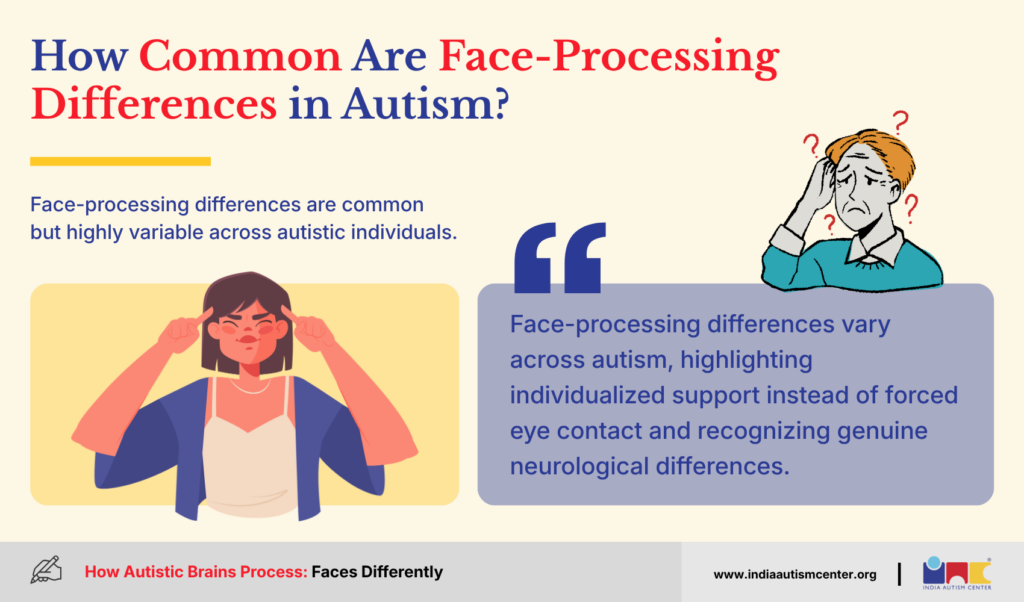
    Disclaimer: This article is intended for educational and informational purposes only. It does not constitute medical advice, diagnosis, or treatment. If you have concerns about your child’s development, attention, or behaviour, please consult a qualified healthcare professional. The research cited here reflects findings at the time of writing and should not be used as a substitute for personalised clinical guidance.