Author: Anubhav

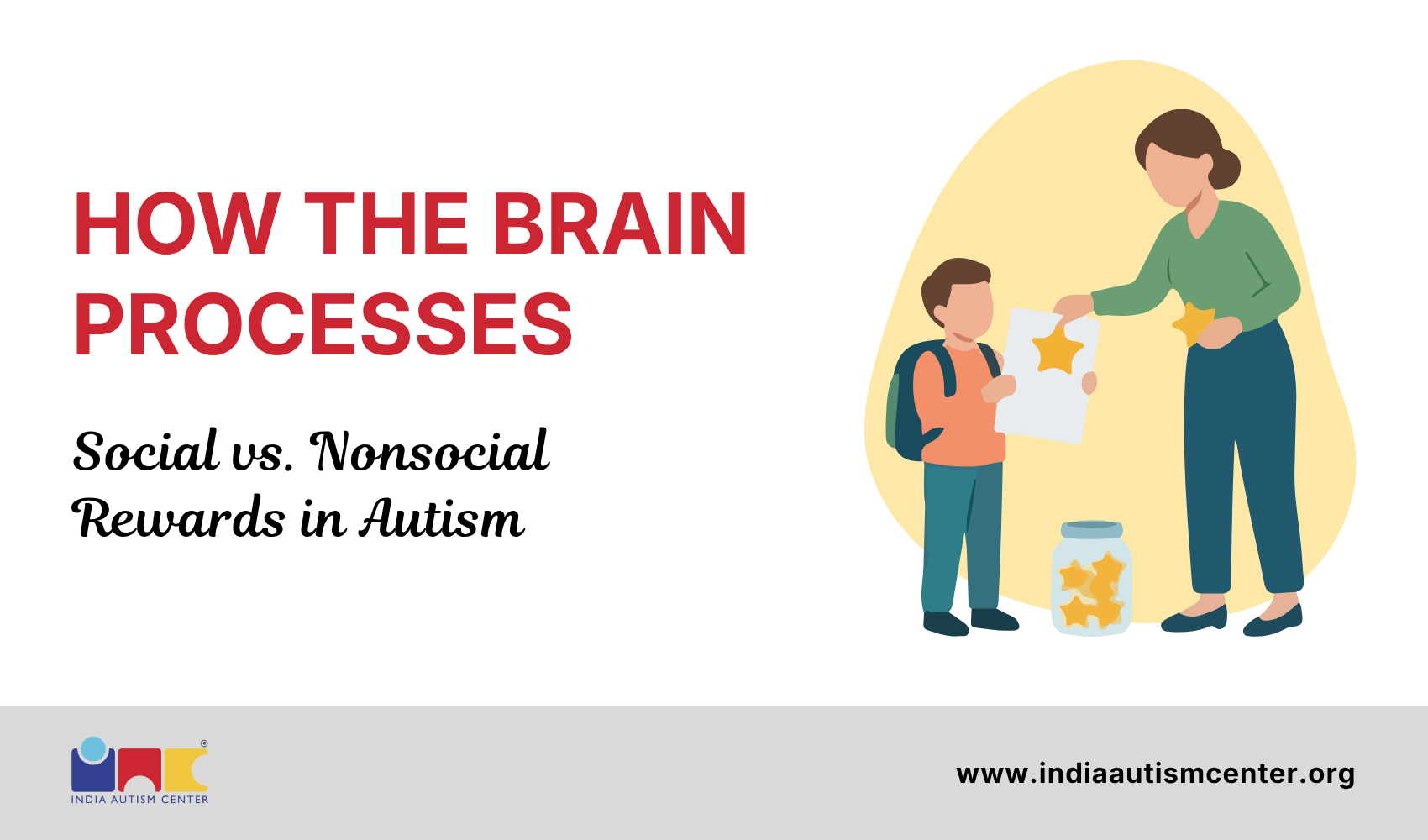
  • How the Brain Processes Social vs. Nonsocial Rewards in Autism

    How the Brain Processes Social vs. Nonsocial Rewards in Autism

    In autism, the brain processes social rewards — like smiles, praise, or eye contact — differently from nonsocial rewards like food or sensory experiences. This isn’t indifference. Specific brain circuits that connect emotional value to social signals show reduced functional connectivity in individuals with higher autistic traits. That distinction changes everything about how we support autistic people.

    What Are Social and Nonsocial Rewards — and Why Does the Difference Matter?
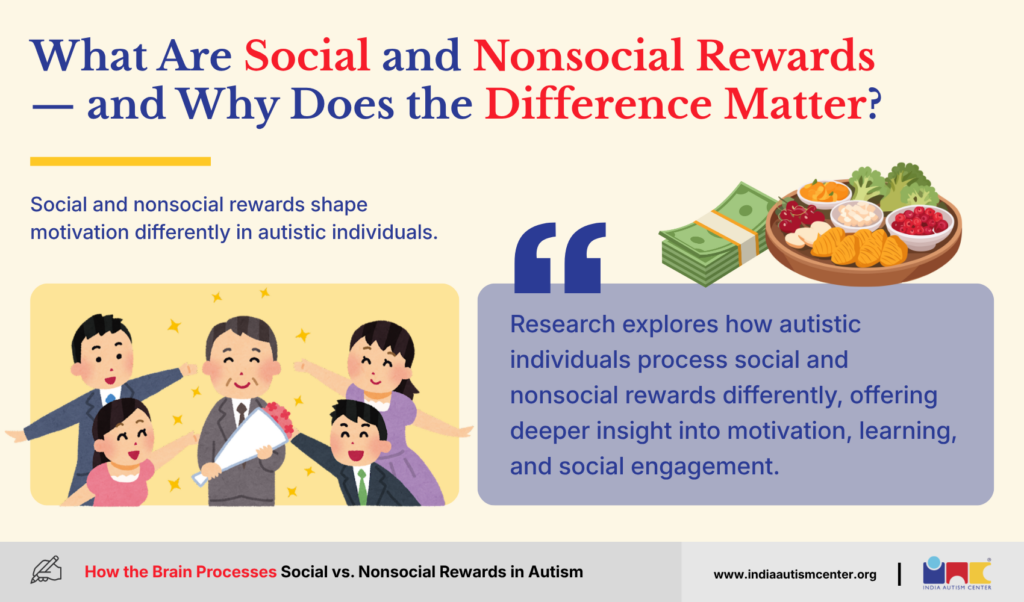
    What Are Social and Nonsocial Rewards — and Why Does the Difference Matter?

    Before we get into the neuroscience, it helps to be clear on what we mean.

    Social rewards are things that feel good because they involve human connection. A smile from a parent. A “well done” from a teacher. Eye contact that signals approval.

    Nonsocial rewards are things that are intrinsically satisfying — independent of another person. Food, money, a favourite object, a particular texture or sound.

    For most neurotypical people, social rewards feel powerful and motivating from birth. For many autistic individuals, this isn’t the case — and understanding why at a brain level is what the latest research is finally beginning to explain.

    How Does the Neurotypical Brain Respond to Social Rewards?
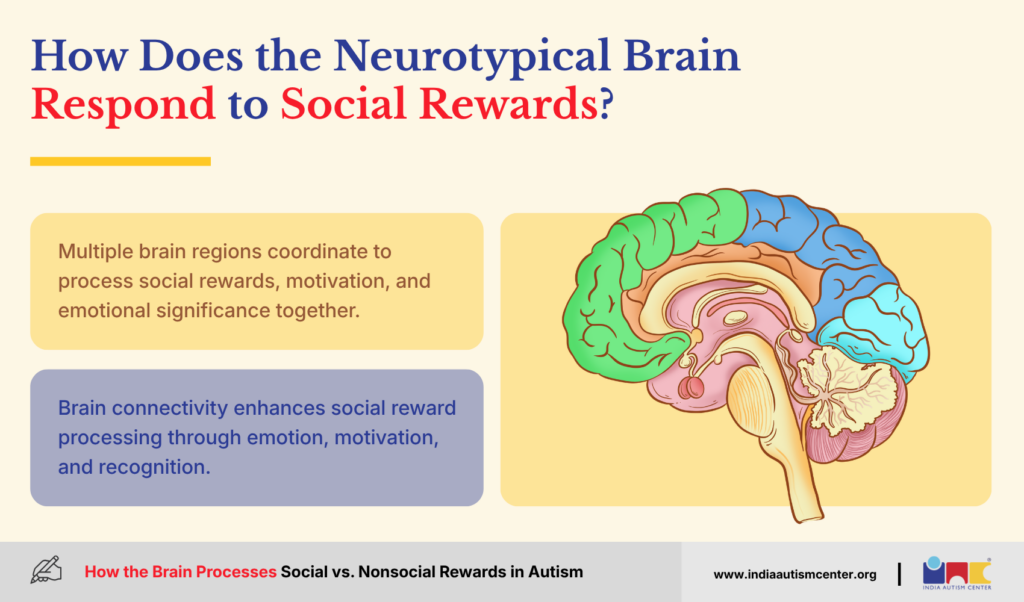
    How Does the Neurotypical Brain Respond to Social Rewards?

    The brain doesn’t have one single “reward centre.” It has a whole network of regions that work together.

    When a neurotypical person receives a social reward — say, a warm smile — several brain areas activate in coordination:

    Brain RegionRole in Reward Processing
    Medial Orbitofrontal Cortex (mOFC)Assigns value to an experience — tells you if it’s worth seeking again
    Ventral StriatumDrives motivation and anticipation of reward
    Anterior Insula (AI)Processes emotional and bodily feelings; makes social moments feel significant
    Anterior Cingulate Cortex (ACC)Integrates emotion and decision-making; tracks whether things are “going well”
    Fusiform Gyrus (FG)Specialises in face recognition and reading social cues
    AmygdalaTags experiences with emotional salience

    Social rewards activate all of these regions. More importantly, these regions talk to each other. It’s the connectivity between them — the neural conversation — that gives social rewards their motivating power.

    Want to know more? Get in touch with us.

    What Is the Social Motivation Hypothesis of Autism?
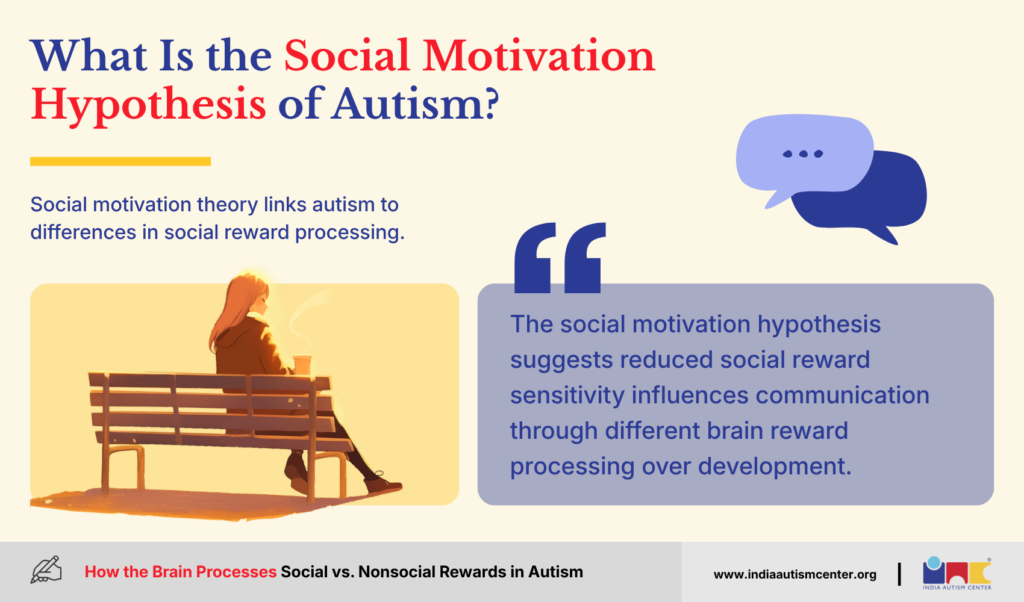
    What Is the Social Motivation Hypothesis of Autism?

    The social motivation hypothesis is one of the most influential frameworks in autism research.

    The idea is this: autistic individuals may experience social stimuli as less rewarding from early in development. Because social rewards don’t activate the brain’s reward system as strongly, there’s less drive to seek out social interaction. Less interaction means fewer opportunities to develop social skills. This compounds over time.

    It’s a cascade — not a single deficit.

    The hypothesis suggests that what looks like a “social communication difficulty” on the outside is, at its root, a difference in how the brain assigns value to social experiences. The brain isn’t broken. It’s running a different calculation.

    This theory has been supported by neuroimaging studies, but the picture is far more nuanced than the original hypothesis suggested. And that’s what makes recent research so important.

    What Does the 2025 fMRI Study Actually Show?
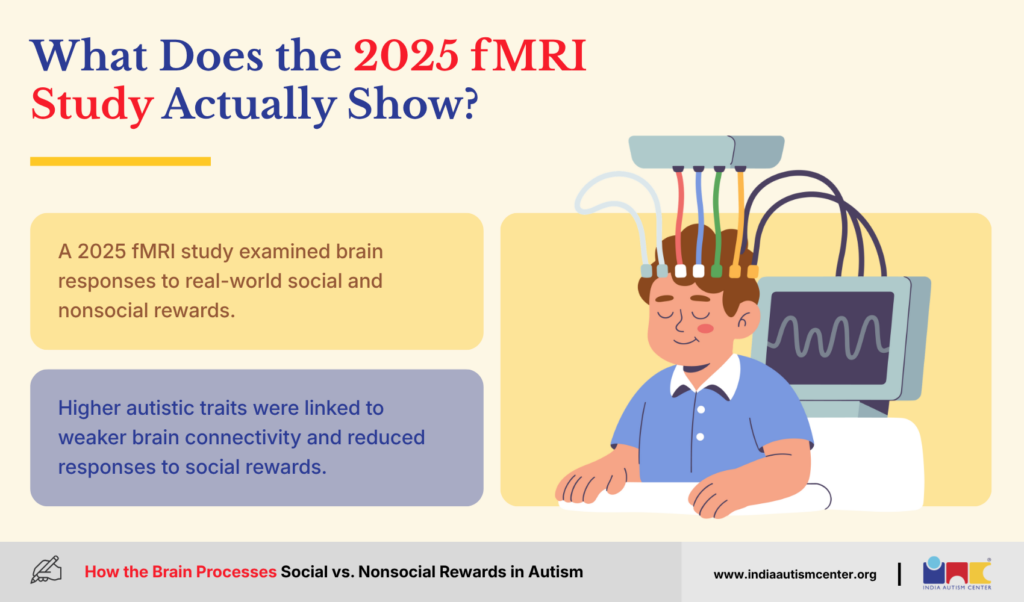
    What Does the 2025 fMRI Study Actually Show?

    A 2025 study published in Personality Neuroscience — co-authored by researchers affiliated with the University of Reading and India Autism Center, Kolkata — looked directly at how autistic traits affect the brain’s response to social versus nonsocial rewards.

    Here’s what makes this study stand out: most earlier research used artificial stimuli — strangers’ faces, abstract symbols. This study used real-world images, carefully matched for emotional intensity, brightness, and arousal levels. That makes the findings much closer to everyday life.

    What they did:

    • 37 adults underwent fMRI brain scanning
    • Participants viewed social reward images (e.g., warm, genuine smiles) and nonsocial reward images matched for emotional valence
    • Researchers measured both brain activity and subjective ratings of how positive each image felt

    What they found:

    Individual preference for social images was linked to stronger functional connectivity between two specific pairs of brain regions:

    • The left anterior insula (LAI) and the medial orbitofrontal cortex (mOFC)
    • The left fusiform gyrus (LFG) and the anterior cingulate cortex (ACC)

    In individuals with higher autistic traits, both of these connections were weaker.

    Those same individuals also rated social images as less positive — their subjective experience matched the reduced brain activity. This is significant. It means the difference isn’t just detectable on a brain scan. It shows up in how people actually feel about social moments.

    Which Brain Regions Are Most Affected in Autism’s Reward System?
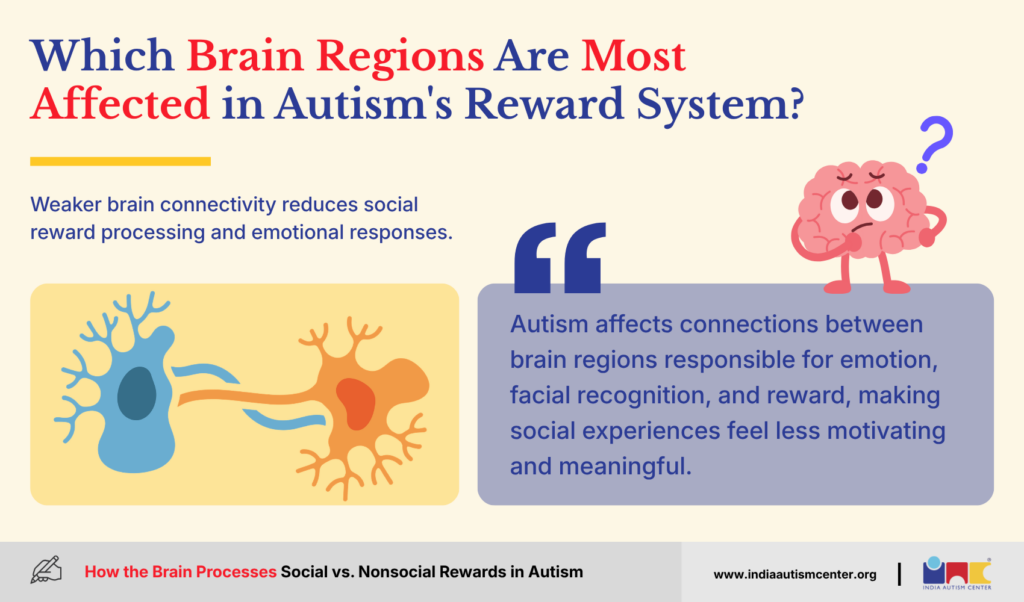
    Which Brain Regions Are Most Affected in Autism's Reward System?

    Let me break this down simply.

    The anterior insula is what helps you feel why something matters emotionally. When it doesn’t communicate well with the mOFC (which assigns value to experiences), social moments don’t get flagged as worth repeating.

    The fusiform gyrus is your brain’s face-processing hub. When it doesn’t connect strongly to the ACC (which tracks social outcomes), reading and responding to others’ expressions becomes harder to integrate with decision-making.

    In short: the individual parts of the brain may be functioning. But the pathways between them are weaker. It’s like having all the instruments in an orchestra but the musicians aren’t hearing each other clearly.

    Is It Social Rewards Specifically — or All Rewards?
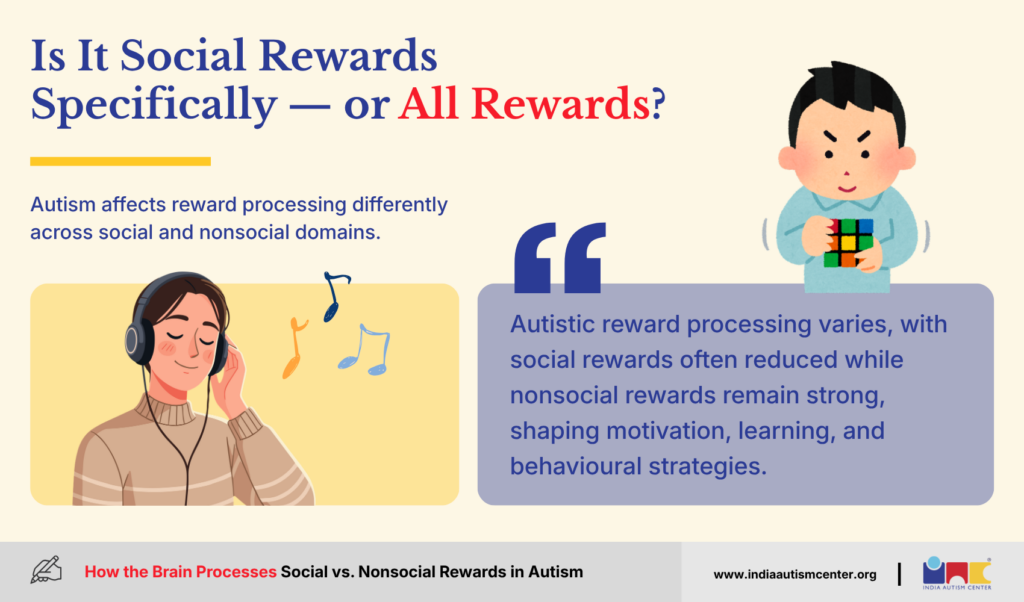
    Is It Social Rewards Specifically — or All Rewards?

    This is one of the most debated questions in the field. And the honest answer is: it depends.

    Some studies show reduced reward responses only in the social domain. Others find that reward processing differences in autism span both social and nonsocial categories — including monetary rewards.

    What recent evidence suggests is a more nuanced position:

    • Reward processing in autism is not absent — it is differently calibrated
    • The brain may still process nonsocial rewards quite typically in many autistic individuals
    • The specific disruption appears to be in how social information gets translated into reward value
    • This means autistic individuals can and do experience strong reward responses — just often through nonsocial channels (interests, sensory experiences, objects)

    This has real implications for how we design therapy, learning environments, and motivational strategies.

    What’s the Difference Between Reward Anticipation and Reward Reception in Autism?
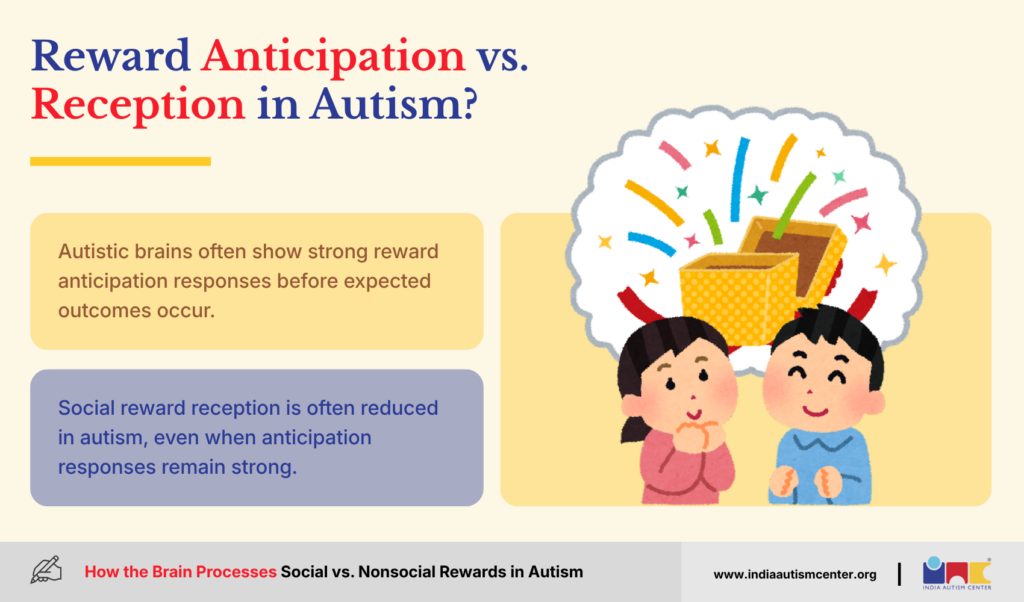
    Difference Between Reward Anticipation and Reward Reception in Autism

    This distinction often gets overlooked — but it matters practically.

    Research using EEG (measuring electrical brain activity) has found that autistic individuals and those with higher autistic traits actually show heightened brain responses during the anticipation phase of reward — the moment when you’re expecting something good to happen.

    But during the reception of social rewards — when the smile or praise actually arrives — the neural response is attenuated, particularly for social rewards.

    Think of it this way: the autistic brain may expect a reward with as much (or more) excitement as anyone else. But when the reward is a social one — a nod, a smile, a word of approval — it doesn’t land with the same neural weight.

    This is a crucial distinction for parents and educators. It means the issue isn’t low motivation overall. It’s that social feedback specifically may not register as the powerful signal it does for neurotypical peers.

    Does This Look the Same for Autistic Girls and Boys?
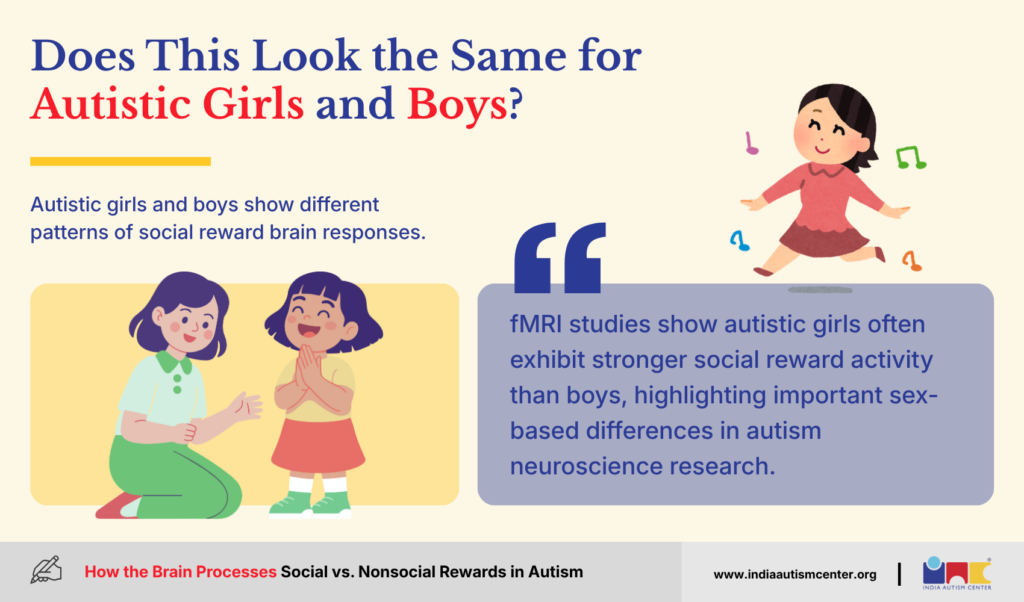
    Does This Look the Same for Autistic Girls and Boys?

    No — and this is an important gap in the original social motivation theory.

    Research using fMRI in children and adolescents found that autistic girls showed increased neural activity to social rewards — not decreased. Specifically, autistic girls showed greater activity in the nucleus accumbens (a core reward region) and the anterior insula compared to typically developing girls.

    This is the opposite of what’s been found in autistic boys.

    What this tells us:

    • Reduced social reward sensitivity is not universal across all autistic people
    • The neural profile may differ significantly between autistic males and females
    • This likely contributes to why autistic girls are frequently missed in diagnosis — their social reward processing may not match the pattern that diagnostic criteria were originally built to detect

    The science is still developing here. But it’s a reminder that “autism” is not one brain type.

    How Does This Research Change the Way We Should Support Autistic Individuals?
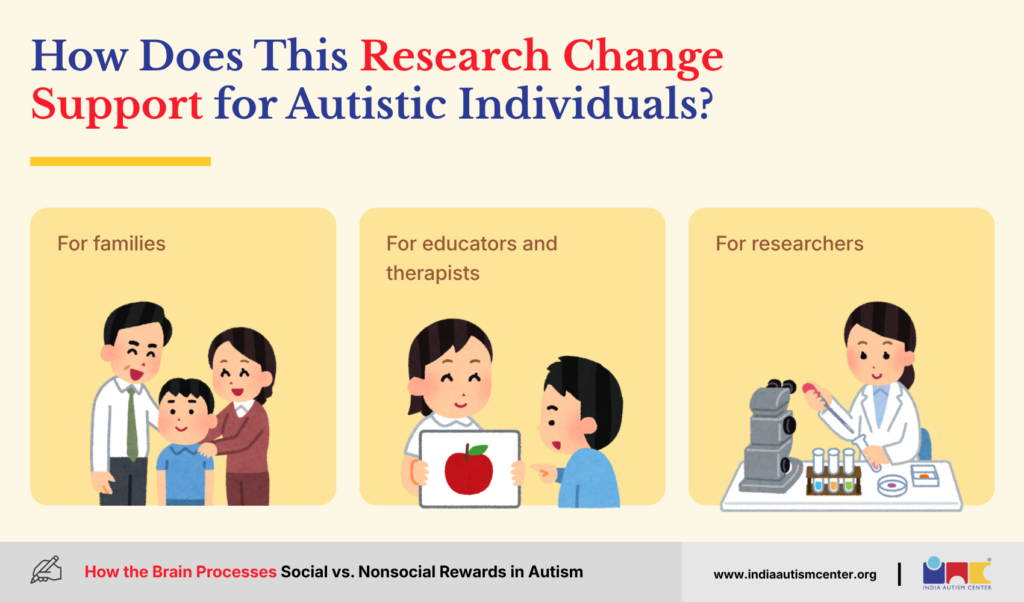
    How Does This Research Change the Way We Should Support Autistic Individuals?

    Understanding the neuroscience shifts the frame entirely.

    When an autistic child doesn’t respond to praise or social approval the way a parent or teacher expects, it isn’t stubbornness, lack of effort, or emotional disconnection. The brain’s reward circuitry is genuinely processing that social signal differently.

    Here’s what this means practically for:

    Families:

    • Combining social rewards with preferred nonsocial rewards (a favourite activity, a sensory item) can be more effective than relying on praise alone
    • Noticing and responding to what does register as rewarding for your specific child is more useful than assuming praise should motivate them
    • Recognising that reduced social reward responsivity is neurological — not a choice — can reduce blame and conflict at home

    Educators and therapists:

    • Motivational systems that assume social approval is inherently reinforcing may need to be redesigned for autistic learners
    • Strength-based approaches that lean into genuine interests and nonsocial reward preferences are neurologically consistent with what the brain is actually doing
    • The goal isn’t to force social reward sensitivity — it’s to build meaningful engagement in ways the autistic brain can sustain

    Researchers:

    • The 2025 study introduces a new experimental paradigm that could contribute to transdiagnostic biomarkers for social cognitive processes — markers that go beyond diagnosis categories and speak to underlying brain function

    Want to know more? Get in touch with us.

    What Does This Mean for Early Development?
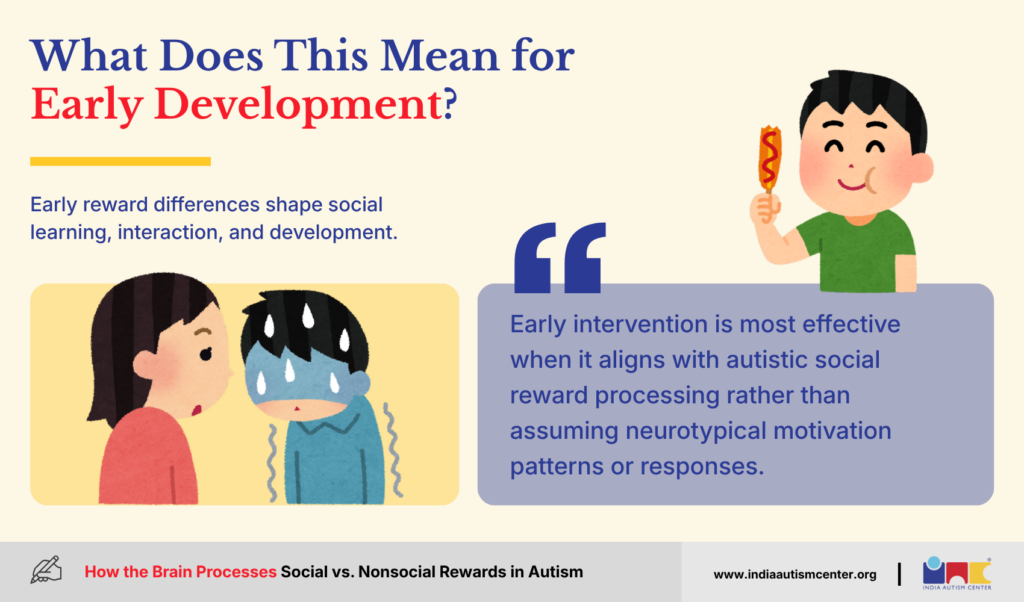
    What Does This Mean for Early Development?

    The social motivation cascade matters most early.

    If social stimuli aren’t registering as rewarding in infancy and early childhood, fewer social interactions happen. Fewer interactions mean less practice with reading faces, interpreting tone, and building the social pattern recognition that most people develop automatically.

    This isn’t irreversible. But it does mean that early intervention — designed with an understanding of how the autistic brain processes social information — will be more effective than approaches that assume a neurotypical reward system.

    The aim should never be to make social rewards feel “normal” through pressure. The aim should be to meet the brain where it is and build genuine connection from there.

    What Does the Research Still Not Know?
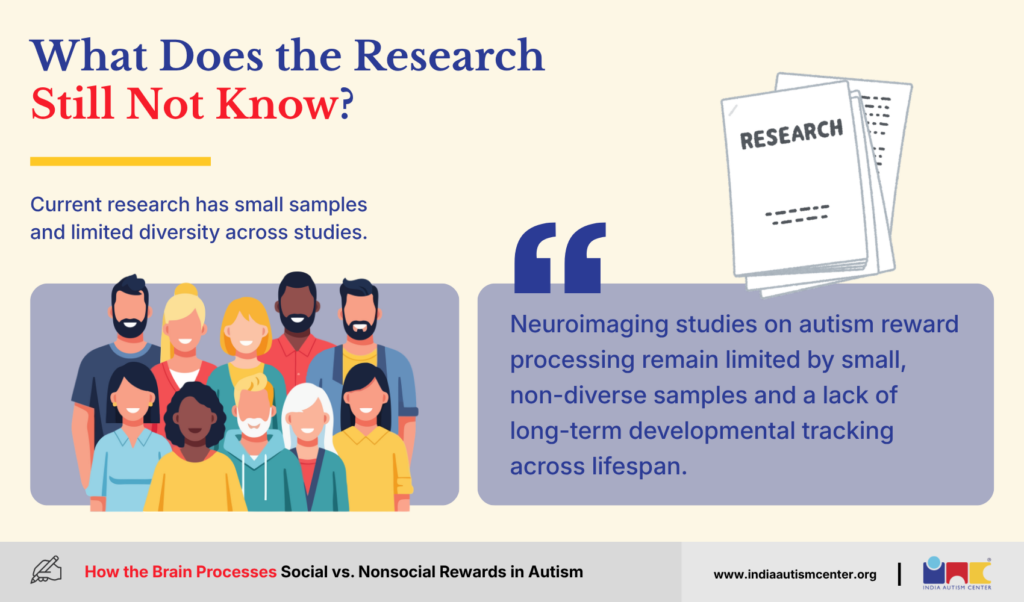
    What Does the Research Still Not Know?

    It’s worth being honest about the limits here.

    • The 2025 fMRI study had 37 participants — a relatively small sample
    • Most neuroimaging studies in this area still have sample sizes under 50
    • The majority of participants in this field historically have been male, white, and Western — limiting generalisability
    • We don’t yet have strong longitudinal data on how these brain patterns change across the lifespan
    • The relationship between neural reward differences and specific everyday behaviours is still being mapped

    The field is moving fast. But we’re still at the point where the findings are highly important directionally, even if the full picture isn’t complete.

    📥 Free download: Printable daily routine chart for autistic children

    Conlclusion
    The science of social reward processing in autism is young — but it’s already telling us something important. The autistic brain is not unmotivated. It is not emotionally empty. It is processing the world through a different neural architecture, one where social signals carry less automatic reward weight.

    That understanding should change how we talk about autism. It should change how we design support. And it should deepen our respect for the way autistic individuals navigate a world built largely around social reward systems they experience differently.

    At India Autism Center, our research division Khoj is committed to building an evidence base that reflects the actual diversity of autistic experience — including how the brain’s reward system works differently across individuals. Because better science leads to better support.

    Key Takeaways

    • Social rewards (smiles, praise, approval) and nonsocial rewards (food, money, sensory experiences) are processed by overlapping but distinct brain networks
    • In individuals with higher autistic traits, functional connectivity between the anterior insula and mOFC, and between the fusiform gyrus and ACC, is reduced
    • This reduced connectivity correlates with lower subjective ratings of social images — meaning the brain difference shows up in lived experience
    • The issue is not that autistic individuals can’t feel rewards. It’s that social signals don’t reliably trigger the same reward response as they do in neurotypical brains
    • Autistic girls may show an opposite neural pattern to autistic boys — more activity, not less, to social rewards
    • Practical support should work with the brain’s actual reward preferences, not against them

    Frequently Asked Questions

    Does the autistic brain feel no social rewards at all? 

    No. The autistic brain can and does respond to social stimuli. The difference is in the strength and consistency of the neural signal — reduced functional connectivity between reward-related regions means social rewards may not register as strongly or reliably.

    Can therapy improve social reward processing in autism? 

    Some interventions — particularly those that pair social experiences with preferred nonsocial rewards — may help build positive associations over time. The goal is building genuine engagement, not forcing neurotypical reward responses.

    Is reduced social reward sensitivity the same in all autistic people?

    No. Research shows significant variability — particularly between autistic males and females. Autistic girls, for example, have been found to show increased neural activity to social rewards in some studies, not decreased.

    What brain regions are most involved in social reward processing?

    The anterior insula, medial orbitofrontal cortex, fusiform gyrus, anterior cingulate cortex, and ventral striatum are the most studied. The connections between these regions matter as much as the regions themselves.

    What is the social motivation hypothesis of autism?

    It’s a theory suggesting that autistic individuals experience social stimuli as less rewarding, leading to reduced motivation for social interaction, which then compounds into broader social communication differences over development.

    Educational Disclaimer: This article is intended for informational and educational purposes only. It does not constitute medical advice, diagnosis, or treatment. The research discussed is ongoing and findings from animal or laboratory studies do not automatically translate to clinical recommendations for humans. Parents and caregivers should always consult a qualified medical professional — including a paediatrician, neurologist, or clinical nutritionist — before making any decisions about supplementation or dietary changes for a child with autism. India Autism Center does not endorse any specific supplement, treatment, or brand.

    For expert insights, support services, and inclusive learning initiatives, visit the India Autism Center.

  • Can Zinc Help the Autistic Brain? What the New Study Reveals

    Can Zinc Help the Autistic Brain? What the New Study Reveals

    A new study at the University of Auckland is testing whether zinc can improve communication between human brain cells linked to autism. This is the first time zinc has been tested on human brain cells in a lab setting. The findings could eventually open a treatment path — but experts say we are not there yet.

    What Is The New Zinc And Autism Study About?

    What Is The New Zinc And Autism Study About?

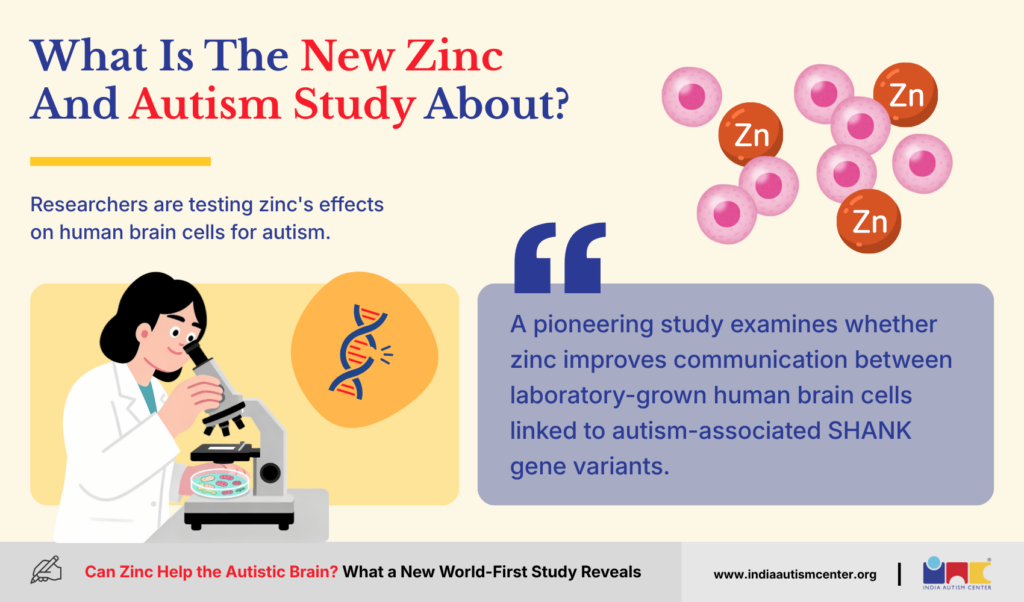
    This is a world-first. Professor Johanna Montgomery at the University of Auckland’s Centre for Brain Research is leading a study that tests the effects of zinc directly on human brain cells grown in a laboratory.

    The research team includes PhD student Zoe Payne, Professor James Ellis from the University of Toronto, and Dr Kevin Lee from the University of California, San Francisco.

    What makes this different from past research is the subject: human brain cells, not mice. Previous studies used animal models. This study bridges that gap.

    The lab process works like this:

    • Blood samples are taken from people with Phelan-McDermid syndrome — a condition linked to autism caused by deletion of the SHANK 3 gene
    • Cell samples from individuals with SHANK 2 gene variants, associated with severe autism, are also included
    • These blood cells are “trained” in incubators and multiplied into thousands of brain cells
    • Electrodes then measure how well signals travel between brain cells — before and after a dose of zinc

    The hypothesis is that zinc strengthens communication between brain cells. The mouse research already proved this. Now the team wants to know if it holds true in human cells.

    What Did Earlier Zinc And Autism Research Find?

    What Did Earlier Zinc And Autism Research Find?

    Professor Montgomery has spent 15 years studying the relationship between autism and SHANK genes. That background matters here because it explains why zinc became a focus.

    SHANK genes are responsible for building the proteins that allow neurons to talk to each other. When SHANK genes are missing or altered — as they are in some people with autism — those communication pathways break down.

    Here is what the mouse research found:

    Research StageKey Finding
    Zinc given to pregnant and lactating miceOffspring showed fewer autistic behaviours (less anxiety, fewer repetitive actions, better social interaction)
    Zinc given after weaningBeneficial effects still observed — some autistic behaviours reversed
    Best outcomesIn some mice, autistic behaviours completely disappeared

    A separate 2024 study from Academia Sinica in Taiwan added to this picture. Researchers found that a low-dose combination of zinc, serine, and branched-chain amino acids restored more typical synaptic protein patterns and reduced excessive amygdala activity across three autism mouse models.

    The consistency across different research groups is what makes this area genuinely exciting.

    Want to know more? Get in touch with us.

    Why Does Zinc Matter For Brain Development?

    Why Does Zinc Matter For Brain Development?

    Zinc is not just an immune-boosting mineral you take when you have a cold. It plays a deep, structural role in how the brain forms and functions.

    Here is what zinc does in the brain specifically:

    • Supports neurogenesis — the formation of new brain cells
    • Regulates cell differentiation — determining what type of cell a brain cell becomes
    • Powers hundreds of enzymes and transcription factors that control gene expression
    • Strengthens synaptic connections — the junctions where brain cells communicate

    The body cannot store large amounts of zinc. It has to come in regularly through food. When intake is inadequate or absorption is poor, deficiency builds up — and developing brains are especially vulnerable to that.

    The SHANK gene connection is particularly important here. Zinc physically interacts with SHANK proteins at the synapse. When zinc levels are low, those proteins may not function correctly — which, in some individuals with specific gene variants, could contribute to the communication difficulties seen in autism.

    Is There A Proven Link Between Low Zinc Levels And Autism?

    Is There A Proven Link Between Low Zinc Levels And Autism?

    The evidence is growing — and it is more consistent than many people realise.

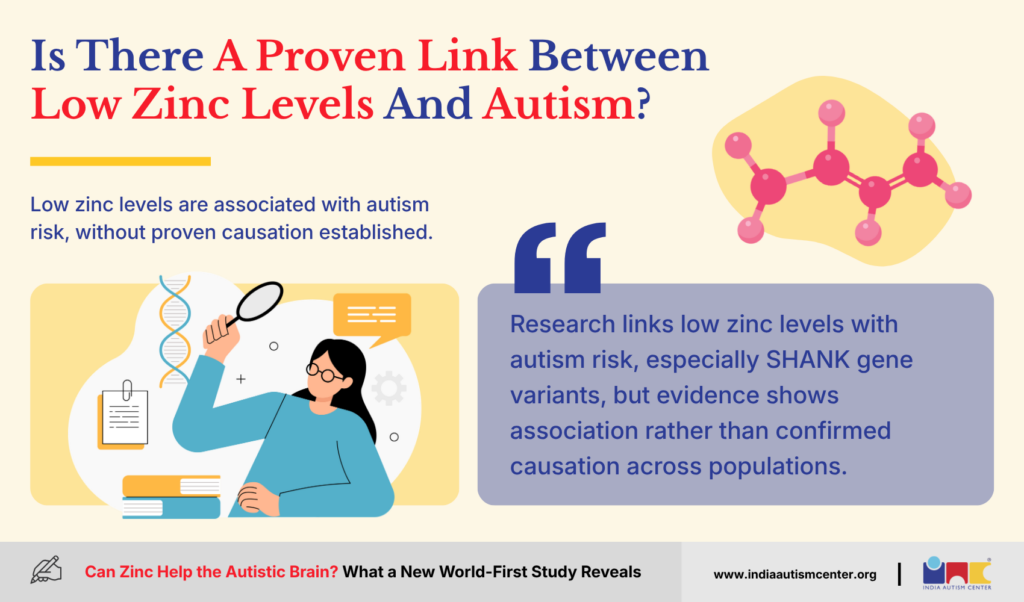
    A 2025 systematic review and meta-analysis published in Frontiers in Nutrition analysed 25 case-control studies involving nearly 4,800 children and adolescents. The conclusion was clear: blood zinc levels are associated with autism spectrum disorder.

    Earlier, a study published in Frontiers in Molecular Neuroscience suggested that zinc deficiency in early childhood may contribute to autism — particularly through its effect on developing synapses.

    Researchers at the Autism Research Institute have gone further, proposing a framework in which disrupted zinc homeostasis may act as a modifiable risk factor in a gene-environment interaction model of ASD.

    What does that mean in plain language? Some children may have a genetic predisposition to autism that is worsened by insufficient zinc during critical windows of brain development.

    A few important caveats:

    • Correlation is not causation. Low zinc has been observed in children with autism, but we cannot yet say it causes autism.
    • Not every child with autism has low zinc levels.
    • The zinc-autism connection is strongest in individuals with specific SHANK gene variants — not necessarily across the entire autism spectrum.

    If you want to learn more about Autism in detail, refer to our comprehensive article on the A to Z of Autism.

    What Is Phelan-McDermid Syndrome And Why Is It The Starting Point For This Research?

    What Is Phelan-McDermid Syndrome

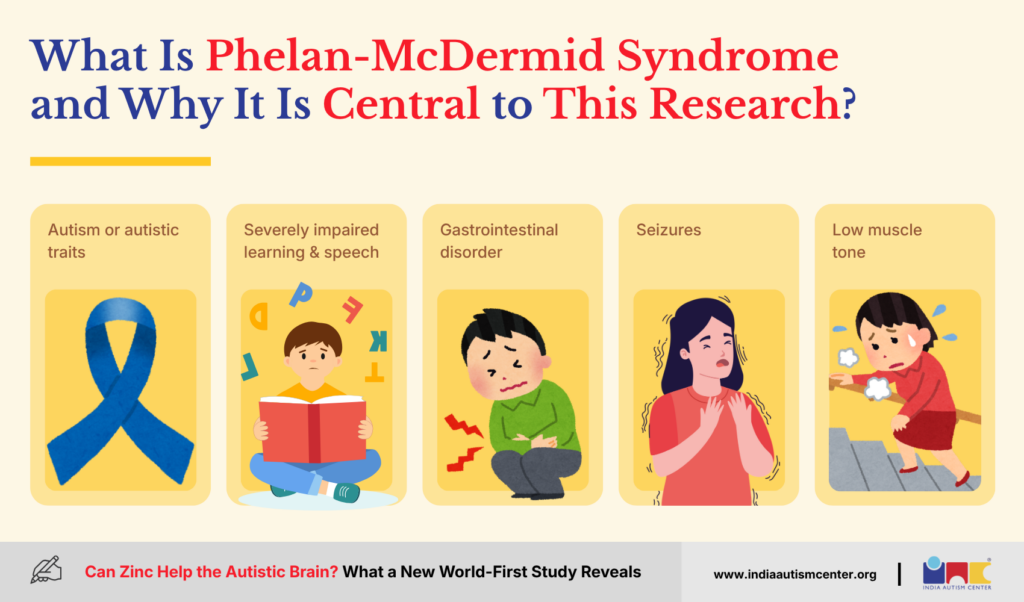
    Phelan-McDermid syndrome is a rare genetic condition caused by the partial or complete deletion of the SHANK 3 gene on chromosome 22. It typically presents with:

    • Autism or autistic traits
    • Severely impaired learning and speech
    • Gastrointestinal disorders
    • Seizures
    • Low muscle tone

    Professor Montgomery spent years building relationships with families of people with this condition. Those partnerships matter — because families are directly involved in providing the blood samples for the research.

    The reason this specific population is the entry point for the study is strategic. Phelan-McDermid syndrome gives researchers a clean genetic variable — the SHANK 3 deletion is clearly defined. This allows them to study zinc’s effects in a controlled biological context before expanding to the broader autism population.

    The roadmap after the brain-cell experiments is a pilot clinical trial examining the effects of zinc supplementation on:

    1. Social behaviours
    2. Cognitive abilities

    The trial will start with people with Phelan-McDermid syndrome, then broaden to include people with severe autism.

    Want to know more? Get in touch with us.

    Should Children With Autism Take Zinc Supplements Right Now?

    Should Children With Autism Take Zinc Supplements Right Now?

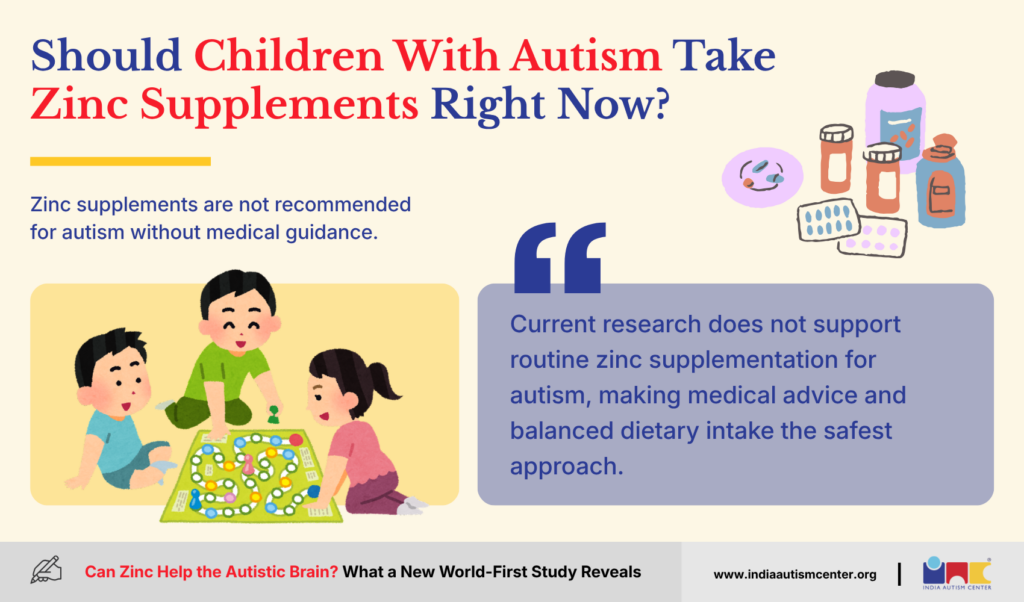
    The direct answer is: no, not yet.

    Professor Montgomery is explicit on this. Zinc can cause harmful effects at the wrong dosage. Taking too much zinc is not safe — and without knowing the precise dosage that may be helpful, supplementation at this stage could do more harm than good.

    There is also a deeper issue. Numerous factors lead to Autism. Not all of those factors are linked to SHANK gene variants. Even if zinc proves beneficial for individuals with Phelan-McDermid syndrome or specific SHANK mutations, that does not automatically extend to everyone on the autism spectrum.

    What I would suggest for parents reading this:

    • Do not self-supplement based on this research
    • Speak with your child’s paediatrician or clinical nutritionist if you have concerns about zinc levels
    • If your child has a known SHANK gene variant, it may be worth discussing blood zinc screening with your specialist
    • Focus on dietary zinc through food — the safest and most balanced approach

    The science is promising. The clinical path is real. But the research is still in progress — and acting ahead of it is not the right call.

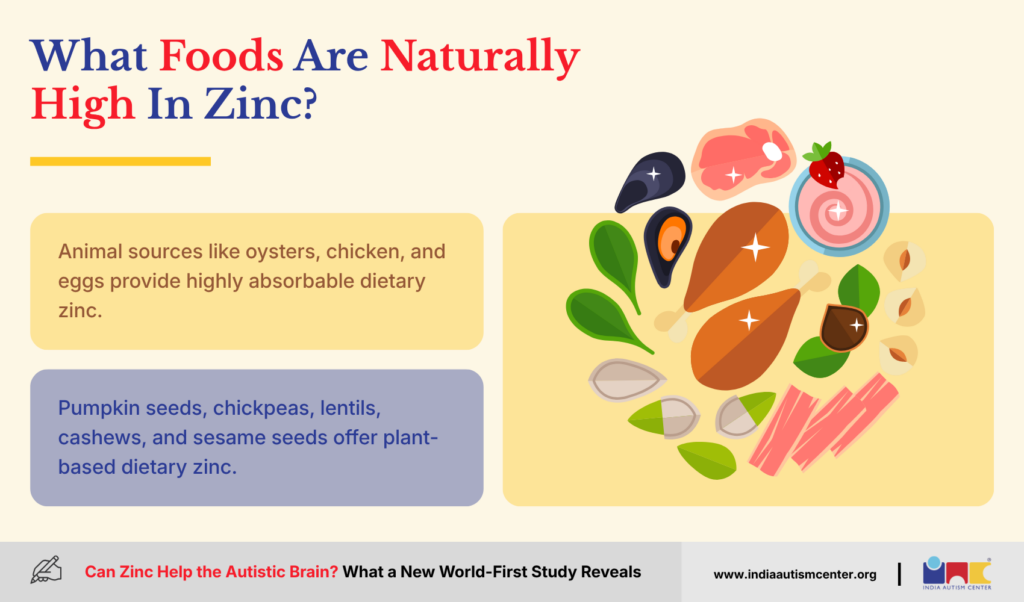
    What Foods Are Naturally High In Zinc?

    What Foods Are Naturally High In Zinc?

    While we wait for the clinical evidence to mature, supporting healthy zinc levels through diet is a sensible and safe step.

    Animal-based zinc sources (highest bioavailability):

    FoodNotes
    OystersRichest known food source of zinc
    Red meat (lamb, beef)High in zinc and well-absorbed
    Poultry (chicken, turkey)Good everyday source
    Seafood (crab, shrimp)Solid zinc content
    Eggs and dairyModerate zinc, widely accessible

    Plant-based zinc sources:

    FoodNotes
    Pumpkin seedsOne of the best plant sources
    Hemp seedsHigh in zinc and easy to add to food
    CashewsPractical snack-based source
    Chickpeas, lentils, rajmaExcellent for Indian diets
    Whole grains (atta, oats)Fortified cereals also contribute
    Sesame seeds (til)Common in Indian cooking, good zinc source

    One important note for plant-based diets: Phytates — found in legumes and whole grains — can reduce zinc absorption. Soaking, sprouting, or fermenting these foods before eating can meaningfully improve absorption.

    For families in India, combining these traditional ingredients intelligently can support adequate zinc intake without supplementation.

    What Does This Mean For Autism Research And Families Going Forward?

    What Does This Mean For Autism Research And Families Going Forward?

    Let me put this in perspective. Globally, autism affects around 1 in 100 people. In India, estimates suggest anywhere from 1 to 1.5 crore individuals live with autism — and there is currently no drug treatment approved specifically for autism.

    That is the gap this research is trying to address — not with a cure, but with a targeted, biologically grounded treatment possibility for a specific subgroup.

    Here is where the research stands and where it is going:

    Stage 1 (Current)

    Testing zinc on human brain cells grown from blood samples of people with Phelan-McDermid syndrome and SHANK 2 variants → measuring changes in brain cell signalling via electrodes.

    Stage 2 (Upcoming)

    Pilot clinical trial testing zinc supplementation on social behaviour and cognitive ability in people with Phelan-McDermid syndrome.

    Stage 3 (Future)

    Expanding the trial to include people with severe autism more broadly.

    This is a multi-year process. The early findings are promising, but science moves carefully — and in this case, that caution protects the very people the research is trying to help.

    What this research does signal, for families and organisations working in autism care, is that the nutritional and metabolic dimensions of autism are no longer on the fringe of research. They are being taken seriously at the highest levels of neuroscience.

    📥 Free download: Printable daily routine chart for autistic children

    Conclusion

    • A world-first study at the University of Auckland is testing zinc on human brain cells linked to autism — specifically in people with Phelan-McDermid syndrome and SHANK 2 gene variants.
    • Earlier mouse research showed zinc can prevent or reverse some autistic behaviours, particularly when given during early brain development.
    • Blood zinc levels are consistently lower in children with ASD across multiple large studies.
    • The mechanism involves zinc’s interaction with SHANK proteins at the synapse — critical junctions for brain cell communication.
    • Experts advise against zinc supplementation without medical guidance. The wrong dosage can cause harm.
    • Supporting zinc levels through diet — particularly oysters, pumpkin seeds, legumes, and seeds — is a safe and practical approach.
    • A pilot clinical trial is in development and will eventually move from Phelan-McDermid syndrome to broader autism populations.

    Frequently Asked Questions

    Does zinc deficiency cause autism?

    Not directly. Low zinc levels are consistently observed in children with ASD, particularly those with SHANK gene variants. Researchers believe zinc deficiency during early brain development may contribute to or worsen autistic traits in genetically predisposed individuals — but it is not established as a standalone cause.

    Can zinc supplements help children with autism?

    Current evidence does not support using zinc supplements without medical supervision. Studies in mice are promising, but the human brain cell study is still underway. A clinical trial is being developed. Parents should consult a paediatrician before making any changes

    What is the SHANK gene and how does it connect to zinc?

    SHANK genes code for proteins that build synaptic structures — the connection points between brain cells. Zinc interacts directly with these proteins. When SHANK genes are altered or deleted, as in some people with autism or Phelan-McDermid syndrome, zinc’s role in keeping synaptic communication functioning may be disrupted.

    What is Phelan-McDermid syndrome?

    A rare genetic condition caused by partial or complete deletion of the SHANK 3 gene. It typically includes autism, intellectual disability, speech difficulties, gastrointestinal issues, and low muscle tone. It is the focus of the current zinc study because it provides a clearly defined genetic context for research.

    Which foods are highest in zinc for children?

    Oysters, red meat, poultry, eggs, and dairy have the highest bioavailable zinc. For vegetarian diets, pumpkin seeds, cashews, chickpeas, lentils, and sesame seeds are good sources. Soaking legumes before cooking improves zinc absorption.

    When will zinc treatment for autism be available?

    There is no timeline yet. The human brain cell study must first yield results. Then a pilot clinical trial will follow. This is a multi-stage process likely spanning several years before any treatment recommendations could be made.

    For expert insights, support services, and inclusive learning initiatives, visit the India Autism Center.


    Educational Disclaimer: This article is intended for informational and educational purposes only. It does not constitute medical advice, diagnosis, or treatment. The research discussed is ongoing and findings from animal or laboratory studies do not automatically translate to clinical recommendations for humans. Parents and caregivers should always consult a qualified medical professional — including a paediatrician, neurologist, or clinical nutritionist — before making any decisions about supplementation or dietary changes for a child with autism. India Autism Center does not endorse any specific supplement, treatment, or brand.

  • Does Speech Therapy Work? Here’s What the Evidence Actually Says

    Does Speech Therapy Work? Here’s What the Evidence Actually Says

    Does Speech Therapy Work? The quick answer is yes, speech therapy works. Research consistently shows that structured speech and language therapy improves communication outcomes across age groups and conditions — including autism, Down syndrome, cerebral palsy, stroke, and learning disabilities. The earlier therapy begins, the stronger the results. But it also works for adults, and it’s never too late to start.

    What Exactly Happens In Speech And Language Therapy?

    What exactly happens in speech and language therapy?

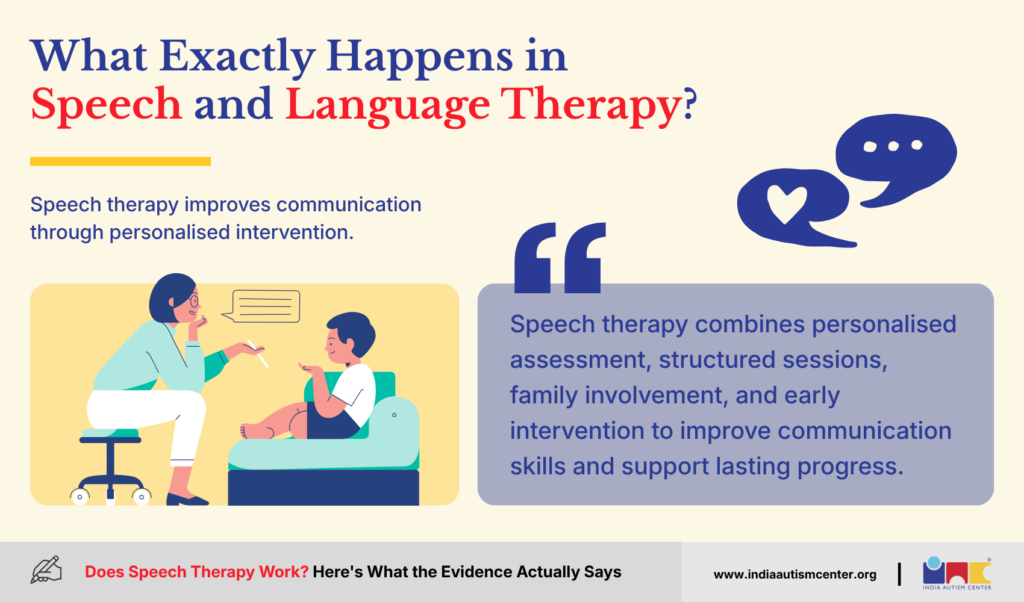
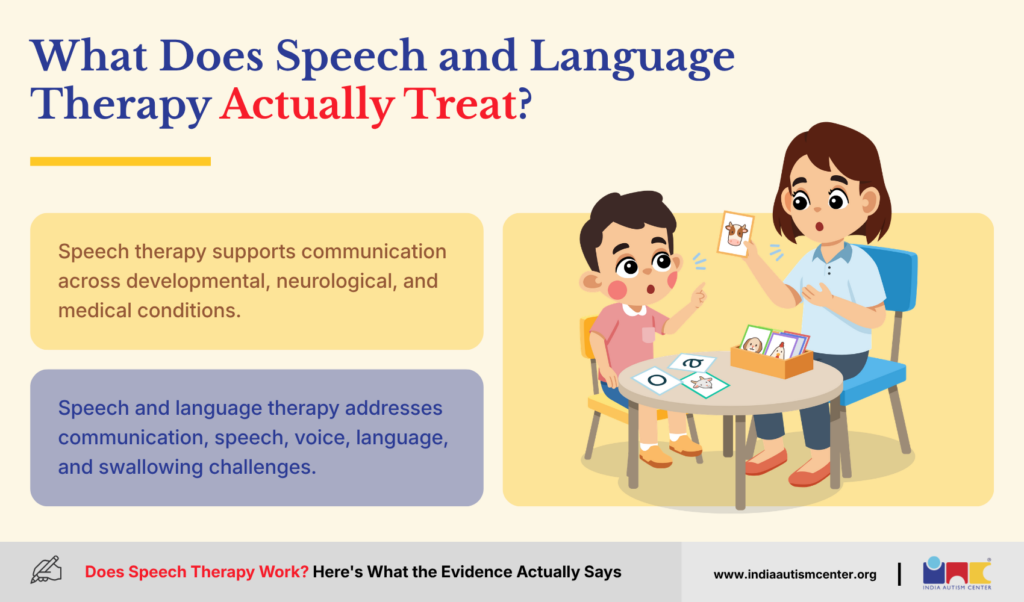
    Speech and language therapy (SLT) is a clinical intervention that addresses difficulties with communication, language, voice, fluency, and swallowing. A licensed speech-language pathologist (SLP) assesses where the breakdown is — whether it’s in articulation, comprehension, social language, or something else — and builds a plan around that.

    The process is structured, goal-driven, and highly individualised. No two therapy plans look the same, because no two people communicate the same way.

    Sessions can be one-on-one, group-based, or a combination. They happen in clinics, schools, hospitals, or even online. What makes therapy effective isn’t just the technique — it’s consistency, family involvement, and early identification.

    What Does Speech And Language Therapy Actually Treat?

    What does speech and language therapy actually treat?

    This is a question worth answering clearly, because many families think SLT is only for children who stutter or mispronounce words. It’s far broader than that.

    SLT addresses:

    ConditionWhat SLT Targets
    Autism Spectrum DisorderSocial communication, AAC, pragmatic language
    Down SyndromeArticulation, vocabulary, functional communication
    Cerebral PalsyMotor speech, alternative communication systems
    Stroke / AphasiaLanguage recovery, word retrieval, reading
    Learning DisabilitiesPhonological awareness, reading foundations
    Selective MutismAnxiety-linked speech, graduated exposure
    Voice DisordersVocal hygiene, resonance, pitch
    DysphagiaSafe swallowing, food textures, oral motor skills
    Intellectual DisabilitiesExpressive language, life-skills communication

    If communication is the challenge — in any form — speech and language therapy is the clinical pathway.

    Does Speech Therapy Work For Children?

    Does speech therapy work for children?

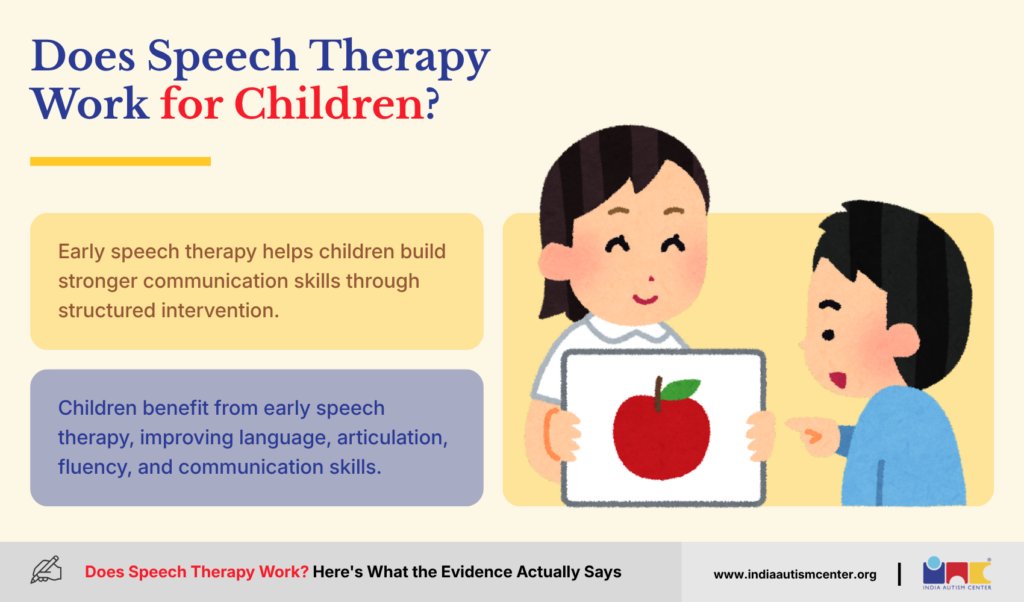
    Yes, children’s speech and language therapy has one of the strongest evidence bases in all of rehabilitation medicine. The brain’s neuroplasticity — its ability to form new connections — is at its peak during the early years. This is why early intervention matters so much.

    Children who receive therapy between ages 2 and 5 tend to show significantly faster progress. But even children who begin later still benefit from structured intervention.

    What therapy typically works on in children:

    • Phonological awareness (the foundation of reading and spelling)
    • Expressive vocabulary (putting words and sentences together)
    • Receptive language (understanding instructions and questions)
    • Pragmatics (taking turns, reading facial expressions, staying on topic)
    • Articulation (clear sound production)
    • Fluency (managing stuttering)

    The goal isn’t to make a child sound “normal.” The goal is to give them the tools they need to communicate effectively in the environments that matter to them — home, school, friendships.

    Want to know more? Get in touch with us.

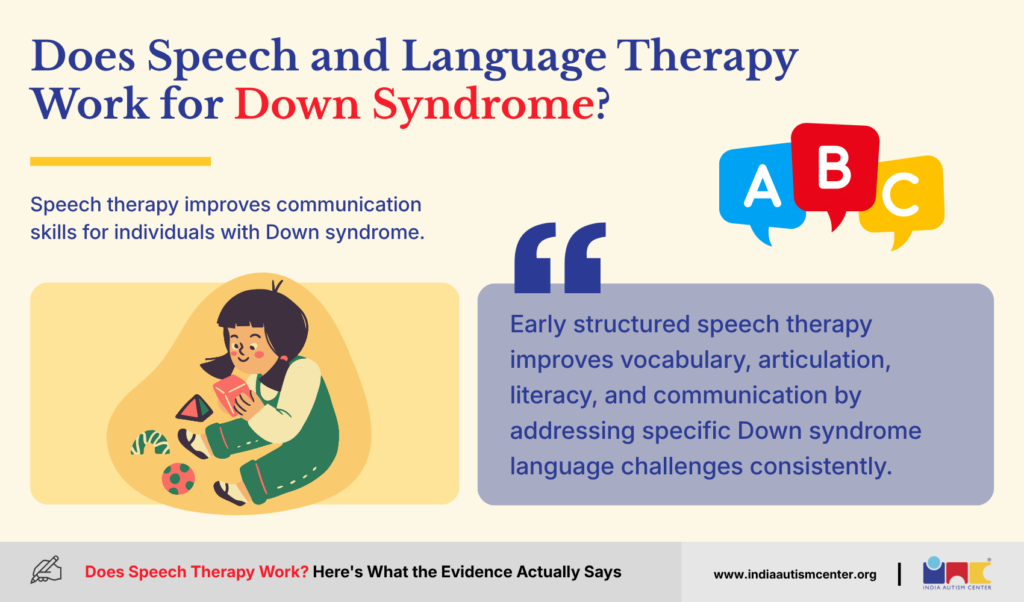
    Does Speech And Language Therapy Work For Down Syndrome?

    Does speech and language therapy work for Down syndrome?

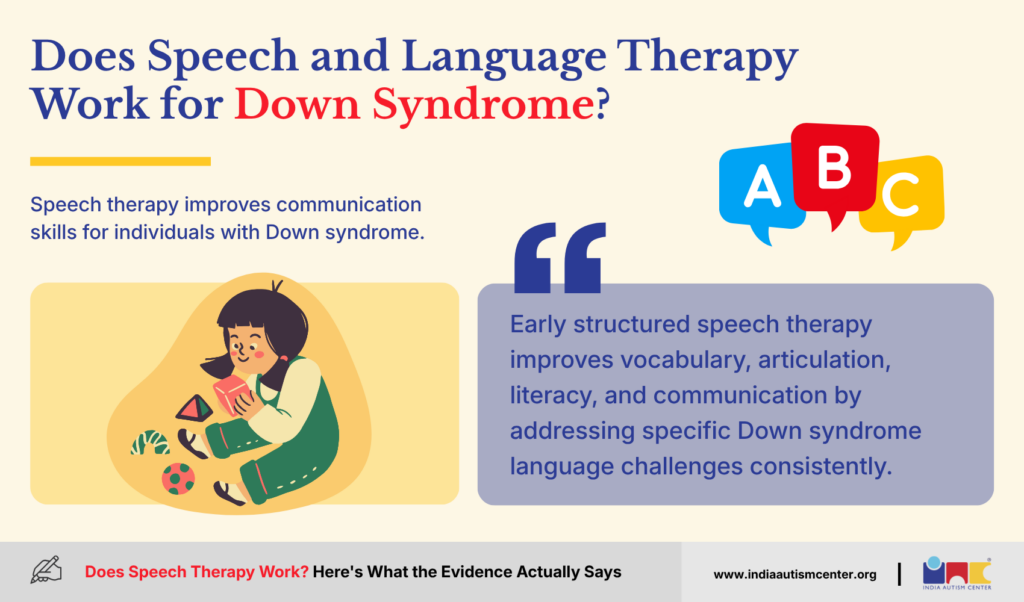
    This is one of the most common questions I encounter. And the answer is: yes, meaningfully so.

    Down syndrome affects speech and language in specific, well-documented ways. Low muscle tone (hypotonia) makes articulation difficult. Shorter working memory affects sentence processing. Hearing issues — very common in Down syndrome — compound the challenge.

    Speech and language therapy for Down syndrome targets all of these simultaneously.

    Key approaches used in Down syndrome SLT:

    • Oral motor exercises — to build lip, tongue, and jaw strength
    • Total Communication — combining speech with sign language and visuals
    • AAC (Augmentative and Alternative Communication) — devices, boards, or apps for those who need them
    • Phonological awareness training — critical for literacy
    • Short, structured language input — matched to processing speed
    • Reading-based language intervention — individuals with Down syndrome often learn through reading, which supports spoken language development

    Research from the Down Syndrome Education International has shown that structured, consistent SLT — started early and sustained across childhood — leads to measurable gains in vocabulary, intelligibility, and literacy. The therapy doesn’t “fix” Down syndrome. It addresses the specific communication challenges that come with it, directly and practically.

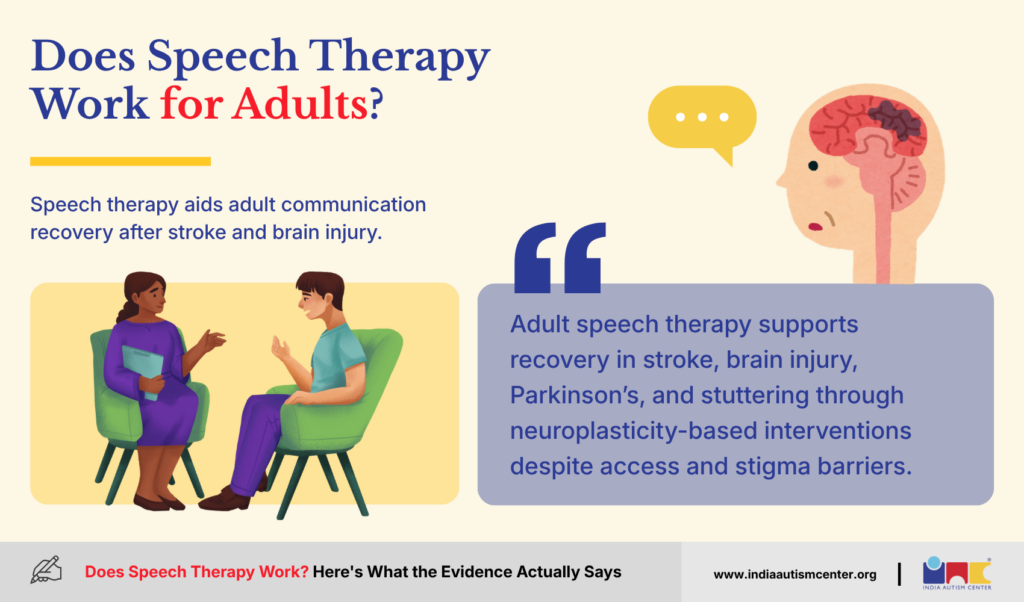
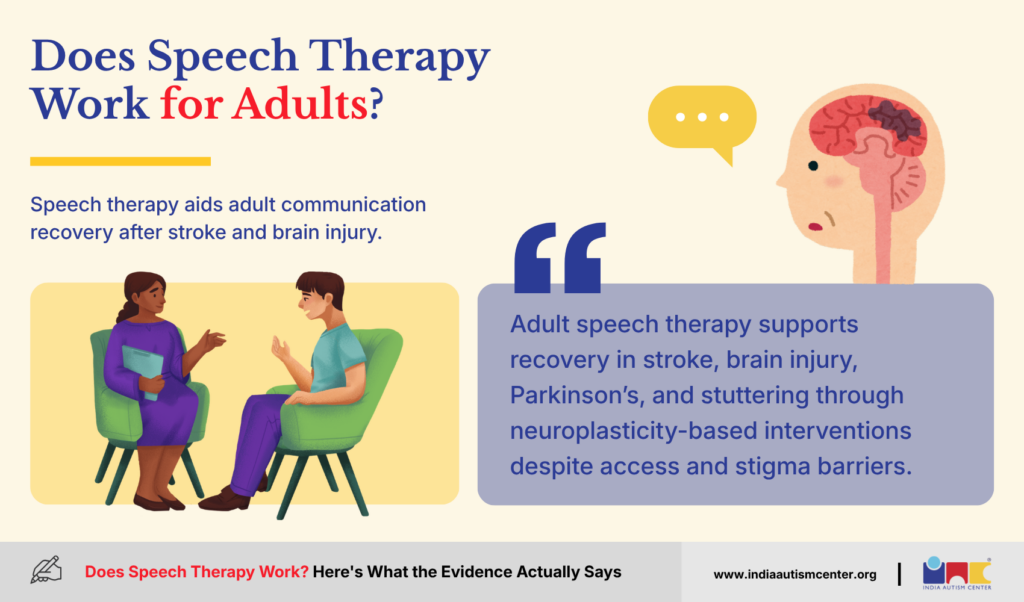
    Does Speech Therapy Work For Adults?

    Does Speech Therapy Work For Adults?

    Absolutely. This is one of the most underappreciated areas of the field.

    Speech and language therapy for adults covers post-stroke aphasia, acquired brain injury, Parkinson’s disease, voice disorders, and stuttering. Adults recovering from stroke, for example, can regain significant language function through intensive SLT — even months or years after the event.

    The adult brain retains neuroplasticity. It adapts more slowly than a child’s brain, but it adapts. Programmes like LSVT LOUD (for Parkinson’s) and Constraint-Induced Language Therapy (for aphasia) have clinical trial data showing real, sustained improvements.

    Why adults delay or avoid SLT:

    • Assumption that “it’s too late”
    • Limited awareness that services exist for adults
    • Stigma around communication difficulties
    • Access and cost barriers

    None of these makes the therapy less effective. They make access harder — which is a systemic problem worth naming.

    Refer to our detailed blog on Speech Therapy for Adults

    What Speech And Language Therapy Techniques Are Actually Used?

    What Speech And Language Therapy Techniques Are Actually Used?

    This varies by condition and age, but here are the evidence-based techniques you’ll most commonly encounter:

    Articulation Therapy

    The SLP works on specific sounds the person struggles to produce, using repetition, auditory feedback, and visual cues. Most effective for children with phonological disorders.

    Language Intervention Activities

    Structured play and conversation activities that target specific language goals. The therapist models correct language and builds on what the child produces.

    Augmentative and Alternative Communication (AAC)

    For individuals who cannot rely on speech alone. Includes low-tech options (picture boards) and high-tech (speech-generating devices). AAC doesn’t replace speech — it supports communication and often facilitates speech development.

    Social Communication Therapy

    Targets pragmatic skills — understanding context, reading non-verbal cues, initiating and maintaining conversations. Frequently used in autism therapy.

    Fluency Shaping

    Used for stuttering. Teaches slower, relaxed speech patterns to reduce disfluency.

    Voice Therapy For vocal nodules, paralysis, or misuse injuries. Includes vocal hygiene education, breath support training, and resonance work.

    PROMPT Therapy

    A tactile-kinaesthetic approach where the therapist physically guides jaw, lip, and tongue movements. Used for motor speech disorders like apraxia.

    Narrative and Literacy-Based Therapy

    Uses stories and books to build sentence structure, vocabulary, and inferential language. Particularly effective for school-age children.

    This blog will help you get better insights 5 Effective Speech Therapy Techniques for Autism

    What Are Speech And Language Therapy Assessments Like?

    What are speech and language therapy assessments like?

    Before therapy begins, a comprehensive assessment is done. This is not a pass/fail test. It’s a diagnostic process that helps the therapist understand exactly where and how communication is breaking down.

    A standard SLT assessment typically includes:

    • Case history — medical background, developmental milestones, family concerns
    • Standardised tests — norm-referenced tools that compare performance to age peers
    • Informal observation — watching the person communicate in natural settings
    • Oral motor examination — checking the structure and function of speech muscles
    • Parent/caregiver interviews — understanding daily communication at home
    • Hearing screening — often conducted in conjunction with SLT assessment

    For adults, assessment also covers reading, writing, and cognitive-communication. For children with autism or Down syndrome, assessments are often multidisciplinary — involving OT, psychologist, and the SLT together.

    The report that follows guides the entire therapy plan. It’s a clinical document, but a good SLT will walk you through it in plain language.

    Want to know more? Get in touch with us.

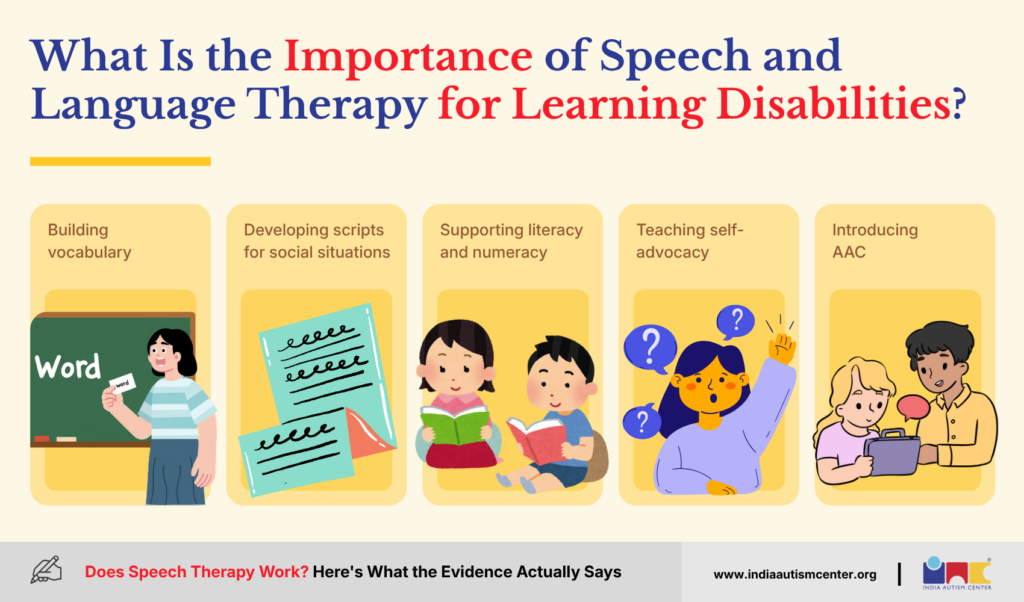
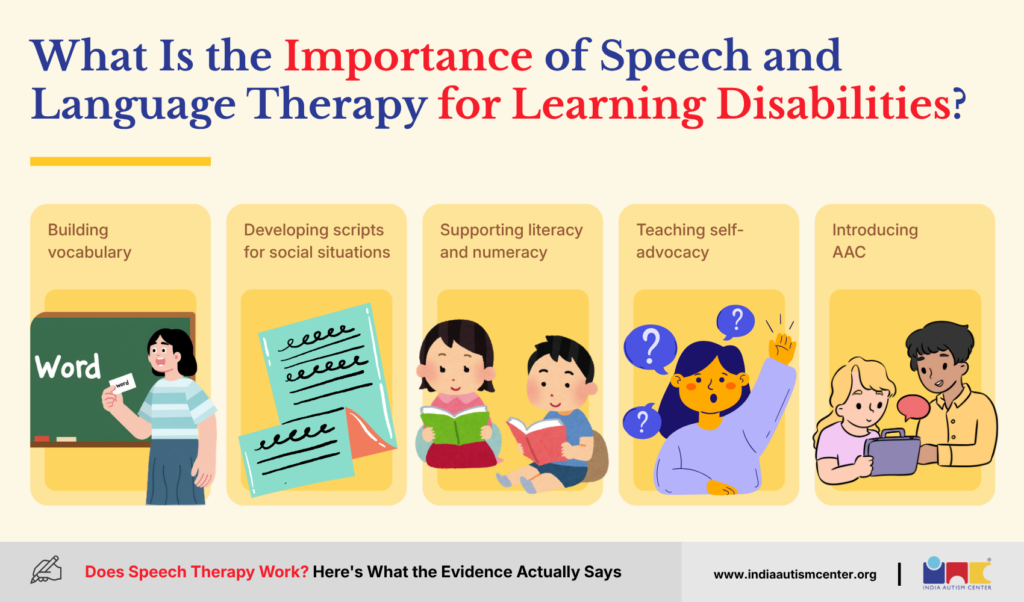
    What Is The Importance Of Speech And Language Therapy For Learning Disabilities?

    What is the importance of speech and language therapy for learning disabilities?

    Communication is the gateway to almost every other skill. When a person with a learning disability struggles to express needs, follow instructions, or connect socially, it affects education, employment, relationships, and mental health.

    Learning disability speech and language therapy takes a functional approach. The goal isn’t always “correct grammar.” It’s often about giving the person the tools to communicate what they need, when they need it, in the environments that matter most.

    Specific goals in LD-focused SLT:

    • Building vocabulary for daily life and work
    • Developing scripts for common social situations
    • Supporting literacy and numeracy language
    • Teaching self-advocacy language (“I need help with this”)
    • Introducing AAC where verbal communication is limited

    This kind of therapy is also deeply tied to quality of life and independence. When someone can communicate their needs and preferences clearly, they exercise more control over their own life. That’s not a small thing.

    What Makes Speech And Language Therapy Services Effective?

    What makes speech and language therapy services effective?

    Not all SLT is created equal. Evidence points to several factors that consistently determine outcomes:

    FactorWhy It Matters
    Early identificationThe earlier the intervention, the higher the impact
    Therapy intensityMore frequent sessions within a focused period outperform sporadic therapy
    Family involvementCarryover practice at home is critical for generalisation
    Goal specificityVague goals produce vague progress — specific, measurable targets work better
    Therapist expertiseSpecialist experience with the individual’s condition matters
    Multidisciplinary coordinationSLT working alongside OT, psychologist, and educators produces better outcomes
    Environmental supportTeachers, employers, and family members who understand the person’s communication profile help generalise skills

    Families often ask: “How long will my child need therapy?” There’s no universal answer. But generally, the clearer the goals and the more consistent the input, the faster the progress.

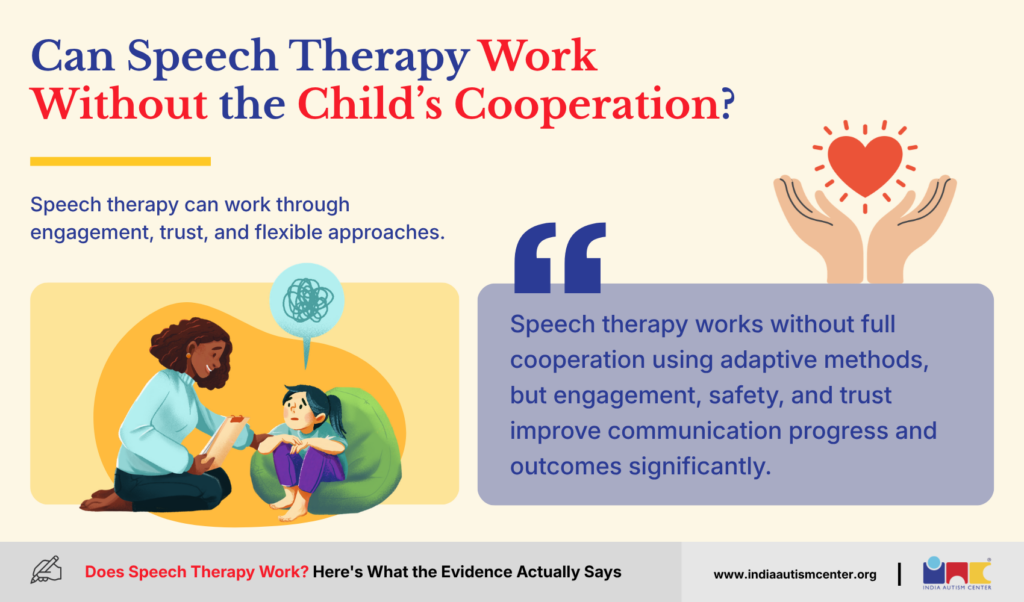
    Can Speech Therapy Work Without The Child’s Cooperation?

    Can speech therapy work without the child's cooperation?

    This is a real concern, especially for parents of young children or individuals with significant behavioural challenges.

    Good speech and language therapists are trained to work with resistance. Play-based therapy, child-led sessions, and high-preference activities are all strategies that help. The session doesn’t need to look like a structured lesson to be therapeutic.

    That said, cooperation does improve outcomes. When a child feels safe, understood, and engaged — they learn faster. This is why the relationship between the therapist and the individual matters as much as the technique.

    For adults who are resistant or withdrawn — especially post-stroke — motivational approaches and meaningful, functional goals tend to unlock engagement better than abstract exercises.

    Watch this video on

    https://youtu.be/YU2Qcp2A09M?si=pBH-LYWPK4O_YC3T

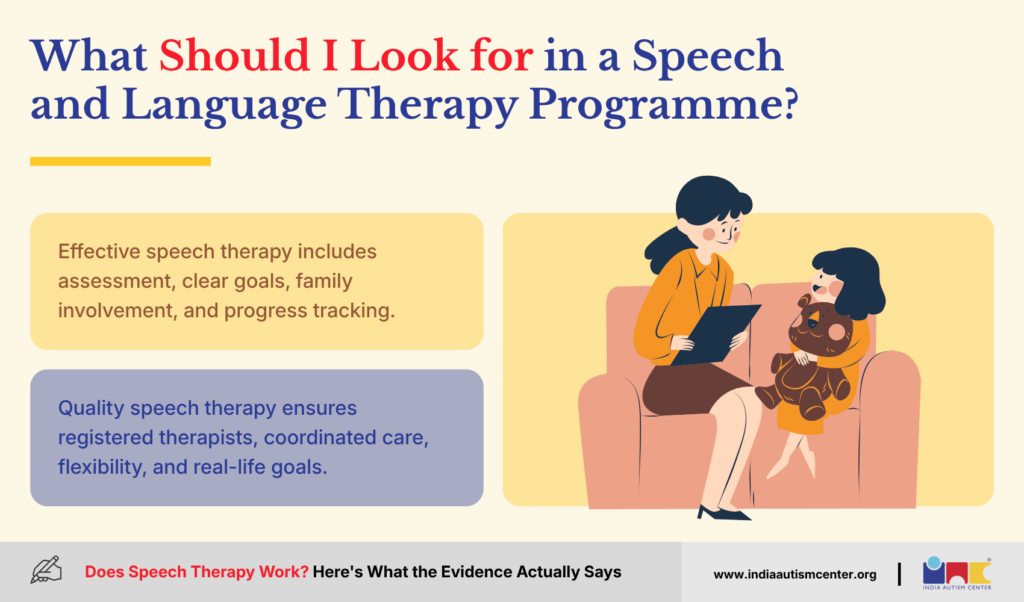
    What Should I Look For In A Speech And Language Therapy Programme?

    What should I look for in a speech and language therapy programme?

    If you’re evaluating services — for a child or an adult — here’s what to look for:

    • RCI-registered therapist (in India, the Rehabilitation Council of India is the governing body)
    • Clear assessment before therapy begins
    • Written goals that are reviewed regularly
    • Active involvement of family or caregivers
    • Transparency about progress — you should know if it’s working
    • Coordination with the school, medical team, or other therapists
    • Flexibility to adapt when something isn’t working

    At India Autism Center, our speech and language therapy services are integrated within a multidisciplinary care model. Our therapists work alongside occupational therapists, behaviour analysts, and special educators to ensure every communication goal is connected to real life — not just clinic performance.

    📥 Free download: Printable daily routine chart for autistic children

    Conclusion

    Speech and language therapy works. It works for children and adults. It works across diagnoses — autism, Down syndrome, learning disabilities, stroke, and more. The evidence is strong, and the impact on quality of life is real.

    The biggest barrier isn’t the therapy itself. It’s awareness, access, and the belief that help is available. If you’re asking “does speech therapy work?” — you’re already asking the right question. The next step is finding the right team.

    For expert insights, support services, and inclusive learning initiatives, visit the India Autism Center.


    Disclaimer: This article is intended for educational purposes only. The information provided here does not constitute medical or clinical advice and should not be used as a substitute for professional assessment, diagnosis, or treatment. If you have concerns about your child’s or a family member’s communication development, please consult a qualified speech-language pathologist or medical professional.

  • How Genetics and Family Environment Shape Autism Risk

    How Genetics and Family Environment Shape Autism Risk

    Is autism genetic? Well, autism risk is shaped by three interlocking forces: a child’s own DNA, the indirect influence of each parent’s genes, and environmental factors like maternal nutrition and metabolic health. No single gene causes autism. A landmark 2026 study published in Nature Genetics — analysing over 18,000 families — has now mapped exactly how these forces work together

    Is Autism Genetic? What the Research Actually Says

    Is Autism Genetic? What the Research Actually Says

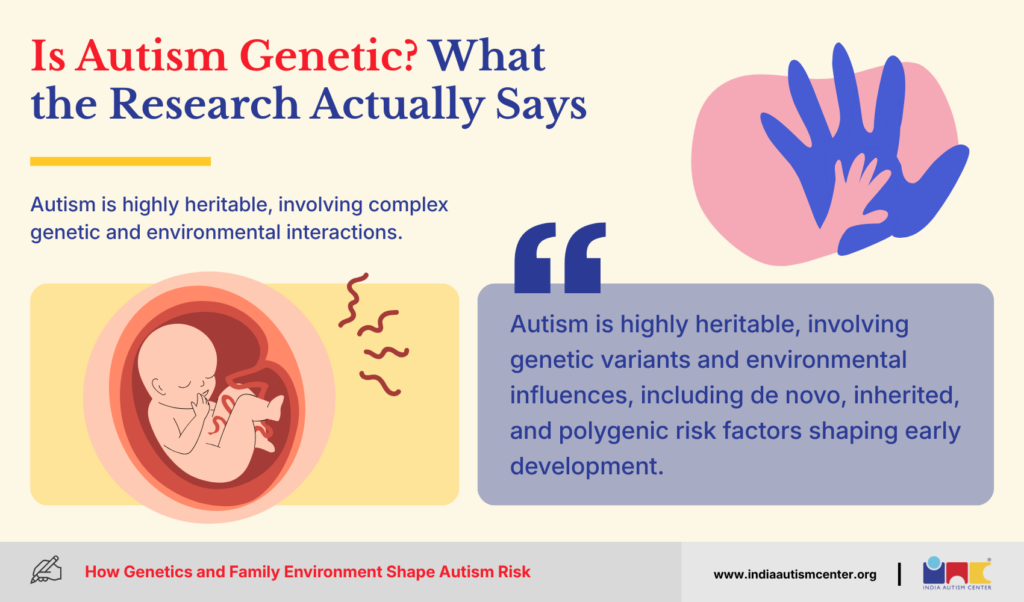
    Yes — but not in the way most people imagine.

    Autism is highly heritable, with heritability estimated between 70–90%. That means genetics plays a major role. But heritable does not mean inevitable, and it does not mean a single gene is passed from parent to child like eye colour.

    Autism emerges from a complex interaction between hundreds of genetic variants, each contributing a small amount of risk, and the developmental environment the child grows in — starting from the womb.

    There are three distinct genetic pathways that researchers have identified:

    • De novo variants — new gene mutations that appear in the child but are not present in either parent
    • Inherited variants — gene variants passed down from one or both parents
    • Polygenic risk — the cumulative effect of hundreds of common genetic variants, each with a tiny individual impact

    Most autistic children carry a combination of all three.

    What Is a Polygenic Score — and Why Does It Matter for Autism?

    What Is a Polygenic Score — and Why Does It Matter for Autism?

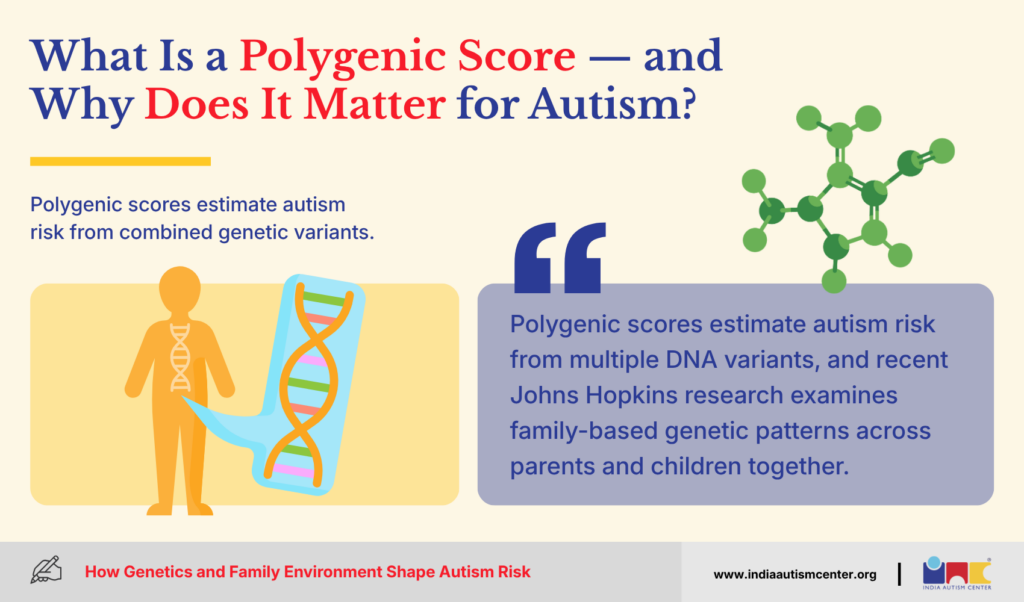
    A polygenic score (PGS) is a DNA-based calculation that estimates a person’s predisposition to a condition based on how many genetic risk variants they carry. Think of it as a genetic risk calculator — not a diagnosis, but a probability estimate.

    Large-scale studies have developed polygenic scores for autism over the past decade. What was missing, until recently, was a framework that could analyse these scores in the context of families, taking into account not just the child’s DNA, but the mother’s and father’s genetic backgrounds separately.

    That is exactly what the 2026 Johns Hopkins study set out to do.

    Want to know more? Get in touch with us.

    What Did the 2026 Johns Hopkins Study Find?

    What Did the 2026 Johns Hopkins Study Find?

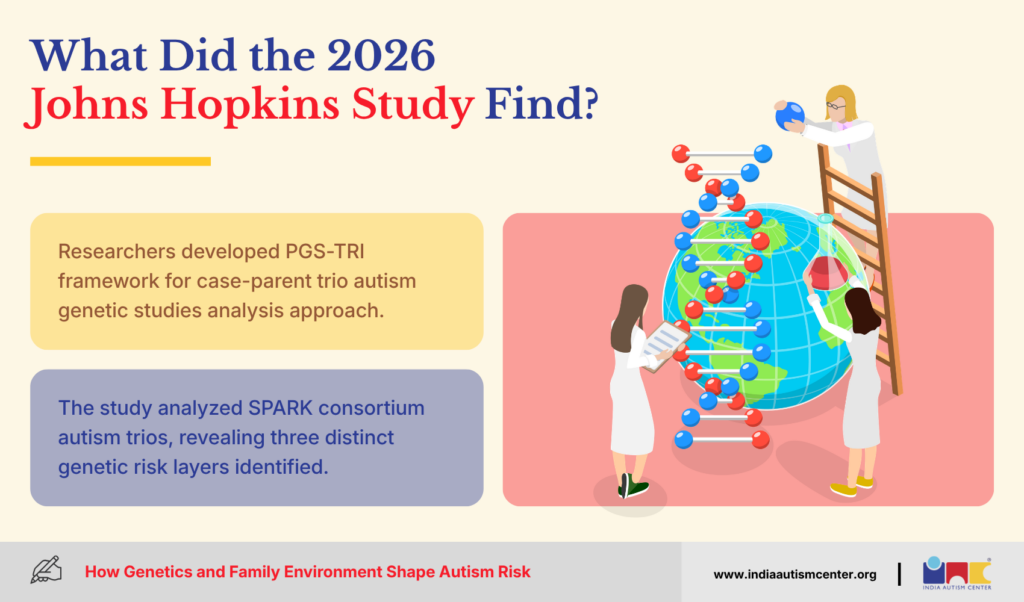
    Researchers at Johns Hopkins Bloomberg School of Public Health, Johns Hopkins University School of Medicine, and Kaiser Permanente Northern California developed a new statistical framework called PGS-TRI, designed specifically for case-parent trio studies.

    A trio study analyses an autistic child and both biological parents together. This design reveals things that standard population studies cannot: specifically, how a parent’s genes shape a child’s risk not through direct inheritance, but through the environment the parent creates.

    The team applied PGS-TRI to 18,383 autism trios drawn from the Simons Foundation Powering Autism Research (SPARK) consortium — one of the largest and most diverse autism genetic datasets in the world.

    Their findings revealed three distinct layers of risk.

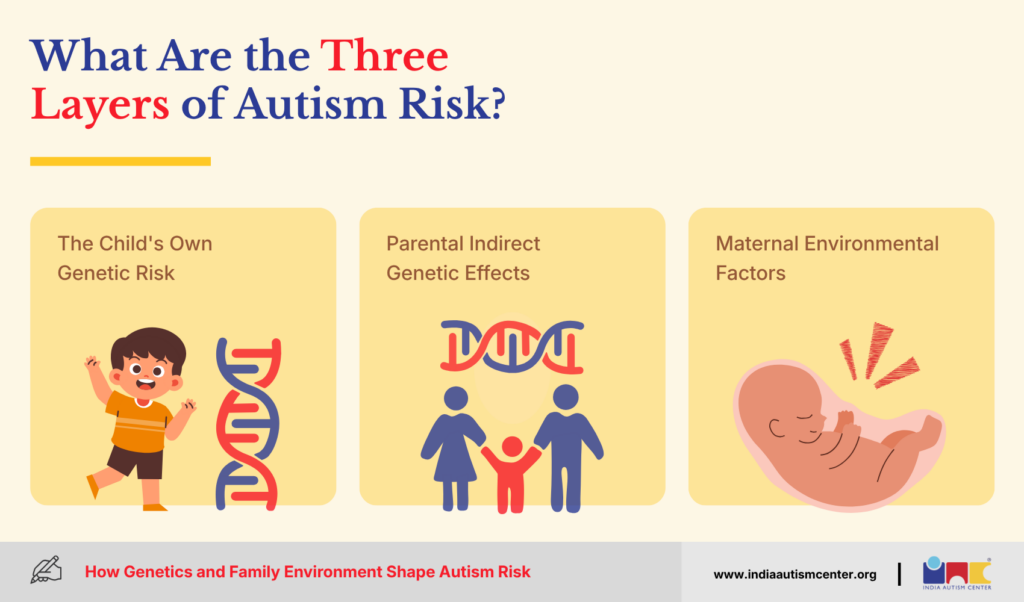
    What Are the Three Layers of Autism Risk?

    What Are the Three Layers of Autism Risk?

    Layer 1: The Child’s Own Genetic Risk

    The child’s inherited polygenic score for autism directly increases their probability of diagnosis. This is the most intuitive finding — and it confirms what earlier research had suggested.

    But the child’s autism PGS is only part of the picture.

    Layer 2: Parental Indirect Genetic Effects

    This is the study’s most significant — and most surprising — finding.

    The researchers found that parents’ polygenic scores for BMI and several neurocognitive traits had significant indirect effects on their child’s autism risk. In other words, a parent’s genetic predisposition for high BMI or certain cognitive traits influenced the child’s autism risk — not by passing those genes directly to the child, but by shaping the developmental environment.

    Here is what makes this important: the mother’s and father’s indirect contributions are not equal. PGS-TRI was built to detect this asymmetry. The data suggests that maternal and paternal indirect effects operate through different biological and behavioural pathways.

    📥 Free download: Printable daily routine chart for autistic children

    Notably, the study found no significant indirect effect from the parents’ own autism polygenic score — only from BMI and neurocognitive traits. This tells us that what a parent does developmentally and metabolically may matter as much as what genes they pass on.

    Layer 3: Maternal Environmental Factors

    The framework was also designed to detect gene–environment interactions — specifically how maternal lifestyle factors like diet, weight, and metabolic health interact with a child’s genetic risk.

    This is not about blame. A parent’s BMI or cognitive profile is itself genetically influenced. What it signals is that modifiable factors during pregnancy — nutrition, folic acid supplementation, managing metabolic health — can interact with genetic predispositions in meaningful ways.

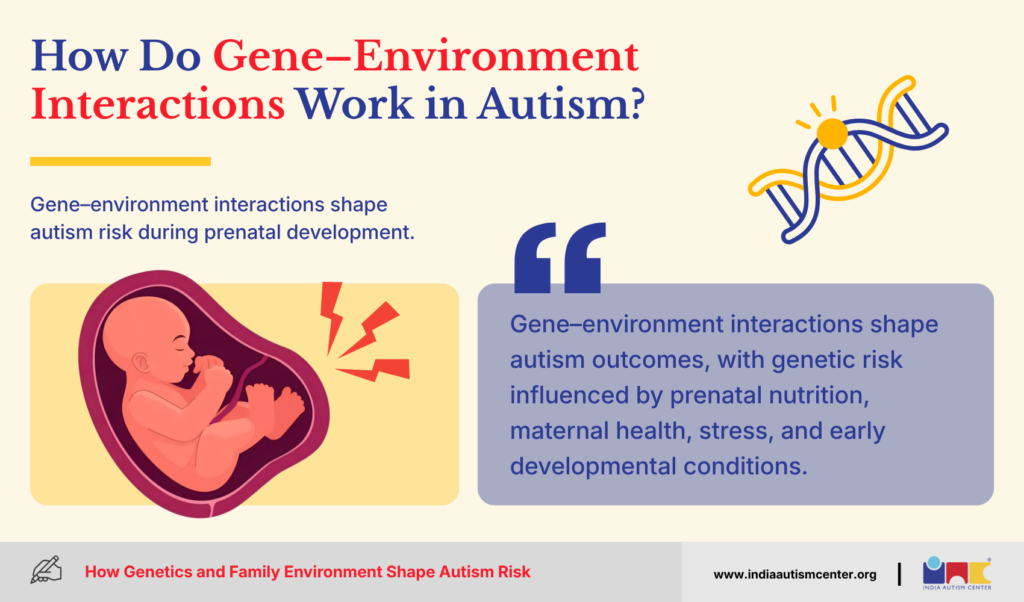
    How Do Gene–Environment Interactions Work in Autism?

    How Do Gene–Environment Interactions Work in Autism?

    A gene–environment interaction (G×E) happens when a genetic predisposition expresses differently depending on the environment it encounters.

    A simple way to understand this: imagine two children who carry the same autism polygenic risk score. One grows in a nutrient-rich prenatal environment with no significant stressors. The other is exposed to nutritional deficiencies or high maternal cortisol levels in utero. The genetic risk is identical — but the developmental outcome can differ.

    Known environmental modulators in autism research include:

    Environmental FactorWhat the Research Shows
    Prenatal folic acidAdequate intake linked to reduced neural tube and neurodevelopmental risk
    Maternal BMIHigh pre-pregnancy BMI associated with elevated autism risk in offspring
    Maternal ageAdvanced maternal age correlates with increased de novo mutation rates
    Paternal ageOlder paternal age linked to higher rates of new genetic mutations in children
    Prenatal stressElevated maternal cortisol may alter fetal brain development trajectories
    Infections during pregnancyImmune activation in utero has been studied as a potential risk modulator

    These are modulators, not causes. Autism is not caused by a parent’s diet or stress levels. These factors influence how a genetic predisposition unfolds — nothing more.

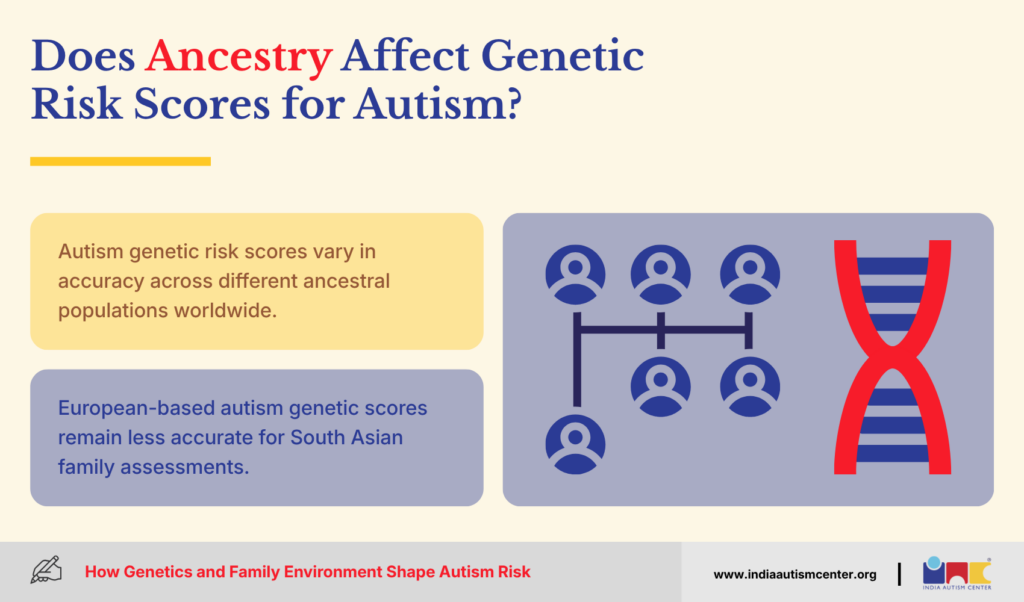
    Does Ancestry Affect Genetic Risk Scores for Autism?

    Yes — significantly. And this matters deeply for Indian and South Asian families.

    The study found that existing polygenic risk scores predict autism more accurately in individuals of European ancestry than in other populations. The reason: most large-scale genetic studies that created these scores used predominantly European cohorts. When applied to South Asian or East Asian individuals, the scores lose predictive accuracy.

    The Johns Hopkins team demonstrated that this drop-off is not random — it follows a continuous attenuation pattern based on how genetically distant the target population is from the population the score was trained on.

    What this means for families in India:

    • Consumer genetic tests or research polygenic scores built on European data may underestimate or misrepresent autism risk in Indian children
    • Clinical diagnosis through developmental assessment remains the most reliable approach for Indian families
    • There is an urgent need for South Asian representation in autism genetic databases — studies like these need data from families like yours

    This is a research gap, not a permanent limitation. It will close as diversity in autism datasets grows.

    Want to know more? Get in touch with us.

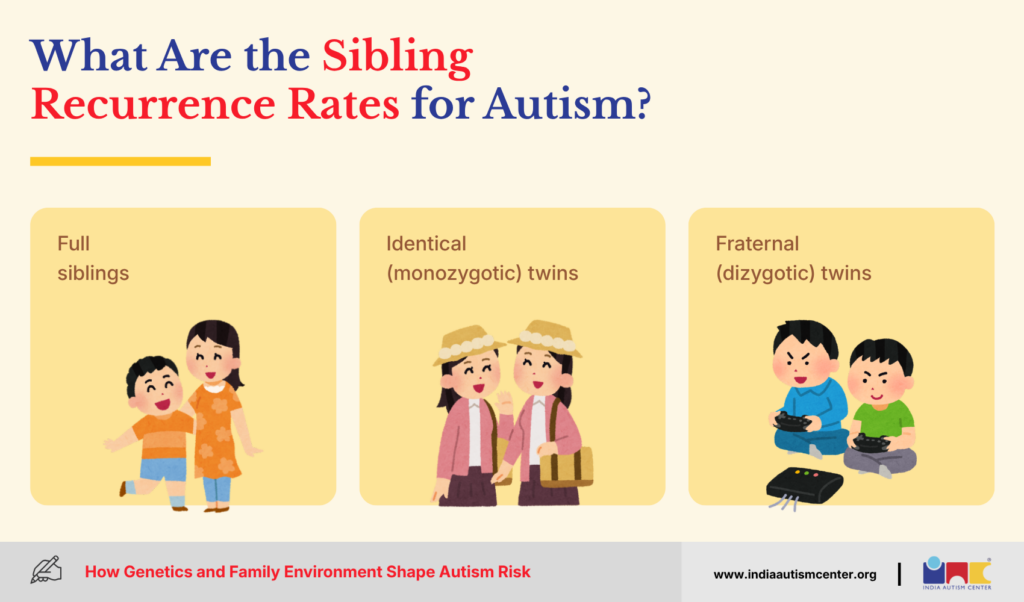
    What Are the Sibling Recurrence Rates for Autism?

    What Are the Sibling Recurrence Rates for Autism?

    If you have one autistic child, this is almost certainly a question you have asked.

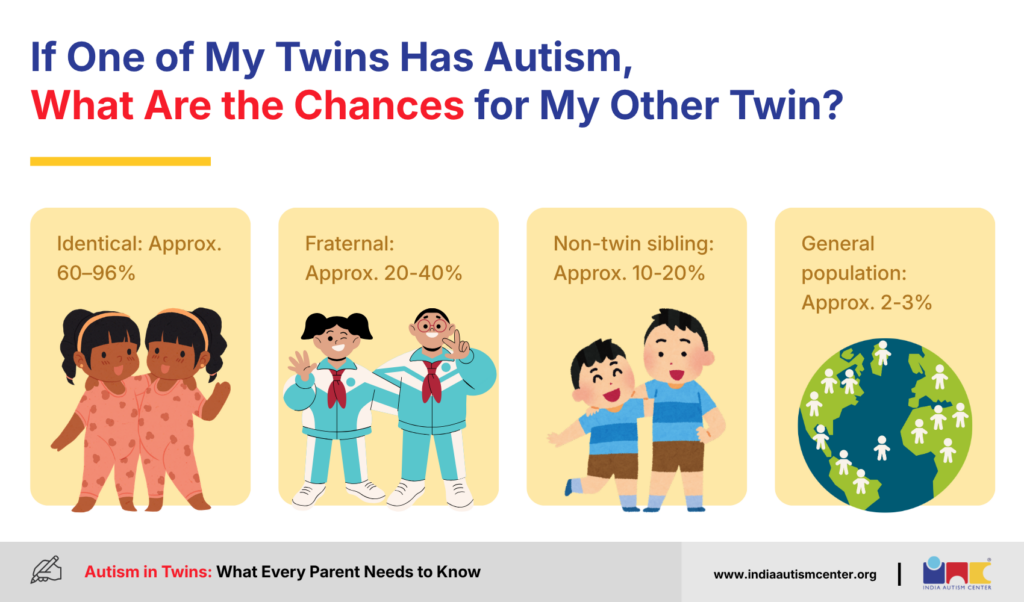
    The research is consistent here. Sibling recurrence rates for autism are meaningfully higher than the general population rate of approximately 1–2%. Studies suggest:

    • Full siblings of an autistic child have roughly a 10–20% recurrence risk
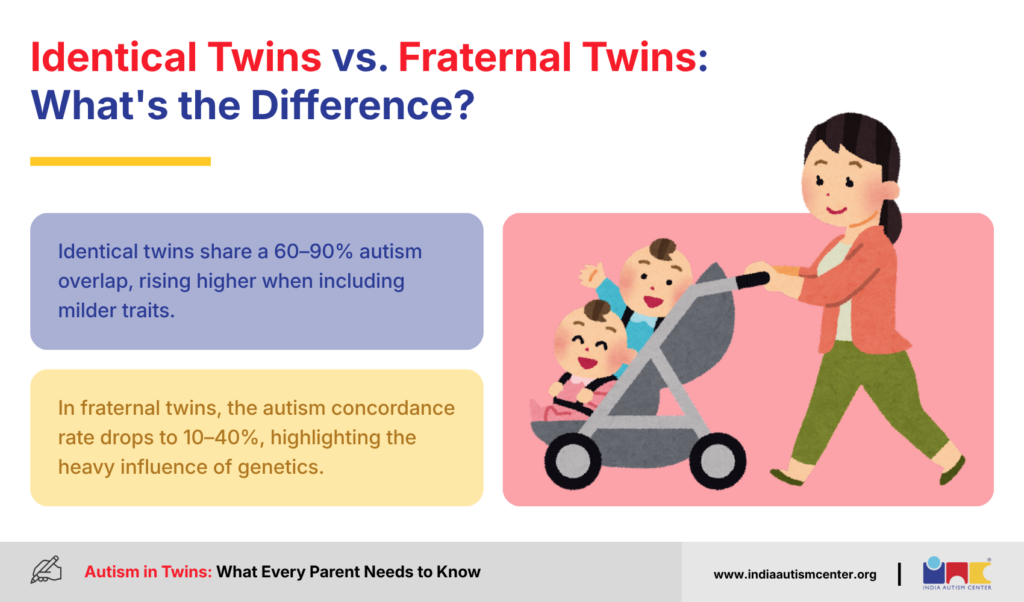
    • Identical (monozygotic) twins: concordance rates of 70–90%
    • Fraternal (dizygotic) twins: concordance rates of 30–40%

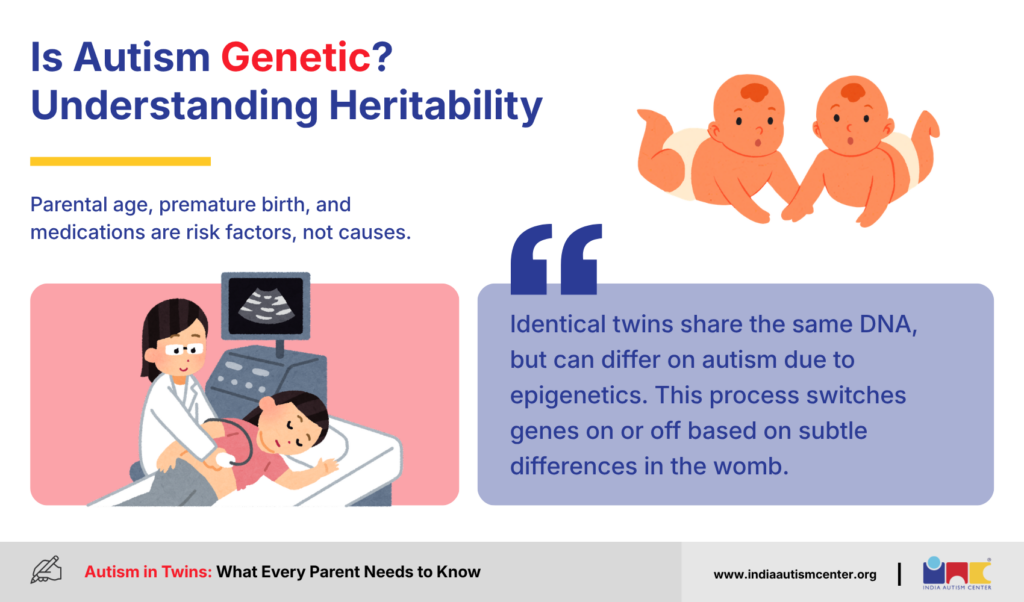
    These numbers reflect shared genetics and shared prenatal environment — which is why identical twins, despite identical DNA, do not show 100% concordance. The environment inside the womb still matters.

    If you are planning another pregnancy and have concerns, speaking with a developmental paediatrician or genetic counsellor is the most productive next step.

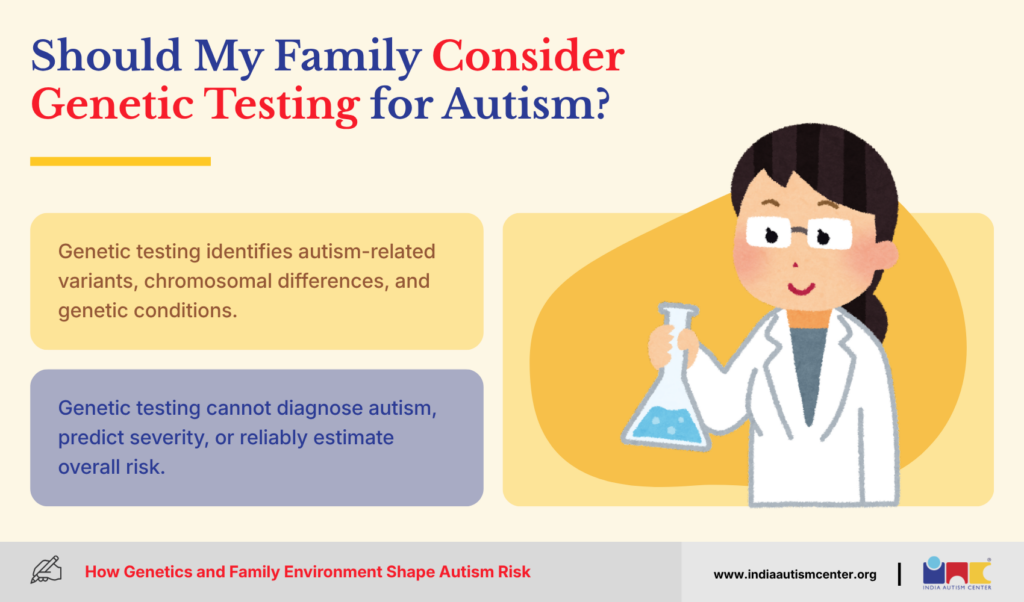
    Should Families Consider Genetic Testing for Autism?

    Should My Family Consider Genetic Testing for Autism?

    This depends on what you are looking for — and it is worth being honest about what genetic testing can and cannot tell you.

    What genetic testing can identify:

    • Specific high-impact single gene variants associated with autism (e.g., mutations in SHANK3, CHD8, PTEN, MECP2)
    • Chromosomal differences like copy number variations (CNVs)
    • Conditions like Fragile X syndrome or Angelman syndrome where autism is a common feature

    What genetic testing cannot currently do:

    • Confirm or rule out an autism diagnosis
    • Give a reliable polygenic risk probability for most non-European populations
    • Predict severity or trajectory

    Polygenic scores are research tools, not clinical diagnostic instruments. If your child is showing developmental differences, the priority is developmental assessment — not a DNA test.

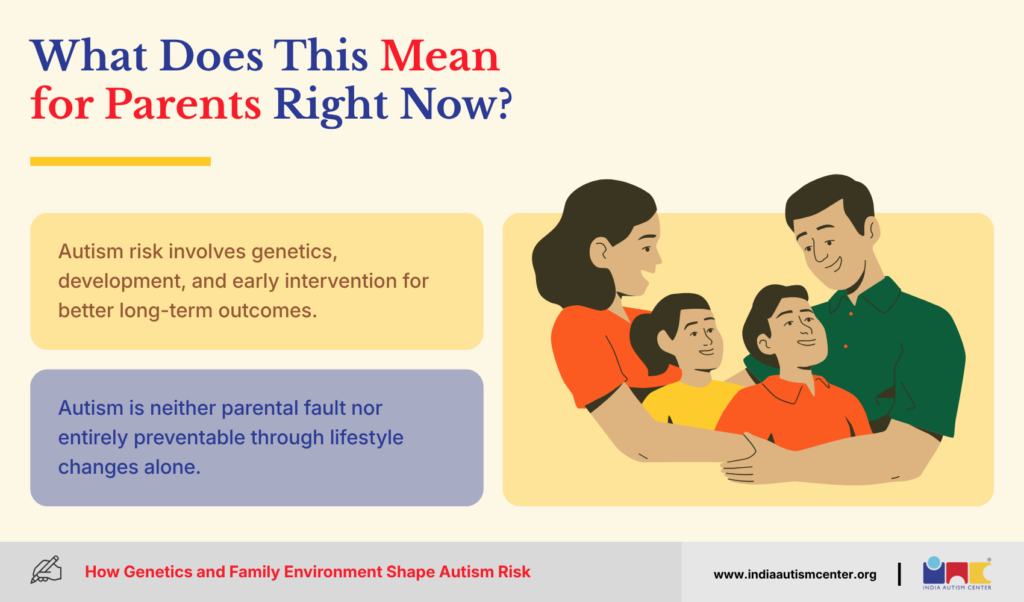
    What Does This Mean for Parents Right Now?

    What Does This Mean for Parents Right Now?

    Let me be direct about what this research does and does not imply.

    It does not mean:

    • You caused your child’s autism
    • You could have prevented it with a different lifestyle
    • Your child’s autism is a genetic error

    It does mean:

    • Autism risk is multifactorial — genetics, parental biology, and developmental environment all interact
    • Prenatal health — particularly maternal nutrition, folic acid intake, and metabolic health — is worth prioritising in any pregnancy
    • Early identification and structured intervention remain the most evidence-based response, regardless of genetic profile

    The researchers behind the PGS-TRI framework have stated that their goal is to enable better discovery of risk factors and biomarkers — not to predict or prevent autism, but to understand it more completely so that families and clinicians can make better-informed decisions.

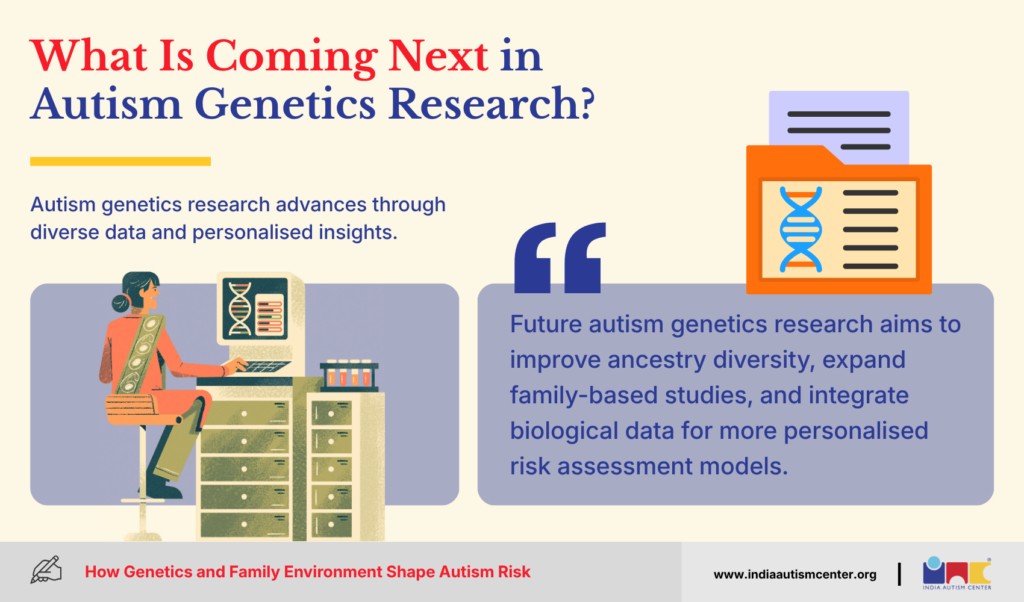
    What Is Coming Next in Autism Genetics Research?

    What Is Coming Next in Autism Genetics Research?

    The Johns Hopkins team has outlined several directions for extending this work:

    • Applying PGS-TRI to broader family structures — including grandparents, siblings, and extended relatives — to capture more nuanced patterns of indirect genetic effects
    • Integrating transcriptomics and metabolomics data (gene expression and metabolite profiles) into risk modelling — the 2026 study piloted this approach
    • Building ancestry-diverse datasets so that polygenic scores become equally predictive across all populations

    This is a field moving quickly. The science of autism genetics in 2026 is substantially more nuanced than it was even five years ago — and the direction of travel is clearly toward understanding autism as a deeply individual, multifactorial condition rather than a uniform diagnostic category.

    Want to know more? Get in touch with us.

    Conclusion

    • Autism heritability is 70–90%, but no single gene causes autism
    • Risk comes from the child’s DNA, indirect parental genetic effects, and gene–environment interactions
    • A parent’s BMI and neurocognitive genetic profile can influence a child’s autism risk indirectly — through the developmental environment
    • Maternal lifestyle factors (nutrition, metabolic health) are modulators, not causes
    • Polygenic risk scores are less accurate for non-European populations — Indian families should rely on clinical assessment
    • Sibling recurrence risk is 10–20% for full siblings; family genetic counselling is available and worthwhile
    • Early identification and structured intervention remain the most evidence-based response for any family

    This article is intended for educational purposes only. It does not constitute medical advice, genetic counselling, or a clinical recommendation. If you have concerns about your child’s development or wish to discuss genetic testing, please consult a qualified developmental paediatrician, clinical geneticist, or autism specialist. Families in India can contact India Autism Center for guidance on appropriate assessment and support pathways.


    Source: Wang Z, Grosvenor L, Ray D, et al. “Estimation of Direct and Indirect Polygenic Effects and Gene–Environment Interactions using Polygenic Scores in Case-Parent Trio Studies.” Nature Genetics, June 2026. DOI: 10.1038/s41588-026-02601-2

  • Why Are Fewer Girls Diagnosed with Autism? The X Chromosome May Hold the Answer 

    Why Are Fewer Girls Diagnosed with Autism? The X Chromosome May Hold the Answer 

    Yes — the X chromosome does appear to offer girls a degree of biological protection against autism. A landmark study published in Nature Genetics in March 2026 identified specific genes on the X chromosome that may reduce the impact of autism-linked genetic mutations in females. This doesn’t mean girls can’t have autism. It means they may need a higher genetic threshold before it manifests.

    Why Are Boys Four Times More Likely To Be Diagnosed With Autism Than Girls?

    Why Are Boys Four Times More Likely To Be Diagnosed With Autism Than Girls?

    This is one of the most persistent questions in autism research.

    For decades, data across countries — including India — has shown that boys are diagnosed with autism at roughly four times the rate of girls. The ratio holds up across cultures, income groups, and healthcare systems.

    For a long time, the dominant explanation was bias. The thinking was that girls were simply being missed — that they present differently, mask better, and fall through the diagnostic cracks. And that’s true, to a significant extent.

    But a major 2026 genetic study has added a second, equally important layer to this story: biology itself may be at play.

    What Did The 2026 Nature Genetics Study Actually Find?

    What Did The 2026 Nature Genetics Study Actually Find?

    Researchers at the Whitehead Institute and the Massachusetts Institute of Technology (MIT) published a study on March 30, 2026, in Nature Genetics that zeroed in on the X chromosome as a possible source of protection against autism in females.

    Here’s what they found, in plain language:

    • Females carry two X chromosomes (XX); males carry one X and one Y (XY).
    • Scientists previously believed one of a female’s two X chromosomes was almost entirely “switched off” — a process called X-inactivation.
    • Newer research shows this is not the full picture. Some genes on the “inactive” X chromosome remain active. Scientists call these “escapee genes”.
    • These escapee genes appear to regulate the activity of many other genes, including some directly linked to autism risk.
    • Having a second copy of these regulatory genes may help counterbalance the effect of autism-associated genetic mutations.

    - David Page, Lead author

    What Is The "Female Protective Effect" In Autism?

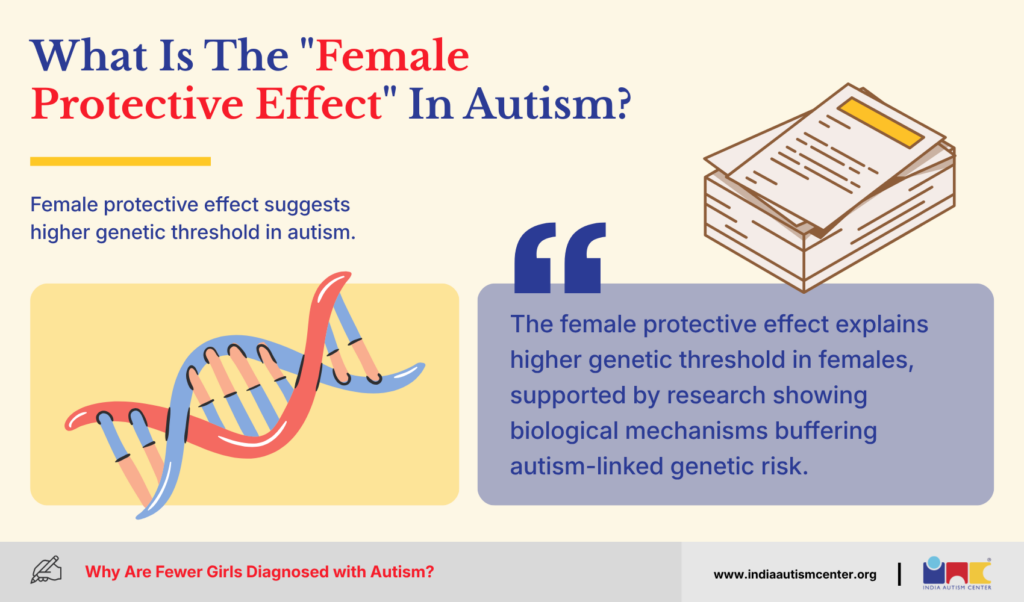
    What Is The "Female Protective Effect" In Autism?

    The Female Protective Effect (FPE) is a well-established theory in autism research. It proposes that females require a higher genetic or biological "load" before autism manifests compared to males.

    Think of it like a dam with a higher wall. The same amount of water (genetic risk) that floods a lower dam in a boy may stay safely contained in a girl.

    This doesn't mean the risk isn't there. It means the threshold is higher.

    Key evidence supporting the FPE:

    StudyYearFinding
    American Journal of Human Genetics2014Autistic females carry more autism-linked genetic mutations on average than autistic males
    Nature Genetics (Whitehead Institute/MIT)2026Escapee genes on the X chromosome may buffer the impact of those mutations
    Multiple population studiesOngoingThe 4:1 male-to-female ratio holds consistently across diverse populations

    The 2026 study doesn't invent the FPE. It gives us, for the first time, a credible biological explanation for how it works.

    Want to know more? Get in touch with us.

    What Exactly Are "Escapee Genes" On The X Chromosome?

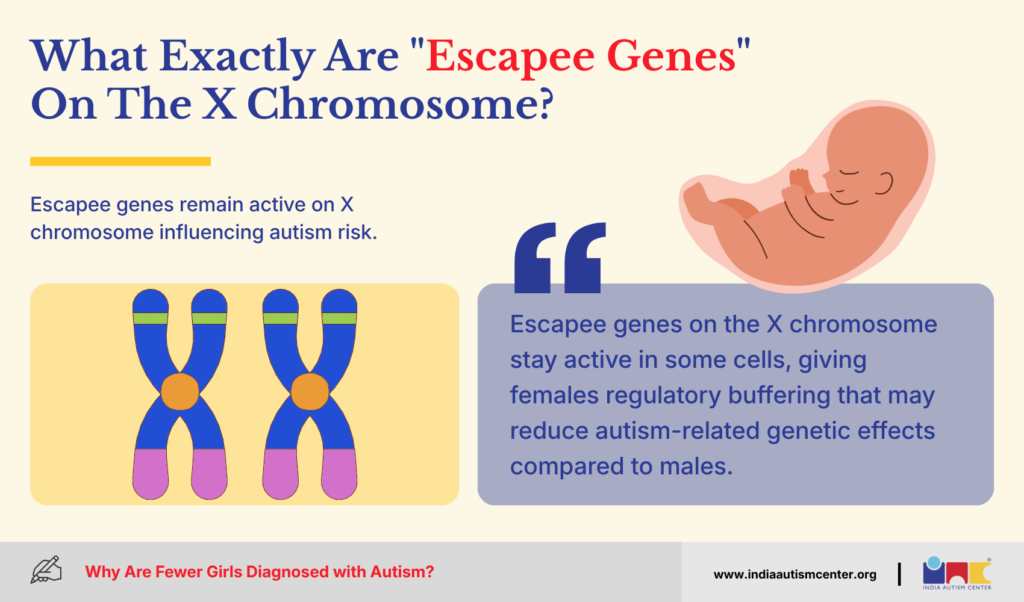
    What Exactly Are "Escapee Genes" On The X Chromosome?

    Here's a quick biology refresher, kept simple.

    Every cell in the human body contains chromosomes — structures that carry genetic instructions. Females have two X chromosomes. To prevent a "double dose" of X-linked genes, one of the two X chromosomes in each female cell is largely silenced. This is called X-chromosome inactivation.

    However, not all genes on the silenced X stay silent. Some "escape" the inactivation process and remain active. These are escapee genes.

    Why does this matter for autism?

    • Escapee genes on the second X chromosome give females an extra functional copy of certain regulatory genes.
    • These regulatory genes can influence how autism-related mutations express themselves.
    • In males, there is only one X chromosome — so there is no backup copy, no regulatory buffer.

    It's the genetic equivalent of having a co-pilot in the cockpit. Males are flying single-handed.

    -Maya Talukdar, First author

    Does This Mean Girls Are Immune To Autism?

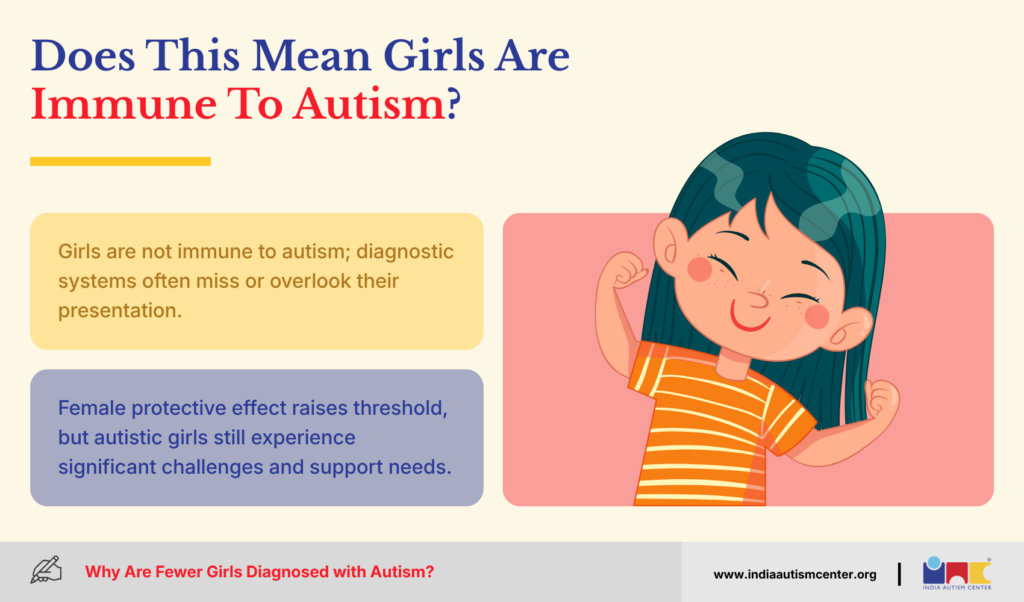
    Does This Mean Girls Are Immune To Autism?

    No — and this point is critical.

    The female protective effect does not prevent autism. It raises the threshold at which autism manifests. When girls do cross that threshold, research consistently shows they often carry more significant genetic mutations than their male counterparts with similar diagnoses.

    This means:

    • Autistic girls are real. Their autism is not milder, imagined, or a misdiagnosis.
    • They are being missed. The diagnostic system was largely built around the male presentation of autism.
    • When they are diagnosed, their profile may be more complex than typical male presentations.

    Girls who are autistic are not protected from the challenges of autism. They may simply have needed a larger biological "push" to reach diagnosis — and that gap in diagnosis has real-world consequences.

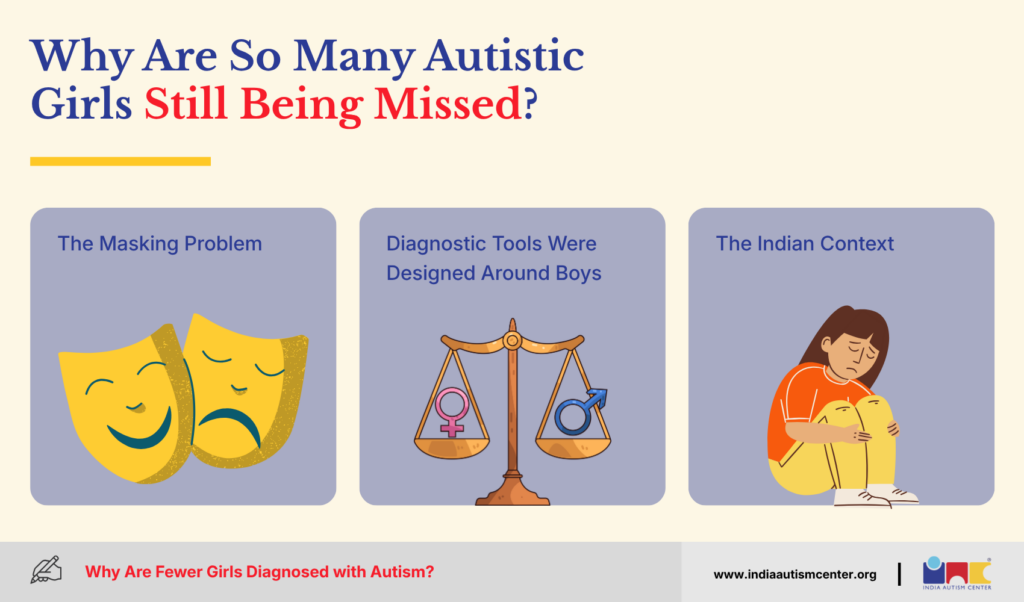
    Why Are So Many Autistic Girls Still Being Missed?

    Why Are So Many Autistic Girls Still Being Missed?

    This is where biology and social context intersect — and where the problem deepens.

    Even accounting for the female protective effect, there is strong evidence that a significant number of autistic girls are going undiagnosed. The reasons are both scientific and cultural.

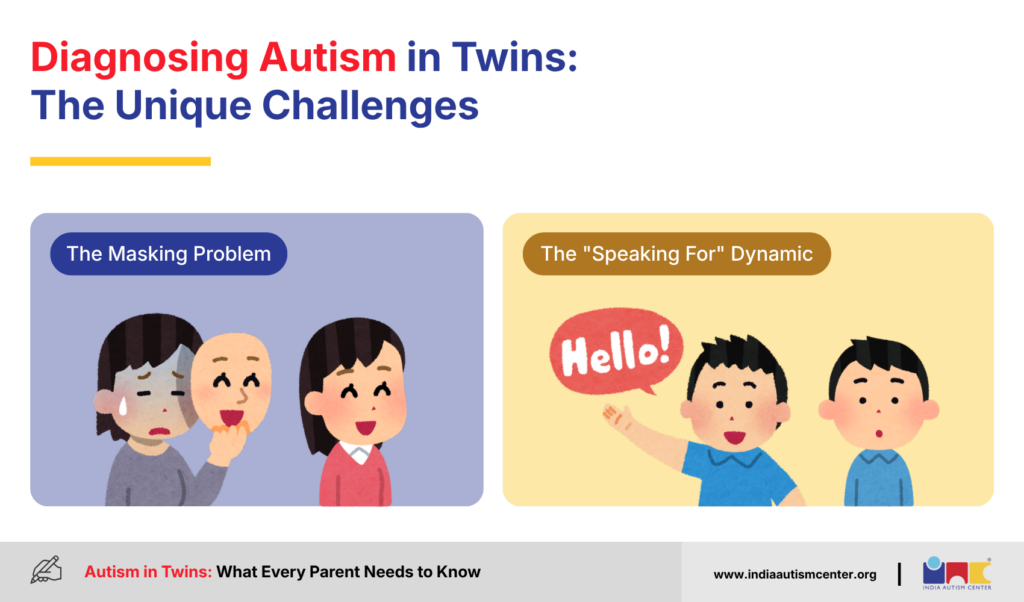
    The Masking Problem

    Masking (also called camouflaging) refers to the conscious or unconscious process by which autistic people suppress their natural behaviours to appear neurotypical. Research shows autistic girls mask more extensively than autistic boys.

    Common masking behaviours in girls include:

    • Mimicking the social behaviour of peers
    • Suppressing stimming in public
    • Forcing eye contact even when it feels uncomfortable
    • Using scripted social responses learned through observation
    • Developing intense but socially acceptable special interests (e.g., books, animals, celebrities — rather than the train schedules or video games stereotypically associated with autistic boys)

    Masking is exhausting. It works well enough to fool clinicians, teachers, and even parents — but it comes at a significant cost. Many autistic girls develop anxiety, depression, and burnout as a direct consequence of sustained masking, often hitting a breaking point in adolescence.

    Diagnostic Tools Were Designed Around Boys

    The original diagnostic criteria for autism were developed largely from studies of male subjects. Tools like the Autism Diagnostic Observation Schedule (ADOS) were not initially calibrated to detect the subtler, more socially-oriented presentations common in girls.

    This has begun to change, but slowly. The bias persists in clinical practice, especially in lower-resource settings.

    The Indian Context

    In India, additional cultural layers complicate diagnosis in girls:

    • Girls are socialised to be quiet, compliant, and accommodating — traits that can mask autistic behaviour effectively.
    • Family concerns about marriageability and social stigma may discourage parents from seeking an autism evaluation for daughters.
    • Diagnostic services in India remain heavily concentrated in urban centres, where gender biases in clinical practice mirror global patterns.

    The result: India almost certainly has a significant population of autistic girls and women who have never been identified, never received support, and are navigating life without understanding why it feels so difficult.

    📥 Free download: Printable daily routine chart for autistic children

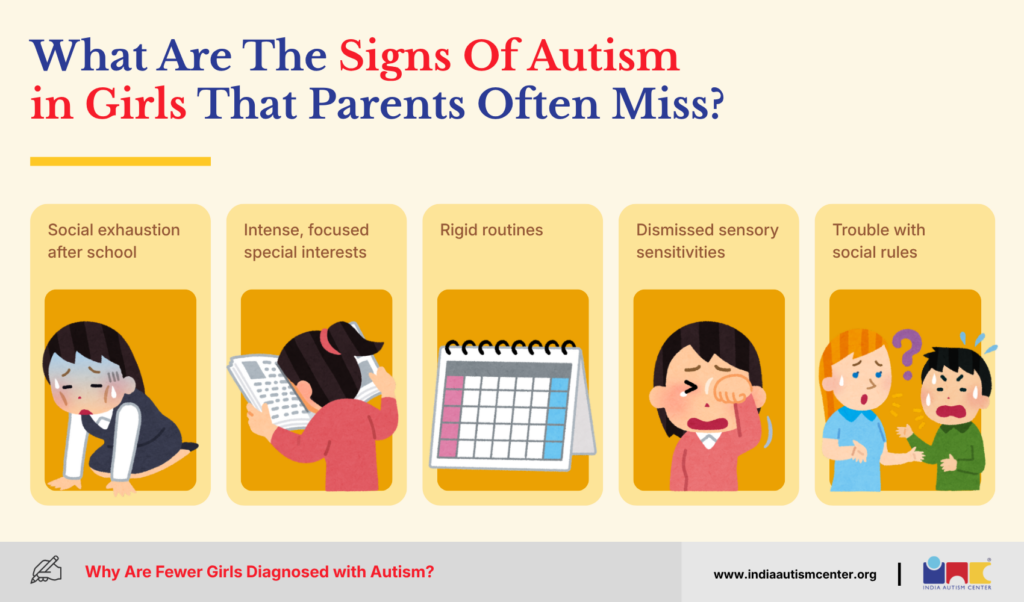
    What Are The Signs Of Autism in Girls That Parents Often Miss?

    What Are The Signs Of Autism in Girls That Parents Often Miss?

    Because masking is so effective, the signs of autism in girls often look very different from what most parents picture when they think of autism.

    Watch for these patterns in girls:

    • Social exhaustion after school — appears fine in class, but melts down at home. School consumes all her regulatory energy.
    • Intense, focused special interests — not unusual in type, but unusual in depth and exclusivity.
    • Rigid routines — distress when plans change, even small ones.
    • Sensory sensitivities dismissed as "being dramatic" — clothing textures, food consistency, loud environments.
    • Difficulty with unstructured social time — playdates and group settings are harder than one-on-one interactions.
    • Trouble with abstract social rules — understands explicit instructions but struggles with unspoken social norms.
    • History of anxiety or depression — often the presenting issue in adolescent girls whose underlying autism was never detected.

    None of these signs alone confirms autism. But a consistent pattern across multiple settings and developmental stages warrants a proper evaluation.

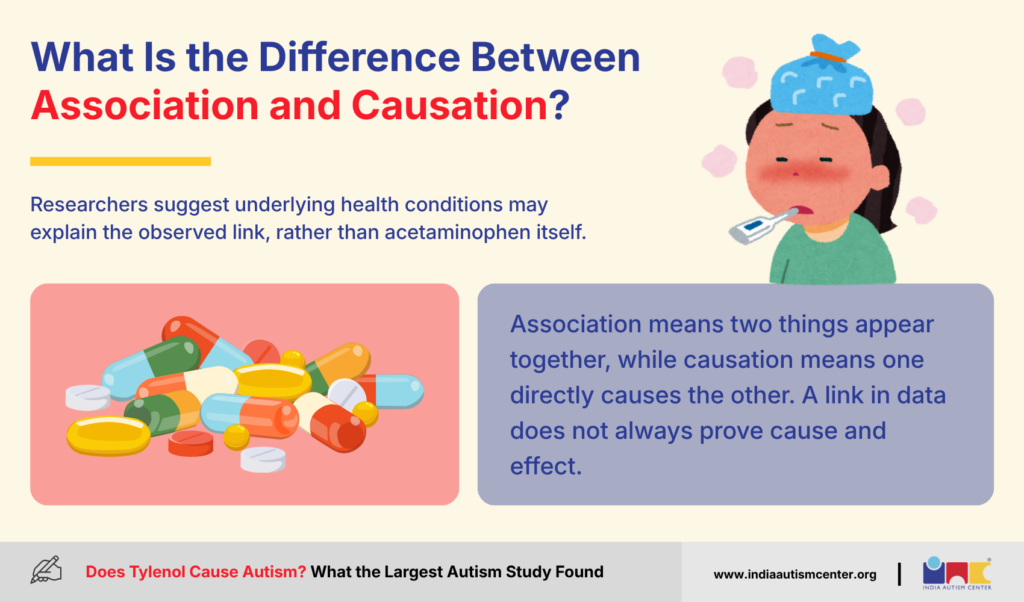
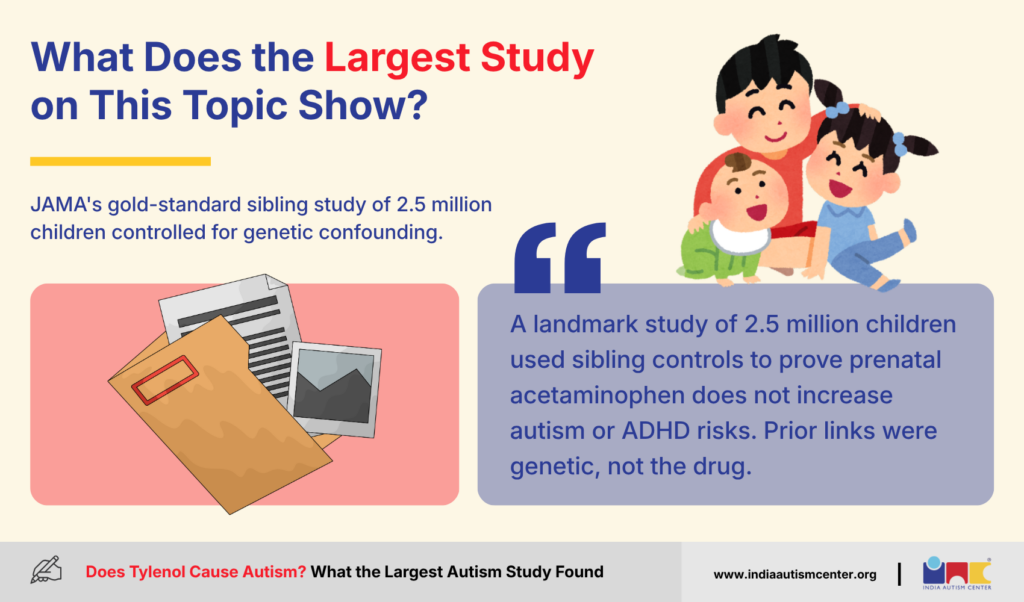
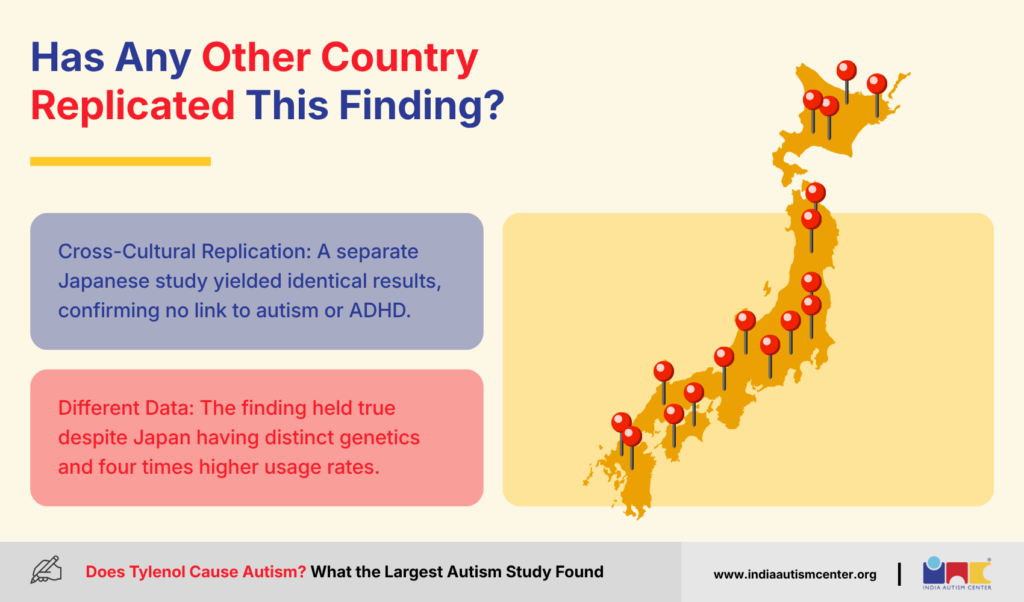
    Read our blog on Does Tylenol Cause Autism? What the Largest Autism Study Found  

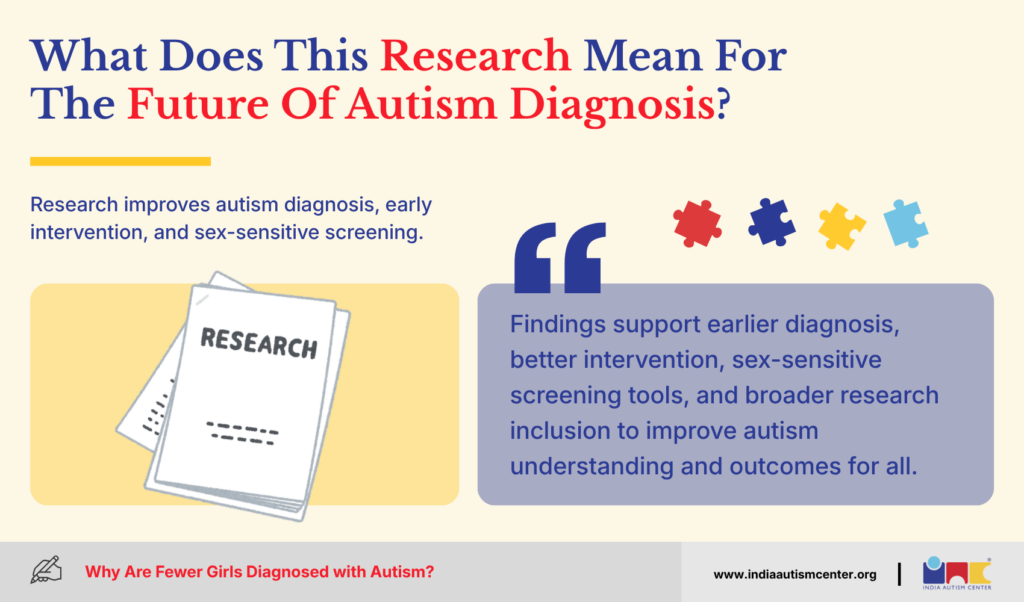
    What Does This Research Mean For The Future Of Autism Diagnosis?

    What Does This Research Mean For The Future Of Autism Diagnosis?

    The implications of the 2026 Nature Genetics study extend well beyond a single discovery.

    For diagnostics: If we understand why girls have a higher threshold for autism, we can develop sex-sensitive screening tools that catch girls earlier — before years of masking take their toll.

    For intervention: Earlier identification means earlier support. The earlier a child receives appropriate intervention, the better the outcomes across communication, daily living skills, and emotional regulation.

    For genetic counselling: Families with autistic children may one day benefit from understanding their child's specific chromosomal profile — and what it means for siblings.

    For other conditions: The female protective effect may apply to ADHD, dyslexia, and other neurodevelopmental conditions where boys are similarly over-represented. This research could open doors across multiple fields.

    For research inclusivity: Science has historically under-included women and girls in autism research. This study is a reminder of what we miss when we do. More diverse, sex-stratified research is essential going forward.

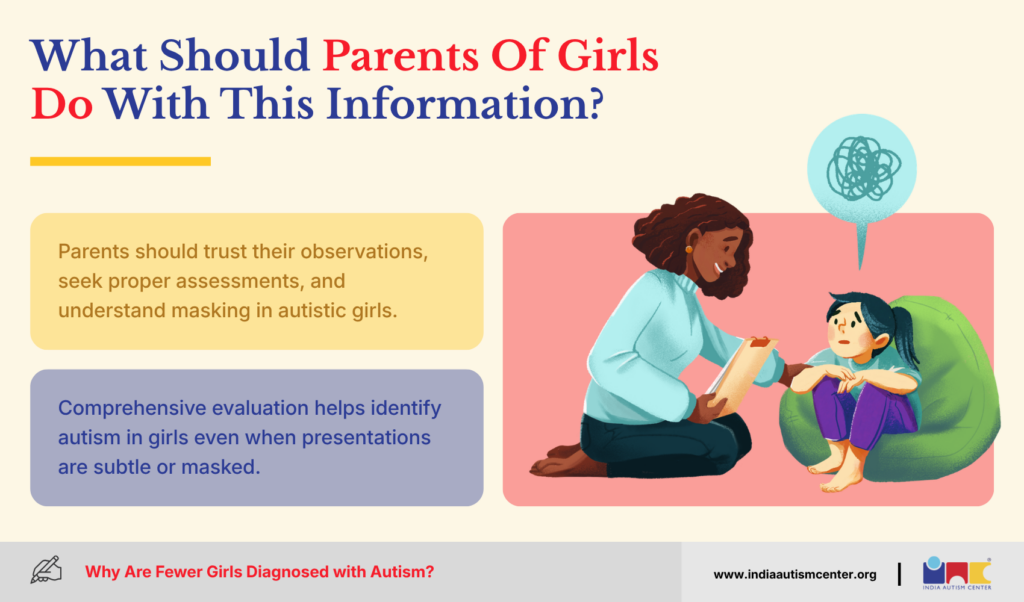
    What Should Parents Of Girls Do With This Information?

    What Should Parents Of Girls Do With This Information?

    If you've been wondering whether your daughter might be autistic — or if you've been told she's "probably fine" — this research gives you scientific grounding to push further.

    Here's what I'd recommend:

    1. Trust your observations. You see your child across contexts. A clinician sees her for an hour at her most regulated.
    2. Ask specifically about female presentation when seeking an assessment. Not all clinicians are trained in this.
    3. Don't let masking fool you. The fact that she "seems fine at school" doesn't rule out autism — it may, in fact, be evidence of it.
    4. Seek a multidisciplinary evaluation. Autism in girls often co-occurs with anxiety, ADHD, or sensory processing differences. A thorough assessment looks at the full picture.
    5. A diagnosis is not a ceiling. It's a starting point for understanding, support, and self-knowledge.

    At India Autism Center, we work with families navigating exactly these questions. Our team provides comprehensive assessments that account for the full spectrum of autism presentations — including the subtler profiles more common in girls.

    You may want to read Signs of Autism in Women: Early Clues, Diagnosis & Support 

    Conclusion

    • Boys are diagnosed with autism roughly four times more than girls — a ratio that holds globally, including in India.
    • A 2026 Nature Genetics study from the Whitehead Institute and MIT identified "escapee genes" on the X chromosome that may buffer the impact of autism-linked mutations in females.
    • This supports the female protective effect — the theory that girls need a higher biological threshold before autism manifests.
    • The FPE does not mean girls can't have autism. Many autistic girls are missed due to masking and diagnostic tools built around male presentations.
    • Earlier, better, and more inclusive diagnosis for girls is both possible and urgent — and this research may accelerate it.

    Want to know more? Get in touch with us.

    Frequently Asked Questions (FAQs)

    Can girls have autism even if the X chromosome offers protection?

    Yes. The protection raises the threshold — it doesn't eliminate the possibility. Many girls are autistic, and many more are going undiagnosed.

    Is the female protective effect proven?

    The FPE is a well-supported theory with growing evidence. The 2026 study provides the first credible molecular mechanism. Further research is ongoing.

    Why do autistic girls often get diagnosed later than boys?

    Primarily due to masking behaviours and diagnostic tools not calibrated to female presentations. Cultural factors, including social pressure on girls to be compliant, can further obscure symptoms.

    What should I do if I think my daughter might be autistic?

    Seek a comprehensive evaluation from a multidisciplinary team experienced in autism. Ask specifically about female presentation. Don't rely on surface-level behaviour as a disqualifier.

    Does this research change how autism is treated in girls?

    Not yet directly, but it points toward the need for sex-stratified diagnostic tools and personalised intervention approaches — an important shift the field is beginning to make.

    For expert insights, support services, and inclusive learning initiatives, visit the India Autism Center.
    Disclaimer: This article is intended for educational and informational purposes only. It does not constitute medical advice, a clinical diagnosis, or a substitute for professional consultation. If you have concerns about your child's development, please consult a qualified healthcare professional or developmental specialist. India Autism Center encourages all families to seek personalised guidance from trained clinicians. The research cited reflects findings available at the time of publication and is subject to ongoing scientific review.

    Sources: Nature Genetics (March 2026), Whitehead Institute for Biomedical Research, Massachusetts Institute of Technology, American Journal of Human Genetics (2014), Futura Sciences.

  • Aggressive Behavior in Autism: What Every Parent Needs to Know

    Aggressive Behavior in Autism: What Every Parent Needs to Know

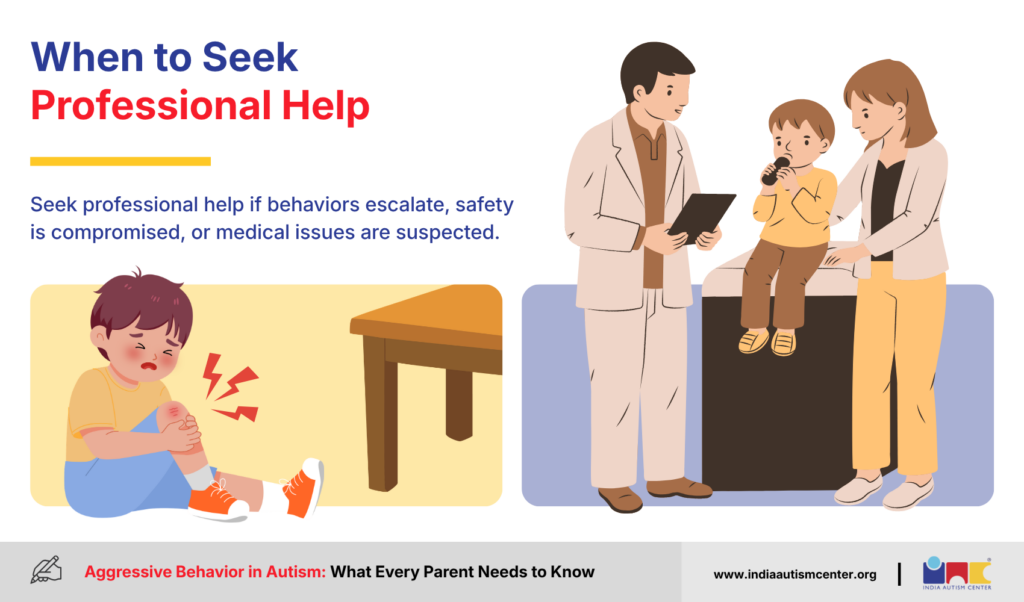
    If you’re reading this, chances are you’ve been hit, kicked, bitten, or screamed at by your own child — and you didn’t know what to do. Maybe you cried afterward. Maybe you felt guilty for getting frustrated. Maybe you Googled “why does my autistic child get aggressive suddenly” at midnight, desperate for something — anything — that would help.

    I want you to know: you are not a bad parent. And your child is not a bad kid.

    Aggressive behavior in autism is one of the most exhausting, heartbreaking, and misunderstood challenges that autism families face. It affects an estimated 25–30% of autistic children at some point, and for many families, it’s the number one reason they seek help.

    This guide is written for you — the parent who is in the thick of it. I’m going to walk you through what’s actually happening when your child lashes out, what’s causing it, and most importantly, what you can do about it in a way that actually works.

    Have a look at What Is Autism? Signs, Causes & Truths Explained Simply 

    What Is Aggressive Behavior in Autism? 

    What Is Aggressive Behavior in Autism? 

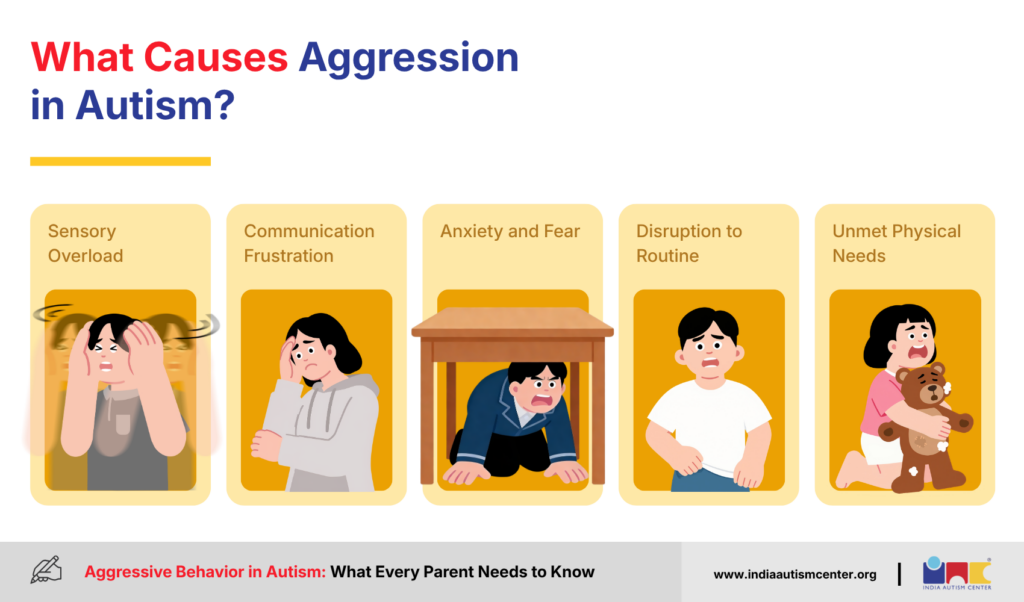
    When we talk about aggressive behaviour in autism, we’re talking about a wide range of behaviors that can include:

    • Hitting, slapping, or punching (often directed at parents or caregivers)
    • Biting — themselves or others
    • Kicking, scratching, or pulling hair
    • Throwing objects
    • Head-banging or other forms of self-injury
    • Screaming or extreme emotional outbursts

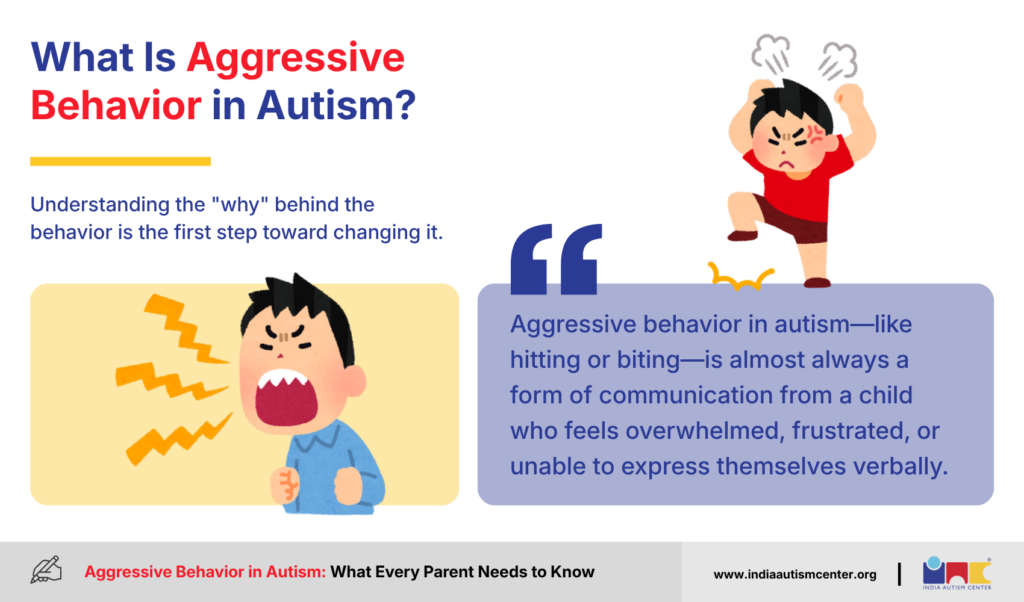
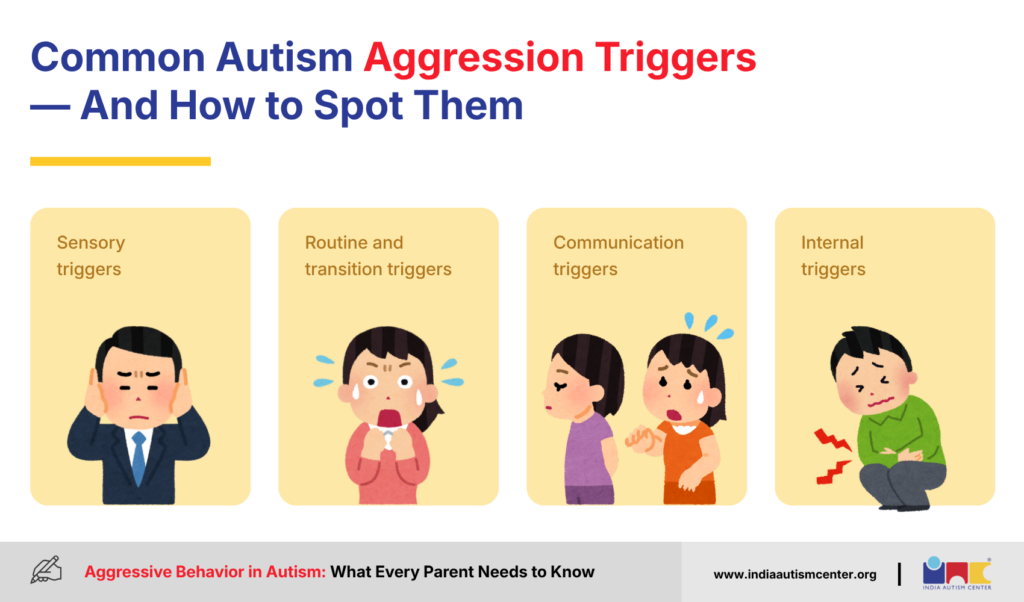
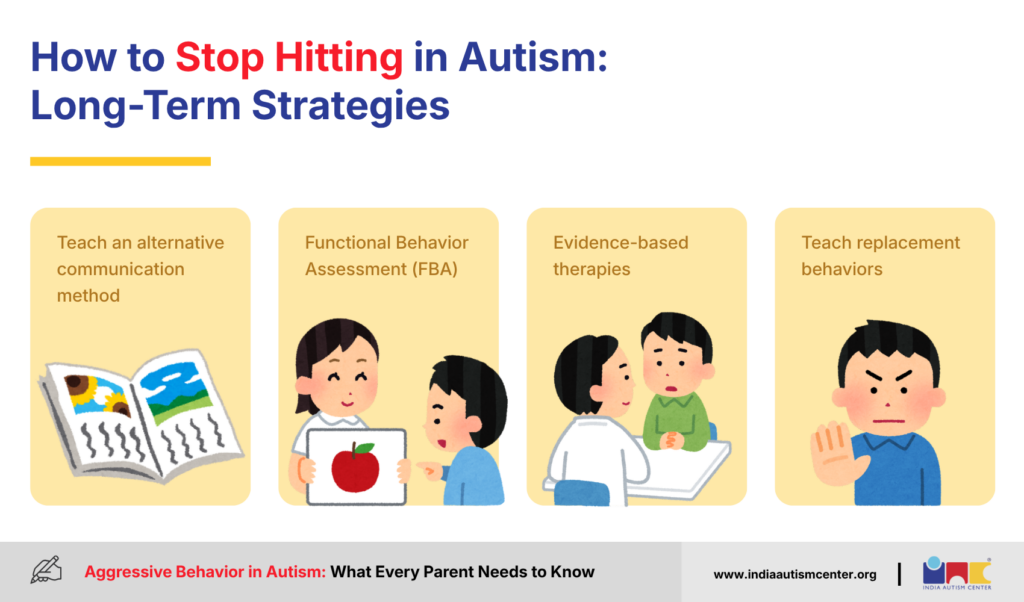
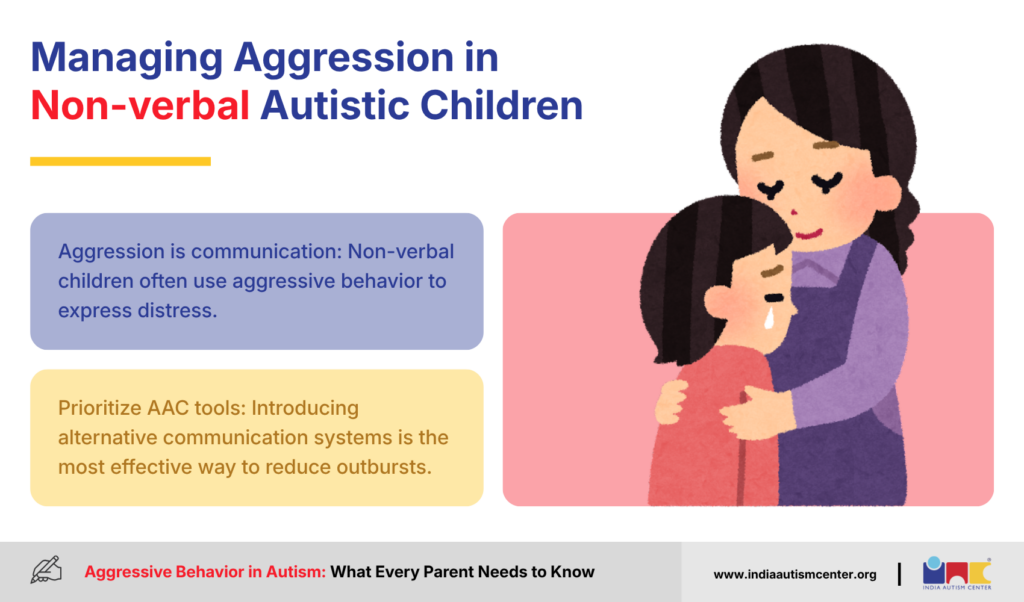
    Here’s the most important thing I want you to hold onto as you read this: aggression in autism is almost always a form of communication. Your child isn’t hitting you because they’re mean or manipulative. They are overwhelmed, in pain, frustrated, or terrified — and they don’t have the words or the tools to tell you that.

    Think of it this way: if you were locked in a room where everything was too loud, too bright, and too overwhelming, and nobody understood what you were saying, you might start acting out, too.

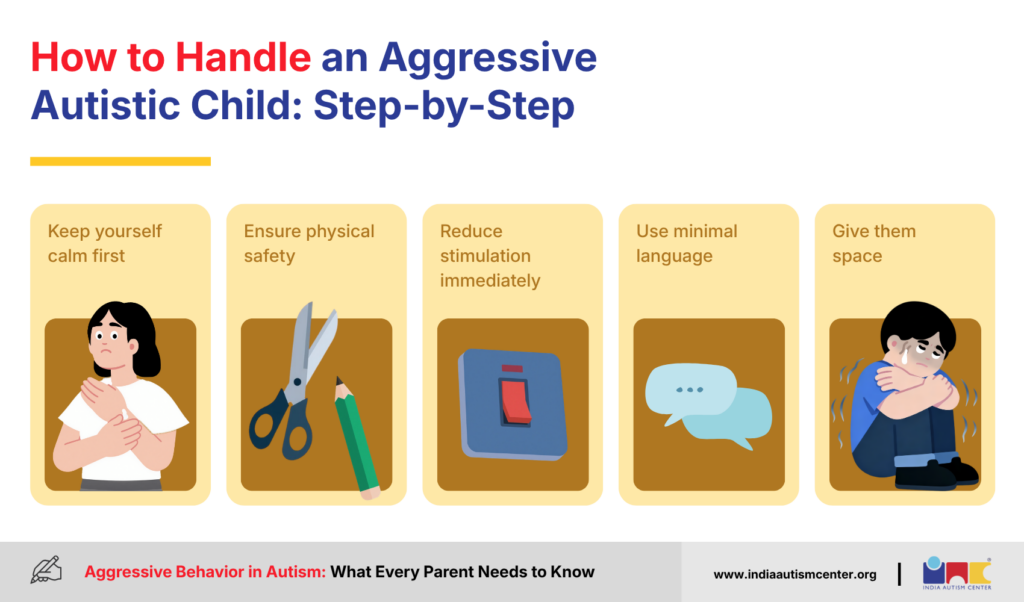
    This doesn’t mean the behavior is okay or that you just accept it. But understanding the why behind the behavior is the very first step toward actually changing it.

    Who does autism aggression affect?

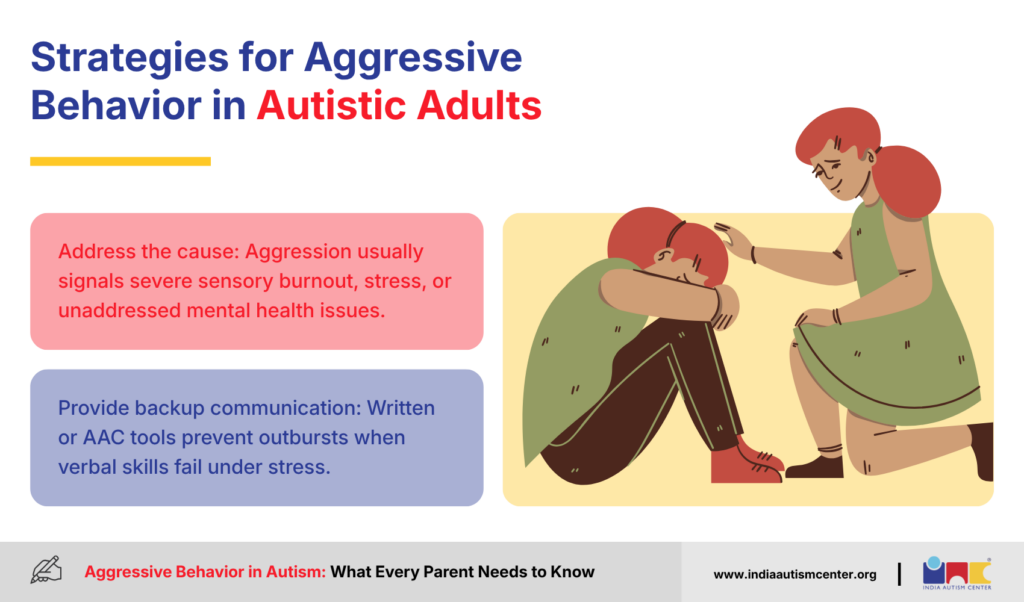
    Autism aggression can happen at any age — it’s common in young children, but it can persist into the teen years and even adulthood if not properly addressed. It can affect autistic individuals at every level of the spectrum, but it tends to be more frequent and intense in children who have limited verbal communication.

    Autism Meltdowns vs. Tantrums — What’s the Difference?

    Autism Meltdowns vs. Tantrums — What's the Difference?

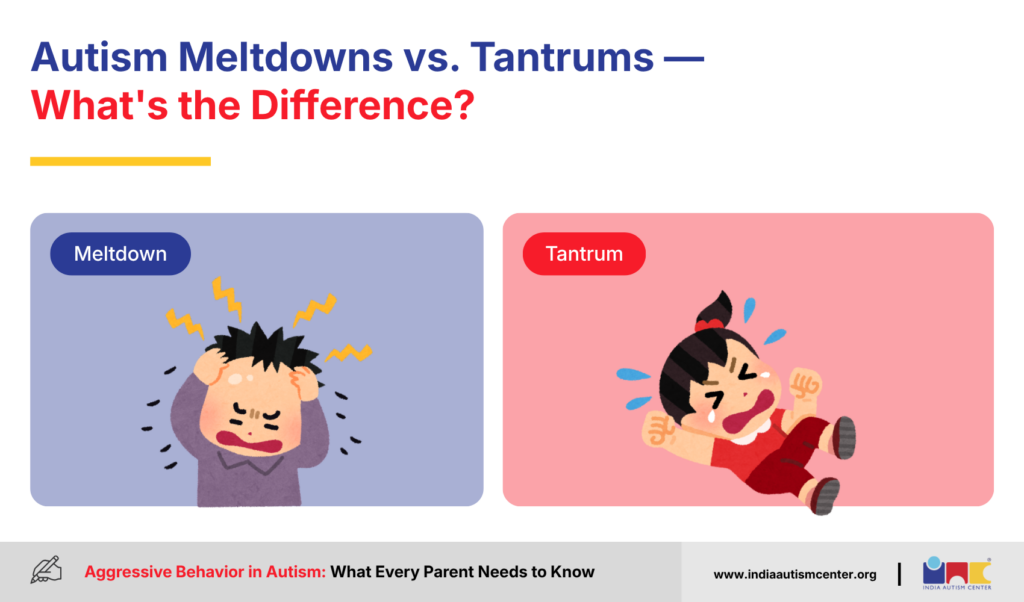
    One of the most common mistakes parents and even professionals make is treating a meltdown like a tantrum. These are two completely different things, and responding to them the same way can actually make things worse.

    MeltdownTantrum
    What it isA neurological response to overwhelming sensory or emotional inputGoal-directed behavior to get something or avoid something
    Is the child in control?No — they’ve lost controlSomewhat — they’re aware of what they’re doing
    Does it stop when they get what they want?NoOften yes
    What triggers it?Sensory overload, anxiety, communication breakdownBeing told “no,” not getting a preferred item, transitions
    How long does it last?Can last minutes to over an hourUsually shorter once need is met
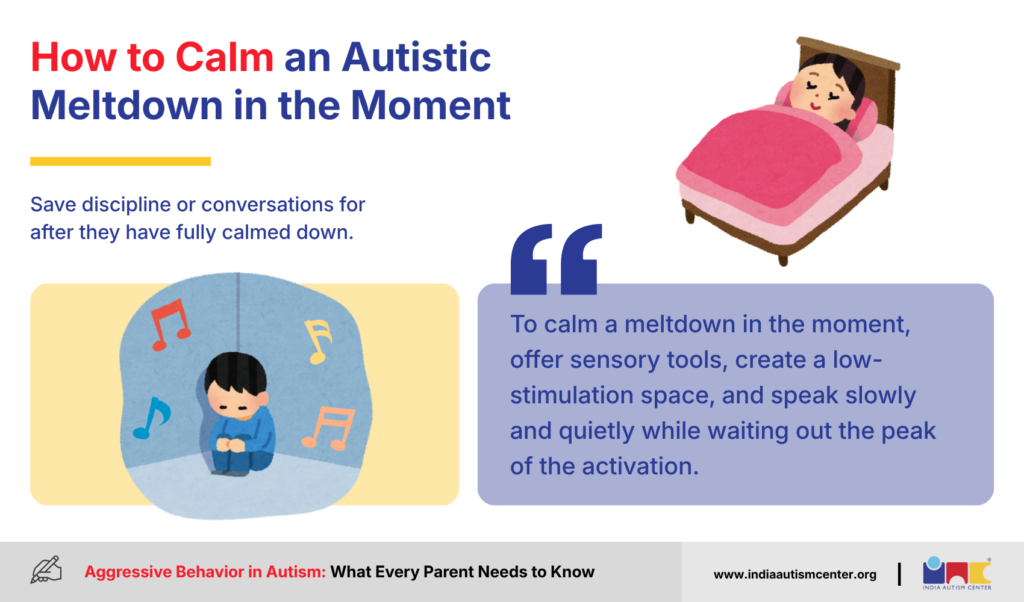
    What helps?Reduce stimulation, wait it out, stay calmSet clear boundaries, do not give in to demands
    What makes it worse?Trying to reason, punishing, high-stimulation responsesGiving in every time, escalating conflict

    A meltdown is not manipulation. Your child is not “doing this for attention.” During a meltdown, their nervous system has completely overloaded — it’s closer to a panic attack than a deliberate choice. Punishing them for it doesn’t work because they aren’t in a state where learning can happen.

    A tantrum, on the other hand, does involve some degree of awareness. A child having a tantrum might sneak glances at you to see your reaction. They may stop the moment they get what they want.

    Knowing which one you’re dealing with changes everything about how you respond. Read Autism Meltdown in Different Age Groups.

    What Causes Aggression in Autism? 

    What Causes Aggression in Autism? 

    There is no single answer to the question of what causes aggression in autism — it’s usually a combination of factors. Here are the most common ones:

    Sensory Overload

    Many autistic individuals experience sensory input very differently from neurotypical people. Sounds that seem normal to you — a crowded mall, a TV in the background, fluorescent lights humming — can feel like physical pain to them. When the sensory world becomes too much, aggression can be the result of complete overwhelm.

    Communication Frustration

    This is huge, especially in younger children and those with limited verbal speech. Imagine desperately needing something — to be left alone, to have the TV turned off, to have a specific toy — and not being able to say so. You’ve tried to communicate in every way you know how, and nobody is understanding you. That kind of frustration can quickly boil over into physical behavior.

    For nonverbal or minimally verbal autistic children, hitting and biting are often the most “effective” communication tools they have — because they get an immediate response.

    📥 Free download: Printable daily routine chart for autistic children

    Anxiety and Fear

    Autism and anxiety often go hand-in-hand. In fact, up to 40–50% of autistic individuals also have an anxiety disorder. When an autistic child feels unsafe, unsure, or threatened — even by something that seems small to you, like a change in routine — the fight-or-flight response can kick in. Aggression is sometimes literally the body’s fear response.

    Disruption to Routine

    Many autistic children rely heavily on routine and predictability. When something unexpected happens — the usual route to school is different, a parent is late, a planned activity gets cancelled — it can trigger intense distress that comes out as aggression.

    Unmet Physical Needs

    This one is often overlooked. A child who is hungry, tired, or in physical pain is far more likely to be aggressive. Autistic children often have difficulty identifying and communicating internal body states (a condition called interoception differences). So instead of saying “my tummy hurts,” they might just explode.

    Hidden medical causes like ear infections, gastrointestinal pain, headaches, or dental pain are a surprisingly common driver of sudden aggression in autistic children who can’t verbally explain what’s wrong.

    Emotional Dysregulation

    Many autistic individuals have difficulty regulating their emotions. They can go from calm to completely overwhelmed very quickly, with little awareness of how or why. They may not yet have the emotional toolkit to manage big feelings — and aggression is what happens when those feelings have nowhere else to go.

    Common Autism Aggression Triggers — And How to Spot Them

    Common Autism Aggression Triggers — And How to Spot Them

    Understanding autism aggression triggers is one of the most powerful things you can do as a parent. Because if you can predict when a meltdown is coming, you can often prevent it — or at least reduce its intensity.

    Every autistic child is different, but here are the most common triggers I hear parents describe:

    Sensory triggers:

    • Loud or sudden noises (fireworks, alarm bells, other children screaming)
    • Crowded or busy environments
    • Certain textures of clothing, food, or objects
    • Bright or flickering lights
    • Strong smells

    Routine and transition triggers:

    • Unexpected changes to the schedule
    • Transitions between activities (especially stopping a preferred activity)
    • New environments or unfamiliar situations
    • Arrival of visitors or changes in who’s present at home

    Communication triggers:

    • Being unable to express a need or want
    • Not being understood
    • Being asked to do something they don’t understand

    Internal triggers:

    • Hunger or thirst
    • Fatigue
    • Illness or pain
    • Anxiety about an upcoming event

    How to track your child’s triggers

    One of the best tools available to you is the ABC chart — short for Antecedent, Behavior, Consequence. For every aggressive episode, jot down:

    • A (Antecedent): What happened right before the behavior? Where were they? Who was there? What time was it?
    • B (Behavior): What exactly did they do?
    • C (Consequence): What happened after? What did you do? Did the behavior stop? Did they get what they seemed to want?

    After a week or two of tracking, patterns start to emerge. You might notice that most aggressive incidents happen right before dinner (hunger), during transitions from screen time, or in specific environments. That information is gold.

    How to Handle an Aggressive Autistic Child: Step-by-Step 

    How to Handle an Aggressive Autistic Child: Step-by-Step

    When aggression is happening in the moment, most of us react on instinct — and our instincts aren’t always helpful. Here’s a calmer, more effective approach:

    Step 1: Keep yourself calm first

    I know this is the last thing you want to hear when your child has just bitten your arm. But your nervous system directly influences your child’s nervous system. If you escalate, they escalate. Slow, deep breaths. Lower your voice. Soften your posture. You are the regulation they can’t find in themselves right now.

    Step 2: Ensure physical safety

    Move dangerous objects out of reach. If your child is hitting, create physical distance without escalating. If there are other children present, remove them from the area calmly.

    Step 3: Reduce stimulation immediately

    Turn off the TV. Dim the lights if you can. Reduce noise. Move to a quieter space if possible. You’re trying to reduce the input their nervous system is trying to process.

    Step 4: Use minimal language

    During a meltdown or aggressive episode, your child’s brain is not in a state to process complex language. Don’t lecture. Don’t explain consequences. Don’t ask “why did you do that?” Keep it to one or two words maximum: “Safe now.” “It’s okay.” Or nothing at all.

    Step 5: Give them space

    This doesn’t mean abandonment — it means not hovering over them or demanding eye contact or compliance. Sit nearby, stay present and calm, and let the storm pass.

    What NOT to do:

    • Don’t punish them during a meltdown. It doesn’t teach anything and increases distress.
    • Don’t physically restrain unless absolutely necessary for safety. Physical restraint can be traumatic.
    • Don’t match their emotional energy. Yelling back, crying, or threatening escalates the situation.
    • Don’t take it personally in the moment. I know that’s hard. But this is not about you.

    How to Calm an Autistic Meltdown in the Moment

    How to Calm an Autistic Meltdown in the Moment

    Once you’ve followed the steps above, here are specific things that can help your child come back to a regulated state:

    Sensory tools that help many children:

    • Weighted blanket or lap pad (the deep pressure is calming)
    • Noise-canceling headphones
    • A favorite comfort object or fidget tool
    • A cool cloth on the face or back of the neck
    • Gentle, rhythmic movement (rocking, swinging)

    Environmental adjustments:

    • A designated “calm-down corner” in your home — a low-stimulation space with soft lighting, sensory tools, and a few comfort items. This is not a punishment space. It’s a safe haven they can learn to use proactively.

    What to say (and how to say it):

    • Speak slowly and quietly
    • Use your child’s name calmly at the start
    • Acknowledge their feelings without interrogating: “You’re really upset. I’m right here.”
    • Avoid questions during the peak of the meltdown

    Wait it out. The hardest part of calming an autistic meltdown is that you can’t rush it. The brain needs time to come back down from that level of activation. Trying to force the process — demanding they stop, removing privileges, applying consequences in the moment — extends it.

    After the meltdown has passed and your child is calm — this is when reconnection and gentle conversation can happen, if they’re ready for it.

    Here is a detailed blog on How to Handle Autism Meltdown: Complete Guide for Parents and Caregivers 

    How to Stop Hitting in Autism: Long-Term Strategies 

    How to Stop Hitting in Autism: Long-Term Strategies 

    In-the-moment management is only half the picture. The longer-term goal is to reduce the frequency and intensity of aggressive behavior over time. Here’s what actually works:

    Teach an alternative communication method

    If hitting is being used to communicate “stop,” “I need help,” “I’m overwhelmed,” or “I want that” — you need to give your child another way to say those things.

    This might look like:

    • Picture Exchange Communication System (PECS): Using picture cards to communicate
    • Augmentative and Alternative Communication (AAC) devices: Tablet-based apps like Proloquo2Go
    • Sign language: Even a few basic signs (more, stop, help, no) can dramatically reduce frustration-based aggression
    • Visual cues: Emotion cards or “first-then” boards

    The research is clear: teaching communication reduces aggression. These aren’t workarounds — they’re powerful, evidence-based tools.

    Functional Behavior Assessment (FBA)

    An FBA is a formal process where a specialist (usually a Board Certified Behavior Analyst, or BCBA) figures out the function of the aggressive behavior — what need it is serving. Is it to escape a task? To get attention? To get a preferred item? To communicate sensory discomfort?

    Once you know the function, you can address it directly rather than just trying to suppress the behavior.

    Evidence-based therapies

    Applied Behavior Analysis (ABA): When delivered ethically and with your child’s wellbeing at the center, ABA therapy  can be highly effective at reducing aggressive behavior and teaching replacement behaviors. Look for providers who take a neurodiversity-affirming, naturalistic approach.

    Positive Behavior Support (PBS): A framework that focuses on understanding behavior, reducing triggers, and teaching new skills — without punishment-based strategies.

    Occupational Therapy (OT): Particularly effective when sensory processing is a major driver of aggression. An Occupational Therapy can develop a “sensory diet” — a personalized plan of sensory activities that help regulate your child’s nervous system throughout the day.

    Speech-Language Therapy: Essential for children whose aggression is rooted in communication frustration. And this why we have A Comprehensive Guide to Speech and Language Therapy for Autism 

    Teach replacement behaviors

    Instead of just trying to eliminate hitting, explicitly teach what to do instead. Practice saying “stop” or handing over a “break” card. Role-play scenarios when your child is calm. Reinforce the replacement behavior consistently and enthusiastically.

    Autism Behavior Management at Home: Daily Strategies 

    Autism Behavior Management at Home: Daily Strategies 

    The home environment is where you have the most control — and that’s actually great news. Here are day-to-day strategies that make a real difference:

    Build predictable routines

    Predictability is genuinely calming for the autistic brain. A consistent daily schedule — wake up, breakfast, activities, meals, wind-down, bed — reduces anxiety and therefore reduces the likelihood of aggressive outbursts.

    When you know a disruption is coming (a doctor’s appointment, a trip, a visitor), prepare your child in advance. Talk about it. Show them a picture schedule of what’s happening. Give them as much notice as possible.

    Use visual schedules

    Words are harder to process than visuals for many autistic children — especially when emotions are already elevated. A simple visual schedule (pictures or symbols showing the sequence of the day) gives your child a way to know what’s coming without relying on you to constantly explain.

    Social stories

    Social stories are short, simple narratives that walk your child through a situation they find challenging — from their perspective. You can create one for almost anything: “When I feel angry, I can go to my calm corner.” “When it’s time to turn off the TV, I can give my tablet to Mum.” These aren’t magic, but used consistently they build new neural pathways.

    Create a calm-down corner

    Set up a small space in your home — a corner of their room, under the stairs, anywhere quiet — with items that help your child self-regulate. Think: soft cushions, sensory toys, headphones, a lava lamp, weighted blanket. Make it a positive place they want to go, not a punishment room.

    Positive reinforcement

    Catch your child being calm, cooperative, or using their words (or AAC device) — and make a big deal of it. Specific, enthusiastic praise (“I love how you used your words to tell me you needed a break!”) reinforces the behaviors you want to see more of.

    Token boards and reward systems can work well for some children — they provide visible, predictable reinforcement for positive behavior.

    Proactive sensory strategies

    Don’t wait for your child to become overwhelmed — build sensory breaks into their day before they need them. This might mean 10 minutes of jumping on a trampoline before homework, a fidget toy available during meals, or noise-canceling headphones for the school run.

    Managing Aggression in Non-verbal Autistic Children 

    Managing Aggression in Non-verbal Autistic Children 

    Nonverbal autism aggression deserves its own section, because the dynamics are somewhat different — and the stakes feel higher.

    When a child has very limited verbal communication, aggression often becomes their most effective communication tool. If hitting makes you leave the room when they need alone time, or makes you give them the toy they want, or makes you turn off the overwhelming TV — then from their perspective, hitting works.

    This is not manipulation in the way we typically think of it. It’s a child doing the best they can with the tools they have. Your job — with professional support — is to give them better tools.

    What helps most for nonverbal children

    Prioritize communication above everything else. This is the single most impactful thing you can do. Work with a speech-language pathologist to find the right AAC system for your child. Research consistently shows that robust communication support reduces aggressive behavior — often dramatically.

    Become a body language expert. Before your child reaches the point of aggression, there are usually early warning signs — if you know what to look for. Learn your child’s individual signs of rising distress: increased stimming, avoiding eye contact, tensing up, pulling at clothes, becoming very still, a particular sound or expression. These are your windows for early intervention.

    Use visual supports everywhere. “First-then” boards, choice boards, emotion charts, and picture schedules can give nonverbal children a way to navigate their world with more autonomy and less frustration.

    Reduce demands when they’re already at the edge. If you can tell your child is getting close to their limit, it’s not the time to push through homework or practice transitions. Strategic retreating is not giving in — it’s smart parenting.

    Strategies for Aggressive Behavior in Autistic Adults

    Strategies for Aggressive Behavior in Autistic Adults

    Aggression doesn’t automatically resolve when an autistic child becomes an adult — and for families still supporting adult autistic children at home, this can be an incredibly isolating experience.

    Aggression in autistic adults often looks different from childhood aggression. It may be less frequent but more physically significant. It may be triggered by workplace stress, relationship difficulties, or the ongoing exhaustion of navigating a neurotypical world.

    What helps for autistic adults:

    Emotional regulation support: Adapted DBT (Dialectical Behavior Therapy) and CBT for autism can help autistic adults build emotional regulation skills. Look for therapists with experience in autism — not just anxiety or depression.

    Sensory accommodations: Adults still have sensory needs. Noise-canceling headphones at work, control over lighting at home, the ability to take sensory breaks — these aren’t accommodations to be ashamed of. They’re necessary for wellbeing.

    Communication support: Some autistic adults who can speak find that their verbal communication breaks down under stress. Having a written or AAC-based backup can prevent communication-related frustration from boiling over.

    Addressing the underlying cause: Very often, aggression in autistic adults is a sign that something is seriously wrong — they’re being pushed past their limits at work, dealing with an unaddressed mental health condition, or in an environment that isn’t meeting their needs. The aggression is the symptom. Find the cause.

    Psychiatric evaluation: For some autistic adults, co-occurring conditions like ADHD, OCD, anxiety, or depression significantly contribute to aggression. Medication, when appropriate and carefully managed, can make a real difference — but it should always be part of a broader support plan, not the only intervention.

    https://youtu.be/9Ds1HolJ5Wk?si=tzDhsnEGM2g4aa__

    When to Seek Professional Help

    There’s no shame in needing a team. In fact, managing significant autism aggression at home without any professional support is extremely hard, and it’s not what you should be expected to do alone.

    Seek professional help when:

    • The aggression is frequent (multiple times per week or daily)
    • Someone is getting hurt — your child, you, or siblings
    • You’ve tried behavior strategies consistently and they’re not helping
    • The aggression is getting more intense over time
    • Your child seems to be in pain, or aggression is sudden and unexplained (rule out a medical cause first)
    • Your mental health or the family’s wellbeing is significantly impacted

    Who to contact:

    • Pediatrician or GP: Start here. Rule out medical causes for a sudden increase in aggression (ear infections, constipation, GI issues, dental pain). Also discuss referrals.
    • Board Certified Behavior Analyst (BCBA): For a Functional Behavior Assessment and behavior support plan.
    • Occupational Therapist (OT): For sensory-based strategies and a sensory diet.
    • Speech-Language Pathologist (SLP): For AAC and communication-based intervention.
    • Child Psychiatrist or Psychologist: For co-occurring anxiety, ADHD, or other conditions that may be driving aggression.

      Watch what experts say about Autism aggression:Why Aggression Happens in Autism and What Actually Helps | India Autism Center

    📥 Free download: Printable daily routine chart for autistic children

    Conclusion

    Living with autism aggression is hard in a way that’s difficult to put into words. On the days when you’ve been hurt, or you’ve watched your child suffer through a meltdown, or you’ve had to cancel another outing because you didn’t know what might trigger an episode — it can feel impossibly lonely.

    But I want you to hear this: things can get better. With the right support, the right strategies, and the right team around your family, aggressive behaviour in autism can improve — often dramatically. Your child is not broken. They are communicating the only way they know how right now. Your job isn’t to fix them. It’s to understand them and to build a bridge.

    You are already doing that — just by being here and reading this far.

    If this article helped you, share it with another autism parent who might need it. And if you’d like support tailored to your child’s specific needs, please reach out to your local autism support organisation or speak to your pediatrician about a referral.

    Frequently Asked Questions

    Why does my autistic child hit me and not other people?

    This is actually a sign of attachment and trust. Your child hits you because you are safe. They know you won’t abandon them, won’t hurt them back, and will still love them. It doesn’t make it okay, but it means something important about your relationship.

    Is aggression more common in boys with autism?

    Studies do show higher rates of externalised aggression in autistic boys, while autistic girls tend to internalise distress. However, aggression can occur in autistic children of any gender.

    My autistic child was calm for months and suddenly became aggressive. Why?

    Sudden-onset aggression in a child who was previously calm is a red flag for an unaddressed medical issue — particularly pain. Rule out ear infections, constipation, dental pain, and gastrointestinal issues first. A change in environment, school stress, or puberty can also be triggers.

    Can aggression in autism be cured?

    “Cured” isn’t quite the right word — but aggression can absolutely improve significantly with the right support, communication tools, and environmental adjustments. Many children who were significantly aggressive at age 4 are living calm, connected lives by their teens with proper intervention.

    Should I call the police if my child is being aggressive?

    This is a deeply difficult question. Most autism parents exhaust every other option first — and rightfully so, because police involvement can be traumatic and dangerous for autistic individuals. If you are genuinely in danger, call for help. But also speak to your child’s BCBA or psychiatrist about a safety plan for severe episodes before they happen, so you have a protocol ready.

    At what age does autism aggression typically peak?

    For many children, aggression peaks in the early to middle childhood years (ages 4–10) and often reduces with proper intervention and as communication skills grow. However, puberty can bring a new wave of challenging behavior for some families.

    Is it okay to walk away during a meltdown?

    If you need a moment to regulate yourself, stepping away briefly — while ensuring your child is physically safe — is okay. You cannot help your child if you’re completely dysregulated yourself.


    This article is for informational purposes only and is not a substitute for professional medical, psychological, or behavioural advice. If your child is experiencing significant aggressive behavior, please consult a qualified professional.

    For expert insights, support services, and inclusive learning initiatives, visit the India Autism Center.
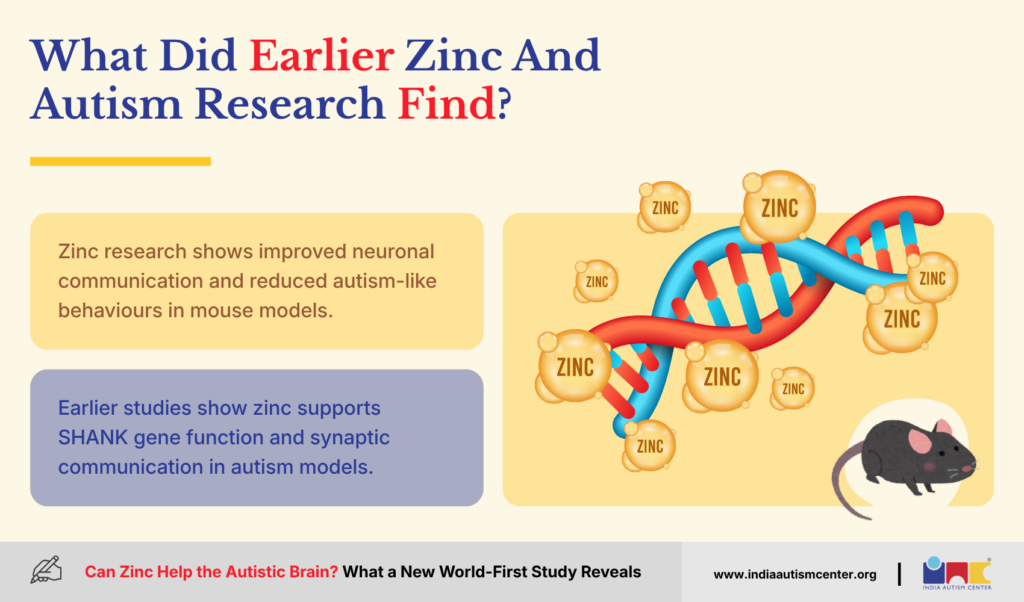
  • How to Join an NGO Without Experience: Step-by-Step Guide (2026)

    How to Join an NGO Without Experience: Step-by-Step Guide (2026)

    Let me be honest with you.

    When people first decide that they want to work for an NGO, they are excited, motivated, and completely clueless. They have a degree, a burning desire to “do something meaningful,” and zero experience in the development sector. Every job posting they opened asked for “2+ years of field experience” or a “background in humanitarian work.” Many don’t have any of that.

    And if you’re reading this, I’m guessing you’re in a similar spot.

    Here’s the good news: you don’t need years of experience to start your NGO journey. What you need is the right strategy, a little patience, and the willingness to show up. In this guide, I’m going to walk you through exactly how to break into the NGO sector — step by step — even if you’re starting from zero.

    What is an NGO, and why is it Different from a Regular Job?

    What is an NGO and Why is it Different from a Regular Job?

    Before we talk about how to join one, let’s quickly understand what an NGO actually is — because “NGO” is a broad term that means different things in different contexts.

    An NGO (Non-Governmental Organisation) is a non-profit organisation that operates independently of the government. Its goal is to address social, environmental, humanitarian, or developmental issues. NGOs are funded through donations, grants, and sometimes government partnerships — but they aren’t government bodies themselves.

    There are different types of NGOs you might want to work with:

    • Local/grassroots NGOs — small organisations working within a specific community or city (like an NGO in Kolkata working on child education)
    • National NGOs — organisations working across a country (like Pratham or Goonj in India)
    • International NGOs (INGOs) — global organisations like Oxfam, Save the Children, or Médecins Sans Frontières
    • UN Agencies — like UNICEF, UNDP, or WHO (technically intergovernmental, but many entry-level roles exist here too)

    NGO roles span a wide range: program delivery, field work, communications, fundraising, research, monitoring & evaluation (M&E), grant writing, finance, and administration. There’s genuinely a place for almost every skill set.

    Why NGOs Don’t Always Need “Experienced” Candidates

    Why NGOs Don't Always Need "Experienced" Candidates

    Here’s something most job seekers get wrong: NGOs say they want experience, but what they really want is commitment.

    In corporate jobs, experience signals competence. In the NGO sector, experience signals something deeper — that you understand the reality of working in challenging conditions, that you’re not going to quit after three months, and that you genuinely care about the cause.

    But here’s the thing: you can demonstrate all of those things without prior NGO experience.

    Many entry-level NGO roles — especially volunteering positions, internships, and fellowship programs — are specifically designed for people without formal experience. Organisations like UN Volunteers, AmeriCorps, and hundreds of local Indian NGOs actively recruit fresh graduates and career changers.

    What they’re looking for isn’t a resume full of NGO stamps. They’re looking for:

    • Genuine passion for the cause
    • Transferable skills (communication, data, project management, writing)
    • Flexibility and adaptability
    • A growth mindset and willingness to learn

    So if you’re sitting there thinking “I have nothing to offer” — stop. You likely have more than you think.

    7 Proven Ways to Join an NGO Without Experience

    7 Proven Ways to Join an NGO Without Experience

    This is the core of what I want to share with you. These are real, actionable pathways — not vague advice like “follow your passion.”

    1. Start as a Volunteer

    Volunteering is the single fastest way to get your foot in the door. Almost every NGO has volunteer programs, and most of them require nothing more than willingness and reliability.

    When I say volunteering, I don’t mean just weekend clean-up drives. I mean structured, skill-based volunteering where you contribute meaningfully:

    • Help an NGO manage their social media
    • Assist with data collection or field surveys
    • Support their event planning or fundraising drives
    • Teach a skill (English, computers, art) in their programs

    Not only does this give you experience to put on your resume, but it also gets you inside the organisation. You build relationships, understand how the sector works, and often get first notice when paid positions open up.

    Where to find volunteering opportunities:

    • Volunteering India (volunteeringindia.com)
    • iVolunteer (ivolunteer.in)
    • United Way India
    • Your city’s local NGO directories
    • Google: “volunteer with NGO in [your city]”

    2. Apply for Internships

    NGO internships are one of the best-kept secrets for career switchers and fresh graduates. Many of them are paid (especially at larger national and international organisations), and they are explicitly designed for people with little to no prior experience.

    Internships give you:

    • Real work experience with a legitimate organisation
    • A professional reference (huge for future applications)
    • Clarity on whether NGO work is actually right for you
    • A direct line to full-time hiring

    Where to find NGO internship:

    • India Autism Center – one of the best NGOs in Neurodivergent sector
    • Idealist.org — one of the best global platforms
    • DevNetJobs.org — focused on development sector roles
    • NGO Jobs India
    • LinkedIn — search “NGO intern” or “non-profit intern”
    • Organisation websites directly (check their “Careers” or “Get Involved” pages)

    Pro tip: Don’t wait for internship listings to appear. Send a direct email to organisations you admire, expressing your interest and attaching a short proposal on how you can help. NGOs often create opportunities for motivated people who reach out.

    3. Leverage Your Transferable Skills

    This one changed the way I looked at my own resume.

    You don’t need NGO experience to be valuable to an NGO. You need skills — and skills transfer across industries. Here’s how to map what you already know:

    Your BackgroundTransferable NGO Skill
    Marketing / Social MediaCommunications, digital outreach, fundraising
    Teaching / TrainingCapacity building, field education programs
    Data Analysis / ExcelM&E (Monitoring & Evaluation), impact reporting
    Finance / AccountingGrant management, budgeting
    Writing / JournalismGrant writing, reports, donor communications
    IT / TechDatabase management, digital tools for development
    HealthcareCommunity health programs, public health initiatives
    LawHuman rights, legal aid programs

    Look at your existing skills and ask: “How would an NGO use this?” Then write your resume and cover letter through that lens.

    4. Build a Cause-Specific Portfolio

    If you don’t have NGO experience, create it yourself. A portfolio of cause-related work is surprisingly powerful — especially for roles in communications, research, or program design.

    Here are practical ways to build one:

    • Start a blog or newsletter about issues you care about (child rights, climate change, women’s empowerment)
    • Create social media content advocating for a cause and build a small, engaged following
    • Write research summaries or policy briefs on development issues
    • Organise a community initiative — even something small like a local food drive or awareness campaign
    • Contribute to open-source development projects that support social causes

    When you apply to an NGO, you’ll be able to show — not just tell — that you care. That makes a massive difference.

    5. Take Relevant Online Courses and Certifications

    This one is simple, affordable, and often underused. There are excellent courses available — many of them free or low-cost — that give you foundational knowledge in the development sector.

    Courses worth exploring:

    • Coursera / edX: Search for courses on “International Development,” “Public Health,” “Human Rights,” “Sustainable Development Goals (SDGs)”
    • NPTEL (for Indian learners): Development economics, social policy
    • UN SDG Academy: Free online learning on global development
    • UNHCR’s Learning Hub: Refugee and humanitarian response training
    • Google.org Skills: Digital skills for the social sector

    Even completing one or two relevant courses shows initiative. List them on your LinkedIn and resume under “Certifications” — they signal that you’re investing in this career switch seriously.

    6. Network Inside the Sector

    I’ll be direct: the NGO world is relationship-driven. A lot of hiring happens through word of mouth, referrals, and internal networks. If you’re only applying cold through job portals, you’re fighting the hardest battle.

    Here’s how to network effectively:

    • LinkedIn: Follow NGOs you admire, engage with their posts, connect with program officers and HR managers
    • Attend events: Webinars, panel discussions, development conferences, TEDx talks — show up and introduce yourself
    • Info interviews: Reach out to people working in NGOs and ask for a 20-minute call to learn about their journey. Most people are happy to help — and these conversations often lead somewhere unexpected
    • Join sector communities: Facebook groups, WhatsApp communities, Reddit threads focused on non-profit work
    • Alumni networks: Your college alumni working in NGOs are your warmest possible introduction

    Don’t network just to “get a job.” Network to genuinely learn, build relationships, and contribute. The opportunities follow naturally.

    7. Apply for Fellowship Programs

    Fellowship programs are structured, time-bound experiences designed specifically to bring talented people into the social sector — often without prior NGO experience required.

    Fellowships worth researching (India & Global):

    • Teach For India Fellowship — education-focused, 2-year teaching fellowship
    • Gandhi Fellowship — rural education and community leadership
    • Acumen India Fellowship — social entrepreneurship and leadership
    • Atlas Corps — international NGO placement fellowship
    • Echidna Global Scholars — girls’ education focus
    • LAMP Fellowship (India) — legislative research and public policy
    • UN Young Professionals Programme (YPP) — entry into the UN system

    Most fellowships come with a stipend, training, and mentorship. They’re an excellent launchpad — and they look exceptional on your resume.

    How to Write an NGO Resume When You Have No Experience

    How to Write an NGO Resume When You Have No Experience

    Your resume is your first impression. In the NGO sector, a resume isn’t just a career document — it’s a statement of values. Here’s how to write one that works:

    1. Start with a strong objective/summary Lead with 2–3 lines that communicate your motivation and what you bring. Example:

    “A communications professional with 3 years of digital marketing experience, transitioning into the development sector with a focus on women’s empowerment and community engagement. Passionate about using storytelling for social impact.”

    2. Reframe your experience using impact language Even if your jobs weren’t NGO-related, describe them in terms of outcomes and people impacted.

    3. Highlight volunteering and community work Don’t bury it at the bottom. If your NGO-relevant experience is volunteering, make it prominent.

    4. Add a skills section List both hard skills (Excel, research, social media, content writing) and soft skills (communication, adaptability, cross-cultural sensitivity).

    5. Tailor every application Read the organisation’s mission carefully. Mirror their language. Show that you understand their specific work — not just “NGOs in general.”

    Crafting a Cover Letter That Actually Gets Read

    Crafting a Cover Letter That Actually Gets Read

    In corporate hiring, cover letters are often skimmed or ignored. In the NGO sector, they matter a lot.

    NGO hiring managers want to know why you care — and a well-written cover letter is your chance to show them.

    Structure your cover letter like this:

    Paragraph 1 — Hook with your ‘why’ Tell them why this specific organisation and cause matters to you. Make it personal. Be specific.

    Paragraph 2 — Show you understand their work Mention a specific program, initiative, or impact report you’ve read. Demonstrate that you’ve done your homework.

    Paragraph 3 — Connect your skills and experience Explain clearly what you bring to the table and how your background maps to their needs.

    Paragraph 4 — Close with intent Express your enthusiasm, mention you’d love to discuss further, and include a clear call to action.

    Mistakes to avoid:

    • Starting with “I am writing to apply for…” (boring, skip it)
    • Copy-pasting the same letter to multiple organisations
    • Focusing only on what you want to gain, rather than what you’ll contribute
    • Using corporate jargon (“synergize,” “leverage bandwidth”) — keep it warm and human

    Where to Find NGO Job Opportunities

    Where to Find NGO Job Opportunities

    Here’s a consolidated list of the best places to look:

    Job Boards:

    Other Channels:

    • LinkedIn — follow NGOs, set job alerts, use keywords like “program associate,” “social sector,” “development sector fresher”
    • Organisation websites — bookmark and check “Careers” pages of your target organisations regularly
    • Facebook groups — search “NGO jobs India,” “development sector jobs,” “social sector careers”
    • WhatsApp groups — many sector-specific networks share openings informally

    How to Ace the NGO Interview

    How to Ace the NGO Interview

    Getting the interview is half the battle. Here’s how to make it count.

    Before the interview:

    • Read everything on their website — mission, programs, annual reports, recent news
    • Understand their “theory of change” (how they believe their work creates impact)
    • Research the sector they work in so you can speak knowledgeably

    Common NGO interview questions — and how to think about them:

    • “Why do you want to work in the development sector?” — Be honest and specific. Avoid generic answers like “I want to make a difference.” Talk about a real moment or experience that shaped your interest.
    • “What do you know about our organisation?” — This is a test of preparation. Have 2–3 specific things ready about their programs, geography, or recent impact.
    • “How would you handle working in a resource-constrained environment?” — They want to know you can be creative, flexible, and resilient. Give a real example if you can.
    • “Do you have experience with [specific skill — e.g., M&E, grant writing]?” — If not, don’t bluff. Be honest, express your eagerness to learn, and mention any adjacent experience or courses.

    Questions you should ask them:

    • “What does success look like in this role in the first 6 months?”
    • “What are the biggest challenges your team is currently navigating?”
    • “How does the organisation support the professional development of new team members?”

    Asking good questions signals genuine interest and maturity.

    Frequently Asked Questions

    Can I join an NGO without a degree?

    Yes. Many NGOs — especially at the grassroots level — hire based on skills, experience, and commitment rather than formal qualifications. Volunteering, certifications, and demonstrated passion can outweigh a degree in many cases.

    Do NGOs pay their workers?

    Yes, NGOs do pay salaries — they are not entirely run by volunteers. However, compensation is generally lower than the corporate sector, especially at entry level. International NGOs and UN agencies tend to offer more competitive packages.

    How do I find NGOs near me?

    Search “[your city] NGO list” or check your state’s NGO directory. In India, you can also explore the NITI Aayog NGO Darpan portal (ngodarpan.gov.in), which lists thousands of registered NGOs across the country

    What skills do NGOs look for?

    Communication, research, project management, data analysis, community engagement, grant writing, and digital skills are highly valued. Beyond technical skills, NGOs look for empathy, cultural sensitivity, adaptability, and a genuine commitment to the cause.

    Is volunteering the only way to enter an NGO?

    No. Volunteering is one of the easiest entry points, but internships, fellowships, direct applications for junior roles, and networking are all valid paths. Many people enter through lateral moves from related fields like public health, education, or government.

    Can I join an international NGO without experience?

    It’s harder, but not impossible. UN Volunteers, the UN Young Professionals Programme, and international fellowship programs like Atlas Corps are specifically designed to bring in candidates with limited formal experience. Start with these, build your experience, and move up from there.

    Conclusion

    I want to leave you with this: the NGO sector needs people like you.

    It needs people who bring fresh perspectives, cross-sector skills, and genuine motivation. The world’s most pressing problems — poverty, inequality, climate change, displacement — aren’t going to be solved by people who already have all the answers. They’ll be solved by people who are willing to show up, learn, and contribute.

    You don’t need a perfect resume. You need a clear starting point.

    So here’s your action step for this week: pick one thing from this list and do it. Apply for a volunteering role. Sign up for an online course. Send one networking message on LinkedIn. Reach out to a local NGO.

    Every career in the development sector started with one small step. Yours starts now.


    Found this guide helpful? Share it with someone who’s looking to make the switch into the social sector. And if you have questions, drop them in the comments — I read every one.

  • Autism in Twins: What Every Parent Needs to Know

    Autism in Twins: What Every Parent Needs to Know

    If you’re a parent of twins and autism has entered your world — whether through a recent diagnosis, a nagging worry, or a question your paediatrician raised — I want you to know something first: you are not alone, and you are asking exactly the right questions.

    Twin studies have shaped nearly everything we know about autism. For decades, researchers have looked at twins to understand why autism happens, how much of it is genetic, and what it means when one twin is diagnosed. The answers are nuanced, sometimes surprising, and — most importantly — genuinely useful for parents like us.

    In this article, we are going to walk you through what the science actually says, in plain language. No jargon, no scary statistics without context. Just the honest, evidence-based information you need to understand your children and support them well.

    What Is Autism, and Why Do Twin Studies Matter?

    What Is Autism, and Why Do Twin Studies Matter

    Autism Spectrum Disorder (ASD) is a neurodevelopmental condition that affects how a person communicates, socialises, and experiences the world. The word “spectrum” is key — autism looks very different from one person to the next. Some autistic individuals are highly verbal and academically gifted; others may have significant support needs. Many fall somewhere in between.

    According to the CDC, about 1 in 36 children in the United States is diagnosed with ASD. Globally, the World Health Organisation estimates 1 in 100 children is on the spectrum, though rates vary by country and diagnostic criteria.

    So why are twins so central to autism research?

    Because twins give scientists a rare natural experiment. When researchers study twins — especially identical ones who share the same DNA — they can start to separate what’s caused by genes from what’s caused by environment. If autism were purely genetic, identical twins would always both be autistic. If it were purely environmental, the rates would look similar in identical and fraternal twins. The truth, as we’ll see, is somewhere more interesting than either extreme.

    Identical Twins vs. Fraternal Twins: What’s the Difference?

    Identical Twins vs. Fraternal Twins: What's the Difference?

    Before we get into the research, it helps to understand the two types of twins and why scientists treat them differently.

    Identical twins (monozygotic, or MZ) come from a single fertilised egg that splits into two. This means they share virtually 100% of their DNA. They are always the same sex, and they often look strikingly similar.

    Fraternal twins (dizygotic, or DZ) come from two separate eggs fertilised by two separate sperm. They share roughly 50% of their DNA — the same as any two siblings. They can be the same sex or different sexes, and they may or may not look alike.

    This genetic difference is exactly why researchers love studying both types together. By comparing how often autism appears in identical versus fraternal twin pairs, scientists can get a clearer picture of just how much genetics is driving the condition.

    📥 Free download: Printable daily routine chart for autistic children

    What Does the Research Actually Tell Us?

    Here is where things get genuinely fascinating — and reassuring in some ways, and sobering in others.

    The Concordance Rate: What It Means for Your Family

    In research, the word “concordance” simply means both twins sharing the same trait or diagnosis. A concordance rate of 100% would mean that if one identical twin has autism, the other always does too. A rate of 0% would mean it never happens.

    The numbers from decades of twin studies are striking:

    • In identical (MZ) twins, the concordance rate for autism is roughly 60–90%. Some studies put it even higher when they include the broader autism phenotype — meaning milder autistic traits that don’t meet the full diagnostic threshold.
    • In fraternal (DZ) twins, the concordance rate is significantly lower, around 10–40%.

    For comparison, the general population rate is about 2–3%. So even being a fraternal twin of an autistic child raises the chances meaningfully.

    The gap between those two numbers — 60–90% versus 10–40% — is what tells us genetics is playing a major role. But notice that even in identical twins, concordance isn’t 100%. If autism were entirely down to genes, identical twins would always share the diagnosis. The fact that they don’t tells us something equally important: environment, and other biological factors, matter too.

    Want to know more? Get in touch with us.

    Is Autism Genetic? Understanding Heritability

    Is Autism Genetic? Understanding Heritability

    One of the most common questions parents ask is: “Did I pass this on to my child?”

    It’s an emotionally loaded question, and it deserves an honest answer.

    Autism is one of the most heritable neurodevelopmental conditions we know of. Heritability estimates from twin studies typically range from 64% to 91%. That means somewhere between 64 and 91 cents of every metaphorical dollar of autism risk comes from genetic factors.

    But here’s what heritability does not mean: it doesn’t mean autism is caused by a single “autism gene” that parents pass down. It doesn’t mean you did something wrong. And it doesn’t mean the outcome is fixed.

    Autism is polygenic — meaning hundreds, possibly thousands, of genes are each contributing a tiny bit of risk. Some of these variants are inherited; others arise as new mutations (called de novo mutations) that weren’t present in either parent. This is why autism can appear in a family with no prior history of it, and why siblings of autistic children have elevated risk even when parents are neurotypical.

    What about the environment?

    Environmental factors also play a real role — and this is important for parents to understand, because it is not about anything you did or didn’t do during pregnancy.

    Research has linked a higher likelihood of autism to factors including:

    • Advanced parental age (particularly paternal age over 40)
    • Premature birth and low birth weight
    • Prenatal exposure to certain medications (notably valproate, used for epilepsy)
    • Complications during labour and delivery

    None of these is a guarantee, and none of them is anyone’s fault. They are risk factors in a statistical sense — they shift probabilities slightly, they don’t determine outcomes. Most children exposed to these factors are not autistic, and most autistic children were not exposed to them.

    The Epigenetics Piece: Why Identical Twins Can Be Different

    Here’s something that surprises many parents: identical twins can have the same DNA and still have very different experiences of autism, or one can be autistic while the other is not.

    How is that possible?

    The answer lies in epigenetics — the study of how genes are switched on or off by biological and environmental influences. Even though identical twins start with the same genetic code, over time, their gene expression can diverge. Different experiences in the womb (one twin may receive slightly more nutrients or be in a different position), different immune responses, different early-life exposures — all of these can change how genes are expressed without changing the underlying DNA sequence.

    This is actually a hopeful finding, in a way. It tells us that genes are not destiny. The environment — including early intervention, therapy, and support — can genuinely make a difference.

    If One of My Twins Has Autism, What Are the Chances for My Other Twin?

    If One of My Twins Has Autism, What Are the Chances for My Other Twin

    This is the question most parents come here to answer, and I want to give you the clearest possible picture.

    Twin TypeRisk if the Other Twin Has Autism
    Identical (MZ)Approximately 60–96%
    Fraternal (DZ)Approximately 20–40%
    Non-twin siblingApproximately 10–20%
    General populationApproximately 2–3%

    A few things worth noting:

    Severity can differ significantly. Even when both twins in an identical pair are autistic, they may present very differently. One might be minimally verbal with high support needs; the other might be highly verbal with milder challenges. Same genes, different expression.

    The broader autism phenotype matters. In many cases where one twin is autistic and the other isn’t formally diagnosed, the undiagnosed twin still shows some subclinical autistic traits — slightly different social communication patterns, particular sensory preferences, narrow interests. Researchers call this the “broader autism phenotype” (BAP). It’s not autism, but it’s a sign the genes are present even if the full condition isn’t expressed.

    What should you do with this information? If one of your twins has been diagnosed, I’d strongly recommend asking your paediatrician about developmental monitoring for the other twin, even if they seem to be developing typically. The earlier a diagnosis is made, the earlier support can begin — and early intervention has consistently been shown to make a meaningful difference.


    Diagnosing Autism in Twins: The Unique Challenges

    Diagnosing Autism in Twins

    Diagnosing autism in twins comes with a set of challenges that many parents and even some clinicians don’t anticipate.

    The Masking Problem

    When one twin is clearly autistic, attention often focuses on that child. The other twin may actually be masking autistic traits — subconsciously learning to imitate their twin’s social behaviour or compensating with their own strategies. This is especially common in girls, who tend to mask more effectively than boys regardless of whether they have a twin.

    The “Speaking For” Dynamic

    Twin pairs often develop tight communication shortcuts. The more verbally fluent twin may answer questions for both, fill in silences, or guide their co-twin through social situations. In a diagnostic assessment, this can make the quieter twin appear more socially capable than they actually are without their twin present.

    What Good Assessment Looks Like

    A thorough evaluation should assess each twin independently — in separate rooms, with separate sessions. The gold standard tools are:

    • ADOS-2 (Autism Diagnostic Observation Schedule) — a structured observation
    • ADI-R (Autism Diagnostic Interview – Revised) — a detailed parent interview
    • M-CHAT-R/F — a screening tool used in toddlers (18–30 months)

    If you feel that your concerns about the second twin aren’t being taken seriously because “we already assessed the other one and they’re fine,” advocate clearly. Each child deserves their own thorough evaluation.

    📥 Free download: Printable daily routine chart for autistic children

    Supporting Your Twins: Practical Guidance for Parents

    Supporting Your Twins: Practical Guidance for Parents

    Learning that one or both of your twins is autistic doesn’t change who your children are. It changes what you now know about them, and it opens the door to support that is genuinely life-changing when started early and sustained consistently.

    Treat Each Twin as an Individual

    This might seem obvious, but it’s easy to fall into patterns where twins are treated as a unit — same school, same class, same therapy group. In families with autism in the mix, this needs careful thought. Each child’s needs are different. Each child’s pace of development is their own.

    Create space for each twin to have their own relationships with you, their own achievements, and their own identity outside of being “the twins.”

    Therapies and Interventions That Help

    The most effective approaches are individualised — designed around each child’s specific profile of strengths and challenges. Depending on your child’s needs, these may include:

    • Speech and language therapy — for communication development, whether verbal or AAC (augmentative and alternative communication)
    • Occupational therapy (OT) — for sensory processing, fine motor skills, and daily living skills
    • Applied Behaviour Analysis (ABA) — structured skill-building; look for providers who take a naturalistic, child-led approach
    • Social skills groups — for children who want to build peer connections
    • Parent-mediated approaches — programmes like JASPER, ESDM, and Hanen that train you to support your child in everyday interactions

    None of these are one-size-fits-all. A good therapist will regularly review progress and adjust the approach.

    Don’t Forget the Neurotypical Twin

    If one of your twins is autistic and the other is not, the neurotypical child has their own emotional journey to navigate. They may feel overlooked when their sibling needs more attention. They may feel confused about why their twin is different. They may internalise worry or feel pressure to compensate.

    Acknowledge their feelings directly. Keep some time that is just for them. Consider sibling support groups, many of which are offered by autism organisations and are specifically designed for brothers and sisters of autistic children.

    School Placement: Together or Apart?

    This is one of the most common questions twin parents ask, and there’s no universal right answer.

    Some twins thrive in the same classroom — the familiar presence of their sibling is regulating and comforting. Others do better in separate classes, where the autistic child can receive more targeted support without being compared to their twin, and where both children have the chance to build their own friendships independently.

    Talk openly with your school’s SENCO (Special Educational Needs Coordinator) or equivalent, consider your children’s individual preferences, and revisit the decision each year — what’s right at age five may not be right at age nine.

    Look After Yourself Too

    Parenting twins is demanding under the best of circumstances. Add an autism diagnosis — or two — and the weight can feel immense. The research is detailed that parental well-being directly affects child outcomes. This isn’t a guilt trip; it’s a reason to prioritise your own support.

    Seek out parent support groups (online and in-person), be honest with your GP about how you’re coping, and remember that asking for help is one of the best things you can do for your children.

    https://youtu.be/yr1zmIysrmM?si=uGMrn0WCBox9fDWy

    Conclusion

    If there’s one thing I hope you take from this article, it’s this: autism in twins is not a mystery beyond your understanding, and it is not outside your ability to respond to meaningfully.

    The science tells us that genetics matters enormously — but it is not destiny. Epigenetics, environment, early intervention, and the quality of daily support all make a real difference to how autistic children develop and thrive.

    If one of your twins has been diagnosed, get the other assessed. If both have been diagnosed, seek individualised support for each. And through all of it, take care of yourself — because your children need you at your best, not just your most exhausted.

    You are already doing the most important thing: you are trying to understand.

    Frequently Asked Questions

    Are twins more likely to have autism than singletons?

    Some research suggests a modest increase in autism rates among twins compared to singletons, though findings have been mixed. What is well-established is that twins are more likely than the general population to have a co-twin with autism if they are an identical twin of an autistic child.

    Can twins have completely different levels of autism?

    Yes, absolutely. Even identical twins with shared DNA can present very differently. One might need significant daily support while the other needs minimal accommodations. Autism is a spectrum, and gene expression varies even between genetically identical individuals.

    Is autism caused by genetics or the environment?

    Both play a role. Genetics accounts for roughly 64–91% of autism risk based on twin studies. Environmental factors — including prenatal exposures, birth complications, and parental age — contribute the remainder. Neither is “the cause” on its own; it’s an interaction.

    At what age should I screen my twin for autism if the other has already been diagnosed?

    As soon as possible. Screening tools like the M-CHAT-R/F are used from 18 months. If your other twin is already past that age and hasn’t been evaluated, speak to your paediatrician about a formal developmental assessment. Don’t wait for obvious signs — many children on the spectrum don’t show clear signs until 2–3 years of age, and some not until school age.

    Do identical twins always share an autism diagnosis?

    No. The concordance rate for identical twins is high (60–96%) but not 100%. Epigenetic differences, in-womb environmental variations, and other biological factors mean that one identical twin can be autistic while the other is not.


    This article is for informational purposes only and does not constitute medical advice. If you have concerns about your child’s development, please consult a qualified healthcare professional.

  • How to Accept an Autism Diagnosis: A Complete Guide for Parents 

    How to Accept an Autism Diagnosis: A Complete Guide for Parents 

    If you have just received an autism diagnosis for your child—or for yourself—you are likely feeling overwhelmed. In that moment, the only question pounding in your head is how to accept an autism diagnosis. 

    Today, we will walk you through that very journey. We will share what we have learned, what the research says, and how thousands of families have moved from fear to acceptance.

    In this guide, we will explore signs of autism in children, understand autism in kids at different ages, recognise early signs of autism, and demystify autism spectrum disorder. We will also tackle the parent reaction to autism diagnosis, overcome autism diagnosis fear, map out what to do after autism diagnosis, and finally embrace your autism acceptance journey.

    First Step on Your Autism Acceptance Journey

    First Step on Your Autism Acceptance Journey

    When you first learn about an autism diagnosis, your emotions may swing wildly. One minute, you feel numb. The next minute, you cry. Then you feel angry. Then guilty. Then scared again. Let me normalise all of this for you. Every single feeling is allowed.

    Why Denial Is a Natural First Response

    Denial is your brain’s way of buying time. You might think, “The doctor must be wrong,” or “He will grow out of it.” I felt that way too. Denial is not weakness; it is a temporary shield. However, staying in denial prevents you from getting the support your child needs. So acknowledge the denial, but then gently set it aside.

    Role of Grief in Accepting an Autism Diagnosis

    Grief is another common part of how to accept autism diagnosis. You grieve the child you imagined. You grieve the parenting experience you expected. You might even grieve your own future plans if you are an autistic adult receiving a late diagnosis. Let yourself grieve. Cry in the car. Write in a journal. Talk to a trusted friend. Grief has no timeline, but it does have a purpose: it clears the way for acceptance.

    Letting Go of Guilt and Self-Blame 

    Many parents ask me, “Did I cause this?” Let me answer clearly: No. Autism spectrum disorder is not caused by what you ate during pregnancy, how you parented, or any vaccine. Science confirms that autism is largely genetic and neurological. So release that guilt immediately. Instead of blaming yourself, channel that energy into learning.

    What Is Autism Spectrum Disorder? 

    Infographic titled "First Step on Your Autism Acceptance Journey" featuring a winding road or rollercoaster path showing emotional phases like numbness, anger, guilt, fear, and eventually acceptance, with icons for navigating transitions (arrows), building life skills (tools), and embracing strengths (star), using compassionate warm colors from stormy gray to hopeful gold, with call-to-action "How to Accept an Autism Diagnosis: A Complete Guide for Parents" and website www.indiaautismcenter.org.

    Before you can truly accept, you need accurate information. Autism spectrum disorder (ASD) is a neurodevelopmental condition. That means the brain is wired differently from birth. It affects communication, social interaction, sensory processing, and behavior patterns.

    The word “spectrum” is crucial. Autism in kids and adults looks different for every person. Some autistic individuals speak fluently but struggle with social cues. Others are nonspeaking but communicate using devices. Some have intense sensory sensitivities; others seek sensory input. Some need significant daily support; others live independently.

    If you want to know more about Autism in more detail, refer to Autism full guide.

    Common Myths About Autism Diagnosis 

    Common Myths About Autism Diagnosis 

    Much of your autism diagnosis fear comes from myths. Let me bust three big ones right now:

    1. Myth: Autistic people have no empathy.
      Fact: Many autistic people have deep empathy but express it differently. They may not show it with facial expressions, but they feel others’ pain profoundly.
    2. Myth: Autism is a tragedy.
      Fact: Autism is a different way of being human. Many autistic adults report that they would not want to be “cured.”
    3. Myth: Autistic children never live independently.
      Fact: Many do. With the right support and skills training, autistic adults hold jobs, maintain relationships, and live on their own.

    Recognizing Strengths in Autism Spectrum Disorder 

    Recognizing Strengths in Autism Spectrum Disorder 

    When you focus only on challenges, how to accept autism diagnosis feels impossible. But let me shift your perspective. People with autism spectrum disorder often have remarkable strengths:

    • Intense focus and attention to detail
    • Honesty and directness
    • Deep knowledge in special interests
    • Pattern recognition and logical problem-solving
    • Creativity and unconventional thinking

    We have worked with autistic children who could memorise entire train schedules. We know autistic adults whose coding abilities made them irreplaceable at work. These are not exceptions; they are common outcomes when autism is supported, not suppressed.

    Early Signs of Autism in Children: What to Look For at Every Stage 

    Early Signs of Autism in Children: What to Look For at Every Stage 

    You may have noticed differences in your child long before the official autism diagnosis. Recognising early signs of autism is actually a gift because it leads to early support.

    Early Signs of Autism in Babies and Toddlers

    Most parents notice early signs of autism between 12 and 24 months. Typical signs of autism in children under two include:

    • Not responding to their name by 12 months
    • No babbling, pointing, or waving by 12 months
    • No single words by 16 months
    • No two-word phrases by 24 months
    • Losing speech or social skills they once had
    • Avoiding eye contact consistently
    • Not showing interest in other children
    • Unusual repetitive movements (hand-flapping, rocking, spinning)
    • Extreme reactions to sounds, textures, or lights

    If you saw these early signs of autism and sought an evaluation, you did exactly the right thing. Early identification leads to early intervention, which dramatically improves outcomes.

    Signs of Autism in Children Ages 5 to 12

    Autism in kids of elementary school age may look different. You might notice:

    • Difficulty understanding sarcasm, jokes, or figurative language
    • Taking everything literally (e.g., “It’s raining cats and dogs” causes confusion)
    • Trouble making or keeping friends
    • Intense, narrow interests (only talking about dinosaurs, space, or video games)
    • Extreme distress over small changes in routine
    • Difficulty with abstract concepts like time or money
    • Sensory aversions to certain clothing, foods, or noises
    • Meltdowns that look like tantrums but are actually sensory overload

    Again, none of these traits are “bad.” They simply mean your child needs a different teaching and parenting approach.

    What Autism Looks Like in Teenagers

    Autism in kids who become teenagers presents unique challenges. Social expectations increase, and differences become more obvious. You may see:

    • Social anxiety or avoidance of peers
    • Difficulty with dating or subtle social rules
    • Intense adherence to routines and rituals
    • Burnout from masking (pretending to be neurotypical)
    • Depression or anxiety as a result of feeling “different”

    Recognising autism in kids at this stage still allows for support like social skills groups, therapy, and school accommodations.

    We have a detailed blog on Signs of Autism in Newborns: Early Symptoms Explained.

    Parent Reaction to Autism Diagnosis – From Shock to Strength

    Parent Reaction to Autism Diagnosis – From Shock to Strength

    Let me speak directly to parents now. Your reaction to autism diagnosis will evolve over time. 

    Emotional Stages After Diagnosis 

    Many parents go through stages similar to grief, though not in a straight line:

    1. Denial – “Maybe he will outgrow it.”
    2. Anger – “Why us? Why not that family down the street?”
    3. Bargaining – “If I try this diet or that therapy, will he become normal?”
    4. Depression – “Our lives are ruined forever.”
    5. Acceptance – “He is autistic, and we can handle this.”

    You will not move through these stages neatly. One day, you feel acceptance; the next day, anger returns. That is fine. Be patient with yourself. The goal is not to skip emotions but to process them.

    When Parents Cope Differently 

    Your reaction to autism diagnosis might not match your partner’s. One of you may dive into research and action. The other may shut down emotionally. One may cry; the other may crack jokes. Neither is wrong. You are two different people coping in your own ways.

    Therefore, communicate openly. Say, “I am really struggling today. Can we just sit together?” Do not judge each other’s coping mechanisms. If you disagree on treatments or therapies, seek a neutral third party like a family therapist.

    Talking to Family and Friends About Autism 

    After the autism diagnosis, you will eventually tell siblings, and friends, etc. Prepare yourself for mixed reactions. Some will offer unconditional support. Others will say ignorant things like, “But he looks normal,” or “Have you tried punishing him more?”

    Here is my advice: You do not need to educate everyone immediately. Start with the people who matter most. Send them a simple message: “We have learned that our child is autistic. That means his brain works differently. We are learning how to support him. In the meantime, we need your love and patience.

    Overcoming Autism Diagnosis Fear – Why You Feel This Way and How to Move Forward

    Overcoming Autism Diagnosis Fear

    Autism diagnosis fear is real, and it does not make you a bad parent or a weak person. Fear is your brain’s way of protecting you from threats. But here is the truth: many of those threats are based on outdated information.

    Fear of the Future – “What Will Happen When I Am Gone?”

    This is the most common fear we hear. Parents worry, “Who will love my autistic child when I die?” That question haunts you at 3 a.m. I understand completely.

    Let me offer you a different perspective. First, you have decades to build a support network. You can teach your child self-advocacy skills. You can connect with adult services, supported living programs, and vocational training. Many autistic adults live independently or semi-independently. Second, your child may surprise you. I know autistic individuals who graduated college, got married, and built meaningful careers. Do not write off a future you cannot predict.

    Fear of Judgment – “People Will Think I Am a Bad Parent”

    Yes, some people will stare if your autistic child has a meltdown in the grocery store. Some relatives will imply that better discipline would “fix” your child. That hurts. But let me ask you: Do those people know more than the developmental pediatrician who gave the autism diagnosis? Do they understand neurology? Of course not.

    You are not a bad parent. You are a parent who shows up every day for a child with extra needs. That makes you dedicated, not defective.

    Fear of Losing Your Own Identity

    Parents of autistic children often feel consumed by therapies, appointments, and advocacy. You might fear losing your career, your hobbies, or your friendships. That fear is legitimate. Therefore, part of how to accept an autism diagnosis is learning to carve out time for yourself. You cannot pour from an empty cup. Schedule one hour per week for something just for you. Hire a respite caregiver if possible. Ask family to babysit. Your child needs a healthy parent, not a perfect martyr.

    Practical Ways to Reduce Autism Diagnosis Fear

    Practical Ways to Reduce Autism Diagnosis Fear

    Here are actionable steps to lower your fear:

    • Educate yourself from autistic adults, not just doctors. Follow @indiaautismcenter on YouTube and other platforms.
    • Connect with other parents who have been through this. Their lived experience will calm your worries.
    • Write down your fears and then write a realistic counterpoint. For example: “Fear – My child will never speak.” “Reality – Many nonspeaking autistic people communicate with devices or typing.”
    • Limit exposure to fear-based content. Avoid websites that use words like “epidemic,” “suffering,” or “cure.”

    What to Do After Autism Diagnosis – A Practical Roadmap

    What to Do After Autism Diagnosis – A Practical Roadmap

    You have asked “what to do after autism diagnosis” a hundred times in your head. Now let me give you a clear, step-by-step action plan.

    Step 1 – Read and Understand the Diagnostic Report

    Your diagnostician gave you a written report. Read it carefully. It will describe your child’s strengths and challenges. It may mention specific levels of support (Level 1, 2, or 3). It may list recommendations for therapies. If anything confuses you, contact the clinician for clarification. You have the right to understand every word.

    You can read about Levels of Autism Explained here.

    Step 2 – Build Your Professional Support Team

    What to do after autism diagnosis includes assembling the right professionals:

    • Developmental pediatrician – coordinates overall medical care
    • Speech-language pathologist – helps with communication (verbal and nonverbal)
    • Occupational therapist – addresses sensory processing, fine motor skills, and daily living skills
    • Behavior analyst (BCBA) – works on skill-building and reducing challenging behaviors (if needed)
    • Child psychologist – supports emotional regulation and family coping

    Step 3 – Find Your Community

    You need people who have walked this path. Search for “autism parent support group” in your area or on Facebook. These groups are goldmines of practical advice: which therapists are great, how to navigate insurance, and which schools are inclusive. More importantly, they provide emotional validation. When you post, “My child had a meltdown because I cut his sandwich wrong,” and twenty parents reply, “Same,” you will feel less alone.

    Step 4 – Create a Self-Care Plan for You

    We cannot stress this enough. What to do after autism diagnosis includes taking care of yourself. Exercise, sleep, therapy, date nights, hobbies—these are not luxuries. They are necessities. You will be a better advocate when you are not exhausted and resentful.

    Write down three self-care activities you can do this week. Maybe it is a 15-minute walk. Maybe it is calling a friend. Maybe it is reading a novel for 20 minutes before bed. Schedule them into your calendar like appointments.

    Accepting Your Autism Acceptance Journey 

    Accepting Your Autism Acceptance Journey 

    The autism acceptance journey does not end with a single decision. It is a lifelong practice of shifting your mindset. Here are strategies that will help you and your family thrive.

    Shift from Cure to Support

    Early in this journey, people spent thousands of dollars on therapies that promised to “recover” my child from autism. They wasted time, money, and emotional energy. Then they learned about the neurodiversity movement. Instead of trying to erase autistic traits, they started supporting them.

    One parent bought noise-cancelling headphones for his son. He let him stim (hand-flap) without scolding him. He stopped forcing eye contact. Guess what? He became happier and less anxious. And so did we. That is the core of how to accept autism diagnosis – working with autism, not against it.

    Celebrate Small Wins Every Day

    In the world of autism in kids, progress happens in millimetres, not miles. Therefore, celebrate everything. Your child made eye contact for one second? Celebrate. They used one word instead of crying? Celebrate. They tolerated brushing their teeth for ten seconds? Big celebration. This positivity fuels motivation for both of you.

    Teach Self-Advocacy Early

    Even young autistic children can learn to say, “Too loud,” or “Need break.” As they grow, teach them to explain their needs to teachers, bosses, and friends. Self-advocacy is the single most important skill for a happy autistic life. Your child does not need to learn to act “normal.” They need to learn to ask for what they need.

    Reframe Your Vision of a Good Life

    Society tells us that success means a big house, a high salary, and dozens of friends. But for many autistic individuals, success means a quiet morning routine, a job that matches their strengths, and one or two close friends. That is not a lesser life. It is a different life. Let go of the script you were given and write a new one.

    Join the Autistic Community

    The best way to accept autism spectrum disorder is to listen to autistic adults. They will tell you what helped them and what harmed them. Many reject person-first language (“person with autism”) in favour of identity-first language (“autistic person”). They explain that autism is not a puzzle to be solved but an identity to be honoured. Seek out their voices on YouTube, blogs, and conferences.

    https://youtu.be/LNdZaNqEdBs?si=QwZQmlrIOtJpGe3S

    A Special Note for Adults Receiving a Late Autism Diagnosis

     Special Note for Adults Receiving a Late Autism Diagnosis

    Perhaps you are not a parent. Perhaps you are an adult who just received an autism diagnosis after years of feeling “different.” You struggled socially. You burned out from masking. You always felt like an alien pretending to be human. And now, finally, you have an answer.

    Your autism acceptance journey will have its own flavour. You may feel relief – finally, an explanation. You may also feel grief for the years you lost without support. You may feel anger at therapists or parents who missed the early signs of autism in you.

    Let yourself feel all of it. Then, embrace your autistic identity. Connect with other late-diagnosed adults. Unmask slowly and safely. Redesign your life to accommodate your sensory and social needs. You are not broken. You were never broken. You are simply autistic, and that is more than okay – it is something to be proud of.

    📥 Free download: Printable daily routine chart for autistic children

    Conclusion 

    Learning how to accept an autism diagnosis is not a one-time event. It is a winding road with hills and valleys. Some days you will feel at peace. Other days, the old fears will resurface. That is human.

    But I promise you this: the autism acceptance journey is worth every tear. On the other side of denial is understanding. On the other side of fear is advocacy. On the other side of grief is joy – real, authentic joy that comes from seeing your autistic child smile, or feeling the relief of finally understanding yourself.

    You have already taken the bravest step: you sought answers. Now, use the information in this guide. Acknowledge your parent reaction to autism diagnosis without shame. Overcome autism diagnosis fear by replacing myths with facts. Follow the practical steps of what to do after autism diagnosis. Learn the signs of autism in children to help others who may be wondering. Recognize early signs of autism so no child falls through the cracks. Celebrate autism in kids as a beautiful form of human diversity. And most importantly, be gentle with yourself.

    You are not alone. Millions of families and individuals have walked this path before you. They have found peace, purpose, and even celebration. So will you. One day at a time. One breath at a time.

    Frequently Asked Questions (FAQs)

    How long does it take to accept an autism diagnosis?

    There is no set timeline. Some parents accept within weeks. Others take years. The key is not to rush yourself. Every person’s autism acceptance journey is unique.

    Is it normal to still have bad days after accepting?

    Absolutely. Acceptance is not a permanent state of happiness. It means you have stopped fighting reality. But you will still have hard days. That is normal. On those days, revisit the practical steps in this guide.

    What if my partner never accepts the diagnosis?

    Some partners stay in denial for years. You cannot force acceptance. However, you can lead by example. Continue to seek support and interventions. Eventually, when your partner sees progress and your child’s happiness, they may come around. If not, consider couples counselling with a therapist who understands autism spectrum disorder.

    Can I accept the diagnosis and still wish my child were not autistic?

    Yes. Many parents feel both acceptance and sadness at the same time. That is called “ambiguous loss.” You can love your autistic child fully while grieving the neurotypical child you once imagined. Both emotions are valid.

    Disclaimer: This article is intended for educational and informational purposes only. It is not a substitute for professional medical advice, diagnosis, or treatment. If you are pregnant or have concerns about medication use during pregnancy, please consult a qualified healthcare provider. If your child has received an autism diagnosis and you have questions about causes or support, please reach out to a trained specialist or an autism-focused organisation for guidance.

    For expert insights, support services, and inclusive learning initiatives, visit the India Autism Center.
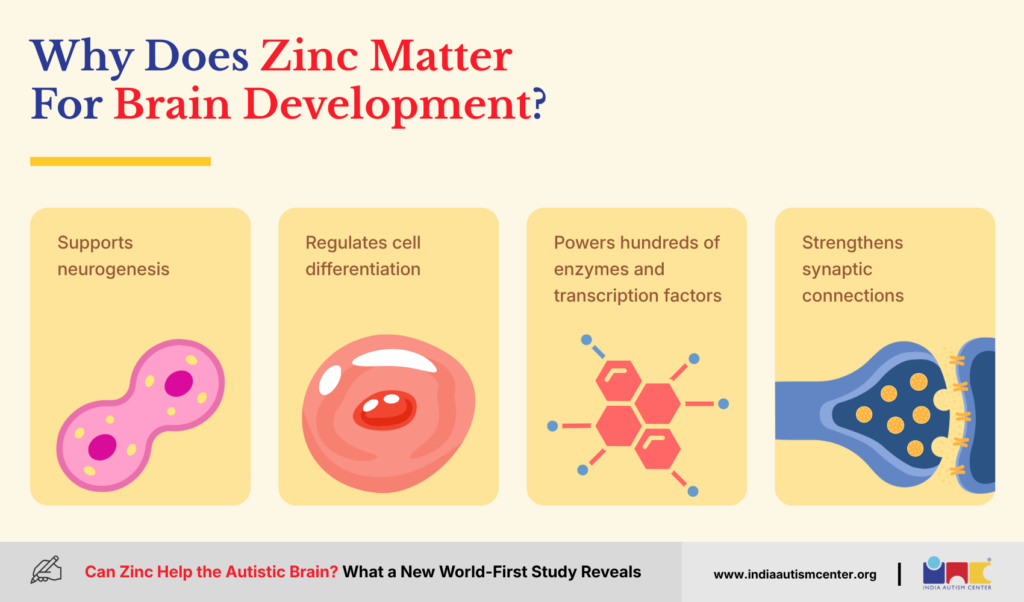
  • Does Tylenol Cause Autism? What the Largest Autism Study Found 

    Does Tylenol Cause Autism? What the Largest Autism Study Found 

    No. Current scientific evidence does not show that Tylenol (acetaminophen) causes autism. The largest study on this topic — covering 2.5 million children — found no causal link. Some earlier studies showed a statistical association, but association is not the same as causation. This distinction matters enormously for parents.

    What Is the Tylenol–Autism Controversy About?

    What Is the Tylenol–Autism Controversy About?

    In September 2025, President Donald Trump and HHS Secretary Robert F. Kennedy Jr. announced that the FDA would warn physicians about a “very increased risk of autism” linked to acetaminophen use during pregnancy. The statement made headlines globally and caused immediate alarm among expecting mothers.

    Doctors, researchers, and autism organisations pushed back quickly. The science, they said, simply does not support that claim.

    So where did this fear come from? And what does the evidence actually show? Let me walk you through it clearly.

    What Is Acetaminophen (Tylenol / Paracetamol)?

    What Is Acetaminophen?

    Acetaminophen is the active ingredient in Tylenol. Outside the US, it is commonly known as paracetamol (Crocin, Dolo, Calpol in India). It is one of the most widely used over-the-counter pain relievers and fever reducers in the world.

    Pregnant women often take it for:

    • High fever during infection
    • Headaches and body pain
    • Post-delivery pain management

    It has historically been considered the safest OTC pain option during pregnancy — which is exactly why this controversy has caused so much confusion.

    Want to know more? Get in touch with us.

    Why Did Some Studies Link Tylenol to Autism?

    Why Did Some Studies Link Tylenol to Autism?

    Several studies over the past decade did find an association between prenatal acetaminophen use and Autism or Attention Deficit Hyperactivity Disorder (ADHD) diagnoses in children.

    Here is a summary of the key studies that raised concerns:

    StudyFindingLimitation
    Johns Hopkins cord blood study (2019)Highest acetaminophen exposure linked to ~3× higher autism/ADHD riskNo control for genetics or family history
    NCBI prenatal exposure meta-analysisChildren prenatally exposed were 19% more likely to show autism symptomsHigh selection bias across included studies
    Mount Sinai review (2025)Available evidence supports an association with neurodevelopmental disordersDid not use sibling-comparison design

    These studies found correlation, not causation. That difference is critical, and I will explain exactly why below.

    What Is the Difference Between Association and Causation?

    What Is the Difference Between Association and Causation?

    This is the most important concept in this entire debate.

    Association means two things tend to appear together in the data. Causation means one thing directly causes the other. These are not the same thing.
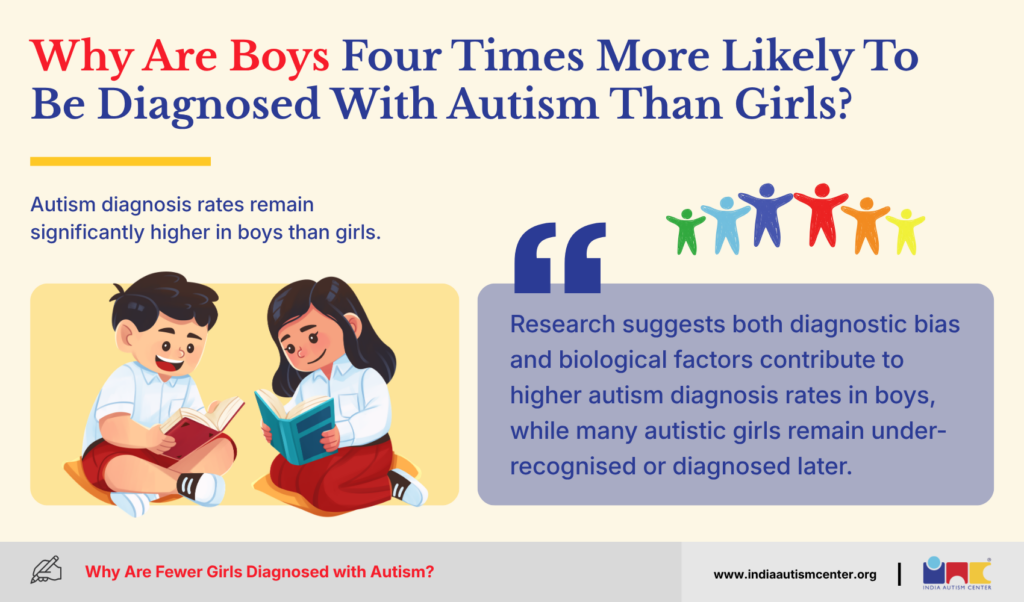
    A classic example: Ice cream sales and drowning rates both rise in summer. They are associated. Ice cream does not cause drowning — hot weather causes both.
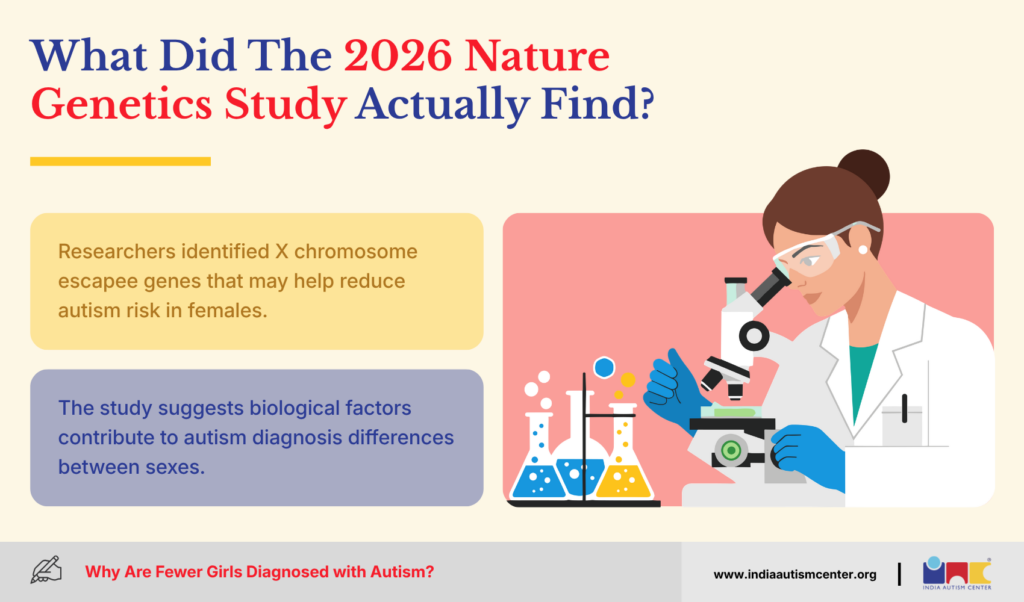
    In the acetaminophen–autism studies, the same problem existed. Mothers who took acetaminophen during pregnancy were also more likely to have:

    • Fever or infection (themselves linked to autism risk in the fetus)
    • Chronic pain or autoimmune conditions (genetically connected to neurodevelopmental differences)
    • Migraines or inflammatory conditions (also heritable, and associated with autism)

    So it is entirely possible — and scientifically likely — that the studies were measuring the underlying illness, not the medication.

    What Does the Largest Study on This Topic Show?

    What Does the Largest Study on This Topic Show?

    In April 2024, a landmark study was published in JAMA — one of the world’s most respected medical journals.

    The study: Conducted by the Karolinska Institute (Sweden) and Drexel University, funded by the US National Institutes of Health (NIH).

    The data: Nearly 2.5 million children born in Sweden between 1995 and 2019.

    The method: A sibling-comparison design — comparing children in the same family, one exposed to acetaminophen in the womb and one not. This controls for shared genetics and family environment simultaneously. It is considered the gold standard for this type of research.

    The finding:

    When siblings were compared, there was no difference in autism, ADHD, or intellectual disability rates — regardless of acetaminophen exposure during pregnancy.

    The specific numbers:

    • Autism hazard ratio: 0.98 (effectively neutral — no increased risk)
    • ADHD hazard ratio: 0.98 (same)
    • Intellectual disability hazard ratio: 1.01 (same)

    Earlier models in the same study had shown a marginal 5–7% association. That association completely disappeared once sibling controls were applied. This strongly suggests the earlier association was caused by genetic and familial confounding — not the drug.

    Want to know more? Get in touch with us.

    Has Any Other Country Replicated This Finding?

    Has Any Other Country Replicated This Finding?

    Yes. A separate Japanese study used the exact same sibling-comparison design.

    Japan has a very different population, with different genetics and different acetaminophen usage patterns — nearly 40% of Japanese mothers reported using it during pregnancy, compared to under 10% in Sweden.

    Despite these differences, the conclusion was identical: no link between acetaminophen use during pregnancy and autism or ADHD when siblings are compared.

    This cross-cultural replication adds significant weight to the Swedish findings.

    What About the February 2025 Meta-Analysis That Claimed a Link?

    What About the February 2025 Meta-Analysis That Claimed a Link?

    A 2025 meta-analysis (the Prada et al. review) was cited by political figures as evidence of harm. It used a methodology called the Navigation Guide.

    However, independent scientists have noted that most studies included in this review had:

    • High selection bias
    • Variable methods for measuring exposure
    • Inadequate control for familial and genetic confounding
    • No sibling analysis — the most reliable design for this question

    The Autism Science Foundation’s 2025 year-in-review explicitly noted that this year’s research helped exonerate acetaminophen as a cause of autism.

    So What Actually Causes Autism?

    So What Actually Causes Autism?

    Autism does not have a single cause. It is a spectrum condition shaped by a complex interaction of genetics and environment.

    Here is what the current scientific consensus does support:

    Genetic factors (strongest evidence):

    • Hundreds of genes have been linked to autism
    • Most cases involve common inherited genes with small individual effects that work additively
    • A rare genetic condition is identified in approximately 7–20% of cases
    • Siblings of autistic children have roughly a 20% likelihood of also receiving a diagnosis

    Environmental factors (supporting role, not standalone causes):

    • Advanced parental age at conception
    • Premature birth or very low birth weight
    • Maternal fever or infection during pregnancy (the illness itself, not the treatment)
    • Prenatal exposure to certain medications such as valproic acid (an anti-epileptic drug)
    • Exposure to air pollution and certain pesticides during pregnancy

    Factors that have been studied and found NOT to cause autism:

    • Vaccines (the MMR-autism link was thoroughly debunked and retracted)
    • Acetaminophen / Tylenol (as shown by the 2024 JAMA study)

    Autism arises from differences in early brain development — and those differences begin forming in the womb, shaped by a mosaic of genetic and environmental influences over time.

    Want to know more? Get in touch with us.

    Is It Safe to Take Paracetamol During Pregnancy?

    Is It Safe to Take Paracetamol During Pregnancy?

    This is a question for your doctor, not for a headline. But here is the scientific context:

    Untreated high fever during pregnancy carries documented risks — including complications for both mother and baby. The choice is not simply “Calpol vs. no Calpol.” It is often “treat the fever vs. leave it untreated.”

    Major health bodies including the WHO and most national obstetric guidelines have not changed their position based on the Trump administration’s announcement. Acetaminophen, when used at recommended doses for specific indications, remains the most studied and generally accepted pain/fever option available to pregnant women.

    That said:

    • Use the lowest effective dose for the shortest necessary time
    • Consult your OB/GYN before taking any medication during pregnancy
    • Do not self-medicate for prolonged periods without medical supervision

    The Autism Science Foundation described the link between acetaminophen and autism as “based on limited, conflicting, and inconsistent science” and called the current concern “premature.

    If My Child Is Autistic, Did Something I Do During Pregnancy Cause It?

    If My Child Is Autistic, Did Something I Do During Pregnancy Cause It?

    No. And I want to be clear about this, especially for parents who may be carrying that guilt.

    The best available science does not support the idea that taking a common fever reducer during pregnancy caused your child’s autism. Autism develops through a combination of genetic predispositions and early brain development differences — not a single pill, a single moment, or a single decision.

    Parents of autistic children already carry enough. You do not need to add unfounded guilt to that weight.

    📥 Free download: Printable daily routine chart for autistic children

    Conclusion

    Does Tylenol cause autism? No. The largest study to date (2.5 million children, JAMA 2024) found no causal link.

    Is there an association between acetaminophen and autism? Some earlier studies found a weak statistical association, but it disappeared in sibling-comparison analyses — suggesting genetic confounding, not causation.

    What is the gold standard study design for this question? Sibling-comparison design, which controls for shared genetics and family environment.

    What does the 2024 Swedish study show? No increased risk of autism, ADHD, or intellectual disability from prenatal acetaminophen use, after controlling for family genetics.

    What actually causes autism? A complex interaction of hundreds of genes and environmental influences during early brain development. There is no single cause.

    Should pregnant women avoid Tylenol? Consult your doctor. Untreated fever also carries pregnancy risks. No major health body has changed guidance based on current claims.

    Sources and References

    • Ahlqvist VH et al. Acetaminophen use during pregnancy and offspring neurodevelopment — JAMA, April 2024
    • Johns Hopkins Bloomberg School of Public HealthThe Evidence on Tylenol and Autism, November 2025
    • NIH press release — Study reveals no causal link between neurodevelopmental disorders and acetaminophen exposure before birth, April 2024
    • Autism Speaks — Tylenol and Autism: Sibling study finds previously reported connection is likely due to other underlying factors, April 2024
    • Autism Science Foundation — 2025 Autism Research Year in Review, January 2026
    • JHU News-Letter — From Correlation to Confusion: Fact-Checking President Trump’s Tylenol–Autism Claim, October 2025
    • FIGO — Paracetamol use during pregnancy and autism risk: evidence does not support causal association
    • PBS NewsHour — Research doesn’t show using Tylenol during pregnancy causes autism, September 2025

    Disclaimer: This article is intended for educational and informational purposes only. It is not a substitute for professional medical advice, diagnosis, or treatment. If you are pregnant or have concerns about medication use during pregnancy, please consult a qualified healthcare provider. If your child has received an autism diagnosis and you have questions about causes or support, please reach out to a trained specialist or an autism-focused organisation for guidance.
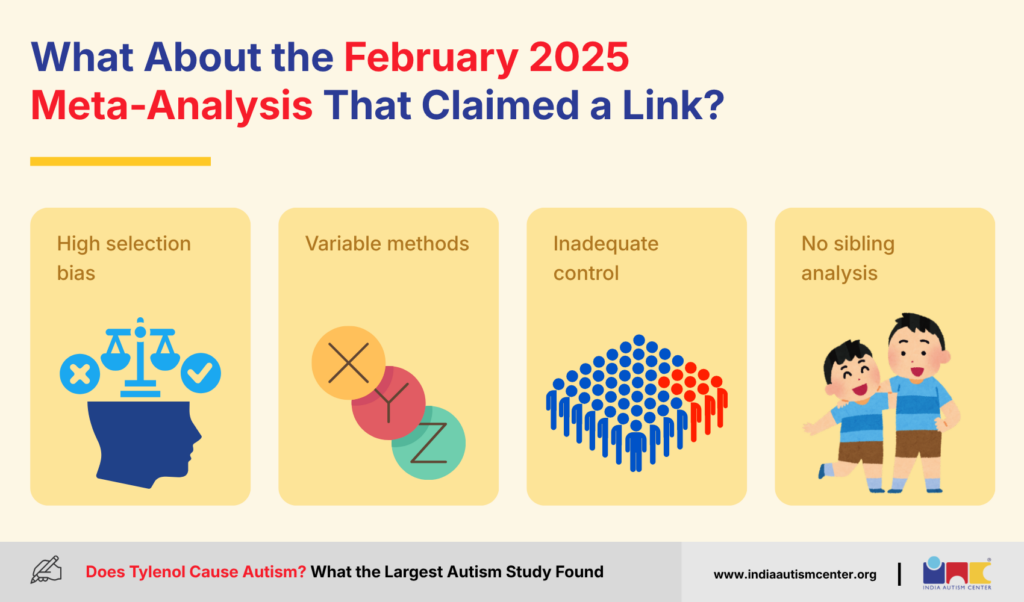
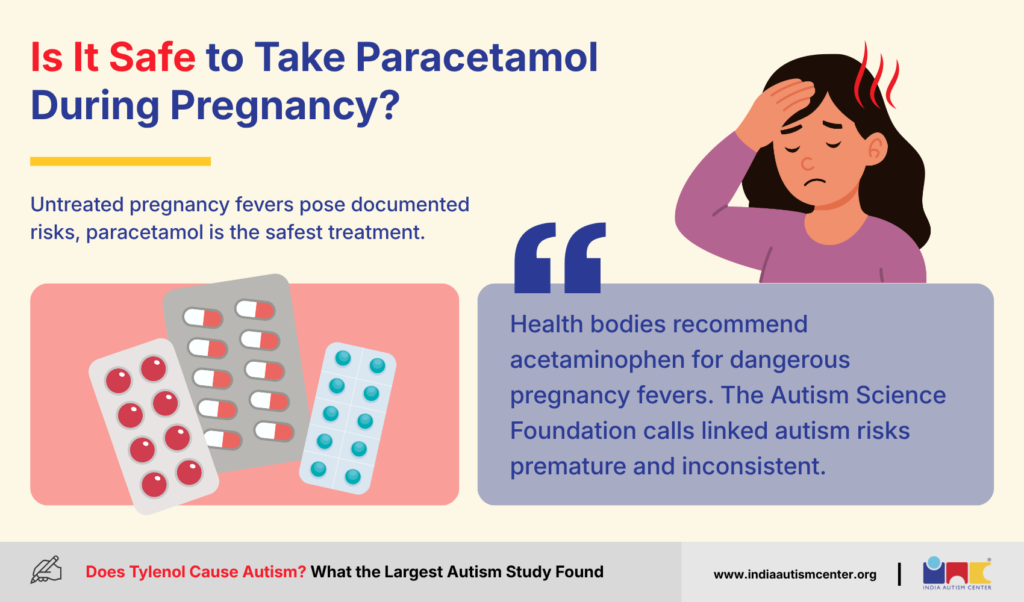
    For expert insights, support services, and inclusive learning initiatives, visit the India Autism Center.