Let me guess. Your daughter just turned 16, or maybe your son is 18 and about to exit the school system. For years, you had IEP meetings, therapists, school buses, and a structured schedule. Now you look ahead, and all you worry about is autism adulthood transition.
We have been there. You are not alone.
The autism adulthood transition is one of the most overwhelming phases you will ever navigate. Why? Because the services that felt like a safety net in school simply vanish when that diploma arrives. One day, your child has a case manager. The next day, you are staring at waitlists for adult disability services.
But here is the good news. With the right transition planning, you can build a bridge. A strong, steady bridge. In this guide, I will walk you through every step. We will talk about work, college, living arrangements, doctor visits, and even how to handle meltdowns in a new environment.
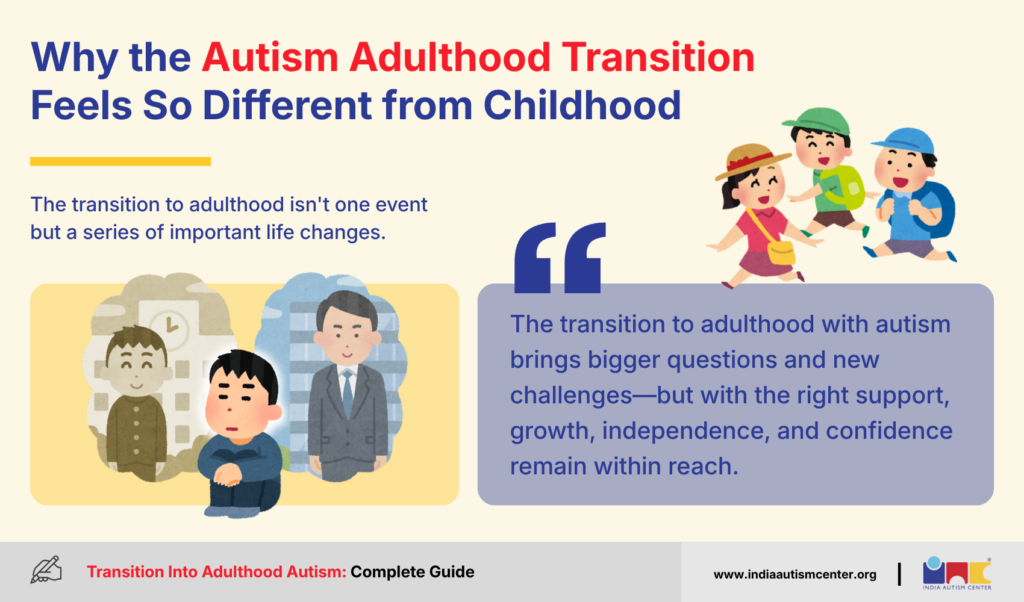
Why the Autism Adulthood Transition Feels So Different from Childhood
When your child was small, you focused on speech therapy, social skills groups, and surviving public meltdowns. You celebrated eye contact and a first word. That was phase one.
Now the game has changed. Suddenly, the questions are bigger.
Will he ever hold a job?
Can she live on her own?
What happens when I am gone?
Who will understand her sensory processing in adults needs in a loud workplace?
You see, the autism adulthood transition is not one event. It is a series of tectonic shifts. Health insurance, legal status, housing options, daily routines — all of these shift at once.
I want you to remember something. Your young adult is still the same wonderful person. They just need new tools. And you can help them build those tools.
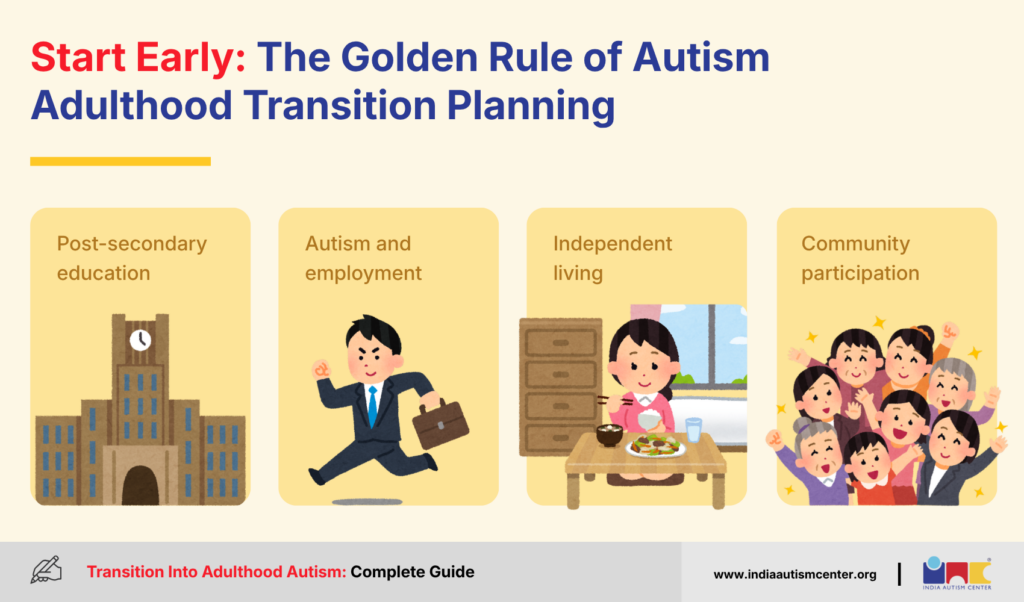
Start Early: The Golden Rule of Autism Adulthood Transition Planning
Social communication skills do not develop overnight. Neither do independent living skills. By starting early, you have years to practice small steps like ordering food, taking the bus, or filling out a job application.
What to Include in Your First Transition Meeting
When you sit down with the school team, demand a plan that covers four pillars:
Post-secondary education (college or trade school)
Autism and employment (jobs, internships, or sheltered work)
Independent living (apartment, group home, or supported living)
Community participation (friends, hobbies, transportation)
Do not let the school focus only on academics. Academics mean nothing if your child cannot navigate a grocery store or ask for help.
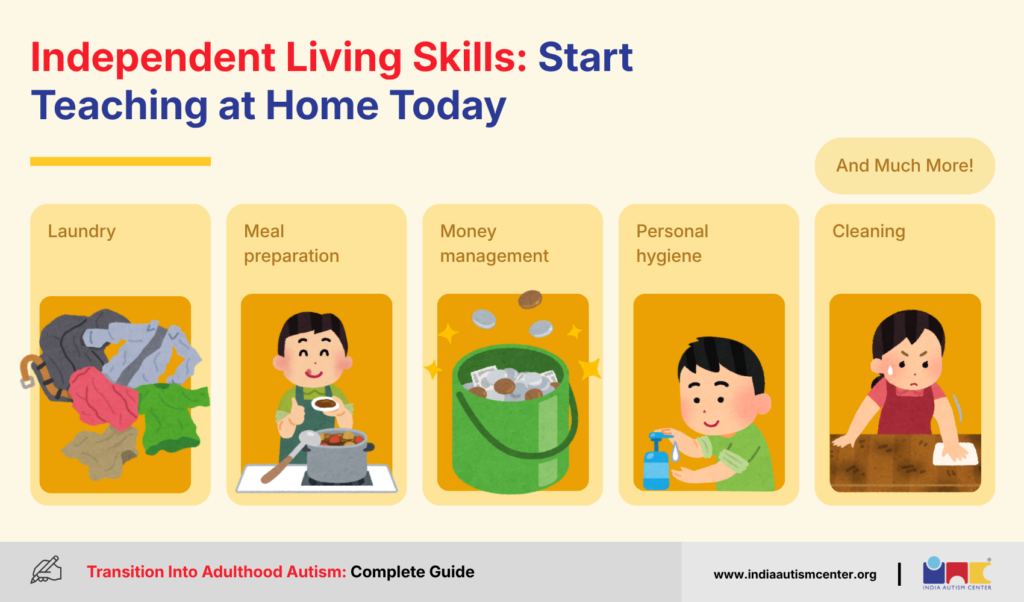
Independent Living Skills: Start Teaching at Home Today
Let me be real with you. Your child might know how to solve a quadratic equation but have no idea how to do laundry. I see this all the time.
Independent living skills are the quiet heroes of successful adulthood. You do not need a classroom to teach them. You need your kitchen, your bathroom, and your backyard.
The Top 10 Skills to Master Before Age 18
Laundry – sorting, washing, drying, folding.
Meal preparation – from microwaving a burrito to boiling pasta.
Money management – using a debit card, making change, budgeting.
Personal hygiene – showering, shaving, menstrual care, deodorant.
Cleaning – wiping counters, vacuuming, taking out trash.
Safety awareness – what to do in a fire, how to call 911.
Using public transportation – reading a bus schedule, handling delays.
Making appointments – phone calls or online forms.
Medication management – filling a pillbox, refilling prescriptions.
Emergency planning – who to call when you feel overwhelmed.
I know it feels slow. I know you have to prompt a hundred times. But every small win builds momentum. Use visual schedules, checklists, and reward systems. Be patient. Do not do it for them.
Here is something most professionals forget. Sensory processing in adults does not magically improve at age 21. In fact, new environments can make it worse.
A dormitory with flickering lights. An office with constant chatter. An apartment with thin walls and noisy neighbors.
When you teach independent living skills, always include sensory solutions. Noise-canceling headphones. Weighted blankets. A “sensory corner” in their future bedroom. Teach them to recognize early warning signs of overload before a meltdown starts.
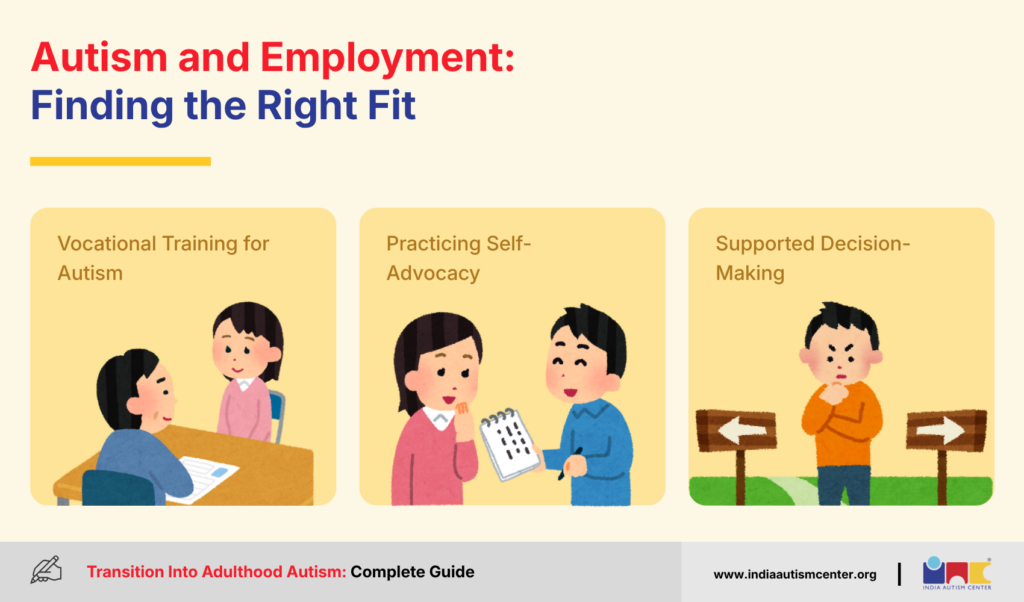
Autism and Employment: Finding the Right Fit
Let me guess. You have heard the statistics. Over 80% of autistic adults are underemployed or unemployed. Those numbers are terrifying.
But here is what they do not tell you. Many of those adults never received proper vocational training for autism. They were thrown into standard job interviews with no accommodations. They were fired for being “too blunt” or “too slow.”
You can change that narrative for your child.
Vocational Training for Autism
Not all job training is the same. Your young adult needs:
Structured internships in high school (paid if possible)
Job coaching from someone who understands autism
Social scripts for common work situations (asking for help, declining extra shifts, requesting a break)
Sensory audits of the workplace before starting
Trial shifts where they can leave early without penalty
Look into local vocational rehabilitation agencies. They are funded by the government and often provide free job training. Also explore companies that specifically hire neurodivergent talent, such as Microsoft’s Autism Hiring Program, SAP’s Autism at Work, or Walgreens distribution centers.
Healthcare Transition: Moving from Pediatric to Adult Medicine
One of the scariest parts of the autism adulthood transition is healthcare. Suddenly, your child’s beloved developmental pediatrician says, “We only see patients up to age 21.”
Now you need to find an adult primary care doctor. And you need to teach your young adult to speak for themselves.
The Self-Advocacy Script You Need to Practice
Write down a simple script. Practice it until it feels natural.
“My name is XYZ. I have autism. Sometimes I have trouble explaining my pain. Please ask me yes or no questions. Please write down your instructions. I may need extra time to answer.”
Teach them to bring a healthcare summary card in their wallet. That card should list:
Here is a big legal decision. Many parents automatically assume they need full guardianship. But guardianship takes away your child’s right to make any decision about their body, money, or life.
Consider guardianship alternatives first. Supported decision-making is a legal agreement where your adult child keeps their rights but names you (and others) as helpers. They sign a document allowing you to access medical records or talk to bankers, but they still give final consent.
Only pursue full guardianship if your child truly cannot understand basic choices. And even then, make it as limited as possible. We want dignity. We want autonomy.
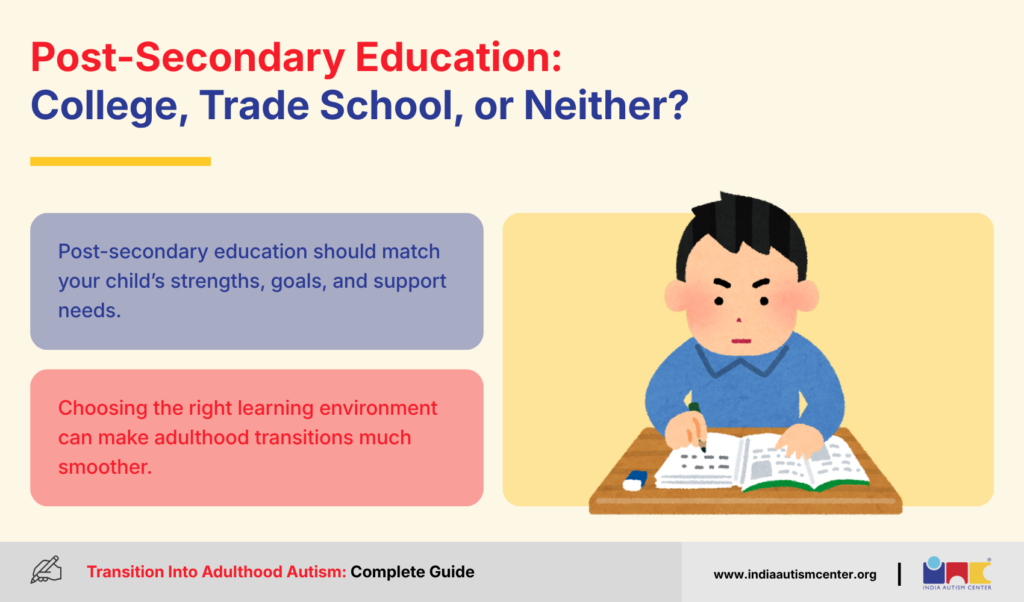
Post-Secondary Education: College, Trade School, or Neither?
Your cousin keeps asking, “Is he going to college?” And you want to scream.
Let’s set the record straight. Post-secondary education is not a moral requirement. It is a tool. Does your child need that tool?
Signs a Traditional Four-Year College Might Work
Reading comprehension at or near grade level
Ability to follow a loose schedule (not minute-by-minute)
Can handle some independent studying
Wants to be there (not just pleasing you)
Better Options for Many Autistic Young Adults
Community college – smaller classes, less expensive, easy to drop in and out
Trade or vocational school – HVAC, culinary arts, medical coding (hands-on, clear rules)
Certificate programs – digital marketing, computer repair, pharmacy technician
If your child struggles with social communication, dorm life can be a nightmare. Roommates who party until 2 AM. Cafeterias with 500 people. Large lecture halls with no structure.
Instead, start with one class. One. Then add more slowly. And register with the disability services office on day one. Ask for note-takers, extended time on tests, and permission to record lectures.
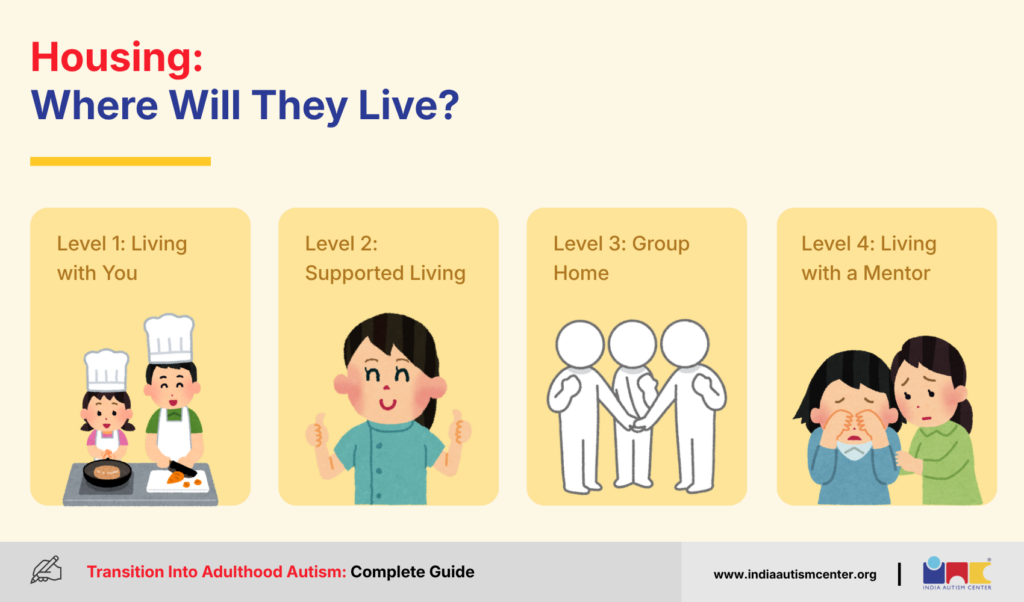
Housing: Where Will They Live?
This is the question that keeps you up at night. I know.
The old model was simple: group home. But now you have many more options. Let us walk through the spectrum of independent living.
Level 1: Living with You (with adult rules)
Many autistic adults live with parents well into their 30s. That is fine. But make a formal agreement. Charge a small rent ($200/month). Assign chores. Expect them to cook one night a week. Treat them like a roommate, not a child.
Level 2: Supported Living
They have their own apartment (or a room in a shared house). A support worker visits 5–15 hours per week to help with budgeting, medical appointments, and social outings. This is often funded through Medicaid waivers.
Level 3: Group Home (now called Community Living Arrangement)
For those who need 24/7 supervision. Many group homes are terrible. Some are wonderful. You must visit often, check staffing ratios, and stay involved.
Level 4: Living with a Mentor or Peer
Some families buy a duplex. Their adult child lives in one unit; a responsible graduate student or older adult lives in the other rent-free in exchange for 10 hours of check-ins per week.
Start touring options when your child turns 16. Waitlists for adult disability housing are often 5–10 years long. Yes, years. Do not wait.
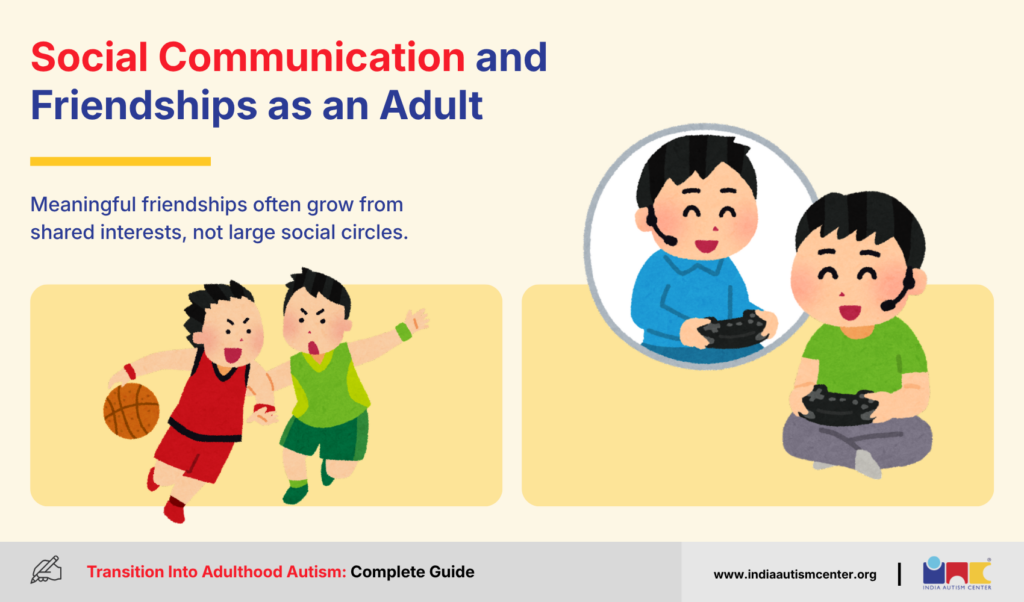
Your child may not need a huge friend group. But loneliness is real. And social communication in adulthood is trickier than in high school.
At school, peers are forced together. After graduation, no one forces anything.
How to Help Your Adult Child Build Social Connections
Special-interest groups – Dungeons & Dragons at the local game store, train clubs, anime conventions, coding meetups. Shared interests lower the social pressure.
Peer mentor programs – Some adult disability agencies match your young adult with a neurotypical peer for weekly coffee or walks.
Online communities – Discord servers, Reddit forums, or video game guilds. If real-world interaction is too hard, online friendship is still real friendship.
Volunteering – Animal shelters, food banks, or libraries. Lower stakes than a paid job.
Teach them the two-question rule for conversations: Ask someone a question. Listen to the answer. Then ask one follow-up question. Then you can talk about your special interest. That small framework prevents monologuing.
Your Emotional Health as a Parent
I see you. You have spent 20 years advocating, crying, celebrating, and exhausting yourself. And now the autism adulthood transition asks you to do even more.
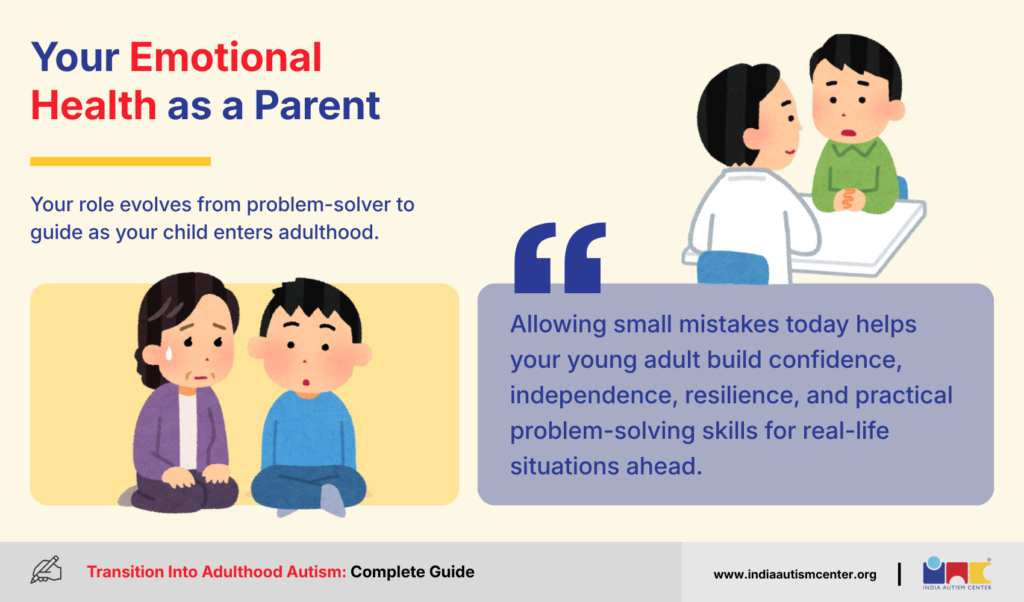
But here is the secret. Your best role now is not “fixer.” It is “consultant.”
Step back. Let them fail in small ways. Let them forget to do laundry and wear a dirty shirt to work. Let them call you from the bus stop because they missed the bus. Do not rescue immediately.
Why? Because you will not be here forever. They need practice fixing their own small problems while you are still around to help them debrief.
Find your own support. A therapist. A parents’ group for adult autistic children. A weekly coffee with a friend who gets it. You cannot pour from an empty cup.
The First Year After High School: A Survival Guide
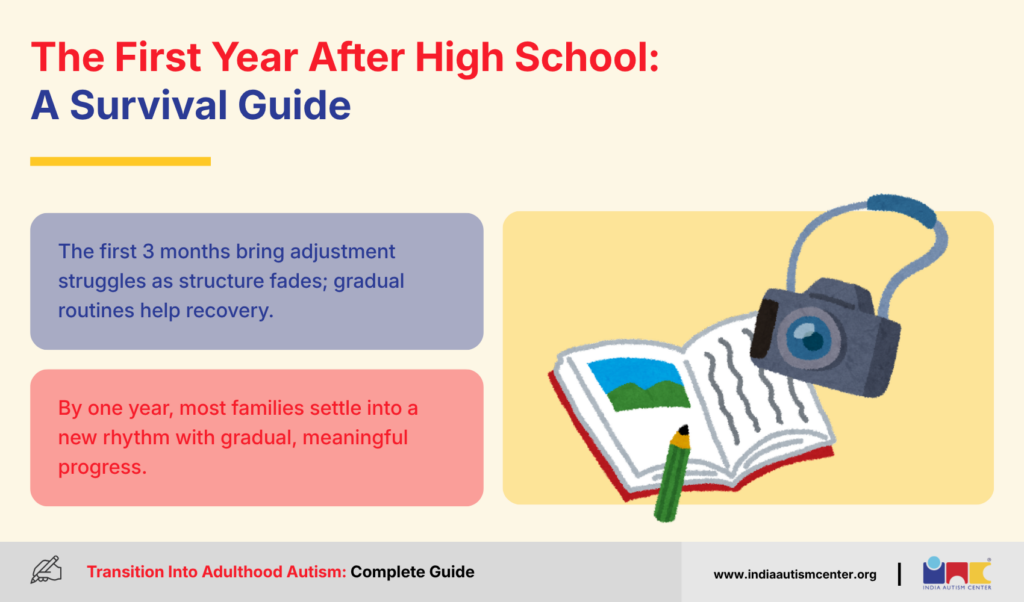
That first year of the autism adulthood transition will feel like chaos. Prepare for it.
The 3-Month Slump
Months 1-3: They sleep late, eat junk food, and seem lost. This is normal. The structure of school is gone. Give them a few weeks of decompression, then start slowly introducing new routines.
The One-Year Mark
After 12 months, most families have found a new rhythm. Maybe they work 15 hours a week at a pet store. Maybe they take two community college classes. Maybe they volunteer at a library. Progress is progress.
Celebrate small wins. A successful bus ride. A polite email to a professor. A meal they cooked without your help. Write these down. On hard days, read the list.
Close your eyes for a moment. Picture your child at 30. Not at 18. At 30.
What do you see? Maybe they live in a small apartment with a cat. Maybe they work at a grocery store and come home tired but satisfied. Maybe they text you a funny meme every morning.
That is success. That is not a tragedy. That is a real, meaningful adult life.
The autism adulthood transition is not about turning your child into a neurotypical corporate executive. It is about giving them the tools to build a life that feels good to them.
You have done amazing work to get them this far. Now take a breath. Make a plan. Start today with one small step.
Key Takeaways (for that parent notebook you keep)
Start transition planning by age 14 – demand it in the IEP.
Teach independent living skills at home – laundry, cooking, money.
Vocational training for autism works – seek internships and job coaching.
Healthcare transition needs a script – practice self-advocacy phrases.
Post-secondary education is optional – trade school is just as valid.
Housing waitlists are long – start touring group homes and supported living at 16.
Functional needs trust and ABLE account – protect benefits and savings.
Write a letter of intent – your future self will thank you.
Take care of yourself – you are the long-term support system.
Disclaimer: This article is for educational purposes. Laws, benefits, and programs change. Always consult an attorney, benefits counsellor, or medical professional for your specific situation.
Frequently Asked Questions
What if my adult child refuses to leave the house at all?
Start tiny. A walk to the mailbox. A drive-through coffee run. 5 minutes in the backyard. Then build. If refusal persists more than 2 weeks, consider depression screening.
Can my child still get SSI if they work?
Yes. SSI has work incentives. In 2025, they can earn about $2,000 per month and keep partial benefits. Talk to a benefits counsellor.
How do I handle meltdowns in public now that they are an adult?
Police may not understand autism. Create a safety card that explains “This is a meltdown, not aggression. Please give us 10 minutes alone.” Keep it in their wallet.
What if nothing I try works and they just play video games all day?
First, stop all unlimited screen time. Use video games as a reward for completing one small task (taking a shower, sending one job application). Then slowly increase expectations. Therapy may be needed for pathological demand avoidance.
For expert insights, support services, and inclusive learning initiatives, visit the India Autism Center.
Have you ever spent an entire day smiling, nodding, and saying exactly the right things — only to get home and feel completely hollowed out? For many autistic people, this isn’t an occasional bad day. It’s a way of life. It has a name: autism masking.
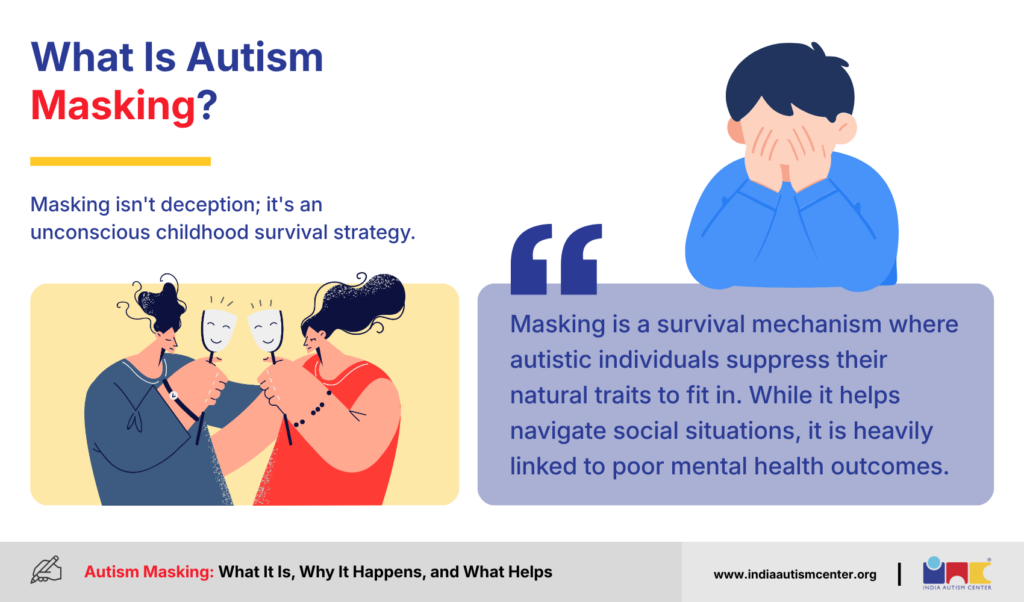
Autism masking — also called camouflaging — is the conscious or unconscious process of suppressing autistic traits to appear neurotypical. It is exhausting, it is invisible, and for far too long, we mistake it for “doing well.”
This blog explores what autism masking truly is, why autistic people do it, and its impact on mental health. And — crucially — how psychotherapy offers a compassionate, evidence-backed path toward unmasking and living more authentically.
What is Autism Masking?
Autism masking refers to a set of strategies autistic individuals use to hide or suppress their natural neurological traits in social situations. These can include making deliberate eye contact even when it feels uncomfortable, scripting conversations in advance, mimicking other people’s gestures and expressions, forcing themselves to sit still instead of stimming, and performing emotions they do not actually feel.
We sometimes use the term “camouflaging” interchangeably, and research published in Autism (Lai et al., 2017) was among the first to formally study it in adults. What the research found was striking: masking was widespread, particularly among autistic women, and it was strongly associated with poor mental health outcomes.
Masking is not a deliberate act of deception. It is a survival mechanism — one that develops early in life, often before a person even has the vocabulary to describe what they are doing.
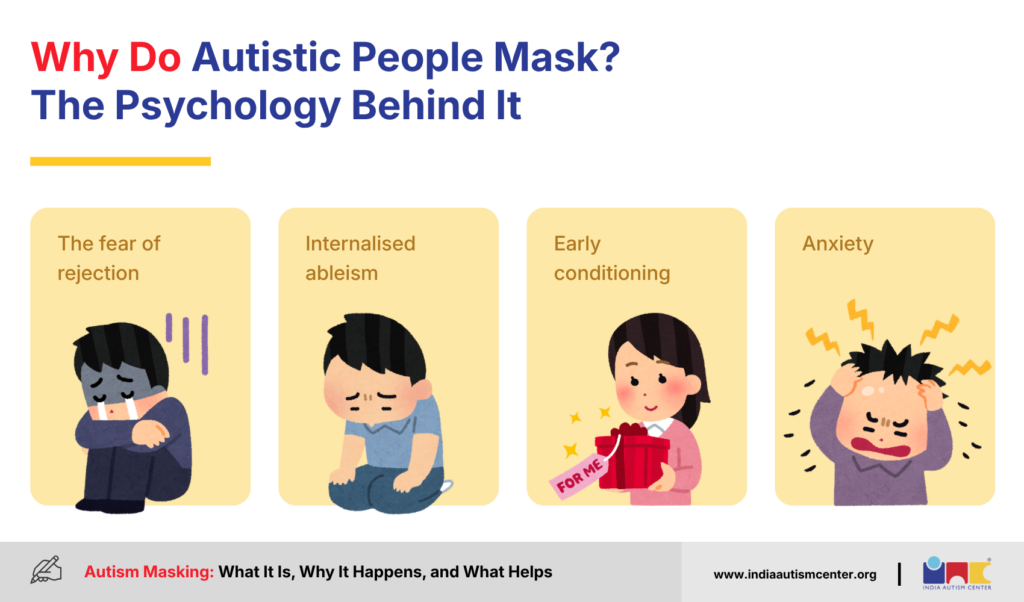
Why Do Autistic People Mask? The Psychology Behind It
Understanding autism masking means understanding the social environment in which autistic people grow up. From a young age, many autistic children receive implicit and explicit messages that their natural way of being is wrong. We tell them to “look at me when I’m talking to you,” encourage to stop flapping their hands, praised when they manage to blend in, and excluded or bullied when they do not.
Over time, masking becomes automatic. It is an adaptive response to an environment that was not designed with neurodivergent people in mind.
Several psychological forces drive masking:
The fear of rejection and social exclusion. Humans are fundamentally social animals, and autistic people are no different. When the price of being visibly autistic has historically been mockery, isolation, or hostility, hiding those traits feels necessary — even lifesaving.
Internalised ableism. Many autistic people absorb the message that autism itself is something shameful, something to be hidden or overcome. This internalised ableism can make masking feel not just practical but morally necessary.
Early conditioning and reward systems. Children who mask are frequently rewarded for it — with praise, inclusion, and adult approval. This creates a powerful feedback loop that embeds masking deep into a person’s behavioural repertoire long before they can reflect on whether it is serving them.
Anxiety. The relationship between masking and anxiety is bidirectional. Masking is often driven by anxiety about social judgment, and in turn, it perpetuates anxiety by preventing genuine connection and authentic self-expression. This is one reason why psychotherapy for anxiety is such a central component of support for masking autistic adults. The two issues are rarely separable.
Psychotherapy is a structured, therapeutic process in which a trained professional helps an individual explore thoughts, emotions, and behavioural patterns in order to support psychological well-being.
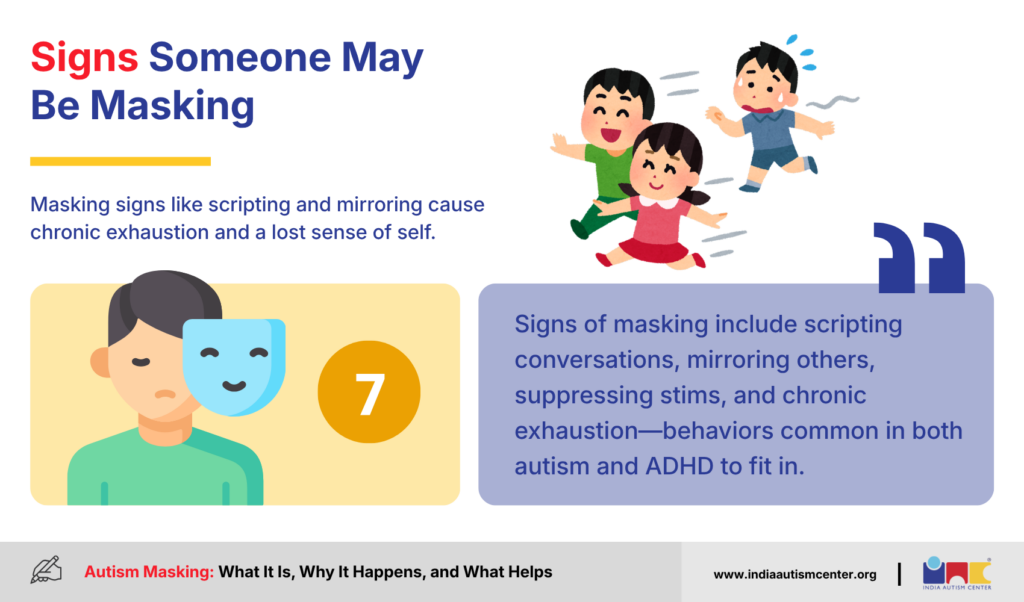
Masking is not always obvious — even to the person doing it. Here are some of the most common signs:
Scripting conversations — rehearsing what you will say before social situations, sometimes running through multiple possible responses in your head
Mirroring — unconsciously copying the speech patterns, gestures, body language, and facial expressions of the people around you
Suppressing stimming in public — holding back rocking, tapping, fidgeting, or other self-regulatory behaviours while in social settings, then stimming intensely once alone
Performing emotions — smiling when you do not feel happy, feigning enthusiasm, or modulating your emotional expression to match what seems expected
Chronic social exhaustion — feeling deeply depleted after interactions that others seem to find effortless
Losing track of your own preferences — finding it difficult to answer questions like “what do you enjoy?” because so much energy has gone into tracking others’ preferences instead
Being described as “surprisingly normal” — receiving comments like “you don’t seem autistic” that, however well-intentioned, signal how thoroughly the mask has done its job
It is also worth noting that masking is not exclusive to autism. Many people with ADHD engage in similar camouflaging behaviour, suppressing symptoms of inattention, impulsivity, or hyperactivity to fit workplace or social norms. Psychotherapy for ADHD often addresses this parallel experience, and for the significant proportion of people who are both autistic and have ADHD, therapeutic support that holds both identities at once is essential.
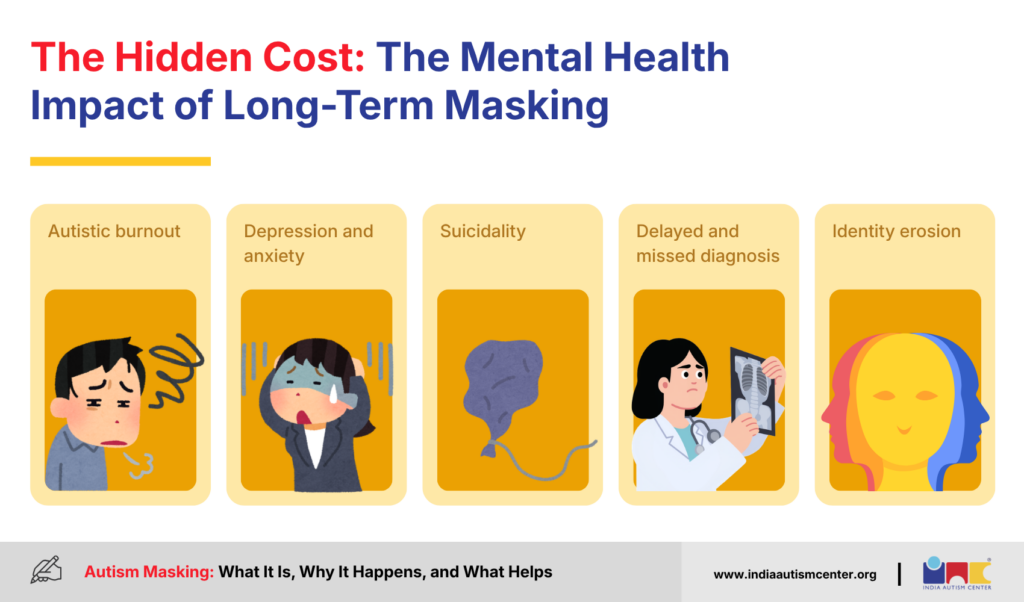
The Hidden Cost: The Mental Health Impact of Long-Term Masking
Masking comes at a profound cost.
Autistic burnout
Unlike ordinary fatigue, autistic burnout is a state of chronic exhaustion that results from the sustained effort of masking over time. It involves significant declines in cognitive function, a reduced ability to perform daily tasks, a loss of previously held skills, and an overwhelming need for withdrawal and rest. Autistic burnout can last for months or years, and it is frequently misdiagnosed as depression or chronic fatigue syndrome.
Depression and anxiety
Multiple studies have found significantly elevated rates of depression and anxiety among autistic adults, particularly those who mask heavily. The effort of constant performance, combined with the disconnection from one’s authentic self, creates fertile ground for both conditions.
Suicidality
Masking seldom associates with elevated suicidal ideation in autistic people. A 2018 study in The Lancet Psychiatry found that autistic adults are at significantly higher risk of suicidal behaviour than the general population, and masking is considered a contributing factor — both because of the psychological burden it places on individuals and because it can delay the recognition of distress by others, including clinicians.
Delayed and missed diagnosis
Perhaps one of the most insidious consequences of masking is that it fools diagnosticians. Autistic people — particularly women, non-binary individuals, and people of colour — who have spent years perfecting their mask often receive no diagnosis at all, or are misdiagnosed with borderline personality disorder, anxiety disorders, or depression, while the underlying autism remains invisible.
Identity erosion
When a person has been masking since childhood, they can lose touch entirely with who they actually are. The authentic self — genuine preferences, natural ways of moving and speaking, real emotional responses — becomes buried under layers of performance. Many late-diagnosed autistic adults describe a profound grief when they first receive their diagnosis: not just relief, but sorrow for the years lived as someone else.
This is precisely why psychotherapy for anxiety, depression, and identity-related distress is so critical for this population. The symptoms are real, they are serious, and they deserve serious, neurodivergence-affirming support.
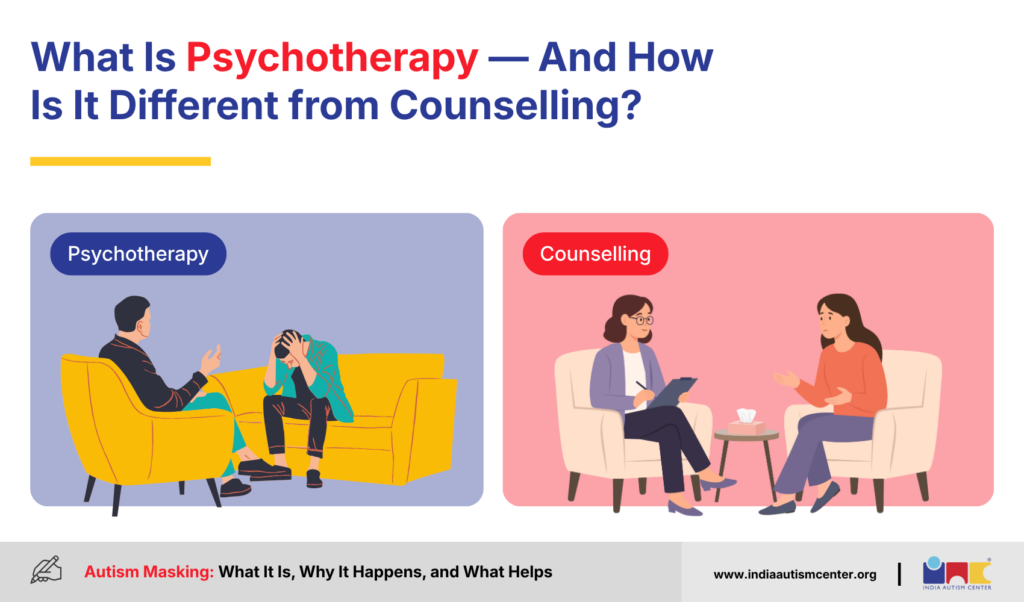
What Is Psychotherapy — And How Is It Different from Counselling?
Before exploring how psychotherapy helps with masking, it is worth clarifying what psychotherapy means and addressing a common source of confusion: the difference between counselling and psychotherapy.
Psychotherapy meaning: Psychotherapy is a broad term for therapeutic interventions delivered by a trained mental health professional, to help people understand and change thinking patterns, emotional responses, and behaviours that are causing distress or preventing them from living well. Psychotherapy involves a a specific theoretical model, more in-depth, longer-term therapeutic relationship than counselling.
We often misunderstand the difference between counselling and psychotherapy. Both involve talking with a trained professional in a confidential space, and there is genuine overlap between them. However, there are meaningful distinctions:
Counselling
Psychotherapy
Focus
Present-life difficulties, specific concerns
Deeper exploration of patterns, identity, past experiences
Duration
Often shorter-term (6–12 sessions)
Often longer-term (months to years)
Depth
Supportive and solution-focused
Explorative and insight-oriented
Training
Varies by country and setting
Typically requires extensive clinical training and supervision
Best for
Situational distress, life transitions
Complex or long-standing difficulties
For autistic adults navigating the aftermath of years of masking — including identity confusion, trauma, burnout, and anxiety — psychotherapy’s greater depth and longer timeframe is often what is needed. Counselling can absolutely be helpful, but the roots of masking tend to go deep, and meaningful unmasking work often requires the kind of sustained, exploratory relationship that psychotherapy provides.
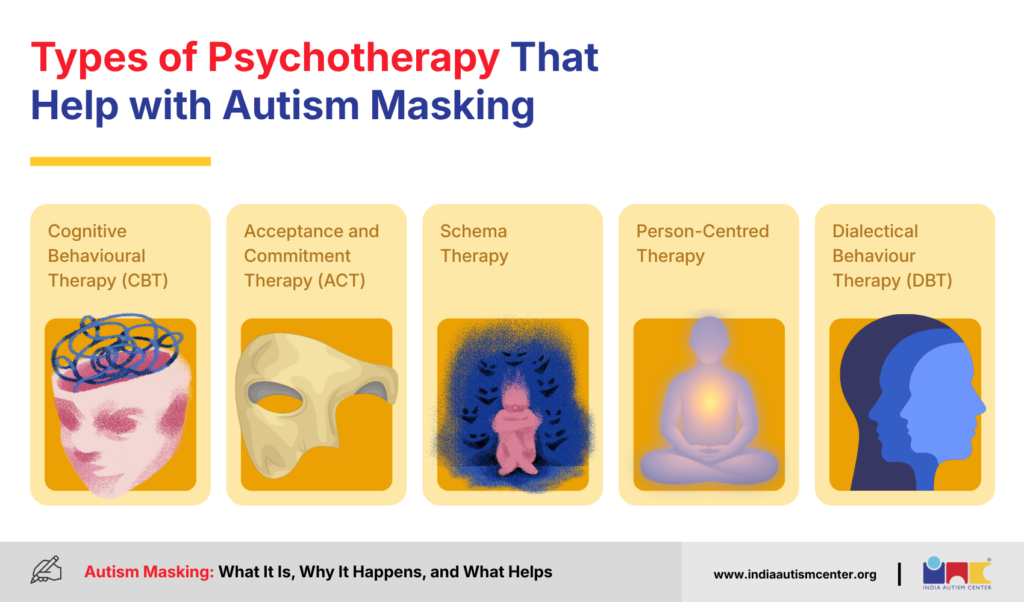
Types of Psychotherapy That Help with Autism Masking
Here are the most well-evidenced and clinically relevant approaches.
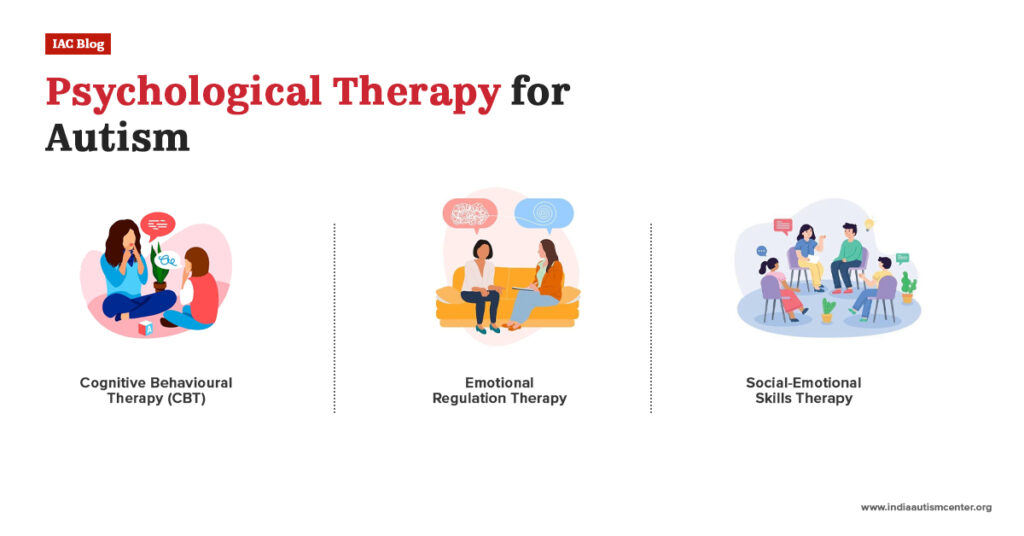
Cognitive Behavioural Therapy (CBT)
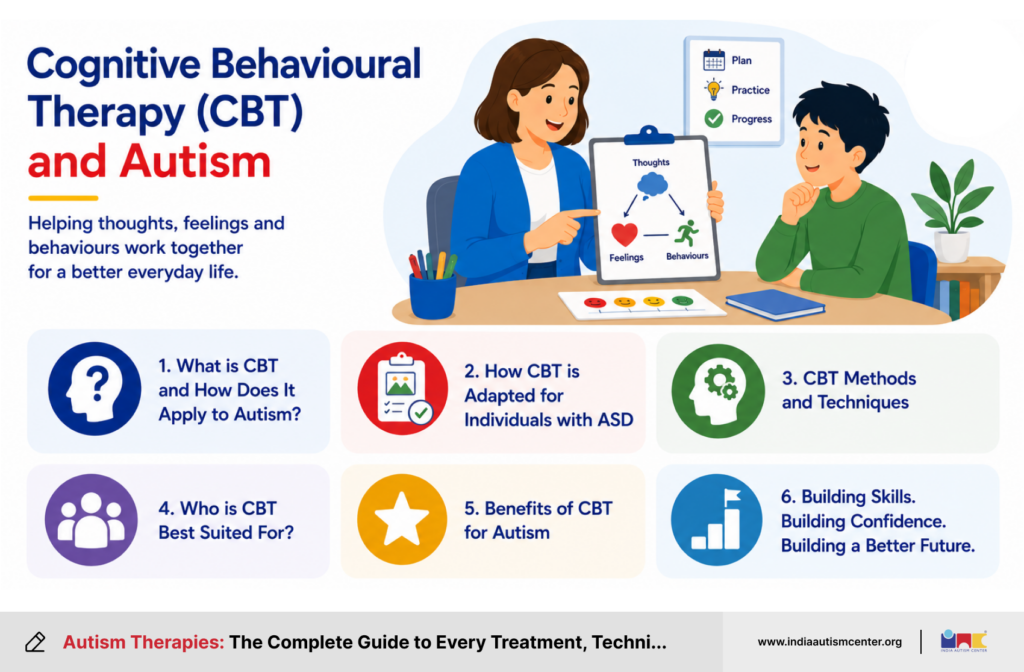
CBT is one of the most widely researched types of psychotherapy, and with autism-specific adaptations, it can be highly effective. Standard CBT focuses on identifying and challenging unhelpful thought patterns — but for autistic people, it needs to be adapted. Autism-affirming
CBT does not treat autism as the problem to be fixed; instead, it targets the anxiety, self-critical beliefs, and social fears that drive masking. Psychotherapy techniques within CBT — such as cognitive restructuring, behavioural experiments, and graduated exposure — can help clients test the belief that being themselves will lead to catastrophic social rejection.
Acceptance and Commitment Therapy (ACT)
ACT is particularly well-suited to unmasking work. Rather than challenging beliefs directly, ACT focuses on psychological flexibility — the ability to hold difficult thoughts and feelings without being controlled by them, while committing to actions aligned with personal values. For autistic people who have spent years suppressing who they are, values clarification work is transformative. ACT helps clients ask: What actually matters to me? What kind of life do I want to live? — questions that masking can make almost impossible to answer.
Schema Therapy
Schema therapy addresses deeply rooted emotional patterns — called “schemas” — that typically develop in childhood. For autistic people who masked from an early age, schemas around defectiveness, shame, and social isolation are common. Schema therapy’s combination of cognitive, behavioural, and experiential psychotherapy techniques makes it particularly suited to the kind of deep, identity-level work that unmasking often requires.
Person-Centred Therapy
Developed by Carl Rogers, person-centred therapy is built on unconditional positive regard — the therapist’s genuine, non-judgmental acceptance of the client as they are. For someone who has spent their life performing an acceptable version of themselves, this kind of radical acceptance can be profoundly healing. Person-centred work creates the safety needed to begin lowering the mask.
Dialectical Behaviour Therapy (DBT)
DBT was originally developed for borderline personality disorder but has since been adapted for a wide range of presentations. Its focus on emotional regulation, distress tolerance, and interpersonal effectiveness makes it particularly relevant for autistic people experiencing intense emotions and burnout. It is also one of the most commonly used types of psychotherapy in psychotherapy for ADHD, making it useful for the many people navigating both diagnoses simultaneously.
https://youtu.be/UU5WPIho8z4?si=UdrNpoJlQudZDQAF
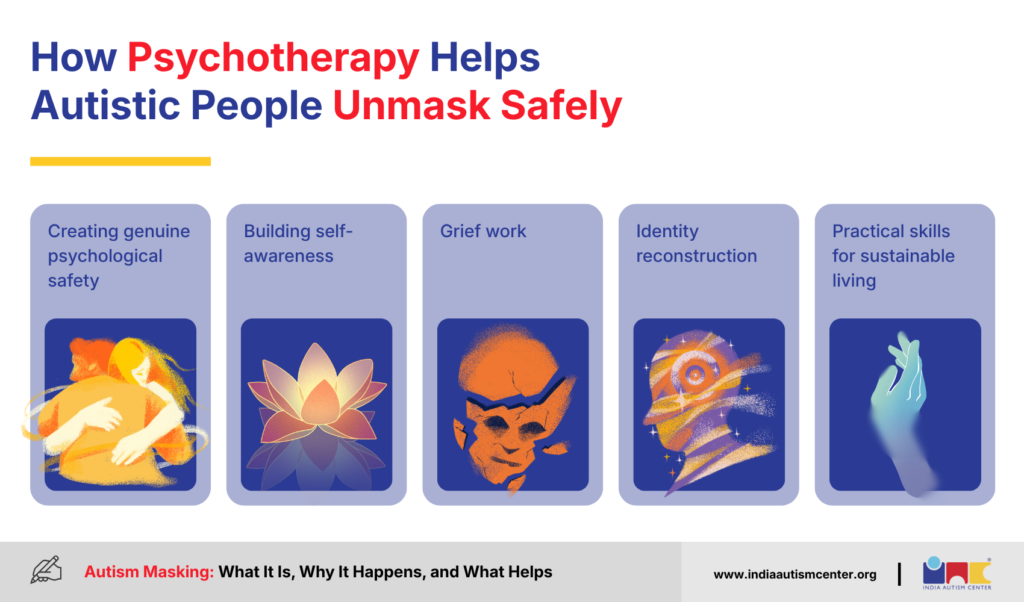
How Psychotherapy Helps Autistic People Unmask Safely
So, how does psychotherapy help with autism masking, practically speaking? The process is rarely linear, but there are several core elements that effective, autism-affirming therapeutic work tends to involve.
Creating genuine psychological safety
Unmasking cannot happen under threat. The first and most essential thing psychotherapy offers is a relationship in which the autistic client genuinely feels safe to be themselves — where stimming is welcome, where silence is not awkward, where directness is appreciated rather than pathologised, and where the therapist’s understanding of autism is affirmative rather than deficit-based.
Building self-awareness
Many autistic adults who have masked for years have little conscious awareness of when they are doing it. A significant part of psychotherapy involves developing the capacity to notice — to identify masking triggers, to recognise the internal signals of inauthenticity, to begin distinguishing between “who I am” and “who I have learned to perform.” Psychotherapy techniques such as mindfulness practices, body-based awareness work, and structured reflection exercises support this developing self-knowledge.
Grief work
Unmasking is not simply a process of becoming freer. It is also a process of loss. Grieving missed years, grieving the relationships built on a performance rather than on genuine self, grieving the diagnoses that came late or not at all — this grief is real, and good psychotherapy holds space for it without rushing toward resolution.
Identity reconstruction
Once the mask begins to loosen, the question becomes: who am I without it? This is both an exciting and a disorienting question. Psychotherapy supports clients in building what might be called a “chosen identity” — one that is genuinely their own, that incorporates their neurodivergence not as a deficit but as a dimension of self, and that draws on their actual values, interests, and ways of engaging with the world.
Practical skills for sustainable living
Part of how psychotherapy helps is also very practical. Clients learn to set boundaries around energy-draining social situations, to communicate their needs more clearly, to build environments that support rather than require constant masking, and to develop strategies for navigating a neurotypical world without abandoning themselves in the process.
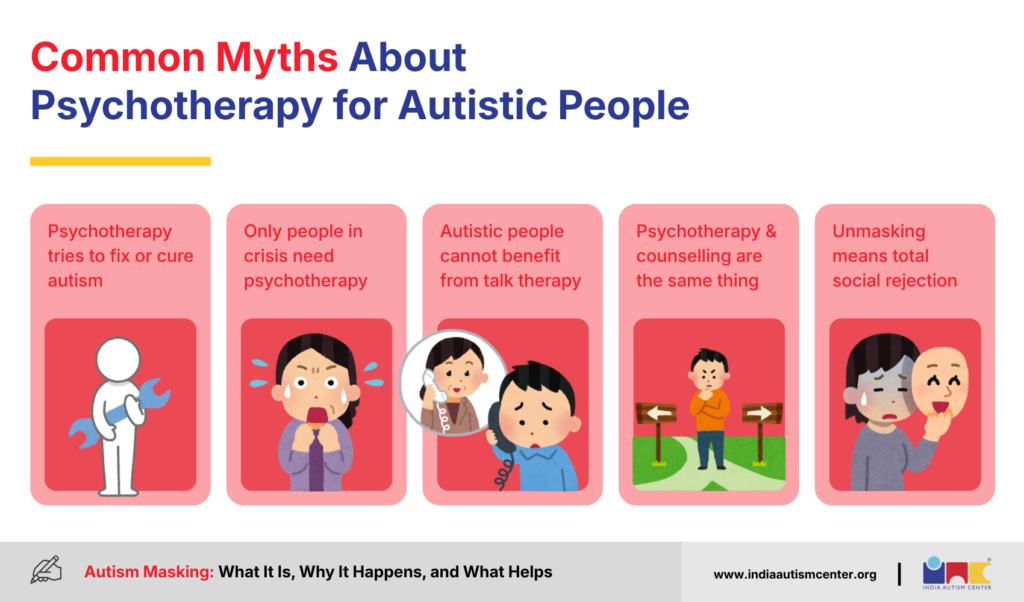
Common Myths About Psychotherapy for Autistic People
Despite growing awareness, a number of persistent psychotherapy myths prevent autistic people from accessing the support they need. It is worth addressing the most common ones directly.
Myth: Psychotherapy tries to fix or cure autism.
Fact: This is perhaps the most damaging myth, and it reflects a real and legitimate fear rooted in the history of autism “interventions” — particularly Applied Behaviour Analysis (ABA) — that have caused genuine harm. Autism-affirming psychotherapy does not attempt to make someone less autistic. It works with the person’s neurology, not against it. The goal is wellbeing, not normalisation.
Myth: Only people in crisis need psychotherapy.
Fact: In reality, psychotherapy is just as valuable as a preventive and developmental resource. An autistic adult who is managing day-to-day but quietly exhausted by masking can benefit enormously from therapeutic support before reaching burnout — not only after. Understanding psychotherapy meaning as a space for growth, not just crisis management, opens up far wider access to its benefits.
Myth: Autistic people cannot benefit from talk therapy.
Fact: This myth likely stems from the misapplication of therapies designed for neurotypical people to autistic individuals without adaptation. Autistic-affirming therapy — delivered by a clinician who understands and respects neurodivergence — can be deeply effective. Research supports this, and the clinical evidence base for adapted CBT, ACT, and other approaches in autistic populations is growing steadily.
Myth: Psychotherapy and counselling are the same thing.
Fact: As discussed above, there are meaningful differences between counselling and psychotherapy in terms of depth, duration, and clinical focus. Neither is inherently superior — but knowing the difference allows people to seek the right kind of support for their specific needs.
Myth: Unmasking means total social rejection.
Fact: Many autistic people fear that if they stop masking, they will lose all their relationships, their jobs, and their place in the world. This fear is understandable — and not entirely unfounded, given how much neurotypical social norms dominate most workplaces and communities. But unmasking is not an all-or-nothing event. Good psychotherapy supports clients in making nuanced, context-sensitive choices about when and where to lower the mask, rather than demanding wholesale transformation overnight.
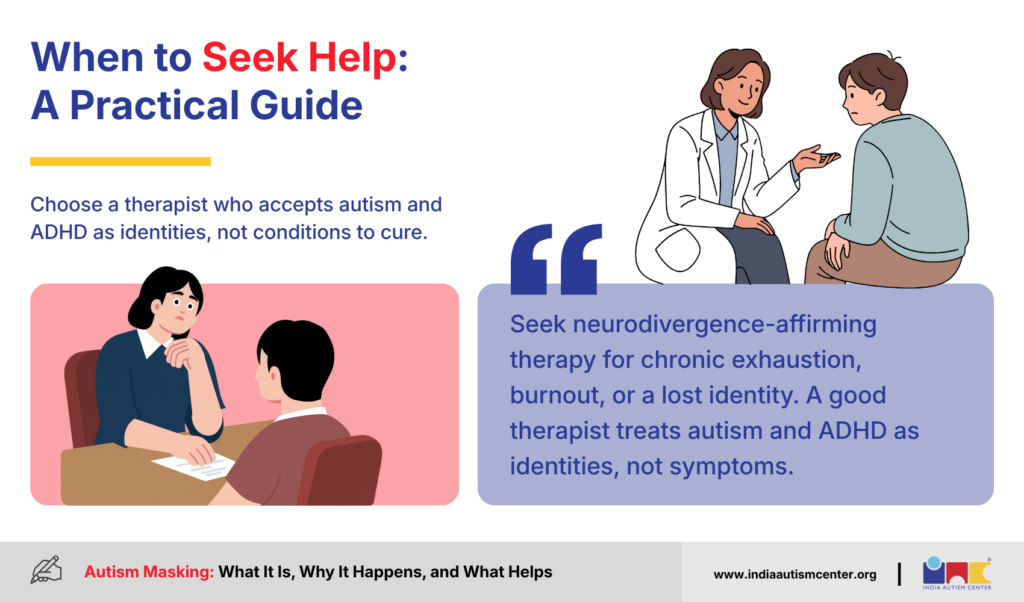
When to Seek Help: A Practical Guide
If any of the following resonate, it may be time to explore psychotherapy with an autism-affirming therapist:
You are frequently exhausted after social situations in ways that others do not seem to be
You struggle to identify your own preferences, feelings, or opinions independently of what others seem to want
You have recently received an autism (or ADHD) diagnosis and are trying to make sense of your history
You are experiencing anxiety, depression, or burnout that has not responded to other forms of support
You feel like there is a “real you” somewhere underneath the version of yourself you show the world — and you want to find them
When looking for a therapist, seek out someone who explicitly describes their practice as neurodivergence-affirming or autism-friendly. Ask whether they have experience working with autistic adults. Ask how they approach diagnosis — a good therapist will see your autism as a dimension of identity to be understood and respected, not a collection of symptoms to be eliminated.
If you also have ADHD, or suspect you might, look for a therapist with experience in psychotherapy for ADHD alongside autism. The overlap between the two conditions is significant, and therapeutic support that understands both is more effective than support designed for only one.
In a first session, expect to do a lot of talking about your history. A good therapist will take time to understand your experience before moving into any particular therapeutic framework.
https://youtu.be/anAtvNRwhWQ?si=ST9vzeaPqhLY4CG9
Conclusion
Autism masking is not a personal failing, a deliberate deception, or a sign that someone is “doing well.” It is an exhausting, often invisible survival strategy that has allowed countless autistic people to navigate a world not designed for them — at significant cost to their mental health, identity, and sense of self.
The path toward unmasking is not a quick or simple one. But it is possible, and it is worth it. Psychotherapy — the right kind, delivered by clinicians who understand and affirm neurodivergence — offers autistic people a genuine chance to explore who they are beneath the mask, to grieve what masking has cost them, and to build lives that feel genuinely their own.
If you recognise yourself in these pages, you deserve support. You deserve a space where you do not have to perform. And you deserve to find out who you actually are.
Autism masking is the process by which autistic people suppress or hide their natural neurological traits — such as stimming, direct communication, or sensory reactions — in order to appear more neurotypical in social situations. It is a survival strategy that develops in response to social pressure and is associated with significant mental health costs when sustained over time.
What does psychotherapy mean?
Psychotherapy refers to a structured, evidence-based form of therapeutic support delivered by a trained mental health professional, aimed at helping individuals understand and change thought patterns, emotions, and behaviours that are causing distress. Unlike counselling, which tends to be shorter-term and more solution-focused, psychotherapy often involves deeper exploration of underlying patterns and a longer therapeutic relationship.
What does psychotherapy mean?
Psychotherapy refers to a structured, evidence-based form of therapeutic support delivered by a trained mental health professional, aimed at helping individuals understand and change thought patterns, emotions, and behaviours that are causing distress. Unlike counselling, which tends to be shorter-term and more solution-focused, psychotherapy often involves deeper exploration of underlying patterns and a longer therapeutic relationship.
What is the difference between counselling and psychotherapy?
Counselling typically focuses on present-life difficulties and offers shorter-term, supportive conversation. Psychotherapy goes deeper — exploring the roots of long-standing patterns, working with identity and past experiences, and requiring a more extensive clinical training on the part of the practitioner. For autistic adults dealing with the aftermath of years of masking, psychotherapy’s greater depth is often more appropriate.
Can psychotherapy help with autism masking?
Yes. Autism-affirming psychotherapy — particularly approaches like ACT, adapted CBT, and schema therapy — can be profoundly helpful for autistic adults working through the effects of masking. It provides a safe space to develop self-awareness, process grief, rebuild identity, and develop practical strategies for more authentic living.
What types of psychotherapy are best for autistic adults?
The most commonly recommended types of psychotherapy for autistic adults include adapted CBT (for anxiety and self-critical thinking), ACT (for values-based living and psychological flexibility), schema therapy (for deep-rooted patterns from childhood), person-centred therapy (for identity work and unconditional acceptance), and DBT (for emotional regulation and distress tolerance, particularly relevant where ADHD co-occurs).
Is psychotherapy for anxiety relevant if I mask?
Absolutely. Anxiety and masking are closely linked — masking often develops as a response to social anxiety, and in turn generates further anxiety through the effort it requires and the inauthenticity it perpetuates. Psychotherapy for anxiety that is autism-aware will address both the anxiety symptoms and the masking behaviours that feed them.
Are there psychotherapy myths that stop autistic people from seeking help?
Yes — some of the most common psychotherapy myths affecting autistic people include the belief that therapy tries to “fix” autism, that autistic people cannot benefit from talk therapy, or that psychotherapy and counselling are the same thing. These myths can be barriers to accessing genuinely helpful support.
For expert insights, support services, and inclusive learning initiatives, contact India Autism Center for more information.
Autism therapies are structured, evidence-based interventions designed to support individuals on the autism spectrum in developing communication, social, behavioural, sensory and daily living skills. No single therapy works for everyone; rather, a personalised combination of approaches tends to produce the most meaningful outcomes.
Autism therapies form the cornerstone of support for individuals diagnosed with Autism Spectrum Disorder (ASD). Whether a child is newly diagnosed or an adult has been living with autism for decades, the right therapy — or combination of therapies — can significantly improve quality of life, independence, and the ability to connect with others.
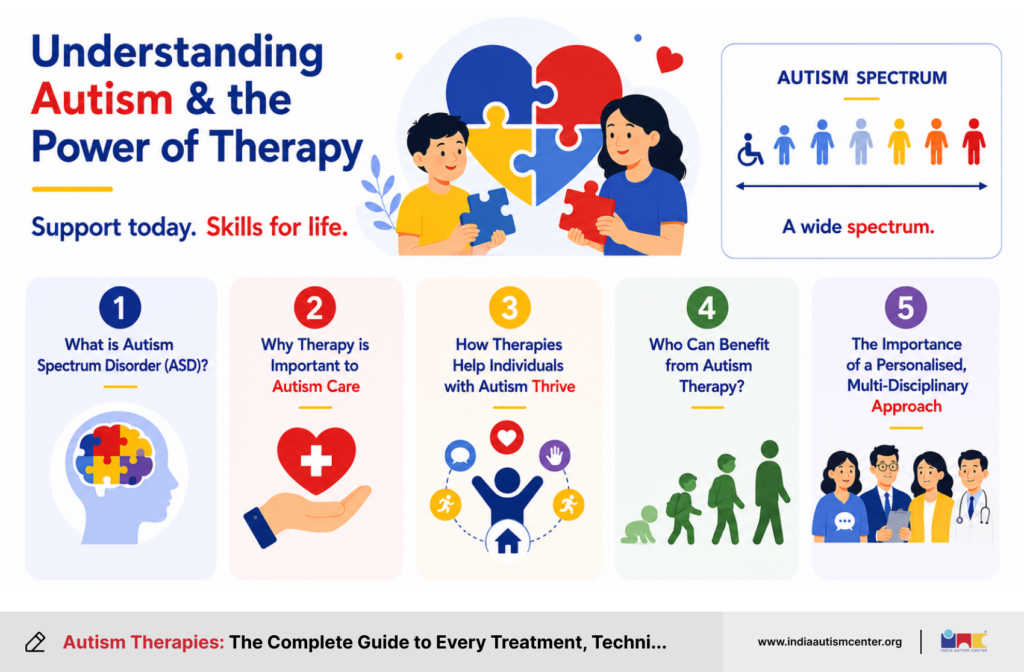
What is Autism Spectrum Disorder (ASD)?
Autism Spectrum Disorder is a neurodevelopmental condition that affects how a person communicates, interacts socially, processes sensory information, and regulates behaviour and emotion. The word “spectrum” is key: autism presents differently in every individual, ranging from those who are non-verbal and require significant support to those who are highly verbal and largely independent but struggle with social nuance or sensory sensitivities. Because of this wide spectrum, autism therapies must be equally diverse and adaptable.
Why Therapy is Important to Autism Care
Unlike many medical conditions, autism does not have a pharmaceutical cure. Instead, therapy is the primary tool used to help individuals develop skills they find challenging and manage difficulties that affect their daily lives. Therapy does not aim to “fix” or change a person’s fundamental identity. Rather, it equips individuals with strategies, skills and tools so that they can navigate the world more comfortably and communicate their needs more effectively.
How Therapies Help Individuals with Autism Thrive
Autism therapies address a broad range of areas, including language and communication, emotional regulation, sensory processing, motor skills, social interaction, and adaptive daily living skills. When delivered consistently and tailored to the individual’s profile, therapies can lead to measurable improvements in functioning, confidence, and overall well-being. Over time, therapeutic gains often extend beyond the clinic — into the home, school, and community.
Who Can Benefit from Autism Therapy?
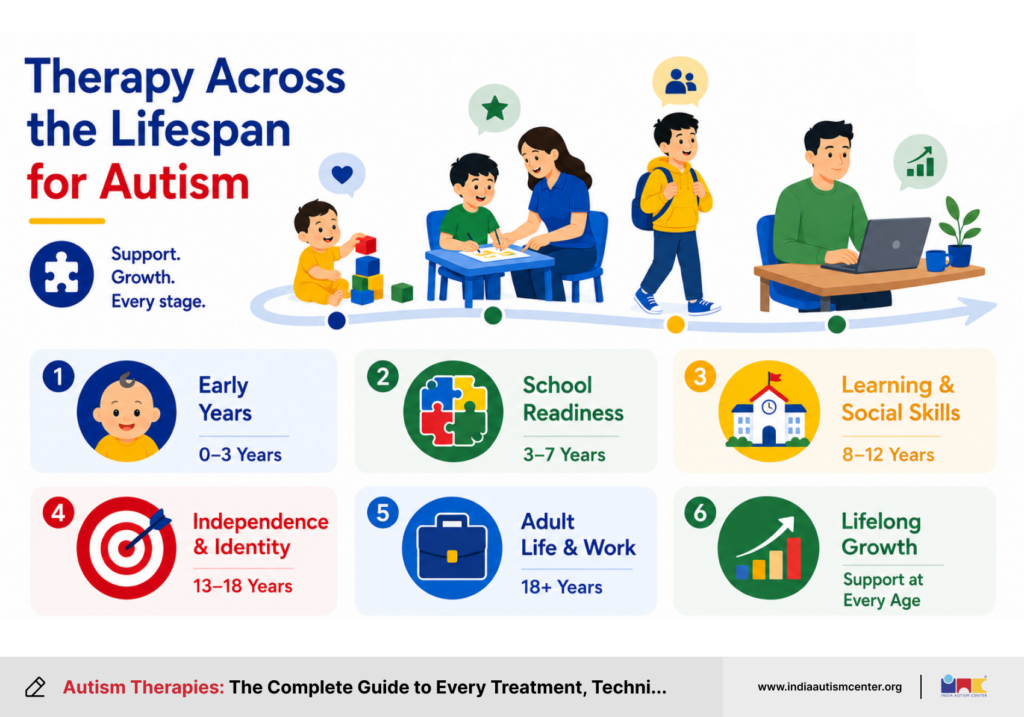
Autism therapies benefit individuals across all age groups and ability levels. Young children benefit enormously from early intervention programmes that target foundational communication and social skills during the most developmentally receptive years of the brain. School-age children benefit from therapies that support academic participation, peer relationships and self-regulation. Adolescents and adults benefit from therapies focused on independence, vocational skills, emotional wellbeing, and community integration. In short, there is no age at which therapy becomes irrelevant.
The Importance of a Personalised, Multi-Disciplinary Approach
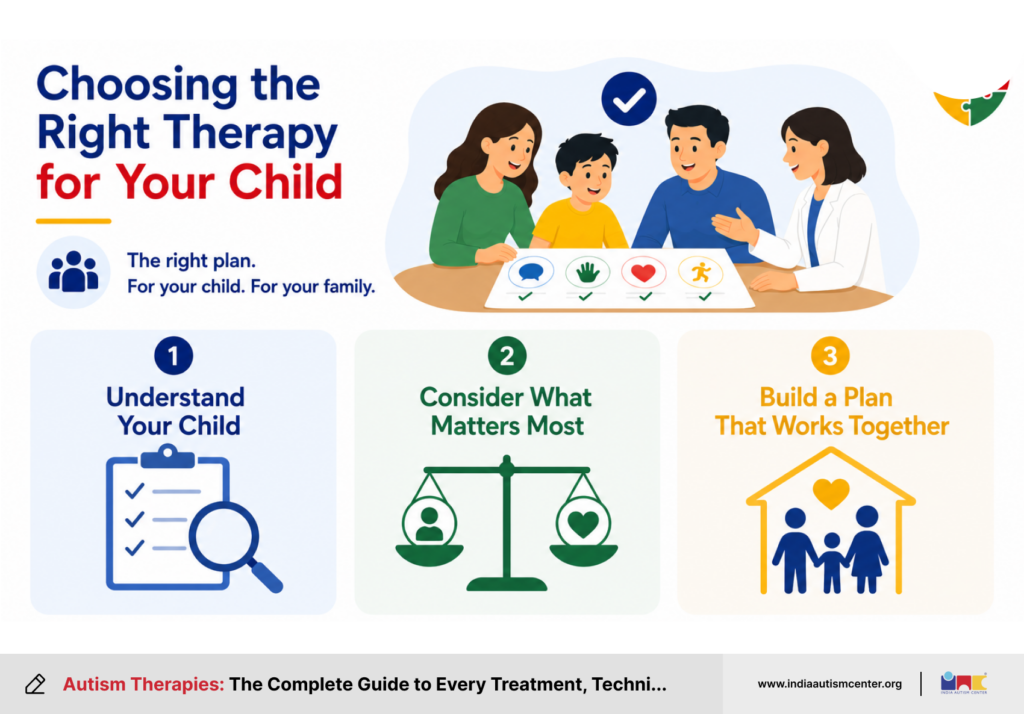
No two individuals with autism are alike, and therefore no single therapy suits everyone. The most effective approach is one that is tailored to the individual’s unique profile — their strengths, challenges, learning style, sensory needs, and family context. A multi-disciplinary team, which may include a speech-language therapist, occupational therapist, behaviour analyst, psychologist, and paediatrician, works collaboratively to design and review an integrated therapy plan. This coordinated approach ensures that all areas of development are addressed in a cohesive and complementary manner.
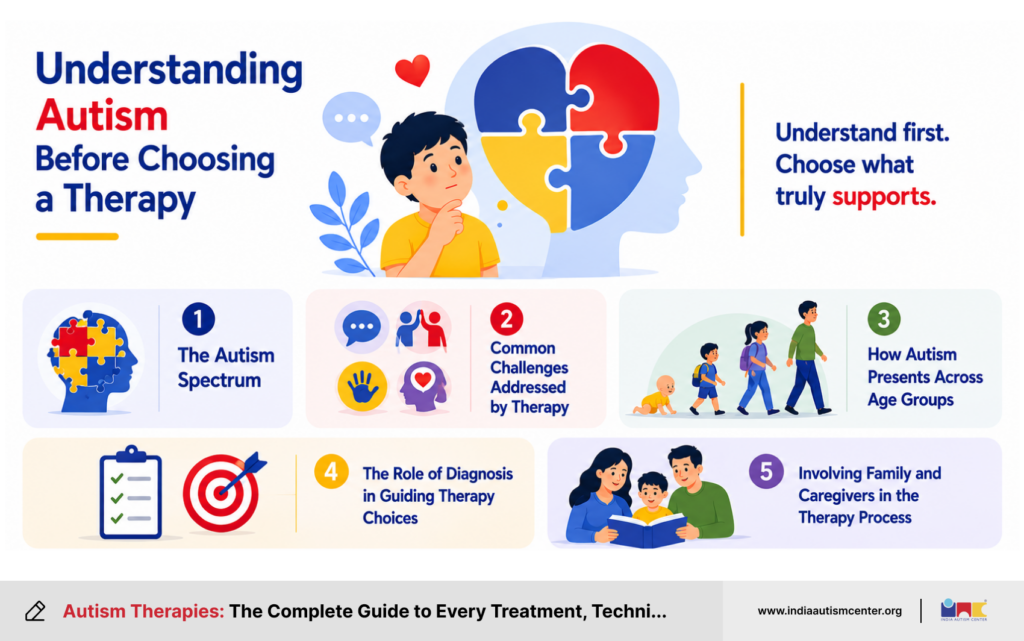
Understanding Autism Before Choosing a Therapy
Before selecting an autism therapy, it is essential to understand how autism presents in the individual. Autism affects communication, social interaction, sensory processing, behaviour and motor skills — but the degree and combination of these challenges varies widely. A thorough diagnostic assessment helps identify which areas need the most support and which therapies are best matched to the individual’s profile.
Selecting the right autism therapy is not a one-size-fits-all process. Understanding the specific ways in which autism affects the individual is the necessary first step. This section outlines the core areas that autism therapies are designed to address and the importance of working from a well-informed foundation.
The Autism Spectrum: What It Means and Why It Matters for Treatment
The term “spectrum” reflects the enormous variability in how autism presents. Some individuals experience profound challenges across communication, behaviour and sensory processing, while others display highly specific difficulties, such as social anxiety, sensory sensitivity or rigid thinking patterns. Treatment must be matched to the individual’s actual profile — not to a generalised idea of what autism looks like. This is why a detailed diagnostic assessment, conducted by a qualified professional, is always the starting point.
Common Challenges Addressed by Therapy
Communication and Language Deficits: Many individuals with autism experience difficulties with both verbal and non-verbal communication. Some are non-verbal or minimally verbal, relying on gesture, pictures or communication devices. Others speak fluently but struggle with pragmatic language — the social rules of conversation, such as turn-taking, topic maintenance, or understanding sarcasm. Speech and language therapy specifically targets these areas.
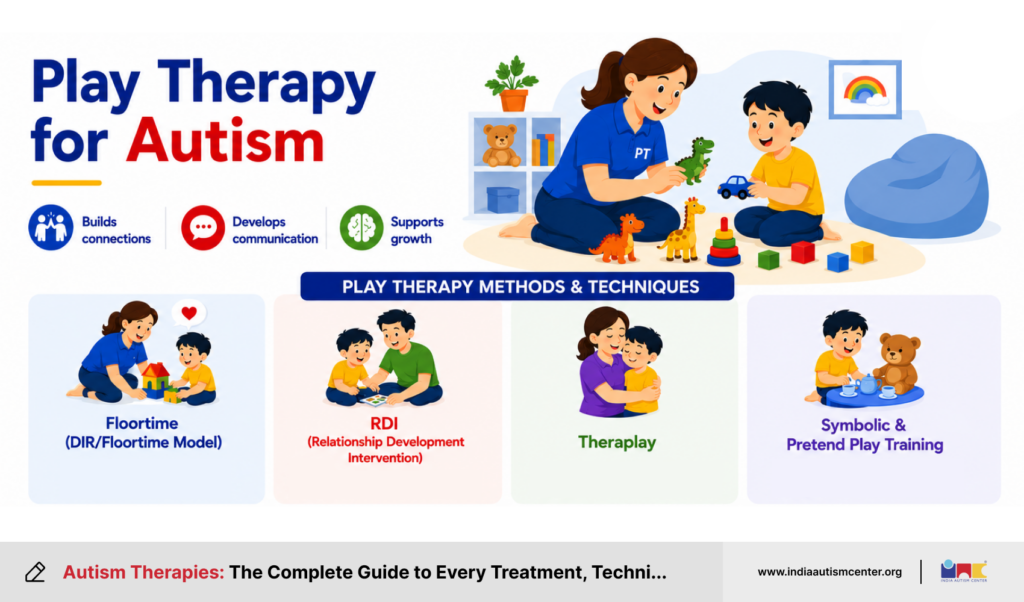
Social Skills and Interaction: Difficulties with social interaction are a defining characteristic of autism. Individuals may find it hard to initiate conversations, read facial expressions, understand unspoken social rules, or make and maintain friendships. Therapies such as social skills groups, play therapy and Applied Behavior Analysis (ABA) target these challenges directly.
Sensory Processing Differences: Many individuals with autism are hypersensitive (over-responsive) or hyposensitive (under-responsive) to sensory input — including touch, sound, light, taste, smell and movement. These sensory differences can make everyday environments overwhelming or disorienting. Sensory integration therapy and occupational therapy address these needs directly.
Behavioural and Emotional Regulation: Challenging behaviours — such as meltdowns, self-injurious behaviour, aggression or extreme rigidity — are often the result of unmet communication needs, sensory overload, anxiety, or an inability to regulate overwhelming emotions. ABA, Cognitive Behavioral Therapy (CBT) and sensory therapies all contribute to improving emotional and behavioural regulation.
Motor and Coordination Issues: Many individuals with autism also experience motor difficulties, including poor fine motor control (affecting writing and self-care), gross motor challenges (affecting balance, gait, and coordination), and low muscle tone. Occupational therapy and physical therapy address these motor needs.
Cognitive and Learning Differences: Autism is often accompanied by differences in learning style, attention, executive functioning, and memory. Some individuals have exceptional abilities in specific areas, while others have co-occurring intellectual disabilities. Therapies that incorporate visual supports, structured routines and step-by-step instruction help bridge cognitive differences.
How Autism Presents Differently Across Age Groups
Autism looks different at different life stages. In infancy and toddlerhood, early signs may include a lack of eye contact, delayed babbling, or reduced response to one’s name. In school-age children, difficulties with peer relationships, rigid adherence to routines, and sensory sensitivities often become more prominent. In adolescence, social complexity increases and mental health challenges such as anxiety and depression frequently emerge. In adulthood, challenges around independent living, employment and relationships come to the fore. Therapy must be responsive to these changing developmental demands.
A formal diagnosis of autism, made by a qualified clinical team, provides the foundation for all subsequent therapy decisions. The diagnostic process typically includes detailed developmental history, standardised assessments, direct observation, and input from parents and educators. The results identify not only that autism is present, but also the individual’s cognitive level, language profile, adaptive functioning and co-occurring conditions — all of which directly inform which therapies should be prioritised.
Involving Family and Caregivers in the Therapy Process
Family involvement is one of the strongest predictors of positive therapy outcomes. Parents and caregivers who understand the principles behind therapy are far better equipped to reinforce skills at home, respond to challenging behaviours effectively, and advocate for their child’s needs in educational and community settings. Most evidence-based autism therapies actively involve family training as a core component of the intervention.
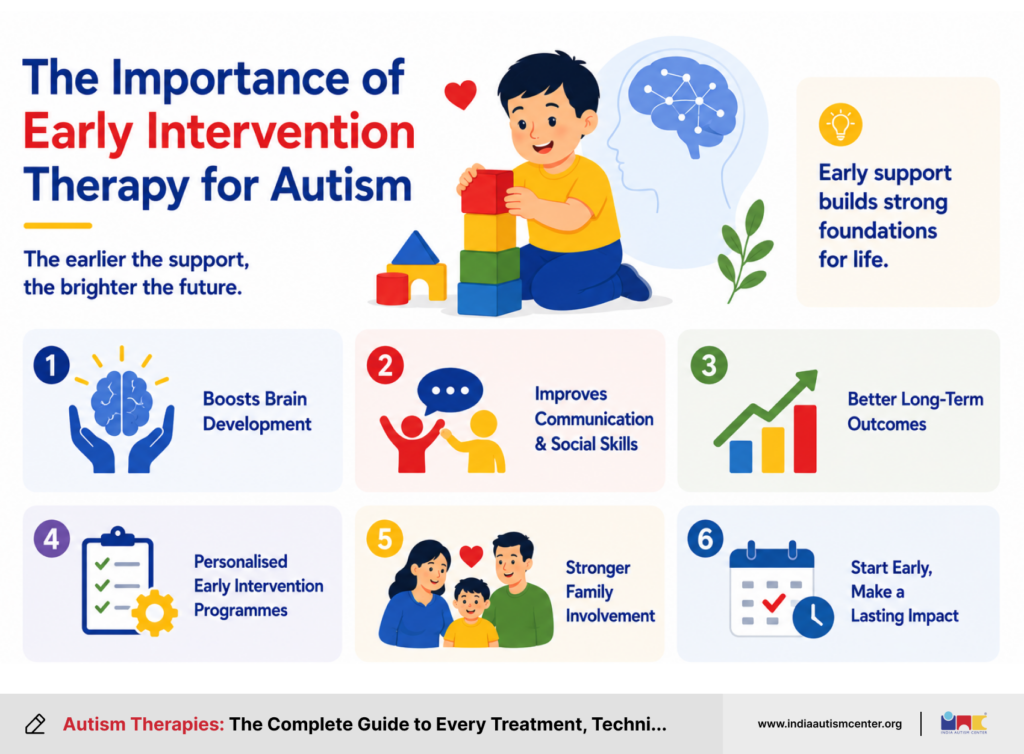
The Importance of Early Intervention Therapy for Autism
Early intervention for autism refers to structured therapeutic support provided to children, ideally before the age of five, during the most critical window of brain development. Research consistently shows that children who receive intensive, targeted therapy in the early years achieve significantly better outcomes in communication, social skills, and adaptive behaviour than those who begin later.
What is Early Intervention?
Early intervention refers to a range of therapeutic programmes and support services delivered to young children — typically between birth and five years of age — who show signs of developmental delay or have received a confirmed autism diagnosis. The goal is to target developmental challenges during the period when the brain is most adaptable, responsive and capable of forming new neural pathways. Early intervention for autism typically encompasses ABA, speech and language therapy, occupational therapy and developmental play-based approaches.
The Science Behind Early Brain Plasticity
The concept underpinning early intervention is neuroplasticity — the brain’s remarkable ability to reorganise and form new connections in response to experience and learning. This capacity is at its peak in the early years of life. During this window, the brain is uniquely receptive to learning new skills, forming communication pathways, and developing social understanding. Neuroscience research confirms that the earlier a therapeutic intervention begins, the greater the potential for reshaping developmental trajectories and establishing foundational skills.
When Should Therapy Begin?
Therapy can and should begin as soon as concerns about development are identified — even before a formal diagnosis is confirmed. In many countries, children can access early intervention services based on developmental delay alone, without waiting for a definitive autism diagnosis. The general consensus among clinicians and researchers is that the most significant improvements are seen when intervention begins before the age of three. However, it is equally important to note that meaningful progress is possible at any age and that it is never “too late” to begin therapy.
Types of Early Intervention Programmes
Several structured early intervention programmes have been developed specifically for young children with autism. The Early Start Denver Model (ESDM) integrates ABA principles with developmental and relationship-based strategies in a play-based format. The LEAP (Learning Experiences and Alternative Programme for Preschoolers) model emphasises inclusive peer interactions. Hanen’s “More Than Words” programme equips parents with the skills to support their child’s communication development at home. Each of these approaches shares a common emphasis on communication, social engagement, and learning through positive interaction.
Outcomes and Long-Term Benefits of Starting Early
Children who receive intensive early intervention therapy for autism frequently demonstrate improvements across multiple domains: greater gains in language development, improved social communication, higher adaptive behaviour scores, reduced severity of autism symptoms, and improved cognitive functioning. Many children who receive high-quality early intervention are subsequently able to participate in mainstream education with fewer additional supports. Over the long term, early gains in communication and social skills also contribute to better mental health outcomes in adolescence and adulthood.
Key early signs that may warrant a therapy referral include: not babbling or pointing by 12 months, not using single words by 16 months, not using two-word phrases by 24 months, a loss of previously acquired language or social skills, limited or absent eye contact, lack of response to their name, and very limited pretend play. If any of these signs are present, a referral to a developmental paediatrician, speech-language therapist or early intervention service should be sought without delay.
How to Get an Early Intervention Assessment
Parents who are concerned about their child’s development should begin by speaking to their GP or paediatrician. In many countries, early intervention assessments are available through public health services, developmental paediatric clinics, or specialist autism assessment centres. The assessment typically involves a multi-disciplinary team and results in a profile of the child’s strengths and needs, alongside a tailored early intervention plan. Private assessment pathways are also available for families who wish to access services more quickly.
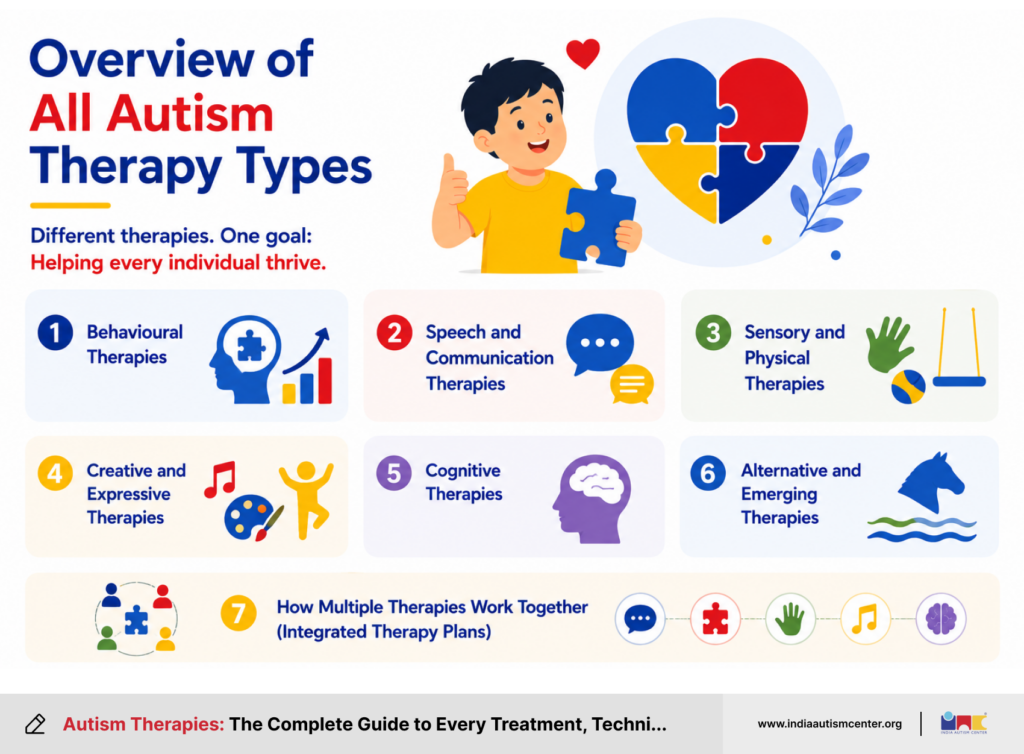
Autism therapies can be grouped into five broad categories: behavioural therapies (such as ABA), communication therapies (such as speech and language therapy), sensory and physical therapies (such as occupational therapy and sensory integration therapy), creative and expressive therapies (such as music, dance and art therapy), and cognitive therapies (such as CBT). Most individuals benefit from a combination of therapies drawn from more than one of these categories.
Understanding the landscape of autism therapies before exploring each one in depth helps families and individuals approach decision-making with clarity and confidence. The following overview introduces each category and explains why an integrated approach is generally considered the gold standard.
Behavioural Therapies
Behavioural therapies focus on understanding and modifying behaviour by systematically applying learning principles. Applied Behaviour Analysis (ABA) is the most widely researched and implemented behavioural therapy for autism. These therapies analyse the relationship between the environment and behaviour, then use structured strategies to increase helpful behaviours and reduce those that interfere with learning or safety.
Speech and Communication Therapies
Speech and language therapy addresses the full range of communication challenges associated with autism — from pre-verbal communication and early language development to complex pragmatic and social communication skills. This category also includes the use of Augmentative and Alternative Communication (AAC) systems for non-verbal or minimally verbal individuals.
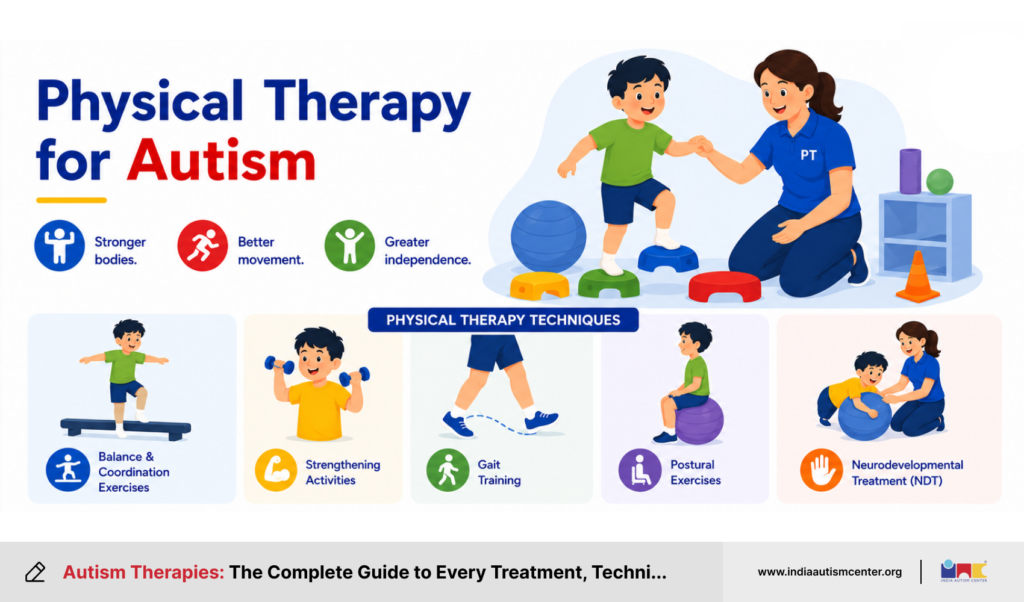
Sensory and physical therapies address how the body receives, processes and responds to sensory information, as well as motor and physical functioning. Occupational therapy, sensory integration therapy, and physical therapy all fall within this category. These therapies play a critical role in supporting daily living skills, sensory regulation and physical development.
Creative and Expressive Therapies
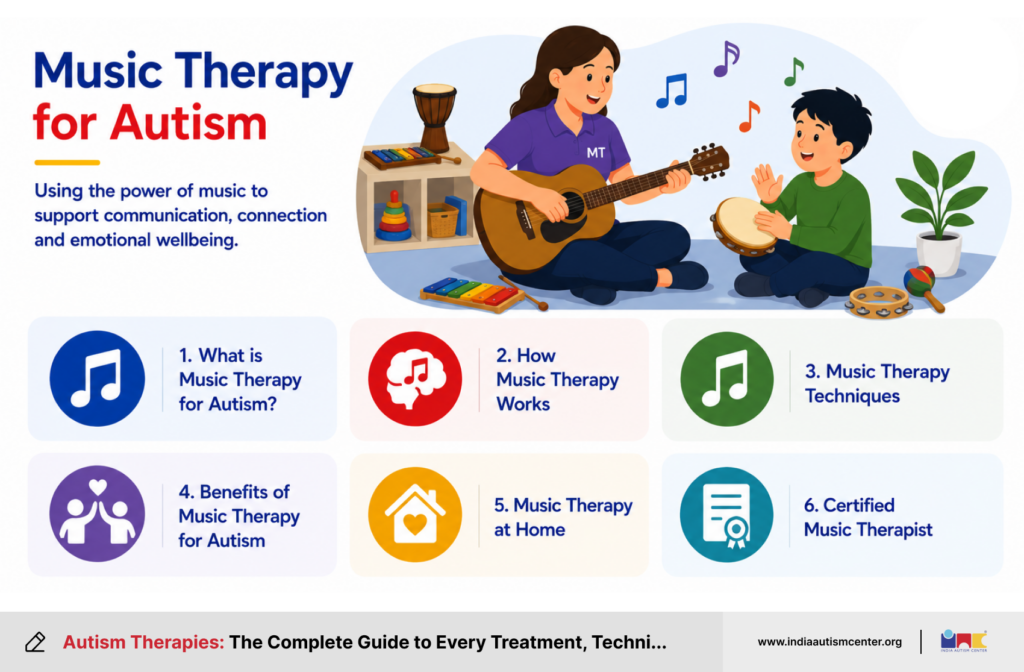
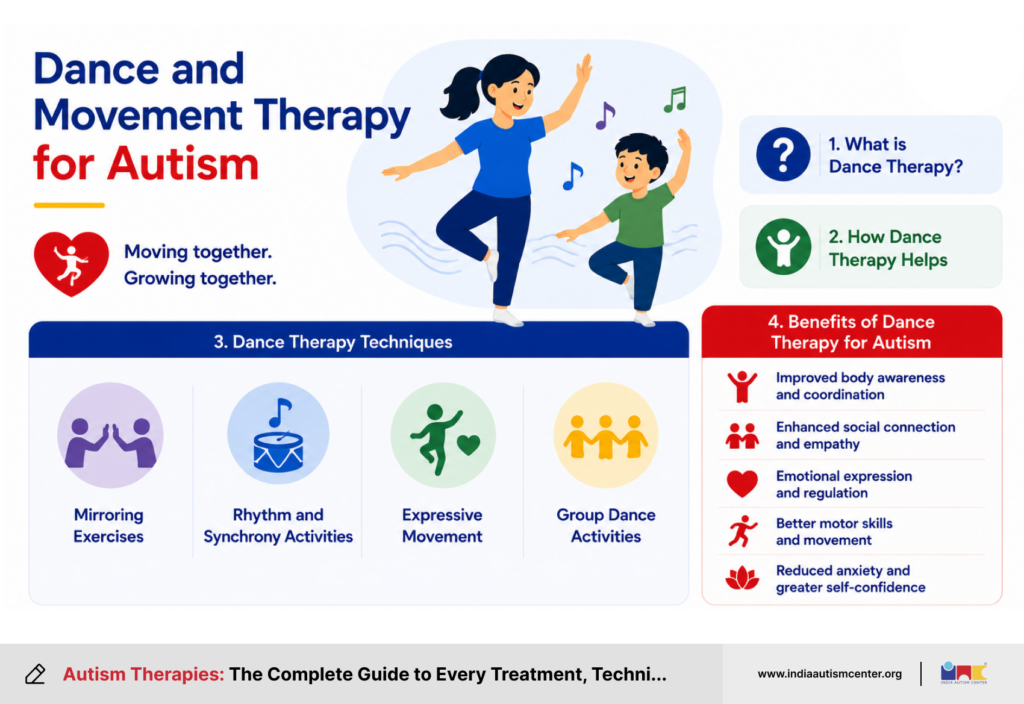
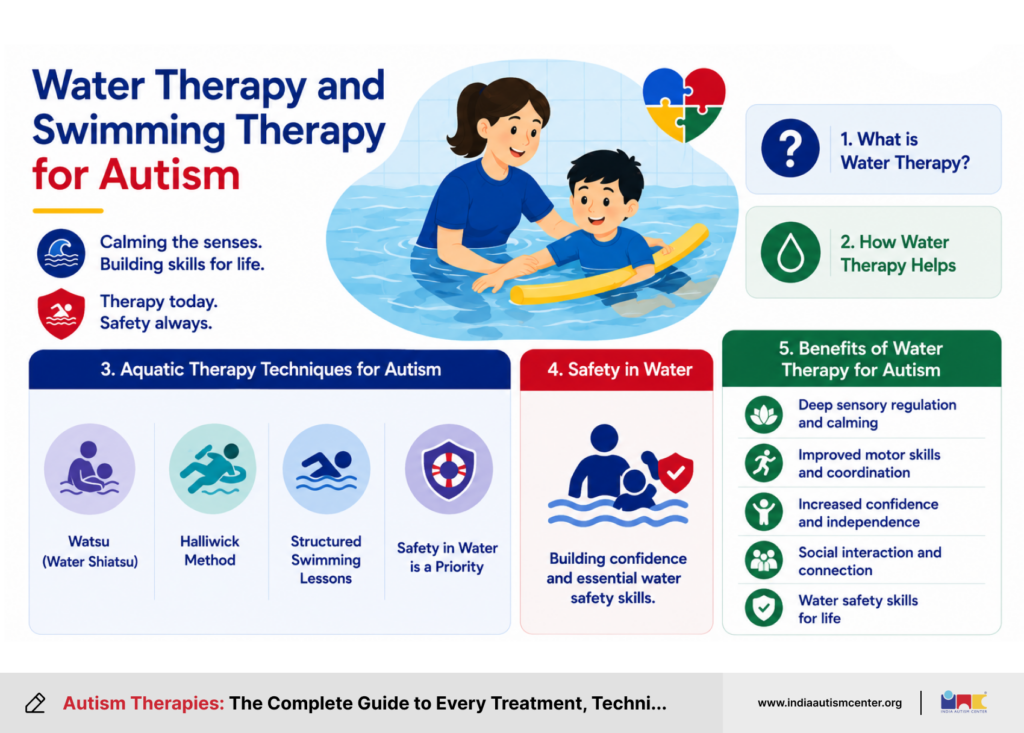
Creative therapies harness the power of non-verbal, expressive modalities — music, movement, art, drama and water — to reach individuals with autism in ways that traditional talk-based therapies may not. These approaches are particularly valuable for individuals who find verbal communication challenging and for those who respond strongly to sensory-based or creative experiences.
Cognitive Therapies
Cognitive therapies, most notably Cognitive Behavioural Therapy (CBT), target the relationship between thoughts, feelings and behaviours. These therapies are typically most suitable for individuals who are higher-functioning and have sufficient verbal and cognitive skills to engage with structured self-reflection and problem-solving.
Alternative and Emerging Therapies
In addition to the well-established approaches above, a number of alternative and emerging therapies are used in autism care. These include aquatic therapy, equine-assisted therapy, and neurofeedback. While the evidence base for some of these approaches is still developing, many families report meaningful benefits and they may serve as valuable complements to core therapies.
How Multiple Therapies Work Together (Integrated Therapy Plans)
The most effective autism therapy programmes draw on multiple approaches simultaneously, with all therapists working towards a shared set of goals. For example, a child’s speech therapy goals around requesting may be reinforced within ABA sessions; sensory strategies from occupational therapy may be embedded into the home environment; and music therapy may provide a motivating context for practising turn-taking and communication. An integrated therapy plan, coordinated by the family and the multi-disciplinary team, ensures coherence, avoids contradiction, and maximises the transfer of skills across settings.
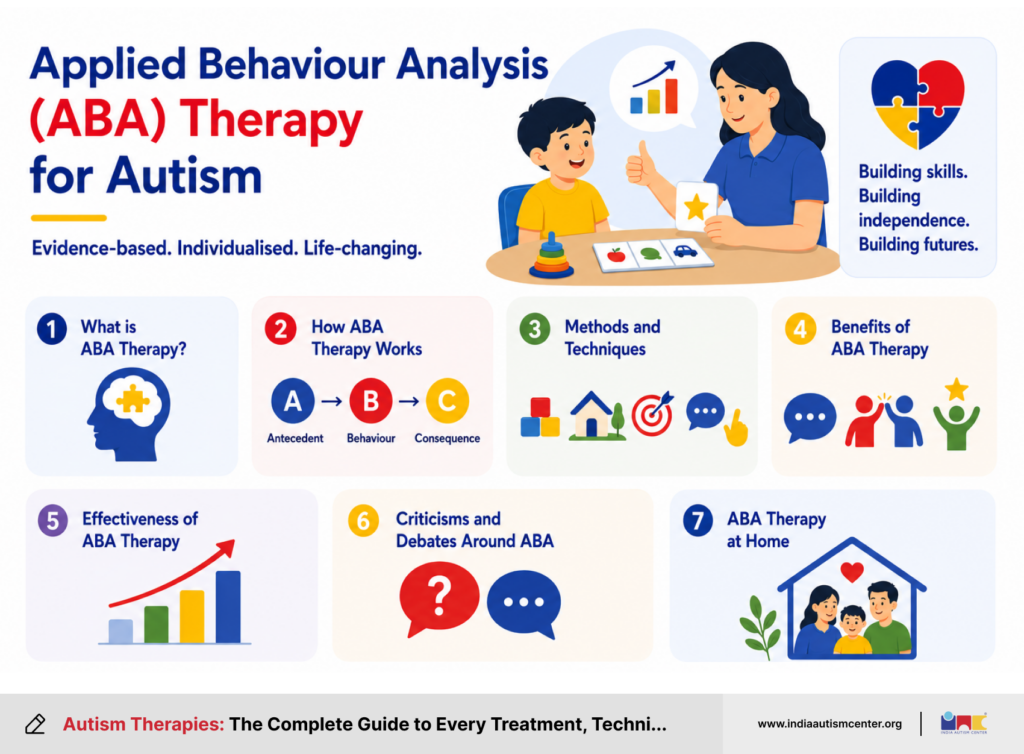
Applied Behaviour Analysis (ABA) Therapy for Autism
ABA therapy for autism is a structured, evidence-based intervention that applies the science of behaviour and learning to increase useful skills and reduce harmful or disruptive behaviours. It is widely considered the most extensively researched autism therapy available and is recommended by numerous clinical and governmental bodies worldwide.
What is ABA Therapy for Autism?
Applied Behaviour Analysis (ABA) is a therapy grounded in the scientific study of behaviour and learning. It operates on the principle that behaviour is learned and influenced by the environment. By systematically modifying environmental factors and using positive reinforcement, ABA therapy helps individuals with autism learn new skills, build on existing strengths, and reduce behaviours that interfere with learning or daily functioning. ABA is not a single technique; rather, it is a framework from which a range of specific interventions are derived.
How ABA Therapy Works
The A-B-C Model (Antecedent, Behaviour, Consequence): At the heart of ABA is the A-B-C framework. The Antecedent is the event or situation that occurs immediately before a behaviour. The Behaviour is the response that follows. The Consequence is what happens immediately after the behaviour. By carefully analysing this chain of events, therapists identify patterns and design precise interventions to encourage desired behaviours and discourage problematic ones.
Positive Reinforcement Strategies: ABA relies heavily on positive reinforcement — the delivery of a rewarding consequence immediately following a desired behaviour — to increase the likelihood that the behaviour will occur again. Reinforcers are highly individualised and may include verbal praise, access to preferred toys, social attention, food, or any other item or experience that the individual finds motivating. The power of ABA lies in identifying what truly motivates each individual and using that strategically to drive learning.
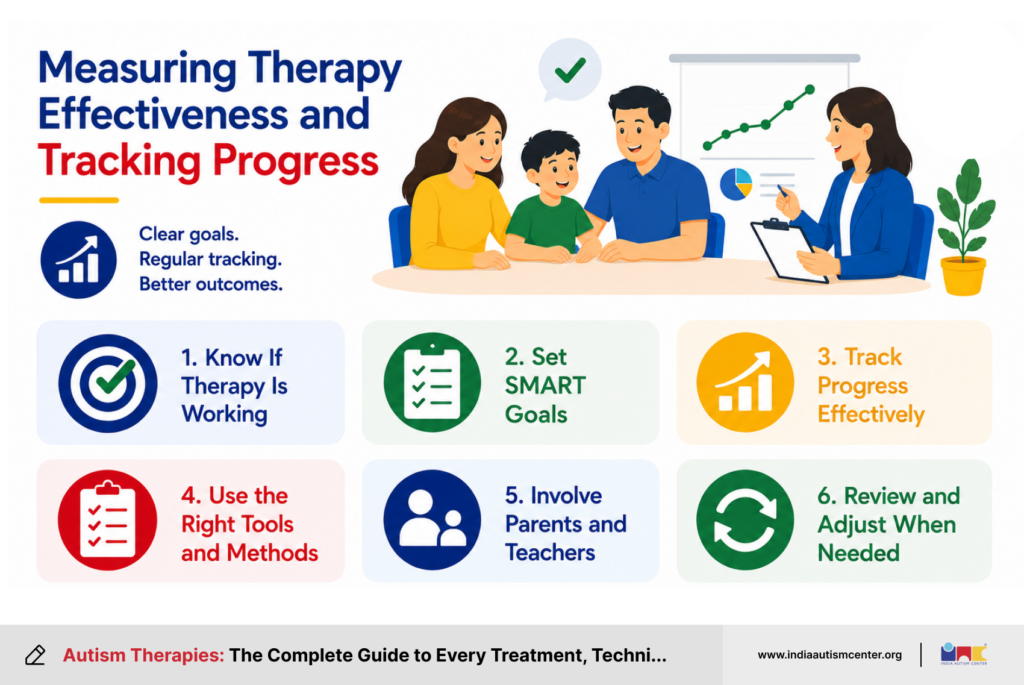
Data Collection and Progress Tracking: One of the hallmarks of ABA is its rigorous, ongoing data collection. Therapists record performance on every skill target during every session. This data is then analysed regularly to determine whether the individual is progressing, plateauing, or regressing. Data-driven decision-making ensures that the therapy plan is always based on objective evidence rather than subjective impression.
Methods and Techniques in ABA Therapy
Discrete Trial Training (DTT): DTT is a highly structured teaching method in which skills are broken down into small, distinct components and taught one at a time through repeated practice. Each trial has a clear instruction, a prompted or independent response, and an immediate consequence. DTT is particularly effective for teaching foundational skills such as early language, imitation, and basic academic concepts.
Natural Environment Teaching (NET): NET involves teaching skills within the context of the individual’s natural environment and daily routines — such as during play, mealtimes, or outdoor activities. This approach promotes the generalisation of skills across different settings and people, making it a powerful complement to more structured teaching methods.
Pivotal Response Treatment (PRT): PRT targets “pivotal” areas of development — such as motivation, self-management, and social initiation — that are foundational to a wide range of other skills. By improving these pivotal behaviours, PRT produces broad improvements across multiple developmental domains simultaneously.
Verbal Behaviour Therapy: Drawing on Skinner’s analysis of language, Verbal Behaviour (VB) therapy categorises language into functional units — such as requesting (mands), labelling (tacts), and imitating (echoics) — and teaches each one systematically. This approach is particularly effective for building functional communication in early language learners.
Incidental Teaching: Incidental teaching capitalises on naturally occurring opportunities to teach skills during everyday activities. The therapist follows the child’s lead and embeds learning within motivating, child-initiated interactions, making the process feel less structured and more enjoyable for the learner.
Benefits of ABA Therapy for Autism
Improving Communication and Language: ABA therapy is highly effective in developing both verbal and non-verbal communication skills, particularly in young children who are early language learners. Through structured and naturalistic teaching, individuals learn to request, label, respond, and eventually converse.
Reducing Problem Behaviours: By understanding the function of challenging behaviours — such as avoiding demands, accessing attention, or seeking sensory stimulation — ABA therapists design targeted interventions that reduce these behaviours while simultaneously teaching more appropriate alternatives.
Building Social Skills: ABA incorporates specific social skills programmes that teach foundational skills such as joint attention, imitation, turn-taking, and peer interaction. These skills form the building blocks of meaningful relationships.
Increasing Independence: ABA targets daily living skills — such as dressing, toileting, mealtime routines, and community safety — equipping individuals with the practical skills they need to function as independently as possible.
Effectiveness of ABA Therapy
ABA therapy has the most extensive evidence base of any autism intervention. Numerous systematic reviews and randomised controlled trials have demonstrated significant improvements in language, adaptive behaviour, social skills, and cognitive functioning in individuals who receive intensive, high-quality ABA therapy. The US Surgeon General, the American Academy of Pediatrics, and the UK’s National Institute for Health and Care Excellence (NICE) all recognise ABA as an evidence-based treatment for autism.
Criticisms and Debates Around ABA: It is important to acknowledge that ABA is not without controversy. Some autistic advocates and self-advocates have raised concerns about historical ABA practices that focused heavily on eliminating autistic behaviours rather than addressing genuine wellbeing. Modern ABA has evolved significantly and now emphasises naturalised, strength-based and child-led approaches. Families are encouraged to seek practitioners who apply contemporary, humane and developmentally appropriate ABA principles.
ABA Therapy at Home
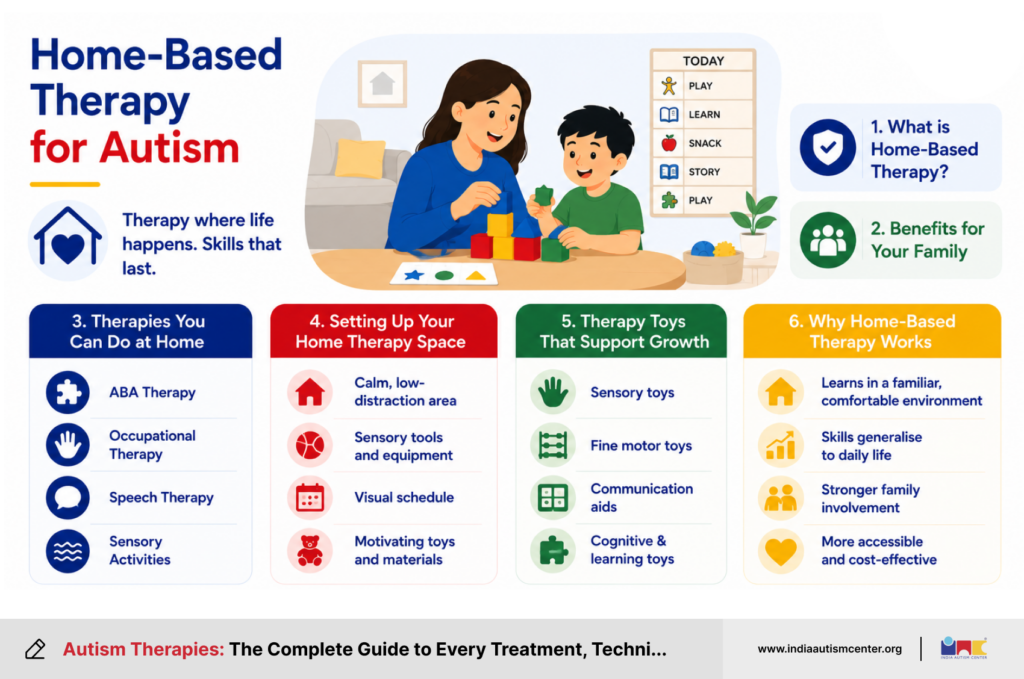
Many ABA principles can be incorporated into home routines by parents and caregivers who have received training from a BCBA. Home-based ABA allows for consistent reinforcement of skills in the natural environment, promotes generalisation, and reduces the burden of frequent clinic visits. A trained professional should always guide the design and oversight of a home ABA programme.
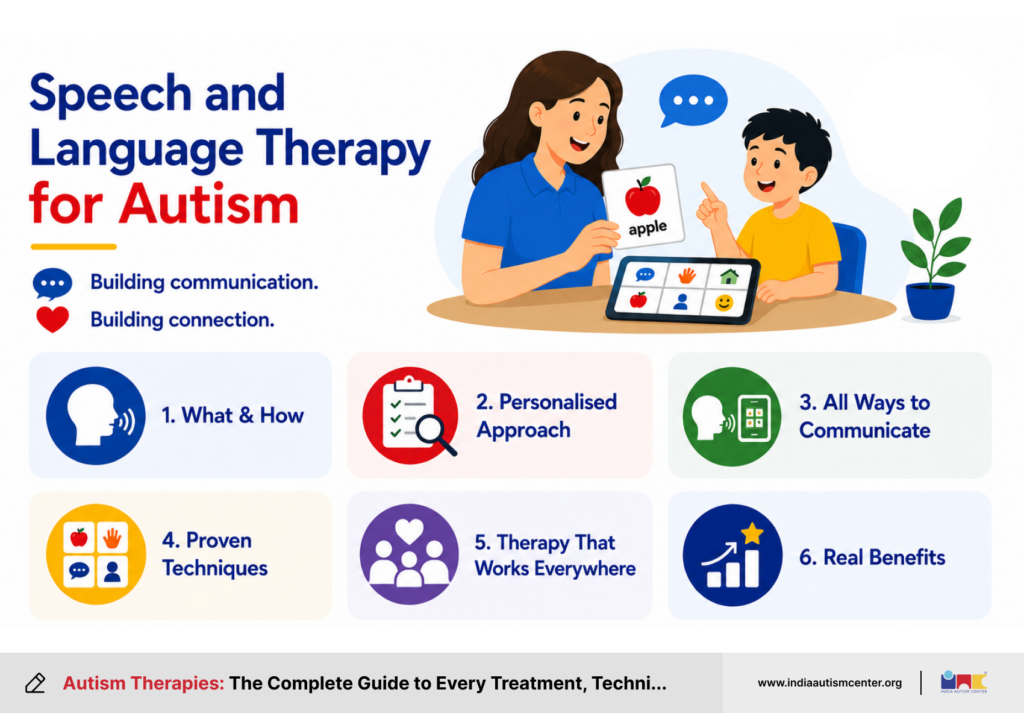
Speech and language therapy for autism is a specialised intervention that targets communication skills across all modalities — verbal, non-verbal and augmentative. Delivered by a qualified Speech-Language Pathologist (SLP) or Speech and Language Therapist (SaLT), it addresses not only how a person speaks, but how they understand and use language to connect with others. It is recommended for virtually all individuals on the autism spectrum.
What is Speech Therapy for Autism?
A common misconception is that speech therapy for autism is solely about helping children to speak. In reality, the scope of speech therapy is far broader. It encompasses understanding and using language (both spoken and non-spoken), pragmatic and social communication, voice and fluency, feeding and swallowing, and the use of alternative communication tools for those who cannot yet speak reliably. For many individuals with autism, the ultimate goal is not necessarily verbal speech but effective communication — however that is achieved.
How Speech Therapy Works for Autism
Speech therapy begins with a comprehensive communication assessment that evaluates the individual’s receptive language (understanding), expressive language (use), pragmatics (social communication), articulation, fluency, and voice. Standardised tools such as the CELF (Clinical Evaluation of Language Fundamentals) and ADOS (Autism Diagnostic Observation Schedule) communication subtests are frequently used. The assessment identifies not only weaknesses but also strengths and preferred communication modalities.
Verbal vs. Non-Verbal Communication Strategies
Not all individuals with autism will develop reliable spoken language, and that is a perfectly valid outcome. Speech therapy supports both verbal and non-verbal pathways to communication. For individuals who are non-verbal or minimally verbal, the focus may be on building functional communication through AAC systems, gesture, picture exchange, or digital communication devices. For verbal individuals, therapy may focus on conversational skills, understanding and using figurative language, or managing communication anxiety.
Speech Therapy Techniques for Autism
PECS (Picture Exchange Communication System): PECS is a structured programme that teaches individuals to communicate by exchanging pictures. It begins with the exchange of a single picture for a desired item and progressively builds towards sentence-level communication and commenting. PECS is evidence-based and particularly effective for young or minimally verbal children.
Augmentative and Alternative Communication (AAC) Devices: AAC encompasses any tool or strategy that supplements or replaces natural speech. This ranges from low-tech systems such as communication boards and PECS to high-tech Speech-Generating Devices (SGDs) and tablet-based apps. Research strongly supports the use of AAC for non-verbal individuals with autism and confirms that AAC does not prevent speech development — in fact, it often supports it.
Social Stories and Scripts: Social Stories, developed by Carol Gray, are short, personalised narratives that describe a social situation, skill, or concept from the individual’s perspective. They help individuals with autism understand what is expected in specific situations and how others might feel. Social scripts provide practised language for common interactions, reducing the cognitive demand of navigating social situations in real time.
Oral Motor Exercises: For individuals who have difficulties with the physical production of sounds due to oro-motor weaknesses, targeted exercises targeting the lips, tongue, jaw, and palate may be incorporated into therapy. These exercises support clearer articulation and can improve speech intelligibility.
Pragmatic Language Therapy: Pragmatic language refers to the social use of language — understanding and following conversational rules, interpreting implied meaning, adjusting language for different audiences, and recognising non-literal language such as humour, sarcasm, and idioms. Pragmatic language therapy teaches these skills explicitly, using structured activities, role-play, and video modelling.
Functional Communication Training (FCT): FCT teaches individuals to replace challenging behaviours — such as screaming, hitting, or throwing — with a more acceptable form of communication that serves the same function (e.g., requesting a break, seeking attention, or escaping a difficult task). FCT is typically implemented in close collaboration with the ABA team.
The Speech Therapy Process
Initial Evaluation: The therapy process begins with a detailed evaluation of the individual’s communication profile. This includes a parent or caregiver interview, direct assessment, observation in natural settings (where possible), and review of relevant reports from other professionals.
Setting Communication Goals: Based on the evaluation, the SaLT collaborates with the individual and their family to establish clear, functional and measurable communication goals. These goals are reviewed regularly and updated as progress is made.
One-on-One and Group Sessions: Speech therapy may be delivered in individual sessions, small group settings, or both. Individual sessions allow for intensive, targeted skill work, whilst group sessions provide a supported environment for practising communication skills with peers.
Home Practice Programmes: Because communication occurs throughout every waking moment, the generalisation of skills to the home and community is essential. Speech therapists typically provide home practice programmes that guide parents and caregivers in embedding communication targets into daily routines and play activities.
Benefits of Speech Therapy for Autism
Improved Verbal Communication: For individuals who have the potential for verbal speech, consistent speech therapy can accelerate language development, increase vocabulary, improve sentence structure, and build conversational competence.
Enhanced Non-Verbal Communication: Even for individuals who do not develop verbal speech, speech therapy builds rich non-verbal communication repertoires — including gesture, eye gaze, pointing, and the use of AAC — that allow meaningful communication to occur.
Better Social Interactions: By targeting pragmatic language and social communication skills, speech therapy helps individuals with autism navigate conversations, build relationships, and participate more fully in social life.
Reduced Frustration and Behavioural Issues: Many challenging behaviours in autism arise from the inability to communicate needs or feelings effectively. As communication improves, frustration decreases and challenging behaviours often reduce as a natural consequence.
Effectiveness of Speech Therapy
Speech therapy is one of the most consistently recommended and evidence-supported interventions for autism. Meta-analyses of intervention research confirm significant improvements in expressive and receptive language, social communication, and AAC use following targeted speech therapy. The combination of speech therapy with early intensive behavioural intervention (such as ABA) produces particularly strong outcomes for young children.
Finding Speech Therapy for Autism Near You
When seeking a speech therapist for autism, families should look for an SaLT with specific experience in autism spectrum disorders and AAC. Referrals can be obtained through GPs, paediatricians, schools, or autism diagnostic services. Waiting times in publicly funded services can be lengthy; private SaLT services offer shorter waiting periods for families who are able to access them. Teletherapy (online speech therapy) has also become widely available and is a viable and evidence-supported option, particularly for home-based practice.
https://youtu.be/YU2Qcp2A09M?si=QAs8eVX2OTvk_y2j
Occupational Therapy for Autism
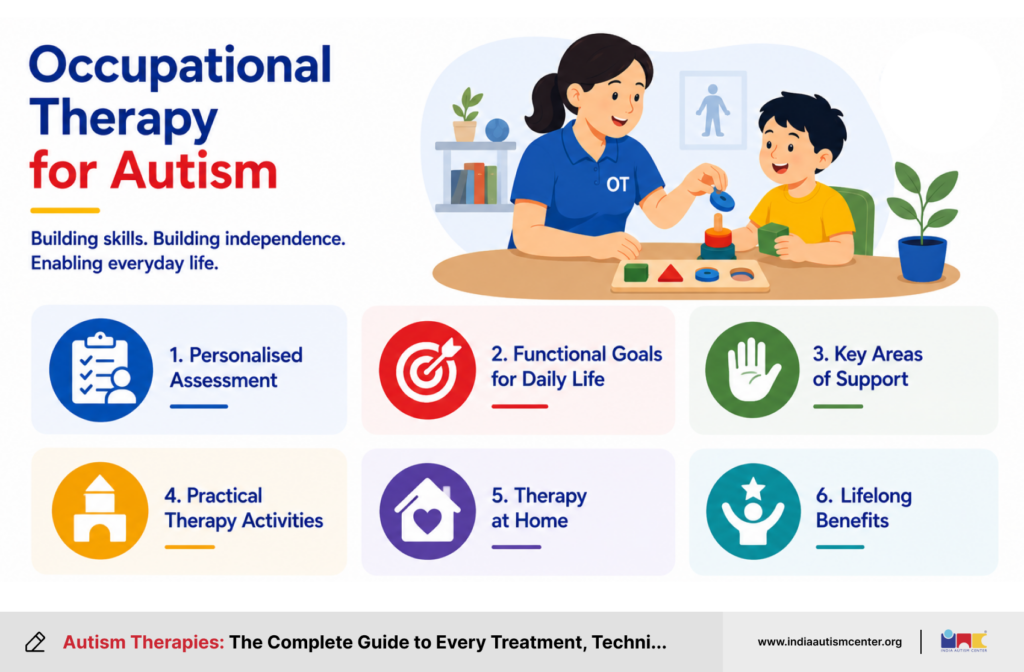
Occupational therapy (OT) for autism helps individuals develop the everyday skills needed for self-care, learning, play and participation. OT targets fine and gross motor skills, sensory processing, daily living skills, and visual-motor integration. It is one of the most widely recommended autism therapies and plays a vital role in supporting independence across the lifespan.
Occupational therapy is a health profession that focuses on enabling people to participate in the activities of daily life that are meaningful to them — referred to as “occupations.” For children with autism, these occupations include playing, dressing, eating, writing, engaging in school activities, and socialising. For adults, they extend to work, community participation, and independent living. The occupational therapist identifies barriers to participation and implements targeted interventions to overcome them.
Role of the Occupational Therapist (OT): Occupational therapists working with autistic individuals possess specialist training in sensory processing, fine and gross motor development, neurodevelopment, adaptive equipment, and environmental modification. They work across a variety of settings, including specialist clinics, schools, community centres, and homes.
How Occupational Therapy Works
Occupational Profile and Assessment: OT begins with a comprehensive assessment that creates an occupational profile — a detailed picture of the individual’s daily routines, challenges, priorities and goals. Assessment tools used in autism OT include the Sensory Profile, the Peabody Developmental Motor Scales, the Bruininks-Oseretsky Test of Motor Proficiency, and clinical observation.
Setting Functional Goals for Daily Life: Goals in OT are always functional and meaningful to the individual and their family. Rather than targeting isolated skills in a vacuum, OT frames every goal in the context of real-life participation — for example, improving pencil grip so that the child can write comfortably at school, or building dressing skills so that the young person can manage their morning routine independently.
The Role of Occupational Therapy in Autism
Fine Motor Skill Development: Fine motor skills involve the coordinated use of the small muscles of the hands and fingers. Many children with autism have difficulties with fine motor tasks such as writing, using cutlery, fastening buttons, and manipulating small objects. OT uses targeted activities to strengthen hand muscles, improve bilateral coordination, and develop the precision needed for these tasks.
Gross Motor Skills and Coordination: Gross motor skills involve the large muscle groups used for whole-body movements such as running, jumping, climbing, and balancing. Children with autism frequently experience motor coordination difficulties, which can affect physical education participation, playground inclusion and general physical confidence. OT and physical therapy both contribute to improving gross motor functioning.
Self-Care and Daily Living Skills: One of the most practically significant roles of OT is developing independence in self-care tasks — such as dressing, undressing, toileting, bathing, brushing teeth, and preparing simple meals. These skills are foundational to independence and quality of life. OT uses task analysis, visual supports, adaptive equipment, and repeated practice to build self-care competence.
Sensory Processing and Regulation: Sensory processing differences are among the most common and impactful features of autism. Many OTs have specialist training in sensory integration and develop individualised “sensory diets” — tailored programmes of sensory activities that help regulate the individual’s arousal level and sensory comfort throughout the day.
Visual-Motor Integration: Visual-motor integration — the ability to coordinate visual information with hand movements — is essential for reading, writing, drawing, and many functional tasks. OT activities targeting eye-hand coordination and spatial perception build this critical skill.
Social Participation: Through structured group activities, play-based learning, and environmental adaptations, OT supports social participation by equipping individuals with autism with the motor, sensory and organisational skills they need to engage successfully with peers.
Handwriting and Pencil Grip Exercises: Programmes such as “Handwriting Without Tears” are frequently used by OTs to address handwriting difficulties in children with autism. Activities include pre-writing exercises, correct grip training, and pencil-control games.
Play-Based Activities: Play is the primary occupation of childhood and a critical context for learning. OT uses structured and semi-structured play activities to build fine motor skills, sensory tolerance, social interaction, and problem-solving.
Sensory Play Activities: Sensory play activities — such as playdough manipulation, finger painting, sand and water play, and textured materials exploration — provide controlled sensory input that supports sensory processing development and tolerance.
Life Skills Training Activities: Practical activities such as cooking simple recipes, managing money, using public transport, and operating home appliances are incorporated into OT for older children and adults to build real-world independence.
Social Skills Activities: Group OT sessions may incorporate board games, cooperative building activities, and role-play scenarios that provide a structured context for practising turn-taking, sharing, communication, and social problem-solving.
Occupational Therapy at Home for Autism
Home-based OT is a highly effective complement to clinic-based intervention. Parents and caregivers are taught to embed OT goals into daily routines — for example, practising fine motor skills through cooking activities, building sensory tolerance through bathtime play, and targeting gross motor coordination through outdoor games. A qualified OT should design and regularly review any home programme.
Benefits of Occupational Therapy for Autism
Occupational therapy delivers wide-ranging benefits, including improved self-care independence, better academic participation through improved motor and sensory skills, enhanced social inclusion, reduced sensory overwhelm, improved concentration and learning readiness, and increased confidence in daily activities. Families consistently report that OT makes a profound practical difference to daily life.
Finding Occupational Therapy for Autism Near You
OT for autism is available through the NHS in the UK, through public health services in many countries, and through private clinics. When selecting a paediatric OT for autism, families should seek a practitioner with experience in sensory integration, autism spectrum profiles, and functional skills development.
https://youtu.be/19tjfIQWcWE?si=c9p2un73ua8x6UDc
Sensory Integration Therapy for Autism
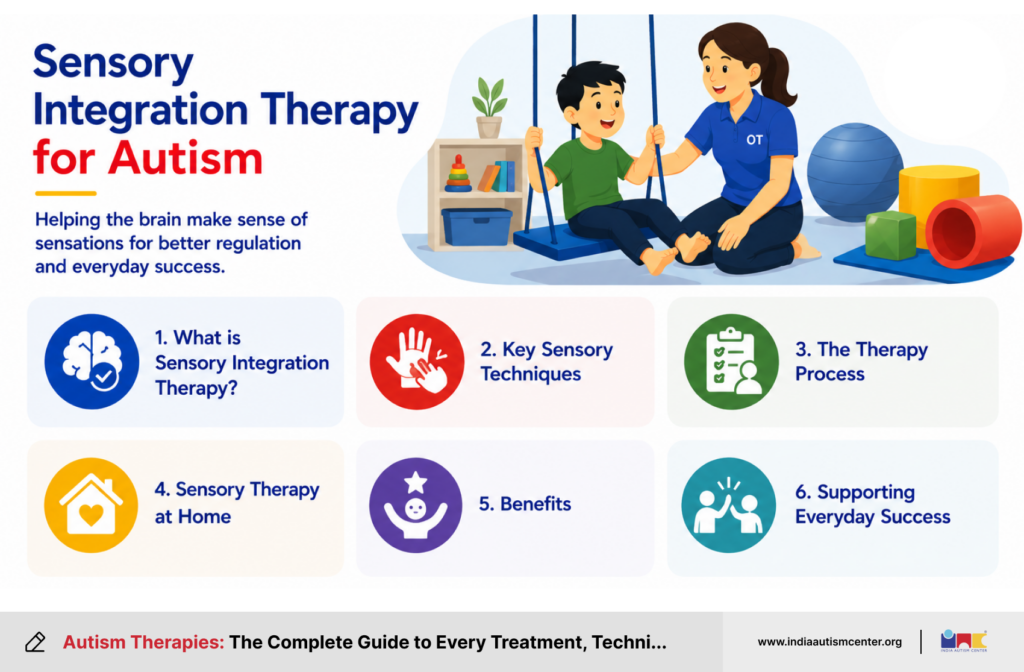
Sensory integration therapy for autism is a specialised form of occupational therapy that addresses the way the brain receives and processes sensory information. Developed by occupational therapist Dr A. Jean Ayres in the 1970s, it uses specific sensory experiences — movement, deep pressure, touch and proprioceptive input — to improve the brain’s ability to organise and respond to sensory stimuli. It is widely used for autistic individuals who experience sensory hypersensitivity, hyposensitivity, or sensory-seeking behaviours.
What is Sensory Integration Therapy?
Understanding Sensory Processing Disorder (SPD) in Autism: Many individuals with autism experience significant difficulties in how their nervous system registers and responds to sensory input. This is often referred to as Sensory Processing Disorder (SPD). Some individuals are over-responsive — finding ordinary sensory input (such as a clothing tag or background noise) intensely uncomfortable or painful. Others are under-responsive — seeking out intense sensory stimulation to register their environment. Still others show a mixed profile. These sensory differences significantly affect behaviour, learning, and daily functioning.
Jean Ayres’ Sensory Integration Framework: Dr Ayres proposed that the brain’s ability to organise sensory information is a fundamental prerequisite for learning and behaviour. When sensory integration is disrupted, the brain cannot efficiently use sensory information to plan and execute appropriate responses. Her therapeutic approach uses graded, purposeful sensory activities to challenge the nervous system and improve its processing efficiency.
Sensory Therapy Techniques for Autism
Deep Pressure Therapy: Deep pressure — applied through massage, compression clothing, weighted items, or firm squeezing — activates the proprioceptive system and produces a calming, organising effect on the nervous system. Many autistic individuals are drawn to deep pressure input and find it highly regulating.
Brushing Protocol (Wilbarger Protocol): The Wilbarger Protocol, developed by Patricia Wilbarger, involves systematic, firm brushing of the skin using a specialised surgical brush, followed by joint compressions. It must be administered by a trained OT and carried out multiple times per day. It is used to reduce tactile hypersensitivity and improve sensory tolerance.
Weighted Vests and Blankets: Weighted vests and blankets provide proprioceptive input that many individuals with autism find calming and focusing. They are used during specific activities (such as seatwork or transitions) and are prescribed as part of a broader sensory diet.
Swinging and Vestibular Activities: The vestibular system, which controls balance and spatial orientation, is often dysregulated in autism. Swinging on a therapy swing, using a hammock, or engaging in rocking and spinning activities provides vestibular input that can have a powerful organising or calming effect on the nervous system.
Tactile Bins and Textures: Tactile exploration activities — such as playing with dried beans, sand, water, or textured materials — systematically expose the individual to a range of textures, supporting the development of tactile tolerance and discrimination over time.
Proprioceptive Input Activities: Activities that involve pushing, pulling, carrying, climbing and jumping provide proprioceptive input (feedback from joints and muscles) that supports body awareness, motor planning and self-regulation. Proprioceptive activities are commonly incorporated into sensory diets as regulating strategies.
The Sensory Integration Therapy Process
Sensory Profile Assessment: The process begins with a comprehensive sensory assessment — such as the Sensory Profile 2 (Winnie Dunn) — completed by parents and caregivers, combined with direct clinical observation by the OT. This assessment identifies the individual’s specific sensory processing patterns across all sensory systems.
Creating a Sensory Diet: A sensory diet is an individualised plan of sensory activities prescribed throughout the day to maintain the individual’s optimal arousal and regulation state. The OT designs the sensory diet based on the assessment findings and teaches the family and school how to implement it consistently.
Monitoring Sensory Responses: Sensory responses are closely monitored over time. The OT observes changes in sensory tolerance, regulation, behaviour, and participation, adjusting the sensory diet and clinic-based activities as the individual’s sensory needs evolve.
Benefits of Sensory Integration Therapy for Autism
Sensory integration therapy delivers significant benefits for autistic individuals with sensory processing difficulties. These include reduced sensory overload and meltdowns, improved focus and attention for learning, better behavioural regulation, enhanced motor planning, increased tolerance of everyday sensory experiences, and a greater sense of comfort and safety in daily environments.
Sensory Therapy at Home
Parents can support sensory integration between therapy sessions by implementing the sensory diet at home and creating a sensory-friendly environment. This includes providing access to regulating sensory equipment (such as therapy swings or sensory corners), using calming sensory strategies before transitions, and avoiding sensory triggers where possible.
Cognitive Behavioural Therapy (CBT) and Autism
Cognitive Behavioural Therapy (CBT) is a structured, evidence-based psychological therapy that helps individuals understand the connections between their thoughts, feelings and behaviours. For autistic individuals — particularly those with higher cognitive functioning — CBT is effective in addressing anxiety, depression, obsessive-compulsive behaviours and emotional dysregulation. It is typically adapted with visual supports, explicit instruction and concrete examples to suit autistic learning styles.
What is CBT and How Does It Apply to Autism?
CBT is based on the principle that unhelpful thought patterns contribute to emotional distress and problematic behaviours. By identifying and challenging these thoughts and developing more balanced cognitive perspectives, individuals are able to change how they feel and behave. In autism, CBT is most frequently used to address the high rates of co-occurring anxiety (present in approximately 40–50% of autistic individuals), as well as depression, anger regulation and repetitive or obsessive behaviours.
How CBT is Adapted for Individuals with ASD
Standard CBT assumes strong verbal reasoning, abstract thinking, and the ability to identify and discuss emotions — abilities that may be less readily available in autistic individuals. Autism-adapted CBT makes a number of key modifications: it uses visual aids, worksheets and diagrams to represent abstract concepts concretely; it incorporates the individual’s specific interests to enhance engagement; it builds explicit emotion recognition skills before progressing to cognitive restructuring; and it reduces the metaphor and ambiguity common in standard CBT language, replacing these with clear, direct instruction.
CBT Methods and Techniques Used in Autism
Thought-Emotion-Behaviour Triangle: The foundational model of CBT is the triangle connecting thoughts, emotions and behaviours. CBT explicitly teaches the individual to identify where they are in the cycle — for example, recognising that a thought such as “nobody likes me” contributes to feelings of sadness and behaviours such as withdrawal — and then to examine and challenge that thought.
Emotion Identification and Regulation: Many autistic individuals have alexithymia — difficulty identifying and describing their own emotions. CBT sessions may begin with explicit emotion identification work, using visual emotion scales (such as the “anxiety thermometer”) to help the individual recognise the signs of different emotional states in their body.
Cognitive Restructuring: Cognitive restructuring involves identifying unhelpful automatic thoughts (such as catastrophising or black-and-white thinking), evaluating the evidence for and against them, and developing more balanced alternative thoughts. In autism, this process is typically made more concrete by using structured thought records and written worksheets.
Exposure and Response Prevention (ERP): For autistic individuals with significant anxiety or OCD-type behaviours, Exposure and Response Prevention — a specific CBT technique — is used to systematically and gradually confront feared situations whilst resisting the urge to engage in avoidance or compulsive behaviours. This is conducted in a carefully planned, paced and supportive manner.
Who is CBT Best Suited For?
CBT is generally most suitable for autistic individuals who are higher-functioning, have verbal communication skills, and possess sufficient cognitive ability to reflect on their own thoughts and feelings. It is widely used with older children, adolescents and adults on the autism spectrum. It is less suitable for individuals who are non-verbal or who have significant intellectual disabilities, for whom other emotional regulation approaches (such as sensory-based strategies or visual supports) may be more appropriate.
Benefits of CBT for Autism
CBT offers meaningful benefits to autistic individuals who are well-suited to the approach. These include significantly reduced anxiety symptoms, better management of obsessive and repetitive thoughts and behaviours, improved emotional regulation and frustration tolerance, enhanced social confidence, and a stronger sense of self-efficacy and personal control.
Music therapy for autism is an evidence-based therapeutic intervention in which a qualified music therapist uses musical experiences — including singing, playing instruments, movement to music, and improvisation — to address communication, social, emotional and sensory goals. Research consistently demonstrates that music therapy produces meaningful improvements in communication and social interaction in autistic individuals, including those who are non-verbal.
What is Music Therapy for Autism?
Music therapy is a clinical discipline in which music is used purposefully and systematically as a therapeutic tool. Unlike music lessons or recreational music participation, music therapy is led by a trained clinician who sets specific goals and uses musical experiences to achieve them. Music engages multiple areas of the brain simultaneously and can reach individuals with autism who are less responsive to verbal or behavioural approaches.
Who is a Certified Music Therapist? A certified music therapist holds a recognised qualification in music therapy and has training in clinical assessment, intervention planning, and evaluation. In the UK, music therapists are registered with the Health and Care Professions Council (HCPC).
How Music Therapy Works
The Connection Between Music and the Autistic Brain: Research in neuroscience has revealed that music activates a remarkably broad network of brain areas, including those responsible for emotion, memory, motor control, attention and language. Notably, many autistic individuals show preserved or heightened musical perception and processing abilities, making music a particularly accessible and motivating medium for therapy. Music also provides a structured, predictable and non-threatening context for interaction, which reduces the social anxiety that often accompanies other forms of engagement.
Active vs. Receptive Music Therapy: Active music therapy involves the individual directly creating music — through singing, instrument playing, or improvisation. Receptive music therapy involves listening to music that is selected or played by the therapist to elicit specific emotional, physical or cognitive responses. Both forms are used in autism practice, often within the same session.
Music Therapy Techniques for Autism
Rhythmic Auditory Stimulation (RAS): RAS uses rhythmic musical cues to support motor function and movement. In autism, RAS is used to improve coordination, gait, and motor sequencing, as well as to regulate attention and arousal.
Neurologic Music Therapy (NMT): NMT is a neuroscientific approach to music therapy that uses specific music-based techniques to address cognitive, communicative, sensory and motor functions. NMT is grounded in research on the neural mechanisms that underpin the music-brain relationship.
Improvisational Music Therapy: Improvisation allows the individual to explore music freely and spontaneously, without a prescribed structure. The therapist responds to the individual’s musical expressions — mirroring, complementing and building upon them — creating a musical dialogue that parallels and supports the development of communication and social reciprocity.
Song Writing and Lyric Analysis: Composing original songs provides a creative and emotionally meaningful channel for self-expression. Lyric analysis involves exploring the themes and messages within songs, which can support emotional literacy, perspective-taking and social understanding.
Movement to Music: Combining music with movement supports body awareness, motor coordination, rhythm perception and social engagement. Dance and movement to music is used within music therapy sessions, as well as in dedicated dance and movement therapy (see Section 15).
Benefits of Music Therapy for Autism
The benefits of music therapy for autism are well-documented in the research literature and include: enhanced verbal and non-verbal communication; improved joint attention and social reciprocity; reduced anxiety and emotional distress; better sensory regulation through auditory and rhythmic input; increased motivation and engagement in therapeutic activities; and improved self-expression and emotional wellbeing. Notably, music therapy is particularly effective for non-verbal individuals who may not engage readily with language-based therapies.
Music Therapy at Home — Activities for Parents
Parents can support music therapy goals at home through simple activities such as singing during daily routines (bath time, mealtimes, transitions), using percussion instruments to encourage turn-taking, playing preferred music during times of emotional dysregulation to provide comfort, and exploring music improvisation through household items.
https://youtu.be/6VeFl0kjKg4?si=BOxjOXrJwVJZ9NS5
Sound Therapy for Autism
Sound therapy for autism uses specific auditory stimuli — including modulated music, specific frequencies, and filtered sound programmes — to address auditory processing difficulties, sensory hypersensitivities, attention and language processing. The most widely used forms are Auditory Integration Training (AIT) and the Tomatis Method. While evidence is still developing, many families report reduced sound sensitivity and improved communication following sound therapy.
What is Sound Therapy for Autism?
Sound therapy and music therapy are distinct disciplines that are often confused. Music therapy is a clinically established profession using music to address a range of goals; it is delivered by a qualified therapist and is built on a robust evidence base. Sound therapy, by contrast, uses specific acoustic stimuli — often electronically filtered or modulated — to target auditory processing and nervous system regulation. Sound therapy is delivered by practitioners trained in specific auditory programmes and has a smaller but growing evidence base.
Types of Sound-Based Interventions: The main sound therapy programmes used in autism practice include Auditory Integration Training (AIT), the Tomatis Method, Therapeutic Listening (developed by Sheila Frick), and Berard AIT (developed by Dr Guy Berard). More recently, binaural beats and brain entrainment approaches have also gained attention, although evidence for these is preliminary.
How Sound Therapy Works
Auditory Processing and Autism: Many autistic individuals have hypersensitive auditory systems — they are disturbed by sounds that others barely notice, experience physical pain from certain pitches, or find it extremely difficult to filter relevant sounds from background noise. These auditory processing difficulties affect behaviour, communication, learning and sensory comfort. Sound therapy aims to retrain and recalibrate the auditory system through repeated exposure to carefully structured sound stimuli.
How Specific Frequencies Affect the Nervous System: Different sound frequencies are thought to activate different parts of the auditory and nervous system. Sound therapy programmes exploit this by selectively filtering and modulating sound frequencies to provide the auditory system with novel, challenging input that encourages processing adaptation over time.
Sound Therapy Methods and Techniques
Auditory Integration Training (AIT): AIT, developed by Dr Guy Berard, involves listening to electronically modulated music through headphones for two sessions of 30 minutes per day over ten days. The music is filtered to remove frequencies at which the individual shows auditory hypersensitivity, identified through an initial audiogram. AIT aims to reduce auditory hypersensitivities and improve auditory processing efficiency.
The Tomatis Method: Developed by French ENT physician Dr Alfred Tomatis, this method uses electronically filtered and modulated sound — primarily classical music and the mother’s voice — to stimulate and retrain the auditory system and the vestibular-cochlear connection. The method aims to improve listening, language, communication, and sensory integration.
Therapeutic Listening: Therapeutic Listening, developed by OT Sheila Frick, involves listening to electronically altered music through high-quality headphones as part of a broader sensory integration programme. It is used to modulate sensory processing, improve attention, and support self-regulation.
Reported benefits of sound therapy for autism include reduced hypersensitivity to everyday sounds, improved listening and auditory processing, enhanced language comprehension, better attention and concentration, reduced anxiety in auditory environments, and improved communication. The strength of these benefits varies between individuals and programmes, and it is important to seek programmes delivered by qualified and experienced practitioners.
https://youtu.be/vplnVUeisQI?si=xvXjKb_KgaP7DpZj
Visual Therapy for Autism
Visual therapy for autism addresses difficulties in how the brain processes and uses visual information. Delivered by a developmental optometrist or trained vision therapist, it uses targeted exercises and visual tools to improve eye tracking, visual perception, and visual-motor integration. It also encompasses the broad use of visual supports — such as visual schedules, choice boards and social stories — as strategies throughout autism intervention.
What is Visual Therapy for Autism?
Understanding Visual Processing Differences in ASD: Many autistic individuals experience differences in visual processing that go beyond simple visual acuity (sharpness of sight). These include difficulties with visual tracking, visual-spatial perception, depth perception, and the ability to process visual information efficiently during movement or in visually complex environments. These differences can affect reading, learning, coordination, and daily functioning.
Role of a Developmental Optometrist: A developmental optometrist is a specialist who evaluates not only the physical structure of the eye but also how the brain processes and uses visual information. Developmental optometrists can identify visual processing difficulties that may be contributing to the learning and behavioural challenges commonly seen in autism, and can prescribe targeted vision therapy programmes.
Visual Therapy Techniques for Autism
Eye Tracking Exercises: Smooth pursuit and saccadic eye movement exercises train the eyes to track moving objects accurately and to shift focus efficiently between targets. Poor eye tracking can affect reading fluency, attention, and coordination, and is frequently identified in autistic individuals.
Convergence and Divergence Training: Convergence (the ability to turn both eyes inward to focus on a near target) and divergence (the ability to turn eyes outward to shift to a far target) are essential for comfortable near and far vision. Difficulties in these areas can cause eyestrain, headaches and avoidance of visual tasks, which may manifest as learning resistance or challenging behaviour.
Visual-Motor Integration Activities: Visual-motor integration activities link visual perception with fine motor execution — for example, copying shapes, tracing patterns, completing mazes, and constructing block designs. These activities develop the foundation skills required for handwriting, drawing and many academic tasks.
Use of Colour and Visual Schedules: The use of colour coding, visual schedules (sequences of pictures showing the day’s activities), and visual organisers supports attention, prediction and understanding of routines in autistic individuals. These visual tools reduce reliance on verbal instruction, which can be harder for many individuals with autism to process.
Prism Lenses: Some developmental optometrists prescribe tinted or prism lenses for individuals with autism who experience visual stress or perceptual distortions. These lenses can modify the way light reaches the visual cortex and may reduce visual discomfort and improve attention.
Benefits of Visual Therapy for Autism
Visual therapy offers benefits including improved reading fluency and comprehension, better visual-motor coordination, reduced visual stress and eyestrain, enhanced eye contact and visual engagement, and improved academic and learning performance. The use of visual supports as a broader autism strategy — which is supported by extensive research — significantly improves understanding, compliance with routines, and communication.
Physical Therapy for Autism
Physical therapy (PT) for autism addresses motor development, coordination, strength, balance, and gait. Delivered by a paediatric physiotherapist, PT helps autistic individuals overcome gross motor difficulties that affect their participation in physical activities, school, and daily life. It is particularly valuable for individuals with low muscle tone, coordination disorders, or delayed motor milestones.
What is Physical Therapy for Autism?
Physical therapy for autism focuses on improving the physical and motor aspects of functioning that are affected by autism and its common co-occurring conditions. Many autistic individuals have low muscle tone (hypotonia), poor motor coordination (dyspraxia), an atypical gait pattern, or delayed gross motor milestones. Physical therapy addresses these challenges directly, improving physical capability, safety, and participation.
Physical Therapy Techniques for Autism
Balance and Coordination Exercises: Activities such as standing on one leg, walking on a balance beam, catching and throwing balls, and obstacle courses challenge and develop balance and whole-body coordination skills that are often underdeveloped in autism.
Strengthening Activities: Core and limb strengthening exercises, adapted for the individual’s ability and interests, build muscle strength and endurance. Stronger muscles support better posture, more controlled movement, and greater physical confidence.
Gait Training: Many autistic individuals have an unusual walking pattern — such as toe-walking, a wide-based gait, or poor arm swing — that can affect comfort, endurance, and physical development. Gait training uses targeted exercises and sometimes orthotic devices to improve walking mechanics.
Postural Exercises: Poor posture — often related to low muscle tone and reduced proprioceptive awareness — affects seated attention, handwriting, and physical comfort. Postural exercises and positioning strategies support better alignment and endurance.
Neurodevelopmental Treatment (NDT): NDT is a hands-on physiotherapy approach that uses facilitation techniques to improve movement patterns, reduce abnormal muscle tone, and promote typical motor development.
Benefits of Physical Therapy for Autism
Physical therapy delivers benefits including improved gross motor skills and coordination, better posture and gait, increased physical strength and endurance, enhanced body awareness and proprioception, greater participation in sports and physical activities, and improved overall physical health and wellbeing. Physical fitness is also closely linked to mental health, and regular physical activity has been shown to reduce anxiety and repetitive behaviours in autistic individuals.
Play Therapy for Autism
Play therapy for autism uses play — the natural language of childhood — as a therapeutic medium to develop social, communication, emotional and cognitive skills. Approaches such as DIR/Floortime, Theraplay and play-based social skills groups are specifically designed to meet the developmental and relational needs of autistic children in a child-led, warm and engaging way.
What is Play Therapy for Autism?
Play therapy recognises that children communicate and learn most naturally through play. For autistic children, play development is often delayed, atypical, or primarily solitary. Play therapy aims to enrich the child’s play repertoire, build meaningful engagement with adults and peers, and use the motivating context of play to develop key developmental skills.
Play Therapy Methods and Techniques
Floortime (DIR/Floortime Model): Developed by Dr Stanley Greenspan, the Developmental, Individual-Difference, Relationship-based (DIR) model — commonly known as Floortime — emphasises following the child’s lead and joining them in their play world. The therapist and parent get down on the floor with the child, engage with their interests, and use playful interaction to expand circles of communication, emotional connection, and cognitive complexity. Floortime is particularly effective for building the foundational social-emotional developmental milestones that precede higher-level communication.
Relationship Development Intervention (RDI): RDI is a parent-guided programme that focuses specifically on building dynamic intelligence — the ability to engage flexibly in social and real-world situations. RDI uses structured, graded activities to develop joint attention, experience sharing, and collaborative problem-solving.
Theraplay: Theraplay is a structured, short-term therapy that uses playful, nurturing activities to build attachment, self-esteem, and trust between child and caregiver. Sessions involve four dimensions — nurture, structure, engagement and challenge — and are conducted with parents present and active.
Symbolic and Pretend Play Training: Many autistic children have limited pretend or imaginative play. Targeted pretend play training — in which therapists model and scaffold increasingly complex pretend play scenarios — helps children develop the symbolic thinking that underpins language, social interaction, and creativity.
Benefits of Play Therapy for Autism
Play therapy builds social reciprocity and joint attention, develops communication through joyful interaction, improves imagination and flexible thinking, strengthens the parent-child relationship, reduces anxiety around social engagement, and provides a motivating and enjoyable context for therapeutic growth.
Dance and Movement Therapy for Autism
Dance and movement therapy (DMT) for autism uses body movement as a primary medium for therapeutic intervention. It supports body awareness, self-expression, emotional regulation, and social connection. DMT is particularly valuable for individuals who find verbal communication challenging and who respond well to non-verbal, physical modes of interaction.
What is Dance Therapy for Autism?
Dance and movement therapy is a psychotherapeutic discipline based on the premise that body and mind are deeply interconnected. Changes in movement quality, posture and physical engagement reflect and influence psychological and social functioning. A qualified Dance/Movement Therapist (DMT) uses structured and improvised movement experiences to support the individual’s emotional, social, physical and cognitive development.
Dance Therapy Techniques
Mirroring Exercises: The therapist mirrors the child’s spontaneous movements, reflecting them back without direction or correction. This validates the child’s self-expression, builds a sense of being seen and understood, and creates the conditions for genuine social connection without the demands of verbal communication.
Rhythm and Synchrony Activities: Moving in synchrony with another person — to music, percussion or spoken rhythm — supports the development of social attunement, timing, and cooperative engagement. Research shows that moving in synchrony also increases feelings of connection and prosocial behaviour.
Expressive Movement: Individuals are encouraged to use their bodies to express emotions, stories and experiences. This is particularly powerful for individuals who have limited verbal emotional expression and can significantly reduce anxiety and emotional tension.
Group Dance Activities: Group sessions use structured dances, movement games and cooperative activities to develop social skills, body awareness, turn-taking, and a shared sense of belonging within a group.
Benefits of Dance Therapy for Autism
Dance and movement therapy supports improved body awareness and proprioception, enhanced social connection and empathy, emotional expression and regulation, physical coordination and motor skills, reduced anxiety, and a heightened sense of joy and self-confidence.
Water therapy (aquatic therapy) for autism uses the therapeutic properties of water — including buoyancy, hydrostatic pressure, warmth and resistance — to support motor development, sensory regulation and social skills. Many autistic children are drawn to water, making it a highly motivating therapeutic medium. Swimming therapy also provides critical safety skills for children who are at high risk of water-related accidents.
What is Water Therapy for Autism?
Aquatic therapy for autism is delivered in a heated pool or warm water environment by a trained aquatic therapist or physiotherapist. The physical properties of water create a unique sensory and motor environment that is often deeply regulating for autistic individuals — many of whom find water intrinsically calming and enjoyable.
Aquatic Therapy Techniques for Autism
Watsu (Water Shiatsu): Watsu involves passive, flowing movements in warm water, with the therapist supporting the individual throughout. It provides deep relaxation, sensory integration, and physical release, and is particularly beneficial for individuals with significant sensory sensitivities or high anxiety.
Halliwick Method: The Halliwick Method is a structured ten-point programme for teaching swimming and water independence to people with physical and developmental disabilities. It focuses on water safety, balance, and independent movement in water.
Structured Swimming Lessons: Adapted swimming lessons, designed with the sensory, communication and motor needs of autistic individuals in mind, develop swimming skills progressively whilst building water confidence and physical fitness.
Autism Swimming Therapy: Safety in Water
Drowning is a serious concern for autistic children — research indicates that they are at a disproportionately higher risk of drowning than the general population, partly due to a strong attraction to water and a tendency to wander. Water and swimming therapy should therefore include an explicit focus on water safety awareness alongside therapeutic goals. Specialist swimming programmes for autistic children, led by qualified instructors with ASD training, are available in many communities.
Benefits of Water Therapy for Autism
Aquatic therapy delivers a unique set of benefits, including deep sensory regulation and calming, improved gross motor skills and coordination, enhanced body awareness, increased physical fitness, social interaction in group swimming settings, growing confidence and independence in water, and the development of critical water safety skills.
Home-Based Therapy for Autism
Home-based therapy for autism delivers therapeutic intervention within the individual’s home environment, either by visiting therapists or by trained parents and caregivers guided by professionals. It promotes the generalisation of skills to real-life settings, increases family involvement, reduces the disruption of frequent clinic travel, and can be highly effective when implemented consistently.
What is Home-Based Autism Therapy?
Home-based therapy for autism is any structured therapeutic support that is delivered primarily in the home. This may involve a therapist visiting the home to deliver sessions, or a professionally designed programme that parents implement during daily routines. The home environment offers a uniquely powerful context for therapy: it is the setting in which the individual spends the most time, the place where skills must ultimately be functional, and the environment most familiar and comfortable to the individual.
Types of Therapies That Can Be Delivered at Home
Home-Based ABA: ABA is one of the most commonly delivered home-based therapies for autism. Home-based ABA allows skills to be taught directly within the natural environment, making it easier to generalise them to daily life. A BCBA supervises the programme and trains parents and caregivers to implement strategies consistently.
Occupational Therapy at Home for Autism: Home-based OT embeds therapeutic activities into daily routines — such as dressing, mealtimes and play — making learning practical and immediately relevant. The occupational therapist designs a home programme and visits regularly to review progress and update strategies.
Speech Therapy at Home: Home-based speech therapy allows communication goals to be practised during natural daily interactions — conversations, shared reading, mealtime chat, and play — which is where communication generalisation ultimately needs to occur.
Sensory Activities at Home: Parents can implement sensory diets at home under the guidance of an occupational therapist, using simple activities and sensory tools to support their child’s regulation throughout the day.
An effective home therapy space does not require expensive equipment. Key elements include a calm, low-distraction area for structured activities; access to sensory tools such as a mini trampoline, therapy ball, or sensory bin; a visual schedule on the wall showing the day’s activities; and a selection of motivating toys and materials for teaching and play. A qualified therapist can advise on specific equipment based on the individual’s goals.
Therapy Toys for Autism
Therapy toys play an important role in both clinic-based and home-based autism therapy. Sensory toys — such as fidget tools, weighted lap pads, tactile materials, and noise-cancelling headphones — support sensory regulation. Fine motor toys — such as threading beads, construction sets and playdough — develop hand strength and coordination. Communication aids — including PECS boards, picture communication apps and speech-generating devices — support language development. Cognitive and learning toys — such as sorting games, matching activities and simple puzzles — develop foundational academic skills.
Home-based therapy offers a range of compelling benefits: the child learns in their most familiar and comfortable environment, which reduces anxiety and increases engagement. Skills that are practised in the home generalise more readily to daily life. Family members develop confidence and competence in supporting their child’s development. The intensity of intervention can be greater when parents implement strategies throughout the day. Finally, home-based therapy is often more accessible and affordable than full-time clinic-based provision.
Choosing the Right Therapy for Your Child
Choosing the right autism therapy depends on the individual’s specific profile — their age, developmental level, communication abilities, sensory needs, co-occurring conditions, and family goals. The best approach is to work with a qualified multi-disciplinary team to build a personalised, integrated therapy plan that targets the most impactful areas first whilst remaining responsive to the individual’s changing needs over time.
How to Assess Your Child’s Individual Needs
Before selecting therapies, families need a clear picture of the individual’s strengths, challenges, learning style and sensory profile. This picture is best built through formal assessment by qualified professionals, supplemented by parents’ own knowledge and observation. Understanding which areas are most significantly impacting daily life — communication, behaviour, sensory processing, motor skills, social participation — helps prioritise where to focus therapeutic effort.
Factors to Consider When Choosing a Therapy
Age and Developmental Level: Younger children benefit most from intensive early intervention programmes such as ABA and speech therapy. Older children, adolescents and adults may benefit more from CBT, social skills groups, vocational programmes and life skills training. The developmental level of the individual — rather than their chronological age — should guide therapy selection and approach.
Severity and Profile of Autism: The specific pattern of strengths and difficulties shapes therapy priorities. A non-verbal child needs intensive communication support; a highly verbal adolescent with significant anxiety may benefit most from CBT and social skills training. Always match therapy type to the individual’s actual profile, not to diagnostic labels or assumptions.
Co-occurring Conditions: Many autistic individuals have co-occurring conditions such as ADHD, anxiety, dyspraxia, sensory processing disorder, intellectual disability, or epilepsy. These co-occurring conditions significantly influence which therapies are most appropriate and how they are delivered.
Evidence Base and Research Support: Families should prioritise therapies with a strong, peer-reviewed evidence base — such as ABA, speech therapy, OT and CBT — particularly as the primary components of the therapy plan. Less well-evidenced therapies may still be valuable as complements to core interventions, but should not replace them.
Therapist Qualifications and Credentials: Always verify that any therapist you engage is registered with the relevant professional body, holds recognised qualifications, and has demonstrated experience working with autistic individuals. Do not hesitate to ask about credentials, supervision, and approaches used.
Financial Considerations: Autism therapy can be expensive, particularly when accessed privately. Families should explore all available funding options, including public health service entitlements, educational therapy funding, charitable grants, and insurance coverage. Early investment in high-quality therapy often reduces the long-term cost of support.
Building an Integrated Therapy Plan
The most effective therapy programme is one in which multiple therapists share goals, communicate regularly, and coordinate their approaches. When building an integrated plan, families should ensure that therapy goals are linked to real-life outcomes (such as communicating at school or managing the supermarket), that all therapists are aware of each other’s work, and that the plan is reviewed at least annually or when significant changes occur.
A high-quality autism therapy centre offers a qualified, multi-disciplinary team; individualised assessment and treatment planning; regular parent involvement; transparent progress reporting; and a supportive, sensory-aware environment. When searching for autism therapy centres near you, it is important to assess not just location and availability, but the quality of clinical practice and the extent to which the centre takes a holistic, family-centred approach.
What to Look for in an Autism Therapy Centre
Qualified Staff and Credentials: All therapists at the centre should hold recognised qualifications in their respective disciplines and be registered with relevant professional bodies. The centre should have BCBAs for ABA, registered SaLTs for speech therapy, HCPC-registered OTs, and so on.
Range of Services Offered: The best centres offer a comprehensive range of services under one roof — including ABA, speech therapy, occupational therapy, sensory integration therapy, and psychological support — enabling families to access a coordinated multi-disciplinary team without needing to travel to multiple locations.
Individualised Treatment Plans: Every individual with autism deserves a treatment plan that is tailored to their unique profile, goals and circumstances. Be cautious of centres that offer a standardised “one size fits all” programme without conducting a thorough individual assessment first.
Parent Communication and Involvement: A good centre will involve families as genuine partners in the therapy process. This means regular progress meetings, home programme guidance, transparent reporting, and a culture in which parents’ observations and concerns are welcomed and acted upon.
Environment and Facilities: The physical environment matters enormously for autistic individuals. Look for a centre with sensory-friendly spaces, low-arousal décor, minimal clutter and noise, access to a sensory room or gym, and separate areas for structured work and free play.
https://youtu.be/tlttzs6MUDM?si=iPNMxtJkoncC_pmS
Therapy Across the Lifespan — Age-Specific Guidance
Autism therapy needs change significantly across the lifespan. Early childhood therapy focuses on building communication and social foundations; school-age therapy targets academic participation and peer relationships; adolescent therapy addresses independence, identity and mental health; and adult therapy focuses on vocational skills, community integration and sustained wellbeing. Therapy is not only for children — meaningful progress and improved quality of life are achievable at every stage of life.
Therapy for Toddlers and Infants (0–3 Years)
This is the most critical period for intervention. The primary goals are to build pre-verbal and verbal communication, promote social engagement and joint attention, support sensory regulation, and involve parents as active therapeutic partners. The most effective approaches at this age are naturalistic, play-based and family-centred — such as the Early Start Denver Model and DIR/Floortime — combined with speech therapy and occupational therapy.
Therapy for Young Children (3–7 Years)
As children enter preschool and school, therapy increasingly targets school readiness skills — including fine motor ability, communication with peers, emotional regulation, self-care, and the ability to follow group instructions. ABA, speech therapy and OT remain central, and social skills groups become increasingly valuable. School inclusion support and collaboration between therapists and educators is essential during this period.
Therapy for School-Age Children (8–12 Years)
During middle childhood, academic demands increase and peer relationships become more complex. Therapy at this stage increasingly addresses academic participation (through OT and speech therapy), social skills within peer group contexts (through social skills groups and CBT), and the management of co-occurring challenges such as anxiety, ADHD, and learning differences. Homework and classroom adaptations guided by the OT and SaLT become important components of the support plan.
Therapy for Adolescents (13–18 Years)
Adolescence is a period of heightened social complexity, identity development, hormonal change, and increased mental health vulnerability. Therapy for autistic adolescents should address: social and relationship skills in age-appropriate contexts; emotional regulation and anxiety management through CBT; self-advocacy and understanding of one’s own autism; puberty-related education; and transition planning — preparing for post-school education, employment and independent living.
Therapy for Adults with Autism
Autism is a lifelong condition, and therapeutic support continues to be valuable in adulthood. Adults may benefit from vocational therapy to support employment, occupational therapy for independent living skills, CBT for anxiety and depression, social skills coaching for workplace and relationship contexts, and ongoing speech therapy for communication support. The autism community increasingly advocates for adult services that respect autistic identity, support self-determination, and go beyond a solely deficit-based model of care
Measuring Therapy Effectiveness and Tracking Progress
Therapy effectiveness in autism is measured by tracking progress towards specific, measurable goals across communication, behaviour, social skills, sensory processing and daily living. Progress monitoring uses a combination of standardised assessments, therapist-collected data, and parent and teacher observations. Regular review ensures that therapy remains aligned with the individual’s changing needs and that resources are being directed where they will have the most impact.
How to Know If Therapy is Working
Meaningful progress in autism therapy does not always look like dramatic, rapid change. In many cases, it is gradual and incremental. Signs that therapy is working include: the individual demonstrating skills in real-life settings that were previously only seen in the therapy room; fewer and less intense challenging behaviours; increased initiation of communication; greater participation in family, school and community activities; and improved wellbeing and mood. Regular review meetings with the therapy team allow families to gain an accurate picture of progress.
Setting SMART Goals for Autism Therapy
All therapy goals should be Specific, Measurable, Achievable, Relevant and Time-bound (SMART). For example, a SMART speech therapy goal might be: “Within three months, [child’s name] will independently use a two-word request to ask for preferred items in at least 80% of opportunities across three different settings.” SMART goals make it possible to objectively evaluate whether therapy is producing results and to make evidence-based decisions about adjustments.
Tools and Methods for Tracking Progress
Therapist Assessments and Reports: Qualified therapists use standardised assessment tools at regular intervals to measure change in specific domains. Examples include the VABS (Vineland Adaptive Behaviour Scales) for adaptive functioning, the PLS (Preschool Language Scales) for communication, and the Sensory Profile 2 for sensory processing.
Parent Observation Checklists: Parents are in a unique position to observe progress in everyday settings. Structured observation checklists — provided by the therapy team — allow parents to record the frequency and quality of target behaviours at home, providing rich real-world data to complement clinic-based assessments.
When to Consider Changing Approaches
If a therapy has been implemented consistently and with high fidelity for a reasonable period — typically three to six months — without evidence of meaningful progress, it is appropriate to reconsider the approach. This does not necessarily mean abandoning the therapy entirely; it may mean adjusting the goals, techniques, intensity, or therapist. Regular, honest review conversations with the therapy team are essential to ensure that every intervention is delivering genuine value.
https://youtu.be/uzXC7KQHVG0?si=AFOBRQjtXye3x2Wi
Frequently Asked Questions About Autism Therapies
What is the most effective therapy for autism?
There is no single “most effective” therapy for all individuals with autism, because autism presents differently in every person. However, Applied Behaviour Analysis (ABA), Speech and Language Therapy, and Occupational Therapy have the strongest and most consistent evidence bases. Early, intensive, multi-disciplinary intervention tends to produce the best outcomes overall.
At what age should autism therapy start?
Therapy should begin as soon as developmental concerns are identified — ideally before the age of three — to capitalise on the brain’s maximum plasticity. However, meaningful progress is achievable at any age, and it is never too late to begin or add therapy.
Can autism be treated without medication?
Yes. Therapy — rather than medication — is the primary treatment for autism. Medication may be used to manage specific co-occurring symptoms, such as anxiety, ADHD or sleep disturbance, but it does not address the core features of autism. Therapy is always the foundation of an autism support plan.
How long does a child need therapy for autism?
The duration of therapy varies greatly between individuals. Some children make rapid early gains and require less intensive support as they grow; others benefit from ongoing therapy throughout childhood and into adulthood. Regular reassessment helps determine appropriate therapy intensity and duration at each life stage.
What is the difference between ABA therapy and speech therapy?
ABA therapy is a broad behavioural intervention that targets a wide range of skills, including communication, social skills, behaviour, and daily living. Speech therapy specifically targets communication — including language development, social communication, articulation, and the use of AAC systems. Both are frequently used together, with ABA and speech therapy goals complementing and reinforcing each other.
Can occupational therapy and ABA be done together?
Absolutely. In fact, combining OT and ABA is considered best practice. OT addresses sensory processing, motor skills and daily living, while ABA targets behaviour, communication and social skills. The two disciplines share many goals and each strengthens the other’s outcomes.
Is music therapy scientifically proven for autism?
Yes. Music therapy for autism is supported by a growing and robust evidence base. Multiple systematic reviews and randomised controlled trials have demonstrated significant improvements in social interaction, communication, and emotional wellbeing following music therapy. It is recognised as an evidence-based intervention by international autism and music therapy professional bodies.
What therapies work best for non-verbal children with autism?
Non-verbal children benefit greatly from AAC-focused speech therapy, ABA with a verbal behaviour approach, sensory integration therapy, music therapy, aquatic therapy, and play-based approaches such as DIR/Floortime. The priority is to establish a functional communication system — whether verbal or alternative — as early as possible.
What is the cost of autism therapy in India?
The cost of autism therapy in India varies widely depending on the type of therapy, city, and whether services are accessed publicly or privately. In cities such as Kolkata, Delhi, Mumbai and Bengaluru, private therapy sessions typically range from ₹500 to ₹3,000 per session depending on the therapist’s qualifications and the specialisation required. Government-supported early intervention services are available through National Trust and other schemes, though availability and quality vary by region. Families are advised to contact their nearest autism resource centre or developmental paediatric service for a current and local guide to costs and funding options.
Can parents do therapy at home without a therapist?
Parents play a vital role in therapy at home, but should always be guided and supervised by a qualified professional. Home programmes designed and overseen by a BCBA, SaLT, or OT allow parents to embed therapy goals into daily routines safely and effectively. Attempting to implement autism therapy without professional guidance risks inconsistency, ineffective strategies, or inadvertent reinforcement of problematic behaviours.
How do I know which therapy is right for my child?
The best way to identify the right therapies for your child is to undergo a comprehensive assessment by a multi-disciplinary team — including a developmental paediatrician, SaLT, OT, and psychologist — who can map your child’s profile and recommend a prioritised, integrated therapy plan. Families are also encouraged to trust their own knowledge of their child and to remain active, informed participants in all therapy decisions.
If you are at the beginning of your journey with autism therapies, the following steps will help you to access the right support:
First, seek a formal diagnostic assessment through your GP, paediatrician, or local developmental service. A diagnosis provides the foundation for accessing appropriate therapy funding and provision. Next, request referrals to a speech and language therapist and an occupational therapist, both of whom can assess your child and begin early intervention whilst you await a full multi-disciplinary assessment. From there, work with your clinical team to develop an integrated therapy plan with clear, functional goals, and review this plan regularly as your child grows and develops. Finally, connect with your local autism community — parent support groups, carer networks, and national organisations — who can provide invaluable guidance, peer support, and advocacy resources.
Autism therapies are a lifelong journey, not a short-term fix. With the right team, the right approach, and a committed family behind them, every individual with autism has the potential to grow, thrive, and live a meaningful and fulfilling life.
https://youtu.be/lL1PVaY0dpQ?si=yPyPSXEjRvKcaTp0
This guide is intended for informational and educational purposes only. It does not constitute medical advice. Always consult a qualified healthcare professional before beginning any new therapy programme.
Have you ever watched a child who struggles to speak suddenly light up and say a word to a dog? We have, and it feels like magic. But it is not magic—it is Animal Assisted Therapy.
If you are a parent, therapist, or educator working with a child on the autism spectrum, you have likely asked this question: Can animal-assisted therapy improve communication in autism?
In this article, you will learn exactly how animal therapy for autism works, what the communication benefits of animal assisted therapy in autism really are, and why so many families are turning to autism communication therapy with animals.
What Is Animal Assisted Therapy?
First, let me clarify what we mean by Animal Assisted Therapy. You might confuse it with simply owning a pet. But there is a big difference. Animal-assisted therapy is a structured, goal-directed intervention.
A trained therapist works alongside a specially screened animal—often a dog, horse, or even a guinea pig. Together, they target specific skills like speech, eye contact, or social turn-taking.
I like to think of it as a partnership. The animal acts as a co-therapist. You set clear objectives. For example, you might want a non-verbal child to point at a picture of a “dog” or say “ball.” The animal provides comfort, motivation, and a non-judgmental presence. This is not just playtime. It is therapy with a tail wag.
So, can animal assisted therapy improve communication in autism? The short answer is yes, and the long answer is even more exciting. Let me show you why.
Understanding Communication Challenges in Autism: Why We Need New Tools
Before we explore how animals help, you need to understand the problem. Autism Spectrum Disorder (ASD) often affects two key areas of communication: verbal expression and social pragmatics.
A child might have delayed speech. They might repeat words (echolalia) without meaning. Or they might struggle with non-verbal cues—like understanding your smile or matching your tone of voice. Some individuals are non-speaking. Others speak fluently but cannot hold a back-and-forth conversation.
I have worked with children who want to connect but feel overwhelmed by human interaction. A direct question from a therapist can feel threatening. A demand to “look at me” can trigger anxiety. This is where animal therapy for autism steps in. Animals ask for nothing. They simply exist, and that existence creates a safe bridge.
You see, a dog does not judge a stutter. A horse does not care if you avoid eye contact. This lack of social pressure is exactly why autism communication therapy with animals works so well.
How Animal Assisted Therapy Works: The Science Behind the Bond
Now, let me explain the mechanism. You might wonder, “Is this just a nice story, or is there real science?” I can assure you, the research is robust.
When a person interacts with a calm, friendly animal, their body releases oxytocin. You probably know oxytocin as the “love hormone.” It lowers stress, reduces cortisol, and increases feelings of safety. For an autistic person who is often in a state of high arousal (due to sensory sensitivities or social anxiety), this biochemical shift is huge.
Lower stress means better learning. Better learning means more communication attempts.
Additionally, animals provide predictable, rhythmic input. Stroking a dog’s fur or grooming a horse creates a repetitive, calming motion. This can help an autistic person regulate their sensory system. Once regulated, they can focus on a communication task.
I have seen a non-speaking child hum along to a song about a cat. I have watched a teenager with severe social anxiety order a guinea pig’s food at a pet store — because the animal gave them a reason to speak. These are not miracles. They are the communication benefits of animal – assisted therapy in autism in action.
Key Communication Benefits of Animal Assisted Therapy in Autism (A Detailed List)
Let me break down the specific ways Animal Assisted Therapy improves communication. You can use this list to set goals for your own child or client.
1. Initiating Speech and Vocalisations
Many autistic children rarely start a conversation. But an animal creates a natural reason to speak. For example, a child might say “more” to request another treat for the dog. I have seen children produce their first intentional word—like “woof” or “go”—during a therapy session with a trained dog. The animal never pressures them. It just waits, and that waiting invites a response.
2. Improving Non-Verbal Communication
Communication is more than words. Animal therapy for autism targets eye contact, pointing, and facial expressions. You might ask a child to point to the dog’s nose. Or you might reward a quick glance toward the handler. Horses, in particular, are sensitive to body language. If a child slumps, the horse stops. The child quickly learns that their posture “speaks” to the animal.
3. Enhancing Social Turn-Taking
Conversation requires back-and-forth. Animals are natural at this. You throw a ball; the dog fetches it. You say “sit”; the dog sits. This predictable exchange teaches turn-taking without complex social rules. I often use a simple game: “Your turn to brush the horse, my turn to feed the carrot.” The child internalises the rhythm of interaction.
4. Reducing Anxiety That Blocks Communication
Anxiety is the enemy of speech. When you are scared, your brain’s Broca’s area (responsible for language production) shuts down. Animal Assisted Therapy lowers that anxiety. A child who refuses to speak in a clinical room might whisper to a rabbit in a quiet corner. The animal acts as a social lubricant. You are not talking to a therapist; you are talking about the animal.
5. Generalising Skills to Real Life
This is the ultimate goal. You do not want a child to only talk to animals. You want them to talk to people, too. The good news is that skills learned with animals often transfer. I have seen a child learn to ask “Can I pet your dog?” on a walk, and then generalise that sentence structure to ask “Can I play with your toy?” at school. How animals help with autism communication is by providing a bridge from the therapy room to the real world.
Autism Communication Therapy with Animals: Techniques and Approaches You Can Use
You might be thinking, “This sounds great, but how do we actually do it?” Let me give you specific techniques that therapists use in autism communication therapy with animals.
The “Ask the Animal” Technique
Instead of asking the child a direct question (which can feel threatening), you ask them to ask the animal. For example: “Can you ask the dog if he wants a walk?” The child then speaks to the dog. The pressure is off. You can fade this later by having the dog “answer” through the therapist.
Commenting and Labelling
You place the child in front of the animal and model simple comments. “Dog is brown.” “Cat is sleeping.” The child is more likely to imitate because the animal is interesting. I use this for children with echolalia—they repeat the phrase happily because they associate it with the furry friend.
Requesting and Choice-Making
Hold two items (a brush and a ball). Ask the child to tell the animal what they want. “Do you want to brush the horse or play fetch with the dog?” The child points, signs, or speaks. The animal then receives the action. This teaches purposeful communication.
Social Stories with Animals
You can write a social story about a dog who learns to say “hello.” Read it together. Then act it out with the real animal. The child sees that communication has consequences—the dog wags its tail when you speak nicely.
All of these techniques rely on one core principle: the animal is a motivator. You do not have to force communication. The child wants to interact with the animal, so they find a way.
Animal Assisted Intervention Autism: Which Animals Work Best?
You might assume dogs are the only option. But animal assisted intervention for autism includes many species. Each has unique advantages.
Dogs
Dogs are the most common. They are trainable, affectionate, and responsive. A therapy dog remains calm in chaotic environments. They tolerate hugs, loud noises, and sudden movements. I recommend dogs for children who need high-energy interaction—like playing fetch or practising commands.
Horses
Horses are powerful for body awareness and non-verbal communication. They mirror your emotions. If you are anxious, the horse becomes tense. This gives immediate feedback. Horses work well for older children and teens who need to regulate their own state before speaking.
Guinea Pigs and Rabbits
Small mammals are perfect for non-speaking or highly anxious children. They are quiet, soft, and non-threatening. You can hold them in your lap. I often start with guinea pigs for children who are completely non-verbal. The child just needs to sit and stroke the fur. Eventually, they whisper a sound.
Cats
Cats are more independent, but some therapy cats exist. They work for children who prefer calm, still companionship. A cat sitting on a child’s lap can encourage whispering and quiet vocalisations.
Dolphins
You may have heard of dolphin-assisted therapy. I want to be honest: the evidence is weak, and there are ethical concerns. I do not recommend it. Stick with land animals that you can interact with regularly.
Practical Considerations for Starting Animal Assisted Therapy
You are probably excited. But let me give you a few practical tips before you start.
1. Work with a Certified Team
Animal Assisted Therapy requires a trained therapist and a certified therapy animal. Do not just bring your family pet into a session. Even a gentle dog can get stressed by an autistic child’s sensory behaviours. A certified team knows how to read the animal’s stress signals and keep everyone safe.
2. Start with Short Sessions
A 20-minute session is often enough. Autistic children can become overstimulated by the animal’s movements, smells, or sounds. Watch for signs of distress—covering ears, turning away, or tensing up. End on a positive note.
3. Pair with Speech-Language Therapy
Animal-assisted therapy is not a replacement for speech therapy. It is a supplement. You should continue working with a speech-language pathologist (SLP). Ideally, the SLP incorporates the animal into their existing goals. I have seen the best results when the animal is a tool in a larger communication plan.
4. Address Allergies and Phobias
Some autistic children have severe animal phobias or allergies. Do not force it. You can start with photos, videos, or robotic stuffed animals. Slowly desensitise them. For allergies, consider hypoallergenic breeds (poodles) or animals like reptiles (though they offer less social feedback).
5. Measure Progress
Keep a simple log. Note how many vocalisations, gestures, or initiations occur per session. You want to see a clear increase over the weeks. If you do not, reassess the approach.
What Does the Research Say? Evidence for Communication Benefits
I promised you science, so let me deliver. Multiple studies have examined how animals help with autism communication.
A 2019 randomised controlled trial (O’Haire et al.) found that children with ASD who participated in animal-assisted intervention autism showed significantly more social talk and positive affect compared to a control group. They also displayed fewer instances of social withdrawal.
A 2021 meta-analysis of 24 studies concluded that animal therapy autism has a moderate to large effect on social communication behaviours, including joint attention, verbal initiations, and facial orienting.
A 2022 study on equine-assisted therapy reported that 80% of autistic participants increased their use of multi-word phrases after 10 sessions.
I will be transparent: not every study shows massive gains. Some children respond better than others. But the overall direction is clear. Animal-assisted therapy is an evidence-based complementary approach.
Myth 1: “The child will only talk to animals, not people.” This is rare. In fact, the opposite happens. The animal acts as a stepping stone. Once the child experiences success (e.g., saying “sit” to a dog and seeing the dog sit), they gain confidence. That confidence spills over into human interactions.
Myth 2: “It is too expensive.” Yes, professional Animal Assisted Therapy can cost $75–$150 per session. But some non-profits offer scholarships. You can also look for “animal-assisted activities” at local libraries or schools—these are less formal but still beneficial. Alternatively, consider adopting a calm pet and working with a volunteer trainer.
Myth 3: “My child is afraid of animals.” Start extremely slow. Use stuffed animals, then videos, then a very small caged animal (like a hamster). Do not rush. For some children, fear of animals is a sensory issue (unpredictable movement). Desensitisation works, but consult an occupational therapist.
If you are ready to try Animal Assisted Therapy, here is my recommended roadmap.
Talk to your child’s SLP or behavioural therapist. Ask if they have experience with animals.
Search for a certified therapy animal organisation. In the US, look for Pet Partners or Therapy Dogs International. They can connect you to a local team.
Visit a session without your child first. Watch how the animal interacts. Ask about their safety protocols.
Bring your child for a short meet-and-greet. No goals. Just let them see the animal.
Set three communication goals. For example: “Point to the dog’s nose” or “Say ‘more’ twice per session.”
Commit to 6–8 sessions. Then reassess. Have you seen improvement?
Conclusion: Can Animal Assisted Therapy Improve Communication in Autism?
Let me give you my final answer. Yes, animal-assisted therapy can absolutely improve communication in autism. But it is not a magic wand. It is a tool—a beautiful, furry, feathery, or four-legged tool that lowers anxiety, provides motivation, and creates a safe space for practising speech and social skills.
You have learned how animal therapy for autism works at a biochemical level and the communication benefits of animal assisted therapy in autism through real-life stories. Now you understand how animals help autism communication by acting as non-judgmental co-therapists. And you have specific techniques for autism communication therapy with animals, plus a guide to different species in animal-assisted intervention for autism.
I encourage you to take the next step. Call a local therapy animal organization. Ask questions. Observe a session. Your child or client might just find their voice—with a little help from a loyal friend.
After all, communication is connection. And animals are masters of connection. Let us use their gift to unlock ours.
Do you have experience with Animal Assisted Therapy? I would love to hear your story in the comments below. And if you found this article helpful, please share it with another parent or therapist who needs hope.
Frequently Asked Questions (FAQs)
Can animal-assisted therapy improve communication in autism?
Yes, animal-assisted therapy can significantly improve communication in autism. It creates a low-pressure, emotionally safe environment where individuals feel more comfortable expressing themselves. Over time, this leads to better verbal attempts, improved non-verbal cues, and increased social interaction.
How does animal therapy help autism communication?
In animal therapy autism, animals act as social bridges. They motivate individuals to communicate through commands, play, and interaction. This encourages both verbal and non-verbal communication while reducing anxiety, making communication more natural and spontaneous.
Is animal-assisted therapy effective for non-verbal children with autism?
Yes, animal assisted therapy autism can be highly beneficial for non-verbal children. It helps develop foundational communication skills like gestures, eye contact, and sounds. In some cases, it may even support the development of verbal speech over time.
What animals are commonly used in autism communication therapy with animals?
Common animals used in autism communication therapy with animals include:
Small animals like rabbits or guinea pigs (for sensory comfort and gentle interaction)
Dogs (most widely used for emotional bonding and commands)
Horses (used in equine therapy for non-verbal communication and confidence)
What are the benefits of animal-assisted therapy in autism?
The key benefits of animal assisted therapy in autism include:
Enhanced emotional connection and bonding
Improved communication skills (verbal and non-verbal)
Reduced anxiety and stress
Better social interaction and engagement
Increased motivation to communicate
Can animal-assisted therapy replace speech therapy for autism?
No, Animal Assisted Therapy should not replace speech therapy. Instead, it works best as a complementary approach. When combined with speech and occupational therapy, it enhances overall outcomes, especially in improving communication and social skill
For expert insights, support services, and inclusive learning initiatives, visit the India Autism Center.
If you’ve ever found yourself thinking, “Why do I keep reacting this way?” or “How can I help my child manage emotions better?” — you’re not alone. I hear this often from parents, caregivers, and individuals navigating emotional or behavioural challenges. That’s where cognitive behavioural therapy (CBT) becomes a powerful, practical solution.
In this comprehensive guide, I’ll walk you through what cognitive behavioural therapy is, how it works, and how it connects with neurodevelopmental disorders like autism, Attention-deficit/hyperactivity disorder (ADHD), and learning difficulties.
What Is Cognitive Behavioural Therapy and Why Does It Work for Children?
Before we talk about techniques, let’s get clear on the cognitive behavioural therapy definition.
Cognitive behavioural therapy is a short-term, goal-oriented form of therapy that examines the relationship between thoughts, feelings, and behaviours. The core idea is simple but powerful: Your thoughts shape your feelings, and your feelings shape your actions. Change the thought, and you can change the entire chain reaction.
The CBT Triangle Explained (Thoughts → Feelings → Actions)
Imagine a triangle with three corners:
Thoughts (what you say to yourself internally)
Feelings (emotions like fear, anger, sadness, or excitement)
Actions (what you actually do, like hiding, yelling, or asking for help)
Here’s how it plays out for a child who’s scared of the dark:
Thought: “There’s something under my bed.”
Feeling: Terror, racing heart, sweaty palms.
Action: Screaming for mom, refusing to sleep alone, lying rigid in bed.
Now watch what happens when we change the thought:
New Thought: “I checked under the bed with dad. There’s nothing there. I am safe.”
New Feeling: Calm, relaxed, sleepy.
New Action: Closing eyes, falling asleep, staying in bed all night.
That’s cognitive behavioural therapy in a nutshell. And when you teach this framework to children, you give them a superpower: the ability to become their own thought detectives.
How Children’s Brains Process CBT Differently Than Adults
You might be wondering: Can my 7-year-old really understand this?
The answer is yes—but with one important caveat. Children’s prefrontal cortexes (the “logic center” of the brain) are still developing. That means they struggle with abstract reasoning. So you can’t just hand them a textbook on cognitive behavioural therapy.
Instead, you adapt, use stories, drawings, puppets, and games. You call negative thoughts “thought monsters” or “brain bugs.” You make it concrete, visual, and playful.
For teenagers, you can be more direct. Teens have better abstract thinking skills, so you can introduce worksheets, journals, and digital apps. But the principle remains the same: meet the child where they are developmentally.
Evidence-Based Success Rates for Childhood Anxiety, OCD, and Anger
See, cognitive behavioural therapy isn’t a fad. It’s one of the most researched psychological treatments in existence.
Here’s what the data shows:
Anxiety disorders: Up to 60% of children show significant improvement after 8–12 sessions of CBT.
OCD: CBT with Exposure and Response Prevention (ERP) works for 70-80% of pediatric patients.
Anger and aggression: CBT reduces disruptive behaviors by 40-50% compared to no treatment.
These aren’t guesses. These are numbers from peer-reviewed studies. So when someone asks, “Does cognitive behavioural therapy work?”—you can answer with confidence: Yes!
5 Core CBT Techniques Every Parent Can Use at Home
Now let’s get practical. You don’t need a therapist in the room to start using cognitive behavioral therapy techniques. Here are five strategies you can implement tonight.
1. Thought Detective: Helping Your Child Catch Negative Thoughts
This is the foundation of everything.
What to do: Teach your child that thoughts are not facts. Just because they think something terrible will happen doesn’t mean it will.
How to explain it: Say, “Your brain has a detective agency. Sometimes the detective makes mistakes. Let’s catch those mistakes together.”
Questions to ask your child:
What’s the evidence that this scary thing will happen?
What’s the evidence that it won’t happen?
What would you tell a friend who had this same thought?
Example: Your daughter thinks, “Nobody likes me at school.” You ask for evidence. She says, “Lily didn’t sit next to me at lunch.” Then you ask for evidence against: “But Emma saved you a seat yesterday, right? And you played tag with three kids at recess.”
Suddenly, the original thought doesn’t hold up.
2. The Feelings Thermometer: Scaling Emotional Intensity
Young children struggle to describe emotions. They only know “fine” or “terrible.” The Feelings Thermometer gives them a scale from 1 to 10.
How to make one: Draw a large thermometer on paper. Color the bottom green (1–2: calm/happy). Move to yellow (3–5: worried/frustrated). Then orange (6–8: very upset). Finally red (9–10: explosive panic).
How to use it: Use when your child is calm, practice rating different situations. “How many points would you give a small spider? Then, when they’re upset, ask: “Where are you on the thermometer right now?”
This does two things. First, it gives you objective data. Second, it forces the child to pause and self-reflect, which alone lowers the intensity.
3. Behavioural Activation: Breaking the Avoidance Cycle
Anxiety and depression feed on avoidance. The more your child avoids the scary thing (school, social events, homework), the bigger that thing becomes in their mind.
Behavioural activation is the opposite: you deliberately engage in positive or neutral activities even when you don’t feel like it.
How to do it at home: Create a “brave choices” chart. Every time your child does something they were afraid of (asking a question in class, going to a birthday party), they earn a sticker. After five stickers, they get a small reward.
Real-world example: One parent I worked with had a son who refused to order his own food at restaurants. They started small: first, he just made eye contact with the waiter. Next, he whispered his order to mom, who repeated it. Finally, he ordered a single drink by himself. Each step earned points. Within three weeks, he was ordering full meals.
4. The Worry Journal: Tracking Triggers and Patterns
You cannot fix what you do not measure.
What to do: Buy a simple notebook. Label it “My Worry Journal.” Every evening, ask your child to write (or draw) three things:
What made me worried today?
What did I think would happen?
What actually happened?
Why this works: Over time, patterns emerge. Your child will see, with their own eyes, that 90% of their predicted disasters never come true. That’s not you telling them—that’s data telling them. And data is hard to argue with.
Role-playing difficult conversations with stuffed animals
The “Worry Box”: Decorate a shoebox. Write worries on slips of paper. “Lock” them inside at bedtime.
Pro tip: Use their interests. If they love superheroes, frame CBT as “training your brain to defeat the worry villain.”
CBT for Teenagers (Ages 13–18): Self-Monitoring and Digital Tools
Teens value autonomy. They also live on their phones. Use that to your advantage.
What works:
CBT apps like MindShift, Woebot, or Sanvello
Digital mood trackers (Daylio, Moodnotes)
Letting them lead their own therapy sessions (with your support)
What to avoid: Nagging, checking their journal without permission, or forcing them to talk “on your schedule.” Teens will shut down fast.
Common Childhood Conditions CBT Treats Most Effectively
Let me be clear: cognitive behavioural therapy isn’t a magic wand. But for the following conditions, it’s often the first-line treatment recommended by pediatric psychologists.
Generalized Anxiety Disorder (GAD) in Children
Symptoms: Constant worrying about school, family health, natural disasters, or performance. Physical symptoms like headaches and fatigue.
How CBT helps: Thought challenging reduces catastrophic predictions. Relaxation techniques (deep breathing, progressive muscle relaxation) lower the physical arousal.
Social Anxiety and Selective Mutism
Symptoms: Extreme fear of embarrassment or judgment. Some children speak normally at home but go completely silent at school (selective mutism).
How CBT helps: Brave Ladders slowly expose the child to social situations. Role-play builds conversational confidence.
How CBT helps: Teaches “stop and think” skills. Replaces aggressive actions with verbal expression (“I’m angry because…”).
CBT for Pediatric OCD and Tic Disorders
Symptoms: Repeated unwanted thoughts (obsessions) and rituals (compulsions). Tics are sudden, repetitive movements or sounds.
How CBT helps: A specialized form called Exposure and Response Prevention (ERP) teaches the child to feel the urge to perform a ritual—but not do it. Over time, the urge fades.
Sleep Disorders and Nightmares in Kids
Symptoms: Difficulty falling asleep, frequent night waking, terrifying dreams.
How CBT helps: Stimulus control (only using bed for sleep), bedtime routine adjustments, and “dream rescripting” (rewriting the nightmare’s ending with a positive twist).
At some point, you might decide: I need professional help. That’s wise. Here’s exactly how to search for “cognitive behavioural therapy near me” and find someone great.
10 Questions to Ask a Potential Therapist
Before you book a session, call or email these questions:
Do you have specific training in cognitive behavioural therapy for children?
How many children with my child’s condition have you treated?
Do you involve parents in the sessions?
Will you give us “homework” to practice between sessions?
How do you measure progress?
What happens if my child refuses to talk?
Do you offer teletherapy (video sessions)?
What’s your cancellation policy?
How much does each session cost?
Do you accept our insurance?
Red Flags: When CBT Isn’t Being Done Properly
Be cautious if the therapist:
Never gives you a clear treatment plan or timeline
Tells you parents should “stay out of it”
Only talks to your child about “how that makes you feel” without teaching skills
Promises a “cure” in 3 sessions
Real cognitive behavioural therapy is structured, goal-oriented, and transparent. If something feels off, trust your gut.
Parent-Led CBT vs. Professional Therapy: What’s Best for Your Family?
You might be wondering: Can I just do this myself?
The answer: Sometimes yes, sometimes no.
When You Can Successfully Use DIY CBT Techniques
Try home-based CBT first if:
Your child has mild anxiety (worries less than 1 hour/day)
The problem is recent (started within the last few months)
Your child is cooperative and willing to try
You have the time and patience to practice daily
Signs Your Child Needs a Professional
Get professional help immediately if your child:
Refuses to go to school for more than 2 weeks
Talks about wanting to hurt themselves or others
Has panic attacks (can’t breathe, chest pain, dizziness)
Is losing weight or not sleeping for days
Has stopped bathing, changing clothes, or seeing friends
Combining Home Practices with Weekly Therapy for Faster Results
Here’s the secret: The best outcomes happen when parents and therapists work together.
In weekly therapy, the child learns skills. At home, you reinforce those skills. You become the coach, not the therapist. You practice the Brave Ladder, the Feelings Thermometer and celebrate the small wins.
When you search for “where can I get cognitive behavioural therapy,” ask the provider: “Do you offer parent training sessions?” If yes, jump on it.
7 Common Mistakes Parents Make with CBT (And How to Avoid Them)
I’ve seen hundreds of families try cognitive behavioural therapy. Here are the mistakes that derail progress—and how to sidestep them.
Mistake #1: Lecturing Instead of Collaborating
Wrong: “You’re being irrational. There’s nothing to be afraid of. Stop it.”
Right: “I see you’re scared. Let’s figure this out together. What’s your brain telling you right now?”
Mistake #2: Skipping the “Feeling” Step
Wrong: “Just go to the party. You’ll be fine.”
Right: “First, let’s name what you’re feeling. Scared? Nervous? Okay, now let’s rate it on the thermometer.”
Mistake #3: Inconsistency with Rewards
Wrong: Praising bravery one day, ignoring it the next.
Right: Same reward system. Same expectations. Every. Single. Day.
Mistake #4: Doing the Brave Ladder Backward
Wrong: Starting with the scariest task (step 10) and being shocked when your child melts down.
Right: Step 1 only. Master it. Then step 2.
Mistake #5: Forgetting to Model CBT Yourself
Wrong: “Do as I say, not as I do.”
Right: Narrate your own thought process. “Mommy is worried about her presentation tomorrow. Let me check the evidence…”
Mistake #6: Quitting Too Early
Wrong: Stopping after two good days.
Right: CBT takes 8–12 weeks minimum. Old habits die hard. Stick with it.
Mistake #7: Not Celebrating Effort
Wrong: Only praising the final outcome.
Right: “I’m so proud of you for trying step 4, even though you were scared. That took real courage.”
Conclusion
Cognitive behavioural therapy isn’t a mystery. It’s a practical, evidence-based framework that shows your child how thoughts create feelings, and feelings create actions. You now know the cognitive behavioral therapy definition, the core techniques, and exactly how to do cognitive behavioral therapy at home.
You’ve seen the age-by-age adaptations. You’ve learned when to search for “cognitive behavioral therapy near me” and when to trust your own parenting skills. And you have a list of common mistakes to avoid.
So here’s my challenge to you.
Pick just one technique from this guide. The Feelings Thermometer. The Thought Detective questions. A single rung on a Brave Ladder. Try it tonight. Not tomorrow. Not “when things calm down.” Tonight.
Because here’s the truth I’ve learned from working with hundreds of families: The parents who see the biggest changes aren’t the smartest or the wealthiest. They’re the ones who start.
Frequently Asked Questions (FAQs)
Can I do CBT with my child without a therapist?
Yes, for mild to moderate issues. The techniques I shared above (Thought Detective, Feelings Thermometer, Brave Ladder) are safe and effective for home use. However, if your child has a diagnosed mental health condition or is in crisis, please consult a professional.
What’s the difference between CBT and play therapy?
Play therapy uses toys, art, and sand trays to help young children express emotions indirectly. CBT is more structured and skills-based. For children under 6, play therapy is often preferred. For children 7 and older, CBT is typically more effective for specific problems like anxiety or anger.
Does my child have to talk about trauma for CBT to work?
No. While some forms of CBT address traumatic memories (Trauma-Focused CBT), standard CBT focuses on current thoughts, feelings, and behaviours. Your child never has to relive painful memories unless you and the therapist agree that the approach is necessary.
What age is appropriate for cognitive behavioral therapy?
Cognitive behavioural therapy can be used for children as young as 5–6 years old, with techniques adapted to their developmental level. It is effective for teenagers and even adults, making it a versatile, lifelong skill.
For expert insights, support services, and inclusive learning initiatives, visit the India Autism Center.
When you care for an autistic individual, you do it with love—but also with constant responsibility. I understand how overwhelming it can feel at times. That’s where a short term stay for autism can truly help.
In this guide, I will walk you through everything you need to know about short term stay, how it connects with assisted living, and why it can be a powerful support system for both you and your loved one.
What is a Short Term Stay in Autism Care?
A short term stay is a temporary residential care option designed specifically to support autistic individuals in a structured and safe environment—for a limited period of time.
Let me explain this in a more practical way.
Think of it as a planned, short break from home, where your child or loved one stays at a specialised centre that understands autism deeply. This stay could last:
A few days
A weekend
A couple of weeks
Now, this is not just about “staying away from home.”
Instead, during a short term stay, your loved one:
Follows a structured daily routine
Receives professional care and supervision
Participates in therapies and skill-building activities
Learns to adapt to a new environment gradually
At the same time, you get the space to:
Rest and recharge
Focus on other responsibilities
Plan long-term care, including assisted living options
Why You Should Consider a Short Term Stay?
Let’s slow this down and understand it a bit more deeply—because this decision is often emotional, not just practical.
A short term stay is not about “sending your child away.” Instead, it is about sharing the responsibility of care in a healthy and sustainable way.
Here’s what that really means for you and your loved one:
1. You Get Respite Without Guilt
Caregiving is a full-time role. Over time, it can affect your:
Energy
Mental health
Patience
Now, you may feel guilty even thinking about taking a break. That’s natural. But here’s the truth—you cannot pour from an empty cup.
A short term stay gives you:
Time to rest
Space to focus on other family needs
A chance to reset emotionally
And when you come back, you are more present, calm, and effective as a caregiver.
2. Your Loved One Builds Independence
This is one of the most powerful benefits.
When your child or adult steps into a short term stay, they are gently encouraged to do things on their own:
Follow routines without constant prompts
Make small choices
Interact with new people
At home, we often (understandably) do a lot for them. But in a structured setting, they get the chance to try, learn, and grow.
Over time, this builds:
Confidence
Adaptability
Self-reliance
These are essential life skills, especially if you are considering assisted living in the future.
3. It Prepares for Assisted Living Gradually
Let’s be honest—thinking about assisted living can feel overwhelming.
Questions like:
Will my child adjust?
Will they feel safe?
Will they accept the change?
A short term stay helps answer these questions—step by step.
It acts as a trial experience, where:
Your loved one gets familiar with a residential setting
A short term stay is not just about temporary care. It actively contributes to your loved one’s growth and development in a structured, supportive way. Let me explain each aspect briefly so you can clearly understand its value.
Structured Routine
Autistic individuals often feel more comfortable when their day follows a predictable pattern. During a short term stay, routines are carefully planned and consistently followed.
For example, there are fixed times for:
Waking up
Meals
Activities
Rest
Because of this structure, your loved one feels more secure and less anxious. Over time, this consistency helps improve focus, behaviour, and overall emotional stability.
Skill Building
A key goal of any short term stay is to build everyday life skills.
In a supportive setting, individuals are gently encouraged to:
Take care of personal hygiene
Eat independently
Organise their belongings
Communicate their needs
These may seem like small steps. However, they play a big role in developing independence. This becomes especially important if you are considering assisted living in the future.
Social Interaction
Many autistic individuals find social situations challenging. A short term stay creates safe opportunities to interact with others.
Through guided group activities, your loved one learns to:
Share space with peers
Participate in simple group tasks
Understand social cues gradually
Because this happens in a controlled environment, it reduces pressure and builds confidence step by step.
Behavioural Support
During a short term stay, trained professionals observe and support behaviour using structured approaches.
They help your loved one to:
Manage anxiety or frustration
Reduce challenging behaviours
Develop coping strategies
This is done with patience and consistency. As a result, your loved one becomes better at handling changes and expressing emotions.
Sensory-Friendly Environment
Many autistic individuals are sensitive to noise, light, or crowded spaces. Good short term stay facilities for autism are designed to be sensory-friendly.
This includes:
Calm, clutter-free spaces
Controlled noise levels
Soothing colours and lighting
Such an environment helps your loved one feel comfortable and reduces sensory overload.
Short Term Stay vs Assisted Living: Key Differences
Aspect
Short Term Stay
Assisted Living
Duration
Temporary (few days to a few weeks)
Long-term or ongoing stay
Purpose
Respite, trial experience, and exposure to structured care
Stable living with continuous support and development
Commitment Level
No long-term commitment
Requires long-term planning and decision-making
Care Structure
Structured but flexible
Highly structured and consistent
Focus Area
Adjustment, routine-building, and short-term skill development
Independence, daily living support, and long-term growth
Family Involvement
Very high; you stay closely involved
Temporary (a few days to a few weeks)
Emotional Adjustment
Moderate; you remain involved, but not daily caregiving
Takes time; involves deeper lifestyle adjustment
Environment Exposure
Helps individuals get used to residential settings
Becomes the individual’s primary living environment
Use Case
When you need a break, during emergencies, or to test readiness
When long-term support and supervised living are needed
Role in Transition
Acts as a bridge to assisted living
Final or ongoing stage of supported independent living
When Should You Choose a Short Term Stay for Autism?
This is a very practical question—and honestly, there is no “perfect time.” Instead, there are certain situations where a short term stay becomes especially helpful for both you and your loved one.
Let me explain each situation clearly so you can relate it to your own circumstances.
When You Feel Caregiver Burnout
Caring for an autistic individual is a full-time responsibility. Over time, it can become physically and emotionally exhausting.
You might notice:
Constant fatigue
Irritability or stress
Lack of personal time
At this point, a short term stay gives you the chance to rest and recharge. And this is important—because when you feel better, you provide better care.
When You Need to Travel or Handle Emergencies
Life can be unpredictable. There may be times when you:
Need to travel for work or family
Face a medical emergency
Have urgent responsibilities
In such situations, a short term stay ensures your loved one continues to receive structured and professional care, without disruption in routine.
When Your Loved One is Transitioning to Adulthood
As autistic individuals grow older, their needs change. The focus slowly shifts from dependence to building independence.
A short term stay helps during this phase by:
Introducing structured living outside home
Teaching daily life skills
Encouraging responsibility
This makes the transition smoother and more natural over time.
When You Want to Explore Assisted Living
Thinking about assisted living can feel overwhelming. You may not be sure how your loved one will respond.
A short term stay works as a safe starting point. It allows you to:
Observe how they adjust to a residential setup
Understand their comfort level
Identify support needs
So instead of making a big decision suddenly, you take a step-by-step approach.
When Social Exposure is Limited
If your loved one mostly stays at home, they may have fewer opportunities to interact with others.
During a short term stay, they get:
Exposure to peers
Opportunities for group activities
Guided social interaction
This helps improve confidence and reduce social anxiety gradually.
When Routine Needs Reinforcement
Sometimes, maintaining structure at home becomes difficult due to daily demands.
A short term stay reinforces:
Consistent routines
Behavioural expectations
Daily living habits
This structure often carries forward even after your loved one returns home.
A short term stay is carefully designed to provide a balance of care, structure, and development. It is not just about accommodation—it is a planned, supportive experience that helps your loved one feel secure while learning new skills. Let’s understand each part in a bit more detail.
Daily Life
Structured routine: Each day follows a consistent schedule, including wake-up time, meals, activities, and rest, which helps reduce uncertainty and anxiety.
Balanced activities: The day is thoughtfully divided between therapy, leisure, and relaxation so your loved one stays engaged without feeling overwhelmed.
Gradual independence: Individuals are encouraged to complete simple daily tasks on their own, helping them build confidence step by step.
Therapies and Activities
Skill-based therapies: Professional sessions like occupational or speech therapy focus on improving communication, motor skills, and everyday functioning.
Sensory-friendly activities: Activities are designed to suit sensory needs, helping individuals stay calm, focused, and comfortable.
Group interaction: Guided group tasks encourage social engagement, helping your loved one slowly build interaction and cooperation skills.
Supervision and Safety
Trained caregivers: Experienced staff are present round the clock to guide, support, and respond to individual needs with care and understanding.
Personalised attention: Care plans are often tailored, ensuring your loved one receives support based on their specific strengths and challenges.
Safe environment: The facility is designed with safety measures, including secure spaces and emergency protocols, so you can feel reassured at all times.
Choosing the Right Short Term Stay Facility
Selecting the right short term stay facility is one of the most important decisions you will make. The quality of the environment, staff, and approach can directly impact your loved one’s comfort and development. So, let me guide you through what you should look for—clearly and practically.
Autism-Specific Expertise
Specialised understanding: Choose a facility that focuses on autism, so they understand sensory needs, communication styles, and behavioural patterns.
Tailored interventions: Such centres design programs specifically for autistic individuals rather than using a general care approach.
Structured Yet Flexible Programs
Consistent routine: A well-planned daily schedule helps your loved one feel secure and reduces anxiety.
Individual flexibility: At the same time, the program should adapt to your loved one’s pace, preferences, and comfort levels.
Qualified and Trained Staff
Professional expertise: Look for trained therapists, special educators, and caregivers who have experience in autism care.
Compassionate approach: Beyond qualifications, the staff should be patient, empathetic, and responsive to individual needs.
Transition to Assisted Living Options
Continuity of care: Facilities that also offer assisted living can provide a smoother transition if you consider long-term support later.
Familiar environment: Your loved one already knows the space and people, which reduces stress during future transitions.
Family Communication and Involvement
Regular updates: You should receive consistent feedback about routines, behaviour, and progress during the short term stay.
Open communication: A good facility encourages your involvement and listens to your concerns and inputs.
Safety and Infrastructure
Secure environment: The space should be designed to prevent risks, with proper supervision and safety measures in place.
Sensory-friendly design: Calm lighting, minimal noise, and clutter-free spaces help your loved one feel comfortable and regulated.
Trial and Observation Option
Short trial stays: A good facility allows you to start with a brief short term stay to assess comfort and suitability.
Observation opportunity: This helps you evaluate how your loved one adapts before making longer commitments.
How to Prepare Your Loved One for a Short Term Stay
Preparing your loved one for a short term stay is just as important as choosing the right facility. A thoughtful and gradual approach can reduce anxiety, build trust, and make the experience smoother for both of you. Let me walk you through how you can do this effectively.
Visit the Facility Beforehand
Familiarisation: Take your loved one to visit the centre so they can see the space, meet staff, and feel more comfortable with the environment.
Reduce anxiety: When the place is no longer “new,” it lowers fear and resistance during the actual stay.
Share Routines and Preferences
Consistency in care: Inform the staff about daily habits, food preferences, triggers, and calming techniques to maintain familiarity.
Personalised support: This helps caregivers adjust their approach according to your loved one’s unique needs.
Pack Familiar Items
Emotional comfort: Carry favourite items like toys, blankets, or books to create a sense of home in the new environment.
Easier adjustment: Familiar objects can soothe anxiety and help your loved one settle in faster.
Talk Positively About the Experience
Build trust: Explain the short term stay in a calm and encouraging way so your loved one feels safe and supported.
Set expectations: Let them know what to expect, using simple and reassuring language to avoid confusion.
Start with Short Durations
Gradual exposure: Begin with a short stay, like a day or weekend, before moving to longer durations.
Build confidence: This step-by-step approach helps your loved one adjust without feeling overwhelmed.
Stay Calm and Reassuring
Emotional transfer: Your feelings influence your loved one—if you stay calm, they are more likely to feel secure.
Consistent reassurance: Let them know you will return and that they are safe, which builds trust in the process.
Coordinate with the Care Team
Clear communication: Stay in touch with caregivers to understand how your loved one is adjusting during the stay.
Ongoing support: This collaboration ensures any concerns are addressed quickly and effectively.
Why Choose IAC’s Short Stay Program
We provide a consistent and structured environment where your child can learn, practice, and grow every day. Our focus is on your child’s overall development across key areas:
Cognitive and Learning Skills: We help your child build attention, memory, and early learning abilities through structured activities.
Behavioural and Emotional Regulation: We support your child in managing emotions, reducing challenging behaviours, and developing calm responses.
Communication and Social Skills: We work on helping your child express needs, understand language, and interact confidently with others.
Daily Living and Independence: We teach essential life skills such as eating, dressing, hygiene, and following routines.
Customised Short Stay Program for Your Child
Ages 3–6: Early Intervention
We focus on communication, play, and early developmental skills, while also guiding parents on how to support learning at home.
Ages 7–12: Skill Development
We work on independence, behaviour management, social interaction, and functional academics.
Ages 13–15: Emotional and Social Understanding
We help children navigate emotional changes, build social awareness, and strengthen academic skills.
Ages 16–19: Preparing for Adulthood
We focus on vocational training, independence, and understanding relationships and responsibilities.
At the end of the day, you want one thing—a safe, fulfilling life for your loved one.
A short term stay is not just a service. It is:
A support system
A learning environment
A stepping stone to independence
And when combined with the right assisted living approach, it can truly transform lives.
Frequently Asked Questions
How long can a short term stay last?
A short term stay can range from a few days to a few weeks, depending on your needs and the facility’s program. You can start small and gradually increase the duration as your loved one becomes comfortable.
Will my loved one feel anxious during a short term stay?
It is natural for some individuals to feel anxious initially. However, with proper preparation, familiar items, and supportive staff, most individuals gradually adjust and feel more comfortable within a structured environment.
Is a short term stay safe for autistic individuals?
Yes, a well-designed short term stay facility provides 24/7 supervision, trained caregivers, and a sensory-friendly environment to ensure safety, comfort, and proper care at all times.
How is short term stay different from assisted living?
A short term stay is temporary and mainly used for respite, trial, or transition purposes. In contrast, assisted living is a long-term residential arrangement focused on continuous support and independent living.
Can a short term stay help prepare for assisted living?
Absolutely. A short term stay acts as a stepping stone by helping your loved one adjust to new environments, routines, and caregivers—making the transition to assisted living smoother and less stressful.
For expert insights, support services, and inclusive learning initiatives, visit the India Autism Center.
When we speak about adult psychiatry, we often tell people this: mental health does not stop at childhood. In fact, many challenges become clearer—or more complex—in adulthood. You may be managing work, relationships, and responsibilities while silently dealing with emotional or cognitive struggles.
So, let’s break this down together. I’ll guide you through adult mental health, common conditions, their link with neurodevelopmental disorders, and how you can seek the right anxiety support and care.
What Is Adult Psychiatry?
Adult psychiatry focuses on diagnosing, treating, and preventing mental illness in individuals aged 18 and above.
In simple terms, it’s all about:
Understanding emotional and behavioural changes
Managing conditions like psychiatric depression, anxiety disorder, or obsessive-compulsive disorder
Improving overall mental wellness
Unlike general medicine, adult psychiatry looks at how your mind, brain, and life experiences interact.
How Is Adult Psychiatry Different?
As an adult, your challenges are more layered. You are balancing:
Career pressures
Relationships and family roles
Financial responsibilities
Social expectations
Because of this, your adult mental health needs a different approach than that of children or adolescents.
For example, adult psychiatrists don’t just look at symptoms like anxiety or low mood. They also ask:
How is this affecting your work performance?
Are your relationships suffering?
Are you coping in healthy or harmful ways?
So, adult psychiatry always looks at the bigger life context.
What Conditions Does Adult Psychiatry Cover?
Usually it covers:
Psychiatric depression (persistent low mood, lack of motivation)
Anxiety disorder (constant worry, fear, or stress)
Obsessive-compulsive disorder (repetitive thoughts and behaviours)
Panic attacks (sudden episodes of intense fear)
Other behavioural health concerns, like sleep issues or substance use
Today, adult mental health is facing increasing pressure—and we see this every day in clinical practice. Life has become faster, more demanding, and often overwhelming. As a result, your mind is constantly trying to keep up.
For instance, you may be dealing with:
Work deadlines and job insecurity
Social expectations and family responsibilities
Constant digital exposure and comparison on social media
Over time, this creates a state of chronic stress, which directly impacts your mental wellness.
Early Signs You Should Not Ignore
These pressures don’t always show up dramatically. Instead, they appear as subtle but persistent changes.
You might notice:
Ongoing stress or burnout that doesn’t go away
Difficulty focusing, making decisions, or staying productive
Emotional numbness, irritability, or feeling “disconnected”
Increased worry or early signs of an anxiety disorder
Sometimes, these can even progress into panic attacks or psychiatric depression if left unaddressed.
Common Mental Illnesses in Adult Psychiatry
In adult psychiatry, certain conditions appear more frequently than others. Let me walk you through them in a slightly deeper, but still simple way.
1. Psychiatry Depression
When we talk about psychiatric depression, we are not referring to temporary sadness. Instead, it is a persistent condition that affects your mood, energy, and motivation.
You may notice:
A constant feeling of emptiness or heaviness
Loss of interest in things you once enjoyed
Difficulty getting through daily tasks
Over time, this can impact your adult mental health, relationships, and even physical health.
2. Anxiety Disorder and Panic Attacks
An anxiety disorder goes beyond normal worry. It is excessive, ongoing, and often difficult to control.
You might experience:
Constant overthinking or fear
Restlessness or inability to relax
Physical symptoms like sweating or a racing heart
At times, this can lead to panic attacks, which feel sudden and intense.
During a panic attack, you may feel:
A surge of fear without a clear reason
Chest discomfort or breathlessness
A sense of losing control
3. Obsessive Compulsive Disorder (OCD)
Obsessive-compulsive disorder is often misunderstood as just being “too clean” or “particular.” In reality, it is much more complex.
It involves:
Obsessions: unwanted, intrusive thoughts (e.g., fear of contamination)
Compulsions: repetitive actions to reduce that anxiety (e.g., excessive washing or checking)
These behaviours are not choices—they feel necessary to relieve distress.
4. Behavioural Health Concerns
Behavioral health looks at how your daily habits influence your mental state.
This includes:
Sleep patterns
Substance use
Eating habits
Activity levels
For example:
Poor sleep can worsen anxiety
Unhealthy coping habits can increase emotional distress
The good news is—small, consistent changes here can greatly improve your mental wellness.
How Neurodevelopmental Disorders Affect Adult Mental Health
When neurodevelopmental disorders continue into adulthood, their impact is often subtle—but deeply felt. You may not always recognize the root cause, yet you experience the effects in your daily life.
Let me explain this more clearly.
Everyday Challenges You Might Experience
As an adult, these difficulties often show up in practical, real-life situations:
Social difficulties: You may find it hard to read social cues, maintain conversations, or feel comfortable in group settings. As a result, you might avoid social interactions or feel isolated.
Sensory sensitivities: Everyday environments—like crowded places, loud noises, or bright lights—can feel overwhelming. This can lead to irritability, stress, or even withdrawal from situations others find normal.
Executive functioning challenges: This refers to difficulties in planning, organising, focusing, or completing tasks. You might struggle with deadlines, forget important things, or feel constantly “behind.”
Recognising When You Need Anxiety Support
You might sometimes pause and wonder, “Is what I’m feeling normal, or do I actually need help?” This is a very common and important question in adult psychiatry.
Let me help you understand this more clearly.
Feeling stressed or anxious once in a while is normal. However, the concern begins when these feelings become frequent, intense, or difficult to control.
Ask yourself honestly:
Do I feel overwhelmed most days, even without a clear reason?
Am I struggling to function at work, in relationships, or at home?
Do I experience repeated panic attacks or sudden waves of fear?
If you notice these patterns consistently, it may indicate an underlying anxiety disorder or another form of mental illness.
Subtle Signs You Might Miss
Sometimes, the need for anxiety support is not obvious. It can show up in indirect ways, such as:
Avoiding certain situations or responsibilities
Constant overthinking or worst-case thinking
Physical symptoms like fatigue, headaches, or poor sleep
Feeling “on edge” even during normal situations
Over time, these signs can affect your overall mental wellness and quality of life.
Diagnosis in Adult Psychiatry
In adult psychiatry, diagnosis goes far beyond simply listing symptoms. I don’t just ask “What are you feeling?”—I try to understand “Why are you feeling this way, and how is it affecting your life?”
This is what makes psychiatric diagnosis both detailed and highly personalised.
Looking Beyond Symptoms
Two people may come in with similar symptoms—say, anxiety or low mood—but their underlying causes can be completely different.
For example:
One person’s anxiety disorder may stem from chronic work stress
Another’s may be linked to an underlying neurodevelopmental condition like ADHD
So, focusing only on symptoms can lead to an incomplete or inaccurate diagnosis.
What Psychiatrists Consider During Diagnosis
To get a full picture of your mental health, I look at multiple areas of your life:
1. Personal History: They explore your life journey:
Childhood experiences
Past emotional challenges
Major life events or trauma
This helps identify long-term patterns and triggers.
2. Family Background: Mental health conditions often have a biological component.
They may ask:
Is there a history of mental illness in your family?
Have close relatives experienced depression, anxiety, or OCD?
This gives insight into possible genetic influences.
3. Work and Relationships: Your daily functioning matters a lot in adult psychiatry.
They assess:
Your performance and stress levels at work
The quality of your relationships
Any interpersonal conflicts or social difficulties
These areas often reflect how your condition is impacting real life.
4. Behavioural Patterns: They pay close attention to your habits and coping mechanisms:
Sleep routines
Substance use
Repetitive behaviours (as seen in OCD)
Avoidance patterns in anxiety
These behaviours provide important diagnostic clues.
Screening for Neurodevelopmental Disorders
In many cases, they also evaluate for underlying neurodevelopmental disorders such as:
Autism Spectrum Disorder
ADHD
This is especially important if:
Your symptoms have been present since early life
You’ve always felt “different” or struggled in specific ways
Adult psychiatry is not just about reducing symptoms—it’s about helping you regain control, improve functioning, and build long-term mental wellness.
Let me walk you through each approach in a more detailed yet practical way
1. Psychotherapy (Talk Therapy)
Psychotherapy is often the foundation of treatment in adult mental health. It gives you a safe space to understand your thoughts, emotions, and behaviours.
In therapy, they work with you to:
Identify negative thought patterns
Understand emotional triggers
Develop healthier coping strategies
One of the most effective approaches is Cognitive Behavioural Therapy (CBT). It helps you:
Challenge irrational thoughts
Replace them with balanced thinking
Reduce symptoms of anxiety disorder, psychiatric depression, and obsessive-compulsive disorder
For example: If you tend to think, “I will fail at everything,” therapy helps you reframe that into a more realistic perspective.
Over time, this improves both your emotional control and behavioural health.
2. Lifestyle and Behavioural Health Interventions
This is often underestimated, but it is extremely powerful.
Your daily habits directly affect your mental health.
They usually guide patients to work on:
Sleep hygiene – consistent sleep improves mood and reduces anxiety
Physical activity – even moderate exercise can reduce symptoms of depression
Nutrition – balanced diets support brain function
Mindfulness and relaxation – helps manage stress and prevent panic attacks
Small, consistent lifestyle changes can significantly improve your mental wellness over time.
3. Support Systems and Anxiety Support
No treatment works in isolation. Human connection is essential.
Strong anxiety support systems include:
Family members who understand your condition
Friends who provide emotional support
Peer or support groups where you feel heard
These systems help you:
Feel less isolated
Share your experiences openly
Stay motivated during recovery
In many cases, support systems act as a buffer against worsening mental illness
4. Personalised and Integrated Care
Here’s the most important part.
In adult psychiatry, treatment is rarely just one approach. Instead, they combine:
Therapy
Medication (if needed)
Lifestyle changes
Support systems
This integrated approach ensures:
Better symptom control
Long-term stability
Improved quality of life
Breaking the Stigma Around Adult Psychiatry
Let’s address something that silently prevents many people from seeking help—stigma.
Even today, adult psychiatry is often misunderstood. People hesitate, delay, or completely avoid getting help for their mental health because of fear, judgment, or misinformation.
Why Does Stigma Still Exist?
Stigma around mental illness comes from long-standing myths and cultural beliefs. You might have heard statements like:
“Just be strong, it’s all in your mind.”
“Seeing a psychiatrist means something is seriously wrong.”
“People will judge me if I seek help.”
Because of this, many individuals continue to struggle with anxiety disorders, psychiatric depression, or even panic attacks in silence.
Changing the Narrative Around Adult Psychiatry
We need to shift how we think about adult psychiatry.
Let me put it simply:
Seeking psychiatric help is not a sign of weakness—it is a sign of awareness and responsibility.
Just like you consult a doctor for physical health issues, consulting a psychiatrist for mental wellness is equally important.
Conclusion
If there’s one thing I want you to take away, it’s this:
Your mental health matters—at every stage of life.
Adult psychiatry is not just about treating illness. It’s about helping you live a meaningful, balanced life.
Frequently Asked Questions
What does an adult psychiatrist actually do?
An adult psychiatrist diagnoses and treats mental health conditions like depression, anxiety disorders, and obsessive-compulsive disorder. They use a combination of therapy, medication, and lifestyle guidance to improve your overall mental wellness.
How do I know if I need adult psychiatry support?
You should consider seeking help if your thoughts, emotions, or behaviors:
Persist for weeks or months
Interfere with daily life or relationships
Include symptoms like constant worry, low mood, or panic attacks
Early anxiety support can prevent symptoms from worsening.
Can mental illness be treated without medication?
Yes, in many cases. Mild to moderate conditions can often be managed with psychotherapy, lifestyle changes, and strong behavioral health practices. However, medication may be recommended for more severe symptoms or when therapy alone is not enough.
Is it possible to diagnose neurodevelopmental disorders in adults?
Absolutely. Conditions like autism or ADHD are often identified later in life. In adult psychiatry, proper diagnosis can help explain long-standing challenges and guide more effective treatment for both neurodevelopmental conditions and co-occurring mental illness.
For expert insights, support services, and inclusive learning initiatives, visit the India Autism Center.
Autism support often focuses on speech therapy, occupational therapy, or behavioural interventions. However, one crucial professional is sometimes overlooked — the rehabilitation psychologist in autism.
In my experience as a rehabilitation psychologist, I often meet families who ask: “My child is receiving therapy, but why is emotional regulation still difficult?” Or “Why does behaviour suddenly change even after therapy?”
The answer is simple. Autism is not only about behaviour or communication. It is also about emotions, coping skills, mental health, and psychological well-being.
This is where the role of a rehabilitation psychologist becomes essential.
What Does a Rehabilitation Psychologist in Autism Do?
A rehabilitation psychologist in autism focuses on the emotional, behavioural, and psychological well-being of autistic individuals. While therapists work on skill development, the psychologist works on how the individual experiences and manages the world emotionally.
In simple terms, I help individuals with autism understand their emotions, manage stress, and build coping strategies for everyday life.
The role typically includes:
Emotional and behavioural assessment
Psychological therapy and counselling
Emotional regulation training
Support for anxiety, frustration, or mood difficulties
Guidance for families and caregivers
Building long-term coping strategies
Therefore, autism rehabilitation is not only about teaching skills. It is also about supporting the mind behind those skills.
Understanding Autism Behaviour vs Emotions
One of the biggest misunderstandings in autism care is confusing behaviour with emotions.
Many people see behaviour such as:
Meltdowns: An autism meltdown is an intense emotional reaction that happens when an autistic individual becomes completely overwhelmed. This overwhelm may be caused by sensory overload, frustration, anxiety, or sudden changes in routine. During a meltdown, the person may cry, shout, scream, or lose control of their emotions.
Aggression: Aggression refers to behaviours that may appear physically or verbally forceful, such as hitting, pushing, shouting, or throwing objects. In autism, aggression often occurs when the individual is experiencing strong emotions like frustration, fear, or sensory overload, but cannot communicate their needs effectively
Withdrawal: Withdrawal occurs when an individual pulls away from social interaction, communication, or activities. An autistic person may avoid eye contact, prefer being alone, or stop participating in conversations or tasks. This behaviour may happen when the person feels overwhelmed, anxious, tired, or socially exhausted.
Repetitive actions: Repetitive actions, often called repetitive behaviours or stimming, are repeated movements or activities such as hand flapping, rocking, repeating words, or arranging objects in patterns. These actions can help autistic individuals regulate emotions, manage sensory input, or reduce anxiety.
Sudden frustration: Sudden frustration refers to a quick emotional reaction that occurs when something becomes difficult, confusing, or overwhelming. In autism, frustration can appear suddenly because of communication challenges, sensory discomfort, unexpected changes, or difficulty completing a task.
In many cases, autistic individuals experience:
Sensory Overload: A condition where the brain receives too much sensory information (such as sounds, lights, or touch), making it difficult for the person to process and respond calmly.
Anxiety: A feeling of excessive worry, nervousness, or fear that can affect thoughts, emotions, and daily functioning.
Communication Frustration: The stress or anger that occurs when an individual struggles to express their needs, thoughts, or feelings effectively.
Difficulty Identifying Emotions: A challenge in recognising or understanding one’s own feelings, such as not knowing whether they are sad, angry, or anxious.
Difficulty Expressing Feelings: A struggle to communicate emotions to others through words, facial expressions, or behaviour.
For example:
Behaviour
Possible Emotional Cause
Meltdown
Overwhelm or sensory overload
Aggression
Frustration or inability to communicate
Withdrawal
Anxiety or social exhaustion
Repetitive behaviour
Self-soothing or stress regulation
When we only try to control behaviour without understanding the emotion behind it, improvement becomes temporary. That is why a rehabilitation psychologist in autism focuses on the emotional meaning behind behaviour.
Many autistic individuals struggle with autism emotional regulation. In simple terms, this means they may experience emotions very strongly but may find it difficult to manage or calm those emotions quickly.
We often explain this to families in a simple way: Imagine feeling extremely upset, anxious, or frustrated but not having the tools to calm yourself down or explain what you are feeling. This can make everyday situations much more challenging.
Several neurological and developmental factors contribute to this difficulty.
1. Sensory Overload
Many autistic individuals have heightened sensory sensitivity. Everyday stimuli such as loud sounds, bright lights, strong smells, or crowded environments can feel overwhelming. When the brain receives too much sensory information at once, it becomes difficult to stay calm. As a result, the person may experience stress, anxiety, or emotional outbursts.
Some autistic individuals find it difficult to recognise or label their emotions. For example, they may feel uncomfortable or distressed but may not understand whether the feeling is anxiety, frustration, sadness, or sensory discomfort. When a person cannot clearly identify what they are feeling, it becomes harder to regulate that emotion.
3. Communication Barriers
Communication challenges can also make emotional regulation harder. If someone cannot easily express their thoughts, needs, or feelings, frustration may build up internally. Over time, this bottled-up emotion may appear as behaviours such as meltdowns, withdrawal, or sudden frustration.
4. Executive Function Challenges
Executive functions are brain processes that help us plan, control impulses, switch between tasks, and regulate our responses. Many autistic individuals experience differences in these abilities. As a result, when a stressful situation occurs, it may be harder for them to pause, think, and choose a calm response.
Because of these factors, emotional regulation training becomes an important part of autism rehabilitation therapy. With proper guidance, individuals can gradually learn strategies to recognise emotions, cope with stress, and respond more calmly to challenging situations.
The Role of a Rehabilitation Psychologist in Autism Care
The role of a rehabilitation psychologist goes beyond counselling. It involves structured psychological support that helps autistic individuals function better in daily life. Here are the major areas where psychologists contribute.
Emotional Awareness Training
Emotional awareness training helps autistic individuals understand and recognise their emotions more clearly. This is an important first step before learning how to manage those emotions.
This training may include:
Identifying feelings: Helping individuals recognise different emotions such as happiness, anger, frustration, or sadness.
Recognising body signals: Teaching individuals to notice physical signs of emotions, such as a fast heartbeat, muscle tension, or feeling restless.
Connecting situations with emotions: Helping individuals understand how certain situations or events can trigger specific emotional responses.
Using visual or structured tools: Emotion charts, pictures, or simple scales can help individuals describe how they feel.
When individuals become better at recognising their emotions, it becomes easier for them to regulate and manage those emotions effectively.
Emotional Regulation Strategies
Next, we teach strategies that help autistic individuals manage their emotions in a healthy and controlled way. Some common approaches include:
Breathing exercises: Slow and deep breathing helps calm the nervous system and reduce feelings of stress, anger, or anxiety during overwhelming situations.
Sensory regulation techniques: Tools such as sensory toys, weighted items, or quiet spaces help individuals cope with sensory overload and feel more comfortable.
Structured calming strategies: Simple routines like taking a short break, counting slowly, or moving to a calm environment help the person regain emotional control.
Emotional expression methods: Encouraging individuals to express feelings through words, pictures, writing, or art helps them release emotions in a safe and healthy way.
With regular practice, these strategies help individuals pause, understand their emotions, and respond thoughtfully instead of reacting impulsively
Anxiety and Stress Management
Many autistic individuals experience higher levels of anxiety due to sensory sensitivities, communication challenges, or unexpected changes in routine. Psychological support helps them manage these feelings in a structured and supportive way.
Psychological therapy helps by:
Identifying triggers: Understanding situations, environments, or events that cause anxiety or stress, such as loud noises, crowded spaces, or sudden changes in routine.
Teaching coping mechanisms: Learning practical techniques like deep breathing, relaxation exercises, or structured problem-solving to manage stress when it arises.
Building emotional resilience: Helping individuals gradually develop confidence and the ability to handle challenging situations without becoming overwhelmed.
Together, these approaches form an important part of autism mental health support, helping individuals feel safer, calmer, and more in control of their emotions.
Family Counselling and Guidance
Parents and caregivers often feel confused or overwhelmed while supporting an autistic individual. Family counselling and guidance help families better understand autism and learn practical ways to provide emotional and behavioural support at home.
A rehabilitation psychologist guides families by:
Teaching emotional support strategies: Helping parents understand the child’s emotions and respond with patience, empathy, and supportive approaches.
Improving communication approaches: Guiding families on using clear language, visual supports, and structured communication methods that work better for autistic individuals.
Managing meltdowns effectively: Helping parents recognise early signs of distress and use calming techniques to handle emotional outbursts in a supportive way.
Reducing stress at home: Suggesting structured routines, predictable environments, and coping strategies that create a calmer and more stable home environment.
Many people assume therapy for autism is only behavioural or speech-related. However, psychological therapy for autism plays an equally important role.
Different therapeutic approaches may be used depending on the individual’s needs.
Cognitive Behavioural Therapy (CBT)
Cognitive Behavioural Therapy is a form of psychological therapy that helps autistic individuals understand how their thoughts, emotions, and behaviours are connected. It is especially useful for managing anxiety, stress, and negative thinking patterns.
CBT helps by:
Understanding thought patterns: Helping individuals recognise negative or unhelpful thoughts that may increase anxiety or distress.
Linking thoughts, emotions, and behaviour: Teaching how thoughts influence feelings and how those feelings can affect behaviour.
Developing healthier thinking habits: Encouraging more balanced and realistic ways of thinking about situations.
Learning coping strategies: Providing practical tools such as relaxation techniques, problem-solving skills, and emotional regulation methods.
Managing anxiety and stress: Helping individuals identify triggers and respond to stressful situations in a calmer and more controlled way.
Emotional Regulation Therapy
Emotional regulation therapy focuses on helping autistic individuals recognise, understand, and manage strong emotions in a healthy way. It teaches practical skills that help individuals stay calm and respond better to stressful situations.
This therapy may include:
Emotion recognition exercises: Activities that help individuals identify and label different emotions, such as happiness, anger, sadness, or anxiety.
Coping skill training: Teaching practical techniques like deep breathing, taking breaks, or using calming activities to handle overwhelming emotions.
Stress regulation strategies: Helping individuals learn ways to reduce stress, such as relaxation techniques, sensory calming methods, or structured routines.
Social-Emotional Skills Therapy
Social-emotional skills therapy helps autistic individuals understand social situations and interact more comfortably with others. It focuses on improving awareness of emotions and social communication.
This therapy helps by:
Understanding social cues: Teaching individuals to recognise cues such as tone of voice, facial expressions, and body language during interactions.
Recognising emotional expressions: Helping individuals identify emotions in themselves and others, such as happiness, anger, sadness, or confusion.
Improving interpersonal interactions: Practising skills like taking turns in conversations, responding appropriately, and maintaining respectful communication.
Building social confidence: Helping individuals feel more comfortable in social settings such as school, therapy sessions, or community environments.
Autism Mental Health Support: A Critical but Often Ignored Need
Mental health is an essential part of autism care, yet it is frequently overlooked.
Research and clinical experience show that autistic individuals are more likely to experience:
anxiety disorders
depression
chronic stress
emotional burnout
social isolation
Therefore, autism mental health support must be integrated into long-term rehabilitation.
When emotional well-being improves, individuals often show improvements in:
learning ability
communication
social participation
overall quality of life
This is why psychological care should work alongside other therapies.
What does a rehabilitation psychologist in autism do?
A rehabilitation psychologist in autism focuses on emotional regulation, mental health support, behavioural understanding, and coping strategies to help autistic individuals function better in daily life.
Why is emotional regulation difficult in autism?
Autism emotional regulation can be difficult due to sensory sensitivity, communication challenges, difficulty identifying emotions, and executive functioning differences
How does psychological therapy help autistic individuals?
Psychological therapy for autism helps individuals understand emotions, manage anxiety, develop coping strategies, and improve emotional well-being.
Is mental health support important for autism rehabilitation?
Yes. Autism mental health support is essential because many autistic individuals experience anxiety, stress, or emotional challenges that affect learning and daily functioning.
When should someone consult a rehabilitation psychologist for autism?
Consult a psychologist if there are frequent emotional outbursts, anxiety, withdrawal, difficulty coping with change, or emotional challenges affecting therapy or daily life.
In recent years, many parents have started asking a new question: “Is my child developing autism because of too much screen time?” This concern has led to discussions around a term called virtual autism.
While the concept is still debated in the medical community, experts agree that excessive exposure to digital screens during early childhood can significantly affect a child’s social, communication, and cognitive development.
In this guide, I will walk you through everything you need to know about virtual autism—its symptoms, causes, therapy options, and whether it can be reversed.
What Is Virtual Autism?
Virtual autism refers to autism-like symptoms that appear in young children due to excessive screen exposure and limited real-world interaction during early development.
Unlike traditional autism, this condition is believed to develop when children spend long hours interacting with screens instead of engaging with people and their environment.
For example, many children today spend several hours daily with:
Smartphones
Tablets
Television
Digital learning apps
Video streaming platforms
When this replaces face-to-face interaction, play, and exploration, a child may begin showing behaviours similar to autism.
However, it is important to understand that virtual autism is not officially recognised as a clinical diagnosis. Instead, it describes developmental delays caused by environmental factors, especially screen overexposure.
Virtual Autism vs Autism Spectrum Disorder (ASD)
Understanding the difference between autism spectrum disorder and virtual autism is important for parents, caregivers, and educators. Although some behaviours may appear similar, the causes, development patterns, and outcomes can be quite different.
ASD is a neurodevelopmental condition that affects how a person communicates, interacts socially, and processes information. It is typically present from early brain development.
On the other hand, virtual autism describes autism-like developmental delays associated with excessive screen exposure and reduced human interaction during early childhood.
The table below explains the differences in a more detailed way.
Aspect
Autism Spectrum Disorder
Virtual Autism
Definition
A lifelong neurodevelopmental condition that affects social communication, behaviour, and sensory processing.
A term used to describe autism-like symptoms that may appear due to excessive screen exposure and limited real-world interaction in early childhood.
Primary Cause
Caused by differences in brain development influenced by genetic and biological factors.
Mostly linked to environmental factors such as prolonged screen time, lack of social interaction, and reduced real-world stimulation.
Age of Onset
Signs usually appear before the age of 2–3 years as the child develops.
Symptoms may appear after prolonged exposure to screens during early developmental stages.
Communication Development
Children often show persistent challenges with speech, language understanding, and social communication.
Children may experience delayed speech mainly because screens replace conversation and interaction with caregivers.
Social Interaction
Children may have difficulty understanding social cues, emotions, and relationships.
Children may show reduced social engagement because they spend more time interacting with devices instead of people.
Eye Contact
Limited or inconsistent eye contact is commonly observed as part of the condition.
Poor eye contact may occur due to reduced practice in real-life social interaction.
Behavioural Patterns
Repetitive behaviours, restricted interests, and sensory sensitivities are common and often persistent.
Repetitive behaviours may appear but often decrease once screen time is reduced and interactive activities increase.
Brain Development
Linked to structural and functional differences in brain development.
Generally related to environmental stimulation patterns rather than underlying neurological differences.
Response to Intervention
Requires long-term therapies such as behavioural therapy, speech therapy, and occupational therapy.
Many children show improvement when screen exposure is reduced and developmental stimulation increases.
Possibility of Improvement
Individuals can develop skills and independence with support, but autism itself is not “cured.”
Symptoms may significantly improve or disappear when the child receives appropriate interaction and therapy.
Therapy Approach
Early intervention therapies focus on communication, behaviour, sensory regulation, and life skills.
Interventions usually focus on reducing screens, increasing social interaction, and supporting language development.
To understand autism virtual development, we first need to understand how a young child’s brain grows.
During the first three years of life, the brain develops at an extraordinary speed. Children learn language, emotions, social behaviour, and problem-solving mainly through human interaction, play, and exploration. They watch facial expressions, respond to voices, imitate gestures, and slowly build communication skills.
However, when screens replace these real-world experiences, the developmental process can change. Children may receive visual and auditory stimulation from devices, but they miss out on two-way communication and social learning.
Below are some key factors that may contribute to virtual autism development.
1. Reduced Human Interaction
One of the biggest causes of virtual autism development is reduced face-to-face interaction.
Young children learn communication through constant interaction with caregivers. When you talk to a child, they observe your mouth movements, facial expressions, tone of voice, and gestures. They respond, imitate, and gradually develop language skills.
However, screens do not provide this kind of interaction. A video may talk to the child, but it cannot respond to the child’s emotions, gestures, or attempts to communicate.
When a child spends long hours watching screens instead of interacting with parents or peers, they may experience:
delayed speech development
reduced eye contact
limited social engagement
2. Passive Learning Instead of Active Engagement
Another important factor is passive learning.
In healthy development, children learn by doing things actively. They touch objects, explore their surroundings, ask questions, and interact with people. These experiences strengthen brain connections related to thinking, language, and social understanding.
In contrast, digital media often encourages passive consumption. A child may sit quietly watching videos for long periods without needing to think, respond, or interact.
As a result, children may:
become less curious about real-world activities
struggle to initiate communication
show reduced attention in non-screen environments
3. Delayed Language Development
Language development depends heavily on real conversations.
When adults speak to children, they pause, wait for responses, repeat words, and adjust their tone. This natural exchange helps children learn vocabulary, sentence structure, and social communication.
However, when screens dominate a child’s routine, conversations may decrease significantly.
For example, a child who spends several hours watching videos may hear many words but rarely practice speaking or responding. Without this practice, language skills may develop more slowly.
This is why delayed speech is one of the most common virtual autism symptoms reported by parents.
4. Overstimulation from Fast-Paced Digital Content
Many digital programmes for children are designed to capture attention through:
bright colours
rapid scene changes
loud sounds
fast-paced animation
While this may keep children engaged, it can also lead to sensory overstimulation.
Young brains may become accustomed to this high level of stimulation. As a result, normal real-world activities such as reading, playing with toys, or listening to conversations may feel less exciting or difficult to focus on.
This overstimulation can contribute to:
shorter attention spans
restlessness
difficulty focusing on slower activities
5. Limited Physical and Sensory Play
Children need a wide range of physical and sensory experiences to support brain development.
Activities such as running, building blocks, drawing, climbing, and playing with other children help develop:
motor skills
problem-solving abilities
creativity
emotional regulation
When a child spends long periods with digital devices, these activities often decrease.
Instead of moving, exploring, and interacting with their environment, the child may remain sedentary and mentally disengaged from real-world experiences.
This lack of sensory and physical stimulation can contribute to delays in cognitive and social development.
6. Reduced Parent–Child Bonding Time
Another overlooked factor is reduced bonding between parents and children.
Healthy development depends greatly on shared experiences, such as:
talking during meals
reading stories together
playing interactive games
exploring the outdoors
When screens are frequently used as entertainment or distraction, these bonding opportunities may decrease.
Children may begin to prefer digital devices over human interaction, which can further affect their communication and social development.
7. Screen Use During Critical Brain Development
The timing of screen exposure also matters.
The first 1,000 days of life are particularly important for brain growth. During this period, neural connections responsible for language, social skills, and emotional understanding develop rapidly.
If children spend a significant amount of this time interacting with screens rather than people, the brain may receive less social and linguistic stimulation than it needs.
This imbalance can increase the likelihood of autism-like developmental delays, which some researchers describe as virtual autism.
Virtual Autism Symptoms Parents Should Watch For
Recognising virtual autism symptoms early can help you take timely action. Many of these signs appear when screen time replaces real interaction, play, and conversation during early childhood.
At first, the changes may seem small. You might notice your child becoming more attached to screens or less interested in interacting with people. However, over time, these behaviours can affect language development, social skills, and attention.
It is important to remember that seeing one symptom does not necessarily mean your child has virtual autism. But if several signs appear together and persist, it may be helpful to consult a developmental professional.
Below are some common virtual autism symptoms parents should watch for.
Delayed Speech or Language Development
One of the most frequently reported virtual autism symptoms is delayed speech.
Young children normally begin saying simple words between 12 and 18 months and gradually start forming short sentences by the age of two to three years. However, children who spend excessive time with screens may have fewer opportunities to practice real conversations.
You may notice that your child:
speaks very few words for their age
struggles to combine words into short sentences
prefers pointing or gestures instead of speaking
This happens because language develops through back-and-forth interaction, which screens cannot provide.
Poor or Limited Eye Contact
Eye contact plays a crucial role in early communication and emotional connection.
When parents talk to their children, they naturally make eye contact. This helps children learn how to read facial expressions, understand emotions, and respond socially.
Children showing virtual autism symptoms may:
avoid looking directly at people while communicating
focus more on screens than on faces
appear distracted during conversations
Limited eye contact can happen because the child is more used to interacting with digital devices than with people.
Children naturally enjoy interacting with caregivers, siblings, and peers. Through play and shared activities, they learn important skills such as turn-taking, cooperation, and emotional understanding.
However, excessive screen use can reduce these opportunities.
You may notice that your child:
prefers watching videos rather than playing with others
shows little interest in group play
becomes upset when screens are removed
This reduced interest in social interaction may resemble behaviours often associated with autism virtual patterns.
Limited Response to Their Name
Most children begin responding to their name during the first year of life. It becomes a natural part of communication and attention.
However, some children with heavy screen exposure may:
ignore their name when called
remain focused on the device instead of responding
react only when the screen is turned off
This behaviour can occur because screens capture a child’s attention very strongly, making it harder for them to shift focus to people around them.
Repetitive Behaviours
Some children may display repetitive actions when they spend excessive time with digital content.
Examples may include:
repeating the same sounds or phrases from videos
watching the same video repeatedly
performing repetitive body movements such as hand flapping
These behaviours may develop because children often imitate patterns they repeatedly see on screens. In many cases, such behaviours decrease when screen exposure is reduced and the child engages in more interactive activities.
Short Attention Span
Another common virtual autism symptom is difficulty focusing on activities that do not involve screens.
Fast-moving animations and colourful digital content can condition the brain to expect constant stimulation. As a result, slower activities may feel less engaging.
You might observe that your child:
quickly loses interest in toys or books
struggles to focus during conversations
frequently asks for screens when bored
Over time, this pattern can affect learning, play, and communication skills.
Reduced Interest in Physical Play
Healthy child development requires movement, exploration, and sensory play.
Activities like running, building blocks, drawing, and outdoor play help children develop motor skills, creativity, and problem-solving abilities.
However, when screen time dominates daily routines, children may show:
less interest in outdoor play
reduced curiosity about their environment
preference for sitting with devices for long periods
This reduced engagement with the physical world may contribute to developmental delays linked to virtual autism.
Can Virtual Autism Be Cured?
Many parents ask a crucial question: Can virtual autism be cured?
The encouraging answer is that many children improve significantly when screen exposure is reduced and developmental support is provided early.
Unlike ASD, symptoms linked to virtual autism often decrease when the child receives proper stimulation and interaction.
Key improvements often occur when parents:
Reduce screen time drastically
Encourage real-life play and exploration
Increase parent-child interaction
Begin early developmental therapy
However, every child is different. So, professional assessment remains essential.
Virtual Autism Therapy: Effective Interventions
If a child shows signs of virtual autism, early intervention can make a major difference.
Let me walk you through some effective virtual autism therapy approaches.
1. Screen Detox
The first step usually involves reducing or eliminating screen exposure.
Many experts recommend:
No screens for children under 2 years
Limited, supervised use for older children
Replacing screen time with interactive activities helps stimulate development.
2. Speech and Communication Therapy
Speech therapy can help children:
Develop vocabulary
Improve communication skills
Learn conversational responses
Therapists also guide parents on interactive communication strategies.
3. Play-Based Therapy
Children learn best through play.
Therapists often use structured play sessions to improve:
Social engagement
Attention
Problem-solving skills
4. Parent-Mediated Therapy
Parents play a central role in supporting development.
You should consider consulting a specialist if your child:
Has no meaningful speech by 2 years
Shows limited eye contact
Does not respond to their name
Avoids social interaction
Displays repetitive behaviours
Early evaluation helps determine whether the symptoms relate to virtual autism, developmental delay, or ASD.
Conclusion
The rise of digital technology has changed childhood dramatically. While screens can be useful tools, excessive exposure during early development can affect social and communication skills.
Understanding virtual autism helps parents recognise the importance of balanced childhood experiences.
The good news is that early intervention, reduced screen time, and supportive therapy can significantly improve outcomes for many children.
If you suspect developmental concerns, the best step is simple: seek professional guidance and focus on meaningful interaction with your child.
After all, no screen can replace the power of a real human connection.
Frequently Asked Questions
What is virtual autism?
Virtual autism refers to autism-like symptoms in young children that may appear due to excessive screen exposure and limited real-world interaction during early development.
What are the main virtual autism symptoms?
Common virtual autism symptoms include delayed speech, poor eye contact, limited social interaction, reduced response to name, and repetitive behaviours.
Can virtual autism be cured?
In many cases, symptoms improve when screen time is reduced and early intervention therapies are introduced. However, professional assessment is important.
What is the difference between classical and virtual autism?
Classical autism is a neurodevelopmental condition present from early brain development, whereas virtual autism symptoms are believed to arise due to environmental factors such as excessive screen exposure.
For expert insights, support services, and inclusive learning initiatives, visit the India Autism Center.
When I speak with parents and caregivers, one question comes up very often: “Is there a link between autism and epilepsy?”
The short answer is yes. Research shows that epilepsy and autism frequently occur together, and understanding this relationship can help families identify symptoms earlier and seek the right care.
In this guide, I will explain what epilepsy is, how autism and epilepsy are related, the symptoms to watch for, and how seizures are managed in autistic individuals. My goal is simple: to give you clear, reliable, and practical information that helps you support your child or loved one.
What Is Epilepsy?
Before we explore the connection, let us first understand what epilepsy is.
Epilepsy is a neurological condition in which a person experiences recurrent seizures caused by abnormal electrical activity in the brain.
Our brain communicates through electrical signals. However, in epilepsy, these signals sometimes become sudden, excessive, and uncontrolled, which leads to seizures.
A person is usually diagnosed with epilepsy if they have two or more unprovoked seizures.
Epilepsy can affect people of any age, including infants, children, and adults. In children with developmental conditions such as Autism Spectrum Disorder (ASD), the likelihood of developing epilepsy is higher.
Epilepsy Symptoms
The symptoms of epilepsy can vary widely. Some seizures are dramatic and easy to recognise. However, others are subtle and may look like ordinary behaviour, especially in children with ASD.
Because of this, many parents initially miss the early warning signs. Let me explain the most common epilepsy symptoms in a bit more detail so you know exactly what to watch for.
1. Sudden Staring Spells
One of the most commonly overlooked symptoms is a sudden staring episode.
Your child may suddenly stop what they are doing and stare blankly into space for several seconds. During this time:
They may not respond when you call their name.
Their eyes may appear fixed or unfocused.
They may pause mid-activity, such as while speaking or playing.
These episodes often last 5–15 seconds and then the child resumes normal activity as if nothing happened.
Parents often mistake this for daydreaming or inattention, but frequent staring spells may actually indicate absence seizures, a type of epilepsy.
2. Uncontrolled Body Movements
Another clear sign of epilepsy is sudden involuntary movements of the body.
These movements happen because the brain sends abnormal electrical signals to the muscles. As a result, you may notice:
rhythmic jerking of the arms or legs
twitching of the face or eyelids
sudden stiffening of the body
repeated shaking movements
In some seizures, the whole body may shake strongly for a short period. In others, only one part of the body moves repeatedly.
3. Sudden Loss of Awareness
Sometimes seizures affect consciousness rather than movement.
During these episodes, the person may appear awake but is not aware of what is happening around them. For example:
They may not respond when spoken to.
They may continue a repetitive movement such as lip smacking or hand rubbing.
They may seem confused or disconnected.
After the episode ends, the person often does not remember what happened.
This type of seizure can easily be mistaken for behavioural changes, especially in autistic individuals.
4. Sudden Falls
Some seizures cause a sudden loss of muscle control. When this happens, the person may collapse or fall without warning.
This type of seizure is sometimes called a drop attack.
You might notice that the child:
suddenly drops to the ground
loses strength in the legs
briefly becomes limp
Because these seizures occur suddenly, they can lead to frequent injuries, such as bruises or cuts. Therefore, they require careful medical evaluation.
5. Confusion or Extreme Fatigue After the Episode
After a seizure ends, many individuals enter what doctors call a post-seizure or recovery phase.
During this time, the person may:
feel extremely tired
appear confused or disoriented
have difficulty speaking clearly
complain of a headache
want to sleep immediately
This recovery period can last a few minutes to several hours, depending on the seizure type.
If you repeatedly notice this pattern — an unusual episode followed by sudden exhaustion or confusion — it may indicate seizure activity.
6. Sudden Behavioural Changes
In some cases, seizures can appear as brief behavioural changes rather than physical symptoms.
For example, a person may suddenly:
stop interacting with others
become unusually agitated or fearful
repeat the same movement over and over
show sudden emotional changes
Because these symptoms can resemble behavioural patterns seen in autism, they are sometimes misinterpreted as sensory overload or emotional dysregulation.
Now, let us talk about the important question: how are autism and epilepsy related?
Research shows that individuals with autism have a higher risk of developing epilepsy compared to the general population.
Studies suggest:
Around 20–30% of people with autism may develop epilepsy during their lifetime.
Seizures may appear in early childhood or during adolescence.
In clinical practice, I often tell parents that both conditions affect brain development and brain signalling, which partly explains why they occur together. However, not every autistic individual will develop epilepsy.
Autism and Epilepsy Comorbidity: Why Do They Occur Together?
The term autism and epilepsy comorbidity simply means that both conditions occur in the same individual. In medical practice, this overlap is not rare. In fact, studies suggest that around one in four individuals with autism may develop seizures at some point in life.
But many parents ask me: “Why do autism and epilepsy appear together so often?” The answer lies in how the brain develops and functions.
Both Autism Spectrum Disorder and Epilepsy involve differences in brain connectivity, electrical signalling, and neurological development. Because these biological pathways overlap, some individuals may develop both conditions simultaneously.
Let us look at the main reasons in a little more detail.
1. Shared Brain Development Pathways
The brain develops rapidly during early childhood. During this period, billions of neurons form connections that help control:
communication
social interaction
learning
movement
sensory processing
In autism, these neural connections may develop differently, affecting how the brain processes information.
At the same time, epilepsy occurs when electrical signals in the brain become overly active or disorganised, triggering seizures.
2. Genetic Factors
Genetics also plays a significant role in the overlap between autism and epilepsy.
Certain genetic conditions affect brain development and neural signalling, which can increase the risk of both disorders. For example:
Tuberous Sclerosis Complex
Fragile X Syndrome
Rett Syndrome
These conditions influence how brain cells grow, communicate, and organise themselves. As a result, individuals with these genetic syndromes often show features of autism along with seizures.
However, it is important to remember that most people with autism do not have these genetic disorders. They simply increase the likelihood of the two conditions appearing together.
3. Differences in Brain Structure and Connectivity
Brain imaging studies have shown that some individuals with autism may have differences in brain structure and connectivity.
For example, certain areas of the brain may show:
altered neural connectivity
differences in cortical thickness
variations in how brain regions communicate with each other
These structural differences can sometimes make the brain more sensitive to abnormal electrical activity, which may lead to seizures.
However, this does not happen in every autistic individual. Many people with autism never develop epilepsy.
4. Intellectual Disability and Developmental Delay
Research shows that the risk of epilepsy is higher in individuals who have autism along with intellectual disability.
This is because more significant developmental differences in the brain may increase the likelihood of unstable electrical signalling, which can trigger seizures.
That said, epilepsy can also occur in autistic individuals without intellectual disability, although the probability is generally lower.
5. Brain Maturity and Hormonal Changes
Another interesting observation is that seizures often appear during two key developmental stages:
early childhood
adolescence
During these periods, the brain undergoes major structural and hormonal changes. These changes can sometimes affect electrical stability in the brain, increasing the chances of seizure onset.
This is why doctors continue to monitor autistic individuals for seizure activity even during their teenage years.
Autism and Seizures: How Do Seizures Appear in Autistic Individuals?
Seizures in individuals with autism can sometimes be difficult to recognise. This is because some seizure symptoms may look similar to behaviours commonly seen in Autism Spectrum Disorder.
1. Sudden Staring or “Zoning Out”
One of the most common seizure signs is brief staring episodes.
Your child may suddenly:
stop speaking mid-sentence
pause during an activity
stare blankly into space
fail to respond when you call their name
These episodes usually last a few seconds, and then the child continues normal activity as if nothing happened.
2. Repetitive Movements That Appear Suddenly
Many autistic individuals show repetitive movements, also called stimming behaviours. However, seizures may also cause involuntary repetitive movements.
For example, during a seizure, you may notice:
repeated lip smacking
chewing motions
blinking rapidly
sudden hand movements
rhythmic twitching of one arm or leg
The key difference is that seizure-related movements usually begin suddenly and stop abruptly, whereas typical stimming behaviours often occur in response to emotions or sensory needs.
3. Sudden Behavioural Shutdown
Sometimes seizures cause a brief loss of awareness or responsiveness.
During these episodes, the person may:
stop interacting with people
appear confused or disoriented
fail to respond to instructions
seem mentally “absent”
These episodes may last a few seconds to a few minutes.
Because communication challenges are common in autism, these seizures may easily be mistaken for withdrawal, sensory overload, or fatigue.
After certain seizures, individuals may experience temporary confusion, known as the post-seizure phase.
During this period, a person may:
appear confused
become unusually irritable
show sudden agitation
struggle to communicate clearly
In autistic individuals, this may be misinterpreted as behavioural dysregulation rather than a neurological event.
5. Loss of Muscle Control or Sudden Falls
Some seizures cause a sudden loss of muscle strength. As a result, the individual may:
suddenly drop objects
lose balance
collapse unexpectedly
briefly become limp
These events can happen very quickly and without warning. Because autistic individuals may already have coordination or motor planning differences, these episodes may not immediately raise concern unless they happen repeatedly.
Why Seizures Are Often Missed in Autism
There are several reasons why seizures may go unnoticed in autistic individuals:
Some seizures are very brief and subtle.
Communication difficulties may make it hard for the individual to describe what they feel.
Certain seizure behaviours may resemble common autism traits.
Because of this overlap, doctors sometimes recommend a neurological evaluation if parents notice new, sudden, or unexplained behavioural changes.
When Should You Suspect Seizures?
You should consider a medical evaluation if you notice:
repeated staring spells
sudden unexplained falls
unusual repetitive movements that appear abruptly
periods of unresponsiveness
confusion or extreme fatigue after episodes
Tracking these episodes in a symptom diary can be very helpful for doctors.
When Do Seizures Usually Start in Autism?
Seizures can occur at any stage of life, but research shows that individuals with Autism Spectrum Disorder who develop Epilepsy often experience their first seizures during two key developmental periods.
These periods are important because the brain undergoes major growth and neurological changes, which can sometimes increase vulnerability to seizure activity.
Let me explain these stages more clearly.
1. Early Childhood (Around 2–5 Years)
The first common period when seizures may appear is early childhood, usually between the ages of 2 and 5 years.
During this time, the brain is developing very rapidly. Neural connections that support:
language development
social interaction
motor skills
learning and memory
are forming at a fast pace.
Because the brain’s electrical systems are still maturing and organising, some children may develop abnormal electrical activity that leads to seizures.
Parents may notice signs such as:
frequent staring spells
sudden pauses during play or speech
unusual repetitive movements
brief loss of awareness
Sometimes these symptoms are initially mistaken for autism-related behaviours, which is why seizures during this stage may go undiagnosed for some time.
2. Adolescence (Around 10–18 Years)
The second peak period for seizure onset is adolescence.
During puberty, the brain undergoes another major phase of development. Several biological changes occur, including:
hormonal fluctuations
restructuring of brain circuits
changes in sleep patterns
increased emotional and cognitive demands
These changes can sometimes affect the brain’s electrical stability, making seizures more likely to appear during the teenage years.
In adolescents with autism, seizures may show up as:
sudden confusion or disorientation
unexplained falls
jerking movements
brief loss of consciousness
Because behavioural changes are also common during teenage years, seizure symptoms may sometimes be misinterpreted as mood or behavioural issues.
How Doctors Diagnose Epilepsy in Children with Autism
If a doctor suspects epilepsy, several tests may be recommended.
Electroencephalogram (EEG)
This test records electrical activity in the brain and helps identify seizure patterns.
Brain imaging
Doctors may recommend scans such as:
MRI scan
CT scan
These help detect structural differences in the brain.
Developmental assessment
Because autism and epilepsy can interact, doctors often assess:
Managing epilepsy and autism requires a multidisciplinary approach. In my clinical experience, the best outcomes happen when neurologists, therapists, and families work together.
Here are some of the approaches you can opt for.
1. Anti-seizure medications
Most people with epilepsy manage seizures through medication. Your doctor will choose medication based on:
seizure type
age
overall health
These medicines help stabilise electrical activity in the brain.
2. Behavioural and developmental therapies
While medication controls seizures, therapy supports developmental progress.
This may include:
speech therapy
occupational therapy
behavioural therapy
Together, they help improve communication, daily functioning, and independence.
3. Lifestyle and seizure safety
Parents should also follow some practical safety measures.
For example:
Ensure adequate sleep, as sleep deprivation can trigger seizures.
Maintain consistent medication schedules.
Keep a seizure diary to track patterns.
What Should Parents Do During a Seizure?
Witnessing a seizure can be frightening. However, knowing what to do can protect your child.
Here are the basic steps:
Stay calm.
Place the person on their side to keep the airway clear.
Remove nearby objects that could cause injury.
Do not put anything in the mouth.
Seek medical help if the seizure lasts more than five minutes.
Most seizures stop on their own within a few minutes.
Conclusion
The relationship between epilepsy and autism is complex, but understanding it helps families take the right steps.
Let me summarise the most important points:
Epilepsy is a neurological condition that causes recurrent seizures.
People with autism have a higher risk of developing epilepsy
Seizures may sometimes look like autism behaviours.
Early diagnosis and treatment significantly improve outcomes.
If you suspect seizures in a child with autism, never ignore the signs. Speak to a neurologist. Early intervention can protect brain health and improve quality of life.
Frequently Asked Questions
How common is epilepsy in autism?
Around 20–30% of individuals with autism develop epilepsy at some point in life. The risk is higher in those with intellectual disability or genetic conditions
Can autism cause epilepsy?
Autism itself does not directly cause epilepsy. However, both conditions share brain development pathways and genetic factors, which explains why they often occur together.
What are the early epilepsy symptoms in children?
Common symptoms include:
confusion after episodes
staring spells
sudden body jerks
loss of awareness
unexplained falls
4. Can epilepsy be cured?
Epilepsy usually cannot be permanently cured, but it can often be well controlled with medication and medical care.
For expert insights, support services, and inclusive learning initiatives, visit the India Autism Center.


 Donate now
 Get a Call Back
 MENU
MENU