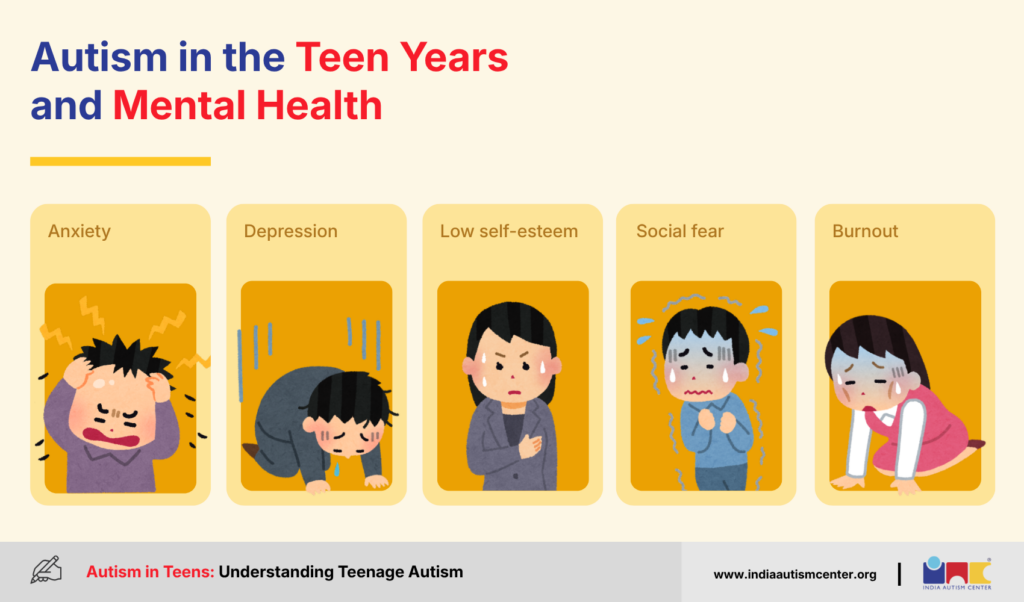
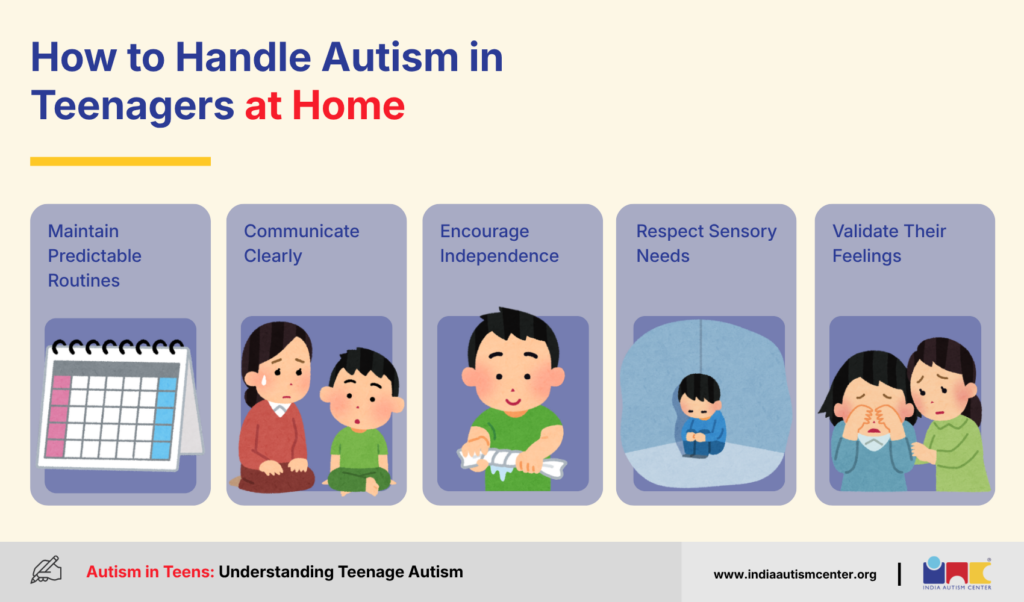
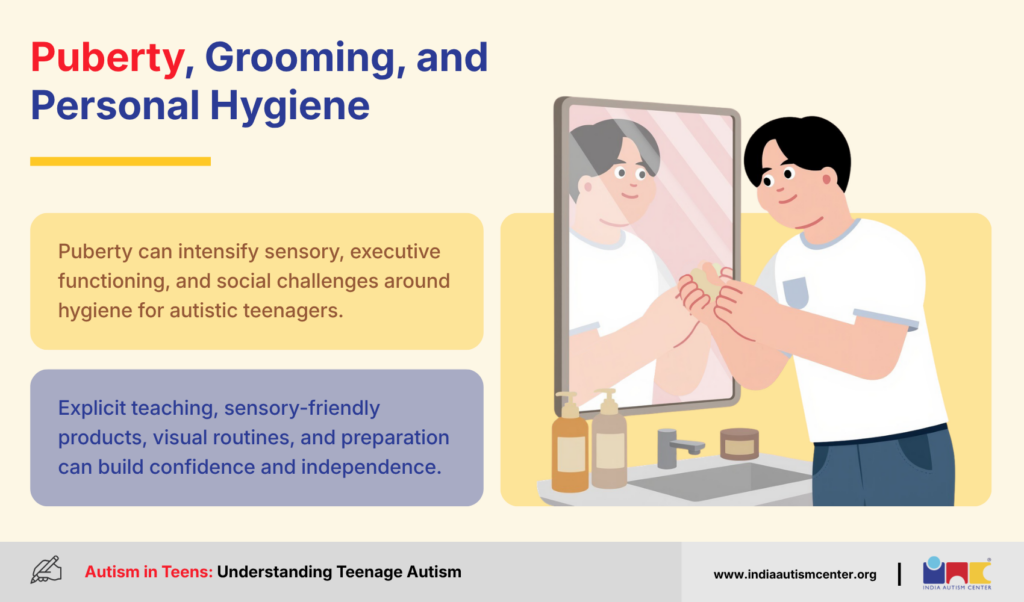
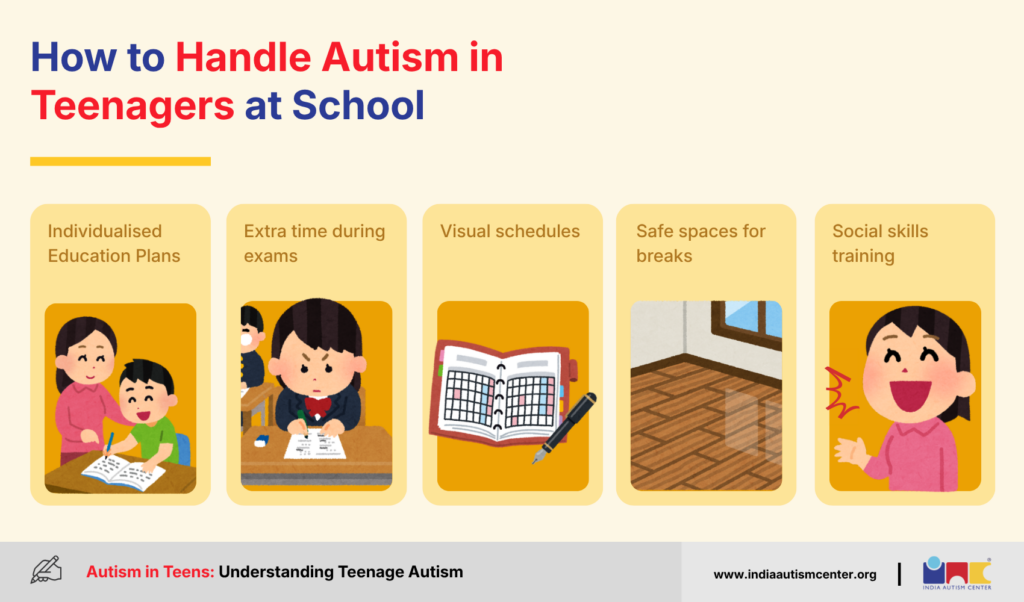
Parenting always comes with questions. However, dealing with an autistic child can sometimes feel overwhelming, especially if you are still learning about autism and how it affects behaviour, communication, and emotions.
Many parents ask us the same questions: Why does my child react differently? How can I support them better? What strategies actually work?
The good news is that with the right knowledge, patience, and structured support, you can create a nurturing environment where your child feels safe, understood, and able to grow.
In this guide, we will walk you through identifying and dealing with autistic child behaviours, and share practical tips to deal with an autistic child in everyday situations.
Understanding Autism Before Dealing With an Autistic Child
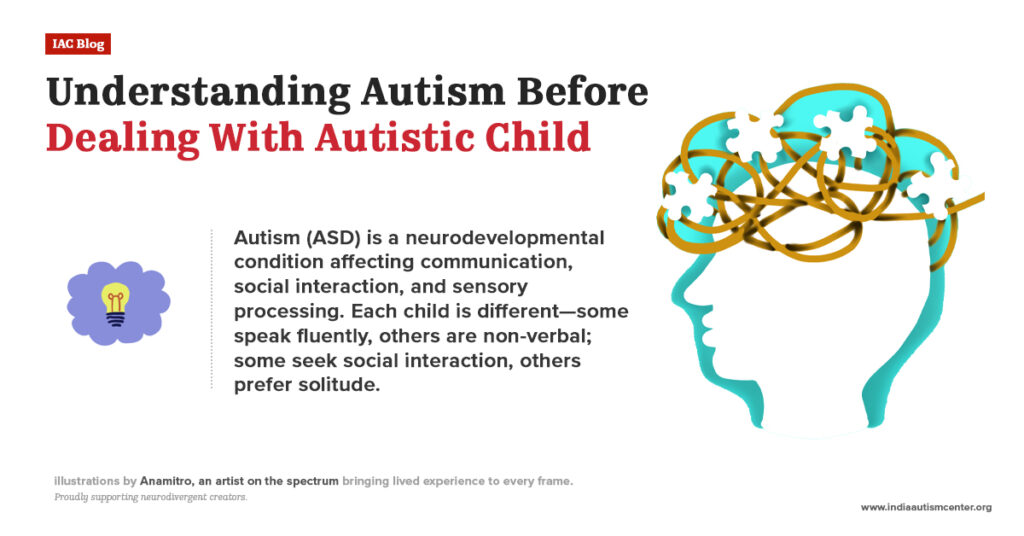
Autism Spectrum Disorder (ASD) is a neurodevelopmental condition that affects how a person communicates, interacts socially, and processes sensory information. Every autistic child is different. Some children may speak fluently, while others may communicate non-verbally. Some may enjoy social interaction, while others prefer solitude.
Therefore, when dealing with an autistic individual, we must focus on understanding their individual needs rather than expecting them to behave like a neurotypical person.
Early awareness makes a big difference. Identifying and dealing with autistic child behaviours early allows families to seek support, therapies, and structured guidance sooner.
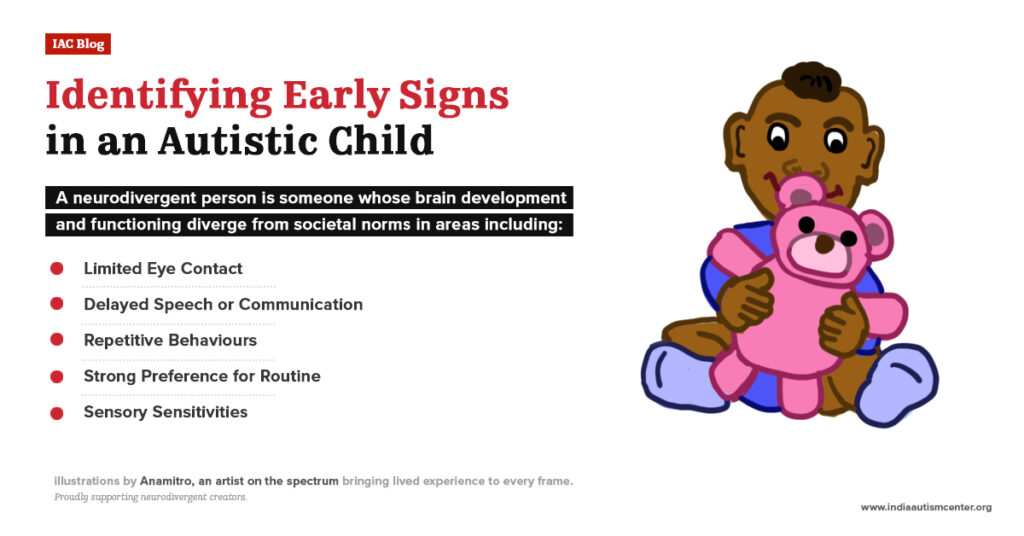
Here are some common early signs to watch for:
Limited Eye Contact
Your child may avoid eye contact during conversations or play. This often reflects differences in social communication rather than a lack of affection.
Delayed Speech or Communication
Some autistic children speak later than others or rely on gestures instead of words. When dealing with an autistic child, encouraging alternative communication methods can help.
Repetitive Behaviours
You may notice hand flapping, rocking, or repeating words. These behaviours often help children regulate their emotions or sensory input.
Strong Preference for Routine
Many autistic children prefer predictable routines. Even small changes in daily activities can cause stress.
Sensory Sensitivities
Your child might react strongly to loud sounds, bright lights, textures, or certain foods.
Recognising these signs is the first step in identifying and dealing with an autistic child’s needs effectively.
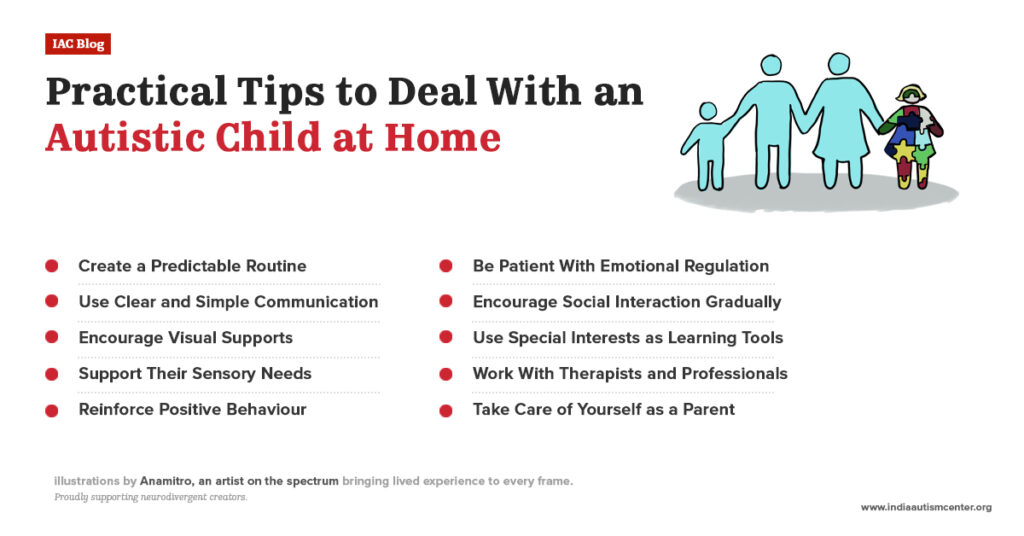
Practical Tips to Deal With an Autistic Child at Home
Once you begin to understand your child’s unique needs, everyday interactions become easier. Here are some practical tips to deal with an autistic child that parents and caregivers can start using immediately.
1. Create a Predictable Routine
Autistic children feel more comfortable when their day follows a clear structure.
We suggest creating a simple daily routine for meals, playtime, therapy, and sleep. This reduces anxiety and makes dealing with an autistic child’s transitions much easier.
2. Use Clear and Simple Communication
Keep instructions short and direct.
Instead of saying, “Can you please go and clean up all your toys now?” say, “Put the toys in the box.” This approach helps when dealing with an autistic child’s communication challenges.
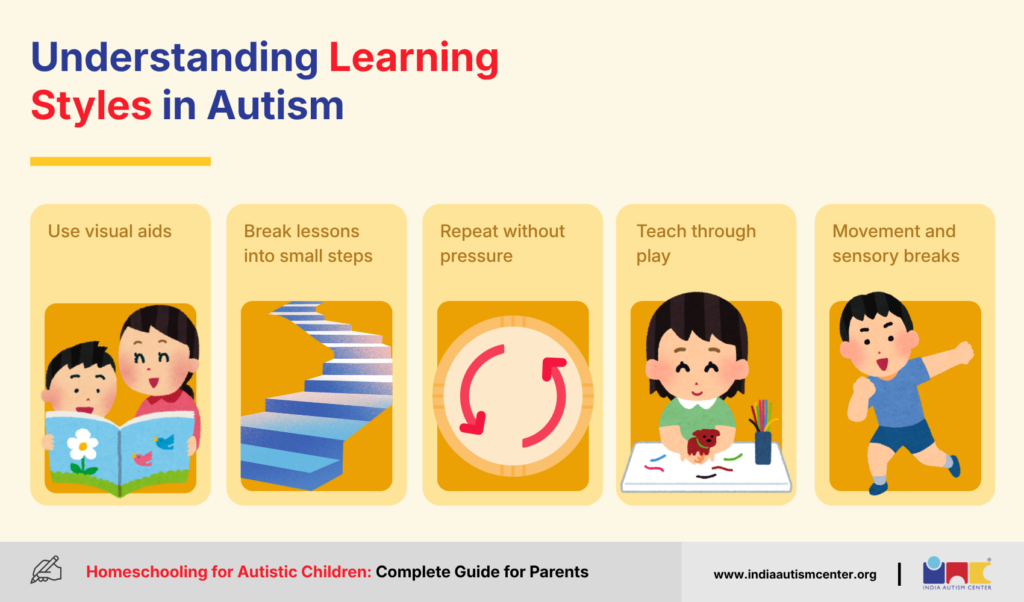
3. Encourage Visual Supports
Many autistic children understand visuals better than spoken instructions.
Use picture charts, schedules, or flashcards to show daily activities. Visual cues make identifying and dealing with an autistic child’s routines easier for both parents and children.
4. Support Their Sensory Needs
Your child may experience sensory overload from sounds, lights, or textures.
Provide quiet spaces, noise-cancelling headphones, or sensory toys to help them regulate. This can significantly improve your experience dealing with an autistic child’s sensory challenges.
5. Reinforce Positive Behaviour
Praise and rewards encourage learning.
When your child completes a task or behaves positively, acknowledge it immediately. Positive reinforcement is one of the most effective tips to deal with an autistic person’s behaviour.
6. Be Patient With Emotional Regulation
Autistic children may experience meltdowns when overwhelmed.
Stay calm and avoid raising your voice. Your calm response helps the child feel safe while dealing with emotional distress.
7. Encourage Social Interaction Gradually
Social skills develop at different speeds.
Start with small interactions, such as playing with siblings or one friend. Gradual exposure helps when identifying and dealing with autistic child’s social development.
8. Use Special Interests as Learning Tools
Many autistic children develop strong interests in specific topics.
Use these interests to teach new skills, improve communication, or encourage participation in activities. This strategy makes dealing with an autistic child’s learning more engaging.
9. Work With Therapists and Professionals
Professional support can make a major difference.
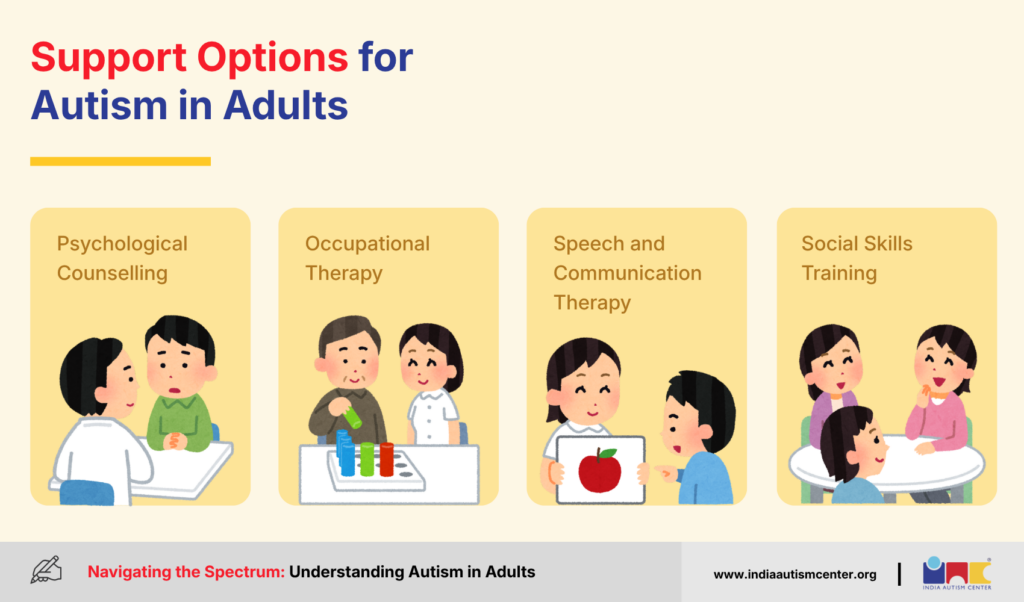
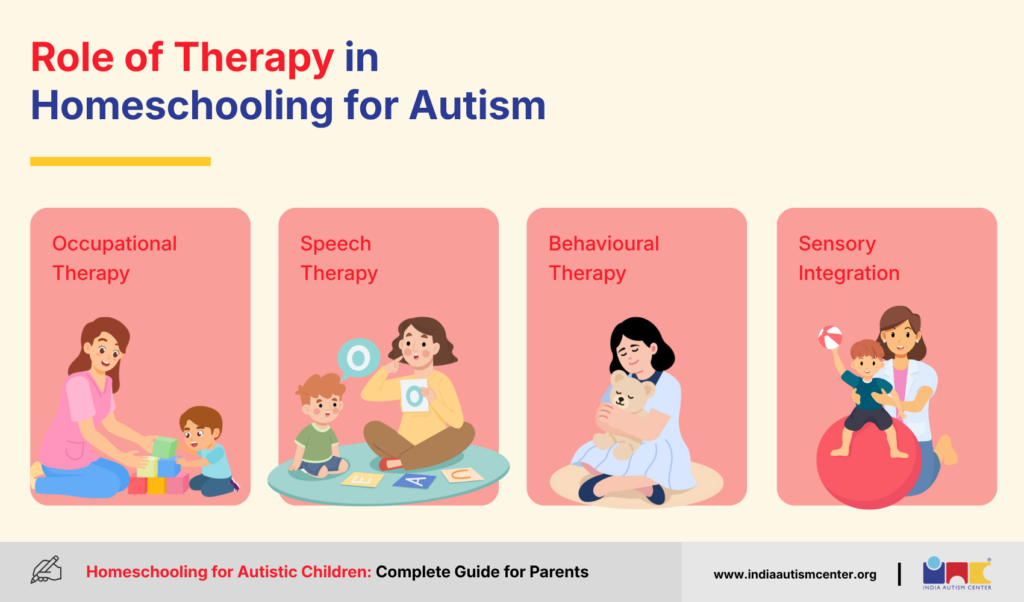
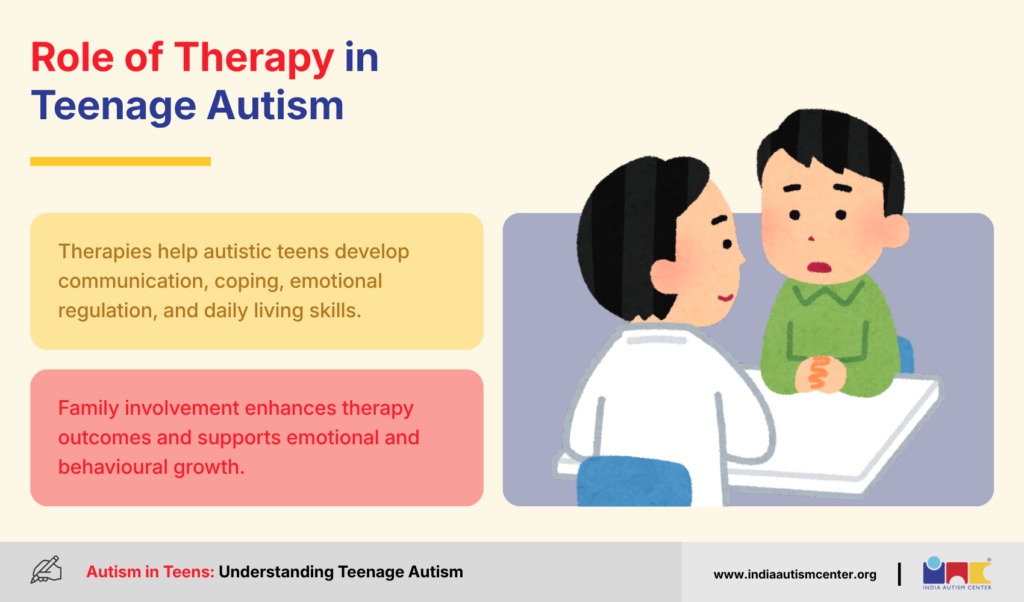
Speech therapists, occupational therapists, and behavioural specialists can guide families in identifying and dealing with autism effectively.
10. Take Care of Yourself as a Parent
Supporting an autistic child requires emotional strength and patience.
Take breaks when needed and seek support groups or professional guidance.
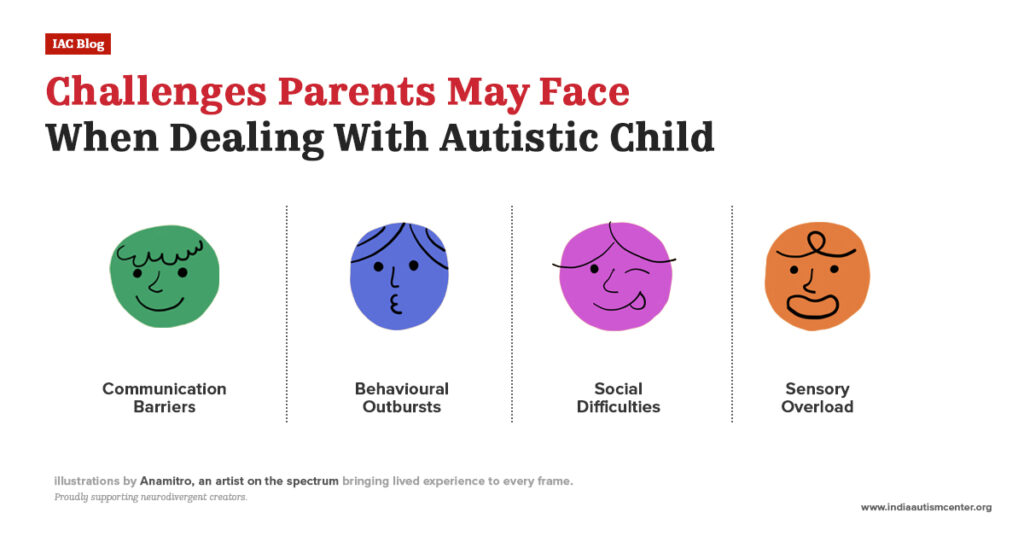
Challenges Parents May Face When Dealing With an Autistic Child
While every child is different, some challenges are common among families.
Communication Barriers
Children may struggle to express their needs clearly, which can lead to frustration for both the child and parents.
Behavioural Outbursts
Meltdowns can occur when the child feels overwhelmed, confused, or unable to communicate.
Social Difficulties
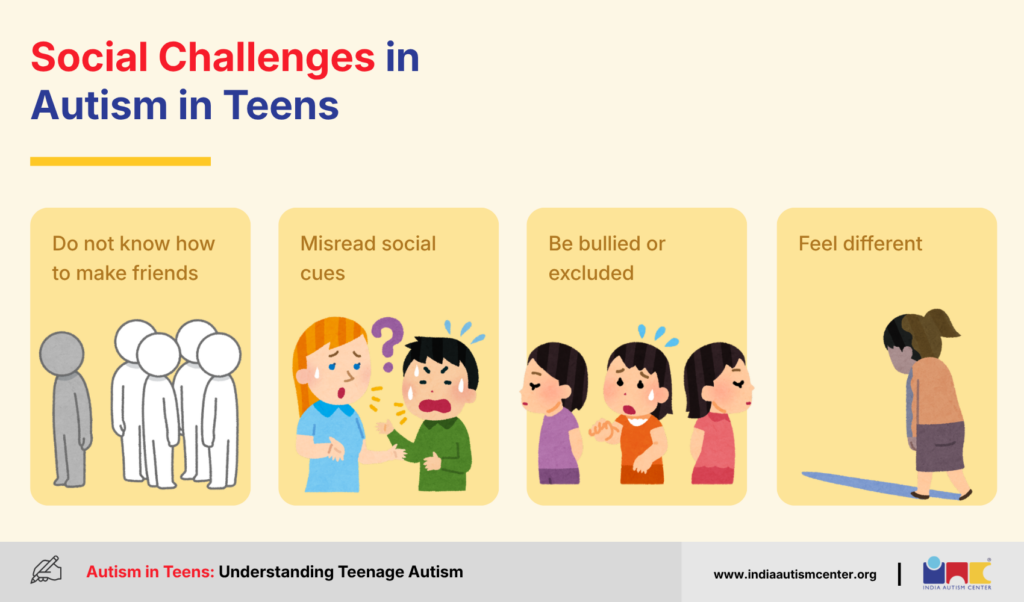
Your child may find it harder to form friendships or understand social cues.
Sensory Overload
Busy environments, loud noises, or crowded places can trigger anxiety.
Understanding these challenges helps parents become more prepared when dealing with an autistic child’s daily life situations.
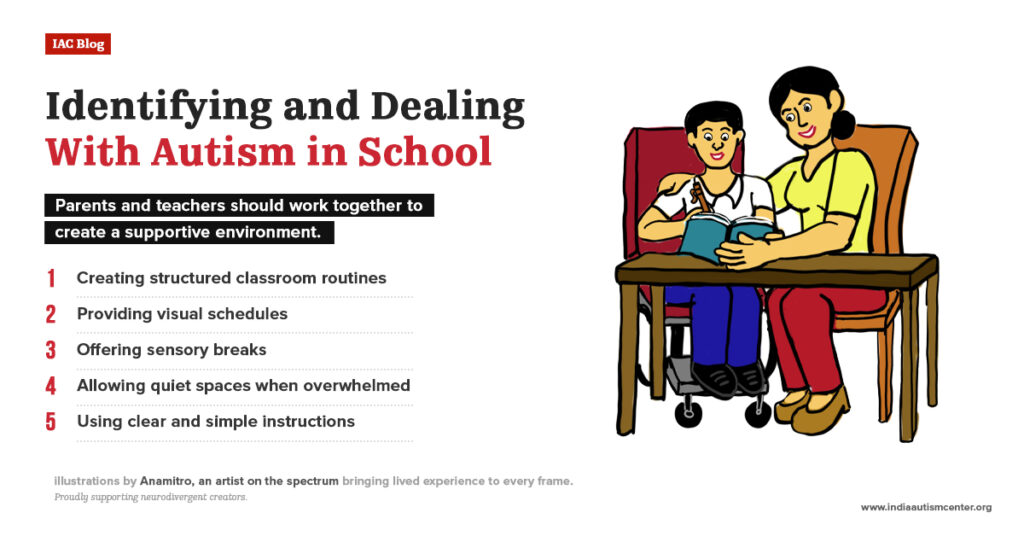
School environments can be challenging for autistic children. However, the right support can help them thrive.
Parents and teachers should work together to create a supportive environment.
Key strategies include:
Creating structured classroom routines
Providing visual schedules
Offering sensory breaks
Allowing quiet spaces when overwhelmed
Using clear and simple instructions
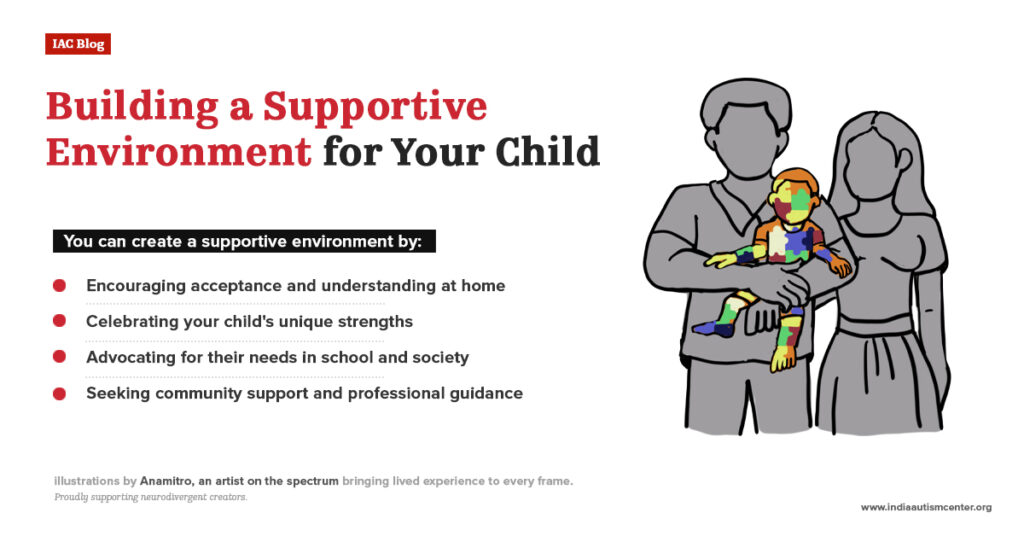
Building a Supportive Environment for Your Child
When dealing with an autistic child, the goal is not to change who they are. Instead, we focus on helping them navigate the world comfortably and confidently.
You can create a supportive environment by:
Encouraging acceptance and understanding at home
Celebrating your child’s unique strengths
Advocating for their needs in school and society
Seeking community support and professional guidance
Remember, progress may be gradual. However, every small step matters.
Learning about dealing with autistic child behaviours can feel overwhelming at first. Yet with the right approach, patience, and support, parents can build strong and meaningful connections with their children.
By identifying and dealing with autistic children’s needs early and applying practical tips to deal with autistic children, families can create an environment where autistic children feel safe, valued, and understood.
Most importantly, remember this: autism is not something that needs to be “fixed.” Instead, it is a different way of experiencing the world. When we understand this, dealing with autism becomes less about managing challenges and more about supporting potential.
Frequently Asked Questions (FAQs)
What is the best way of dealing with an autistic child at home?
The best approach when dealing with autistic child at home is to create a predictable routine, use simple communication, and provide a calm environment. Consistency helps children feel secure and reduces anxiety.
What are some practical tips to deal with an autistic child’s behaviour?
Some effective tips to deal with an autistic child’s behaviour include using visual schedules, reinforcing positive actions, understanding sensory sensitivities, and staying patient during emotional outbursts.
How can parents start identifying and dealing with the early signs of an autistic child?
Parents can begin identifying and dealing with an autistic child early by observing behaviours such as limited eye contact, delayed speech, repetitive movements, or strong attachment to routines. Early consultation with professionals can help guide the next steps.
Why is routine important when dealing with an autistic child?
Routine helps autistic children feel safe and prepared for what comes next. When dealing with autistic child, predictable daily schedules reduce stress and improve their ability to adapt to activities and transitions.
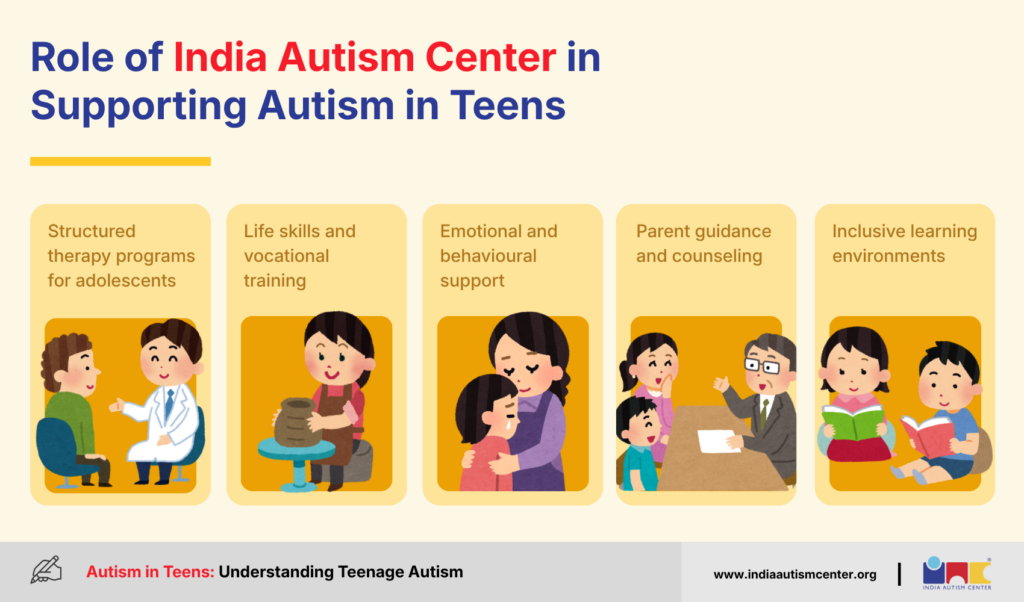
For expert insights, support services, and inclusive learning initiatives, visit the India Autism Center.
Understanding autism stimming becomes important because when you first notice your child repeating certain movements or sounds, you may feel worried or confused.
You might ask yourself, “Why is my child doing this?” or “Is this behaviour linked to autism?”
In this guide, we explain what stimming in autism spectrum disorder (ASD) means, why it happens, common examples, and whether you should try to stop it.
What Is Stimming in Autism Spectrum Disorder?
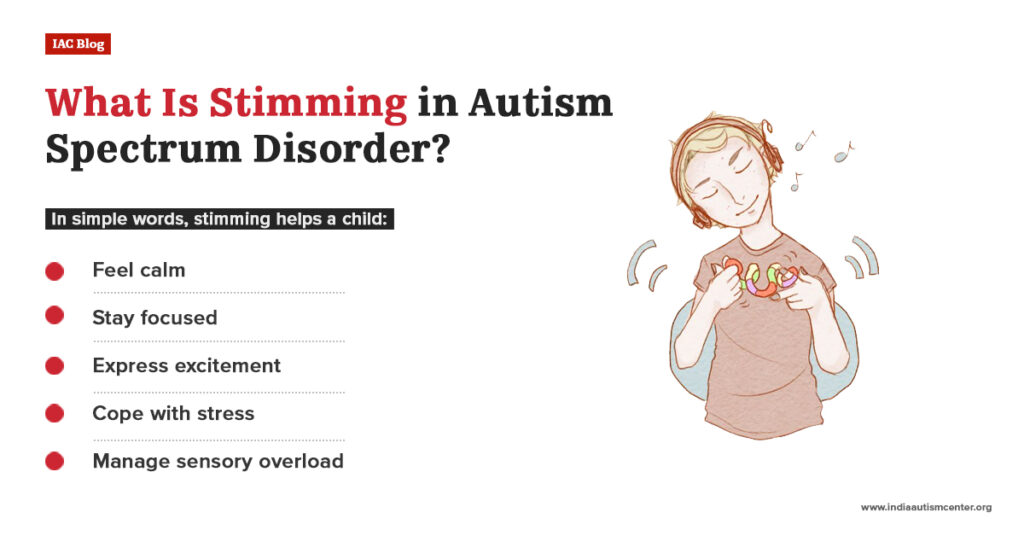
Stimming in autism refers to self-stimulating behaviours. These are repetitive movements, sounds, or actions that help a person regulate their emotions or sensory input.
In simple words, stimming helps a child:
Feel calm
Stay focused
Express excitement
Cope with stress
Manage sensory overload
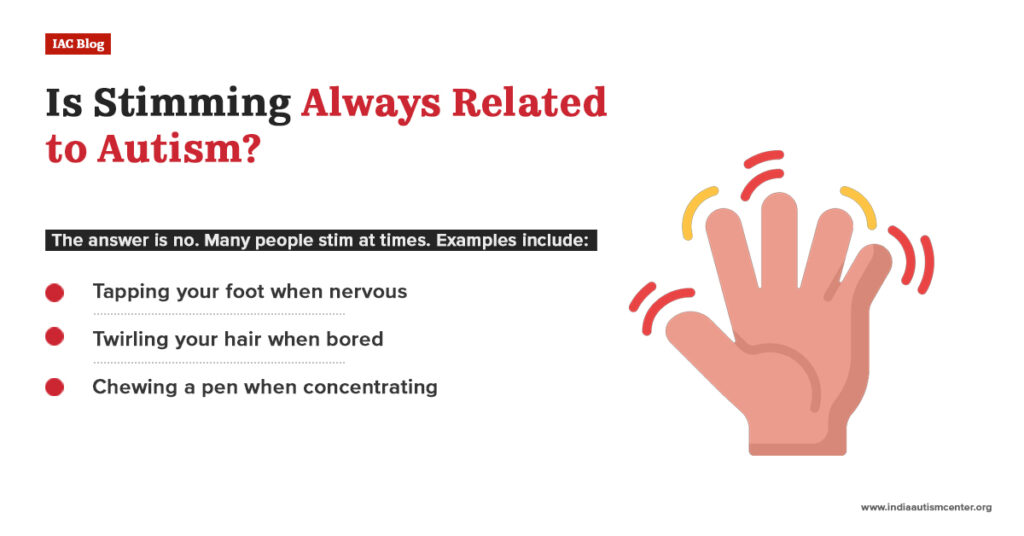
Stimming is common in autistic individuals, but it can also appear in people without autism.
So, what is stimming in autism spectrum disorder? It is a natural coping strategy that supports emotional and sensory balance.
Children with autism stim because their brains process feelings and sensory information differently. Autism stimming helps them manage their body, emotions, and environment. It is not random behaviour. It has a purpose.
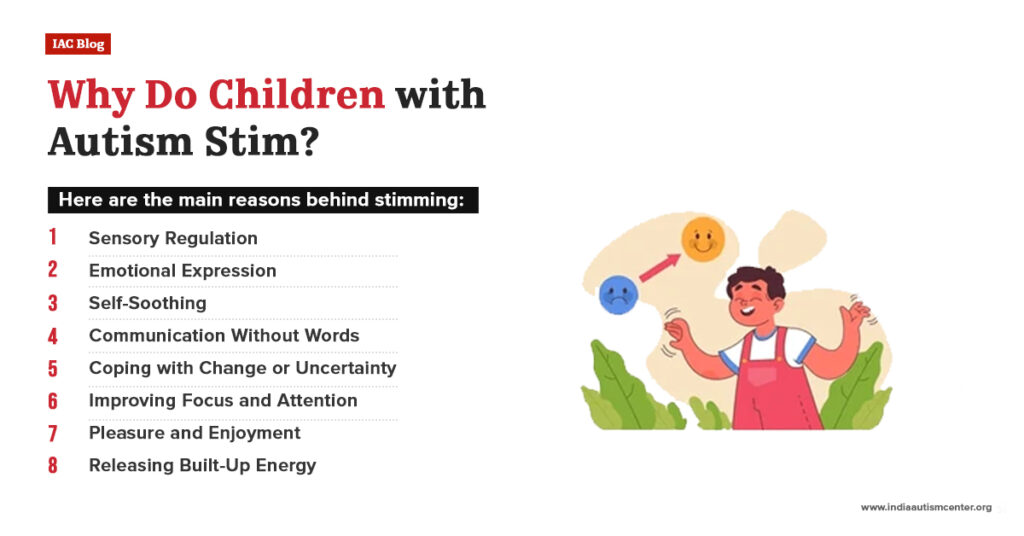
Here are the main reasons behind stimming:
1. Sensory Regulation
Many autistic children experience sounds, lights, smells, or touch more strongly than others. Stimming helps them control these sensations. For example, rocking or hand flapping may help block out loud noise or bright light.
2. Emotional Expression
Some children find it hard to explain how they feel using words. Stimming becomes their way to show emotions such as happiness, fear, anger, or excitement. In this way, autism stimming examples can act like emotional language.
3. Self-Soothing
Stimming often works like a calming tool. When a child feels anxious or overwhelmed, repeating a movement or sound helps their body relax and feel safe again.
4. Communication Without Words
When speech is limited, stimming can send a message. For example, increased stimming may mean the child is tired, stressed, or needs a break. So, what is stimming in autism spectrum disorder? It is also a form of non-verbal communication.
5. Coping with Change or Uncertainty
Changes in routine can feel frightening for autistic children. Stimming helps them cope when something feels unpredictable or unfamiliar.
6. Improving Focus and Attention
Some children stim to help their brain concentrate. A small movement, such as tapping or rocking, can help them stay engaged with learning or listening.
7. Pleasure and Enjoyment
Not all stimming happens because of stress. Sometimes children stim simply because it feels good or fun. For example, spinning or watching moving objects can be enjoyable.
8. Releasing Built-Up Energy
Stimming can help release physical tension or excess energy, especially when a child has been sitting still for too long.
Important Point for Parents
Stimming is not bad behaviour. It is a coping strategy. Before asking how to reduce stimming behaviors in autism, we must understand why the child is stimming.
Instead of asking: “How do I stop this?” We should ask: “What is my child feeling or experiencing right now?”
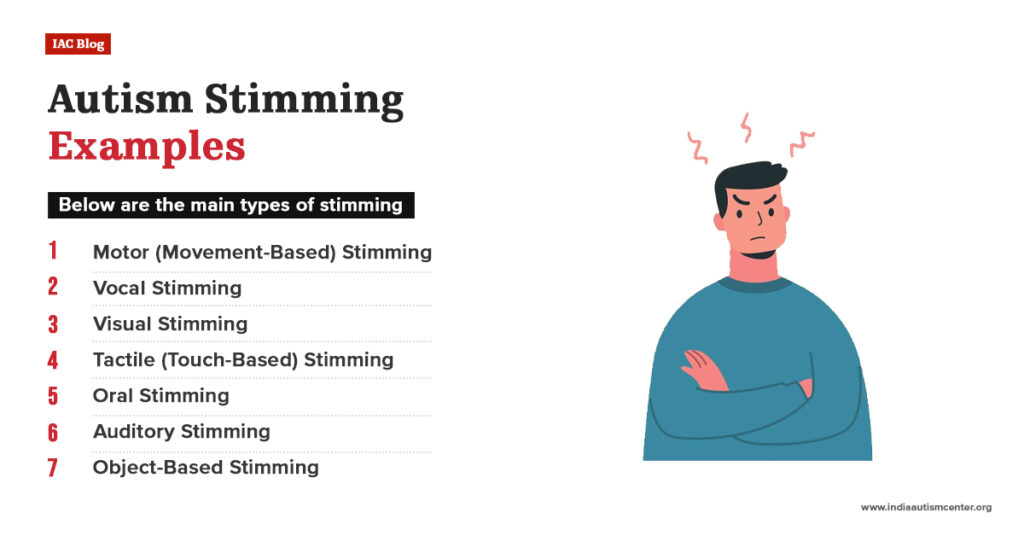
Autism Stimming Examples
Autism stimming can look different from one child to another. These behaviours involve repeated movements, sounds, or actions that help the child regulate emotions or sensory input. Understanding these autism stimming examples helps us respond with support instead of fear.
Below are the main types of stimming, with easy explanations.
1. Motor (Movement-Based) Stimming
This type involves body movements that are repeated again and again. Examples include hand flapping, rocking, spinning, jumping, or pacing. These movements help the child release energy or feel calm.
2. Vocal Stimming
This includes repeated sounds or words. Examples are humming, making clicking noises, repeating certain words, or echoing phrases. This type of autism stimming may help the child feel relaxed or focused.
3. Visual Stimming
This involves looking at objects or lights in a repetitive way. Examples include staring at ceiling fans, watching spinning toys, or moving fingers in front of the eyes. These actions help control visual input.
4. Tactile (Touch-Based) Stimming
This relates to the sense of touch. Examples include rubbing fabrics, scratching surfaces, touching textured objects, or tapping the skin. It helps the child feel grounded and secure.
5. Oral Stimming
This involves the mouth and chewing behaviours. Examples include chewing toys, biting clothes, licking objects, or sucking on fingers. This type of stimming helps with self-soothing and sensory regulation.
6. Auditory Stimming
This focuses on sound. Examples include repeating noises, tapping objects to hear the sound, or listening to the same sound again and again. It helps the child manage how they hear their environment.
7. Object-Based Stimming
This involves using objects in a repetitive way. Examples include spinning wheels, lining up toys, or flicking strings. These actions provide comfort and predictability.
These autism stimming examples are not meaningless habits. They serve important purposes such as:
calming the body
expressing emotions
coping with stress
managing sensory overload
When we ask what stimming is in autism spectrum disorder, the answer is simple: It is a natural way for the child to regulate their feelings and senses.
When Do These Behaviours Need Support?
Stimming may need guidance only when:
It causes physical harm
It stops learning or communicating
Puts the child at risk
Leads to social isolation
In such cases, the focus is not punishment but learning how to reduce stimming behaviours in autism safely by offering better coping tools.
Is Autism Stimming Harmful?
In most cases, autism stimming is not harmful. It is a natural way for autistic children to manage their feelings and sensory experiences. Stimming often helps them stay calm, feel safe, and cope with their surroundings.
So, when we ask, “Is stimming always related to autism?” or “Is stimming dangerous?”, the answer is usually no. Stimming is often helpful rather than harmful.
When Stimming Is Not Harmful
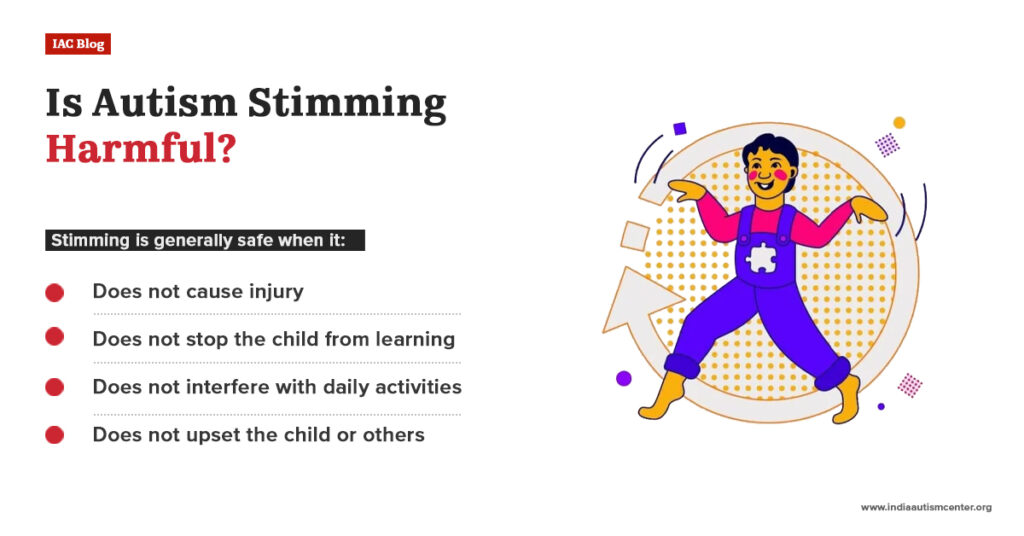
Stimming is generally safe when it:
does not cause injury
does not stop the child from learning
does not interfere with daily activities
does not upset the child or others
For example, hand flapping, rocking, or humming may simply help the child feel relaxed or focused. These types of autism stimming examples support emotional balance and self-regulation.
When Stimming Can Become a Concern
Stimming may need attention when it:
causes physical harm (such as head banging or skin picking)
affects speech or social interaction
prevents the child from taking part in school or play
becomes more intense over time
puts the child in unsafe situations
In these cases, the behaviour is not “bad”, but it shows that the child may be overwhelmed, anxious, or unable to cope with their environment.
Why We Should Not Automatically Stop Stimming
Trying to stop all stimming can:
increase anxiety
remove a coping method
lead to emotional distress
cause new problem behaviours
This is why the treatment of stimming in autism does not aim to remove stimming completely. Instead, it focuses on:
understanding the cause
reducing harmful stims
teaching safer alternatives
improving emotional regulation
Supportive Approach for Parents
Instead of asking, “How do I stop this behaviour?” We should ask, “What is my child trying to manage or communicate?”
Before thinking about how to reduce stimming behaviors in autism, we should:
Observe when it happens
Look for emotional or sensory triggers
Provide calm and safe coping tools
This helps the child feel understood rather than controlled.
How to Reduce Stimming Behaviours in Autism Safely
Before we try to reduce any behaviour, we must understand one thing: autism stimming is a coping tool, not a bad habit. Our goal is not to remove stimming completely. Instead, we help the child use safer and more appropriate ways to regulate emotions and sensory needs.
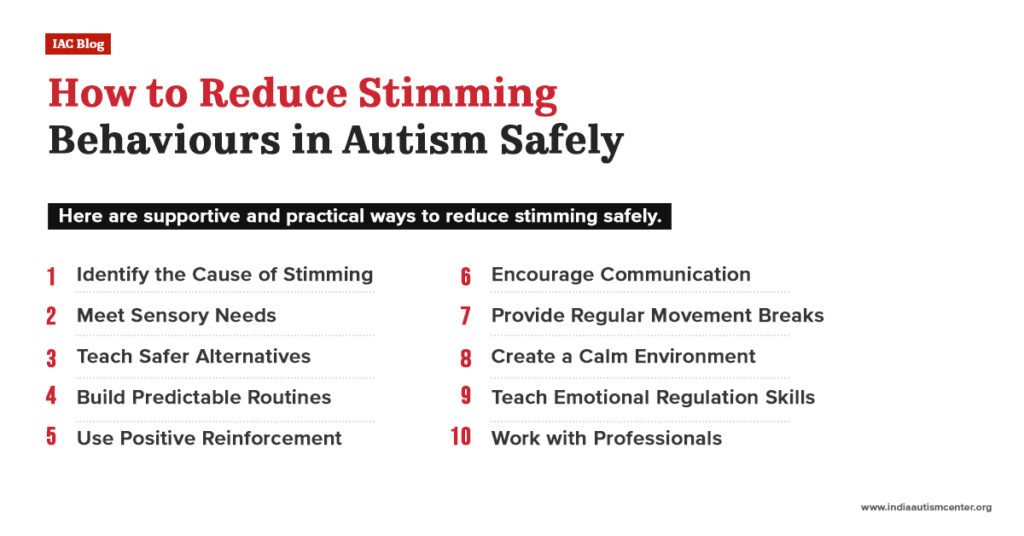
Here are supportive and practical ways to reduce stimming safely.
1. Identify the Cause of Stimming
We should observe when stimming happens and what comes before it. Your child may stim due to stress, excitement, boredom, or sensory overload. Once we know the trigger, we can respond in a better way.
2. Meet Sensory Needs
Many stimming behaviours happen because the child’s sensory system is overwhelmed or under-stimulated. We can provide sensory tools such as soft toys, textured objects, or quiet spaces to help balance their sensory input.
3. Teach Safer Alternatives
If a stim is harmful, we replace it with a safer behaviour rather than stopping it suddenly. For example, instead of head banging, we can teach squeezing a cushion or holding a stress ball.
4. Build Predictable Routines
Uncertainty increases anxiety and stimming. When we use clear routines and visual schedules, the child feels safer and needs fewer self-soothing behaviours.
5. Use Positive Reinforcement
We should praise and reward calm behaviour and safe coping skills. This helps the child learn better ways to manage emotions without feeling punished.
6. Encourage Communication
Some stimming happens because the child cannot express needs using words. We can teach simple gestures, pictures, or communication tools so they can say when they feel tired, scared, or overstimulated.
7. Provide Regular Movement Breaks
Children often stim when they have too much energy or have been sitting still for too long. Short movement breaks help release tension and reduce the need for repetitive actions.
8. Create a Calm Environment
Too much noise, light, or activity can increase autism stimming. We can reduce background noise, use soft lighting, and limit sudden changes to make the space more comfortable.
9. Teach Emotional Regulation Skills
Children need help understanding and managing their feelings. Simple breathing exercises, calm-down corners, or quiet time can reduce anxiety-based stimming.
10. Work with Professionals
Therapists can assess why stimming happens and design personalised strategies. This is an important part of the treatment of stimming in autism, especially when behaviours affect safety or learning.
Important Reminder for Parents
When we think about how to reduce stimming behaviours in autism, we must remember:
Not all stimming should be reduced
Only harmful or disruptive stims need guidance
The child still needs a way to self-regulate
When we understand autism stimming, we realise it is not bad behaviour. It is a way your child manages emotions and sensory experiences. Our role is to guide and support, not to control or shame.
Below is a clear guide on what we should and should not do.
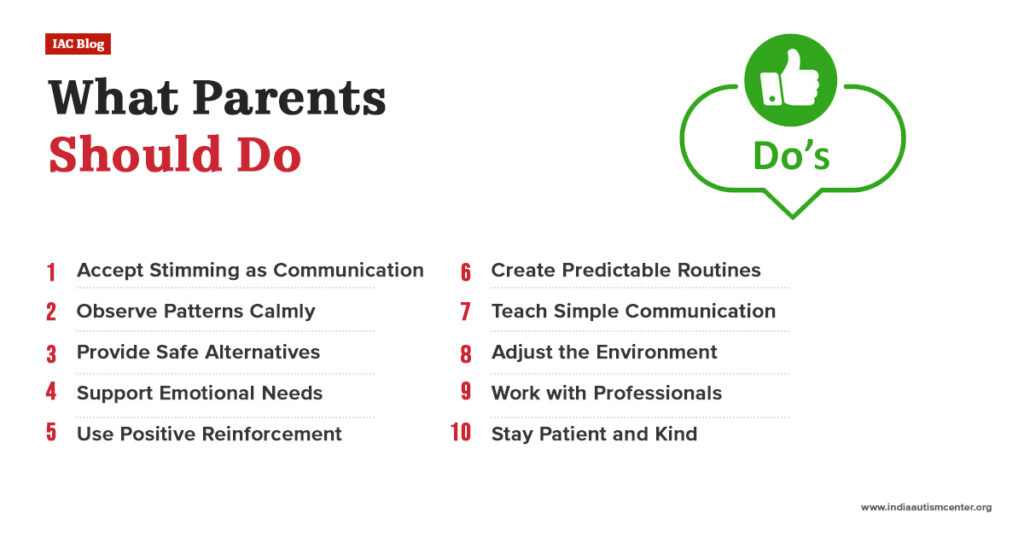
What Parents Should Do
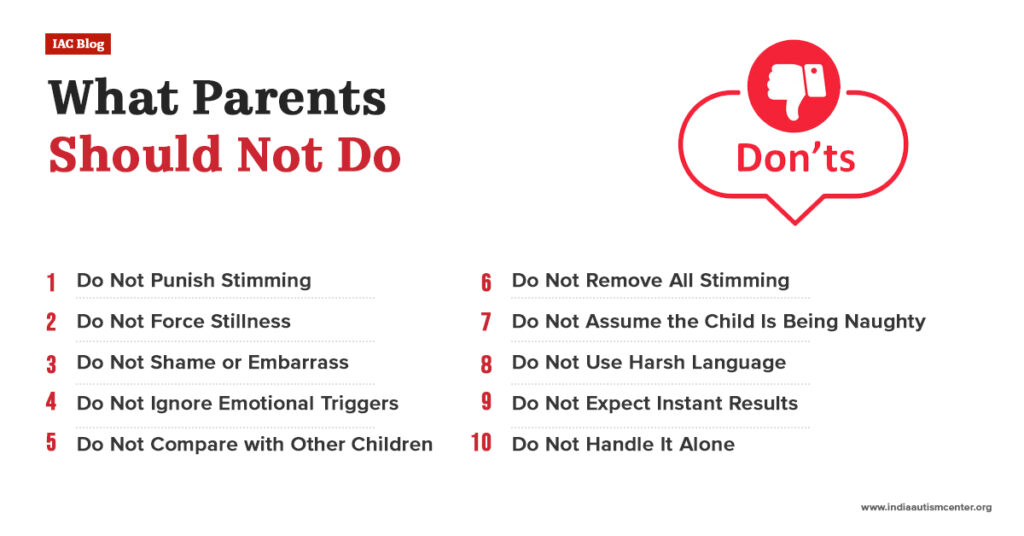
1. Accept Stimming as Communication
We should see stimming as a message, not a mistake. It tells us how the child feels inside, such as stress, excitement, or overload.
2. Observe Patterns Calmly
We need to notice when stimming happens, where it happens, and what happens before it. This helps us understand the trigger behind the behaviour.
3. Provide Safe Alternatives
If a stim is harmful, we should gently replace it with a safer option, such as squeezing a ball instead of hitting or chewing a toy instead of biting clothes.
4. Support Emotional Needs
We should help the child feel secure by offering comfort, quiet time, or reassurance when they seem overwhelmed.
5. Use Positive Reinforcement
We must praise and encourage calm behaviour and healthy coping skills. This builds confidence and reduces stress-based stimming.
6. Create Predictable Routines
Consistent routines make children feel safe. When anxiety is lower, the need for self-soothing behaviours also becomes lower.
7. Teach Simple Communication
We should help the child express needs using words, pictures, or gestures, so stimming is not their only way to communicate.
8. Adjust the Environment
We can reduce noise, strong light, or crowds when possible. A calmer environment lowers sensory overload and stimming intensity.
9. Work with Professionals
Therapists can guide us in the treatment of stimming in autism by creating personalised strategies for the child’s needs.
10. Stay Patient and Kind
Progress takes time. We must remember that the child is learning skills, not misbehaving on purpose.
What Parents Should Not Do
If you are reading this, chances are you have watched your child rock back and forth during a crowded family gathering, or bang their head against the wall after a long school day, and felt a knot of worry in your stomach. That worry is completely valid. You are not overreacting. You are paying attention – and that is exactly what your child needs.
Here is the truth, though: autism stimming is not a flaw to be fixed. It is a coping tool. A child who flaps their hands or hums repeatedly is not misbehaving. They are managing a nervous system that experiences the world far more intensely than most of us can imagine. Our goal, then, is not to silence that coping tool. It is to make sure it stays safe, does not block learning, and – where needed – gets channelled into something that works even better.
With that framing in mind, here are ten practical, evidence-informed ways to reduce stimming behaviours in autism safely, followed by clear guidance on when to bring in professional support.
1. Identify the Cause of Stimming
Every stim has a story. Before you can change the behaviour, you need to read that story.
Observe your child closely for a week. Note when the stimming happens, where it happens, and what immediately precedes it. You may notice a clear pattern – for example, your child starts spinning in circles every afternoon when the pressure cooker goes off in the kitchen, or begins rocking intensely just before a maths test at school.
Common triggers include sensory overload, boredom, excitement, hunger, fatigue, and transitions between activities. In many Indian households, Diwali or wedding season – with their firecrackers, loud music, and unpredictable crowds – can spike stimming significantly. That is not a coincidence. That is your child’s nervous system working overtime.
Try this: Keep a simple trigger diary for seven days. Write down the time, the environment, what happened just before, and what the stim looked like. Patterns will emerge faster than you expect.
Do not do this: Do not assume the stim is random or attention-seeking before you have tracked it. Acting on assumptions leads to the wrong response.
2. Meet Sensory Needs in Autism
Many stimming behaviours exist because the child’s sensory system is either overwhelmed or starved of input. This is one of the most direct ways to address sensory needs in autism.
A child who chews their collar all day may need more oral sensory input. One who rocks constantly may need more proprioceptive (deep pressure) feedback. Meeting these needs proactively – before the child reaches overload – can reduce stimming dramatically.
Try this: Introduce a small “sensory toolkit” at home. This could include a chewable silicone pendant, a weighted lap pad, a textured stress ball, or a small trampoline for jumping. Offer these tools during known high-stress periods, such as homework time or before a family outing.
Do not do this: Do not wait for the stim to escalate before offering the tool. Proactive sensory support works far better than reactive management.
3. Teach Safer Alternatives
If a stim is physically harmful – head banging, skin picking, biting themselves – the priority is to replace it with a safer behaviour that meets the same sensory need. Stopping it cold without offering an alternative is like removing a pressure valve without releasing the pressure.
For example, a child who bangs their head against a wall may be seeking deep pressure on the skull. A safer alternative could be pressing their forehead firmly into a large cushion, or wearing a snug-fitting hat. A child who bites their hand might accept a chewy toy instead.
Many parents in India feel embarrassed when their child head-bangs in a temple or at a relative’s home. The instinct is to physically restrain the child. Instead, carry a small, firm cushion in your bag. When you sense the stim building, offer the cushion quietly. It redirects without a scene.
Try this: For each harmful stim, identify what sensory input it provides (pressure, vibration, pain relief, etc.) and find one safer object that delivers something similar. Work with a therapist to confirm the match.
Do not do this: Do not physically restrain or hold the child’s hands down. This increases panic and can make the behaviour more intense.
4. Build Predictable Routines
Uncertainty is one of the biggest drivers of anxiety-based stimming in autism. When a child does not know what comes next, their nervous system goes on high alert – and stimming is how they self-soothe through that alert state.
Predictable routines act like a map. They tell the child’s brain: you are safe, you know what is happening, you do not need to brace yourself.
School exam seasons, summer vacations that disrupt daily schedules, or sudden changes like a grandparent’s visit can all destabilise a child’s routine. During these periods, parents often report a spike in stimming. A simple visual schedule – pictures or written steps showing the day’s plan – can buffer that anxiety significantly.
Try this: Use a whiteboard or printed picture cards to display the day’s routine each morning. Even if the content changes, the ritual of reviewing the schedule together creates predictability. Apps like Choiceworks (available on iOS and Android) can help.
Do not do this: Do not spring surprises, even pleasant ones like a surprise trip to the park. Give at least 10–15 minutes of advance notice for any change.
5. Use Positive Reinforcement
When a child manages to use a safer alternative or gets through a stressful situation without escalating, that moment deserves genuine acknowledgement. Positive reinforcement is not bribery – it is the brain’s learning mechanism.
Praise needs to be specific and immediate. “Good boy” is vague. “I noticed you squeezed your stress ball instead of hitting the wall – that was brilliant” is specific and teaches the child exactly what to repeat.
Try this: Build a simple reward chart. For younger children, stickers work beautifully. For older children, a points system redeemable for screen time or a favourite activity can be highly motivating. Keep the bar achievable – reward effort, not perfection.
Do not do this: Do not withhold rewards as punishment for stimming. That conflates two separate issues and increases anxiety, which will increase stimming.
6. Encourage Communication
A significant portion of stimming happens because the child cannot find words for what they are experiencing. When a child cannot say “this room is too loud and I need to leave,” the body says it instead – through rocking, humming, or covering their ears.
Teaching even basic communication – a gesture, a picture card, a simple phrase – gives the child a more efficient tool than stimming to signal their state.
Many Indian families rely heavily on verbal communication and may not have encountered AAC (Augmentative and Alternative Communication) tools. Picture Exchange Communication System (PECS) cards, which can be printed at home, or simple apps like Proloquo2Go or LetMeTalk (free on Android) can open a communication channel that dramatically reduces distress-driven stimming.
Try this: Teach your child two or three key phrases or picture cards: “too loud,” “I need a break,” “I am scared.” Practise them during calm moments so they are available during stressful ones.
Do not do this: Do not assume that because a child is non-verbal, they cannot communicate. Every child can learn some form of expression with the right support.
7. Provide Regular Movement Breaks
Children with autism often stim more intensely when they have been sedentary for too long. The body builds up tension, and stimming is the release valve. Scheduled movement breaks prevent that build-up from reaching a tipping point.
This is especially relevant in Indian school settings, where children are often expected to sit still for 40–45 minutes at a stretch. Many mainstream schools are not yet equipped to offer structured movement breaks, which means parents need to build this into the home routine.
Try this: Every 20–30 minutes during homework or structured activity, offer a 5-minute movement break. Options include jumping on a small trampoline, doing 10 star jumps, carrying a heavy bag of books (proprioceptive input), or a short walk. These are not rewards – they are neurological necessities.
Do not do this: Do not cancel movement breaks as a consequence for bad behaviour. That removes a regulatory tool and makes the next hour harder, not easier.
8. Create a Calm Environment
Too much noise, harsh lighting, strong smells, or visual clutter can push a child’s sensory system past its threshold – and autism stimming escalates in response. Modifying the environment is one of the fastest and most underused strategies available to Indian parents.
Many Indian homes are multi-generational and genuinely noisy – TV running in the background, relatives visiting, pressure cookers, mixers, and traffic outside. None of this is anyone’s fault. But for a child with heightened sensory needs, it is a constant assault. Even small changes make a measurable difference.
Try this: Designate one corner of the house as a “calm corner” – a low-stimulation space with soft lighting (a simple lamp rather than a tube light), a bean bag or floor cushion, and a few favourite sensory objects. Let the child go there whenever they need to regulate. This is not a time-out; it is a refuelling station.
Do not do this: Do not dismiss environmental modifications as impractical. Even closing a door, switching off one TV, or drawing a curtain can lower the sensory load enough to make a difference.
9. Teach Emotional Regulation Skills
Children with autism often have difficulty recognising what they are feeling and even more difficulty knowing what to do about it. Emotional regulation skills – the ability to notice, name, and manage emotions – are learnable. They just need to be taught explicitly, step by step.
Simple techniques include belly breathing (breathe in for 4 counts, hold for 2, out for 6), the “5-4-3-2-1” grounding exercise (name 5 things you can see, 4 you can touch, etc.), and using an emotion chart to point to how they feel.
Try this: Practise one calming technique together every day during a calm moment – not during a meltdown. The brain cannot learn new skills when it is in crisis. Repetition during calm periods means the skill becomes automatic when it is needed most.
Do not do this: Do not introduce a new calming technique for the first time during a meltdown. It will not work, and both of you will feel like failures.
10. Work with Professionals
Home strategies are powerful, but they work best when they are designed alongside a qualified professional who has assessed your specific child. When stimming is frequent, intense, or causing harm, professional support is not optional – it is essential.
A good therapist will assess the function of each stim, identify the sensory and emotional triggers, and design a personalised plan. This is the backbone of any serious approach to how to control stimming in a way that is both safe and sustainable.
Try this: Ask your child’s paediatrician for a referral to an occupational therapist or developmental paediatrician as a first step. Be specific: describe the stims, their frequency, and any safety concerns.
Do not do this: Do not try to implement a full behaviour management programme from a YouTube video alone. Without professional assessment, you risk targeting the wrong behaviour or missing an underlying medical cause.
Conclusion
When we understand what stimming is in autism spectrum disorder, we stop seeing it as a problem and start seeing it as communication.
Instead of asking, “How do we stop this?”, we should ask: “What is my child trying to tell me?”
By learning the meaning behind autism stimming examples, we create safer, kinder, and more supportive environments for autistic children.
Stimming is not a flaw. It is a coping tool. And with the right guidance, it can become a strength rather than a struggle.
Important Reminder for Parents
1. When thinking about how to reduce stimming behaviors in autism, keep these three principles close:
2. Not all stimming should be reduced. Safe stims that help your child regulate are doing their job.
3. Only harmful or significantly disruptive stims need active guidance. The bar is safety and functioning, not social appearance.
4. Your child still needs a way to self-regulate. If you reduce one stim without offering an alternative, another will take its place.
Understanding autism stimming means recognising it as communication, not misbehaviour. Your role is to guide and support – not to control or shame. Every step you take to understand your child’s sensory world is a step toward a calmer, more connected life for both of you.
Frequently Asked Questions (FAQs)
What is stimming in autism spectrum disorder?
Stimming in autism refers to repetitive movements, sounds, or actions that help an autistic person regulate emotions and sensory input. In autism, stimming behaviours help reduce anxiety, express feelings, and cope with overwhelming environments. Stimming is a natural coping strategy, not bad behaviour.
Is stimming always related to autism?
No, stimming is not always related to autism. Many people stim when they feel nervous, bored, or excited, such as tapping a foot or biting a pen. However, in autism, stimming tends to happen more often and may look more noticeable or intense.
What are some common autism stimming examples?
Common autism stimming examples include hand flapping, rocking, spinning, humming, repeating words, chewing objects, staring at lights, and rubbing textures. Each child shows stimming differently, depending on their sensory needs and emotions.
How can we reduce stimming behaviors in autism safely?
When thinking about how to reduce stimming behaviors autism, the goal is not to stop stimming completely. We should first understand the cause, then offer safer alternatives, sensory tools, and calm routines. Support from therapists is often part of the treatment of stimming in autism, especially if the behaviour causes harm or affects learning.
For expert insights, support services, and inclusive learning initiatives, visit the India Autism Center.
How to handle autism meltdowns is one of the most common and grave concerns of both parents and caregivers. Autism meltdowns can feel overwhelming for both the child and the caregiver. Many parents worry that they are doing something wrong when their child suddenly cries, screams, or loses control.
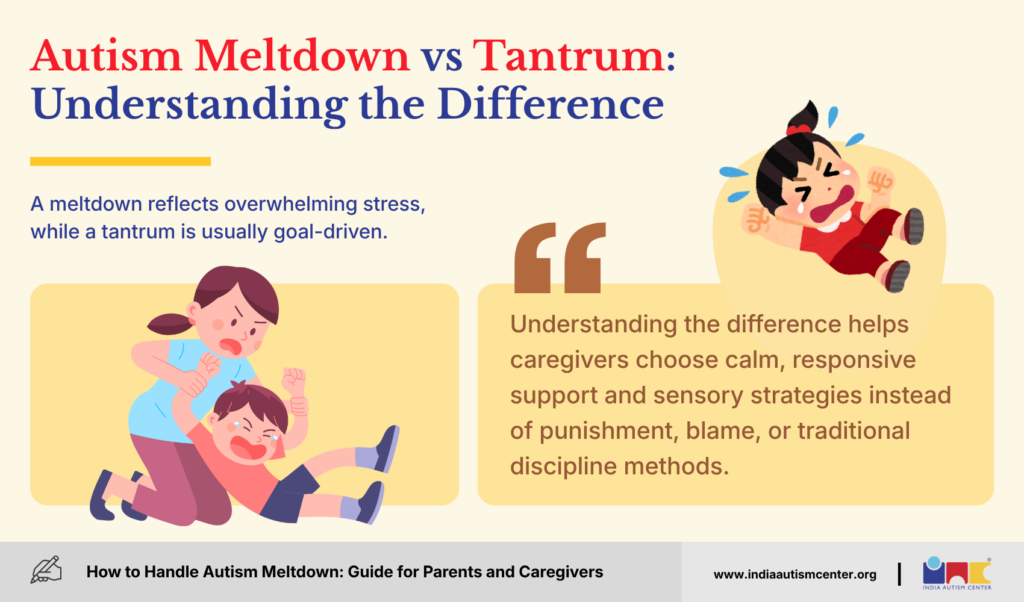
However, an autism meltdown is not a tantrum. It is usually a response to overwhelming stress, sensory overload, or emotional distress.
In this guide, we will help you understand autism meltdowns, learn how to calm an autistic meltdown, and discover practical strategies to handle autism meltdowns effectively.
What is an Autism Meltdown?
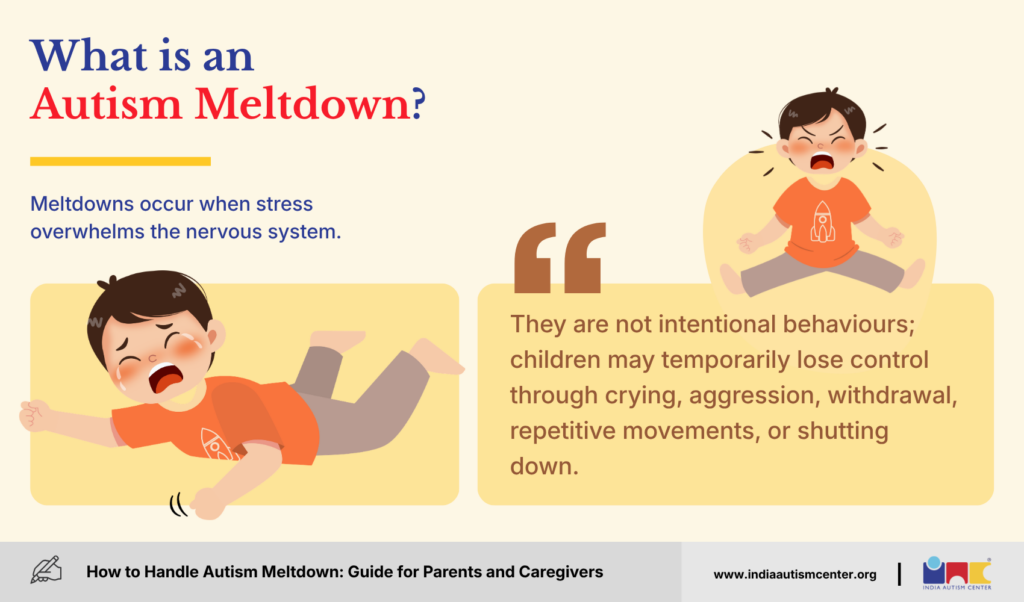
An autism meltdown is an intense emotional reaction that occurs when a person with autism becomes overwhelmed by sensory input, emotions, or environmental stress.
Unlike tantrums, meltdowns are not intentional behaviours used to get attention or achieve something. Instead, they happen when a child’s nervous system becomes overloaded, and they cannot regulate their emotions.
During an autism meltdown, a child may temporarily lose control of their behaviour.
Common behaviours during an autism meltdown include:
Crying or screaming loudly
Hitting, kicking, or throwing objects
Running away or hiding
Repetitive movements such as rocking or flapping
Covering ears or eyes
Shutting down and becoming unresponsive
Every autistic child is different. Therefore, the intensity and signs of an autism meltdown may vary.
Why Meltdowns Happen: The Neuroscience Behind Autism Meltdowns
A meltdown is not a choice. It is a neurological event – and understanding why it happens at the level of the brain changes everything about how caregivers respond.
Atypical Neural Connectivity and Sensory Processing
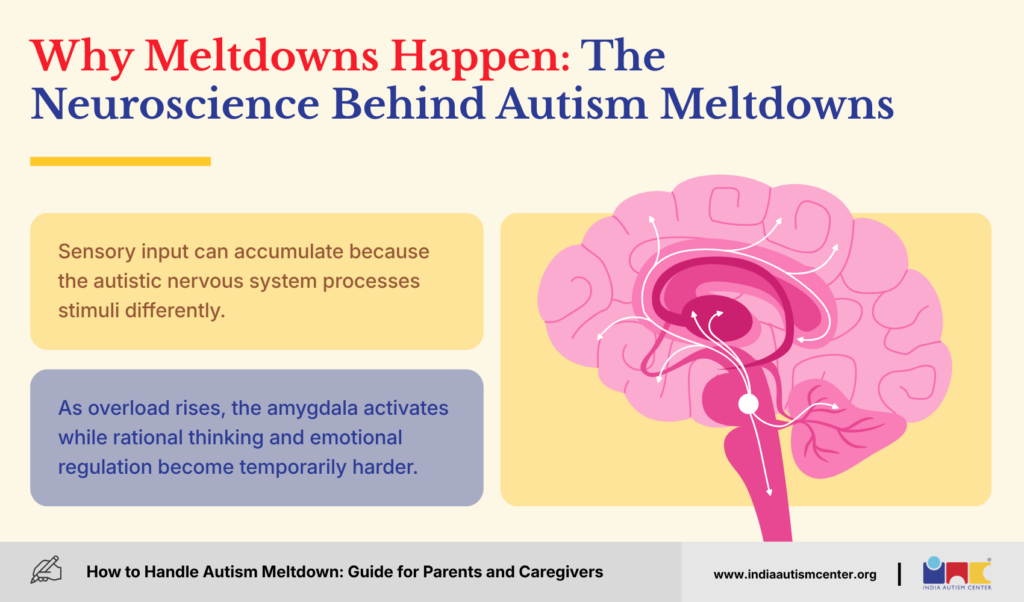
Research published on NCBI shows that autistic individuals possess neurons with a higher level of connectivity compared to non-autistic people. This atypical neural architecture has a direct consequence for sensory processing: the autistic nervous system receives and transmits sensory information differently, and often more intensely, than a neurotypical one.
In a neurotypical brain, a process called habituation means that repeated stimuli gradually fade into the background. Think of the ticking of a clock – within minutes, most people stop consciously registering it. The autistic brain frequently does not habituate in the same way. Research published in PubMed suggests that for many autistic individuals, the ticking clock remains as loud and intrusive on the hundredth tick as it was on the first.
This means sensory input does not fade – it accumulates. Sound, light, texture, smell, and social demands stack on top of each other, pushing the nervous system steadily toward overload.
The Amygdala and the Prefrontal Cortex
When sensory accumulation reaches a tipping point, the amygdala – the brain’s threat-detection centre – becomes hyperactivated. It reads the overload as danger and triggers a full stress response: elevated heart rate, muscle tension, shallow breathing, and a flood of stress hormones.
At the same time, the prefrontal cortex – the part of the brain responsible for rational thinking, emotional regulation, and decision-making – is temporarily overridden. The child or adult cannot “think their way out” of the meltdown because the very brain region needed for that task has been effectively taken offline.
What This Feels Like From the Inside
A landmark study by Lewis and Stevens (2022), which interviewed 32 autistic adults about their lived experience of meltdowns, found that participants described the experience as a whole-body event. Physical precursors included blurred vision, heightened muscle temperature, flushed cheeks, and tense shoulders. Cognitively, participants reported difficulty thinking, finding words, and recalling simple information – all consistent with prefrontal suppression under acute stress.
One participant described it as being “crushed by the sensory and informational overload.” Another said, “I lose the ability to think clearly. My head feels foggy and muddled.”
Understanding this is not a behavioural choice but a neurological event fundamentally changes how caregivers respond. Punishment, reasoning, and demands for self-control are not just unhelpful during a meltdown – they are neurologically impossible to respond to.
Autism Meltdown vs Tantrum: Understanding the Difference
A tantrum is usually a goal-driven behaviour. Children may throw a tantrum when they want something, such as a toy, attention, or permission to do something. In most cases, the child still has some level of control over their behaviour and may stop once their demand is met or when they realise the behaviour is not working.
An autism meltdown, on the other hand, is not intentional. It happens when the child becomes overwhelmed by sensory input, emotional stress, or frustration.
During a meltdown, the child’s nervous system becomes overloaded, and they temporarily lose the ability to regulate their emotions or behaviour. This is why traditional discipline strategies that work for tantrums often do not work for autism meltdowns.
Understanding this distinction helps parents respond with support, patience, and calming strategies instead of punishment.
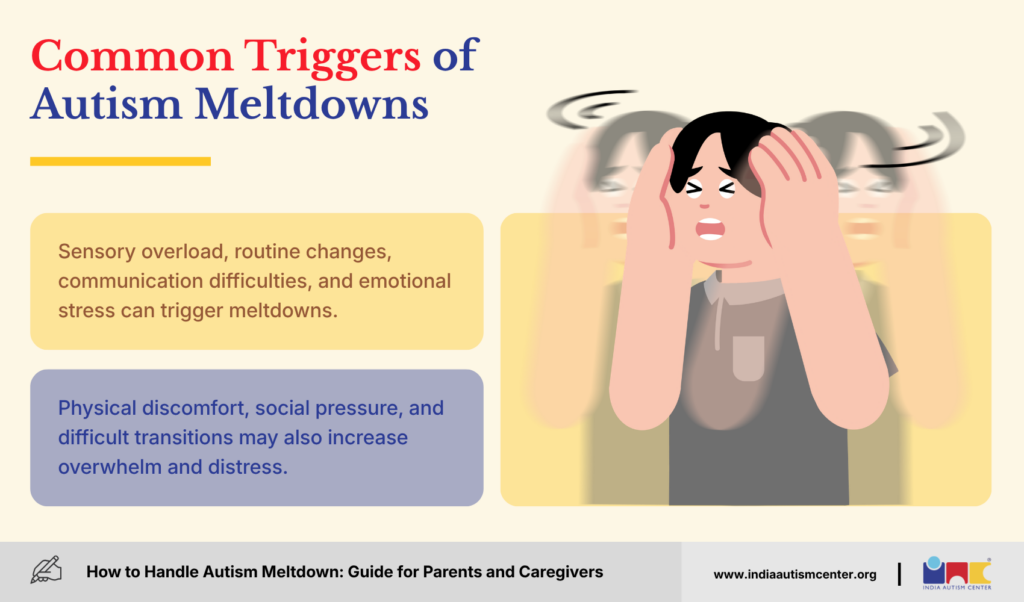
Understanding the triggers behind an autism meltdown is one of the most important steps when learning how to handle autism meltdown situations effectively. Meltdowns rarely occur without a reason. In most cases, they are the result of the child becoming overwhelmed by internal or external stressors.
Every autistic child has different sensitivities and experiences. Therefore, triggers may vary from one child to another. However, several common factors frequently contribute to meltdowns.
1. Sensory Overload
Many autistic individuals experience heightened sensitivity to sensory input. Sounds, lights, textures, smells, or crowded environments may feel much stronger and more overwhelming to them than they do to others.
For example, loud music, bright fluorescent lighting, strong food smells, or busy public places can quickly overload the sensory system. When too much sensory information enters the brain at once, the child may struggle to process it, which can lead to an autism meltdown.
Creating sensory-friendly environments and reducing unnecessary stimulation can make it easier to handle autism meltdowns and prevent them from occurring frequently.
2. Sudden Changes in Routine
Children with autism often rely on structured routines because predictability helps them feel safe and secure. When a routine changes unexpectedly, it can cause confusion, anxiety, and emotional stress.
For instance, a cancelled outing, a different classroom activity, or a sudden change in daily plans may disrupt the child’s sense of control. Without time to mentally prepare for the change, the child may feel overwhelmed and experience a meltdown.
Using visual schedules, giving advance warnings, and explaining transitions clearly can help reduce anxiety and prevent autism meltdowns caused by routine disruptions.
3. Communication Difficulties
Many autistic children face challenges when expressing their needs, feelings, or discomfort. They may know what they want but struggle to communicate it clearly using words or gestures.
When a child cannot express hunger, pain, frustration, or confusion, the internal stress may build up over time. Eventually, this frustration can lead to an autism meltdown as the child attempts to release overwhelming emotions.
Encouraging alternative communication methods, such as visual supports, communication boards, or simple gestures, can help reduce frustration and make it easier to handle autism meltdowns related to communication barriers.
4. Emotional Overload
Autistic children may find it difficult to process and regulate strong emotions such as anger, excitement, disappointment, or anxiety. When several emotions occur at the same time, the child may struggle to cope.
For example, a child might feel excited about an activity but also anxious about the unfamiliar environment. These mixed emotions can overwhelm their emotional regulation system.
When emotions build up faster than the child can manage them, the brain may respond with an autism meltdown as a way to release that pressure.
Teaching emotional awareness and simple calming strategies can help children gradually learn how to calm an autistic meltdown and regulate emotions more effectively.
5. Physical Discomfort
Physical needs often play a larger role in meltdowns than many caregivers realise. Factors such as hunger, fatigue, illness, or pain can reduce a child’s ability to cope with stress.
For instance, a child who is tired after a long school day may find it harder to manage sensory input or emotional challenges. Similarly, discomfort from tight clothing, temperature changes, or illness may contribute to frustration.
When physical discomfort combines with other triggers, the child may reach a breaking point that results in an autism meltdown.
Maintaining regular meals, ensuring adequate rest, and paying attention to signs of discomfort can help reduce these triggers and make it easier to handle autism meltdowns calmly and proactively.
6. Social and Environmental Stress
Social situations can sometimes feel confusing or overwhelming for autistic children. Busy classrooms, unfamiliar people, or situations with unclear expectations may create anxiety.
For example, a crowded birthday party or a noisy playground may involve too many interactions and sensory inputs at once. The child may struggle to process social cues while also managing environmental stress.
When these pressures build up, the child may experience an autism meltdown as their brain attempts to cope with the overload.
Preparing children for social situations and providing breaks during activities can help them manage stress and reduce the likelihood of meltdowns.
7. Transitions Between Activities
Transitions can be challenging for many autistic children because they require shifting attention from one activity to another. This shift may feel abrupt or confusing, especially if the child is deeply focused on a preferred activity.
For instance, stopping playtime to start homework or leaving the park earlier than expected may cause distress. Without preparation, these transitions may trigger resistance or emotional overwhelm.
Providing countdown warnings, visual timers, or transition cues can help children prepare mentally and make it easier to handle autism meltdowns during activity changes.
The Rumble Stage: Recognising Early Warning Signs Before a Meltdown
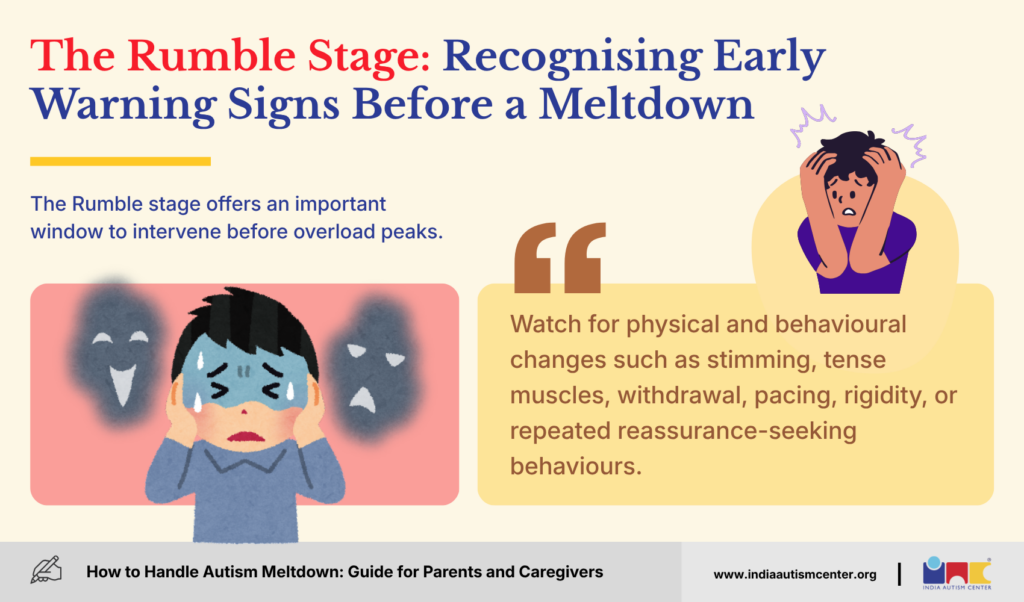
The single most effective thing a caregiver can do is intervene before the meltdown reaches full intensity. That window exists – but it requires knowing what to look for.
The Three-Stage Model: Rumble → Rage → Recovery
Autism meltdowns typically follow a recognisable arc:
Rumble – the build-up phase, where distress signals appear, but the nervous system has not yet reached full overload
Rage – the peak of the meltdown, where the child has lost regulatory control
Recovery – the gradual return to baseline, which can take 20 minutes to several hours
The Rumble stage is the intervention window. Once the Rage stage begins, the priority shifts to safety and containment. Intervening at the Rumble stage – by reducing demands, moving to a quieter space, or offering sensory tools – can prevent the full meltdown from occurring at all.
Physical Warning Signs to Watch For
These are the body’s distress signals, not defiance:
Flushed face or visibly warm cheeks
Tense muscles, hunched or raised shoulders
Increased or intensified stimming (rocking, hand-flapping, pacing)
Shallow, rapid breathing
Covering ears or eyes
Blurred or glazed expression (consistent with the sensory overload described in Lewis & Stevens, 2022)
Behavioural Warning Signs to Watch For
Becoming unusually quiet or withdrawn
Increased rigidity – refusing requests that are normally manageable
Repetitive questioning or seeking reassurance repeatedly
Pacing or inability to settle
Reaching for a specific comfort object
Building a Personal Warning Sign Profile
Every autistic child has a unique early-warning pattern. We recommend that parents and caregivers observe and note which signs appear first for their child – before the pattern becomes obvious. Over two to four weeks of observation, a reliable individual profile typically emerges.
Practical tip: Agree on a code word or signal with your child – something simple they can say or show you to communicate “I am overwhelmed” before it escalates. Even a hand gesture or a card with a symbol works. This gives the child agency and gives you early warning.
Intervening at the Rumble stage – moving to a quiet space, reducing demands, offering a sensory tool – is far more effective than any strategy applied during the Rage stage.
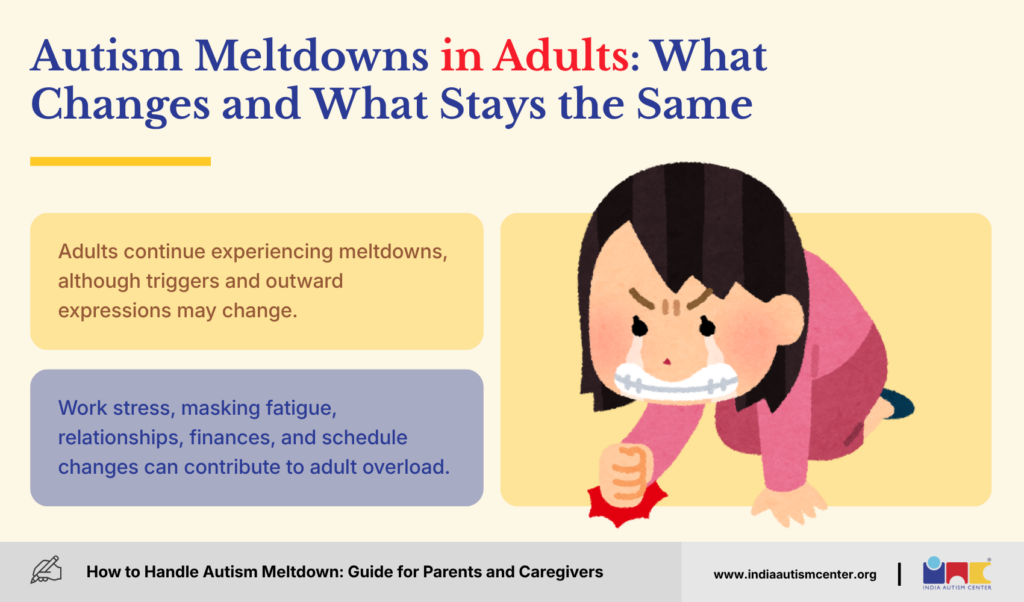
Autism Meltdowns in Adults: What Changes and What Stays the Same
There is a persistent and damaging misconception that autism meltdowns are something children grow out of. They do not. Autistic adults – across all support needs, including those who are employed, educated, and socially capable – continue to experience meltdowns throughout their lives.
What Stays the Same
The neurological mechanism is identical at every age. The amygdala becomes hyperactivated, the prefrontal cortex is overridden, and the nervous system reaches overload. The internal experience – the blurred vision, the muscle tension, the cognitive shutdown, the loss of rational control – does not diminish simply because a person has turned 18.
Lewis and Stevens (2022) found that autistic adults described meltdowns as “distressing, scary, confusing, and intensely painful events.” Many reported that the frequency varied significantly with life circumstances: some experienced meltdowns every few hours during high-stress periods; others, once or twice a year. The common thread was that the events remained neurologically involuntary.
What Changes in Adulthood
Triggers shift. School-based triggers – loud classrooms, rigid timetables, playground noise – give way to adult stressors:
Open-plan offices with unpredictable noise and interruptions
Social masking fatigue – the exhaustion of suppressing autistic traits all day to appear neurotypical
Unexpected schedule changes in professional or personal life
Financial anxiety and the pressure of independent living
Relationship demands and the complexity of adult social expectations
Masking becomes more sophisticated. Many autistic adults learn to suppress the external expression of a meltdown in public – holding it together at work, then experiencing a delayed meltdown at home when the social pressure lifts. This is not a sign that the meltdown was less severe; it is a sign that the person has learned to internalise at great personal cost.
Shame and self-blame intensify. Adults are expected to “have it together.” When a meltdown occurs, many autistic adults internalise it as personal failure – evidence that they are broken, weak, or incapable. Lewis and Stevens (2022) found that post-meltdown guilt, shame, and remorse were consistently reported, even when participants fully understood that the meltdown was not within their control.
Physical manifestations may become more internalised. Rather than the outward explosion more commonly seen in children, adult meltdowns may present as a shutdown – withdrawal, silence, inability to move or speak, dissociation. These internal meltdowns are invisible to observers but equally distressing to the person experiencing them.
Support Strategies for Autistic Adults
Self-advocacy: Learning to name and communicate personal triggers to employers, partners, and family members before overload occurs
Identifying personal triggers: Keeping a record of what precedes meltdowns (see the Meltdown Diary section below)
Scheduled decompression time: Building deliberate recovery periods into the day – particularly after high-masking situations such as meetings, social events, or commutes
Communicating needs to employers: Under the Rights of Persons with Disabilities (RPWD) Act 2016, autistic employees in India are entitled to reasonable workplace accommodations
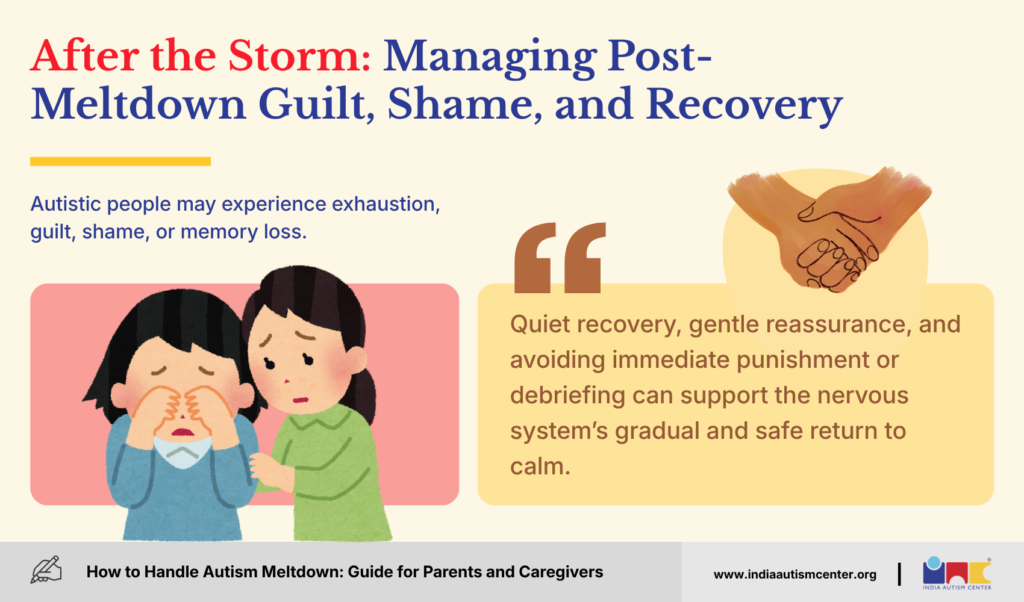
After the Storm: Managing Post-Meltdown Guilt, Shame, and Recovery
The meltdown itself is only part of the experience. What happens in the hours that follow matters just as much – for the autistic person and for the caregiver.
What the Autistic Person Experiences After a Meltdown
Lewis and Stevens (2022) found that post-meltdown experiences for autistic adults consistently included:
Profound exhaustion – physical and cognitive fatigue that can last hours or even days
Memory gaps – many participants could not recall what had happened during the meltdown; some described learning about their own behaviour second-hand from family members
Intense guilt, shame, and remorse – even when the person fully understood that the meltdown was not intentional
Negative self-worth – thoughts such as “I am worthless” or “I am broken,” which participants noted felt entirely logical during the meltdown but not outside it
For children, the post-meltdown period may look like exhaustion, tearfulness, or unusual quietness. They may not be able to articulate what happened. This is normal – the brain is still recovering.
What Caregivers Experience After a Meltdown
Caregivers are not immune to the aftermath. Emotional exhaustion, helplessness, frustration, and grief are all valid responses. Many parents describe a particular kind of loneliness – the meltdown is over, the child is resting, and the caregiver is left to process it alone.
All of these feelings are legitimate. Acknowledging them is not self-indulgent; it is necessary for sustainable caregiving.
What NOT to Do in the Immediate Aftermath
Do not debrief immediately. The nervous system needs time to reset – attempting a conversation about what happened within minutes of a meltdown adds to the overload.
Do not punish or demand apologies. The child or adult could not control what happened. Punishment does not prevent future meltdowns; it adds shame to an already painful experience.
Do not replay the incident in front of the child, or discuss it with others within earshot.
What TO Do
Allow quiet recovery time. The nervous system reset can take anywhere from 20 minutes to several hours. Offer a calm, low-stimulation environment – a favourite blanket, a quiet room, minimal talking.
Offer comfort without overwhelming. Presence without pressure. Sit nearby. Let them know you are there.
Check in gently once calm is fully restored – not surface calm, but genuine calm. A simple “Are you feeling better? Do you need anything?” is enough.
For your own recovery: Step away briefly if it is safe to do so. Debrief with a partner, a trusted friend, or a parent support group. Avoid self-blame.
Using the Calm Period Constructively
Hours or even days after the meltdown – when the child is genuinely settled – is the right time to gently explore what happened. Not as a lesson or a correction, but as a collaborative conversation: “Do you remember feeling upset yesterday? What was happening just before?” Over time, this builds the child’s self-awareness and helps them identify their own early warning signs.
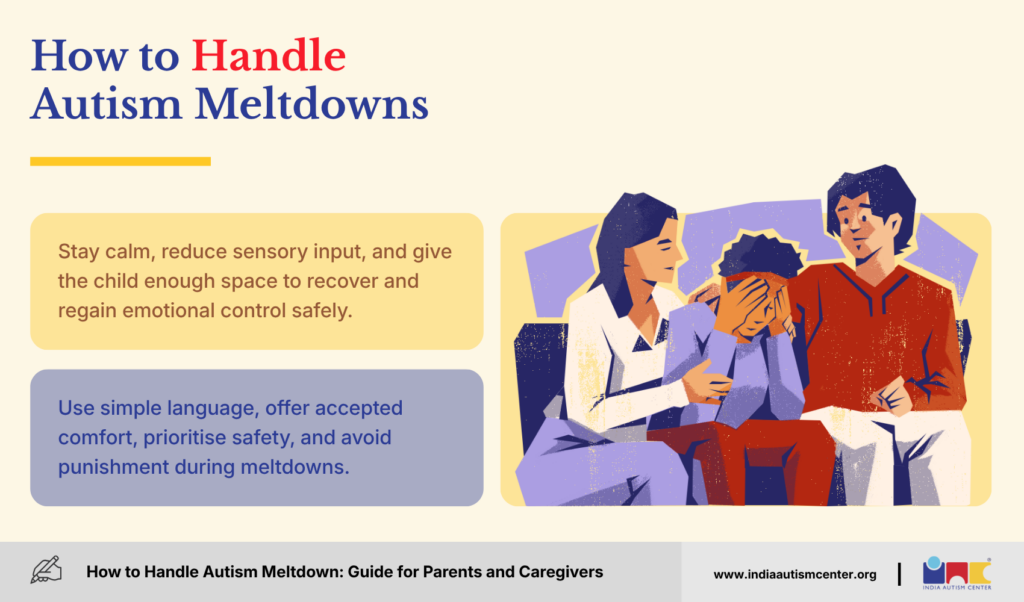
How to Handle Autism Meltdowns
When a meltdown happens, your main goal should be to help your child feel safe and regain emotional control.
Here are practical ways to handle autism meltdowns calmly and effectively.
1. Stay Calm and Patient
Children often mirror the emotions of adults around them. If we panic or raise our voice, the situation may worsen.
Instead, take a deep breath and speak in a calm tone. Your calm presence can help your child feel safe during an autism meltdown.
2. Reduce Sensory Input
Many meltdowns occur due to sensory overload. Reducing stimulation can help calm an autistic meltdown.
You can try the following:
Move the child to a quieter space
Dim bright lights
Turn off loud music or devices
Provide noise-cancelling headphones
A calmer environment can help the nervous system settle.
3. Give the Child Space
Some children need physical space during a meltdown. Too much interaction can increase distress.
Allow your child to sit, lie down, or move around safely while they calm themselves. Stay nearby so they know you are present and supportive.
4. Use Simple and Clear Language
During an autism meltdown, the brain struggles to process complex instructions.
Use short, simple sentences such as:
“You are safe.”
“Let’s take deep breaths.”
“We will sit here quietly.”
Clear communication helps reduce confusion and anxiety.
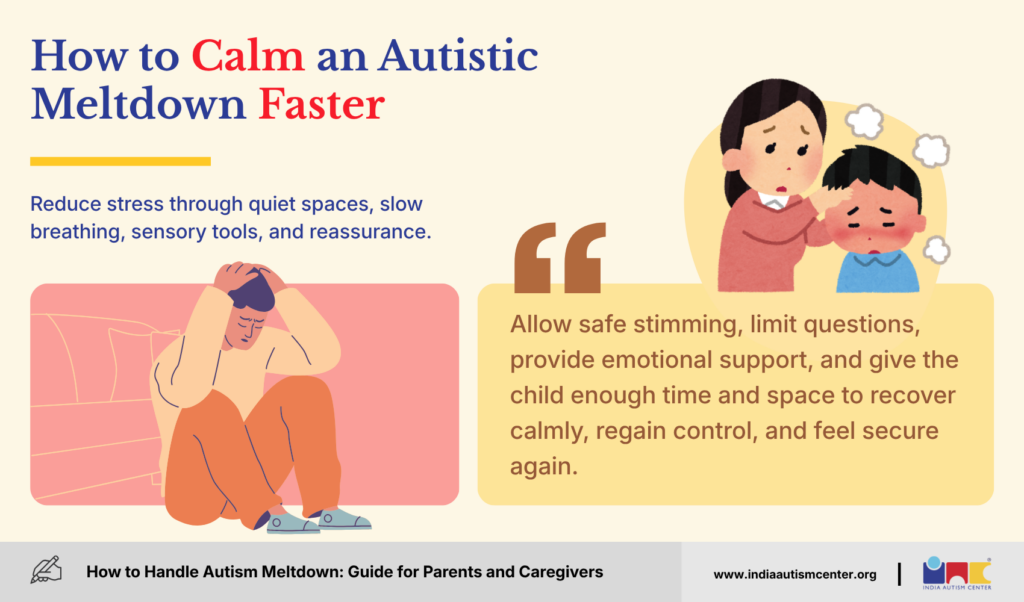
When an autism meltdown occurs, the child’s nervous system is in a state of overload. At that moment, the goal is not to reason, discipline, or correct behaviour. Instead, the focus should be on reducing stress and helping the child regain emotional control.
Although every child is different, certain strategies can help calm an autistic meltdown more quickly and safely. These techniques aim to regulate sensory input, reduce anxiety, and support the child until they feel stable again.
1. Encourage Slow and Deep Breathing
Breathing exercises can help regulate the nervous system during stressful situations. Slow breathing sends signals to the brain that the body is safe, which gradually reduces panic and emotional intensity.
You can gently guide your child by saying simple instructions such as “Breathe in slowly” and “Breathe out slowly.” Demonstrating the breathing yourself may also help the child follow your actions more easily.
Even a few deep breaths can help calm an autistic meltdown by slowing the heart rate and reducing physical tension.
2. Move to a Quiet and Safe Space
A calm environment can make a significant difference in learning to handle autism meltdowns effectively. If possible, guide the child to a quieter place where sensory stimulation is lower.
For example, you can move to a quiet room, a calm corner in the house, or a less crowded area if you are outside. Reducing loud sounds, bright lights, and visual distractions helps the brain recover from sensory overload.
This change of environment often allows the child to regain control more quickly during an autism meltdown.
3. Offer Sensory Regulation Tools
Many autistic children respond well to sensory tools that help regulate their nervous system. These tools provide controlled sensory input that can be calming and reassuring.
Examples include:
Stress balls or fidget toys
Weighted blankets or lap pads
Soft textures such as sensory cushions
Noise-cancelling headphones
These tools give the child something familiar and soothing to focus on, which may help calm an autistic meltdown faster.
4. Use Visual Supports
During an autism meltdown, verbal communication may become difficult for the child to process. Visual supports can provide clear guidance without overwhelming them with too many words.
You can use tools such as:
Emotion charts showing different feelings
Calm-down cards with simple instructions
Visual routines for breathing or relaxation
Visual cues help the child understand what they can do to regulate their emotions, making it easier to handle autism meltdowns in a structured way.
5. Speak in a Calm and Reassuring Tone
Your voice and body language play a major role in how the child responds during a meltdown. If we speak loudly, show frustration, or rush the child, their stress may increase.
Instead, speak slowly and gently. Short phrases such as “You are safe,” “I am here,” or “It will be okay” can provide reassurance without overwhelming the child with information.
A calm and supportive presence can help the child feel secure while the autism meltdown gradually passes.
6. Allow Safe Stimming Behaviour
Stimming behaviours such as rocking, hand-flapping, or pacing often help autistic individuals regulate their sensory input. During an autism meltdown, these movements may increase.
As long as the behaviour is safe, it is helpful to allow the child to stim freely. These repetitive movements can help release built-up tension and support emotional regulation.
Allowing safe stimming can therefore be an effective way to calm an autistic meltdown naturally.
7. Give the Child Time to Recover
Meltdowns do not stop instantly because the brain needs time to recover from overload. Trying to rush the process or forcing the child to calm down may increase distress.
Instead, stay nearby and allow the child to regain control at their own pace. Your calm presence reassures them that they are safe and supported.
Patience is essential when learning how to handle autism meltdowns effectively, as recovery may take several minutes or sometimes longer.
8. Avoid Asking Too Many Questions
During an autism meltdown, the brain may struggle to process language and respond to questions. Asking many questions, such as “What happened?” or “Why are you upset?” can increase frustration.
Instead, focus on simple reassurance and supportive actions. You can discuss the situation later once the child has fully calmed down.
Reducing verbal pressure helps make it easier to handle autism meltdowns without adding extra stress.
9. Stay Close and Offer Emotional Support
Even if the child prefers space, knowing that a trusted caregiver is nearby can provide emotional security. Stay close enough to monitor safety, but allow the child the distance they need.
Your presence communicates support and stability, which helps the child gradually regulate their emotions.
Over time, consistent support teaches the child that meltdowns are safe moments where caregivers will help them calm down during an autism meltdown rather than punish them.
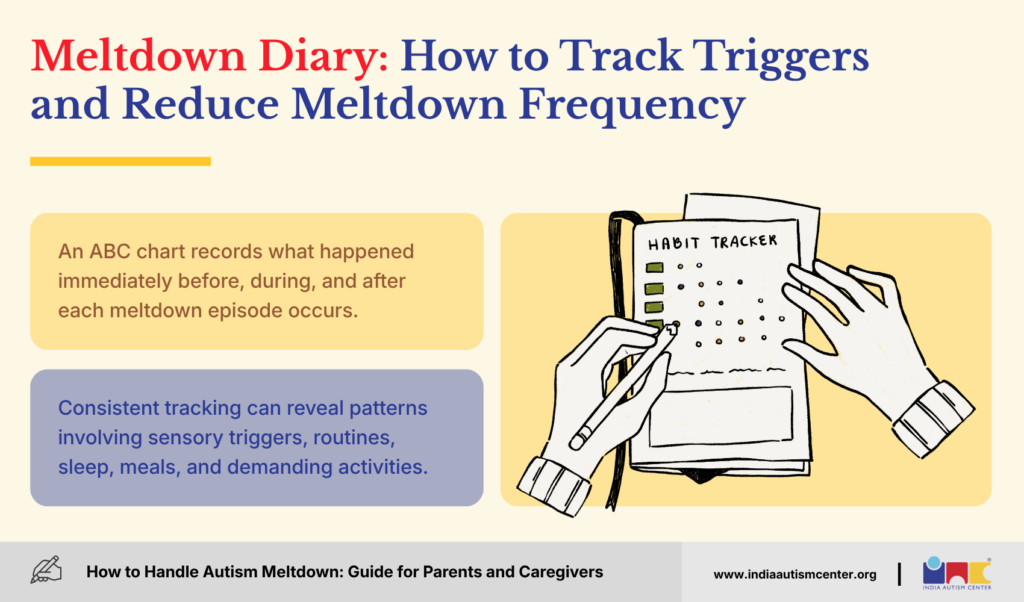
Meltdown Diary: How to Track Triggers and Reduce Meltdown Frequency
Patterns that are invisible in the moment become clear over time. A meltdown diary – sometimes called a behaviour log or ABC chart – is one of the most practical tools available to parents and caregivers.
What Is an ABC Chart?
The ABC framework stands for:
A – Antecedent: What happened immediately before the meltdown
B – Behaviour: What the meltdown looked like (intensity, duration, type of behaviour)
C – Consequence/Response: What was done in response, and whether it helped
This structure, used by behaviour therapists and special educators worldwide, turns individual meltdown incidents into usable data.
What to Record After Each Meltdown
Keep entries brief – consistency matters far more than detail. Record:
1. Date, time, and location
2. What happened immediately before (the antecedent): where were you, who was present, what was the child doing?
3. What the meltdown looked like: intensity (mild/moderate/severe), duration, specific behaviours
4. What helped or did not help in the moment
5. Physical state: Had the child eaten recently? Slept well the night before? Were they unwell?
What Patterns Typically Emerge
After two to four weeks of consistent recording, patterns usually become visible. Common findings include:
Meltdowns clustering on Monday mornings – the transition back to school after the weekend
Meltdowns following long outings or social events, even when the child appeared to cope well at the time (a sign of delayed overload)
A specific sensory trigger – a particular sound, texture, or smell – appearing in nearly every antecedent
A correlation with poor sleep or missed meals
These patterns allow for proactive adjustments: schedule changes, sensory accommodations, pre-emptive calming routines, or simply building in more recovery time after demanding activities.
How to Use the Diary Effectively
Keep it simple. A notes app on your phone works perfectly well. A dedicated notebook is fine too. The format is irrelevant; the consistency is everything.
Share it with your child’s therapist, school, or the clinical team at India Autism Center. A well-kept meltdown diary is a powerful clinical tool – it can inform therapy goals, school accommodation plans, and sensory profiles in ways that memory alone cannot.
Involve the child where appropriate. Older children and teenagers can sometimes contribute to the diary themselves, which builds self-awareness and a sense of agency.
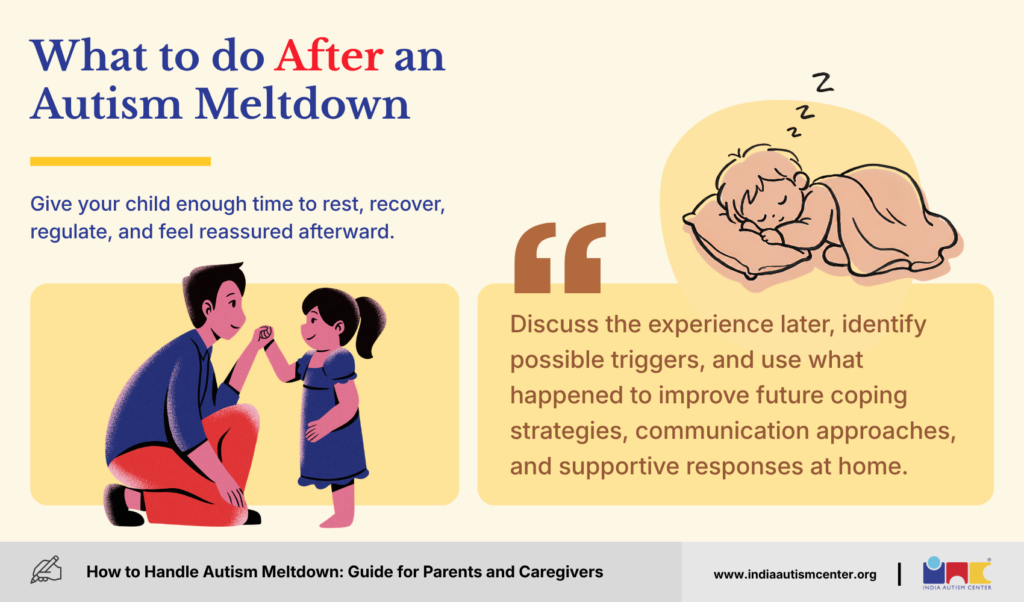
What to do After an Autism Meltdown
Once the meltdown ends, the child may feel exhausted, embarrassed, or confused. This is the time for gentle support.
Give Time to Recover
Allow your child to rest. Their nervous system needs time to recover after intense emotional stress.
Offer Reassurance
Let your child know they are safe and loved. Avoid criticism or blame.
Discuss the Situation Later
When your child is calm, you can talk about what happened. Try to identify triggers and discuss better coping strategies.
Adjust Future Strategies
Each meltdown teaches us something new. Use these experiences to plan better responses next time.
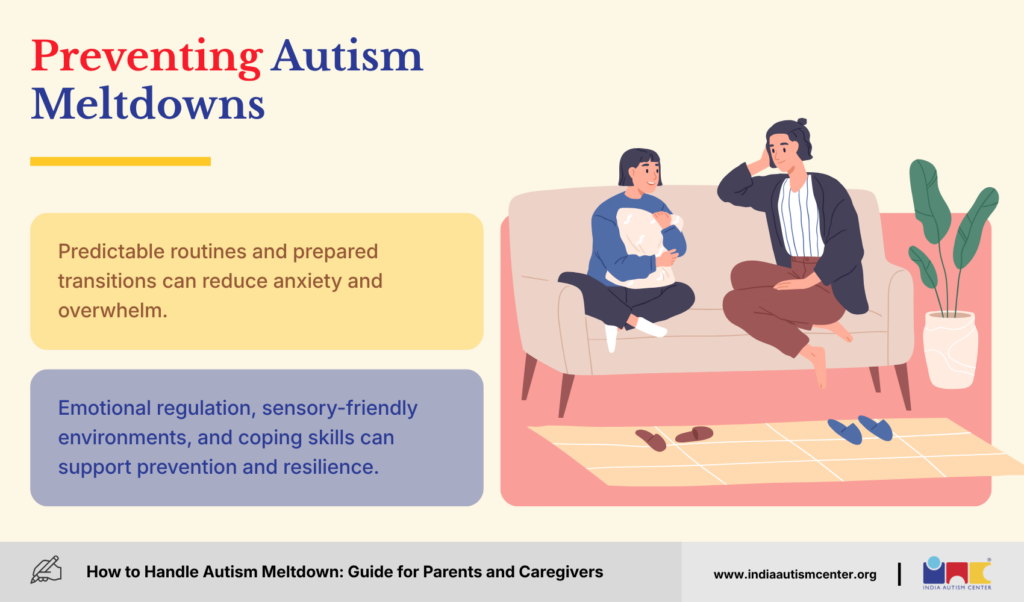
While we cannot prevent every autism meltdown, we can reduce its frequency by planning ahead. Here are some preventive strategies.
Maintain Predictable Routines
Structured routines help children feel secure and reduce anxiety.
Prepare for Transitions
Use visual schedules or reminders before changing activities.
Teach Emotional Regulation
Help your child learn words for emotions such as “frustrated”, “tired”, or “overwhelmed”.
Create a Sensory-Friendly Environment
Reduce sensory triggers at home and school whenever possible.
Build Coping Skills
Teach calming techniques such as breathing exercises, sensory breaks, or quiet time.
These strategies make it easier to handle autism meltdowns and support emotional development.
Conclusion
Learning how to handle autism meltdown situations calmly and effectively can make a significant difference for both parents and children.
Remember:
An autism meltdown is a response to overwhelming stress, not bad behaviour.
Your calm support helps your child feel safe.
Understanding triggers can help prevent future meltdowns.
With patience, awareness, and the right strategies, we can learn how to calm an autistic meltdown and support children with autism more effectively.
Frequently Asked Questions (FAQs)
What is an autism meltdown?
An autism meltdown is an intense emotional reaction that occurs when an autistic person becomes overwhelmed by sensory input, stress, or strong emotions. During a meltdown, the child may cry, scream, withdraw, or display repetitive behaviours because their nervous system is overloaded. Unlike tantrums, meltdowns are not intentional behaviours but a response to overwhelming situations.
What causes an autism meltdown?
Several factors can trigger an autism meltdown, including sensory overload, sudden changes in routine, communication difficulties, emotional stress, or physical discomfort. Loud noises, crowded environments, unfamiliar situations, or frustration from not being able to express needs can also lead to a meltdown.
How to calm an autistic meltdown quickly?
To calm an autistic meltdown, first stay calm and create a quiet, safe environment. Reduce sensory stimulation by lowering noise and lights, and speak in short, reassuring sentences. Offering sensory tools such as a stress ball or weighted blanket may also help the child regulate their emotions more quickly.
How should parents handle autism meltdowns at home?
Parents can handle autism meltdown situations by staying patient, reducing sensory triggers, and allowing the child space to calm down. Speaking calmly, ensuring the environment is safe, and offering comfort items can help the child regain emotional control. After the meltdown, parents can gently discuss the situation to identify triggers and prevent future meltdowns.
For expert insights, support services, and inclusive learning initiatives, visit the India Autism Center.
Caring for a child on the autism spectrum involves ongoing expenses. In India, these costs can add up over time, especially in private and urban settings.
For many families, monthly expenses range from ₹10,000 to over ₹30,000, depending on the intensity of support needed. This usually does not include medication or specialised education.
Therapies form the core of autism care. ABA therapy typically costs between ₹800 and ₹2,000 per session. Speech therapy ranges from ₹700 to ₹1,500 per session, while occupational therapy may cost ₹800 to ₹1,800 per session.
Some families opt for structured or full-day therapy programs. These programs, often run by private centres, can cost anywhere between ₹30,000 and ₹80,000 per month. Initial diagnosis and assessments are another expense. Most evaluations fall in the ₹1,500 to ₹4,000 range.
Special education support is another important cost. Monthly fees for specialised schooling or learning support usually range from ₹5,000 to ₹15,000. These services are often essential to a child’s development but are rarely fully covered by standard policies.
There are also alternative interventions that families may come across. For example, stem cell therapy is sometimes promoted, though it is not widely recommended. These treatments can be very expensive, often costing ₹3.3 lakh to ₹8 lakh per cycle.
Common Myths Around Autism Insurance in India
Many parents feel confused or discouraged when exploring autism insurance in India. This is often due to myths that circulate online or through word of mouth. Below are some common misunderstandings, explained simply and clearly, so families can make informed decisions.
Common Myths vs Facts
Myth
Reality
No insurance covers autism in India
Autism insurance coverage does exist, mainly through government schemes and a few specialised private policies. Coverage is limited, but it is not absent.
Private health insurance completely excludes autism
While standard plans may restrict coverage, some private insurers offer autism-specific or disability-focused policies with defined benefits.
Most policies place limits. Hospitalisation is more commonly covered, while therapies are subject to caps, conditions, or exclusions.
Insurance is only useful for young children.
Autism is a lifelong condition. Some government-backed options and disability-linked benefits continue into adulthood.
Autism, being a pre-existing condition, means no coverage at all
Some specialised autism insurance plans do not require pre-policy medical screening and still offer defined benefits.
What Parents Should Keep in Mind
Specialised policies are limited but real: Autism insurance is not widely available under general plans, but specific options do exist. These are designed with clear limits and eligibility criteria.
Government support plays a key role: Public schemes remain an important part of insurance coverage for autism in India, especially for therapy and OPD support.
Not all treatments are treated equally: Core medical care and diagnostics are more likely to be included than experimental or alternative therapies.
Coverage terms matter more than policy names: The best health insurance for autism depends on what is covered, how much is covered, and how claims work in practice.
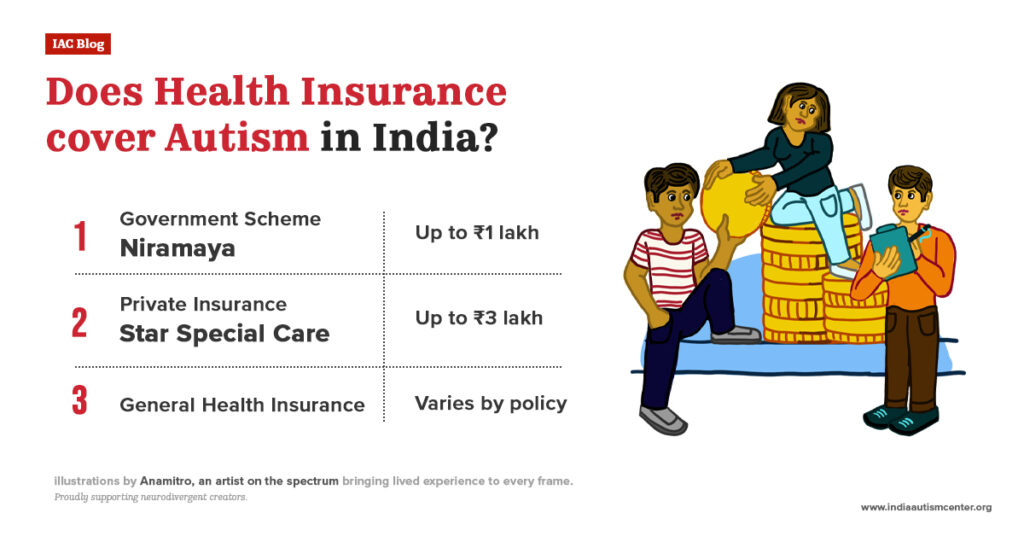
Yes, autism is covered by health insurance in India. However, the coverage is limited and works differently from regular health insurance. Most support comes through government-backed schemes and a few specialised private policies.
Autism is usually treated as a lifelong or pre-existing condition. Because of this, coverage is not automatic under standard plans. This is why families often need autism insurance India–specific options rather than regular policies.
Persons with autism and other developmental disabilities
OPD care, therapies, diagnostics, and hospitalisation
Up to ₹1 lakh
Private Insurance (Star Special Care)
Children and young adults aged 3–25 years
Hospitalisation, OPD, therapies, diagnostics
Up to ₹3 lakh
General Health Insurance
All individuals
Mostly hospitalisation for related conditions
Varies by policy
Autism Health Insurance in India: What Coverage Really Looks Like
Government Scheme: Niramaya Health Insurance
The Niramaya Health Insurance Scheme is one of the most accessible autism insurance options. The National Trust runs it for people with autism and related disabilities.
Key features include:
Coverage up to ₹1 lakh per year
Includes OPD expenses
Covers therapy sessions and hospitalisation
Designed specifically for developmental disabilities
Private Autism Insurance Options
Some private insurers offer specialised plans. A well-known example is Star Special Care.
What these plans usually cover:
Children and young adults with autism
Hospitalisation for medical conditions
OPD consultations and diagnostics
Limited therapy coverage, based on policy terms
The maximum sum insured is usually up to ₹3 lakh. These plans are often considered when families seek the best health insurance for autism, though coverage limits should be carefully reviewed.
General Health Insurance and Autism
Regular health insurance policies may cover autism-related care to a limited extent.
Important points to know:
Autism is often classified as a pre-existing condition
Waiting periods may apply
Coverage usually focuses on hospitalisation
Therapy and OPD benefits are often restricted
Under IRDAI guidelines, insurers must have clear underwriting rules for persons with disabilities. This improves transparency but does not guarantee full autism insurance coverage.
What Is Commonly Covered
Across government and private options, coverage usually includes:
Hospitalisation for associated medical conditions
Therapies, such as speech or behavioural therapy, are subject to limits
Medicines and diagnostics, often under OPD benefits
Disability Insurance and Autism: What Parents Need to Know
In India, autism is legally recognised as a disability under the Rights of Persons with Disabilities (RPWD) Act, 2016. This recognition is important. It allows families to access government support, financial assistance, and disability-related benefits. While disability insurance works differently from health insurance, both play a role in long-term planning for autism.
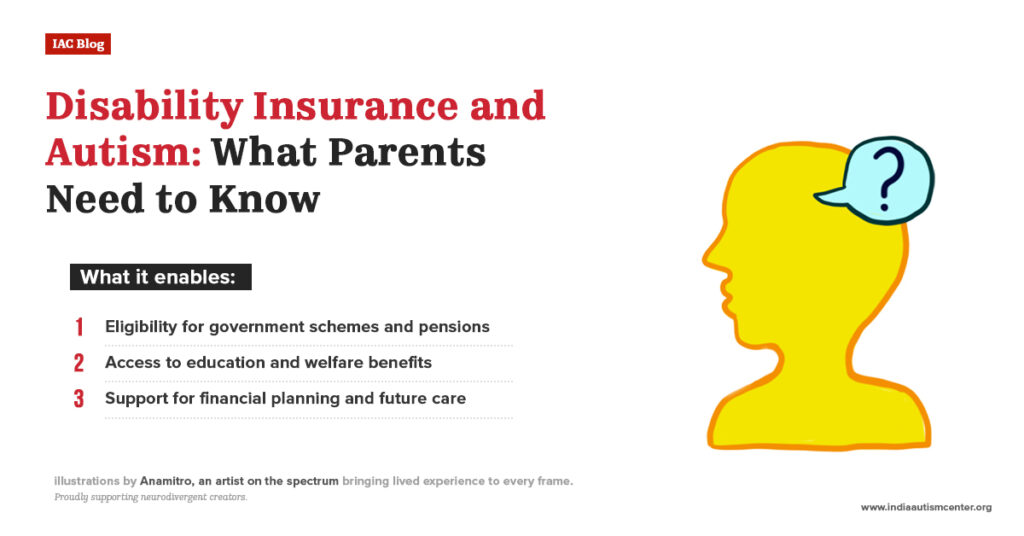
Why a Disability Certificate Matters
A disability certificate is the foundation for accessing most benefits related to autism.
What it enables:
Eligibility for government schemes and pensions
Access to education and welfare benefits
Support for financial planning and future care
Without this certificate, many forms of assistance linked to disability insurance and government aid are not available.
Steps Parents Should Take
Obtain a disability certificate: Apply through authorised government hospitals or local authorities. This certificate officially confirms autism as a recognised disability under the law.
Keep clear records: Maintain copies of diagnosis reports, therapy plans, and expense records. These documents are often required for claims, renewals, and government benefits.
Consult professionals: Speak with specialists or financial advisors who are familiar with autism insurance options in India. They can help identify suitable health and disability insurance plans that align with your child’s needs.
Prepare a Letter of Intent (LOI): An LOI is not a legal document, but it is very important. It explains your child’s daily routine, therapies, preferences, and long-term care needs. This helps future caregivers or guardians understand how to support your child.
Deductions on medical treatment and insurance premiums
Parents of children with disabilities
Disability Insurance vs Health Insurance
Health insurance usually focuses on medical care, hospitalisation, and limited therapies.
Disability insurance and disability-related schemes focus on income support, long-term care, and social security.
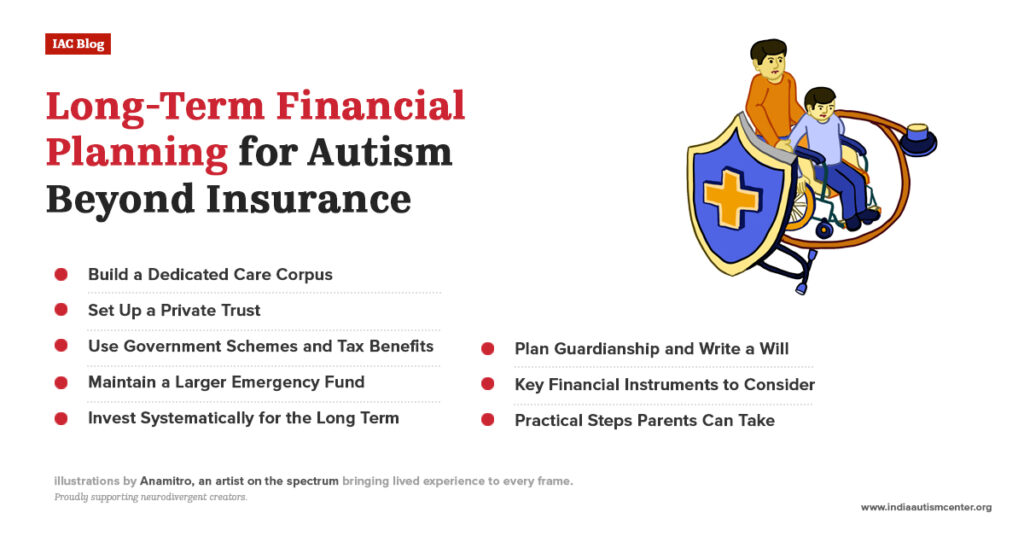
Long-Term Financial Planning for Autism Beyond Insurance
Insurance is only one part of the picture. Autism care often continues for life, and many needs fall outside what autism health insurance or disability insurance can cover. Long-term financial planning helps families build stability, maintain continuity of care, and achieve peace of mind.
Build a Dedicated Care Corpus
Create a separate investment pool meant only for your child’s lifelong needs. This corpus should not be mixed with regular household savings.
Use equity mutual funds for long-term growth
Add debt instruments for stability and predictable access
Plan with medical inflation in mind, which can be much higher than general inflation
Set Up a Private Trust
A private, non-revocable trust helps protect assets meant for the child.
Key points to consider:
Create a formal trust deed
Appoint trustees younger than the parents, such as siblings or close relatives, rather than the parents.
Clearly define how funds should be used for care and support
Some families also explore options under the National Trust Act of 1999, which supports guardianship planning for persons with disabilities.
Use Government Schemes and Tax Benefits
Government benefits can reduce long-term financial pressure when used correctly.
Benefit
What It Helps With
UDID card
Access to disability-related services and schemes
Section 80DD tax deduction
Up to ₹1.25 lakh for severe disability
Disability-linked schemes
Income and welfare support
Maintain a Larger Emergency Fund
Families caring for a child with autism often face sudden cost spikes.
Keep an emergency fund at least 50% larger than a typical household’s
Maintain it separately from regular savings
Use it only for urgent medical or care-related needs
Invest Systematically for the Long Term
Systematic Investment Plans help spread risk and build discipline.
Equity-oriented SIPs support long-term growth
Long time horizons help manage care-related inflation
Regular investing reduces dependence on short-term funding
Plan Guardianship and Write a Will
A legal will is essential for long-term security.
Appoint a trusted guardian
Clearly state how funds should be managed
Align the will with trust structures, if any
Key Financial Instruments to Consider
Instrument
Why It Helps
Public Provident Fund (PPF)
Low risk and tax-free returns
Sukanya Samriddhi Yojana
Long-term savings for a girl child
Mutual funds
Higher return potential over long periods
Practical Steps Parents Can Take
Review investments once a year
Allocate 20-30% of income toward therapies, education, and caregiving.
Connect with support organisations such as Action for Autism for guidance and resources.
How India Autism Center Supports Families Beyond Care
For individuals with autism and related conditions, daily life can feel demanding. For families, the emotional and practical challenges often continue for years. Support needs go beyond therapy sessions or medical care.
Located in Sirakol, about an hour from Kolkata, the Centre is building a calm and inclusive environment. The focus is not only on care, but on long-term support, dignity, and independence.
India Autism Center is a not-for-profit initiative. Its mission is to create a complete ecosystem for individuals with autism and related conditions. This includes residential living, skill development, and research-led programs that respond to real needs.
Residential Support
The Centre provides structured residential care designed around safety, routine, and personal growth. This helps families plan for continuity of care while knowing their loved ones are supported in a stable environment.
Skill-Building and Vocational Training
India Autism Center focuses on helping individuals build practical skills. These programs support independence, confidence, and participation in daily life, based on each person’s abilities and pace.
Training for Professionals
The Centre also runs training courses for aspiring caregivers and professionals. This helps strengthen the overall autism support ecosystem in India by improving the quality of care and understanding.
Research-Driven Approach
Research is a key part of the Centre’s work. By studying autism and related conditions in the Indian context, India Autism Center contributes to better practices, informed interventions, and long-term solutions.
Frequently Asked Questions
Does health insurance cover autism in India?
Yes, but coverage is limited. It is mainly available through government schemes and a few specialised private policies.
Which is the best health insurance for autism in India?
There is no single best plan. Government schemes and autism-specific policies work best when combined based on the child’s needs.
Does disability insurance help families with autism?
Yes. Disability-related benefits provide financial support, pensions, and tax relief that health insurance may not cover.
Does insurance fully cover therapy costs?
No. Most policies have limits. Therapies are often partially covered or capped.
Is long-term financial planning necessary even with insurance?
Yes. Insurance alone is not enough. Long-term planning helps manage lifelong care, emergencies, and future security.
For expert insights, support services, and inclusive learning initiatives, visit the India Autism Center.
When it comes to bilingualism and autism, many parents ask the same question: “Will learning two languages confuse my autistic child?”
Well, some professionals suggest sticking to one language. Others encourage bilingual exposure. This uncertainty can feel overwhelming. I want to reassure you from the start: bilingualism and autism can work together — when done thoughtfully and with the right support.
In this blog, I will explain:
What the research actually says about bilingualism in autism spectrum disorder (ASD)
The real impact of bilingualism on autistic children – positive and challenging
How AAC fits in for minimally verbal children
Six common myths – and the evidence that dismantles them
How to get your child assessed properly as a bilingual learner
Ten practical, actionable tips you can start using this week
How India Autism Center (IAC) supports bilingual autistic children
Understanding Bilingualism and Autism
Bilingualism simply means using or learning two languages regularly. In India, this is not unusual – it is the norm. Your child may hear Bengali at home, Hindi in the neighbourhood, and English at school. That is not a problem to be solved. That is a rich linguistic environment.
Here is a number worth holding onto: over 43% of the global population is bilingual or multilingual. Monolingualism is actually the exception, not the rule. The idea that a child must grow up with only one language to thrive is a Western clinical assumption that does not reflect how most of the world – including most of India – actually lives.
Autism affects communication, social interaction, and language processing. Because of this, many parents worry that two languages will slow speech development or increase confusion. That worry is understandable. But the evidence does not support it.
Autistic children can learn two languages without harming their communication development.
In fact, bilingualism and autism do not conflict. Instead, language development depends more on:
Quality of interaction
Consistency
Emotional connection
Professional support
Not on the number of languages alone.
One more important context: more than 30% of autistic children are minimally verbal – meaning they use fewer than 20 functional words. For these children, the question of bilingualism does not disappear. It becomes even more important to address, especially when Augmentative and Alternative Communication (AAC) is part of the picture. We will come back to this.
What Does Research Say About Bilingualism in Autism Spectrum Disorder?
When we talk about bilingualism in autism spectrum disorder, we rely on growing global research. Studies comparing monolingual and bilingual autistic children show something important:
Bilingual autistic children do not have worse language outcomes
They do not show higher levels of confusion
They can differentiate between languages
They can develop vocabulary in both languages over time
Some children may speak later. Others may mix languages at first. This is also seen in non-autistic bilingual children.
What truly matters is how language is taught and used. At India Autism Center (IAC), therapists use structured methods such as:
Speech and Language Therapy
Speech and language therapy helps autistic children build vocabulary, understand instructions, and use words meaningfully. In bilingualism and autism, therapists support language development in both languages by strengthening comprehension, pronunciation, and functional communication.
Play-based Learning
Play-based learning uses games, toys, and daily activities to teach language in a natural and enjoyable way. For children experiencing bilingualism in autism spectrum disorder, play helps them connect words with actions and emotions across both languages without pressure.
Visual Communication Systems
Visual communication systems use pictures, symbols, and visual schedules to support understanding and expression. These tools are especially useful in reducing confusion and improving the impact of bilingualism on autistic children who process visual information better than spoken words.
Social Interaction Training
Social interaction training focuses on teaching children how to start conversations, take turns, and respond appropriately to others. This approach strengthens real-life communication skills and helps children manage bilingualism and autism in school and community settings.
What About Minimally Verbal Children? AAC and Bilingualism
If your child is minimally verbal – using very few spoken words – you may feel that the bilingualism conversation does not apply to you. It absolutely does.
AAC (Augmentative and Alternative Communication) includes picture boards, communication apps, speech-generating devices, and sign-supported communication. And here is what the research shows clearly:
AAC does not block speech development. A review of 12 studies found that AAC interventions did not impede speech production – in fact, most studies reported increased speech alongside AAC use. A 2024 scoping review in the Augmentative and Alternative Communication journal found that bilingual AAC use was not harmful and could improve self-identity and caregiver participation.
What does this mean practically?
AAC devices and boards can be set up in two languages. Many modern communication apps allow bilingual vocabulary sets – your child can access words in both Bengali and English on the same device.
Do not abandon your home language because your child uses AAC. If your family speaks Marathi at home, keep speaking Marathi. Your child’s AAC system should reflect their full linguistic world, not just the language of the therapy room.
Bilingual AAC supports family connection. When grandparents can interact with a child through a shared home language on an AAC device, that is not a complication – that is a lifeline.
The guidance from ASHA (American Speech-Language-Hearing Association) is unambiguous: assessment and communication support should be provided in the child’s heritage language or other mode of communication, in the form most likely to yield accurate information about what the child knows and can do.
At IAC, we work with families to ensure AAC systems reflect both languages used at home, so that bilingual autism benefits extend to every child – including those who are minimally verbal.
Impact of Bilingualism on Autistic Children
The impact of bilingualism on autistic children is not the same for every child. It depends on several important factors, such as:
Their cognitive level affects how easily they process and remember language.
Their sensory profile, as some children are sensitive to sounds or struggle with auditory input.
Their family environment, including how often and how naturally both languages are used at home.
The support system available, such as access to trained therapists and structured intervention.
Because of these differences, bilingualism can bring both positive outcomes and certain challenges. Understanding both sides helps families make informed decisions.
Positive Impact
1. Stronger family bonds
When a child understands and uses the family’s natural language, communication within the household becomes easier and more meaningful. This allows grandparents, relatives, and caregivers to interact with the child in a warm and familiar way. As a result, emotional connections grow stronger, and the child feels more included in everyday family life.
2. Better cultural identity
Language plays a key role in shaping identity. A bilingual autistic child who learns both the home language and the community language can feel connected to both worlds. This helps the child take part in cultural traditions, social gatherings and community activities, reducing feelings of isolation and strengthening their sense of belonging.
3. Cognitive flexibility
Switching between two languages encourages the brain to adapt and organise information more efficiently. This process may help improve attention, problem-solving skills, and mental flexibility. For some autistic children, this can support better focus and improved ability to shift between tasks or ideas.
4. Social participation
Bilingualism can allow autistic children to communicate in different environments, such as at home, in school, and in public settings. This makes it easier for them to join group activities, interact with peers, and respond appropriately in social situations. As communication improves, confidence and independence may also increase.
Possible Challenges
1. Slower expressive speech at first
Some autistic children may take longer to develop spoken language when learning two languages at the same time. They may understand more than they can express, or use fewer words initially. This does not mean bilingualism is harmful; rather, it shows that the child may need extra time, repetition, and structured support.
2. Code-mixing
Children may combine words from both languages within the same sentence. This behaviour is common in bilingual development and is not a sign of confusion. It usually reflects the child’s attempt to communicate using all the language tools available to them. With consistent exposure and guidance, children often learn to separate the two languages more clearly over time.
3. Higher processing load
Learning and managing two languages can place additional demands on memory and attention. For autistic children who already face challenges with processing information, this may require carefully planned teaching strategies. Visual supports, routine-based learning and simplified language input can reduce overload and make learning more manageable.
This is why professional guidance is essential. India Autism Center provides customised language programmes that take into account each child’s cognitive abilities, sensory needs, and family background. Through structured therapy and family involvement, IAC helps ensure that bilingualism becomes a supportive tool rather than a source of difficulty for autistic children.
Let us look closely at the benefits of bilingualism in autism when learning is guided properly.
1. Emotional Security
When you speak to your child in your most comfortable language, your tone, emotions, and expressions become natural. This helps your child feel safe and understood.
IAC therapists encourage parents to:
Speak in their strongest language
Use daily routines as teaching moments
Build language through shared experiences
2. Communication Opportunities
Learning two languages increases the number of people your child can communicate with. This builds:
Confidence
Social awareness
Interaction skills
3. Brain Development
Language exposure activates different parts of the brain. For autistic children, this can support:
Attention
Memory
Symbolic thinking
4. Long-Term Independence
Bilingual skills can help later in:
Education
Employment
Community participation
Challenges in Bilingualism and Autism
While bilingualism offers advantages, it also presents challenges that must be addressed properly.
1. Speech Delay Anxiety
Parents often worry when their child speaks later than their peers. When two languages are involved, this worry can increase.
However, delay does not mean failure. It means:
The child needs structured input
Visual cues
Repetition
Motivation-based learning
IAC monitors language milestones carefully and adapts intervention plans accordingly.
2. Limited Exposure Time
Children need enough exposure to both languages. If one language dominates too much, the second language may remain weak.
Therapists at IAC help families create:
Balanced exposure plans
Daily language routines
Play-based bilingual activities
3. Sensory and Processing Difficulties
Some autistic children struggle with:
Sound sensitivity
Auditory processing
Verbal overload
In such cases, bilingualism must be introduced gradually. IAC uses:
6 Common Myths About Bilingualism and Autism – Debunked
These myths are widespread. They cause real harm – they lead families to abandon their home language, disconnect from their culture, and make decisions based on fear rather than evidence. Let us address them directly.
MYTH 1: Bilingualism causes speech delay in autistic children.
FACT: Autism affects language development. Bilingualism does not. A 2024 systematic review on PubMed (pubmed.ncbi.nlm.nih.gov/38065434/) found clear consensus that bilingualism does not add extra difficulty to language development in children with ASD. Any speech delay observed in bilingual autistic children is attributable to autism – not to the number of languages.
MYTH 2: Two languages confuse autistic children.
FACT: Autistic children can differentiate between languages. Digard et al. (2023) in Frontiers in Psychiatry (frontiersin.org) specifically identified this as a long-standing misconception with no supporting evidence. Code-mixing – using words from both languages in one sentence – is a normal stage of bilingual development, not a sign of confusion.
MYTH 3: Parents should only speak one language to an autistic child.
FACT: This advice is unfounded, as Digard et al. (2023) explicitly state. The Hanen Early Language Program (hanen.org) confirms there is no evidence to support telling families to drop their home language. Speaking your most natural language is better for your child – because your emotional expressiveness, your warmth, and your fluency come through most authentically in the language you know best.
MYTH 4: Bilingualism worsens autism symptoms.
FACT: There is no evidence that bilingual exposure increases the severity of autism characteristics. A 2023 study (PubMed, pubmed.ncbi.nlm.nih.gov/37937530/) found that bilingual autistic children performed comparably to – and in some areas better than – monolingual autistic peers. Garrido et al. (2024) in ScienceDirect similarly found no detrimental effect of bilingualism on autism symptom severity.
MYTH 5: Assessments only need to be done in one language.
FACT: Assessing a bilingual child in only one language systematically underestimates their true abilities. ASHA’s guidelines state clearly that assessment should be conducted in both languages whenever possible, using culturally appropriate methods. A child who knows “paani” in Hindi and “water” in English has full knowledge of that concept – a monolingual English assessment will not capture that. Always request bilingual assessment or an interpreter.
MYTH 6: AAC and bilingualism don’t mix.
FACT: They mix very well. A 2024 scoping review in the Augmentative and Alternative Communication journal (tandfonline.com) found that bilingual AAC use was not harmful and actively supported caregiver participation and self-identity. AAC devices can be configured in two languages. Families should not abandon their home language simply because a child uses AAC.
How to Assess a Bilingual Autistic Child
Assessment is where bilingual children are most frequently let down – and where getting it right matters most.
Monolingual assessments underestimate bilingual children. A child’s language knowledge is distributed across both languages. Assessing in only one language gives you an incomplete picture. A child who scores low on an English vocabulary test may have strong vocabulary in Bengali – and vice versa. Single-language scores, measured against monolingual norms, routinely misrepresent what bilingual children actually know and can do.
What best practice looks like:
Assessment conducted in both languages whenever possible
Use of a bilingual SLP (speech-language pathologist) or a trained interpreter who understands autism
Language samples collected in both home and school languages
Dynamic assessment – looking at what the child can do with support, not just what they can do independently
Caregiver interview about home language use: which language is used by whom, how often, in what contexts
What to tell the assessor about your home language:
When you bring your child for an assessment, share this information proactively:
Which languages are spoken at home, and by whom
Which language your child responds to most readily
Whether your child uses any words, phrases or communication in the home language that they do not use in English
Any AAC systems currently in use, and in which language(s) they are configured
At IAC, every child undergoes an individualised language assessment that takes their full bilingual profile into account – not just their performance in a single language.
10 Practical Tips for Parents Raising a Bilingual Autistic Child
These are not abstract recommendations. These are things you can do starting today.
Tip 1: Speak the Language You Are Most Comfortable With
Your child needs your warmth, your expressiveness, and your natural communication – not a performance in a second language. If you think in Bengali, feel in Bengali, dream in Bengali – speak Bengali to your child. The quality of your interaction matters far more than which language you choose.
Tip 2: Ensure Regular, Consistent Exposure to Both Languages
Consistency is the engine of language learning. Create predictable daily routines where both languages appear naturally – perhaps one language at mealtimes, another during play, or one parent consistently uses one language. It does not need to be rigid, but it should be regular.
Tip 3: Work with a Bilingual Speech-Language Pathologist
If possible, find an SLP who speaks your home language or who has experience working with bilingual families. If a bilingual SLP is not available, ask for an interpreter to be present during sessions. Your home language is not a barrier to therapy – it is part of the therapy.
Tip 4: Read to Your Child in Both Languages
Books are one of the richest sources of vocabulary and sentence structure. Read in your home language and in English. Use picture books with simple, repeated language. Let your child see that both languages live on the page – and in your voice.
Tip 5: Use AAC in Both Languages If Your Child Is Minimally Verbal
If your child uses an AAC device or picture board, set it up in both languages. Work with your therapist to ensure the vocabulary reflects the words your child hears at home, not just at school. A child who hears “khaana” at home should be able to find “khaana” on their device.
Tip 6: Celebrate Communication in Either Language – Never Correct the Language
If your child says “paani please” – that is a complete, functional, beautiful communicative act. Respond to the meaning. Expand on it. Never correct the language choice. The goal is communication, not linguistic purity. Every attempt in either language deserves acknowledgement and celebration.
Tip 7: Bring the Home Language Into Therapy Sessions
Do not leave your home language at the door of the therapy room. Share songs, rhymes, stories, and phrases from your home language with your child’s therapist. Ask them to incorporate familiar home-language vocabulary into sessions. Therapy that reflects your child’s full world is more effective therapy.
Tip 8: Use Visual Supports and Routines in Both Languages
Label objects around the house in both languages. Create visual schedules that use words from both languages alongside pictures. Routines – morning routine, mealtime, bedtime – are powerful language-learning moments. When both languages appear consistently in those routines, both languages become part of your child’s world.
Tip 9: Connect with Bilingual Autism Communities and Support Groups
You are not alone in navigating this. Seek out parent communities – online or in person – where other families are raising bilingual autistic children. Shared experience is one of the most powerful sources of practical wisdom. IAC’s parent network is one place to start.
Tip 10: Do Not Wait – Early Bilingual Exposure Alongside Early Intervention Gives the Best Outcomes
The research is detailed: early intervention produces the best outcomes in autism. And bilingual exposure, started early and supported consistently, gives your child the fullest possible communicative foundation. Do not delay bilingual exposure waiting for your child to “master” one language first. Start now, with support.
Strategies for Supporting Bilingualism in Autism Spectrum Disorder
Here are practical ways you can support bilingualism in autism spectrum disorder at home and in therapy.
1. One Person, One Language
You may choose to:
Speak one language consistently
Let another caregiver use a different language
This reduces confusion and supports clarity.
2. Use Visual Supports
Pictures, objects, and gestures strengthen understanding. IAC uses:
Visual schedules
Picture exchange systems
Storyboards
These tools support bilingual comprehension.
3. Follow Your Child’s Interests
Language grows faster when linked to interests. If your child loves trains, animals, or music, use those topics in both languages.
4. Avoid Pressure
Forcing speech can increase anxiety. Instead:
Model language
Encourage attempts
Praise communication efforts
5. Work with Professionals
Speech therapists trained in autism understand:
How to structure bilingual input
When to focus on one language first
How to generalise skills across languages
This is where IAC plays a vital role.
Role of IAC in Supporting Bilingualism and Autism
At India Autism Center, bilingualism is not seen as a barrier. It is seen as part of a child’s identity.
IAC supports bilingual autistic children by:
1. Individualised Language Assessment
Each child undergoes:
Speech and language evaluation
Cognitive assessment
Sensory profiling
This helps therapists decide:
Which language to prioritise
How to introduce the second language
What strategies to use
2. Family-Centred Therapy
IAC involves parents directly. Families are guided on:
How to talk to their child
Which language to use
How to build routines at home
Therapy continues beyond the centre.
3. Structured Communication Programmes
IAC integrates:
Speech therapy
Behavioural intervention
Occupational therapy
Social communication training
This multi-disciplinary approach supports bilingual language growth.
4. School Readiness and Community Integration
Children learn language for:
Classroom participation
Peer interaction
Daily life skills
This improves independence and confidence.
Common Myths About Bilingualism and Autism
Myth 1: Two languages will confuse my child
Fact: Children can separate languages naturally with time and exposure.
Myth 2: My child should master one language before learning another
Fact: Learning two languages together does not harm language development.
Myth 3: Bilingualism causes speech delay
Fact: Autism, not bilingualism, affects language speed.
Myth 4: Therapy must be only in English
Fact: Therapy works best when it respects the family’s language and culture.
IAC challenges these myths through education and evidence-based practice.
Conclusion
Bilingualism and autism can work well together when language learning is planned and supported properly. The key is not to limit a child to one language, but to introduce both languages in a structured and meaningful way. Consistent use of language at home, combined with professional guidance, helps children develop communication skills without feeling overwhelmed.
India Autism Center (IAC) supports bilingual development by creating individualised language programmes based on each child’s abilities and family language environment. Through therapy, parent training and visual communication strategies, IAC ensures that bilingualism strengthens connection, learning and independence rather than becoming a challenge.
With the right approach, bilingualism becomes a practical solution for improving communication and inclusion in autistic children.
Frequently Asked Questions
Can bilingualism and autism work together without confusing a child?
Yes, bilingualism and autism can work together successfully when both languages are introduced in a structured and supportive way. Research shows that autistic children can learn two languages without harming their communication development, especially when guided by speech and language professionals.
What does research say about bilingualism in autism spectrum disorder?
Studies on bilingualism in autism spectrum disorder indicate that learning two languages does not negatively affect language or cognitive development. Autistic children exposed to more than one language can develop communication skills similar to those of monolingual autistic children when proper support is provided.
What is the impact of bilingualism on autistic children’s language development?
The impact of bilingualism on autistic children depends on factors such as their cognitive abilities, sensory needs and family environment. While some children may take longer to express themselves verbally, bilingual exposure can strengthen social connection, cultural identity and long-term communication opportunities.
How does India Autism Center (IAC) support bilingualism and autism?
India Autism Center (IAC) supports bilingualism and autism through individualised speech and language therapy, family-centred intervention and structured communication programmes. IAC helps children learn and use language in meaningful ways across both home and social settings, ensuring that bilingualism becomes a strength rather than a challenge.
Disclaimer: This article is intended for educational and informational purposes only. It is not a substitute for professional medical advice, diagnosis, or treatment. If you are pregnant or have concerns about medication use during pregnancy, please consult a qualified healthcare provider. If your child has received an autism diagnosis and you have questions about causes or support, please reach out to a trained specialist or an autism-focused organisation for guidance.
For expert insights, support services, and inclusive learning initiatives, visit the India Autism Center.
Memory plays a vital role in how we learn, communicate, and manage daily life. We rely on memory to follow instructions, recall information, complete tasks, and understand routines. In this blog, I will help you understand memory difficulties in autism, why they occur, and how you can support your child effectively.
If you are a parent or caregiver, you may often wonder: Do autistic people struggle with memory? You might notice that your child remembers tiny details about favourite topics but forgets everyday instructions.
I will also explain how professional support from institutions like India Autism Center (IAC) can make a meaningful difference in managing autism memory problems in children.
Understanding Memory Difficulties in Autism
Before we explore strategies, we must understand what memory really means. Memory is not a single ability. It includes several types:
Working memory – holding information in mind while using it
Short-term memory – remembering something briefly
Long-term memory – storing information over time
Visual memory – remembering what we see
Verbal memory – remembering spoken or written information
Autistic individuals may have genuine strengths in some of these areas and real difficulties in others. A 2023 Stanford Medicine study found that children with autism show broad memory difficulties – particularly in episodic and verbal memory – even when non-verbal intelligence is within the typical range. This tells us the challenge is specific, not global.
Your child may remember dates, facts, or images with striking accuracy but struggle to recall verbal instructions or what happened at school yesterday. That uneven profile is the hallmark of memory difficulties in autism.
Do Autistic People Struggle with Memory?
Many parents observe that their child can remember songs, numbers, or cartoon dialogues perfectly but forgets simple tasks like brushing teeth or packing. Many parents observe that their child can recite entire cartoon dialogues or recall the exact sequence of train stops on a route they travelled once – yet forgets simple tasks like brushing teeth or packing a school bag. This pattern is extremely common in autism-related memory problems in children.
Autistic individuals may struggle with:
Remembering multi-step instructions given verbally
Recalling information without visual cues or prompts
Transferring a memory from one setting to another (generalisation)
Organising information into a meaningful sequence
These challenges often relate to differences in executive functioning, attention and sensory processing – not intelligence. So when you ask, “do autistic people struggle with memory?”, the honest answer is: in specific ways, yes. But the full picture is far more interesting than that, because autism memory strengths are just as real as the difficulties.
There is no single cause of memory difficulties in autism. Several factors work together:
1. Differences in Brain Processing
Autistic brains tend to process information more visually than verbally. Spoken instructions can fade quickly, while pictures or written words stay longer. This is why a verbal instruction like “tidy your room” may evaporate within seconds, while a picture checklist on the wall works reliably.
2. Working Memory Differences
Working memory in autism deserves particular attention. Rabiee et al. (2020) reviewed the evidence and found that working memory deficits are among the most consistently documented cognitive differences in autism – affecting both verbal and visuospatial working memory, and closely linked to difficulties in daily functioning and academic learning. This is not a peripheral finding; it is one of the most replicated results in autism research.
It is also worth noting that ADHD and memory difficulties frequently co-occur, since ADHD is present in a significant proportion of autistic children and compounds working memory challenges further.
3. Attention Difficulties
Memory depends on attention. If your child struggles to focus – whether because of distractibility, sensory input, or anxiety – the brain may not encode information properly in the first place. You cannot recall what was never stored.
4. Sensory Overload
Noisy or visually busy environments can overwhelm the nervous system. When this happens, the brain prioritises managing sensory input over forming new memories. A classroom with flickering lights and background noise is genuinely harder to learn in for many autistic children.
5. Language Delays
If a child has limited receptive language, they may not fully understand what they are being asked to remember. The memory difficulty is downstream of a language-processing difference, not a storage problem per se.
6. Anxiety and Stress
High anxiety actively blocks memory recall. Many autistic children experience significant anxiety when routines change unexpectedly, and that anxiety narrows their cognitive bandwidth, making it harder to retrieve even well-learned information.
Autism Memory Problems in Children: Common Signs
You may notice autism memory problems in children through daily behaviours such as:
Forgetting daily routines
Difficulty remembering instructions
Losing track of tasks
Trouble recalling names or words
Struggling to remember what happened yesterday
Needing frequent reminders
At the same time, your child may show exceptional memory for:
Favourite topics
Visual patterns
Songs or videos
Numbers or letters
This contrast is part of how memory difficulties in autism present differently from child to child.
Practical Strategies for Coping with Memory Difficulties in Autism
Let me share seven practical ways to support your child at home and school. These strategies work best when used consistently and with patience.
1. Use Visual Supports
Visuals reduce pressure on verbal memory. They help your child “see” what to do instead of having to hold spoken instructions in mind.
You can use:
Picture schedules and visual timetables
Step-by-step task charts with photographs
Colour-coded labels on drawers and shelves
Written checklists for morning and bedtime routines
A morning routine chart with pictures for brushing teeth, bathing and dressing can transform a chaotic start to the day into a smooth, independent sequence. This approach is central to the work at India Autism Center, where therapists design structured visual systems tailored to each child’s needs.
2. Break Tasks into Smaller Steps
Large tasks overload working memory. Smaller steps are far easier to hold in mind and act on.
Instead of saying: “Get ready for school,” say: “Put on your uniform.” Then: “Pack your bag.” Then: “Wear your shoes.”
One instruction at a time. Clear steps reduce stress and improve success dramatically.
3. Repeat and Reinforce Information
Repetition strengthens memory pathways. This is not about drilling your child – it is about building familiarity through consistent exposure.
You can:
Repeat instructions calmly and in the same words
Practise skills daily in the same sequence
Review learning frequently using spaced repetition
Use songs or rhymes to anchor key information
Consistency builds familiarity, and familiarity builds confidence.
Learning improves when more senses are involved simultaneously. Combining channels reduces the burden on any single memory system.
Try combining:
Seeing – pictures, written words, demonstrations
Hearing – spoken words, songs, audio cues
Doing – physical actions, hands-on practice
For example, teach handwashing by showing the steps on a chart, narrating each step aloud, and guiding the physical action. At IAC, therapists use sensory-based teaching methods specifically designed to strengthen memory retention in autistic learners.
5. Build Routines and Structure
Routines reduce memory load. When actions become habits, they require far less active recall – they run almost on autopilot.
Fixed, predictable routines for:
Morning activities
Mealtimes
Study time
Bedtime
…help your child remember what comes next without having to consciously retrieve it. Predictability is not rigidity – it is scaffolding.
6. Encourage Use of Memory Aids
Memory aids act as external memory tools. Rather than making your child dependent, they empower independence.
These include:
Reminder cards in a pocket or bag
Phone or tablet alarms for transitions
Checklists stuck to the desk or fridge
Sticky notes in key locations
Visual cues at the point of need
Teaching your child to use these tools is itself a life skill. Many successful adults – autistic and neurotypical alike – rely on external memory systems every day.
7. Support Emotional Regulation
Stress blocks memory. A calm, regulated nervous system is the foundation for learning and recall.
You can support regulation by:
Reducing unnecessary noise and visual clutter
Offering regular movement breaks
Validating your child’s feelings without dismissing them
Using relaxation strategies such as deep breathing or sensory tools
A regulated child remembers better. Full stop. Occupational therapy for sensory processing can be particularly valuable here, helping children build the self-regulation skills that underpin memory function.
The Role of Therapy in Improving Memory Difficulties in Autism
While home strategies help, professional support accelerates progress.
At India Autism Center (IAC), memory development is integrated into therapy programmes such as:
IAC follows an interdisciplinary approach. This means therapists work together to address memory difficulties holistically rather than in isolation.
Each child receives:
Individual assessment
Personalised goals
Structured teaching
Family training
Regular monitoring
This coordinated approach makes IAC a vital support system for families managing memory problems in autism.
Memory Strengths in Autism
It would be incomplete – and frankly unfair – to discuss memory difficulties in autism without giving equal weight to the genuine autism memory strengths that many autistic individuals possess. These are not quirks or party tricks. They are real cognitive advantages.
Rote memory is often exceptional. Many autistic children can memorise sequences, rules, timetables and scripts with remarkable speed and accuracy. A child who struggles to recall what they had for breakfast may recite the entire dialogue of a film they watched once, months ago.
Visual-spatial memory is another area of frequent strength. Autistic individuals often remember routes, layouts, patterns, and images with a level of detail that surprises others. This strength can be harnessed directly in learning – presenting information visually taps into a genuine cognitive advantage.
Hyperlexia – the ability to read and decode written text at a level well above what is expected for age – is associated with strong visual-verbal memory for written words. Children with hyperlexia often remember written information far better than spoken information.
Savant memory represents the end of this spectrum. A small proportion of autistic individuals demonstrate extraordinary memory abilities in specific domains – music, mathematics, art, dates, or geography. The late Stephen Wiltshire, for example, could draw entire city skylines from memory after a single helicopter flight.
The concept of autism photographic memory – sometimes called eidetic memory – is often discussed in this context. True photographic memory is rare, but many autistic people do have unusually detailed visual recall that functions similarly in practical terms.
Stanford Medicine’s 2023 research confirms this uneven profile: while episodic and verbal memory show broad difficulties, other memory systems can be intact or superior. Understanding your child’s specific memory strengths is just as important as addressing their difficulties – and a good assessment will map both.
How Memory Difficulties Affect Daily Life
Understanding the theory is one thing. Seeing how memory difficulties in autism play out across a real day – at school, at home, in social situations – is where it becomes personal.
At School
The classroom places enormous demands on working memory. A teacher might give a three-part instruction: “Open your book to page 42, answer questions 1 to 5, and write the date at the top.” For many autistic children, the first part of that instruction has already faded by the time the third part is delivered.
Copying from the board is similarly taxing – it requires holding a chunk of text in working memory long enough to transfer it to paper, while simultaneously managing handwriting. Tests and exams add another layer: retrieval under time pressure, in an unfamiliar format, with anxiety running high.
Understanding the types of learning disability in children that can co-occur with autism helps schools put the right accommodations in place – such as written instructions, extended time, and reduced copying tasks.
At Home
At home, memory difficulties show up in the texture of daily life. A child may forget a chore they have done every day for a year. They may leave their water bottle at school repeatedly, not through carelessness but because the act of packing it requires prospective memory – remembering to do something in the future – which is particularly vulnerable in autism.
Routines that seem established can unravel when there is a small change in sequence. The child who manages their morning routine perfectly when everything is in the right place may fall apart when the toothbrush is in a different spot. This is not defiance. It is a genuine memory and flexibility challenge.
In Social Situations
Social memory is perhaps the most emotionally loaded area. Remembering names, faces, and previous conversations is the glue of social relationships. Many autistic children find this genuinely difficult – not because they do not care, but because episodic memory for social events is often weaker than memory for facts or patterns.
Research by Norris et al. (2021) explored how autistic adults recall episodic memories and found that structured cuing and visual prompts significantly improved recall of social events. The same principle applies to children: helping them record and revisit social experiences – through photos, diaries, or social stories – can strengthen social memory over time.
Do Autism Memory Problems in Children Improve Over Time?
Many parents worry about the future. You may ask, “Will my child always struggle with memory?”
The answer is encouraging: With early intervention and consistent strategies, many children show significant improvement.
Memory can be strengthened through:
Practice
Structure
Therapy
Visual support
Emotional regulation
At IAC, progress is tracked carefully, and goals evolve as children grow. Improvement may be gradual, but it is very real.
Conclusion
Memory difficulties in autism are not a sign of laziness or inability. They reflect a different way of processing the world. When you understand this, your response becomes supportive rather than corrective.
With practical strategies, emotional understanding, and professional support from institutions like India Autism Center, children with autism can develop stronger memory skills and greater independence.
You play the most important role in this journey. When you adapt the environment instead of blaming the child, learning becomes possible.
Frequently Asked Questions (FAQs)
Do autistic people struggle with memory?
Yes, some autistic people struggle with certain types of memory, especially working memory and verbal memory. However, they may have strong visual or factual memory. Memory difficulties in autism vary from person to person and depend on attention, sensory processing and learning style.
What causes memory difficulties in autism?
Memory difficulties in autism can be caused by differences in brain processing, attention challenges, sensory overload, language delays and anxiety. These factors affect how information is stored and recalled, leading to memory problems in autism, especially in daily routines and learning tasks.
What are common autism memory problems in children?
Memory difficulties in autism can be caused by differences in brain processing, attention challenges, sensory overload, language delays and anxiety. These factors affect how information is stored and recalled, leading to memory problems in autism, especially in daily routines and learning tasks.
What are common autism memory problems in children?
Parents can help by using visual schedules, breaking tasks into small steps, creating daily routines and using memory aids such as charts and checklists. Professional support from centres like India Autism Center (IAC) also helps children improve memory skills through structured therapy and personalised learning plans.
For expert insights, support services, and inclusive learning initiatives, visit the India Autism Center.
Many parents feel confused and worried when they first hear about Attention Deficit Hyperactivity Disorder (ADHD) in children. I want you to know this first: you are not alone, and your child is not broken.
ADHD is one of the most common neurodevelopmental conditions in childhood – and it is also one of the most misunderstood, especially here in India. In this guide, I will walk you through everything you need to know: what ADHD actually is, how to recognise the signs, what causes it, how it is diagnosed, and – most importantly – what you can do to help your child thrive.
What Is ADHD in Children?
ADHD is a neurodevelopmental condition. That simply means it affects how a child’s brain grows and works, particularly in the areas that control attention, impulse regulation, and activity levels.
Children with ADHD usually struggle with:
Paying attention for sustained periods
Controlling impulses (acting before thinking)
Sitting still or regulating how active they are
It is important to understand that ADHD is not a result of poor parenting, lack of discipline, or a child being “difficult.” The brain of a child with ADHD is wired differently – and with the right support, these children can and do flourish.
ADHD in India is more common than most families realise. School-based studies across the country – including research published in the Indian Journal of Psychiatry and data referenced in NIMHANS-affiliated literature – consistently report prevalence rates of 6% to 9% among school-age children. A pooled analysis of Indian studies puts the figure at approximately 7%, which translates to roughly 29 million children across the country. Yet the vast majority remain undiagnosed.
In India, children with ADHD are frequently labelled “naughty,” “lazy,” or “careless.” This misunderstanding delays diagnosis and, more harmfully, damages a child’s sense of self-worth at a critical age. Awareness is growing – but there is still a long way to go.
An important note: Many people often get confused between autism and ADHD, but there are differences. If you want to learn more about it in detail, check our article on ADHD or Autism: How do you know?
Why Understanding ADHD in Children Matters
When ADHD is not recognised early, a child may:
Fall behind in school despite having average or above-average intelligence
Develop low self-esteem from repeated criticism
Feel rejected by peers who don’t understand their behaviour
Show signs of emotional distress, anxiety, or withdrawal
But when you understand ADHD – really understand it – everything changes. You can:
Respond with patience instead of punishment
Provide structured, predictable support at home
Seek a proper professional assessment
Advocate for your child at school
Improve their learning, confidence, and daily happiness
ADHD symptoms in children typically appear before the age of 12 and last for at least six months. They show up in more than one setting – at home, at school, or in social situations – not just in one place.
Symptoms look different depending on your child’s age. Here is what to watch for at each stage.
Common Signs of ADHD in Children
At preschool age (3–5 years):
Extreme restlessness – can’t sit for even a short story
Grabbing toys from other children without waiting
Constant running, climbing, or jumping even in unsafe situations
Explosive tantrums that seem out of proportion
Very short attention span even for preferred activities
At school age (6–12 years):
Difficulty paying attention to tasks or instructions
Making careless mistakes in schoolwork – not from lack of effort, but from inattention
Forgetting to bring homework, losing pencils, misplacing books
Constantly fidgeting, tapping, or leaving their seat in class
Talking excessively or blurting out answers before a question is finished
Interrupting conversations or games
Acting without thinking – running into the road, grabbing things impulsively
Struggling to wait for their turn in games or queues
Appearing not to listen even when spoken to directly
In adolescence (13+ years):
Chronic disorganisation – missed deadlines, lost assignments, forgotten commitments
Low motivation for tasks that feel repetitive or uninteresting
You may notice these behaviours at home, at school, or both. The key is that they are persistent, pervasive, and impairing – not just occasional or situational.
Types of ADHD in Children
Understanding the type of ADHD helps guide the right intervention. The DSM-5 recognises three presentations:
1. Inattentive Type
Children with this type:
Seem dreamy or distracted, even in quiet environments
Avoid tasks that require sustained mental effort
Miss details and make careless errors
Appear not to listen when spoken to directly
Lose things constantly and forget daily tasks
This type often goes unnoticed – especially in girls – because the child is not disruptive. Teachers may describe them as “a bit slow” or “not trying hard enough.” They are trying. Their brain just processes attention differently.
2. Hyperactive-Impulsive Type
Children with this type:
Run, climb, or move constantly – even when it is not appropriate
Speak out of turn and have difficulty staying quiet
Have trouble sitting still in class or at the dinner table
Act without thinking, often getting into physical danger
Interrupt others frequently and struggle to wait
3. Combined Type
This includes both inattentive and hyperactive-impulsive traits. It is the most common form of ADHD in children, and it is the presentation most parents and teachers recognise.
Many parents ask: Is anxiety a core symptom of ADHD in children?
The answer is no. Anxiety is not a core symptom of ADHD. However, anxiety very frequently occurs alongside it.
A child with ADHD may:
Feel anxious about school failure after repeated poor grades
Worry constantly about being scolded or getting into trouble
Struggle socially and feel left out
Develop stress from years of constant correction and criticism
So while anxiety is not ADHD itself, it frequently overlaps. This is precisely why a thorough, professional evaluation matters – so that both conditions can be identified and addressed together.
ADHD in India is a significant and under-addressed public health concern. Here is what the data tells us:
Indian school-based studies report ADHD prevalence between 6% and 9% of children, with some community studies going higher.
A pooled analysis of Indian research estimates the prevalence at approximately 7.1% – meaning roughly 1 in 14 school-going children may have ADHD.
Despite this, the majority of children with ADHD in India remain undiagnosed – often well into their teens or adulthood.
Why does diagnosis get missed so often in India? Several reasons:
Stigma: Many families fear that a diagnosis will “label” their child or affect their prospects for marriage or employment.
Lack of trained professionals: Child psychiatrists and clinical psychologists are concentrated in urban centres; rural families have very limited access.
Confusion with discipline: In many Indian schools and homes, ADHD behaviours are interpreted as defiance or laziness, leading to punishment rather than support.
Limited school screening: Most Indian schools do not have structured processes for identifying neurodevelopmental conditions.
Cultural pressure: The intense academic pressure in the Indian school system – board exams, competitive entrance tests, tuition classes – can make ADHD symptoms worse while simultaneously making them harder to distinguish from general exam stress.
The result? Children who could have thrived with early support spend years being told they are not good enough. That is a cost no child should have to pay.
Centres like India Autism Center (IAC) are working to change this – through early screening, parent education, and multidisciplinary support for families across India.
Diagnosing ADHD in Children: The Diagnostic Process
Diagnosing ADHD in children involves a comprehensive evaluation by trained healthcare professionals – typically a paediatrician, clinical psychologist, or child psychiatrist. There is no single test for ADHD. The diagnosis is built from multiple sources of information.
The process typically includes:
1. Medical History: The clinician gathers detailed information about your child’s developmental history, behaviour patterns, academic performance, and family medical history. Your observations as a parent are invaluable here.
2. Behavioural Assessment: You, your child’s teachers, and sometimes other caregivers complete standardised rating scales – tools like the Conners Rating Scales or the Vanderbilt Assessment – to document behaviour across different settings. ADHD must be present in at least two settings (e.g., home and school) to meet diagnostic criteria.
3. Physical Examination: A physical examination rules out other medical conditions that can mimic ADHD symptoms – thyroid problems, hearing or vision impairments, sleep disorders, or nutritional deficiencies. This step is important and should not be skipped.
4. Psychological Testing: Cognitive and neuropsychological assessments give a clearer picture of your child’s attention, memory, processing speed, and executive functioning. These tests also help identify co-occurring learning disabilities or developmental differences.
5. Diagnostic Criteria (DSM-5): The formal ADHD diagnosis is based on the criteria in the Diagnostic and Statistical Manual of Mental Disorders, 5th Edition (DSM-5). To meet the criteria, symptoms must:
Be present for at least 6 months
Appear in two or more settings
Cause significant impairment in daily functioning
Have begun before age 12
Not be better explained by another condition
Obtaining an accurate diagnosis is the foundation of everything that follows. It opens the door to the right support – at school, at home, and in therapy.
Causes of ADHD in Children: Understanding the Factors
The exact causes of ADHD are still being studied, but we know that a combination of genetic, neurobiological, and environmental factors plays a role. Importantly: no single cause has been identified, and ADHD is never caused by bad parenting, too much screen time alone, or sugar.
Genetics
ADHD runs strongly in families. If a parent has ADHD, their child has a 40–60% chance of also having it. Twin studies show heritability rates of around 74–76%. Several genes involved in dopamine regulation – the brain chemical that controls motivation and attention – have been linked to ADHD.
Brain Chemistry and Structure
Neuroimaging research has consistently shown differences in the brains of children with ADHD. The prefrontal cortex (responsible for planning, impulse control, and attention) and the basal ganglia (involved in regulating movement and behaviour) develop more slowly and function differently. Dopamine and norepinephrine – two key neurotransmitters – are less efficiently regulated.
Prenatal and Early Childhood Exposures
Certain exposures during pregnancy increase the risk of ADHD:
Maternal smoking or alcohol use during pregnancy
Significant stress during pregnancy
Premature birth or low birth weight
Oxygen deprivation during birth
Diet and Nutrition
The evidence here is more mixed. Some studies suggest that omega-3 fatty acid deficiency may worsen attention difficulties. Artificial food colourings have been studied, but the evidence is not conclusive enough to recommend elimination diets as a treatment. A balanced, nutritious diet supports brain health generally – but diet alone does not cause or cure ADHD.
Risk Factors
Beyond the core causes, certain factors increase the likelihood of ADHD:
Premature birth (before 37 weeks) – children born preterm are at significantly higher risk
Low birth weight (under 2.5 kg at birth)
Lead exposure in early childhood – even low-level lead exposure has been associated with attention and behavioural difficulties.
Excessive screen time in the first 2–3 years of life – while not a direct cause, very high screen exposure in infancy may affect developing attention systems
Family history of ADHD, anxiety, or mood disorders
Significant early childhood trauma or neglect
Understanding the causes is not about assigning blame. It is about understanding your child’s brain – and responding with the compassion and support they deserve.
ADHD in Girls vs. Boys: Why Girls Are Often Missed
Here is something many parents – and even many teachers – do not know: ADHD in girls looks very different from ADHD in boys. And because of this, girls are diagnosed far less often, far later, or sometimes not at all.
Why Boys Get Diagnosed Earlier
Boys with ADHD tend to present with the hyperactive-impulsive type. They are running around the classroom, calling out answers, pushing in queues, and generally hard to miss. Their behaviour is disruptive – and disruptive behaviour gets noticed. Teachers refer them for evaluation. Parents seek help.
Why Girls Are Overlooked
Girls with ADHD more commonly present with the inattentive type. They sit quietly in class, staring out of the window. They seem dreamy or distracted. They forget their homework. They lose things. They are disorganised.
But they are not disruptive. So nobody refers them for evaluation.
Instead, girls with undiagnosed ADHD are often described as:
“A bit scattered” or “not very organised”
“Sensitive” or “emotional”
“A daydreamer”
“Tries hard but doesn’t achieve her potential”
These descriptions follow them through school – while the underlying ADHD goes unaddressed.
The Hidden Symptoms in Girls
Girls with ADHD often show what clinicians call internalised symptoms:
Excessive talking in social situations (a way of compensating for feeling lost or overwhelmed)
Emotional dysregulation – intense emotional reactions that seem disproportionate
Social difficulties – struggling to read social cues, difficulty maintaining friendships
Anxiety and low self-esteem – from years of feeling like they are failing without understanding why
Perfectionism – working twice as hard as peers to mask their difficulties
Research shows that girls with undiagnosed ADHD are significantly more likely to develop anxiety disorders, depression, and eating disorders in adolescence and adulthood – often as a direct consequence of the missed diagnosis.
What This Means for You
If your daughter seems consistently distracted, forgetful, emotionally overwhelmed, or socially struggling – please do not dismiss it. These are not personality quirks. They may be signs of ADHD that deserve a proper evaluation.
ADHD does not discriminate by gender. But our awareness of it has – and it is time to change that.
ADHD and Co-occurring Conditions (Comorbidities)
One of the most important things to understand about ADHD in children is that it rarely travels alone. Research consistently shows that the majority of children with ADHD have at least one additional condition – what clinicians call a comorbidity. In fact, studies suggest that up to 77% of children with ADHD have at least one co-occurring mental, behavioural, or developmental condition.
This is not unusual or alarming. It simply means your child needs a comprehensive evaluation – not just a tick-box ADHD assessment.
Anxiety Disorders
Anxiety is the most commonly co-occurring condition in children with ADHD. Estimates vary, but research suggests that around 40–50% of children with ADHD also experience significant anxiety. The two conditions can be hard to untangle – ADHD can cause anxiety (from repeated failure and criticism), and anxiety can worsen attention difficulties. Both need to be addressed.
Learning Disabilities
Approximately 46% of children with ADHD also have a learning disability. The most common are:
Dyslexia – difficulty with reading and phonological processing
Dyscalculia – difficulty with numbers and mathematical reasoning
Dysgraphia – difficulty with writing and fine motor coordination
A child who is struggling academically despite effort may have both ADHD and an unidentified learning disability. Psychological testing can identify both.
Autism Spectrum Disorder (ASD)
ADHD and autism can and do co-occur. Research suggests that around 14% of children with ADHD also meet criteria for ASD. The two conditions share some overlapping features – difficulty with attention, social challenges, sensory sensitivities – but they are distinct conditions requiring different approaches. A thorough evaluation by a trained clinician can differentiate between them and create a plan that addresses both.
Oppositional Defiant Disorder (ODD)
ODD is characterised by persistent patterns of angry outbursts, argumentativeness, and defiance toward authority figures. Studies report ODD in 26–41% of children with ADHD. It is important to note that ODD is not simply “bad behaviour” – it is often a response to the frustration and emotional dysregulation that comes with unmanaged ADHD.
Depression and Mood Disorders
Children with ADHD – particularly those who have gone undiagnosed or unsupported for years – are at significantly higher risk of developing depression and mood disorders. The constant experience of failure, criticism, and social rejection takes a toll. Recognising and treating ADHD early is one of the most effective ways to protect your child’s long-term mental health.
Sleep Disorders
Sleep problems are extremely common in children with ADHD. These include:
Difficulty falling asleep (the brain simply won’t “switch off”)
Restless, fragmented sleep
Difficulty waking in the morning
Delayed sleep phase (naturally wanting to sleep and wake later)
Poor sleep worsens ADHD symptoms significantly, creating a difficult cycle. Addressing sleep is often an important part of ADHD management.
Tic Disorders and Tourette Syndrome
Tics – sudden, repetitive movements or sounds – occur more frequently in children with ADHD than in the general population. Tourette syndrome (which involves both motor and vocal tics) co-occurs with ADHD in a smaller but significant proportion of children. If your child has tics alongside attention difficulties, both conditions should be evaluated together.
A note on co-occurring conditions: The presence of multiple conditions does not make your child’s situation hopeless – it makes a comprehensive, multidisciplinary evaluation essential. At IAC, our team of RCI-registered clinical psychologists, occupational therapists, and speech-language pathologists works together to assess the full picture and create a personalised support plan for your child.
Complications of Untreated ADHD in Children
When ADHD in children goes unrecognised and unsupported, the consequences extend far beyond a few missed homework assignments. The ADHD complications that accumulate over time can affect every area of a child’s life.
Academic Underachievement and School Dropout Risk
Children with untreated ADHD consistently underperform relative to their intellectual potential. They miss instructions, lose assignments, struggle to complete tests in time, and fall progressively further behind. In the high-pressure Indian school system – where board exam results can feel like they define a child’s entire future – this gap can become devastating. Research links untreated ADHD to higher rates of grade repetition, school suspension, and dropout.
Low Self-Esteem and Negative Self-Image
Perhaps the most painful consequence. A child who is told – directly or indirectly – that they are lazy, careless, or not trying hard enough, year after year, begins to believe it. By the time many children with ADHD reach adolescence, they carry a deeply negative self-image that has nothing to do with their actual abilities or character.
Social Rejection and Peer Relationship Difficulties
Impulsivity, emotional dysregulation, and difficulty reading social cues make friendships genuinely hard for children with ADHD. They may interrupt, take over, or react intensely – and peers pull away. Social rejection in childhood is a significant predictor of mental health difficulties in adulthood.
Risk-Taking Behaviour in Adolescence
Teenagers with untreated ADHD are at higher risk of:
Substance use (alcohol, tobacco, and other substances)
Reckless driving and accidents
Impulsive decision-making with serious consequences
Early sexual activity and associated risks
This is not a character flaw. It is the predictable outcome of an impulsive brain navigating adolescence without adequate support.
Mental Health Complications
Untreated ADHD significantly raises the risk of anxiety disorders and depression – both in childhood and into adulthood. The chronic stress of managing an unrecognised condition, combined with repeated failure and social difficulties, creates fertile ground for mental health challenges.
Family Stress and Parent-Child Conflict
ADHD affects the whole family. Parents often feel exhausted, frustrated, and guilty. Siblings may feel overlooked. The parent-child relationship can become strained when neither side understands what is really happening.
The good news – and this is important – is that early diagnosis and appropriate intervention dramatically reduce all of these risks. Children who receive the right support early go on to build strong relationships, succeed academically, and lead fulfilling lives. The diagnosis is not the end of the story. It is the beginning of the right story.
Teeth Grinding and ADHD: What Parents Should Know
Many parents worry about nighttime habits and ask: how to stop teeth grinding in ADHD children?
Teeth grinding, also known as bruxism, is common in children with ADHD. It may happen due to:
Stress
Anxiety
Sensory sensitivity
Sleep disturbances
How to Stop Teeth Grinding in ADHD Children
Here are practical steps:
Maintain a calming bedtime routine
Reduce screen time before sleep
Encourage relaxation exercises
Consult a dentist for mouth guards
Address emotional stress
Managing ADHD symptoms often reduces teeth grinding naturally.
ADHD Therapy Options for Children
There is no single “cure” for ADHD – but there are highly effective ADHD treatment options for children that can transform your child’s daily life. The most successful approach is almost always multimodal: combining behavioural support, parent education, school accommodations, and – where appropriate – medication.
Behavioural Therapy
Behavioural therapy is the first-line treatment for children under 6, and remains essential for all ages. It works by teaching children specific skills and by helping parents and teachers respond to ADHD behaviours in ways that support rather than escalate.
Key approaches include:
Behavioural Parent Training (BPT): Parents learn practical strategies – positive reinforcement, consistent routines, clear and brief instructions, planned ignoring of minor misbehaviour. This is one of the most evidence-based interventions available.
Cognitive Behavioural Therapy (CBT): More useful for older children and teens. Helps children identify unhelpful thought patterns, manage frustration, and develop problem-solving skills.
Applied Behaviour Analysis (ABA) principles: Structured reinforcement strategies that can help build attention, task completion, and self-regulation skills.
Medication
For school-age children and adolescents with moderate to severe ADHD, medication can be a highly effective part of the treatment plan. There are two main categories:
Stimulant medications (such as methylphenidate) – the most commonly prescribed and most studied. They work by increasing dopamine and norepinephrine activity in the brain.
Non-stimulant medications (such as atomoxetine) – an alternative for children who do not respond well to stimulants or have certain health conditions.
Medication is prescribed by a paediatrician or child psychiatrist – not by psychologists. At IAC, we do not prescribe medication, but we work closely with medical colleagues to coordinate care and ensure your child receives a comprehensive, joined-up plan.
Medication is not right for every child, and it is never the only answer. But for many children, it makes a significant difference – allowing them to access the benefits of therapy and school support more fully.
Parent Training and Education
You are your child’s most important support. Parent training goes beyond therapy sessions – it means:
Learning how ADHD actually works in the brain (so you stop blaming yourself or your child)
Building structured daily routines that reduce friction
Using positive reinforcement consistently and specifically
Communicating with your child’s school effectively
Practising ADHD coaching strategies at home
Educated, supported parents make an enormous difference to outcomes. This is not optional – it is central to the treatment plan.
School-Based Support
In India, the Rights of Persons with Disabilities Act, 2016 recognises specific learning disabilities and entitles children to reasonable accommodations. In practice, this means:
Extended time for exams
Preferential seating (near the front, away from distractions)
Written instructions rather than verbal only
Breaks during long tasks
Teacher training in ADHD-aware classroom management
An Individualised Education Plan (IEP) where needed
Advocating for your child at school is one of the most impactful things you can do. IAC can support you in having these conversations with your child’s school.
Occupational Therapy (OT)
Occupational therapy addresses the practical, day-to-day functional challenges that come with ADHD:
Sensory integration – helping children who are over- or under-sensitive to sensory input
Fine motor skills – handwriting, cutting, tying shoelaces
Daily living skills – getting dressed independently, organising a school bag, managing a morning routine
Self-regulation strategies – movement breaks, sensory tools, calming techniques
OT is particularly valuable for younger children and for those with co-occurring sensory processing difficulties.
Speech and Language Therapy
Where ADHD affects communication – difficulty organising thoughts, talking over others, struggling to follow multi-step instructions, or challenges with social communication – speech and language therapy can help. This is especially relevant when ADHD co-occurs with ASD or language delays.
The Multimodal Approach
Most children with ADHD benefit from a combination of the above. No single intervention is sufficient on its own. The specific combination depends on your child’s age, the severity of their symptoms, their co-occurring conditions, and your family’s circumstances.
How India Autism Center Supports Children with ADHD
At IAC, we believe every child deserves understanding and structured support. Although IAC is known for autism services, it also contributes significantly to awareness and care for children with developmental challenges, including ADHD.
Role of IAC in ADHD Support
IAC makes support possible by:
Promoting early screening
Training educators and caregivers
Offering therapy-based interventions
Creating structured learning environments
Supporting family education
Encouraging inclusive education
Through its integrated model, IAC helps families understand ADHD in children and respond with evidence-based care rather than fear.
Conclusion
In conclusion, ADHD is a common neurodevelopmental disorder that affects children’s behaviour, attention, and self-control. Recognising the symptoms of ADHD in kids and understanding the diagnostic process are crucial steps in providing appropriate support and intervention. While the exact causes of ADHD are still not fully understood, research suggests a combination of genetic, environmental, and neurobiological factors.
By raising awareness, promoting early detection, and implementing evidence-based interventions, we can better support children with ADHD in reaching their full potential and improving their quality of life.
Collaborative efforts between healthcare professionals, educators, parents, and caregivers are crucial in providing comprehensive care and support for children with ADHD. With proper diagnosis and intervention, children with ADHD can thrive and succeed in various aspects of their lives.
Frequently Asked Questions(FAQs)
What are the most common ADHD symptoms in children?
The most common adhd symptoms in children include difficulty paying attention, frequent forgetfulness, impulsive behaviour, excessive talking, and constant movement. Some children mainly struggle with focus, while others show hyperactivity and impulsivity. These signs of adhd in children usually appear before the age of 12 and affect school and home life.
What causes ADHD in children?
Many parents ask, what causes adhd in children? ADHD is mainly caused by genetic and neurological factors. The brain develops differently in children with ADHD, especially in areas responsible for attention and self-control. Prenatal factors such as stress, low birth weight, and premature birth may also increase risk. Poor parenting does not cause ADHD.
Is anxiety a core symptom of ADHD in children?
No, anxiety is a core symptom of ADHD in children is a common question, and the answer is no. Anxiety is not a core symptom of ADHD. However, many children with ADHD also experience anxiety due to academic pressure, social difficulties, and repeated negative feedback. Both conditions can exist together and should be assessed properly.
How can parents manage ADHD in children in India?
Managing ADHD in children in India requires early diagnosis, structured routines, school support, and therapy-based intervention. Parents should work closely with trained professionals and educators. Centres like India Autism Center (IAC) support families by promoting early screening, caregiver education, and child-focused interventions that help children with ADHD improve attention, behaviour, and emotional regulation.
Disclaimer: This article is intended for educational and informational purposes only. It is not a substitute for professional medical advice, diagnosis, or treatment. If you are pregnant or have concerns about medication use during pregnancy, please consult a qualified healthcare provider. If your child has received an autism diagnosis and you have questions about causes or support, please reach out to a trained specialist or an autism-focused organisation for guidance.
For expert insights, support services, and inclusive learning initiatives, visit the India Autism Center.
Autism in adults is one of the most underrecognised conditions in clinical practice. Millions of autistic adults are living without a diagnosis – not because autism isn’t there, but because the world was never taught to look for it in them.
You spent decades wondering why social situations left you exhausted when everyone else seemed to coast through them. Replayed conversations at 2 a.m., trying to figure out where you went wrong. You built elaborate systems just to get through a normal Tuesday. You were called “too sensitive,” “too intense,” “too much” – or sometimes, confusingly, “not enough.”
We see this every week: adults in their 30s, 40s, even 50s, finally getting answers they deserved years ago.
A diagnosis doesn’t change who you are. It changes how clearly you can see yourself. And that changes everything.
What is Autism in Adults?
Autism spectrum disorder (ASD) is a lifelong neurodevelopmental condition that affects how a person processes the world – socially, sensorially, cognitively. It is not a disease, not something that develops in adulthood. It was always there, woven into the architecture of how your brain works.
What changes in adulthood is the context. Social demands increase. Workplaces are complex. Relationships require sustained, nuanced communication. And the coping strategies that got you through childhood – the ones you built quietly, without realising you were building them – start to crack under the pressure.
Globally, approximately 1 in 45 adults are estimated to have ASD, according to research published in JAMA Network Open. A landmark cross-sectional study published in JAMA Network Open in 2024 analysed U.S. health records from January 2011 to December 2022 and found that autism diagnosis rates rose 175% overall during that period – from 2.3 per 1,000 enrollees to 6.3 per 1,000. The largest relative increase – a staggering 450% – was among adults aged 26 to 34. Increases were also greater among females than males.
This isn’t an autism epidemic. It’s a recognition epidemic. Adults who were always autistic are finally being seen.
In India, the picture is even more stark. A 2024 global burden analysis estimated India had 4.53 million autism cases in 2021 – the largest absolute number of any country. Yet adult autism diagnosis infrastructure in India remains thin. No validated screening tool developed specifically for Indian adults with ASD exists yet. Most adults who seek answers are navigating a system built almost entirely around children.
That gap is exactly what we’re working to close.
Signs of Autism in Adults
Many people ask, “What are the signs of autism in adults?” The answer varies. Still, there are common patterns.
Social Communication Differences
One of the most noticeable signs of autism involves social interaction. You may:
Find it hard to start or maintain conversations
Struggle to understand sarcasm or indirect speech
Avoid eye contact or feel uncomfortable with it
Prefer written communication over spoken words
These signs are often mistaken for shyness. However, they stem from neurological differences in processing social cues.
Difficulty with Relationships
Individuals with autism can find relationships complex. You may want a connection but feel unsure how to build it. Many adults report:
Trouble making or keeping friends
Feeling exhausted after social events
Misunderstanding emotional signals
Repetitive Behaviours and Routines
Another key area in symptoms is repetitive behaviour. You may:
Follow strict daily routines
Feel distressed by sudden changes
Engage in repeated movements like tapping or rocking
These behaviours help regulate anxiety and sensory overload.
Intense Interests
Adults with autism often develop deep interests in specific topics. These may include technology, music, history, or numbers. Such interests can be highly productive. However, they may limit flexibility in conversations or activities.
Sensory Sensitivities
Sensory issues are common in adults. You might be sensitive to:
Bright lights
Loud sounds
Certain fabrics or food textures
Because of this, everyday environments can feel overwhelming.
You find small talk genuinely baffling. Not because you don’t care about people – you often care deeply – but because the unwritten rules of conversation feel arbitrary and inconsistent. You don’t know when to jump in. You say exactly what you mean and are confused when others don’t do the same. Sarcasm and irony require a beat of processing time that others don’t seem to need.
Common signs include:
Difficulty reading facial expressions, tone of voice, or body language in real time
Taking language literally – idioms like “break a leg” or “it’s not rocket science” require conscious decoding
Replaying conversations after the fact, analysing what went wrong
Preferring one-on-one interaction over groups, where social demands multiply
Talking at length about a topic you love without noticing the other person has disengaged
Difficulty with small talk – not shyness, but a genuine uncertainty about its purpose and rules
This is not introversion. It’s not rudeness. It’s a different neurological wiring for social processing.
Sensory Sensitivities
The open-plan office is agony. Certain fabrics make your skin crawl. Fluorescent lighting gives you a headache within twenty minutes. Loud restaurants are so overwhelming you can’t follow a conversation, let alone enjoy the food.
Autistic adults experience both hypersensitivity (input feels too intense) and hyposensitivity (input feels muted or difficult to register). Both are valid. Both affect daily life profoundly.
Common sensory experiences include:
Sound: background noise, overlapping conversations, or sudden loud sounds feel physically painful or impossible to filter
Light: fluorescent or bright lighting causes headaches, eye strain, or disorientation
Touch: certain fabrics, tags in clothing, or unexpected physical contact are deeply uncomfortable
Smell: strong perfumes, food smells, or cleaning products can be overwhelming
Taste and texture: strong food preferences or aversions that go beyond pickiness
Sensory differences are not a preference or a quirk. They’re a neurological reality that shapes where you can work, what you can wear, and how long you can stay in a given environment before you need to leave.
You take the same route to work every day – not out of habit, but because a different route requires cognitive resources you’d rather spend elsewhere. You have a specific order for your morning routine, and if something disrupts it, the whole day feels off-kilter. You rock slightly when you’re thinking, or tap your fingers in a specific pattern, or chew the inside of your cheek.
These are called stimming behaviours – self-stimulatory movements that help regulate the nervous system. They’re not dysfunction. They’re self-regulation. The problem is that society has spent decades telling autistic people to stop doing them, stripping away a primary coping mechanism and leaving nothing in its place.
Rigid routines serve the same function: they reduce cognitive load, create predictability in an unpredictable world, and lower anxiety. When plans change without warning, the distress is real and physiological – not an overreaction.
Intense Special Interests
You don’t just like things. You know things. You’ve read everything ever written about a particular historical period, or you can name every species of bird native to the Indian subcontinent, or you’ve spent 400 hours building a single model. The depth of your engagement with your interests is qualitatively different from the way most people engage with hobbies.
Special interests are often framed as a deficit. They’re not. In the right context – a career, a community, a creative project – they’re a superpower. Many autistic adults find that their special interest becomes their professional expertise, their greatest source of joy, and their most reliable anchor when everything else feels chaotic.
Emotional Regulation Challenges
Autistic adults experience emotions intensely. The challenge is often not feeling too little – it’s feeling too much, too fast, with insufficient tools to process it in the moment.
Meltdowns are not tantrums. They’re a neurological response to overwhelm – a point at which the nervous system can no longer cope with incoming stimulation or emotional load. In adults, meltdowns often look like crying, anger, or an urgent need to escape a situation.
Shutdowns are the opposite: a withdrawal, a going quiet, an inability to speak or respond. Both are involuntary, exhausting, and frequently misread as mood disorders.
Alexithymia – difficulty identifying and describing your own emotions – affects a significant proportion of autistic adults. You know something is wrong, but you can’t name it. You know you’re not okay, but you can’t explain why. This is not emotional immaturity. It’s a specific neurological difference in interoception.
High Functioning Autism in Adults
“High functioning autism” is a term you’ll still hear, though clinicians have largely moved away from it. The DSM-5 now uses a single diagnosis – autism spectrum disorder – with support levels (1, 2, or 3) replacing the old categories.
The problem with “high functioning” is the implication: that if you can hold a job, maintain relationships, and get through a day without visible support, you don’t really need help. This is wrong. Many autistic adults who appear to function well are doing so at enormous personal cost – burning through energy reserves that other people don’t have to spend. “High functioning” often means “high masking.” It does not mean low support needs.
If you’ve been told you can’t be autistic because you’re too articulate, too successful, or too socially capable – that’s not a clinical assessment. That’s a myth.
Late Diagnosis: Why Is Autism in Adults So Often Missed?
Masking – also called camouflaging – is the process of suppressing or hiding autistic traits to appear neurotypical. They rehearse conversations before making a phone call and scripts your responses to “How are you?” and force eye contact even though it physically hurts their concentration. They laugh when others laugh, even when they didn’t catch the joke.
It works. That’s the problem.
Masking works well enough that clinicians, teachers, employers, and even family members never suspect autism. But the cost is enormous. A 2019 meta-analysis found that autistic adults experience anxiety disorders at a pooled lifetime prevalence of 42% and depressive disorders at 37% – rates dramatically higher than the general population. Masking is a primary driver of this burden. Suppressing who you are, all day, every day, is exhausting in a way that’s almost impossible to explain to someone who has never done it.
The result is often autistic burnout: a state of profound physical and mental exhaustion, often accompanied by loss of skills, increased sensitivity, and withdrawal. It’s frequently misread as depression, chronic fatigue, or a breakdown. The underlying cause – years of sustained masking – goes unaddressed.
Overlapping Conditions That Obscure the Diagnosis
Autism rarely travels alone. ADHD, anxiety disorders, depression, OCD, and eating disorders are all significantly more common in autistic adults than in the general population. And here’s the clinical reality: these conditions almost always get diagnosed first.
You go to a psychiatrist feeling overwhelmed and anxious. You leave with a prescription for an SSRI and a diagnosis of generalised anxiety disorder. That’s not wrong – you do have anxiety. But the anxiety is downstream of autism, and treating only the anxiety without addressing the underlying neurology is like treating the smoke without finding the fire.
In India, where mental health literacy is still growing, and autism is culturally associated almost exclusively with children, this diagnostic layering is especially common. Adults arrive at our clinic having been treated for depression, ADHD, or personality disorders for years – sometimes decades – before anyone considered autism.
Gender Differences in Autism Presentation
The diagnostic criteria for autism were developed primarily from studies of male children. That’s not a small caveat – it’s a structural problem that has left an entire generation of autistic women and girls undiagnosed.
Research published in 2025 found that autistic women are diagnosed on average significantly later than autistic men, with one study finding a mean diagnosis age of 25 years and 58% of women diagnosed at age 18 or older. Women are more likely to receive prior psychiatric diagnoses – depression, anxiety, borderline personality disorder – before autism is identified.
Why? Because autistic women tend to mask more effectively. They’re more likely to observe and imitate social behaviour, to maintain friendships through conscious effort rather than natural ease, and to have special interests that look socially typical (celebrity culture, fiction, animals). Their emotional intelligence can be high enough to compensate for underlying communication differences – at least on the surface.
If you’re a woman reading this and wondering whether it applies to you: it might. The female autism phenotype is real; it’s well-documented, and it’s chronically underserved. You can also refer to Why Autism in Girls Is Missed: The Hidden Diagnostic Gap.
Adult Autism Symptoms vs. Childhood Autism – Key Differences
Children with autism are often identified through obvious developmental markers: delayed speech, limited eye contact, visible stimming, difficulty in structured classroom settings. Adults have had decades to develop workarounds.
By the time you’re 35, you’ve built a whole architecture of compensatory strategies. You’ve learned to script conversations, memorised the rules of social situations through sheer observation. And you’ve found jobs that suit your processing style, environments you can tolerate, and routines that keep you functional. From the outside, you look fine.
The adult autism symptoms are the same as childhood ones – they’re just buried under years of adaptation. What surfaces instead is the exhaustion of maintaining those adaptations: the chronic anxiety, the burnout, the sense that everyone else is playing a game you’ve had to learn consciously while they just… know.
Key differences in adult presentation:
Symptoms are subtler – masked by decades of learned behaviour
Co-occurring mental health conditions are more prominent – anxiety and depression often dominate the clinical picture
Social demands are higher – workplace dynamics, romantic relationships, and parenting require sustained, complex social navigation.
Self-awareness is greater – many autistic adults know they’re different; they just don’t know why
Burnout is more common – years of masking accumulate into crisis
How Autism Affects Daily Life
Work and Career
Autistic adults bring genuine strengths to the workplace: exceptional pattern recognition, deep focus, meticulous attention to detail, reliability, and a directness that cuts through organisational noise. Many autistic adults excel in fields like data analysis, engineering, research, writing, music, and design.
The challenges are real too. Open-plan offices are sensory nightmares. Unwritten social rules – office politics, networking, reading the room in meetings – require conscious effort that neurotypical colleagues expend automatically. Job interviews are a particular minefield: they test social performance more than actual competence, which disadvantages autistic candidates regardless of their ability.
Reasonable accommodations make an enormous difference: a quieter workspace, written rather than verbal instructions, clear and explicit feedback, flexible hours. In India, the Rights of Persons with Disabilities Act, 2016 (RPWD Act) includes autism in its list of recognised disabilities, which means autistic adults have a legal basis to request workplace accommodations – though awareness of this right remains low.
Relationships and Family Life
Autistic adults can and do have deep, meaningful relationships. The challenges are real but navigable.
Communication differences are the most common source of friction. An autistic partner might not intuitively pick up on emotional cues, might need explicit rather than implied communication, or might need more alone time than their partner expects. This isn’t a lack of love. It’s a difference in communication style that, when named and understood, can be worked with.
Parenting as an autistic adult brings its own complexity – the sensory demands of young children, the unpredictability of family life, the social navigation of school communities. Many autistic parents find that understanding their own neurology makes them more empathetic, more intentional, and more honest with their children than they might otherwise have been.
Independent Living
Executive function – the cluster of cognitive skills that includes planning, time management, task initiation, and working memory – is frequently affected in autistic adults. You know what you need to do. Starting it is the problem. Deadlines arrive before you’ve registered that they were approaching. Bills go unpaid not from irresponsibility but from a genuine difficulty tracking multiple administrative threads simultaneously.
Practical strategies that help:
External structure: calendars, alarms, and visual schedules externalise the planning that doesn’t happen automatically
Chunking tasks: breaking large tasks into small, concrete steps reduces the initiation barrier
Body doubling: working alongside another person (in person or virtually) can dramatically improve task completion
Automating recurring tasks: direct debits, subscription services, and standing orders reduce the cognitive load of routine administration.
Psychological counselling for autistic adults is not about changing who you are. It’s about understanding yourself more clearly, developing strategies that work with your neurology rather than against it, and processing the grief and relief that often accompany a late diagnosis.
Effective approaches include Cognitive Behavioural Therapy (CBT) adapted for autism, Acceptance and Commitment Therapy (ACT), and trauma-informed therapy – because many autistic adults carry significant trauma from years of being misunderstood, bullied, or forced to mask.
What to look for in a therapist: someone who is autism-affirming (not trying to make you “less autistic”), who communicates directly and explicitly, and who has specific experience with adult ASD.
Occupational Therapy
Occupational therapy (OT) for autistic adults focuses on the practical skills of daily life: sensory processing strategies, executive function support, workplace adaptations, and independent living skills.
An OT can help you identify your sensory profile – what environments drain you, what helps you regulate – and develop concrete modifications. They can work with you on time management systems, organisational tools, and strategies for managing transitions and change.
Speech and Communication Therapy
Speech therapy for autistic adults isn’t about teaching you to speak “normally.” It’s about understanding your communication style, developing strategies for contexts where your natural style creates friction, and building confidence in professional and social communication.
This might include work on pragmatic language (the social use of language), assertive communication, or strategies for navigating specific high-stakes situations like job interviews or difficult conversations.
Social Skills Training
Social skills training for autistic adults works best when it’s framed as learning a second language – not correcting a deficiency. You’re learning the neurotypical social code, not because your way of communicating is wrong, but because understanding the code gives you more choices.
Effective social skills training is group-based, uses real-world scenarios, and is led by someone who understands the autistic perspective. It should never feel like you’re being trained to pretend to be someone you’re not.
Autism requires ongoing support. Fortunately, many evidence-based interventions exist.
1. Psychological Counselling
Counselling helps manage anxiety, depression, and self-esteem issues. It also supports emotional understanding and stress control.
How to Get an Autism Diagnosis as an Adult in India
This is where most international guides fail you. The NHS pathway, the Autism Speaks toolkit, the Verdant Psychology guide – none of them can tell you what it actually looks like to seek an autism diagnosis in India. We can.
Who can diagnose autism in India?
A formal autism diagnosis must be made by either a psychiatrist or a clinical psychologist. If you’re seeing a psychologist, check that they are RCI-registered (registered with the Rehabilitation Council of India) and hold an M.Phil. in Clinical Psychology or an equivalent qualification. A general psychology degree is not sufficient. RCI registration is the minimum standard – it’s not a guarantee of expertise in adult autism assessment, so ask specifically about their experience with adult ASD.
What does the assessment involve?
A comprehensive adult autism assessment in India typically includes:
Detailed developmental history – gathering information about childhood, school, relationships, and work from you and, where possible, from a family member who knew you as a child
Structured clinical interview – exploring current functioning across social communication, sensory processing, routines, and emotional regulation
Standardised assessment tools – the ADOS-2 (Autism Diagnostic Observation Schedule, Second Edition) is the gold-standard observational tool; not all centres have trained ADOS-2 administrators, so ask specifically.
Cognitive and neuropsychological testing – often included to rule out or identify co-occurring conditions like ADHD.
Written report – a formal diagnostic report that documents the assessment findings, the diagnosis (or absence of one), and recommendations
What does a diagnosis mean legally and practically in India?
An autism diagnosis from a qualified clinical psychologist or psychiatrist entitles you to apply for a Disability Certificate under the RPWD Act, 2016. This certificate can be used to access workplace accommodations, certain government schemes, and – critically – to access India Autism Center’s formal support programs. The certificate is issued by a government-designated medical authority, and the diagnostic report from your assessment is a key supporting document.
Where to go?
India Autism Center offers integrated adult autism assessment services in Kolkata, conducted by RCI-registered clinical psychologists with specific training in adult ASD. If you’re outside Kolkata, we can guide you toward appropriate referrals in your city.
The Role of India Autism Center (IAC)
IAC plays a vital role in supporting adults with autism. IAC offers a comprehensive, life-span approach to care. This includes diagnosis, therapy, and residential support.
Integrated Assessment Services
At IAC, professionals use multidisciplinary assessments. This means psychologists, therapists, and medical experts work together. As a result, autism is identified accurately and respectfully.
Adult Therapy Programs
IAC designs personalised therapy plans. These plans address:
Vocational training
Social communication development
Each program matches the individual’s strengths and challenges.
Residential and Community Living
One of IAC’s unique contributions is long-term residential care. They receive:
Safe housing
Life skills training
Emotional support
This ensures dignity and independence.
Family Education and Support
IAC also empowers families. Parents and caregivers learn how to:
Even if autism is diagnosed late, early adult support changes lives. Proper guidance helps you:
Build confidence
Improve employability
Maintain mental health
Without support, autism symptoms in adults can worsen due to isolation and stress.
Therefore, seeking help is not a weakness. It is empowerment.
Breaking Myths About Autism and Adults
Many myths surround autism in adults.
Myth 1: Adults with autism cannot work. Fact: Many work successfully with the right support.
Myth 2: Autism disappears with age. Fact: Autism is lifelong.
Myth 3: Therapy only helps children. Fact: Adults benefit significantly from therapy.
By spreading awareness, IAC helps change these harmful beliefs.
Living Well with Autistic Adults
A diagnosis is the beginning, not the end. Here are ten concrete strategies that autistic adults consistently find helpful:
1. Audit your sensory environment. Identify your top three sensory triggers and make one change to reduce each. Noise-cancelling headphones, softer lighting, and natural fabrics cost relatively little and can transform your daily experience.
2. Build non-negotiable routines. Anchor your day with fixed points – morning, midday, evening – that don’t require decision-making. Protect these ruthlessly.
3. Use communication scripts. Prepare scripts for high-stakes situations: job interviews, difficult conversations, phone calls. This isn’t cheating. It’s preparation. Neurotypical people do it too – they just don’t have to.
4. Find your community. Online autistic communities – forums, Discord servers, Reddit communities – offer something that’s hard to find elsewhere: people who understand without explanation. The Autistic Self Advocacy Network (ASAN) and similar organisations provide both community and advocacy resources.
5. Learn your disclosure calculus. You don’t owe anyone your diagnosis. Disclose at work only when the accommodation you need outweighs the risk of disclosure. Know your rights under the RPWD Act before you disclose.
6. Practice self-advocacy. Start small. Ask for what you need in low-stakes situations. Build the muscle. Self-advocacy is a skill, not a personality trait.
7. Map your strengths. Make a literal list of what you’re good at – the things your brain does that other brains don’t. Build your career, relationships, and daily life around these wherever possible.
8. Manage burnout before it manages you. Learn your early warning signs – increased irritability, sensory sensitivity, social withdrawal – and treat them as signals to reduce load, not push through. Burnout is not weakness. It’s a physiological response to chronic overextension.
9. Prioritise sleep hygiene. Sleep difficulties are extremely common in autistic adults. A consistent sleep schedule, a dark and quiet room, and a wind-down routine that avoids screens and social stimulation can make a significant difference.
Find an autism-affirming therapist. Not every therapist is equipped to work with autistic adults. Ask directly: “Do you have experience working with autistic adults? What’s your approach?” An affirming therapist works with your neurology, not against it.
Autism in adults deserves attention, understanding, and proper care. Recognising the signs of autism in adults helps in early identification.
India Autism Center stands as a beacon of hope. Through diagnosis, therapy, education, and residential care, IAC ensures that adults on the spectrum are not left behind.
If you or someone you love shows autism symptoms in adults, do not wait. Seek professional guidance. Autism is not a limitation. With the right support, it becomes a different way of seeing the world.
Frequently Asked Questions (FAQs)
What are the signs of autism in adults?
The most common signs of autism in adults include difficulty with social interaction, trouble understanding emotions, sensory sensitivities, repetitive behaviours, and strong preferences for routines. These autism signs in adults vary in intensity from person to person.
Can autism be diagnosed in adulthood?
Yes, autism can be diagnosed in adulthood. Many people remain undiagnosed during childhood due to a lack of awareness. A professional assessment can identify autism in adults’ symptoms and help individuals access appropriate therapy and support.
How is autism in adults different from autism in children?
Autism in adults often appears subtler than in children. Adults may mask their traits and develop coping strategies. However, challenges with communication, relationships, and sensory processing remain common autism symptoms in adults.
What support options are available for adults with autism?
Support options for autism in adults include psychological counselling, occupational therapy, speech therapy, social skills training, and supported living programs. Centers like India Autism Center provide structured and long-term care for adults on the spectrum.
For expert insights, support services, and inclusive learning initiatives, visit the India Autism Center.
Walk into most mainstream schools in India, and you will find one special educator – if you are lucky – managing 30 or more children, including those with significant support needs. Sensory accommodations are rare. Quiet rooms are almost unheard of. The fluorescent lights, crowded corridors, and unpredictable noise levels that are simply part of school life can be genuinely overwhelming for an autistic child.
The numbers tell the story. A 2023 UNESCO report noted that India has fewer than 1 special educator per 200 children with disabilities in government schools. Private schools are inconsistent at best. Many families in cities like Kolkata, Mumbai, and Bengaluru report waiting 6–18 months for an OT or speech therapy slot that fits around school hours – only to find their child is too exhausted after a difficult school day to engage meaningfully in therapy.
Homeschooling for autistic children is not a last resort. It is a structured, professionally supported educational choice that an increasing number of Indian families are making deliberately – after careful thought, proper assessment, and with a clear plan.
This guide is written for those families. Whether you are just beginning to explore the idea or are ready to register with NIOS tomorrow, you will find actionable, India-specific guidance here.
What Is Homeschooling for Autistic Children?
Homeschooling means educating your child at home rather than in a conventional school. You design the schedule, set the pace, and adapt the learning approach to your child’s actual needs.
For children with autism, this matters enormously. No two autistic children are alike. One child may be a strong visual learner who thrives with picture-based instruction. Another may need movement breaks every 20 minutes. A third may be academically advanced but struggle with the social demands of a classroom.
Homeschooling allows you to:
Focus on your child’s strengths, not just their deficits
Reduce sensory overload by controlling the learning environment
Embed therapy within the school day rather than squeezing it in at 6 pm
Teach life skills alongside academics
Move at your child’s pace – faster in some areas, slower in others
In short: instead of forcing your child to fit the system, you adapt the system to your child.
Is Homeschooling Legal in India?
This is the question every Indian parent asks first. The honest answer: homeschooling exists in a legal grey area, but it is widely practised and not prohibited.
The RTE Act, 2009
The Right to Education Act mandates free and compulsory education for children aged 6–14. Crucially, it does not specify that this education must happen inside a recognised school building. It does not contain a provision that criminalises home education. Most legal experts and homeschooling advocates in India interpret this as leaving the door open for home-based education, particularly for children with disabilities.
The RPwD Act, 2016
The Rights of Persons with Disabilities Act, 2016 explicitly recognises Autism Spectrum Disorder as a disability. Section 31 gives every child with a benchmark disability (aged 6–18) the right to free education in a neighbourhood school or a special school of their choice. The Act also mandates reasonable accommodations, accessible learning materials, and – importantly – home-based education for children with severe or multiple disabilities who cannot attend school. This is the strongest legal backing for families choosing to educate autistic children at home.
No Dedicated Homeschooling Law
India has no national homeschooling statute. There is no registration system for homeschoolers at the central level. This means families typically begin home education without prior government permission – which is standard practice across the country.
NIOS: The Certification Pathway
The National Institute of Open Schooling (NIOS) is the primary route for homeschooled children to obtain recognised board certification. NIOS offers:
Open Basic Education (OBE): Equivalent to Classes 3, 5, and 8 – suitable for younger children or those working at foundational levels
Secondary (Class 10) and Senior Secondary (Class 12): Fully recognised board certificates, accepted by colleges and universities across India
Children with disabilities, including autism, are eligible for:
Fee concessions (reduced admission fees for differently-abled candidates)
Exam accommodations – extra time, a scribe/amanuensis, reader, or interpreter
Subject exemptions in specific cases
To register, visit nios.ac.in and apply online as a private candidate. Upload a disability certificate from a government-recognised authority. For exam accommodations, submit a separate application to your NIOS Regional Centre along with the disability documentation.
State-Level Flexibility
Some states – Delhi, Karnataka, Maharashtra – have their own open school boards that may offer additional flexibility. A few states have also piloted home-based education programmes for children with severe disabilities under Samagra Shiksha.
Important: Education law in India is a concurrent subject. Rules can vary by state. We strongly recommend consulting a legal or education advisor familiar with your specific state’s regulations before you begin.
Why Parents in India Choose Homeschooling for Autism
Indian parents do not pull their children out of school lightly. When we speak with families at India Autism Center, the reasons they give are consistent – and they are very specific to the Indian context.
1. Lack of trained inclusion teachers. Most mainstream schools have no staff trained in autism-specific pedagogy. A general class teacher with 40 students cannot implement an Individualised Education Plan (IEP).
2. Poor support ratios. The recommended ratio for children with significant support needs is 1:3 or lower. In most Indian classrooms, one special educator manages 15–30 children with widely varying needs.
3. Sensory-hostile environments. Crowded corridors, assembly bells, fluorescent lighting, noisy canteens – these are standard features of Indian schools that can trigger genuine distress in sensory-sensitive children.
4. Bullying. Children who stim, who communicate differently, or who have meltdowns are frequently targeted. The social dynamics of Indian classrooms can be particularly unforgiving.
5. Long commutes. In metro cities, school commutes of 60–90 minutes each way are common. For an autistic child, arriving at school already dysregulated is a recipe for a difficult day.
6. Therapy slot scarcity. ABA, OT, and speech therapy slots in India are limited. Most clinics operate 9 am–6 pm. If your child is in school until 3:30 pm and commutes until 5 pm, meaningful therapy becomes nearly impossible on weekdays.
7. Rigid academic pressure. The Indian school system is heavily exam-oriented. For a child who needs more time, different modalities, or a focus on functional skills, this structure can be actively harmful.
Every autistic child learns differently. This is not a cliché – it is the central fact that should drive every educational decision you make.
Some children are strong visual learners: they absorb information through pictures, diagrams, and visual schedules far better than through spoken instruction. Others are kinesthetic learners who need to touch, move, and do to retain information. Some thrive on repetition and routine; others engage best through their special interests.
Before you design any homeschool programme, understand your child’s profile:
How does my child communicate? (Verbal, AAC, PECS, sign language?)
What are their sensory sensitivities? (Sound, light, texture, movement?)
What motivates them? (Specific topics, games, movement, music?)
What is their current academic level across different domains?
A formal psychoeducational assessment by an RCI-registered psychologist or special educator will answer these questions systematically. Do not skip this step – it is the foundation of everything else.
How to Start Homeschooling Your Autistic Child in India
Starting feels overwhelming. It does not have to be. Here is a clear, step-by-step process.
Step 1: Get a formal assessment. Book a comprehensive assessment with an RCI-registered clinical psychologist or special educator. This should include cognitive assessment, adaptive behaviour evaluation, communication profile, and sensory processing assessment. The report will form the basis of your child’s IEP.
Step 2: Register with NIOS or a state open school. If your child is school-age and you want recognised certification, register as a private candidate with NIOS. For younger children, the OBE programme is appropriate. For older children (14+), register for Secondary or Senior Secondary. Apply online at nios.ac.in with your disability certificate.
Step 3: Build your support team. A good homeschool team for a child with autism typically includes:
An occupational therapist (for sensory processing, fine motor, and daily living skills)
A speech-language therapist (for communication)
A behaviour therapist or ABA therapist (for skill-building and behaviour support)
A shadow teacher or special educator (to support structured learning sessions)
Find RCI-registered professionals through the Central Rehabilitation Register – you can search by state, category, and qualification.
Step 4: Design your curriculum around IEP goals. Your IEP should drive your curriculum choices, not the other way around. If your child’s priority goals are functional communication and self-care, those come first – even if it means spending less time on formal academics.
Step 5: Set up your home environment. Create a dedicated learning space. Include:
A sensory corner (weighted blanket, fidget tools, dim lighting option)
A visual schedule on the wall (picture-based for non-readers)
A work station with minimal distractions (TEACCH-style, with clear task boxes)
A movement area for sensory breaks
Step 6: Connect with a community. Join homeschooling groups – Swashikshan (Indian Association of Homeschoolers), local WhatsApp groups for autism parents, or Facebook groups like “Homeschooling Special Needs India.” You will need peer support as much as your child will.
Curriculum Options for Homeschooling Autistic Children
There is no single “autism curriculum.” The right approach depends on your child’s age, support needs, communication level, and learning style. Here are the five most commonly used frameworks in India.
1. Structured/ABA-Based Curriculum
What it is: Applied Behaviour Analysis breaks skills into small, teachable steps. Each skill is taught through clear instruction, prompting, and positive reinforcement. Progress is tracked systematically.
Best for: Young children (2–8 years) with significant support needs, children who are non-verbal or minimally verbal, children who need intensive skill-building in communication, self-care, and early academics.
India note: Several Indian centres (including ACE India) have developed ABA curricula adapted for Indian contexts and languages.
2. TEACCH-Structured Teaching
What it is: The TEACCH approach (Treatment and Education of Autistic and Communication Handicapped Children) uses visual structure, predictable routines, and organised work systems. Tasks are presented in a clear “left to right, top to bottom” format with a defined finish point.
Best for: Children who need high predictability, who are distressed by ambiguity, or who work well independently once a task is clearly set up. Excellent for building independent work habits.
3. Eclectic Approach
What it is: A combination of ABA, TEACCH, speech therapy techniques, and mainstream academic content, blended based on the child’s needs. Most experienced homeschooling families in India end up here.
Best for: Children with moderate support needs who have some functional communication and can engage with varied teaching styles. Offers the most flexibility.
4. Online Platforms and NIOS Study Material
What it is: Digital learning tools used alongside or instead of textbooks. Options include:
Khan Academy (free, adaptive, excellent for maths and science)
NIOS study material (free to download, aligned to board exams)
Vedantu and other Indian edtech platforms (some offer special needs tracks)
Best for: Older children (10+) with moderate to good literacy and numeracy skills who are working toward NIOS board certification.
5. Interest-Led / Unschooling
What it is: Learning is driven entirely by the child’s interests and curiosity. No fixed curriculum. The parent facilitates exploration rather than teaching.
Best for: Autistic children with strong special interests, good self-regulation, and families who prioritise wellbeing and autonomy over academic benchmarks. Less suitable if NIOS certification is a goal.
Sample Daily Schedules for Homeschooling Autistic Children
A predictable homeschooling schedule is not optional for most autistic children – it is therapeutic in itself. Here are two detailed, time-blocked schedules based on age and support level.
Schedule A: Therapy-Heavy (Ages 4–8, Significant Support Needs)
Time
Activity
Notes
8:00 – 8:30
Morning routine
Dressing, hygiene, breakfast – taught as life skills with visual prompts
8:30 – 9:00
Morning circle
Visual schedule review, calendar, weather, songs/movement
9:00 – 9:45
ABA/structured teaching session
Communication targets, imitation, early academics (1:1 with therapist or parent)
9:45 – 10:00
Sensory break
Trampoline, swings, proprioceptive activities
10:00 – 10:45
Occupational therapy
Fine motor, sensory integration, self-care skills
10:45 – 11:00
Snack + free play
Child-directed activity
11:00 – 11:45
Speech therapy
Communication, language, AAC practice
11:45 – 12:00
Sensory break
Outdoor time, movement
12:00 – 12:30
Lunch
Eating as a life skill – utensil use, sitting, food variety
12:30 – 1:00
Rest / quiet time
Calm sensory activity, books, music
1:00 – 1:45
Life skills / play-based learning
Sorting, matching, cooking activities, art
1:45 – 2:15
TEACCH independent work
Pre-set task boxes, minimal prompting
2:15 – 2:45
Outdoor / gross motor
Park, garden, or indoor movement
2:45 – 3:15
Social skills activity
Sibling play, video modelling, turn-taking games
3:15 – 4:00
Wind-down routine
Preferred activity, visual schedule close-out
Total structured time: ~6 hours. Therapy blocks (ABA + OT + Speech) = ~2.5 hours.
Schedule B: Academic-Focused (Ages 9–14, Moderate Support Needs)
Time
Activity
Notes
8:30 – 9:00
Morning routine + visual schedule review
Independent where possible
9:00 – 9:45
Mathematics
NIOS material / Khan Academy / workbook
9:45 – 10:00
Movement break
Walk, stretching, sensory activity
10:00 – 10:45
English / Language arts
Reading comprehension, writing, grammar
10:45 – 11:00
Snack break
11:00 – 11:45
Science or Social Studies
NIOS-aligned content, project-based where possible
11:45 – 12:00
Sensory break
12:00 – 12:30
Lunch
12:30 – 1:00
Independent reading / special interest project
Child-directed
1:00 – 1:45
Speech therapy or OT
3–4 days per week; life skills on other days
1:45 – 2:15
Life skills
Cooking, money management, household tasks
2:15 – 3:00
Social activity
Peer group, sports, arts class, or community activity
Education and therapy are not separate things for autistic children. They are the same thing, delivered in different formats.
When you homeschool, you have the rare opportunity to embed therapy into learning rather than treating it as an add-on. Here is how each therapy type integrates:
Occupational Therapy (OT): Fine motor skills become handwriting practice. Sensory integration work becomes part of the morning routine. Daily living skills – dressing, cooking, cleaning – are both OT goals and life skills lessons.
Speech-Language Therapy: Communication targets are practised throughout the day, not just in a 45-minute clinic session. Every mealtime, every activity, every transition is an opportunity to practise requesting, commenting, and conversing.
ABA Therapy: Discrete trial teaching, natural environment teaching, and behaviour support plans are woven into structured learning blocks and daily routines.
Sensory Integration: The sensory corner, movement breaks, and the overall design of your home learning environment are therapeutic in themselves.
Finding RCI-registered therapists: Use the Central Rehabilitation Register at rehabcouncil.nic.in. Search by state, category (speech-language pathology, occupational therapy, special education), and qualification. Only RCI-registered professionals are legally qualified to practise rehabilitation in India.
Can therapy hours count as school hours? Yes – and this is one of the most significant advantages of homeschooling autism India families often overlook. When therapy is delivered in a structured, goal-directed format with documented progress, it constitutes legitimate educational time. Your child’s IEP should formally list therapy goals alongside academic goals.
These are not “extras.” For many autistic adults, these skills determine quality of life far more than knowing the periodic table.
Is Homeschooling for Autistic Children Right for You?
Ask yourself:
Can I commit time daily?
Do I have access to professional support?
Does my child need a calmer environment?
If yes, homeschooling may help.
However, remember the pros and cons of homeschooling a child with autism. It works best with guidance.
Socialization Strategies for Homeschooled Autistic Children in India
The most common objection to homeschooling is: “But what about socialization?” It is a fair concern. Here is how Indian families address it – practically and effectively.
1. Structured peer programmes. India Autism Center runs peer interaction groups and social skills programmes designed specifically for autistic children. These provide structured, supported social experiences in a safe environment – far more therapeutic than unstructured classroom interaction.
2. Autism support organisations.
Action for Autism (AFA) in New Delhi runs weekend respite programmes, holiday camps, and parent-child training programmes. Their family support services are among the best in the country.
Autism Society of India (ASI) maintains a directory of therapy centres and support groups across India.
3. Inclusive sports and arts programmes. Many cities now have inclusive cricket, swimming, dance, and art programmes. These provide genuine peer interaction with neurotypical children in a low-pressure, activity-focused setting.
4. Homeschool co-ops. In metro cities, Bengaluru, Mumbai, Pune, Delhi, and Hyderabad, homeschooling families are increasingly forming co-ops where children meet 2–3 times a week for group activities, science projects, and social time. Swashikshan (Indian Association of Homeschoolers) is a good starting point for finding local groups.
5. Online communities. Facebook groups like “Homeschooling Special Needs India” and “Autism Parents India” connect families across the country. These are valuable for sharing resources, finding local therapists, and simply knowing you are not alone.
6. Cultural and religious community events. Festivals, temple/church/mosque gatherings, and neighbourhood events – with some preparation and sensory planning – can be meaningful social experiences. Prepare your child with social stories and a sensory kit (noise-cancelling headphones, a fidget tool, a quiet corner plan).
The goal is not maximum social exposure. It is quality, supported social interaction that builds genuine skills and positive experiences.
How to Return to Mainstream School
Homeschooling does not have to be permanent. Many families use it as a bridge – a period of intensive skill-building – before transitioning back to a mainstream or inclusive school.
Signs your child may be ready:
Improved emotional regulation and reduced meltdown frequency
Functional communication (verbal or AAC)
Ability to tolerate group settings for 30–60 minutes
Basic self-care independence
Steps for a successful transition:
1. Reassessment. Get an updated psychoeducational assessment to document current levels and revised IEP goals.
2. Choose the right school. Look for schools with a trained special educator, a low student-to-support-staff ratio, and a genuine inclusion policy – not just a token one. Ask specific questions: How many children with autism do you currently support? What training has your staff received?
3. Plan gradual integration. Start with 1–2 hours per day, 2–3 days per week. Increase slowly over 6–12 weeks.
4. IEP handover. Provide the school’s special educator with your child’s current IEP, therapy reports, and a detailed profile of what works and what does not.
5. Stay involved. Attend every review meeting. Keep communication open with the class teacher and special educator. Be prepared to adjust the plan.
Returning to school is not failure. It is the next step in your child’s journey.
Government Schemes and Financial Support
Homeschooling an autistic child in India has real costs. Here is what financial support is available.
1. NIOS fee concessions. Children with disabilities – including autism – are eligible for reduced admission fees at NIOS. You will need a valid disability certificate from a government-recognised authority. Exam accommodations (scribe, extra time) are provided at no additional cost.
2. Assistance to Disabled Persons (ADIP) Scheme. The Ministry of Social Justice and Empowerment’s ADIP scheme provides assistive devices and aids to persons with disabilities below a certain income threshold. This can include communication devices (AAC devices), hearing aids, and mobility aids. Apply through your District Disability Rehabilitation Centre (DDRC).
3. State-level disability scholarships. Most states offer scholarships for children with disabilities at the school and college level. Amounts vary – typically ₹500–₹3,500 per month. Check your state’s Social Welfare Department website or contact your DDRC.
4. Section 31, RPwD Act 2016. This section gives every child with a benchmark disability the right to free education up to age 18. If your child is registered as a Person with Disability (PwD), they are entitled to free education – including, in principle, home-based education where school attendance is not feasible.
5. National Trust Schemes. The National Trust (under the Ministry of Social Justice) runs several schemes for persons with autism, cerebral palsy, intellectual disability, and multiple disabilities. These include the Samarth scheme (day care and respite care) and the Niramaya health insurance scheme (up to ₹1 lakh per year). Visit thenationaltrust.gov.in for details.
Practical tip: Get your child’s disability certificate issued under the RPwD Act 2016 as early as possible. This single document unlocks most of the above benefits.
They are frequently distressed, dysregulated, or refusing school
They are being bullied or excluded
Their current school cannot implement their IEP
Therapy slots are unavailable during after-school hours
Long commutes are causing daily dysregulation
They have significant sensory sensitivities that the school environment cannot accommodate
You have access to professional support (therapists, special educator)
Homeschooling may not be the right fit if:
Your child is thriving socially and academically in their current school
You do not have access to any professional support
You are considering it primarily to avoid difficult conversations with the school
Your child strongly prefers being around peers and finds home isolating
There is no universal answer. The right choice is the one that serves your specific child’s specific needs – assessed by professionals, not decided in a moment of crisis.
Key Aspects to Consider Before Enrolling in an Accredited Homeschooling Program
Before enrolling your autistic child in an accredited homeschooling program, it’s crucial to consider several key aspects to ensure a successful and fulfilling educational experience tailored to their unique needs.
Here are some essential factors to keep in mind:
Program Flexibility
Look for accredited homeschool programs that offer flexibility in scheduling, pacing, and curriculum choices. Autistic children may thrive in environments that allow individualised instruction and accommodate their specific learning styles and preferences. Flexibility also enables parents to adjust the learning environment to accommodate sensory sensitivities and communication challenges.
Specialised Support Services
Seek out accredited homeschooling programs that provide specialised support services for autistic learners. These may include access to educational therapists, behaviour specialists, and speech-language pathologists who can offer tailored interventions and strategies to address core deficits associated with autism spectrum disorder (ASD). Additionally, inquire about social skills development, sensory integration, and emotional regulation resources.
Evaluate the curriculum options available within the homeschooling program to ensure they meet your child’s academic goals and developmental needs. To enhance comprehension and engagement, look for materials incorporating visual supports, hands-on activities, and multisensory learning experiences. Consider supplementing the home school programs with resources specifically designed for autistic learners, such as social stories, visual schedules, and structured routines.
Peer Interaction Opportunities
While homeschooling provides a personalised learning environment, it’s essential to provide opportunities for socialisation and peer interaction. Look for homeschooling programs that offer organised activities, clubs, or co-op opportunities where autistic children can interact with peers in a supportive and inclusive setting. Additionally, explore online communities and support groups for homeschooling families with autistic children to connect with others facing similar challenges and share resources and strategies.
Parent Training and Support
Consider the level of support and training offered to parents within the homeschooling program. Parent education workshops, online forums, and individualised consultation can empower parents to support their autistic child’s learning and development effectively. Additionally, access to professional guidance and expertise can help navigate challenges and maximise the benefits of homeschooling for autistic children.
Conclusion
Homeschooling is not an escape from school. It is an alternative learning path.
It allows your child to grow at their own pace.
Guides them closely.
Makes education nurturing.
However, success depends on support.
With structured programs and guidance from India Autism Center (IAC), families can transform homeschooling into a powerful learning journey.
If you are exploring homeschooling for autistic children, remember this:
You are not alone.
You are not unprepared.
And with the right help, your child can thrive.
Frequently Asked Questions (FAQs)
What is homeschooling for autistic children?
Homeschooling for autistic children is a personalized education approach where parents teach their child at home using flexible schedules and adapted learning methods. It allows children with autism to learn at their own pace while receiving emotional and therapeutic support.
Is homeschooling for autism better than regular schooling?
Homeschooling for autism can be better for children who struggle with sensory overload, anxiety, or social pressure in traditional schools. However, the choice depends on the child’s needs, learning style, and access to professional support.
What are the pros and cons of homeschooling a child with autism?
The pros of homeschooling a child with autism include personalised learning, reduced stress, and flexible routines, while the cons include limited social interaction, parental workload, and the need for expert guidance.
For expert insights, support services, and inclusive learning initiatives, visit the India Autism Center.
Disclaimer: This article is intended for educational and informational purposes only. It is not a substitute for professional medical advice, diagnosis, or treatment. If you are pregnant or have concerns about medication use during pregnancy, please consult a qualified healthcare provider. If your child has received an autism diagnosis and you have questions about causes or support, please reach out to a trained specialist or an autism-focused organisation for guidance.
Autism in teenagers is not simply “childhood autism with homework.” The teenage years introduce a completely different set of demands – puberty, peer hierarchies, board exams, and the growing awareness of being different. For families who have been navigating autism since early childhood, adolescence can feel like the ground shifting beneath their feet.
In this guide, we cover the signs of autism in teenagers, why the teen years intensify existing challenges, what the research says about effective support, and what autism in adolescents looks like specifically in the Indian context.
Understanding Autism in Teens
Autism in teens refers to how Autism Spectrum Disorder (ASD) appears and evolves during adolescence. Many traits observed in childhood persist, but hormonal changes, social expectations, and academic pressure can make these traits more pronounced.
Teenage autism does not look the same in every child. Some teens struggle mainly with communication. Others face challenges with emotions, sensory processing, or social behaviour. As a parent or caregiver, you may notice that your child becomes more aware of their differences during this phase.
This awareness can lead to anxiety, frustration, or withdrawal. That is why understanding autism in teenagers is essential. When you know what is happening, you can respond with empathy instead of fear.
Why Teenage Autism Feels More Complex
The teenage years demand more independence, stronger social skills, and emotional regulation – all at once. These demands can overwhelm autistic teens who are already working harder than their peers just to get through a school day.
Here is what makes autism in teens particularly complex during this phase:
Social rules become unspoken and fast-changing – the explicit rules of childhood give way to subtle peer codes that are genuinely hard to decode
Peer pressure intensifies – fitting in stops being optional and starts feeling urgent
Academic expectations jump sharply – especially in Classes 9 and 10, where self-directed study becomes essential
Emotional changes are amplified – puberty affects mood regulation for every teenager; for autistic teens, the impact is often more intense.
Sensory sensitivities may worsen – crowded classrooms, new school environments, and changing bodies all add to the sensory load.
Executive Functioning Challenges in Autistic Teens
One of the most underappreciated teenage autism symptoms is difficulty with executive functioning – the set of mental skills that allow us to plan, organise, start tasks, switch between activities, and regulate our own behaviour.
Rosenthal et al. (2013) found that executive functioning problems do not simply stay the same as autistic children grow older – they widen. Specifically, the gap between autistic adolescents and their typically developing peers grows larger in metacognitive skills: working memory, initiation, and organisation of materials. In plain terms: the demands of high school increase faster than an autistic teen’s executive skills can keep pace.
The three areas that cause the most day-to-day difficulty are:
Cognitive flexibility – the ability to shift from one task or idea to another. This is the standout deficit. When a teacher changes the lesson plan, or a project takes an unexpected turn, an autistic teen may freeze, protest, or shut down – not out of stubbornness, but because their brain genuinely struggles to switch gears.
Planning and initiation – knowing where to start a long assignment, breaking it into steps, and actually beginning. Many autistic teens can describe what they need to do but cannot get started without external prompting.
Task-switching – moving between subjects, activities, or social contexts. A school day that requires switching between eight subjects, two teachers, and three different social groups is an executive functioning marathon.
What parents can do:
Use written checklists and visual schedules rather than verbal reminders
Break tasks into numbered steps (not just “study for your exam” but “open your notebook → write the chapter heading → read the first paragraph”)
Give transition warnings: “In five minutes we are moving to the next activity”
Work with teachers to allow extra time for task-switching during exams and class activities
Autism in Teenage Girls: Why It’s Often Missed
Autism in teenage girls is consistently underdiagnosed. The average age of diagnosis for girls is several years later than for boys – and many autistic girls reach adulthood without ever receiving a diagnosis at all.
The main reason is masking, also called camouflaging. Autistic girls are more likely than autistic boys to observe and imitate the social behaviour of their peers – mirroring body language, memorising conversational scripts, and forcing themselves to make eye contact even when it is deeply uncomfortable. From the outside, they can appear socially competent. Internally, they are exhausted.
Research published in Autism (Hull et al., 2017) found that women and girls engage in significantly more camouflaging behaviour than men and boys, and that this masking is directly linked to higher rates of anxiety, depression, and autistic burnout.
Why standard diagnostic criteria underrepresent girls:
The diagnostic criteria for ASD were largely developed from studies of male participants
Clinicians trained on “classic” presentations – often male – may not recognise the subtler, internalised profile common in girls
Girls who mask well are frequently dismissed as “shy,” “anxious,” or “quirky” rather than referred for autism assessment
Restricted interests in girls often look more socially acceptable (intense focus on a celebrity, animals, or fiction) and are less likely to trigger concern
Signs that autism in teenage girls may be being missed:
She has friends but finds social interaction exhausting and needs a long recovery time alone
She copies the behaviour, speech patterns, or style of a specific peer or character
She holds it together at school but has significant meltdowns at home
She has been diagnosed with anxiety or depression, but these do not fully explain her difficulties
She describes feeling like she is “performing” or “acting” in social situations
If you recognise this pattern, push for a comprehensive autism assessment. A diagnosis is not a label – it is an explanation, and it opens the door to the right support.
What are the Signs of Autism in Teenagers?
Many parents ask, what are the signs of autism in teenagers? Some signs appear early in childhood, while others become more visible during adolescence.
Common signs of teenage autism include:
Social and Communication Signs
Difficulty starting or maintaining conversations
Limited eye contact
Trouble understanding sarcasm or jokes
Preference for being alone
Difficulty forming close friendships
Emotional and Behavioural Signs
Strong reactions to change
Anxiety or depression
Emotional outbursts or shutdowns
Rigid routines
Low frustration tolerance
Sensory and Physical Signs
Sensitivity to noise, lights, or textures
Avoidance of crowded places
Unusual posture or repetitive movements
Academic and Daily Life Signs
Trouble with time management
Difficulty with organization
Strong interest in specific topics
Challenges with self-care routines
If you are wondering what the signs of autism in teenagers are, remember that no single sign confirms autism. A professional evaluation is always necessary.
Because of this, some teens who coped well in childhood may suddenly struggle in adolescence. This does not mean regression. It means their environment has changed faster than their coping skills.
Autism in the Teen Years and Mental Health
Mental health becomes a critical topic during the teenage years. Many autistic teens experience:
Anxiety
Depression
Low self-esteem
Social fear
Burnout
These feelings often come from trying to “fit in” or hide their autistic traits. This is known as masking. Masking may help them blend in socially, but it can also cause exhaustion and emotional distress.
Puberty is challenging for every teenager. For autistic teens, it brings a specific set of difficulties that parents and professionals often underestimate.
Why puberty is particularly hard for autistic teens:
Sensory sensitivities around hygiene products – deodorant sprays may feel overwhelming, certain soaps or shampoos may be intolerable due to smell or texture, and the sensation of shaving can cause genuine distress
Body changes as a source of sensory distress – breast development, body hair, and menstruation all change the sensory experience of being in one’s own body, often without warning.
Difficulty understanding unspoken social norms – neurotypical teens pick up grooming expectations from peers without being told explicitly; autistic teens often need those expectations stated directly
Executive functioning barriers – even when a teen understands what to do, initiating and sequencing a multi-step hygiene routine can be genuinely difficult
Practical strategies for parents:
1. Teach hygiene as an explicit skill, not an assumed one. Create a laminated step-by-step chart for morning and evening routines – shower, deodorant, hair, teeth – with pictures if helpful.
2. Trial hygiene products together. Let your teen smell deodorants before buying, choose unscented options, and test textures. Sensory-friendly alternatives exist for almost every product.
3. Use social stories or video modelling to explain why grooming matters socially, without shaming.
4. Separate the conversation about puberty from the conversation about hygiene. Both need to happen explicitly and more than once.
For girls: Prepare for menstruation well in advance. Explain what will happen, practise using sanitary products, and create a period kit with preferred products that she controls.
Puberty education for autistic teens should be explicit, concrete, and repeated. Assume nothing has been picked up by osmosis.
How to Handle Autism in Teenagers at School
School life is often the biggest challenge for teens with autism. Social pressure, exams, and classroom rules can be overwhelming.
Helpful school-based strategies include:
Individualised Education Plans (IEPs)
Extra time during exams
Visual schedules
Safe spaces for breaks
Social skills training
Teachers must understand autism during the teen years so they can respond with flexibility rather than punishment.
Social Challenges in Autism in Teens
Friendships become central during adolescence. For autistic teens, this stage can be genuinely painful – not because they do not want connection, but because the unspoken rules of peer relationships are so hard to navigate.
Autistic teens may:
Want friends but not know how to initiate or sustain friendships
Misread social cues and unintentionally offend or confuse peers
Be excluded from group activities without understanding why
Feel profoundly different and struggle to articulate why
Social skills training and peer support groups help address these struggles. Learning how to greet, listen, and negotiate conflict can meaningfully change a teen’s social experience. Structured social groups – where the rules are explicit and the environment is predictable – are often more effective than simply placing autistic teens in mainstream social situations and hoping for the best.
Bullying and Social Isolation in Autistic Teens
The social difficulties of autism in adolescents make autistic teens disproportionately vulnerable to bullying and isolation. The numbers are stark.
Research from the Interactive Autism Network (IAN) at Kennedy Krieger Institute found that:
40% of autistic teens never got together with friends outside school
50% were never invited to activities by peers
54% never received a phone call from a friend
These are not small numbers. They describe a near-total absence of social life outside the classroom for a large proportion of autistic adolescents.
Bullying is a related crisis. A meta-analysis published in Research in Autism Spectrum Disorders found a pooled victimisation rate of 44% among autistic youth – more than double the rate for neurotypical peers. Bullying spikes sharply in grades 5 through 8, with some studies reporting 42–49% of autistic children in those grades currently experiencing bullying.
The mental health consequences are severe. Bullied autistic teens aged 12–17 show rates of anxiety and depression three to nine times higher than non-bullied autistic peers. Social isolation compounds this: when a teen has no friendships outside school, there is no buffer against the cruelty they may experience inside it.
Strategies to reduce risk:
Teach explicit self-advocacy skills – help your teen identify trusted adults and know how to report bullying
Build at least one strong friendship – even one genuine peer relationship significantly reduces the mental health impact of social exclusion.
Seek out interest-based groups – coding clubs, art groups, or drama classes where shared interest creates natural common ground.
Communicate with the school – bullying of autistic students often goes unreported because the teen does not recognise it or does not believe adults will act.
Monitor for signs of internalised distress – withdrawal, refusal to attend school, or sudden changes in behaviour may indicate bullying that has not been disclosed.
Role of Therapy in Teenage Autism
Therapies play a major role in managing teenage autistic children:
These therapies work best when combined with family involvement.
Role of India Autism Center in Supporting Autism in Teens
At India Autism Center (IAC), we understand that autism needs specialised care, irrespective of age. Teenagers are not children anymore, and they are not adults yet. Their support system must reflect this unique stage of life.
IAC provides:
Structured therapy programs for adolescents
Life skills and vocational training
Emotional and behavioural support
Parent guidance and counseling
Inclusive learning environments
IAC focuseson helping teens build confidence, communication, and independence. We do not only address symptoms. We work on the whole person.
Through individualised plans, IAC ensures that each teen receives care suited to their strengths and challenges.
Preparing for Adulthood in Autism in Teens
Transition planning should begin early. This includes:
Career exploration
Skill assessment
Higher education options
Supported employment
Independent living training
When planning starts during teen years, adulthood becomes less frightening and more achievable.
India has a legal and institutional framework for autism support – but knowing it exists and accessing it are two very different things.
Legal rights under Indian law:
The Rights of Persons with Disabilities (RPwD) Act, 2016 explicitly recognises Autism Spectrum Disorder among its 21 listed disabilities. Under this Act, autistic teenagers have the right to free and inclusive education, reasonable accommodations in schools, and protection from discrimination.
The National Trust Act, 1999 establishes a welfare framework specifically for people with autism, cerebral palsy, intellectual disability, and multiple disabilities. It enables legal guardianship planning, welfare schemes, and registered organisation support.
The Sarva Shiksha Abhiyan (SSA) inclusion mandate requires mainstream schools to accommodate children with disabilities – including autism – though implementation varies significantly by state.
National diagnostic and specialist centres:
NIMHANS (Bengaluru) – the National Institute of Mental Health and Neurosciences offers comprehensive neurodevelopmental assessment and is one of India’s leading centres for autism diagnosis and research
AIIMS (New Delhi and other campuses) – provides multidisciplinary autism evaluation through its child psychiatry and neurology departments
Ali Yavar Jung National Institute of Speech and Hearing Disabilities (AYJNISHD, Mumbai) – a Government of India autonomous institute that covers ASD within its rehabilitation and speech-language services framework, with regional centres across the country
The gap between policy and reality:
Despite these frameworks, families in smaller cities and rural areas face significant barriers. State-level early intervention services are inconsistent. Waiting lists at national centres can stretch for months. Schools that are legally required to provide accommodations often lack trained staff to deliver them. For many Indian families, the diagnosis happens late – and the support system they are directed to is either distant, underfunded, or both.
How IAC fills this gap:
India Autism Center offers what most government services cannot: residential and intensive therapeutic support in a structured, autism-informed environment. For families where the local school system cannot meet their teen’s needs, where therapy services are unavailable nearby, or where the teen’s challenges require more intensive support than weekly sessions can provide, IAC provides a genuine alternative. The focus is on building real-world skills – communication, self-care, social navigation, and vocational readiness – that prepare autistic teenagers for adult life in India.
Conclusion
Understanding autism in teens helps families replace fear with knowledge. When we recognise the signs of autism in teenagers and learn how to handle autism in teenagers, we create a path toward independence and dignity.
India Autism Center plays a crucial role in shaping this path. Through structured programs, emotional support, and life skills training, IAC ensures that autism in teenagers becomes a stage of preparation, not struggle.
If we guide our teens with patience and respect, we do not just help them survive adolescence. We help them build their future.
Frequently Asked Questions (FAQs)
What are the signs of autism in teenagers?
The common signs of autism in teenagers include difficulty with social interaction, trouble understanding emotions, sensitivity to noise or light, rigid routines, anxiety, and challenges in communication. These signs of teenage autism may become more noticeable during puberty due to emotional and social changes.
How to handle autism in teenagers effectively?
To handle autism in teenagers, it is important to maintain structured routines, use clear communication, encourage independence, and provide emotional support. Therapy, life skills training, and parental guidance also play a major role in managing Autism in the Teen Years successfully.
Why is Autism in the Teen Years different from childhood autism?
Autism in the Teen Years is different because adolescents face increased academic pressure, social expectations, and hormonal changes. These factors can intensify emotional challenges, anxiety, and social difficulties, making teenage autism more complex than childhood autism.
How can the India Autism Center help teens with autism?
India Autism Center supports Autism in Teens through structured therapy programs, life skills development, vocational training, and emotional support. IAC focuses on preparing teenagers with autism for adulthood by improving independence, communication, and confidence.
For expert insights, support services, and inclusive learning initiatives, visit the India Autism Center.
Disclaimer: This article is intended for educational and informational purposes only. It is not a substitute for professional medical advice, diagnosis, or treatment. If you are pregnant or have concerns about medication use during pregnancy, please consult a qualified healthcare provider. If your child has received an autism diagnosis and you have questions about causes or support, please reach out to a trained specialist or an autism-focused organisation for guidance.


 Donate now
 Get a Call Back
 MENU
MENU