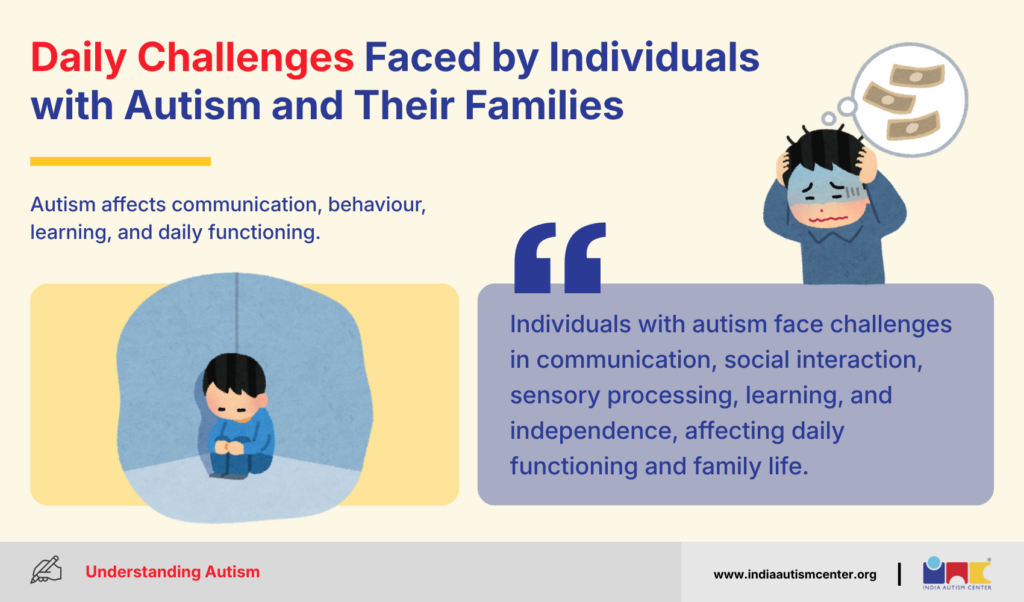
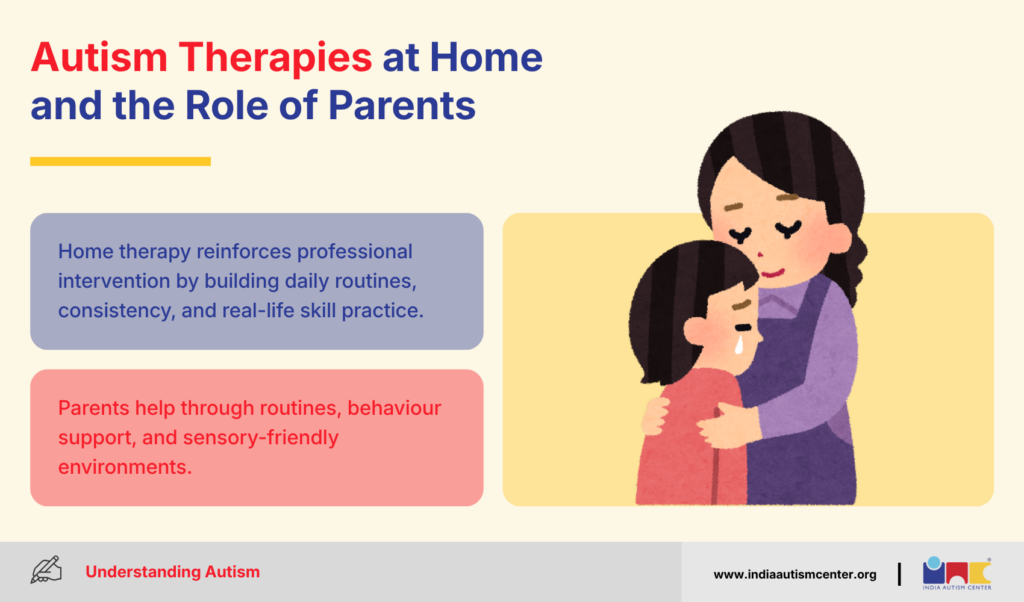
Your child is screaming. Nothing is working. You feel helpless. What do you do next? As a parent or caregiver, managing an autistic child’s behaviour can sometimes feel overwhelming. Every day brings new challenges, questions, and emotional moments.
When your child struggles with behaviour, especially if they show signs similar to high-functioning autism behavior problems, you might wonder: What works? What doesn’t? How do I respond with patience and understanding?
In this detailed guide, I’m going to walk you through strategies that helped me—and can help you too—with behaviour issues, communication barriers, sensory needs, and emotional regulation.
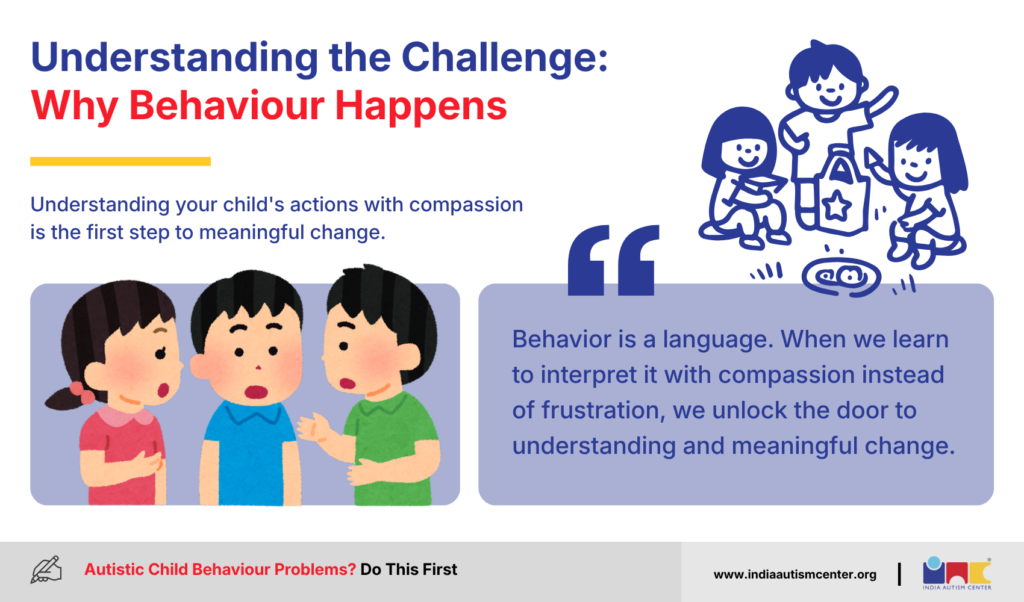
Understanding the Challenge: Why Behaviour Happens
Before diving into strategies, it’s vital to understand that behaviour in autistic children isn’t about “being difficult.” Most often, behaviours are communication; it’s your child’s way of expressing discomfort, anxiety, or unmet needs.
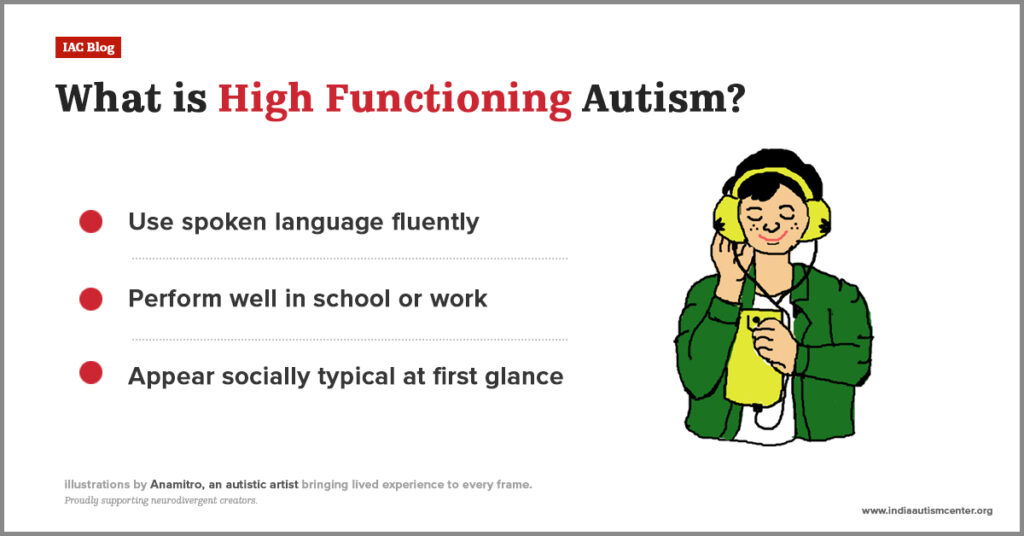
Some behaviours may look like tantrums or meltdowns. Others might be repetitive actions, withdrawal, or avoidance. Especially with high-functioning autism, behaviour problems, the challenges may be subtler but still impactful in daily life.
When I started learning about managing an autistic child’s behaviour, I realised that behaviour is a language. If we learn to interpret it with curiosity and compassion, we can customise our responses for meaningful change.
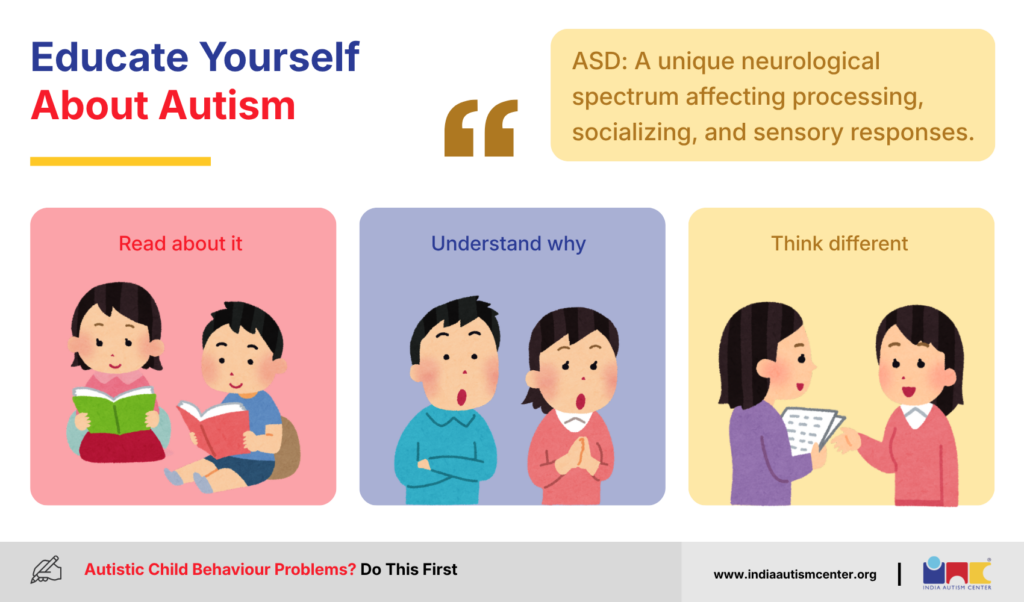
1. Educate Yourself About Autism
The first step in managing behaviour is simple—learn more about autism.
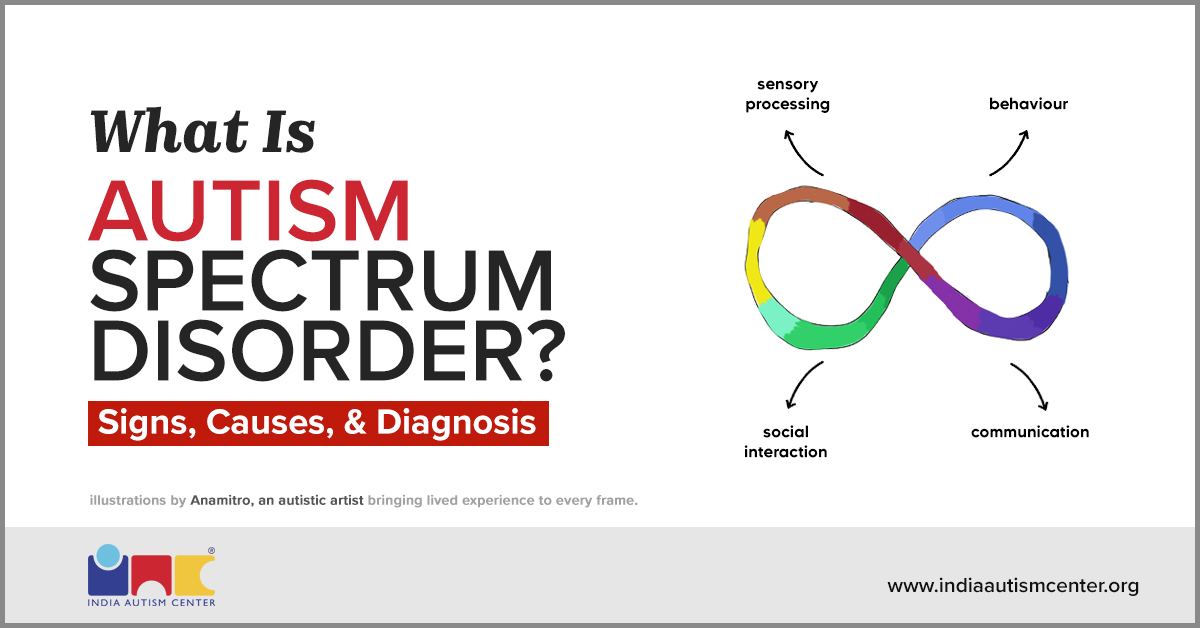
Autism Spectrum Disorder (ASD) is a neurological difference that affects how a child processes information, interacts with others, and responds to sensory input. There isn’t “one behaviour of autism.” Every child’s profile is unique. Learning about autism helps you respond with clarity, not frustration.
What to do:
Read reliable resources about autism, especially guides that explain behaviour traits.
Understand the why behind certain actions—like sensory overload or communication struggles.
Think of behaviour as communication rather than misbehaviour.
When you know your child’s strengths and challenges, you can adapt your approach. This is the foundation of how to deal with autism behaviour problems.
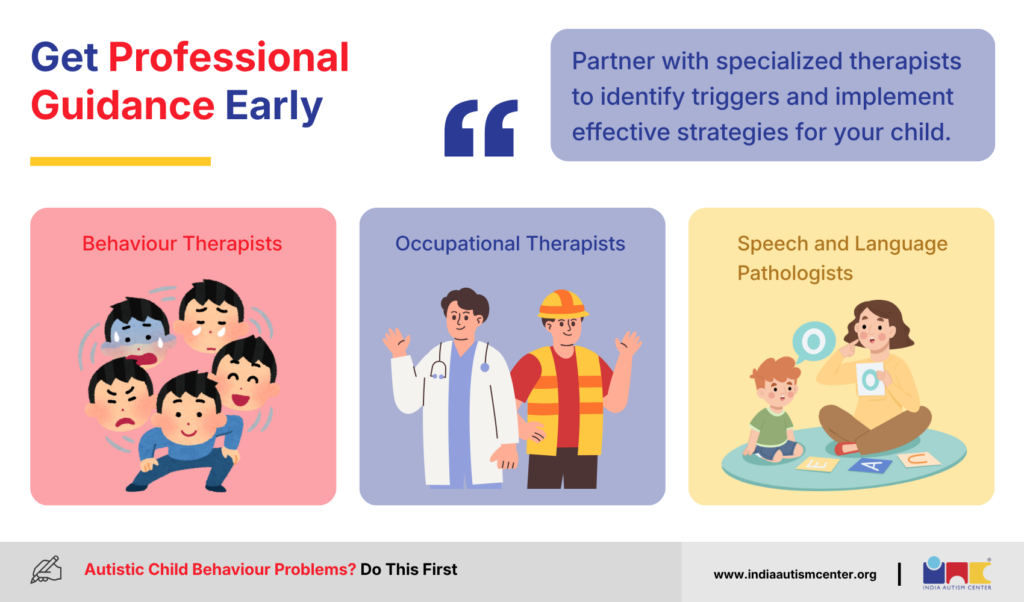
You don’t have to do this alone. Consult professionals such as:
Behaviour Therapists (ABA, for example)
Occupational Therapists
Speech and Language Pathologists
Applied Behaviour Analysis (ABA) is often recommended because it breaks down behaviours into measurable steps. A trained professional can help you understand triggers and tailor strategies that actually work for your child.
What helped me:
A therapist helped identify specific triggers for my child’s meltdowns. This insight allowed me to prepare for many outbursts rather than react to them.
Together, we set up simple reinforcement plans that showed big results over time.
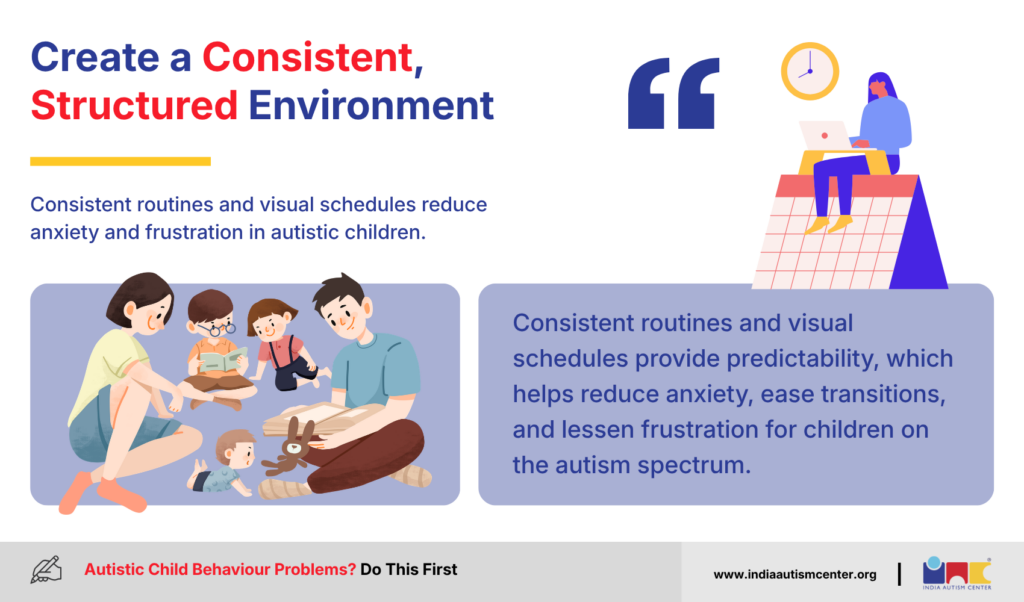
3. Create a Consistent, Structured Environment
Consistency is key. Children on the autism spectrum often thrive on routine. When they know what to expect, they feel safe—and safe children behave better.
Here’s how structure helps:
Routines decrease anxiety and unexpected reactions.
Predictable schedules give your child a sense of control.
Transitions (e.g., playtime to dinner) become easier with clear signals.
You can use visual schedules or simple charts to illustrate the day. These act as behaviour anchors to reduce confusion and frustration—especially helpful if your child shows signs of high-functioning autism-related behaviour problems.
This blog on Autism Therapies at Home will help you plan your routine effectively. Don’t forget to check it out.
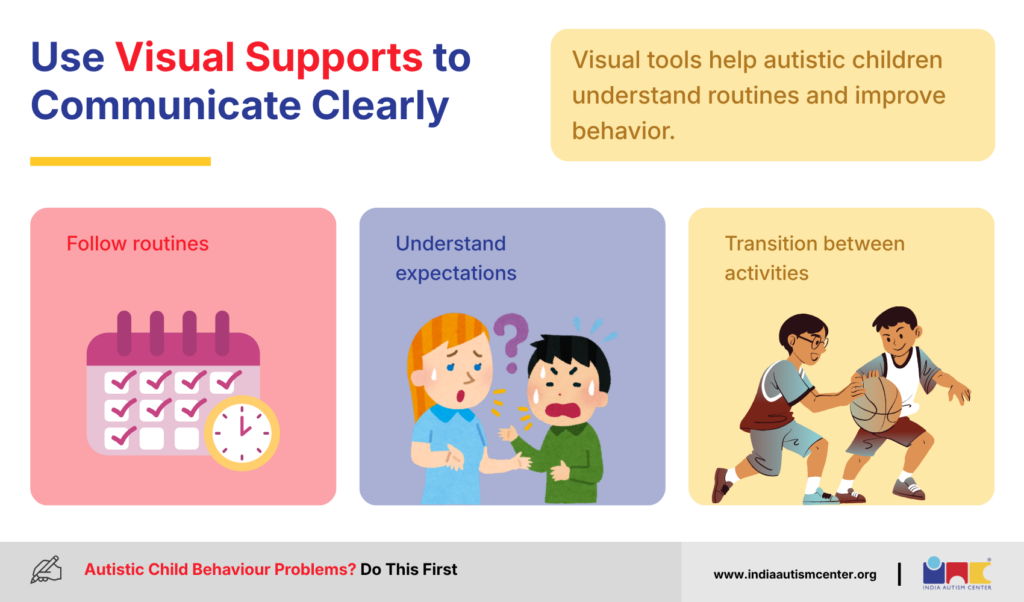
4. Use Visual Supports to Communicate Clearly
Many autistic children find visual information easier to understand than spoken words. Visual supports help your child:
Follow routines
Understand expectations
Transition between activities
Examples of visual tools:
Picture cards
Timers or visual clocks
Social stories that explain situations step by step
I found that when my child could see what was coming next, behaviour improved significantly. Visual reminders reduce surprises, and fewer surprises mean fewer behaviour challenges.
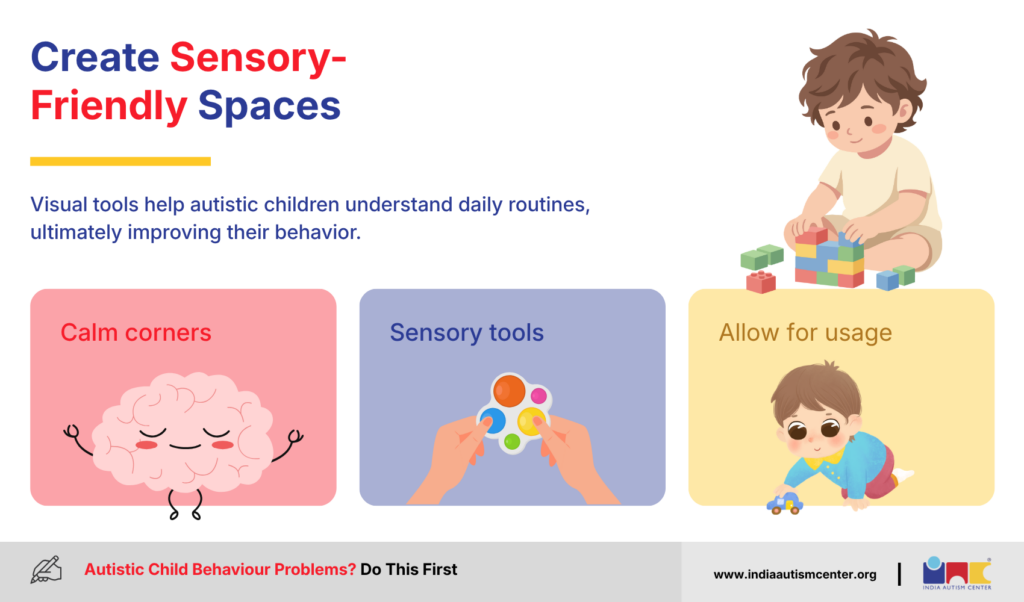
5. Create Sensory-Friendly Spaces
Sensory sensitivities often play a big role in behaviour. Loud sounds, bright lights, and unexpected touch can overwhelm a child’s nervous system, leading to behaviours that seem confusing or disruptive.
To support sensory needs:
Set up calm corners with soft lighting.
Provide sensory tools like fidget toys, weighted blankets, or noise-cancelling headphones.
Let your child use these tools when needed.
When we identify sensory triggers and provide supportive spaces, many behaviour challenges become easier to manage.
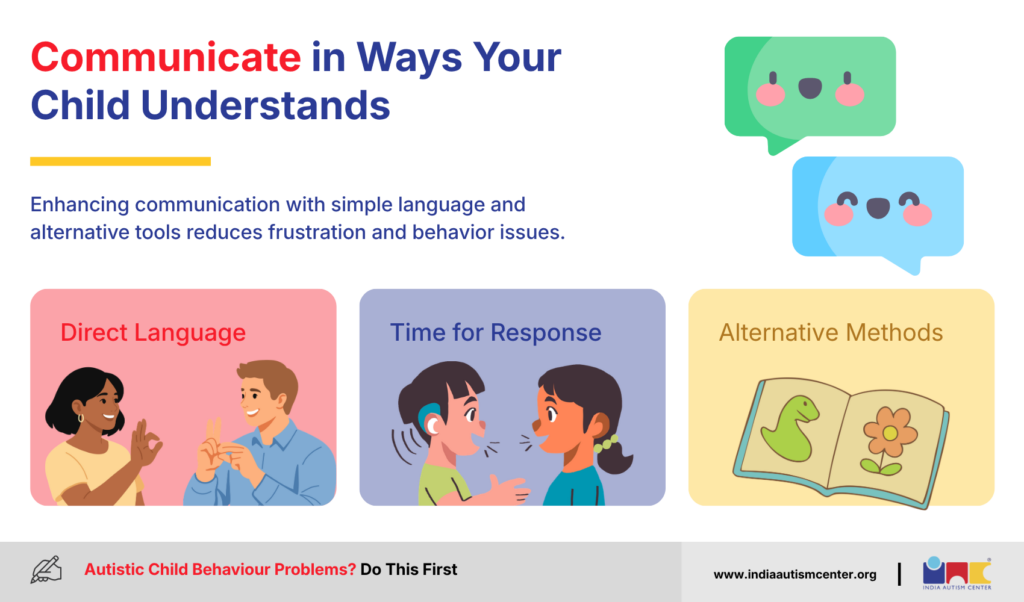
6. Communicate in Ways Your Child Understands
Communication difficulties are a major cause of frustration and behaviour issues. When your child can’t express themselves, their emotions often show up in behaviour.
Here’s how to help:
Use simple, direct language.
Allow extra time for your child to respond.
Consider alternative communication methods like picture exchange systems or apps.
Be patient. Celebrating even small attempts at communication can build confidence and reduce challenging behaviours.
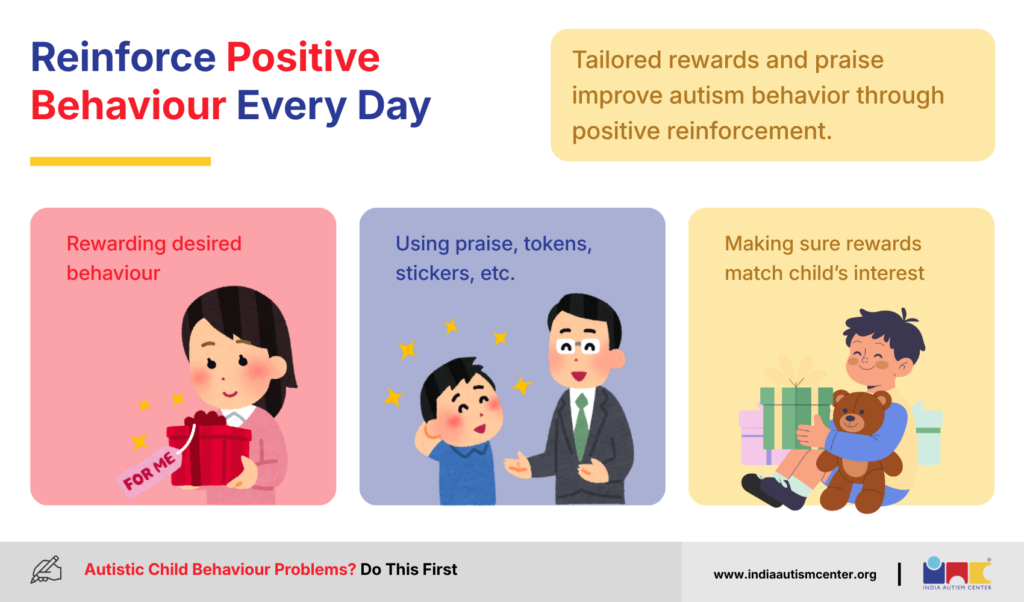
One of the most practical ways of dealing with autism behaviour problems is through positive reinforcement.
Positive reinforcement means:
Rewarding desired behaviour
Using praise, tokens, stickers, or preferred activities
Making sure rewards match your child’s interests
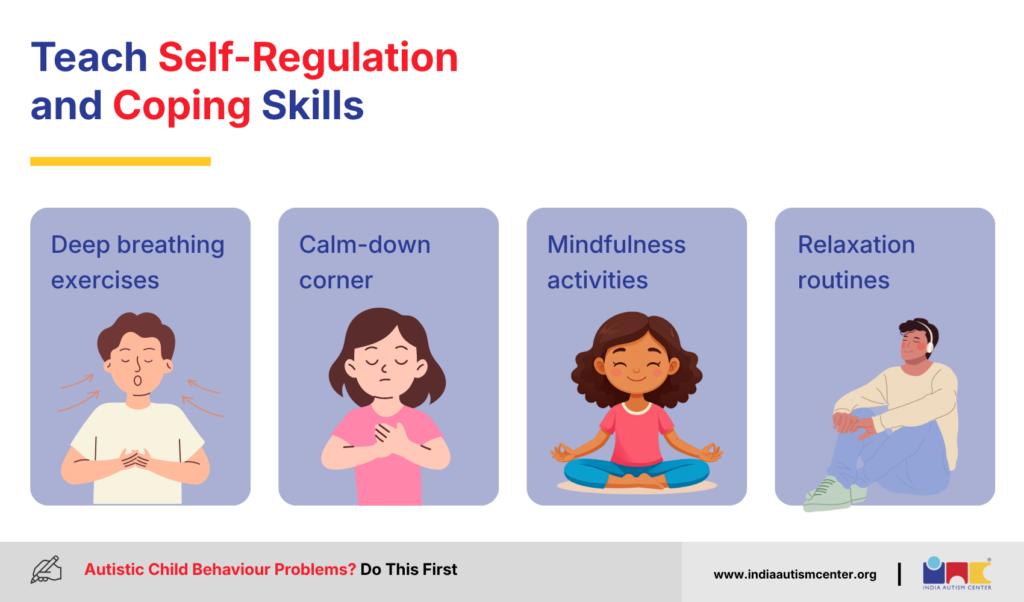
8. Teach Self-Regulation and Coping Skills
Self-regulation helps your child manage emotions like frustration, anger, or overstimulation. It’s a lifelong skill that can transform behaviour.
Some effective techniques include:
Deep breathing exercises
Calm-down corner with sensory tools
Simple mindfulness activities
Guided relaxation routines
When your child learns to regulate their feelings, you’ll see fewer intense reactions, especially during stressful times.
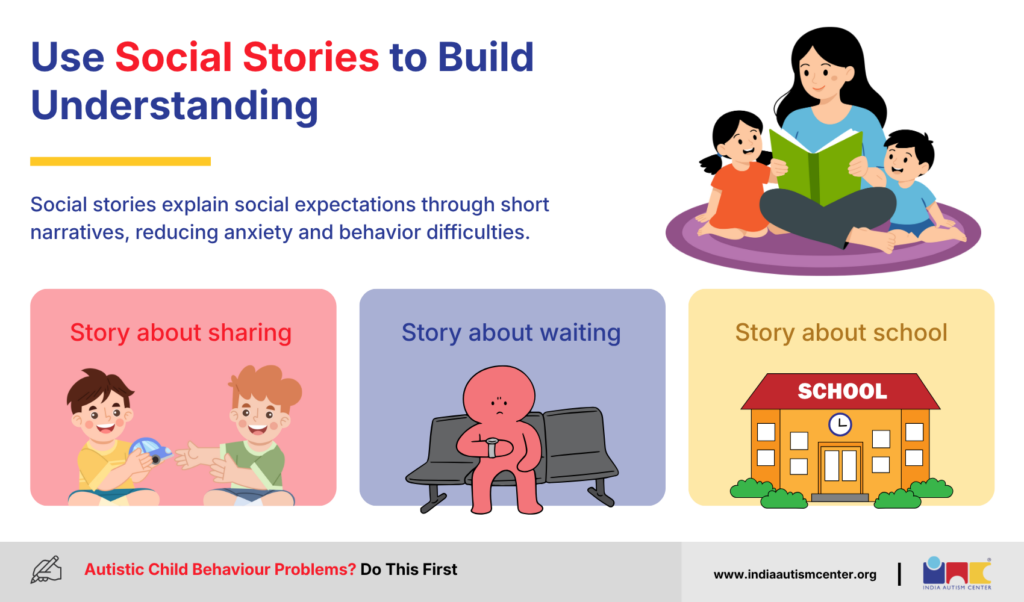
9. Use Social Stories to Build Understanding
Social stories are short narratives that explain challenging social situations in simple terms. These help children understand why certain behaviours are expected and what to do in specific scenarios.
For example:
A story about sharing toys
A story about waiting for your turn
A story about going to school
Social stories help children anticipate and prepare for real-life interactions, which can reduce anxiety and behaviour difficulties.
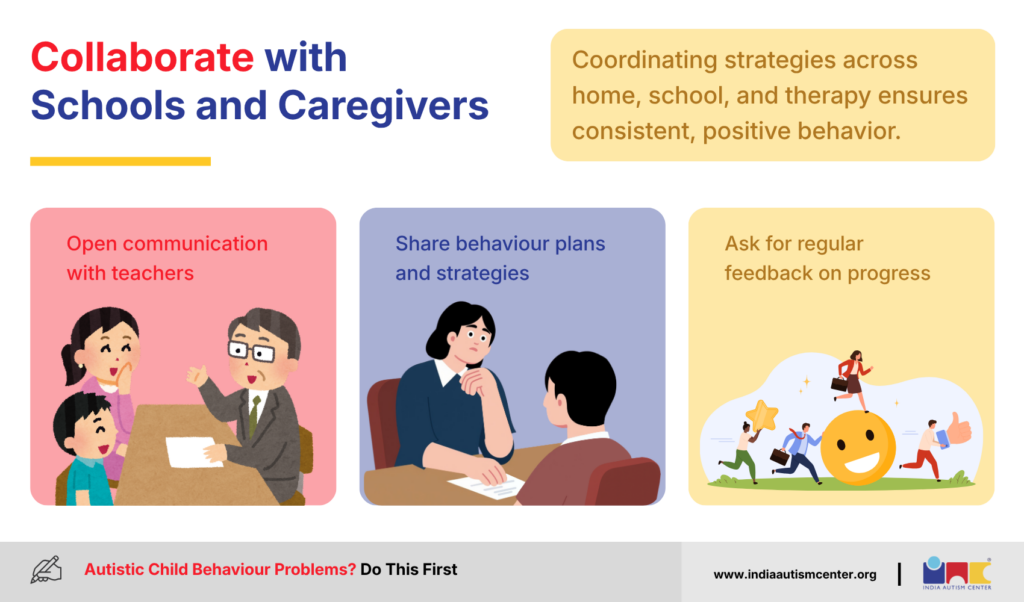
10. Collaborate with Schools and Caregivers
If your child attends school or therapy programs, coordination is essential. Consistent expectations across home, school, and therapy help reinforce positive behaviour everywhere your child goes.
Here’s how to collaborate effectively:
Maintain open communication with teachers and therapists.
Share behaviour plans and strategies that work at home.
Ask for regular feedback on progress.
A unified support system makes managing an autistic child’s behaviour much more achievable.
Here’s something I wish someone had told me earlier: our children are working incredibly hard every single day just to get through ordinary life.
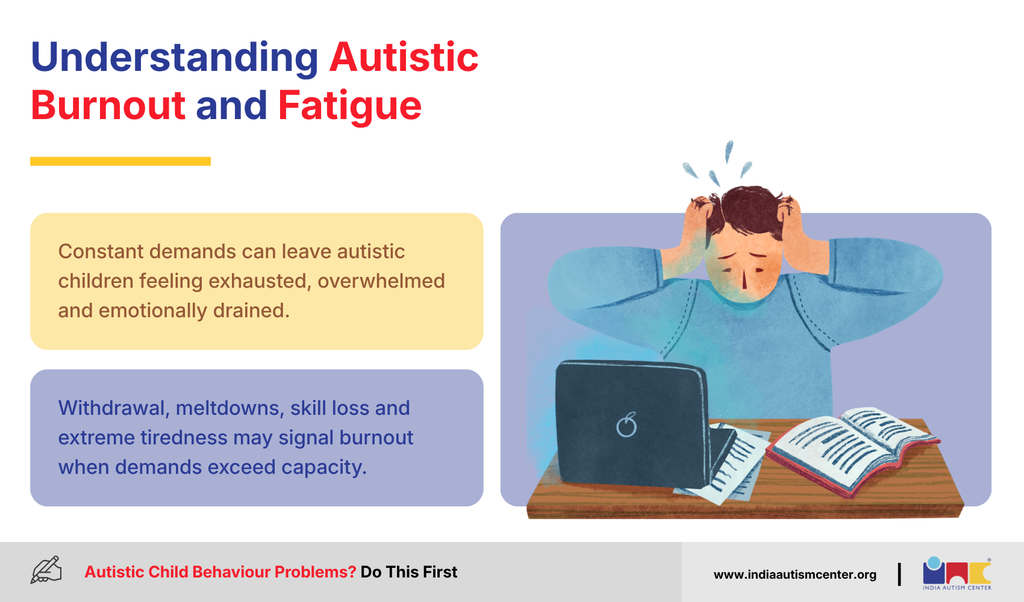
Navigating a noisy classroom, following unspoken social rules, holding themselves together when the lights are too bright, or the schedule changes – all of this takes enormous energy. Over time, that constant effort leads to what researchers and clinicians now call autistic burnout or autistic fatigue. It’s real, it’s common, and it’s often mistaken for a behaviour problem.
What it looks like:
Withdrawal – your child becomes quieter, more isolated, and refuses activities they usually enjoy
Increased meltdowns or shutdowns – even small triggers cause big reactions
Loss of skills – a child who was speaking in sentences may go back to single words; toilet training may regress
Extreme tiredness – sleeping more than usual, or struggling to sleep at all
What you can do:
Build in genuine rest time – not screen time, but low-demand, quiet time with no expectations
Reduce demands temporarily – if your child is burning out, this is not the moment to push new skills
Create a safe quiet space at home where they can decompress without being asked anything
Watch for patterns – burnout often follows a high-demand period like exams, festivals, or a change in routine
If you notice your child losing skills they previously had, speak to their therapist or paediatrician. It’s a signal worth taking seriously.
Managing Transitions Without Meltdowns
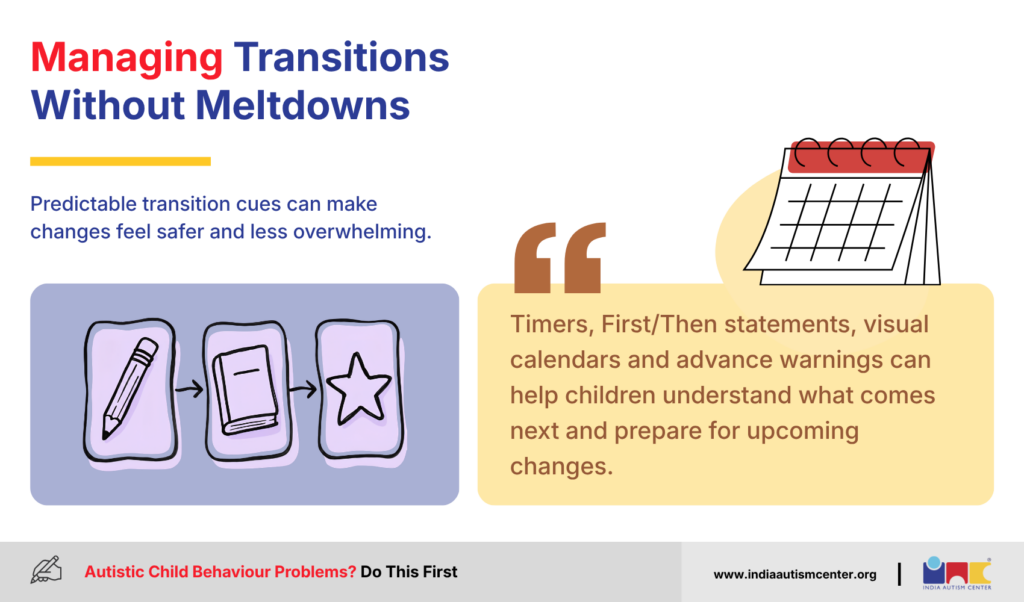
Transitions are one of the hardest parts of the day for many autistic children. Not just big changes – even small ones, like moving from playtime to dinner, or from school to home, can feel abrupt and overwhelming.
The problem isn’t stubbornness. It’s that autistic children are often deeply absorbed in what they’re doing, and an abrupt “stop now” feels like a shock to the system.
Practical tools that actually help:
Timers as audible cues – a visual timer (like the Time Timer app or a sand timer) gives your child a concrete, visible countdown. “Five more minutes, then we eat.” They can see time running out, which is far less jarring than a sudden verbal command.
First/Then statements – keep it simple and concrete. “First finish dinner, then iPad.”“First shoes on, then we go to the park.” This tells your child exactly what comes next, which reduces anxiety about the unknown.
Visual calendars with images – a picture-based daily schedule on the wall or a small card in their pocket shows the sequence of the day. When your child can see that school comes before home, and home comes before dinner, transitions feel predictable rather than random.
Transition warnings – give a 10-minute warning, then a 5-minute warning. Consistency matters here. Do it the same way every time, and your child will start to trust the signal.
The goal isn’t to eliminate transitions – it’s to make them feel safe.
Use Positive Language – Tell Them What TO Do
This one is a mindset shift, and it changed how I communicate with my child completely.
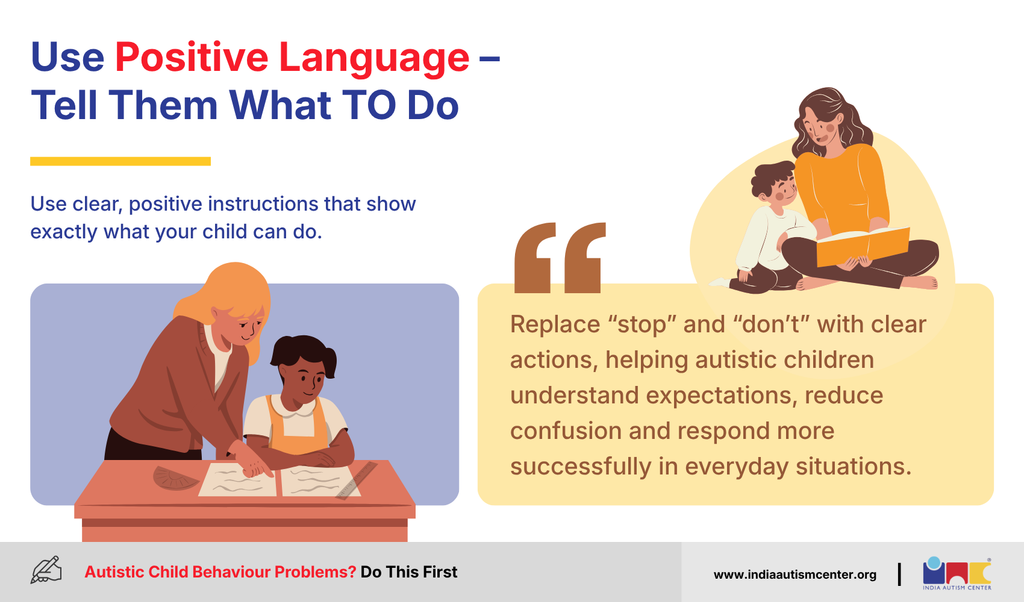
When we say “stop hitting” or “don’t run,” we’re telling a child what not to do – but we’re not giving them anything to replace it with. Autistic children, especially those who process language literally, need to hear the desired behaviour, not the behaviour to avoid.
The shift in practice:
Instead of saying…
Say this instead…
“Stop hitting your sister.”
“Keep your hands in your lap.”
“Don’t run in the corridor.”
“Walk slowly with me.”
“Stop shouting.”
“Use your quiet voice, please.”
It sounds simple. But it works because it gives your child a clear, actionable instruction – something they can do, not just something to stop.
Why it matters for autistic children:
It reduces confusion and processing load
It focuses attention on the correct behaviour, making it easier to reinforce
It keeps the interaction calm and directive, rather than reactive
Next time you catch yourself saying “don’t” or “stop,” pause for a second and ask: what do I actually want them to do? Then say that.
Meltdowns Are Not Tantrums – Know the Difference
This distinction is one of the most important things I’ve learned as a parent – and getting it wrong leads to responses that make things much worse.
A tantrum is goal-directed. Your child wants something – a toy, more screen time, to avoid a task – and the behaviour is (consciously or not) aimed at getting it. Tantrums usually stop when the child gets what they want, or when the audience leaves.
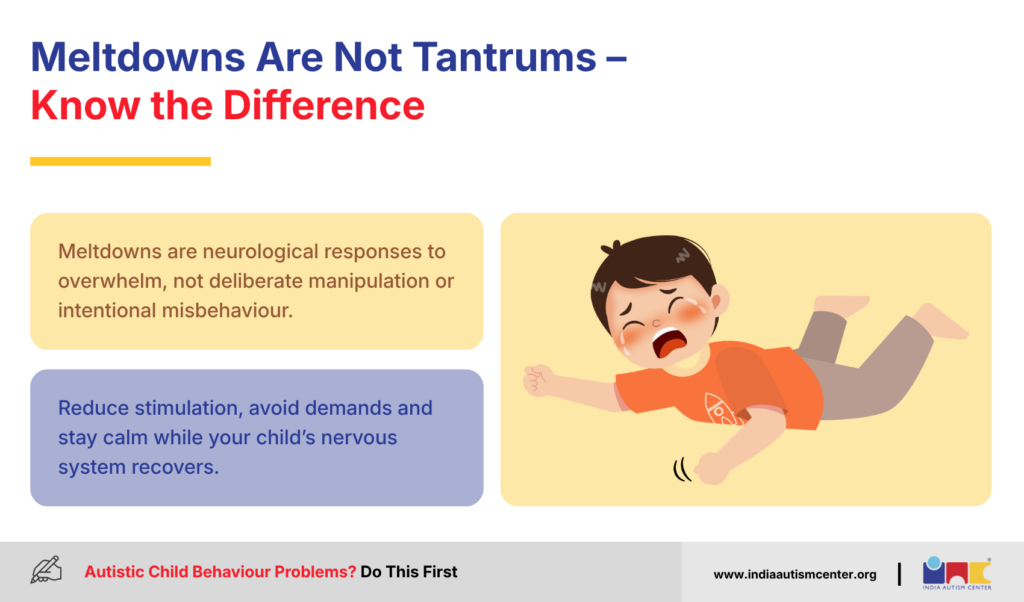
A meltdown is a neurological response to overwhelm. Your child has hit a wall. Their nervous system is flooded. They are not in control, and they cannot simply stop – even if they want to. Meltdowns are not manipulation. They are not a choice.
Signs you’re looking at a meltdown, not a tantrum:
It escalates even when you try to give them what they want
Your child seems genuinely distressed, not strategic
There may be stimming (rocking, hand-flapping), covering ears, or going silent
Recovery takes time – often 20–40 minutes – and is followed by exhaustion
What to do during a meltdown:
Reduce stimulation immediately – turn off the TV, dim the lights, move to a quieter space if possible
Do not demand compliance – this is not the moment for “look at me” or “calm down now.” Those instructions add more input to an already overloaded system
Wait it out calmly – your calm presence is the most powerful thing you can offer. Sit nearby, stay quiet, and let the storm pass.
Once your child is calm and regulated again – that’s when you can reconnect, comfort, and, if needed, gently problem-solve.
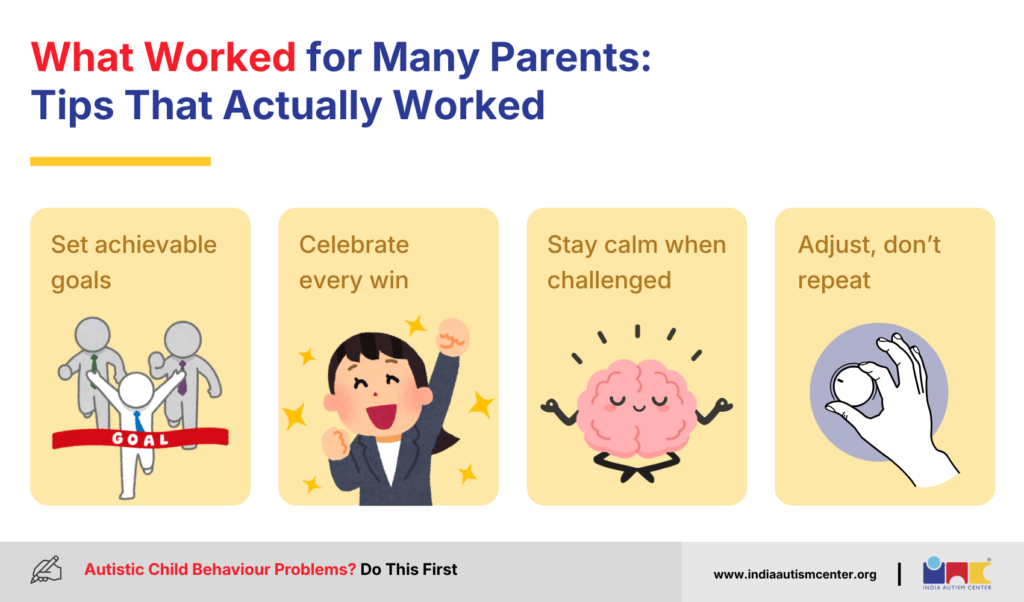
What Worked for Many Parents: Tips That Actually Worked
Here are some personal, practical insights that made a real difference in my journey:
Set Small, Achievable Goals
Big behaviour changes take time. I started with tiny achievable goals, like staying calm through one transition. That felt small, but it built confidence.
Celebrate Every Win
Whether it was one less meltdown or one extra word spoken, we celebrated. These celebrations helped reinforce good behaviour.
Stay Calm During Challenges
When I stayed calm, even amidst behaviour episodes, our home environment became more predictable and safe—this helped reduce triggers.
Adjust, Don’t Repeat
When something didn’t work, I didn’t repeat it the same way. I adjusted. Behaviour management is flexible—it evolves with your child.
These strategies aren’t one-size-fits-all, but with consistency, they can bring real progress and meaningfully teach your child how to cope, communicate, and thrive.
You don’t have to be perfect, just keep learning, adjusting, and showing up every day.
You are not alone—and your efforts make a difference.
Frequently Asked Questions (FAQs)
What are the most effective ways for managing an autistic child’s behaviour at home?
Managing an autistic child’s behaviour at home becomes easier when you follow a consistent routine, use visual supports, and respond calmly. Focus on understanding what triggers your child’s behaviour. Positive reinforcement, sensory-friendly spaces, and clear communication help reduce behaviour challenges over time.
How do I deal with autism behaviour problems without using punishment?
If you are wondering how to deal with autism behaviour problems, avoid punishment and focus on teaching skills instead. Use positive reinforcement, redirect unwanted behaviour, and teach coping strategies like deep breathing or calm-down breaks. Behaviour improves when children feel safe, understood, and supported.
Are high-functioning autism behaviour problems different from other autism behaviour challenges?
Yes, high-functioning autism behaviour problems may look different. Children may communicate well but still struggle with emotional regulation, social understanding, or anxiety. These challenges often appear as frustration, rigidity, or emotional outbursts. Structured routines and social skills support are especially helpful in such cases.
What are some tips that improved my autistic child’s behaviour over time?
Some tips that improved my autistic child’s behaviour include setting small goals, praising positive actions immediately, staying calm during meltdowns, and adjusting strategies when something didn’t work. Consistency, patience, and understanding your child’s sensory and emotional needs make a big difference.
Disclaimer: This article is intended for educational and informational purposes only. It is not a substitute for professional medical advice, diagnosis, or treatment. If you are pregnant or have concerns about medication use during pregnancy, please consult a qualified healthcare provider. If your child has received an autism diagnosis and you have questions about causes or support, please reach out to a trained specialist or an autism-focused organisation for guidance.
For expert insights, support services, and inclusive learning initiatives, contact India Autism Center for more information.
Picture this: you’re at a Diwali mela with your child. The firecrackers go off, the crowd surges, the lights flash – and within seconds, your child is on the ground, screaming, inconsolable. Or maybe it’s something smaller: every morning is a battle over the school uniform because the collar “feels wrong.” You’ve been told it’s stubbornness, attention-seeking, bad parenting. It isn’t any of those things.
Sensory issues in autism are neurological, not behavioural. They happen because the autistic brain processes sensory information differently – more intensely, less intensely, or in ways that simply don’t match the environment around it. Research published on PubMed Central estimates that up to 90% of autistic individuals experience atypical sensory responses. That’s not a quirk. That’s a core feature of autism, formally recognised in the DSM-5 under Criterion B4.
This article covers what sensory issues actually are, the 8 sensory systems involved, the difference between hypersensitivity and hyposensitivity, what sensory overload looks like, and – most importantly – what you can do about it as a family in India.
Understanding Sensory Issues in Autism
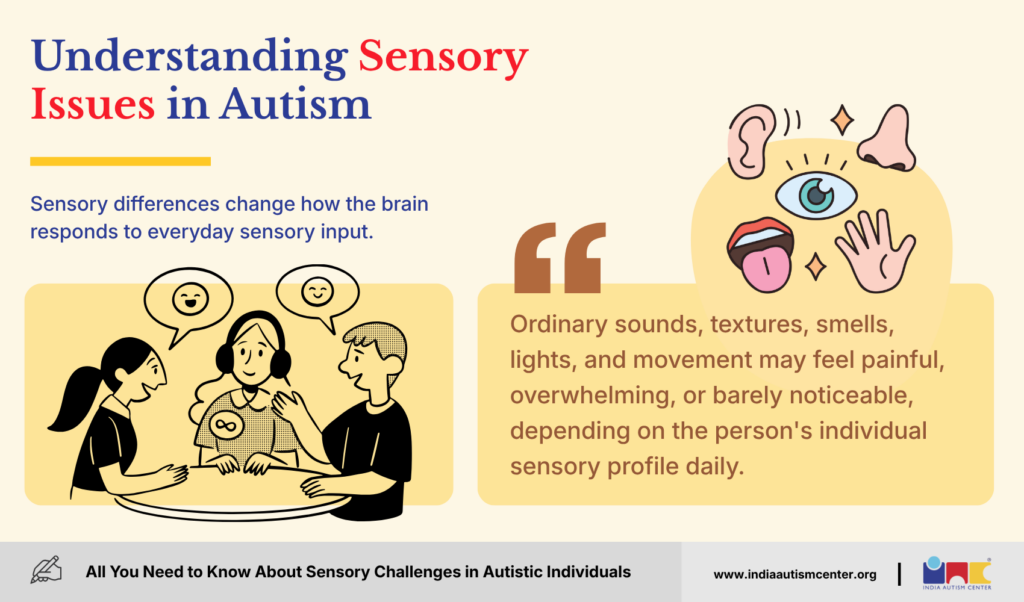
Sensory issues – also called sensory processing differences – refer to the way an autistic person’s brain receives, filters, and responds to information coming in through the senses. For most people, the brain acts like a smart filter: it turns down the background hum of a ceiling fan, ignores the feel of a shirt collar, and focuses on the conversation in front of you. For many autistic individuals, that filter doesn’t work the same way.
The result? Ordinary sensory input – a school bell, a scratchy dupatta, the smell of a neighbour’s cooking – can register as genuinely painful, terrifying, or completely invisible. According to a review in PMC (2020), approximately 90% of people with ASD experience some form of atypical sensory response. These autism sensory issues are not a phase, and they’re not something a child will “grow out of” without the right support.
Since 2013, sensory differences have been formally embedded in the autism diagnostic criteria. DSM-5 Criterion B4 specifically lists “hyper- or hypo-reactivity to sensory input or unusual interest in sensory aspects of the environment” as one of the defining features of ASD. This matters because it means sensory challenges autism families deal with every day are clinically recognised – and deserve clinical support.
The 8 Sensory Systems – Not Just the Usual Five
Most of us learned about five senses in school. But the human nervous system actually processes eight distinct streams of sensory information. All eight can be affected in autism.
Vision – How the brain interprets light, colour, movement, and visual patterns. Autism example: A child becomes distressed by the flickering of fluorescent tube lights in a classroom.
Hearing – How the brain processes sound, pitch, and volume. Autism example: A child covers their ears and cries when a pressure cooker whistles, even from another room.
Touch (Tactile) – How the brain reads pressure, texture, temperature, and pain on the skin. Autism example: A child refuses to wear any clothing with an inner label or a tight elastic waistband.
Taste (Gustatory) – How the brain interprets flavour, texture, and temperature in the mouth. Autism example: A child will only eat foods of a specific texture – plain rice, no dal, nothing mixed – and gags at anything else.
Smell (Olfactory) – How the brain processes scent. Autism example: A child refuses to enter the kitchen when certain spices are being cooked, even if the smell is mild to everyone else.
Proprioception – The sense of where your body is in space, including awareness of muscle tension and joint position. Autism example: A child constantly bumps into walls, misjudges distances, or seeks bear hugs and heavy blankets for deep pressure input.
Vestibular – The sense of balance, movement, and spatial orientation, processed in the inner ear. Autism example: A child spins endlessly without getting dizzy, or conversely, panics at the top of a staircase.
Interoception – The brain’s awareness of internal body signals: hunger, thirst, pain, heartbeat, bladder fullness, temperature. Autism example: A child doesn’t signal when they need the toilet, or doesn’t notice they’re hungry until they’re in a full meltdown from low blood sugar.
Understanding all eight systems is essential. Sensory challenges autism families notice are rarely limited to just hearing or touch – they often span multiple systems at once.
Sensory Overload and Autism
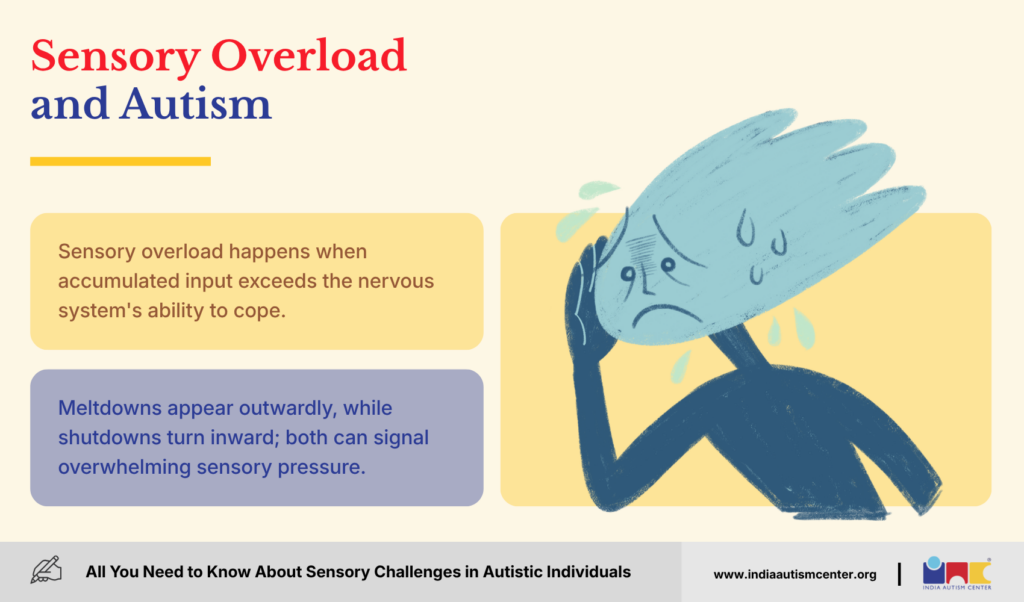
Think of the autistic nervous system as a glass that fills faster than neurotypical glasses. Every sensory input – the hum of the AC, the smell of lunch, the tag on the shirt, the noise of traffic – adds a little more to the glass. When the glass overflows, the result is sensory overload.
What happens in the brain during overload is not a choice. The amygdala – the brain’s threat-detection centre – fires as if there’s genuine danger. The stress hormones cortisol and adrenaline flood the system. The prefrontal cortex, responsible for reasoning and self-regulation, goes offline. At that point, your child is not being naughty. They are in a neurological emergency.
Overload expresses itself in two very different ways:
Meltdown – An external, outward response. Crying, screaming, hitting, throwing objects, running away. This is the nervous system releasing unbearable pressure. It is not a tantrum. Tantrums are goal-directed (a child wants something). Meltdowns are neurological – they happen because the system has exceeded its capacity, full stop.
Shutdown – An internal, inward response. The child goes quiet, withdraws, stops responding, stares blankly, or curls up. This can look like compliance or calm, but it’s actually the nervous system shutting non-essential functions down to cope. Shutdowns are often missed or misread as the child “being fine.”
Early warning signs of sensory overload – watch for these:
Covering ears or eyes without an obvious reason
Increased stimming (rocking, hand-flapping, humming) – the nervous system self-regulating
Becoming clingy or unusually quiet in a busy environment
Refusing to enter a room or a building
Complaints of headache, stomach ache, or “feeling sick” in sensory-heavy settings
Irritability or tearfulness that seems disproportionate to the situation
Skin-picking, nail-biting, or other self-soothing behaviours ramping up
Asking to go home repeatedly
Catching these signs early – before the glass overflows – is the most effective intervention available to any parent.
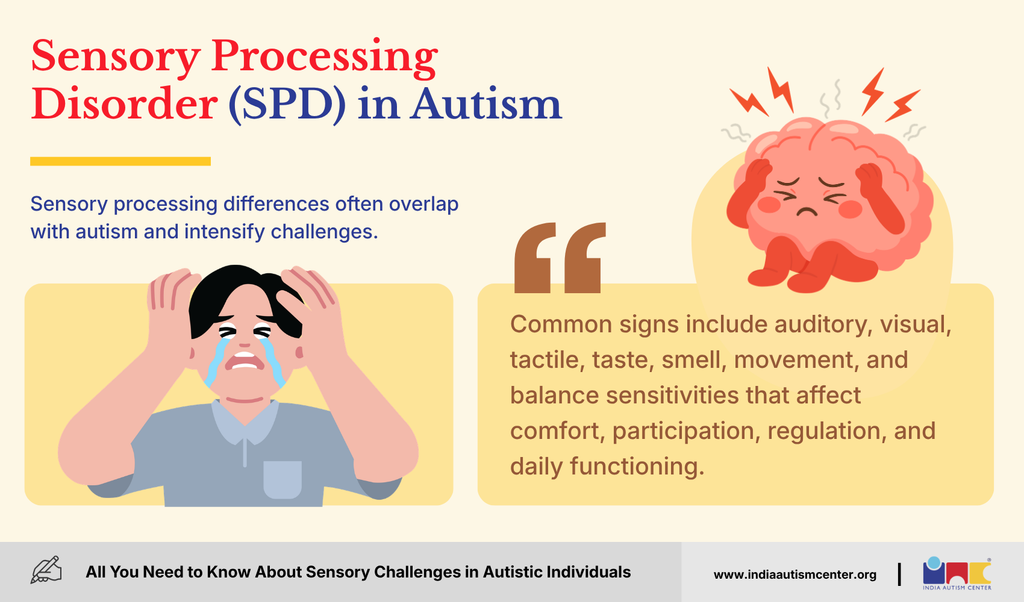
To understand these sensory challenges clearly, let’s talk about sensory processing disorder (SPD). Although SPD isn’t a formal medical diagnosis, it describes a pattern where the brain has trouble interpreting sensory signals, like sight, sound, touch, and movement.
Sensory Processing vs Autism
You might wonder — is sensory processing disorder the same as autism sensory issues? Not always. Sensory processing differences are part of autism for many people, but not everyone with autism has SPD, and some neurotypical people can also have sensory processing differences.
Still, the overlap is significant. For example, about three out of four autistic children also experience symptoms of sensory processing challenges.
Understanding this overlap helps you see sensory challenges in context — they’re part of the sensory world of many autistic individuals, and they can shape behaviour and comfort in daily life.
Recognising the signs of sensory problems in autistic individuals is crucial for understanding and supporting them effectively.
Some common signs include:
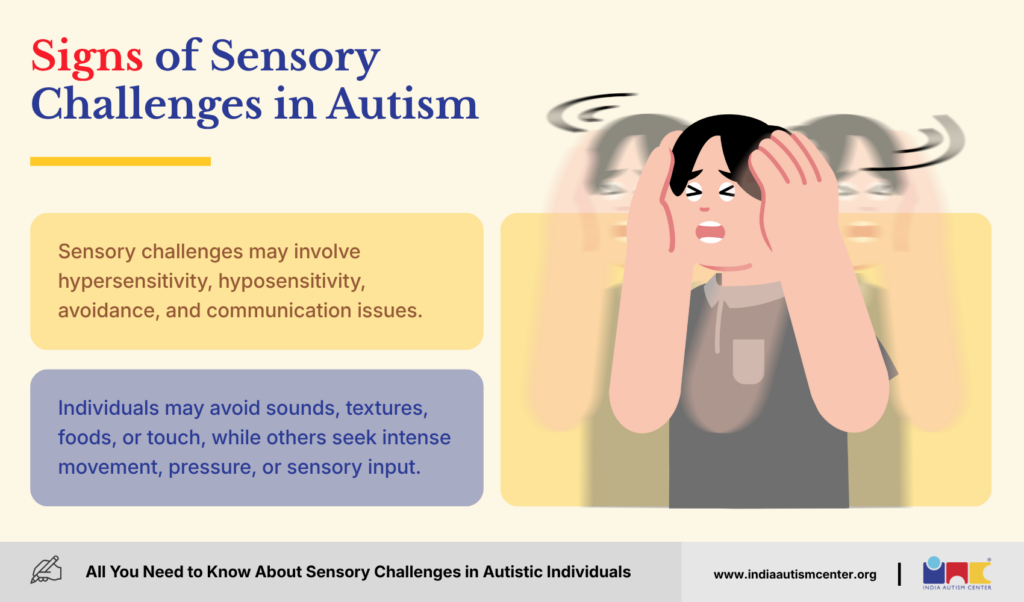
Hypersensitivity: Some autistic individuals are hypersensitive to certain stimuli. They might cover their ears in response to normal sounds, avoid certain textures of clothing, or become distressed by bright lights. Example reactions include:
Covering ears because noises feel too loud
Avoiding tags on clothing
Refusing certain foods due to texture
Shying away from touch or unexpected sensations
Hyposensitivity: On the other hand, hyposensitivity involves a decreased sensitivity to sensory input. An individual might not notice temperature extremes, engage in self-stimulatory behaviours (stimming) like repetitive movements, or seek out intense sensory experiences like jumping from heights. Examples include:
Not noticing extreme temperatures
Seek deep pressure or intense stimulation (like jumping or crashing)
Have a high tolerance for pain
Do not react to loud environments
Avoidance Behaviours: Autistic individuals with sensory challenges often develop avoidance behaviours to cope with overwhelming stimuli. This can lead to limited social engagement, difficulty in daily activities, and challenges in academic or work settings.
Communication Difficulties: Sensory issues can also impact communication. For instance, an individual might struggle to focus on a conversation in a noisy environment or become anxious when touched unexpectedly.
Sensory Processing Disorder in Autism
Sensory processing disorder in Autism is a condition where the brain has difficulty receiving and responding to sensory information. While not exclusive to Autism, SPD frequently co-occurs with the condition. Research suggests that around 75% of children with ASD also experience SPD (NIH). This overlapping occurrence of sensory challenges and Autism often intensifies the individual’s struggles in daily life.
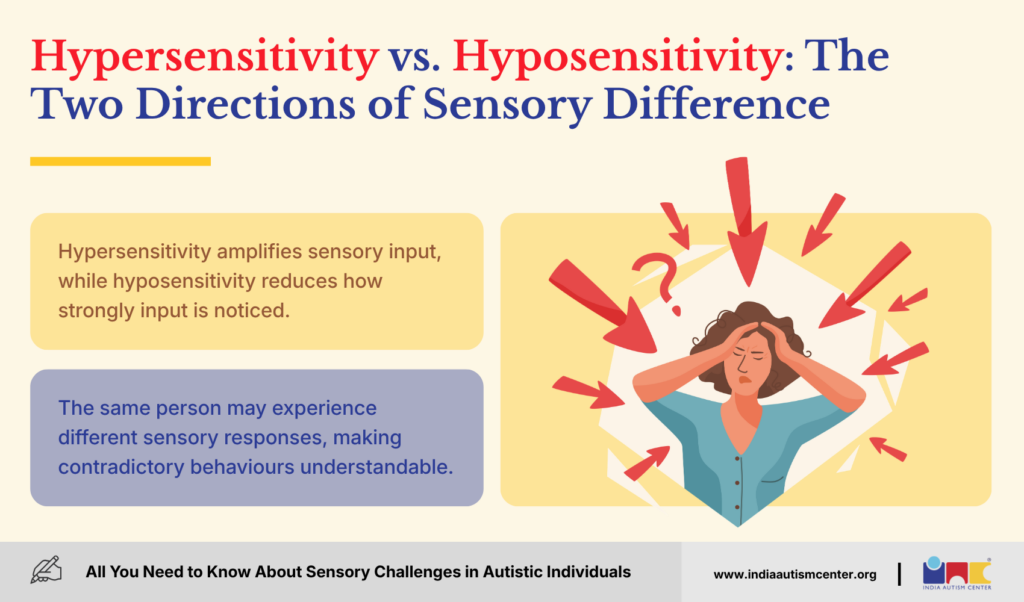
Hypersensitivity vs. Hyposensitivity: The Two Directions of Sensory Difference
Here’s something that trips up even experienced parents: sensory differences don’t run in just one direction. Some autistic children are over-responsive (hypersensitive) – their nervous system amplifies input. Others are under-responsive (hyposensitive) – their nervous system dampens it. And the same child can be hypersensitive in one system and hyposensitive in another, sometimes simultaneously.
Sensory System
Hypersensitivity (Over-Responsive)
Hyposensitivity (Under-Responsive)
Hearing
Covers ears at normal sounds; distressed by sudden noises
Doesn’t respond to their name; seeks loud music
Vision
Distressed by bright lights or busy patterns
Stares at lights or spinning objects for long periods
Touch
Avoids clothing tags, hugs, or unexpected touch
Seeks deep pressure; doesn’t feel pain normally
Taste
Refuses foods by texture or flavour; very restricted diet
Mouths non-food objects; seeks very strong flavours
Doesn’t notice hunger, thirst, pain, or need to toilet
This is why your child might seem contradictory – desperately seeking the deep pressure of a tight hug, but screaming when a relative touches their arm lightly. Both responses make complete neurological sense. The nervous system craves one type of input and is overwhelmed by another. Once you see it through this lens, the behaviour stops looking like contradiction and starts looking like communication.
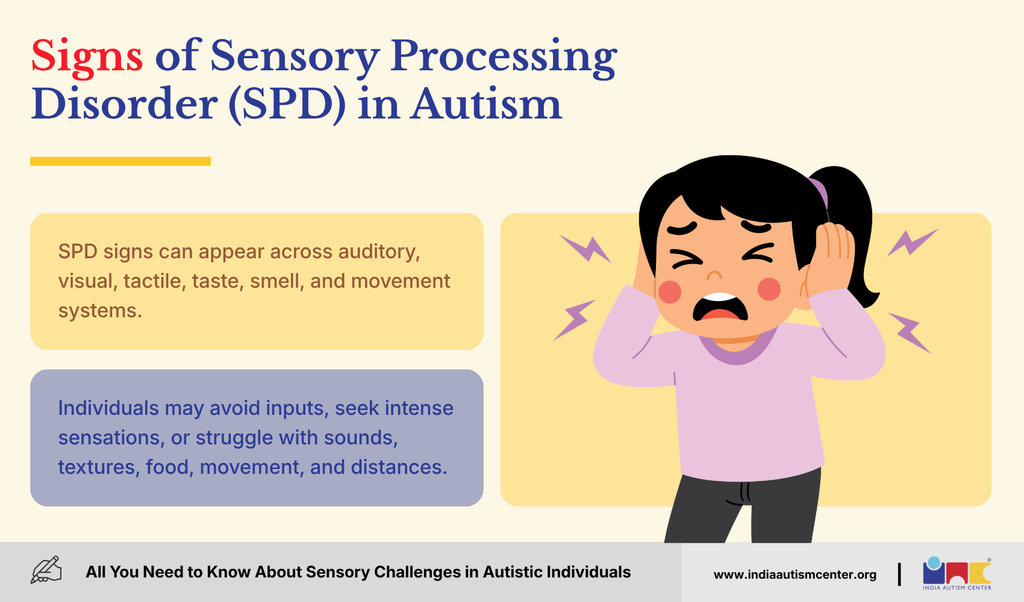
Signs of Sensory Processing Disorder (SPD) in Autism
Sensory processing disorder (SPD) and autism sensory issues overlap significantly, but they’re not identical. Research suggests that around 75% of children with ASD also experience clinically significant SPD symptoms – a figure consistent with multiple NIH-indexed reviews. The overlap intensifies daily challenges, because a child managing both autism and SPD-level sensory difficulties faces a much higher baseline of sensory stress.
Signs of SPD in autism, by sensory channel:
Auditory (Hearing)
Covers ears or becomes distressed in busy environments like markets, school assemblies, or wedding halls
Startles excessively at sudden sounds – a door slamming, a dog barking
Struggles to follow verbal instructions in noisy classrooms
Visual
Distressed by bright sunlight, fluorescent lighting, or rapidly moving images
Prefers dim rooms; may wear sunglasses indoors
Fascinated by spinning objects, lights, or specific visual patterns for extended periods
Tactile (Touch)
Refuses certain clothing fabrics, seams, or labels – a common trigger for school uniform battles in India
Reacts strongly to unexpected touch, even from familiar people
Seeks deep pressure – tight hugs, heavy objects, being wrapped tightly
Taste and Smell
Extremely restricted diet based on texture, temperature, or flavour
Gags or vomits at certain food smells
Conversely, mouths non-food objects or seeks very intense tastes
Movement and Balance (Vestibular and Proprioceptive)
Fearful of heights, escalators, or uneven ground
Seeks constant movement – spinning, rocking, jumping on furniture
Appears clumsy; misjudges spatial distances
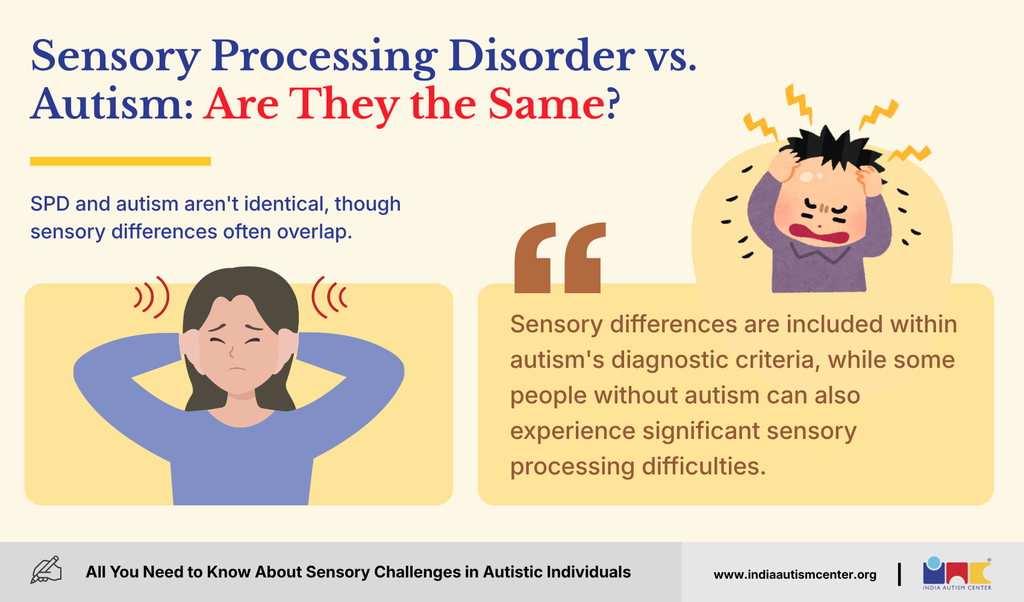
Sensory Processing Disorder vs. Autism: Are They the Same?
No – but the overlap is substantial, and the distinction matters for diagnosis and support.
SPD is not a standalone DSM-5 diagnosis. It is not listed as a separate condition in the current diagnostic manual. However, sensory differences are now formally embedded in autism’s diagnostic criteria under DSM-5 Criterion B4: “hyper- or hypo-reactivity to sensory input or unusual interest in sensory aspects of the environment.” This means that for autistic individuals, sensory processing differences are part of the diagnosis itself – not a separate add-on.
Some neurotypical people do experience SPD-like sensory difficulties without meeting autism criteria. And not every autistic person experiences sensory differences at the same level of intensity. The key takeaway: if your child has received an [LINK: autism diagnosis in India], sensory differences are almost certainly part of the picture and should be assessed and addressed as part of their overall support plan.
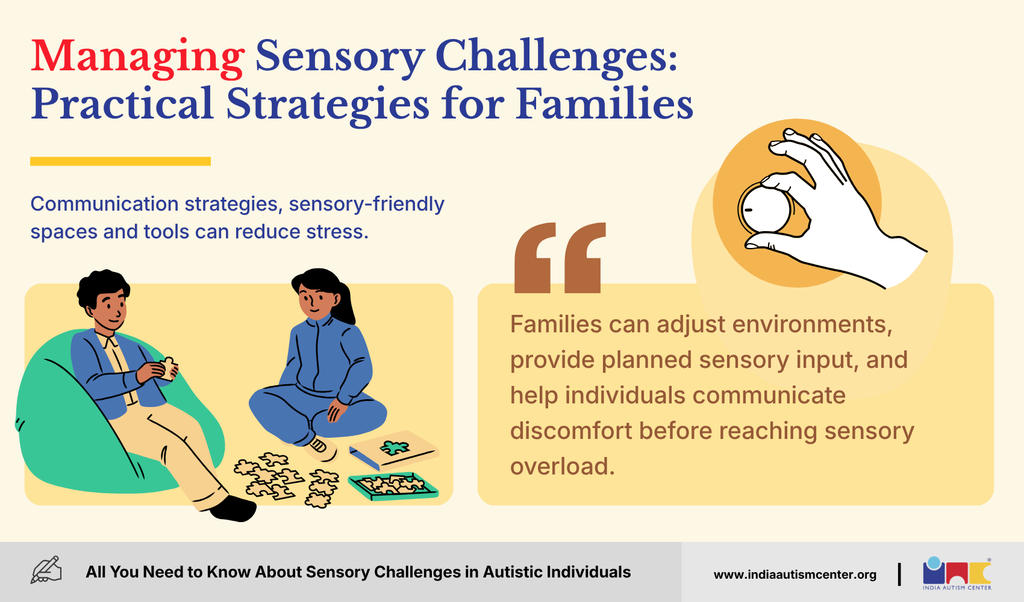
Managing Sensory Challenges: Practical Strategies for Families
Understanding autism sensory issues is the first step. Acting on that understanding is the next. Here are four evidence-informed approaches that work in real Indian homes and schools.
1. Create a Sensory-Friendly Environment at Home
You don’t need to renovate your house. Small, targeted changes make a real difference.
Lighting:
Replace harsh fluorescent bulbs with warm LED lights or CFL bulbs with a lower colour temperature
Use curtains or blinds to control sunlight during peak hours
Give your child a small lamp for their room so they can control their own light level
Sound:
During festivals like Diwali or Holi, plan ahead: identify a quiet room in the house as a “retreat space” your child can access freely
Use soft background music or white noise to mask unpredictable sounds
Warn your child before loud events – a simple “the pressure cooker will whistle in 2 minutes” can prevent a meltdown
Touch and Texture:
Source school uniforms in softer cotton fabrics; remove inner labels or replace them with iron-on name tags
Offer seamless socks – widely available online in India
Let your child choose their own bedding; weighted blankets (available from several Indian vendors on platforms like Amazon. in and Flipkart) can be deeply calming
Space:
Create a designated “calm corner” – a small, low-stimulation area with a beanbag, dim light, and a few preferred sensory items
In joint family settings, negotiate a specific room or time that is your child’s low-stimulation zone
2. Build a Sensory Diet (It’s Not About Food)
A sensory diet is a personalised plan of sensory activities scheduled throughout the day to keep the nervous system regulated. Occupational therapist Patricia Wilbarger coined the term, and it remains a cornerstone of occupational therapy at IAC and OT practice worldwide.
The idea is simple: a nervous system that gets the right kind of sensory input at regular intervals is far less likely to overflow into overload. Think of it like eating – small, regular inputs prevent the crash that comes from going too long without.
Calming activities (for an over-aroused, hypersensitive nervous system):
Deep pressure massage or firm joint compressions
Slow, rhythmic rocking or swinging
Weighted blanket time (15–20 minutes)
Slow, deep breathing exercises
Kneading dough or clay (excellent proprioceptive input)
Listening to preferred music through headphones
Alerting activities (for an under-aroused, hyposensitive nervous system):
Important: a sensory diet should be designed by a qualified occupational therapist who has assessed your child’s specific sensory profile. What calms one child can dysregulate another. Early intervention with OT support gives families the best foundation for building an effective sensory diet.
3. Use Sensory Tools and Supports
Several tools can make day-to-day sensory management much more manageable. Many are now accessible in India.
Noise-cancelling headphones – Brands like Sony, JBL, and Anker all have affordable options available in India. A game-changer for crowded places, school assemblies, and festival seasons.
Weighted blankets – Typically 10% of the child’s body weight. Available from Indian sellers on Amazon. in and Flipkart; expect to pay ₹1,500–₹4,000 depending on size and fill.
Chewable jewellery (chewelry) – Food-grade silicone pendants or bracelets for children who seek oral sensory input. Available from specialist autism supply stores online in India.
Sensory swings – Indoor fabric pod swings or hammock chairs provide vestibular and proprioceptive input. Can be installed in a doorframe or ceiling hook.
Sunglasses and caps – Simple, cheap, and effective for visual hypersensitivity outdoors.
4. Communicate Sensory Needs – Even Without Words
One of the most important things we can do for a child with sensory challenges and autism families face is give them a way to communicate what they’re experiencing – before they reach overload.
Visual schedules – A picture-based or symbol-based daily schedule reduces the anxiety of unpredictability, which itself reduces sensory load. Apps like Choiceworks and First Then Visual Schedule are widely used.
Augmentative and Alternative Communication (AAC) apps – Apps like Proloquo2Go, Snap Core First, or the free LetMeTalk (Android) allow non-verbal or minimally verbal children to express sensory discomfort. A child who can tap “too loud” or “hurts” is a child who doesn’t need to melt down to be heard.
Sensory cards – Simple laminated cards with pictures of sensory states (“I need quiet,” “I need a hug,” “I need to move”) that a child can hand to an adult. Low-tech, highly effective.
Social stories – Short, personalised narratives that explain upcoming sensory situations (“At Diwali, there will be loud sounds. I can wear my headphones. I can go to my quiet room.”). These prepare the nervous system in advance.
Non-verbal children absolutely can communicate their sensory needs with the right tools. The goal is to build that communication system before the crisis, not during it.
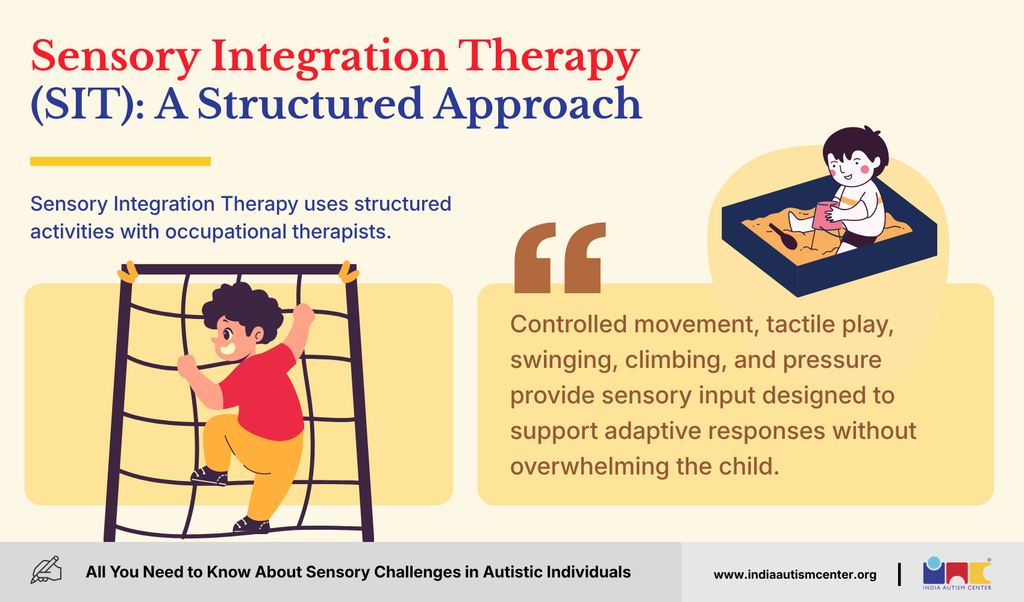
Now, there is one more way to develop an autistic individual’s motor, adaptive, and cognitive skills and help them build social-emotional relationships. It is called Sensory Integration Therapy (SIT). SIT provides strategies to help autistic individuals better process sensory input. It is an element of occupational therapy. It can be provided only by qualified OT therapists.
Sensory Integration Therapy: A Structured Approach
Sensory Integration Therapy (SIT) is an occupational therapy-led intervention specifically designed to help the brain learn to process sensory information more effectively. Developed by Dr A. Jean Ayres in the 1970s, it remains one of the most widely used approaches for addressing sensory problems that autism specialists work with.
What SIT involves: A trained OT guides the child through structured, play-based activities that provide controlled sensory input – swinging, climbing, deep pressure, tactile play – in a way that challenges the nervous system just enough to promote adaptive responses. The environment is carefully calibrated: the child is never overwhelmed, but always gently stretched.
Who delivers it: SIT can only be delivered by a qualified occupational therapist with specific training in sensory integration. It is not something that can be replicated at home without professional guidance, though the OT will typically send home activities to reinforce the work done in sessions.
What outcomes to expect: Research supports SIT for improving sensory regulation, motor coordination, and adaptive behaviour in autistic children. Progress is gradual – most families notice meaningful changes over 3–6 months of consistent therapy. For a detailed breakdown of what the therapy involves, read Sensory Integration Therapy for Autism: A Complete Parent’s Guide (2026).
At India Autism Center, sensory integration is embedded within our OT-led therapy programmes. Our occupational therapists conduct individualised sensory profiles for each child and design SIT programmes accordingly, as part of a holistic approach to development and daily living.
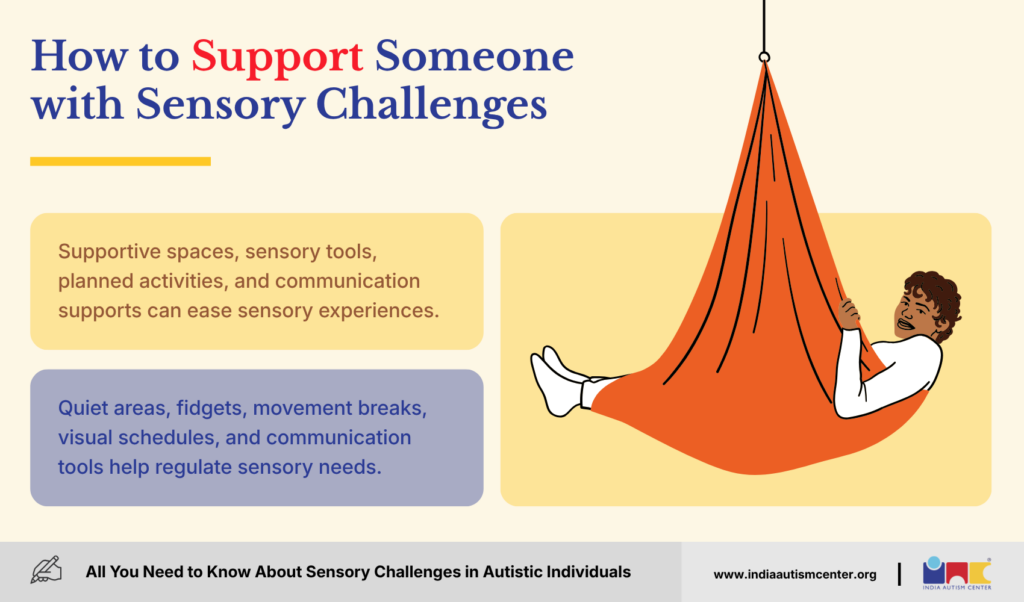
How to Support Someone with Sensory Challenges
Here’s where your support really matters. Managing sensory challenges involves understanding, patience, and practical adjustments.
1. Create Sensory-Friendly Spaces
Small changes can make a big difference:
Use soft or natural lighting
Reduce background noise
Provide quiet corners or calm spaces
Allow the use of noise-cancelling headphones
These changes help people feel more comfortable and less overwhelmed.
2. Use Sensory Tools and Supports
Many autistic individuals benefit from supportive tools:
Fidget toys
Weighted blankets
Sensory swings
Quiet play items
These tools help regulate sensory input and give the nervous system predictable feedback
3. Build a Sensory Diet
A sensory diet is not food — it’s a plan of sensory activities that help the nervous system stay regulated. Occupational therapists often create these plans based on individual needs.
Activities might include:
Deep pressure exercises
Movement breaks
Sensory play
Stretching or jumping
These activities help balance sensory input and reduce stress.
4. Communicate Sensory Needs Clearly
Encourage the person to express what they feel. Tools like visual schedules, communication apps, and social stories can help those who find it hard to put sensory experiences into words.
Understanding what causes discomfort helps everyone adapt and support effectively.
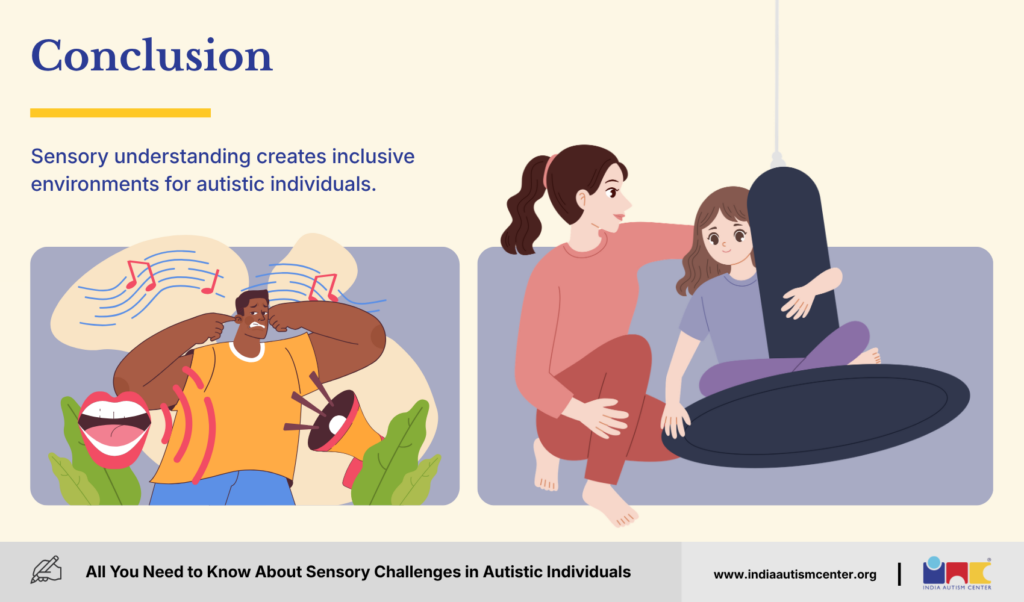
Sensory challenges are a key part of the autism experience — and they deserve greater understanding and support. When we learn about sensory processing disorder, autism sensory issues, and sensory problems in autism, we create a world that’s easier for autistic individuals to navigate.
Remember:
Sensory experiences are real and meaningful.
They affect comfort, behaviour, and participation.
Supportive environments and tools can make life easier.
Whether you are a caregiver, educator, family member, or an autistic individual yourself, knowing about sensory challenges in autistic individuals helps you interact with the world in more compassionate and effective ways.
If you have questions or want practical tips tailored to your situation, feel free to ask.
Frequently Asked Questions (FAQs)
1. What are sensory challenges in autistic individuals?
Sensory challenges in autistic individuals refer to differences in how the brain processes sensory information such as sound, light, touch, taste, smell, and movement. These differences can make everyday experiences feel overwhelming, uncomfortable, or sometimes under-stimulating.
2. Are sensory challenges a part of autism?
Yes, sensory challenges are very common in autism. Many people on the autism spectrum experience autism sensory issues, which are recognised as a core feature of Autism Spectrum Disorder (ASD).
3. What is sensory processing disorder, and how is it related to autism?
Sensory processing disorder occurs when the brain has difficulty organising and responding to sensory input. While sensory processing disorder can exist on its own, it is frequently seen in autistic individuals and closely linked to sensory problems in autism.
4 . What does sensory overload mean in autism?
Sensory overload happens when too much sensory input is received at once and the brain cannot cope with it. This may result in anxiety, shutdowns, meltdowns, or withdrawal. Sensory overload is a common experience related to autism sensory challenges.
5. Can sensory issues in autism change over time?
Yes, sensory issues in autism can change with age, environment, and support. Some sensory sensitivities may reduce, while others may become more noticeable depending on life situations and stress levels.
6. How can parents support a child with sensory problems in autism?
Parents can support their child by creating sensory-friendly environments, respecting sensory preferences, using calming tools, and seeking guidance from trained professionals such as occupational therapists who specialise in autism sensory issues.
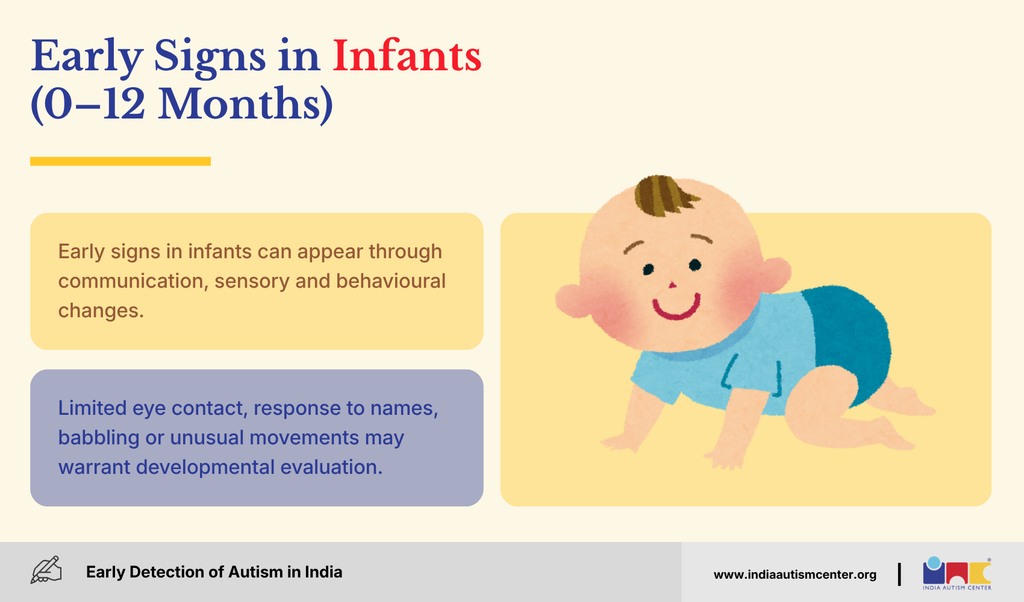
Many Indian parents wonder if a late smile or delayed speech is “just a phase” or a sign of autism. In reality, autism spectrum disorder (ASD) is present from birth, and early symptoms often appear in the first 12–18 months. Catching these signs early is crucial: neuroscientists call ages 0–3 a period of “experience-dependent plasticity,” when the young brain can change most rapidly. Studies show that interventions begun before age 3 can significantly improve language and social outcomes.
The challenge in India is that many children aren’t diagnosed until they start school at 5–6 years, missing this “critical window.” Our overcrowded healthcare system and lack of awareness create a detection gap: parents may notice concerns (e.g. no eye contact by 6 weeks, or no words by 12 months) but be told “boys speak late” or wait for “normal” development. This article helps bridge that gap.
What Is Autism Spectrum Disorder?
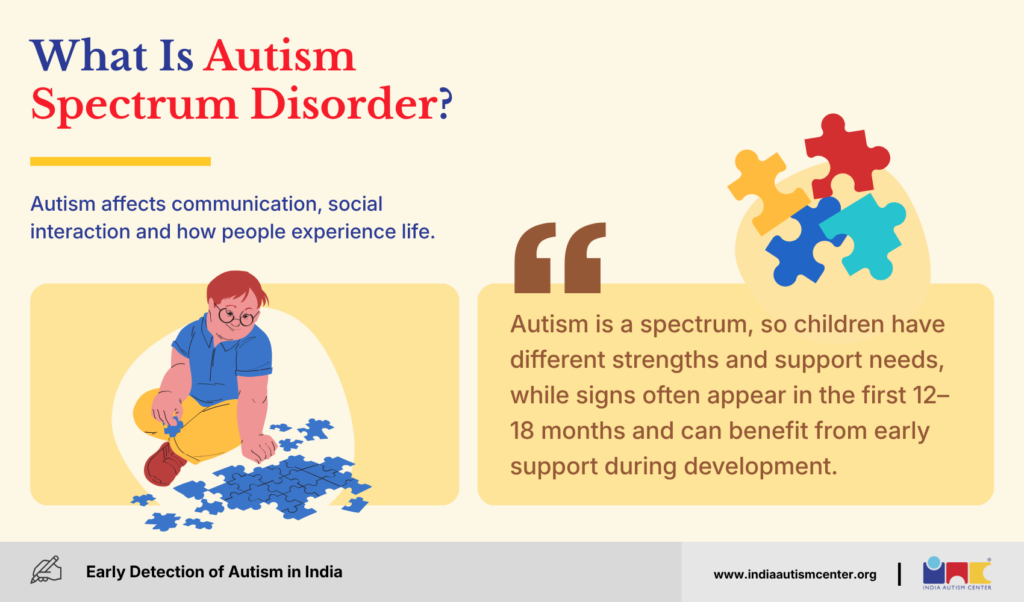
Autism Spectrum Disorder (ASD) is a neurological and developmental condition that affects how a person communicates, relates to others, and experiences the world around them. The word spectrum matters: no two autistic children are alike. Some are highly verbal; others may not speak at all. Some have exceptional memory or focus; others need support with basic daily tasks.
ASD is not caused by bad parenting, vaccines, or diet. Research points to a combination of genetic and environmental factors, though the exact cause remains under study.
What we do know with certainty: autism is present from birth, its signs often appear in the first 12–18 months of life, and the brain is most responsive to intervention in the earliest years. This is not a condition a child “grows out of” – but with the right support started early, the trajectory changes dramatically.
Understanding what autism is sets the stage for understanding why catching it early is so urgent.
Statistics on Autism in India
The numbers are significant – and they demand attention.
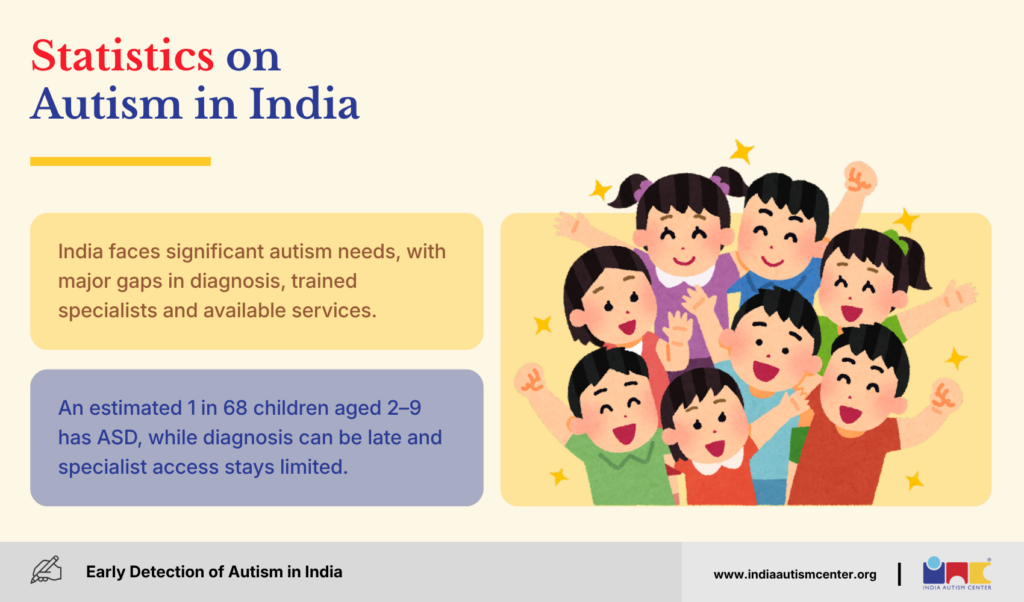
1 in 68 children in India aged 2–9 years is estimated to have ASD, according to data cited in Indian Pediatrics.
Boys are three times more likely to be diagnosed than girls, with a male-to-female ratio of approximately 3:1.
Despite these numbers, the average age of diagnosis in India remains well above 3–4 years – and in rural areas, it is often much later.
India has an estimated 10 million+ individuals on the autism spectrum, yet the number of trained specialists, therapy centres, and diagnostic services remains critically inadequate.
Most standardised assessment tools used in India are available only in English, creating an immediate barrier for the majority of the country’s population.
These aren’t just statistics. Each number represents a child who may have spent years without the support their developing brain needed most.
Knowing the scale of the problem makes the case for early action impossible to ignore.
Here’s the most important thing this article can tell you: the earlier intervention begins, the better the outcomes – full stop.
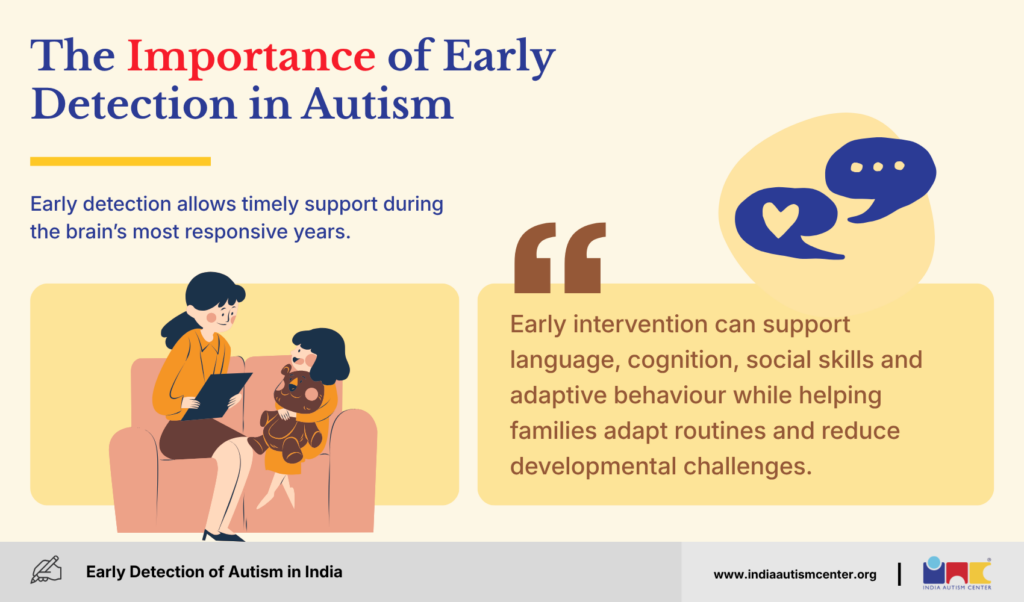
The reason is biology. In the first three years of life, the human brain undergoes its most rapid period of growth and reorganisation. Neuroscientists call this experience-dependent plasticity – the brain’s extraordinary ability to form new connections in response to stimulation and learning. Interventions begun during this window, particularly between 18 and 36 months, are consistently associated with greater gains in language, cognition, social skills, and adaptive behaviour than those started later.
A 2024 review published in PMC found that programs begun before age 3 are linked to better outcomes in IQ, language development, and social communication compared to interventions that start after age 5. The gains aren’t uniform – autism is a spectrum – but the direction of the evidence is clear.
What early detection makes possible:
Tailored early intervention – speech therapy, occupational therapy, ABA, and developmental programmes can begin during the brain’s most responsive period.
Parental education – families who understand their child’s needs early can adapt their home environment, communication style, and daily routines in ways that support development every single day.
Prevention of secondary challenges – anxiety, frustration, and behavioural difficulties often escalate when a child’s needs go unrecognised. Early diagnosis reduces this burden significantly.
School readiness – children who receive early support are far better prepared for structured learning environments.
In India, many children are not diagnosed until they enter school at age 5 or 6. By then, years of the brain’s most plastic period have passed. Early detection of autism in India isn’t just a medical goal – it’s a developmental emergency.
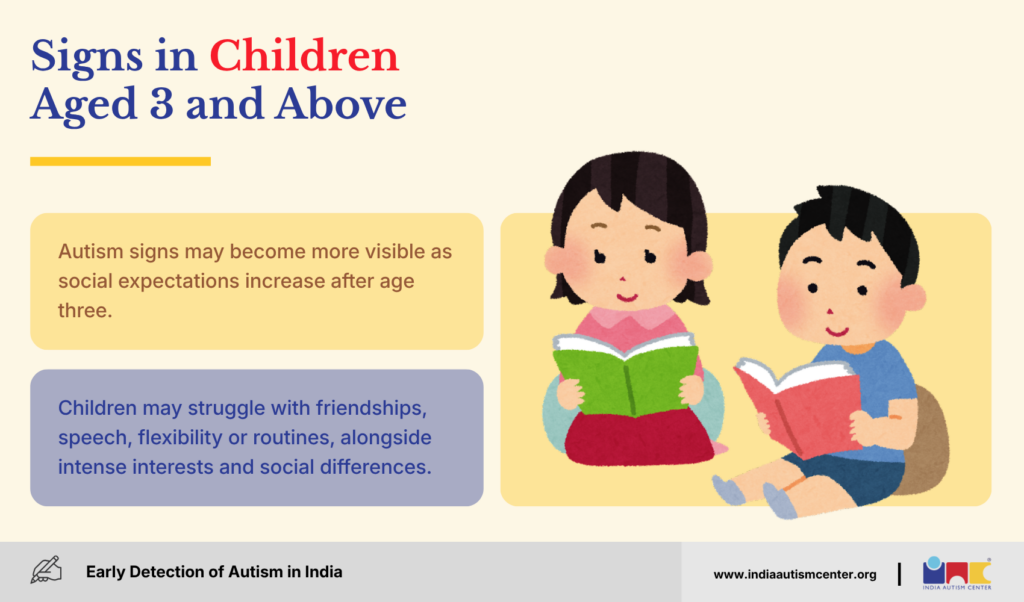
By age 3, the social demands on a child increase sharply – and so does the visibility of autism. Signs at this stage include:
Social interaction:
Treats other children or adults as objects rather than people
Does not understand turn-taking, sharing, or basic social conventions
No interest in making friends; may not notice when other children approach
Lacks empathy or has unusual emotional responses – laughing at pain, no reaction to distress
Communication:
Little expressive language, or speech that is not used meaningfully
Improper use of pronouns (says “you want water” instead of “I want water”)
Frequently makes irrelevant or repetitive remarks
Great difficulty with abstract language, jokes, or metaphor
Restricted interests and routines:
Preoccupied with one or two narrow topics to an extreme degree
Rigid adherence to routines – any deviation causes significant distress
Fascinated with spinning objects, fans, or lights
Exceptional rote memory (can recite long lists, dialogues, or facts) alongside difficulty with flexible thinking
If your child is 3 or older and you’re recognising several of these signs, it is not too late. Early intervention at any age helps – but the urgency to act remains real.
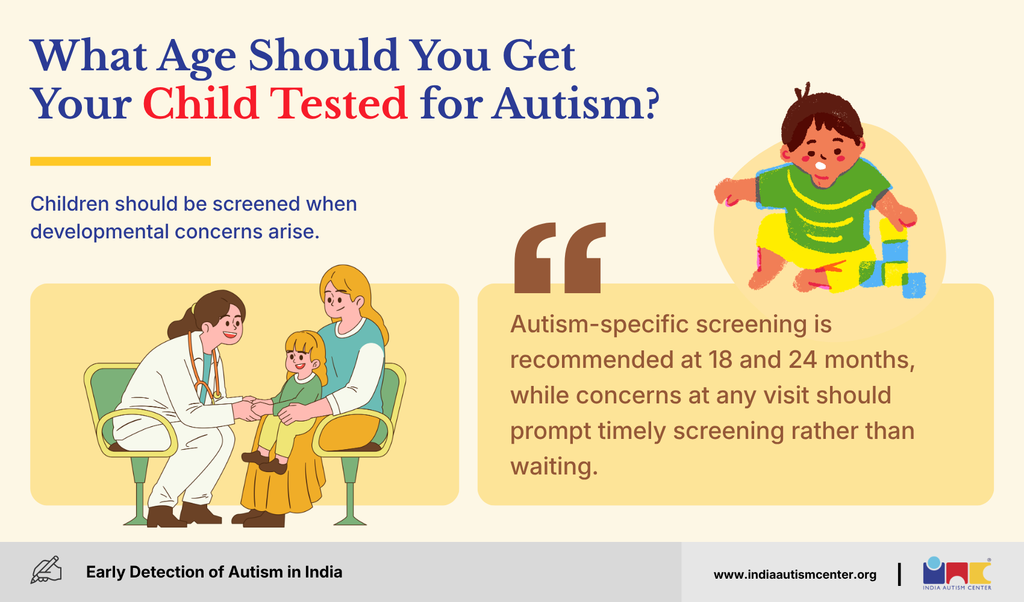
What Age Should You Get Your Child Tested for Autism?
The short answer: as soon as you have concerns. There is no age too young to raise a worry with your paediatrician.
The formal guidance is clear:
18 months: Autism-specific screening (M-CHAT-R/F) is recommended at the 18-month well-child visit. This is the earliest point at which the tool is validated and reliable.
24 months: A second round of autism-specific screening is recommended at the 24-month visit, even if the 18-month screen was negative. Many children who are missed at 18 months are identified at 24.
Any time: If a parent or caregiver raises a concern at any visit, screening should happen immediately – not at the next scheduled check-up.
What happens if you wait?
The brain’s plasticity – its ability to form new pathways in response to intervention – is highest in the first three years and declines gradually after that. This doesn’t mean intervention after age 3 doesn’t help; it absolutely does. But the intensity of gains is consistently greater when therapy begins earlier.
Children diagnosed after age 5 often enter school without the communication and social tools they need, leading to academic struggles, social isolation, and in many cases, anxiety and depression that compound the original challenges.
If your child is 2 years old and you’re worried, today is the right time to call your paediatrician.
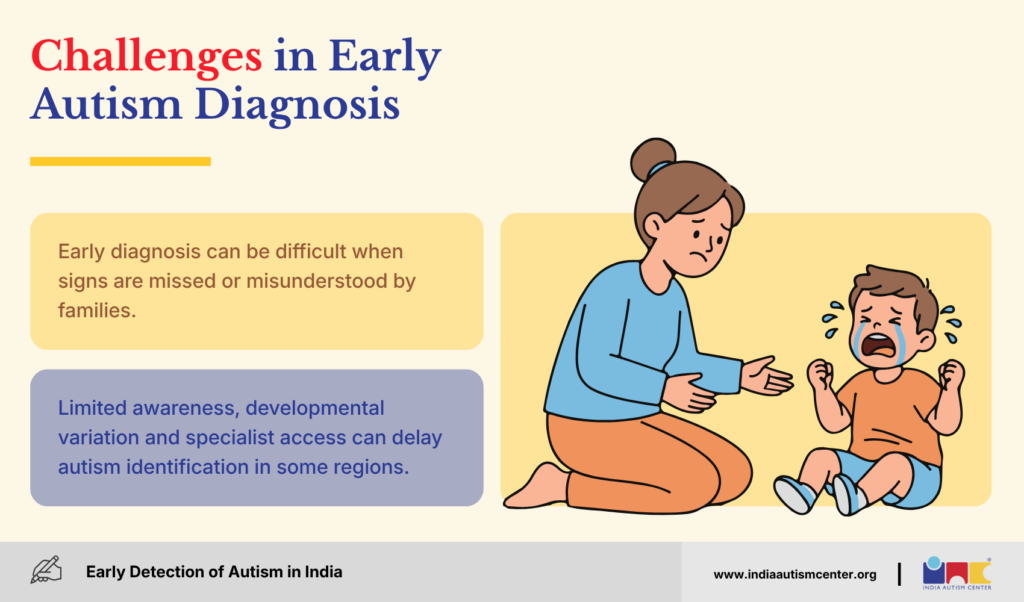
Challenges in Early Autism Diagnosis
Despite the importance of early detection, there are several challenges in identifying Autism in infants and toddlers:
Lack of Awareness: Many parents and caregivers may not be aware of the early signs of Autism, leading to delays in seeking a professional evaluation. In some cases, parents might adopt the deferred approach, wherein they refuse to accept that their child might have ASD. This further complicates the situation and might aggravate the ASD symptoms in the child.
Normal Variability: In early childhood, there is a wide range of development in social, communication, and behaviour skills. Distinguishing typical variations from potential autism symptoms can be tricky.
Limited Access to Resources: In some regions of India, access to specialised healthcare professionals and diagnostic services is limited, hindering early diagnosis efforts for ASD.
This section is perhaps the most important one in this entire article. Because in India, the barriers to early detection aren’t just medical – they’re cultural, social, and deeply human.
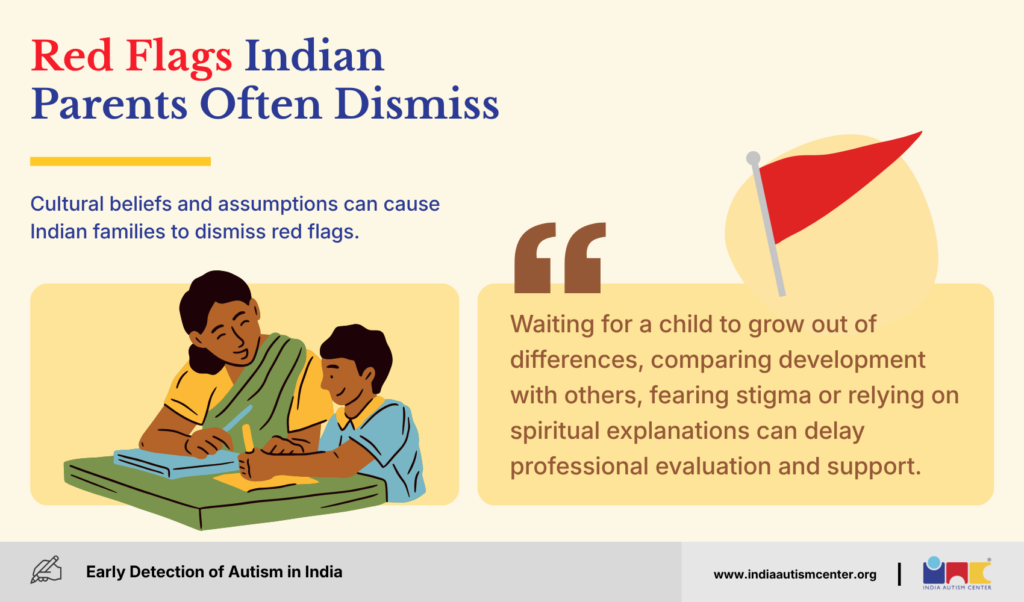
“He’ll grow out of it.” This is the most common phrase that delays diagnosis by months or years. Developmental differences don’t resolve on their own. Waiting costs the child time they cannot get back.
“His cousin was also a late talker.” Comparing your child to cousins, neighbours, or siblings is natural – but it’s not a diagnostic tool. Every child develops differently, and a family history of late talking doesn’t rule out autism; in some cases, it increases the likelihood.
“He’s just shy/stubborn/naughty.” Autistic children who struggle with social interaction are often labelled as shy or antisocial. Children who have meltdowns over routine changes are called stubborn or spoiled. These labels delay the real conversation.
“What will people say?” The stigma around developmental disorders in India is real and heavy. Many families fear that a diagnosis will affect marriage prospects, school admissions, or their social standing. Some parents avoid evaluation entirely to avoid a label. But a diagnosis is not a life sentence – it’s a map. It tells you where your child is and how to help them get where they need to go.
“He’s a boy – boys develop slower.” There is a kernel of truth here: boys are diagnosed with autism more often than girls. But “boys are slow” is not a developmental principle. It’s a cultural assumption that has caused countless Indian boys to lose critical intervention years.
Religious or spiritual explanations. In some communities, developmental differences are attributed to karma, a divine test, or the evil eye. Seeking spiritual remedies instead of – or before – medical evaluation is a pattern that delays diagnosis significantly.
Recognising these patterns in yourself or your family is not a cause for shame. It’s the first step toward getting your child the support they deserve.
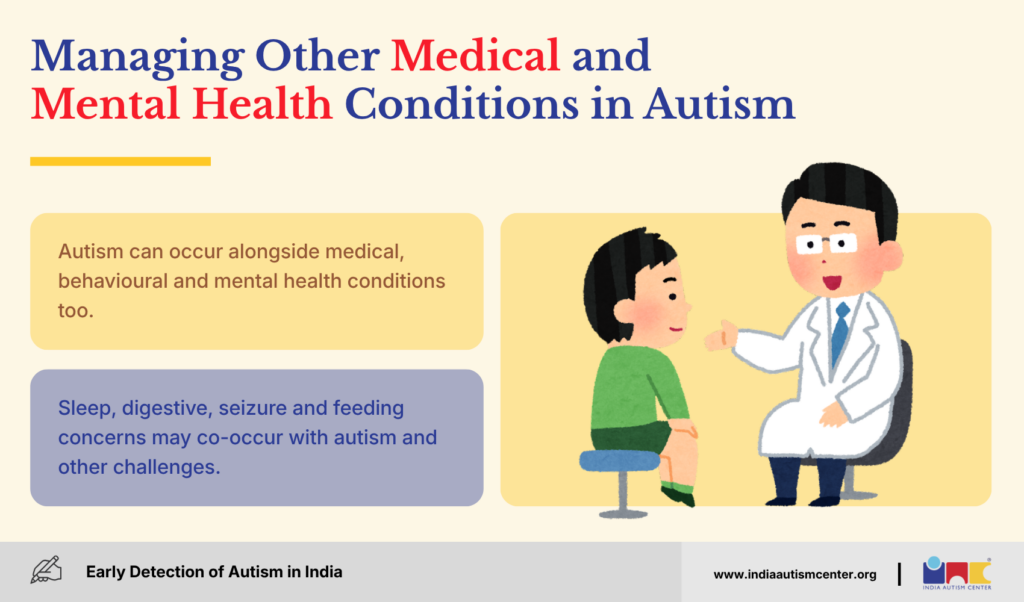
Managing Other Medical and Mental Health Conditions in Autism
Along with ASD, many children, teenagers, and adults may experience additional medical and mental health conditions. This is why early detection of autism is important—it helps families and doctors identify related challenges early and manage them in a better, more coordinated way. With timely diagnosis of Autism Spectrum Disorder, individuals can receive the right care for both autism and co-occurring conditions.
Medical Health Conditions
Children with ASD may also have health issues such as epilepsy, sleep problems, digestive concerns, or very limited food choices. Early medical guidance helps families understand how to manage these conditions together and improve overall well-being. This is especially relevant to early detection of autism in India, where early medical support can prevent long-term complications.
Challenges During Transition to Adulthood
Teenagers and young adults with autism may find physical changes and growing social expectations difficult to understand. Social situations become more complex during adolescence, and differences may not always be accepted. Early support can help build life skills, emotional understanding, and confidence during this phase.
Other Mental Health Conditions
Many teens and adults with ASD may also experience anxiety, depression, ADHD, or substance misuse. Early identification allows mental health professionals to create personalised support plans. This highlights again why early detection of autism is important, as it helps reduce emotional stress later in life.
Behavioural Health Concerns
Some individuals with autism may show behaviours such as irritability, aggression, hyperactivity, sudden outbursts, or self-harm. These behaviours are often signs of pain, frustration, or difficulty communicating needs. Working closely with healthcare and mental health professionals helps identify the cause and manage these behaviours in a safe and supportive way.
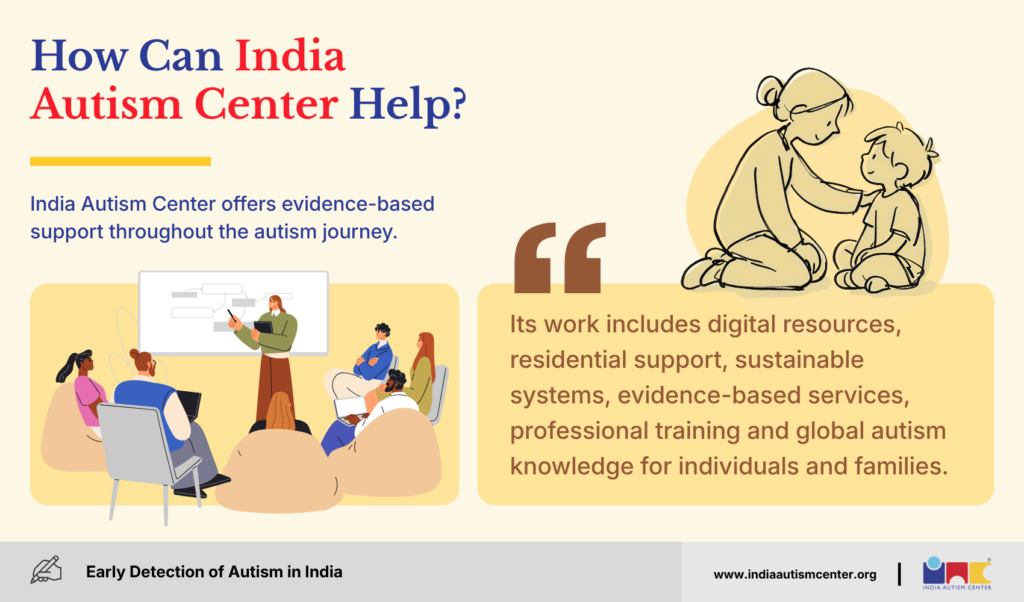
How Can India Autism Center Help?
The team at India Autism Center is committed to extending holistic support to autistic individuals and other spectrum disorders by
Building a digital platform, a one-stop solution for the entire neurodiverse community.
Offering a personalised and responsive residential center that facilitates lifelong support to autistic individuals and their families.
Building a sensitive and sustainable ecosystem that promotes quality of life.
Extending evidence-based support mechanisms for Autistic individuals.
Contributing towards the global knowledge base on Autism and related neurodiverse disorders.
Creating a global pool of top-notch professionals equipped with the requisite training to help autistic individuals realise their ultimate potential.
Early detection and diagnosis of Autism in infants and toddlers are crucial for providing timely interventions and support. As awareness about the early symptoms of Autism grows, more children can receive the assistance they need for improved developmental outcomes. Addressing the challenges in early detection, such as increasing awareness, improving access to diagnostic services, and supporting parents and caregivers, can significantly impact the lives of autistic children and their families across India. Let us work together to build a more inclusive and supportive environment for autistic individuals in the country.
Watch: Our clinical team explains what to look for in your child’s first 18 months.
Frequently Asked Questions
1. What is Early Detection of Autism in India, and why does it matter?
Early Detection of Autism in India refers to identifying signs of autism in infants and toddlers as early as possible. Early recognition is crucial because it allows for timely intervention and support, which can significantly improve communication, social development, and long-term outcomes for children with Autism Spectrum Disorder.
2. Why is early detection of autism important for children’s development?
Early detection helps families and healthcare providers start therapies during a child’s most responsive developmental stage. Early diagnosis and intervention can support brain plasticity and encourage better progress in language, behaviour, and social skills.
3. How is the diagnosis of Autism Spectrum Disorder done in India?
The diagnosis of Autism Spectrum Disorder in India typically involves careful observation of developmental milestones, screening for behavioural and communication differences, and assessment by trained specialists. Early professional evaluation helps confirm the condition and plan appropriate support.
4. What are the common early signs that may lead to early detection of autism in India?
Some early signs that support early detection of autism in India include limited eye contact, delayed speech, not responding to their name, lack of gestures like pointing or waving, and repetitive behaviours in infants. These signs can help parents seek evaluation sooner.
5. What challenges affect the diagnosis of Autism Spectrum Disorder in India?
Challenges to the diagnosis of Autism Spectrum Disorder in India include limited awareness of early signs among parents, misconceptions about developmental delays, and restricted access to trained professionals and diagnostic services in many regions.
6. How can early detection improve long-term outcomes after an autism diagnosis?
After an early diagnosis, interventions can be started right away, helping children build communication, social, and adaptive skills sooner. This leads to better learning, stronger relationships, and improved quality of life as they grow.
For expert insights, support services, and inclusive learning initiatives, contact India Autism Center for more information.
Autism is a lifelong neurodevelopmental condition that affects how a person communicates, behaves, and interacts with others. It is called a spectrum because its characteristics and support needs vary widely from one individual to another.
Autism is not a disease or a mental illness. Instead, it reflects differences in brain development that influence social understanding, communication skills, and sensory processing. While autism appears in early childhood, its features continue across the lifespan and may change with age and support.
Key Points About Autism
Neurodevelopmental condition: Autism develops due to differences in brain development that begin before or shortly after birth.
Spectrum nature: The term “spectrum” means individuals with autism can show mild, moderate, or significant challenges in daily functioning.
Early onset: Signs of autism usually appear in the first two to three years of life, although some people receive a diagnosis in adolescence or adulthood.
Lifelong condition: Autism does not disappear over time; however, early support and structured intervention can improve independence and quality of life.
Increasing prevalence: Reported cases of autism have increased globally, mainly due to better awareness and improved diagnostic practices.
What Is Autism Spectrum Disorder?
Autism Spectrum Disorder is the clinical term used to describe autism as a single condition with a wide range of abilities and support needs. It recognises that autism presents differently in each individual, rather than as separate disorders.
ASD replaces older diagnostic labels and brings all forms of autism under one medical and developmental framework. This approach helps professionals assess needs more accurately and plan suitable interventions.
Core Features of Autism Spectrum Disorder
Autism Spectrum Disorder is defined by consistent patterns of social, communication, behavioural, and sensory differences. These features influence how individuals with autism perceive the world, interact with others, and manage daily life.
Difficulties in social communication: Individuals with autism may struggle to interpret facial expressions, tone of voice, and body language, which can affect conversations and relationship-building.
Challenges in social interaction: People with autism may prefer solitary activities, find group settings overwhelming, or have difficulty understanding social rules such as turn-taking and sharing.
Restricted and repetitive behaviours: These include repeated movements (such as hand flapping), strict adherence to routines, and strong attachment to familiar patterns or objects.
Highly focused interests: Many individuals with autism develop intense interests in specific subjects, which can support learning but may limit flexibility in activities.
Sensory processing differences: Autism often involves over- or under-sensitivity to sounds, lights, textures, smells, or pain, which can affect comfort and emotional regulation.
Variation in intellectual and functional ability: Some individuals with autism have average or above-average intelligence, while others may experience learning difficulties and require ongoing support.
How ASD is Defined Clinically
Spectrum-based diagnosis: ASD groups all autism-related conditions into one spectrum based on functional ability rather than separate categories.
Developmental origin: Doctors diagnose ASD based on patterns of behaviour and development, not on blood tests or brain scans.
International diagnostic standards: Clinicians use structured criteria, such as those in DSM-5, to ensure consistency in diagnosis.
Main Causes and Risk Factors of Autism
Autism develops due to a complex interaction between genetic predisposition and biological influences that affect early brain development. These factors usually act before birth or during early infancy and shape how the brain forms connections related to communication, behaviour, and sensory processing.
Genetic factors: Autism often occurs within families, which shows that inherited genes play a significant role in how the brain develops and organises social and communication networks.
Prenatal influences: Conditions during pregnancy, such as maternal infections, nutritional deficiencies, exposure to harmful substances, or unmanaged medical conditions, may influence foetal brain development and increase the likelihood of autism.
Birth-related factors: Premature birth, low birth weight, and complications during delivery can affect oxygen supply and early neurological growth, which may slightly raise the risk of autism.
Environmental interactions: Environmental factors do not directly cause autism; however, when combined with genetic vulnerability, they may influence critical stages of brain maturation.
Neurological development differences: In autism, certain brain regions involved in language, attention, and emotional regulation develop differently, which explains variations in learning patterns, behaviour, and sensory responses.
Multiple factors working together: No single cause explains autism; instead, several risk factors combine to influence how the condition develops in each individual.
Understanding what causes autism is one of the first questions many parents ask after a diagnosis. The urge to find answers is natural. Families often retrace medical histories, revisit early signs, or reflect on emotional outbursts and delays.
But ASD doesn’t have one clear cause. Instead, it emerges from a combination of genetics, brain development, and environmental factors.
So, let’s first take a closer look at what science has to say about the causes.
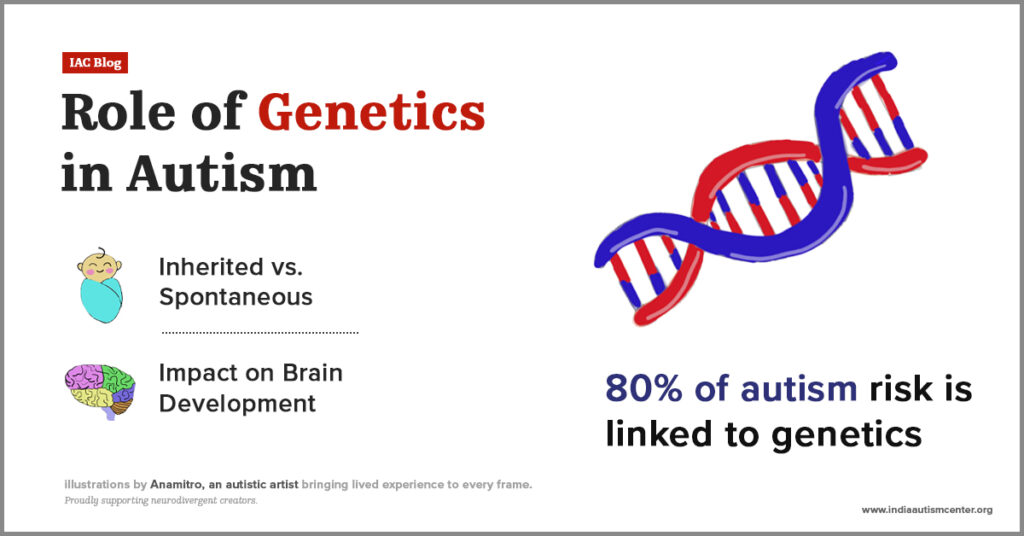
Some are inherited. Others appear early in development as de novo mutations. In simpler words, these are genetic changes that occur spontaneously and aren’t passed down from parents.
These genetic variations influence how the brain forms and connects. Specifically, they impact the regions involved in communication, sensory processing, and social behavior.
Here’s where it gets interesting.
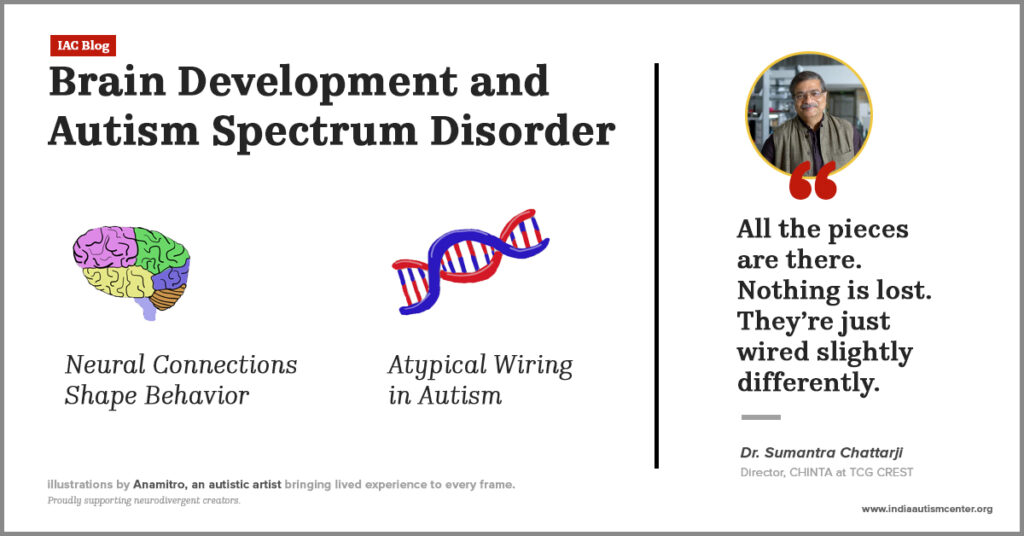
Brain Development and Autism Spectrum Disorder
As the brain develops during fetal and early postnatal life, the connections between neurons (also known as synapses) form critical pathways. This governs behavior, perception, and interaction.
In our podcast with Dr. Sumantra Chattarji, Director of CHINTA at TCG CREST, he shared,
As the brain develops in its early days, the connections between neurons don’t form in the typical fashion. As a result, the brain is wired differently over time and reaches a point where all the pieces are there. Nothing is lost. They’re just wired slightly differently.
But this also doesn’t reveal the whole picture.
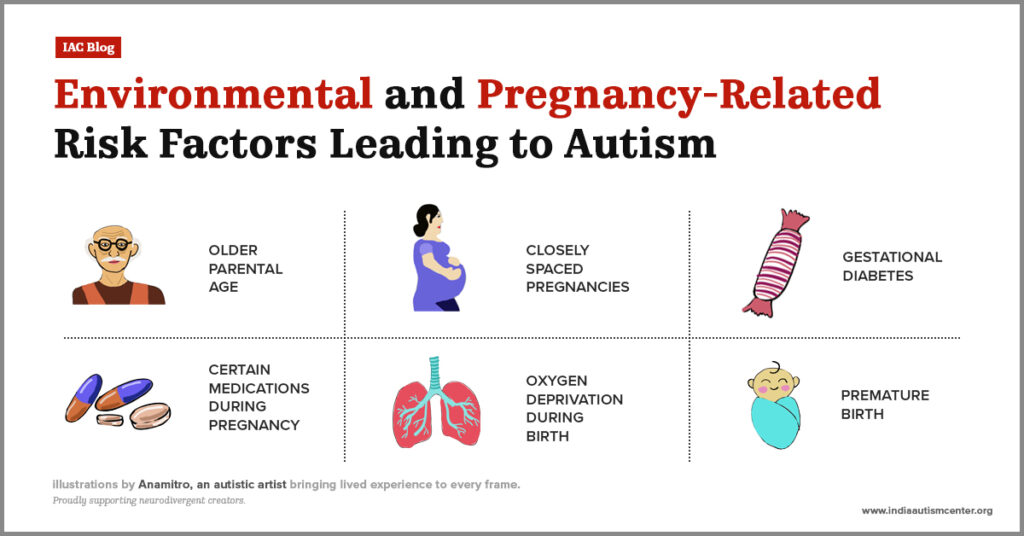
Environmental and Pregnancy-Related Risk Factors Leading to Autism
While genetics and brain development are central, researchers have also identified non-genetic risk factors that may increase the likelihood of ASD.
These include:
Older parental age: Especially fathers over 40. This is linked to a higher likelihood of autism due to age-related genetic changes.
Closely spaced pregnancies: Short intervals between pregnancies can affect maternal health and fetal brain development, raising the risk.
Gestational diabetes: This condition can interfere with fetal brain development and is associated with an increased likelihood of autism in the child.
Certain medications during pregnancy: Drugs like valproate (used to treat epilepsy) are known to disrupt fetal brain development and significantly elevate autism risk.
Oxygen deprivation during birth: Birth complications that lead to low oxygen levels can cause brain injury, contributing to a higher risk.
Premature birth: Babies born prematurely are more vulnerable to neurodevelopmental differences, including autism, due to early-stage brain development.
It’s important to remember that these factors do not cause ASD on their own. Instead, they may elevate risk when combined with underlying genetic susceptibility.
With that said, let’s now delve into the most-awaited aspect.
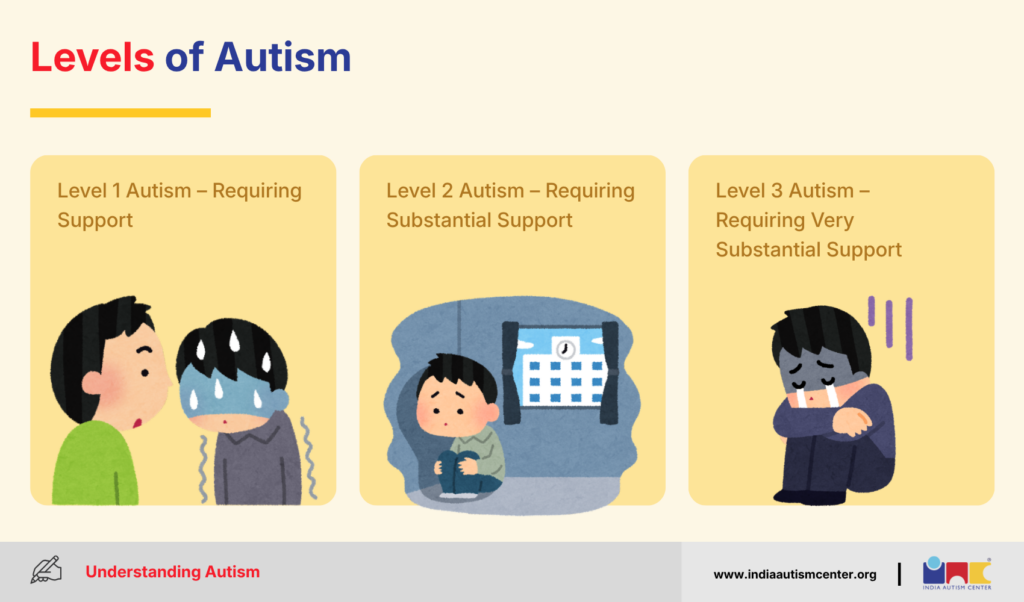
Autism is classified into levels based on the degree of support an individual requires in daily life. These levels do not measure intelligence or potential; instead, they describe how much assistance a person needs for communication, behaviour management, and independent living.
The level system helps clinicians, educators, and families plan suitable interventions and realistic goals. Importantly, an individual’s level may change over time with appropriate therapy and support.
Level 1 Autism – Requiring Support
Level 1 autism refers to individuals who can function independently in many areas but still experience noticeable difficulties in social and behavioural skills.
Social communication challenges: Individuals may speak fluently but struggle with initiating conversations, understanding humour or sarcasm, and interpreting facial expressions or tone of voice.
Difficulty with organisation and planning: Managing time, completing tasks, and adapting to new routines can be challenging, especially in school or work environments.
Rigid thinking patterns: They may prefer strict routines and find unexpected changes stressful, which can affect emotional well-being.
Hidden support needs: Although they appear independent, they often need guidance in social skills, emotional regulation, and coping strategies.
Level 2 Autism – Requiring Substantial Support
Level 2 autism involves more visible communication and behavioural difficulties that significantly affect daily functioning.
Limited verbal communication: Speech may be simple, repetitive, or used mainly to meet basic needs rather than for social interaction.
Restricted social engagement: Individuals may show little interest in social interaction and find it hard to respond appropriately to others.
Frequent repetitive behaviours: Repetitive movements and fixed interests are more intense and interfere with learning and daily routines.
Low tolerance for change: Even small changes in environment or schedule can lead to distress or emotional outbursts.
Greater dependence on structured support: Assistance is often required in education, therapy, and daily living tasks.
Level 3 Autism – Requiring Very Substantial Support
Level 3 autism is associated with severe challenges in communication, behaviour, and adaptive functioning.
Minimal or absent speech: Individuals may rely on non-verbal communication such as gestures, pictures, or assistive communication devices.
Severe social difficulties: Understanding and responding to social situations is extremely limited, which affects relationships and learning.
Intense repetitive and sensory behaviours: Strong reactions to noise, light, or touch may cause distress and impact safety and emotional stability.
High level of dependency: Continuous support is usually required for eating, dressing, hygiene, and personal safety.
Limited coping skills: Emotional regulation is difficult, which may result in frequent meltdowns or withdrawal.
Why Understanding Autism Levels Is Important
Recognising autism levels allows support to be tailored to individual needs rather than applying a single approach to all.
Improves the accuracy of intervention planning: Therapies can be selected according to communication ability, behavioural needs, and independence level.
Supports educational placement: Schools can adapt teaching methods, classroom structure, and learning goals appropriately.
Guides family expectations: Families can set realistic objectives and prepare suitable long-term care plans.
Enhances independence: With the right level of support, individuals can achieve better social participation and life skills.
Less interest in playing with others or imitating adults
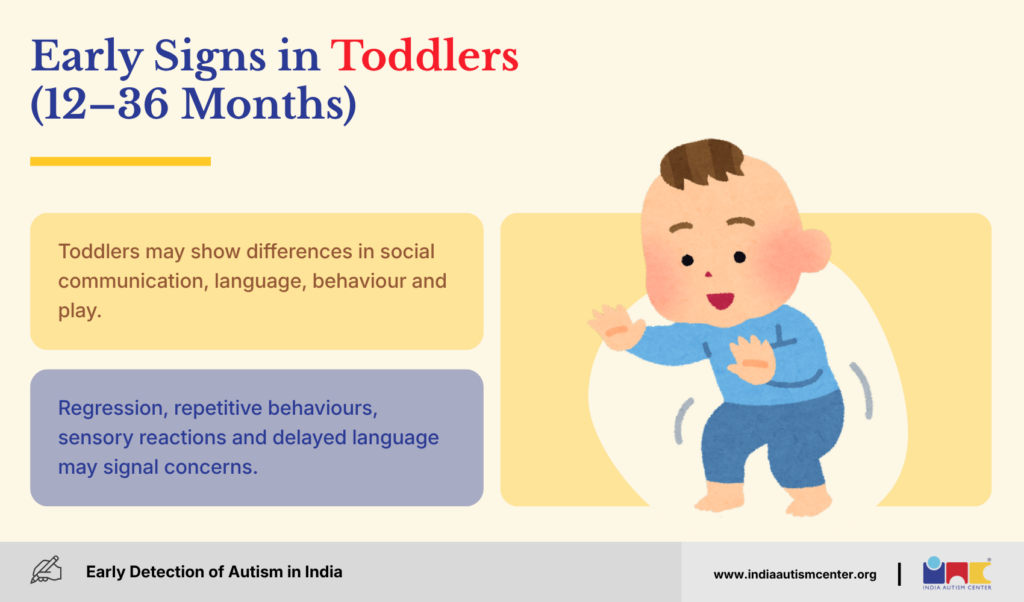
This is also the stage when regressive autism can emerge.
This begs the question.
What is Regressive Autism?
Regressive autism (also called autism with regression) means the loss of previously acquired skills.
This is a subtype of ASD that is often seen in children, usually aged between 15 and 30 months.
A child who once said words, responded to their name, or enjoyed play may suddenly:
Stop using language
Withdraw from social interaction
Avoid eye contact or connection
Show reduced emotional expression
It’s important to remember that this regression is not necessarily caused by trauma or illness. It’s simply one of the ways ASD can unfold.
Early Autism Symptoms and Signs In Preschoolers (3–4 Years)
In social settings like preschool, autism signs and symptoms often become more obvious, manifesting in:
Lack of pretend play (e.g., pretending to feed a toy)
Difficulty engaging with peers or group activities
Repeating phrases (echolalia) or using unusual speech patterns
Over- or under-reaction to sounds, lights, textures
Trouble understanding or expressing emotions
Autism Signs and Symptoms in Children and Teenagers (5–17 Years)
In school-aged children and teens, challenges often shift from developmental delays to social struggles, emotional regulation issues, and the effort to blend in.
Social Communication and Interaction Challenges
Navigating friendships and social expectations can become more challenging in school settings.
At this stage, autistic individuals may experience:
Difficulty reading social cues like facial expressions, body language, or tone of voice
Struggles with initiating or maintaining back-and-forth conversations
Preference for playing alone or spending time with younger children or adults
Literal interpretation of language and missing sarcasm, jokes, or implied meaning
Limited or avoidant eye contact during conversations
Restricted Interests and Repetitive Behaviors
Autistic children and teens often develop focused interests that may dominate their time and conversations.
Common autism symptoms and signs are:
Intense fixation on specific topics, activities, or objects
Repetitive behaviors like spinning objects, hand-flapping, or rocking
Insistence on routine or predictability and distress when routines are disrupted
Difficulty transitioning between classes, tasks, or social environments
Sensory Sensitivities
Sensory differences often become more pronounced in high-stimulus environments like schools or social gatherings.
Look for:
Overreaction to sounds, lights, or textures (e.g., buzzing lights, scratchy uniforms)
Seeking or avoiding sensory input (e.g., covering ears, refusing certain foods)
Overwhelm or shutdowns in crowded or chaotic spaces
Emotional Regulation and Daily Living
As expectations increase with age, autistic teens may face unique internal struggles, such as:
Heightened anxiety, especially in social settings
Mood changes, emotional shutdowns, or meltdowns
Difficulty managing transitions or unexpected changes
Trouble with daily tasks like organizing schoolwork, hygiene, or managing time
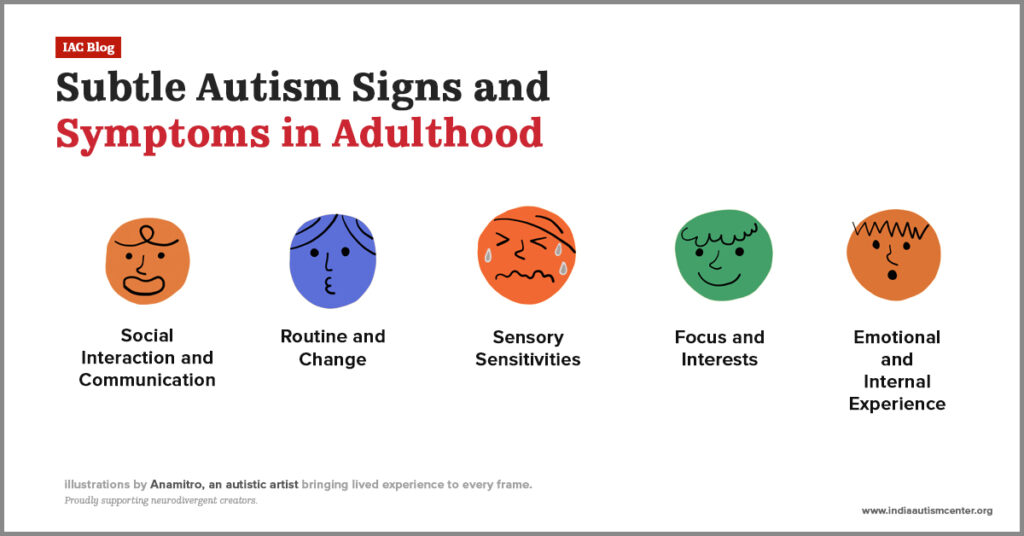
In adulthood, ASD can look quieter. Traits like sensory sensitivity, social fatigue, or rigid routines often get mistaken for anxiety or just being ‘a bit different.’
Social Interaction and Communication
Part of understanding what autism is in adults is recognizing that everyday social dynamics can feel like a completely different operating system.
You might notice:
Difficulty reading facial expressions, tone, or unspoken cues
Preference for one-on-one conversations
Feeling socially drained after even short interactions
Struggling to follow fast-paced group conversations or interruptions
Routine and Change
Predictability brings comfort. A strong need for routine helps create a sense of stability in a world that feels unpredictable.
Look for:
Discomfort with sudden changes in routine
Deep attachment to daily rituals
Difficulty switching between tasks
High stress from unexpected events
Reliance on structure to feel in control
Sensory Sensitivities
Bright lights, loud noises, or certain textures commonly trigger discomfort in adult autistic people. This makes sensory sensitivities an important yet under-recognized aspect of ASD symptoms.
These autism signs include:
Sensitivity to bright lights, loud sounds, or strong smells
Overwhelm in crowded or noisy environments
Discomfort with certain textures of clothing
Difficulty focusing due to sensory overload
Focus and Interests
Autistic adults often develop ‘special interests’. These are deep, passionate areas of focus that bring joy, clarity, and calm.
Common autism signs are:
Intense, almost encyclopedic knowledge of certain topics
Spending hours immersed in research or activities
Difficulty pulling away from focused interests
A sense of purpose rooted in specific routines or hobbies
Emotional and Internal Experience
To fully grasp autism in adulthood, you need to look beneath the surface.
Consider:
Difficulty identifying or naming emotions (alexithymia)
Feeling out of sync in social or emotional situations
Chronic anxiety or burnout from masking
Struggling to manage sensory-emotional overload
Coping through strict routines or withdrawal
Now that we’ve explored what signs to look for, let’s talk about what to do next, especially if you’re noticing these traits in a young child.
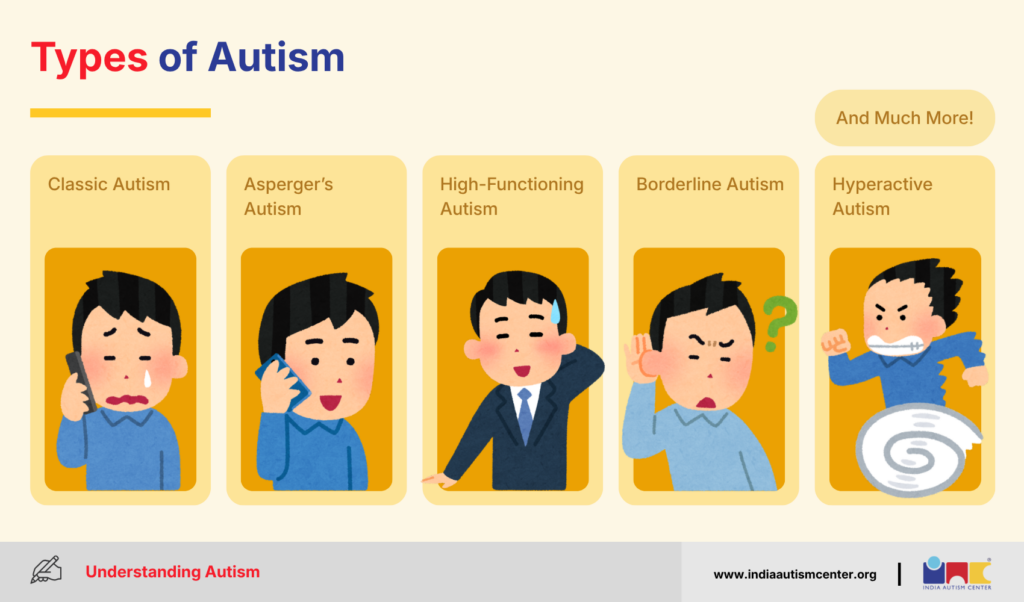
Types of Autism
Autism presents in different forms depending on communication ability, behaviour patterns, and level of independence. Although modern diagnosis uses the single term ASD, these commonly recognised types help explain the wide variation seen in individuals with autism.
Understanding the different types of autism supports accurate identification, appropriate intervention, and realistic planning for education and daily life.
Classic Autism
Classic autism refers to individuals who show clear difficulties in communication, social interaction, and behaviour from early childhood.
Communication delays: Speech development may be slow or absent, and individuals may rely on gestures or alternative communication methods.
Social interaction challenges: Difficulty forming relationships and responding to social cues is common.
Behavioural patterns: Repetitive actions and strict routines often dominate daily activities.
Asperger’s Autism
Asperger’s autism describes individuals with average or above-average intelligence but significant social and communication difficulties.
Strong verbal ability: Speech develops on time, but conversations may sound formal, one-sided, or overly focused on specific topics.
Social understanding difficulties: Individuals may struggle to interpret emotions, sarcasm, or body language.
High independence potential: With guidance in social skills and emotional regulation, many individuals can live independently.
High-Functioning Autism
High-functioning autism refers to individuals who manage daily tasks independently but still experience challenges in social and emotional areas.
Good academic ability: Learning skills are often intact or advanced in certain subjects.
Hidden difficulties: Anxiety, sensory sensitivities, and social confusion may not be obvious to others.
Support needs: Therapy often focuses on social skills, coping strategies, and workplace adaptation.
Borderline Autism
Borderline autism describes individuals who show mild traits of autism that may overlap with other developmental conditions.
Subtle symptoms: Difficulties in communication and flexibility may be mild and not immediately recognised.
Diagnostic complexity: Borderline cases may be mistaken for behavioural or emotional disorders.
Need for monitoring: Early support helps prevent later learning or social difficulties.
Hyperactive Autism
Hyperactive autism refers to individuals with autism who also show high levels of restlessness and impulsivity.
Excessive movement: Difficulty sitting still and constant activity are common features.
Attention difficulties: Sustained focus on tasks may be challenging.
Overlap with ADHD: This type often shares features with attention deficit disorders and requires combined management strategies.
Autism with Intellectual Disability
Some individuals with autism also have intellectual disability, affecting learning and daily functioning.
Delayed cognitive development: Learning new skills may take longer and require repetition.
High support needs: Assistance with personal care and communication is often necessary.
Structured learning benefits: Visual aids and routine-based teaching improve understanding.
Non-Verbal Autism
Non-verbal autism involves individuals who have little or no spoken language.
Alternative communication methods: Picture exchange systems or communication devices may be used instead of speech.
Social understanding remains possible: Even without speech, individuals can develop relationships and emotional awareness.
Focus on functional communication: Therapy aims to enable the expression of needs and feelings.
Autism Diagnosis in Children and Teens (Ages 3-18)
After age 3, teens and children can undergo a formal autism diagnosis. This doesn’t just confirm ASD; it also helps assess co-occurring conditions like ADHD, sensory issues, anxiety, or speech delays.
How to Get an Autism Spectrum Disorder Diagnosis
Start with a licensed clinical psychologist, rehabilitation psychologist, or developmental pediatrician.
A proper diagnosis includes:
Parental interviews and developmental history
Direct observation of behavior and interaction
Review of previous therapy records or school reports
Standardized tools like the Indian Scale for Assessment of Autism (ISAA), Indian Scale for Assessment of Autism (CARS-2), or Autism Diagnostic Observation Schedule (ADOS-2)
A multidisciplinary team arrives at a conclusive diagnosis through consensus.
Multidisciplinary Support After Diagnosis
Diagnosis is just the beginning. Based on the assessment, autistic children and teens may be referred to:
A speech-language therapist
An occupational therapist
A special educator
A psychologist
A play therapist
A health practitioner (for co-occurring conditions)
This integrated approach is key to designing personalized autism intervention strategies. It also truly supports the child’s strengths and challenges.
Autism Diagnosis for Adults (Ages 18+)
Not everyone receives a diagnosis in childhood. Some begin to question their lifelong struggles with communication, masking, or sensory sensitivities in adulthood.
How to Get an Autism Diagnosis as an Adult
Autism diagnosis for adults follows a similar pathway, but with added focus on lived experience and adaptive functioning.
Seek out:
A licensed clinical or rehabilitation psychologist with experience in adult neurodevelopment
A psychiatrist, especially if emotional or behavioral concerns like anxiety or depression are involved
They will use tools like the ISAA, ADOS-2, DISCO, or clinical interviews alongside DSM-5 autism diagnosis criteria.
The Power of Clarity
Receiving a diagnosis in adulthood helps explain long-standing challenges and opens doors to support, workplace accommodations, and therapy.
It also helps uncover any co-occurring conditions that may have been misunderstood.
As Puja Dutta, an RCI-licensed Clinical Psychologist at India Autism Center, shared:
Ethical diagnosis isn’t just about a label. It’s about understanding the child or adult, and building interventions that work in real life.
Caution: Avoid Online or Remote Diagnosis
While preliminary consultations can happen online, a proper diagnosis must be done in person.
Tools like ISAA and ADOS-2 rely on live behavioral cues, eye contact, gestures, and shared attention. These are not reliably captured over video.
Always seek in-person assessments through certified professionals.
Now, here is something to keep in mind.
Co-occurring Conditions in Autism Spectrum Disorder
Many autistic individuals experience other neurodevelopmental, medical, or psychological conditions alongside their autism diagnosis. These are called co-occurring conditions.
Recognizing them is vital for delivering the right support. Here are the most common ones:
Attention-Deficit/Hyperactivity Disorder (ADHD)
Frequently co-occurring with autism, ADHD includes symptoms like inattention, impulsivity, and hyperactivity. It can increase sensory overwhelm and make routines more difficult to follow.
Intellectual Disability (ID)
Some autistic individuals have below-average intellectual functioning, qualifying as having intellectual disabilities. This impacts their learning pace, communication, and adaptive living skills.
Dyslexia
This reading-related difference may go unnoticed in verbal autistic individuals. But becomes unavoidable to address because dyslexia causes major frustration in language-heavy learning environments.
Gastrointestinal (GI) Issues
A complete understanding of ASD must include the gut-brain connection. In other words, gastrointestinal issues accompany autism.
Chronic GI concerns, like constipation, stomach pain, or food sensitivities, often impact behavior, mood, and focus.
Fibromyalgia
In autistic adults, fibromyalgia may present as chronic pain and fatigue, further intensifying sensory sensitivities and emotional stress.
Selective Mutism
Selective mutism is an anxiety-related condition. It makes situations extremely difficult for some autistic children to speak in certain settings, even when they want to.
Sensory Processing Differences
Sensory sensitivities are a core trait. It includes extreme responses to light, sound, touch, or smell. Sensory processing differences can interfere even with daily tasks like dressing, eating, or relieving oneself.
Epilepsy
Seizures occur more frequently in autistic individuals, especially those with intellectual disabilities. If this is epilepsy, seizures can begin in early childhood or develop later during adolescence.
Psychosis
Though rare, some autistic individuals may show signs of psychosis. Psychotic episodes involve experiences of hallucinations or delusions, usually linked to stress, trauma, or genetic vulnerability.
Developmental Coordination Disorder (DCD)
Often seen in autistic children, developmental coordination disorder affects fine and gross motor skills. DCD leads to clumsiness or difficulty with handwriting, sports, or dressing.
Obsessive Compulsive Disorder (OCD)
Obsessive-compulsive disorder and ASD can look similar. However, OCD is primarily driven by anxiety and intrusive thoughts, requiring different interventions.
Polycystic Ovary Syndrome (PCOS)
Autistic women and girls are more prone to having PCOS. This suggests that hormonal pathways may play a role in how autism is expressed and experienced.
All of these co-occurring conditions may stay hidden well into adulthood. Not because they weren’t there. But because individuals often mask them to get through the day.
Suppressing stimming, like rocking, hand-flapping, or tapping, because someone once said it looked odd
Rehearsing conversations ahead of time to sound ‘normal’
These strategies often work. Sometimes, they even help autistic individuals get through the day. Help them feel safe. Accepted. And avoid being teased.
Another way autism gets misunderstood is through the language we use, especially when it comes to describing ability levels.
What is the Difference Between High and Low Functioning Autism?
You’ve probably heard terms like high-functioning autism or low-functioning autism in casual conversations. Maybe even in some diagnostic reports.
So, it’s quite natural to wonder what these terms mean.
What is High Functioning Autism?
High-functioning autism refers to autistic individuals who:
Use spoken language fluently
Perform well in school or work
Appear socially typical at first glance
But here is the catch.
Many high-functioning autistic individuals deal with daily challenges that go unnoticed. Often because they’re good at masking them.
However, beneath the surface, there’s:
Sensory overload that builds up silently
Struggles with social communication and expectations
Anxiety, shutdowns, or burnout from constant self-monitoring
Now let’s discuss the opposite label.
What is Low Functioning Autism?
Individuals with low-functioning autism:
Have little or no spoken language
Need high levels of daily living support
May have co-occurring intellectual disability
Face significant barriers in traditional communication or schooling
But what it doesn’t reflect are:
Nonverbal intelligence or pattern recognition
Deep emotional insight or visual/spatial strengths
The ability to connect, express, and learn, just differently
So, as it turns out, the word ‘functioning’ flattens the picture.
What’s the Alternative?
Terms like ‘functioning’ flatten a complex spectrum. Instead, clinicians now describe autism using support levels, as per DSM-5 autism diagnosis criteria:
Level 1: Requires support
Level 2: Requires substantial support
Level 3: Requires extremely substantial support
This approach respects individuality and focuses on the real question: What support does the person need to thrive?
Now, just as important as understanding what autism is, we must also understand what it is not.
What Are Some Common Autism Myths and Misconceptions?
From news stories to Netflix shows, ASD is often shown in narrow, predictable ways. The quirky genius. The emotionless coder. The one who ‘just doesn’t get people’.
But ASD doesn’t come in one template. These repeated portrayals can erase the real-life diversity of experiences among autistic individuals.
We will now set the record straight about autism myths and facts.
Myth 1: Autism Is A Disease
Truth: Autism spectrum disorder is not a disease. It’s a lifelong neurodevelopmental condition.
Myth 2: Autism Is A Mental Illness
Truth: ASD is not a psychiatric disorder. However, co-occurring conditions like anxiety or depression are common.
Myth 3: There’s an Autism Epidemic
Truth: Higher diagnosis rates are due to better awareness and broader criteria.
Myth 4: Only Boys Can Be Autistic
Truth: Signs of autism in women are often subtle. In most cases, they are underdiagnosed due to social masking and gender bias in diagnostic tools.
Myth 5: Autistic People Are Either Nonverbal or Geniuses
Truth: The autism spectrum is wide. Some are non-verbal; others are hyper-verbal. Sensitivities, support needs, and strengths vary widely. One person’s traits don’t represent the whole spectrum.
Myth 6: Vaccines Cause Autism
Truth: There is no scientific evidence linking vaccines and autism spectrum disorder. This myth originated from a retracted and fraudulent study. Multiple global studies have confirmed that vaccines do not cause autism.
Myth 7: Bad Parenting Causes Autism
Truth: This outdated autism myth has been debunked. Parenting style does not cause autism.
Myth 8: Autism Can Be Cured
Truth: Autism is not something to be cured. Instead, the goal should be to provide individualized support.
Myth 9: Autistic People Can’t Live Independently
Truth: Some individuals on the spectrum need high levels of support; others live fully independent lives. That is why success looks different for each person living with autism.
Autism in Women
Autism in women often presents differently from autism in men, which can lead to underdiagnosis or late diagnosis. Many females with autism develop coping strategies that hide their difficulties, making their needs less visible to families, teachers, and healthcare professionals.
Understanding autism in women is essential for accurate diagnosis, appropriate support, and improved mental well-being.
Why Autism Is Often Missed in Women
Subtle social differences: Women with autism may show fewer obvious repetitive behaviours and may appear socially engaged, even though they struggle internally with understanding social rules and expectations.
Better imitation and masking skills: Many women learn to copy speech patterns, gestures, and social behaviours from others to fit in. This masking can hide autistic traits but increases emotional stress and exhaustion.
Misinterpretation of symptoms: Difficulties related to autism in women are sometimes mistaken for anxiety, depression, or personality traits rather than recognised as part of autism.
Later diagnosis: Because symptoms are less noticeable in childhood, many women receive a diagnosis only in adolescence or adulthood, often after years of social or emotional challenges.
Strong desire for social connection: Unlike some male presentations, women with autism may want friendships and relationships but struggle to maintain them due to difficulty interpreting social cues.
Intense but socially acceptable interests: Special interests may focus on topics such as books, animals, or celebrities, which appear typical and therefore attract less attention.
High emotional sensitivity: Women with autism may experience emotions more intensely and may feel overwhelmed by criticism, conflict, or sensory input.
Difficulty with identity and self-esteem: Long-term masking and social comparison can lead to confusion about personal identity and low confidence.
Emotional and Mental Health Impact
Higher risk of anxiety and depression: Continuous effort to adapt socially can result in chronic stress and emotional exhaustion.
Social burnout: Women may feel mentally and physically drained from maintaining social expectations, leading to withdrawal or shutdown.
Increased vulnerability: Difficulty recognising unsafe social situations can increase the risk of exploitation or unhealthy relationships.
Challenges in Education and Employment
Hidden learning needs: Women with autism may perform well academically but struggle with group work, presentations, or unstructured tasks.
Workplace pressure: Social communication demands and sensory environments can make employment stressful without proper support.
Limited access to appropriate services: Lack of recognition means many women do not receive early educational or workplace adjustments.
Importance of Gender-Sensitive Diagnosis and Support
Recognising autism in women requires awareness of gender-specific patterns and behavioural masking.
Improves diagnostic accuracy: Professionals can identify autism more effectively when they consider female developmental traits.
Enables tailored therapy: Support can focus on emotional well-being, social confidence, and self-acceptance.
Reduces long-term mental health risks: Early and accurate diagnosis prevents years of misunderstanding and emotional strain.
Transition to Adulthood and Independent Living in Autism
The transition from adolescence to adulthood is one of the most critical and vulnerable phases for individuals with autism. During this stage, focus shifts from school-based support to independent living, higher education, employment, and social participation. Without structured guidance, many autistic individuals experience a sudden loss of services and increased emotional stress.
A well-planned transition process helps individuals build life skills, confidence, and long-term stability.
Challenges During Transition to Adulthood
Loss of structured support systems: After school, many therapy and special education services reduce or stop altogether, leaving families unsure how to continue skill development and emotional support.
Increased social and functional demands: Adult life requires managing money, travel, work schedules, and relationships—tasks that may be overwhelming without training in executive functioning and problem-solving.
Emotional vulnerability: Anxiety, fear of failure, and low self-esteem are common when expectations increase faster than coping skills.
Daily living skills: Training in cooking, hygiene, time management, and household responsibilities builds independence and reduces long-term dependence on caregivers.
Community navigation: Learning how to use public transport, shop independently, and handle real-world interactions improves confidence and safety.
Decision-making and self-advocacy: Autistic individuals must be taught how to express needs, set boundaries, and make informed choices about their lives.
Education and Career Pathways
Identifying strengths and interests: Career planning should focus on abilities rather than limitations, helping individuals find meaningful vocational or academic paths.
Skill-based training: Practical and job-oriented learning (such as computer skills, art, hospitality, or technical work) increases employability.
Workplace preparation: Training in communication, teamwork, and handling feedback is essential for adapting to professional environments.
Social and Emotional Readiness
Understanding relationships: Education about friendships, personal boundaries, and healthy relationships protects against exploitation and social isolation.
Managing stress and change: Teaching coping strategies such as structured routines, relaxation methods, and problem-solving reduces emotional overload.
Identity and self-worth: Transition programmes should encourage self-acceptance and pride in neurodiversity rather than focusing only on deficits.
Role of Family in Transition Planning
Gradual transfer of responsibility: Families should slowly allow individuals to take control of tasks such as budgeting or travel, rather than expecting sudden independence.
Long-term financial and legal planning: Planning for guardianship, supported decision-making, and future care ensures security and dignity.
Emotional support and encouragement: Families play a key role in reinforcing confidence and resilience during this phase of change.
Importance of Structured Transition Programmes
Reduces drop-out and unemployment: Supported pathways help autistic individuals stay engaged in education or work.
Prevents mental health decline: Consistent guidance lowers the risk of anxiety, depression, and social withdrawal.
Promotes long-term independence: Individuals gain skills that allow them to live more self-directed lives.
Autism Therapies and Interventions
Autism therapies aim to improve communication, behaviour, learning ability, and daily functioning. While autism is not a disease that can be cured, early and structured therapeutic support can significantly enhance independence, emotional well-being, and quality of life. Effective therapy plans are individualised, evidence-based, and reviewed regularly.
Importance of Early and Continuous Therapy
Maximises brain development: Early therapy takes advantage of neuroplasticity, helping children develop communication and adaptive skills more effectively.
Prevents secondary difficulties: Timely intervention reduces the risk of anxiety, behavioural challenges, and academic failure.
Supports lifelong learning: Therapy is not limited to childhood; adolescents and adults also benefit from structured skill-building and emotional support.
Behavioural Therapies
Applied Behaviour Analysis (ABA): ABA focuses on reinforcing positive behaviours and reducing behaviours that interfere with learning, using structured and measurable techniques.
Positive Behaviour Support (PBS): PBS addresses the reasons behind behaviours and teaches alternative skills rather than relying on punishment-based methods.
Parent-mediated behavioural programmes: Parents are trained to use behavioural strategies at home, ensuring consistency across daily routines.
Speech and Communication Therapy
Language development: Speech therapy helps improve verbal communication, vocabulary, and sentence formation.
Alternative communication methods: For non-speaking individuals, tools such as picture-based systems or communication devices enable functional expression.
Social communication skills: Therapy also focuses on understanding tone, turn-taking, and non-verbal cues essential for social interaction.
Emotional awareness training: Therapy teaches recognition and expression of feelings in healthy ways.
Trauma-informed care: Addresses stress related to bullying, academic failure, or social rejection.
Educational and Skill-Based Interventions
Special education programmes: Tailored teaching methods address learning differences and promote academic success.
Social skills training: Structured sessions help individuals practise conversations, friendships, and conflict resolution.
Vocational therapy: Focuses on job readiness, task management, and workplace behaviour for adolescents and adults.
Medical and Allied Health Support
Paediatric and psychiatric care: Doctors monitor sleep, nutrition, and co-existing conditions such as epilepsy or ADHD.
Medication (when needed): Used cautiously to manage severe anxiety, aggression, or attention difficulties—not to treat autism itself.
Dietary and feeding therapy: Supports nutritional health and reduces food-related sensory challenges.
Therapy at Home and in the Community
Home-based programmes: Daily routines become opportunities for learning through guided play and structured activities.
School collaboration: Therapists coordinate with teachers to ensure consistent strategies.
Community-based learning: Real-world environments help generalise skills beyond therapy rooms.
Autism Diet, Nutrition, and Overall Health
A balanced and structured diet supports physical growth, brain development, and emotional regulation in individuals with autism. Although there is no single “autism diet,” proper nutrition can improve energy levels, digestion, immunity, and attention, while reducing discomfort that may worsen behavioural challenges.
Dietary planning should always be evidence-based and supervised by healthcare professionals.
Importance of Nutrition in Autism
Supports brain and body development: Adequate intake of proteins, healthy fats, vitamins, and minerals is essential for cognitive function, learning, and muscle growth.
Improves behaviour and attention: Stable blood sugar levels and sufficient nutrients can reduce irritability, fatigue, and poor concentration.
Prevents secondary health issues: Proper nutrition lowers the risk of obesity, vitamin deficiencies, and digestive problems, which are common in autistic individuals.
Food selectivity: Many individuals prefer a limited range of foods based on texture, colour, or smell, leading to unbalanced diets.
Sensory sensitivity: Strong reactions to taste, smell, or texture can make mealtimes stressful and restrict food variety.
Gastrointestinal difficulties: Constipation, reflux, and bloating may occur more frequently and affect comfort and behaviour.
Special Diet Approaches (With Medical Guidance)
Gluten-free and casein-free (GFCF) diet: Some families explore removing gluten and dairy to reduce digestive discomfort and behavioural issues, although scientific evidence remains mixed.
Elimination diets: These identify food intolerances by removing and reintroducing certain foods under professional supervision.
Balanced therapeutic diets: Focus on whole grains, fruits, vegetables, lean protein, and healthy fats rather than restricting food groups unnecessarily.
Role of Micronutrients
Iron and vitamin D: Support immunity, energy, and bone health, which may be low in children with restricted diets.
Omega-3 fatty acids: May help with attention and emotional regulation when included through fish or supplements.
B vitamins and zinc: Contribute to nerve function and metabolism and should be monitored in selective eaters.
Gradual food introduction: New foods should be introduced slowly alongside preferred foods to avoid distress.
Positive reinforcement: Praising attempts rather than forcing consumption builds healthier eating habits.
Feeding Therapy and Professional Support
Speech and occupational therapy: These address chewing, swallowing, and oral sensitivity issues.
Dietitian involvement: Nutritionists ensure dietary plans are balanced and safe.
Medical monitoring: Paediatricians and gastroenterologists assess growth and digestive health regularly.
Long-Term Health Considerations
Weight management: Limited physical activity and selective eating increase obesity risk without structured dietary planning.
Bone and muscle health: Adequate calcium and protein intake supports long-term mobility and posture.
Mental wellbeing: Stable nutrition contributes to better sleep, mood, and stress tolerance.
Autism Awareness, Social Inclusion, and Public Perception
Autism awareness is essential for building an inclusive society that respects neurodiversity and supports equal participation. Awareness goes beyond recognising the condition; it involves understanding strengths, reducing stigma, and creating environments where individuals with autism can learn, work, and live with dignity.
When communities are informed, barriers to education, employment, and social relationships are significantly reduced.
Meaning of Autism Awareness
Understanding autism correctly: Awareness promotes accurate knowledge about autism as a neurodevelopmental condition rather than a behavioural problem or illness.
Recognising individual differences: It highlights that autism exists on a spectrum, with varying abilities, challenges, and support needs.
Encouraging acceptance: Awareness supports respect for neurodiversity rather than forcing conformity to social norms.
Importance of Social Inclusion
Access to education and employment: Inclusive schools and workplaces allow individuals with autism to contribute meaningfully to society.
Participation in community life: Inclusion ensures access to recreation, public spaces, and cultural activities without discrimination.
Improved mental well-being: Acceptance reduces loneliness, anxiety, and social withdrawal.
Reducing Stigma and Misconceptions
Challenging stereotypes: Not all autistic individuals have intellectual disability or extraordinary abilities; both assumptions can be harmful.
Correcting myths: Autism is not caused by poor parenting, emotional neglect, or modern technology alone.
Promoting respectful language: Using person-centred and non-judgemental language improves attitudes and social interaction.
Role of Media and Popular Culture
Influence on public understanding: Films, documentaries, and social media shape how autism is viewed by society.
Balanced representation: Responsible storytelling shows both strengths and challenges without exaggeration.
Educational value: Media can be used as a tool to spread factual information and empathy.
Autism Awareness in Schools and Workplaces
Teacher and staff training: Educators and employers benefit from learning how autism affects communication and behaviour.
Reasonable adjustments: Sensory-friendly classrooms, flexible schedules, and clear instructions support inclusion.
Anti-bullying initiatives: Awareness reduces peer rejection and improves emotional safety.
Community-Based Awareness Initiatives
Public campaigns: Awareness days and events help disseminate reliable information to large audiences.
Workshops and seminars: Community training improves understanding among healthcare workers, police, and service providers.
Parent and peer education: Families and classmates learn how to communicate and interact supportively.
Daily Challenges Faced by Individuals with Autism and Their Families
Autism affects multiple areas of daily life, including communication, behaviour, learning, and social participation. These challenges vary widely from person to person and may change across different stages of life. Understanding these difficulties is essential for providing effective support, reducing stress, and improving long-term outcomes.
Communication Difficulties
Delayed or limited speech: Some individuals with autism may have delayed language development or remain non-speaking, making it difficult to express needs and emotions.
Social communication challenges: Difficulties in understanding tone, facial expressions, and body language can affect friendships and classroom or workplace interactions.
Literal interpretation of language: Idioms, sarcasm, and indirect instructions may be confusing, leading to misunderstandings.
Social Interaction Challenges
Difficulty forming relationships: Making and maintaining friendships can be challenging due to differences in social interests and interaction styles.
Limited social reciprocity: Individuals may struggle with turn-taking, shared attention, or understanding others’ perspectives.
Risk of isolation: Without support, social difficulties may lead to loneliness and reduced self-esteem.
Behavioural and Emotional Regulation Issues
Meltdowns and shutdowns: Emotional overload caused by sensory input, frustration, or change can result in intense reactions or withdrawal.
Anxiety and fear of change: Unexpected events or transitions may trigger distress and resistance.
Difficulty managing emotions: Recognising and expressing feelings appropriately may require structured teaching and support.
Sensory Processing Challenges
Over-sensitivity: Bright lights, loud sounds, or certain textures may cause discomfort or pain.
Under-sensitivity: Some individuals may seek strong sensory input, such as spinning or touching objects repeatedly.
Impact on daily routines: Sensory issues can affect eating, dressing, learning, and social participation.
Learning and Academic Difficulties
Uneven skill development: Strong abilities in some areas and significant difficulties in others can make standard teaching methods ineffective.
Attention and executive functioning issues: Planning, organising, and completing tasks may be challenging without support.
Need for adapted teaching methods: Visual learning and structured instruction are often more effective than verbal-only teaching.
Challenges in Adolescence and Adulthood
Identity and self-esteem concerns: Increased social awareness during adolescence may lead to emotional stress and comparison with peers.
Employment barriers: Lack of workplace understanding and flexibility can limit job opportunities.
Independent living difficulties: Managing finances, transport, and healthcare may require long-term support.
Family and Caregiver Challenges
Emotional stress: Parents and caregivers may experience anxiety, exhaustion, and uncertainty about the future.
Financial burden: Therapy, education, and healthcare costs can place strain on family resources.
Social stigma:Negative attitudes and lack of awareness may isolate families from community life.
Autism often occurs alongside other developmental or neurological conditions, which can influence diagnosis, support needs, and long-term outcomes. Understanding these overlaps helps families and professionals create accurate intervention plans and avoid misdiagnosis. Each condition has distinct features, even when some behaviours appear similar.
Autism and Attention Deficit Hyperactivity Disorder (ADHD)
Shared characteristics: Both autism and ADHD may involve inattention, impulsivity, and difficulty with emotional regulation, which can make differentiation challenging.
Key differences: Autism primarily affects social communication and sensory processing, whereas ADHD mainly impacts attention, impulse control, and activity level.
Impact on intervention: When both conditions coexist, therapy must address communication difficulties alongside focus and behavioural regulation
Distinct genetic origins: Down syndrome is caused by an extra chromosome, while autism results from differences in brain development influenced by genetic and environmental factors.
Overlapping features: Both conditions may involve learning delays and speech difficulties, but social motivation is often stronger in Down syndrome than in autism.
Dual diagnosis: Some individuals have both autism and Down syndrome, requiring highly specialised educational and therapeutic planning.
Difference in core difficulty: Intellectual disability primarily affects overall learning ability, while autism mainly impacts communication, behaviour, and sensory processing.
Independent conditions: An individual can have autism with or without intellectual disability.
Support planning: Therapy must be adapted according to cognitive level and communication ability.
Autism and Anxiety Disorders
High prevalence: Anxiety is common in autistic individuals due to sensory sensitivity, social stress, and difficulty coping with change.
Behavioural impact: Anxiety may increase meltdowns, avoidance, or rigid behaviour patterns.
Therapeutic approach: Emotional regulation training and adapted psychological therapy help manage anxiety effectively.
Autism and Epilepsy
Neurological link: Epilepsy occurs more frequently in autistic individuals than in the general population.
Health monitoring: Regular neurological evaluation is essential for safety and overall development.
Integrated care: Medical management must be coordinated with educational and therapeutic planning.
Autism and Sensory Processing Disorder
Sensory differences: Many autistic individuals experience heightened or reduced sensitivity to sound, light, touch, or movement.
Daily life impact: Sensory challenges affect eating, dressing, learning, and social participation.
Support strategies: Occupational therapy and environmental modification help regulate sensory input.
Education, Schooling Options, and Learning Approaches for Autism
Education plays a central role in the long-term development, independence, and social participation of individuals with autism. Because autism affects communication, attention, and sensory processing, learning methods must be adapted to suit individual needs.
A flexible and inclusive education system allows autistic learners to reach their potential academically, socially, and emotionally.
Importance of Individualised Education
Learning at one’s own pace: Autistic learners often show uneven skill development, excelling in some areas while struggling in others, which requires personalised teaching methods.
Focus on functional learning: Education should include academic subjects alongside life skills, communication, and emotional regulation.
Strength-based approach: Teaching should build on interests and abilities rather than focusing only on limitations.
Mainstream Schooling
Inclusive education model: Many autistic children attend mainstream schools with appropriate accommodations, such as learning support teachers or classroom aides.
Benefits of inclusion: Interaction with peers supports social development and community participation.
Challenges: Large class sizes, sensory overload, and rigid teaching styles may require adjustments such as visual aids and structured routines.
Special Education Schools
Specialised teaching methods: These schools offer adapted curricula and trained staff who understand autism-specific learning needs.
Smaller class sizes: This allows for greater individual attention and emotional support.
Therapy integration: Speech, occupational, and behavioural therapies are often incorporated into daily learning.
Homeschooling and Home-Based Education
Flexible learning environment: Homeschooling allows education to be tailored to the child’s pace, sensory needs, and interests.
Reduced sensory stress: Home settings may minimise anxiety caused by noise, crowding, and rigid schedules.
Parental responsibility: Families must ensure structured learning and social interaction opportunities.
Exposure to multiple languages: Research indicates that bilingualism does not worsen autism-related communication challenges.
Cultural and family connection: Using home languages supports emotional bonding and cultural identity.
Structured language teaching: Clear and consistent language models help autistic children learn effectively.
Use of Technology in Education
Visual learning tools: Tablets and educational apps support communication and concept learning.
Assistive communication devices: Technology enables non-speaking individuals to express themselves.
Remote learning options: Online education offers flexibility for those unable to attend traditional schools.
Social Skills and Peer Learning
Structured social interaction: Group activities teach turn-taking, cooperation, and communication.
Peer modelling: Observing classmates helps reinforce appropriate behaviour and language.
Anti-bullying strategies: Awareness and inclusion policies protect emotional well-being.
Transition from School to Vocational Learning
Skill-based education: Adolescents benefit from training in practical skills such as computing, crafts, or technical trades.
Career-oriented planning: Education should align with future employment or independent living goals.
Supported learning pathways: Guidance helps reduce dropout and unemployment risk.
Barriers to Education
Limited trained educators: Lack of autism-specific training affects teaching quality.
Inflexible curricula: Standardised systems may not accommodate individual learning styles.
Social stigma: Misunderstanding can lead to exclusion or low expectations.
Autism Therapies at Home and the Role of Parents
Home-based support plays a vital role in reinforcing therapeutic progress and promoting everyday learning for individuals with autism. While professional therapy provides structured intervention, consistent practice at home ensures skills are generalised into real-life situations.
Parents and caregivers act as primary facilitators of growth, emotional security, and independence.
Importance of Therapy at Home
Continuity of learning: Skills taught in therapy sessions must be practised daily at home to ensure long-term retention and functional use.
Natural learning environment: Home settings allow children to learn communication, behaviour, and self-care skills in familiar and meaningful contexts.
Cost-effective support: Home-based strategies reduce overdependence on clinic-based sessions and empower families to become active participants in intervention.
Structured Daily Routines
Predictability and security: Clear routines reduce anxiety and help individuals understand expectations for daily activities such as meals, study, and sleep.
Improved time management: Visual schedules and step-by-step instructions help individuals complete tasks independently.
Behaviour regulation: Consistent routines reduce frustration and behavioural outbursts linked to uncertainty.
Communication Support at Home
Encouraging functional language: Parents can model simple, clear language during daily interactions such as eating, dressing, and play.
Use of visual aids: Picture charts, labels, and gesture-based systems improve understanding and expression.
Responsive interaction: Following the child’s interests strengthens attention and social engagement.
Behaviour Management Strategies
Positive reinforcement: Rewarding desired behaviours increases motivation and learning.
Understanding behaviour triggers: Identifying causes of meltdowns or withdrawal helps families modify environments to prevent distress.
Consistency across caregivers: Using the same strategies across family members avoids confusion and mixed signals.
Sensory Regulation at Home
Creating sensory-friendly spaces: Quiet corners, soft lighting, and noise reduction help manage sensory overload.
Daily sensory activities: Activities such as swinging, squeezing stress balls, or deep-pressure exercises support emotional regulation.
Monitoring sensory needs: Parents learn to identify when sensory input is calming or overwhelming.
Teaching Life Skills
Self-care skills: Dressing, toileting, and hygiene routines build independence and dignity.
Household responsibilities: Simple chores teach responsibility and improve motor coordination.
Safety awareness: Learning about danger, personal boundaries, and basic first aid promotes protection and autonomy.
Emotional and Social Development
Recognising emotions: Parents help children label and understand feelings using stories and visual cues.
Social modelling: Everyday interactions teach turn-taking, sharing, and empathy.
Building resilience: Supportive parenting encourages confidence and coping with challenges.
Collaboration with Professionals
Following therapy plans: Parents apply professional recommendations in daily routines.
Monitoring progress: Keeping simple records helps therapists adjust goals.
Regular feedback: Open communication between families and professionals ensures consistency.
Autism awareness in society means understanding autism accurately, accepting neurodiversity, and creating inclusive environments where autistic individuals can participate fully in community life. Greater awareness helps reduce stigma, encourages early diagnosis, improves access to services, and promotes dignity and independence for individuals with autism.
Why Autism Awareness Matters
Promotes early identification and intervention: Greater public awareness helps parents, teachers, and healthcare professionals recognise early signs of autism. According to the World Health Organisation, early identification followed by appropriate intervention can significantly improve communication, behaviour, and learning outcomes.
Reduces stigma and discrimination: Misconceptions about autism often lead to social isolation and exclusion. Awareness campaigns help people understand that autism is a neurological difference rather than a disease or behavioural problem.
Encourages inclusive communities: Awareness encourages schools, workplaces, and public institutions to adopt inclusive practices that allow autistic individuals to participate meaningfully in education, employment, and social life.
Global Autism Awareness Initiatives
World Autism Awareness Day: The United Nations declared 2 April as World Autism Awareness Day to promote global understanding and acceptance of autism. Each year, governments and organisations conduct awareness campaigns, conferences, and educational programmes.
Growing global prevalence awareness: The Centers for Disease Control and Prevention (CDC) estimates that 1 in 36 children is diagnosed with autism spectrum disorder. Increasing awareness helps societies prepare healthcare, education, and social systems to support this growing population.
International advocacy movements: Organisations worldwide work to promote neurodiversity, support families, and advocate for policies that improve access to therapy, education, and employment.
Autism Awareness in India
Rising awareness but persistent gaps: India has seen increasing recognition of autism over the past two decades, but awareness is still limited in many communities, particularly in rural areas.
Legal recognition and policy support: Autism is recognised under the Rights of Persons with Disabilities Act, 2016, which ensures legal rights, inclusive education, and access to government schemes for individuals with autism.
Need for community education: Many families still face stigma and delays in diagnosis due to a lack of awareness among educators, healthcare providers, and the general public.
Role of Schools and Educational Institutions
Teacher awareness and training: Educators who understand autism can identify developmental differences early and provide appropriate classroom support.
Inclusive education practices: Schools that adopt flexible teaching methods, visual learning tools, and sensory-friendly environments create better learning outcomes for autistic students.
Peer awareness programmes: Educating classmates about autism encourages empathy, reduces bullying, and fosters acceptance.
Role of Media and Public Communication
Accurate representation: Films, television, and digital media influence how people perceive autism. Balanced and realistic portrayals help society understand the diversity of the autism spectrum.
Educational campaigns: Social media campaigns, documentaries, and public awareness drives help disseminate accurate information about autism symptoms, support strategies, and success stories.
Combating misinformation: Reliable information from healthcare professionals and research institutions is essential to counter myths and misconceptions.
Community and Workplace Inclusion
Employment opportunities: Awareness encourages organisations to create supportive workplaces where autistic individuals can use their unique strengths such as attention to detail, pattern recognition, and analytical thinking.
Accessible public spaces: Sensory-friendly environments in malls, transport systems, and community centres improve accessibility.
Social participation: Inclusive community events allow autistic individuals and their families to engage in cultural and recreational activities.
Importance of Autism Advocacy
Promoting policy changes: Advocacy groups influence government policies to improve healthcare, education, and social welfare programmes for autistic individuals.
Supporting families: Parent networks and advocacy organisations provide emotional support, information, and guidance.
Encouraging self-advocacy: Increasingly, autistic individuals themselves are speaking out about their experiences, needs, and rights.
Autism is a lifelong neurodevelopmental condition that affects communication, behaviour, and social interaction, but it also represents a diverse spectrum of abilities and strengths. With early identification, evidence-based therapies, supportive education systems, and strong family involvement, individuals with autism can make meaningful progress in communication, independence, and social participation.
Increasing awareness and reducing stigma are equally important, as they encourage timely diagnosis, improve access to services, and create environments where autistic individuals are accepted and valued. When society understands autism better, schools, workplaces, and communities become more inclusive and supportive.
At the same time, long-term progress requires coordinated efforts from families, professionals, policymakers, and support organisations. India Autism Center (IAC) contributes significantly to this effort by providing multidisciplinary therapy, education, awareness programmes, and family support services. By promoting early intervention, skill development, and community inclusion, IAC helps individuals with autism move toward greater independence and improved quality of life.
Frequently Asked Questions
How do I know if my child has autism?
There’s no single test, but here are some early signs to look for:
Limited eye contact or social engagement
Delayed speech or minimal gestures
Repetitive movements like rocking or hand-flapping
Intense reactions to textures, sounds, or routine changes
A strong preference for playing alone
If these patterns persist, speak with a developmental pediatrician or clinical psychologist. Early intervention for autism can significantly improve long-term outcomes.
Can autism be cured or treated?
ASD is not something to be cured. It’s a different way of being. However, therapy, communication support, and structured routines can help build skills and reduce challenges.
Can autism improve with age?
Traits may evolve or become easier to manage, especially with early support. But autism is lifelong. What can grow is confidence, emotional regulation, and self-advocacy.
At what age is autism usually diagnosed?
Autism can often be identified by 18–24 months. But most diagnoses in India happen between the ages of 2 and 4. In some cases, especially when traits are masked, adult autism diagnosis may occur later in life.
What is the difference between autism and dementia?
Autism is present from early life and involves different sensory and social processing. Dementia, on the other hand, is a degenerative condition that leads to memory loss and cognitive decline, typically in older adults.
What is the difference between autism and Asperger’s disorder?
Asperger’s was once used to describe autistic individuals with strong verbal skills and no cognitive delays. Today, it’s folded into autism spectrum disorder under the DSM-5. The term is outdated in clinical settings.
What is severe autism?
Severe autism generally refers to individuals who have limited or no verbal language, co-occurring intellectual disability, and high support needs. It often aligns with Level 3 autism under DSM-5 classification.
What is the difference between autism and ADHD?
While both can include inattention and impulsivity, autism affects social communication and sensory regulation. ADHD is more focused on attention span, hyperactivity, and impulse control. The two can co-occur, but they’re distinct conditions.
What is the difference between Autism and Down syndrome?
Autism affects how the brain processes social and sensory input. Down syndrome is a genetic condition (trisomy 21) with distinct physical and cognitive features. Some individuals have both, but they are entirely separate diagnoses.
DetailsWhat is borderline autism?
Borderline autism is a non-clinical term. It is sometimes used when a person shows autistic traits but doesn’t meet full diagnostic criteria. These individuals may still benefit from support.
What is atypical autism?
Atypical autism was used to refer to those with some but not all traits of autism. It’s important to note that this is no longer a formal diagnosis.
What is considered nonverbal autism?
Nonverbal autism means a person on the spectrum doesn’t use spoken words to communicate, or uses very few. They might use gestures, sounds, pictures, or devices instead. This is different from being nonverbal due to things like trauma or illness. Here, the brain develops differently, making speech hard to learn or use naturally.
Disclaimer: This article is intended for educational and informational purposes only. It is not a substitute for professional medical advice, diagnosis, or treatment. If you are pregnant or have concerns about medication use during pregnancy, please consult a qualified healthcare provider. If your child has received an autism diagnosis and you have questions about causes or support, please reach out to a trained specialist or an autism-focused organisation for guidance.
For expert insights, support services, and inclusive learning initiatives, visit the India Autism Center.
The world is always buzzing with sights, sounds, smells, and textures. Many people find it natural to process the constant stream of sensory input. However, for autistic individuals, this same sensory world can feel intense, unpredictable, or even overwhelming.
A bright supermarket light, the scratchy texture of a shirt, or the mixed smells in a food court may be enough to trigger discomfort or anxiety. It might come as a surprise to many, but food can also become a sensory experience, sometimes soothing, sometimes stressful.
It is therefore necessary to understand the autism food list. You can consider it a personalised, balanced, sensory-aware guide that turns mealtimes from a struggle into a predictable, comforting routine.
So, let’s understand the whole concept step by step.
What is an Autism Food List?
An autism food list is not a rigid prescription. It’s a personalised, living guide – built around your child’s unique sensory profile, digestive health, and nutritional gaps.
Food is a sensory experience before it’s a nutritional one. The smell of a tadka, the slimy texture of okra, the unexpected crunch inside a soft idli – any of these can trigger distress in a child with heightened sensory sensitivity. At the same time, the gut-brain axis research published in journals like Nature Neuroscience (2023) confirms that what happens in the gut genuinely influences mood, attention, and behaviour in autistic individuals.
So a good autism food list works on three levels simultaneously:
Sensory comfort – textures, temperatures, and smells that don’t overwhelm
Gut health – foods that support a balanced microbiome and smooth digestion
Nutritional completeness – ensuring the child isn’t missing key vitamins and minerals because of selective eating
The goal isn’t perfection. It’s a calmer, more predictable relationship with food – for your child and for you.
The goal is to ensure that autistic individuals eat foods that nourish the body, calm the senses, and avoid those that may cause discomfort or overstimulation. Hence, it is essential to select a comprehensive autism care facility that focuses on providing autism diet plans curated with care.
Food Groups That Belong on Every Autism Food List
Gut-Friendly Foods
The gut-brain connection is one of the most important – and most underappreciated – dimensions of autism nutrition. Studies consistently show that autistic children have higher rates of GI symptoms: constipation, bloating, irregular bowel movements, and gut dysbiosis (an imbalance in gut bacteria). These symptoms don’t just cause physical discomfort; they can directly worsen irritability, sleep, and focus.
The good news? Indian cuisine is naturally rich in gut-friendly foods.
Fermented foods (excellent for the microbiome):
Homemade curd – far more probiotic-rich than commercial yoghurt
Buttermilk (chaas) – light, easy to digest, soothing
Idli and dosa batter – naturally fermented overnight; the fermentation process increases B vitamins and digestibility
Naturally fermented achar (pickle) – use sparingly due to salt; avoid commercial brands with preservatives
Fibre-rich vegetables (keeps digestion smooth):
Okra (bhindi) – mucilaginous fibre that soothes the gut lining
Bottle gourd (lauki) – very easy to digest, mild flavour
Pumpkin (kaddu) – soft when cooked, naturally sweet, high in fibre
Spinach (palak) – iron + fibre, blends well into dal and khichdi
Prebiotic foods (feed the good bacteria):
Garlic and onion – powerful prebiotics; cook them into everyday sabzis
Banana – ripe bananas provide soluble fibre; slightly unripe bananas are even richer in resistant starch
Foods Rich in Vitamins & Minerals
Nutrients like Vitamin B6, Vitamin C, and Magnesium play a real role in brain function and mood regulation. Back in the 1970s, Dr Bernard Rimland – founder of the Autism Research Institute – reported that in one controlled study, 12 of 16 autistic individuals showed measurable improvement when supplemented with high-dose B6 and magnesium, and regressed when the supplements were replaced with placebos. Later systematic reviews have found the evidence base too small to make a firm recommendation, but food-first approaches to these nutrients carry no risk and plenty of benefit.
Indian food sources by nutrient:
Nutrient
Indian Food Sources
Vitamin B6
Chickpeas (chana), bananas, sunflower seeds
Vitamin C
Amla (the richest natural source – one amla = ~600 mg Vit C), guava, oranges
Magnesium
Ragi (finger millet), pumpkin seeds, spinach
These foods integrate easily into everyday cooking. Ragi can go into rotis, porridge, or ladoos. Amla can be given as murabba, juice, or dried candy. Chickpeas work in chaat, chilla, or simply boiled with a squeeze of lemon.
Sensory-Friendly Foods
For many autistic children, the real barrier to eating isn’t flavour – it’s texture. Soft, predictable textures are almost universally easier to accept because they require less chewing, produce no unexpected crunch sounds, and feel consistent in the mouth.
Soft carbs (the backbone of a sensory-friendly autism meal plan in India):
Mashed sweet potato – naturally sweet, smooth, and filling
Soft idli – the softer the better; add a little extra water to the batter
Dal khichdi – the ultimate comfort food; moong dal version is easiest to digest
Banana – portable, predictable, no preparation needed
Mild proteins:
Paneer – soft, mild, takes on any flavour; paneer bhurji is a favourite
Boiled or scrambled egg – consistent texture, easy to season mildly
Moong dal – the gentlest of all lentils on the gut
Smooth fruits:
Chiku (sapodilla) – naturally sweet, smooth, no seeds to navigate
Stewed apple – warm, soft, mildly sweet; great for children who reject cold foods
Nutrient-Dense Foods
Brain development doesn’t pause because eating is difficult. These foods pack the most nutritional value per bite – important when a child’s food variety is limited.
Omega-3 fatty acids (brain and nervous system):
Flaxseeds (alsi) – grind them fresh and add to rotis or porridge
Walnuts – two to three walnuts daily; can be powdered and mixed into food
Fatty fish – sardines (tarli), rohu, catla are safer Indian options with lower mercury
Iron (energy, focus, and haemoglobin):
Ragi – one of the best plant-based iron sources; 3.9 mg per 100g
Spinach – pair with Vitamin C (amla, lemon) to boost absorption
Jaggery (gud) – use as a sweetener instead of sugar; contains iron and minerals
Zinc (immune function and neurological development):
Pumpkin seeds – a small handful daily covers a significant portion of zinc needs
Sesame seeds (til) – use in chutneys, laddoos, or sprinkled on rice
Energy-Stabilizing Foods
Blood sugar swings are a real but underappreciated trigger for behavioural shifts in autistic children. A spike from white bread or a mithai followed by a crash can look like irritability, aggression, or inability to focus – when it’s actually a physiological response to unstable glucose.
The fix is simple: swap refined carbs for complex ones.
Complex carbs that stabilise energy:
Brown rice – slower to digest than white rice; swap gradually
Oats (daliya) – excellent for breakfast; keeps energy steady for hours
Ragi roti – low glycaemic index, high in calcium and iron
Jowar and bajra rotis – traditional Indian millets that are naturally gluten-free and nutrient-dense
Protein-carb combinations that work well:
Dal chawal – the classic; protein from dal slows glucose absorption from rice
Curd rice – probiotic + complex carb in one bowl
Besan chilla – high protein, low glycaemic, quick to make
How to Create an Autism Food List (Step-by-Step)
Creating the right autism diet plan is not just a routine task but a structured approach that helps manage several aspects, including nutrition, behaviour, sensory needs, and daily wellbeing.
Many parents struggle with autism food aversion, autism food sensitivity, selective eating, restricted textures, and unpredictable preferences.
Here is a step-by-step guide to help you create a practical, sensory-informed, and health-focused autism diet list while keeping individual comfort and nutritional balance in mind.
Step 1: Start With a 7-Day Observation Journal
When you start to create an autism diet list, you first have to invest some time in observing your child’s eating habits. It will help you to create a baseline for understanding diet and autism patterns.
Here are some things that you need to track:
Consistently accepted foods (autism-safe foods)
Foods causing refusal or distress (autism food refusal, autism and food aversion)
Sensory responses such as gagging, rejecting textures, or preferring only white/beige foods
Temperature and texture preferences (autism and food textures, food textures and autism)
Tracking these patterns will help to understand the core of autism food issues, identifying where food aversions, autism, or autism and food selectivity are strongest. This also confirms whether food aversion is a sign of autism in your child.
Step 2: Organise Foods Into Sensory Categories
Mealtime anxiety in autistic children can be managed with a strong sensory diet for autism or an autism sensory diet. It is necessary to classify food options by sensory features rather than standard nutritional groups.
Sensory-based categories:
Crunchy foods
Soft/pureed foods
Liquids & smooth foods
Warm vs. cold foods
Low-odor foods
Categorising by sensations helps align your sensory diet for autism with daily meals. It also helps address food aversions and autism, particularly when a child rejects foods based on smell, texture, or appearance.
Step 3: Identify “Safe Foods” and “Maybe Foods”
The foundation of the autism-friendly foods section in your final chart is incomplete without understanding which foods are safe.
These are eaten without resistance and can be used to anchor meals.
Maybe Foods
These are foods accepted occasionally or under specific conditions.
It is important to understand the difference to reduce stress during meals. It will be quite helpful in creating a structure for your personalised autism food plate or autism-safe food framework.
Step 4: Add Sensory-Compatible Alternatives
After identifying safe foods, it is now time to introduce similar sensory alternatives. This prevents nutritional gaps while respecting autism and food sensitivities.
Examples:
If crunchy foods are preferred: roasted chickpeas, veggie sticks
If smooth foods are preferred: pureed soups, blended porridges
If warm, bland foods are preferred: soft rice, khichdi
This step supports gradual progress in tackling autism-related food aversion, food refusal, and food selectivity.
Step 5: Build a “Restricted Foods” List
Along with other important considerations like safe foods for autism, maybe foods, and sensory-compatible foods for autism. It is equally important to recognise the foods to avoid for people with autism.
The food options that you must keep in the restricted autism food list include:
Allergic reactions (autism and food allergies)
Digestive discomfort
Sensory overload
Behavioural triggers
Here are some examples for you:
Artificial dyes
Highly processed snacks
Foods with strong smells
Certain dairy or gluten items, depending on sensitivity (autism and gluten-free diet)
Knowing which foods to avoid with autism helps ensure the autism diet plan remains supportive and consistent.
Step 6: Balance the List With Nutrition Categories
A proper diet for autism spectrum disorder must consider nutrition, sensory needs, and health conditions.
Nutrients that are essential in an autism diet plan include:
Proteins
Carbohydrates
Fruits
Vegetables
Fats
As a parent, you can explore diet options such as:
Gluten-free diet for autism
GAPS diet autism (Gut and Psychology Syndrome diet)
Keto diet and autism, or autism and ketogenic diet
Step 7: Create Visual Meal Planners Based on the Autism Diet List
Meal planners help to support predictability and reduce anxiety.
Some examples of visual tools include:
Picture-based autism food plate
Weekly charts using food images
Step-by-step meal sequences
Colour-coded portion guides
These tools reinforce structure and help the child engage better with their autism-friendly foods.
Step 8: Review and Update Every 30 Days
Even the best plans take time, as eating preferences often evolve. Here are the steps you can take:
Recheck:
Newly accepted foods
New sensory challenges
Increasing or decreasing levels of autism food sensitivity
Updated notes on autism and food textures
This ensures your autism diet list and autism nutrition diet stay relevant and supportive.
The GFCF Diet for Autism: A Complete India Guide
The Gluten-Free, Casein-Free (GFCF) diet is one of the most widely explored dietary approaches for autism. It removes gluten (a protein found in wheat and related grains) and casein (the primary protein in dairy) from the child’s diet entirely.
Why do families try it?
The theoretical basis is the opioid peptide hypothesis: when gluten and casein are incompletely digested – possibly due to increased intestinal permeability (commonly called “leaky gut”) – the resulting peptides may cross into the bloodstream and act on opioid receptors in the brain, potentially affecting behaviour and cognition. This is a hypothesis, not a proven mechanism. Research on gut permeability in autism, including a 2021 review in Frontiers in Psychiatry, does show increased intestinal permeability in a subset of autistic individuals – but causality remains unresolved.
What we do know from clinical experience: some families report meaningful improvements in focus, GI symptoms, and behaviour after removing gluten and casein. Others see no change. Dr Susan Hyman, Professor of Paediatrics at the University of Rochester, puts it plainly: “While some parents report behavioural improvements with gluten-free, casein-free diets, controlled studies have not consistently demonstrated significant benefits. Dietary changes should be approached cautiously and under professional supervision to ensure nutritional adequacy.”
⚠️ Medical disclaimer: Always consult a paediatric dietitian before starting a GFCF diet. Removing dairy without a plan can cause calcium and Vitamin D deficiencies. Removing wheat without substitutes can reduce fibre and B vitamins. A dietitian ensures your child’s nutrition stays complete.
What to Remove on a GFCF Diet
Gluten sources to eliminate:
Wheat atta, maida, suji (semolina), and daliya (broken wheat)
All bread, biscuits, and bakery items (including Marie biscuits, Parle-G, cream crackers)
Pasta and noodles (Maggi, Yippee, and similar)
Ready-to-eat upma mixes, halwa mixes, and most namkeen (many contain besan mixed with maida)
Malted drinks like Horlicks and Bournvita (contain barley malt)
Casein sources to eliminate:
Cow’s milk and buffalo milk
Paneer, cheese, butter, cream, khoa
Curd and buttermilk (yes, even these – casein is present)
Ghee – this one is debated. Ghee is clarified butter with most milk proteins removed; some families on GFCF tolerate it, others don’t. Start by removing it and reintroduce after 4–6 weeks to observe.
Hidden gluten in Indian packaged foods – watch these:
Kurkure and similar puffed snacks (often contain wheat flour)
Most commercially available namkeen and chakli
Soy sauce (used in Chinese-style Indian cooking)
Many Indian pickles and chutneys with added thickeners
Week 4: Assess. Have behaviour, GI symptoms, or sleep changed? Consult your dietitian with your diary notes before deciding to continue.
Important Components for Your Autism Diet Chart
A meal that feels routine to others can become overwhelming when strong smells, unexpected textures, or loud surroundings mix with heightened sensory sensitivity.
“The moment I stepped in, the heavy aroma of food filled the air, overwhelming my senses. The greasy dishes on display felt like they were closing in on me, while the clatter of trays and the hum of conversations grew deafening. Panic took over; my chest tightened, my legs refused to move, and tears spilled down my face. My mother’s voice reached me, full of concern, but I couldn’t respond. She carried me home. Tomorrow was another day.”
Stories like this are evidence of why an autism diet chart can have a considerable impact.
The right food choices not only add nutrition but also bring comfort, predictability, and calm.
Balanced meals can:
Reduce sensory discomfort
Support digestion and reduce anxiety
Improve focus and energy stability
Minimise meltdowns triggered by food textures or smells
A well-designed chart also helps you identify what foods to avoid with autism, like:
Highly processed snacks
Strong-smelling or intensely flavoured foods
Hard-to-chew textures
Fruits and Vegetables for Brain and Gut Health
Food directly influences attention, mood, and digestion, three areas many autistic individuals struggle with. Adding nutrient-dense produce to the autism diet chart strengthens both brain and gut function.
What It Essentially Helps With
Berries protect brain cells and improve memory.
Oranges boost immunity and support cognitive health.
Spinach and kale provide iron and folate to support better concentration.
Broccoli and cauliflower can aid in detoxification and support gut strength.
Carrots and bell peppers increase immunity with beta-carotene.
Quick Reference Table
Food
Benefit
Blueberries
Protects brain cells, boosts memory
Spinach
Provides iron for energy and focus
Oranges
Enhances immune + brain function
Broccoli
Supports gut health + detoxification
Fibre-Rich Choices for Better Digestion
Digestive issues, including constipation, gas, or bloating, are quite common in individuals with autism. A fibre-rich section in your autism diet chart helps manage this discomfort and promote regular bowel movements.
Why Fibre Matters
Supports smoother digestion
Feeds healthy gut bacteria
Reduces inflammation
Prevents constipation
Top Fibre-Boosting Foods
Apples can help nurture good gut bacteria
Bananas improve digestion with soluble fibre
Sweet potatoes deliver prebiotic fibre
Brussels sprouts reduce inflammation and aid detoxification
Quick Reference Table
Food
Provides soluble fibre, aids digestion
Apples
Feeds gut bacteria, prevents constipation
Bananas
Provides soluble fiber, aids digestion
Sweet Potatoes
Supports gut health with prebiotics
Brussels Sprouts
Reduces inflammation + detoxifies
Nutrient-Dense Foods for Stable Energy & Mood
Energy crashes and sudden mood swings often have a nutritional root. Including slow-release, nutrient-dense foods in an autism diet chart supports stable energy levels and reduces irritability.
How These Foods Help:
Apples and berries provide slow-release natural sugars
Bananas stabilise nerve and muscle function
Carrots and squash offer long-lasting carbohydrates
Spinach and bell peppers supply magnesium to calm the nervous system
Quick Reference Table
Food
How It Helps
Apples
Provides steady energy release
Bananas
Regulates nerve + muscle function
Carrots
Slow-digesting carbs for sustained energy
Spinach
Magnesium-rich food that reduces hyperactivity
Thinking About Starting an Autism-Friendly Diet? Start Here.
When you are thinking of creating an autism-friendly diet. It doesn’t need to have complicated restrictions. It is more important to understand your child’s sensory world and their relationship with meals.
Here is how you can begin:
Observe sensory triggers: Which smells, textures, or temperatures cause discomfort?
Build a safe-food foundation: Use foods your child already accepts as a base.
Introduce new foods gradually: Match new foods to the texture, temperature, or colour of their preferred items.
Watch for digestive reactions: Bloating, hyperactivity, or fatigue can reveal intolerances.
Make one small change at a time: Progress is slow, but the payoff is big.
Tips for Making Fruits and Vegetables Easier to Eat
New foods can feel unfamiliar or even overwhelming. The key is to introduce them in ways that feel safe and inviting.
Small changes in flavour, temperature, and pairing can make a big difference.
Use Mild, Familiar Seasonings
A sprinkle of cumin, a dash of cinnamon, or a squeeze of lemon can enhance taste without overpowering. Mild spices make vegetables more flavourful while keeping them easy to accept.
Serve at the Right Temperature
Cold foods may feel refreshing, while warm foods can be more soothing. Some may prefer room temperature for a neutral experience. Experiment to see what works best.
Combine with Preferred Foods
Pairing new fruits or vegetables with a familiar favourite can increase acceptance. Mix finely chopped spinach into dal, blend carrots into dosa batter, or serve cucumbers alongside a favourite dip.
Offer Choices, Not Pressure
Giving options allows more control. Instead of saying, “Eat your carrots,” try, “Would you like roasted carrots or carrot sticks?” The freedom to choose makes mealtimes more comfortable.
Make Eating Visually Interesting
Colours, shapes, and arrangement matter. A fruit salad with vibrant mango and pomegranate may be more appealing than plain apple slices. Fun shapes, like cucumber rounds or star-cut watermelon, can add curiosity and engagement.
Foods to Avoid in Autism
The gut–brain connection plays a major role in how autistic individuals feel, focus, and respond to sensory input. Certain foods may worsen discomfort, trigger irritability, or intensify sensory overwhelm. That’s why identifying foods to avoid with autism is the first step toward creating calmer mealtimes and better daily balance.
“While some parents report behavioural improvements with gluten-free, casein-free diets, controlled studies have not consistently demonstrated significant benefits. Dietary changes should be approached cautiously and under professional supervision to ensure nutritional adequacy.”
Every autistic individual is unique; what works beautifully for one may not work for another. With that balanced lens, here are the key food categories many families explore and why:
Gluten & Casein (if on GFCF)
Already covered above. The key point: if you’re not on a full GFCF protocol, you don’t need to eliminate these – but reducing highly processed wheat products (biscuits, white bread, maida-based snacks) and commercial dairy is sensible for any child.
Refined Carbs & Sugar
This is the category that affects almost every autistic child, regardless of diet protocol. Refined carbohydrates – maida, white bread, polished white rice in excess, packaged biscuits, mithai, and sugary drinks – cause rapid blood sugar spikes followed by crashes. That crash often looks like a meltdown, aggression, or sudden fatigue.
Artificial colours, MSG (monosodium glutamate), and chemical preservatives are linked to increased hyperactivity in children in general – and the concern is amplified for autistic children who may already have heightened sensory and neurological sensitivity.
Indian products to watch:
Maggi noodles and similar instant noodles (MSG, refined flour, high sodium)
Kurkure, Lays, and similar chips (artificial flavours, MSG)
Packaged fruit juices with added colours (look for E102, E110, E122 on labels)
Rule of thumb: If the ingredient list has more than 8–10 items and includes numbers (E-codes), it’s worth avoiding.
Soy & Corn Products
Soy contains phytoestrogens (plant-based oestrogen-like compounds) that some researchers flag as a concern for children with hormonal sensitivity. It is also a common allergen. Corn, particularly in its processed form (corn syrup, corn starch), is a high-glycaemic ingredient that can spike blood sugar.
Hidden soy sources: soy sauce, tofu, soy milk, many packaged biscuits and breads (soy lecithin is a common emulsifier – check labels).
Hidden corn sources: corn syrup in packaged sweets and drinks, corn starch in gravies and sauces, cornflour-coated fried snacks.
High-Mercury Fish
Fish is an excellent source of omega-3s and protein, but certain large predatory fish accumulate mercury, which is a neurotoxin. Shark (mori), swordfish, and king mackerel are the main ones to avoid.
Safer Indian fish options with lower mercury:
Rohu and catla – freshwater fish, widely available, low mercury
Sardines (tarli) – small fish, very low mercury, high omega-3
Pomfret (paplet) – moderate mercury, fine in moderation (once or twice a week)
Hilsa (ilish) – moderate; fine in moderation
Supplements That Support Autism – What the Research Says
⚠️ Important disclaimer: Supplements should only be given under medical supervision. Dosing varies significantly by age, weight, and individual nutritional status. Never self-supplement based on general guidelines alone. Always get a blood test first to confirm deficiency before supplementing.
Omega-3 Fatty Acids (DHA/EPA)
DHA (docosahexaenoic acid) is the primary structural fat in the brain. EPA (eicosapentaenoic acid) has anti-inflammatory properties. Both are found in fatty fish and in smaller amounts in flaxseed and walnuts.
What the research says: An umbrella review of meta-analyses published in Nutrition Reviews (2024) found that omega-3 supplementation showed the most consistent signal for hyperactivity in children under 8 years, particularly with supplementation lasting more than 14 weeks. Effects on core autism symptoms (social communication, repetitive behaviours) were inconsistent. The honest answer: omega-3s may help some children with attention and hyperactivity, but they’re not a treatment for autism itself.
Supplement note: If supplementing, look for a combined DHA+EPA formula. A typical paediatric dose is 500–1,500 mg combined DHA+EPA daily, but confirm with your doctor. Fish oil capsules are the most bioavailable form.
Vitamin D
India is a sun-rich country – and yet Vitamin D deficiency is remarkably common, including in autistic children. A case-control study from Northern India found significantly lower serum Vitamin D levels in children with ASD compared to healthy controls. Multiple international reviews confirm the association: lower Vitamin D correlates with greater autism symptom severity on standardised scales like CARS and ATEC.
What this means practically: Get your child’s Vitamin D (25-OH) levels tested. If deficient (below 20 ng/mL), supplementation is warranted. The typical supplementation range for children is 400–1,000 IU daily, but children with significant deficiency may need higher doses under medical supervision.
Food sources: Fatty fish, egg yolk, fortified foods. Sun exposure (15–20 minutes of direct morning sun on arms and legs) also helps – though this is often insufficient alone for children with ASD who may avoid outdoor time.
Vitamin B6 + Magnesium
Dr Rimland’s work in the 1970s and 1980s suggested that high-dose B6 combined with magnesium improved behaviour, speech, and social interaction in a subset of autistic individuals. Later systematic reviews found the evidence base too small and methodologically limited to make a definitive recommendation – but the food-first approach to both nutrients is safe and sensible.
Supplement note: If a paediatrician recommends B6 supplementation, it is typically given alongside magnesium (magnesium reduces the risk of B6-related side effects like peripheral neuropathy at high doses). Do not supplement high-dose B6 without medical guidance.
Probiotics
The gut-brain axis is bidirectional: the gut microbiome influences brain chemistry, and brain states influence gut function. Multiple studies have found altered microbiome composition in autistic children – lower levels of Lactobacillus and Bifidobacterium species in particular.
What probiotics can do: Reduce GI symptoms (constipation, bloating, diarrhoea), potentially improve mood and behaviour through gut-brain signalling. The evidence for direct behavioural improvement is preliminary but promising.
Indian food sources first (always preferable):
Homemade curd – the best natural source of Lactobacillus
Buttermilk (chaas) – lighter and often better tolerated than curd
Idli and dosa – fermented, though the probiotic count varies
Supplement note: If recommending a probiotic supplement, strains most studied in autism include Lactobacillus acidophilus, Lactobacillus rhamnosus, and Bifidobacterium longum. Dosing is typically 1–10 billion CFU daily. Consult a paediatrician for the right strain and dose for your child’s age.
Zinc
Zinc deficiency is common in Indian children generally – and particularly so in autistic children, who often have restricted diets. It plays a role in immune function, gut integrity, and neurological development. Low zinc has been associated with increased repetitive behaviours and impaired social cognition in some studies.
Supplement note: Zinc supplementation in children is typically 5–10 mg elemental zinc daily, but excess zinc can interfere with copper absorption. Test before supplementing, and supplement only under medical supervision.
Meal Planning Using an Autism Food List
Once you know what to avoid, planning meals becomes easier, calmer, and more predictable. Here are three simplified meal plans, each crafted for a specific need, sensory ease, gut support, and steady energy.
Meal Plan 1: For Sensory Sensitivities
Soft, neutral-flavoured foods that reduce overwhelm and feel comfortable to chew.
How to Create Your Child’s Autism Diet Chart (Step-by-Step)
A good autism diet chart is a tool, not a rulebook. Here’s how to build one that actually works.
Step 1: Keep a 7-day observation journal. Before changing anything, watch and record. Note which foods are accepted without resistance, which cause gagging or refusal, and which seem to affect behaviour or digestion. This is your baseline.
Step 2: Sort foods by colour code. Use a simple three-colour system:
🟢 Green = Safe – accepted consistently, no negative reactions
🟡 Yellow = Try – sometimes accepted, or worth introducing gradually
🔴 Red = Avoid – causes distress, refusal, or negative physical reactions
Step 3: Identify safe foods and maybe foods. Safe foods anchor every meal. Maybe foods are introduced slowly, one at a time, alongside a safe food. Never introduce two new foods in the same week – you won’t know which one caused a reaction.
Step 4: Add sensory-compatible alternatives. If your child only accepts soft foods, find soft versions of nutritious foods (mashed sweet potato instead of raw carrot; soft idli instead of bread). Match the texture, not just the nutrition.
Step 5: Build a restricted foods list. This isn’t punishment – it’s information. Foods that consistently cause meltdowns, GI distress, or refusal go here. Review this list monthly; preferences change.
Step 6: Create a visual meal planner. Autistic children thrive on predictability. A picture-based weekly chart – showing what’s for breakfast, lunch, and dinner each day – reduces mealtime anxiety dramatically. Use printed photos of actual dishes your child eats, not generic clip art.
Step 7: Review every 30 days. Taste preferences evolve. A food that was red last month might be yellow this month. Update the chart regularly and celebrate every small expansion.
Tips to Make Fruits & Vegetables Easier to Eat
Getting an autistic child to eat vegetables is one of the most common struggles parents share with us. The key is not pressure – it’s strategy.
Use mild, familiar seasonings. A pinch of jeera, a squeeze of lemon, or a tiny bit of jaggery can make vegetables feel familiar. Avoid strong spices, pungent smells, or anything that changes the colour of the food unexpectedly.
Serve at the right temperature. Many autistic children have strong temperature preferences. Some want everything warm; others prefer room temperature. Find your child’s preference and stick to it – at least initially.
Combine with preferred foods. Finely chop spinach into dal (it disappears into the texture). Blend carrots into dosa batter. Mash pumpkin into khichdi. The vegetable is present nutritionally without being a sensory challenge.
Offer choices, not pressure. “Do you want lauki or pumpkin today?” is far more likely to succeed than “You have to eat your vegetables.” Choice creates a sense of control, which reduces anxiety.
Try smoothie bowls. Blend banana, mango, and a handful of spinach into a thick smoothie. Pour into a bowl, top with a few familiar safe foods (like a few pieces of banana). The green colour may be a hurdle initially – introduce gradually.
Make vegetable parathas. Grate lauki, carrot, or beetroot into ragi or jowar dough. The vegetable is hidden inside the familiar texture of a soft roti.
Fruit chaat with chaat masala. For children who accept some flavour complexity, a mild fruit chaat with a tiny pinch of chaat masala and lemon can make fruits feel exciting rather than plain.
Final Words
Always remember, mealtime challenges don’t have to turn into battles. Understanding this can help you stay calm and use the coping strategies we discussed earlier to defuse tension.
To get a clearer perspective, introduce new foods alongside familiar favourites and take it slow. Just like we discussed. Involving your child in choosing alternatives and planning “Plan B” options helps build cooperation and flexibility.
Keep trusting the process!
Every small step you take is moving you closer to easier meals and a more peaceful, balanced mealtime for everyone.
Frequently Asked Questions (FAQs)
Is milk good for autism?
This depends on the individual child. Milk is a rich source of calcium, Vitamin D, and protein – nutrients that are important for any growing child. However, some autistic children show sensitivity to casein, the primary protein in cow’s milk, which may manifest as GI symptoms (bloating, loose stools, constipation) or, in some cases, behavioural changes. If your child has no GI issues and tolerates dairy well, there’s no evidence-based reason to remove it. If you suspect a casein sensitivity, discuss a structured elimination trial with a paediatric dietitian – don’t remove dairy without a nutritional plan in place, as calcium and Vitamin D deficiency are real risks.
Can diet really improve autism symptoms?
Diet is not a cure for autism, and it’s important to be clear about that. But the right autism-friendly foods can meaningfully reduce some of the factors that worsen daily functioning: GI discomfort, blood sugar instability, nutritional deficiencies, and sensory overwhelm at mealtimes. Families who work with a dietitian to address gut health, reduce processed foods, and ensure nutritional completeness often report calmer behaviour, better sleep, and improved focus – not because diet changed the autism, but because it removed unnecessary physical stressors. Think of it as reducing the load, not changing the diagnosis.
What is the best breakfast for an autistic child in India?
There’s no single best breakfast – it depends on your child’s sensory profile and nutritional needs. That said, a few combinations work well for most children: soft idli with mild coconut chutney (sensory-friendly, fermented, easy to digest), ragi porridge with jaggery (iron-rich, low glycaemic, smooth texture), or moong dal chilla with a banana (high protein, naturally gluten-free, soft). The key principles for any autism-friendly breakfast: predictable texture, mild flavour, no sudden sensory surprises, and a protein source to stabilise energy through the morning.
Which foods trigger autism symptoms or meltdowns?
Food-triggered meltdowns are usually linked to one of three mechanisms: sensory overload (unexpected texture, temperature, or smell), blood sugar spikes and crashes (from refined carbs and sugar), or GI discomfort (from foods the child is sensitive to). Common Indian culprits include packaged biscuits and namkeen (refined carbs + artificial additives), sugary drinks and mithai (rapid blood sugar spikes), strong-smelling foods like certain fish preparations or heavily spiced curries (sensory overload), and dairy or gluten in children with specific sensitivities. Keep a food-behaviour diary for two weeks – patterns usually become clear.
Is the GFCF diet safe for all autistic children?
No – and this is important. The GFCF diet is not appropriate for every autistic child, and it carries real nutritional risks if not managed properly. Removing dairy without calcium and Vitamin D substitutes can affect bone development. Removing wheat without adequate fibre replacements can worsen constipation. The diet also adds significant complexity to family mealtimes and can increase food restriction in children who are already selective eaters. The GFCF diet should only be started after a consultation with a paediatric dietitian, with a clear plan for nutritional monitoring and a defined trial period (typically 3–6 months) to assess whether it’s actually helping.
What vitamins are most important for autism?
Based on current research, the vitamins and minerals most commonly deficient in autistic children – and most worth investigating – are: Vitamin D (deficiency is very common; associated with symptom severity), Vitamin B6 (involved in neurotransmitter synthesis; explored since Dr Rimland’s work in the 1970s), Magnesium (often low; supports nervous system calm), Zinc (immune and neurological function; commonly deficient in Indian children), and Omega-3 fatty acids (DHA for brain structure; EPA for inflammation). The right approach is to test first, then supplement under medical supervision. Food-first strategies – ragi, amla, pumpkin seeds, flaxseeds, homemade curd – should always be the foundation.
Every parent is eager to hear their child’s first words, regardless of whether it is as simple as “no”. But what happens when those words take longer to come? You might start to wonder: Is my child just a late talker, or could it be something more, like autism?
Because both conditions can present as “delayed speech”, it’s easy for parents to feel confused or even alarmed when milestones don’t align.
The good news is that speech delay and autism are not the same. Understanding the subtle yet important differences between the two can help you take the right steps early, whether that means seeking speech therapy, undergoing developmental assessments, or simply requiring more time and support.
Today, we will explore speech delay vs autism and discuss what parents and caregivers can do to support individuals with these conditions.
Speech and Language Milestones: What to Expect at Each Age
Every parent counts words. It’s natural – and it’s actually useful. Speech milestones give you a concrete benchmark, not a verdict. Think of them as a road map, not a finish line. Most children reach these markers in roughly the same order, even if the timing shifts by a few weeks.
The table below draws on guidance from the WHO’s hearing and language milestone resource, the CDC’s developmental milestones, and India’s own child-development charts published by the Ministry of Women and Child Development. We’ve added a separate red-flag column for autism because the warning signs look different – and that difference matters.
Age
Typical Speech Milestone
Red Flag: Speech Delay
Red Flag: Autism
6 months
Babbles; responds to sounds; smiles back when spoken to
No babbling; no response to voices
No social smile; no eye contact during interaction
9 months
Copies sounds and simple gestures; understands “no”
No imitation of sounds or gestures
No back-and-forth babbling; does not look where you point
12 months
Says 1–2 words; waves bye-bye; responds to own name
No words at all; no waving or pointing
Does not respond consistently to own name; no pointing to show interest
18 months
Uses 10+ words; points to ask for things; follows simple directions
Fewer than 6 words; no pointing
Very few or no words; no pointing; does not bring objects to show you
Limited sentence structure; very hard to understand
Rigid speech patterns; talks at length about one topic but doesn’t respond to others
5 years
Speaks in full sentences; uses most sounds correctly; can say full name and address
Significant articulation errors; struggles to be understood by peers
Difficulty with conversation turn-taking; takes language very literally
What this table means for you
A delay in the “Typical Milestone” column alone – your child is behind on words but still pointing, making eye contact, and reaching for you – is most likely an isolated speech delay. Around 10% of preschool-aged children experience this. It’s common. It’s treatable. And early speech therapy makes a real difference.
A pattern of red flags in the “Red Flag: Autism” column – especially missed name response, no pointing to share interest, and limited back-and-forth play – suggests something broader may be going on. That’s not a diagnosis. But it is a clear signal to ask for a comprehensive developmental evaluation, not just a speech therapy referral.
The most important thing to know: these two columns can overlap. Up to 30% of children with autism also have a speech delay. A child can have both. Getting clarity on which is which – or whether it’s both – is exactly what a developmental evaluation is for. You don’t need to figure this out alone.
If your child is missing milestones in either column, trust what you’re seeing. Talk to your paediatrician at the next visit, or sooner. The earlier you ask, the earlier your child gets the right support.
In simple terms, speech delay is when a child is unable to produce words or sentences in comparison to other children their age. However, the pattern of learning typically follows a similar path.
Children with speech delay typically understand what’s being said to them (their receptive language) but struggle to express themselves verbally (expressive language).
For example, they may follow instructions such as “Bring your shoes,” but they may not be able to say “shoes here” or even “I want shoes.”
Some of the most common speech delay symptoms include:
Limited babbling by 12 months
No single meaningful words by 16–18 months
Not combining words by age 2 (e.g., “want juice”)
Speech that’s difficult for even the family to understand
Frequent use of gestures to communicate instead of words
There are different reasons that can lead to speech delay, such as hearing impairment, oral-motor difficulties, cognitive delay, multilingual environments, or simply a “late bloomer” tendency.
In conclusion, speech delay does not imply autism.
Understanding Autism Spectrum Disorder (ASD)
Autism, otherwise known as Autism Spectrum Disorder (ASD), is a neurodevelopmental condition that affects communication, social interaction, and behaviour. It is to be noted that speech delay is one of the symptoms of autism, but many more developmental differences define if a child has autism.
Often, children who have autism develop speech delay. Sometimes, a child with autism might not even have a speech delay. However, even when words appear, they may use them in unusual ways (e.g., repeating phrases or scripting lines from TV shows).
Some of the most common autism symptoms include:
Reduced eye contact or social engagement
Limited use of gestures such as pointing towards an object or waving
Lack of response to name
Repetitive behaviours (flapping, lining up toys, spinning objects)
Strong preference for routines or sameness
Sensitivity to sound, touch, or light
Speech that’s monotone, robotic, or echolalic (repetition of words or phrases)
Contrary to popular belief, autism does not happen due to poor parenting, vaccination, or poor diet. It is essentially a neurological and developmental issue. If diagnosed early, with proper treatment, communication and social skills can improve considerably.
Speech Delay vs Autism: Key Differences
It is a natural phenomenon to feel confused between speech delay and autism. However, they are different from one another. When a child struggles with forming or using words, it is a speech delay, while autism involves broader challenges in communication, social interaction, and behaviour.
It is essential to understand the distinction between speech delay and autism, allowing for timely intervention. Here is a side-by-side comparison of speech delay vs autism:
Feature
Speech Delay
Autism
Primary issue
Slower speech development; articulation or word-use lags
Core issues in social communication & interaction + repetitive behaviours; speech may be delayed or atypical
Social engagement
The child typically uses gestures, points, makes eye contact, and tries to communicate non-verbally despite delayed speech.
The child may have reduced eye contact, limited pointing or gesturing, less joint attention and may prefer solitary play.
Non-speech behaviours
Usually no major behavioural or play issues beyond the speech domain.
Presence of repetitive behaviours, restricted interests, difficulty with change of routine, etc.
Outcome & intervention
With speech therapy and support, many children catch up.
Lifelong profile; early intervention helps significantly, but the condition tends to remain on the spectrum.
Speech pattern
Typical pattern but slower; errors in production, short phrases.
Speech may be absent/very delayed or present but atypical (echolalia, literal language, unusual prosody).
For example, when a two-year-old doesn’t speak but points to objects, imitates gestures, and also plays pretend, speech delay may develop. On the other hand, a child who does not point to any object, tends to avoid eye contact, and often fixates on spinning objects has a higher chance of being diagnosed with autism.
Is Speech Delay Autism?
Since it is easy to get confused due to similar symptoms of both speech delay and autism, the reality is that speech delay itself is not autism. However, one of the many symptoms of autism is speech delay when it appears along with social as well as behavioural differences.
Many children with speech delays do not have autism and catch up with therapy, but if other developmental red flags appear, further assessment is needed.
So, is speech delay autism? No, a child with speech delay is not autistic, but every child with autism tends to have speech delay.
Signs more likely to indicate speech delay only
These behaviours suggest your child’s words are behind, but their social connection and communication drive are intact:
Points to things they want – at the biscuit tin, at the dog outside, at you – even without words
Makes eye contact naturally during play, feeding, and everyday moments
Responds to their name consistently when called from across the room
Uses gestures to communicate: waves bye-bye, nods yes or no, reaches up to be held
Brings you things to show you – a toy, a leaf, something interesting – just to share it
Engages in pretend play: feeds a doll, pretends to talk on a toy phone, acts out scenes
Clearly wants to communicate and gets frustrated when they can’t be understood
Watches and imitates what other children and adults do
Signs that may indicate autism alongside speech delay
These behaviours, especially when several appear together, suggest the delay may be part of a broader developmental pattern:
Does not respond reliably to their name by 12 months, even when hearing is normal
Rarely or never points to share interest in something – not to request, and especially not just to show you
Limited eye contact during interaction, or eye contact that feels fleeting or unusual
Lost skills they once had – stopped babbling, stopped waving, stopped saying a word they used to say
Repeats phrases from TV or songs (echolalia) in place of spontaneous speech
Play is repetitive or rigid: lines up toys in the same order, spins wheels, insists on the same routine
Seems content alone for long stretches; doesn’t seek you out to share experiences
Unusual reactions to sensory input: covers ears at ordinary sounds, distressed by certain textures, or seems not to notice pain
Getting an evaluation is not a verdict. It’s the first step toward the right support.
Many parents tell us that the hardest moment was picking up the phone to make the appointment. We understand that. But here’s what we know: children who get assessed early – whether the answer is speech delay, autism, or both – have significantly better outcomes than those who wait. An evaluation gives your child’s therapists a precise map of where to start. It gives you answers instead of worry. And it gives your child the gift of support that actually fits them.
Whatever the result, you will still be the same parent. Your child will still be the same. You’ll just have a clearer path forward.
Signs that Hint at Autism in the Presence of Speech Delay
Speech delay is an early sign of autism. However, it is not necessarily always the case. Hence, it is essential to recognise the additional signs to look for. Here are some “red flag” behaviours:
If you find that there is limited babbling by 12 months. Or if there is a loss of babbling.
No single words by 16 months, or loss of previously acquired words.
Not pointing at objects, not waving or using gestures to display their interest.
Doesn’t respond to their name by 9-12 months or seems indifferent.
Limited eye contact or social smiling.
Often displays repetitive behaviour, mainly including hand-flapping, spinning objects, or even lining up their toys.
Strong preference for sameness and difficulty with change.
Unusual speech: echolalia, literal language, or monotone or robotic prosody.
If many of the listed signs begin to appear, it is time to have a complete evaluation done.
Why Does Making the Distinction Matter?
Understanding whether a child has a speech delay or autism is not about labelling them; it is about finding the right approach to obtain help at the right time. Early and accurate identification allows parents, therapists, and educators to tailor interventions that match the child’s specific needs.
When parents and caregivers understand the difference between speech delay and autism, they can take action and offer support that can have a lifelong impact.
Here is why it is necessary to understand the speech delay vs. autism concepts:
Intervention Timing
Children with speech delays can receive speech-language therapy that can lead to significant catch-up. For autism, early multi-modal intervention (speech, occupational therapy, and behavioural therapy) is linked to better outcomes.
Focused Therapy
For speech delay, focused therapy can be provided to address articulation, sentence formulation, and vocabulary. On the other hand, for autism, more focus is on improving social skills, play skills, sensory regulation, and routine management.
Expectations and Support Services
Families of a child who is diagnosed with autism may have the chance to access specialised services, support networks, and long-term planning. Appropriate planning can only be done when a parent understands the distinction between speech delay and autism.
Monitoring and Collaboration
If you treat it as a speech delay but miss warning signs of autism, you might miss an earlier chance to intervene more comprehensively.
What Can Parents and Caregivers Do?
Parents and caregivers have to be aware of communication delays, as they can be both confusing and emotionally distressing. The key is not to panic but to take proactive, informed steps.
There are different steps that parents as well as caregivers have to take, such as seeking a professional evaluation, engaging in early intervention programmes, or using supportive communication techniques at home. It can make a significant difference.
The measures that a parent or a caregiver can take include:
1. Tracking Development Milestones
You can utilise speech or language milestones such as babbling by ~9–12 months, single words by ~16 months, and two-word phrases by ~24 months. If your child is not meeting expected milestones, it is essential to consult a paediatrician, a developmental paediatrician, or a speech-language pathologist.
Reaching out to a professional can help you determine if the issue is just related to speech delay or if other broader developmental or behavioural signs imply autism.
2. Engage in Early Intervention Services
Once you have a diagnosis or developmental report, don’t delay intervention. In India, early intervention programs include speech therapy, occupational therapy, and behavioural therapy (like ABA).
These therapies help to improve communication, cognitive development, and social interaction skills. The earlier the therapy begins, the more effective it tends to be.
3. Practise Speech and Communication at Home
Parents have to include interactive activities in their child’s speech development to enhance their child’s speech skills. Here are some actions that can help:
Reading storybooks aloud every single day
Naming different objects while playing
Encouraging them to repeat simple words
Singing rhymes or using picture cards
It will strengthen both expressive and receptive language and also create a positive communication environment.
4. Observe and Encourage Social Interaction
Social reciprocity is a common challenge that children with autism face. Some symptoms include difficulty making eye contact, difficulty sharing joy, and not responding to their name when called.
It is essential to foster small but meaningful interactions through play-based learning, where communication occurs naturally and organically. You can encourage children to get engaged in playing turn-based games or engage in pretend play, which helps build joint attention and empathy.
5. Stay Patient and Consistent
Parents/caregivers need to understand that progress will not happen overnight. Whether your child is receiving speech therapy or autism support, consistency and emotional reassurance matter most.
It is important to celebrate even minor milestones. Moreover, a calm environment should be maintained. It also helps to keep routines predictable, as it provides a sense of safety for children with communication difficulties.
6. Join Support Networks and Communities
Parents who have children with such concerns can feel quite calm yet empowered when they connect to other parents with similar experiences. You’ll gain practical tips, emotional support, and access to professionals who specialise in both speech delay and autism management.
How Does Therapy Differ for Speech Delay vs. Autism?
Even though certain symptoms are similar for speech delay and autism, the treatment approaches for speech delay versus autism are quite different. Understanding these distinctions helps parents choose the right kind of intervention tailored to their child’s unique developmental needs.
Here is a side-by-side comparison of how therapy differs for speech delay versus autism:
Therapy Focus
Speech Delay
Reading aloud, naming objects, and interactive play
Main Goal
Improve articulation, vocabulary, and sentence use
Enhance communication, social understanding, and behavioural regulation
Visual schedules, sensory integration, and structured social activities
Visual schedules, sensory integration, structured social activities
Expected Outcome
Catching up to peers within 6–12 months of therapy
Gradual progress; lifelong communication growth with continuous support
When to Seek Professional Help?
Do not wait for the condition to get worse. Once you find the signs below, it is time to seek professional help:
Isn’t babbling by 12 months
Doesn’t say single words by 16–18 months
Doesn’t combine words by 24 months
Doesn’t respond to their name or show interest in people
Avoids eye contact or play interaction
You can consult a speech-language pathologist or a developmental paediatrician. If you get early screening for your child, it can help with better identification.
Conclusion
Whether it is speech delay or autism, it can tend to confuse parents and make them concerned, as the symptoms overlap. A speech delay mainly has an effect on a child’s ability to use or understand language, while autism involves broader challenges in communication, behaviour, and social connection. Identifying the distinction will help the child receive the right help.
With actions including early detection, consistent therapy, and compassionate guidance, children with communication challenges can make remarkable progress. Ultimately, it is essential to recognise that each child is unique and develops at their own pace.
Frequently Asked Questions
Is speech delay the same as autism?
No, they are not the same. Speech delay affects a child’s ability to produce or use words, while autism (ASD) involves challenges in social communication, sensory processing, and behaviour. Some children with autism may have speech delays, but not all children with speech delays have autism.
What are the common symptoms of speech delay?
Typical speech delay symptoms include limited vocabulary for age, unclear speech, difficulty forming sentences, and frustration when trying to communicate. However, these children typically show an interest in interacting with and understanding others.
What causes speech delay?
Speech delay can result from hearing loss, oral motor issues, bilingual exposure, lack of stimulation, or neurological conditions. It doesn’t necessarily indicate autism, but it may need professional assessment to identify the cause.
How is autism diagnosed?
To diagnose autism, developmental assessments, observing the child’s behaviour, and standardised tools like the ADOS (Autism Diagnostic Observation Schedule) are used.
Disclaimer: This article is intended for educational and informational purposes only. It is not a substitute for professional medical advice, diagnosis, or treatment. If you are pregnant or have concerns about medication use during pregnancy, please consult a qualified healthcare provider. If your child has received an autism diagnosis and you have questions about causes or support, please reach out to a trained specialist or an autism-focused organisation for guidance.
For expert insights, support services, and inclusive learning initiatives, visit the India Autism Center.


 Donate now
 Get a Call Back

 MENU