Category: Autism Guides

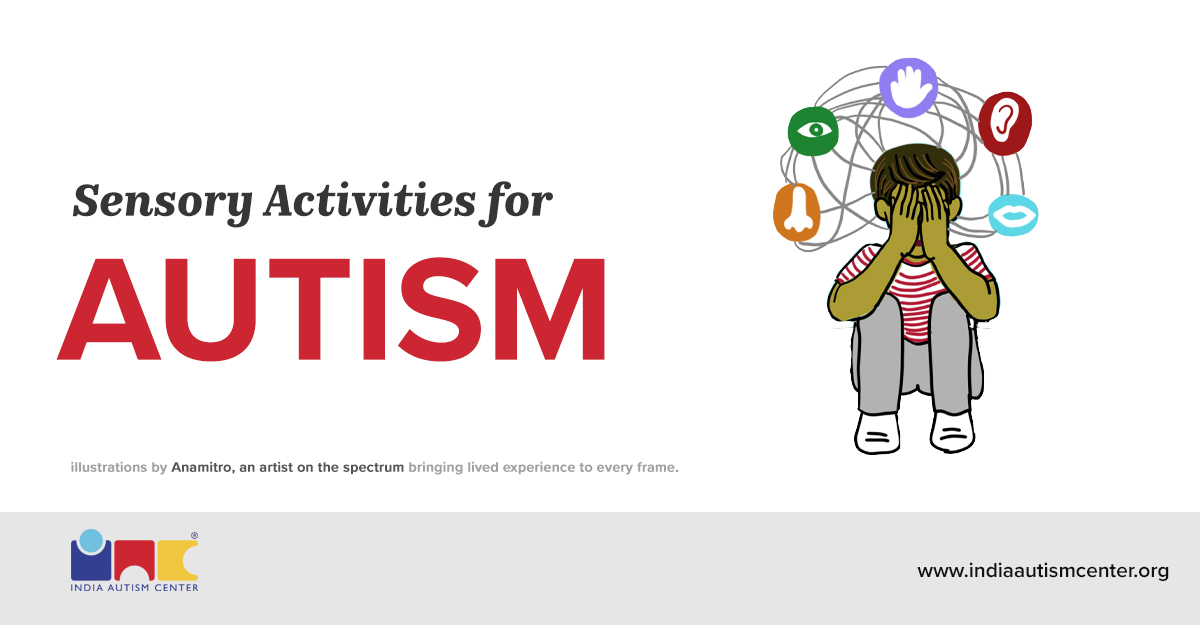
  • 10 Fun Sensory Activities for an Autistic Child

    10 Fun Sensory Activities for an Autistic Child

    If you’re here, you might be asking: What are good sensory activities for autism spectrum disorder (ASD)? Or maybe you want creative, engaging ways to help your child explore their world through play. Whatever your reason, you’re in the right place.

    I’ve worked with many families and therapists who ask similar questions every day. Sensory experiences play an important role in helping a child with autism feel comfortable, confident, and connected.

    In this blog, I’ll walk you through 10 of the most effective sensory play activities for autism, explain why they work, and show you how to make them part of your daily routine.

    Why Sensory Activities Matter

    Before we dive in, let’s answer a key question you may be asking: What are good sensory activities for autism?

    Autistic children often experience sensory challenges. They may be more sensitive (or less sensitive) to sights, sounds, touch, taste, or movement. Because of this, they can get overwhelmed or under-stimulated in regular environments. Sensory activities help them:

    • Understand and organise sensory information
    • Improve focus and self-regulation
    • Explore textures, movement, sounds, and touch in a safe way
    • Build confidence through play
    • Develop motor and social skills

    In short, sensory activities aren’t just fun — they support learning and development. When you tailor these activities to your child’s needs, you can help them thrive.

    1. Sensory Bins: Simple but Powerful

    One of the easiest sensory play activities for autism (and one of the most effective) is a sensory bin.

    A sensory bin is a container filled with materials that your child can touch, explore, and manipulate. You can include items like:

    • Rice
    • Sand
    • Beans
    • Water beads
    • Pom-poms
    • Shaving cream

    Why this works: Sensory bins promote tactile play. They help your child explore different textures and develop fine motor skills. You can hide small toys or objects in the bin to encourage discovery, attention, and play skills.

    How to get started:

    1. Choose a bin or tray.
    2. Fill it with one or more sensory materials.
    3. Add small toys or tools (like scoops or cups).
    4. Invite your child to play — and follow their pace.

    2. Texture Scavenger Hunt: Active and Engaging

    Do you wonder “How to teach kids with autism?” One of the fun answers is through movement and discovery.

    A texture scavenger hunt gets your child moving and exploring different surfaces. Hide items around a room or yard with varied textures:

    • Smooth stone
    • Soft plush toy
    • Rough sponge
    • Bumpy ball
    • Silky cloth

    Encourage your child to find and describe each one. This activity doesn’t need to be loud or competitive. It’s about curiosity and engagement — and it builds sensory awareness.

    Want to know more? Get in touch with us.

    3. Sensory Zones at Home: Create a Comfort Space

    Not every moment needs structured play. Sometimes, the best sensory activities for a child with autism are part of their environment.

    Creating sensory zones at home helps your child feel regulated and safe. These can include:

    • Quiet area: pillows, soft lighting, calming music
    • Tactile station: bins, fabrics, play materials
    • Movement area: swing, crash pad, balance board
    • Visual focus area: calming lights, picture cards

    Each zone serves a purpose: to meet sensory needs in a predictable space. You decide what works best, then observe how your child responds. Some kids prefer upbeat movement; others seek calm visuals or sounds.

    4. Sensory Games: Movement and Fun

    Games give structure and joy to sensory play activities for autism. One favourite I use often is sensory bowling.

    Here’s how it works:

    • Set up soft foam pins
    • Use a ball with different textures (fuzzy, rubbery, bumpy)
    • Encourage your child to roll the ball and knock down pins

    This game combines movement (gross motor skills) with touch and pressure feedback. It’s interactive, motivating, and easy to adjust for different ages or abilities.

    Other movement games you can try:

    • Balloon volleyball
    • Obstacle course with cushions and tunnels
    • Dance freeze game with music

    These games help with coordination, sensory regulation, and communication.

    5. Sensory Exercises: Yoga for Kids

    Physical movement matters. Sensory exercises help children connect with their bodies and regulate sensory responses.

    Try simple yoga for kids sessions that include:

    • Deep pressure stretches
    • Balanced poses (tree pose, mountain pose)
    • Slow breathing together

    You can guide your child verbally: “Reach up high. Now breathe in deeply. Let’s hold this pose.”

    These exercises are great whether your child is calm or a bit restless. They promote body awareness and improve focus.

    Want to know more? Get in touch with us.

    6. Sensory Bottles: Visual and Calming

    One of the most relaxing sensory activities for autism is the sensory bottle.

    To make one:

    1. Take a clear plastic bottle
    2. Fill it with water, glitter, beads, and small toys
    3. Add a bit of glue or oil to slow the movement

    When your child shakes or rolls the bottle, they can observe soothing movement inside. It’s a visually calming sensory tool that can also help reduce overwhelm.

    You can personalise bottles with favourite colours, themes, or soothing elements like small bells.

    7. Nature Walks: Explore the World Together

    Never underestimate the power of the great outdoors. Nature walk sensory activities for autism are simple to set up and rich in experience.

    On a nature walk, your child can:

    • Touch the tree bark
    • Smell flowers
    • Hear birds chirping
    • Feel the grass or leaves under their feet

    This type of sensory exposure helps link movement, sound, touch, and smell — all while gently calming the nervous system.

    Take your time. Let them explore at their own pace. The goal is comfort and curiosity, not speed or accomplishment.

    8. Sensory Art Projects: Creativity with Touch

    Art is not just expressive; it’s sensory!

    Try finger painting with texture:

    • Use paint
    • Add sand, rice grains, or textured materials
    • Explore painting with tools like sponges and fabric

    Art allows your child to express emotions through touch, colour, and movement — all wrapped into one playful experience.

    You can also try scented paints (like vanilla or lemon oil) to add olfactory cues — engaging more senses at once.

    9. Music Play: Sound and Rhythm

    Many autistic children respond deeply to sound. Music therapy sensory activities help with auditory exploration and emotional expression.

    You can create a sound exploration kit with:

    • Small drums
    • Shakers
    • Bells
    • Tambourines

    Let your child experiment freely. Try slower, calming rhythms first, then faster beats if they enjoy movement.

    Music helps regulate emotions, supports motor planning, and can improve communication — especially when paired with singing and movement.

    10. Sensory Storytelling: Read and Engage

    Storytime doesn’t have to be quiet! Sensory storytelling brings stories to life.

    Choose books with:

    • Textured pages
    • Sound buttons
    • Scented elements

    As you read, encourage your child to touch, smell, or listen along with you. This approach helps connect language with sensory experience, improving focus and comprehension.

    It’s especially helpful if your child is still learning to sit through more traditional reading sessions.

    Want to know more? Get in touch with us.

    Tips for Success

    Here are a few practical tips to help your sensory activities for autism go smoothly:

    1. Watch your child’s cues.

    If they seem overwhelmed, take a break. Slow down, lower noise, or switch to calm activities.

    2. Use familiar preferred items.

    If your child enjoys certain textures or sounds more, make them part of play.

    3. Keep routines predictable.

    Consistency helps autistic children feel secure, even in play.

    4. Be present and involved.

    Join in the play — your participation motivates your child and enhances connection.

    Here is another blog for you on the Autism Therapies that you can try at home.

    Conclusion

    Sensory activities for autism are not just tools for fun — they form a foundation for skill building, emotional regulation, and connection. Whether you’re asking What are good sensory activities for autism? or How to teach kids with autism?, these ideas give you ways to engage your child meaningfully.

    From sensory bins and nature walks to music play and movement games, each activity offers a unique avenue for discovery. Always observe your child’s responses and tailor activities to their interests and sensory preferences.

    Most importantly, enjoy this time with your child. Each sensory play session is a chance to learn, bond, and grow together.

    Frequently Asked Questions (FAQs)

    What are good sensory activities for autism?

    Good sensory activities for autism include sensory bins, water play, textured art, music activities, movement games, and nature walks. These activities help children explore touch, sound, movement, and visuals in a safe and enjoyable way. The best sensory activities are those that match your child’s interests and sensory needs.

    Why are sensory play activities important for children with autism?

    Sensory play activities for autism help children process sensory information, improve focus, and manage emotions. They also support motor skills, communication, and self-regulation. Regular sensory play can reduce anxiety and help children feel more comfortable in everyday environments.

    How to teach kids with autism using sensory activities?

    You can teach kids with autism through sensory activities by combining learning with play. For example, you can teach colours using textured art, numbers through sensory bins, or communication skills through music and movement games. Keep instructions simple, use repetition, and follow your child’s pace.

    How often should sensory activities for a child with autism be done?

    Sensory activities for a child with autism can be done daily, even for short periods. Some children benefit from multiple short sensory breaks throughout the day, while others prefer one structured session. Observe your child’s response and adjust the frequency based on what helps them feel calm and engaged.

    For expert insights, support services, and inclusive learning initiatives, contact India Autism Center for more information.

  • Autism and Eye Contact: Everything You Should Know [Updated]

    Autism and Eye Contact: Everything You Should Know [Updated]

    Eye contact is one of the most powerful forms of non-verbal communication. But when it comes to eye contact in autism, things work differently.

    In this blog, I’ll guide you through the science, personal experiences, challenges, and practical strategies related to eye contact in autism—including for children and adults.

    What Is Eye Contact and Why Does It Matter?

    Eye contact helps people communicate without words. It builds social bonds. In neurotypical interactions, steady eye contact signals interest and attention.

    However, eye contact in autism doesn’t always follow this pattern. Many autistic individuals find direct eye contact uncomfortable, overwhelming, or even stressful.

    It’s important to know this: lack of eye contact should never be taken as a lack of interest or empathy. Instead, it often reflects sensory and social processing differences within the brain

    Autism and Eye Contact: The Science Behind It

    When we talk about autism and eye contact, research shows that underlying brain activity is different.

    For instance, studies find that parts of the brain linked with social attention—like the dorsal parietal cortex—activate less in autistic individuals during eye contact. This may help explain why maintaining gaze feels harder or less natural.

    In another piece of research, scientists suggest that autistic adults often engage in eye contact only with conscious effort, rather than automatically as neurotypical people do. Some even learn strategies to adapt or mask their eye contact in social situations.

    This doesn’t mean autistic people don’t want connection. It means the experience of eye contact is different, not wrong.

    Want to know more? Get in touch with us.

    Eye Contact Challenges in Autism: What’s Really Going On?

    1. Sensory Overload

    For many autistic people, direct gaze can overwhelm the brain. Looking into someone’s eyes means processing a lot of sensory data at once. In addition to decoding eye expressions, the brain also handles sound, visual scene, and body language— all at the same time. This intense sensory load can feel exhausting or unpleasant.

    2. Cognitive Load and Multitasking

    Eye contact isn’t just visual. It requires attention while listening, thinking, and forming a response. For an autistic person, handling all these simultaneously can be hard. Many describe feeling mental overload when trying to talk and maintain eye contact at the same time.

    3. Anxiety and Emotional Stress

    Trying to meet social expectations for eye contact can trigger anxiety. Some people on the spectrum report that making eye contact feels like a performance rather than natural communication.

    4. Misinterpretation by Others

    In neurotypical culture, avoiding eye contact is often misunderstood as disinterest, evasion, or rudeness — none of which are accurate for many autistic people. This misunderstanding creates social pressure that only worsens eye contact challenges.

    Why People With Autism Have Trouble Making Eye Contact

    So, you may be wondering: Why do autistic people have trouble making eye contact? Let’s break it down.

    • Brain differences in social processing: Social gaze activates different neural pathways in autistic people. This often makes eye contact less intuitive or more stressful.
    • Sensory sensitivity: Some individuals find looking into eyes intensely stimulating or overwhelming.
    • Different social motivation: For several autistic individuals, the social reward of eye contact doesn’t operate the same way it does for neurotypical people.
    • Avoidance learned from experience: If someone is repeatedly criticised for not making eye contact, they might avoid it even more — not because they don’t care, but because it becomes linked to stress.

    Want to know more? Get in touch with us.

    7 Tips to Help Children with Autism Improve Eye Contact

    1. Start with Comfortable Interactions

    Choose settings that are calm, quiet, and free from distractions.

    2. Use Visual Supports

    Visual cues like cards, pictures, or social stories help children learn when eye contact can be useful.

    3. Practice Short Moments First

    Begin by encouraging brief moments of gaze and slowly build up, instead of expecting steady eye contact right away.

    4. Pair Eye Contact with Positive Experiences

    Celebrate small moments. Make it fun, not a test.

    5. Encourage Alternative Signals

    Teach children to show engagement with gestures, words, or by facing the speaker if eye contact feels too overwhelming.

    6. Model Behaviour

    Use modelling — showing examples through videos or games — so children can see where and when eye contact might be helpful.

    7. Work with Therapists

    Behavioural and social skills therapists can tailor planned routines that match a child’s needs.

    These tips help nurture skills without pressure, making learning feel safe and encouraging

    Since you read it this far, here is a bonus article for you: 10 Fun Sensory Activities for an Autistic Child

    Autism and Eye Contact Activities:

    Recognising the unique needs of each individual, we tailor these activities to foster a sense of comfort and build confidence in social interactions.

    Interactive Games

    Incorporating interactive games that involve eye-tracking exercises can be beneficial. These games, designed with input from therapists and educators, aim to make the process enjoyable while subtly encouraging eye contact.

    Visual Supports

    Introducing visual supports, such as social stories and visual schedules, can provide a structured framework that helps autistic individuals navigate social situations. These tools serve as aids in understanding the importance of eye contact and when it is most appropriate.

    Our guide on Visual Therapy for Benefits covers in depth what vision therapy for autism is, how it works, and how it can help.

    Modelling Techniques

    Utilising modelling techniques involves demonstrating appropriate eye contact behaviour through videos or live interactions. This technique can be particularly effective for individuals with high-functioning autism who may benefit from observing and imitating social cues.

    The Complex Relationship: Autism with Good and Poor Eye Contact

    Contrary to common misconceptions, the lack of eye contact does not universally signify autism, nor does good eye contact necessarily exclude an individual from being on the spectrum.

    Autism with Good Eye Contact

    While some autistic individuals maintain good eye contact, it’s crucial to recognise that this does not negate their autism diagnosis. High-functioning autism, characterised by relatively mild symptoms and strong cognitive abilities, may include individuals who exhibit typical eye contact behaviour.

    Poor Eye Contact Not Always Indicative of Autism

    Conversely, the absence of eye contact does not automatically point to an autism diagnosis. Various factors, such as cultural differences, social anxiety, or sensory sensitivities, can contribute to poor eye contact in autistic individuals.

    When it comes to eye contact, a study conducted by the National Institute of Mental Health and Neurosciences (NIMHANS) in Bangalore found that a significant number of autistic individuals in India exhibit challenges in establishing and maintaining eye contact. This underscores the importance of tailored interventions and support systems for this population.

    Want to know more? Get in touch with us.

    Common Myths About Eye Contact and Autism

    Let’s clear up a few:

    Myth 1: “All autistic people avoid eye contact.”

    Not true. Some autistic individuals maintain eye contact comfortably, especially with people they trust.

    Myth 2: “Good eye contact means you’re not autistic.”

    Also false. High-functioning autism may include people who can or do make good eye contact. It has no diagnostic power on its own.

    Myth 3: “Eye contact is essential for communication.”

    While eye contact can be helpful, it isn’t the only way to show engagement. Many autistic people communicate just fine using other cues like facing the listener, nodding, verbal responses, or body language — all of which signal attentiveness and interest.

    Conclusion

    Understanding autism and eye contact helps us appreciate the diversity of human communication. Eye contact is a skill — not a marker of worth, interest, or empathy. For autistic individuals, especially those with sensory sensitivities or social processing differences, direct gaze can be overwhelming or mentally demanding.

    You don’t need perfect eye contact to build trust, friendship, or connection. Instead, focus on shared understanding, mutual respect, and comfortable communication. When we do that, we open doors to real connection — one meaningful moment at a time.

    Frequently Asked Questions (FAQs)

    Why is eye contact difficult for people with autism?

    Eye contact can feel uncomfortable or overwhelming for many autistic individuals. This happens due to differences in sensory processing and brain activity. For some, looking into someone’s eyes creates sensory overload or makes it harder to focus on what is being said. This is a common eye contact challenge in autism and does not indicate disinterest or lack of attention.

    Is avoiding eye contact always a sign of autism?

    No. Avoiding eye contact alone is not a diagnosis of autism. While eye contact in autism may differ from neurotypical patterns, many autistic individuals can make eye contact in certain situations. Similarly, non-autistic people may also avoid eye contact due to shyness, anxiety, or cultural norms.

    How does eye contact differ in adults with autism?

    Eye contact in adults with autism varies widely. Some adults avoid it because it feels stressful, while others consciously make eye contact as a learned social skill. In some cases, maintaining eye contact requires significant mental effort and can be tiring, even if it appears natural on the surface.

    Do people with high-functioning autism make eye contact?

    Yes, many individuals with high-functioning autism can make eye contact, especially in familiar or comfortable settings. However, eye contact may still feel unnatural or distracting. The ability to make eye contact does not reflect how well someone understands emotions or communicates.

    Can children with autism be taught to improve eye contact?

    Yes, children can be gently supported using structured and respectful methods. The focus should be on comfort, not forcing eye contact. Using play-based interactions, visual supports, and positive reinforcement are effective tips to help children with ASD improve eye contact, while also respecting their individual needs.

    For expert insights, support services, and inclusive learning initiatives, contact India Autism Center for more information.

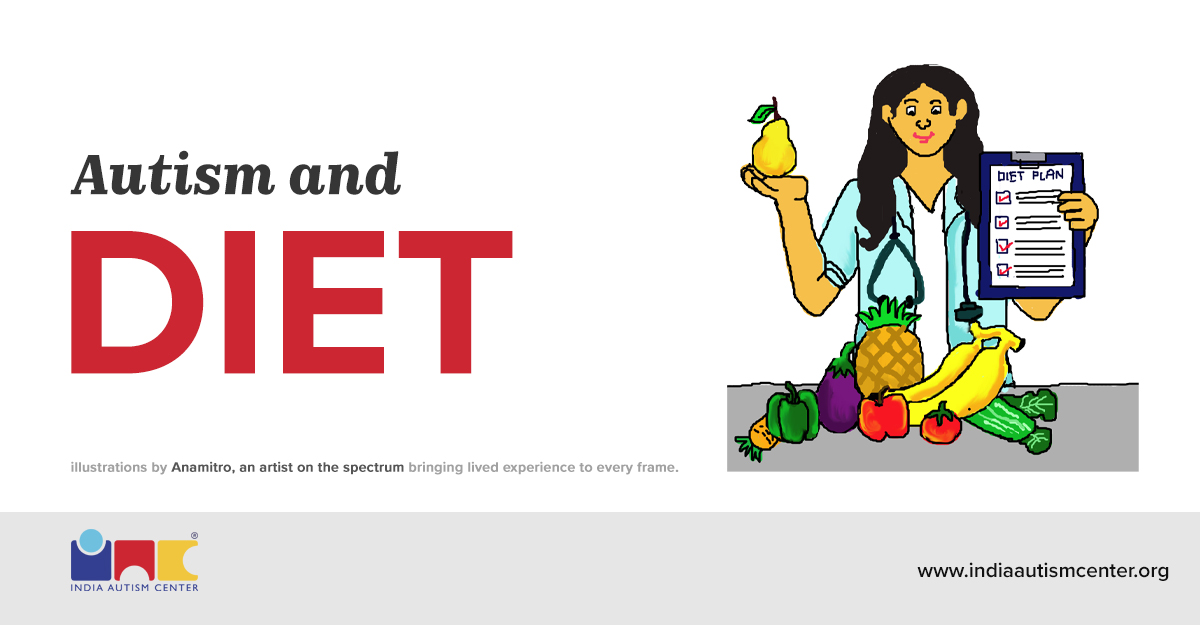
  • Autism Diet: A Detailed Guide (2026)

    Autism Diet: A Detailed Guide (2026)

    What Is Autism and Diet All About?

    When we talk about autism and diet, we are not suggesting that food causes autism. Rather, we want to understand how diet can support overall health. Many autistic people have unique eating behaviours.

    Research shows that children with Autism Spectrum Disorder (ASD) often have mealtime challenges. They may show extreme food selectivity, ritualistic eating, and tantrums during meals. These behaviours affect how much and what they eat, which in turn affects nutrition.

    If you are a caregiver, parent, teacher, or someone living with autism, this article will help you understand the relationship between autism and diet.

    Autism Diet Plans: Tailoring Nutrition for Individual Needs

    Crafting an effective autism diet plan requires a nuanced understanding of the specific needs and sensitivities of each autistic individual. While there is no one-size-fits-all solution, certain dietary approaches have gained attention for their potential to positively impact the lives of those with autism.

    1. Gluten-Free Diet for Autism

    Gluten, a protein found in wheat and other grains, has been implicated in exacerbating certain symptoms in some autistic individuals.

    While research on the effectiveness of a gluten-free diet for autism is still inconclusive, anecdotal evidence suggests that eliminating gluten can lead to improvements in behaviour and digestive issues for some.

    2. Casein-Free Diet and Autism

    Similar to gluten, casein, a protein found in milk and dairy products, has been scrutinised in relation to autism. Advocates of the casein-free diet claim that removing dairy from the diet can alleviate gastrointestinal problems and improve behaviour.

    However, scientific consensus on the efficacy of this approach is still evolving.

    3. Ketogenic or High-Fat Diets

    Some studies show potential benefits of ketogenic diets (high in fat, low in carbs) for a subset of people with ASD. However, these diets are complex and should only be tried under professional supervision due to potential nutritional risks

    4. Montessori, Feingold, or Healthy Diets

    Survey data suggests that standard healthy diets and Feingold diets (which reduce artificial colours and additives) are among the most beneficial according to families.

    Here is an in-depth article for you on the Autism Food List.

    Want to know more? Get in touch with us.

    Best Fruits and Vegetables for Autistic Individuals 

    Certain fruits and vegetables have been highlighted for their potential benefits in supporting autistic individuals. While individual responses may vary, incorporating the following into the diet can be a good starting point:

    1. Berries

    Rich in antioxidants and vitamins, berries such as blueberries, strawberries, and raspberries are not only delicious but also offer potential cognitive and health benefits.

    2. Leafy Greens

    Vegetables like spinach, kale, and broccoli are packed with essential nutrients, including vitamins A and K, folate, and fibre, contributing to overall well-being.

    3. Avocado

    Known for its healthy fats, avocados are a nutrient-dense option that can provide a good source of energy and support brain health.

    Indian Diet for Autism: Blending Tradition with Modern Approaches

    In the context of Indian dietary practices, incorporating traditional foods into an autism diet plan can provide a sense of familiarity while meeting nutritional needs. Traditional Indian diets often include a variety of spices, lentils, and vegetables, offering a rich source of nutrients.

    1. Spices with Potential Benefits

    Turmeric, a staple in Indian cuisine, contains curcumin, which has anti-inflammatory and antioxidant properties. While more research is needed, some studies suggest potential benefits for autistic individuals.

    2. Lentils and Legumes

    Rich in protein and fibre, lentils and legumes are integral to Indian diets. They can provide a sustained release of energy and contribute to overall digestive health.

    Diet for Autism and ADHD: Exploring Overlapping Concerns

    Many autistic individuals also experience symptoms of attention deficit hyperactivity disorder (ADHD). Considering the overlap in these conditions, dietary interventions targeting both autism and ADHD symptoms have gained attention.

    1. Elimination Diets

    Some families and healthcare professionals have explored elimination diets that exclude common allergens, additives, and artificial colourings. While the scientific evidence supporting the efficacy of elimination diets is limited, anecdotal reports suggest improvements in behaviour for some individuals.

    2. Omega-3 Fatty Acids

    Research has shown that omega-3 fatty acids, found in fatty fish like salmon and flaxseeds, may have cognitive and behavioural benefits. Including these sources of healthy fats in the diet could potentially support autistic individuals and those with ADHD.

    Best Practices for an Autism Diet Plan

    Here are some best practices to guide the development of an effective autism diet plan:

    1. Individualised Approach

    No two autistic individuals are the same, and their dietary needs will vary. An individualised approach, possibly with the guidance of a nutritionist or healthcare professional, is crucial for tailoring the diet to specific requirements and preferences.

    2. Nutrient-Dense Foods

    Emphasising nutrient-dense foods is essential for supporting overall health and development. Fresh fruits, vegetables, lean proteins, and whole grains should be integral components of the diet to ensure that autistic individuals receive the essential vitamins and minerals their bodies need.

    3. Attention to Food Sensitivities

    Many autistic individuals experience sensitivities to certain textures, tastes, or smells. Understanding and accommodating these sensitivities is vital for creating a positive and sustainable eating experience. This might involve experimenting with different preparation methods or exploring alternative food options.

    Autistic Sensory Issues and Eating Patterns

    Many autistic individuals have sensory sensitivities. They might react strongly to texture, temperature, smell, or taste. These sensory responses affect food preferences.

    For example:

    • Some avoid crunchy foods.
    • Others reject gooey or mixed textures.
    • Certain smells may trigger discomfort or refusal.

    These traits can influence eating behaviour, leading to limited food variety. Limited variety can make it hard to get balanced nutrition.

    Understanding these sensory experiences helps you build a supportive eating plan. Rather than forcing foods, you can learn to gently expand the variety in ways that feel safe to the individual.

    The Emotional Impact of Dietary Interventions

    Navigating the world of autism diet plans can be emotionally challenging for families and caregivers. The quest for the best diet for autism often involves a process of trial and error, with each step carrying the hope of improving the quality of life for loved ones on the spectrum. It’s crucial to approach dietary interventions with a mix of optimism, patience, and realistic expectations.

    Want to know more? Get in touch with us.

    Challenges You Might Face

    You may feel overwhelmed. Some common issues include:

    Food Refusal

    This can be due to sensory aversions or past discomfort.

    Limited Variety

    This can lead to low intake of key nutrients.

    Gastrointestinal Issues

    Many autistic individuals experience constipation, bloating, or stomach discomfort.

    Rigid Eating Patterns

    Strong routines can make it hard to introduce new foods.

    These challenges are common, not a sign of “failure.” They can be handled with patience and strategy.

    Conclusion

    Autism and diet go hand in hand in your everyday life. What you eat affects how you feel, behave, and grow. Though no diet can “cure” autism, good nutrition and personalised support can make a big difference in health and comfort.

    Remember:

    • Understand sensory needs
    • Focus on nutrient-dense foods
    • Seek professional guidance
    • Be patient and flexible

    Every autistic individual is different. What works for one person may not work for another. But with care, knowledge, and compassion, you can build a nutrition plan that supports health and happiness.

    Frequently Asked Questions (FAQs)

    What is the connection between autism and diet?

    Autism and diet are closely linked because many autistic individuals have unique eating habits, sensory sensitivities, and digestive challenges. While diet does not cause or cure autism, proper nutrition can support overall health, digestion, energy levels, and daily functioning in autistic individuals.

    How does nutrition impact Autism Spectrum Disorder?

    Nutrition and Autism Spectrum Disorder are connected through physical and behavioural well-being. A balanced diet can help manage gastrointestinal issues, support brain development, and improve focus and mood. Poor nutrition, on the other hand, may worsen fatigue, discomfort, and eating-related stress.

    What is the best diet for autism?

    There is no single best diet for autism. An effective diet for autism focuses on nutrient-dense foods such as fruits, vegetables, lean proteins, healthy fats, and whole grains. The ideal plan should be personalised based on sensory preferences, allergies, and nutritional needs, preferably with guidance from a healthcare professional.

    How can I plan a healthy diet for an autistic child?

    Planning a diet for an autistic child starts with understanding their food preferences and sensory sensitivities. Offer familiar foods while slowly introducing new ones. Maintain consistent meal routines, ensure balanced nutrition, and consult a dietitian to address any nutritional gaps safely.

    What is the impact of diet and nutrition on autistic individuals?

    The impact of diet and nutrition on autistic individuals can include better digestion, improved energy levels, stable mood, and enhanced overall health. While dietary changes do not alter the core traits of autism, they can significantly improve comfort, daily functioning, and quality of life.

    For expert insights, support services, and inclusive learning initiatives, contact India Autism Center for more information.

  • Understanding The Difference Between Autism and Down Syndrome

    Understanding The Difference Between Autism and Down Syndrome

    If you ever thought, “Are autism and Down syndrome the same?”, then you’re not alone. Many people mix these two terms up, partly because they both relate to development in children.

    But the difference between Autism and Down Syndrome is significant, and knowing it helps families, educators, and the community support individuals more effectively.

    In this guide, I’ll break down everything clearly and comprehensively.

    Why Understanding Matters

    When I first learned about developmental differences, I often heard people ask: “Down Syndrome vs Autism — is there a difference?” It’s a fair question. Both are lifelong conditions that affect development. Yet, their causes, features, and support needs are quite different. Still, they share some similarities, which we’ll explore too.

    By the end of this article, you’ll clearly understand:

    • What Autism Spectrum Disorder (ASD) is
    • What Down Syndrome is
    • How professionals diagnose each
    • Where they overlap
    • And most importantly, how we can support individuals with love and respect

    Want to know more? Get in touch with us.

    What Is ASD? (Autism Spectrum Disorder)

    Autism — also called Autism Spectrum Disorder (ASD) — is a neurodevelopmental condition. It affects how the brain processes social interaction, communication, behaviour, and sensory input. You’ll often see ASD described as a “spectrum” because symptoms and their severity vary widely between individuals.

    Key features of Autism

    • Social Interaction: One of the hallmarks of Autism is difficulty in social interactions. Individuals with Autism may struggle to understand social cues, such as facial expressions or body language. They may have difficulty forming and maintaining relationships, often preferring solitary activities.
    • Communication: Communication difficulties are another key aspect. While some individuals with Autism may have limited or delayed speech, others may have advanced language skills but still find it challenging to engage in conversations or understand nuances in communication.
    • Repetitive Behaviours: Repetitive behaviours, such as hand-flapping, rocking, or repeating words or phrases (echolalia), are common among those with Autism. These behaviours can serve as a way to self-soothe or manage anxiety.
    • Sensory Sensitivities: Many individuals with Autism experience sensory sensitivities, meaning they may be hypersensitive or hyposensitive to sensory stimuli like light, sound, touch, or taste. This can make certain environments overwhelming or uncomfortable.
    • Special Interests: Another characteristic of Autism is the presence of intense, focused interests. Individuals may become experts in specific subjects or hobbies, often displaying remarkable talents.

    Some autistic people speak fluently; others might use alternative communication methods like gestures or devices. Autism isn’t defined by intellectual ability alone — many autistic people have average or high intelligence. Want to know what causes autism?

    What Is Down Syndrome?

    Down Syndrome is a genetic condition caused when a child is born with an extra copy of chromosome 21, also called Trisomy 21. It affects physical growth, cognitive development, and can influence health in other ways.

    Common Traits of Down Syndrome

    • Physical Characteristics: Individuals with Down Syndrome often have distinctive physical features, such as almond-shaped eyes, a single crease across the palm of their hand, and a flattened facial profile. These features can vary in intensity among individuals.
    • Cognitive Development: Down Syndrome is associated with intellectual disabilities of varying degrees. While individuals with Down Syndrome can learn and develop, they often have cognitive challenges that may impact their learning abilities.
    • Health Concerns: Individuals with Down Syndrome may have an increased risk of certain health conditions, including heart defects, gastrointestinal problems, and respiratory issues. Regular medical check-ups and early intervention are essential for their well-being.
    • Social and Emotional Development: Individuals with Down Syndrome often display warmth and affection in their social interactions. They may experience delays in speech and language development, but can build meaningful relationships with support and encouragement.
    • Inclusion and Education: Many individuals with Down Syndrome can thrive in inclusive educational settings with appropriate support. Tailored educational programs can help them reach their full potential.

    While people with Down Syndrome may take longer to reach developmental goals, many thrive with early support and inclusive education.

    Diagnostic Criteria for Autism and Down Syndrome

    Understanding the diagnostic process is important — it’s how we know these two are distinct

    Autism Diagnosis

    Autism is diagnosed by observing behaviour and developmental patterns. There’s no single lab test. Specialist clinicians look for persistent challenges in:

    • Social communication
    • Restricted or repetitive behaviours
    • Sensory responses

    Symptoms are typically noticeable by age 2 or 3 and must significantly affect daily functioning. If you want deeper insights, you can read our article on autism diagnosis.

    Down Syndrome Diagnosis

    Down Syndrome is identified through genetic testing. It can be detected:

    • Before birth (through prenatal tests)
    • At birth (chromosome analysis)

    The diagnosis is clear because it’s linked to a specific change in the chromosomes (extra 21st chromosome).

    Down Syndrome vs Autism: Side-by-Side Comparison

    Let’s compare these conditions directly to see how they differ and where they can sometimes overlap.

    AspectAutism Spectrum DisorderDown Syndrome
    CauseNeurodevelopmental differences (complex genetics + environment)Genetic condition (extra chromosome 21)
    DiagnosisBehavioral evaluationGenetic testing
    Physical TraitsNo specific physical profileRecognizable physical features
    Social InteractionCan be challenging, especially interpreting cuesOften social, warm interactions
    CommunicationDelays or differences commonTypical delay pattern
    Medical NeedsSensory, behavioral, and developmental supportPhysical health screenings + developmental support
    OverlapSome may also have Down Syndrome + ASDSome individuals with Down syndrome may also meet criteria for ASD

    Want to know more? Get in touch with us.

    What Are the Similarities Between Autism and Down Syndrome?

    Even though they are distinct, there are areas where these conditions can look somewhat alike — especially to people unfamiliar with them. These include:

    1. Developmental Delays

    Both groups can show delays in speech, motor skills, or learning milestones. Though the cause differs, the observable developmental patterns may overlap.

    2. Communication Challenges

    Children with either condition may struggle to express themselves or understand others. Early speech and language therapy benefits many.

    3. Social Interaction Differences

    Autistic people may find social cues hard to interpret. Some children with Down Syndrome might also struggle in more complex social settings, even if they’re generally friendly.

    4. Behaviour Patterns

    Both groups can show repetitive behaviours or prefer routine. In autism, this is core to the diagnosis. In Down Syndrome, repetition may arise from comfort and predictability needs.

    Can Someone Have Both Autism and Down Syndrome?

    Yes — and this is an important point. Some individuals are diagnosed with both autism and Down syndrome. Studies suggest that around 16–18% of people with Down syndrome also show autistic traits significant enough to meet ASD diagnosis criteria.

    When this happens:

    • Evaluation can be more complex
    • Support needs may combine strategies from both fields
    • Awareness helps tailor better educational and therapy plans

    Supporting Individuals: What You Can Do

    Understanding the difference between autism and Down syndrome is only the first step. What matters most is how we support people with these conditions.

    1. Early Intervention

    Whether your child has autism, Down syndrome, or both, early support helps immensely. Speech therapy, occupational therapy, and behavioural support can improve outcomes.

    2. Inclusive Education

    Learning in environments that appreciate diversity fosters confidence and skills.

    3. Family and Community Support

    Parents, caregivers, and peers benefit from resources, support groups, and patience. Acceptance makes a huge difference in quality of life.

    Conclusion

    So, are autism and Down syndrome the same? No. They are distinct conditions with different causes and characteristics. Yet, they share some common ground that can sometimes create confusion.

    By understanding the difference between Autism and Down Syndrome, you can better support individuals, reduce misunderstanding, and help foster acceptance.

    Every person’s journey is unique. A diagnosis like Autism Spectrum Disorder or Down Syndrome doesn’t define someone — it’s just one part of who they are. With the right support, encouragement, and connection, anyone can thrive.

    Thank you for reading — and thank you for caring.

    Frequently Asked Questions (FAQs)

    Are autism and Down syndrome the same?

    No, autism and Down syndrome are not the same. Autism is a neurodevelopmental condition affecting communication and behaviour, while Down syndrome is a genetic condition caused by an extra chromosome 21.

    What is the main difference between autism and Down syndrome?

    The main difference lies in their cause. Autism is diagnosed based on behavioral and developmental patterns, whereas Down syndrome is diagnosed through genetic testing and involves physical and intellectual differences.

    Can a child have both autism and Down syndrome?

    Yes, a child can have both autism and Down syndrome. Some individuals with Down syndrome may also meet the criteria for Autism Spectrum Disorder, which requires a specialised evaluation.

    What are the similarities between autism and Down syndrome?

    Both conditions can involve developmental delays, communication challenges, and learning differences. Early intervention and supportive therapies are beneficial for individuals with both conditions.

    How can parents support children with autism or Down syndrome?

    Parents can support their child through early intervention, therapy, inclusive education, and by creating a nurturing and structured environment tailored to the child’s individual needs.

    For expert insights, support services, and inclusive learning initiatives, contact India Autism Center for more information.

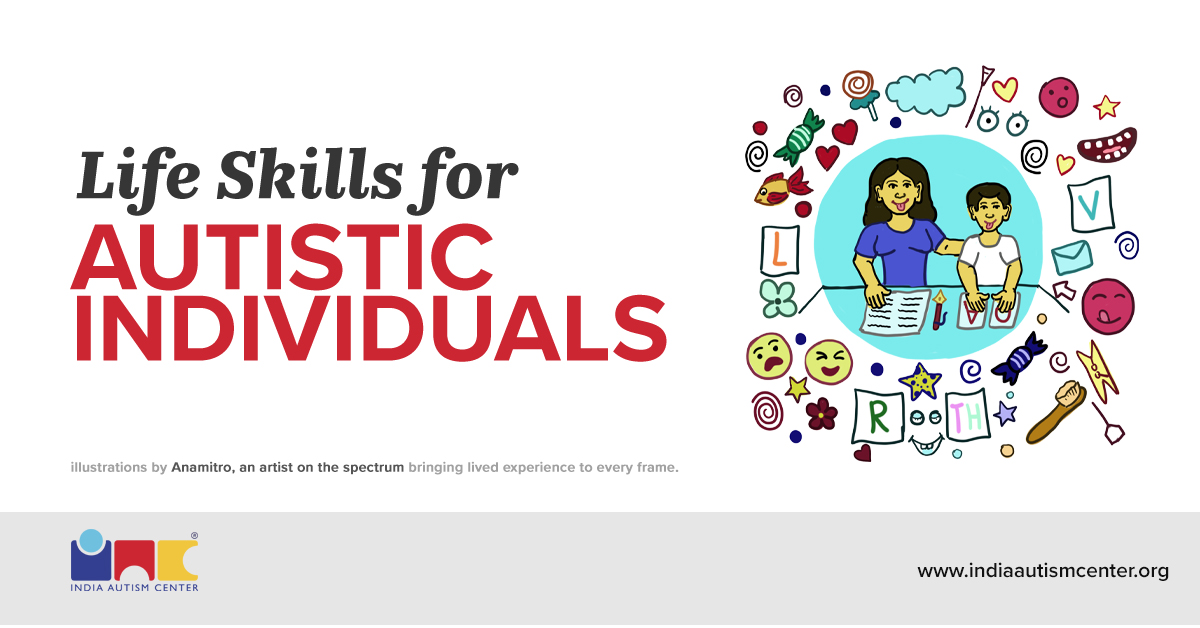
  • Empowering Autistic Individuals: Nurturing Life Skills for Independence

    Empowering Autistic Individuals: Nurturing Life Skills for Independence

    A Complete Guide to Building Independence

    When we talk about life skills for autistic individuals, we are talking about more than just tasks. These skills are the foundation for confidence, independence, and a fulfilling life. Whether you are a parent, caregiver, educator, or someone on the autism spectrum, this guide is for you.

    We’ll explain what life skills are, why they matter, and how you can help nurture them in everyday life. Most importantly, we’ll keep the language clear, direct, and practical so you can take real actions and make a real difference.

    Understanding Autism and Life Skills

    Autism is a neurodevelopmental condition that affects how a person experiences the world. Every individual on the autism spectrum is unique. Some may be non-verbal, some may need daily support, and others may thrive independently with minimal help

    Life skills are abilities that help an individual manage daily life. These skills range from basic tasks like self-care to more complex ones like money management and social interaction. For autistic people, learning these essential life skills is a key part of growing into an independent adult.

    When individuals learn to master even a few important tasks, they feel more confident, more capable, and more in control of their lives. These improvements also bring greater happiness and participation in the community.

    In this blog, we focus on Autism Life Skills, including Essential Life Skills for Autism and High Functioning Autism Life Skills — explained in simple, supportive language.

    Activities and Strategies to Build Life Skills

    Developing life skills happens best through real practice, not just talking. Here are some effective strategies you can use:

    1. Use Everyday Routines

    Turn daily life into learning moments. For example, brushing teeth becomes a step in a self-care routine, and grocery shopping becomes a money management lesson.

    2. Create Personalised Plans

    Because autism is unique to each person, setting goals one-by-one helps learners feel successful and supported. Break complex tasks into small steps and celebrate progress.

    3. Seek Support from Therapists and Educators

    Professionals can guide you with strategies like:

    • Speech therapy for communication
    • Occupational therapy for daily tasks
    • Life skills workshops
    • Supported employment services

    Want to know more? Get in touch with us.

    Autism Life Skills Activities

    Social Skills Workshops

    Autistic individuals often face challenges in social interactions. Engaging in autism social skills workshops can help them learn how to initiate conversations, make friends, and understand social cues.

    Occupational Therapy

    Occupational therapy can help autistic adults develop fine motor skills and sensory processing abilities. This therapy can enhance their ability to perform tasks related to daily living.

    Independent Autism Living Skills Programs

    Many organisations offer independent Autism living skills programs specifically tailored to the needs of autistic adults. These programs cover a wide range of skills, including housekeeping, time management, and vocational training.

    Vocational Training

    Preparing for employment is a crucial aspect of independent living. Vocational training programs can help individuals on the autism spectrum gain skills that are applicable in the job market.

    Autism and Independent Living Skills

    Living Arrangements: Autistic adults may choose to live independently, with family, or in supported living arrangements. The choice depends on their abilities and personal preferences. Independent living skills for Autism are essential for all these options.

    Transportation: Learning to navigate public transportation or drive a car is an essential life skill that can provide greater independence and access to job opportunities.

    Health and Safety: Understanding basic health and safety measures is crucial. Autistic individuals should know how to handle emergencies and seek medical assistance when necessary.

    Emotional and Psychological Well-being

    Developing life skills is not just about practical tasks; it’s also about emotional and psychological well-being. Autistic individuals may experience increased stress and anxiety when dealing with the challenges of daily life. It is essential to provide emotional support and create a safe and inclusive environment.

    Encouraging self-advocacy, self-esteem, and self-regulation skills can help individuals on the autism spectrum manage their emotions and mental health effectively.

    Want to know more? Get in touch with us.

    A Holistic Approach to Life Skills for Autistic Individuals

    In nurturing life skills for autistic adults, it’s crucial to adopt a holistic approach. This means considering the unique needs and strengths of each individual. A one-size-fits-all approach may not be effective, as autism is a highly variable condition. Assessments and personalised plans can help autistic individuals acquire the specific life skills they require while harnessing their talents and interests.

    You may like to read our blog on specialised support for adults, to know how we do it and how it helps them.

    Your Role in Empowering Life Skills

    If you are reading this, you likely care about helping an autistic individual thrive. You are already part of their support system. Here’s how you can help:

    • Start small — pick one skill to focus on this week
    • Make learning fun and practical
    • Praise efforts and celebrate improvements
    • Use visuals, routines, and step-by-step instructions
    • Ask for help from professionals when needed
    • Keep a positive and patient mindset

    Conclusion

    Life Skills for Autistic Individuals are more than checkboxes. They are pathways to independence, confidence, and choice. By teaching and supporting autism life skills step by step — from daily routines to emotional strength — we help individuals thrive, contribute, and feel confident in their world.

    Whether someone is learning basic self-care or advanced money management, each success builds a stronger, more independent future. With the right support and strategies, everyone has the potential to live a meaningful and fulfilled life.

    Frequently Asked Questions (FAQs)

    What are life skills for autistic individuals?

    Life Skills for Autistic Individuals are everyday abilities that help a person manage daily tasks independently. These include self-care, communication, social interaction, money management, cooking, and time management. Developing these autism life skills improves confidence, independence, and overall quality of life.

    Why are essential life skills important for autism?

    Essential Life Skills for Autism help individuals become more independent and self-reliant. These skills reduce dependency on others, improve decision-making, and support participation in school, work, and community life. They also boost self-esteem and emotional well-being.

    At what age should autism life skills training begin?

    Autism life skills training can begin at any age. However, starting early allows skills to develop gradually and naturally. Even adults on the spectrum can successfully learn and improve life skills for autistic individuals with the right guidance, structure, and practice.

    How do life skills differ for high-functioning autism?

    High functioning autism life skills often focus on advanced areas such as social communication, workplace behavior, time management, financial planning, and independent living. While support needs may be lower, structured guidance is still essential to build confidence and consistency.

    How can parents and caregivers support life skills development at home?

    Parents and caregivers can support autism life skills by breaking tasks into small steps, using visual schedules, encouraging daily practice, and maintaining consistent routines. Positive reinforcement, patience, and professional support from therapists or specialised centres further improve outcomes.

    For expert insights, support services, and inclusive learning initiatives, contact India Autism Center for more information.

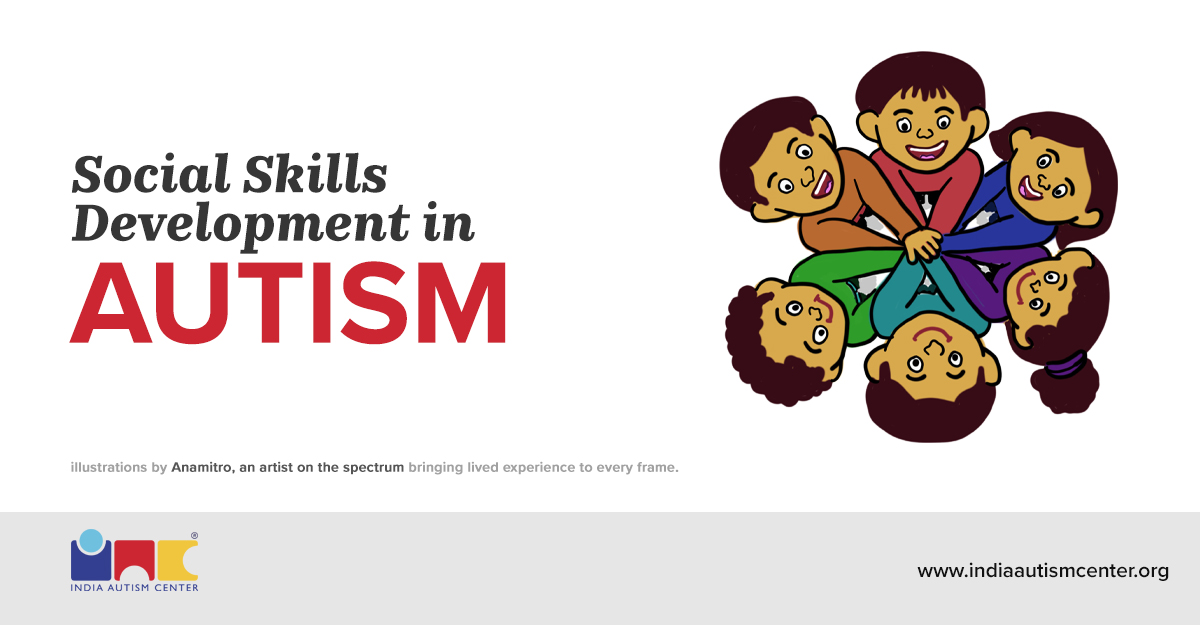
  • Social Skills Development in Autism | 5 Proven Approaches (2026)

    Social Skills Development in Autism | 5 Proven Approaches (2026)

    As someone who cares deeply about the well-being of autistic individuals, you may have often wondered how to support meaningful social skills development in autism. You’re not alone — many families, educators, and caregivers struggle with understanding how to help individuals on the autism spectrum build strong social connections.

    In this blog, we will explore the 5 valuable tips to facilitate the growth of social skills in autistic individuals, and the benefits of social skills programs for children with autism.

    So, Why Social Skills Matter in Autism

    From making friends to asking for help at school or work, good social skills shape positive experiences. For individuals with autism, however, social communication doesn’t always come naturally. Many autistic people face challenges in interpreting facial expressions, understanding tone of voice, and responding in social situations — all of which are central to successful Social Skills Development in Individuals with Autism.

    Understanding Autism and Social Interaction Problems

    When we talk about autism and social interaction problems, we refer to the differences in how autistic individuals communicate and engage socially. These differences might show up as:

    • Difficulty recognising emotions in others
    • Trouble with back-and-forth conversations
    • Challenges in understanding nonverbal cues
    • Struggles with initiating or maintaining friendships

    Recognising these challenges is the first step toward making social skills development in autism practical and effective. Through understanding, we can remove judgment and replace it with encouragement and tools that genuinely help.

    Want to know more? Get in touch with us.

    Key Social Skills to Build in Individuals with Autism

    To grow meaningful connections, autistic individuals benefit from support in several key social skill areas. Below are some of the most essential skills you can focus on:

    1. Emotional Recognition

    Being able to identify one’s own feelings and the emotions of others is vital. When individuals can recognise emotions, they can respond more comfortably in social settings.

    2. Conversational Skills

    These include learning how to take turns in conversation, maintain eye contact when appropriate, and read social cues in dialogue. These are essential for forming deeper connections with family, friends, and peers.

    3. Empathy and Understanding

    Contrary to some misconceptions, many autistic individuals experience empathy deeply. What they may need is guidance to express that empathy in recognisable social ways.

    4. Making and Keeping Friends

    Initiating interactions, joining activities, and navigating social roles — such as playdates or group work — are all part of everyday life. Autistic individuals may need tailored support to feel confident in these moments

    5. Advanced Social Cues for High-Functioning Autism

    For individuals with stronger communication skills, learning how to interpret irony, sarcasm, humour, or subtle social cues can boost confidence and reduce frustration in complex social spaces

    Effective Approaches to Social Skills Development in Autism

    There is no one-size-fits-all method for Social Skills Development in Individuals with Autism. What works for one person may not work for another. The key is a balanced mix of professional support, real-life practice, and individualised adjustments. Here are approaches that have strong evidence of success:

    1. Structured Learning Opportunities

    Structured lessons give clear steps toward developing specific skills. Visual aids, checklists, scripts, and explicit instructions help make social expectations easier to understand. Examples of structured social learning include:

    • Breaking down how to start a conversation
    • Demonstrating turn-taking during play
    • Using pictures to show facial expressions and emotions

    2. Identifying Key Social Skills for Autism

    A comprehensive list of social skills is essential to tailor interventions required for facilitating social skills for autistic individuals effectively. The list of social skills for autistic individuals includes:

    Emotional Recognition: Emotional recognition varies from person to person. While some individuals are quite adept at it, some grapple to hold social conversations efficiently. Autistic individuals struggle with this aspect more than anyone else. Helping autistic individuals identify and understand their own emotions optimally, as well as the emotions of others around them, can help them establish better social skill foundations.

    Conversational Skills: Educating autistic individuals on turn-taking, maintaining appropriate eye contact, and understanding conversational cues can help them establish improved social bonds. These conversational skills are not only important for them to forge interactive relationships with their parents, spouse, siblings and caregivers but also for communicating aptly in societal and professional ecosystems. 

    Empathy: Autistic individuals lack empathy – this is probably the worst kind of notion most non-autistic individuals have. On the contrary, autistic individuals are highly sensitive to emotions of their own and others and need the right decorum or social setting to display them properly. Encouraging the ability to understand and relate to the feelings of others and communicate the same optimally can help autistic individuals overcome the social interaction barrier.

    Initiating and Maintaining Friendships: Forging friendships and being the first one to initiate a dialogue and carry it through can be a key challenge many autistic individuals contend with. Guiding how to make friends, engage in shared activities, and navigate social dynamics can pave the way for them to flourish in social ecosystems.

    3. Social Stories and Visual Supports

    Social stories and visual aids help break down social expectations into small, understandable pieces. You might create a comic-style guide about:

    • What happens during snack time
    • Steps of greeting a friend
    • Appropriate ways to join a group project

    These visual tools make social rules predictable and less intimidating. You can read our detailed blog on Visual Therapy for a clearer understanding of how it works.

    4. Tailoring Interventions to Individual Needs

    Recognising that every autistic individual is unique is essential. It’s crucial to emphasise the importance of individualised interventions. What works for one autistic individual might not work for another.

    So, caregivers and educators should assess the specific strengths, challenges, and interests of each autistic individual. This individualised approach ensures that interventions are personalised, relevant, and effective in promoting social skills development in autistic individuals.

    5. Incorporating Social Skills into Everyday Life

    Social skills training doesn’t only happen in therapy or school. Real improvement comes from blending practice into everyday routines. Encouraging participation in:

    • Family game nights
    • Community clubs
    • Group activities that match interests

    Here is our detailed guide on Life Skills for Autistic Individuals.

    Benefits of Social Skills Programs for Children with Autism

    When we invest in Social Skills Development in Autism — especially through structured programs — the benefits are broad and long-lasting. Social skills programs can help children:

    • Build Confidence and Trust: Understanding social rules reduces anxiety and increases participation.
    • Improve Emotional Regulation: Children learn to identify triggers and respond thoughtfully rather than reactively.
    • Better Academic and Social Outcomes: Children who can communicate their needs and collaborate with peers often show improved performance in school and beyond.
    • Foster Meaningful Friendships: Program activities and peer groups help form genuine connections based on shared interests and mutual respect.

    Want to know more? Get in touch with us.

    Practical Tips You Can Start Today

    Here are simple, concrete steps you can start implementing right now:

    • Start Small and Be Consistent: Begin with basic greetings before moving on to more complex interactions. Repetition creates confidence.
    • Use Interests to Motivate Engagement: If your child loves trains or drawing, incorporate those interests into social games or discussion topics.
    • Encourage Play Dates With Structure: Set clear expectations for activities, like turn-taking during board games. Structured social interaction helps ease uncertainty.
    • Celebrate Progress: Every step forward is progress — whether it’s making eye contact, saying “hello,” or playing cooperatively with peers.

    Conclusion

    Remember, Social Skills Development in Autism isn’t just for childhood — it’s a lifelong process. As individuals grow, they’ll face new social challenges in adolescence, adulthood, and careers. A foundation built on patience, practice, and understanding will help them navigate these milestones with strength and confidence.

    With the right support, individuals with autism can build fulfilling relationships, communicate authentically, and find belonging in their communities. That’s the power of social skills — and it starts with understanding, compassion, and intentional practice.

    Some of our key initiatives and relentless efforts toward equipping autistic individuals to lead a good quality of life include:

    • A fully-equipped and personalised residential facility for the entire neurodiverse community. 
    • A safe and sustainable ecosystem for autistic individuals to realise their potential and further improve it. 
    • Evidence-based and time-tested support towards enabling autistic individuals to rehash their social skills. 
    • Leveraging digital-native initiatives and platforms for expanding reach and support for autistic individuals. 

    Frequently Asked Questions (FAQs)

    What is social skills development in autism?

    Social skills development in autism focuses on helping individuals on the autism spectrum learn how to communicate, interact, and build relationships through structured teaching, practice, and real-life experiences.

    Why do autistic individuals face challenges with social interaction?

    Autistic individuals may find it difficult to understand social cues, body language, emotions, and conversational rules. These challenges are linked to autism and social interaction problems, not a lack of interest in social connection.

    At what age should social skills training start for autistic children

    Social skills for autistic children can begin as early as preschool. Early intervention supports better communication, emotional understanding, and confidence as children grow.

    What are the benefits of social skills programs for children with autism?

    The benefits of social skills programs for children with autism include improved communication, reduced anxiety, better peer relationships, emotional regulation, and greater independence in social settings.

    Are social skills programs helpful for individuals with high-functioning autism?

    Yes. Social skills for high-functioning autism focus on advanced skills such as understanding social boundaries, managing conversations, interpreting subtle cues, and navigating social situations in school, work, and community environments.

    For expert insights, support services, and inclusive learning initiatives, contact India Autism Center for more information.

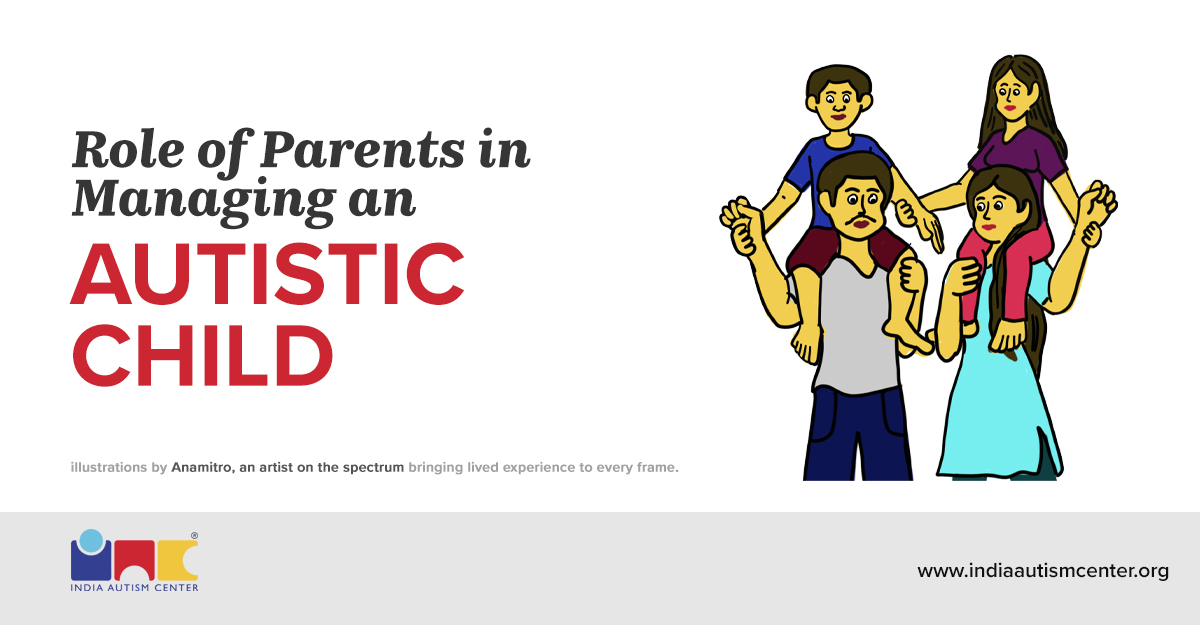
  • The Crucial Role of Parents in Managing an Autistic Child

    The Crucial Role of Parents in Managing an Autistic Child

    Managing autism in a child is one of the most important journeys a parent will ever take. When we talk about the role of parents in managing an autistic child, we’re talking about more than routines and therapies. We’re talking about love, learning, patience, and continuous support.

    Autism spectrum disorder (ASD) affects children differently, and as a parent or caregiver, you are central to your child’s growth, well-being, and future success.

    In this guide, I will share practical insights, educational information, and real-life tips to help you navigate parenting an autistic child with confidence. You’ll learn how to handle an autistic child, what works, what doesn’t, and how your role makes a lasting impact on your child’s life.

    Understanding Autism and Why Parents Matter

    Autism spectrum disorder is a complex neurological condition, often presenting challenges in communication, social interaction, and behavior. No two autistic children are the same — every child has unique strengths and challenges. Parents are usually among the first to notice early signs of autism. That means parents are also the first responders in seeking help and support.

    Your role extends far beyond caregiving. You become:

    • An advocate
    • A teacher
    • A therapist at home
    • And the most important emotional anchor in your child’s life

    And here’s what you can do

    1. Early Intervention: Research from the National Institutes of Health (NIH) has consistently highlighted the significance of early intervention in improving the outcomes of autistic children.

    Parents, being the first to notice developmental differences, play a crucial role in seeking timely intervention. Early diagnosis and intervention, often involving therapies tailored to the child’s unique needs, can lead to substantial improvements in communication skills, behaviour management, and social interactions.

    Here is a comprehensive guide on Early Intervention for Autism: A Parent’s Guide to Better Outcomes.

    2. Individualised Support: No two autistic children are alike, and parents are the ones who best understand their child’s strengths, challenges, and triggers. This insight enables parents to collaborate effectively with healthcare professionals and educators to create individualised support plans. The active participation of parents in crafting these plans ensures that the child’s specific needs are met comprehensively.

    3. Daily Life Skills: Autistic children often require targeted assistance in acquiring daily life skills that neurotypical children may grasp more naturally. Parents are instrumental in teaching essential life skills, ranging from personal hygiene routines to basic communication techniques. Also, don’t forget Social Skills, which is a very common challenge faced by children on the spectrum. This involvement fosters the child’s independence and self-confidence, setting the stage for greater autonomy in adulthood.

    Want to know more? Get in touch with us.

    Challenges Faced by Parents 

    Parenting an autistic child can be emotionally and physically demanding. The relentless effort required to provide optimal care, along with potential financial strains from therapy and medical expenses, can take a toll on parental well-being. At India Autism Centre, we are dedicated to autism advocacy, and thus, we recognise the importance of offering parents a support network and resources to navigate these challenges.

    Empowering Parents Through Requisite Knowledge

    Education is an empowering tool for parents of autistic children. Being well-informed about autism spectrum disorder equips parents to make informed decisions, advocate for their child’s needs, and collaborate effectively with professionals. Workshops, webinars, and information-sharing sessions offered by dedicated social organisations serve to enhance parental knowledge and confidence in managing their child’s autism.

    Promoting Emotional Well-being

    The emotional well-being of parents directly influences the support they provide to their autistic children. We emphasise the significance of self-care for parents, encouraging them to seek respite and emotional support when needed. Engaging in peer support groups and counselling sessions can alleviate stress and foster a more resilient caregiving environment.

    Role of Parents in Managing an Autistic Child

    Parental involvement in autism management not only benefits the child in the present but also lays the foundation for the child’s future. As autistic children grow into autistic adults, they require continued guidance and support from their parents. Equipped with an understanding of their child’s unique strengths, parents can play a vital role in fostering the independence and social integration of autistic adults.

    Personalized Support: Know Your Child Best

    One of the central pillars of parenting an autistic child is understanding your child’s strengths, struggles, and triggers. This knowledge is the foundation for creating a supportive environment at home and beyond. No professional can know your child as you do.

    Here’s what personalized support looks like:

    • Tailor routines to your child’s comfort
    • Use visual schedules or cue cards to prepare them for transitions
    • Modify sensory experiences (noise levels, lighting, textures) based on your child’s preferences

    Such personalization allows your child to feel secure and supported emotionally.

    Building Daily Life Skills

    As a parent, you play a direct role in helping your child build daily living skills — such as feeding, dressing, hygiene, and simple communication. These skills boost independence and self-confidence.

    Simple strategies you can use at home include:

    • Breaking routines into small, manageable steps
    • Using visuals and timers for transitions
    • Celebrating progress, no matter how small

    This kind of hands-on autism management teaches practical life skills while strengthening your bond.

    Want to know more? Get in touch with us.

    Positive Reinforcement: Focus on What Works

    Positive reinforcement is one of the most effective strategies in Tips for Parenting A Child With Autism. It means you praise your child when they show good behavior or achieve a small goal, encouraging them to repeat that behavior. Let’s break this down:

    • Use praise, stickers, favourite activities, or small rewards
    • Notice every improvement — not just perfection
    • Avoid punishment — it often causes confusion or anxiety in autistic children

    This method builds confidence and sets a positive tone for learning and behavior management.

    What Not To Do as a Parent of an Autistic Child

    Equally important in parenting an autistic child is understanding what not to do. Avoiding certain responses can prevent stress and conflict.

    • Avoid sudden changes in routine — these can cause anxiety
    • Do not compare your child to neurotypical peers
    • Don’t ignore your child’s sensory needs (e.g., noisy environments)
    • Avoid traditional punishments — these often confuse rather than teach

    Understanding these “don’ts” is just as valuable as knowing the dos. They help you keep your environment calm, predictable, and supportive.

    Practical Tips You Can Use Today

    Here are quick, actionable tips for daily life:

    • Keep things simple and predictable
    • Praise progress often
    • Use visuals and schedules
    • Watch and respond to non-verbal cues
    • Create sensory-friendly spaces at home
    • Spend quality one-on-one time daily

    Conclusion

    The role of parents in managing an autistic child cannot be overstated. From early intervention to advocating for their child’s needs, parents are the driving force behind their child’s growth and development. 

    At India Autism Centre, we acknowledge and celebrate the dedication of parents in this journey. By offering resources, education, and a supportive community, we aim to empower parents to provide the best possible care for their autistic children, ensuring a brighter future for both the child and their family.

    Some of our crucial initiatives for helping autistic individuals include:

    • Offering a full-time supported and safe residential ecosystem 
    • Family housing and daytime support facilities
    • A fully equipped and scalable digital platform enabling enhanced speed of service and product delivery
    • Imparting autism management training to create a global, accessible, and scalable workforce of professionals

    Frequently Asked Questions(FAQs)

    What is the role of parents in managing an autistic child?

    The role of parents in managing an autistic child includes providing emotional support, maintaining daily routines, encouraging communication, and collaborating with therapists and educators. Parents help create a safe, structured environment that supports learning, behavior, and overall autism management.

    How can parents handle an autistic child at home?

    To handle an autistic child at home, parents should follow consistent routines, use clear and simple language, offer visual cues, and practice positive reinforcement. Understanding sensory sensitivities and responding calmly to challenging behaviors also plays a key role.

    What are the best tips for parenting a child with autism?

    Some effective tips for parenting a child with autism include being patient, focusing on strengths, using visual schedules, celebrating small achievements, and maintaining open communication. Seeking professional guidance and parent support groups also helps in long-term autism management.

    What should parents avoid when raising an autistic child?

    Parents should avoid sudden changes in routine, harsh discipline, comparisons with other children, and ignoring sensory or emotional needs. Understanding what not to do as a parent of an autistic child helps reduce anxiety and builds trust and emotional security.

    How does parenting an autistic child help in autism management?

    Parenting an autistic child plays a crucial role in autism management by reinforcing therapy goals at home, supporting emotional regulation, and helping the child develop daily living and social skills through consistent care and guidance.

    Can parents support an autistic child without professional therapy?

    Parents can support their autistic child through structured routines, communication strategies, and home-based activities. However, professional therapies and guidance from specialised autism centres significantly enhance outcomes and provide parents with the right tools and direction.

  • What is ABA Therapy for Autism Spectrum Disorder? A Complete Guide

    What is ABA Therapy for Autism Spectrum Disorder? A Complete Guide

    Is your child on the spectrum and is struggling to communicate? Are they finding it difficult to regulate their emotions, or are they having challenges with everyday tasks? These things not only affect the child but also the parent. 

    If you are a parent who is searching for support for a child with autism spectrum disorder, then you should opt for applied behaviour analysis or ABA therapy. ABA can be a powerful tool for providing your child with much-needed support. In this article, we are going to explain what ABA therapy is, how it can help children on the spectrum, and why it is a gold-standard intervention technique for autism.

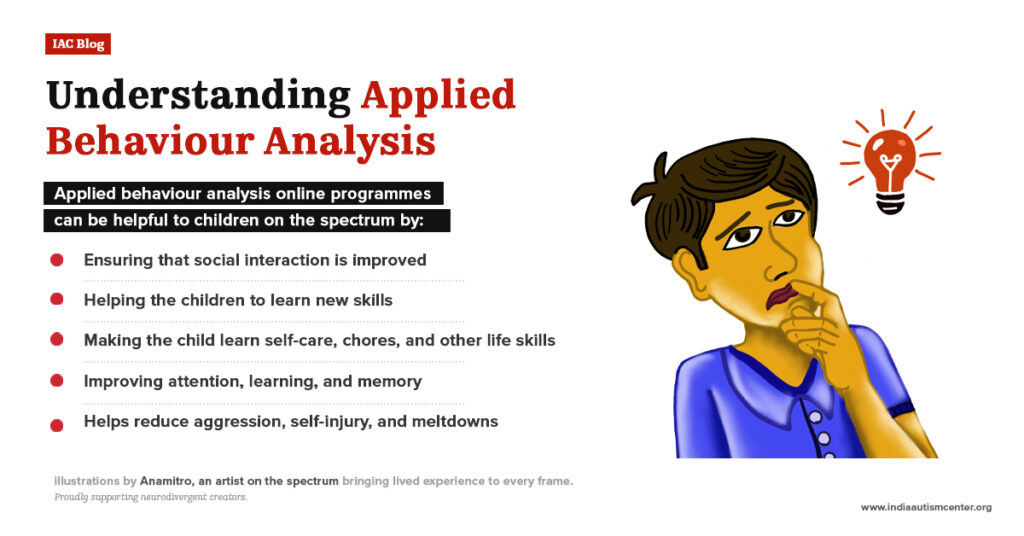
    Understanding Applied Behaviour Analysis 

    Understanding applied behaviour analysis and how ABA therapy improves social skills, learning, and daily life skills

    ABA therapy is the study of how behaviour works in real-life situations. It is a gentle, ethical, and effective approach that can help a person on the spectrum function independently. 

    ABA therapy works on the principle that children learn different behaviours, and since they learn them over time, it is possible to alter or strengthen them in positive ways. It is more of a guided-learning approach grounded in applied behaviour analysis. 

    It is important to understand that a child on the spectrum is not misbehaving; they are trying to communicate. ABA is a science-backed approach that helps decode what the child is trying to communicate and teaches a clear, safe, and more functional alternative. 

    Applied behaviour analysis online programmes can be helpful to children on the spectrum by:

    • Improving social interaction.
    • Helping the children to learn new skills.
    • Making the child learn self-care, chores, and other life skills.
    • Improving attention, learning, and memory.
    • Helps reduce aggression, self-injury, and meltdowns.

    How Applied Behaviour Analysis Therapy Works?

    Step-by-step explanation of how applied behaviour analysis therapy works, from assessment to skill generalisation

    It is easier to understand applied behaviour analysis therapy once you see how it works. Applied behaviour analysis training is not a single technique or a fixed routine. It is a structured yet very flexible process that works. Careful observation, data, and a collaboration between therapists and parents guide it. 

    The primary focus is to help the individual learn meaningful skills that improve daily life. It helps reduce behaviours that often lead to frustration, distress, or limited independence. Let us understand how ABA therapy actually works step by step:

    Step 1: Getting to Know the Individual

    The first step is to understand the person, not just their behaviour. Before beginning teaching, a qualified professional (usually a Board Certified Behaviour Analyst) observes the child in their natural setting, such as home or school. 

    The professional also speaks to the parent or caregiver to understand the concerns. They also review the developmental history, routines and daily challenges. All these things ensure that applied behaviour analysis therapy works around the children’s real lives, not just based on labels or assumptions.

    Step 2: Functional Behaviour Assessment (FBA).

    The next step is to identify why a certain behaviour occurs. A functional behaviour assessment looks at different aspects, such as:

    • What triggers a certain behaviour in the child?
    • What does the behaviour look like in clear and observable terms?
    • What happens immediately after the behaviour?

    By understanding such patterns, it is easier to apply behaviour-analytic interventions that help address the course of behaviour.

    Step 3: Designing an ABA Therapy Plan.

    After the assessment is complete, the professionals create a personal therapy plan. This therapy plan is like a roadmap for better learning and processing. The ABA therapy plan outlines:

    • The skills that the child needs to learn include communication, social skills, independence, and emotional regulation.
    • Reduction or replacement of specific behaviours if needed.
    • The teaching approach that suits the learner’s capabilities and style.
    • On what basis will progress be measured and reviewed?

    To bring great results, every goal in applied behaviour analysis therapy needs to be specific, realistic, and meaningful.

    Step 4: Structures and Natural Methods to Teach

    This is the most visible part of the ABA therapy. It is where the learning happens day by day. Based on the child’s needs, the professionals create strategies. Some of the most common strategies include:

    • Positive Reinforcement: When the child displays a helpful behaviour, rewarding it encourages them. It can be praise, access to a favourite activity, or a favourite toy. This helps motivate the child to continue learning without pressure. 
    • Prompting and Fading: At first, they offer the child support to succeed. Then gradually reduce the support so they are more independent when doing a task. 
    • Task Analysis: Even everyday tasks, such as getting dressed or brushing their teeth, are further broken into smaller steps. Since the steps become more manageable, they feel less overwhelming.
    • Natural Environment Teaching (NET): Children learn skills through everyday activities, making learning feel relevant and practical.

    Step 5: Data Collection

    One key defining feature of applied behaviour analysis online training programmes is that progress is always measured. In every session, the therapist collects different data, such as:

    • How often does the behaviour occur?
    • How often does the child on the spectrum need support?
    • How independently is a skill performed?
    • How consistent is the progress?

    Collecting different data helps professionals identify areas that need support, understand which approach is working, and adjust strategies to ensure approaches remain effective and individualised. 

    Support is always evidence-based, which is a major reason parents often explore the question, “What is ABA therapy?” 

    Step 6: Generalising Skills Across Settings

    For optimum results, it is important to learn skills across various settings. A key goal of applied behaviour analysis therapy is generality. It ensures that skills and learning remain consistent at home, school, and even in community settings. 

    Example: When the child learns to ask for help during applied behaviour analysis therapy sessions, it supports them in using the same skill with parents, teachers, and friends. It ensures that progress is visible and leads to real-world independence.

    Step 7: Involving Parents 

    It is important to note that parents and caregivers can play an essential role in the success of ABA therapy. Therefore, applied behaviour analysis online programmes often include:

    • Parent coaching sessions
    • Guidance in reinforcing skills at home
    • Support with managing routines and transitions

    When parents get actively involved and trained, the collaboration will ensure consistency. It eventually supports skill development even after ABA therapy hours end, especially in applied behaviour analysis in home settings.

    Step 8: Reviewing and Adapting

    ABA therapy is not static. As the child grows, their needs change. Hence, the goals also need updating, the teaching approach is then open for alteration, and then making adjustments in support levels becomes easier. 

    This flexibility makes applied behaviour analysis equally effective for autism and ADHD across different life stages.

    Myths and Facts About ABA Therapy: Separating Assumptions from Reality

    Common myths and facts about ABA therapy, addressing misconceptions around intensity, emotions, and individualised care

    People often misunderstand Applied Behaviour Analysis, and there is also not much discussion about it. When parents hear about ABA therapy or an applied behaviour analysis online training programme, it is usually via social media or second-hand opinions; the data and descriptions are often outdated, or they cannot reflect how professionals practise modern applied behaviour analysis for ADHD. 

    However, for parents to make an informed decision, they must move past assumptions and examine what ABA therapy is today. So here we are, breaking down the most common assumptions and myths. 

    Myth 1: ABA therapy is too intense

    Fact: The techniques and strategies used in applied behaviour analysis therapy are not based on a fixed formula. 

    In fact, they are as per the child’s needs. Some children see improvement from more structured support, while others seem to thrive with fewer hours. Modern applied behaviour analysis therapy aims to adjust session length and frequency, and to incorporate play, movement, and breaks. 

    Also, the therapy respects when there are signs of stress or fatigue. Thus, ABA therapy feels supportive and not exhausting. 

    Myth 2: ABA is only for autism

    Fact: While applied behaviour analysis autism support is the most well-known application, ABA is not limited to autism. ABA therapy is also beneficial for other conditions like ADHD, anxiety, trauma, or substance abuse recovery. 

    Applied behaviour analysis training is a framework for understanding behaviour, not a diagnosis-specific treatment.

    Myth 3: ABA is the same for every child

    Fact: Applied behaviour analysis therapy uses an individualised approach. Not all applied behaviour analysis online programmes look the same. 

    It is important to know that ethical ABA therapy is as follows:

    • The child’s strengths and interests
    • Family values and cultural context
    • Real-life priorities, not generic checklists

    ABA therapy focuses on having personalised plans for daily living, social skills, and communication.

    Myth 4: ABA ignores emotions

    Fact: Applied behaviour analysis programmes do not ignore emotion; they work around it. 

    Applied behaviour analysis at home or the training centre focuses on observable behaviour because it is measurable and also changeable. Although ethical applied analysis therapy recognises the behaviour and the emotions behind it, such as anxiety, frustration or overwhelm. 

    So, instead of labelling emotions, ABA works to reduce situations that cause distress, teaches coping and regulation skills, and increases a child’s ability to communicate their emotions. 

    Myth 5: ABA is forcing a child to behave “normally:

    Fact: Modern and improved applied behaviour analysis therapy and programmes are not about forcing a child to mask who they are. 

    Who can benefit from ABA? What Does Research Say?

    ABA therapy is not just for a single group or condition. It is, in fact, a flexible, research-backed method that allows the child to learn meaningful skills and reduce behaviours that get in the way of daily life.

    Here’s a closer look at who it helps, and what the science says.

    For Children and Adults with Autism

    Applied behaviour analysis training is most widely used to support individuals with Autism Spectrum Disorder. It helps to build essential life skills, such as communication, social interaction, and independent living. 

    ABA therapy teaches these skills in structured but natural ways that fit into real-life scenarios. As Lovaas (1987) found, “early and intensive behavioural intervention leads to significant improvements in language, learning, and adaptive behaviour.” 

    You would like to focus on the skills taught in a structured yet natural way. They fit well into real-life scenarios. 

    For Individuals with Intellectual and Developmental Disabilities

    ABA is effective for people with intellectual disabilities or global developmental delays. Since it is structured and individualised, it allows therapists to work on practical skills while respecting each person’s pace and strengths. 

    Research shows that applied behaviour analysis can lead to meaningful improvements in social interaction and communication, making daily life more manageable and enriching.

    For Teenagers, Adults, and Older Individuals Across Settings

    Applied behaviour analysis interventions are not limited to young children. It can also support people at all stages of life, whether it’s helping a teenager navigate social situations, an adult improve work-related behaviours, or an older individual maintain independence. 

    The techniques used adapt well to different environments, including homes, schools, workplaces, and community programs, making it a lifelong support option.

    What to Consider Before Starting ABA Therapy?

    What to consider before starting ABA therapy for autism, including assessment, goals, progress tracking, and family involvement

    ABA therapy or applied behavioural science can be a powerful support. Getting started means knowing what to expect, asking thoughtful questions, and finding the approach that truly fits your needs.

    The debate around Applied Behaviour Analysis continues to evolve. Critics have questioned whether it pressures autistic individuals to suppress who they are. But many families today describe a shift. ABA therapy, or applied behavioural science, focuses on building independence without changing a person’s core identity.

    Parents like Stephanie Kenniburg share a different take on the ABA debate. She says, “ABA hasn’t tried to erase my son’s autism; it is about helping him thrive with the brain he has.” For Stephanie, applied behaviour analysis ASD is not about making her child ‘fit in’ by losing who he is; it is about giving him the tools to navigate the world on his own terms.

    Here is what to look for before you begin:

    • Make sure the team includes certified BCBAs and RBTs who possess training in ethical, effective practice.
    • Understand the assessment. The first assessment sets the direction. It helps tailor therapy to your child’s specific needs.
    • Find out the process of goal monitoring and what happens if things don’t work as planned, as data matters in applied behaviour analysis for autism.
    • Always clarify the goals. Good therapy focuses on what’s most important right now, not everything at once.
    • Know the techniques. Different children need different strategies. Ask about the method and how they fit your child.
    • Families play a big role in autism spectrum disorder ABA therapy. You will probably be part of the process, not just watching from the sidelines, so get involved.
    • Some programs need 20–40 hours a week. Make sure it works with your routine.
    • Look into the costs. Ask about fees, insurance coverage, and what’s included in the plan.
    • Therapy shouldn’t end when the session does. Check how skills can be useful in daily life.
    • Make sure it is flexible. Therapy should adapt to your child, not the other way around.

    Conclusion

    What to consider before starting ABA therapy for autism, including assessment, goals, progress tracking, and family involvement

    Now you see that the applied behaviour analysis definition is more than just a therapy; it is a way to understand behaviour and make meaningful changes. It is about observing, learning, and building skills that lead to a more independent and, more importantly, a fulfilling life. 

    Whether it is improving communication, reducing challenging behaviours, or helping someone grow, applied behaviour analysis for adults or children is not age-specific. If you are considering applied behaviour analysis programmes, remember that it is all about what fits the person. Get clear on your goals, stay involved, and trust that with the right approach, change is within reach.

    Frequently Asked Questions

    What is applied behaviour analysis (ABA)?

    Applied behaviour analysis, or ABA therapy for ASD, is a science-based, research-informed approach that studies how behaviour is learned and how it can be positively shaped. It primarily focuses on understanding why certain types of behaviour occur and on developing practical skills that improve communication, independence, and daily functioning.

    How does autism spectrum disorder ABA therapy help children?

    Autism spectrum disorder ABA therapy helps children build communication, social, emotional, and daily living skills. It reduces frustration by teaching children clearer ways to express needs and cope with changes in routine.

    What is the difference between ABA and other behavioural therapies?

    Unlike many therapies, applied behaviour analysis therapy is highly data-driven. Progress is measured continuously, and strategies are adjusted based on evidence, ensuring therapy remains personalised and effective.

    What are the 7 dimensions of applied behaviour analysis?

    The 7 dimensions of applied behaviour analysis are: applied, behavioural, analytic, technological, conceptually systematic, effective, and generality. Together, they ensure ABA is meaningful, measurable, and transferable to real life.

    What does an applied behaviour analysis technician do?

    An applied behaviour analysis technician works directly with the child or adult who is on the spectrum, delivering therapy sessions under supervision. They help practise skills, record progress, and maintain consistency across sessions.

    Can applied behaviour analysis help adults?

    Yes. Applied behaviour analysis for adults supports workplace behaviour, independence, social communication, and emotional regulation. Goals are self-directed and respect adult autonomy.

    For expert insights, support services, and inclusive learning initiatives, visit the India Autism Center.

  • Home-based Treatment vs. Specialised Autism Center: Which is Best for Your Child?

    Home-based Treatment vs. Specialised Autism Center: Which is Best for Your Child?

    When your child is diagnosed with autism spectrum disorder (ASD), one of the first questions that comes to mind is: Which will be better, home-based treatment vs. specialised autism center?

    This decision shapes your child’s daily routine, learning environment, and long-term development. Therefore, it is vital to understand the real differences between the two options.

    In this guide, we explore the difference between home-based treatment and specialised autism center in detail. We compare learning settings, therapy effectiveness, and family involvement.

    Understanding Autism Therapy Options

    Autism therapy focuses on improving communication, behaviour, independence, and social interaction. The most common approach is Applied Behaviour Analysis (ABA). However, ABA can be delivered in two main ways:

    1. Home-based therapy

    2. Centre-based therapy

    This leads to a frequent debate: Home-based treatment vs. Specialised Autism Center.

    There is no universal answer. Every child is unique. However, understanding the strengths and limitations of each model helps you choose wisely.

    What Is Home-Based Autism Therapy?

    Home-based therapy means that trained therapists visit your home and work with your child in familiar surroundings.

    Key Benefits of Home-Based Therapy

    • Your child stays in a familiar environment
    • Therapy fits naturally into daily routines
    • Parents participate directly
    • Skills transfer easily to real-life situations

    Limitations of Home-Based Therapy

    However, home therapy also has challenges:

    • Fewer chances for peer interaction
    • Limited access to specialised equipment
    • Distractions at home can reduce focus
    • Progress depends heavily on parent involvement

    So, while home therapy feels comfortable, it may not offer enough structure for all children.

    Want to know more? Get in touch with us.

    What Is a Specialised Autism Center?

    A specialised autism centre provides structured therapy in a professional environment designed specifically for autistic learners.

    Advantages of Centre-Based Therapy

    • Multi-disciplinary professionals in one place
    • Peer interaction builds social skills
    • A consistent routine improves behaviour
    • Advanced tools and therapy rooms
    • Strong monitoring and data tracking

    Challenges of Centre-Based Therapy

    However, centre-based care also has drawbacks:

    • Travel time can be tiring
    • Children may take time to adjust
    • Less spontaneous family involvement
    • Fixed schedules may limit flexibility

    So, when comparing Differences Between Center-Based and Home ABA, we see trade-offs rather than winners.

    Home-Based Treatment vs. Specialised Autism Center: A Direct Comparison

    AspectHome-Based TreatmentSpecialised Autism Center
    Learning EnvironmentTherapy takes place in a familiar home setting, which feels safe and comfortable for the child.Therapy happens in a structured, controlled environment designed specifically for learning and behaviour management.
    Social InteractionInteraction is mainly with parents and therapists, so peer exposure is limited.Children interact with other autistic peers daily, which supports social skill development.
    Parent InvolvementParents take an active role in therapy sessions and daily skill practice.Parents are involved through reviews and guidance, but not usually present during sessions.
    Routine and StructureDaily routine is flexible and depends on family schedules.Sessions follow a fixed timetable, which builds consistency and discipline.
    Therapy IntensityUsually fewer structured therapy hours per day.Offers longer and more intensive therapy programmes.
    Resources and EquipmentLimited to what is available at home.Access to specialised tools, therapy rooms, and learning aids.
    Skill GeneralisationSkills are practised directly in real-life home situations.Skills are first learnt in therapy rooms and then transferred to home settings.
    Distraction LevelMore distractions from family members, TV, or household noise.Fewer distractions due to controlled and purpose-built spaces.
    Best Suited ForYounger children, children with high anxiety, or families who can participate actively.Children who need structured learning, social exposure, and multi-disciplinary support.

    Want to know more? Get in touch with us.

    Role of India Autism Center

    At India Autism Center (IAC), we understand that every child has different needs. Therefore, we do not promote a one-size-fits-all model.

    Instead, we offer:

    • Evidence-based therapy
    • Individualised treatment plans
    • Professional therapists and educators
    • Family counselling and training
    • Structured centre-based programmes
    • Support for home-based continuity

    We evaluate your child first. Then, we recommend the most suitable model.

    When Home-Based Treatment Works Best

    Home-based therapy works well when:

    • The child is very young
    • The child struggles with new environments
    • Parents can actively participate
    • Travel is difficult
    • Therapy focuses on daily living skills

    If you want an in-depth guide on autism therapies at home, you can read this blog.

    When Centre-Based Therapy Works Best

    Centre-based therapy works best when:

    • The child needs social exposure
    • Behaviour issues require structured control
    • Speech and occupational therapy are needed
    • Consistency is crucial
    • Multiple professionals are required

    Choosing Home-Based or Centre-Based ABA Therapy

    Choosing between the two options requires honest reflection. Ask yourself:

    • Does my child enjoy social interaction?
    • Can I participate daily?
    • Does my child need structured learning?
    • Is travelling manageable?
    • What are my child’s sensory needs?

    These answers will guide you to make a more suitable decision.

    Why Families Trust IAC

    India Autism Center stands out because we:

    • Use global best practices
    • Focus on dignity and inclusion
    • Offer holistic development
    • Train parents alongside children
    • Support long-term independence

    We do not just provide therapy. We build learning ecosystems.

    Want to know more? Get in touch with us.

    Conclusion

    The debate around Home-based treatment vs. Specialised Autism Center will continue. However, informed parents make confident decisions.

    Home therapy offers familiarity and flexibility. Centre therapy offers structure and social exposure.

    At India Autism Center, our goal is simple: To help every child reach their fullest potential.

    If you are unsure about choosing Home-based vs. Center-based therapy, professional guidance can make all the difference.

    Frequently Asked Questions (FAQs)

    What is the difference between home-based treatment and a specialised autism center?

    Home-based treatment happens in the child’s home with parent involvement, while a specialised autism center offers structured therapy, peer interaction, and professional facilities.

    Is home-based ABA therapy better than centre-based ABA therapy?

    Home-based ABA therapy is helpful for comfort and daily life skills, but center-based ABA therapy provides stronger structure and social learning. The best choice depends on your child’s needs.

    How do I choose between home-based and center-based ABA therapy?

    Choosing home-based vs. center-based ABA therapy depends on your child’s age, behaviour, sensory needs, family involvement, and access to specialised services.

    Can home-based and center-based ABA therapy be combined?

    Yes. Many families use a blended approach where skills are taught at a specialised autism center and practised through home-based therapy for better long-term outcomes.

    For expert insights, support services, and inclusive learning initiatives, visit the India Autism Center.

  • List of Several Government Schemes for Disabled Persons in India (2026)

    List of Several Government Schemes for Disabled Persons in India (2026)

    As per the latest records, there are more than 2.68 crore disabled persons. Even when the number is so huge, awareness of available support remains significantly low. It has also been found that over 42% of eligible persons with disabilities do not apply for government benefits simply because they are unaware of the schemes.

    These facts make one thing for sure: The families of disabled persons are not always lacking support; they are, in reality, lacking access to information.

    Whether you’re a caregiver of a child with autism, someone with a locomotor disability, or an adult seeking financial independence, this guide ensures that you not only know the schemes but also fully understand how they can improve your daily life.

    Today, we will provide a detailed, up-to-date list of government schemes for persons with disabilities in India.

    The Complete List of Government Schemes for Disabled Persons in India (2026)

    Complete list of government schemes for disabled persons in India 2025 with benefits and eligibility

    Finding the right support for disability can be quite overwhelming. Several disabled persons and their families are missing out on available government support. This updated list of government schemes for persons with disabilities in India (2026) brings together all major welfare initiatives. 

    Especially when you are the parent or a primary caregiver of a kid who has autism spectrum disorder, an adult with a disability, or a caregiver who is looking for proper guidance, this guide simplifies the landscape so you can finally understand and claim the support you deserve.

    1. NIRAMAYA Health Insurance Scheme – Healthcare Safety Net

    Niramaya health insurance scheme covering OPD, hospitalisation, medicines, and therapies for disabled persons

    When it comes to support for people with disabilities, health insurance is more than just an option; it is a necessity, a health insurance scheme exclusively for PwDs that provides coverage for a wide variety of medical needs.

    There is no need for pre-insurance medical tests. Irrespective of age or disability type, there is only one time premium. This ensures that medical emergencies don’t become financial disasters.

    What the Scheme Covers:

    • OPD and hospitalisation expenses
    • Medicines, check-ups, dental care, surgeries
    • Therapies (physiotherapy, occupational therapy, etc.)
    • Transportation costs associated with care or treatment

    Who Can Apply:

    Persons with disabilities (autism, cerebral palsy, intellectual disability, multiple disabilities) with a valid disability certificate and UDID/enrollment number.

    2. VIKAAS Daycare Scheme – Daytime Care, Therapy & Skill Building

    VIKAAS daycare scheme for therapy, skill development, and structured learning for persons with disabilities

    Besides early intervention, children with disabilities can benefit from schemes like day care. There are daycare centres run by certified organisations that aim to provide therapy, education, and social & life-skills training during daytime hours.

    For families seeking assistance for disabled persons while balancing other responsibilities, VIKAAS ensures children get needed support without needing full-time institutionalisation.

    What the Scheme Covers:

    • Special educators and therapy support
    • Physiotherapy / occupational therapy for mobility or daily-living support
    • Counselling & skill-building to improve communication, daily living, and social skills
    • Structured environment for growth and learning during the day hours
    • Gives family members respite while ensuring the child’s growth and learning

    Who Can Apply:

    Children/young persons (10+ years), with autism, cerebral palsy, intellectual disability, or multiple disabilities. The applicant mustn’t already be enrolled in other residential schemes such as GHARAUNDA or SAMARTH.

    3. GHARAUNDA (Group-Home for Adults) – Long-Term Care & Support

    Gharaunda group-home scheme for adults with disabilities providing long-term residential care and therapy

    GHARAUNDA is a scheme that provides a safe, lifelong group home for adults with disabilities under the umbrella of the relevant national disability legislation.

    It is one of the most stable government facilities for disabled persons, ensuring long-term inclusion, dignity, and independence for adults who may not be able to live independently.

    What the Scheme Covers:

    • Secure residential home providing 24/7 care. 
    • Access to medical care, therapy, physiotherapy/occupational therapy.
    • Special educators, vocational/pre-vocational training for skill development. 
    • A structured, supportive environment that helps people build daily living and vocational skills, social interaction, and meaningful routine.

    Who Can Apply:

    Adults (18+ years) with disabilities such as autism, cerebral palsy, intellectual disability, including intellectual retardation, or multiple disabilities.

    4. SAMARTH Respite & Residential Care – Temporary Shelter and Support

    Samarth respite and residential care scheme offering temporary shelter and medical support for persons with disabilities

    SAMARTH aims to offer residential or respite care and assistance for disabled persons; it is particularly helpful for orphans, abandoned persons, PwDs from low-income backgrounds, or families in crisis. It serves as a critical government facility for people with disabilities, offering meaningful respite, especially when family support is absent or temporary relief is needed.

    What the Scheme Covers:

    • Group-home style living with basic medical care
    • Support from special educators, vocational trainers, therapists (physio / occupational) to improve physical functionality and daily-living skills 
    • Periodic assessments can help to monitor progress and offer tailored support plans
    • Safe, caring environment for those needing temporary or long-term residential support 

    Who Can Apply:

    Persons with autism, cerebral palsy, or other disabilities, as per the relevant disability act, especially those not under other long-term or daycare schemes for disabled people in India, such as Disha, Vikaas, or Gharaunda scheme, are at the same time.

    5. Deendayal Disabled Rehabilitation Scheme (DDRS) – Rehabilitation & Inclusion Funding

    Deendayal Disabled Rehabilitation Scheme DDRS for rehabilitation, therapy, and inclusion funding in India

    This is a flagship centrally sponsored program that aims to support NGOs/voluntary organisations that work for PwDs. DDRS helps build infrastructure and services for rehabilitation and inclusion through financial grants and other forms of aid.

    By funding grassroots organisations, DDRS strengthens the network of government facilities for people with disabilities across the country, thereby increasing reach, quality, and sustainability.

    What the Scheme Covers:

    • Establishment and maintenance of special schools, vocational training centres
    • Early intervention centres for children with developmental delays
    • Infrastructure improvements (ramps, toilets, and other accessible facilities) are made in disability-support institutions.
    • Rehabilitation services: therapy, counselling, skill training, inclusion programmes
    • Community-based rehabilitation and inclusive social initiatives

    Who Can Apply:

    NGOs must be registered under the PwD Act/Trusts Act/Societies Act and must have at least 2 years of experience delivering disability-related services. They must also meet the government’s infrastructure, staff, and service-quality standards to receive funding.

    6. SAHYOGI Care-Associate Training Scheme – Skilled Caregiver Training

    Sahyogi care-associate training scheme for skilled caregiver training and professional support services

    A training scheme that builds a network of trained caregivers (care associates) across India to support PwDs and their families. By enhancing the availability and quality of care, this scheme for disabled people in India significantly enhances day-to-day support, enabling PwDs to lead more independent, dignified lives, and reduces the burden on families.

    What the Scheme Covers:

    • Basic (3-month) and advanced (6-month) courses covering first-aid, basic care, communication skills, special needs support (for autism, CP, etc.)
    • Paid internships/placements, enabling livelihood opportunities while meeting demand for caregiving professionals
    • Empowers families by offering professional-grade care support, especially beneficial when managing severe disabilities

    Who Can Apply:

    People aged roughly 18 to 35 years, with a minimum of 8th-grade education, who wish to become care associates. Also aimed at parents/guardians seeking training.

    7. Indira Gandhi National Disability Pension Scheme (NSAP) – Financial Support for Vulnerable Adults

    Indira Gandhi National Disability Pension Scheme NSAP providing monthly financial support to disabled adults

    A pension scheme offering monthly financial aid to adults (18–79 years) with severe disabilities (≥ 80%) and living below the poverty line (BPL), helping them meet basic needs. 

    This is a foundational social security net, a core example of how the Indian state provides assistance for disabled persons who are economically marginalised, allowing them dignity and basic financial support.

    What the Scheme Covers:

    • Monthly pension (for example, ₹300 for eligible adults). The amount may be higher for those aged 80 or older.
    • Basic financial security for those unable to work due to disability

    Who Can Apply: 

    • The applicant must be a person with a severe or multiple disability (typically 80% or above), and belong to a household under the Below Poverty Line (BPL) classification.
    • The eligible age group is 18 to 79 years (some state-specific norms may apply).

    8. Welfare Schemes for Persons with Disabilities – Allowances, Incentives, Scholarships & Travel Support

    Welfare schemes for persons with disabilities in India including allowances, scholarships, and travel support

    This is a government scheme in India for people with disabilities that offers multiple welfare benefits to improve financial security, social inclusion, and access to opportunities for PwDs.

    These schemes give real-world, everyday assistance for disabled persons, helping them lead a dignified life with social participation, mobility, education, and financial stability.

    What the Scheme Covers: 

    • A one-time amount (for example, ₹30,000) to support disabled persons upon marriage, acknowledging their right to a dignified social life.
    • A monthly maintenance grant is provided (e.g., ₹1,500) for individuals with certain disabilities that can help them with everyday needs.
    • An annual scholarship (₹3,000–₹8,000 or more) for disabled students ensures continuity in education.
    • Free or subsidised public transport for PwDs holding a valid disability certificate improves mobility and access.
    • For unemployed persons with disability (meeting certain criteria), a small stipend (e.g., ₹400–₹1,000/month) is offered to support basic needs while they seek work or training.

    Who Can Apply: 

    Applicants need to have a disability certificate. For unemployment allowance, the applicant must be aged 18 to 48, registered as unemployed, and have a 10th-grade education. 

    9. ADIP Scheme (Full Form – Assistance to Disabled Persons for Purchase/Fitting of Aids & Appliances) – Assistive Devices & Mobility Support

    ADIP scheme providing assistive devices, wheelchairs, hearing aids, and mobility support for disabled persons in India  If you want, I can also optimize all alt texts for PageSpeed + accessibility best practices in one clean list.  You said:
meta desc for blog of these images
ChatGPT said:  Here’s a clean SEO meta description (under 160 characters) for the blog covering these images and schemes:  Explore the complete list of government schemes for disabled persons in India 2025, including health insurance, pensions, rehabilitation, daycare, and support programmes.

    ADIP helps persons with disability acquire essential certified aids and appliances which can help in enhancing mobility, independence, communication, and daily living capabilities. For many PwDs, assistive devices are a gateway to independence. 

    ADIP brings those within reach, thereby reducing caregivers’ burden and increasing the person’s ability to lead a more self-reliant, active life.

    What the Scheme Covers: 

    • Wheelchairs, callipers, walking aids, orthopaedic devices
    • Hearing aids, assistive devices for speech/communication (very relevant for autism/intellectual disability)
    • Visual aids, prosthetics, mobility supports
    • Pre-aid surgeries or procedures when required for proper use of devices (e.g., orthopaedic)

    Who Can Apply:

    Indian citizens with at least 40% disability, certain income thresholds, and who have not received similar assistance in recent years. 

    10. BADHTE KADAM – Awareness, Inclusion & Community Sensitisation Programme

    Badhte Kadam programme for disability awareness, inclusion, and community sensitisation in India

    BADHTE KADAM is a scheme to promote social awareness, community interaction, and inclusion of PwDs. It is helping change attitudes, reduce stigma, and build inclusive societies.

    Access to government facilities for disabled persons is only part of the journey. For real social empowerment, public attitudes must shift. BADHTE KADAM works prominently for that, making inclusion part of the mainstream social fabric, and not just some policy documents.

    What the Scheme Covers:

    • Supports community sensitisation efforts through campaigns, workshops, and awareness drives
    • Encourages inclusive policies in local communities, schools, and workplaces
    • Spreads knowledge about disability rights, support schemes, and social inclusion

    Who Can Apply:

    Registered organisations (under the National Trust) working for persons with autism, cerebral palsy, intellectual disability, or multiple disabilities.

    Conclusion

    Conclusion on government schemes for persons with disabilities in India promoting inclusion and equal opportunities

    Disabled people need as much assistance as possible. Empowering persons with disabilities isn’t just a government responsibility; it’s a collective step that is taken toward a more inclusive India where everyone gets a fair opportunity. The government has a wide range of schemes in place offering financial aid, healthcare support, education benefits, and rehabilitation services. Every eligible individual can access opportunities to improve their quality of life.

    Being aware of and understanding the key details of these schemes for the disabled in India is the first step towards accessing their benefits. Encourage, apply, and help someone claim the support they deserve. India’s progress depends on inclusion, and inclusion begins with awareness.

    Frequently Asked Questions

    What are the major government schemes for disabled persons in India?

    There are several key disability welfare and government schemes that a person with disability can avail themselves of in India, including the Deendayal Disabled Rehabilitation Scheme (DDRS), the Indira Gandhi National Disability Pension Scheme (IGNDPS), the ADIP Scheme, Scholarships for Students with Disabilities, the UDID initiative, and Skill Development for PwDs. These schemes provide financial assistance, rehabilitation support, mobility aids, education grants, and livelihood opportunities.

    Who is eligible for government disability benefits in India?

    To be eligible, an individual must have a benchmark disability of 40% or more, possess a valid Disability Certificate/UDID card, and meet specific income, age, or category-based criteria depending on the scheme.

    What documents are required to apply for schemes for disabled persons in India?

    Common documents to apply for different government schemes for disabled persons include:

    • Disability Certificate or UDID
    • Aadhaar Card
    • Income Certificate
    • Age Proof
    • BPL Card (if applicable)
    • Bank account details
    • Passport-sized photographs

    What is the UDID card, and why is it mandatory?

    The UDID (Unique Disability ID) card creates a national registry of PwDs. It removes the need for multiple disability documents. It also ensures quick access to any scheme for the handicapped in India. With UDID, beneficiaries can apply for pensions, aids, transportation concessions, and education benefits seamlessly.

    For expert insights, support services, and inclusive learning initiatives, visit the India Autism Center.

Privacy Overview

This website uses cookies so that we can provide you with the best user experience possible. Cookie information is stored in your browser and performs functions such as recognising you when you return to our website and helping our team to understand which sections of the website you find most interesting and useful.