Author: accesses@vryse.co

  • Deendayal Disabled Rehabilitation Scheme (DDRS): Details 2026

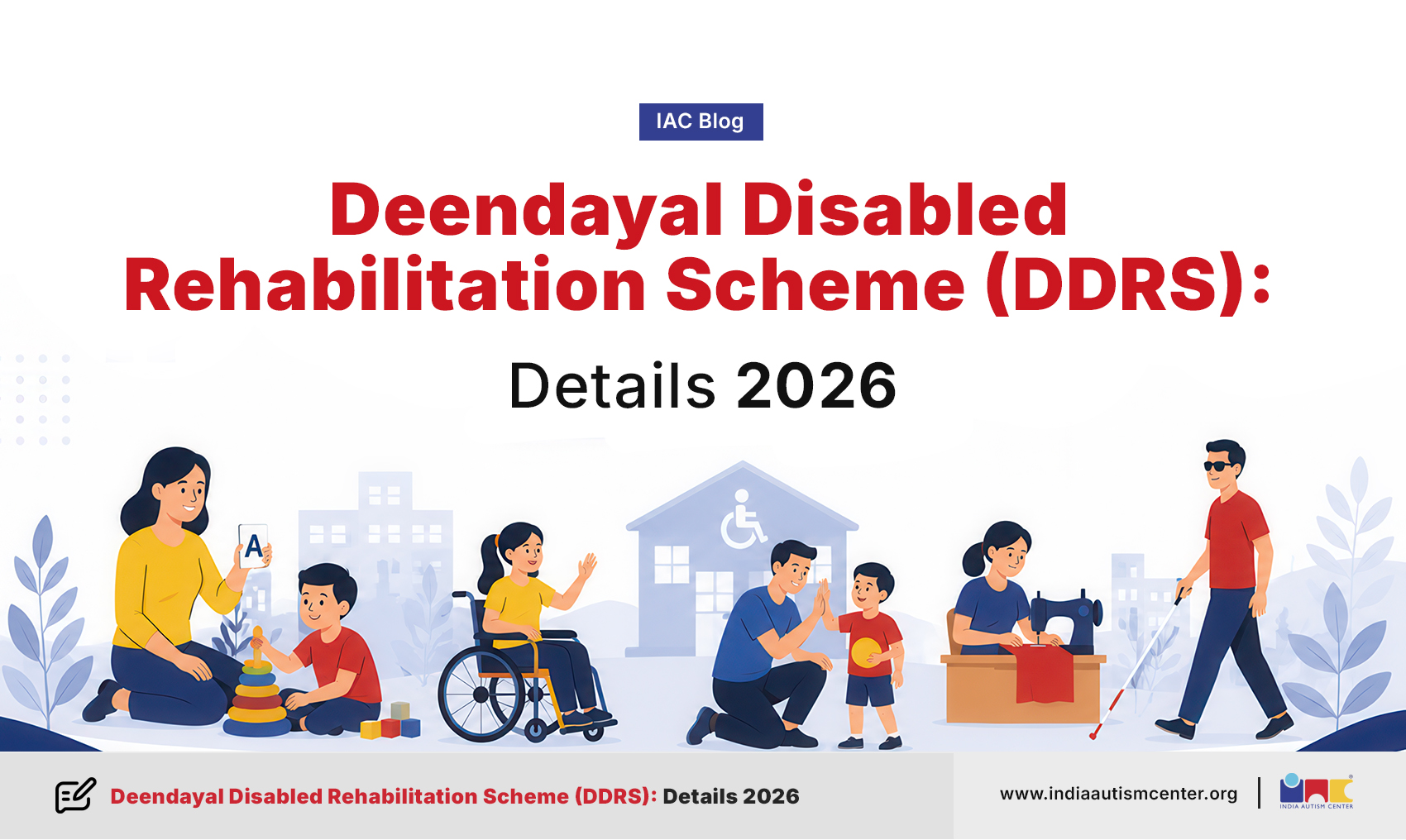
    Deendayal Disabled Rehabilitation Scheme (DDRS): Details 2026

    When a person is diagnosed with a disability, whether it is autism or another disability, the journey ahead often involves therapy, assistive devices, education support, and long-term care planning.

    The challenge is not just emotional but also financial and logistical. This is where structured government initiatives like the Deendayal Disabled Rehabilitation Scheme DDRS come into play. The initiative can be a game-changer as India has over 2.68 crore persons with disabilities as per the Census of 2011. 

    Moreover, a large chunk of this number still lacks access to structured rehabilitation services. Schemes like the DDRS thus aim to bridge this huge gap by strengthening grassroots rehabilitation services as well as empowering organisations to deliver support where it is needed most.

    If you are a parent of a child with autism, a caregiver, or part of an NGO, this guide helps you understand how the Deendayal Disabled Rehabilitation Scheme can help you unlock real, tangible support.

    What is the Deendayal Disabled Rehabilitation Scheme?
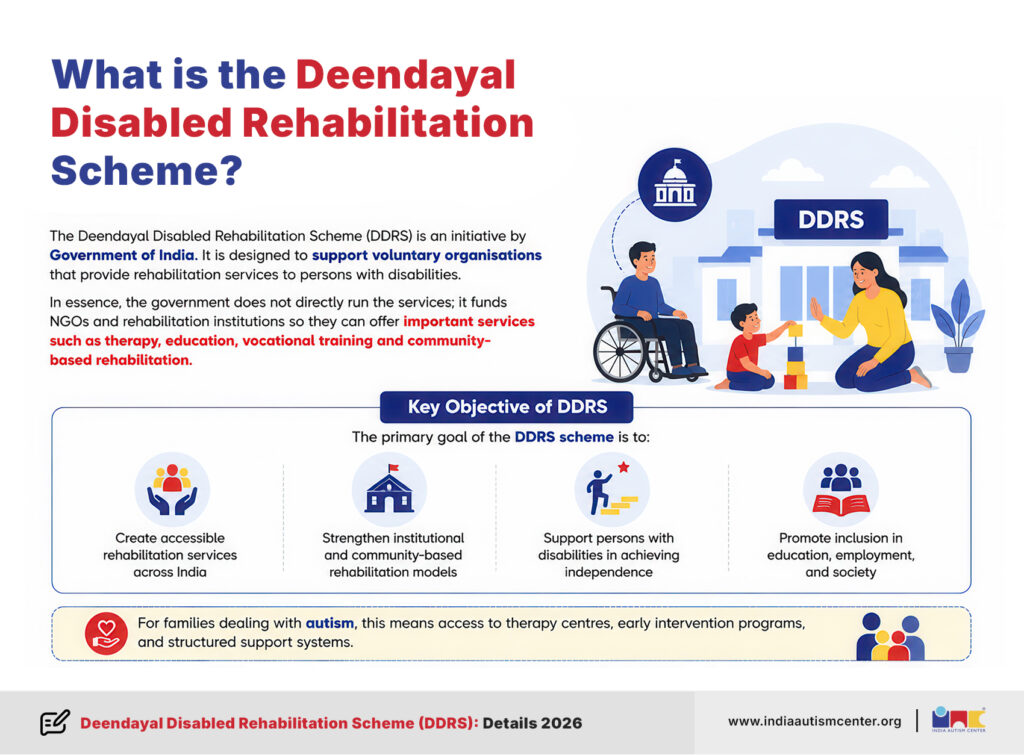
    What is Deendayal Disabled Rehabilitation Scheme DDRS and how it supports NGOs and rehabilitation services in India

    The Deendayal Disabled Rehabilitation Scheme (DDRS) is an initiative by the Government of India. It is designed to support voluntary organisations that provide rehabilitation services to persons with disabilities.

    In essence, the government does not directly run the services; it funds NGOs and rehabilitation institutions so they can offer important services such as therapy, education, vocational training and community-based rehabilitation.

    Key Objective of DDRS:

    The primary goal of the DDRS scheme is to:

    • Create accessible rehabilitation services across India
    • Strengthen institutional and community-based rehabilitation models
    • Support persons with disabilities in achieving independence
    • Promote inclusion in education, employment, and society

    For families dealing with autism, this means access to therapy centres, early intervention programs, and structured support systems.

    The Vision and Objectives of the DDRS Scheme
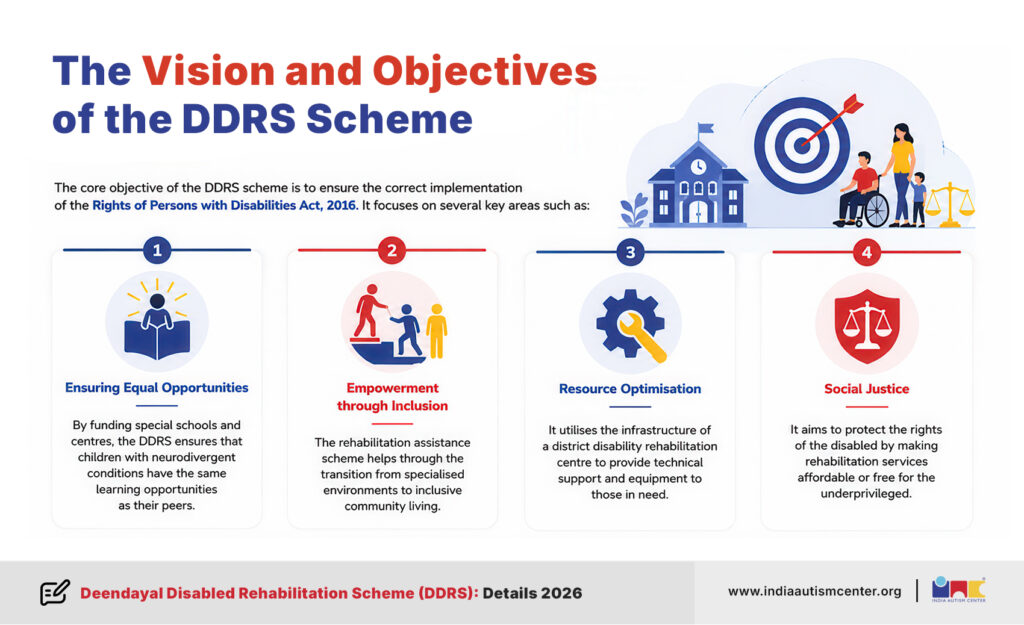
    Key objectives of DDRS scheme including inclusion, equal opportunities and rehabilitation support in India

    The core objective of the DDRS scheme is to ensure the correct implementation of the Rights of Persons with Disabilities Act, 2016. It focuses on several key areas such as:

    1. Ensuring Equal Opportunities: By funding special schools and centres, the DDRS ensures that children with neurodivergent conditions have the same learning opportunities as their peers.

    2. Empowerment through Inclusion: The rehabilitation assistance scheme helps through the transition from specialised environments to inclusive community living.

    3. Resource Optimisation: It utilises the infrastructure of a district disability rehabilitation centre to provide technical support and equipment to those in need.

    4. Social Justice: It aims to protect the rights of the disabled by making rehabilitation services affordable or free for the underprivileged.

    Why DDRS Matters for Autism and Developmental Disabilities?
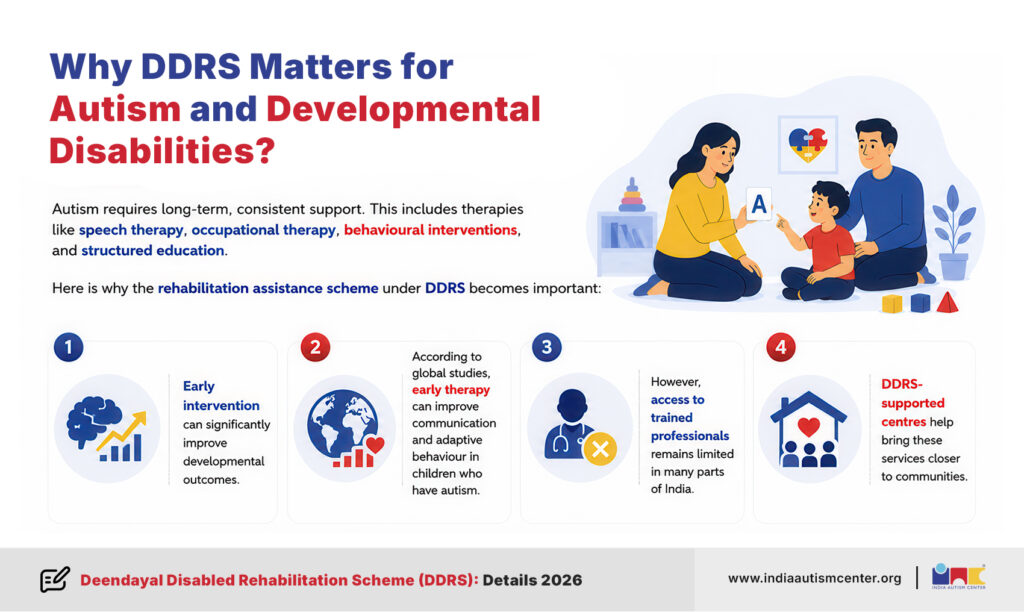
    Importance of DDRS for autism and developmental disabilities with early intervention and therapy support

    Autism requires long-term, consistent support. This includes therapies like speech therapy, occupational therapy, behavioural interventions, and structured education.

    Here is why the rehabilitation assistance scheme under DDRS becomes important:

    • Early intervention can significantly improve developmental outcomes.
    • According to global studies, early therapy can improve communication and adaptive behaviour in children who have autism.
    • However, access to trained professionals remains limited in many parts of India.
    • DDRS-supported centres help bring these services closer to communities.

    Types of Projects Supported Under DDRS
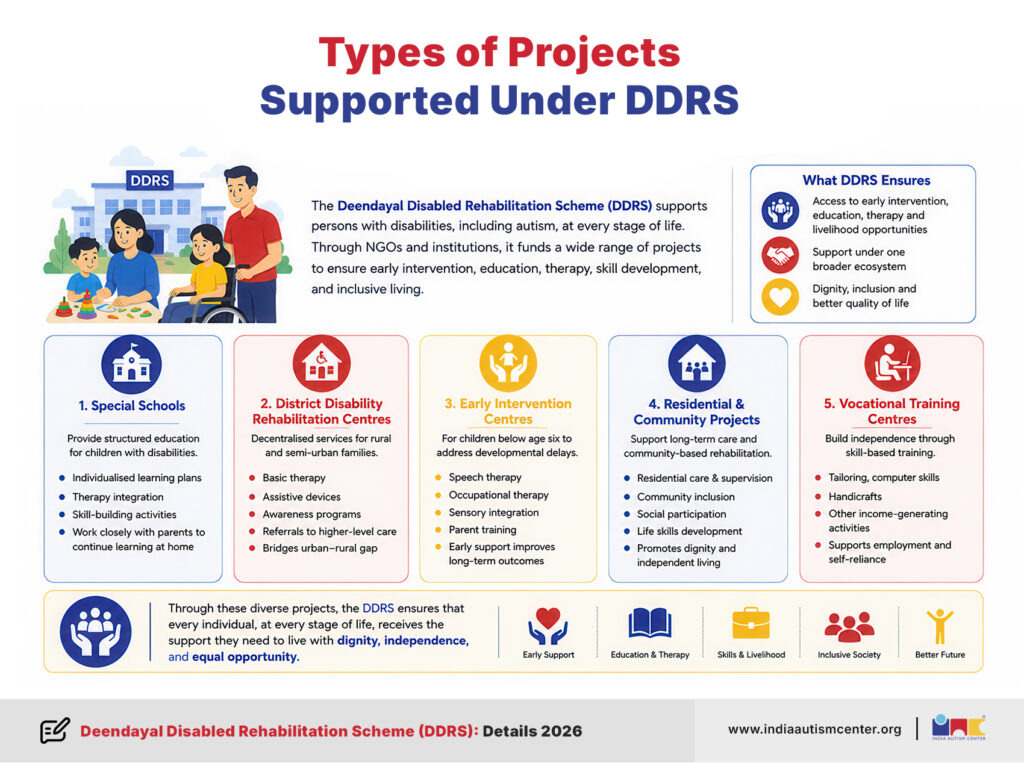
    Types of projects supported under DDRS including special schools, early intervention centres and vocational training

    The DDRS scheme is designed to support a wide range of rehabilitation services so that persons with disabilities, including autism, can receive care at different stages of life. Instead of focusing on just one type of support, the Deendayal Disabled Rehabilitation Scheme funds multiple project models through NGOs and institutions

    This ensures that families can access early intervention and education, therapy, and livelihood opportunities under one broader ecosystem.

    Special Schools

    Special schools supported under the DDRS provide structured education for children with disabilities who may not be able to cope in mainstream classrooms without support. These schools focus on individualised learning plans, therapy integration, and skill-building activities.

    For children with autism, this often includes communication training, behaviour support, or social skills development as per the requirement. Many of these schools tend to work closely with parents so that learning can be continued at home.

    District Disability Rehabilitation Centres

    The district disability rehabilitation centre model focuses on decentralising services so that families in rural and semi-urban areas can get complete access to necessary support without travelling long distances.

    These centres provide basic therapy, assistive devices, awareness programs, as well as referrals to higher-level care when needed. They play a key role in bridging the urban-rural gap in disability services.

    Early Intervention Centres

    Early intervention is one of the most critical components of the rehabilitation assistance scheme. These centres cater to children usually below the age of six, where developmental delays can be identified and addressed early.

    Services include speech therapy, occupational therapy, sensory integration, and even parent training. Research consistently shows that early support is significantly helpful in improving long-term outcomes in children with autism, making these centres a cornerstone of the Deendayal Disabled Rehabilitation Scheme DDRS.

    Residential and Community-Based Rehabilitation Projects

    The Deendayal Disabled Rehabilitation Scheme offers support for residential care facilities and community-based rehabilitation programs. Residential facilities aim to offer long-term care for persons who are in need of constant supervision, while community-based programs focus on integrating persons with disabilities into society.

    These initiatives emphasise life skills, social participation, and dignity, which are necessary for holistic rehabilitation.

    Vocational Training Centres

    For older children, adolescents, and adults, vocational training centres funded under the DDRS scheme help build independence. These centres offer skill-based training such as tailoring, computer skills, handicrafts, and other income-generating activities.

    For individuals who are diagnosed with autism, structured vocational environments can improve focus, routine-building, and confidence, ultimately supporting long-term employment or self-employment.

    Who Can Benefit from DDRS?
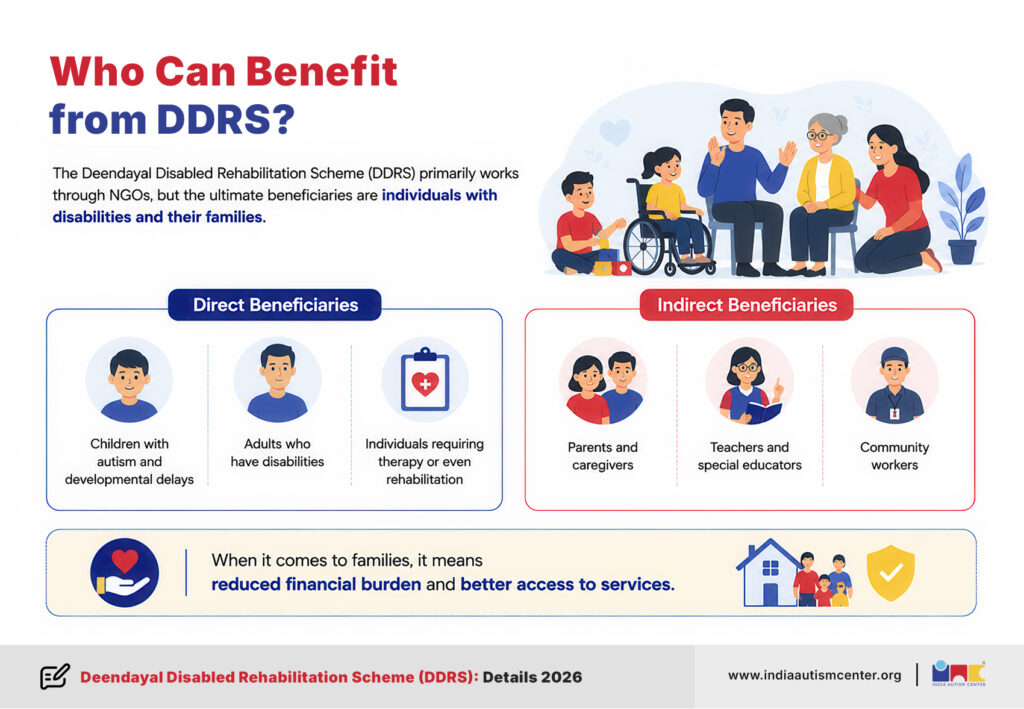
    Who benefits from DDRS scheme including children with disabilities, families, caregivers and educators

    The Deendayal Disabled Rehabilitation Scheme DDRS primarily works through NGOs, but the ultimate beneficiaries are individuals with disabilities and their families.

    Direct beneficiaries include:

    • Children with autism and developmental delays
    • Adults who have disabilities
    • Individuals requiring therapy or even rehabilitation

    Indirect beneficiaries:

    • Parents and caregivers
    • Teachers and special educators
    • Community workers

    When it comes to families, it means reduced financial burden and better access to services.

    What is the Eligibility Criteria for Organisations?
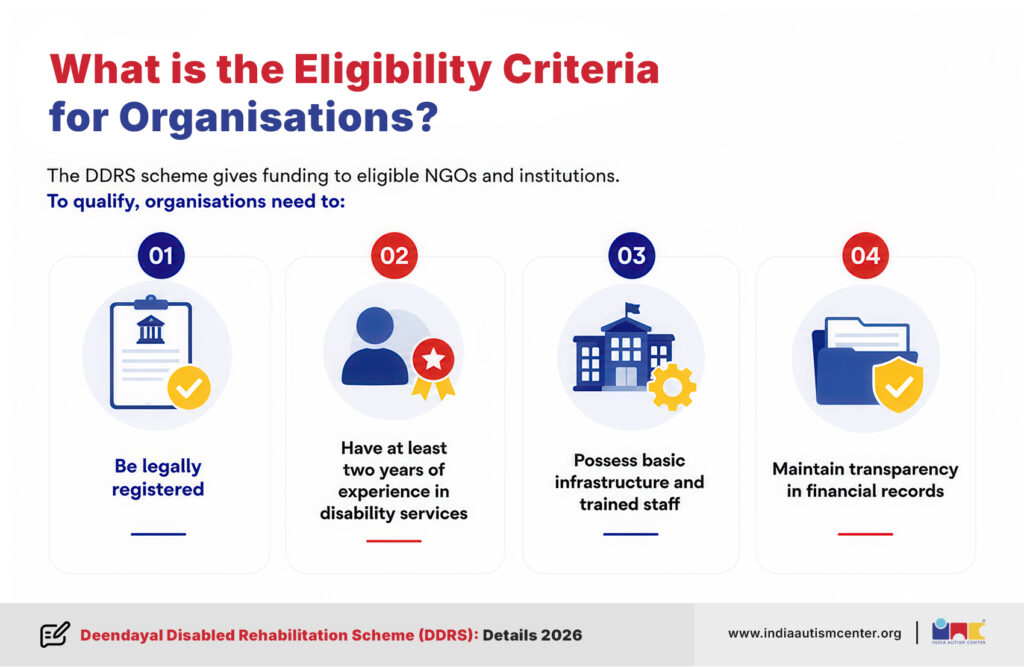
    DDRS eligibility criteria for NGOs including registration, experience, infrastructure and transparency requirements

    The DDRS scheme gives funding to eligible NGOs and institutions. To qualify, organisations need to:

    • Be legally registered
    • Have at least two years of experience in disability services
    • Possess basic infrastructure and trained staff
    • Maintain transparency in financial records

    How to Access DDRS Services as a Parent?
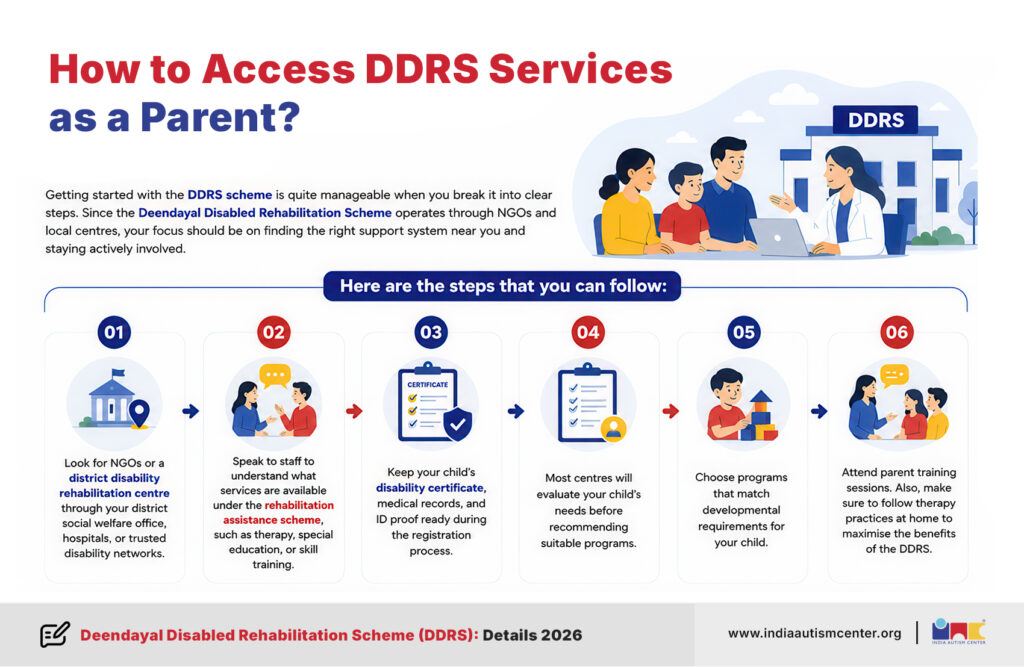
    Steps to access DDRS services for parents including NGOs, disability certificate and rehabilitation centres

    Getting started with the DDRS scheme is quite manageable when you break it into clear steps. Since the Deendayal Disabled Rehabilitation Scheme operates through NGOs and local centres, your focus should be on finding the right support system near you and staying actively involved.

    Here are the steps that you can follow:

    Step 1: Look for NGOs or a district disability rehabilitation centre through your district social welfare office, hospitals, or trusted disability networks.

    Step 2: Speak to staff to understand what services are available under the rehabilitation assistance scheme, such as therapy, special education, or skill training.

    Step 3: Keep your child’s disability certificate, medical records, and ID proof ready during the registration process

    Step 4: Most centres will evaluate your child’s needs before recommending suitable programs

    Step 5: Choose programs that match developmental requirements for your child

    Step 6: Attend parent training sessions. Also, make sure to follow therapy practices at home to maximise the benefits of the DDRS.

    What are the Challenges During Implementation of the DDRS Scheme?
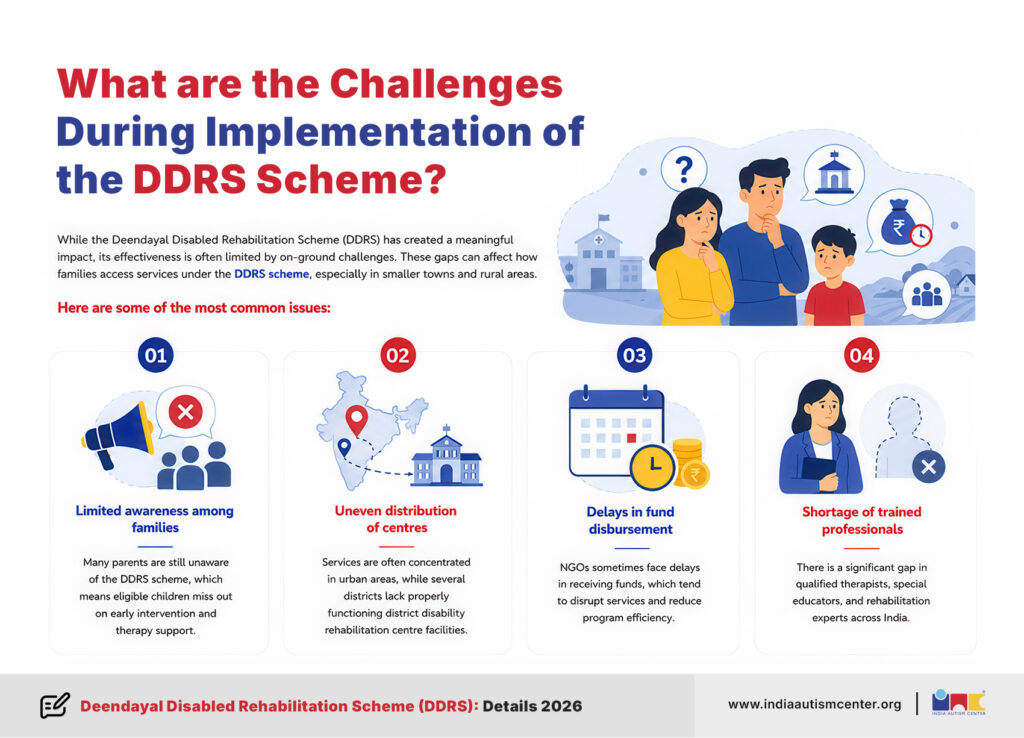
    Challenges in DDRS implementation such as low awareness, funding delays and shortage of trained professionals

    While the Deendayal Disabled Rehabilitation Scheme DDRS has created a meaningful impact, its effectiveness is often limited by on-ground challenges. These gaps can affect how families access services under the DDRS scheme, especially in smaller towns and rural areas.

    Here are some of the most common issues:

    • Limited awareness among families: Many parents are still unaware of the DDRS scheme, which means eligible children miss out on early intervention and therapy support
    • Uneven distribution of centres: Services are often concentrated in urban areas, while several districts lack properly functioning district disability rehabilitation centre facilities
    • Delays in fund disbursement: NGOs sometimes face delays in receiving funds, which tend to disrupt services and reduce program efficiency
    • Shortage of trained professionals: There is a significant gap in qualified therapists, special educators, and rehabilitation experts across India

    Because of these challenges, the reach of the DDRS remains uneven, making awareness and stronger implementation critical for better outcomes.

    Tips for Parents and Caregivers
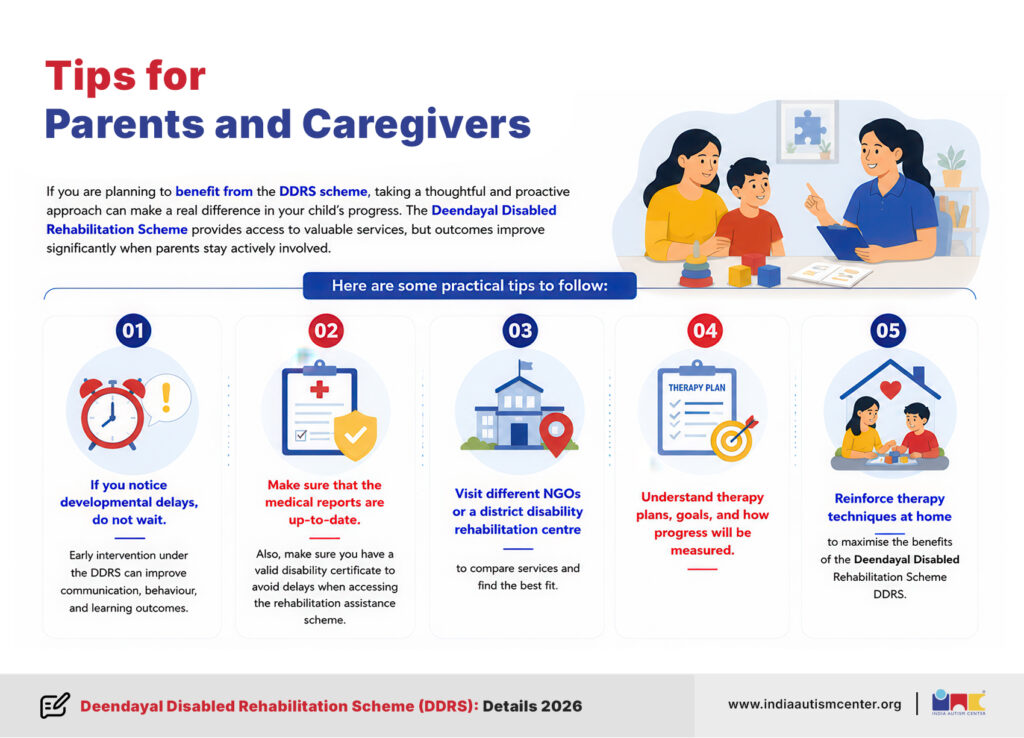
    Practical tips for parents and caregivers to benefit from DDRS scheme and improve child development outcomes

    If you are planning to benefit from the DDRS scheme, taking a thoughtful and proactive approach can make a real difference in your child’s progress. The Deendayal Disabled Rehabilitation Scheme provides access to valuable services, but outcomes improve significantly when parents stay actively involved.

    Here are some practical tips to follow:

    1. If you notice developmental delays, do not wait. Early intervention under the DDRS can improve communication, behaviour, and learning outcomes.

    2. Make sure that the medical reports are up-to-date. Also, make sure you have a valid disability certificate to avoid delays when accessing the rehabilitation assistance scheme.

    3. Visit different NGOs or a district disability rehabilitation centre to compare services and find the best fit.

    4. Understand therapy plans, goals, and how progress will be measured.

    5. Reinforce therapy techniques at home to maximise the benefits of the Deendayal Disabled Rehabilitation Scheme DDRS.

    Future of DDRS in India
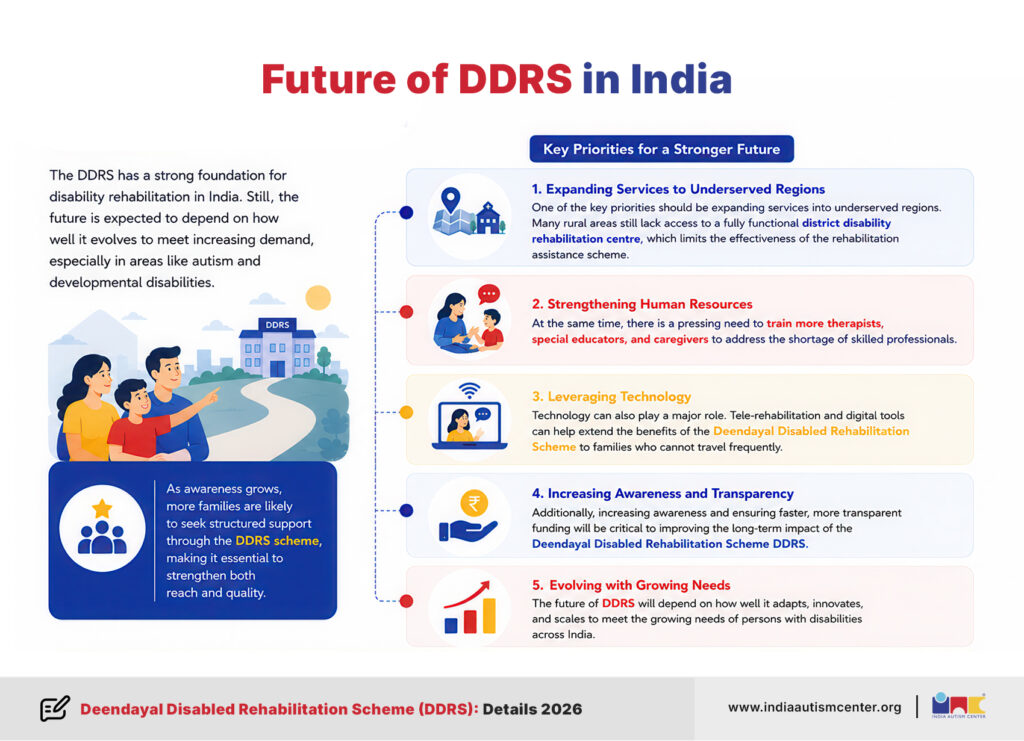
    Future of DDRS in India focusing on expanding services, technology adoption and improving accessibility

    The DDRS has a strong foundation for disability rehabilitation in India. Still, the future is expected to depend on how well it evolves to meet increasing demand, especially in areas like autism and developmental disabilities. 

    As awareness grows, more families are likely to seek structured support through the DDRS scheme, making it essential to strengthen both reach and quality.

    One of the key priorities should be expanding services into underserved regions. Many rural areas still lack access to a fully functional district disability rehabilitation centre, which limits the effectiveness of the rehabilitation assistance scheme. 

    At the same time, there is a pressing need to train more therapists, special educators, and caregivers to address the shortage of skilled professionals.

    Technology can also play a major role. Tele-rehabilitation and digital tools can help extend the benefits of the Deendayal Disabled Rehabilitation Scheme to families who cannot travel frequently. 

    Additionally, increasing awareness and ensuring faster, more transparent funding will be critical to improving the long-term impact of the Deendayal Disabled Rehabilitation Scheme DDRS.

    Conclusion
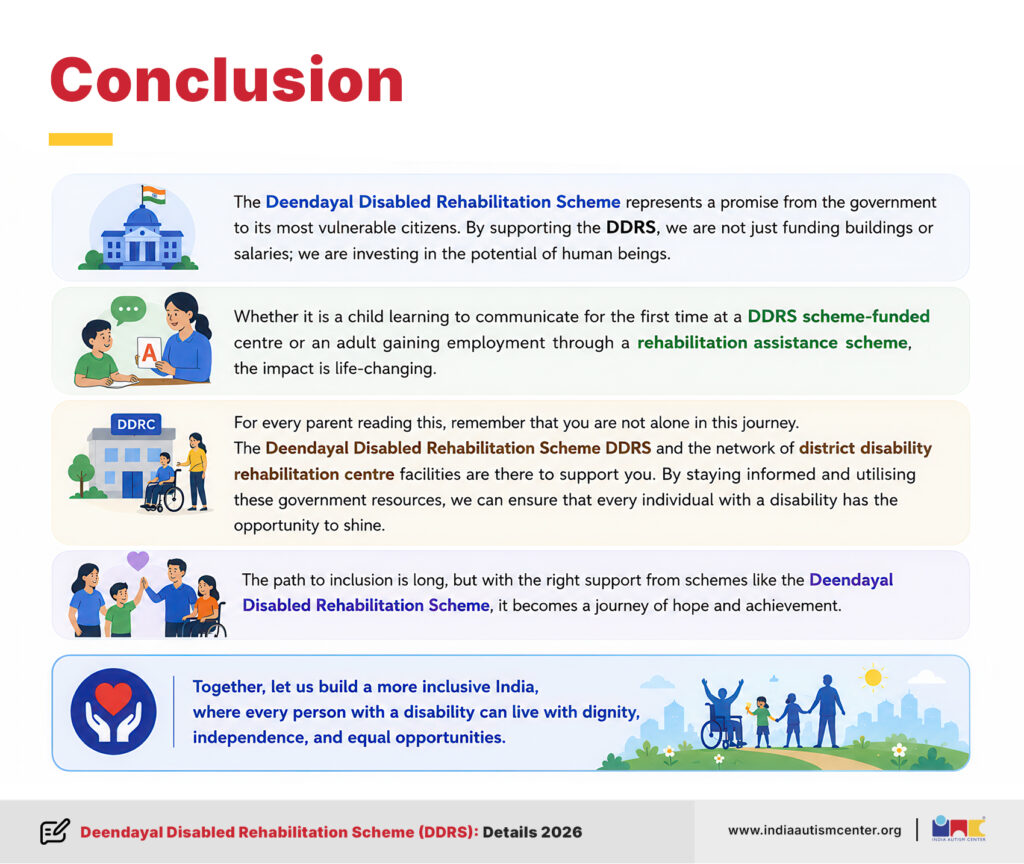
    Conclusion on DDRS scheme impact highlighting inclusion, rehabilitation support and empowerment of people with disabilities

    The Deendayal Disabled Rehabilitation Scheme represents a promise from the government to its most vulnerable citizens. By supporting the DDRS, we are not just funding buildings or salaries; we are investing in the potential of human beings. 

    Whether it is a child learning to communicate for the first time at a DDRS scheme-funded centre or an adult gaining employment through a rehabilitation assistance scheme, the impact is life-changing.

    For every parent reading this, remember that you are not alone in this journey. The Deendayal Disabled Rehabilitation Scheme DDRS and the network of district disability rehabilitation centre facilities are there to support you. By staying informed and utilising these government resources, we can ensure that every individual with a disability has the opportunity to shine. 

    The path to inclusion is long, but with the right support from schemes like the Deendayal Disabled Rehabilitation Scheme, it becomes a journey of hope and achievement.

    Frequently Asked Questions

    What is DDRS in simple terms?

    The DDRS is a government scheme that funds NGOs to provide rehabilitation services like therapy, education, and skill training for persons with disabilities across India.

    Is DDRS only for physical disabilities?

    No, the Deendayal Disabled Rehabilitation Scheme covers multiple disabilities, including autism, intellectual disabilities, and sensory impairments.

    Are services under DDRS free?

    Many services under the Deendayal Disabled Rehabilitation Scheme DDRS are free or highly subsidised, depending on the organisation and type of support provided.

    Can adults with autism benefit from DDRS?

    Yes, the rehabilitation assistance scheme includes vocational training and life skills programs for adults with autism and other disabilities.

    Can NGOs apply for multiple projects under the DDRS scheme?

    Yes, eligible NGOs can apply for multiple projects under the DDRS scheme, provided they meet infrastructure, staffing, and compliance requirements set by the government.

    How does DDRS support inclusive education?

    The Deendayal Disabled Rehabilitation Scheme DDRS supports special schools and resource centres that help children transition into inclusive education environments with proper support systems.

    How can DDRS improve long-term outcomes for children with autism?

    By providing early intervention, therapy, and skill-building programs, the Deendayal Disabled Rehabilitation Scheme DDRS helps improve independence, communication, and overall quality of life.
  • ADIP Scheme: How It Helps People With Autism and Disabilities?

    ADIP Scheme: How It Helps People With Autism and Disabilities?

    Finding the right support for a child or a loved one with a disability can feel like a big challenge for many parents. Whether you are caring for a child with autism or someone with physical needs, having the right tools can make a world of difference.

    In India, the government has a special and dedicated program, which is known as the Assistance to Disabled Persons for Purchase/Fitting of Aids or Appliances (ADIP scheme), to help families get the equipment they need without worrying about the cost. This program gives necessary assistance to people with disabilities, ensuring that each person gets a chance to live an independent life.

    Recent studies show that there are over 26.8 million people living with disabilities in India. It is also a fact that using assistive technology for disabled children early in life can help them become much more independent as they grow up.

    This detailed guide will explain to you all about the ADIP scheme, including eligibility, benefits, application process, and how it supports individuals with autism and other disabilities.

    What is the ADIP Scheme?

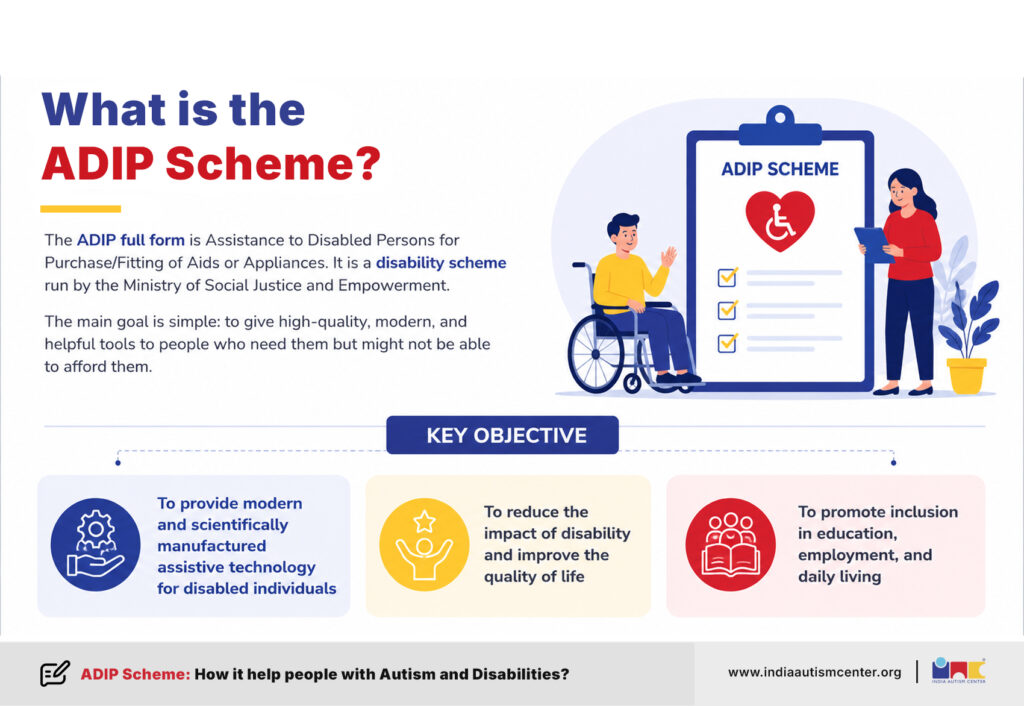
    What is the ADIP Scheme infographic showing objectives of disability assistance and assistive technology support in India

    The ADIP full form is Assistance to Disabled Persons for Purchase/Fitting of Aids or Appliances. It is a disability scheme run by the Ministry of Social Justice and Empowerment. The main goal is simple: to give high-quality, modern, and helpful tools to people who need them but might not be able to afford them.

    Key Objective:

    • To provide modern and scientifically manufactured assistive technology for disabled individuals
    • To reduce the impact of disability and improve the quality of life
    • To promote inclusion in education, employment, and daily living

    Why the ADIP Scheme Matters?

    Importance of the ADIP Scheme for autism and disabilities including early intervention and mobility support

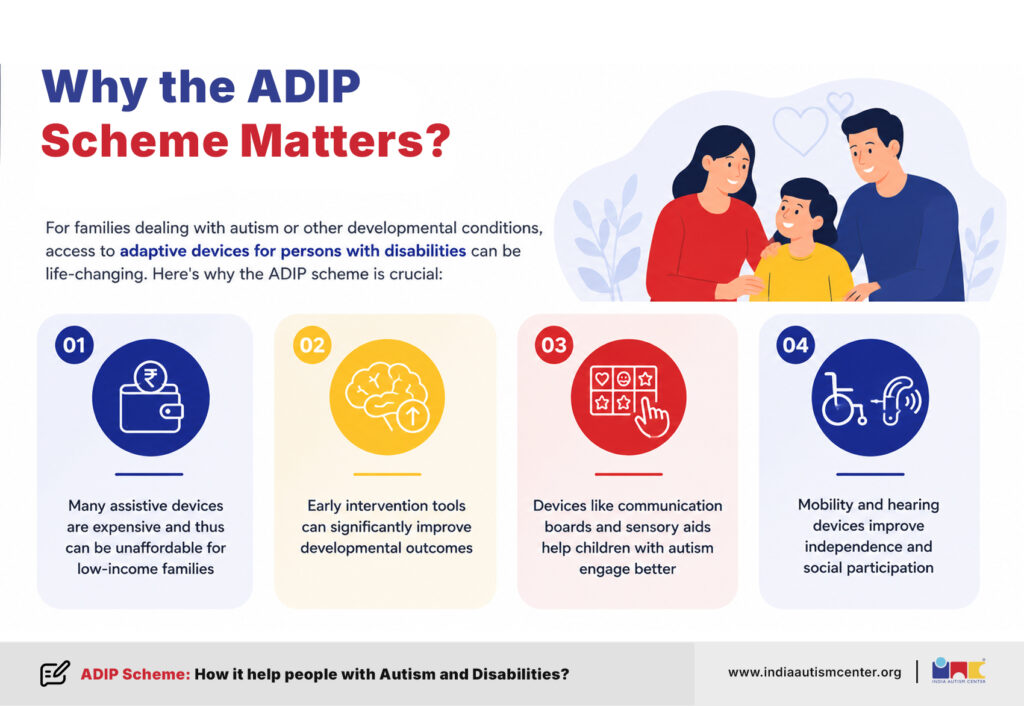
    For families dealing with autism or other developmental conditions, access to adaptive devices for persons with disabilities can be life-changing. Here’s why the ADIP scheme is crucial:

    • Many assistive devices are expensive and thus can be unaffordable for low-income families
    • Early intervention tools can significantly improve developmental outcomes
    • Devices like communication boards and sensory aids help children with autism engage better
    • Mobility and hearing devices improve independence and social participation

    Different Types of Assistive Devices for People with Disabilities

    Different types of assistive devices for people with disabilities including wheelchairs hearing aids and autism learning tools

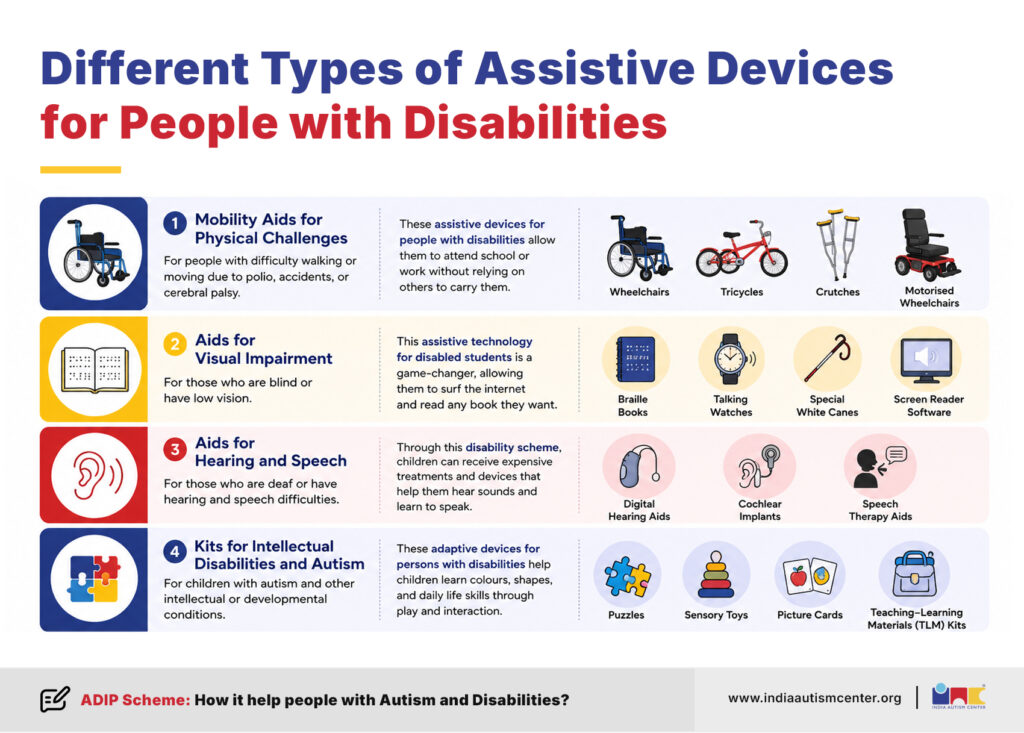
    The ADIP scheme covers many different needs. Depending on what a person requires, the scheme provides different types of tools. Let’s look at them in detail.

    Mobility Aids for Physical Challenges

    For people who have trouble walking due to polio, accidents, or cerebral palsy, the scheme provides wheelchairs, tricycles, and crutches. For those who have great difficulty moving their arms or legs, motorised wheelchairs are also available. 

    These assistive devices for people with disabilities allow them to attend school or work without relying on others to carry them.

    Aids for Visual Impairment

    For those who are blind or have low vision, the government provides Braille books, talking watches, and special white canes. They also provide high-tech software for computers that reads text aloud. 

    This assistive technology for disabled students is a game-changer, allowing them to surf the internet and read any book they want.

    Aids for Hearing and Speech

    Digital hearing aids are very common under this disability scheme. For young children who cannot hear at all, the government even helps pay for cochlear implants. 

    A cochlear implant is a very expensive surgery, but through the ADIP scheme, many poor children get it for free. This helps them start hearing sounds and eventually learn how to speak.

    Kits for Intellectual Disabilities and Autism

    This is very important for parents of neurodivergent children. The scheme provides special kits called Teaching-Learning Materials (TLM) kits. These kits contain puzzles, sensory toys, and picture cards. 

    These adaptive devices for persons with disabilities are designed to help children with autism learn colours, shapes, and daily life skills through play.

    How to Use the ADIP Scheme Apply Online Feature?

    Step by step guide to apply online for the ADIP Scheme through the official government disability portal

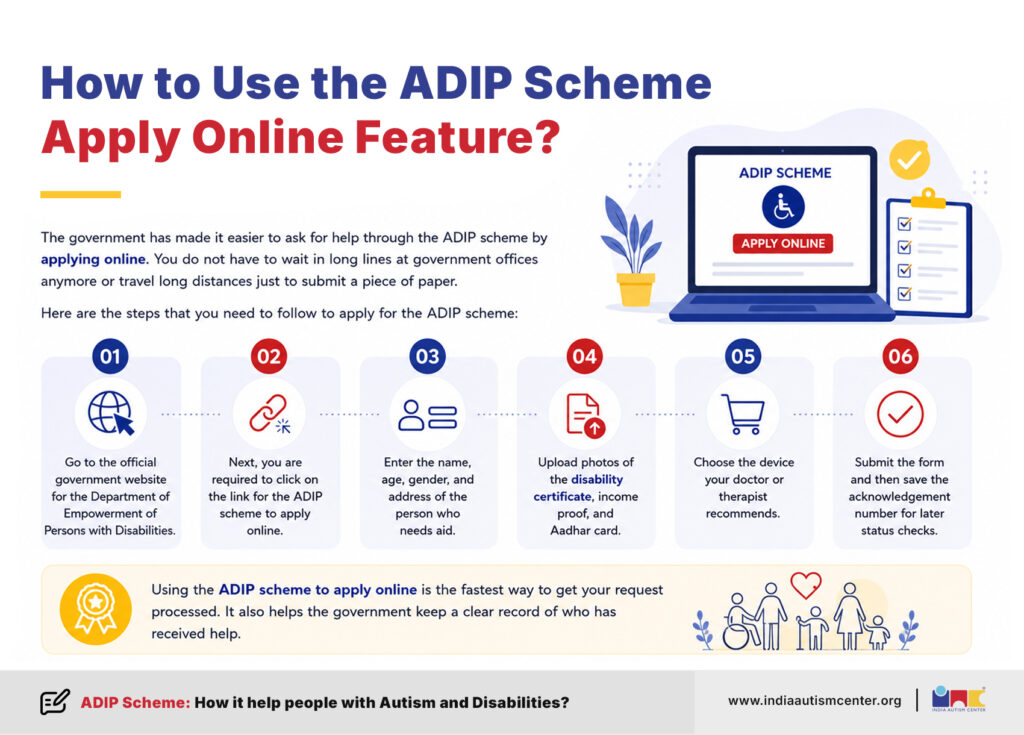
    The government has made it easier to ask for help through the ADIP scheme by applying online. You do not have to wait in long lines at government offices anymore or travel long distances just to submit a piece of paper.

    Here are the steps that you need to follow to apply for the ADIP scheme:

    Step 1: Go to the official government website for the Department of Empowerment of Persons with Disabilities.

    Step 2: Next, you are required to click on the link for the ADIP scheme to apply online.

    Step 3: Enter the name, age, gender, and address of the person who needs aid.

    Step 4: Upload photos of the disability certificate, income proof, and Aadhar card.

    Step 5: Choose the device your doctor or therapist recommends.

    Step 6: Submit the form and then save the acknowledgement number for later status checks.

    Using the ADIP scheme to apply online is the fastest way to get your request processed. It also helps the government keep a clear record of who has received help.

    Who Can Apply for this Scheme?

    Eligibility criteria infographic for ADIP Scheme applicants including disability certificate and income requirements

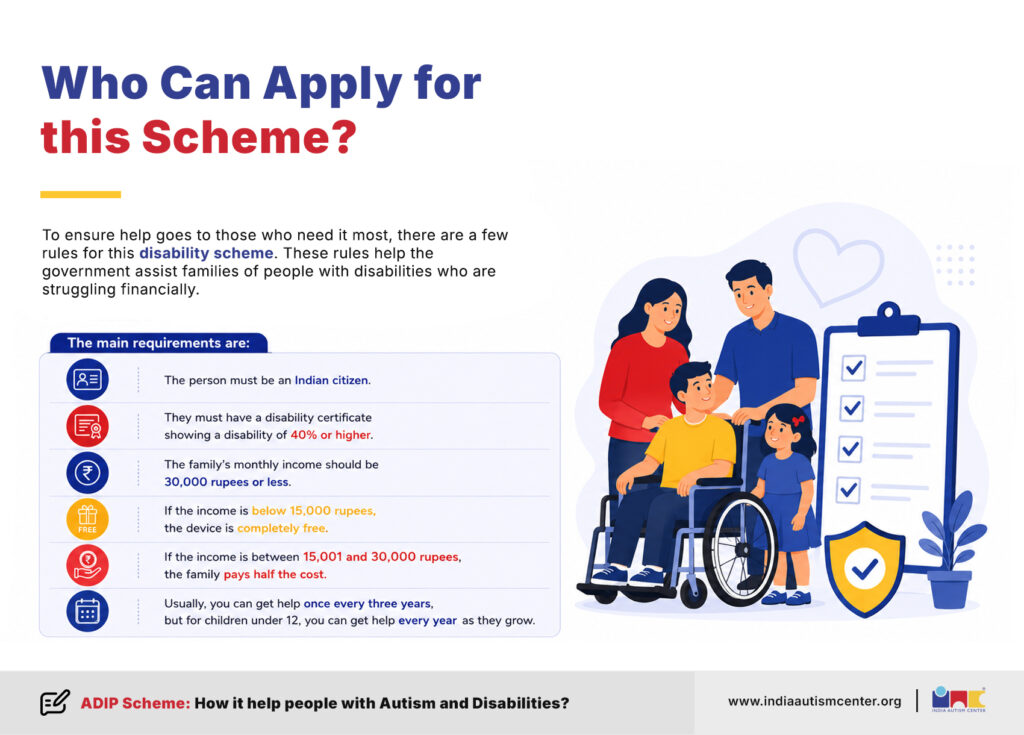
    To ensure help goes to those who need it most, there are a few rules for this disability scheme. These rules help the government assist families of people with disabilities who are struggling financially.

    The main requirements are:

    • The person must be an Indian citizen.
    • They must have a disability certificate showing a disability of 40% or higher.
    • The family’s monthly income should be 30,000 rupees or less.
    • If the income is below 15,000 rupees, the device is completely free.
    • If the income is between 15,001 and 30,000 rupees, the family pays half the cost.
    • Usually, you can get help once every three years, but for children under 12, you can get help every year as they grow.

    These rules ensure that adaptive devices for persons with disabilities reach the right hands.

    What Documents are Needed for A Smooth Application?

    Required documents for ADIP Scheme application including Aadhaar disability certificate income proof and medical recommendation

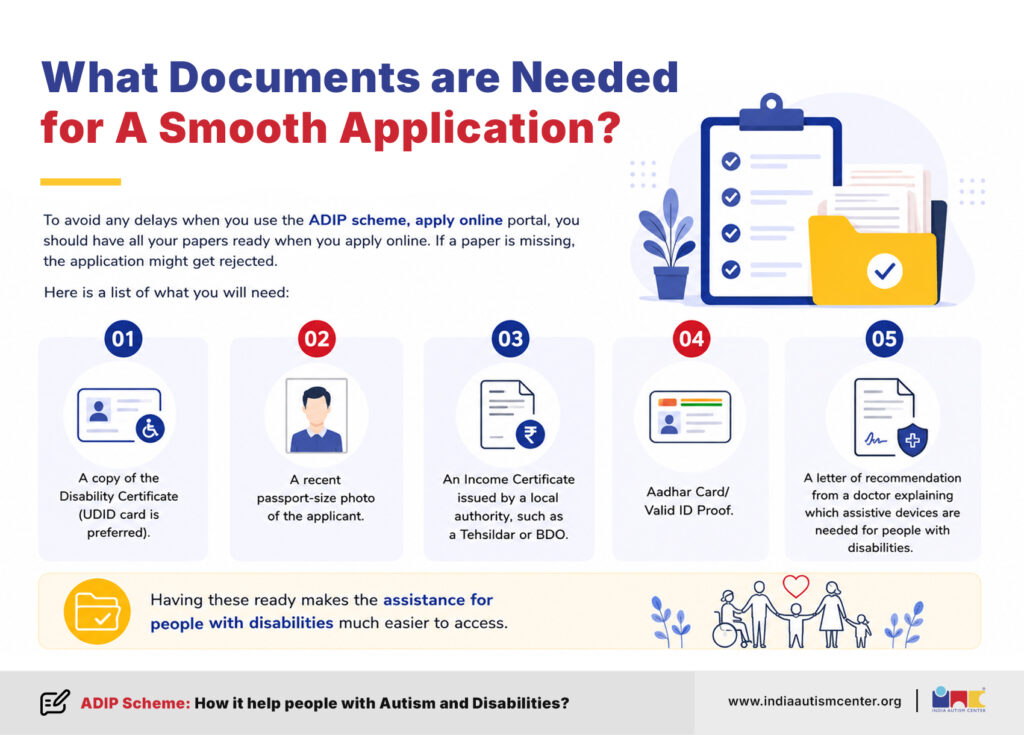
    To avoid any delays when you use the ADIP scheme, apply online portal, you should have all your papers ready when you apply online. If a paper is missing, the application might get rejected.

    Here is a list of what you will need:

    • A copy of the Disability Certificate (UDID card is preferred).
    • A recent passport-size photo of the applicant.
    • An Income Certificate issued by a local authority, such as a Tehsildar or BDO.
    • Aadhar Card/Valid ID Proof.
    • A letter of recommendation from a doctor explaining which assistive devices are needed for people with disabilities.

    Having these ready makes the assistance for people with disabilities much easier to access.

    The Importance of Early Intervention

    Early intervention benefits for children with autism and disabilities through assistive technology and mobility support

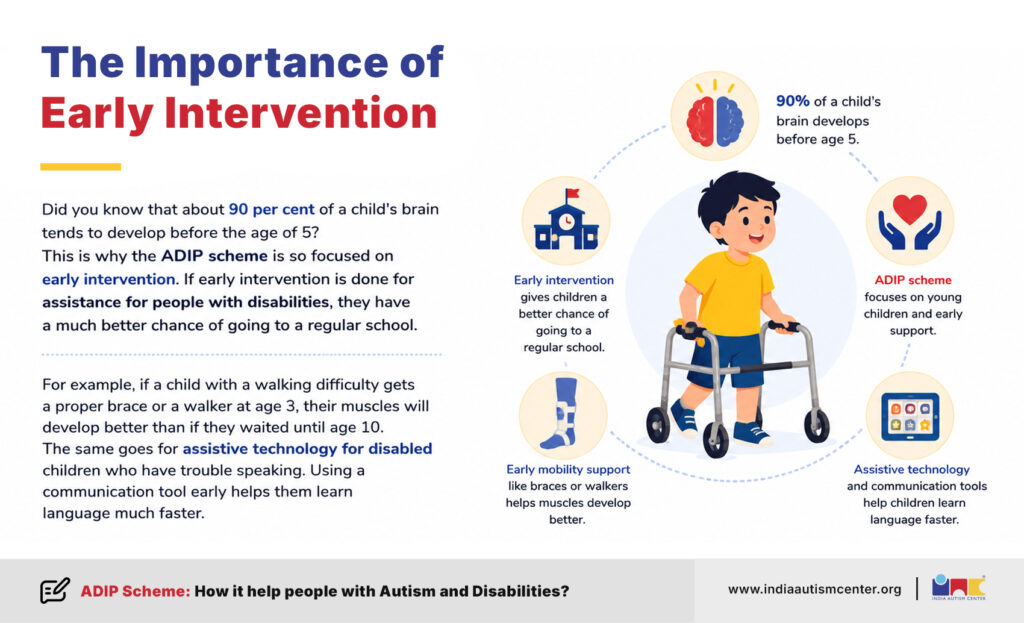
    Did you know that about 90 per cent of a child’s brain tends to develop before the age of 5? This is why the ADIP scheme is so focused on young children. If early intervention is done for assistance for people with disabilities, they have a much better chance of going to a regular school.

    For example, if a child with a walking difficulty gets a proper brace or a walker at age 3, their muscles will develop better than if they waited until age 10. The same goes for assistive technology for disabled children who have trouble speaking. Using a communication tool early helps them learn language much faster.

    The Role of NGOs and Social Workers

    NGOs and social workers helping families apply for the ADIP Scheme and choose assistive devices for disabilities

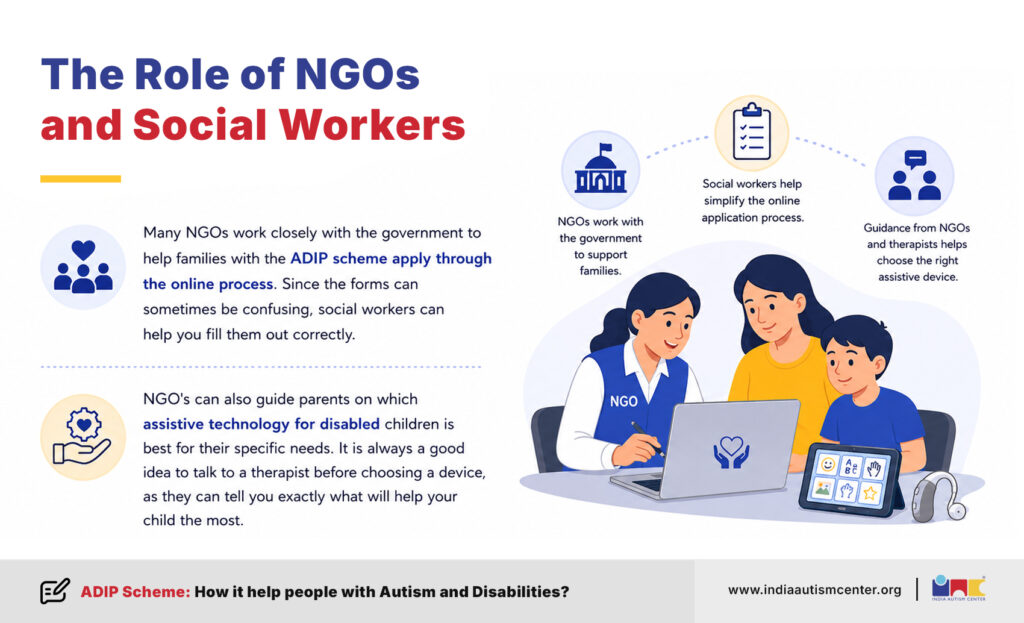
    Many NGOs work closely with the government to help families with the ADIP scheme apply through the online process. Since the forms can sometimes be confusing, social workers can help you fill them out correctly.

    NGO’s can also guide parents on which assistive technology for disabled children is best for their specific needs. It is always a good idea to talk to a therapist before choosing a device, as they can tell you exactly what will help your child the most.

    How is Life After Receiving the Device?

    Parents helping a child use assistive devices after receiving support through the ADIP Scheme

    Getting the device is just the first step. The next step is learning how to use it. If a child gets a new hearing aid or a communication tablet, they will need time and practice to get used to it.

    Parents should:

    • Ask the experts at the camp or hospital to show them how to clean and maintain the device.
    • Encourage the child to use the adaptive devices for persons with disabilities every single day.
    • Be patient, as it can take a few weeks for a child to feel comfortable with a new tool.
    • Check the device on a regular basis for any wear and tear that might happen.

    Common Myths About the ADIP Scheme

    Common myths and facts about the ADIP Scheme including disability support and assistive device accessibility

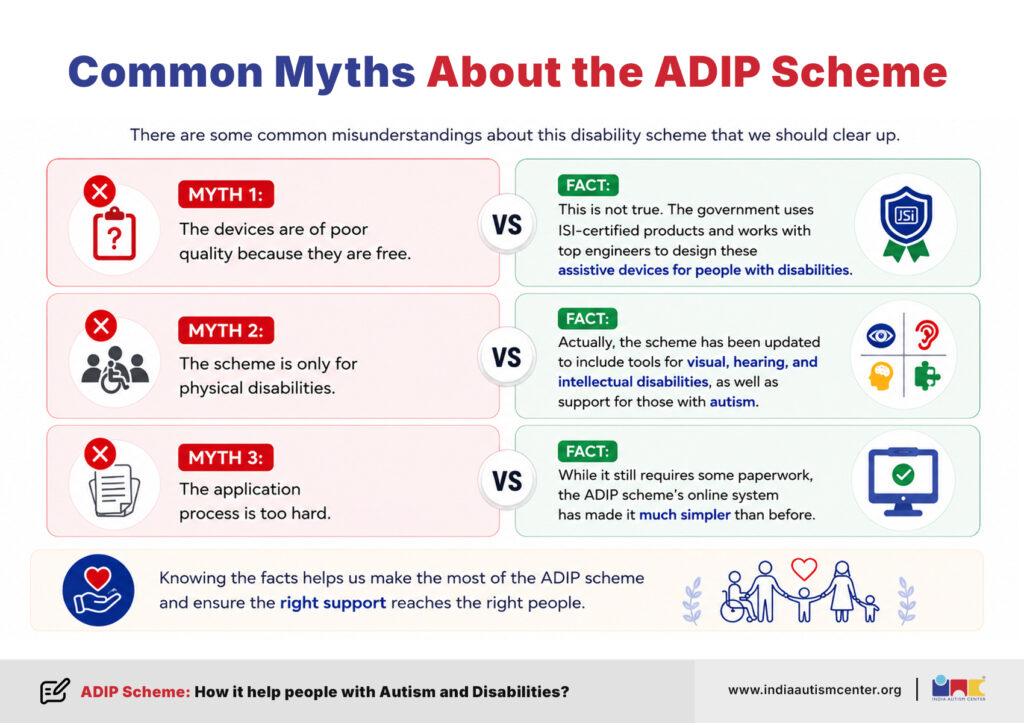
    There are some common misunderstandings about this disability scheme that we should clear up.

    Myth 1: The devices are of poor quality because they are free.

    This is not true. The government uses ISI-certified products and works with top engineers to design these assistive devices for people with disabilities.

    Myth 2: The scheme is only for physical disabilities.

    Actually, the scheme has been updated to include tools for visual, hearing, and intellectual disabilities, as well as support for those with autism.

    Myth 3: The application process is too hard.

    While it still requires some paperwork, the ADIP scheme’s online system has made it much simpler than before.

    Tips for Parents and Caregivers

    Practical tips for parents and caregivers applying for the ADIP Scheme for autism and disability assistance

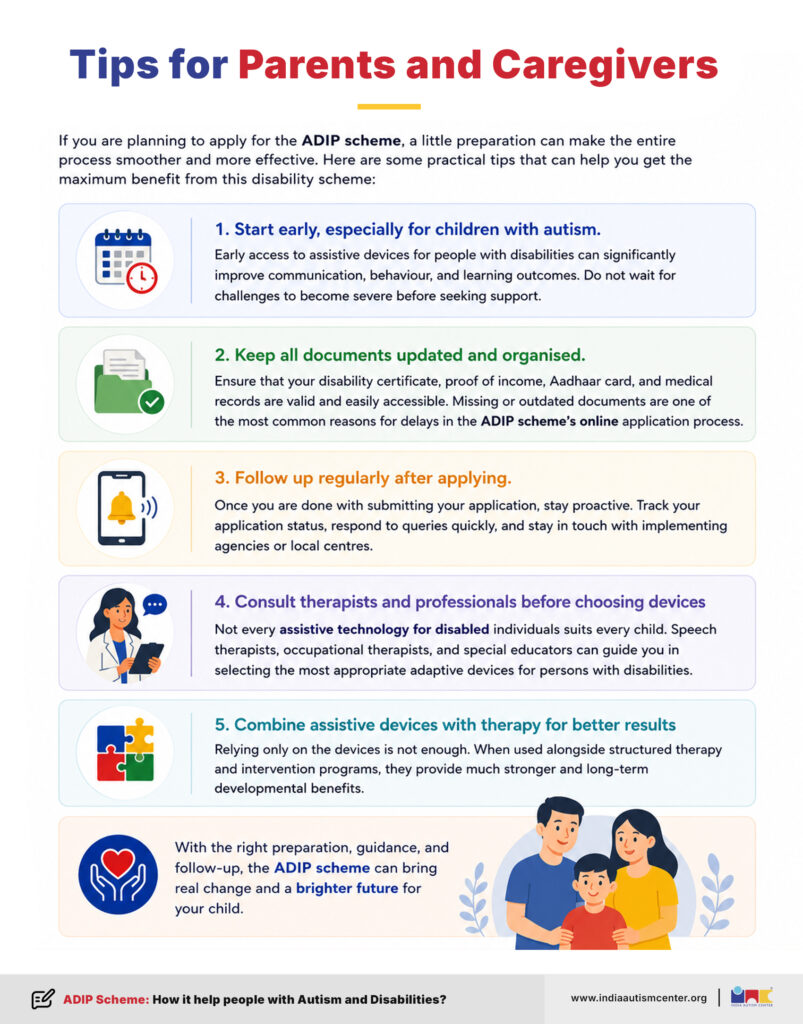
    If you are planning to apply for the ADIP scheme, a little preparation can make the entire process smoother and more effective. Here are some practical tips that can help you get the maximum benefit from this disability scheme:

    Start early, especially for children with autism.

    Early access to assistive devices for people with disabilities can significantly improve communication, behaviour, and learning outcomes. Do not wait for challenges to become severe before seeking support.

    Keep all documents updated and organised.

    Ensure that your disability certificate, proof of income, Aadhaar card, and medical records are valid and easily accessible. Missing or outdated documents are one of the most common reasons for delays in the ADIP scheme’s online application process.

    Follow up regularly after applying.

    Once you are done with submitting your application, stay proactive. Track your application status, respond to queries quickly, and stay in touch with implementing agencies or local centres.

    Consult therapists and professionals before choosing devices

    Not every assistive technology for disabled individuals suits every child. Speech therapists, occupational therapists, and special educators can guide you in selecting the most appropriate adaptive devices for persons with disabilities.

    Combine assistive devices with therapy for better results

    Relying only on the devices is not enough. When used alongside structured therapy and intervention programs, they provide much stronger and long-term developmental benefits.

    Conclusion

    Conclusion infographic about the ADIP Scheme supporting people with autism and disabilities through care education and assistive tools

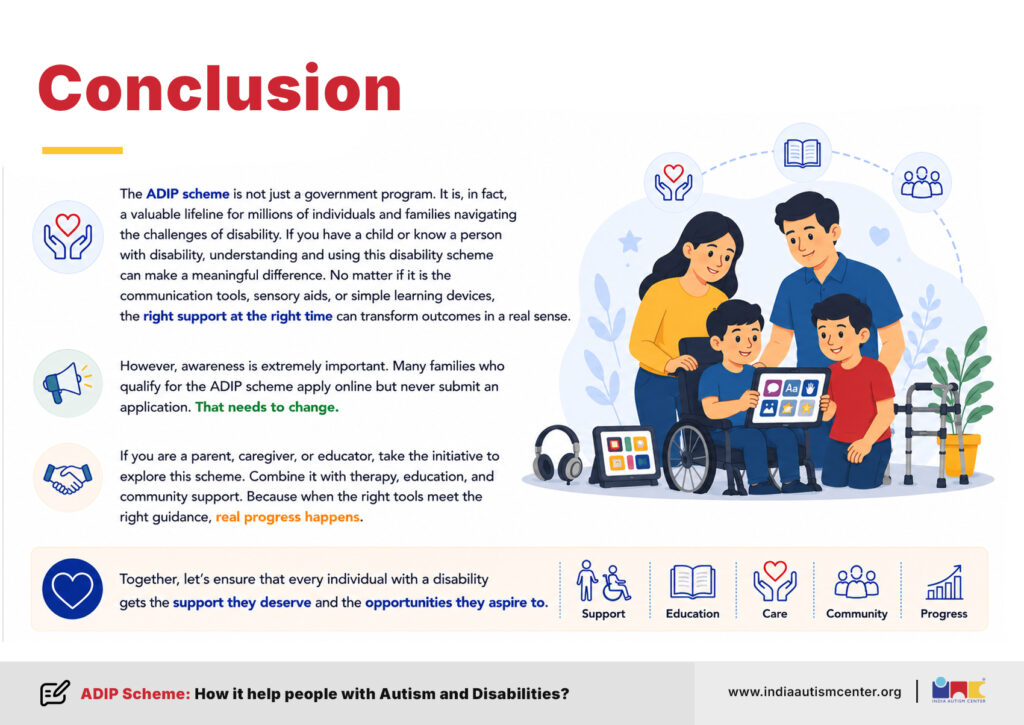
    The ADIP scheme is not just a government program. It is, in fact, a valuable lifeline for millions of individuals and families navigating the challenges of disability. If you have a child or know a person with disability, understanding and using this disability scheme can make a meaningful difference. No matter if it is the communication tools, sensory aids, or simple learning devices, the right support at the right time can transform outcomes in a real sense.

    However, awareness is extremely important. Many families who qualify for the ADIP scheme apply online but never submit an application. That needs to change. 

    If you are a parent, caregiver, or educator, take the initiative to explore this scheme. Combine it with therapy, education, and community support. Because when the right tools meet the right guidance, real progress happens.

    Frequently Asked Questions

    What is the ADIP scheme and who can benefit from it?

    The ADIP scheme is a dedicated government disability scheme that provides assistive devices to eligible individuals with disabilities. This scheme helps in improving mobility, communication, and independence.

    Who is eligible to apply for the ADIP scheme in India?

    Indian citizens with at least 40% certified disability and within the prescribed income limits can apply for the adip scheme to receive assistance for people with disabilities.

    What types of assistive devices are provided under the ADIP scheme?

    The ADIP scheme provides assistive devices for people with disabilities, such as wheelchairs, hearing aids, communication tools, prosthetics, and other adaptive devices.

    Is the ADIP scheme available for children with autism?

    Yes, the AIP scheme is known to support children with autism by providing assistive technology, including communication aids, learning tools, and sensory support devices.

    How long does it take to receive devices under the ADIP scheme?

    The processing time for the ADIP scheme will usually vary but typically ranges from a few weeks to a few months, depending on verification, availability, and distribution schedules.

    Can multiple devices be provided under the ADIP scheme?

    Yes, eligible individuals can receive multiple assistive devices for people with disabilities, based on their needs and a professional assessment, under the ADIP scheme.

    For expert insights, support services, and inclusive learning initiatives, visit the India Autism Center.

  • How to Apply for Disability Certificate in West Bengal? (Complete Guide)

    How to Apply for Disability Certificate in West Bengal? (Complete Guide)

    Getting a disability certificate in West Bengal is one of the most important steps for individuals and families seeking access to government support, education benefits, and healthcare services.

    If we look at the Census of India 2011, about 2.21% population, which is about 2.68 crore are disabled. Out of which, more than 20 lakh disabled people are in West Bengal. Still, a large number of eligible individuals lack a valid West Bengal disability certificate, which often limits their access to schemes and financial assistance.

    With the RPwD Act 2016 expanding recognised disabilities to 21 categories, including autism, applying for a handicap certificate in West Bengal or completing the handicapped certificate online application in West Bengal process has become more important than ever.

    In this guide, we are going to explain how to apply for disability certificate in West Bengal and other necessary information that parents and caregivers must know.

    What Exactly is a Disability Certificate and UDID?

    A disability certificate is a legal document issued by a competent medical board that states the nature of a person’s disability and the degree of their impairment. In West Bengal, this is now integrated with the Unique Disability ID (UDID) project.

    The UDID is a smart card that stores all the medical information of the individual in a digital format. Instead of carrying bulky folders of medical reports to every government office or hospital, you can present this card. 

    Whether you are required to get a handicap certificate in West Bengal for a physical limitation or a neurodiverse condition like autism spectrum disorder (ASD), this card serves as a universal proof of identity and disability across India.

    It is required for various situations:

    • Disability pension
    • School and college reservations
    • Government job quotas
    • Travel concessions
    • Tax benefits
    • Access to therapies and assistive devices

    For families who have children, teens or adults with autism or any other type of developmental delays, this certificate becomes a key step toward structured support and early intervention planning.

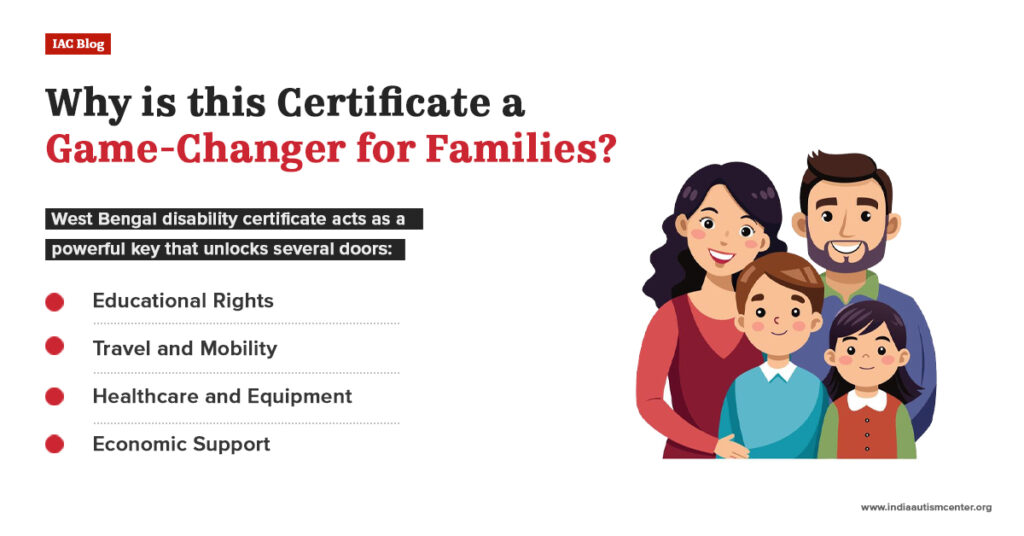
    Why is this Certificate a Game-Changer for Families?

    Why disability certificate is important benefits for families education travel healthcare financial support

    For many parents, the diagnosis of a condition like autism is just the beginning. The real challenge often lies in the costs of long-term therapy and education. A West Bengal disability certificate acts as a powerful key that unlocks several doors:

    • Educational Rights: Children with a certificate are eligible for 5% reservation in all government-aided higher educational institutions. They also get access to specialised scholarships to cover schooling costs.
    • Travel and Mobility: You can avail of up to 75% discount on Indian Railway tickets and significant concessions on state-run bus services across West Bengal.
    • Healthcare and Equipment: The certificate allows you to get free or subsidised assistive devices, such as high-quality hearing aids, wheelchairs, or specialised software for learning.
    • Economic Support: The state offers monthly pensions and tax exemptions for parents. It also provides a 4% reservation in government job vacancies.

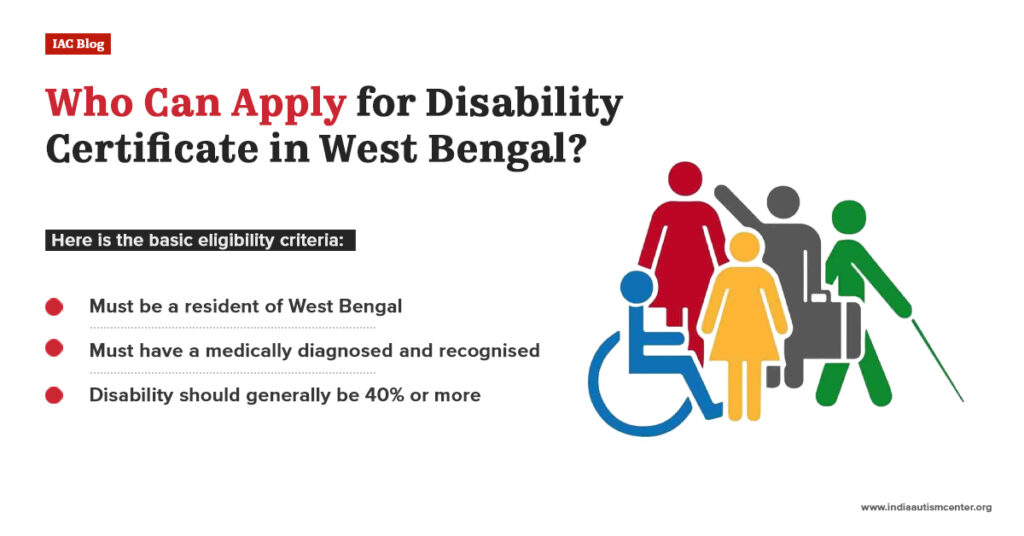
    Who Can Apply for Disability Certificate in West Bengal?

    Eligibility criteria for disability certificate West Bengal resident diagnosed disability 40 percent rule

    Anyone who can meet the basic eligibility criteria can easily apply for a West Bengal disability certificate. The process is inclusive in nature, and hence individuals across different age groups and conditions can access the support they need. However, there are a few eligibility criteria that must be met.

    Here is the basic eligibility criteria:

    • Must be a resident of West Bengal
    • Must have a medically diagnosed and recognised disability
    • Disability should generally be 40% or more to access most government benefits

    Children, adults and seniors can all apply, given that they meet the eligibility criteria.

    It is important to ensure that all medical documents are accurate and up to date, as proper documentation plays a crucial role in getting your West Bengal disability certificate approved without delays.

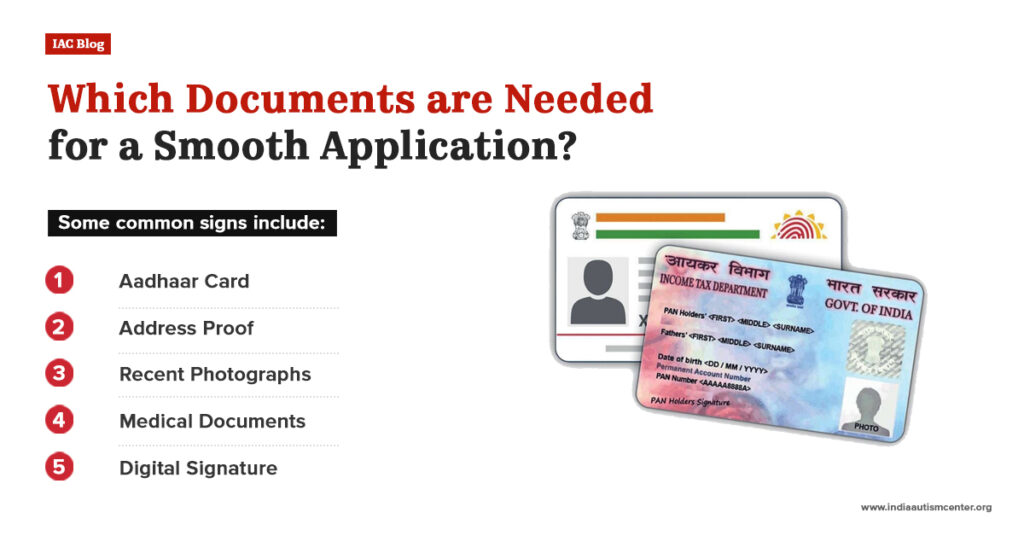
    Which Documents are Needed for a Smooth Application?

    Documents required for disability certificate application Aadhaar address proof photos medical records digital signature

    Before you begin the handicapped certificate online application in West Bengal, it is vital to have your digital folder ready. Having these documents prepared prevents the system from timing out while you search for papers:

    Mandatory Documents

    • Aadhaar Card: This is mandatory. Ensure the name and address are updated.
    • Address Proof: If the Aadhaar address is not local, use a Voter ID, Ration Card, or a recent Electricity Bill from your West Bengal residence.
    • Recent Photographs: A clear, colour passport-size photo of the applicant.
    • Medical Documents: Any previous prescriptions or reports from doctors. For parents, understanding what Level 3 autism is can help you organise your clinical reports to show the specific support needs of your child.
    • Digital Signature: A clear photo of the applicant’s signature or a thumb impression on a white piece of paper.

    Optional Documents:

    • Income certificate
    • Old disability certificate (if renewing)

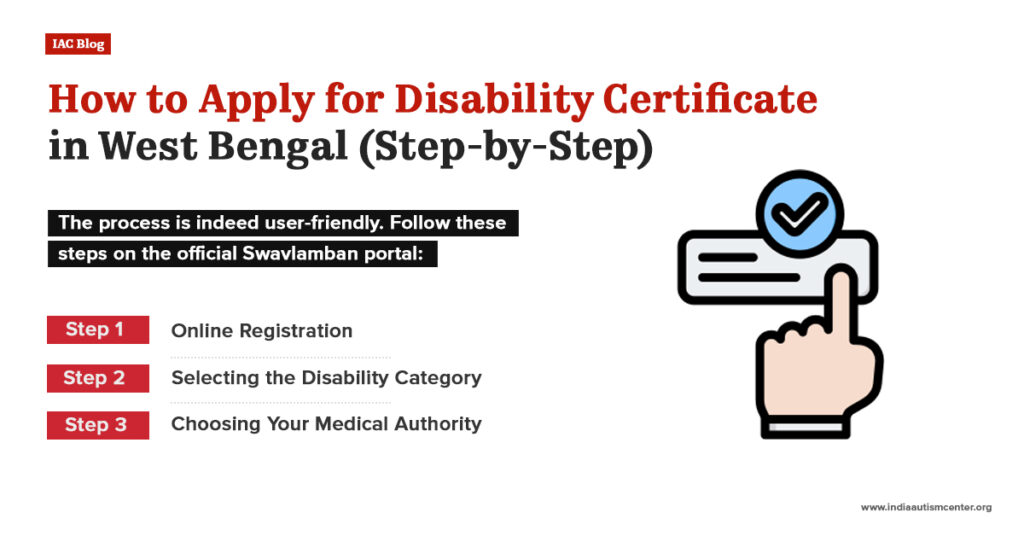
    How to Apply for Disability Certificate in West Bengal (Step-by-Step)

    Step by step process to apply for disability certificate West Bengal online registration category selection

    The process is indeed user-friendly. Follow these steps on the official Swavlamban portal:

    Step 1: Online Registration

    Go to the official UDID website and select “Apply for Disability Certificate.” You will be asked to fill in personal details. Always double-check the spelling of the names.

    Step 2: Selecting the Disability Category

    You first need to select the correct disability from the list of 21. For those with neurodevelopmental challenges, you would select “Autism Spectrum Disorder.” If you are a parent, participating in autism training for parents can be very helpful here, as it teaches you how to describe your child’s condition in the clinical terms that the portal requires.

    Step 3: Choosing Your Medical Authority

    The system will provide a drop-down menu of government hospitals. Choose the one closest to your permanent address. This is where you will go for the physical check-up.

    The Medical Board Visit: What to Expect?

    Medical board assessment for disability certificate India evaluation 40 percent rule process explained

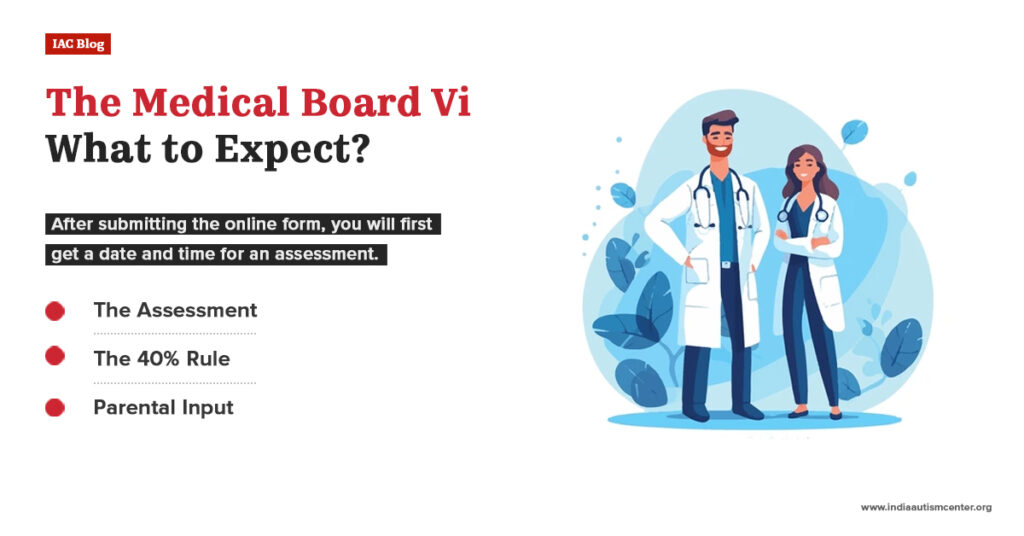
    The most important part of the “How to Apply for a Disability Certificate in West Bengal” journey is the hospital visit. After submitting the online form, you will first get a date and time for an assessment.

    • The Assessment: A board of doctors will meet the applicant. For physical disabilities, they check mobility. For autism, a psychiatrist or psychologist will interact with the child.
    • The 40% Rule: To qualify for most government benefits, the board must certify that the disability is at least 40%.
    • Parental Input: Be prepared to describe the child’s day-to-day life events. If the child has significant communication barriers, explaining what nonverbal autism is to the board helps them understand the depth of the challenge.

    How to Check Application Status of the Disability Certificate in West Bengal?

    How to check disability certificate application status online UDID West Bengal step by step guide

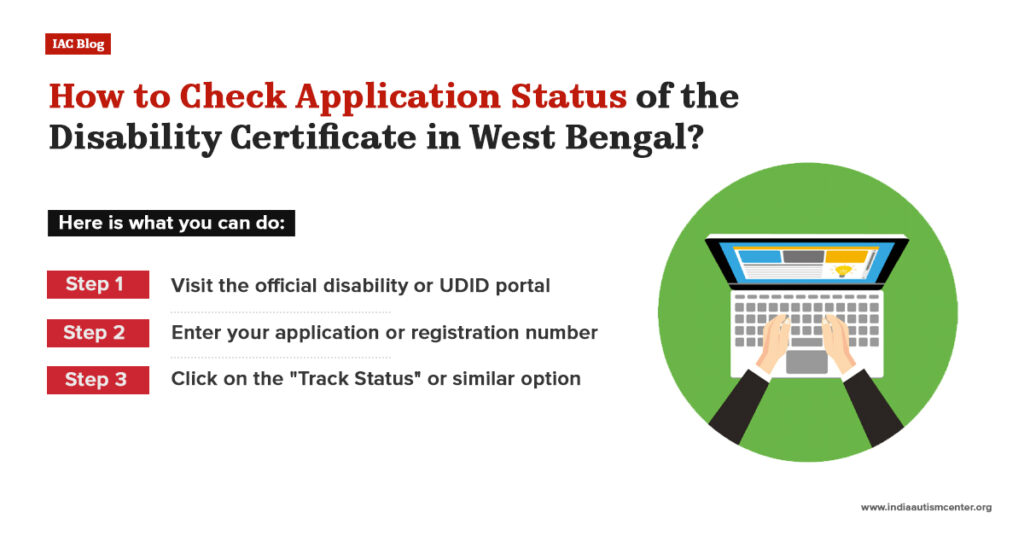
    Once the application is submitted, you can then track your disability certificate status in West Bengal online without visiting any office. This helps you stay updated and saves both time and effort.

    Here is what you can do:

    • Visit the official disability or UDID portal
    • Enter your application or registration number
    • Click on the “Track Status” or similar option

    You might see one of the following options:

    • Under Review: This signifies that the application is under processing
    • Approved: Your application is approved, and the certificate has been issued
    • Rejected: There may be an issue with documents or details

    Regularly checking your disability certificate status in West Bengal ensures you do not miss any updates, especially if further action or document submission is required from your side.

    How to Track and Download the Disability Certificate in West Bengal?

    Once the doctors approve the application at the hospital, the status is updated in the system. You can monitor this from your phone.

    • Check Status: Use the disability certificate status West Bengal feature on the portal by entering your enrollment number.
    • Download the e-Card: You do not have to wait for the physical card to arrive by mail. You can download a disability certificate in West Bengal as soon as it is approved. This digital version is 100% valid for immediate use in school admissions or for applying for the Manobik pension.

    Understanding Disability Percentage

    Disability percentage criteria India eligibility under 40 40 to 75 and above 75 benefits classification

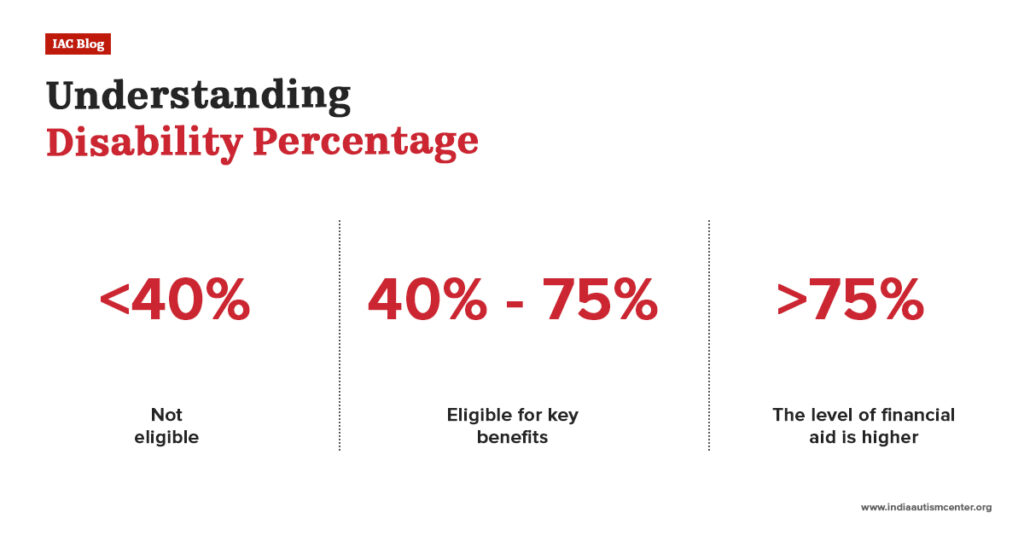
    The disability percentage plays an important role when it comes to determining the type and level of benefits you can receive through a disability certificate in West Bengal. It is assessed by a certified medical board. The assessment is based on medical reports, functional limitations, and overall impact on daily life.

    How It Affects Benefits:

    • Less than 40%: Here, usually the applicant is not eligible for most government schemes
    • 40% to 75%: Eligible for key benefits like pensions, education support, and concessions
    • Above 75%: The level of financial aid is comparatively higher, and additional support services are available

    For conditions like autism, the percentage is not based on visible symptoms alone. It focuses more on communication challenges, social interaction, and daily functioning abilities.

    What are the Benefits of a Disability Certificate in West Bengal?

    Benefits of disability certificate in West Bengal financial education jobs travel healthcare support

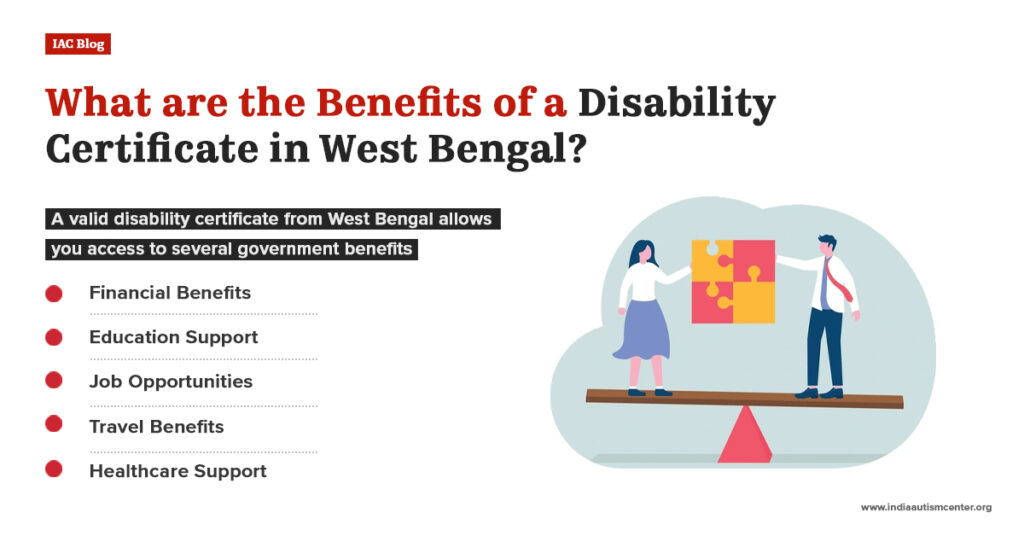
    A valid disability certificate from West Bengal allows you access to several government benefits, which can prove to be useful and can improve the quality of life for individuals with disabilities. Here are the benefits:

    CategoryBenefits Included
    Financial BenefitsMonthly disability pension, scholarships, and financial aid under government schemes
    Education SupportReserved seats, fee concessions, and inclusive education support
    Job OpportunitiesGovernment job reservation, skill training, and self-employment support
    Travel BenefitsRailway fare concessions, discounts on state bus services
    Healthcare SupportFree or subsidised treatment, access to assistive devices and therapies

    This table gives a quick overview, but each benefit may vary based on eligibility, disability percentage, and specific government schemes linked to your West Bengal disability certificate.

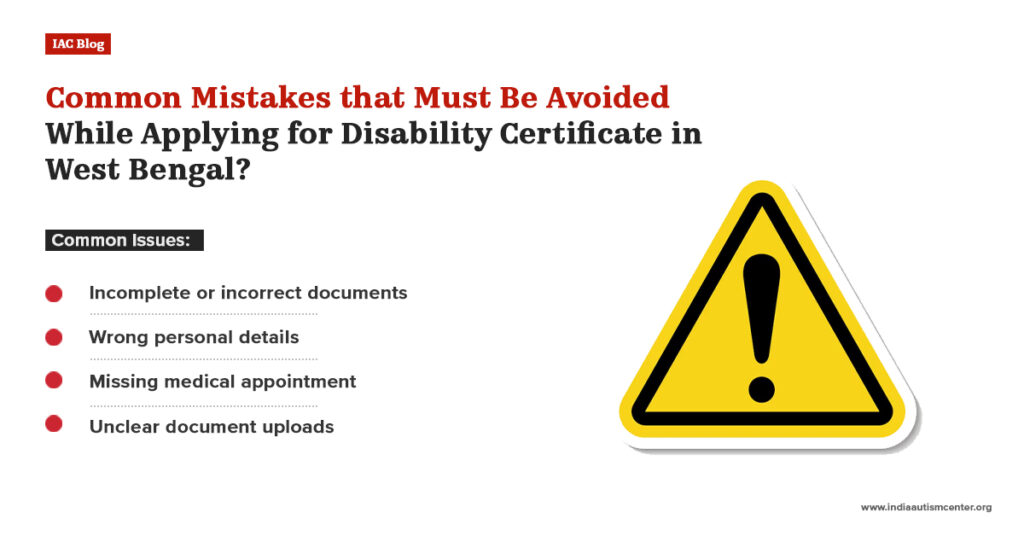
    Common Mistakes that Must Be Avoided While Applying for Disability Certificate in West Bengal?

    Common mistakes while applying disability certificate West Bengal incorrect documents missing appointment errors

    Many applications for a disability certificate in West Bengal get delayed due to small but avoidable errors. Paying attention to details can speed up the process and reduce rejection chances.

    Common Issues:

    • Submitting incomplete/ wrong documents or missing important medical records
    • Entering incorrect personal details like name, date of birth, or address
    • Missing the scheduled medical examination appointment
    • Uploading unclear scanned documents

    Carefully reviewing your application before submitting it and keeping track of updates can drastically improve the chances of approval.

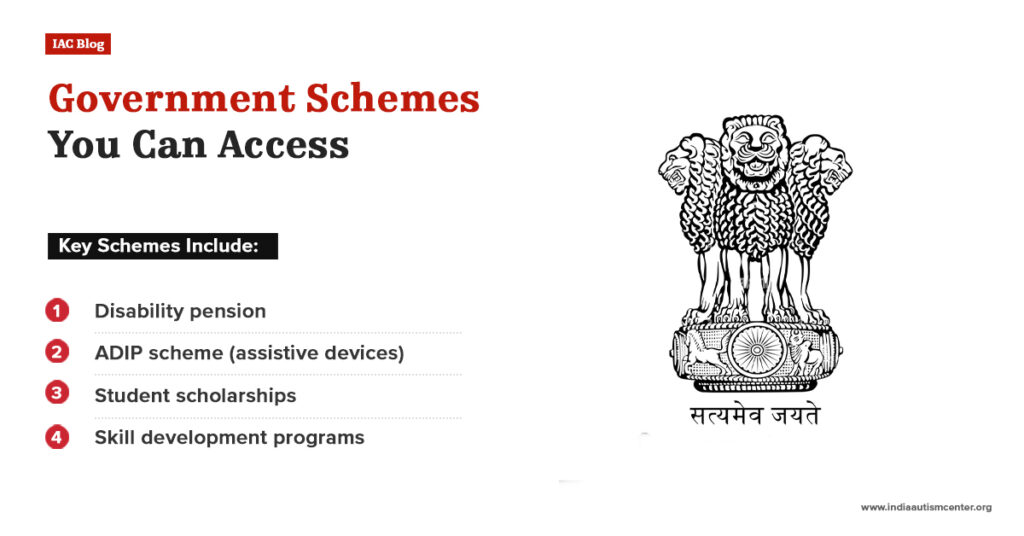
    Government Schemes You Can Access

    Government schemes for disability certificate holders in India pension ADIP scholarships skill development

    When you have a valid disability certificate from West Bengal, needy individuals can unlock several government schemes that aim to provide financial support, education opportunities, and rehabilitation services. Such schemes can improve the quality of life if used effectively.

    Key Schemes Include:

    • Disability pension for regular financial assistance
    • ADIP scheme for free or subsidised assistive devices
    • Scholarships for students who are disabled
    • Skill development programs to improve the employability and overall well-being of the individual.

    Conclusion

    Conclusion applying for disability certificate in West Bengal benefits healthcare education financial aid

    If you are considering applying for a disability certificate in West Bengal, remember that it is not just a formal step; it is a wise decision that parents or caregivers can take to secure the support and rights the individual with a disability deserves. While the process may seem elaborate and exhausting, it will be easier when you follow the given steps, along with proper submission of the documents.

    From financial assistance to education, healthcare, and job opportunities, the benefits which are linked to a West Bengal disability certificate aim to make a meaningful difference in everyday life.

    The earlier you apply for the scheme, the sooner you will be able to access the support systems available. For parents, especially those navigating developmental conditions like autism, early certification can open doors to timely intervention and structured care.

    Stay informed, stay organised, and also make sure to take that first step with compassion and confidence.

    Frequently Asked Questions

    How can I apply for disability certificate in West Bengal online?

    The application can be done easily through the official portal by registering on the portal, filling out the form, uploading the required documents, and attending a medical examination at a designated government hospital for verification.

    How to check disability certificate status in West Bengal online?

    Visit the official portal, then enter your application number, and track your disability certificate status in West Bengal to see whether it is under review, approved, or rejected.

    What documents are required for an online application for a handicapped certificate in West Bengal?

    You need identity proof, address proof, passport-size photographs, and valid medical reports or diagnosis certificates when completing the handicapped certificate online application process in West Bengal.

    What is the processing time for disability certificate in West Bengal?

    The processing of applications will usually take anywhere from 15 to 30 days for online applications, depending on document verification and medical assessment schedules at government hospitals.

    What happens if my disability certificate application is rejected?

    If your application is rejected, you can go ahead and review the reason, correct errors, update documents, and reapply for the disability certificate in West Bengal without significant difficulty.

    For expert insights, support services, and inclusive learning initiatives, visit the India Autism Center.

  • Understanding 21 Types of Disability and Where Autism Fits In

    Understanding 21 Types of Disability and Where Autism Fits In

    For parents as well as caregivers in India, understanding the special needs of a differently abled individual can often feel like walking through a maze without a map. Whether you are noticing certain developmental delays in your child or seeking support for any elderly family member, understanding the legal framework is the first step toward securing the right help.

    Here, the Rights of Persons with Disabilities (RPWD) Act can be very helpful. As of 2026, the RPWD Act recognises 21 types of disability, a significant leap from the 7 categories recognised previously. 

    As per the Census records of 2011, about 2.21% of the population in India is disabled, which roughly translates to 26 million. 

    Another important fact is that neurological and developmental conditions like autism are rising globally, with 1 in 31 children now diagnosed with autism spectrum disorder (ASD), as per recent global data. In India, awareness is still evolving, which makes understanding the 21 types of disability even more important.

    The RPWD Act ensures that individuals across different categories of disabilities are recognised, supported, and given equal opportunities in education, employment, and social participation.

    Today, we will explore the 21 types of disabilities and how this list ensures that every individual receives the dignity, education, and medical support they deserve.

    The Evolution of Disability Rights in India

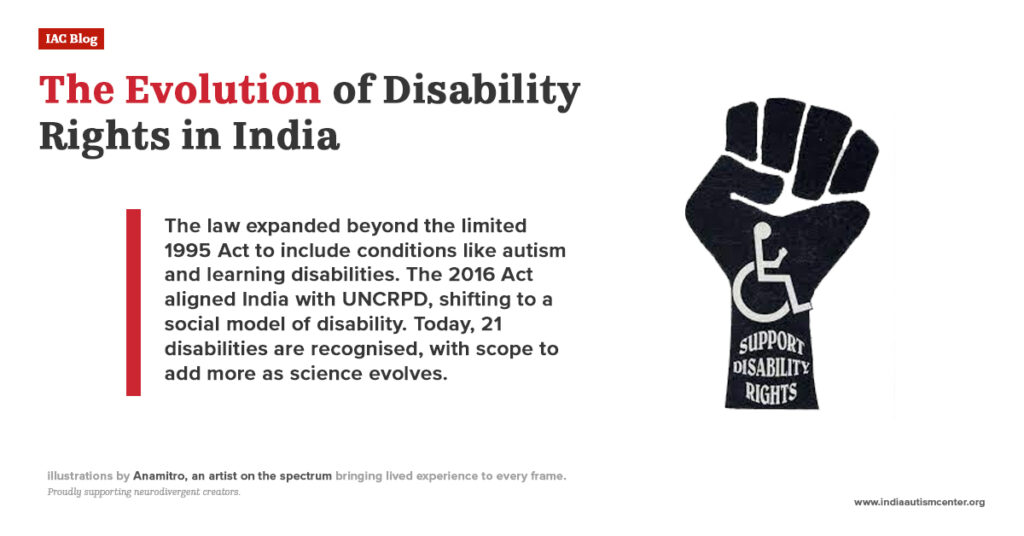
    Evolution of disability rights in India from 1995 Act to RPwD Act 2016 illustration

    Before we dive into the list of disabilities, it is helpful to understand why the law changed. The original 1995 Act was limited. It did not account for many “invisible” conditions like autism or specific learning disabilities.

    The 21 disabilities under the PWD Act 2016 (and its ongoing 2026 framework) were introduced to align India with the United Nations Convention on the Rights of Persons with Disabilities (UNCRPD). 

    This shift changed the definition of disability from a purely medical one to a “social model,” recognising that disability is the result of an individual’s impairment interacting with social and physical barriers.

    Today, the government recognises the many types of disability. Exactly 21, with a provision allowing the Central Government to add more as medical science evolves. This flexibility is crucial for emerging conditions and ensures no one is left behind.

    What Are the 21 Types of Disability?

    What are the 21 types of disability in India categories under RPwD Act explained

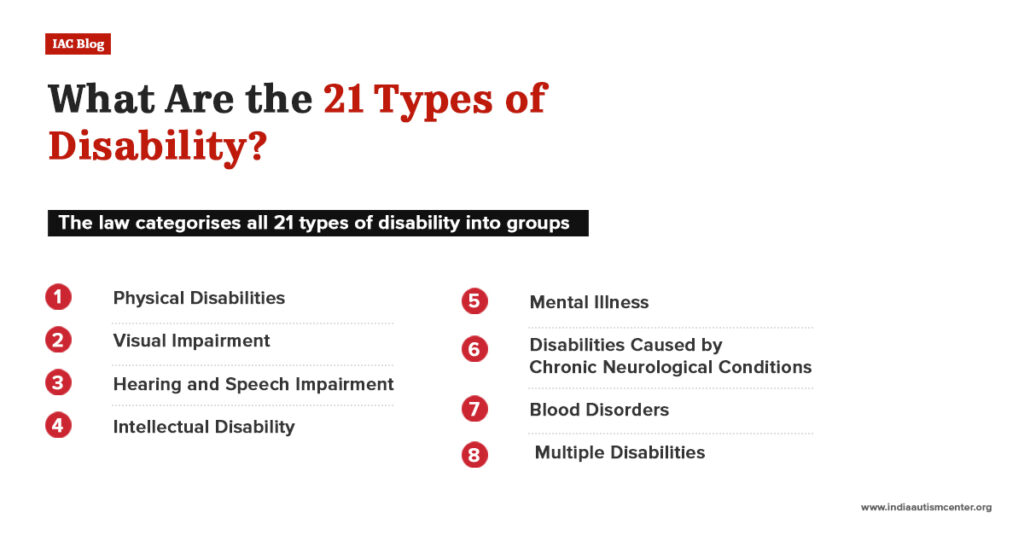
    The law categorises all 21 types of disability into groups such as physical, intellectual, and chronic neurological conditions. Below is a detailed look at the 21 types of disability in India.

    1. Physical Disabilities

    This is the broadest category and includes conditions that affect a person’s mobility or physical functions.

    • Locomotor Disability: This refers to a person’s inability to perform distinctive activities involving movement, including both movement of the person and movement of objects. It often stems from problems with the bones, joints, or muscles.
    • Leprosy Cured Persons: Many people do not realise that leprosy is still part of the categories of disabilities. Even if the infection is cured, the loss of sensation in hands or feet and physical deformities qualify an individual for support.
    • Cerebral Palsy: This is a non-progressive condition caused by brain damage before or during birth. It affects muscle coordination and can vary significantly in severity.
    • Dwarfism: It is a genetic or medical condition that results in a person being stuck at a height of 4 feet 10 inches (maximum).
    • Muscular Dystrophy: This is a group of genetic diseases that cause progressive weakness or even loss of muscle mass.
    • Acid Attack Victims: It is when a person becomes disfigured due to assaults involving acids. Under the Act, it is ensured that they receive specific medical and rehabilitative care.

    2. Visual Impairment

    • Blindness: It includes a complete or absolute absence of sight or visual acuity not exceeding 3/60 in the better eye, even after the best possible correction.
    • Low Vision: This is where a person has partial impairment of visual functioning, even after a corrective treatment; however, they can use vision for planning and performing tasks.

    3. Hearing and Speech Impairment

    • Deaf: This is when a person has about 70 dB hearing loss in speech frequencies.
    • Hard of Hearing: This is when a person has about 60 dB to 70 dB hearing loss in speech frequencies.
    • Speech and Language Disability: This includes conditions such as laryngectomy or aphasia that affect one or many components of speech and language due to either organic or neurological causes.

    4. Intellectual Disability

    This category is vital for parents to understand, as it covers conditions that affect learning and daily functioning.

    • Intellectual Disability: There are considerable limitations in intellectual functioning and everyday adaptive behaviour affecting independent living skills.
    • Specific Learning Disabilities (SLD): These are “invisible” disabilities. A child may seem to have a normal IQ, however they struggle with specific skills. This includes Dyslexia (reading), Dysgraphia (writing), and Dyscalculia (math).
    • Autism Spectrum Disorder: ASD is essentially a neurodevelopmental condition that is known to appear primarily in the first three years of life. It affects communication as well as social interaction. For instance, understanding what level 3 autism is is crucial for parents whose children require very substantial support.

    5. Mental Illness

    • Mental Illness: Unlike intellectual disability, this refers to a substantial disorder or disability when it comes to thinking, mood, perception, orientation, or memory. Mental illness broadly includes several conditions, such as schizophrenia or bipolar disorder, that impair a person’s ability to meet the everyday demands of life.

    6. Disabilities Caused by Chronic Neurological Conditions

    • Multiple Sclerosis: An inflammatory disease where the insulating covers of nerve cells in the brain or spinal cord are heavily damaged.
    • Parkinson’s Disease: It is a progressive disease of the nervous system. It is marked by tremor, muscular rigidity, and slow, imprecise movement.

    7. Blood Disorders

    • Haemophilia: A medical condition where the ability of the blood to clot is severely reduced.
    • Thalassemia: It is a blood disorder that is inherited. It causes your body to have less haemoglobin than the normal range.
    • Sickle Cell Disease: This is essentially a group of disorders. In this disorder, the red blood cells become misshapen or are unable to break down.

    8. Multiple Disabilities

    • Multiple Disabilities: This involves more than one of the above-specified disabilities, such as deaf-blindness. This is a complex category that requires highly specialised interventions.

    Why the Expansion to 21 Disabilities Matters?

    Earlier, only about seven conditions were recognised under the RPWD Act. This left many individuals excluded from legal protection, benefits, and social support. When the RPWD Act of 2016 was introduced, more disabilities and disorders were included in the list, bringing a more inclusive and realistic understanding of disability in India. 

    This shift helps people with different conditions, such as autism, learning disabilities, and blood disorders, to get the support they need. As a result, more individuals can now access education, government schemes, job reservations, and healthcare support. It also encourages early diagnosis and timely intervention. 

    Research shows that early intervention can improve developmental outcomes in children significantly, underscoring the importance of awareness and recognition of disabilities.

    What Are the Key Rights Provided Under the RPWD Act?

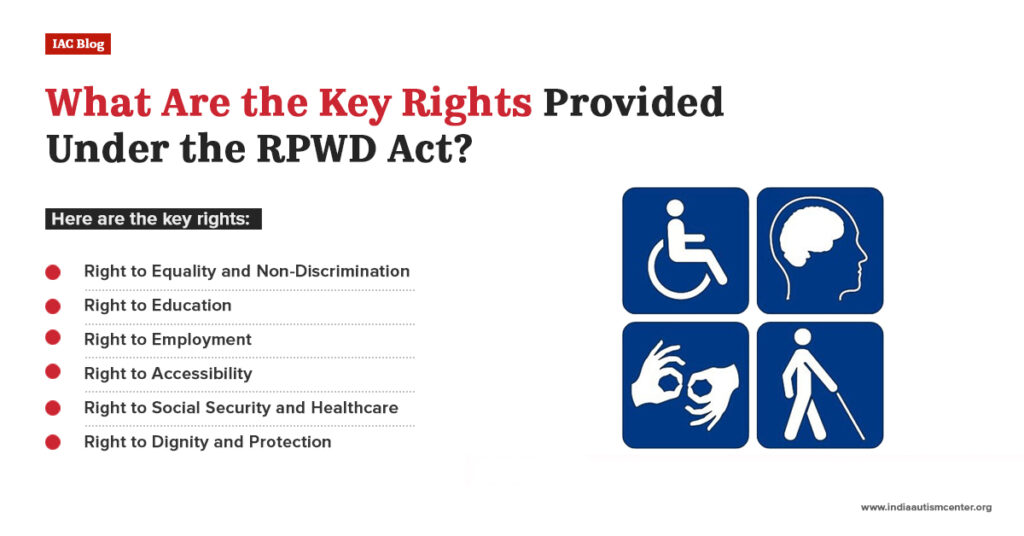
    Key rights under RPwD Act 2016 including equality education employment accessibility illustration

    The RPWD Act, 2016, ensures that individuals across all types of disability are treated with dignity, equality, and respect. It helps individuals to move beyond charity and focus on rights, inclusion, and empowerment. The Act creates a strong framework that supports individuals. Assistance is provided for education, employment, healthcare, and daily living. It is a great help for affected people, which helps them to participate fully in society.

    Here are the key rights explained:

    • Right to Equality and Non-Discrimination

    Every person with a disability has the full and complete right to be treated equally and protected from discrimination in all areas of life, including education, employment, and public services.

    • Right to Education

    Children with disabilities can now have full access to free and inclusive education. It is necessary for the schools to provide the necessary support in terms of trained teachers, assistive devices, and accessible infrastructure.

    • Right to Employment

    The RPWD Act mandates a 4% reservation in government jobs for persons who have the disabilities listed in the RPWD Act. It also encourages private-sector inclusion and equal-opportunity policies.

    • Right to Accessibility

    Public buildings, transportation, and digital platforms have to be made accessible. This ensures the disabled person can live an independent life.

    • Right to Social Security and Healthcare

    Individuals who are differently abled now also have access to financial assistance, rehabilitation services, insurance, and necessary healthcare facilities.

    • Right to Dignity and Protection

    The law protects people who are differently abled from abuse, violence, and exploitation, ensuring a safe and respectful environment.

    Together, these rights create a more inclusive and supportive ecosystem for persons with disabilities in India.

    Role of Early Diagnosis and Intervention

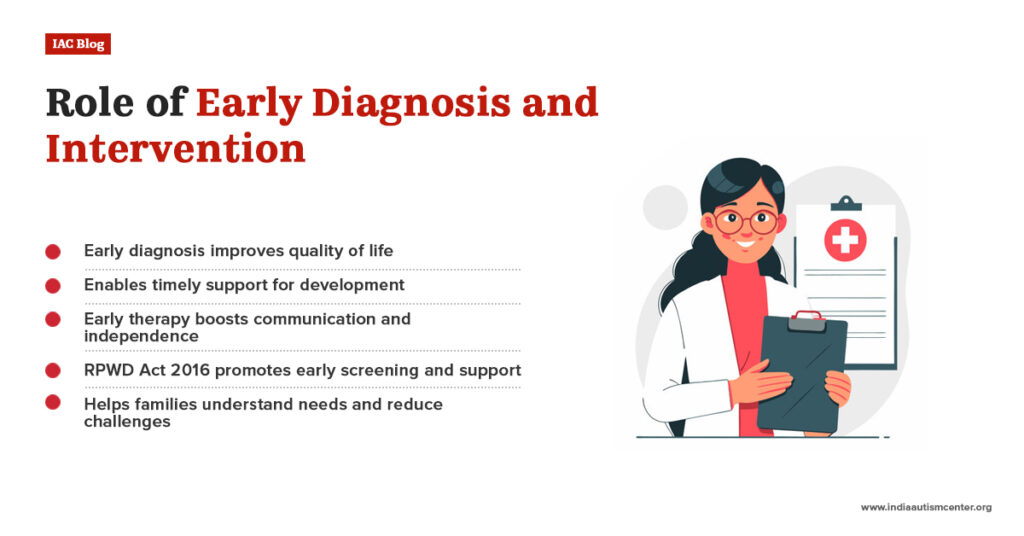
    Importance of early diagnosis and intervention for disabilities improving quality of life illustration

    Early diagnosis as well as early intervention play an important role in improving the quality of life for people across different types of disability. Identifying developmental delays or medical conditions early allows for support, which can significantly enhance a child’s physical, cognitive, and social development. 

    For conditions like autism, intellectual disability, or hearing impairment, early therapy and structured interventions can improve communication skills, learning ability, and independence.

    As per the RPWD Act, 2016, there is a strong emphasis on early screening and access to support services. It also helps families understand their child’s needs and reduces long-term challenges. 

    In simple terms, the earlier the support begins, the better the chances of leading a more independent and fulfilling life.

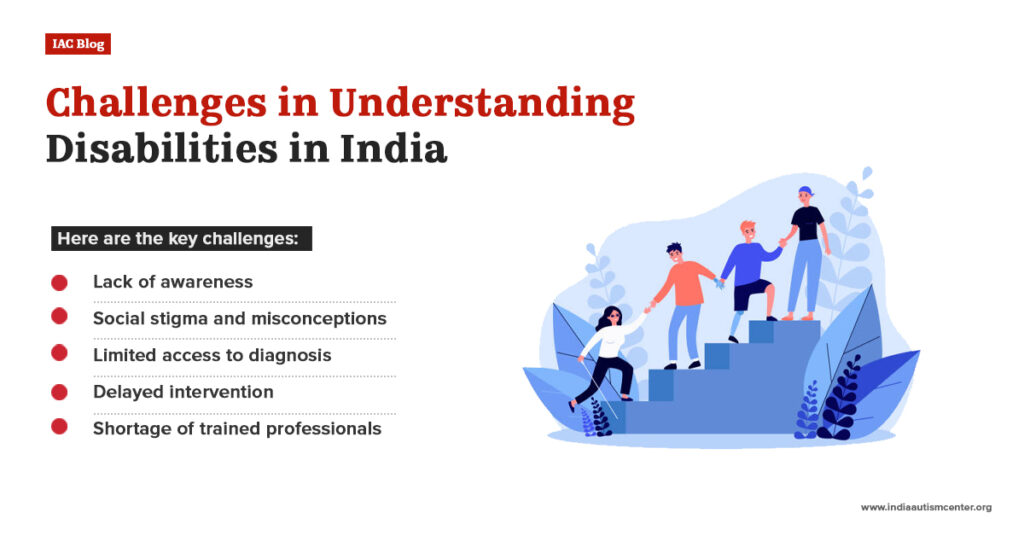
    Challenges in Understanding Disabilities in India

    Challenges in understanding disabilities in India including lack of awareness and stigma illustration

    Despite the progress made through the Rights of Persons with Disabilities Act, 2016, understanding the different types of disability in India remains a challenge. Many families still struggle with awareness, access, and acceptance, which delays proper support and intervention.

    Here are the key challenges:

    • Lack of awareness: Many people are still not completely aware of the 21 types of disability and their early signs.
    • Social stigma and misconceptions: Disabilities, especially mental and developmental conditions, are often misunderstood or hidden.
    • Limited access to diagnosis: Rural or semi-urban areas often face a shortage of specialists as well as screening facilities.
    • Delayed intervention: Late identification tends to significantly reduce the effectiveness of therapies and support.
    • Shortage of trained professionals: In India, there are not enough special educators, therapists, or psychologists.

    Addressing such gaps is essential to ensure on-time care, inclusion, and equal opportunities for every person who is differently abled.

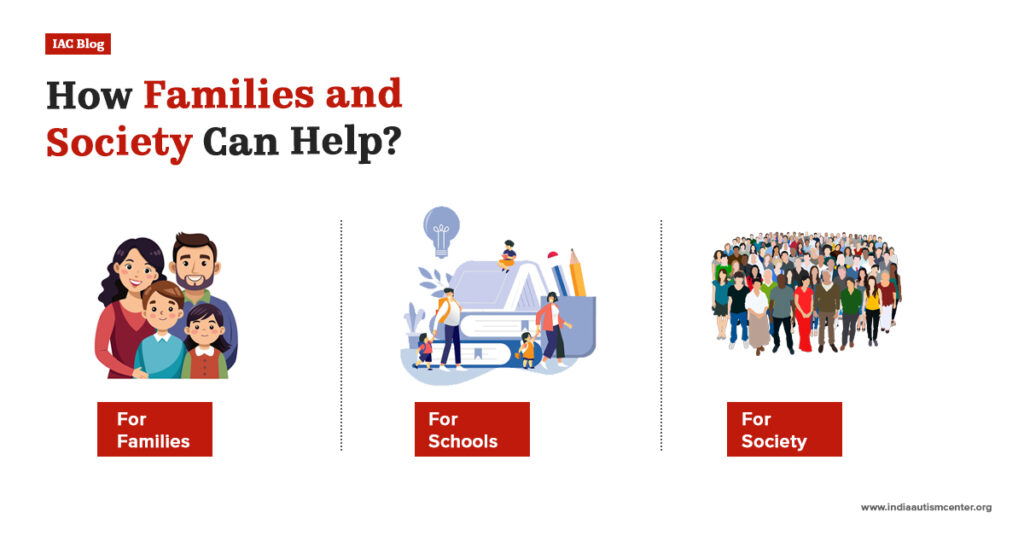
    How Families and Society Can Help?

    How families, schools, and society can support people with disabilities in India illustration

    Understanding the full list of disabilities is only the first step in providing proper support for differently-abled individuals. Real impact comes when families, schools, and society actively create an inclusive and supportive environment. The RPWD Act, 2016, provides a strong framework, but its success depends on its effective implementation at the ground level.

    For Families

    Families play the most important role in early identification and ongoing support. When families and caregivers are aware and involved, it can considerably improve outcomes for children across different types of disability.

    • Observe and identify early developmental signs such as delayed speech, lack of eye contact, as well as difficulty in movement.
    • Seek professional help early from doctors, therapists, or specialists without waiting or denying concerns.
    • Create a supportive and accepting home environment that encourages confidence and independence.
    • Stay informed and involved in therapies, education plans, and progress tracking.

    For Schools

    Schools are key to building inclusive communities and shaping a child’s future.

    • Promote inclusive education by integrating children with disabilities into mainstream classrooms.
    • Train teachers as well as the staff to understand different learning needs and disabilities.
    • Provide necessary support systems such as resource rooms, assistive tools, and individualised learning plans.

    For Society

    A more inclusive society benefits everyone and reduces barriers.

    • Spread awareness to reduce stigma around disabilities through open conversations.
    • Support accessibility initiatives in public spaces, workplaces, and transport.
    • Encourage equal opportunities in employment, education, and social participation.

    Conclusion

    Conclusion on disability awareness under RPwD Act showing wheelchair user with protection symbol

    Understanding the types of disability is about more than just legal definitions; it is about recognising the diverse ways people experience the world. Whether it is a visible physical impairment or an invisible neurological condition like Autism or a Specific Learning Disability, the RPWD Act ensures that every citizen is protected.

    As a parent or caregiver, being informed is your greatest strength. Knowing what the 21 types of disabilities are allows you to advocate for your child’s rights in schools, hospitals, and the workplace. 

    The journey sure is challenging; however, with the current legal framework and the complete support of dedicated centres, a life of dignity and independence is truly possible for everyone.

    Frequently Asked Questions

    How many types of disability are recognised in India as of 2026?

    Under the RPWD Act 2026, 21 types of disability are recognised. This was a significant expansion from the prior list of 7 categories. It thus ensures a more inclusive support for individuals who have different physical and neurological conditions.

    Are “invisible” disabilities like Autism included in the 21 types?

    Yes, Autism Spectrum Disorder (ASD) is one of the key categories of disabilities recognised. This ensures that children who may look physically “typical” but struggle with social communication receive the necessary therapy and educational accommodations.

    Why is it important to know the different types of disabilities?

    Being aware of the different types of disabilities helps parents as well as caregivers to identify specific symptoms early. It also determines eligibility for government schemes, educational reservations, and financial support tailored to each condition.

    Are acid attack victims considered disabled under Indian law?

    Yes, to ensure access to restorative surgery and rehabilitation, acid attack victims are included in the list of disabilities under the locomotor category.

    How many types of disability involve the blood?

    Three specific blood disorders are included: Thalassemia, Haemophilia, and Sickle Cell Disease. These were added to the 21 disabilities under the PWD Act 2016 due to their chronic and debilitating nature.

    For expert insights, support services, and inclusive learning initiatives, visit the India Autism Center.

  • What is Nonverbal Autism? Everything Parents Need to Know

    What is Nonverbal Autism? Everything Parents Need to Know

    Autism is a spectrum, and every individual experiences it differently. One of the most misunderstood aspects of autism is nonverbal autism. It is a condition where individuals have limited or no spoken language but still communicate in other meaningful ways.

    In fact, out of the total number of individuals on the autism spectrum, about 30% of the children are minimally verbal. However, there can still be considerable improvement in speech and language if intervention is provided early.

    While the absence of speech can feel overwhelming, understanding the nuances of autism and nonverbal communication is the first step toward unlocking your child’s potential.

    Today, we are looking deeply into the meaning, symptoms, causes, and supportive methods that can help a nonverbal individual lead a fulfilling life.

    What is Nonverbal Autism?

    Overview of nonverbal autism and how individuals communicate without speech.

    When parents ask, “What is nonverbal autism?”, they are usually looking for a clinical definition. In reality, nonverbal autism is not a separate diagnosis but a specific presentation of Autism Spectrum Disorder (ASD). An individual with nonverbal autism may not use words at all, or they might use a few isolated words without being able to string them into meaningful sentences.

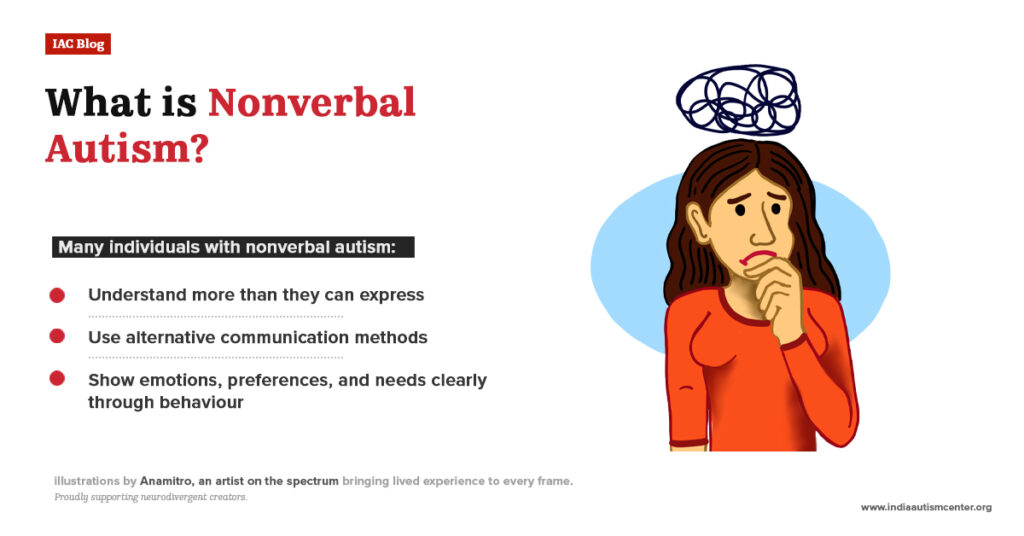
    However, this does not mean silence or lack of understanding. Many individuals with nonverbal autism:

    • Understand more than they can express
    • Use alternative communication methods
    • Show emotions, preferences, and needs clearly through behaviour

    The key to understanding what nonverbal autism is recognising that communication exists in many forms beyond speech.

    Autism vs Nonverbal Learning Disorder: How Do They Differ?

    difference between autism and nonverbal learning disorder communication vs cognitive traits

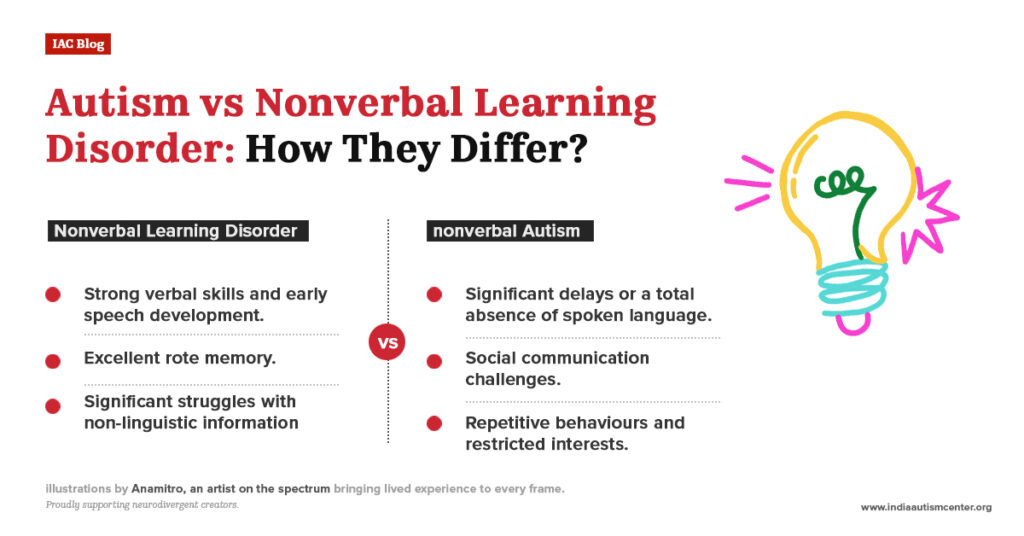
    The two concepts of autism and nonverbal learning disorder can be quite confusing. While the names are strikingly similar, the profiles of these two conditions are nearly opposites.

    Nonverbal Learning Disorder (NVLD) is characterised by:

    • Strong verbal skills and early speech development.
    • Excellent rote memory.
    • Significant struggles with non-linguistic information, such as visual-spatial patterns, mathematics, and reading social cues (facial expressions and body language).

    In contrast, nonverbal autism involves:

    • Significant delays or a total absence of spoken language.
    • Social communication challenges.
    • Repetitive behaviours and restricted interests.

    While both require specialised educational support, the methods for teaching a student with nonverbal autism focus heavily on building a communication system from the ground up. In contrast, NVLD support focuses on helping a verbal student navigate physical space and social nuances.

    What Are the Most Common Signs and Symptoms of Nonverbal Autism?

    Visual list of behavioral and communication symptoms in nonverbal autism.

    Early intervention is the “gold standard” for improving outcomes. Knowing the signs of nonverbal autism allows parents to seek support during the critical years of brain plasticity.

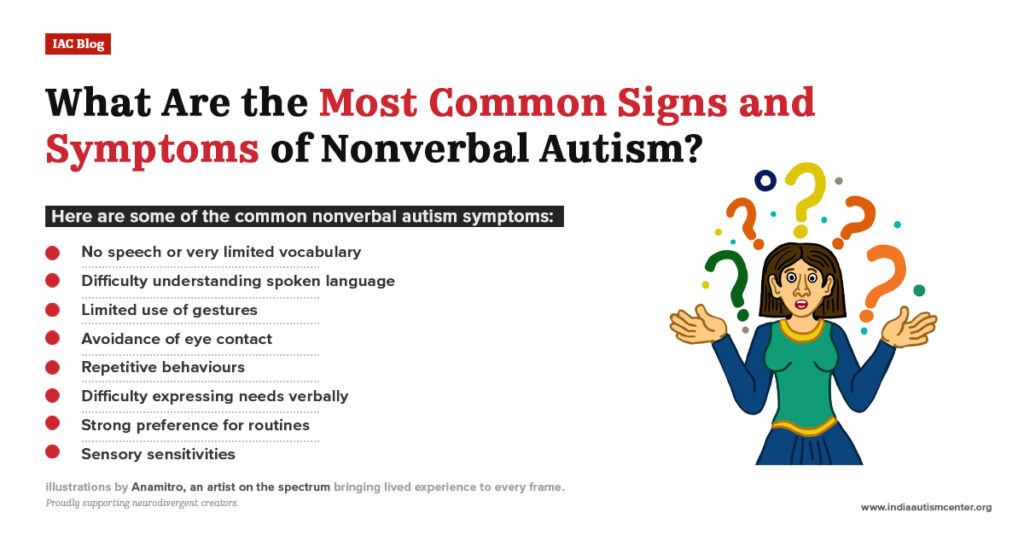
    Here are some of the common nonverbal autism symptoms:

    • No speech or very limited vocabulary: A child may not speak at all or may repeat a few words without meaningful use. For example, they might echo phrases but not use them to communicate needs.
    • Difficulty understanding spoken language: Difficulty in understanding the spoken language.
    • Limited use of gestures: They may not point at objects, wave goodbye, or answer yes or no with a nod. This reduces their ability to communicate basic needs.
    • Avoidance of eye contact: Eye contact may feel uncomfortable or overwhelming, making social interaction harder.
    • Repetitive behaviours: Actions such as hand-flapping, rocking, or spinning objects may help them regulate their emotions or sensory input.
    • Difficulty expressing needs verbally: Instead of directly asking for water, a child might cry, pull a caregiver, or become agitated.
    • Strong preference for routines: When there is a change in routine, there is distress because predictability provides comfort.
    • Sensory sensitivities: Sounds, lights, textures, or smells may feel overwhelming or painful.

    What Are the Common Early Signs of Nonverbal Autism in Toddlers?

    Toddler showing common early signs like lack of response and communication delays.

    Early signs of nonverbal autism can appear before the age of three. Moreover, about 40-70% children who have autism spectrum disorder show delayed speech and language development. 

    Hence, understanding as well as identifying the signs of nonverbal autism early is crucial because early intervention improves communication skills and overall development. Many parents notice subtle differences in how their child interacts, plays, and responds to others.

    Early signs of nonverbal autism that parents should look out for:

    • No babbling or limited or absent sound-making
    • Not responding to their name, even when called consistently
    • Lack of pointing or showing different objects
    • Less or not interested in social interaction
    • Difficulty imitating sounds or actions

    Recognising these early signs of nonverbal autism allows families to seek professional guidance sooner.

    What Causes Nonverbal Autism?

    Causes of nonverbal autism neurological factors motor planning apraxia genetics

    The question of what causes nonverbal autism is one that researchers are working tirelessly to answer. In 2026, the consensus is that there is no single “autism gene.” Instead, it is a combination of environmental and genetic factors that can overall influence brain development during pregnancy as well as early infancy.

    1. Neurological Factors

    Studies using functional MRI (fMRI) are known to show that in nonverbal autistic individuals, Broca’s area, the part of the brain that is primarily responsible for speech production, may function differently. 

    There may be “under-connectivity” between the brain areas that perceive sound and those that control the muscles of the mouth.

    2. Motor Planning and Apraxia

    Sometimes, the cause isn’t a lack of language understanding but a “motor planning” issue. Conditions like Childhood Apraxia of Speech often overlap with autism. 

    In these cases, the child’s brain knows the word “Mama,” but the message gets scrambled on the way to the lips and tongue. This is why nonverbal speech therapy programs for autism often include physical exercises for the mouth.

    3. Genetic Predispositions

    Although not every child with autism necessarily has a family history, genetics can play a massive role. Certain rare genetic mutations are more common in nonverbal individuals. Understanding the biological roots helps remove the stigma and the guilt that parents often feel. This helps to reinforce that autism is a natural neurological variation.

    The Nonverbal Autism Life: What to Expect in Adulthood?

    Nonverbal autism adulthood life support employment and independent living examples

    One of the deepest anxieties for parents is the nonverbal autism life as an adult. Parents often wonder, “What happens when I am no longer here to advocate for them?”

    It is important to emphasise that being nonverbal does not inherently reduce a person’s life expectancy. However, the life of nonverbal autism can be affected by secondary factors. 

    For example, if an individual cannot communicate that they are in pain, a medical condition such as a tooth infection or appendicitis might go untreated longer than it would in a verbal person. This is why teaching functional communication is literally a matter of safety.

    Nonverbal Autism in Adults

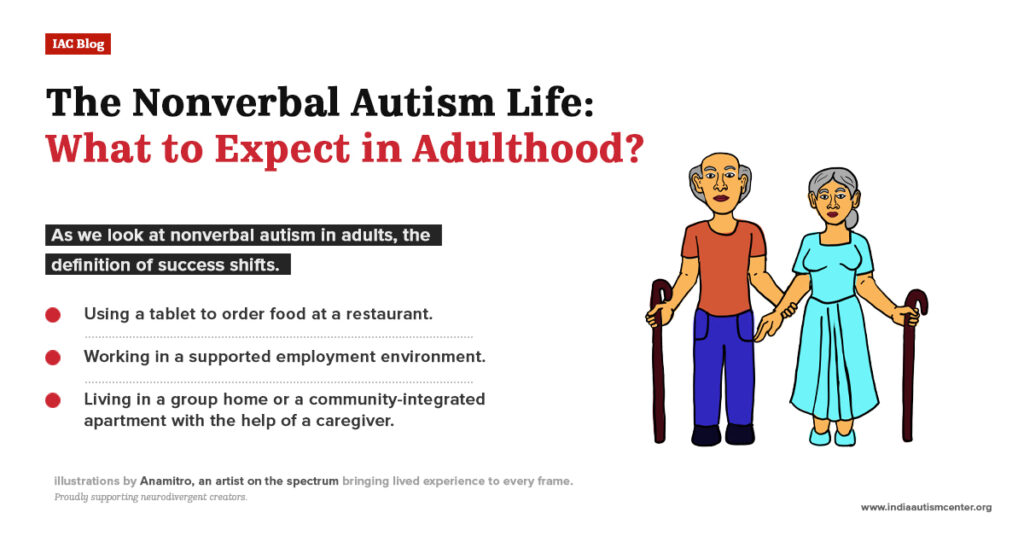
    As we look at nonverbal autism in adults, the definition of success shifts. For an adult, success might mean:

    • Using a tablet to order food at a restaurant.
    • Working in a supported employment environment.
    • Living in a group home or a community-integrated apartment with the help of a caregiver.

    Can Nonverbal Autism Be Cured?

    Illustration explaining autism is not curable but communication and quality of life can improve.

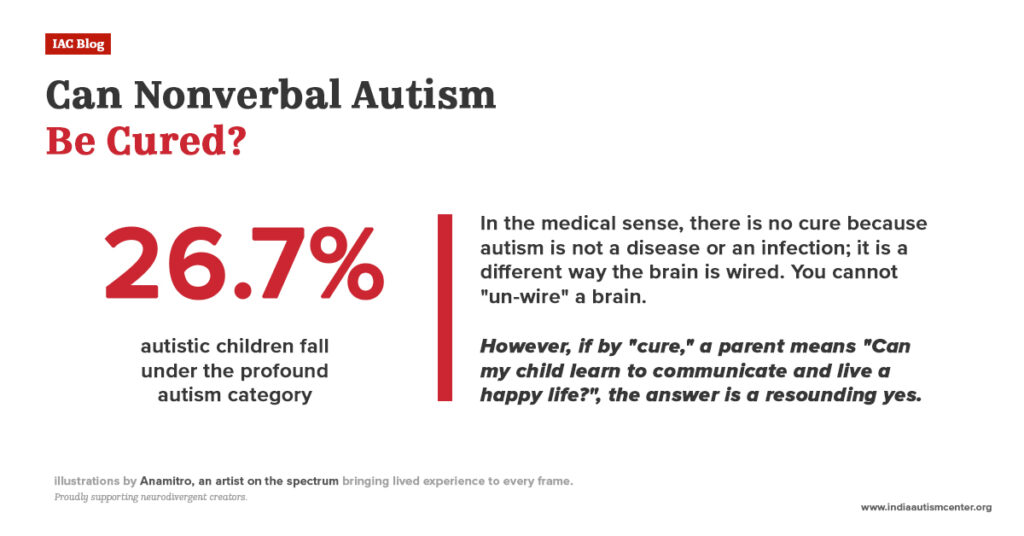
    It has been found in a study that26.7% autistic children fall under the profound autism category, which includes nonverbal autism as well. Hence, the question “Can nonverbal autism be cured?” is controversial. In the medical sense, there is no cure because autism is not a disease or an infection; it is a different way the brain is wired. You cannot “un-wire” a brain.

    However, if by “cure,” a parent means “Can my child learn to communicate and live a happy life?”, the answer is a resounding yes. Through intensive speech therapy, autism nonverbal and behavioural interventions, many children who were nonverbal at age four gain significant speech by age eight. 

    For those who remain nonverbal, the goal is not to “fix” them but to provide them with the tools to interact with a primarily verbal world.

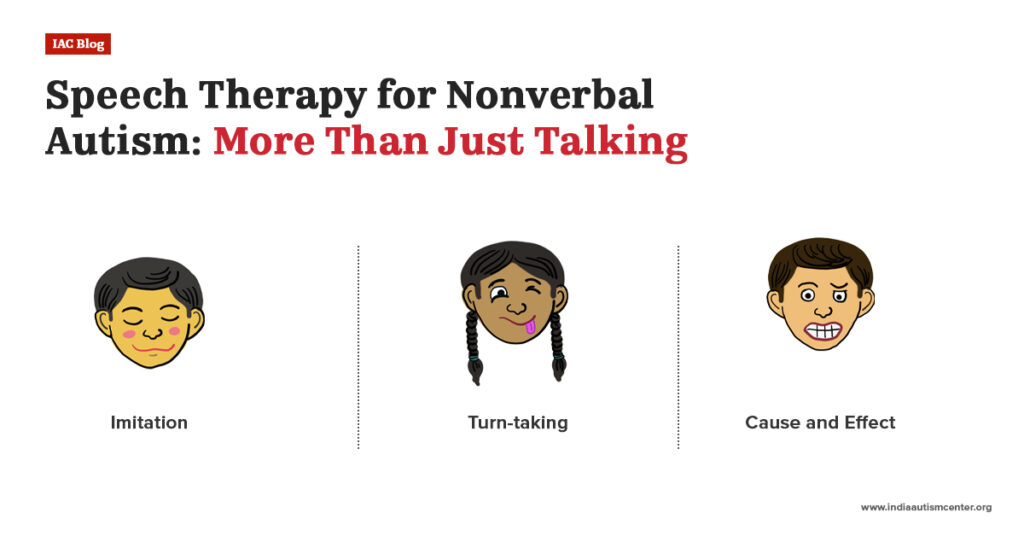
    Speech Therapy for Nonverbal Autism: More Than Just Talking

    Speech therapy techniques for nonverbal autism including imitation turn taking and cause effect

    When people hear “speech therapy,” they often imagine a child repeating words in front of a mirror. However, speech therapy for nonverbal autism is much broader. A skilled Speech-Language Pathologist (SLP) focuses on the “foundations” of communication.

    Before a child can talk, they must master:

    • Imitation: The ability to copy a movement or a sound.
    • Turn-taking: The understanding that communication is a “back and forth” exchange.
    • Cause and Effect: Realising that “If I push this button, a sound happens,” or “If I hand Mom this picture, I get a cookie.”

    What Are the Effective Methods For Teaching A Child With Nonverbal Autism?

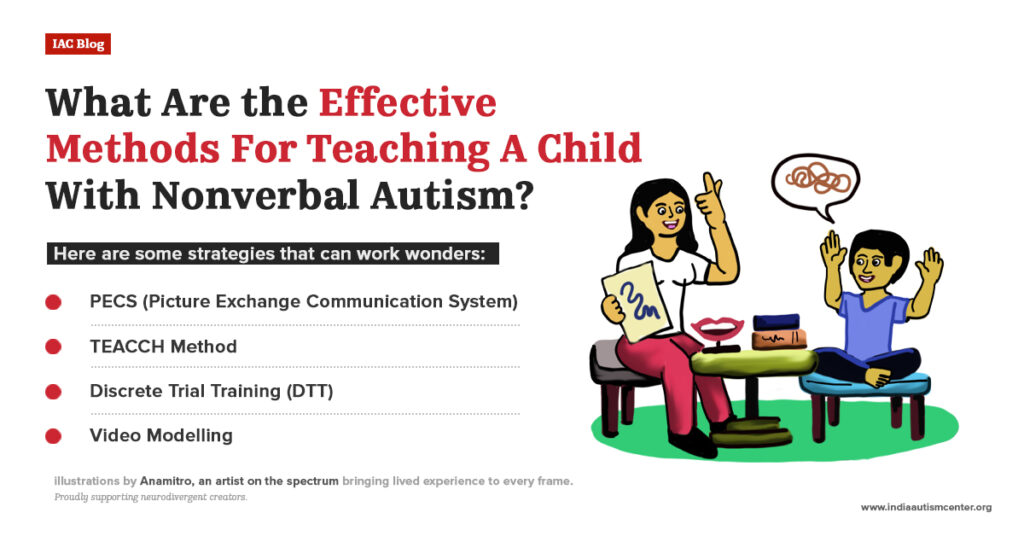
    Effective teaching methods for nonverbal autism PECS TEACCH DTT and video modeling

    When it comes to teaching a student with nonverbal autism, a structured, visual, and consistent approach is required. Traditional teaching methods may not always work, so adapting strategies to match the child’s communication style is essential for better learning outcomes.

    Here are some strategies that can work wonders:

    1. Picture Exchange Communication System (PECS): This involves the student handing a picture of an item to a teacher to receive that item. It teaches the power of initiation.

    2. TEACCH Method: This emphasises a structured environment with clear visual boundaries. For a nonverbal student, knowing exactly where the “work zone” ends and the “play zone” begins reduces anxiety.

    3. Discrete Trial Training (DTT): Breaking down huge or complex skills into tiny, manageable steps and using positive reinforcement to encourage progress.

    4. Video Modelling: Showing a video of a peer performing a task (like washing hands) can be more effective than verbal instructions for a nonverbal learner.

    How Does Sign Language For Nonverbal Autism Help?

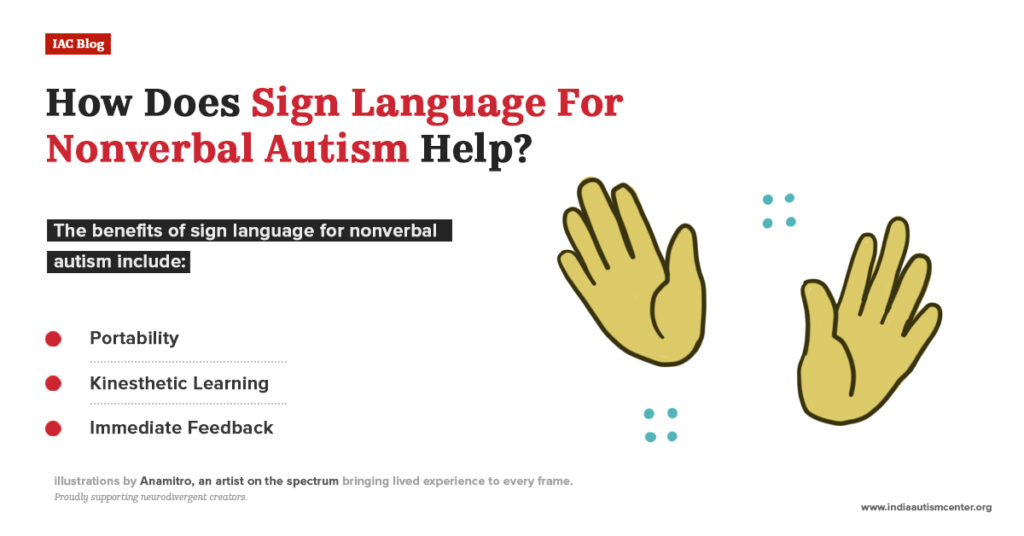
    Sign language communication benefits for nonverbal autism including learning and feedback

    Sign language for nonverbal autism provides a simple and effective way to communicate without speech. It is especially useful for children who can imitate movements and benefit from visual learning methods.

    The benefits of sign language for nonverbal autism include:

    • Portability: You always have your hands with you; you don’t need a battery-operated device.
    • Kinesthetic Learning: The physical movement of signing helps reinforce the meaning of the word in the brain.
    • Immediate Feedback: A parent can gently guide a child’s hands to form the sign, providing physical prompts that aren’t possible with vocal speech.

    Even if a child learns only five basic signs (Eat, Drink, More, Help, All Done), it can drastically reduce the number of behavioural meltdowns caused by an inability to express basic needs.

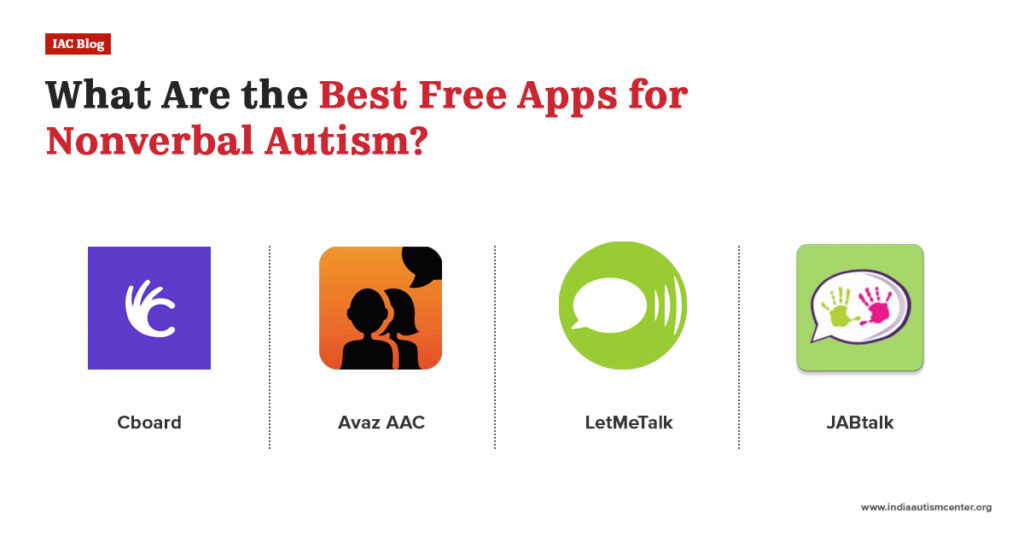
    What Are the Best Free Apps for Nonverbal Autism?

    Best AAC apps for nonverbal autism Cboard Avaz AAC LetMeTalk JABtalk

    Free apps for nonverbal autism provide accessible communication tools that can be used at home and in school. These apps help children express their needs using pictures, symbols, and voice output.

    Some of the most well-known free apps that can considerably help include:

    • Cboard: Simple and easy-to-use communication tool
    • Avaz AAC: Designed for autism with multilingual support
    • LetMeTalk: Works offline with picture-based communication
    • JABtalk: Customizable for individual needs

    By introducing these free apps alongside early speech and language therapy for nonverbal autism, parents can give their child a sense of agency and control over their environment.

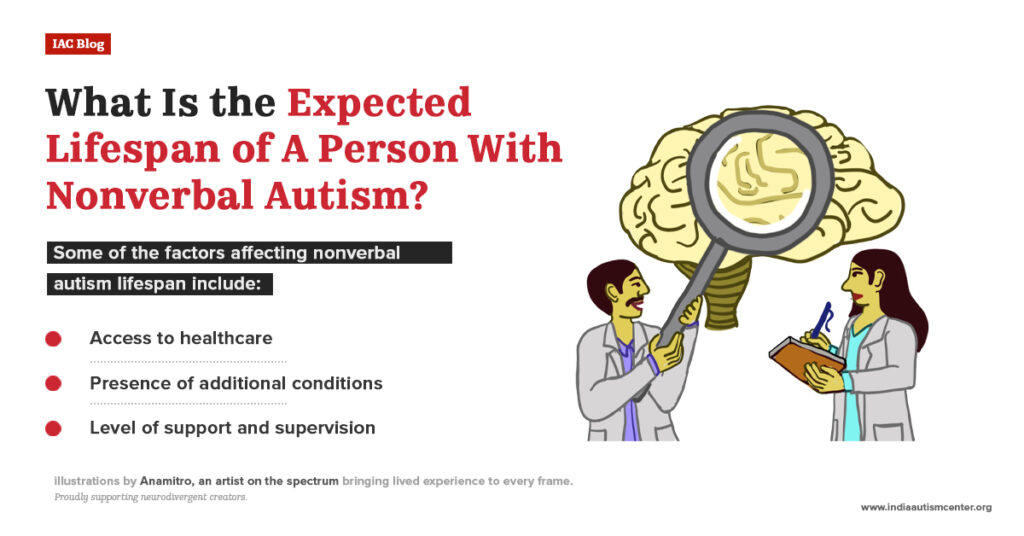
    What Is the Expected Lifespan of A Person With Nonverbal Autism?

    Doctors discussing factors like healthcare access, conditions, and supervision affecting lifespan.

    The nonverbal autism lifespan is generally similar to that of the general population. Autism itself does not shorten life expectancy, but overall health and support systems can influence long-term outcomes.

    Some of the factors affecting nonverbal autism lifespan include:

    • Access to healthcare
    • Presence of additional conditions
    • Level of support and supervision

    Parents need to understand that the quality of life matters as much as life expectancy. Hence, proper and timely support is what makes all the difference.

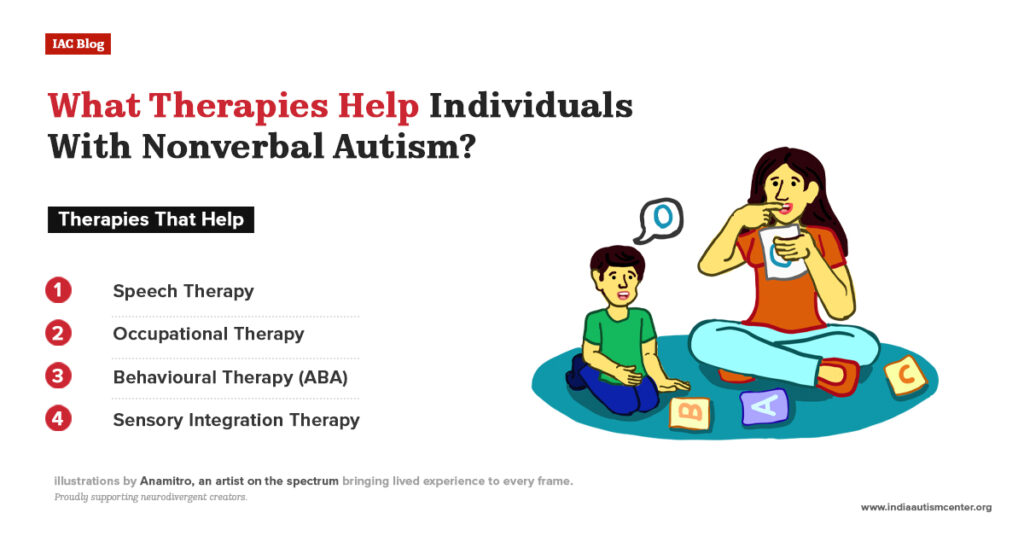
    What Therapies Help Individuals With Nonverbal Autism?

    Child receiving different therapies including speech, occupational, behavioral, and sensory integration.

    Different therapies support communication, behaviour, and daily living skills. A combination of therapies is often the most effective approach. Here are the autism therapies that can be of great help:

    1. Speech Therapy: It primarily focuses on communication methods

    2. Occupational Therapy: This helps to improve daily skills as well as sensory processing

    3. Behavioural Therapy (ABA): This is very important as it helps to encourage positive behaviours

    4. Sensory Integration Therapy: It helps manage sensory sensitivities

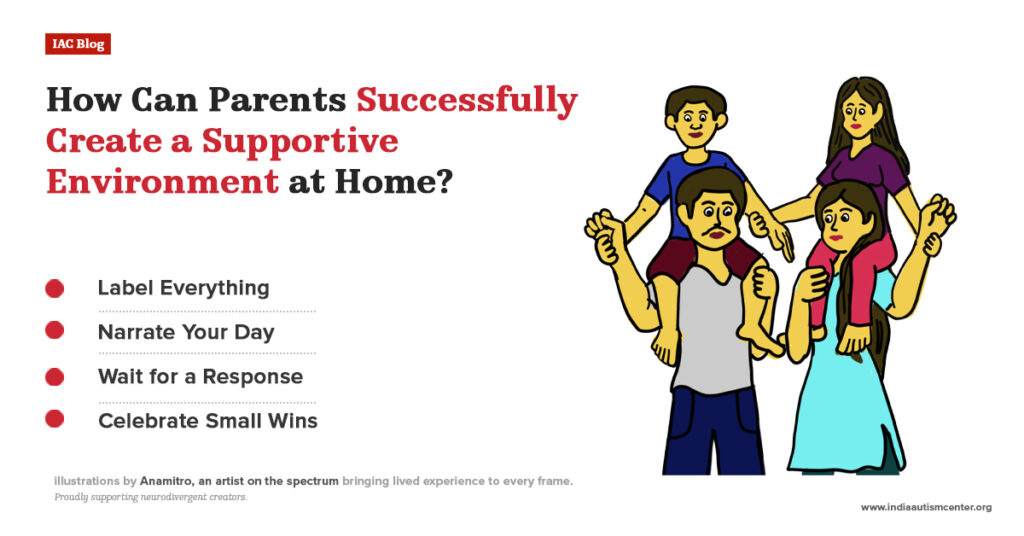
    How Can Parents Successfully Create a Supportive Environment at Home?

    Family using strategies like labeling, narration, and encouragement to support a nonverbal autistic child.

    For a child with autism and nonverbal communication needs, the home should be a “communication-rich” zone. This doesn’t mean talking non-stop; it means making language visible.

    • Label Everything: Put a picture and a word on the toy bin, the pantry, and the bedroom door.
    • Narrate Your Day: Even if the child doesn’t respond, say what you are doing. “I am pouring the milk. The milk is cold.” This builds their receptive vocabulary.
    • Wait for a Response: After asking a question, count to ten in your head. Nonverbal brains often need extra time to process information and formulate a physical or gestural response.
    • Celebrate Small Wins: If your child makes a new sound or uses a gesture they’ve never used before, acknowledge it with enthusiasm.

    Conclusion

    Illustration highlighting that children with nonverbal autism communicate through alternative meaningful ways.

    If you are beginning to explore what nonverbal autism is, remember that a lack of speech is not a lack of soul. Your child has thoughts, preferences, and a unique personality. 

    They may communicate through the way they lean into your hug, the way they light up when they see their favourite toy, or the way they use a tablet to tell you they love you. The nonverbal autism lifespan is a journey of constant discovery. 

    With the right combination of awareness, intervention, therapy, assistive technology, and unconditional love, the “wall” of silence can become a window and can help to create a beautiful, different way of experiencing the world. 

    Stay patient, stay curious, and never stop listening to what your child is telling you, even when they aren’t using words.

    Frequently Asked Questions

    What is nonverbal autism in simple terms?

    Nonverbal autism essentially refers to individuals on the autism spectrum who do not generally use spoken language or have very limited speech. However, they still communicate using gestures, facial expressions, sounds, or tools like communication apps and picture boards to express their needs and emotions.

    What causes nonverbal autism?

    A combination of genetic, neurological, and developmental factors is the main cause of nonverbal autism. Differences in brain development, especially in language areas, also play a big role. There is no single cause, and it is not linked to vaccines or parenting styles.

    How do nonverbal autistic individuals normally communicate?

    Children with nonverbal autism tend to communicate through different ways, such as gestures, body language, facial expressions, eye gaze, sounds, and behaviours. Some also use tools such as picture boards, communication apps, or sign language to explain their needs, preferences, or emotions more effectively.

    What are the early signs of nonverbal autism?

    Early signs include a lack of babbling, failing to respond when their name is called, limited eye contact, no pointing or gestures, and reduced or no interest in social interaction. Such signs tend to appear before age three; a child should be evaluated early for better outcomes.

    Are there free apps for nonverbal communication in autism?

    Yes, there are several free apps, such as Cboard, LetMeTalk, and JABtalk, that can considerably help individuals communicate using pictures and voice output. These apps are useful at home and school and can improve independence and reduce communication-related frustration.

    How is autism different from nonverbal learning disorder?

    Autism affects different aspects of life, such as communication, behaviour, and social interaction, often including varying levels of speech challenges. Nonverbal learning disorder mainly affects spatial and social skills, but individuals usually have strong verbal abilities. Proper diagnosis is necessary as it helps support strategies that differ between the two conditions.

  • What is Level 3 Autism? Meaning, Symptoms, and Diagnosis

    What is Level 3 Autism? Meaning, Symptoms, and Diagnosis

    Autism is not a one-size-fits-all condition. It exists on a spectrum, meaning every individual experiences it differently. Among the three levels defined under Autism Spectrum Disorder (ASD), level 3 autism is considered the most intensive in terms of support needs.

    For parents, caregivers, and educators, understanding what level 3 autism is is necessary. It helps to provide the right care, therapy, and long-term planning for individuals on this part of the spectrum.

    According to the CDC, about 1 in 31 children is diagnosed with autism spectrum disorder. Among these, a smaller percentage falls into level 3 of asd, which requires very substantial support. Research also suggests that early diagnosis and intervention can improve outcomes significantly, even in cases of stage 3 autism.

    Today, we will explain in detail what level 3 autism is, its symptoms, diagnosis, and long-term outlook.

    What is Level 3 Autism?

    What is Level 3 autism meaning symptoms and diagnosis of severe autism spectrum disorder

    Level 3 autism spectrum disorder refers to the most severe classification within ASD. Individuals diagnosed at this level need very substantial support in their daily lives. To understand what level 3 autism is, it helps to know how autism levels are defined:

    Level 1 Autism: Requires support

    Level 2 Autism: Requires substantial support

    Level 3 Autism: Requires complete support

    People with autism level 3 often have significant challenges in communication, social interaction, and behavior. These challenges can affect nearly every part of daily functioning.

    Individuals who have level 3 autism have very limited use of functional speech, experience extreme distress when routines change, and may have significant sensory sensitivities. For parents, this often means your child lives in a world that feels much louder, brighter, and more chaotic than it does for others.

    You might occasionally hear people use the term stage 3 autism. It is important to clarify that autism is not a progressive disease with “stages.” Instead, it is a developmental condition with “levels” of support. Using the correct terminology helps in accessing the right therapeutic resources and insurance coverage.

    Recognising Autism Level 3 Symptoms

    Level 3 autism symptoms including social communication challenges and repetitive behaviors explained

    In the world of asd level 3, the sensory input of daily life, the hum of a refrigerator, the texture of a shirt, or the flickering of a fluorescent light, can be as overwhelming as a thunderclap.

    When we discuss autism level 3 symptoms, we are referring to a set of behaviors that indicate a person needs substantial support to navigate daily life. These symptoms are categorised into two main categories: social communication and restrictive, repetitive behaviors.

    1. Social Communication Challenges

    In level 3 , communication is often the most significant hurdle. While a child with Level 1 might struggle with sarcasm or social cues, a child with Level 3 autism may struggle to convey basic physical needs like hunger or pain.

    Limited or Absent Verbal Speech

    • Many individuals use “functional language” only, meaning they might use single words to get what they need, but cannot engage in a back-and-forth conversation.
    • Some may use echolalia, which is the repetition of phrases they have heard in movies or from parents, but they may not use these phrases to communicate a specific thought.

    Difficulty with Social Initiation and Response

    • They may not respond when their name is called, even if their hearing is perfect.
    • They might not use gestures, such as pointing at an aeroplane in the sky or waving goodbye.
    • Social reciprocity (the natural give-and-take of human interaction) is often absent. They may seem to be in their own world, not out of a desire to be alone, but because the “social coding” others use is not processed by their brain the same way.

    2. Restrictive and Repetitive Behaviours

    The second pillar of what is level 3 autism involves behaviors that provide the individual with a sense of order and safety in a chaotic world.

    Inflexible Adherence to Routines

    • A change as minor as the brand of milk in the fridge or the sequence of putting on shoes can cause extreme distress.
    • This distress often manifests as a “meltdown,” a total neurological overload distinct from a typical toddler tantrum.

    Intense Repetitive Movements (Stimming)

    • Motor Stims: This includes vigorous hand-flapping, rocking back and forth, or spinning in circles for long periods.
    • Visual Stims: A child might stare at the spinning blades of a fan or line up toys in a perfectly straight line for hours, becoming highly distressed if one toy is moved.

    Sensory Processing Issues

    • Hypersensitivity: They may be hyper-aware of sounds, smells, or lights that others don’t notice. The sound of a hair dryer might feel physically painful.
    • Hyposensitivity: Conversely, they may have a high pain threshold or a “sensory seeking” behavior, such as crashing into walls or furniture to feel the physical pressure against their body.

    Identifying Level 3 Autism in a Toddler

    Early signs of Level 3 autism in toddlers including delayed speech lack of pointing and repetitive behavior

    Early identification is crucial. When looking for level 3 autism in toddler years, parents often notice that their child is “in their own world.” While every child develops at their own pace, certain “red flags” are more common in Level 3:

    • By 18 months, the child does not point to things to show interest.
    • By 24 months, there is a total absence of two-word meaningful phrases.
    • The child shows an extreme fixation on parts of objects, such as the spinning wheels of a toy car, rather than on the whole toy.

    If you notice these autism level 3 symptoms, it does not mean your child cannot learn or grow. It means their brain is wired to process information in a very specific way that requires specialised teaching methods.

    Steps in the Diagnostic Process

    Steps in Level 3 autism diagnosis including developmental screening evaluation and diagnostic tools

    The diagnosis of level 3 autism in toddler years or later childhood typically follows a structured path.

    Developmental Screening

    This is often the first step, usually performed by a pediatrician. They use tools like the M-CHAT (Modified Checklist for Autism in Toddlers). If a child scores in the high-risk range, they are referred for a “gold standard” formal evaluation.

    The Formal Evaluation Team

    One person rarely makes a level 3 autism diagnosis. The team usually includes:

    • Developmental Pediatricians: To rule out any physical or neurological causes.
    • Child Psychologists: To evaluate cognitive and emotional functioning.
    • Speech-Language Pathologists (SLPs): To know the severity of communication delays.
    • Occupational Therapists (OT): To assess sensory processing and fine motor skills.

    Diagnostic Tools

    The team uses standardised tests to measure Level 3 symptoms of autism objectively. The most common tool is the ADOS-2 (Autism Diagnostic Observation Schedule). 

    During this test, the clinician engages the child in specific activities to see how they communicate and play. For Level 3, the child may show a total lack of interest in the examiner or the social nature of the tasks.

    Differentiating Level 3 from Other Levels

    A key part of the diagnosis is distinguishing Level 3 autism from Levels 1 or 2. Let us look at how level 3 autism differs from levels 1 and 2:

    FeatureLevel 1 (Requiring Support)Level 2 (Substantial Support)Level 3 (Very Substantial Support)
    Social CommunicationCan speak in full sentences and engage in talk, but struggles with the “back-and-forth” flow of conversation.Speaks in simple sentences. Their interaction is limited to narrow special interests, and they have marked oddities in nonverbal communication.Very limited or no functional speech. They rarely initiate interaction and may only respond to very direct social approaches.
    Response to ChangeBecomes anxious when plans change, but can eventually adapt with some verbal coaching.Clear distress or difficulty changing focus. It is obvious to a casual observer that the person is struggling to switch tasks.Extreme distress or meltdowns when routines are altered. They have great difficulty redirecting their focus from a repetitive task.
    Social SkillsMay appear “awkward” or have trouble making friends, but desires social connection.Has marked gaps in social and nonverbal communication skills; may not seek out others unless they need something.Appears to be in their own world. They may not respond to their name or acknowledge the presence of others in the room.
    Daily Living SkillsCan often manage self-care and independent living with occasional guidance or organizational tools.Needs significant help with daily transitions and may require a structured environment or a part-time caregiver.Requires 24/7 supervision. They usually need full assistance with basic needs like dressing, hygiene, and safety.

    Can Level 3 Autism Improve?

    Can Level 3 autism improve from therapies like ABA speech and occupational therapy that support development

    It is vital to note that these levels are not permanent “labels” that never change. When we ask whether level 3 autism can improve, we are looking at the spectrum’s fluidity.

    With intensive early intervention, especially when identifying level 3 autism in toddler years, a child can gain communication skills that move them into a lower support category over time.

    What Improvement Means

    • Better communication skills
    • Reduced behavioral challenges
    • Increased ability to perform daily tasks

    However, level 3 autism is a lifelong condition. The goal is not to “cure” it but to help the individual reach their full potential.

    Therapies That Help

    • Applied Behavior Analysis (ABA): This highly structured therapy focuses on reinforcing positive behaviours and teaching essential life skills. For level 3 autism, intensive one-on-one sessions help reduce severe challenges—like self-injury—while building foundational communication.
    • Speech Therapy: Speech therapy addresses profound communication barriers, helping individuals safely express their needs and emotions. When spoken language isn’t possible, therapists introduce Alternative and Augmentative Communication (AAC) tools like speech-generating tablets.
    • Occupational Therapy: Occupational therapy builds functional independence by teaching daily living skills like dressing, eating, and personal hygiene. Strategies are customised to the individual’s physical abilities to improve motor skills and overall quality of life.
    • Sensory Integration Therapy: Because level 3 autism often involves severe sensory sensitivities that trigger distress, this therapy uses structured activities to regulate the nervous system. Techniques like deep pressure help individuals process sensory input safely and reduce anxiety.

    Can Level 3 Autism Live Independently?

    Can Level 3 autism live independently explained with support needs therapy and daily living assistance

    A major concern for families is: Can a person with level 3 autism live independently? In most cases, individuals with level 3 autism spectrum disorder require ongoing support throughout their lives.

    Some individuals may earn basic self-care skills, while some may require full-time caregiving. The level of independence eventually depends on early intervention, cognitive abilities, and access to different types of therapy and support. 

    While complete independence may not always be possible, many individuals with asd level 3 can lead meaningful and fulfilling lives when they get the right support system.

    Level 3 Autism Life Expectancy

    Level 3 autism life expectancy factors including medical conditions safety risks and access to healthcare

    Another important concern is the life expectancy of level 3 autism. Research suggests that individuals with autism may have a slightly reduced life expectancy when compared to others who do not have autism level 3. However, this is often due to:

    • Co-occurring medical conditions
    • Accidents or safety risks
    • Limited access to healthcare

    Myths About Level 3 Autism

    Common myths about Level 3 autism explained to reduce confusion and spread awareness among families

    There are several myths that people believe when it comes to level 3 autism, which can create confusion and unnecessary fear for families.

    Myth 1: People with level 3 autism cannot learn

    Reality: Individuals with asd level 3 can learn with structured support, therapies, and consistent routines.

    Myth 2: They cannot communicate

    Reality: Communication may not necessarily be verbal, however tools like gestures, pictures, or devices can be quite helpful to express needs.

    Myth 3: They do not feel emotions

    Reality: People with autism level 3 are known to experience emotions on a deeper level, but may express them differently.

    Myth 4: Level 3 autism cannot improve

    Reality: While lifelong, skills can improve with therapy. Progress may be slow but meaningful.

    Myth 5: They cannot live a meaningful life

    Reality: With the right kind of support, individuals with level 3 autism spectrum disorder can enjoy routines, relationships, and fulfilling experiences.

    Understanding the true meaning of level 3 autism helps replace fear with informed support and acceptance.

    Conclusion

    Conclusion on Level 3 autism highlighting importance of early diagnosis therapy and long term support for better outcomes

    Understanding what level 3 autism is goes beyond labels. It is about recognising the level of support an individual needs and responding with patience, structure, and informed care. 

    While level 3 autism spectrum disorder presents significant challenges in communication, behavior, and daily functioning, it does not define a person’s potential or worth.

    With early diagnosis, consistent therapies, and a robust support system, people with autism level 3 can make steady progress and lead fulfilling lives in their own way. The journey needs long-term commitment from families as well as caregivers, but the impact of the right interventions can be life-changing.

    The key is awareness and acceptance. When we truly understand the meaning of level 3 autism, we move closer to creating an environment where individuals are supported, respected, and given every opportunity to thrive.

    Frequently Asked Questions

    What is level 3 autism?

    Level 3 autism is a severe form of autism spectrum disorder, where individuals need very substantial support in communication, behavior, and daily living activities. It affects how a person interacts and functions every day.

    How is level 3 autism different from other levels?

    Unlike levels 1 and 2, level 3 autism spectrum disorder involves more severe challenges, including minimal communication and a greater need for supervision and structured support.

    Can a person with level 3 autism live independently?

    The answer to whether a person with level 3 autism can live independently varies. Most individuals need lifelong support, but some may gain partial independence with proper training and structured environments.

    How is level 3 autism diagnosed?

    Diagnosis of level 3 autism spectrum disorder is done through developmental screenings, behavioral assessments, and guidelines from DSM-5. It helps to understand the severity and support needs.

    Can children with level 3 autism go to school?

    Yes, children with level 3 autism can attend school through special education programs that mainly focus on communication, behavior, and life skills development.

    For expert insights, support services, and inclusive learning initiatives, visit the India Autism Center.

  • Gharaunda Scheme: A Comprehensive Guide (2026)

    Gharaunda Scheme: A Comprehensive Guide (2026)

    For parents and caregivers of adults with neurodevelopmental conditions like autism or intellectual disabilities, “What happens after us?” is a constant, heavy question. To address this urgent need for long-term assisted living, the Government of India created Gharaunda—a specialised initiative under the National Trust. The Gharaunda scheme provides structured group homes for adults, ensuring lifelong care, essential support, and a dignified quality of life.

    With up to 3.2% of India’s population living with an intellectual disability, finding reliable, lifelong support is critical. Gharaunda bridges this gap. It is not a hospital or a temporary shelter; it is a dedicated assisted living environment designed to balance individual independence with necessary medical, nutritional, and emotional scaffolding.

    This guide breaks down exactly how the Gharaunda scheme works, who is eligible, and how it secures the future of inclusive living in India.

    What is the Gharaunda Scheme?

    Gharaunda scheme overview autism intellectual disability assisted living India

    The word Gharaunda literally means “small, cosy home” or “nest.” This sentiment is at the very heart of the initiative. Launched by the National Trust under the Ministry of Social Justice and Empowerment, the Gharaunda scheme is a residential program that provides an assured home and minimum-quality care services throughout the life of an adult with specific disabilities.

    As per the National Trust Act of 1999, the Gharaunda scheme is tailored for individuals with:

    Today, the Gharaunda scheme has evolved considerably and is now an important cornerstone of social security, especially for families and caregivers. It operates through Registered Organisations (ROs), usually NGOs or specialised care centres, which partner with the government to establish group homes.

    These homes for adults with mental disabilities are not just another establishment; they are, in fact, structured ecosystems where residents are encouraged to live as independently as possible while staying close to a community that understands their unique needs.

    The Vision: Beyond Traditional Shelters

    Gharaunda scheme vision lifelong assisted living dignity skill development care

    For many years, the only options for adults with disabilities were either staying at home with ageing parents or being placed in clinical, often cold, institutional settings. The Gharaunda scheme completely reimagines this.

    Key Objectives of the Scheme:

    • Lifelong Stay: Providing a permanent roof and a stable environment that doesn’t change even when the primary family caregivers are no longer present.
    • Assisted Living with Dignity: Moving away from the “patient” model toward a “resident” model where individuals have agency over their lives.
    • Sustainable Care: Creating a financial and operational model that can survive for decades.
    • Skill Development: Ensuring that the adult years are spent productively through vocational training and social inclusion.

    Why is the Gharaunda Scheme Important?

    importance of gharaunda scheme independent living inclusion disability support India

    India has historically lacked structured homes for mentally challenged adults, especially those that focus on independence rather than just supervision.

    Here’s why the Gharaunda scheme matters:

    1. Addresses the “After Us” Concern

    Parents often have a constant worry as to who will care for their child after they are gone. The Gharaunda scheme directly addresses this emotional and practical concern.

    2. Encourages Independent Living

    Residents are not just cared for. They are trained in daily activities like cooking, hygiene, and communication.

    3. Reduces Social Isolation

    Living in a community setting helps individuals build friendships and develop social skills.

    4. Supports Inclusion

    The scheme promotes the idea that people with disabilities can live fulfilling, semi-independent lives.

    Key Features of the Gharaunda Scheme

    The Gharaunda scheme is structured to ensure both safety and personal growth.

    Residential Facilities

    • Group homes with shared living spaces
    • Safe and accessible infrastructure
    • 24/7 caregiver support

    Skill Development Programs

    Medical and Emotional Support

    • Regular health check-ups
    • Counseling
    • Crisis management systems

    Community Integration

    • Social activities as well as outings
    • Participation in community events
    • Encouragement of social interaction

    These features make the Gharaunda scheme one of the most comprehensive models for homes for mentally challenged adults in India.

    Who Can Benefit? Eligibility and Priority

    gharaunda scheme eligibility criteria priority assisted living disability India

    One of the most pertinent questions parents ask is whether their child qualifies for a Gharaunda centre. The scheme has clear guidelines to ensure that those in the greatest need of assisted living receive priority.

    For the Individual (Beneficiary)

    To be enrolled in the Gharaunda scheme, an individual must meet the following criteria:

    • Age Requirement: The person must be 18 years of age or older. For younger children, other schemes like “Vikaas” (daycare) or “Disha” (early intervention) are more appropriate.
    • Disability Category: As mentioned, they must have a diagnosis in one of the four categories under the National Trust Act.
    • Documentation: A valid Disability Certificate or a UDID Card is mandatory. As of 2026, the UDID card is the primary digital identity used for all government disability benefits.

    For the Families

    The scheme is designed to be inclusive of all economic backgrounds. However, it specifically highlights support for:

    • LIG/BPL Categories: Families that are living below the Poverty Line or in the Low Income Group receive significant financial subsidies.
    • Orphaned or Abandoned Individuals: The Gharaunda scheme serves as a legal and physical guardian for those with no family support, often coordinating with district officials to ensure a seamless transition into the home.

    How does the Gharaunda Scheme work?

    how gharaunda scheme works step by step application assessment placement care plan

    The Gharaunda scheme operates through registered NGOs and organisations that partner with the National Trust.

    Step-by-Step Process

    • Application Submission: Families need to apply via a registered organisation.
    • Assessment: The individual’s needs and abilities are evaluated.
    • Placement: Suitable residential homes are identified.
    • Care Plan Development: A personalised plan is then created for each resident at the facility.
    • Ongoing Monitoring: Regular reviews ensure quality care.

    How Does a Gharaunda Centre Function?

    how gharaunda centre functions residential care therapy vocational training work centre

    A Gharaunda centre is much more than just a dormitory. It is a home that balances safety with growth. When you look for homes for mentally challenged adults, you aren’t just looking for a bed; you are looking for a lifestyle that mirrors the safety and warmth of a family home.

    1. Residential and Basic Care

    Each centre is required to have hygienic lodging, nutritious meals, and basic medical care in place. The staff-to-resident ratio is strictly monitored. For a standard batch of 20 to 26 residents, the centre must employ:

    • Special Educators and Vocational Trainers: At least 2 per centre to lead daily activities.
    • Caregivers: At least 3 caregivers working in shifts to ensure 24/7 supervision.
    • Support Staff: Including ayas, cooks, and cleaners to maintain a healthy living environment.

    2. Therapeutic Support and Mental Health

    Modern Gharaunda centres increasingly recognise that physical care is only half the battle. Many now incorporate specialised emotional support. Understanding the role of a Rehabilitation Psychologist in Autism has become vital in these settings.

    These professionals help residents manage anxiety, transitions, and social interactions, which are often the biggest hurdles in group living.

    3. Vocational Training and the “Work Centre.”

    Life in a Gharaunda home is active. The scheme provides a “Setup Cost for Work Centres” that allows ROs to create small workshops. Residents engage in:

    • Crafting eco-friendly products like paper bags or candles.
    • Basic horticulture and gardening.
    • Simple data entry or office assistance tasks.
    • This focus on “Vocal for Local” and “Divya Kala” initiatives helps residents feel like contributing members of society.

    Types of Homes Under the Gharaunda Scheme

    types of homes in gharaunda scheme assisted semi independent group homes

    The Gharaunda scheme offers different residential setups depending on the level of support required.

    1. Fully Assisted Homes

    • For individuals who are in need of constant supervision
    • Includes medical as well as behavioural support

    2. Semi-Independent Living

    • Residents perform daily tasks, but with minimal assistance
    • Primary focus on skill-building

    3. Group Homes

    • Shared living facilities with peers
    • Emphasise more on social interaction

    These variations ensure that homes for mentally challenged adults are tailored to individual needs rather than being one-size-fits-all.

    How to Apply for the Gharaunda Scheme?

    how to apply for gharaunda scheme NGO registration documents process India

    If you are considering the Gharaunda scheme, here’s how to get started:

    Step 1: Look for NGOs registered with the National Trust.

    Step 2: Gather Documents like:

    • Disability certificate
    • ID proof
    • Medical records

    Step 3: Apply through the chosen organisation.

    Step 4: The individual will be evaluated for suitability.

    Step 5: Once approved, the individual is placed in a suitable home.

    Benefits of the Gharaunda Scheme

    benefits of gharaunda scheme structured care support system developmental disabilities

    The Gharaunda scheme offers a well-rounded support system that goes beyond basic care. It creates a structured environment where individuals with developmental disabilities can live with dignity while also easing the long-term concerns of families and contributing positively to society.

    For Individuals

    Adults living in homes for mentally challenged adults, the benefits are both practical and emotional:

    • Safe and stable living environment where the daily needs like food, hygiene, and supervision are properly taken care of
    • Improved independence through participation in everyday activities such as dressing, cooking, and managing simple routines
    • Better social life with opportunities to interact, form friendships, and engage in group activities
    • Access to therapies and structured programs, including behavioural support, skill-building sessions, and recreational activities
    • Enhanced confidence and self-worth as individuals learn to function with greater autonomy over time

    For Families

    The Gharaunda scheme also provides significant relief and reassurance to families:

    • Peace of mind, knowing their loved one is living in a safe, supportive, and monitored environment
    • Reduced caregiving stress, both physically and emotionally, especially for ageing parents
    • Assurance of long-term care, which addresses the critical “what after us” concern
    • Opportunity to focus on emotional bonding rather than full-time caregiving responsibilities

    For Society

    On a larger scale, the Gharaunda scheme has a major contribution to building a more inclusive and aware society:

    • Promotes inclusion by integrating individuals with disabilities into community-based living
    • Reduces stigma by normalising assisted living and encouraging acceptance
    • Builds awareness about the needs and capabilities of individuals in homes for adults with intellectual disabilities
    • Encourages community participation, making society more empathetic and supportive overall

    Practical Tips for Families

    practical tips for families choosing assisted living homes disability care India

    Choosing a lifelong home is one of the hardest decisions you will ever make. Here is some peer-to-peer advice to make it easier:

    • Start Early: Don’t wait for an emergency. Start visiting centres when your child is in their late teens so they can get used to the idea of a “second home.”
    • Observe the “Quiet Moments”: When you visit a home, don’t just look at the scheduled activities; also observe the quiet moments. See how the residents spend their free time. Are they engaged? Is there a sense of calm?
    • Check the Staff Retention: High staff turnover is a red flag. Residents with autism or intellectual disabilities thrive on consistency. Ask how long the main caregivers have been with the centre.
    • Verify Training: Ensure the staff understands the nuances of the four disabilities. A caregiver who treats autism the same as a physical disability might miss crucial sensory cues.

    Conclusion

    gharaunda scheme inclusive future assisted living homes disability support India

    The Gharaunda scheme is not just a list of rules and funding heads; it is a promise to parents and caregivers. It is essentially the government’s way of comforting the parents and saying, “You are not alone.” Having a structured framework for homes for mentally challenged adults helps to transform the fear of the future into an encouraging plan for the future.

    While India still has a long way to go in building enough homes for mentally challenged adults, initiatives like this are laying the foundation for a more compassionate and inclusive future.

    If you are a parent or caregiver, it may feel like a difficult decision. But the right environment can empower your loved one to grow, connect, and live with dignity.

    Frequently Asked Questions

    What is the Gharaunda scheme?

    The Gharaunda scheme is a government-supported initiative that provides long-term residential care and assisted living facilities for adults with intellectual and developmental disabilities.

    Who is eligible for the Gharaunda scheme?

    Adults above 18 years with intellectual or developmental disabilities who require long-term care are eligible for the Gharaunda scheme.

    What are homes for mentally challenged adults under the Gharaunda scheme?

    These are structured residential facilities that provide care, supervision, and skill development for individuals who cannot live independently.

    What services are provided under the Gharaunda scheme?

    The Gharaunda scheme offers residential care, daily living support, therapy services, and social skill development programs.

    How can I apply for the Gharaunda scheme?

    You can apply through a registered NGO under the National Trust by submitting the required documents and undergoing an assessment.

    What is the difference between the gharaunda scheme and institutional care?

    The Gharaunda scheme focuses on a home-like environment and independence, while institutional care is more rigid and supervision-based.

    For expert insights, support services, and inclusive learning initiatives, visit the India Autism Center.

  • Do Vaccines Cause Autism? Here’s What Science Says

    Do Vaccines Cause Autism? Here’s What Science Says

    As parents, our top priorities are our children’s health and safety. From the moment a child is born, several decisions must be made to ensure the child is healthy. 

    One such decision is vaccination. There has been a lot of debate about whether vaccines actually work or if they are just a gimmick. Some parents even fear that the vaccine can cause diseases and even conditions like Autism. 

    In recent decades, a specific question has echoed through parenting forums, social media, and doctors’ offices: Do vaccines cause autism? This concern has led to many heated debates and, more importantly, a sense of anxiety for many families.

    What adds to the worry is that, as per a report from the CDC, about 1 in 6 children are diagnosed with a developmental disability. Also, as per a study in 1998, it was suggested by Andrew Wakefield that autism can also be caused by vaccinations for MMR (Measles, Mumps, and Rubella). 

    However, some studies explain that the MMR vaccine does not cause autism. Despite this strong evidence, confusion persists. Many parents still search for answers regarding vaccines and autism, especially after encountering conflicting information online.

    Why Do People Think Vaccines Cause Autism?

    Why people think vaccines cause autism – misinformation, timing myths and social media influence

    It is natural to look for a specific reason when a child receives a life-changing diagnosis. If you are wondering why people think vaccines cause autism, the answer lies in a mix of historical misinformation and the timing of childhood development.

    Most children receive their primary vaccination series between birth and age 2. Coincidentally, this is the same window where the first signs of autism, like delayed speech or repetitive behaviours, become noticeable. 

    When two events happen at the same time, it is natural for the human brain to assume that one caused the other, even if they are unrelated.

    Social media and anecdotal stories often amplify fear. Parents naturally want answers, and emotional stories can feel more convincing than data, even when they are not accurate.

    Vaccines and Autism: What Science Actually Proves?

    Vaccines and autism research findings showing no link between vaccines and autism

    When looking at vaccines and autism, it’s important to focus on large-scale, peer-reviewed studies. 

    Key Findings Across Research

    • No difference in the number of autism cases between vaccinated and unvaccinated children
    • No increase in autism risk with multiple vaccines
    • No link between vaccine ingredients (like thimerosal) and autism

    Understanding Vaccine Ingredients and “Overload”

    Some parents worry that even if one vaccine is safe, the sheer number of vaccines given at once might “overload” a child’s immune system. Others worry about specific ingredients, such as thimerosal or aluminium.

    It is helpful to remember that a child’s immune system is incredibly resilient. From birth, babies are exposed to a plethora of bacteria and viruses in the environment, often found on their toys, in their food, and in the air they breathe.

    The total number of “antigens” (the parts of a virus that trigger an immune response) in the entire childhood vaccine schedule is just a tiny fraction of what a child encounters in a single day of normal play.

    Shifting the Focus: What Actually Causes Autism?

    What causes autism – genetics, brain development and environmental factors explained

    If vaccines are not the cause, what is? There is research which suggests that autism is a complex condition which is likely caused by a combination of genetic and environmental factors.

    Genetics

    Genetics plays the largest role in autism. Scientists have identified hundreds of specific genes and genetic mutations linked to brain development. In many cases, these mutations occur spontaneously in the egg or sperm and are not even passed down from the parents.

    Brain Development

    Research using advanced imaging has shown that the differences in the brain structure of autistic children are often present long before they are born. These differences occur during the second and third trimesters of pregnancy when the brain is forming its complex “wiring.” This further confirms that events after birth, such as vaccinations, are not the cause of the condition.

    Environmental Factors

    “Environmental” does not necessarily mean pollution. In scientific terms, it refers to events that occur in the body. Some confirmed risk factors include:

    • Parental Age: Children born to older parents (both mothers and fathers) have a slightly higher risk of ASD.
    • Pregnancy Complications: Premature birth, low birth weight, or certain infections during pregnancy may increase the likelihood of a child being on the spectrum.
    • Spacing of Pregnancies: Having pregnancies less than one year apart has been linked to a higher risk.

    When parents understand the real cause of Autism, it helps in moving away from the fear. It also helps to opt for better support for their child. 

    Understanding Atypical Autism Therapy

    Atypical autism therapies including ABA, speech therapy and occupational therapy

    Atypical autism is part of the broad spectrum known as Autism Spectrum Disorder. When a child is diagnosed with Atypical autism, parents need to shift the focus to getting the right kind of support. 

    Every autistic child is unique; some may have incredible gifts in music or math, while others may struggle with basic daily tasks. The goal of any treatment is to improve the quality of life and independence.

    Choosing an atypical autism therapy plan can feel overwhelming, but the most effective approach is usually early intervention.

    Here are some therapies that parents can consider:

    Applied Behaviour Analysis (ABA)

    ABA is a widely used approach that focuses on teaching specific skills and reducing harmful or interfering behaviours. It uses positive reinforcement to help children learn how to communicate their needs.

    Speech and Language Therapy

    Many children on the spectrum have “social communication” challenges. A speech therapist helps them not just with the physical act of talking, but also with the nuances of conversation, such as taking turns and understanding body language.

    Occupational Therapy (OT) 

    For children who have sensory processing issues, the world can feel like a very loud, bright, and scary place. OT helps children learn how to process sensory information so they can stay calm and focused.

    Social Skills Groups 

    These are supervised settings where children can practice interacting with their friends in a safe environment.

    It is important to remember that while there is no “cure” for autism, these therapies help children build the skills they need for a fulfilling, independent life. It is best to consult with a qualified medical professional before starting a new intervention.

    Vaccination and Autism: Myths Debunked

    Vaccination and autism myths debunked with facts and scientific evidence

    For years, the debate around vaccines and autism has caused confusion and concern among parents. Even though there is overwhelming scientific evidence proving that vaccines are safe, myths continue to circulate, often fueled by misinformation and fear.

    So let us debunk the most common myths around vaccination and autism:

    MythFact
    Myth: Giving too many vaccines at once causes autism.Fact: A child’s immune system handles thousands of antigens daily. Vaccines are a tiny fraction of that and do not cause “overload.”
    Myth: The “mercury” in vaccines is dangerous for the brain.Fact: Thimerosal (ethylmercury) was removed from childhood vaccines years ago, and autism rates continued to rise regardless.
    Myth: Natural immunity is better than vaccine-acquired immunity.Fact: “Natural” immunity comes at the cost of the child getting sick with a dangerous disease. Vaccines provide protection without the risk of the illness.
    Myth: My child was “fine” until they got their shots.Fact: Autism symptoms often become visible at the same age vaccines are given, but brain differences usually begin before birth.

    Why Vaccines Still Matter?

    Why vaccines still matter for children with autism – herd immunity and disease prevention explained

    It can be tempting to think, “If so many other people are not vaccinated, why does my child need to be?” This is known as “herd immunity.” However, herd immunity only works if the vast majority of the community is protected.

    If vaccination rates drop, diseases like measles or polio can make a sudden and deadly comeback. Measles, in particular, is quite contagious and can further lead to serious complications like pneumonia or brain swelling (encephalitis).

    It becomes even more difficult when a child with autism contracts such a disease. Dealing with a severe physical illness on top of their sensory and communication challenges can be incredibly difficult. 

    In short, vaccination is a way to protect children with autism so they can focus on their developmental progress.

    How Parents Can Make Informed Decisions?

    How parents can make informed vaccination decisions using trusted sources and avoiding misinformation

    Today, parents are bombarded with information. Hence, distinguishing between a sensationalised headline and a verified medical fact can feel like a full-time job. When parents are confused about the topic of vaccines and autism, the goal is to move from a place of fear to a place of empowered understanding.

    Parents need to trust their instincts and make informed decisions with the right information. By focusing on evidence-based resources and open communication, you can replace anxiety with a clear plan for your child’s health.

    Here are a few steps that parents can take to make sure they make the right decision:

    1. Rely on Trusted Sources

    Make sure to consult trusted sources, such as paediatricians, government health organisations, or peer-reviewed studies, for advice. 

    For example, if a source claims that vaccines cause autism and only cites personal anecdotes or the retracted 1998 study, it is not a reliable source.

    2. Ask Questions Without Hesitation

    No concern is too small when it comes to your peace of mind. A good healthcare provider will never dismiss your fears; instead, they will explain the science clearly and respectfully.

    Where there is confusion between the contents of the vaccines, ask for the data. A transparent conversation is the best way to dissolve the anxiety that often stems from the unknown.

    3. Avoid Fear-Based Content

    Misinformation often relies on emotional triggers. Anecdotes can be powerful and frightening, but they do not equal scientific evidence.

    Always look for the “big picture” data over isolated, unverified stories.

    4. Focus on Actionable Support for Your Child

    Instead of spending emotional energy on the debunked link between vaccines and autism, redirect that focus toward high-value actions that significantly improve a child’s quality of life.

    Remember:

    • Early identification is the most powerful tool a parent has. It allows you to initiate interventions during the peak developmental window.
    • Whether it is Speech Therapy, Occupational Therapy, or a specific atypical autism therapy like ABA, focus on methods that help your child gain independence and communication skills.
    • Surrounding yourself with people who understand your journey provides the emotional resilience needed to be your child’s best advocate.

    Conclusion

    Vaccines do not cause autism conclusion – science-based evidence on vaccine safety and child protection

    The question: Do vaccines cause autism? It’s more common than you think. There is scientific proof that there is no connection between vaccination and autism.  

    Vaccines do not cause autism. What they do is protect children from serious diseases that can have lifelong consequences. As we move forward into 2026 and beyond, our focus should shift away from baseless myth and toward what truly matters: supporting autistic individuals and their families.

    This means investing in better atypical autism therapy, creating inclusive schools, and building a society where everyone, irrespective of how their brain is wired, can belong.

    A diagnosis does not limit your child’s potential. With the right support, early intervention, and a healthy, vaccine-protected start in life, they can achieve amazing things.

    Frequently Asked Questions

    Do vaccines cause autism in children?

    No, vaccines do not cause autism. Multiple large-scale studies across different countries have consistently shown no link between vaccines and autism. Health organisations worldwide strongly support vaccine safety.

    Can delaying vaccines reduce autism risk?

    No, delaying vaccines does not reduce the risk of autism. Instead, it leaves children unprotected against serious diseases like measles and whooping cough during a critical period of development.

    Do vaccine ingredients cause autism?

    No, vaccine ingredients such as thimerosal have been studied extensively and shown to be safe. Even after thimerosal was removed from most vaccines, autism rates did not decrease, proving no connection.

    When do autism symptoms usually appear?

    Autism symptoms typically become noticeable between 12 and 24 months. This timing overlaps with vaccination schedules, which is why some parents mistakenly link the two.

    Is there a link between vaccines and atypical autism?

    No. There is zero scientific evidence linking vaccines to any form of autism, including atypical autism. The causes remain rooted in genetics and brain development.

    Are unvaccinated children healthier in terms of autism risk?

    No, avoiding vaccines does not reduce the risk of autism. It only increases the likelihood of contracting serious and preventable diseases, which can have long-term health consequences.

    For expert insights, support services, and inclusive learning initiatives, visit the India Autism Center.

  • What Is Atypical Autism? Meaning, Symptoms, Causes

    What Is Atypical Autism? Meaning, Symptoms, Causes

    Autism spectrum conditions are now widely discussed, but not many people are aware of a subtype called atypical autism. Parents often come across this term during evaluations when a child shows certain traits of autism but does not actually meet the full diagnostic criteria for classic autism.

    Globally, autism spectrum disorder, also known as Autism Spectrum Disorder (ASD), affects about 1 in 31 children, according to the CDC. It does not mean that all individuals fall into the typical autism categories. Some show partial traits or develop symptoms later in childhood. These individuals are later diagnosed with atypical autism.

    At times, the symptoms of atypical autism are so mild or unusual that they are often initially overlooked and thus remain undiagnosed until adolescence or adulthood.

    In this guide, we are going to explore the meaning of atypical autism, common atypical autism symptoms, causes, diagnosis, and available therapy options.

    Understanding Atypical Autism

    understanding atypical autism meaning symptoms appear later milder traits infographic

    Atypical autism is a developmental condition where a person shows some characteristics of autism but does not fully meet the diagnostic criteria stated for autism spectrum disorder

    In medical classifications such as ICD-10, it was often known as Pervasive Developmental Disorder – Not Otherwise Specified or PDD-NOS.

    In simple terms, the atypical autism meaning refers to a form of autism where:

    • Symptoms appear later than usual
    • Symptoms are milder or incomplete
    • The individual shows traits of autism in some areas but not others

    Because of this variation, atypical autism is sometimes described as a subthreshold form of autism spectrum disorder.

    Example: A child having social communication challenges but displays normal language development.

    Today, while the medical community mostly uses the umbrella term Autism Spectrum Disorder, the concept of atypical autism remains vital for understanding those who do not fit the “classic” mould of autism.

    Recognising the Signs: Atypical Autism Symptoms

    atypical autism symptoms social communication sensory issues repetitive behavior signs

    Because this condition is “atypical,” the signs can be subtle or inconsistent. Some children might be very social but struggle with the “unspoken rules” of conversation. Others might have no repetitive behaviours but experience extreme sensory sensitivities.

    Common atypical autism symptoms include:

    Social Communication Challenges

    Many individuals with atypical autism struggle with social interactions. However, these challenges may be less severe than in classic autism. Some of the common signs include:

    • Difficulty understanding social cues
    • Limited eye contact
    • Trouble maintaining conversations
    • Difficulty forming friendships
    • Misinterpreting facial expressions or tone

    Delayed or Unusual Communication

    Some children with atypical autism symptoms may develop speech normally but struggle with the social use of language. Here are some signs that are usually found:

    • Talking excessively about specific interests
    • Difficulty understanding jokes or sarcasm
    • Repeating phrases or scripts from TV shows
    • Trouble taking turns in conversation

    Sensory Sensitivities

    Many individuals with atypical autism symptoms experience unusual sensory responses. Children with atypical autism are found to be:

    • Sensitive to loud sounds
    • Disturbed by bright lights
    • Uncomfortable with certain textures
    • Overwhelmed in crowded environments

    Repetitive Behaviors

    Repetitive behaviours are another common feature of atypical autism. However, these behaviours may be less frequent or less intense than those seen in typical autism.

    A person with atypical autism is seen:

    • Repeating certain movements
    • Insisting on routines
    • Being strongly attached to specific objects
    • Repeating the same questions

    Restricted Interests

    People with atypical autism often develop intense interests in specific topics such as trains, maps, science, video games, or other technologies. While having strong interests is normal, individuals with atypical autism symptoms may focus on them to an unusual degree.

    It is important to remember that every individual is different. Some might show many atypical autism symptoms, while others may only show a few that appear intermittently.

    Atypical Autism Symptoms in Adults

    atypical autism symptoms in adults social fatigue routines sensory overload traits

    Many people reach adulthood without ever realising they are neurodivergent. Because atypical autism can be subtle, it is often missed during childhood, especially in individuals with high cognitive abilities who “mask” their struggles to fit in.

    When looking at atypical autism symptoms in adults, we often see:

    • Social Fatigue: Feeling completely exhausted after a normal workday or social gathering due to the effort required to process social cues.
    • Strict Adherence to Routines: Feeling significant anxiety if a planned route is blocked or if a meeting is rescheduled at the last minute.
    • Niche Expertise: Having an encyclopedic knowledge of a specific subject that goes far beyond a hobby.
    • Sensory Overload: Finding open-office plans or loud restaurants physically painful or impossible to concentrate in.
    • Literal Thinking: Difficulty with sarcasm, idioms, or “reading between the lines” in professional emails or romantic relationships.

    Understanding atypical autism symptoms in adults is crucial because receiving a late diagnosis can often provide a massive sense of relief and clarity for the individual.

    How Is Atypical Autism Different From Classic Autism?

    Although both fall within the autism spectrum, atypical autism differs from typical autism in terms of symptom pattern, severity, and age of onset. The table below highlights the key differences:

    FeatureAtypical AutismClassic Autism
    Age of symptom onsetOften after age 3Usually, before age 3
    Symptom severityOften milderOften more pronounced
    Diagnostic criteriaPartial criteriaFull diagnostic criteria
    Social challengesPresent but variableTypically significant
    Repetitive behaviorsMaybe fewer or milderOften more consistent

    How Atypical Autism Is Diagnosed?

    how atypical autism is diagnosed developmental history behavioral assessment testing

    Diagnosing atypical autism means going through a comprehensive evaluation by specialists.

    The assessment may involve:

    • Developmental history
    • Behavioral observations
    • Psychological testing
    • Communication assessments

    Clinicians often use standardised diagnostic tools to identify atypical symptoms of autism. Early diagnosis is important because early intervention with different therapies can significantly improve long-term outcomes.

    Causes of Atypical Autism

    causes of atypical autism genetic factors brain development environmental influences

    There is no single cause of atypical autism. Researchers believe it develops due to a combination of genetic and environmental factors. Let us understand how these factors contribute:

    Genetic Factors

    Genetics plays a significant role in autism conditions. Studies are still being done to study the genetic patterns behind atypical autism symptoms. Here is what parents and even caregivers must know:

    • Autism is highly heritable
    • Certain gene variations affect brain development
    • Families may have multiple members with autism traits

    Brain Development Differences

    When brain imaging is done for individuals with atypical autism, it is found that there are differences in neural connectivity, the structure of the brain, and also the way information is processed. 

    These neurological differences eventually influence communication and behaviour.

    Environmental Influences

    Certain environmental factors may increase the likelihood of autism traits. Some influencing factors include:

    • Advanced parental age
    • Prenatal complications
    • Low birth weight
    • Exposure to certain prenatal risk factors

    Also, contrary to belief, vaccination in no way is responsible for causing atypical autism.

    What Thearpy Is Available for Atypical Autism?

    treatment for atypical autism behavioral therapy speech therapy occupational therapy

    If you or your child has received a diagnosis, the next logical question is: what now? Instead, the focus is on providing tools to navigate a world that isn’t always built for neurodivergent minds.

    Below are the most effective atypical autism therapy approaches.

    Behavioral Therapy

    Methods such as Applied Behaviour Analysis (ABA) can help build positive habits and reduce self-harm behaviours. It helps the child with atypical autism to:

    • Develop social skills
    • Improve communication
    • Reduce problematic behaviors
    • Build adaptive skills

    Speech Therapy

    Speech and language therapy helps with more than just talking. It focuses on social communication, such as taking turns during a conversation or understanding nonverbal cues used in daily life.

    Speech therapy is particularly helpful for children who struggle with expressive or pragmatic language.

    The therapy primarily focuses on:

    • Language development
    • Conversation skills
    • Social communication
    • Understanding tone and context

    Social Skills Training

    Social skills groups provide a safe environment to practice interacting with peers under a therapist’s guidance. These programs are quite beneficial for individuals with atypical autism symptoms in adults.

    Social skills programs help children and adults learn how to:

    • Interpret social cues
    • Maintain conversations
    • Understand emotions
    • Build relationships

    Occupational Therapy

    This is excellent for addressing sensory issues and supporting fine motor skills as well as daily living tasks. This therapy is frequently recommended as part of comprehensive atypical autism care.

    Occupational therapy can support:

    • Sensory processing
    • Fine motor skills
    • Self-care routines
    • Emotional regulation

    Family Support and Education

    Parents and caregivers play an important role in supporting children with atypical autism. Parent training programs aim to help families to:

    • Understand autism traits
    • Use effective communication strategies
    • Create structured environments
    • Encourage independence

    How Early Identification Helps?

    Statistics show that early intervention can drastically improve long-term outcomes for children with developmental delays. 

    When atypical autism is identified early, the brain is more “plastic,” meaning it is more adaptable to learning new coping strategies and communication methods.

    However, even if a diagnosis comes later, the value of knowing what atypical autism is cannot be overstated. It allows families to move away from frustration and toward specialised support. 

    Instead of wondering why a child is “acting out,” parents can recognise a sensory meltdown and provide the right environment to help them calm down.

    Parents should seek professional evaluation if they notice signs such as delayed social interaction, unusual communication patterns, or repetitive behaviours. It is the very first step towards long-term development progress.

    Daily Support Strategies for Atypical Autism

    daily support strategies for atypical autism routines visual schedules sensory support

    In addition to therapy, simple daily strategies can help individuals manage atypical autism symptoms.

    Some helpful strategies include:

    • Creating predictable routines
    • Using visual schedules
    • Encouraging structured play
    • Breaking tasks into smaller steps
    • Providing clear instructions
    • Reducing sensory overload

    Consistency and patience are essential when supporting individuals with atypical autism.

    How Is Living With Atypical Autism?

    living with atypical autism strengths analytical thinking creativity attention to detail

    People with atypical autism can lead fulfilling and successful lives when given the right support.

    Many individuals develop strengths in areas such as:

    • Analytical thinking
    • Attention to detail
    • Creativity
    • Memory
    • Specialised knowledge

    Educational accommodations, therapy, and supportive environments help individuals reach their full potential. Awareness and acceptance are also important in reducing stigma surrounding autism conditions.

    Conclusion

    atypical autism conclusion early support therapy education helps individuals thrive

    Whether you are just starting to ask what atypical autism is or you are looking for new atypical autism therapy options, remember that you are not alone. The spectrum is vast, and atypical autism is a significant and valid part of that diversity.

    Understanding what is atypical autism helps families, educators, and healthcare professionals recognise individuals who may fall outside traditional autism definitions but still require support.

    The atypical autism meaning highlights the diversity within the autism spectrum. Some individuals show only certain traits, while others develop symptoms later in childhood or adulthood.

    When parents can recognise atypical autism symptoms early on, they can opt for the right support at the right time. With proper atypical autism therapy and inclusive education, individuals can develop essential life skills and thrive in their communities.

    Frequently Asked Questions

    What is atypical autism?

    Atypical autism is a developmental condition in which a person shows some traits of autism but does not meet the full diagnostic criteria for autism spectrum disorder. The atypical autism meaning often refers to individuals whose symptoms appear later than age three or who display only partial autism characteristics, such as mild social or communication difficulties.

    Can atypical autism be diagnosed in adults?

    Yes, many individuals receive a diagnosis later in life. Atypical autism symptoms in adults may include difficulty understanding social cues, a preference for routines, intense interests, and challenges with workplace communication or relationships.

    Can children with atypical autism attend regular schools?

    Yes, many children with atypical autism attend mainstream schools with appropriate support. Inclusive education programs, individualised learning plans, and therapies, including speech or occupational therapy, can help them succeed academically and socially.

    Can atypical autism improve with therapy?

    Yes, early and consistent atypical autism therapy can significantly improve social skills, communication abilities, and independence. Early intervention programs are especially beneficial for young children.

    Can atypical autism go undiagnosed?

    Yes, many people live with atypical autism without receiving a formal diagnosis, especially if their symptoms are mild. Some individuals seek evaluation only during adolescence or adulthood, when social or professional challenges arise.

    How can parents identify atypical autism symptoms early?

    Parents should watch for developmental signs such as delayed social interaction, difficulty maintaining eye contact, unusual communication patterns, repetitive behaviours, or strong sensory sensitivities. Early consultation with specialists can help identify atypical autism symptoms.

    For expert insights, support services, and inclusive learning initiatives, visit the India Autism Center.

  • Understanding Level 2 Autism: Symptoms, Meaning, and Diagnosis

    Understanding Level 2 Autism: Symptoms, Meaning, and Diagnosis

    Navigating the world of neurodiversity can create many doubts for parents and caregivers. When a child or an adult receives a diagnosis of level 2 autism spectrum disorder, the terminology can often seem clinical and confusing. You might find yourself asking, what is level 2 autism, and how does it differ from other forms of the condition?

    In India, estimates suggest that more than 1 in 36 children are expected to be on the autism spectrum, although large-scale national data is still evolving.

    Considering the spectrum, many parents often wonder what level 2 autism is and how it is different from other levels of autism. Understanding the meaning, symptoms, diagnosis process, and long-term outlook can help families make informed decisions early.

    Today, through this guide, we will explain the meaning of autistic level 2 in simple terms, offering a comprehensive look at symptoms, the diagnostic process, and what daily life looks like for those navigating this journey.

    Understanding Autism Spectrum Disorder (ASD)

    Autism Spectrum Disorder overview showing social communication behavior patterns sensory processing and routines

    Autism Spectrum Disorder, which is also mainly referred to as ASD, is essentially a neurodevelopmental condition that affects:

    • Social communication
    • Behavior patterns
    • Sensory processing
    • Interests and routines

    In 2013, the Diagnostic and Statistical Manual of Mental Disorders, Fifth Edition (DSM-5) introduced a severity-based classification system. Instead of older labels like Asperger’s syndrome, autism is now divided into three levels based on the amount of support required.

    This classification has led to parents frequently asking: What is ASD level 2, and how does it fit within this system?

    What Does Level 2 Autism Mean?

    Explanation of what level 2 autism means in autism spectrum disorder DSM-5 classification

    To understand what level 2 autism means, we first have to look at how the DSM-5 changed the way we talk about the spectrum. Previously, conditions like Asperger’s Syndrome and Pervasive Developmental Disorder were separate. Today, they all fall under Autism Spectrum Disorder (ASD).

    The levels are not about “how autistic” someone is, but rather how much external help they need to function in a world designed for neurotypical people.

    Level 2 Autism Symptoms: What to Look For?

    Level 2 autism symptoms including social communication challenges and behavioral rigidity

    Understanding level 2 autism symptoms is crucial for parents who are trying to advocate for their child’s needs. These symptoms generally manifest in two core areas. The areas are social communication and restricted repetitive patterns of behaviour.

    Social Communication Challenges

    In Level 2 ASD, social communication gaps are quite visible. Here is what that often looks like:

    • Limited Verbal Interaction: An individual might speak only when they need something, rather than for social pleasure.
    • Atypical Nonverbal Cues: They may struggle with eye contact, or their facial expressions might not match their feelings.
    • Difficulty with Social Nuances: Understanding sarcasm, idioms, or the “unwritten rules” of a conversation is very difficult.
    • Reduced Response to Social Overtures: If someone greets them, they might not respond, or their response might be delayed or unusual.

    Behavioural Symptoms and Rigidity

    The behavioural side of autism level 2 symptoms often centres around a need for sameness.

    • Distress Over Change: Switching from one activity to another (like leaving the house for school) can trigger a meltdown or a total shutdown.
    • Repetitive Body Movements: This might include rocking back and forth, hand flapping, or spinning objects.
    • Narrow Interests: A person might be intensely focused on one specific topic, such as train schedules or a specific cartoon, to the exclusion of everything else.

    What Does Level 2 Autism Look Like at Different Ages?

    Level 2 autism characteristics in toddlers and adults comparison

    The spectrum changes as a person grows. What is visible in a toddler might look different in a working adult.

    Level 2 Autism in Toddlers

    While detecting level 2 autism in toddlers, parents might notice:

    Delayed Speech: The child may not be meeting word-count milestones or may use “echolalia,” repeating phrases they heard elsewhere without understanding their meaning.

    Lack of Functional Play: Instead of playing “house” or “cars,” a toddler might line up their toys for hours.

    Sensory Sensitivities: They might scream at loud noises like that of a vacuum cleaner or refuse to wear certain fabrics because they feel painful against the skin.

    Level 2 Autism in Adults

    For adults who are diagnosed with level 2 autism, the challenges often shift toward independent living and social integration. While many adults with Level 2 have jobs and relationships, they usually require a support system. This could include a job coach, a therapist, or a living situation that provides a predictable routine.

    Adults in this category often experience “autistic burnout” because the effort required to mask their symptoms in public is exhausting. They might still struggle with the complex social dynamics of the workplace, making traditional employment difficult without accommodations.

    The Diagnostic Process: How Level 2 is Identified?

    Diagnostic process for level 2 autism including screening observation interviews and ADOS-2 testing

    If you are wondering what ASD level 2 means in a clinical sense, the diagnosis is usually made by a team of professionals. This often includes a paediatrician, a psychologist, and a speech-language pathologist.

    The process involves:

    • Developmental Screening: Tools like the M-CHAT are used for diagnosis in younger children.
    • Observation: Clinicians watch how the individual interacts with others and toys.
    • Parental Interviews: Gathering a history of the child’s milestones and behaviours.
    • The ADOS-2 Test: the “gold standard” for diagnosis, involving structured tasks that elicit specific social behaviours.

    The goal of the diagnosis is not just to provide a label, but to open doors to services. In India, a formal diagnosis is necessary to access the NIRAMAYA Scheme or to apply for a disability pension for those who qualify. 

    Level 2 Autism Life Expectancy

    Factors influencing life expectancy in individuals with level 2 autism including epilepsy and mental health conditions

    Many parents also wonder about the life expectancy of individuals with level 2 autism.

    Autism itself does not reduce life expectancy directly. However:

    • Co-occurring medical conditions
    • Epilepsy
    • Mental health challenges

    It can affect how long the child or adult will live if untreated.

    Studies suggest individuals with autism can also have slightly reduced life expectancy due to associated health conditions, but proper medical care helps to improve the overall outcomes.

    Can Level 2 Autism Live Independently?

    Can people with level 2 autism live independently with supported living and caregiver assistance

    One of the most common questions parents ask is, ” Can a person with level 2 autism live independently? The answer depends heavily on the individual and the level of early intervention they received. Many people with level 2 ASD can live semi-independently. This might look like:

    • Living in a supported living community.
    • Living at home with a caregiver who helps with finances and scheduling.
    • Living alone but having a “check-in” person who visits daily or weekly.

    In total, unassisted independence is less common for Level 2 than for Level 1 Autism, but it is not impossible. With the right technology, visual schedules, and social skills training, many adults lead fulfilling, semi-autonomous lives.

    Supporting Someone with Type 2 Autism

    Tips for supporting someone with level 2 autism including communication strategies and sensory management

    Supporting a child or an adult with type 2 autism needs patience and, more importantly, a shift in perspective. Instead of trying to force them to “act normal,” focus on creating an environment where they can thrive.

    Communication Strategies

    Use Visuals: Since verbal processing is often on the slower side in Level 2, it is best to use picture schedules or written lists.

    Be Direct: Avoid sarcasm or “beating around the bush.” If you need them to do something, say it clearly.

    Give Time: After asking a question, wait at least 10 seconds for them to process and respond.

    Sensory Management

    Most people with Level 2 ASD have sensory processing issues.

    Create a Safe Zone: Set up a quiet corner in the house with dim lighting and sensory toys.

    Noise-Cancelling Headphones: These are a lifesaver in malls, airports, or loud classrooms.

    Dietary Awareness: Some individuals are highly sensitive to food texture, which can appear like “picky eating” but is actually a sensory response.

    Therapies for Level 2 Autism

    Therapies for level 2 autism including ABA speech therapy occupational therapy and CBT

    Understanding what level 2 autism is, it is important to know that therapy is essential, as this level is defined as “requiring substantial support.” The goal is not to change who the person is, but to build communication, independence, and coping skills.

    • Applied Behaviour Analysis (ABA)

    Applied Behaviour Analysis (ABA) is one of the most widely used approaches for level 2 autism spectrum disorder. It helps improve communication, reduce challenging behaviours, and teach daily living skills through structured, step-by-step learning.

    • Speech and Language Therapy

    Speech and Language Therapy is very important, especially when it comes to level 2 autism symptoms, which include delayed speech or difficulty maintaining conversations. Therapy tends to focus on expressive language, understanding instructions, or using alternative communication methods if needed.

    • Occupational Therapy (OT)

    Occupational Therapy (OT) supports sensory regulation and everyday skills. There are many individuals with level 2 ASD who experience sensory sensitivities or struggle with dressing, feeding, or handwriting. OT helps improve coordination, self-care, and emotional regulation.

    • Social Skills Training

    Social Skills Training teaches children and teens how to take turns, read facial expressions, and engage in conversations. This directly addresses common Level 2 autism symptoms, which are more related to social interaction.

    • Cognitive Behavioural Therapy (CBT)

    For older children and adults, Cognitive Behavioural Therapy (CBT) can help manage anxiety, rigid thinking, and emotional challenges.

    Early intervention with consistent therapies significantly improves long-term outcomes. While therapy is not meant to “cure” autism, it can considerably reduce support needs over time and improve independence. With the right structured support, individuals with level 2 autism can develop meaningful skills for daily life.

    Common Myths About Level 2 Autism

    Common myths and facts about level 2 autism explained

    When parents first learn what level 2 autism is, they are often overwhelmed not just by the diagnosis but by myths and misinformation related to autism . Let us clear up some common myths.

    Myth 1: Level 2 autism is just bad behaviour.

    Truth: Level 2 autism spectrum disorder is a neurodevelopmental condition. The behaviours associated with level 2 autism symptoms are linked to differences in brain development, not to poor parenting or discipline.

    Myth 2: Children will outgrow it.

    Truth: Autism is lifelong. While therapy aims to reduce support needs, Level 2 ASD does not simply disappear with age.

    Myth 3: Level 2 autism means low intelligence.

    Truth: The level of intelligence is not restricted due to autism. It varies widely. Some individuals may have average or even above-average abilities but still struggle socially and behaviorally.

    Myth 4: They cannot live independently.

    Truth: Many families ask, ” Can a person with level 2 autism live independently? With structured therapy, life skills training, and support, some individuals achieve partial or full independence.

    Myth 5: It is the same for everyone.

    Truth: Every person with level 2 autism is different. Symptoms, strengths, and challenges vary significantly.

    Why Early Diagnosis Matters?

    Understanding what level 2 autism is becomes far more meaningful when the diagnosis happens early. Early identification allows families to begin structured interventions during critical years of brain development.

    Research shows that therapy started before age five can significantly improve communication, social interaction, and adaptive skills in kids with level 2 autism spectrum disorder.

    When level 2 autism symptoms are recognised early, children can receive speech therapy, occupational therapy, and behavioural support before these challenges become deeply ingrained.

    Early diagnosis also helps parents understand what level 2 autism means in practical terms, reducing confusion and delay in seeking help.

    Most importantly, early support improves long-term independence, learning outcomes, and overall quality of life.
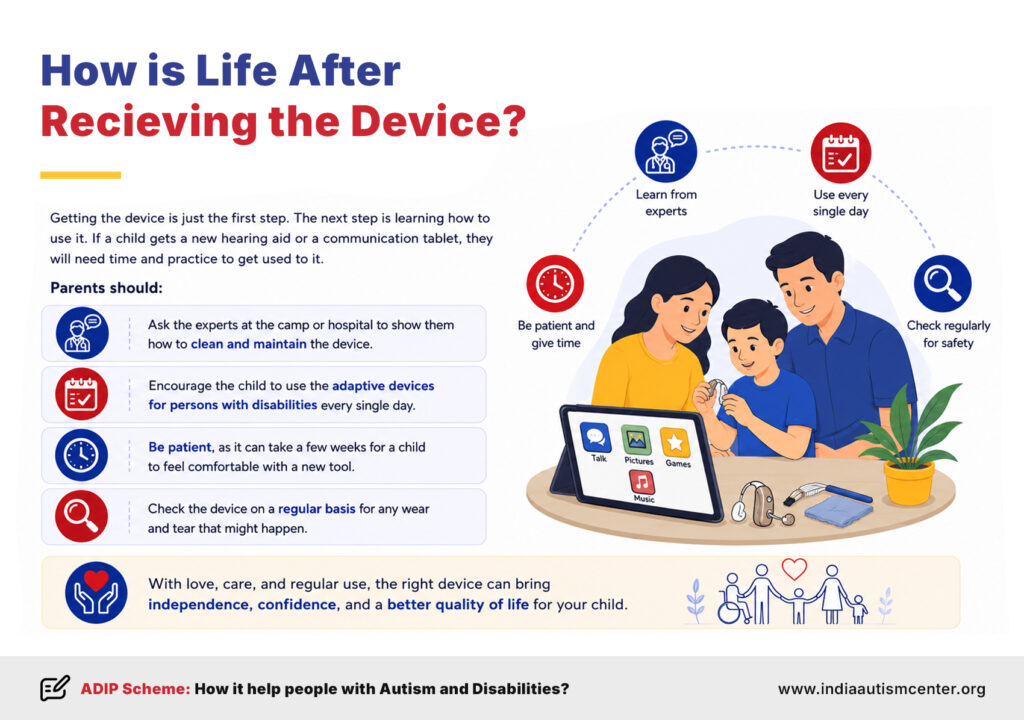
    Conclusion

    Conclusion about living a meaningful life with level 2 autism with proper support

    The first step toward accepting the answer to the question “What is level 2 autism?” is understanding the core concepts. While the “substantial support” label might sound daunting, it simply means that these individuals interact with the world differently. 

    They have a unique “autistic level 2 meaning” that involves deep passions, a different way of seeing details, and a need for a predictable, safe world.

    Whether you are a parent of a toddler or an adult seeking answers, remember that a diagnosis is a tool for understanding, not a limitation on what a person can achieve. With the right support, individuals with level 2 ASD can lead lives filled with purpose, connection, and joy.
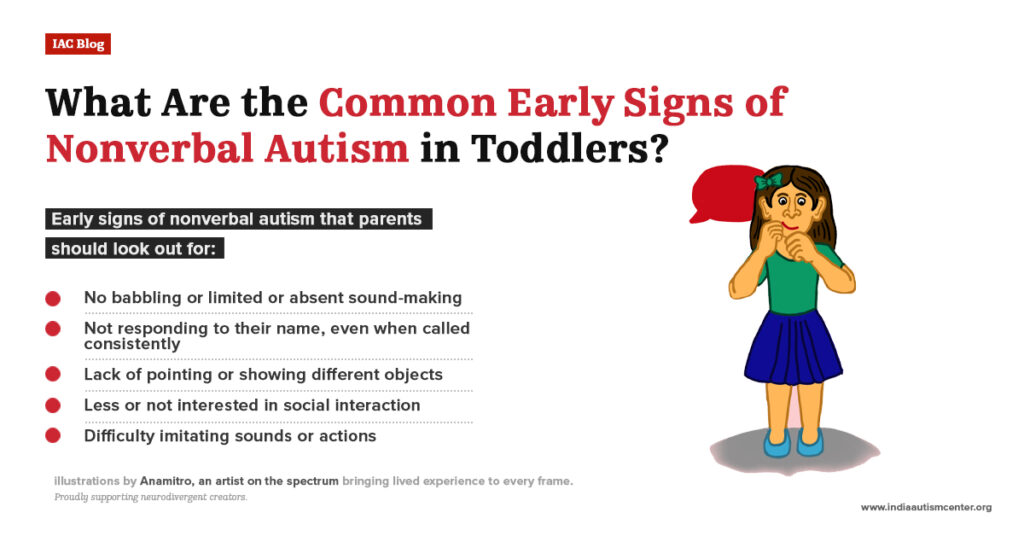
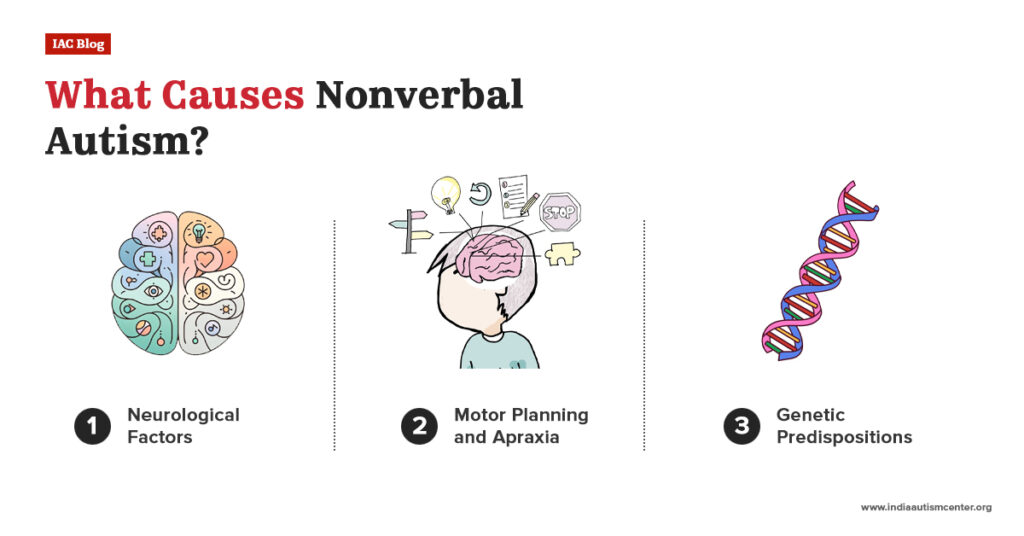
    Frequently Asked Questions

    What is level 2 autism?

    Level 2 autism refers to a moderate form of Autism Spectrum Disorder, where an individual requires substantial support. Children and adults at this level exhibit clear social communication difficulties and repetitive behaviours that affect daily functioning.

    What are the common Level 2 autism symptoms?

    Common level 2 autism symptoms include limited eye contact, difficulty maintaining conversations, rigid routines, sensory sensitivities, and noticeable repetitive behaviours.

    How are autism level 2 symptoms different from Level 1?

    Autism level 2 symptoms are more pronounced and require structured support. Unlike Level 1, individuals at Level 2 cannot function independently without consistent assistance.
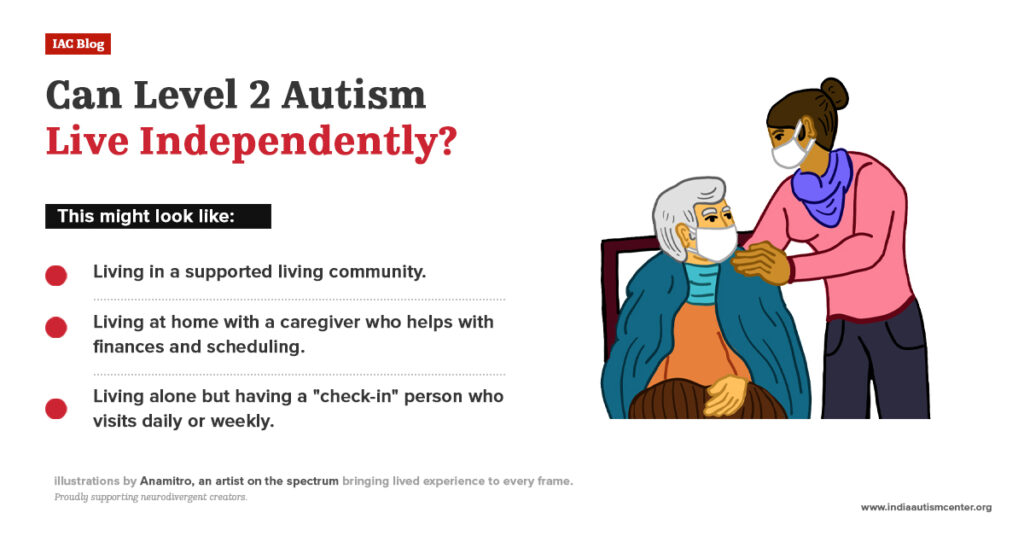
    What does level 2 autism look like in daily life?

    Parents often ask what level 2 autism looks like. It may involve a child who can speak but struggles socially, resists change, and becomes distressed when routines shift.
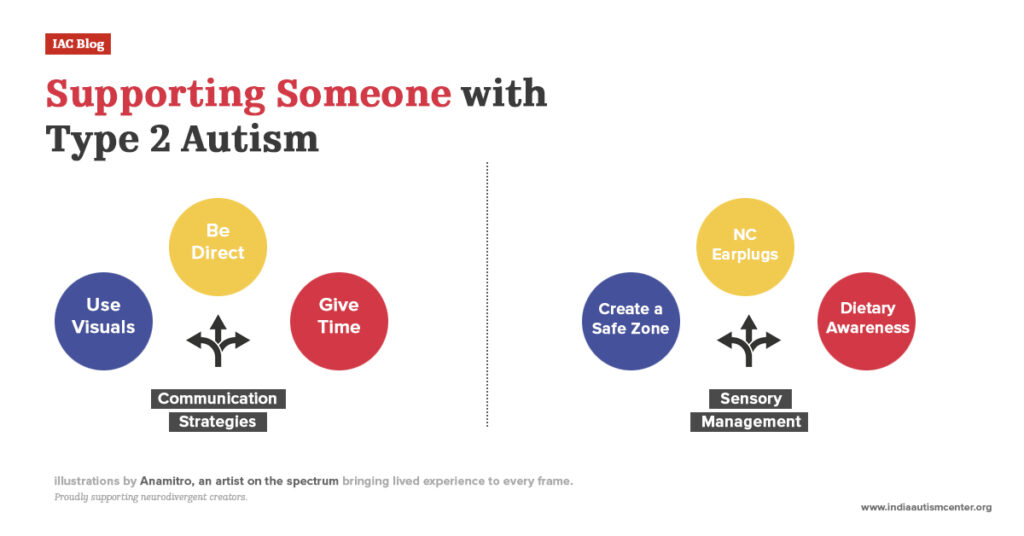
    Can a person with level 2 autism live independently?

    Regarding whether level 2 autism individuals live independently, some individuals achieve semi-independence with life skills training and structured support, while others may require assisted living.