Researchers at UCLA Health did not cure autism in humans. What they found is that a single dose of an existing drug, rapamycin, temporarily reversed autism-like symptoms in adult mice within about two hours. The mice showed less hyperactivity, fewer seizures, and calmer responses to sensory input. The effect wore off, and rapamycin is not a treatment. Here’s what actually happened, and what it means going forward.
What Did the UCLA Study Actually Find?
The study was published in Nature Communications in July 2026. It was led by Dr. Harley Kornblum’s team at UCLA’s Semel Institute for Neuroscience and Human Behaviour.
The researchers exposed pregnant mice to a mild inflammatory stimulus. The dose was low enough that the mother mice stayed healthy. Their offspring, however, grew up with lasting changes in brain activity and behaviour.
These offspring showed several autism-like traits as adults:
Mild brain overgrowth
Excessive signalling through the mTOR pathway
Poorly organised communication between brain networks
Hyperactivity and repetitive behaviors
Heightened sensitivity to sound and touch
Increased seizure susceptibility
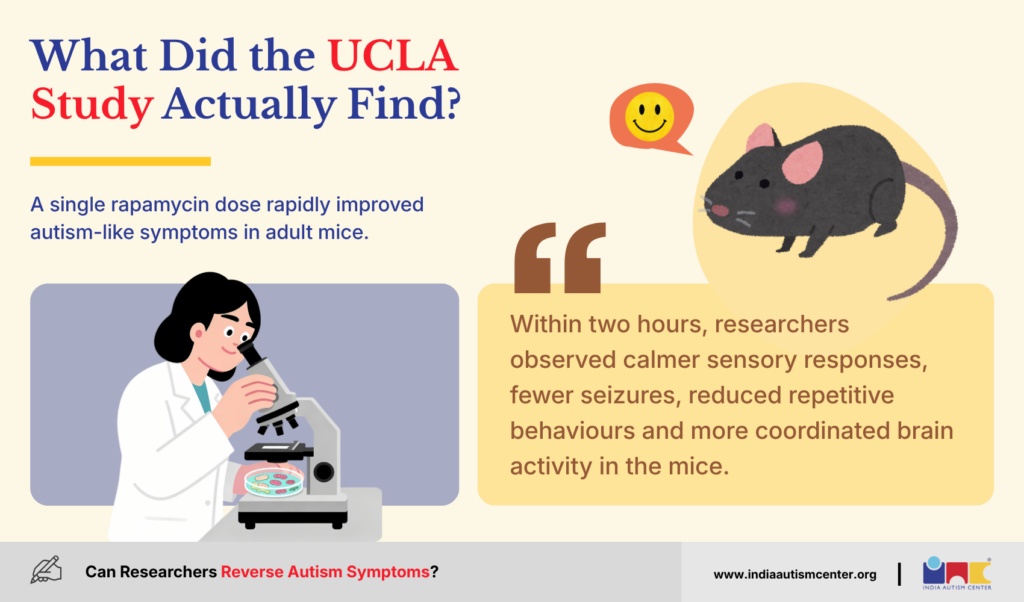
The team then gave these adult mice a single dose of rapamycin, a drug normally used to suppress the immune system in organ transplant patients. Within roughly two hours, nearly every measurement improved. Neurons that had been firing abnormally began to normalize. Seizure risk dropped. Brain regions that weren’t communicating well started syncing up. Repetitive behaviors and sensory over-responsivity declined too.
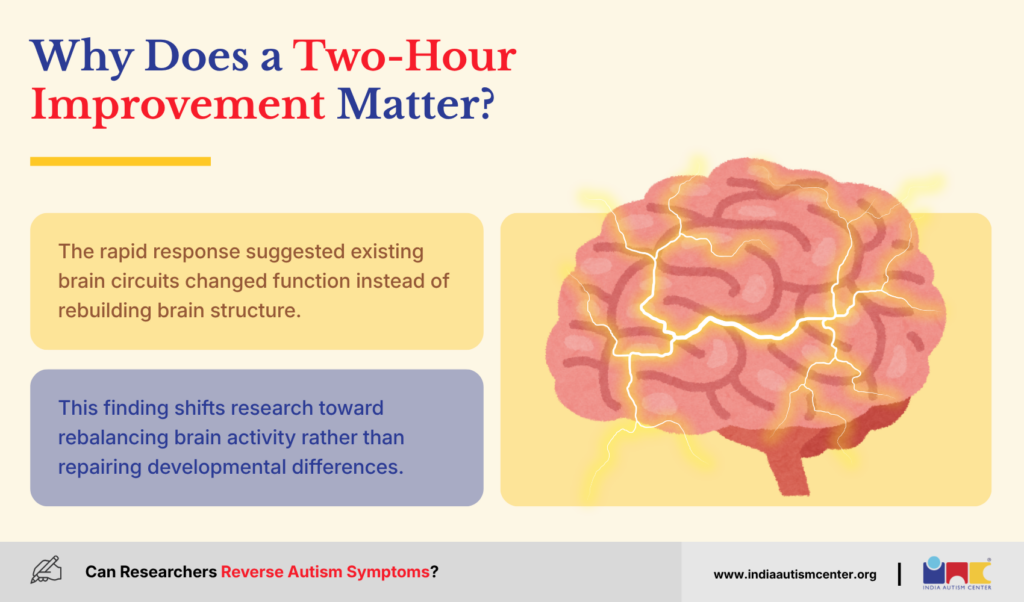
A two-hour response is too fast for the brain to physically rebuild itself. Structural changes in neurons, like new synapse growth, take much longer than that. This detail is actually the most important finding in the whole study.
It tells researchers that rapamycin wasn’t repairing damaged brain structure. Instead, it was changing how existing brain circuits were functioning in real time. Dr. Kornblum put it this way in a statement on the findings: the adult brain may be more adaptable than scientists assumed, even when the underlying structural differences from early development are still there.
This shifts the therapeutic target. Instead of trying to rebuild brain structure, which is a much harder problem, researchers can now explore whether brain circuits can be functionally rebalanced instead. That’s a meaningfully different, and possibly more achievable, goal.
What Is Rapamycin, and Why Isn’t It a Treatment Yet?
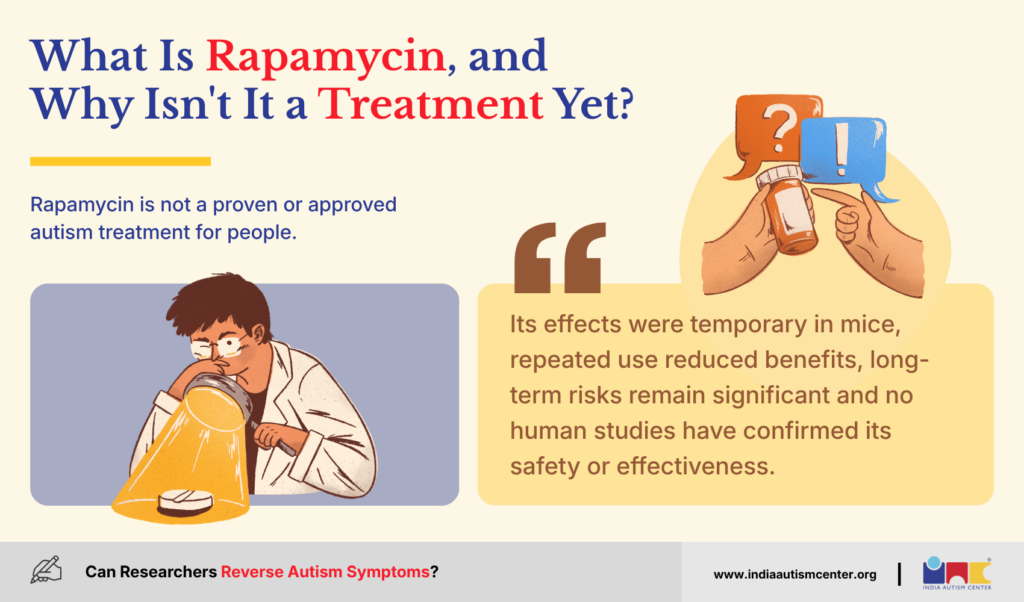
Rapamycin is an immunosuppressive drug. Doctors currently prescribe it to prevent organ rejection after transplants. It works by reducing activity in the mTOR pathway, a cell-signaling system that controls growth and proliferation. Excessive mTOR activity has been linked to some autism-related conditions in earlier research, so the drug wasn’t picked at random.
Despite the dramatic short-term results, rapamycin is not ready, and may never be ready, for autism treatment in humans. Here’s why:
Limitation
What It Means
Temporary effect
Benefits faded after a few hours in mice
Drug tolerance
Mice became less responsive after weeks of repeated dosing
Toxicity risk
Long-term use can cause serious side effects
Animal-only data
The study has not been tested in humans
Narrow symptom set
Findings apply to one specific mouse model, not all autism presentations
Even the study’s co-senior author, Dr. Neil Harris, was direct about this. He said the findings point toward new therapeutic targets, like sensory circuit neuromodulation or rebalancing neuronal excitation and inhibition, rather than toward rapamycin itself as a usable treatment.
What Caused the Autism-Like Traits in This Mouse Model?
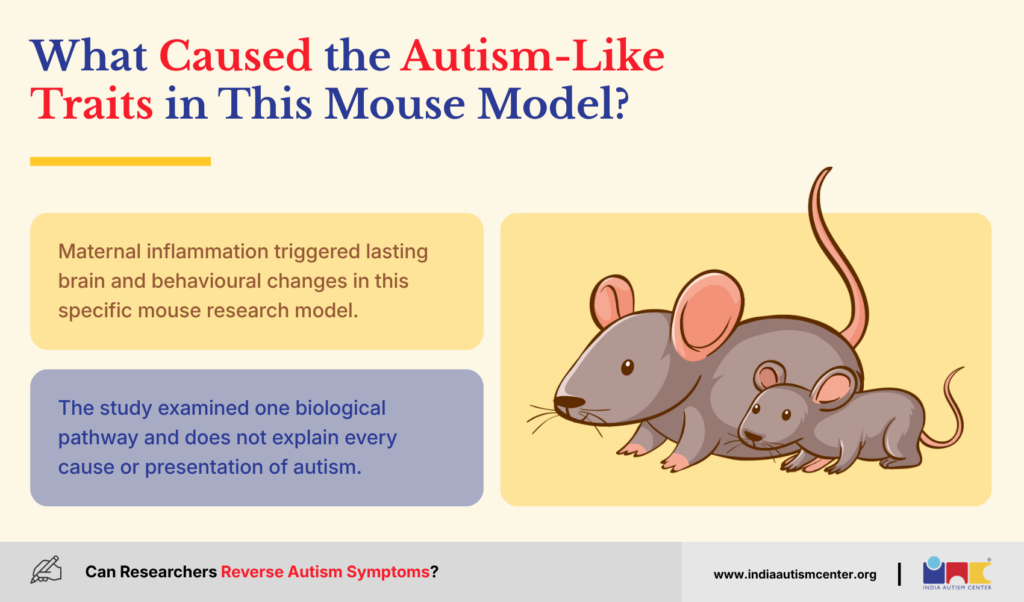
The mice in this study developed autism-like traits because of maternal inflammation during pregnancy. Researchers exposed pregnant mice to a mild immune trigger early in pregnancy. That inflammation carried over into the offspring’s brain and body, and it stayed there into adulthood.
This lines up with earlier research suggesting that immune activation during pregnancy in humans may be associated with a higher likelihood of autism-related traits in children. It’s worth being precise about what that research does and doesn’t say.
Maternal inflammation appears to be one contributing factor among many. Autism is widely understood to involve a mix of genetic and environmental influences. No single cause explains every case, and this study doesn’t claim otherwise. It focused on one biological pathway in one mouse model, not on autism as a whole.
Does This Mean Autism Symptoms Can Be Reversed in Humans?
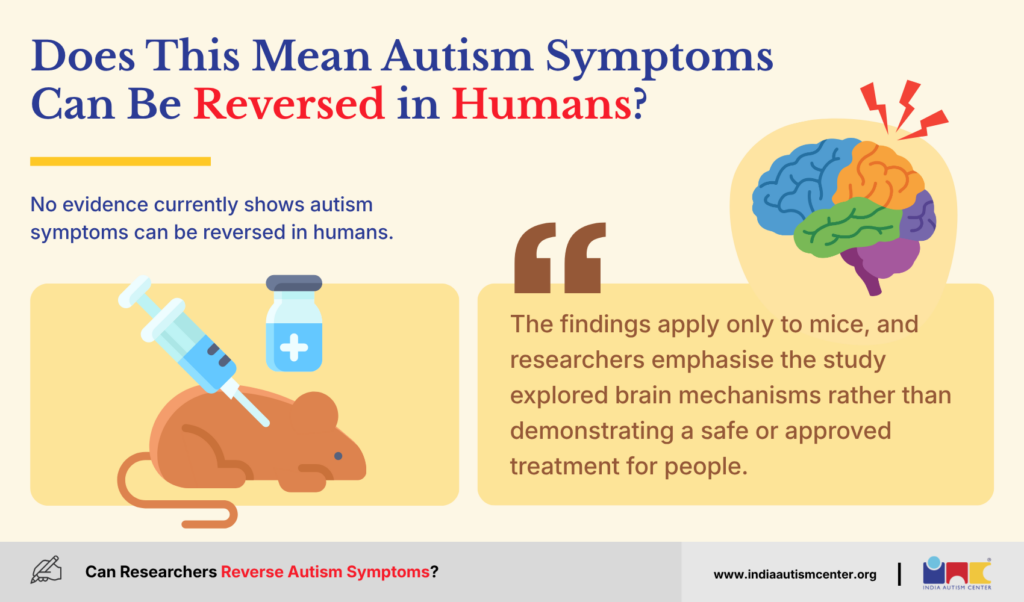
No, not yet, and not with this drug. This was a mouse study, the effects were short-lived, and rapamycin carries real risks with repeated use. Nobody involved in the research is recommending it for people.
I think it’s worth pausing here, because “reverse autism symptoms” is the kind of headline that spreads fast and gets misread. What the study actually demonstrated is narrower and, in some ways, more interesting: that certain autism-like symptoms in mice can be modified in adulthood, without needing to first correct the brain’s underlying structure.
It’s also worth acknowledging that “reversing” or “curing” autism is a sensitive framing within the autism community itself. Some parents and researchers are genuinely looking for treatments that ease specific symptoms, like seizures or sensory overload, that can significantly affect quality of life. Many autistic self-advocates, on the other hand, see autism as part of identity rather than something that needs fixing. Both perspectives show up regularly in how this kind of research gets discussed, and I think it’s fair to hold space for both.
How Does This Compare to Other Autism-Epilepsy Drug Research?
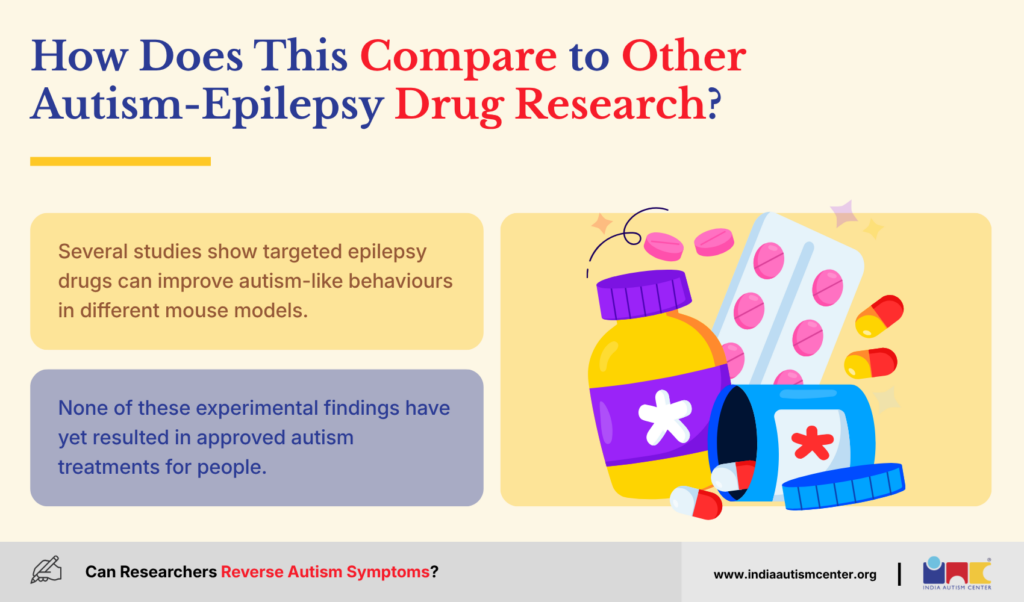
This isn’t the first time researchers have looked at epilepsy drugs and autism together. Autism and epilepsy share overlapping brain mechanisms in several studies, which is part of why drugs developed for seizures keep showing up in autism research.
A few examples:
Lamotrigine, an epilepsy medication, reduced hyperactivity in mice with a specific genetic mutation (MYT1L) linked to autism traits.
Z944, an experimental seizure drug, reversed autism-like behaviors in a Stanford study by calming an overactive brain region called the reticular thalamic nucleus.
Earlier MIT research showed that targeting specific proteins in brain neurons could reduce autism-like traits in mice with Fragile X syndrome, the most common inherited cause of autism and intellectual disability.
The pattern across these studies is consistent. Researchers keep finding that specific, targeted interventions can shift autism-like behaviors in mouse models. None of them, including the UCLA rapamycin study, have moved into approved human treatments yet.
What Could This Research Lead To in the Future?
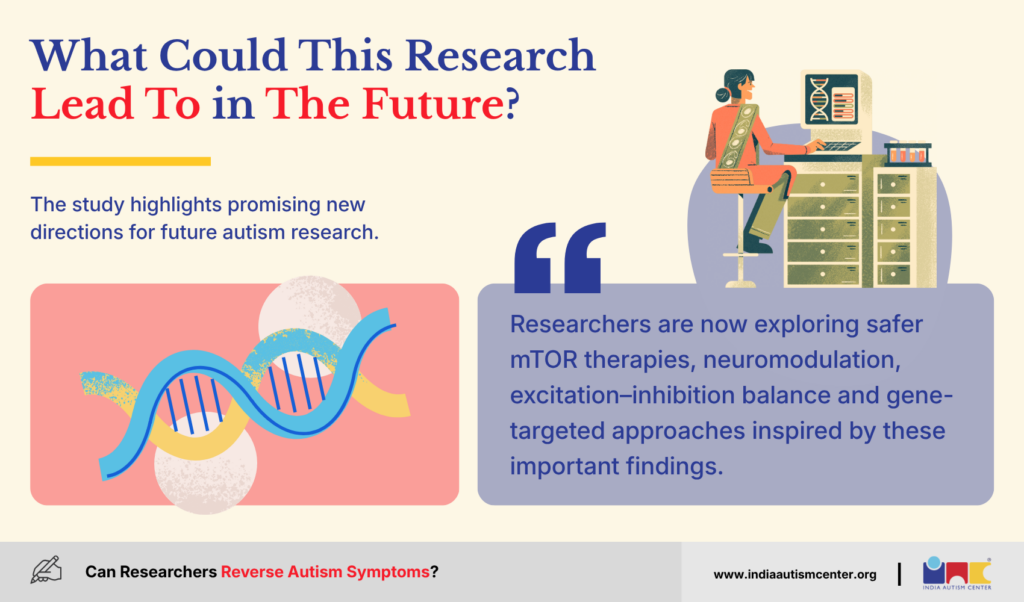
This study opens up a few concrete directions for future autism research. Researchers now have new leads to test:
mTOR-pathway therapies that are safer for long-term or repeated use than rapamycin
Excitation-inhibition balance treatments, aimed at calming overactive neurons without suppressing brain function broadly
Gene expression research, since rapamycin reversed abnormal gene activity tied to autism, epilepsy, and ion channel function in this study
None of this happens quickly. Drug development typically moves from animal models to safety trials to human trials over many years, and most candidates never make it all the way through. I’d treat this study as an early signal worth watching, not a treatment timeline.
What Should Parents and Caregivers in India Take Away From This?
If you’re a parent or caregiver reading this, my honest suggestion is to not act on early-stage mouse research. Rapamycin is not something to seek out, and no clinic offering it as an autism treatment is following the actual science here.
Autism news like this tends to travel fast online, and unverified products or “breakthrough cures” often follow close behind. I’d treat any claim of a fast fix with real skepticism, especially if it’s being sold rather than studied.
What does help right now, based on current evidence, is consistent, evidence-based support:
Early behavioral intervention
Structured skill-building and therapy programs
Sensory support strategies tailored to the individual
Ongoing guidance from qualified autism professionals
If you’re exploring intervention options in India, it’s worth looking into structured, evidence-based programs rather than waiting on research that’s still years away from clinical use.
How Did Rapamycin Change Brain Circuits So Quickly?
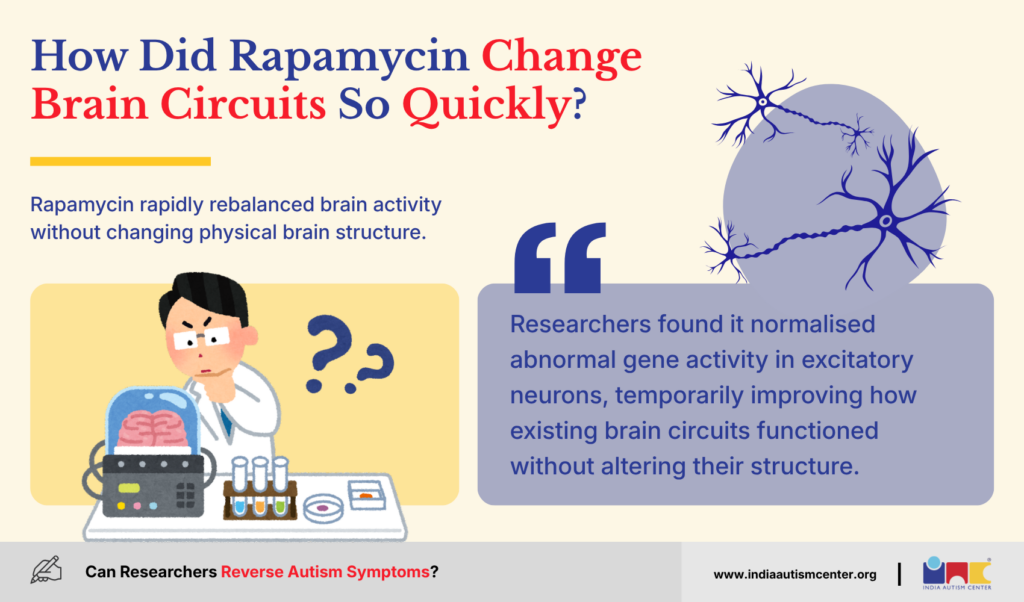
To understand the speed of the response, the UCLA team looked at gene activity in brain cells before and after the rapamycin dose. They found the drug reversed abnormal patterns of gene expression tied to autism, epilepsy, and ion channel function.
The strongest effects showed up in excitatory neurons, the cells that drive activity across brain networks. This tells researchers that rapamycin was rebalancing how excitable these neurons were, rather than altering the brain’s physical wiring.
Think of it less like renovating a house and more like adjusting the thermostat. The house’s structure stays the same, but how it functions in the moment changes. That distinction is why the researchers are now focused on brain circuits as a treatment target, separate from brain structure.
This also helps explain why the effect faded. A thermostat setting doesn’t hold permanently without ongoing input. Once rapamycin cleared the system, the neurons drifted back toward their earlier, less balanced state.
Why Are Sensory Sensitivity and Repetitive Behaviors Hard to Treat?
Sensory sensitivity and repetitive behaviors are two of the most common and most persistent autism traits. They’re also two of the hardest for existing therapies to fully address. Sensory over-responsivity, in particular, doesn’t respond well to most current treatment approaches.
That’s part of what makes this study notable. The rapamycin dose specifically reduced sensory over-responsivity and repetitive behaviors in the mice, alongside the other improvements. If future, safer drugs can replicate that effect without rapamycin’s downsides, it could open a new treatment avenue for symptoms that families often say are the most disruptive day to day.
I’d still stress caution here. A mouse showing less sensitivity to touch or sound is measurable in a lab, but it’s a long way from a validated human therapy. The gap between “promising mechanism” and “usable treatment” is where most drug candidates quietly stall out.
Is This Considered an Autism Treatment Breakthrough?
Researchers are describing this as a mechanistic breakthrough, not a treatment breakthrough. The distinction matters. A mechanistic breakthrough means scientists learned something new and important about how the brain works. A treatment breakthrough means there’s a new therapy people can actually use.
This study is the first kind. It gives researchers a clearer picture of which brain systems to target next, and it challenges the assumption that autism-related brain differences are fixed once they form in early development. That’s genuinely significant for the direction of future research, even without an immediate treatment attached to it.
Researchers reversed specific autism-like symptoms in mice using a single dose of rapamycin, and the improvement happened within two hours. This tells us adult brain circuits may be more adaptable than previously believed, even when early developmental differences remain. It does not mean autism has been reversed or cured in humans, and rapamycin is not a safe or approved treatment for anyone right now.
I’ll be keeping an eye on where this research goes next, particularly around safer mTOR-targeted therapies and sensory circuit approaches. For now, evidence-based intervention remains the most reliable path forward for autistic individuals and their families.
Frequently Asked Questions
Has autism been reversed in humans?
No. The UCLA study reversed autism-like symptoms in adult mice, not in humans. There is currently no drug proven to reverse autism symptoms in people.
What is rapamycin used for?
Rapamycin is an immunosuppressive drug typically prescribed to prevent organ rejection after transplants. Researchers are studying it separately for its effects on the mTOR pathway in autism-related brain activity.
Is inflammation during pregnancy linked to autism?
Some research suggests maternal inflammation during pregnancy may be associated with autism-related traits in offspring. It’s considered one possible contributing factor, not a single cause of autism.
Should parents try rapamycin or similar drugs for autism symptoms?
No. Rapamycin’s effects were temporary in mice, it can be toxic with repeated use, and it hasn’t been tested in humans for this purpose. Any such use would be unsupported by current evidence.
Why do epilepsy drugs keep showing up in autism research?
Autism and epilepsy appear to share overlapping brain mechanisms in several studies. This overlap is why researchers keep testing seizure medications in autism-related brain research.
What’s the difference between mouse studies and human treatments?
Mouse studies test biological mechanisms early, in a controlled way. Findings then need years of safety and efficacy testing in humans before they can become approved treatments. Most don’t make it that far.
Disclaimer: This article is intended for educational and informational purposes only. It is not a substitute for professional medical advice, diagnosis, or treatment. If you are pregnant or have concerns about medication use during pregnancy, please consult a qualified healthcare provider. If your child has received an autism diagnosis and you have questions about causes or support, please reach out to a trained specialist or an autism-focused organisation for guidance.
For expert insights, support services, and inclusive learning initiatives, visit the India Autism Center.
If you’ve ever sat across from your child after a therapy session and thought, “I wish I could do more between now and next week” – you’re not alone. Most parents feel that quiet ache. The good news is that the home is one of the most powerful therapy spaces your child will ever have. You are already the most important person in their world. This guide shows you how to use that.
Autism therapies at home are structured activities and interaction strategies you weave into daily life – mealtimes, bath time, play, bedtime. They don’t replace your therapist. They multiply the work your therapist has already started. Research consistently shows that children who receive therapy reinforcement at home make faster, more durable progress than those who receive clinic sessions alone.
Below, we cover 7 evidence-based approaches, how to adapt each for home use, what the Indian context means for your family, and how to know when to ask for more support.
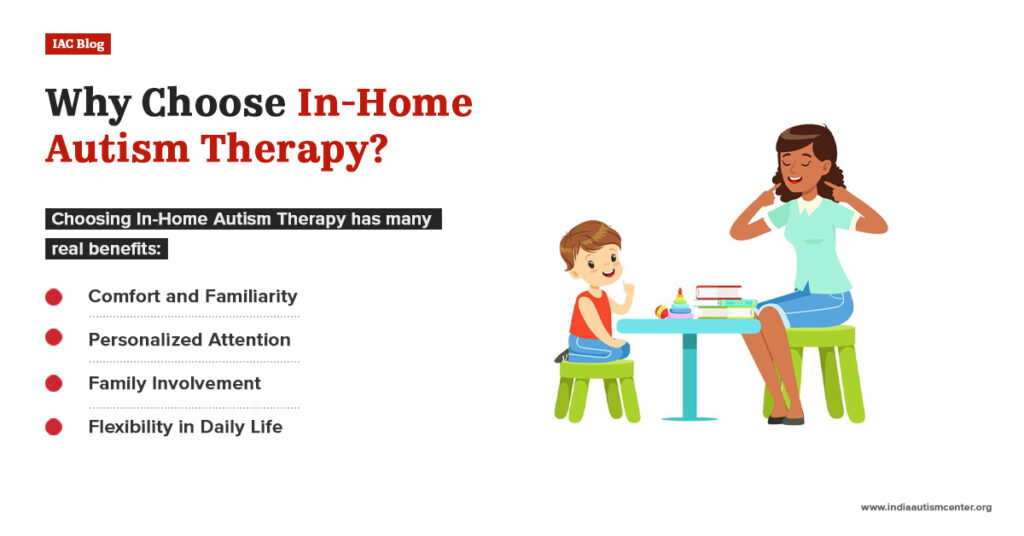
Why Choose In-Home Autism Therapy?
The clinic is where skills are introduced. Home is where they become real. That distinction matters enormously for autistic children, who often struggle to generalise learning from one setting to another. When a child practises a skill at the same kitchen table where they eat breakfast, in the same living room where they watch their favourite show, that skill sticks.
Comfort and Familiarity
The home environment removes a layer of sensory and social unpredictability that can make learning harder. Your child already knows the smells, sounds, and layout of home – and that familiarity lowers their baseline anxiety. A calmer nervous system is a more receptive one. When stress is low, the window for communication and connection opens wider, and that is precisely when learning happens most naturally.
Personalised Attention
No clinic session, however skilled the therapist, can replicate the one-to-one attention a parent provides across an entire day. At home, you can read your child’s mood in real time, pivot an activity when they’re overwhelmed, and seize unexpected moments of engagement – the spontaneous giggle over a spilled cup of water that becomes a five-minute language lesson. That kind of responsiveness is uniquely yours to give.
Family Involvement
When parents, siblings, and grandparents all understand the basics of what supports the child, the whole household becomes a therapeutic environment. Skills reinforced by multiple people across multiple contexts generalise faster. Family involvement also reduces caregiver burnout – when everyone shares the load, no single person carries it all.
Flexibility in Daily Life
Home-based therapies for autism don’t require a separate appointment slot. They live inside routines that already exist: narrating what you’re doing while cooking, practising turn-taking during a board game, using a visual schedule to ease the transition from screen time to dinner. This flexibility means therapy happens far more frequently than once or twice a week – and frequency is one of the strongest predictors of progress.
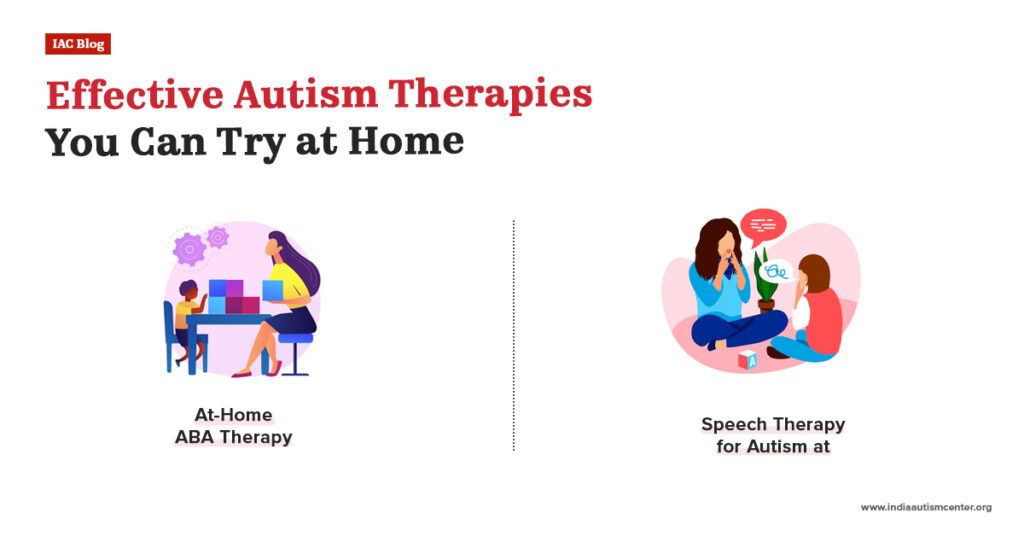
Effective Autism Therapies You Can Try at Home
Applied Behaviour Analysis (ABA)
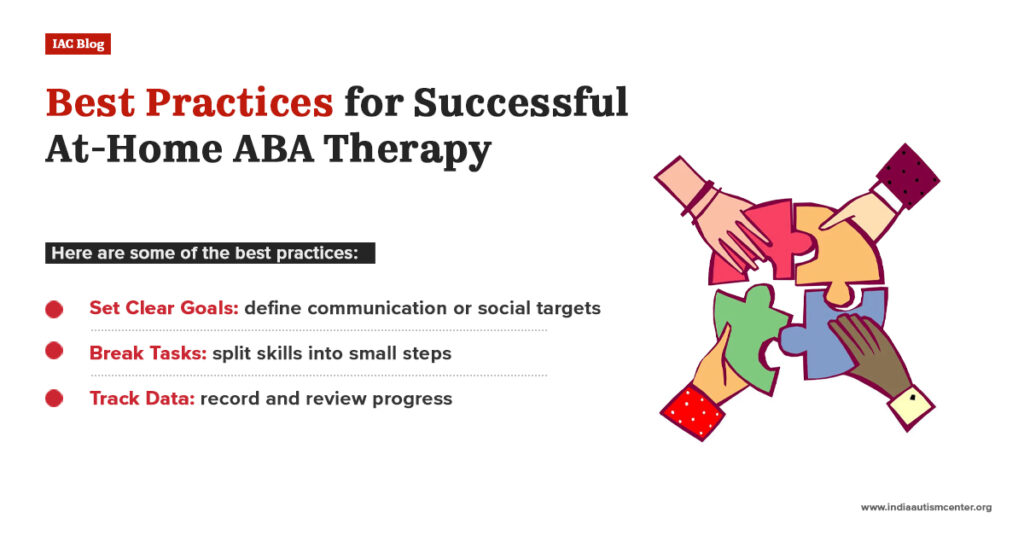
ABA is one of the most extensively researched interventions for autism. At its core, it breaks complex skills into small, teachable steps and uses consistent reinforcement to build them. At home, you don’t need to run formal ABA sessions – but understanding its principles transforms everyday interactions.
How it works: Identify a target skill (e.g., asking for a drink), break it into steps (make eye contact → point or vocalise → wait for response), prompt as needed, and reward the attempt immediately and specifically.
Practical parent tips:
Use “errorless teaching” for new skills. Provide the prompt before the child has a chance to get it wrong – this builds confidence and reduces frustration.
Keep sessions short. Five focused minutes of ABA-style practice during snack time beats a distracted 30-minute sit-down. Repetition across many small moments is more effective than one long session.
Be consistent with your reinforcers. If stickers work on Monday, use stickers on Tuesday too. Consistency is what makes reinforcement powerful.
Always work with a qualified ABA therapist to set goals and review progress. Home practice should follow the programme your therapist has designed – not replace their clinical judgement.
Speech and Language Therapy
Communication challenges are central to autism, but “communication” is far broader than spoken words. It includes gestures, facial expressions, pointing, picture exchange, and augmentative and alternative communication (AAC) devices. Speech therapy at home means creating dozens of small communication opportunities throughout the day.
How it works: Follow your child’s lead in conversation. Expand on what they say rather than correcting it. If they say “ball,” you say “red ball” or “throw ball.” If they gesture, name the gesture and respond to it as a meaningful communication.
One of the most effective parent-training frameworks for this is the Hanen Centre’s “More Than Words” programme – a structured course for parents of autistic children under six, delivered by a Hanen-certified speech-language pathologist. It teaches parents to use everyday routines as communication opportunities and has strong research support from randomised controlled trials. Ask your speech therapist whether they are Hanen-certified or can recommend someone who is.
Practical parent tips:
OWL: Observe, Wait, Listen. Before jumping in to help, pause and give your child space to initiate. Even a glance or a reach counts.
Narrate your day simply. “Mummy is washing the cup. Washing. Cup.” Simple, repeated language builds vocabulary without pressure.
Reduce questions, increase comments. Questions put children on the spot. Comments (“Oh, the dog is running!”) invite response without demanding it.
Floortime (DIR/Floortime)
Developed by child psychiatrist Dr Stanley Greenspan and Dr Serena Wieder, DIR/Floortime is a relationship-based approach that uses play as the vehicle for developmental growth. DIR stands for Developmental, Individual-difference, Relationship-based. The “Floortime” part is literal – you get on the floor with your child and follow their lead.
The key concept: circles of communication. Every back-and-forth exchange between child and caregiver – a look, a gesture, a sound, a shared laugh – is one “circle.” Opening a circle means initiating an interaction. Closing it means responding. The goal is to build longer and longer chains of these exchanges, which gradually develop emotional regulation, social thinking, and language.
Practical steps for parents:
Follow your child into their world. If they’re spinning a wheel, spin one too. Join the activity on their terms before gently expanding it.
Create a “problem” that invites interaction. Put a favourite toy just out of reach, or “accidentally” block their path. These gentle obstacles prompt communication without demanding it.
Aim for 20 minutes of pure Floortime daily. No phones, no agenda. Just you, your child, and their chosen activity. Even three or four short sessions of five minutes each count.
Floortime is something parents can genuinely do well at home, especially after guidance from a trained DIR therapist. It is not about teaching – it is about connecting.
Relationship Development Intervention (RDI)
RDI was developed by Dr Steven Gutstein and focuses on building what he calls dynamic intelligence – the ability to adapt flexibly to changing situations, read social context, and share experiences with others. Where ABA tends to focus on discrete skills, RDI targets the underlying social-cognitive processes that make relationships possible.
The core mechanism: guided participation. Parents act as “guides,” structuring activities so the child must engage, problem-solve, and share the experience – but without explicit instruction or prompting. The parent varies their actions slightly to create just enough uncertainty to keep the child engaged and thinking.
Practical steps for parents:
Do activities side by side, not face to face. Washing dishes together, folding laundry, gardening – these “co-regulation” activities build shared attention naturally.
Use “declarative language.” Instead of “What colour is this?” (a test), say “Hmm, I wonder which one fits…” (an invitation to think together). This shifts the dynamic from compliance to collaboration.
Slow down and pause. RDI relies on the child noticing and responding to small variations in what you do. If you rush, those moments disappear.
RDI is ideally guided by a certified RDI consultant, but the principles can be woven into daily life with relatively little training.
Creative Arts Therapy
Not every child communicates best through words or structured tasks. For many autistic children, drawing, music, movement, and storytelling are the most natural pathways to self-expression and emotional regulation. Creative arts therapy is not about producing good art – it is about using creative processes as a non-pressured, strength-based route to connection and communication.
Why it works: Creative activities engage the right hemisphere, reduce performance anxiety, and allow children to express experiences they may not yet have words for. A child who cannot describe feeling overwhelmed may draw it in vivid, telling detail.
Practical tips for parents:
Music before transitions. Play a consistent “clean-up song” or “bath time song” to signal what’s coming next. Music reduces transition anxiety and builds routine memory.
Offer drawing as emotional check-in. “Show me how you’re feeling today” with a blank page and crayons can open conversations that direct questions cannot.
Movement breaks as regulation tools. Five minutes of jumping, spinning, or dancing before a demanding task helps regulate the nervous system and improve focus. This is not indulgence – it is preparation.
Parent-Child Interaction Therapy (PCIT)
PCIT is a structured, evidence-based therapy originally developed for young children with behavioural difficulties. It has been adapted for autism and is particularly effective for managing challenging behaviours while simultaneously building secure, warm attachment between parent and child.
How it works: A trained therapist coaches the parent in real time – typically through a one-way mirror or an earpiece – while the parent interacts with their child. The therapist guides the parent to use specific skills: following the child’s lead, describing their play, praising specifically, and setting calm, consistent limits.
Important note: PCIT requires a trained therapist to guide the initial sessions. It is not something to attempt from a book alone. However, once parents have learned the skills – usually over 14–17 sessions – they can apply them independently at home, and the effects are lasting. If challenging behaviours are significantly affecting your family’s daily life, ask your paediatrician or psychologist for a PCIT referral.
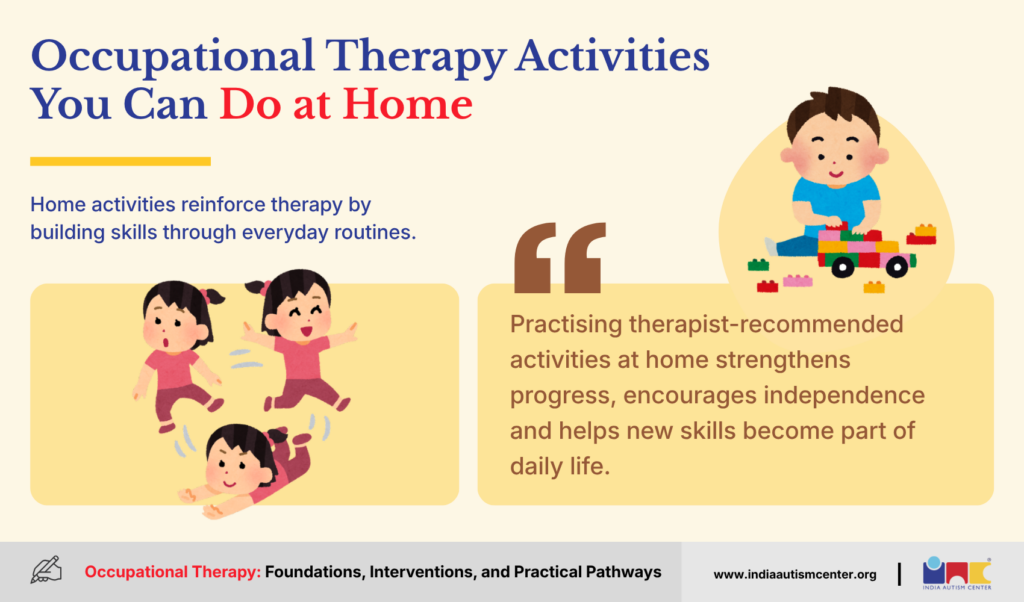
Occupational Therapy Activities at Home
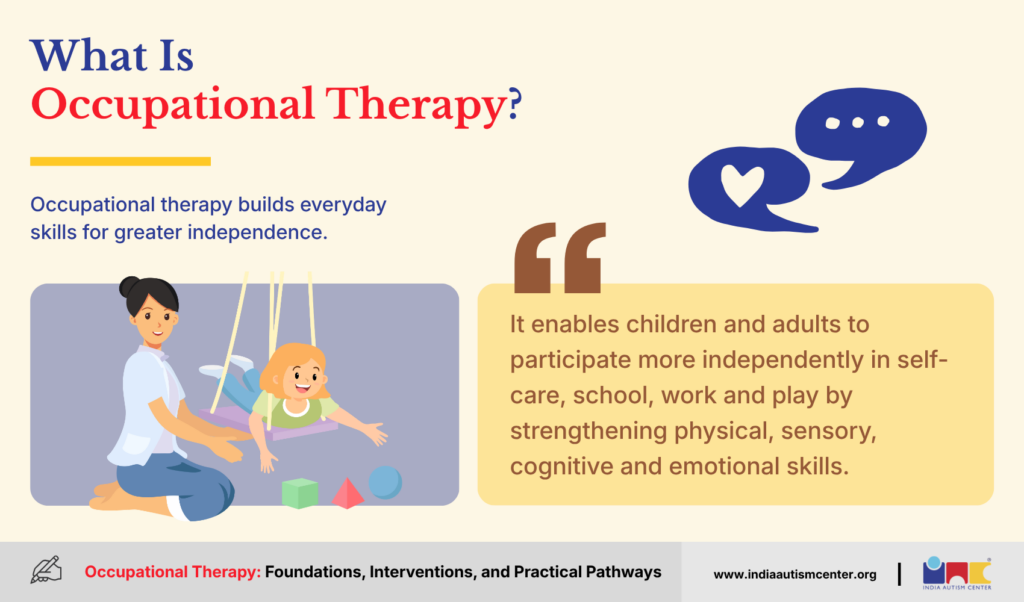
Occupational therapy (OT) for autism addresses three broad areas: sensory integration (how the brain processes sensory input), fine motor skills (the small, precise movements needed for writing, dressing, eating), and daily living skills (independence in self-care and household tasks). OT activities at home are among the most practical and immediately impactful things parents can do.
Three practical home activities:
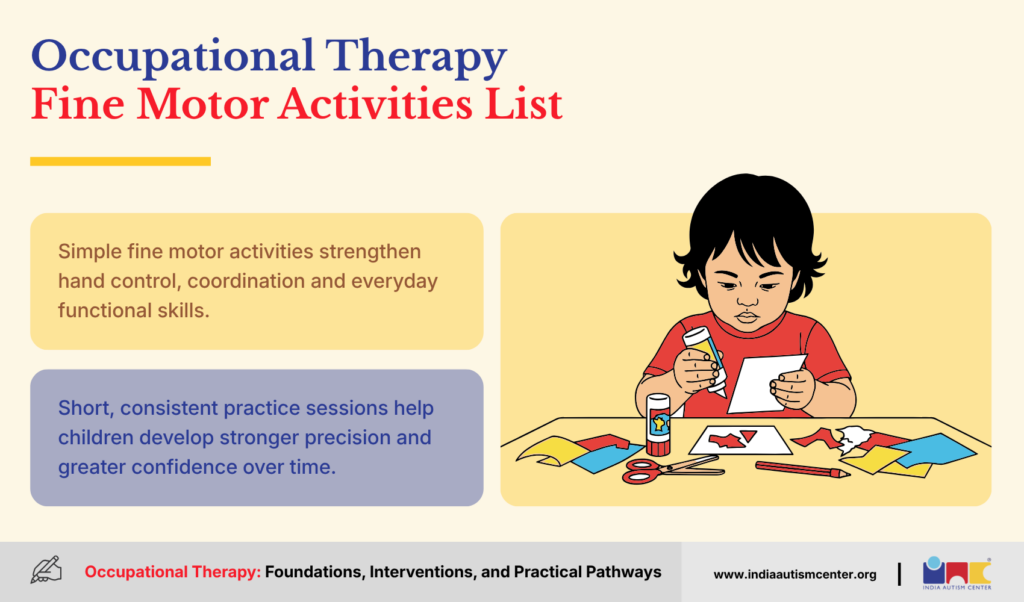
Sensory bin play. Fill a large container with dried rice, lentils, or kinetic sand. Hide small objects inside for your child to find. This provides controlled tactile input, builds tolerance for different textures, and develops fine motor skills simultaneously. Start with textures your child already tolerates and expand gradually.
Threading and sorting. Stringing large beads, sorting buttons by colour, or using tweezers to move small objects between containers all build the hand strength and precision needed for writing and self-care. Make it a game – sort the “red team” versus the “blue team.”
Dressing practice with backward chaining. Teach your child to dress themselves by starting with the last step. If they’re learning to put on a shirt, you do everything except the final pull-over-the-head, and they do that one step. Gradually hand back more steps as confidence grows. This approach builds success from the very first attempt.
Therapy doesn’t need a special room or a special time. The most powerful learning happens inside the rhythms of ordinary life.
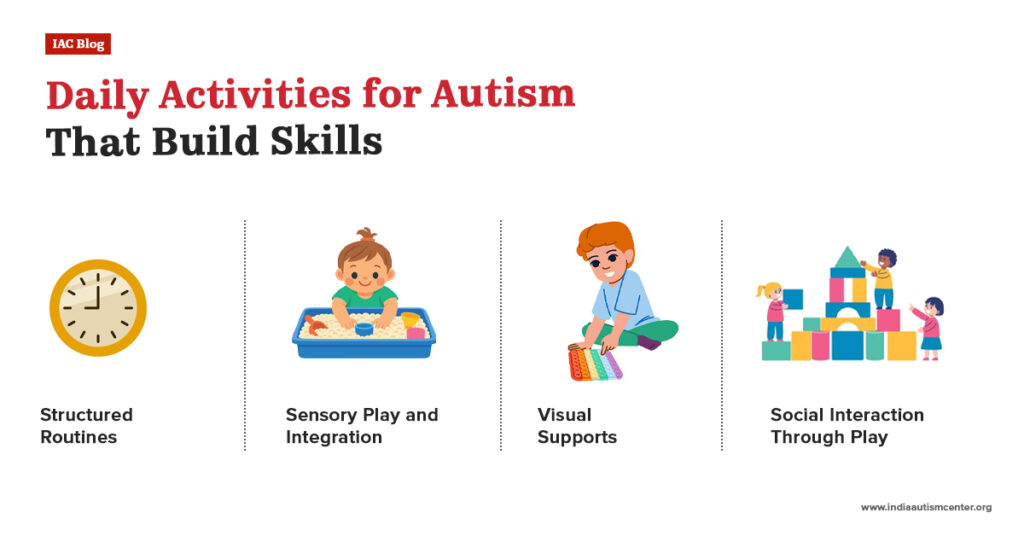
Structured Routines
Children with autism thrive on predictability – not because they are rigid, but because predictability frees up cognitive resources that would otherwise go to managing uncertainty. A consistent daily routine (wake-up, breakfast, play, therapy activities, lunch, rest, outing, dinner, bath, bed) reduces anxiety and creates natural, repeated opportunities to practise skills. Write it out as a simple visual schedule and review it together each morning. When changes are unavoidable, give advance warning: “After lunch, we’re going somewhere different today.”
Sensory Play and Integration
Sensory play is not just fun – it is neurological work. Activities like playing with water, sand, playdough, or textured fabrics help the brain learn to process and organise sensory information more efficiently. Start with sensory experiences your child already enjoys and use them as bridges to new ones. A child who loves water play might tolerate finger painting if you introduce it gradually. The goal is gradual expansion of the sensory comfort zone, never forced exposure.
Visual Supports
Visual supports – picture schedules, choice boards, emotion charts, first-then boards – make the invisible visible. Abstract concepts like “in five minutes” or “after you finish this, you can have that” become concrete and manageable. Print simple images from the internet, laminate them, and attach them to the fridge with velcro. You don’t need expensive materials. The key is consistency: use the same visual for the same concept every time, so your child can rely on it.
Social Interaction Through Play
Play is the original social curriculum. Simple games – rolling a ball back and forth, building a block tower together and knocking it down, simple card games like Snap – teach turn-taking, shared attention, and the joy of doing something with another person. Start with one-to-one play with a parent before introducing siblings or peers. Keep sessions short, positive, and child-led. The moment it stops being fun, it stops being therapeutic.
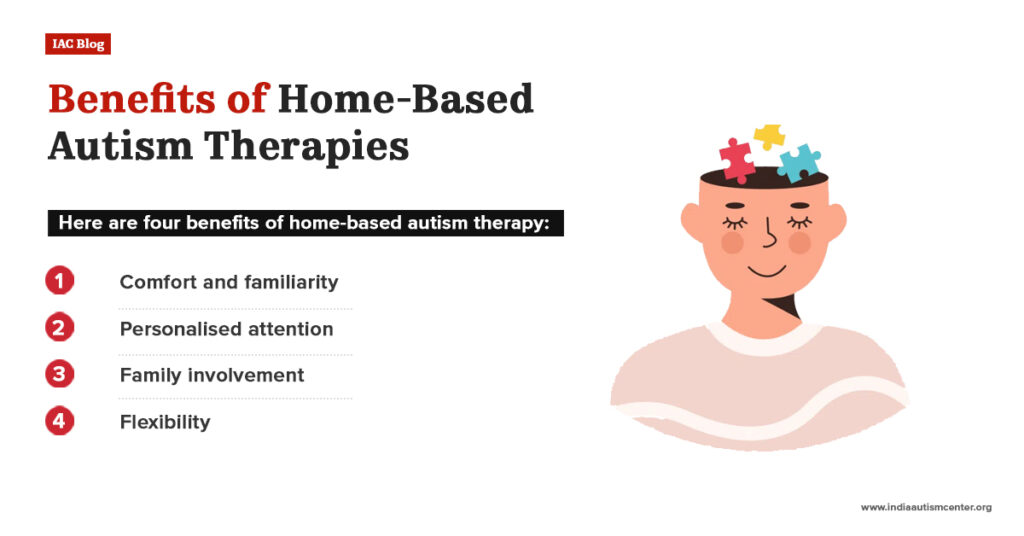
Benefits of Home-Based Autism Therapies
Comfort and Familiarity: The home environment offers comfort and familiarity, which can reduce anxiety and stress often experienced by individuals with autism. This setting promotes a more receptive state for learning and development.
Personalised Attention: At-home therapies allow for one-on-one interaction and personalised attention, which is crucial for addressing individual needs and preferences. Caregivers can tailor activities to match the individual’s interests and strengths.
Family Involvement: Involving family members in therapy fosters a strong support system. When everyone is on board, consistent therapy implementation becomes more achievable, leading to better outcomes.
Flexibility: Home-based therapies can be integrated into daily routines, making them flexible and adaptable. This flexibility can be particularly beneficial for individuals who may struggle with transitions.
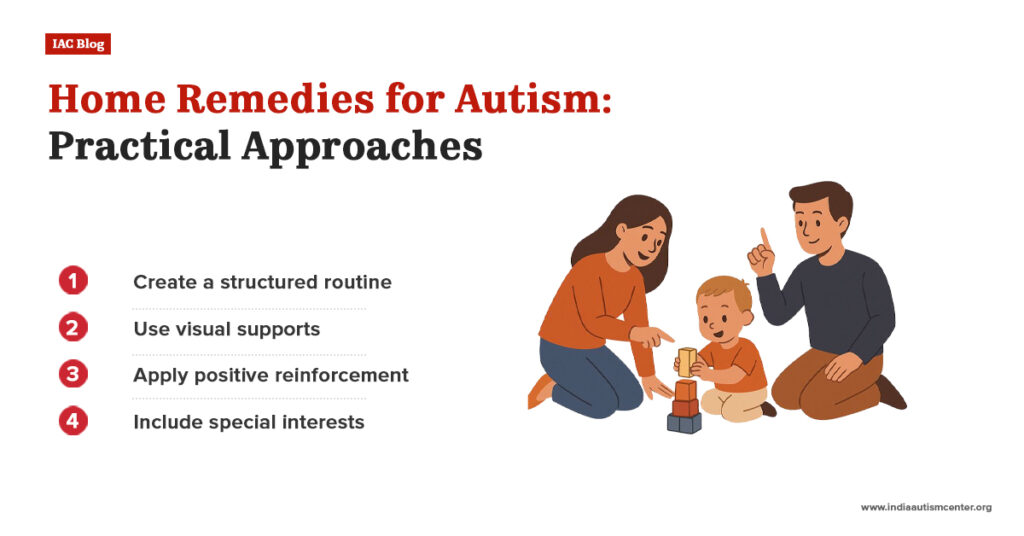
Home Remedies for Autism: Practical Approaches
Create a Structured Routine
Individuals with autism thrive in structured environments. Establish a consistent daily routine that includes therapy sessions, leisure activities, meals, and rest.
Utilise Visual Supports
Visual aids such as schedules, charts, and pictures can help individuals with autism understand expectations and transitions. These aids provide a concrete representation of abstract concepts.
Implement Positive Reinforcement
Rewarding desired behaviours encourages repetition. Use verbal praise, stickers, tokens, or preferred activities as rewards to reinforce positive behaviours and achievements.
Incorporate Special Interests
Special interests can be powerful motivators. Integrate these interests into therapy activities to keep engagement high and foster a positive learning experience.
Decide which therapy activities will happen at which times of day, and stick to it. Consistency is not rigidity – it is the scaffolding that makes everything else possible. A simple weekly plan (Monday: sensory bin + ABA practice; Tuesday: Floortime + speech activities) prevents decision fatigue and ensures nothing gets skipped when life gets busy.
Utilise Visual Supports
Use visual schedules, first-then boards, and choice cards not just as therapy tools but as communication infrastructure throughout the day. The more consistently you use them, the more your child will rely on them – and reliance on visual supports is a strength, not a crutch. Many autistic adults describe visual organisation tools as essential to their independence.
Implement Positive Reinforcement
Reinforcement works best when it is immediate, specific, and meaningful to the child. “Great job!” is less effective than “You asked for the cup – brilliant asking!” Identify your child’s top five motivators (a specific toy, a song, a food, a physical activity, a phrase they love) and use these deliberately. Rotate reinforcers to prevent satiation.
Incorporate Special Interests
A child obsessed with trains will learn prepositions faster if the lesson involves trains. A child who loves a particular cartoon character will engage more readily with a social story featuring that character. Special interests are not distractions from therapy – they are the most powerful engagement tools you have. Use them shamelessly.
Track Progress Simply
You don’t need sophisticated software. A small notebook kept in the therapy space is enough. Note the date, what you worked on, what went well, and what was hard. Take a short video clip once a week of a skill you’re targeting – these clips are invaluable for your therapist and for your own morale when progress feels slow. Review your notes with your therapist at every session. Over months, the pattern of progress becomes visible in a way that daily observation cannot reveal.
Know When to Seek Professional Help
Home therapy is powerful, but it has limits. Seek additional professional support if:
Challenging behaviours are escalating – aggression, self-injury, or severe meltdowns that are increasing in frequency or intensity.
Your child has plateaued for more than 6–8 weeks despite consistent home practice.
You are feeling overwhelmed or burnt out. Caregiver wellbeing is not separate from child outcomes – it is central to them.
New concerns emerge – regression in previously acquired skills, significant sleep disruption, or signs of anxiety or depression.
Recognising these signs and asking for help is not failure. It is exactly what a skilled, attentive parent does. The goal of home therapy is always to complement professional support, never to replace it.
Home-Based Autism Therapy in India: What Parents Need to Know
India’s autism landscape is changing rapidly, but navigating it still requires knowing where to look and what questions to ask.
The cost reality. Professional therapy sessions in India typically cost between ₹800 and ₹2,500 per session, depending on the city, the therapist’s qualifications, and the type of therapy. For a family attending three sessions a week across speech therapy, OT, and behaviour therapy, that adds up quickly. Home-based practice between sessions doesn’t just support progress – it multiplies the value of every session you pay for. The more your child practises at home, the faster they progress in clinic, and the fewer sessions you ultimately need.
Verify your therapist’s RCI registration. The Rehabilitation Council of India (RCI) is the statutory body that regulates rehabilitation professionals in India, including special educators, speech therapists, and clinical psychologists working with autism. Only professionals with RCI-recognised qualifications are legally entitled to practise as rehabilitation professionals. Before engaging any therapist, ask for their RCI registration number and verify it on the Central Rehabilitation Register at rehabcouncil.nic.in. This single step protects your child from unqualified practitioners.
Puja Dutta, the RCI-registered Clinical Psychologist who leads emotional skills programmes at India Autism Center, notes that parents are often unaware they can simply ask a therapist for their RCI number – and that any qualified professional will provide it without hesitation.
Know your rights under the RPWD Act 2016. The Rights of Persons with Disabilities Act, 2016 recognises autism spectrum disorder as a specified disability. Under the Act, children with benchmark disability are entitled to free education, and the government is required to provide healthcare support in the vicinity. While free therapy is not explicitly guaranteed for all families, parents can approach their District Disability Rehabilitation Centre (DDRC) – present in every district – for assessment, referrals, and access to subsidised or free rehabilitation services. Ask at your nearest government hospital for your local DDRC’s address.
Government resources worth knowing:
NIMHANS, Bengaluru – offers low-cost child psychiatry and autism assessment services; one of India’s premier neuroscience institutes.
AIIMS Child Psychiatry departments (Delhi, Bhopal, Bhubaneswar, Jodhpur, and others) – offer structured assessment and intervention programmes.
State-run early intervention centres – most state governments operate centres under the National Trust and the Ministry of Social Justice; eligibility and services vary by state.
How to find a qualified home therapist in India:
1. Search the RCI Central Rehabilitation Register at rehabcouncil.nic.in for registered professionals in your city.
2. Ask your DDRC for a referral list of empanelled therapists.
3. Request a referral from your child’s paediatrician or hospital OPD – most major hospitals maintain lists of qualified therapists who do home visits.
Check with local autism parent support groups – word-of-mouth recommendations from other parents, combined with RCI verification, is often the most reliable route.
Conclusion
Autism therapies at home are powerful because they happen every day, in real life, with people your loved one trusts most — you. By integrating simple activities, routines, and encouragement, you build a supportive space where growth can happen naturally.
Remember: every small step forward matters. With patience, consistency, and warmth, you can make a positive difference in your child’s development and daily life.
P.S.- While autism therapies at home can be very helpful in everyday learning, support and guidance from specialised centres often make the journey more effective and meaningful for long-term development.
What are daily activities for autism that can be done at home?
Daily activities for autism include following visual schedules, practicing communication during meals, sensory play, reading together, and simple social games. These activities promote routine, independence, and skill development.
What are daily activities for autism that can be done at home?
Daily activities for autism include following visual schedules, practicing communication during meals, sensory play, reading together, and simple social games. These activities promote routine, independence, and skill development.
How effective is In-Home Autism Therapy?
In-Home Autism Therapy is highly effective when done consistently. It allows personalized support, reduces anxiety, and helps children apply skills in real-life situations, making learning more meaningful.
Can home-based therapies for autism replace professional therapy?
No. Home-based therapies for autism support progress but do not replace professional intervention. They work best when combined with guidance from therapists or specialists.
How much time should I spend on autism therapies at home daily?
You don’t need long sessions. Even 20–30 minutes a day of focused autism therapies at home, spread across routines like playtime or meals, can make a strong impact.
When should I seek professional help along with home therapy?
You should seek professional support if you notice developmental delays, behavioral challenges, or limited progress. Professionals can guide you on improving your In-Home Autism Therapy approach.
Disclaimer: This article is intended for educational and informational purposes only. It is not a substitute for professional medical advice, diagnosis, or treatment. If you are pregnant or have concerns about medication use during pregnancy, please consult a qualified healthcare provider. If your child has received an autism diagnosis and you have questions about causes or support, please reach out to a trained specialist or an autism-focused organisation for guidance.
For expert insights, support services, and inclusive learning initiatives, visit the India Autism Center.
Imagine giving your child the right support before challenges begin to build. That’s the power of early intervention for autism spectrum disorder (ASD).
In this guide, you’ll learn why early intervention for autism isn’t just beneficial, but essential.
We’ll also walk you through how to recognize early signs, what early autism intervention actually involves, and the steps you can take to improve long-term outcomes.
So, let’s begin.
What Is Early Intervention For Autism?
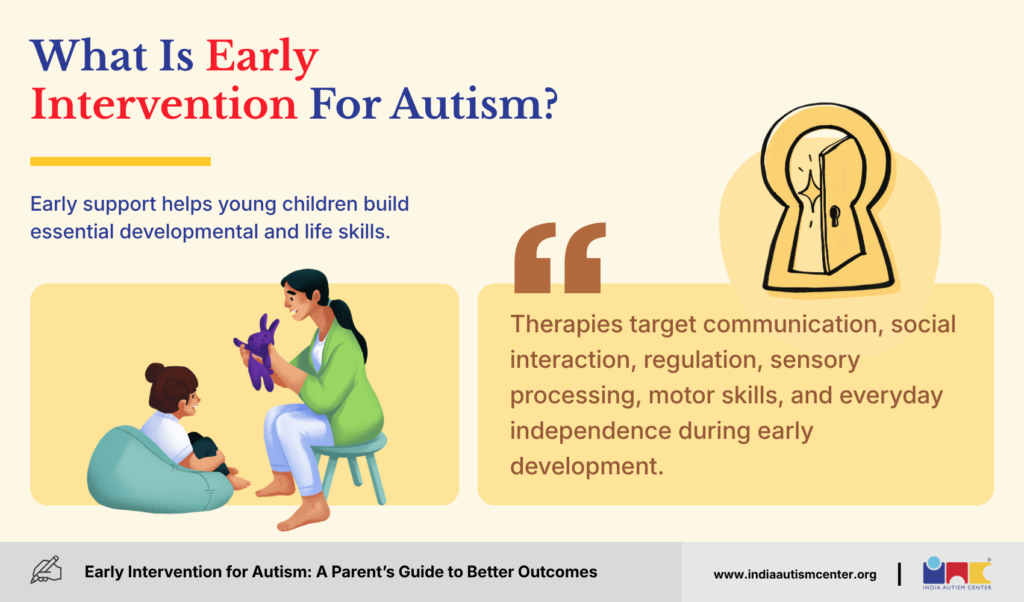
Early intervention for autism spectrum disorder means providing targeted therapies and support to young children, ideally before they turn 3 years old. In many cases, it starts as early as 18 months.
At this age, the brain develops rapidly. It remains highly plastic and especially receptive to learning, change, and growth.
Early autism intervention during this window reduces developmental delays, strengthens key life skills, and improves long-term outcomes.
It typically addresses areas such as:
Communication and speech
Social interaction and play
Emotional regulation
Sensory integration
Gross motor skills (like walking, running, jumping)
Fine motor tasks (like feeding, writing, buttoning)
Daily self-care routines and more
So, early intervention is highly effective in shaping a child’s developmental trajectory. As Raksheet Jain, Co-Founder of Aignosis, shared on the IAC podcast,
There is a 17-point IQ increase that just happens because of early intervention. 37% of these kids will no longer meet the criteria for autism at age three, when they start school. 75% will attend mainstream schools.
This raises the question.
When Should You Consider Early Intervention?
Recognizing early signs of autism is often the first step toward timely support.
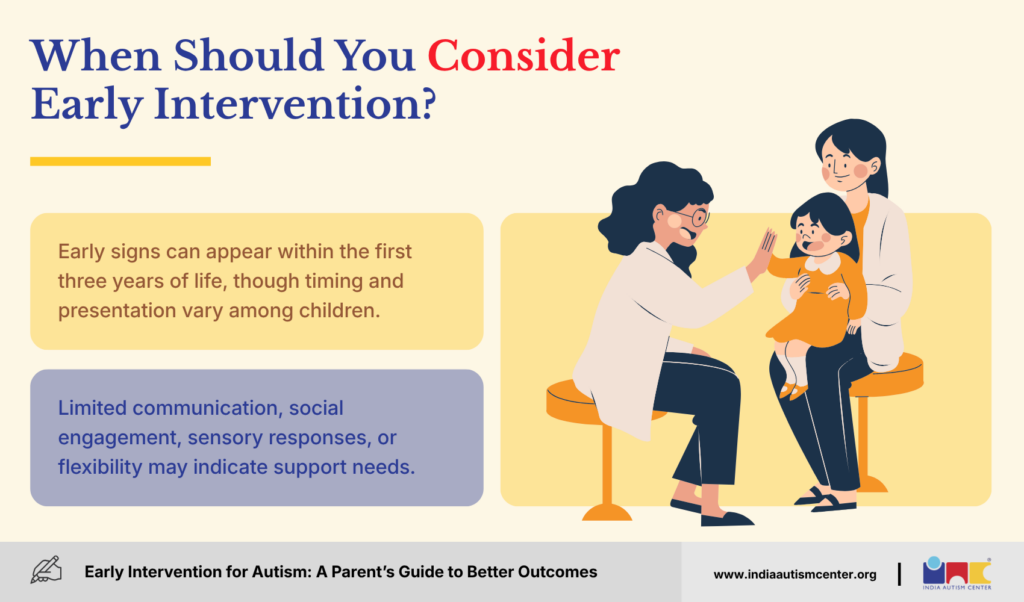
These are the signs that often appear in the first three years. And spotting them opens the door to early support.
The most common signs include:
No babbling, waving, or pointing by 12 months
Not responding to their name despite normal hearing
Minimal eye contact or shared expressions
Few or no spoken words by 16–18 months
Limited interest in social play or imitation
Strong, unusual reactions to sensory input (noise, light, textures)
Repetitive movements like hand-flapping or spinning
Rigid routines or distress over small changes
Understanding these early signs is only part of the journey. The next and most impactful step is knowing why early intervention is important for autism.
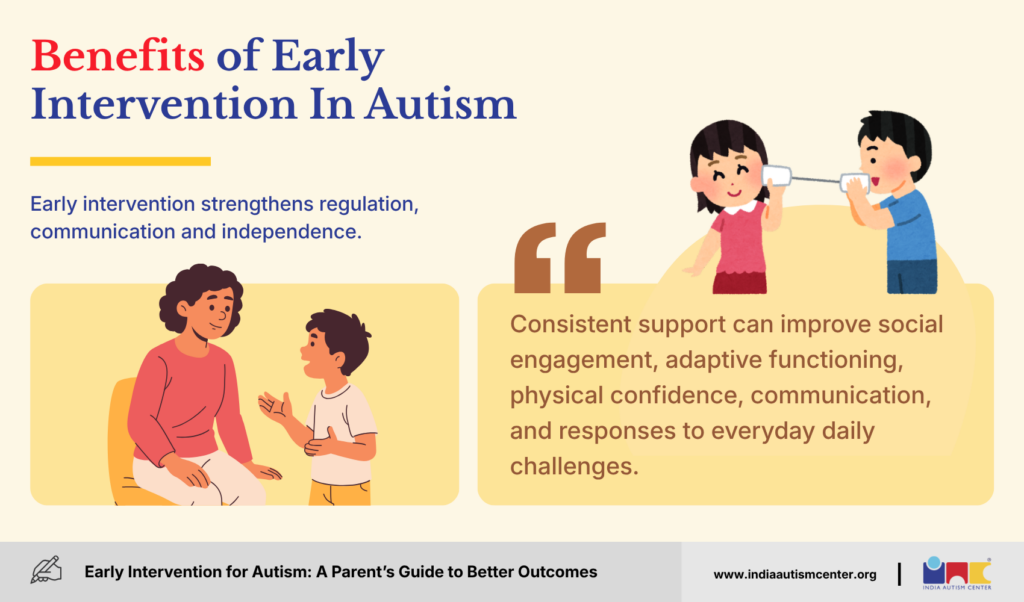
Benefits of Early Intervention In Autism
Without early intervention, progress often slows.
But with it? The difference can be dramatic.
So, how does early intervention help autism? Let’s find out.
Improved Expressive and Receptive Communication
Early intervention for autism spectrum disorder is just about helping children talk. It nurtures both expressive and receptive communication.
This helps children move from single words or gestures to full thoughts, shared intent, and emotional clarity.
With consistent therapy and parent-guided strategies, children begin to connect language with interaction.
Enhanced Social Interaction and Reciprocal Engagement
Through guided play, modeling, and structured therapy, children learn to:
Read facial expressions and social cues
Engage in back-and-forth interactions
Build confidence in peer relationships
Over time, they gain the confidence to initiate and sustain peer relationships. This lays the groundwork for meaningful connections.
Better Emotional Regulation and Behavioral Adaptation
Meltdowns. Sensory overload. Sudden shutdowns. These can escalate quickly.
Autism early intervention teaches children how to self-regulate using:
Calming routines
Sensory tools
Structured transitions
This support reduces emotional outbursts and helps children respond more adaptively to daily challenges.
Accelerated Development of Fine and Gross Motor Skills
From climbing stairs to holding utensils, early intervention in autism improves both:
Gross motor skills (balance, coordination, strength)
Fine motor skills (grasping, writing, buttoning)
Targeted therapies during this window help children gain physical confidence and independence.
Increased Adaptive Skills and Functional Independence
Feeding. Dressing. Toileting. Brushing teeth. Tasks that once felt impossible become manageable.
That’s the real power of early autism intervention. It nurtures adaptive functioning, empowering children toward self-reliance and reducing dependence on others in daily life.
Now that we’ve seen how outcomes improve with early support, let’s explore the proven strategies that make it happen.
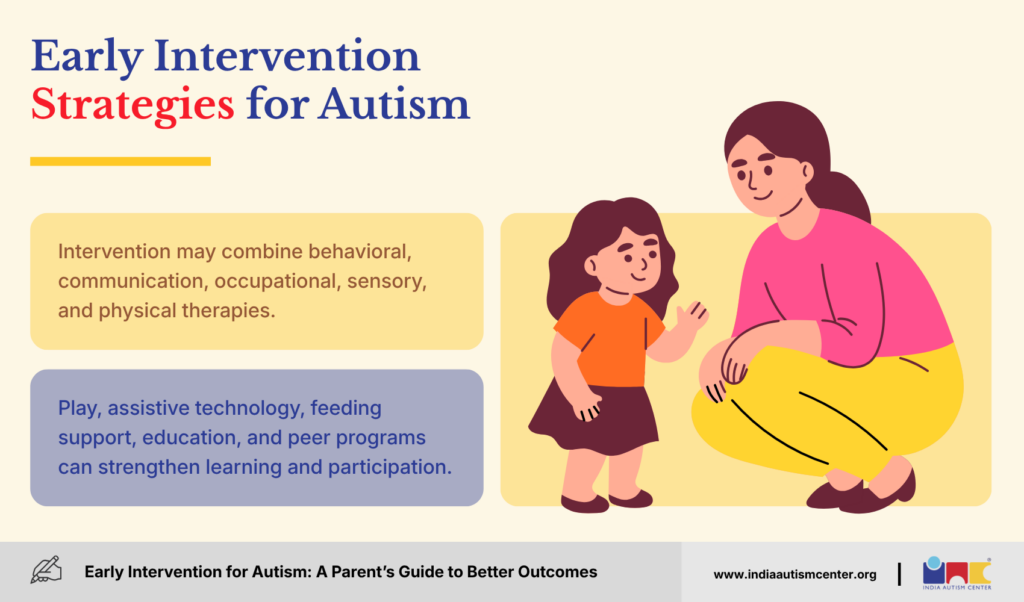
Early Intervention Strategies for Autism
So, where do you begin?
Your first stop should be a developmental pediatrician, clinical psychologist, or rehabilitation psychologist. Ask them to conduct a developmental screening of your child.
If screening raises concerns, early autism intervention can and should begin right away.
Here are a few strategies that can make a lasting difference:
Strategy 1: Build Positive Habits Early with Behavioral Therapy
Applied Behavior Analysis (ABA) is often among the first therapies introduced. It focuses on reinforcing positive behaviors through structured steps like rewards, routines, and repetition.
With ABA, children learn to:
Ask for help
Follow simple instructions
Stay regulated in overstimulating environments
Strategy 2: Boost Connection Through Social Skills Therapy
Did you know that turn-taking, eye contact, and group play can all be taught?
Yes, social skills therapy teaches exactly these core relationship-building tools through guided play sessions and one-on-one modeling.
The right tool, introduced at the right age, can help your child understand the world and be understood in return.
Strategy 7: Reduce Mealtime Stress with Feeding and Nutrition Therapy
Many autistic children struggle with textures, chewing, or swallowing.
This is where feeding and nutrition therapy help. It can:
Reduce stress at meals
Improve oral-motor coordination
Encourage balanced nutrition for better focus and energy
Strategy 8: Encourage Learning Naturally with Play-Based Therapy
Play is not a break from learning. It is learning, especially for young children.
Through pouring rice into cups, pretending to run a tea stall, or simply following a child’s lead in a silly game, play becomes the gateway to communication and emotional connection.
As Puja Dutta, Clinical Psychologist at India Autism Center, says,
Play is the very essence of development… It’s instinctive. It opens us up. And it’s no different for children on the spectrum.
That’s why play-based therapy works. It doesn’t force a child to fit into a plan. It meets them where they are.
Strategy 9: Prepare for School with Early Special Education Services
Preschools with special education services facilitate early intervention for autism.
Some preschools offer:
Visual supports and structured lessons
Individualized learning plans (IEPs)
Flexible pacing
As Shaireen notes,
Most mainstream schools in India are still not equipped for neurodivergent learners. The need of the hour is adaptive learning spaces. And when that isn’t possible, well-supported homeschooling models.
Strategy 10: Foster Teamwork with Peer-Based Community Programs
Children don’t learn in isolation. Peer interaction teaches:
Sharing
Teamwork
Problem-solving
Whether it’s a playgroup or community event, early exposure builds social confidence that carries into the school years.
Now that you know how each strategy supports early development, let’s discuss the role parents play in making early intervention for autism truly effective.
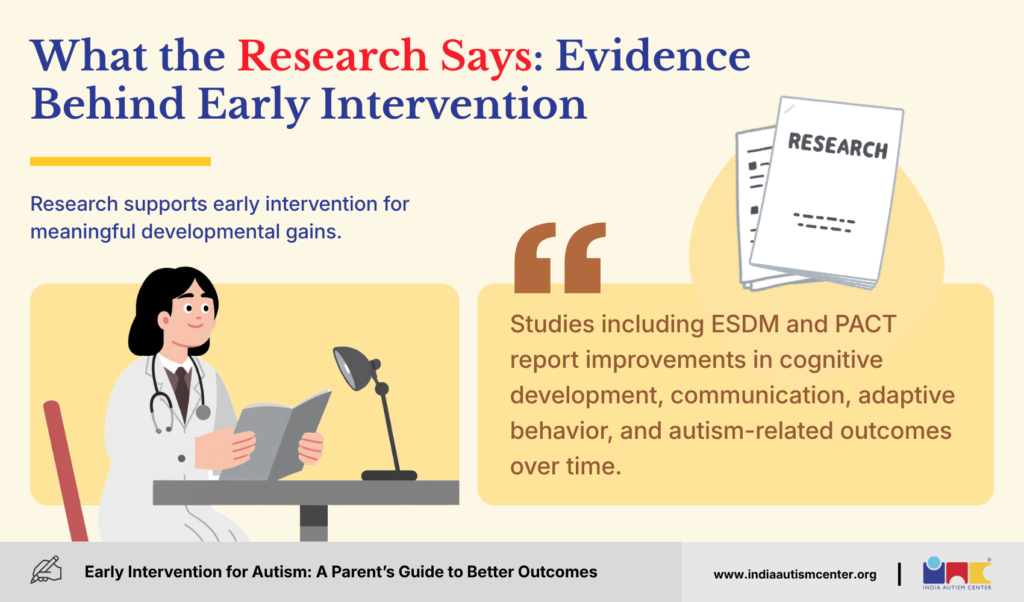
What the Research Says: Evidence Behind Early Intervention
The benefits of early intervention for autism aren’t just anecdotal. They are backed by decades of rigorous, peer-reviewed research. Here’s what the most important studies actually found – in plain language.
The Early Start Denver Model (ESDM)
The landmark study by Dawson et al. (2010), published in Pediatrics, is the most cited randomized controlled trial on early autism intervention. Toddlers aged 18–30 months received ESDM therapy for 20 hours per week over two years. The model combines play-based learning with structured ABA principles and, critically, trains parents to deliver the approach at home.
The results were striking. Children in the ESDM group improved by an average of 17.6 IQ points on cognitive ability measures – compared to just 7.0 points in the control group receiving standard community treatment. That’s more than double the cognitive gain, from the same two-year window.
Beyond IQ, the ESDM group showed significantly better adaptive behavior, language development, and reduced autism symptom severity. Notably, this was the first randomized controlled trial to demonstrate measurable developmental benefits for toddlers with ASD. The play-based, parent-training model is now considered a gold-standard approach worldwide.
The Preschool Autism Communication Trial (PACT)
The PACT study (Green et al., 2010; Pickles et al., 2016) tested a parent-mediated social communication therapy with preschool-aged autistic children. The intervention trained parents to respond more synchronously to their child’s communication cues – essentially, to follow the child’s lead and build on it.
The immediate results showed clear improvements in parent-child social communication and increased child communication initiations. More compelling was the six-year follow-up: children in the PACT group showed significantly less severe autism symptoms and better social communication compared to the treatment-as-usual group. The gains held. That’s the kind of long-term evidence that matters for families making decisions today.
Global Prevalence: Why This Urgency Is Justified
The CDC’s 2025 ADDM Network report found that 1 in 31 children in the United States is diagnosed with ASD – the highest prevalence ever recorded. While India does not yet have an equivalent national surveillance system, this figure serves as a global reference point. It underscores how common autism is, and why building early identification and intervention capacity is a public health priority everywhere, including here.
What Long-Term Research Tells Us
Taken together, the evidence on early intervention points consistently in one direction:
Higher rates of mainstream school attendance – studies show children who receive intensive early intervention are significantly more likely to attend regular schools without additional support
Reduced support needs in adulthood – early gains in adaptive skills translate to greater independence later in life
Improved employment prospects – longitudinal research links early communication and social skill development to better vocational outcomes in adulthood
The window before age 3 is not a deadline to panic about. It’s an opportunity – one that research tells us is genuinely worth acting on as early as possible.
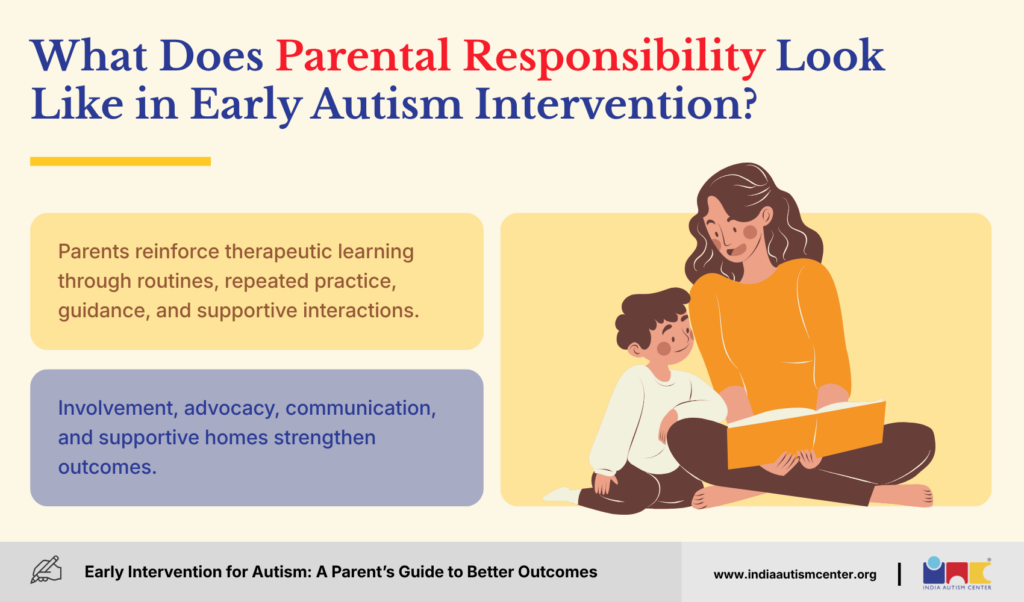
What Does Parental Responsibility Look Like in Early Autism Intervention?
Early intervention for autism is not just about what happens in therapy rooms. It’s about what happens at home. Every single day.
Parents should not be passive observers. They are meant to be core members of the intervention team.
Here’s how you can make your role count.
Turn Everyday Moments Into Practice Opportunities
Therapies like ABA, speech, or occupational therapy teach important skills.
But real growth happens through repetition at home. Moments such as snack time, playtime, or getting dressed can naturally become practice sessions for communication, social skills, and sensory regulation.
To make the most of these everyday moments, try to:
Encourage your child to request or label items during snack time
Use playtime to support turn-taking and social interaction
Practice calming techniques during routines like bathing or dressing
Learn the Techniques and Use Them Confidently
You don’t need formal training to support your child’s development. You just need curiosity and commitment.
Tailor strategies to suit the child’s unique needs
Practice consistently across environments
Build your confidence by learning why certain approaches work
Make Your Home a Supportive Learning Space
A nurturing environment at home can supercharge your child’s comfort and learning.
Try:
Visual schedules to support transitions
Sensory-friendly items to ease overwhelm or increase engagement
Predictable routines to reduce anxiety and improve cooperation
More on this later.
Keep the Conversation Going With Professionals
Open and regular communication with therapists, educators, and specialists ensures that the child’s needs are met consistently.
Make it a habit to:
Provide updates on what you notice at home and in other settings.
Ask questions to clarify goals and strategies.
Participate actively in meetings and planning sessions.
Advocate Strongly for Your Child’s Needs
You are your child’s loudest and strongest voice. Advocacy means ensuring they get the resources, therapies, and accommodations they need.
Take initiative by:
Learning about available services and autism laws
Making detailed requests to schools or healthcare providers
Staying updated on local policy or funding changes
Celebrate Every Step Forward
Autism early intervention outcomes often come in small, meaningful milestones. Recognizing these moments keeps your child motivated.
Celebrate by:
Noticing new skills, improved behaviors, or moments of independence
Praising your child’s effort and persistence
Using positive reinforcement to motivate continued growth
Own Your Role in Your Child’s Progress
Parental involvement is one of the strongest predictors of success in early autism intervention.
Your love, patience, and consistency create the foundation on which everything else is built.
Own your role by:
Being patient with the process and yourself
Staying consistent with routines and practice
Being the primary champion of your child’s growth
Therapy doesn’t stop when you leave the clinic. In fact, much of the progress happens through autism early intervention at home.
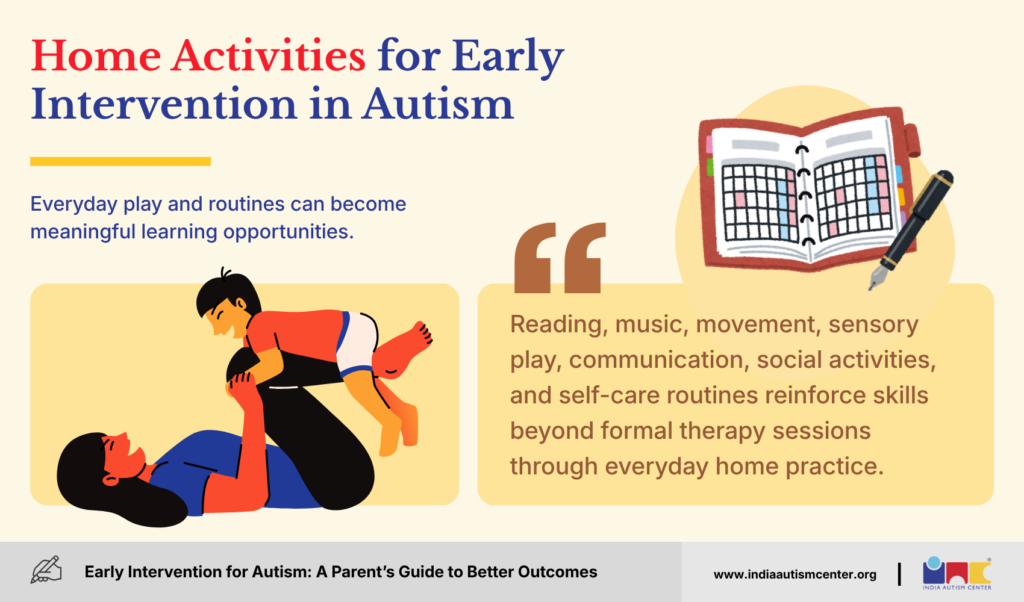
Home Activities for Early Intervention in Autism
Home activities for early autism intervention.
Therapy hours are valuable. No doubt about that.
But what happens at home can multiply their impact.
Here’s how to get the most out of early intervention, right from your living room:
Play with Purpose
Play isn’t just fun. It’s how the children learn.
Activities like stacking blocks, pretending to feed a toy animal, or building with LEGO go beyond creativity. They foster:
Joint attention
Turn-taking
Flexible thinking
Make Reading Interactive
Don’t just read. Interact.
Pause to point out pictures. Name characters. Ask simple questions. Let your child turn the pages.
Books build vocabulary, listening skills, and future communication, even before your child speaks.
Bring in Music and Rhythm
Sing songs with actions. Tap to a beat.
Use music to teach daily routines, like brushing teeth or cleaning up. Songs create structure and support language, memory, and motor development.
Strengthen Little Muscles
Puzzles, finger painting, and stacking rings help build hand-eye coordination.
Additionally, these activities also prepare children for:
Writing
Eating independently
Dressing skills like buttoning or zipping
Encourage Movement
Active play supports sensory regulation and gross motor development.
Try:
Indoor obstacle courses
Cushion jumping
Outdoor walks or park play
Make Routines Count
Bath time. Dressing. Meal prep. These are chores that can double up as learning moments.
Narrate what you’re doing. Offer choices. Give space for independence.
Over time, these routines teach sequencing, communication, and daily living skills.
Support Communication All Day Long
Use short, clear sentences. Label actions and emotions. Use gestures and visuals where possible.
Communication isn’t only built-in therapy, it’s reinforced in every shared moment.
Get Social, Gently
Start small. Invite cousins over for a short visit. Join a parent-child class. Or start with parallel play at a park.
Social practice, at a pace your child can handle, builds confidence and connection.
Create Space for Sensory Needs
Sensory play helps children self-regulate.
Water tubs, sand trays, calm-down bottles, or just a quiet corner with a soft blanket can make all the difference on a hard day.
Early Intervention for Autism in India: What Parents Need to Know
If you’re a parent in India, the information in this guide is directly relevant to you – but the path to accessing early intervention looks different here than it does in the UK or the US. Understanding the landscape honestly is the first step.
The Diagnosis Gap in India
In India, children with autism are diagnosed significantly later than the global best-practice benchmark of age 2. Research published in the Indian Journal of Public Health (2022) found a mean diagnosis age of 4.62 years – and in rural settings, even later. A mixed-methods study from urban North India found that while parents typically noticed developmental concerns around age 2, the actual diagnosis came around age 4. That’s a two-year gap during which the most critical intervention window is passing.
The reasons are systemic. Awareness of early autism signs remains low among many families and frontline health workers. Developmental pediatricians, child psychiatrists, and multidisciplinary assessment teams are concentrated in metro cities. In Tier 2 and Tier 3 cities – and certainly in rural areas – families often travel hundreds of kilometres for a single diagnostic appointment, then wait months for the next one.
This is not a failure of parents. It’s a gap in the system. And knowing it exists is the first step to navigating around it.
Your Child’s Legal Rights: The RPWD Act 2016
Here’s something every Indian parent of an autistic child needs to know: autism is a recognized disability under the Rights of Persons with Disabilities (RPwD) Act, 2016. The Act, which came into force in April 2017, expanded India’s disability framework to 21 categories – and autism spectrum disorder is explicitly included.
What this means practically:
Free education: Schools cannot deny admission on the basis of disability. Inclusive education is mandated.
Reservations: At least 5% of seats in government higher education institutions are reserved for persons with benchmark disabilities, including autism.
Government employment: 4% of vacancies in central government establishments are reserved for persons with benchmark disabilities.
Non-discrimination: The Act mandates equal treatment and accessibility in public life.
To access these rights, your child will need a disability certificate issued through a government-notified process. Ask your developmental pediatrician or district hospital about obtaining a UDID (Unique Disability ID) card – this is the gateway to most government benefits.
The National Trust Act: Welfare and Guardianship
Alongside the RPwD Act, the National Trust Act (1999) specifically covers autism, cerebral palsy, intellectual disability, and multiple disabilities. It provides legal guardianship frameworks for autistic individuals who need support in adulthood, and it funds welfare schemes through registered organizations. If you’re thinking about long-term planning for your child, the National Trust is a resource worth knowing.
Key Institutions for Diagnosis and Intervention
If you’re seeking a formal diagnosis or specialist early intervention, these are the primary referral institutions in India:
NIMHANS (National Institute of Mental Health and Neuro Sciences), Bangalore – a leading centre for autism diagnosis and research
AIIMS (All India Institute of Medical Sciences), New Delhi – offers multidisciplinary developmental assessment
Ali Yavar Jung National Institute of Speech and Hearing Disabilities, Mumbai – specializes in communication disorders and early intervention for children with developmental disabilities
These institutions have long waiting lists. Start the referral process early, and pursue private assessment in parallel if you can.
Government Programs: ICDS and Sarva Shiksha Abhiyan
Some states offer early intervention support through the Integrated Child Development Services (ICDS) scheme, which reaches children from birth to 6 years through Anganwadi centres. The quality of autism-specific support varies widely by state and by the training of local workers.
For school-age children, Sarva Shiksha Abhiyan (SSA) – now subsumed under the Samagra Shiksha framework – mandates inclusive education for children with disabilities. In practice, the availability of trained resource teachers and support staff in mainstream schools remains inconsistent, particularly outside urban areas.
The Private-Government Access Gap
Let’s be direct about something: the majority of quality, evidence-based early intervention in India is currently concentrated in metro cities and delivered through private centres. Families in smaller towns and rural areas face a significant access barrier – both in terms of geography and cost.
This gap is real. It’s also why specialized centres that combine residential programs, trained therapists, and structured parent training are so important for families who cannot access daily outpatient therapy locally.
How India Autism Center Can Help
India Autism Center operates as a specialized residential and training centre designed precisely for this gap. For families who cannot access consistent early intervention locally – whether due to geography, specialist availability, or the need for intensive, structured programming – IAC offers evidence-based programs delivered by trained professionals.
If your child has recently been diagnosed, or if you’re seeing early signs and don’t know where to start, reach out to India Autism Center for guidance. The team can help you understand what early intervention looks like for your child’s specific profile, and what steps to take next – whether that’s with IAC or with services closer to home.
Early intervention for autism works. The research is clear. The question for Indian families is not whether to act, but how to find the right path forward. You don’t have to figure that out alone.
Parting Thoughts: Key Considerations In Early Intervention for Autism
A strong early intervention program for autism begins with a multidisciplinary assessment. Developmental pediatricians, psychologists, speech therapists, occupational therapists, and special educators come together to understand your child’s unique profile.
But that’s only part of the picture. Real success comes when support extends to the whole family.
As Puja emphasizes,
We can’t work in isolation. The child belongs to a family. When parents feel supported, united, and consistent, it creates a more stable environment for the child to grow.
Also, ensure the professionals delivering early intervention are trained, certified, and experienced.
For further assistance, feel free to contact us now.
Frequently Asked Questions
Does autism get better with early intervention?
Early intervention doesn’t cure autism. But it can make a lasting impact on a child’s development. Starting support early helps children build critical skills in communication, learning, social interaction, and daily living.
What should I do if my 2-year-old shows signs of autism?
Start with a developmental evaluation by a pediatrician or psychologist. If autism is suspected, connect with early intervention services in your area.
At home, focus on:
Play-based interaction
Communication-rich environments
Establishing consistent daily routines
What age is considered early intervention for autism?
Early intervention typically refers to support services provided from birth up to 3 years old.
What is the best age to start autism treatment?
There’s no single best age, but the earlier the better. The brain is most adaptable (or plastic) in the first five years of life. Starting therapy as soon as autism is suspected can positively influence learning, social skills, and overall development.
What is the success rate of early intervention for autism?
Success varies based on the child’s individual needs, type of intervention, and family involvement.
Research shows that timely and targeted early autism intervention leads to significant progress in:
Language and communication
Social interaction
Adaptive skills and independence
Can early intervention cure autism?
No, early intervention doesn’t cure autism, and it’s not meant to. Autism is a neurodevelopmental condition, not a disease. What early intervention does is help build communication, confidence, and everyday skills.
Disclaimer: This article is intended for educational and informational purposes only. It is not a substitute for professional medical advice, diagnosis, or treatment. If you are pregnant or have concerns about medication use during pregnancy, please consult a qualified healthcare provider. If your child has received an autism diagnosis and you have questions about causes or support, please reach out to a trained specialist or an autism-focused organisation for guidance.
For expert insights, support services, and inclusive learning initiatives, visit the India Autism Center.
You’ve sat through three different appointments. One specialist says it could be autism. Another says it looks more like a learning disorder. A third shrugs and says, “We’ll watch and wait.” You come home more confused than when you left – and your child is still struggling.
That confusion is not a failure of parenting. It’s a failure of the system to communicate clearly about two conditions that genuinely overlap in ways that challenge even experienced clinicians. Non-verbal learning disorder vs autism is one of the most misunderstood comparisons in developmental paediatrics, and Indian families face the additional burden of navigating it with fewer specialist resources, inconsistent terminology, and a diagnostic landscape that is still catching up.
This article will not give you vague reassurances. It will give you the specific differences, the clinical criteria, the Indian legal rights, and the concrete next steps – so you can walk into your next appointment knowing exactly what to ask.
What Is Non-Verbal Learning Disorder (NVLD)?
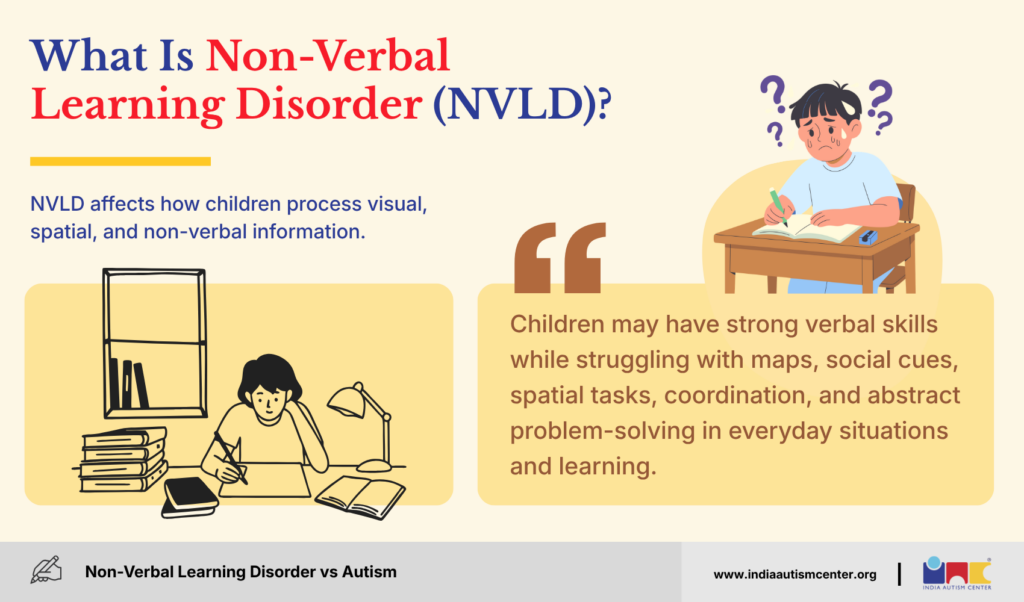
Non-verbal learning disorder (NVLD) – also called nonverbal learning disability or developmental visuospatial disorder – is a neurodevelopmental condition in which a child’s brain struggles to interpret and respond to visual and spatial information. The core deficit is not in speaking or reading words. It is in making sense of the non-verbal world: maps, diagrams, facial expressions, body language, spatial distance, and abstract concepts.
Children with NVLD often:
Excel in spoken language, vocabulary, rote memory, and factual recall
Miss nonverbal social cues such as tone of voice, facial expressions, gestures, and sarcasm
Appear clumsy or uncoordinated because they cannot accurately judge distance and space
Have difficulty with abstract thinking, novel problem-solving, and adapting to unexpected changes
The name “non-verbal learning disorder” trips up many parents. It does not mean the child cannot speak. It means the child has difficulty processing non-verbal information.
The Paradox of NVLD: Fluent Speaker, Missed Signals
Here is the central paradox: a child with NVLD may speak like a little professor – articulate, advanced, even charming in conversation – and yet be completely lost when asked to draw a simple diagram, navigate a new building, or understand why a classmate is upset.
They can follow detailed verbal instructions but get disoriented in a new environment. Can memorise facts from a textbook but cannot interpret a bar graph. They can describe a social situation in perfect sentences but misread the emotional tone entirely.
This gap between verbal brilliance and non-verbal confusion is precisely what makes NVLD so easy to miss – and so easy to mistake for autism, ADHD, or anxiety. As Puja Dutta, an RCI-registered psychologist with India Autism Center, explains:
“Parents often misread social or spatial difficulties when comparing NVLD vs autism. Without a proper assessment, this can lead to misdiagnosis and missed intervention windows. A comprehensive evaluation by trained professionals is essential to ensure timely and appropriate support.”
Is NVLD a Formal Diagnosis? (DSM-5 Status Explained)
No – and this is a critical point that shapes everything else.
NVLD is not currently listed in the DSM-5 (Diagnostic and Statistical Manual of Mental Disorders, Fifth Edition), the reference manual used by clinicians worldwide, including in India, to make formal diagnoses. There is no standardised diagnostic code, no agreed-upon checklist, and no single validated test for NVLD the way there is for autism.
Some researchers advocate renaming it “developmental visuospatial disorder” to better reflect its core deficit and to build the case for eventual DSM inclusion. That process is ongoing.
What this means practically: a child with a clear NVLD profile may receive a diagnosis of “specific learning disorder,” “ADHD,” or even “autism” – not because those labels are accurate, but because they are the closest available boxes. This is exactly why a thorough neuropsychological evaluation matters so much.
NVLD is also not the same as social (pragmatic) communication disorder, another condition that can look similar. Social pragmatic communication disorder involves difficulty using language in social contexts but does not include the visual-spatial deficits that define NVLD, and it also lacks the repetitive behaviours required for an autism diagnosis.
How Common Is NVLD?
A 2020 study published in JAMA Network Open estimated that NVLD affects approximately 3% to 4% of children and adolescents in the United States. There are no equivalent large-scale Indian prevalence studies, but given that NVLD is believed to arise from neurological differences in right-hemisphere brain function, there is no reason to assume the Indian prevalence is dramatically different.
Because NVLD lacks a formal DSM-5 diagnosis, it is almost certainly under-identified in India, where specialist neuropsychological services are concentrated in metros and awareness among general paediatricians remains low.
Understanding NVLD is only half the picture. Let’s now look at what autism actually is – because the two conditions are frequently conflated, and the distinction matters enormously for treatment.
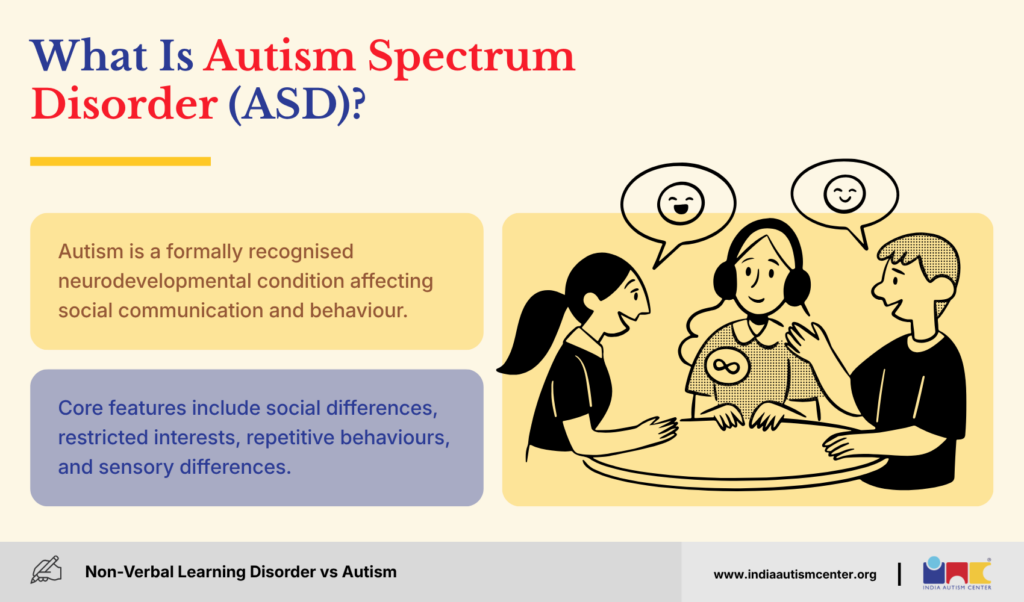
Autism spectrum disorder (ASD) is a formally recognised neurodevelopmental condition listed in the DSM-5 under Neurodevelopmental Disorders. It is characterised by persistent differences in social communication and interaction, combined with restricted, repetitive patterns of behaviour, interests, or activities. Both features must be present for a diagnosis.
According to the Centers for Disease Control and Prevention (CDC), autism affects approximately 1 in 31 children in the United States as of 2023. Indian prevalence data is harder to pin down, but estimates from studies published in journals such as the Indian Journal of Psychiatry suggest figures in a broadly comparable range, with significant regional variation.
Core features of ASD include:
Social communication differences – difficulty with back-and-forth conversation, interpreting facial expressions, understanding social intentions, and using language for social purposes
Repetitive behaviours and restricted interests – stimming (hand-flapping, rocking), insistence on sameness, intensely focused interests, rigid routines
Sensory processing differences – hypersensitivity or hyposensitivity to sounds, lights, textures, temperatures, tastes, and other sensory input
Autism Is a Spectrum – Not a Single Profile
Autism is a spectrum condition. This is not just a polite way of saying “everyone is a little autistic.” It means that two children with the same diagnosis can look entirely different. One child may be minimally verbal, require round-the-clock support, and experience significant sensory overwhelm. Another may be highly verbal, academically strong, and largely independent – but struggle profoundly with social reciprocity and unexpected change.
This variability is part of why autism is so often confused with NVLD. A verbally fluent, academically capable autistic child and a child with NVLD can look remarkably similar in a classroom or a social setting. The differences emerge when you look more carefully at the underlying mechanisms.
How Common Is Autism in India?
India does not yet have a national autism registry, which makes precise figures difficult. Studies from NIMHANS (National Institute of Mental Health and Neurosciences, Bengaluru) and other institutions suggest prevalence figures ranging from roughly 1 in 89 to 1 in 125 children, though methodological differences make direct comparisons tricky. What is clear is that autism is significantly under-diagnosed in India, particularly in rural areas and among girls, and that awareness has grown substantially since the RPWD Act 2016 formally recognised ASD as a disability.
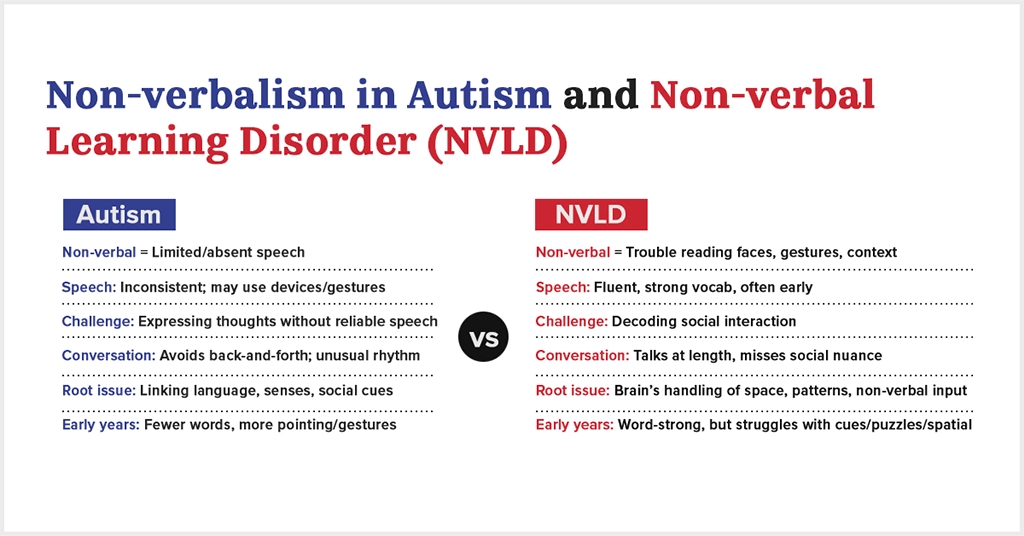
Non-Verbal Learning Disorder vs Autism Spectrum Disorder
Key Trait
Non Verbal Learning Disorder (NVLD)
Autism Spectrum Disorder (ASD)
Verbal Ability
Strong verbal skills; articulate speech and vocabulary
Ranges from nonverbal to highly verbal; challenges in social communication
Visual-Spatial Reasoning
Major difficulties (maps, puzzles, spatial tasks)
May vary; not a core diagnostic feature
Nonverbal Social Cues
Struggles with facial expressions, tone, and body language
Common; part of core diagnostic criteria
Repetitive Behaviors / Routines
Not typical, but may rely on routine for comfort
Hallmark symptom: stimming, insistence on sameness
Sensory Processing
May have proprioceptive challenges
Broad range: hypo- or hyper-sensitivity to sensory input
Motor Coordination
Clumsy movements, poor handwriting
May be present, but varies
DSM-5 Recognition
Not formally recognized
Yes, under Neurodevelopmental Disorders
Diagnostic Tools
No standardized tool; diagnosis via neuropsychological evaluation
Multiple validated tools: ADOS, ADI-R, M-CHAT, etc.
Co-occurrence
May co-occur with ASD or ADHD
May co-occur with intellectual disability, anxiety, ADHD, etc.
Root Challenge
Difficulty interpreting and responding to nonverbal information
Difficulty with social communication, behavior regulation, and sensory input
Social Communication Differences
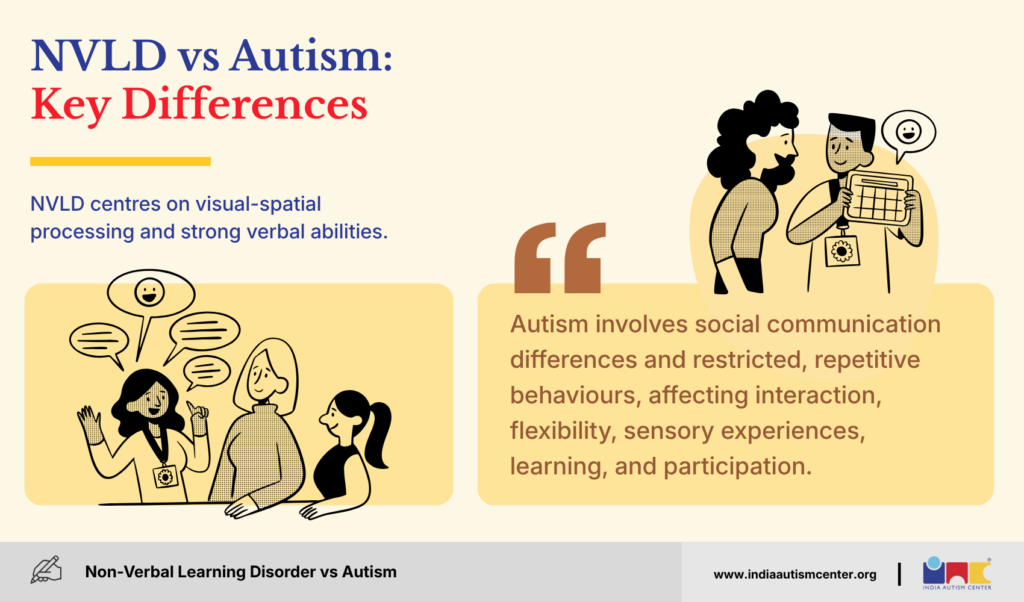
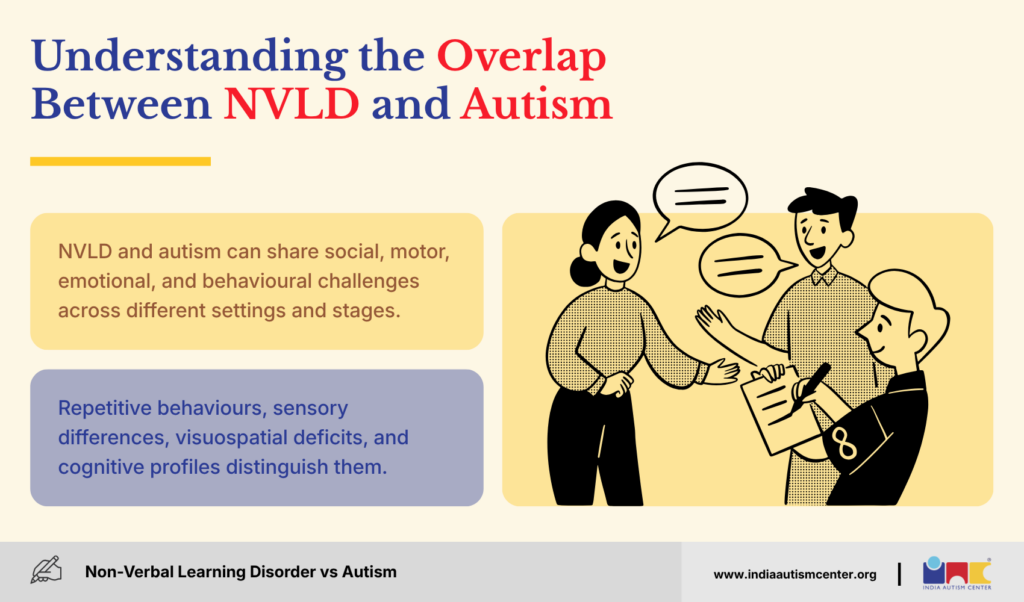
Both NVLD and autism involve social difficulties, but the root cause differs fundamentally.
A child with NVLD wants to connect socially and often tries hard to do so. Their difficulty is in reading the room – they miss the tone of voice, the raised eyebrow, the subtle shift in body language that signals “I’m bored” or “that was a joke.” They are socially motivated but socially misreading.
In autism, the social communication difference is more pervasive. It may include difficulty initiating conversation, understanding social intentions, interpreting figurative language, and adjusting communication style to different contexts. Some autistic children actively prefer solitude; others desperately want friends but find the unwritten rules of social interaction genuinely opaque.
Social pragmatic communication disorder sits somewhere between the two: primarily a pragmatic language difficulty, without the repetitive behaviours of autism and without the spatial processing deficit of NVLD.
Motor Skills and Spatial Reasoning
Motor difficulties appear in both conditions, but for different reasons – a distinction that has direct implications for therapy.
In NVLD, clumsiness stems from visuospatial processing difficulties. The child cannot accurately judge where their body is in space, how far away an object is, or how to plan a physical movement through a spatial environment. Handwriting is often particularly affected.
In autism, motor difficulties – when present – are more often linked to sensory processing differences or motor planning (dyspraxia). The child may have difficulty with the sequencing of movements or be overwhelmed by the sensory experience of certain physical activities.
As Dr Gordon Day has noted: “Both disorders are associated with problems with motor skills, but it is explained in NVLD by visual-spatial organisation, while in autism, it is associated with sensory processing difficulties.” Same surface behaviour, different mechanism – and therefore different therapeutic targets.
Language and Verbal Ability
This is perhaps the clearest differentiator. Children with NVLD typically have strong verbal skills – they are often early talkers, good readers of words (though not of graphs or diagrams), and comfortable with verbal explanation. Their verbal IQ is usually significantly higher than their performance IQ, and this discrepancy is a key diagnostic signal.
In autism, verbal ability varies enormously across the spectrum. Some autistic children are minimally verbal or use augmentative and alternative communication (AAC). Others are highly verbal but use language in ways that feel one-sided, overly literal, or socially mistuned. The key is that social use of language – pragmatics – is affected regardless of vocabulary level.
Sensory Processing
Sensory processing differences are a core diagnostic feature of autism and are included in DSM-5 criteria. Autistic children may be hypersensitive to sounds (covering ears in noisy environments), textures (refusing certain foods or clothing), lights, or smells – or hyposensitive, seeking intense sensory input.
In NVLD, sensory differences are not a defining feature, though proprioceptive challenges (difficulty sensing where the body is in space) are common and contribute to the motor clumsiness described above.
Repetitive Behaviours and Restricted Interests
This is a diagnostic dividing line. Repetitive behaviours and restricted interests are required for an autism diagnosis. They are not a defining feature of NVLD.
An autistic child may stim (rock, flap, spin), insist on the same route to school every day, become intensely absorbed in a narrow topic (train schedules, dinosaur taxonomy, a specific video game), or become distressed when routines change.
A child with NVLD may also prefer routine – but this preference is driven by the anxiety of navigating an unpredictable world, not by the neurological pull towards sameness that characterises autism. The distinction is subtle but clinically meaningful.
Emotional Regulation and Meltdowns
Both conditions can involve emotional dysregulation and what looks like a meltdown – intense emotional outbursts that seem disproportionate to the trigger.
In NVLD, meltdowns are typically triggered by cognitive overload: too many simultaneous demands, confusing instructions, a sudden change in plan that the child cannot mentally reorganise. The child’s executive function is overwhelmed.
In autism, meltdowns are often triggered by sensory overload, routine disruption, or communication breakdown – the neurological threshold for overwhelm is reached, and the result is a full-system crash that is not defiance but a genuine loss of regulatory capacity.
In both cases, discipline is the wrong response. What helps is preparation, sensory scaffolding, and emotional co-regulation.
The surface similarities between these two conditions are real – but so are the differences. The next section explains why even experienced clinicians get confused.
Understanding the Overlap Between NVLD and Autism
Here is a realistic scenario that plays out in clinics across India every week. A parent brings in a 7-year-old who speaks fluently, has an impressive vocabulary, struggles to make friends, gets overwhelmed by unexpected changes, has messy handwriting, and melts down when the school schedule changes. The child is clearly struggling. But is it NVLD or autism?
The overlapping traits that create this confusion include:
Social difficulties – both conditions affect the ability to read and respond to social cues
Motor clumsiness – present in both, for different reasons
Resistance to change – present in both, driven by different mechanisms
Strong verbal ability – common in NVLD; also common in verbally fluent autistic children
Academic inconsistency – both conditions can produce uneven academic profiles
Emotional dysregulation – meltdowns appear in both, though triggered differently
Anxiety – extremely common as a co-occurring condition in both NVLD and autism
The critical differentiators that a skilled evaluator will look for:
Repetitive behaviours and restricted interests – present in autism, not in NVLD
Sensory hypersensitivity/hyposensitivity – a core autism feature, not a defining NVLD feature
Visuospatial processing deficit – the hallmark of NVLD, not a required autism feature
Verbal-performance IQ discrepancy – a key NVLD signal on cognitive testing
When Both Conditions Co-Occur
NVLD and autism can co-occur. This is not a theoretical edge case – it is clinically documented. A child can have the visuospatial processing deficit of NVLD and the social communication differences and repetitive behaviours of autism simultaneously.
Co-occurring conditions make diagnosis harder and treatment planning more complex. A child with both NVLD and autism will need interventions that address the spatial processing deficit and the sensory processing differences and the social communication challenges – not a one-size-fits-all programme.
Other common co-occurring conditions to be aware of:
ADHD – frequently co-occurs with both NVLD and autism
Anxiety disorders – extremely common in both populations
Specific learning disorders (dyslexia, dyscalculia)
Depression – particularly in older children and adolescents with NVLD who are aware of their differences
Accurate diagnosis is not just an academic exercise. It determines which interventions are offered, which school accommodations are granted, and which legal protections apply. That brings us to the diagnostic process itself.
Children with NVLD and ASD may both appear clumsy. Struggling with handwriting, tripping often, or fumbling through physical activities.
But the underlying reasons diverge.
In NVLD, motor challenges arise from difficulties in processing space and distance
In autism, these issues often stem from sensory overload
Both disorders are associated with problems with motor skills, but it is explained in NVLD by visual-spatial organization, while in autism, it is associated with sensory processing difficulties.
Same behaviors, different mechanisms. And that distinction can inform very different therapeutic approaches.
How Is NVLD Diagnosed? (And How Is It Different From Autism Diagnosis?)
The NVLD Diagnostic Process
Because NVLD lacks a DSM-5 entry, there is no single standardised diagnostic pathway. What clinicians do instead is build a profile – a comprehensive picture of the child’s strengths and weaknesses across multiple domains – and determine whether that profile fits the NVLD pattern.
A thorough NVLD evaluation typically includes:
Clinical interview with parents and, where possible, the child
Teacher reports and school records (looking for patterns of academic inconsistency)
Cognitive assessment (IQ testing) – specifically looking for a significant discrepancy between verbal and performance/visuospatial scores
Visual-spatial processing tests – assessing the ability to interpret diagrams, navigate space, and process visual information
Motor assessment – fine and gross motor coordination
Executive function assessment – planning, organisation, working memory
Social cognition assessment – theory of mind, emotion recognition
Emotional and behavioural screening – anxiety, depression, ADHD symptoms
The evaluator will also explicitly assess for autism, ADHD, and specific learning disorders to rule in or rule out co-occurring conditions.
The Autism Diagnostic Process in India
Autism diagnosis in India follows international clinical guidelines, adapted to the Indian context. A formal ASD diagnosis requires:
Developmental history – detailed parent interview covering early milestones, communication, social development, and behaviour
Behavioural observation – structured and unstructured observation of the child
Standardised assessment tools (see below)
Multi-disciplinary input – ideally involving a clinical psychologist, developmental paediatrician, and speech-language pathologist
Key Assessments Used in India (RCI-Registered Professionals, CARS, ADOS, Vineland)
In India, assessments should be conducted by RCI-registered psychologists or clinical psychologists (registered with the Rehabilitation Council of India). Key tools used include:
CARS (Childhood Autism Rating Scale) – a widely used observational rating scale for autism severity; practical and validated for Indian clinical settings
ADOS-2 (Autism Diagnostic Observation Schedule, 2nd Edition) – the gold-standard structured observational assessment for autism; requires specialist training
ADI-R (Autism Diagnostic Interview – Revised) – a detailed parent interview covering the three core autism domains
M-CHAT-R/F – a screening tool for toddlers (16–30 months), widely used in Indian paediatric settings
Vineland Adaptive Behavior Scales – measures real-world adaptive functioning (communication, daily living skills, socialisation, motor skills); essential for understanding how a child functions day-to-day, not just how they perform on tests
Neuropsychological evaluation – for NVLD specifically, this is the most important assessment; it maps cognitive strengths and weaknesses across verbal, visuospatial, memory, attention, and executive function domains
For NVLD, there is no equivalent of the ADOS-2. The diagnosis rests on the neuropsychological profile, clinical judgement, and the exclusion of other explanations.
Why Early and Accurate Diagnosis Matters
An inaccurate diagnosis does not just delay the right support – it can actively cause harm. A child with NVLD who is treated primarily for autism may receive interventions (such as certain behavioural programmes) that do not address the core visuospatial deficit and may even increase anxiety. A child with autism who is treated primarily for a learning disorder may miss out on the sensory integration support and communication strategies that could make a transformative difference.
Early diagnosis – before age 5 for autism, and as early as possible for NVLD – is associated with significantly better long-term outcomes. The brain is most plastic in the early years, and targeted intervention during this window yields the greatest gains.
Diagnosis is not a label. It is a map. And the right map leads to the right destination.
Living With NVLD or Autism in India: What Families Can Expect
Long-Term Outlook for NVLD
The long-term outlook for children with NVLD is genuinely positive – particularly when the condition is identified early and the right supports are in place. Many adults with NVLD lead independent, fulfilling lives. They often gravitate towards careers that leverage their verbal strengths: writing, law, teaching, counselling, research.
The challenges that tend to persist into adulthood include:
Difficulty with organisation and time management
Continued struggles with spatial tasks (driving, navigating new environments)
Social anxiety and difficulty reading social situations
Challenges in workplaces that require strong visual-spatial skills or rapid adaptation to change
With coping strategies, career support, and continued social learning, most adults with NVLD manage these challenges effectively. The key is that they need to understand their own profile – and that starts with an accurate diagnosis in childhood.
Long-Term Outlook for Autism
The long-term outlook for autism varies considerably across the spectrum. Some autistic adults live fully independently, hold demanding careers, and have rich social lives. Others require ongoing support with daily living, communication, and community participation.
What research consistently shows is that early, intensive, targeted intervention significantly improves long-term outcomes across the spectrum. The specific skills that improve most with early intervention include communication, adaptive behaviour, and social participation.
In India, the expanding network of autism-specific schools, therapy centres, and vocational training programmes – supported by the RPWD Act’s provisions – means that the support landscape is improving, even if it remains uneven across regions.
Building a Support System in India
Whether your child has NVLD, autism, or both, building a strong support system is not optional – it is essential. Practically, this means:
A core clinical team: ideally including an RCI-registered clinical psychologist, a speech-language pathologist, and an occupational therapist
A school ally: a teacher or special educator who understands your child’s profile and can implement accommodations
A parent community: connecting with other families navigating similar challenges – through local support groups, online communities, or organisations like the Autism Society of India
Regular review: your child’s needs will change as they develop; assessments and intervention plans should be reviewed at least annually
India’s major cities – Mumbai, Delhi, Bengaluru, Chennai, Kolkata, Hyderabad – have growing ecosystems of specialist services. Families in smaller cities and rural areas face greater challenges, but telehealth options have expanded significantly since 2020 and can provide access to specialist consultation that was previously unavailable outside metros.
The support system you build today is the foundation your child will stand on for years to come.
Conclusion
If the traits described here align with what you’re noticing in your child, it’s worth slowing down and taking a closer look.
Because what if these patterns don’t correct themselves with time, discipline, or simply trying harder?
What makes a real difference is targeted support, grounded in an accurate understanding of your child’s brain.
That starts with a strategic, well-informed approach, which includes the following steps:
Consult a qualified specialist who can look beyond surface behavior
Ask for a comprehensive evaluation that assesses not just for autism, but also learning, motor, and processing differences
Build a multidisciplinary team, including speech-language therapists, occupational therapists, and clinical psychologists, to map out your child’s needs with precision
Follow through on individualized interventions to understand whether the diagnosis falls under autism, NVLD, or elements of both.
Also, engage proactively with your child’s school. Sharing diagnostic insights can open doors to critical accommodations such as structured routines, additional processing time, or visual supports that reduce daily friction.
At India Autism Center, we specialize in creating clarity where there’s diagnostic fog. So, if you’re struggling to distinguish between nonverbal learning disorder vs autism, feel free to contact us.
Frequently Asked Questions
Is NVLD a form of autism?
No, non-verbal learning disorder is not a form of autism. While both involve challenges with social cues and learning, NVLD is primarily about visual-spatial processing and is not on the autism spectrum.
Is NVLD autism?
No. NVLD and autism are separate conditions. NVLD affects how people understand nonverbal information, while autism involves broader differences in social communication, sensory response, and repetitive behaviors.
Is nonverbal learning disorder on the autism spectrum?
No. NVLD is not classified as being on the autism spectrum. However, the two can look similar in social and academic settings, which often leads to misdiagnosis.
Is non-verbal learning disorder on the autism spectrum?
No. Non-verbal Learning Disorder is not officially recognized as part of the autism spectrum, although it shares some overlapping traits.
Is NVLD related to autism?
They’re related in presentation but not the same condition. Both can affect social behavior and learning, but autism typically impacts a wider range of developmental areas, including sensory processing.
What causes NVLD?
While research is ongoing, NVLD is believed to stem from right-hemisphere brain dysfunction, affecting visual-spatial, organizational, and abstract reasoning skills.
A mix of genetic and environmental factors causes autism. It affects brain development, leading to differences in communication, behavior, and sensory experience.
What’s the difference between non-verbal learning disorder and autism?
Autism affects social skills, communication, and sensory processing. NVLD mainly impacts visual-spatial reasoning, understanding body language, and abstract thinking, while verbal skills are often strong.
Can autism be mistaken for a learning disability?
Yes. Autism is a neurodevelopmental condition, not a learning disability, but it can be mistaken for one due to overlapping academic challenges. A full evaluation helps clarify the difference.
Can people with NVLD speak?
Yes. Speaking is usually a strength for people with NVLD. They often have strong vocabularies and communicate well with words, but struggle with social cues and spatial reasoning.
Do kids with NVLD speak?
Yes. Kids with NVLD typically speak fluently and often sound advanced for their age. Their challenges show up more in nonverbal and abstract reasoning tasks.
Is non-verbal related to autism?
It can be, but not always. Nonverbal communication challenges are common in autism, but other conditions like apraxia, trauma, or hearing loss can also cause someone to be nonverbal.
Can a child be nonverbal but not autistic?
Yes. Non-verbal behavior can stem from various causes, like speech delays, apraxia, selective mutism, or neurological conditions, without involving autism.
What’s the difference between being nonverbal and being autistic?
Being nonverbal means not using spoken language. Being autistic means having a different neurotype that affects social, sensory, and communication patterns. Not all autistic people are nonverbal.
Do nonverbal autistic children have intelligence?
Yes. Many nonverbal autistic children have average or above-average intelligence. They may think and learn differently, and communicate better through nonverbal tools like AAC.
Can you go nonverbal without autism?
Yes. People can temporarily or permanently lose speech due to stress, trauma, selective mutism, or other neurological factors unrelated to autism.
Do nonverbal kids eventually talk?
Some do, some don’t. With early intervention and the right supports, many children develop speech over time. Others may rely on alternative forms of communication long-term.
How to teach a child with NVLD?
Use structured, step-by-step instructions. Support verbal strengths, but provide visual aids, social skills coaching, and help with organizing space, time, and tasks.
How does NVLD affect adults?
Adults with NVLD may struggle with organization, abstract reasoning, or reading social cues. Many manage well with coping strategies, career support, and continued social learning.
Disclaimer: This article is intended for educational and informational purposes only. It is not a substitute for professional medical advice, diagnosis, or treatment. If you are pregnant or have concerns about medication use during pregnancy, please consult a qualified healthcare provider. If your child has received an autism diagnosis and you have questions about causes or support, please reach out to a trained specialist or an autism-focused organisation for guidance.
For expert insights, support services, and inclusive learning initiatives, visit the India Autism Center.
For many parents of autistic children, the first worry begins with silence. A toddler who doesn’t say “mama” at 18 months. A child who once spoke but then suddenly stops.
The short answer: there is no single age. Research shows that roughly 25–30% of children with autism remain minimally verbal beyond age five – yet a landmark 2013 study from Kennedy Krieger Institute found that 70% of children with severe early language delay still developed phrase speech, and 47% achieved fluent speech, often with a notable burst between ages 6 and 7.
So what age do kids with autism start talking? It depends on the child. But the evidence is clear: later is not never. And early, consistent support makes a real difference.
In this article, we’ll walk through the speech milestones, the factors that shape them, and what parents can do – at home and with professional support – to help their child communicate.
At What Age Do Kids with Autism Start Talking? Speech Development Timelines in Autism
In typical development, speech moves from babbling to first words, short phrases, and then full sentences.
In autism, these stages may appear later, occur out of order, or look different. Sometimes, there are repeated phrases from others, or long stretches of silence followed by sudden bursts of speech. Parents often ask: “When do autistic kids start talking?” The truth is, the answer varies for each child.
Here’s how typical timelines compare with those on the spectrum:
Cooing and Babbling (2–6 months)
For most infants, the soundtrack of early life begins with rounded vowels like “oo” or “ah”. These soon sharpen into rhythmic “ba-ba” and “ma-ma.”
In autism, these sounds may come later, occur less often, or take different forms such as humming, squealing, or repetitive tones. Sometimes, words appear suddenly and then vanish, leaving parents wondering: “When did your autistic child start talking?”
First Words (12–18 months)
By around 12 to 18 months, children typically begin speaking their first intentional words. Simple ones like “mama” or “ball,” used with meaning.
In autism, however, first words may be delayed beyond age two, appear briefly before fading, or emerge inconsistently. This often leads to the question: “Will my autistic son ever talk?”
As Puja Dutta, RCI-registered clinical psychologist at the India Autism Center, explains,
Between the ages of 14 months to 2 years, some parents report that the child was developing normal speech milestones and then, either abruptly or within a short span, a regression in speech is noticed.
Two-Word Phrases (18–24 months)
The leap from words to short phrases, like “want juice” or “go park,” marks a milestone in combining meaning.
In autism, this step may be postponed or shaped by echolalia, the repetition of words and phrases borrowed from others, before original pairings begin to emerge.
Simple Sentences (2–3 years)
Most children now form 3–4 word sentences such as “I want toy” or “Go see dog.”
In autism, sentence-building tends to be slower, often anchored in concrete language, with abstract or flexible use of words taking longer.
Conversational Skills (3–5 years)
By preschool, most children can trade questions and answers, shift tone to suit the moment, and navigate the give-and-take of talk.
Autistic children may command a wide vocabulary yet struggle with pragmatics. It’s the unspoken rules and rhythms of conversation that are more elusive to them. Parents often ask: “Do non verbal autistic kids ever talk?” The answer: yes, many do, but at their own pace.
Speech Milestone Comparison: Typical Development vs. Autism
Two-word phrases delayed or absent; echolalia common; ~40% of children are minimally verbal at this stage
2–3 years
3–4 word sentences; rapid vocabulary growth; asks simple questions
Sentence-building slower; concrete language predominates; some children still pre-verbal
3–5 years
Full conversations; adjusts language to listener; narrative ability
Wide vocabulary possible but pragmatic difficulties common; many children show a language burst at ages 6–7
5–8 years
Fluent, flexible speech across contexts
Per Kennedy Krieger SSC study: 70% of children with severe early language delay developed phrase speech by age 8; 47% achieved fluent speech
Verbal and Non-Verbal Development in Autism
Unlike typical language growth, which follows a fairly predictable path, speech and language development in autism is often uneven. Some individuals on the spectrum speak fluently, while others use only a few words.
At the same time, this raises another concern: “Do nonverbal autistic children ever speak?” Research and therapy show that yes, many may rely on gestures or augmentative and alternative communication (AAC) devices.
Here’s how different communication profiles typically present:
Profile
Key Characteristics
Common Challenges
Primary Communication Methods
Verbal Autism
Spoken words or sentences; may include echolalia, unusual prosody, or highly specific vocabulary
Conversational reciprocity; adapting language to context; interpreting tone and social cues
Spoken language, sometimes supported by visual aids or AAC
Non-Verbal / Minimally Verbal Autism
Few or no spoken words; may have strong receptive language skills
Initiating speech; sustaining verbal interaction
Gestures, facial expressions, sounds, AAC such as picture boards or speech-generating devices
In practice, autistic individuals often blend verbal and non-verbal methods depending on the situation. Communication is fluid, not fixed, and the most effective approach is one that adapts to each individual’s strengths.
Signs Your Autistic Child May Begin Talking Soon
Early signs of language growth aren’t always about words. They can emerge in tone, rhythm, gesture, or shared engagement. Parents often search for clues about when do kids with autism start talking.
Here are some ways your child may show that speech is beginning to take shape:
Your child imitates sounds and actions
Clapping when you clap, humming back a tune, or trying a new consonant sound. All of these show that they’re linking movement, sound, and meaning, laying the groundwork for speech.
Your child experiments with babbling and first words
Playful strings of consonants (“ba-ba,” “ma-ma”) or sporadic single words show that vocal exploration is underway. Speech may come with quirks such as pronoun reversals (“You want cookie” instead of “I want cookie”) or unusual sentence structures. These aren’t errors. They’re milestones in learning how to use language.
Your child uses communicative gestures
Pointing, waving, reaching out, or clapping serve as intentional signals. These gestures bridge the gap between non-verbal interaction and spoken communication.
Your child repeats words or phrases
Children may echo what they hear immediately or repeat it later in a new context. What looks like parroting is actually practice. A way to explore rhythm, self-soothe, or begin forming speech patterns.
Your child engages in pretend play and turn-taking
Tea parties, role-plays, or simple back-and-forth games show your child understands shared narratives. These interactive abilities often emerge alongside language growth.
Your child responds consistently to their name
Turning toward you when called reflects growing social awareness and readiness to connect verbal cues with action.
Your child takes part in back-and-forth exchanges
Whether trading facial expressions, gestures, or playful sounds, these mini conversations mirror the give-and-take of spoken dialogue.
Your child follows a unique path to language
Some children may skip traditional steps. They move straight from silence to whole words, or begin with short phrases before single words. Different doesn’t mean delayed; it’s simply a different path.
Your child’s speech has distinct vocal qualities
Early speech may carry unusual pitch, rhythm, or inflection. While it can sound atypical, it signals that your child is actively experimenting with the mechanics of speech.
Your child shares joint attention
Looking between a toy and you, or drawing your gaze toward an object, reflects the ability to connect experiences with another person. This is one of the strongest predictors of language growth.
Factors That Influence When an Autistic Child Starts Talking
Why does one child start speaking at 2 while another finds their voice at 7? The answer isn’t random. Several well-documented factors shape the trajectory of speech development in autism – and understanding them helps families and clinicians plan more targeted support.
Cognitive Ability and IQ
Nonverbal IQ is one of the strongest independent predictors of language outcomes. The Kennedy Krieger SSC study (Wodka et al., 2013) found that children with typical nonverbal IQ reached phrase speech approximately 7 months earlier than children with lower nonverbal IQ scores. This doesn’t mean children with intellectual disability won’t speak – many do – but it does mean the timeline and approach may differ.
Lower social impairment scores were also associated with better language outcomes in the same study, suggesting that children who engage more readily with others tend to develop speech sooner.
Early Intervention Timing and Intensity
The ASHA Practice Portal on Autism is unambiguous: earlier intervention produces better outcomes. There is no “too young” for speech-language support. Children who begin structured intervention before age 3 – particularly intensive, play-based approaches – consistently show greater language gains than those who start later.
In India, this means acting on concerns as soon as a developmental difference is noticed, rather than waiting for a formal diagnosis. A speech-language pathologist can begin working with a child even before an autism diagnosis is confirmed.
Sensory Processing Differences
Many autistic children experience the world with heightened or reduced sensitivity to sound, touch, light, and other sensory input. When a child is in a state of sensory overload – a noisy classroom, a crowded family gathering – verbal output can drop dramatically. The child isn’t choosing not to speak; their nervous system is overwhelmed.
Recognising these triggers and creating calmer communication environments can make a significant difference. Occupational therapy alongside speech therapy is often recommended for children with significant sensory processing differences.
Motor Planning and Apraxia
Childhood Apraxia of Speech (CAS) co-occurs with autism more often than previously recognised. CAS is a motor speech disorder – the child knows what they want to say but the brain struggles to plan and sequence the precise movements needed to produce speech. This is distinct from a language delay.
Children with both autism and CAS often benefit from specialised approaches like PROMPT (Prompts for Restructuring Oral Muscular Phonetic Targets) therapy, which uses tactile cues to guide the mouth’s movements. Identifying this overlap early prevents years of frustration for both child and family.
Family Involvement and Communication-Rich Environment
Parent-mediated intervention is one of the most evidence-backed strategies in autism speech development. When parents learn to use techniques like parallel talk (“you’re rolling the ball”), expansion (“big red ball”), and communication temptations (placing a desired object just out of reach), they create hundreds of natural learning opportunities every day that no clinic session can replicate.
Studies consistently show that children in language-rich home environments – where caregivers respond to every communicative attempt, verbal or not – develop speech faster and with greater functional use. This is not about pressure or drilling. It’s about making communication feel worthwhile.
Non-verbalism in Autism vs Non-verbal Learning Disorder (NVLD)
Non-Verbal Learning Disorder can be confusing at first glance. Despite the name, children with NVLD often have plenty of words. Sometimes more than expected for their age.
What’s missing is not speech itself, but the other half of communication. The unspoken layer.
The glance that signals understanding, the pause before answering, the change in tone that shifts a conversation. These subtle cues can slip past unnoticed.
In autism, “non-verbal” tends to mean something quite different.
Speech may be limited, inconsistent, or absent altogether. Communication often shows up through gestures, body language, scripted phrases, or assistive devices. The social frame is present, but the words themselves may take longer or follow an unexpected path to arrive.
Both NVLD and autism reshape how communication unfolds. NVLD leaves the sentences intact but makes the social context harder to grasp. Autism preserves the context but may set words further away.
Sometimes present, sometimes not; may use devices, gestures, or signs
Fluent, often early; vocabulary usually strong
Main challenge
Expressing thoughts and needs when speech is unreliable
Reading the silent language of social interaction
In conversation
May avoid verbal back-and-forth or speak in a distinct rhythm
May speak at length but miss the subtle social undercurrents
Underlying difference
How language, sensory input, and social cues connect
How the brain interprets space, patterns, and non-verbal signals
Early years
Fewer early words, less babbling, more pointing or gestures
Strong with words, but interpreting social cues, puzzles, or spatial tasks can be difficult
How Speech Therapy Can Support Your Non-verbal Child
For many parents, the hope begins with a single word. The dream of hearing “mama” or “baba” feels both urgent and fragile. When that word doesn’t come, or when it fades away, the instinct is to look toward speech therapy as the magic key.
But here’s the truth: speech therapy isn’t just about getting kids to talk. For non-verbal or minimally verbal autistic children, it’s about finding their language, whether through pictures, signs, devices, or movement, and building on it. Families often ask: “Do nonverbal autistic children ever speak?” Yes, many do with the right support.
That’s why modern speech therapy rarely looks like a child sitting at a desk repeating words. It’s individualized, layered, and often creative.
A few of the most effective approaches include:
Augmentative and Alternative Communication: AAC tools ranging from picture boards to high-tech devices that generate speech.
Picture Exchange Communication System (PECS): A step-by-step program where children learn to exchange images for what they want, laying the foundation for symbolic language.
Total Communication Approach: Using speech, sign language, gestures, and AAC together—so no door to communication stays closed.
Prompts for Restructuring Oral Muscular Phonetic Targets (PROMPT) Therapy: A tactile method where therapists use touch cues on the child’s face to guide speech movements.
Oral-Motor Therapy: Strengthening and coordinating muscles needed for speech, especially when motor planning challenges are present.
Naturalistic Developmental Behavioral Interventions (NDBI): Embedding communication practice into play and routines, making learning part of daily life.
Vocal Play and Shaping: Moving from hums and sounds toward syllables and words, often supported with visual or tactile prompts.
Joint Attention Interventions: Building the foundation of language by helping the child share focus with another person.
Therapy can take place one-on-one, in group sessions, at home with caregiver coaching, or even online. What matters most is that it meets the child where they are, and empowers families to recognize every sound, gesture, or picture as a step toward connection.
Assistive Technology and Alternative Communication (AAC)
For children who are not yet speaking – or who speak inconsistently – AAC is not a last resort. It’s a first line of support. And crucially, using AAC does not prevent speech from developing. Research consistently shows it supports it.
Here are the main tools families and therapists use:
PECS (Picture Exchange Communication System): Children start by handing a picture card to request something they want. Over six structured phases, they build toward sentence strips and spontaneous communication. PECS is widely used in Indian therapy settings and can be implemented at home with training.
Speech-generating devices and apps: Apps like Proloquo2Go, TouchChat, or even low-cost alternatives like LetMeTalk (free, Android) allow children to tap symbols that produce spoken output. These give a voice to children who have one – just not yet in the traditional sense.
Sign language: Indian Sign Language (ISL) or simplified sign systems can bridge the communication gap, particularly for children with good motor imitation skills. Signs do not replace speech; for many children, they accompany it.
Visual supports: Schedules, choice boards, and “first-then” cards reduce anxiety and create predictable communication opportunities throughout the day.
The ASHA Practice Portal notes there is no minimum age for AAC introduction. If your child is struggling to communicate, ask their speech therapist about AAC options today.
https://youtu.be/QfEe8J9XIpM?si=bejAxSguMiW97FbQ
Home Speech Intervention Strategies
Speech therapy may happen in a clinic, but the real magic unfolds in kitchens, living rooms, and playgrounds. Everyday routines, the breakfast table, bath time, or a game in the park, are where language comes alive.
The principle is simple: when a child makes an attempt and someone notices and responds, they learn that communication works. That lesson, repeated hundreds of times in small ways, is what builds speech.
Here are some strategies, backed by decades of speech-language research, that parents can weave into daily life:
Model Functional Language: Use short, clear phrases like “more juice” or “open door.” Repeat them in context so the link between words and actions becomes obvious.
Create Communication Temptations: Place a toy just out of reach, or keep the lid on a snack jar. These small obstacles encourage your child to signal for help.
Narrate Actions (Parallel Talk and Self-Talk): Describe what your child is doing (“rolling ball”) or what you’re doing (“pouring water”). It builds a running language map of the world.
Expand and Extend: If your child says “car,” you might add “big car” or “red car.” This gently models more complex language without pressure.
Use Wait Time: After asking a question or making a comment, pause for a few seconds. That extra space gives your child time to process and respond.
Respond to Every Modality: Whether your child points, vocalizes, signs, or uses AAC, treat it as valid communication.
Let Communication Have Consequences: If they ask for water (in any form), make sure they get water. That link reinforces the purpose of communication.
One of the most powerful ingredients here is co-attention. It refers to sharing focus on the same object or activity.
Looking at a drawing together, pointing at a toy, or saying, “Wow, you built this tower!” creates a moment of connection. These small exchanges spark curiosity and open the door to new words.
Important:Skipping therapist-guided exercises, routines, or prompts may feel small in the moment, but over time, it slows or blocks your child’s gains. Every repetition counts.
It’s important to remember that when do autistic kids start talking is only part of the story. Some children may never speak fluently, but still develop meaningful communication through AAC, gestures, or devices. Timing, coordination, and repeated practice all play a role.
For some autistic children, additional challenges like dyspraxia or childhood apraxia of speech make producing spoken language even harder.
This doesn’t mean they cannot connect with others. It simply means their journey to verbal communication may take a different path.
When families and therapists recognize these overlaps, the focus shifts from forcing words to opening multiple avenues for communication.
There’s no fixed formula. However, some signs suggest potential for speech development:
Does the child use gestures (like pointing or waving)?
Do they make meaningful sounds, even if not full words?
Do they show understanding—like responding to their name or following simple instructions?
Are they interested in social interaction or imitating sounds/actions?
These are often encouraging signs. Still, some children may use AAC (Augmentative and Alternative Communication) methods instead of spoken words, and that’s equally valid communication.
At what age do autistic children talk?
It varies a lot. Some autistic children speak on time (around 12–18 months), others may start talking at 2, 3, or even after 5 years old.
Some begin with single words, then gradually combine them. Others may have a speech burst later, especially after starting targeted support like speech therapy or play-based interaction.
Do autistic kids talk eventually?
Many do. But not all. Some become fluent speakers, some develop a few functional words or phrases, and others use nonverbal methods long-term.
It’s also common for speech to start and then pause or plateau. This doesn’t always mean it’s lost for good. With the right supports, gains can return or accelerate.
When do autistic kids start talking fluently?
For those who do become fluent speakers, fluency often emerges between 4 and 7 years, sometimes later.
“Fluent” can look different, too: for some, it means full conversations; for others, scripted or echolalic speech may still serve real communication purposes.
Important: Fluency doesn’t always mean social ease. Even verbally fluent autistic individuals might struggle with back-and-forth conversation or emotional expression.
When do autistic kids start talking?
Some start with first words as early as 12 to 24 months, but it’s also common for speech to emerge later, 3, 4, or even 5+ years.
Others may show early speech that regresses or disappears around age 2, especially in children with co-occurring conditions like childhood apraxia of speech.
Do non-verbal autistic kids ever talk?
Yes, some do. “Non-verbal” doesn’t mean “never verbal.”
Many children once considered non-verbal go on to use spoken words—sometimes after age 5 or even 8—especially with AAC support, language-rich environments, and personalized therapy.
At what age does an autistic child speak fluently?
If they develop fluent speech, it’s typically around 4 to 7 years old. But this varies. Children who speak early might still struggle with conversational fluency or social use of language well into adolescence.
Others may speak fluently in a structured or academic setting, but not in daily social interactions. That’s still valid communication – just with a different style.
When did your autistic child start talking compared to others?
Parents often share very different timelines. Some report their child said first words around age 2, while others mention speech emerging much later, sometimes after 5 years. This variation is normal, and comparing one child’s journey with another’s can cause unnecessary worry.
Do nonverbal autistic children ever speak later in life?
Yes, some do. Even if a child is nonverbal at age 4 or 5, progress can still happen with therapy, AAC devices, and consistent support. Some individuals develop speech in adolescence or adulthood, though others may prefer nonverbal communication.
What therapies help if my autistic child is not talking yet?
Speech therapy, AAC tools, and naturalistic play-based approaches are widely used. Programs like PECS and PROMPT therapy are also effective. To know which option best suits your child, you can reach out to our training center for professional guidance.
Will my autistic son ever talk if he hasn’t started by age 4?
Many children show speech growth after age 4, but others may remain minimally verbal. Progress often depends on early intervention, consistency, and tailoring therapy to your child’s strengths. If you’re unsure, it’s a good time to contact our training center for a personalized assessment.
At what age do autistic children start talking in complete sentences?
Some may form simple sentences around 3–5 years, while others take longer. Many autistic children first echo words or use short phrases before building into fluent sentences. With practice and therapy, even delayed speakers can gain meaningful communication skills.
Disclaimer: This article is intended for educational and informational purposes only. It is not a substitute for professional medical advice, diagnosis, or treatment. If you are pregnant or have concerns about medication use during pregnancy, please consult a qualified healthcare provider. If your child has received an autism diagnosis and you have questions about causes or support, please reach out to a trained specialist or an autism-focused organisation for guidance.
For expert insights, support services, and inclusive learning initiatives, visit the India Autism Center.
Useful Sources
Wodka, E. L., Mathy, P., & Kalb, L. (2013). Predictors of phrase and fluent speech in children with autism and severe language delay. Pediatrics, 131(4), e1128–e1134. pubmed.ncbi.nlm.nih.gov/23460690
Anderson, D. K., et al. (2007). Predicting young adult outcome among more and less cognitively able individuals with autism spectrum disorders. Journal of Child Psychology and Psychiatry. psycnet.apa.org/record/2007-11558-008
Every child learns differently, but when a child consistently struggles to read, write, understand numbers, or process information despite receiving appropriate instruction, it may indicate a learning disability.
Such neurological differences tend to affect how the brain processes information rather than a child’s intelligence or willingness to learn. According to the research, specific learning disorders affect approximately 5% to 15% of school-aged children across different languages and cultures, making early identification and intervention essential.
Understanding all the different types of learning disabilities can help parents, educators, and caregivers recognise challenges early, access the right support, and empower children to develop the skills and confidence they need to thrive both inside and outside the classroom.
What Are Learning Disabilities?
Learning disabilities are lifelong neurological differences that affect the way the brain receives, processes, stores, or communicates information. Poor teaching, low intelligence, hearing problems, or lack of effort do not cause them.
Children with learning disabilities often have average or even above-average intelligence but struggle in one or more academic areas despite receiving appropriate instruction.
The list of learning disabilities covers several conditions that affect reading, writing, mathematics, language, motor coordination, memory, and organisation.
It is important to distinguish learning disabilities from intellectual disability. While intellectual disability affects overall cognitive functioning, learning disabilities impact specific academic skills.
Learning disabilities can affect:
Reading comprehension
Writing and spelling
Mathematical reasoning
Language processing
Organisation and planning
Attention and memory
Motor coordination
Many children experience more than one learning disability simultaneously, making comprehensive assessment essential.
What Are the 7 Types of Learning Disabilities?
Parents and educators often ask: What are the 7 main types of learning disabilities, and how do they affect a child’s development? Learning disabilities are neurological conditions that interfere with the brain’s ability to receive, process, store, or communicate information.
Each condition affects a different set of skills, which means children with learning disabilities require tailored support rather than a one-size-fits-all approach.
It is also important to remember that many children experience more than one learning disability at the same time. For example, a child with dyslexia may also have dysgraphia, while another may have both dyscalculia and attention difficulties.
Early diagnosis and evidence-based interventions can dramatically improve academic performance, confidence, and overall wellbeing.
Below is a comprehensive list of learning disabilities, explaining the seven most recognised types and how they present in children.
1. Dyslexia
Dyslexia is the most common type of learning disability and primarily affects reading, spelling, and language processing. It occurs because the brain processes written language differently, making it difficult to recognise words accurately and fluently.
Children with dyslexia are often intelligent and curious but struggle with decoding words, connecting letters to sounds, and reading smoothly.
These challenges can affect reading comprehension and classroom participation if appropriate support is not provided.
Common signs include:
Slow or hesitant reading
Difficulty recognising familiar words
Frequent spelling mistakes
Confusing similar-looking letters or words
Trouble remembering letter-sound relationships
Avoiding reading aloud
One of the most common examples of a specific learning disability is a child who can retell a story perfectly after hearing it but struggles to read the same story independently.
Structured literacy programmes, multisensory phonics instruction, audiobooks, and additional classroom support have been shown to improve reading outcomes for children with dyslexia.
2. Dysgraphia
Dysgraphia is a learning disability that typically affects handwriting and written expression. Although children know what they want to say, they often find it difficult to organise their thoughts on paper or write them clearly.
The difficulty extends beyond poor handwriting. Children may struggle with spelling, sentence construction, grammar, punctuation, and organising ideas into coherent paragraphs.
Some common signs include:
Illegible or inconsistent handwriting
Slow writing speed
Difficulty copying text
Poor spacing between words and letters
Hand fatigue while writing
Frequent grammatical and spelling errors
Children with dysgraphia often perform much better during verbal discussions than in written assignments. Occupational therapy, handwriting interventions, keyboard use, and structured writing support can help improve both handwriting and written communication.
3. Dyscalculia
Dyscalculia affects a child’s ability to understand numbers, mathematical concepts, and calculations. It is sometimes referred to as “mathematics dyslexia” because of its impact on numerical reasoning.
Children with dyscalculia may struggle to understand number relationships, estimate quantities, remember mathematical facts, or solve arithmetic problems even after repeated practice.
Typical difficulties include:
Counting accurately
Recognising numerical patterns
Understanding place value
Learning multiplication tables
Telling the time
Managing money
Solving multi-step mathematical problems
One of the most common examples of a specificlearningdisability is a child who understands classroom discussions but cannot remember basic addition or subtraction facts despite regular practice.
Visual teaching methods, number lines, manipulatives, interactive activities, and real-life mathematical examples can help children develop stronger numerical understanding.
4. Auditory Processing Disorder (APD)
Auditory Processing Disorder is known to affect how the brain processes sounds rather than how the ears hear them. Children with APD usually have normal hearing but struggle to interpret spoken information, particularly in noisy environments such as classrooms.
These difficulties can affect listening, communication, and classroom learning.
Common symptoms include:
Frequently asking people to repeat instructions
Difficulty following verbal directions
Confusing similar-sounding words
Trouble understanding speech in noisy settings
Difficulty remembering spoken information
For example, a teacher may give several instructions in class, but the child remembers only the first or last.
Speech and language therapy, classroom accommodations, assistive listening devices, and reducing background noise can significantly improve learning outcomes.
5. Visual Processing Disorder
Visual Processing Disorder primarily affects how the brain interprets visual information. It differs from vision problems, as children can often see clearly during an eye examination yet still struggle to process what they see.
Children may experience challenges with reading, recognising patterns, understanding spatial relationships, and accurately interpreting visual information.
Signs may include:
Getting confused between similar letters such as “b” and “d”
Difficulty copying from the board
Problems identifying shapes or patterns
Losing their place while reading
Difficulty understanding maps, charts, or diagrams
These challenges may interfere with reading fluency, mathematics, handwriting, and everyday classroom activities.
Support strategies include using larger print, colour coding, visual organisers, and breaking visual tasks into smaller, manageable steps.
6. Non-Verbal Learning Disability (NVLD)
Non-Verbal Learning Disability primarily affects visual-spatial reasoning, motor skills, organisation, and social understanding, while verbal abilities often remain strong.
Children with NVLD usually develop excellent vocabulary and language skills but find it difficult to interpret non-verbal communication, understand visual information, or organise tasks.
Common characteristics include:
Difficulty understanding facial expressions and body language
Poor coordination and motor planning
Problems with organisation and time management
Difficulty interpreting diagrams and visual instructions
Challenges with social interactions
A child with NVLD may excel in reading and speaking but struggle to complete puzzles, understand graphs, or navigate unfamiliar environments.
Occupational therapy, social skills training, structured routines, and explicit teaching of organisational skills can help children manage these challenges successfully.
7. Language Processing Disorder (LPD)
Language Processing Disorder affects the brain’s ability to understand and express spoken language. It differs from hearing impairment because children can hear sounds normally but have difficulty processing the meaning of language.
Children with LPD may struggle to understand conversations, remember verbal information, or express themselves clearly.
Common signs include:
Difficulty understanding complex instructions
Limited vocabulary for their age
Trouble finding the right words
Frequently misunderstanding conversations
Difficulty answering questions appropriately
Challenges following classroom discussions
Among the different types of learning disabilities, Language Processing Disorder can significantly affect communication, reading comprehension, and academic achievement if left unaddressed.
Speech and language therapy, simplified instructions, visual supports, and repetition can help children improve both receptive and expressive language skills.
What Causes Learning Disabilities?
Researchers believe that learning disabilities result from differences in brain development and functioning rather than parenting style or educational opportunities.
Several factors may increase the likelihood of developing a learning disability.
1. Genetic influences
Learning disabilities often run in families. Studies have shown strong hereditary links, particularly for dyslexia and dyscalculia.
2. Brain development
Differences in how certain brain regions process language, numbers, or visual information can contribute to learning challenges.
3. Premature birth or low birth weight
Children born prematurely have a higher likelihood of experiencing developmental and learning difficulties.
4. Prenatal factors
Exposure to alcohol, drugs, infections, or severe nutritional deficiencies during pregnancy may affect brain development.
5. Early childhood illness or injury
Although less common, serious head injuries or neurological illnesses can influence learning abilities.
Importantly, learning disabilities are not caused by laziness, poor parenting, excessive screen time, or lack of intelligence.
Early Signs of Learning Disabilities
Recognising difficulties early allows children to receive interventions before academic struggles become overwhelming.
Some common early signs of learning difficulties in students include:
Difficulty recognising letters or sounds
Delayed speech and language development
Persistent spelling mistakes
Trouble remembering sequences
Difficulty following multiple instructions
Slow reading speed
Frequent reversal of letters beyond the expected developmental age
Difficulty understanding numbers
Problems organising schoolwork
Poor handwriting
Avoidance of reading or writing tasks
Children with autism may also experience learning disabilities. However, autism and learning disabilities are separate conditions that can occur independently or together. A comprehensive developmental assessment helps identify each child’s unique strengths and support needs.
Can a Child Have More Than One Learning Disability?
Yes. It is common for children to experience more than one condition from the learning disabilities list. For example, a child with dyslexia may also have dysgraphia, while another may experience dyscalculia alongside Language Processing Disorder.
Additionally, some children with autism, ADHD, developmental language disorder, or dyspraxia may also have one or more types of learning disabilities. Because these conditions can overlap, a comprehensive assessment by qualified professionals is essential to accurately identify each child’s strengths and challenges.
Understanding the 7 main types of learning disabilities allows parents and educators to recognise early warning signs and provide timely, evidence-based support. With the right interventions, classroom accommodations, and encouragement, children with learning disabilities can develop effective coping strategies, achieve academic success, and build the confidence needed to thrive throughout their lives.
How Are Learning Disabilities Diagnosed?
Recognising the types of learning disabilities is only the first step. An accurate diagnosis is equally important because different learning disabilities require different forms of support. Identifying a child’s specific strengths and challenges early allows families and educators to provide interventions before learning difficulties begin to affect confidence and emotional wellbeing.
There is no single test that can diagnose all learning disabilities. Instead, specialists carry out a comprehensive assessment that may include:
A detailed developmental, medical, and family history
Feedback from parents, teachers, and caregivers
Standardised assessments of reading, writing, mathematics, and language skills
Evaluations of memory, attention, reasoning, and cognitive abilities
Vision and hearing tests to rule out sensory impairments
According to the research, symptoms of a Specific Learning Disorder should generally persist for at least six months despite targeted interventions before a formal diagnosis is made. Once identified, professionals can recommend personalised strategies that address the child’s unique learning needs.
Supporting Children with Learning Disabilities
A diagnosis is not a limitation. Instead, it provides a roadmap for helping children learn more effectively. With timely intervention and consistent support, children with learning disabilities can strengthen their academic skills, build resilience, and become confident learners.
Effective support often combines educational strategies, therapeutic interventions, and family involvement. Depending on the child’s needs, support may include:
Multisensory teaching methods that engage visual, auditory, and hands-on learning
Structured literacy programmes for reading and spelling difficulties
Occupational therapy to develop handwriting, motor skills, and organisation
Assistive technologies including text-to-speech software, audiobooks, and speech-to-text tools
Breaking complex tasks into smaller, achievable steps
Positive reinforcement that celebrates effort and progress
Schools also play a vital role by creating an inclusive learning environment. Helpful classroom accommodations may include:
Extra time during examinations and assignments
Visual schedules and graphic organisers
Simplified, step-by-step instructions
Reduced copying from the board
Keyboard use instead of lengthy handwritten work
Alternative methods of assessment where appropriate
Parents can reinforce these strategies at home by maintaining predictable routines, reading together regularly, encouraging strengths beyond academics, and maintaining open communication with teachers and therapists. When families and schools work together, children receive the consistent support they need to thrive.
Living with Learning Disabilities
Learning disabilities are lifelong neurological differences, but they do not prevent children from achieving their goals. With the right support, many children develop effective coping strategies and go on to excel in education, careers, and everyday life.
However, learning disabilities can influence more than academic performance. Without appropriate support, children may experience:
Reduced self-confidence
Anxiety about school or examinations
Frustration with everyday learning tasks
Difficulty building peer relationships
Avoidance of reading, writing, or mathematics activities
Addressing these emotional challenges is just as necessary as improving academic skills. Encouragement, patience, and recognising a child’s strengths can significantly boost their confidence and motivation.
It is also important to understand that autism and learning disabilities are separate neurodevelopmental conditions, although they can occur together. Some autistic children may also have one or more types of learning disabilities, while others may not. A comprehensive developmental assessment helps professionals understand each child’s complete profile and recommend interventions that support both learning and overall development.
Supporting Every Child’s Potential with India Autism Center
At India Autism Center (IAC), we believe every child deserves the opportunity to learn in a way that reflects their individual strengths and needs. Through evidence-based interventions, multidisciplinary expertise, family guidance, and inclusive educational support, we help children with autism and learning disabilities develop academic, communication, social, and life skills. By working closely with families, educators, and therapists, we create an environment where children feel understood, supported, and can achieve their full potential.
Conclusion
Understanding the different types of learning disabilities empowers parents, educators, and caregivers to recognise challenges early and provide the right support at the right time.
Although these conditions affect how children process and acquire information, they do not define intelligence or future success.
With an accurate diagnosis, personalised interventions, collaborative support from families and schools, and a nurturing environment, children who have learning disabilities can build confidence, overcome obstacles, and live an enriched life.
Frequently Asked Questions
At what age can learning disabilities be identified?
Early signs may appear in preschool, but many learning disabilities become more noticeable once children begin reading, writing, and solving mathematical problems in primary school.
Is dyslexia the most common type of learning disability?
Yes. Dyslexia is widely recognised as the most common type of learning disability, affecting reading accuracy, fluency, spelling, and language processing.
Are learning disabilities hereditary?
Research suggests that several types of learning disabilities, particularly dyslexia and dyscalculia, have a strong genetic component and may run in families.
Which school accommodations benefit children with learning disabilities?
Helpful accommodations include additional exam time, assistive technology, simplified instructions, visual organisers, alternative assessments, and reduced copying from the board.
Can children with learning disabilities succeed academically?
Absolutely. With early diagnosis, personalised interventions, appropriate classroom support, and family involvement, many children perform well in school and higher education.
Occupational therapy (OT) is a healthcare profession that helps people build the skills they need for daily life. It focuses on independence in everyday activities — dressing, eating, writing, playing, working, and socialising. Occupational therapists work with children and adults who face physical, sensory, cognitive, or developmental challenges. I’ve put together this guide to answer every major question I get asked about occupational therapy, from what it is to how it helps autistic children.
This guide covers the full picture: what occupational therapy actually involves, the different types of OT available, how it compares to physiotherapy, and how it supports specific conditions like autism, Attention Deficit Hyperactivity Disorder (ADHD), cerebral palsy, and neurological injuries. I’ve also included practical sections on finding a provider near you, home-based activities you can start today, and the training pathways available if you’re considering OT as a career or want to support a family member more effectively. Wherever a question naturally leads to another question, I’ve tried to answer that too, so you can find what you need in one place.
What Is Occupational Therapy?
Occupational therapy (OT) is a healthcare profession that helps people of all ages participate in the everyday activities, or “occupations,” that matter to them. These occupations include self-care tasks, schoolwork, play, and employment. An occupational therapist assesses a person’s physical, sensory, cognitive, and emotional abilities. They then design a treatment plan to build the specific skills that person needs.
A quick example helps illustrate this. A 5-year-old who cannot hold a spoon steadily, an adult recovering from a wrist fracture who cannot type, and a retired person struggling to climb their own stairs safely all face different problems — but all three fall under occupational therapy’s scope, because each involves a barrier to a meaningful daily activity.
The word “occupation” in occupational therapy does not just mean a job. It refers to any activity that occupies a person’s time and gives their life structure and meaning. This includes:
Productive activities — school work, chores, employment
Leisure activities — play, hobbies, social participation
Occupational therapy is grounded in the idea that engaging in meaningful activity improves health and wellbeing. A person who cannot button their shirt, hold a pencil, or sit through a classroom lesson faces real barriers to daily life. OT addresses these barriers directly, using hands-on, practical methods.
Stroke recovery, workplace injury, mental health conditions
Older adults
Arthritis, dementia, fall prevention, post-surgical recovery
A Brief History of Occupational Therapy
Occupational therapy emerged in the early 20th century from the observation that purposeful activity supports recovery and mental health. It grew out of work in psychiatric hospitals and rehabilitation settings after World War I, where therapists used craft and activity-based interventions to help injured soldiers regain function. Today, OT is practised in hospitals, schools, homes, and specialised centres across the world, including in India.
Core Principles Behind Occupational Therapy
Every occupational therapy program, regardless of setting, is built on a few consistent principles. Understanding these helps families know what to expect from treatment.
Person-centered goals: Therapy targets what matters to the individual and family, not a generic checklist.
Activity-based learning: Skills are taught through real or simulated versions of the actual task, not abstract drills.
Graded challenge: Therapists adjust task difficulty step by step, so the person is always working just beyond their current ability.
Holistic assessment: OT considers physical, sensory, cognitive, and emotional factors together, not in isolation.
Environmental adaptation: When a skill cannot be fully built, therapists modify the environment or task instead — for example, using adaptive utensils.
Family and caregiver involvement: Because most daily activity happens outside the clinic, therapists actively involve caregivers in goal-setting and home strategies rather than treating therapy as something that happens only in isolated sessions.
Ongoing reassessment: Goals are not fixed. As a person’s skills change, the therapist revisits and updates the plan to keep it relevant and appropriately challenging.
These principles explain why two children with the same diagnosis can end up with very different therapy plans. Occupational therapy responds to the individual, not the label.
Where Is Occupational Therapy Delivered?
Occupational therapy takes place in several settings, depending on the person’s needs and available services.
Setting
Typical Use Case
Hospital-based OT
Post-surgical recovery, stroke rehabilitation, acute care
Outpatient clinic
Ongoing pediatric or adult therapy on a regular schedule
School-based OT
Support for a child’s classroom participation and school tasks
Home-based OT
Therapy delivered in the person’s own environment, often for young children or older adults
Community/residential settings
Long-term support for daily living skills, including residential care campuses
Each setting has advantages. Clinic-based OT often has access to specialized equipment like sensory gyms, while home-based OT allows the therapist to address real daily routines directly in context.
Occupational therapy has several specialised branches, each targeting a different population or set of challenges. The main types are pediatric OT, sensory integration therapy, neurological rehabilitation OT, mental health OT, geriatric OT, hand therapy, and vocational OT. Each uses OT’s core principles but applies different tools and settings.
It’s worth noting that these categories often overlap in real-world practice. A single occupational therapist might specialize primarily in pediatrics while also incorporating sensory integration techniques, or a neuro-rehabilitation therapist might address mental health alongside physical recovery after a stroke. Understanding the categories helps you identify which type of expertise best matches your specific need, even if the therapist you choose works across more than one area.
Pediatric Occupational Therapy
Pediatric OT works with infants, children, and teenagers. It targets developmental milestones, fine and gross motor skills, sensory processing, self-care independence, and school readiness. This is the most common type of OT sought by parents of autistic or developmentally delayed children.
Sensory Integration Therapy
Sensory integration therapy is a specialized approach within pediatric OT. It helps children who struggle to process sensory information from their environment — sound, touch, movement, and light. Therapists use structured sensory activities, often in a sensory gym, to help the brain organize sensory input more effectively.
Neurological / Neuro-Rehabilitation OT
This branch supports people recovering from stroke, traumatic brain injury, spinal cord injury, or progressive neurological conditions like Parkinson’s disease or multiple sclerosis. The goal is to rebuild motor control, cognitive function, and independence in daily tasks after neurological damage.
Mental Health OT
Mental health occupational therapy supports people managing conditions such as anxiety, depression, or trauma. Therapists help clients build routines, coping strategies, and skills for social and occupational participation. This branch is less well known in India but is a growing area of practice.
Geriatric OT
Geriatric OT focuses on older adults. It addresses fall prevention, arthritis management, dementia-related care, and adaptations for aging in place. Therapists often recommend home modifications and assistive devices to keep older adults safe and independent.
Hand Therapy
Hand therapy is a specialized form of OT (sometimes delivered by physiotherapists too) that treats injuries and conditions affecting the hand, wrist, and upper limb. It combines splinting, exercise, and functional training after fractures, surgeries, or repetitive strain injuries.
Vocational / Workplace OT
Vocational OT helps people return to work after injury or illness, or adapt their workplace to accommodate a disability. It may involve ergonomic assessments, job coaching, or building work-related routines.
School-Based OT
School-based occupational therapy is delivered within an educational setting. Therapists work directly with teachers and students to support classroom participation. Common focus areas include handwriting, sitting tolerance, using classroom tools, and managing sensory input in a busy classroom environment. This type of OT is closely tied to a child’s academic success, not just their physical development.
Home Health OT
Home health occupational therapy is delivered in a person’s own home, often for older adults recovering from surgery, illness, or injury. Therapists assess the home environment directly and recommend modifications — grab bars, ramps, or furniture rearrangement — to support safety and independence. This type of OT is also common for very young children who benefit from therapy within their natural daily routine.
Feeding and Oral Motor Therapy
Some occupational therapists specialize in feeding therapy, which addresses difficulties with chewing, swallowing, and accepting different food textures. This is common for children with autism, Down syndrome, or general developmental delay, and often overlaps with speech-language therapy.
Type of OT
Who It’s For
Common Goals
Pediatric OT
Children with developmental, sensory, or motor challenges
Milestones, self-care, school readiness
Sensory Integration Therapy
Children with sensory processing difficulties
Sensory regulation, attention, comfort
Neuro-Rehabilitation OT
Stroke, brain injury, neurological conditions
Motor recovery, cognitive function
Mental Health OT
Anxiety, depression, trauma
Routine building, coping skills
Geriatric OT
Older adults
Fall prevention, independence, safety
Hand Therapy
Hand/wrist/upper limb injuries
Strength, range of motion, function
Vocational OT
Adults returning to work
Job skills, ergonomics, accommodations
What Are the Advantages of Occupational Therapy?
Occupational therapy improves a person’s independence, confidence, and quality of life by building practical, everyday skills. The benefits extend across physical, sensory, cognitive, and emotional domains. Below are the core advantages I see reported most often by families and clients.
Greater Independence in Daily Activities
OT directly targets activities of daily living (ADLs) — dressing, eating, bathing, and toileting. Many children and adults gain the ability to complete these tasks without assistance after consistent OT sessions.
Improved Fine and Gross Motor Skills
Occupational therapists use targeted exercises to strengthen fine motor skills (handwriting, buttoning, using scissors) and gross motor skills (running, jumping, balance). These skills support both academic performance and physical safety.
Better Sensory Regulation
For children with sensory processing differences, OT helps the nervous system respond more calmly to sound, touch, and movement. This reduces meltdowns, avoidance behaviors, and sensory overload.
Improved Social Participation and Communication
OT often incorporates play-based and group activities that build turn-taking, joint attention, and cooperative play. These skills support friendships and classroom participation.
Better School and Work Performance
By addressing attention, motor coordination, and organizational skills, OT helps children keep up with classroom demands and helps adults manage job responsibilities.
Stronger Emotional Regulation and Confidence
As children and adults master new skills, they build self-esteem. OT also teaches specific strategies for managing frustration, anxiety, and emotional overwhelm.
Summary list of key benefits:
Increased independence in self-care
Improved fine and gross motor coordination
Better sensory processing and regulation
Stronger social and communication skills
Improved academic and work performance
Greater emotional regulation and self-confidence
Reduced caregiver burden over time
Benefits by Age Group
The advantages of occupational therapy look different depending on the person’s age and needs. Here’s a quick breakdown.
Age Group
Key Benefits
Infants and toddlers
Stronger developmental foundation, improved feeding, better muscle tone
School-age children
Handwriting readiness, classroom participation, peer play skills
Return to work, injury recovery, mental health support
Older adults
Fall prevention, safer daily routines, continued independence at home
Long-Term Advantages Beyond the Individual
Occupational therapy also benefits families and caregivers, not just the person receiving therapy. As a child or adult becomes more independent, caregiver stress often decreases. Families report spending less time assisting with tasks the person can now do alone, and more time on shared activities. This ripple effect is one reason occupational therapy is considered a long-term investment rather than a short-term fix.
A Real-World Example of OT Benefits
Consider a 6-year-old who struggles to get dressed independently, avoids messy play due to tactile sensitivity, and has difficulty holding a pencil correctly. Over several months of consistent occupational therapy, this same child might progress to dressing with minimal help, tolerating a wider range of textures, and forming letters legibly. Each of these gains reduces daily friction for both the child and the family — which is the practical, cumulative nature of OT’s benefits.
Is Occupational Therapy Evidence-Based?
Yes. Occupational therapy is grounded in decades of research across pediatrics, neurology, and rehabilitation medicine. Techniques like sensory integration therapy, task-based training, and adaptive equipment use are supported by peer-reviewed clinical studies. That said, outcomes vary by individual, and a good therapist will track progress against measurable goals rather than relying on general assumptions about what “should” work.
Occupational Therapy vs Physiotherapy: What’s the Difference?
Occupational therapy focuses on helping people perform daily activities independently, while physiotherapy focuses on restoring physical movement, strength, and function. Both professions often work with the same patients, especially after injury or in developmental care, but their goals and methods differ.
Core Distinction
Physiotherapy asks: “Can this person move their body correctly?” Occupational therapy asks: “Can this person use their body to do what they need to do in daily life?” A physiotherapist might help a stroke patient regain arm strength. An occupational therapist would then help that same patient use their arm to cook a meal or get dressed.
Many children and adults benefit from both therapies together, especially after a stroke, a traumatic injury, or in complex developmental conditions. A physiotherapist rebuilds the physical foundation. An occupational therapist then applies that foundation to real-world tasks. India Autism Center often coordinates OT alongside speech therapy and other disciplines for exactly this reason — see the section on multidisciplinary care below.
A Worked Example: Stroke Recovery
Consider a patient recovering from a stroke that has weakened one arm. A physiotherapist works on rebuilding muscle strength, range of motion, and coordination in that arm through targeted exercises. Once the patient regains some physical capacity, an occupational therapist helps them apply it — practicing how to hold a spoon, button a shirt, or write with the affected hand. Neither discipline replaces the other; they build on each other in sequence.
A Worked Example: Autism
For an autistic child, a physiotherapist might address low muscle tone or gross motor delays like an unsteady walking pattern. An occupational therapist would then address how that child uses their body for daily tasks — sitting still at a desk, managing a bookbag, or navigating a busy classroom. In practice, many autistic children see an occupational therapist rather than a physiotherapist, since motor planning and sensory regulation, not physical strength, are usually the primary challenge.
Occupational Therapy vs Speech Therapy
Families often ask how OT compares to speech-language therapy, especially since both are common in autism care. Speech therapy focuses on communication — language development, articulation, and social communication skills. Occupational therapy focuses on functional and sensory skills — motor coordination, sensory regulation, and daily task independence. The two disciplines frequently overlap, particularly around feeding therapy and social play, which is why many families search for combined “speech and occupational therapy” services under one roof.
What Is Occupational Therapy for Kids?
Occupational therapy for kids helps children build the physical, sensory, cognitive, and social skills needed for school, play, and daily self-care. Pediatric OT differs from adult OT mainly in its methods: sessions are play-based, engaging, and structured around a child’s developmental stage rather than adult tasks.
How Pediatric OT Differs From Adult OT
Pediatric occupational therapists use toys, games, and movement-based activities instead of clinical exercises. Sessions often look like play, but every activity is chosen to target a specific skill — grip strength, balance, attention, or sensory tolerance. Therapy rooms for children frequently include swings, trampolines, and tactile play equipment.
Common Conditions Addressed in Pediatric OT
Autism spectrum disorder
ADHD (Attention-Deficit/Hyperactivity Disorder)
Cerebral palsy
Down syndrome
Developmental delay
Sensory processing disorder
Learning disabilities and dyspraxia
Signs a Child May Need Occupational Therapy
Parents often ask how to know if their child needs OT. Here are common signs to watch for:
Difficulty with fine motor tasks like holding a pencil or using scissors
Extreme sensitivity to textures, sounds, or light
Frequent clumsiness or poor balance
Difficulty with self-care tasks like dressing or brushing teeth
Trouble with handwriting compared to peers
Frequent meltdowns triggered by sensory input
Avoidance of certain textures, foods, or clothing
If a child shows several of these signs, a formal OT evaluation is worth pursuing.
Occupational Therapy for Learning Disabilities and Dyspraxia
Dyspraxia, also called developmental coordination disorder, affects a child’s ability to plan and execute physical movements. Children with dyspraxia often appear clumsy, struggle with handwriting, and find sports or physical education challenging. Occupational therapy addresses these difficulties directly through motor planning practice, broken down into small, sequential steps.
For children with broader learning disabilities, OT often supports the physical and organizational side of learning — handwriting speed, using classroom tools, sitting posture, and managing school materials — working alongside special education support that addresses the academic content itself.
How a Pediatric OT Evaluation Works
An occupational therapy evaluation is a structured process. It typically follows these steps:
Referral or intake — a parent, doctor, or teacher raises a concern.
Initial assessment — the therapist observes the child and uses standardized assessment tools to measure motor skills, sensory processing, and daily functioning.
Parent interview — the therapist gathers developmental history and daily routine information from caregivers.
Goal-setting — the therapist and family agree on specific, measurable goals.
Therapy plan — a session schedule and activity plan is created, often reviewed every few months.
This process ensures therapy is targeted rather than generic. It also gives parents a clear picture of what to expect.
Developmental Milestones OT Therapists Track
Occupational therapists often reference typical developmental milestones when assessing a child. This does not mean every child must hit each milestone exactly on schedule, but a large or persistent gap is a signal worth investigating.
Age
Typical Milestone
6–12 months
Sitting independently, transferring objects between hands
12–18 months
Walking, using a pincer grasp to pick up small objects
2–3 years
Scribbling with a crayon, stacking blocks, feeding with a spoon
3–4 years
Using scissors with help, dressing with some independence, drawing simple shapes
4–5 years
Copying letters, buttoning clothes, hopping on one foot
5–6 years
Writing name, tying shoelaces (with practice), using cutlery independently
What Does a Pediatric OT Session Actually Look Like?
A typical pediatric OT session lasts 30 to 60 minutes. Sessions usually include a warm-up sensory or movement activity, followed by structured skill-building tasks, and often end with a preferred or calming activity. Therapists track progress against the goals set during evaluation and adjust activities as the child improves. Parents are frequently invited to observe or participate, especially toward the end of a session, so they can carry strategies home.
A Sample Session Structure
Segment
Approximate Time
Purpose
Warm-up / sensory activity
5–10 minutes
Regulate the child’s nervous system before structured work
Core skill-building tasks
20–30 minutes
Target specific goals from the therapy plan
Challenge or new skill introduction
5–10 minutes
Gently extend the child just beyond their current ability
Calming / preferred activity
5–10 minutes
End the session positively, reinforcing engagement
Parent handoff
5 minutes
Share observations and home practice suggestions
This structure is a general guide rather than a fixed formula — an experienced therapist adapts session flow in real time based on how the child is responding that day.
Occupational Therapy and Autism: What Role Does It Play?
Occupational therapy is one of the most important interventions for autistic children, helping them build sensory regulation, motor skills, and independence in daily life. OT does not treat autism itself — autism is not a condition to be cured — but it directly addresses the practical challenges that many autistic children and adults experience.
Why Occupational Therapy Matters in Autism Care
Autistic children often experience differences in sensory processing, motor planning, and self-regulation. These differences can make everyday tasks — getting dressed, eating a meal, sitting in a classroom — genuinely difficult. Occupational therapy targets these specific challenges with structured, individualized support.
Core Occupational Therapy Goals for Autistic Children
Sensory regulation — helping the child manage sensory input without becoming overwhelmed
Motor planning — improving the ability to plan and execute physical movements
Social participation — building skills for play, turn-taking, and shared attention
Self-care independence — dressing, feeding, toileting, and hygiene
Emotional regulation — recognizing and managing big emotions
Occupational Therapy and Sensory Processing
Many autistic children experience sensory processing differences. Some are hypersensitive to sound, touch, or light. Others seek out intense sensory input through movement or pressure. Occupational therapists use sensory integration therapy to help the nervous system process this input more comfortably.
A common tool is the “sensory diet” — a personalized schedule of sensory activities built into the child’s day. This might include swinging, deep-pressure activities like weighted blankets, or tactile play. The goal is not to eliminate sensory differences but to help the child regulate more comfortably.
Common Sensory Processing Patterns
Occupational therapists generally categorize sensory responses into a few broad patterns, though many children show a mix of these depending on the sense involved.
Pattern
What It Looks Like
Common OT Strategy
Sensory over-responsive
Distress from loud sounds, certain textures, or bright lights
Gradual desensitization, predictable warnings before sensory input
Sensory under-responsive
Doesn’t notice pain, temperature, or being touched
Craves movement, spinning, crashing, or deep pressure
Structured, safe outlets for sensory-seeking behavior
Poor sensory discrimination
Difficulty distinguishing between similar sensory inputs
Activities that build precision, like sorting textures by feel
Identifying which pattern applies — and it’s often a different pattern for different senses — allows the therapist to build a genuinely individualized sensory diet rather than a one-size-fits-all activity list.
Occupational Therapy to Improve Eye Contact
Parents sometimes ask specifically about occupational therapy and eye contact. It’s worth being clear here: eye contact is not a required goal of OT, and many autistic individuals communicate effectively without sustained eye contact. Where a family and therapist do choose to work on this, OT typically approaches it indirectly, through:
Building joint attention — sharing focus on an object or activity with another person
Structured, low-pressure social play that naturally encourages glancing and shared engagement
Following the child’s comfort level, never forcing eye contact
A neurodiversity-affirming approach prioritizes a child’s comfort and genuine engagement over eye contact as a performance metric.
Occupational Therapy Fine Motor Activities for Autism
Fine motor skills — the coordination of small muscles in the hands and fingers — are a common OT focus for autistic children. Typical fine motor goals include:
Pencil grip and handwriting readiness
Using scissors safely and accurately
Buttoning, zipping, and other dressing skills
Manipulating small objects (beads, blocks, puzzle pieces)
I’ve included a fuller list of specific fine motor and sensory activities in the home activities section below, including a downloadable resource.
Occupational Therapy and Play Skills in Autism
Play is one of the primary “occupations” of childhood, and many autistic children need direct support to develop play skills. Occupational therapists work on:
Parallel play — playing alongside another child before moving to interactive play
Turn-taking — structured games that build patience and shared engagement
Symbolic/pretend play — using objects to represent something else, a skill that doesn’t always develop automatically
Flexible play — tolerating changes to a game or activity without distress
Play-based goals are often woven into sensory and motor activities, so a single session might build fine motor skills and turn-taking at the same time.
Occupational Therapy and Transitions
Many autistic children find transitions — moving from one activity to another — genuinely difficult. Occupational therapists often build transition strategies into therapy, including visual schedules, countdown warnings, and consistent routines. These strategies reduce distress during predictable daily transitions like leaving the house, switching classroom activities, or ending screen time.
Occupational Therapy and Meltdowns
A meltdown is often the result of sensory or emotional overload, not defiance. Occupational therapists help identify a child’s specific triggers and build a regulation plan — a set of strategies the child and caregivers can use before overload occurs. This might include a quiet space, a sensory tool, or a specific calming activity. Understanding the sensory root of a meltdown, rather than treating it purely as a behavior to correct, is central to how OT approaches this challenge.
A Note on Outcomes
Every autistic child’s OT journey looks different. Some children make rapid progress in a specific skill; others need years of consistent support across multiple areas. At India Autism Center, we’ve seen that consistency between clinic sessions and home practice tends to produce the strongest, most sustainable gains — which is why we emphasize caregiver training alongside direct therapy.
A Neurodiversity-Affirming Approach
It’s worth stating clearly: the goal of occupational therapy for autistic individuals is not to make them appear “less autistic.” The goal is to reduce genuine barriers to comfort, independence, and participation, while respecting each child’s individual way of experiencing the world. A skilled therapist distinguishes between skills that meaningfully improve a child’s quality of life and goals that exist only to satisfy external expectations.
What Does the Research Say About OT and Autism?
Research on sensory integration therapy and pediatric occupational therapy has grown substantially over the past two decades. Studies generally support OT’s effectiveness for improving specific, measurable outcomes — such as fine motor skills, sensory processing responses, and functional independence in daily tasks. Research is more mixed on broader claims, such as OT’s direct impact on core autism traits like social communication, which is one reason OT is typically delivered as part of a coordinated, multidisciplinary approach rather than a standalone intervention for autism as a whole.
Families evaluating therapy options should ask providers how they track outcomes and what specific, measurable goals therapy is targeting — rather than relying on general claims about effectiveness.
How Occupational Therapy Fits Into a Broader Autism Support Plan
Occupational therapy is rarely the only support an autistic child receives. It typically sits alongside:
Speech and language therapy — for communication development
Special education — for academic learning support
ABA or other behavioral support — for structured skill-building and behavior guidance
Family/caregiver training — for consistency between therapy and home life
A well-coordinated plan ensures these disciplines reinforce each other rather than working in isolation. This is the model India Autism Center follows across its therapy and residential programs.
Occupational Therapy for ADHD and Other Conditions
Occupational therapy helps people with ADHD build attention regulation, motor coordination, and executive function skills needed for daily tasks. While ADHD is primarily managed through behavioral strategies and, in some cases, medication, OT plays a valuable supporting role — especially for children who also show motor coordination difficulties.
How Occupational Therapy Supports ADHD
Occupational therapists working with ADHD typically target:
Attention regulation — strategies to sustain focus during tasks
Motor coordination — many children with ADHD also show fine or gross motor delays
Organizational skills — managing time, materials, and multi-step tasks
Self-regulation — managing impulsivity and emotional responses
Sensory strategies — some children with ADHD also have sensory processing differences
OT for ADHD often overlaps with school-based support, since classroom performance is a major area of concern for families.
Practical OT Strategies Used for ADHD
Occupational therapists working with children who have ADHD often introduce practical, repeatable strategies rather than one-off exercises. Common examples include:
Movement breaks built into study or homework routines
Fidget tools used purposefully rather than as a distraction
Visual timers to build awareness of time and task duration
Checklist systems for multi-step tasks like getting ready for school
Weighted or textured seating tools to support sustained sitting
These strategies aim to work with a child’s attention profile rather than against it, making daily tasks more achievable without constant correction.
Occupational Therapy for Cerebral Palsy
Cerebral palsy affects muscle control and movement. Occupational therapy for children with cerebral palsy focuses on:
Adaptive techniques for self-care tasks
Fine motor skill-building within the child’s physical capacity
Use of assistive devices and adaptive equipment
Positioning and seating recommendations for daily activities
Occupational Therapy for Down Syndrome
Children with Down syndrome often experience low muscle tone (hypotonia), which affects motor development. OT for Down syndrome typically addresses:
Building strength and stability for fine and gross motor tasks
For children with general developmental delay, OT helps close the gap between a child’s current skills and typical developmental milestones — across motor, sensory, and self-care domains. Early intervention tends to produce the strongest outcomes, which is why pediatricians often recommend an OT evaluation as soon as a delay is suspected.
Occupational therapy plays a significant role in neurological rehabilitation. OT for neurological conditions helps people recover function after damage to the brain or nervous system. Common conditions include:
Stroke — relearning daily tasks with one-sided weakness or coordination loss
Traumatic brain injury — rebuilding cognitive and physical function
Parkinson’s disease — managing tremors, rigidity, and daily task performance
Multiple sclerosis — adapting to fluctuating physical and cognitive symptoms
Neuro-rehabilitation OT often includes cognitive retraining, adaptive equipment recommendations, and task-specific practice. If you’re looking for a structured overview of this area, we’ve put together a downloadable PDF on occupational therapy and neurological conditions — see the resources section below.
What Does Neuro-Rehabilitation OT Involve?
Recovery after a neurological event is rarely linear, and occupational therapy is typically delivered in stages:
Acute stage — working on basic functional tasks, often bedside in a hospital setting
Sub-acute stage — structured outpatient therapy focused on rebuilding specific skills
Chronic/maintenance stage — ongoing support to maintain gains and adapt to permanent changes
Cognitive retraining is a significant part of this work, particularly after traumatic brain injury or stroke. Therapists may work on memory strategies, problem-solving, and attention alongside physical tasks like dressing or cooking.
ABA and Occupational Therapy: How Do They Work Together?
Families exploring autism intervention often ask about ABA (Applied Behavior Analysis) and occupational therapy together. These are two distinct disciplines with different focuses, but they frequently complement each other.
Factor
Occupational Therapy
ABA Therapy
Primary focus
Functional skills for daily life
Behavior change through reinforcement
Common goals
Motor skills, sensory regulation, self-care
Communication, social skills, behavior reduction
Methods
Sensory integration, task-based activities
Structured teaching, reinforcement schedules
Typical setting
Sensory gym, clinic, home
Clinic, home, school
Common misconception: ABA and OT are not competing approaches. Many autistic children benefit from both, delivered by a coordinated team. An OT might address the sensory reasons a child avoids a task, while an ABA program addresses the specific behavioral steps to build a new skill. Coordination between the two teams produces better outcomes than either discipline working in isolation.
A Worked Example: ABA and OT Together
Consider a child who refuses to wear socks every morning. An occupational therapist might identify a sensory sensitivity to the seam or fabric texture as the root cause, and introduce seamless socks or a desensitization activity. An ABA therapist might separately build a structured routine with reinforcement to support the child through the dressing process each morning. Used together, the sensory barrier is reduced and the behavioral routine is reinforced — addressing the issue from both angles at once.
What Tools and Equipment Does an Occupational Therapist Use?
Occupational therapists use a range of tools, from simple household objects to specialized sensory and adaptive equipment, chosen specifically to target each person’s goals. The exact tools depend on the person’s age, condition, and therapy setting.
Common Sensory Integration Equipment
Sensory gyms, often found in pediatric OT clinics, typically include:
Suspended swings — for vestibular (movement and balance) input
Trampolines — for gross motor and proprioceptive (body-awareness) input
Crash pads and ball pits — for deep-pressure sensory input
Textured mats and tunnels — for tactile exploration and motor planning
Weighted blankets and lap pads — for calming, deep-pressure sensory input
Fine Motor and Handwriting Tools
Pencil grips and adapted writing tools
Therapy putty and stress balls for hand strengthening
Scissors designed for developing grip strength
Peg boards and lacing cards
Adaptive Daily Living Equipment
For adults and older adults, occupational therapists often recommend adaptive equipment to support independence:
Equipment
Purpose
Reachers/grabbers
Retrieving objects without bending or overreaching
Built-up utensil handles
Easier grip for people with reduced hand strength
Button hooks and zipper pulls
Independent dressing with limited fine motor control
Shower chairs and grab bars
Safety during bathing
Adapted keyboards or writing aids
Supporting work or communication tasks
Assessment Tools
Beyond physical equipment, occupational therapists use standardized assessment tools to measure a person’s current abilities against typical developmental or functional benchmarks. These structured tools ensure the evaluation is objective and allow progress to be tracked consistently over time, rather than relying only on informal observation.
Common Myths About Occupational Therapy
Several misconceptions persist about what occupational therapy actually does, who it’s for, and how it works. Clearing these up helps families make more informed decisions about seeking care.
Myth: Occupational Therapy Is Only About Finding a Job
This is one of the most common misunderstandings, largely due to the word “occupational.” In reality, OT addresses any meaningful daily activity, including self-care, play, and school participation — not just employment. Vocational OT is only one small branch of the field.
Myth: Occupational Therapy Is the Same as Physiotherapy
As covered earlier in this guide, OT and physiotherapy have distinct goals. Physiotherapy rebuilds physical function; occupational therapy applies that function to real daily tasks. They frequently work together but are not interchangeable.
Myth: Occupational Therapy Can “Cure” Autism
Occupational therapy does not treat or cure autism, because autism is not a disease to be cured. OT addresses specific, practical challenges — sensory regulation, motor skills, self-care — that can make daily life easier for an autistic child or adult.
Myth: Only Children Need Occupational Therapy
While pediatric OT is highly visible, adults and older adults make up a significant share of occupational therapy clients, particularly for stroke recovery, mental health support, and age-related conditions.
Myth: Occupational Therapy Results Are Immediate
Meaningful progress in occupational therapy usually takes consistent effort over weeks or months, not a single session. Families who understand this from the outset tend to have more realistic expectations and better long-term outcomes.
Myth: Home Practice Isn’t Necessary If a Child Attends Clinic Sessions
As covered in the home activities section of this guide, consistent home practice significantly speeds progress. Clinic sessions alone, without reinforcement at home, generally produce slower results.
Why Multidisciplinary Centers Often Work Better
Many families searching for “speech and occupational therapy near me” are really looking for coordinated, multidisciplinary care. A child with autism, for example, may need occupational therapy, speech therapy, and special education support at the same time. When these disciplines work under one roof, therapists can coordinate goals, share observations, and avoid conflicting strategies.
This is also true for the ABA-and-OT combination discussed above. A multidisciplinary team — OT, speech therapy, special education, and behavioral support — tends to produce more consistent, faster progress than fragmented care across multiple unconnected providers.
How a Multidisciplinary Team Coordinates Care
In a well-run multidisciplinary center, therapists don’t just work in the same building — they actively coordinate. This typically includes:
Shared assessment data, so every therapist understands the full picture of a child’s needs, rather than each discipline working from a partial, siloed view.
Joint goal-setting, aligning OT, speech, and behavioral goals so they reinforce each other instead of pulling in different directions.
Regular case discussions among the therapy team, where specific challenges and strategies are reviewed together.
Consistent strategies across disciplines, so a child isn’t taught conflicting approaches to the same challenge — for example, one team using a calm-down strategy that another team unintentionally undermines.
Families benefit from this coordination directly: fewer repeated intake processes, more consistent messaging, and a single point of contact for progress updates.
Questions to Ask Before Choosing a Provider
Before committing to a provider, it’s worth asking a few direct questions:
What is your therapist’s specific experience with my child’s condition? A general pediatric OT background is useful, but hands-on experience with autism, ADHD, or your specific concern makes a meaningful difference in how quickly a therapist identifies the right approach.
How do you measure and report progress? Ask whether progress is tracked against specific, written goals, and how often you’ll receive updates.
Is a full evaluation included before therapy begins? Be cautious of any provider that starts a “standard program” without first assessing the individual.
Do your therapists coordinate with other disciplines, such as speech therapy or special education? This matters most if your child receives more than one type of therapy.
What does a typical session look like, and how long is the recommended program? A clear, honest answer here — rather than a vague estimate — is a good sign of a provider that plans treatment carefully rather than extending sessions indefinitely.
What happens if progress stalls? A strong provider should be able to describe how they adjust a plan when a goal isn’t being met, rather than repeating the same approach indefinitely.
Occupational Therapy in Kolkata
India Autism Center provides occupational therapy services in Kolkata, West Bengal, as part of a coordinated, multidisciplinary autism care model. Our OT services are delivered alongside speech therapy, special education, and behavioral support, so families do not need to manage separate, disconnected providers.
If you’re searching for occupational therapy in Kolkata specifically for a child with autism, developmental delay, or sensory processing needs, our team conducts a full evaluation before recommending a therapy plan — following the same evaluation process outlined earlier in this guide.
Cost of Occupational Therapy in India
The cost of occupational therapy in India varies based on several factors:
Session length and frequency — longer or more frequent sessions cost more overall
Setting — hospital-based OT, private clinics, and home-based OT are priced differently
Therapist specialization — specialized sensory integration or neuro-rehabilitation sessions may cost more than general OT
Location — metro cities generally have higher session rates than smaller towns
Package vs. per-session pricing — many centers offer discounted rates for multi-session packages
Families should ask providers for a clear breakdown of costs during the initial consultation, including whether assessment fees are separate from ongoing therapy fees. It’s also worth asking whether any government schemes or insurance provisions apply to your situation, since coverage for therapy services varies.
Budgeting for Long-Term Therapy
Because occupational therapy for developmental conditions is often a long-term commitment, it helps to plan financially beyond just the first few sessions. Consider asking providers about:
Package pricing for multi-month commitments, which is often more economical than paying per session
Sliding-scale or need-based pricing, offered by some non-profit and community-based centers
Combined therapy packages, where OT is bundled with speech therapy or special education at a lower combined rate
Government disability certificates or schemes, which may unlock specific benefits or subsidized services depending on your state and the specific diagnosis involved
Planning for the full duration of a therapy program, not just the initial sessions, helps families avoid interrupting care due to unexpected cost pressure later on.
Occupational Therapy Activities You Can Do at Home
Home-based occupational therapy activities reinforce the skills a child or adult practices in clinical sessions, helping progress carry over into daily life. Consistent home practice, guided by a therapist’s recommendations, tends to produce faster and more lasting results than clinic sessions alone.
Why Home Practice Matters
A child typically spends far more hours at home than in a therapy clinic. Skills practiced only during a weekly session are unlikely to generalize to daily life without reinforcement. Occupational therapists usually send home a specific set of activities tailored to the child’s current goals — the general categories below reflect common recommendations, but always follow your own therapist’s individualized plan.
General Home OT Activities by Skill Area
Skill Area
Sample Home Activities
Fine motor
Playdough manipulation, threading beads, using tongs to pick up small objects, coloring within lines
Gross motor
Animal walks (bear crawl, crab walk), obstacle courses, jumping on a trampoline, balance beam walking
Sensory regulation
Weighted blanket time, sensory bins (rice, sand, water beads), swinging, deep-pressure hugs
Self-care / ADL practice
Practicing buttons on a spare shirt, brushing teeth with a visual schedule, pouring water between cups
Handwriting readiness
Tracing shapes, pre-writing patterns, using thick grip crayons, chalk drawing on vertical surfaces
Autism-Specific Home OT Activities
For autistic children specifically, occupational therapists often recommend activities that combine sensory regulation with motor and social goals:
Sensory play — sand, water, or textured sensory bins to build tolerance to different textures
Motor planning games — obstacle courses that require sequencing multiple movements
Deep-pressure activities — weighted lap pads, tight hugs, or rolling in a blanket (“burrito roll”)
Joint-attention games — simple turn-taking games like rolling a ball back and forth
Visual schedules — using pictures to guide a child through self-care routines step by step
Occupational Therapy Fine Motor Activities List
Since fine motor skills come up frequently as a specific concern, here is a focused list:
1. Clothespin pinching games — clip clothespins onto a cardboard edge to build pincer grip strength
2. Tearing paper for collage activities — builds bilateral hand coordination
3. Stringing large beads onto a shoelace — supports hand-eye coordination and grip control
4. Squeezing a spray bottle to water plants — strengthens the small muscles used for pencil grip
5. Using tweezers to sort small objects — refines precision grip
6. Rolling, pinching, and flattening playdough — builds general hand strength
7. Stacking small blocks or coins — supports precision and hand stability
8. Practicing scissor cuts on thick paper strips — builds foundational scissor skills before more complex cutting tasks
These activities work best in short, frequent sessions — five to ten minutes at a time — rather than one long weekly practice block.
Downloadable Resource
We’ve compiled aprintable list of occupational therapy activitiesfor autism, organized by skill area, as a free downloadable PDF. It includes step-by-step instructions for each activity and is designed for caregivers to use between therapy sessions
Home Activities by Age Group
Activities should match a child’s developmental stage. Here’s a general guide, though your therapist’s individual recommendations should always take priority.
Meal prep tasks, time-management tools, organizational systems
Building a Simple Home Sensory Routine
Many families find it useful to build a consistent sensory routine into the day, rather than relying on activities only when a child is already distressed. A simple structure might include a calming activity in the morning, an alerting/movement activity mid-day, and a calming wind-down activity before bed. Your occupational therapist can help tailor this routine to your child’s specific sensory profile.
A Safety Note
Home activities should support, not replace, professional therapy. If a child shows signs of significant delay, sensory distress, or regression, consult a qualified occupational therapist before relying on home-based activities alone. A therapist can also confirm which activities are appropriate for your child’s specific needs, since the wrong activity at the wrong developmental stage can be ineffective or even frustrating for the child.
How Long Does Occupational Therapy Take?
The length of an occupational therapy program depends on the condition being treated, the person’s age, and how consistently home strategies are followed. Some people need a few months of therapy; others, particularly children with complex developmental needs, benefit from ongoing support over several years.
Factors That Influence Therapy Duration
Severity and complexity of the condition — a mild motor delay resolves faster than a complex, multi-domain developmental profile
Age at which therapy starts — earlier intervention generally shortens the overall timeline
Consistency of home practice — regular reinforcement between sessions speeds progress
Frequency of sessions — weekly therapy typically shows faster gains than monthly sessions
Presence of co-occurring conditions — a child with autism and ADHD may need a longer, more layered program than a child with a single, isolated concern
Typical Program Lengths by Condition
Condition
Typical Program Length
Mild fine motor delay
A few months of weekly sessions
Sensory processing differences
Six months to over a year, often ongoing
Autism spectrum disorder
Long-term, often years, with evolving goals
Post-stroke recovery
Weeks to months, intensive in early stages
Hand injury rehabilitation
Several weeks to a few months
How Progress Is Measured
Occupational therapists track progress against the specific goals set during evaluation, not against a generic autism or ADHD checklist. Progress reviews typically happen every 8 to 12 weeks, and goals are updated as the person’s needs change. Families should expect regular, honest updates — including when a goal has been met or when a different approach is needed.
How Do I Prepare a Child for Their First Occupational Therapy Session?
Preparing a child for their first occupational therapy session involves explaining the visit in simple terms, bringing comfort items, and setting realistic expectations for both the child and yourself. A little preparation reduces anxiety and helps the therapist get a more accurate first impression of the child’s needs.
Before the Appointment
Explain the visit simply. Use short, concrete language: “We’re going to a room with fun toys and games.”
Avoid over-promising. Don’t describe it only as “playing,” since the child may feel confused when structured tasks begin.
Bring comfort items. A favorite toy, blanket, or snack can ease first-visit anxiety.
Share your child’s routine. Write down typical daily habits, triggers, and preferences to share with the therapist.
Expect some resistance. First sessions can involve tears or reluctance, especially for sensory-sensitive children. This is normal and does not predict how future sessions will go.
During the Appointment
Parents are often invited to stay in the room, particularly for younger children. The therapist will likely spend part of the session simply observing the child at play, alongside more structured assessment tasks. It’s normal for a first session to feel less “productive” than later sessions — a large part of the first visit is building rapport and gathering baseline information.
After the Appointment
Ask the therapist for a plain-language summary of what they observed and what the next steps look like. If home activities are recommended, request clear, written instructions rather than relying on memory alone.
How Does Occupational Therapy Support Mental Health?
Occupational therapy supports mental health by helping people build routines, coping strategies, and meaningful daily activity, which are all closely linked to emotional wellbeing. This branch of OT is less widely known in India but plays a growing role in conditions like anxiety, depression, and trauma recovery.
Why Daily Routine Matters for Mental Health
People experiencing depression or anxiety often lose their daily structure — sleep patterns shift, self-care tasks are neglected, and meaningful activity drops away. Occupational therapists help rebuild this structure step by step, starting with small, achievable routines rather than large lifestyle changes all at once.
Common Mental Health OT Interventions
Routine-building — establishing consistent sleep, meal, and activity patterns
Graded activity plans — slowly reintroducing meaningful tasks and social engagement
Coping strategy development — practical tools for managing anxiety or emotional overwhelm in daily situations
Work or school re-entry support — structured plans for returning to responsibilities after a mental health crisis
Sensory-based regulation techniques — similar to pediatric sensory strategies, adapted for adult self-regulation
Who Benefits From Mental Health OT
Mental health occupational therapy is often used alongside psychiatric or psychological treatment, not as a replacement for it. It’s particularly useful for people who understand the coping strategies discussed in therapy but struggle to apply them consistently in daily life — which is exactly the practical, activity-based gap OT is designed to fill.
Occupational Therapy for Older Adults
Occupational therapy helps older adults stay safe and independent at home by addressing fall risk, physical limitations, and daily task difficulty. As covered earlier under geriatric OT, this branch focuses heavily on practical, environment-based solutions rather than purely clinical exercises.
Fall Prevention Strategies
Falls are a leading cause of injury among older adults, and occupational therapists play a direct role in prevention. Common strategies include:
Home safety assessments — identifying trip hazards, poor lighting, and unsafe furniture layouts
Mobility aid training — proper use of canes, walkers, or wheelchairs
Balance and strength activities — targeted exercises to reduce fall risk over time
Supporting Independence in Daily Living
For older adults managing arthritis, early-stage dementia, or post-surgical recovery, occupational therapists focus on adapting daily tasks rather than forcing a return to previous methods. This might include:
Recommending adaptive utensils for arthritis-related grip difficulty
Creating simplified daily routines and visual reminders for early-stage dementia
Teaching energy conservation techniques for people managing chronic fatigue or cardiac conditions
Advising on home layout changes that reduce unnecessary physical strain
Why Early OT Involvement Matters for Seniors
Families often wait until after a fall or hospitalization to involve an occupational therapist. Earlier involvement — as soon as mobility concerns or minor daily task difficulties appear — tends to prevent more serious injuries and delays the need for more intensive, round-the-clock care.
Can Occupational Therapy Be Delivered Online?
Occupational therapy can be delivered online through telehealth, especially for consultations, caregiver coaching, and follow-up sessions, though hands-on assessment often still requires an in-person visit. Telehealth OT expanded significantly over the past few years and remains a useful option for families with limited access to local providers.
When Telehealth OT Works Well
Caregiver coaching — guiding parents through home activities in real time
Follow-up sessions — reviewing progress and adjusting a therapy plan
Consultation and triage — helping a family decide whether an in-person evaluation is needed
Rural or remote access — reaching families without a nearby specialized center
When In-Person OT Is Necessary
Hands-on assessment, sensory integration equipment, and certain physical techniques generally require an in-person setting. Most providers use a hybrid model — in-person evaluation and core sessions, supplemented by telehealth check-ins and caregiver coaching between visits.
Group vs Individual Occupational Therapy: Which Is Better?
Individual occupational therapy allows for a fully personalized treatment plan, while group therapy adds social and peer-interaction benefits that individual sessions cannot replicate. Many therapy programs use a combination of both.
Advantages of Individual OT
Fully tailored to one person’s specific goals
Faster pace of skill-building, without waiting for group turns
More direct therapist attention and real-time adjustment
Advantages of Group OT
Builds social skills like turn-taking, sharing, and cooperative play alongside motor and sensory goals
Offers peer modeling — children often learn by watching others
Can reduce cost per session compared to one-on-one therapy
How to Decide
A therapist typically recommends a starting format based on the evaluation. Children who need intensive, individualized skill-building often start with one-on-one sessions before transitioning into group settings once foundational skills are in place. Adults recovering from injury may also benefit from group sessions focused on shared goals like community reintegration.
How Can Parents Track Occupational Therapy Progress at Home?
Parents can track occupational therapy progress at home by keeping a simple log of specific skills, noting frequency and independence level, and sharing observations with the therapist regularly. Consistent tracking helps therapists adjust goals accurately and gives families a clear sense of progress over time.
A Simple Home Tracking Method
Pick 2–3 specific skills to track at a time, rather than trying to monitor everything at once
Note independence level — did the child need full help, partial help, or no help at all?
Record frequency, not just success — a skill practiced daily shows different progress than one attempted weekly
Share notes before each therapy session, so the therapist can adjust the plan based on real-world data, not just clinic observations
Signs of Meaningful Progress
The child attempts a task without being prompted — a strong sign that a skill is becoming internalized rather than performed only on request.
A previously distressing activity becomes tolerable or neutral — this often shows up gradually, as shorter meltdowns or quicker recovery rather than a sudden absence of distress.
A skill demonstrated in the clinic now appears at home or school — this generalization across settings is one of the clearest indicators that therapy is translating into real-world function.
The child recovers from a sensory upset more quickly than before — even if the trigger still causes some distress, a faster return to calm reflects genuine regulation progress.
Progress in occupational therapy is not always linear, and plateaus are normal. Regular, honest communication with the therapist helps families understand whether a plateau is temporary or signals a need to adjust the approach.
Occupational therapy uses specific terminology that can be confusing for families new to the field. Here is a quick-reference glossary of terms used throughout this guide.
Term
Definition
Activities of daily living (ADLs)
Basic self-care tasks like eating, dressing, bathing, and toileting
Sensory integration
The brain’s process of organizing and responding to sensory information from the environment
Sensory diet
A personalized schedule of sensory activities designed to help regulate a person’s nervous system
Fine motor skills
Coordination of small muscles, typically in the hands and fingers
Gross motor skills
Coordination of large muscle groups, used for movements like walking, jumping, and balance
Motor planning (praxis)
The ability to plan, sequence, and carry out unfamiliar physical movements
Proprioception
The body’s sense of its own position and movement in space
Vestibular system
The sensory system responsible for balance and spatial orientation, located in the inner ear
Joint attention
Sharing focus on an object or activity with another person
Adaptive equipment
Tools or devices modified to help a person complete daily tasks more independently
Graded activity
A task adjusted in difficulty to match a person’s current ability, increasing gradually over time
Occupational profile
A summary of a person’s daily roles, routines, and goals, gathered during evaluation
Understanding these terms can help families follow therapy discussions more easily and ask more specific, informed questions during sessions.
Frequently Asked Questions About Occupational Therapy
What is occupational therapy?
Occupational therapy is a healthcare profession that helps people build the skills needed for daily activities, including self-care, school, work, and play. Therapists assess a person’s abilities and design individualized treatment plans.
What is the difference between occupational therapy and physiotherapy?
Occupational therapy focuses on independence in daily activities, while physiotherapy focuses on restoring physical movement and strength. They often work together, especially after injury or in developmental care.
How does occupational therapy help autism?
Occupational therapy helps autistic children with sensory regulation, motor planning, self-care independence, and social participation. It does not treat autism itself but addresses specific practical challenges.
What are some occupational therapy activities I can do at home?
Common home activities include playdough manipulation, sensory bins, obstacle courses, and self-care practice like buttoning or pouring. Always follow your therapist’s specific recommendations.
Is occupational therapy the same as ABA therapy?
No. Occupational therapy focuses on functional skills like motor coordination and sensory regulation, while ABA focuses on behavior change through structured reinforcement. Many children benefit from both, delivered by a coordinated team.
How do I find a good occupational therapist near me?
Look for a therapist registered with the Rehabilitation Council of India, with relevant experience in your specific condition, a proper evaluation process, and — ideally — a multidisciplinary setting if you need coordinated care.
How much does occupational therapy cost in India?
Cost varies by session length, setting (hospital, private clinic, or home-based), therapist specialization, and location. Ask providers for a clear cost breakdown, including assessment fees, during your initial consultation.
At what age should a child start occupational therapy?
Early intervention produces the strongest outcomes. If a child shows signs of developmental delay, sensory sensitivity, or motor difficulty, an evaluation is worth pursuing as soon as concerns arise, often well before school age.
Can adults benefit from occupational therapy?
Yes. Adults use occupational therapy after strokes, traumatic injuries, or for mental health support, as well as for age-related conditions like arthritis or dementia-related care.
What qualifications should an occupational therapist have?
In India, occupational therapists typically hold a Bachelor of Occupational Therapy (BOT) degree and register with the Rehabilitation Council of India (RCI). Many pursue further specialization through a Master of Occupational Therapy (MOT) or certification courses.
Does occupational therapy help with handwriting?
Yes. Occupational therapists commonly work on handwriting readiness, including pencil grip, letter formation, and hand strength, especially for children who struggle to keep up with classroom writing demands.
Can occupational therapy help with picky eating?
Yes, in many cases. Feeding difficulties, including extreme food selectivity, are often linked to sensory or oral-motor challenges that occupational therapists address through structured feeding therapy.
How is occupational therapy different from special education?
Special education focuses on academic learning and curriculum-based instruction, while occupational therapy focuses on the physical, sensory, and functional skills a child needs to access that learning. The two often work together in a school or clinical setting.
What should I bring to a first occupational therapy appointment?
Bring any prior developmental or medical records, a list of specific concerns or questions, and information about the person’s daily routine. For children, a favorite comfort item can also help during the first session.
Is occupational therapy covered by insurance in India?
Coverage varies by insurer and policy. Some health insurance plans and government schemes partially cover therapy costs for specific diagnoses, so it’s worth checking directly with your provider and insurer about what applies to your situation.
Can occupational therapy be done online?
Yes, partially. Telehealth OT works well for caregiver coaching, follow-ups, and consultations, but hands-on assessment and sensory equipment-based sessions usually require an in-person visit.
What’s the difference between individual and group occupational therapy?
Individual sessions offer a fully personalized plan and faster pace, while group sessions add peer interaction and social skill-building. Many programs combine both formats over time.
How often should occupational therapy sessions happen?
Frequency depends on the person’s needs, but weekly sessions are common for children with ongoing developmental goals. Your therapist will recommend a schedule based on your evaluation results.
Does occupational therapy help with sensory processing disorder specifically?
Yes. Sensory integration therapy, a specialized branch of OT, is specifically designed to help the nervous system process sensory input like sound, touch, and movement more comfortably.
Can occupational therapy help adults with anxiety or depression?
Yes. Mental health occupational therapy helps adults rebuild daily routines, develop coping strategies, and re-engage with meaningful activity, often alongside psychiatric or psychological treatment.
What happens if my child doesn’t cooperate during a session?
This is common, especially in early sessions. Experienced pediatric therapists adjust their approach, build rapport gradually, and use the child’s interests to encourage participation over time.
Is a doctor’s referral required for occupational therapy?
This depends on the provider and, in some cases, on insurance requirements. Many private OT clinics accept self-referrals directly from families, though a pediatrician or physician referral can help clarify specific concerns beforehand.
Final Thoughts on Choosing an Occupational Therapy Path
Occupational therapy is a broad, flexible field — which is exactly why it can feel overwhelming at first. Whether you’re a parent noticing early signs of developmental delay, an adult recovering from an injury, or a caregiver supporting an aging family member, the right starting point is almost always the same: a proper evaluation with a qualified therapist.
From there, the specific type of OT, the frequency of sessions, and the home strategies you use will all be shaped by that individual assessment, not by a generic program. I’d encourage you to use this guide as a reference as you go through that process — to understand the terminology, ask informed questions, and know what reasonable progress looks like along the way.
If you’re specifically exploring occupational therapy for autism, developmental delay, or related conditions in Kolkata, our team at India Autism Center is happy to walk you through what a coordinated, multidisciplinary evaluation and therapy plan would look like for your family.
Key Takeaways: Occupational Therapy at a Glance
Occupational therapy builds independence in daily activities like self-care, school, work, and play.
It differs from physiotherapy, which focuses on physical movement rather than functional daily tasks.
OT has several types, including pediatric, sensory integration, neuro-rehabilitation, mental health, geriatric, hand therapy, and vocational OT.
For autistic children, OT targets sensory regulation, motor planning, self-care, and social participation — not a “cure” for autism.
OT also supports children with ADHD, cerebral palsy, Down syndrome, and developmental delay, each with tailored goals.
ABA and occupational therapy are distinct but complementary disciplines, often used together for autism support.
Home practice significantly speeds progress and should reinforce, not replace, professional therapy.
Choosing a provider means checking qualifications, evaluation process, and multidisciplinary coordination, whether searching locally or in a specific city like Kolkata.
Occupational therapy courses range from full degree programs to caregiver training workshops — the right choice depends on your goal.
Progress varies by individual, and realistic expectations, consistent tracking, and open communication with your therapist all support better outcomes.
Disclaimer: This article is intended for general educational purposes only and does not constitute medical or therapeutic advice. Every individual’s needs are different, and any decisions about occupational therapy, diagnosis, or treatment should be made in consultation with a qualified occupational therapist or healthcare professional. If you have concerns about a child’s development or your own health, please seek a professional evaluation.
Managing autism in a child is one of the most important journeys a parent will ever take. When we talk about the role of parents in managing an autistic child, we’re talking about more than routines and therapies. We’re talking about love, learning, patience, and continuous support.
Autism spectrum disorder (ASD) affects children differently, and as a parent or caregiver, you are central to your child’s growth, well-being, and future success.
In this guide, I will share practical insights, educational information, and real-life tips to help you navigate parenting an autistic child with confidence. You’ll learn how to handle an autistic child, what works, what doesn’t, and how your role makes a lasting impact on your child’s life.
Understanding Autism and Why Parents Matter
Autism spectrum disorder is a complex neurological condition, often presenting challenges in communication, social interaction, and behavior. No two autistic children are the same — every child has unique strengths and challenges. Parents are usually among the first to notice early signs of autism. That means parents are also the first responders in seeking help and support.
Your role extends far beyond caregiving. You become:
An advocate
A teacher
A therapist at home
And the most important emotional anchor in your child’s life
And here’s what you can do
1. Early Intervention: Research from the National Institutes of Health (NIH) has consistently highlighted the significance of early intervention in improving the outcomes of autistic children.
Parents, being the first to notice developmental differences, play a crucial role in seeking timely intervention. Early diagnosis and intervention, often involving therapies tailored to the child’s unique needs, can lead to substantial improvements in communication skills, behaviour management, and social interactions.
2. Individualised Support:No two autistic children are alike, and parents are the ones who best understand their child’s strengths, challenges, and triggers. This insight enables parents to collaborate effectively with healthcare professionals and educators to create individualised support plans. The active participation of parents in crafting these plans ensures that the child’s specific needs are met comprehensively.
3. Daily Life Skills:Autistic children often require targeted assistance in acquiring daily life skills that neurotypical children may grasp more naturally. Parents are instrumental in teaching essential life skills, ranging from personal hygiene routines to basic communication techniques. Also, don’t forget Social Skills, which is a very common challenge faced by children on the spectrum. This involvement fosters the child’s independence and self-confidence, setting the stage for greater autonomy in adulthood.
Parenting an autistic childcan be emotionally and physically demanding. The relentless effort required to provide optimal care, along with potential financial strains from therapy and medical expenses, can take a toll on parental well-being. At India Autism Center (IAC), we are dedicated to autism advocacy, and thus, we recognise the importance of offering parents a support network and resources to navigate these challenges.
Empowering Parents Through Requisite Knowledge
Education is an empowering tool for parents of autistic children. Being well-informed about autism spectrum disorder equips parents to make informed decisions, advocate for their child’s needs, and collaborate effectively with professionals. Workshops, webinars, and information-sharing sessions offered by dedicated social organisations serve to enhance parental knowledge and confidence in managing their child’s autism.
Promoting Emotional Well-being
The emotional well-being of parents directly influences the support they provide to their autistic children. We emphasise the significance of self-care for parents, encouraging them to seek respite and emotional support when needed. Engaging in peer support groups and counselling sessions can alleviate stress and foster a more resilient caregiving environment.
Role of Parents in Managing an Autistic Child
Parental involvement in autismmanagement not only benefits the child in the present but also lays the foundation for the child’s future. As autistic children grow into autistic adults, they require continued guidance and support from their parents. Equipped with an understanding of their child’s unique strengths, parents can play a vital role in fostering the independence and social integration of autistic adults.
Personalized Support: Know Your Child Best
One of the central pillars of parenting an autistic child is understanding your child’s strengths, struggles, and triggers. This knowledge is the foundation for creating a supportive environment at home and beyond. No professional can know your child as you do.
Here’s what personalized support looks like:
Tailor routines to your child’s comfort
Use visual schedules or cue cards to prepare them for transitions
Modify sensory experiences (noise levels, lighting, textures) based on your child’s preferences
Such personalization allows your child to feel secure and supported emotionally.
Building Daily Life Skills
As a parent, you play a direct role in helping your child build daily living skills — such as feeding, dressing, hygiene, and simple communication. These skills boost independence and self-confidence.
Simple strategies you can use at home include:
Breaking routines into small, manageable steps
Using visuals and timers for transitions
Celebrating progress, no matter how small
This kind of hands-on autism management teaches practical life skills while strengthening your bond.
Positive reinforcement is one of the most effective strategies in Tips for Parenting A Child With Autism. It means you praise your child when they show good behavior or achieve a small goal, encouraging them to repeat that behavior. Let’s break this down:
Use praise, stickers, favourite activities, or small rewards
Notice every improvement — not just perfection
Avoid punishment — it often causes confusion or anxiety in autistic children
This method builds confidence and sets a positive tone for learning and behavior management.
What Not to Do as a Parent of an Autistic Child
Equally important in parenting an autistic child is understanding what not to do. Avoiding certain responses can prevent stress and conflict.
Avoid sudden changes in routine — these can cause anxiety
Do not compare your child to neurotypical peers
Don’t ignore your child’s sensory needs (e.g., noisy environments)
Avoid traditional punishments — these often confuse rather than teach
Understanding these “don’ts” is just as valuable as knowing the dos. They help you keep your environment calm, predictable, and supportive.
Practical Tips You Can Use Today
Here are quick, actionable tips for daily life:
Keep things simple and predictable
Praise progress often
Use visuals and schedules
Watch and respond to non-verbal cues
Create sensory-friendly spaces at home
Spend quality one-on-one time daily
Your Role in Your Child’s Therapy – At the Clinic and at Home
Here’s a number that changes everything: your child receives professional therapy for 1 to 2 hours per week. They live with you for the other 166 hours. That gap is where parents become the most powerful intervention of all.
Research consistently shows that children whose parents actively reinforce therapy goals at home make significantly faster progress than those who receive clinic-based therapy alone. You don’t need a degree in psychology to do this. You need consistency, curiosity about your child, and a few practical techniques.
Applied Behaviour Analysis (ABA): How Parents Reinforce Progress Daily
ABA is one of the most evidence-based approaches to handling an autistic child. At its core, ABA is about understanding what motivates your child and using that to teach new skills and reduce challenging behaviours. Your child’s therapist designs the programme – but you implement it at home, dozens of times a day.
What parents can do between sessions:
Discrete Trial Training (DTT) at the dinner table: If your child is learning to say “more,” prompt them every time they want more food, wait for the attempt, then reward immediately. Three minutes, three times a day adds up to hundreds of practice trials a week.
Natural Environment Teaching (NET): Embed the skill into real life. If the goal is pointing, practise pointing at things during a walk to the park, not just at flashcards.
Data collection doesn’t have to be complicated: A simple tick in a notebook – “Did she make eye contact when I called her name today? Yes / No” – gives your therapist gold-standard feedback.
Ask your therapist for a “parent cheat sheet” – a one-page summary of the current targets and exactly how to prompt and reward them.
The principle is simple: therapy teaches the skill, home practice makes it automatic.
Speech Therapy at Home: Simple Exercises Parents Can Do
Speech therapy sessions are precious – and short. The exercises your child’s speech-language pathologist (SLP) gives you are not optional homework. They are the main event.
Practical exercises for parents:
Imitation games: Sit face-to-face and take turns making sounds, facial expressions, and simple actions. Start with whatever your child already does – blowing raspberries counts. Imitation is the foundation of language.
Narrate everything: “Now we’re washing hands. Water on. Soap. Rub rub rub. Rinse.” Running commentary during daily routines builds vocabulary without any formal “teaching” time.
Expand, don’t correct: If your child says “ball,” you say “big red ball” or “roll the ball.” You’re modelling the next level of language without making them feel wrong.
Pause and wait: After asking a question or making a request, count silently to 10 before jumping in. Autistic children often need more processing time than we give them.
Sing it: Songs and rhymes use different neural pathways than speech. Many children who struggle to say a word can sing it. Use this.
For non-verbal children, your SLP may introduce AAC (Augmentative and Alternative Communication) – picture cards, speech-generating devices, or apps like Proloquo2Go. Learn to use these tools alongside your child. The more you model AAC use, the faster your child will adopt it.
Occupational therapists (OTs) work on the sensory processing, fine motor, and daily living skills that help your child function comfortably in the world. Their recommendations for the home environment are not suggestions – they are prescriptions.
What parents can implement at home:
Proprioceptive input before demanding tasks: A few minutes of jumping on a trampoline, carrying a heavy backpack, or pushing a loaded trolley can calm the nervous system and improve focus. Ask your OT what “heavy work” activities suit your child.
Tactile desensitisation: If your child hates having their hair washed or nails cut, work with your OT on a gradual desensitisation programme. Don’t force it – that creates trauma. Build tolerance slowly.
Vestibular activities: Swinging, rocking, and spinning (in controlled amounts) can be regulating for many autistic children. A garden swing or a rocking chair is a low-cost investment with high returns.
Fine motor practice: Playdough, threading beads, tearing paper, and using tongs to pick up objects all build the hand strength needed for writing and self-care.
The goal is to make your home an extension of the therapy room – a place where your child’s nervous system feels safe enough to learn.
Creating an Autism-Friendly Home Environment
The physical environment of your home sends a constant message to your child’s nervous system: “You are safe here” or “This is overwhelming.” Building an autism-friendly home doesn’t require a renovation. It requires intentionality.
Visual Schedules and Routine Boards
Autistic children thrive on predictability. Visual schedules make the invisible structure of the day visible and concrete.
How to set one up:
1. Choose your format: A strip of laminated picture cards on a velcro board works brilliantly. So does a printed A4 sheet in a plastic sleeve. In India, you can print picture symbols from free resources like Boardmaker or use hand-drawn pictures – the child’s recognition of the image matters more than its artistic quality.
2. Cover the whole day: Wake up → brush teeth → breakfast → school → lunch → therapy → play → bath → dinner → bed. Every transition, pictured.
3. Make it interactive: Have your child physically move the “done” card to a finished pocket. This gives them agency and reinforces the sequence.
4. Add a “first-then” board for immediate transitions: “First shoes, then park.” Two pictures. Enormous reduction in resistance.
5. Low-cost Indian options: Lamination pouches (₹5 each at any stationery shop), velcro strips from fabric stores, and printed symbols from free online sources like Widgit Online or Boardmaker Share make this completely affordable.
Sensory Corners and Calm-Down Spaces
Every autistic child needs a place in the home where they can go when the world gets too loud, too bright, or too much. This is not a punishment corner. It is a regulation station.
What to include:
Dim lighting: A string of warm fairy lights or a salt lamp is far less harsh than overhead tube lights.
Compression: A beanbag, a weighted blanket (around 10% of body weight), or even a pile of cushions provides deep pressure that many autistic children find calming.
Sensory tools: Fidget toys, a small tray of kinetic sand, noise-cancelling earmuffs (available on Amazon India for ₹800–₹1,500), or a simple stress ball.
Favourite comfort items: A beloved soft toy, a picture of the family, a favourite book.
Clear rules: This space is always available, never taken away as punishment, and never used to isolate the child against their will.
Teach your child to go to this space proactively – before they reach meltdown – by practising during calm moments.
Communication Aids: PECS, AAC Devices, and Picture Cards
For children who are minimally verbal or non-verbal, communication aids are not a last resort. They are a first right.
PECS (Picture Exchange Communication System): A structured programme where the child learns to hand a picture card to a communication partner to make a request. It begins with a single picture for a highly desired item and builds to multi-card sentences. PECS can be implemented at home with guidance from a trained SLP.
Low-tech AAC: A simple communication book – a ring binder of laminated picture cards organised by category (food, feelings, activities, people) – costs under ₹500 to make and can transform a non-verbal child’s ability to communicate.
High-tech AAC: Apps like Proloquo2Go, TouchChat, or LetMeTalk (free on Android) turn a tablet into a speech-generating device. The Government of India’s ADIP (Assistive Devices for Persons with Disabilities) scheme provides subsidised assistive technology for eligible families.
Core vocabulary boards: A small laminated card with 20–30 high-frequency words (more, stop, help, want, go, no, yes, I, you) placed in every room of the house gives your child communication access wherever they are.
The research is unambiguous: using AAC does not prevent speech development. It supports it.
Advocating for Your Child in India – Schools, Rights, and Resources
This is where many Indian parents feel most lost. The therapy world has a language. The school world has a different one. And the legal world has yet another. Here’s what you need to know – in plain terms.
Understanding the RPWD Act 2016 and Your Child’s Legal Rights
The Rights of Persons with Disabilities Act, 2016 (RPWD Act 2016) is the most important piece of legislation for Indian families navigating RPWD Act 2016 autism rights. Autism spectrum disorder is explicitly listed as a recognised disability under this Act – which means your child has enforceable legal rights, not just moral claims.
Key rights under the RPWD Act 2016:
Right to free education (ages 6–18): Children with benchmark disability (40% or more) are entitled to free education in a neighbourhood school or a special school of their choice.
Right to inclusive education: Government-funded and government-recognised schools cannot refuse admission to a child on the basis of disability. They must provide reasonable accommodation – adapted teaching methods, accessible infrastructure, and support staff.
Right to reasonable accommodation: Schools must make adjustments so that the child can participate equally. This includes extra time in exams, a scribe, modified question papers, or a separate room for assessments.
Right against discrimination: Any school that refuses admission or expels a child because of autism is violating the law.
Disability certificate: Issued by a government-authorised medical authority, this certificate is the gateway to all legal protections and government schemes. Apply at your nearest government hospital or district disability rehabilitation centre (DDRC).
How to use this: If a school refuses your child admission or fails to provide support, you can file a complaint with the State Commissioner for Persons with Disabilities. The RPWD Act gives the Commissioner powers to investigate and direct corrective action.
How to Work with Schools: IEP Equivalents in India
India does not have a formal Individualised Education Programme (IEP) system mandated by law the way the US does under IDEA. However, the spirit of the IEP – a customised learning plan – is embedded in the RPWD Act’s requirement for “reasonable accommodation” and “special provisions.”
What parents can do:
Request a written support plan from the school at the beginning of each academic year. Put your request in writing (email or letter) so there is a record.
Identify the school’s special educator or resource room teacher – this is your primary contact. Many government and private schools now have resource rooms under the Samagra Shiksha Abhiyan.
Share your child’s assessment reports with the school. A psychoeducational assessment from a clinical psychologist or a developmental paediatrician gives teachers concrete, actionable information.
Ask for specific accommodations in writing: Preferential seating, reduced homework, oral exams instead of written, a buddy system, or a quiet space for breaks.
Attend school meetings prepared. Bring a written list of your child’s current skills, challenges, and what works at home. Teachers implement what they understand.
Managing Behavioural Challenges – A Parent’s Crisis Toolkit
Every parent of an autistic child has been there: a public meltdown in a crowded market, a two-hour refusal to get dressed, a head-banging episode that leaves you shaking. These moments are not failures of parenting. They are communication – your child’s nervous system telling you it is overwhelmed.
Understanding the Triggers Behind Meltdowns
The first step in managing an autistic child meltdown is understanding what it actually is – and what it isn’t.
A meltdown is not a tantrum. This distinction matters enormously.
Meltdown
Tantrum
Cause
Neurological overload – sensory, emotional, or cognitive
Goal-directed – to get something or avoid something
Control
The child has little to no control
The child has some control and adjusts based on audience
Resolution
Needs time, space, and calm – cannot be reasoned with mid-episode
Can be resolved by giving in, ignoring, or redirecting
Routine disruption: An unexpected change in schedule, a different route home, a substitute teacher
Communication frustration: Not being understood, not being able to express a need
Transition stress: Moving from a preferred activity to a non-preferred one
Fatigue or hunger: Basic physiological needs that are harder for some autistic children to self-identify and communicate
Keep a trigger diary. For two weeks, note the time, location, what happened just before, and what the meltdown looked like. Patterns emerge. Patterns can be prevented.
De-escalation Techniques That Work
When a meltdown is building – you’ll learn to recognise the early signs (increased stimming, withdrawal, covering ears, repetitive questioning) – act immediately. The window for prevention is short.
The 3-Step De-escalation Framework:
Step 1: Reduce the load. Remove or reduce the trigger if possible. Turn off the TV. Move to a quieter space. Loosen tight clothing. Don’t add more words – every instruction is additional sensory input. Silence is your first tool.
Step 2: Stay regulated yourself. Your child’s nervous system co-regulates with yours. If you are panicking, they escalate. Slow your breathing deliberately. Lower your voice to just above a whisper. Crouch to their level. Your calm is contagious – and so is your anxiety.
Step 3: Offer comfort, not correction. During a meltdown, your child cannot learn, reason, or respond to instructions. Don’t try to teach. Don’t threaten consequences. Offer a comfort item, a weighted blanket, or simply your quiet presence nearby. Wait. Recovery takes as long as it takes – typically 20 to 45 minutes for a full meltdown.
After the meltdown: Once your child is calm and regulated – not immediately after – you can gently explore what happened. Use pictures or simple language. This is when learning is possible.
When to Seek Professional Help
Most behavioural challenges can be managed with the strategies above. But some situations require professional support:
Self-injurious behaviour (head-banging, biting self, scratching) that causes physical harm
Aggression toward others that cannot be safely managed
Behaviours that are escalating in frequency or intensity despite consistent intervention
Sleep disturbances that are severely impacting the whole family
Your own mental health is suffering to the point where you cannot function
In these situations, a Board Certified Behaviour Analyst (BCBA) or a clinical psychologist with autism specialisation can conduct a Functional Behaviour Assessment (FBA) – identifying exactly why a behaviour is occurring – and design a targeted intervention plan. Don’t wait until crisis point. Early professional support for behavioural challenges is far more effective than crisis management.
Planning for Life Transitions – From Early Childhood to Adulthood
Autism is a lifelong condition. The role of parents in autism doesn’t end when a child turns 18 – it evolves. Planning for each life stage proactively, rather than reactively, makes an enormous difference to outcomes.
Early Childhood (0–6): The Window of Opportunity
The first six years of life are a period of extraordinary neuroplasticity. The brain is more malleable, more responsive to intervention, and more capable of forming new connections during this window than at any other time.
Diagnosis as early as possible: Autism can be reliably diagnosed from 18 months. If you have concerns, don’t wait for your child to “grow out of it.” Seek a developmental paediatrician or child psychiatrist immediately.
Start therapy within weeks of diagnosis: Speech therapy, occupational therapy, and behavioural intervention should begin as soon as possible. Waiting lists are real – get on them early.
Enrol in a structured early intervention programme: Look for programmes that involve parents actively, not just the child.
Focus on communication above everything else: Whether verbal or AAC-based, giving your child a reliable way to communicate is the single most important thing you can do in these years.
Build your own knowledge: Attend every parent training session your therapy centre offers. The more you understand, the more effective your home practice becomes.
School Years (6–18): Building Independence and Social Skills
The school years are about two things: academic access and social participation. Neither happens automatically for autistic children – both require active parent involvement.
Academic access:
Use your RPWD Act 2016 rights to ensure your child has the accommodations they need (see the advocacy section above).
Stay in regular contact with teachers – not just at parent-teacher meetings, but through a communication diary that travels between home and school daily.
If mainstream school is not working despite accommodations, explore special schools or hybrid models. There is no shame in choosing the environment where your child actually thrives.
Social skills:
Social skills don’t develop through osmosis for most autistic children. They need explicit teaching – naming emotions, practising conversations, role-playing social scenarios.
Structured social skills groups (run by psychologists or special educators) are more effective than unstructured playdates for building specific skills.
Identify your child’s interests and use them as social bridges. A child passionate about trains will connect more easily with other train enthusiasts than in a generic social situation.
Independence:
Every year, add one new self-care or life skill to your child’s repertoire. By 18, the goal is that your child can manage as many daily tasks as possible independently.
Use task analysis (breaking a skill into tiny steps) and visual supports consistently.
Resist the urge to do things for your child that they can do themselves, even if it’s slower or messier.
The Transition to Adulthood: Vocational Training and Residential Care in India
The transition to adulthood is the point where most Indian families feel the ground disappear beneath them. School ends. Therapy centres have age limits. Society has no clear place for autistic adults. And parents – who have given everything – are getting older.
This is not a reason for despair. It is a reason to plan early.
Vocational training for autistic adults in India is a growing field. Many autistic adults, with the right support and training, can work in structured environments – data entry, packaging, food preparation, horticulture, craft production, and more. The key is matching the individual’s strengths and sensory profile to the right role, and providing job coaching support during the transition.
India Autism Center’s vocational training program is designed specifically for this transition – building work-readiness skills, social communication in professional settings, and the stamina and routine management that employment requires.
For families considering residential care:
As parents age, the question of “what happens when we’re no longer here?” becomes unavoidable. Autism residential care India options are limited but growing. A good residential facility for autistic adults is not an institution – it is a supported living community where individuals have privacy, agency, meaningful daily activity, and professional care.
India Autism Center’s residential facility offers exactly this: a full-time, supported, and safe residential ecosystem with family housing and daytime support facilities. It is designed so that families can remain involved while knowing their adult child is safe, stimulated, and cared for by trained professionals.
The earlier you begin planning for this transition – ideally when your child is in their early teens – the more options you have and the smoother the transition will be.
Conclusion
The role of parents in managing an autistic child cannot be overstated. From early intervention to advocating for their child’s needs, parents are the driving force behind their child’s growth and development.
At India Autism Center, we acknowledge and celebrate parents’ dedication on this journey. By offering resources, education, and a supportive community, we aim to empower parents to provide the best possible care for their autistic children, ensuring a brighter future for both the child and their family.
Some of our crucial initiatives for helping autistic individuals include:
Offering a full-time supported and safe residential ecosystem
Family housing and daytime support facilities
A fully equipped and scalable digital platform enabling enhanced speed of service and product delivery
Imparting autism management training to create a global, accessible, and scalable workforce of professionals
Frequently Asked Questions(FAQs)
What is the role of parents in managing an autistic child?
The role of parents in managing an autistic child includes providing emotional support, maintaining daily routines, encouraging communication, and collaborating with therapists and educators. Parents help create a safe, structured environment that supports learning, behavior, and overall autism management.
How can parents handle an autistic child at home?
To handle an autistic child at home, parents should follow consistent routines, use clear and simple language, offer visual cues, and practice positive reinforcement. Understanding sensory sensitivities and responding calmly to challenging behaviors also plays a key role.
What are the best tips for parenting a child with autism?
Some effective tips for parenting a child with autism include being patient, focusing on strengths, using visual schedules, celebrating small achievements, and maintaining open communication. Seeking professional guidance and parent support groups also helps in long-term autism management.
What should parents avoid when raising an autistic child?
Parents should avoid sudden changes in routine, harsh discipline, comparisons with other children, and ignoring sensory or emotional needs. Understanding what not to do as a parent of an autistic child helps reduce anxiety and builds trust and emotional security.
How does parenting an autistic child help in autism management?
Parenting an autistic child plays a crucial role in autism management by reinforcing therapy goals at home, supporting emotional regulation, and helping the child develop daily living and social skills through consistent care and guidance.
Can parents support an autistic child without professional therapy?
Parents can support their autistic child through structured routines, communication strategies, and home-based activities. However, professional therapies and guidance from specialised autism centres significantly enhance outcomes and provide parents with the right tools and direction.
Disclaimer: This article is intended for educational and informational purposes only. It is not a substitute for professional medical advice, diagnosis, or treatment. If you are pregnant or have concerns about medication use during pregnancy, please consult a qualified healthcare provider. If your child has received an autism diagnosis and you have questions about causes or support, please reach out to a trained specialist or an autism-focused organisation for guidance.
For expert insights, support services, and inclusive learning initiatives, visit the India Autism Center.
Coping with autism can feel like a sudden shift in gravity. Relief and grief, clarity and confusion, all crowd in at once. There is the label (with that comes the stigma), the paperwork, and the inevitable questions.
And then the quiet pause of “Now what?”
Long before that moment, though, many live through a drawn-out pre-diagnosis phase. Includes studying, noting patterns, and preparing questions for the consultant. These steps, modest as they seem, help steady the ground and make the conversation ahead more coherent.
Our guide on coping with autism diagnosis is meant as a compass through both stages—the groundwork before diagnosis and the path that unfolds after. Up next, we’ll break down what the diagnosis truly means and how to cope with autism in daily life.
Read on.
Coping with Autism Diagnosis: What It Means
You’ve heard the word. You’ve sat through the explanation.
Now you’re holding a diagnosis that’s supposed to help, but doesn’t quite tell you how. Even with a name, coping with autism spectrum disorder is rarely straightforward – it often opens a new set of questions you didn’t know you’d be asking.
Pam Aculey, parent of a child on the spectrum, says, “Receiving our son’s autism diagnosis was a life-changing moment. Whilst it provided us with an explanation… it also instilled panic, confusion and uncertainty for the road ahead.”
That mix of clarity and overwhelm is something many families feel in the days that follow. Understanding the different diagnostic labels is the first step in finding autism coping skills that actually fit.
Your child meets the criteria for Autism Spectrum Disorder Level 2
This statement reflects the current diagnostic model under the DSM-5, where autism is recognized as a spectrum rather than distinct subtypes like Asperger’s or PDD-NOS.
Level 2 suggests substantial support needs, especially in areas like social interaction, communication, behavioral flexibility, and sensory regulation.
You may notice:
Frequent meltdowns when routines change
Limited back-and-forth interaction
Delayed speech or unusual language patterns
High sensitivity to noise, touch, or crowds
What this might mean:
Referrals for speech therapy, occupational therapy, and behaviour-based interventions
Likely need for a special educator or shadow teacher in inclusive settings
Monthly therapy expenses in private setups can run ₹15,000–₹30,000+
Eligible for disability certification under the RPwD Act, which can support access to schools, concessions, and future government schemes
Often, children at this level may also be evaluated for co-occurring conditions like ADHD, sensory processing difficulties, or speech apraxia. Each of these can shape therapy goals and timelines. Families often ask how to cope with autism when support needs are substantial. At this level, coping strategies for autism usually include speech therapy, occupational therapy, structured routines, and professional guidance.
Traits consistent with autism, Level 1
Level 1 autism indicates milder but still impactful support needs. Individuals may have fluent language and average cognitive abilities, but experience difficulty with social nuance, rigidity, anxiety, or sensory overload. These are often internal struggles that others don’t easily see.
This is where high functioning autism coping strategies often come into play – building social confidence, coaching for executive skills, and offering tailored counseling.
What this might mean:
May go unnoticed in school unless academic or emotional challenges appear
Needs may include counseling, executive function coaching, or group therapy
Girls and verbally articulate children may mask symptoms, leading to delayed or missed diagnosis
Support may feel optional to others, but burnout and withdrawal are real risks
Financially, it often means unstructured, ongoing out-of-pocket expenses for private support with little formal recognition
Diagnosis at this level may be made later in life, especially in women, nonbinary individuals, or those misdiagnosed with anxiety, OCD, or depression. For adults, it can feel like both clarity and reckoning.
This is a dual diagnosis that’s becoming more widely recognized. ADHD and autism often overlap, with each condition amplifying the other’s challenges. A child might struggle to sit still and also resist transitions. An adult might be impulsive, yet hyper-focused and anxious in new social situations.
What this might mean:
Need for a combined intervention plan: behavioral therapy, sensory tools, and classroom strategies
In some cases, medication may be advised to manage inattention or hyperactivity
School systems may struggle to support both diagnoses simultaneously
Costs can quickly add up—between therapy, psychiatric consults, and parental guidance
Most insurance plans don’t fully cover these needs in India
Clinicians often highlight this combination to explain why a child doesn’t respond to a single therapy style—or why social skills improve, but regulation doesn’t.
Parents may need to explore combined coping mechanisms for autism and ADHD, including behavioral therapy and school accommodations.
Social Pragmatic Communication Disorder fits better
This diagnosis is given when social interaction is affected—like difficulty understanding tone, taking turns in conversation, or interpreting gestures—but without the repetitive behaviors or sensory differences seen in autism.
It’s considered distinct from ASD, but support is still essential. What this might mean:
May be referred to speech-language therapy focused on social communication
Often excluded from autism-specific school accommodations and benefits
Teachers may misread challenges as immaturity or rudeness
Parents sometimes ask how they’re supposed to hold it all together. The answer isn’t about perfection so much as steadiness.
Your own regulation is the anchor. If you can stay steady, you’ll catch the small signs of frustration and step in before it tips into a breakdown. Every problem cannot be immediately fixed but just staying watchful will help you detect if your child is getting pushed over the edge, and you can check that in time!
Puja Dutta, RCI-registered Clinical Psychologist at India Autism Center
Long-term support is still needed, but legal protections and public funding are limited. This diagnosis can feel ambiguous for parents, but the key is not waiting. Social communication skills can improve dramatically with early, targeted support.
Even without a full autism diagnosis, families benefit from autism coping skills for adults and children alike – skills like emotional regulation, communication strategies, and sensory support.
Developmental delay with autistic features; we’ll reassess
Used for children under 5 when delays are observed across areas—like speech, motor skills, or play—but a full autism diagnosis is not yet confirmed. It’s a watch-and-intervene approach.
This overlaps with Global Developmental Delay (GDD), a term that gives space to monitor evolving needs.
What this might mean:
Begin early intervention immediately: speech, OT, special education
Track milestones closely, with reassessments every 6–12 months
May receive temporary disability certification to access early support
Therapy costs are often high upfront, with limited public provision
Diagnosis may later evolve into ASD, ID, or a learning disability, depending on the child’s developmental path
Early intervention here focuses less on labels and more on developing autism coping skills – speech, play-based learning, and structured support routines.
So, now that you’ve unpacked the language, let’s move toward what to actually do with it. Next up: building a plan, finding the right support, and making this diagnosis work for you.
Personalizing Support: What to Focus on, What to Let Go
Parents of autistic children are often handed a flood of advice. New therapies, new strategies, new “essentials.” What gets lost in that rush is a quieter truth: not every approach matters equally. What matters most is finding coping strategies for autism that fit the child in front of you.
Support becomes clearer when you slow down long enough to notice. Which moments seem to calm? What sparks tension? Which gestures or sounds carry meaning? A pattern begins to reveal itself, and with it, the outline of a plan.
Seen this way, the next steps become clear.
Decode Sensory Clues Before Labeling Behavior
A child covering their ears in a crowded room is not being difficult; they are signaling distress. A refusal to wear a certain shirt may point less to stubbornness than to the irritation of a seam. Behavior, in this sense, is language—sometimes subtle, often urgent.
Check these common sensory signals found in autism and ways to respond:
If You Notice This
It May Reflect
You Can Try
Hands clamped over ears
Auditory sensitivity
Noise-canceling headphones, quiet breaks
Refusal of clothes/shoes
Tactile discomfort
Softer fabrics, tagless clothing
Chewing on sleeves or pencils
Oral sensory-seeking
Chewelry, crunchy snacks
Pacing, spinning, or jumping
Need for movement
Swings, trampolines, and climbing breaks
Withdrawal in bright rooms
Visual overload
Dim lighting, sunglasses
When interpreted this way, behavior shifts from being a problem to be managed to a clue about how the world is being experienced.
This forms part of everyday coping mechanisms for autism, helping children regulate without escalating stress.
Use Routine to Create Safety, Not Rigidity
Routines are often described as restrictive, but for many autistic children, they serve as anchors. Predictability eases anxiety, creates a sense of safety, and makes daily life less chaotic. The goal is not rigid adherence to schedules but a rhythm steady enough to provide reassurance.
Ways routines can ease daily life:
Goal
Tool That Helps
Calmer mornings
Picture strip by the mirror
Smoother bedtimes
Dimmer switch + checklist
Easier transitions
Countdown timer + verbal cue
Less chaotic weekends
“Today’s Plan” fridge chart
Sometimes the most effective support is not a full overhaul but a small, consistent addition that lowers stress.
For many families learning how to live with autism, routines become a key autism coping skill that provides both safety and flexibility.
Expand Communication Beyond Speech
Spoken words often arrive unevenly, or not at all. Yet communication rarely disappears. It shows up in gestures, repeated phrases, the rhythm of movement, or with the help of assistive devices. To recognize those signals is to widen the frame of what language looks like.
Ways to make communication more accessible:
Offer clear picture choices instead of open-ended questions
Treat repeated scripts as openings, not interruptions
Allow extra pauses before stepping in
Keep AAC tools close during everyday routines
By shifting attention from what is absent to what is present, communication begins to feel broader, more possible.
Communication supports are essential coping skills for autism spectrum disorder, especially when speech is delayed or absent.
Teach Regulation Before the Storm
Meltdowns rarely arrive without warning. They build gradually—restlessness, escalating scripts, withdrawal. These are not minor inconveniences but early signals that the child is nearing a breaking point. Intervening before escalation often means the difference between a spiral and a moment of calm.
Here are some early clues and supports that prove useful:
Early Clue
Helpful Support
Pacing or restless hands
Fidget tools, deep pressure
Escalating scripts
Calm break, quiet corner
Covering ears or eyes
Headphones, dim lights
Repeated questions
Visual schedule, consistent reply
Calm practices introduced early and often, not in the midst of a crisis, are the ones most likely to take hold. These proactive methods are some of the most reliable autism coping skills for adults and children.
Start With Strengths, Not Deficits
The impulse to focus on delays is strong, but strengths are often the more reliable path forward. A child’s fascinations, talents, or even quirks can become tools for learning and connection. What lights them up can also guide them toward growth.
Transform strengths into supports:
Strength
How to Build On It
Fascination with trains
Counting, turn-taking, sequencing
Love of drawing
Self-made visual schedules
Strong memory for patterns
Anchoring routines and rules
Mimicry of sounds
Social scripts and play
Passion for animals
Responsibility and empathy-building
When growth is anchored in strength, progress often feels less like correction and more like expansion. This strength-based model not only builds skills but also teaches coping strategies for autism by creating positive learning anchors.
Support, then, is not about adding more. It is about finding the shape that matches a child’s needs and leaning into it. Observed closely, the outline is already there.
Use Cognitive Training to Strengthen Core Skills
In India, cognitive training is slowly gaining traction as an essential part of intervention for children with developmental differences. Unlike therapies that target specific behaviors, cognitive training strengthens the “thinking skills” beneath them with flexibility, self-regulation, multitasking, working memory, and problem-solving. These are the foundations that help a child adapt in the classroom, manage frustration, and carry new learning into daily life.
Why it matters: Without these skills, even strong abilities, like language or memory, may not translate into independence. A child who can memorize facts may still struggle to shift when plans change; one who speaks fluently may still be derailed by poor regulation. Cognitive training fills these gaps by teaching children how to manage information, not just absorb it.
For many, especially when coping with ASD as an adult, cognitive training becomes a crucial tool for independence and daily functioning.
What it looks like:
Memory and sequencing games to strengthen working memory
Structured play that encourages flexible thinking
Daily activities that demand planning and self-monitoring
Talking to Siblings About Autism
When a child receives an autism diagnosis, the conversation that often gets postponed the longest is the one with the other children in the family. It feels complicated. You’re still processing it yourself. You don’t want to say the wrong thing.
But siblings notice. They notice the extra appointments, the changed routines, the meltdowns they don’t quite understand. Silence doesn’t protect them – it just leaves them to fill the gap with their own explanations, which are rarely accurate and often unkind to themselves.
The good news: you don’t need a perfect script. You need an honest, age-appropriate conversation that you’re willing to return to.
What to Say at Each Age
Ages 3–5 (keep it concrete and brief): “Your brother’s brain works a little differently. Loud places feel very big to him, so sometimes he needs quiet. That’s not your fault, and it doesn’t mean he loves you less.”
Ages 6–10 (add a little more detail): “Autism means some parts of the brain develop differently. It can make talking, or being in noisy places, or changes in plans feel really hard. That’s why she has therapy – to help her with those things. She’s really good at other things too, like [specific strength].”
Teenagers (be direct and specific): Teens can handle the full picture. Talk about what autism means, how it affects daily life, what the therapy goals are, and – importantly – what you expect from them as a sibling. Acknowledge that it’s sometimes unfair. Don’t pretend otherwise.
Reassurance That Every Sibling Needs to Hear
“Nothing you did caused this.”
“Autism is not contagious.”
“You are allowed to feel frustrated sometimes. That’s normal.”
“You will still get your time, your attention, your space.”
Involving Siblings Without Burdening Them
There’s a meaningful difference between including a sibling and making them a caregiver. Invite them to join a therapy activity once in a while – not to help, but to understand. Let them see what their brother or sister is working on. Celebrate shared wins.
At the same time, protect their childhood. A sibling should not be managing meltdowns, explaining autism to classmates on behalf of the family, or feeling responsible for their brother’s or sister’s wellbeing. That weight belongs with the adults.
Watch for signs of resentment or withdrawal – a sibling who goes very quiet, who stops inviting friends home, or who starts acting out at school may be carrying more than they’re saying. A few sessions with a counselor, just for them, can make a real difference.
Navigating Parental Guilt After an Autism Diagnosis
Let’s say it plainly: the guilt is real, it’s common, and it makes complete sense.
Almost every parent we work with at India Autism Center describes some version of it. Did I miss the signs too early? Was it something I did during pregnancy? Did I wait too long to get help? The mind goes back and forth, looking for a cause, looking for something to hold responsible. And it lands on you.
Research published in the Journal of Autism and Developmental Disorders confirms what clinicians see every day: parental guilt after diagnosis is one of the most consistent emotional responses, particularly in mothers, and it’s tied not to actual wrongdoing but to the shock of reinterpreting a child’s history through a new lens.
Here’s what we want you to hear clearly: you did not cause your child’s autism.
Autism has a strong genetic basis. It is not caused by parenting style, diet, screen time, vaccines, or anything you did or didn’t do. The guilt you feel is a measure of how deeply you love your child – not evidence of failure.
Reframing the Guilt: Four Mindset Shifts
1. “I missed the signs” → “I noticed something was different and I kept looking.” Most parents who reach a diagnosis did so because they kept pushing, kept asking, kept advocating. That persistence is not a failure. It’s the reason your child has a diagnosis at all.
2. “I should have acted sooner” → “I acted when I had the information I needed.” Autism diagnosis in India is still delayed for many families – the average age of diagnosis remains above 4 years in most studies. The system is not built for early detection. You were navigating that system. Give yourself credit for getting here.
3. “I’m not doing enough” → “I’m learning what ‘enough’ looks like for my child.” There is no universal checklist for autism parenting. What works for one child may not work for another. You are figuring out your child specifically. That takes time, and it’s not a deficit.
4. “I feel guilty, so something must be wrong” → “Guilt is a feeling, not a verdict.” Feelings are real. They are not always accurate. Guilt in this context is a grief response – it’s part of how parents process a major life shift. It deserves compassion, not more self-punishment.
When Guilt Becomes Something More
If the guilt is persistent, if it’s interfering with your ability to be present with your child, or if it’s tipping into depression or anxiety – please reach out to a mental health professional. Parent wellbeing is not a luxury. It is part of your child’s support system.
You cannot pour from an empty cup. And your child needs you steady, not perfect.
India-Specific Support: Government Schemes & Resources
One of the most practical things you can do right after an autism diagnosis in India is to understand what the government has already put in place for your family. Most parents don’t know these schemes exist. Many who do know struggle to navigate them. Here is a clear, actionable breakdown.
Step 1: Get the Disability Certificate (UDID Card)
This is the foundation of everything else. Without a disability certificate, your child cannot access most government schemes, school accommodations, or financial benefits.
The process:
Get a written diagnostic report from a qualified specialist (developmental paediatrician, child psychiatrist, or neurologist)
Visit your nearest government hospital and request an assessment by the Disability Assessment Board
The board uses the Indian Scale for Assessment of Autism (ISAA) to determine the disability percentage
Submit your application with: diagnostic report, identity proof, address proof, birth certificate, and passport-size photographs
The certificate should be issued within 30 days of application
The disability percentage matters: 40%+ qualifies for most benefits; 80%+ opens additional entitlements. Apply through your district DDRC (District Disability Rehabilitation Centre) or the UDID portal.
Legal basis: The Rights of Persons with Disabilities (RPwD) Act, 2016 explicitly includes autism as a specified disability. This law mandates equal opportunity, reasonable accommodation in schools and workplaces, and access to government schemes.
Step 2: Access Inclusive Education via Samagra Shiksha Abhiyan (SSA)
If your child is school-age, Samagra Shiksha Abhiyan is the central government scheme that funds inclusive education in government and government-aided schools across India.
What SSA provides for children with autism:
Identification and assessment support
Special educators and resource teachers in schools
Aids and assistive devices
Therapeutic services (speech, OT) through Block Resource Centres
Teacher sensitization and training
Barrier-free school infrastructure
To access SSA support, approach your child’s school principal or the Block Resource Centre in your district. The school should coordinate with the state SSA office to arrange a special educator or resource support.
Step 3: Register with the National Trust
The National Trust is a statutory body under the Ministry of Social Justice and Empowerment that runs three schemes directly relevant to autism:
Scheme
What It Covers
Who It’s For
Niramaya
Health insurance up to ₹1 lakh/year – OPD, diagnostics, therapies, corrective surgeries, transport
All ages, no age bar
Vikaas
Day care, interpersonal skills, and vocational training
Persons with autism aged 10+
Gharaunda
Lifelong residential care and shelter
Adults with autism
How to apply: Register your child with the National Trust through a Local Level Committee (LLC) in your district. The LLC is usually hosted by a registered NGO. Find your nearest LLC on the National Trust website.
Note: Niramaya is particularly urgent to apply for early – it covers therapy costs that can otherwise run to ₹15,000–₹30,000 per month in private settings.
Step 4: Tap Into NIMHANS and NIMH Resources
NIMHANS (National Institute of Mental Health and Neuro Sciences), Bengaluru, has a dedicated Child and Adolescent Psychiatry department that offers assessment, therapy, and parent training programs. It is a government institution, which means significantly subsidized costs.
NIMH (National Institute for the Mentally Handicapped), now called NIEPID (National Institute for Empowerment of Persons with Intellectual Disabilities), Secunderabad, offers training, rehabilitation, and resource support for families of children with developmental disabilities including autism.
Both institutions also train professionals and publish resources that can help parents understand autism diagnosis India-specific pathways more clearly.
Step 5: Connect with State-Level Autism Societies
Every major Indian state has at least one autism society or parent network that can guide you through local resources, school options, and government scheme applications.
Key organizations:
Action for Autism (AFA) – New Delhi; India’s oldest autism advocacy organization; runs the National Centre for Autism
Autism Society of India (ASI) – national body with state chapters
Ummeed Child Development Centre – Mumbai; multidisciplinary assessment and therapy
The Banyan – Chennai; mental health and disability support
AADI (Action for Ability Development and Inclusion) – New Delhi
These organizations often run helplines, parent support groups, and workshops – many of them free. Connecting with other parents who have navigated the same system is one of the most underrated autism diagnosis next steps you can take.
Looking Ahead: Financial Foundations for Lifelong Support
Financial planning becomes essential once an autism diagnosis enters a family’s life. It is the start of a long journey to ensure your child’s needs are met today and protected for tomorrow. A strong financial plan is just as vital as therapies and coping skills for autism. It ensures that support systems continue long-term, especially as children transition into adulthood.
In India, families can explore government-supported Niramaya Health Insurance, covering hospitalization and therapy, or private options like Star Special Care, which includes medical, therapy, and hospital expenses. Internationally, programs such as UnitedHealthcare Special Needs Plans or AXA disability coverage offer comprehensive long-term support. These plans do more than pay bills. They create a safety net that lets daily life unfold with less uncertainty.
A thoughtful financial strategy brings calm and confidence. Planning early safeguards not just care, but your child’s dignity and future possibilities. If you’re unsure which options fit best, a consultation with a specialist can help map the path forward.
Frequently Asked Questions
What are the first steps after an autism diagnosis in India?
Start with three things: understand the specific diagnosis and what level of support it implies, apply for the disability certificate (UDID card) under the RPwD Act 2016, and connect with a multidisciplinary therapy team. These autism diagnosis next steps create the foundation for everything that follows.
How do I cope with an autism diagnosis as a parent?
Give yourself permission to grieve and to feel overwhelmed – both are normal. Then focus on one step at a time. Connect with other autism parents, seek professional guidance, and remember that how to cope with an autism diagnosis is not a question you have to answer alone. Support groups, parent counseling, and organizations like Action for Autism can help.
Is autism covered under the RPwD Act 2016?
Yes. The Rights of Persons with Disabilities Act 2016 explicitly lists autism spectrum disorder as a specified disability. This entitles your child to a disability certificate, school accommodations, government scheme access, and legal protections against discrimination.
How do I explain autism to my other children?
Use simple, concrete language matched to their age. For young children: “Your brother’s brain works differently.” For older children: add detail about what autism means in daily life. Reassure them that nothing they did caused it, that autism is not contagious, and that they will still get your time and attention.
What is the Niramaya scheme and how do I apply?
Niramaya is a National Trust health insurance scheme that covers up to ₹1 lakh per year for OPD, diagnostics, therapies, and more – with no age bar. Apply through a Local Level Committee (LLC) registered with the National Trust. Find your nearest LLC at nationaltrust.nic.in.
My child was diagnosed late. Did I fail them?
No. The average age of autism diagnosis in India remains above 4 years for most children, and many are diagnosed even later. The system is not built for early detection. You got here. That matters. Focus on what you can do now – early intervention at any age produces meaningful outcomes.
What government schools support for autism is available?
Under Samagra Shiksha Abhiyan (SSA), government and government-aided schools are required to provide inclusive education support – including special educators, assistive devices, and therapeutic services – for children with autism. Contact your child’s school or the district Block Resource Centre to initiate this.
Disclaimer: This article is intended for educational and informational purposes only. It is not a substitute for professional medical advice, diagnosis, or treatment. If you are pregnant or have concerns about medication use during pregnancy, please consult a qualified healthcare provider. If your child has received an autism diagnosis and you have questions about causes or support, please reach out to a trained specialist or an autism-focused organisation for guidance.
For expert insights, support services, and inclusive learning initiatives, visit the India Autism Center.
Higher background electrical activity in the brain, often called neural noise, is linked to weaker everyday verbal communication in autistic children and teens. A 2026 study of 306 youths found this noise pattern predicted real-world communication struggles. It did not predict scores on formal vocabulary or grammar tests. I’ll walk you through what this means and why it matters.
What Is “Brain Noise” and Why Does It Matter in Autism?
Brain noise refers to background electrical activity in the brain that isn’t part of a clean, rhythmic signal. Think of it like static on a radio station. The music is still there, but the static makes it harder to pick out clearly.
Researchers call this aperiodic activity. It’s different from the rhythmic brain waves you may have heard about, like alpha or gamma waves. Those rhythmic waves are called periodic activity. Aperiodic activity is the non-repeating background hum underneath them.
This background hum isn’t just noise in the everyday sense. It reflects something specific: the balance between excitation and inhibition in brain cell networks.
Excitation happens when brain cells fire signals that prompt other cells to activate.
Inhibition happens when cells release signals that calm or dampen that activity.
A healthy brain needs both. When excitation outpaces inhibition, the cortex produces more background noise. This makes information processing less efficient. That’s the mechanism this new study set out to measure directly during speech listening.
What Did This New Study Actually Do?
The study was led by Vardan Arutiunian at Seattle Children’s Research Institute, with senior author Sara Jane Webb of the University of Washington. It was published in Scientific Reports in 2026.
Here’s a quick breakdown of the study design:
Detail
Information
Total participants
306 children and teens
Autistic participants
162
Typically developing peers
144
Age range
7 to 18 years
Matching criteria
Age and sex assigned at birth
EEG sensors used
128-channel cap
Task
Listening to nonsense 3-syllable words (e.g., “pa-bi-ku”)
Participants wore EEG caps while listening to made-up spoken words. They looked at a static robot image on a screen during the task. Researchers recorded electrical activity across nine regions of the scalp.
The team then separated the raw EEG signal into two parts. One part was the periodic, rhythmic brain waves. The other was the aperiodic, non-repeating background signal. This second part is where the “noise” measures come from.
These are the two core measures researchers pulled from the aperiodic signal. Both come from the same background EEG data, but they capture different things.
Aperiodic exponent: This shows how quickly electrical power drops off at higher frequencies. It’s a proxy for the excitation-inhibition balance in the brain.
Aperiodic offset: This reflects the total overall amount of background nerve cell firing, regardless of frequency.
A lower exponent generally points toward more excitation relative to inhibition. A lower offset points toward a higher overall level of background neural firing. Both were reduced in the autistic group in this study.
Researchers also measured periodic gamma activity. Gamma waves are fast oscillations between 35 and 55 Hertz. They depend heavily on specialized inhibitory brain cells that help coordinate sensory processing. Autistic participants showed elevated gamma power during the listening task.
What Did the Study Find in Autistic Youth?
The researchers found three consistent brain signal differences in the autistic group compared to typically developing peers.
1. Lower aperiodic exponent — suggesting a shift toward more cortical excitation.
3. Higher periodic gamma power — suggesting altered inhibitory signalling during speech listening.
Together, these three patterns point to one functional picture. Autistic brains in this sample showed higher baseline excitation. They also showed more background neural noise during speech processing. This isn’t a value judgment. It’s a description of how the signaling balance appears to differ, on average, at the group level.
Does Brain Noise Predict Vocabulary and Grammar Skills?
No. This is one of the most important findings in the study, and it’s easy to miss. The noise measures were not significantly associated with formal structural language scores.
Structural language includes vocabulary knowledge and grammar rules. Researchers measured this using the Clinical Evaluation of Language Fundamentals, a standard clinical assessment. Brain noise levels didn’t meaningfully predict how children scored on this test.
This matters because it separates two things people often lump together: knowing language and using language. A child can have strong vocabulary and grammar. That same child can still struggle to communicate effectively in daily life. This study’s data supports that distinction directly.
What Did Brain Noise Actually Predict?
Brain noise predicted everyday functional communication, not test-based language knowledge. Researchers measured this using the Vineland Adaptive Behavior Scales. This is a parent-report assessment of practical, real-world verbal interaction.
Children with a lower aperiodic exponent and offset tended to score lower on Vineland communication measures. In plain terms: more background neural noise lined up with more real-world communication difficulty. This held true specifically within the autistic group.
This is the practical takeaway for parents and clinicians. A child’s formal language test scores may look completely normal. Their brain’s background signaling pattern may still predict how well they communicate day to day. These are two separate signals worth tracking separately.
How Do These Brain Patterns Change With Age?
The researchers also tracked developmental trends across the 7-to-18 age range. Two clear patterns emerged, and they applied to both autistic and typically developing groups.
Gamma power increased with age in both groups.
Aperiodic exponent and offset decreased with age in both groups.
This suggests these EEG measures reflect normal brain maturation processes. They aren’t unique markers that only appear in autism. What differed between groups was the baseline level of these patterns, not the general direction of change with age.
What Are the Limitations of This Research?
I think it’s important to be direct about what this study can’t tell us yet. Good research always comes with boundaries, and this one has several worth knowing.
Sample profile. Most autistic participants had average or above-average intellectual and verbal ability. The findings may not apply to autistic individuals who are nonverbal or minimally verbal. Future studies need broader cognitive and communication profiles to confirm these patterns hold more widely.
Indirect measurement. Scalp EEG measures broad electrical activity across brain regions. It doesn’t directly measure specific brain chemicals like GABA or glutamate. Researchers noted that combining EEG with techniques like magnetic resonance spectroscopy could sharpen these findings.
Correlation, not causation. The study shows a relationship between brain noise and communication scores. It doesn’t prove that noise causes communication difficulty. Both could stem from a shared underlying factor we haven’t identified yet.
Why Does This Research Matter for Autism Care?
This study offers a possible biological explanation for a pattern many parents and clinicians already notice. Some autistic children test well on formal language assessments. Those same children still struggle with practical, in-the-moment conversation.
Tracking background EEG signals could eventually help evaluate therapy effectiveness over time. Right now, most interventions rely on behavioral observation and standardized testing alone. An objective brain-based marker could add another layer of insight, particularly for monitoring change.
This also reinforces something worth repeating: communication assessment should look beyond vocabulary and grammar. Functional, everyday communication is a distinct skill. It deserves its own evaluation approach, separate from structural language testing.
Is EEG-Based Communication Assessment Available in India?
EEG research of this scale mostly happens in dedicated research institutions abroad, and India is still building this specific research infrastructure. Clinical EEG for seizure and neurological evaluation is widely available in Indian hospitals. Research-grade, high-density EEG for communication and speech processing studies is far less common.
For now, Indian families don’t need to look for this exact EEG protocol to get useful information. Functional communication assessment tools, similar in spirit to the Vineland scales used in this study, are already used by developmental pediatricians and speech-language pathologists here. These assessments look at real-world communication, not just vocabulary and grammar.
If your child tests well on formal language measures but still struggles with daily conversation, that gap is worth raising directly with your care team. Ask specifically for functional or pragmatic communication evaluation, not only a structural language test.
What Should Parents and Educators Take Away From This?
A few practical points come directly out of this research, without overstating what it proves.
Don’t rely only on vocabulary and grammar scores to judge a child’s communication ability.
Ask for functional communication assessment alongside structural language testing.
Understand that communication difficulty isn’t a motivation problem. It may reflect underlying neural signaling differences.
This research is not diagnostic. It doesn’t provide a test you can use today to evaluate an individual child.
Watch this field develop. Brain-based markers for communication may become more clinically useful as research matures.
Frequently Asked Questions
What is “neural noise” in autism research?
Neural noise refers to background, non-rhythmic electrical brain activity called aperiodic activity. Higher levels reflect a shift toward more excitation relative to inhibition in brain signaling.
Does this mean autistic children with good vocabulary don’t have real communication difficulties?
No. This study found the opposite. Vocabulary and grammar scores didn’t predict communication difficulty. Brain noise levels did, specifically for everyday functional communication.
Can this study be used to diagnose autism or communication problems?
No. This is group-level research, not a diagnostic tool. It doesn’t provide a test for evaluating an individual child’s communication ability.
What’s the difference between structural language and functional communication?
Structural language means vocabulary and grammar knowledge, tested through formal assessments. Functional communication means using language effectively in real, everyday situations, often measured through parent-report tools like the Vineland scales.
Will EEG testing become part of standard autism evaluation?
It’s possible in the future, but not yet. Researchers themselves note this needs more study, including larger and more diverse samples, before any clinical application.
Why did gamma power increase with age in this study?
Gamma power reflects fast inhibitory brain signaling. Its rise with age likely reflects normal brain maturation, since this pattern appeared in both autistic and typically developing groups.
This article is based on a study published in Scientific Reports (2026) by Arutiunian et al., and reporting from PsyPost. It is intended for educational purposes only and does not constitute medical, diagnostic, or clinical advice. Please consult a qualified healthcare professional or developmental specialist for guidance specific to your child.
Disclaimer: This article is for educational purposes only and summarizes findings from a published research study. It is not intended as medical, diagnostic, or therapeutic advice. Please consult a qualified healthcare professional for guidance specific to your child.


 Donate now
 Get a Call Back
 MENU
MENU